




Abstract
Public managers need to interact with their political principals when managing cutbacks. However, research on cutback management did not put much emphasis on this interaction. We analyse how the interaction between public managers and political principals develops during cutbacks, and how this affects cutback management. We analyse these interactions between political principals and public managers as a public service bargain. This study employs an in-depth qualitative case study on recent cutbacks in the Dutch penitentiary system. The results show that cutbacks put the interaction between public managers and political principals under pressure. As political principals feel that public managers’ loyalty towards them is violated, they centralise decision making. Consequently, public managers are withheld responsibility for cutback management. Strong resistance to cutbacks from public managers and subsequent political uproar leads to both actors having to find a new balance in the bargain. Furthermore, it leads to changes in both the content (what is cut back back) and the process (how are cutbacks decided upon and implemented) of cutback management. The first conclusion of this study and our contribution to the cutback management literature is that if we want to understand the work and behaviour of public managers during cutbacks, we cannot neglect the political context public managers work in. Second, we contribute to the literature on PSBs, as we conclude that cutbacks, even if they do not impact the institutional, formal part of the bargain, have the potential to affect public service bargains and thus, the interactions between public managers and political principals.
Keywords
Introduction
The financial crisis that erupted in 2008 forced many governments throughout the world to implement cutbacks. Financial decline may transform organizations to political arenas (Mintzberg, 1985) where public managers and political principals face the difficult task of finding ways to manage cutbacks, especially since public organizations cannot easily choose to stop their services (Levine, 1979) and demands for high-quality public service remain ever-present. Research on cutback management shows that cutbacks often leads to centralised decision-making (Raudla et al., 2015), with only the key political and administrative leaders (i.e. public managers) involved.
Cutback management research acknowledges that the interaction between public managers and political principals is important to understand cutback management (Cepiku et al., 2016; Kickert and Randma-Liiv, 2017). Both public managers and political superiors can be assumed to be strategic and goal-oriented actors (Kuipers et al., 2014) whose strategic interaction can influence cutback management and each actor’s role within such processes. So far, cutback management research taking the political-administrative context into account tends to focus on issues such as fiscal consolidation at the macro-level, rather than addressing the managerial challenges that come with cutbacks (Schmidt et al., 2017). This study, therefore, asks a twofold question: how does the strategic interaction between political principals and public managers develop during cutbacks, and how does this affect the cutback management process? This study’s first and primary aim is to contribute to cutback management, by studying how the interaction between political principals and public managers affects cutback management.
We analyse the strategic interactions between political principals and public managers as a public service bargain (PSB). PSBs refer to “explicit or implicit agreements between public servants -the civil or uniformed services of the state- and those they serve” (Hood and Lodge, 2006: 6) and capture the formal and informal relationship between public managers and political principals. Changes in bargains can be the result of changes in the environment (Salomonsen and Knudsen, 2011). Especially crises, such as cutbacks, represent “the hour of the executive” (Lodge and Wegrich, 2012: 2) and have a strong potential to affect PSBs. Next to contributing to cutback management, our second aim is to contribute to theory development on PSBs by giving insight into how PSBs develop in the context of cutbacks.
A single case study of cutbacks at the Dutch Custodial Institutions Agency (DJI) 1 is used to capture the interconnectedness of the different concepts and to generate a rich and detailed study of the interface between politics and bureaucracy (Rubin and Baker, 2018). The case of DJI is an insightful case for studying political-administrative interactions, as public managers in this organization were confronted with cutbacks of more than 25% of the budget. Cutting back on prisons is regarded as a highly political issue in the Netherlands, because safety is high on the political agenda, and because prisons are major employers, especially in the periphery. In such a case, public managers and political principals need to act together during cutback management, thus making it a useful case to study political-administrative interactions during cutbacks. We focus on two strategic interactions: interactions of political principals with public managers working at DJI, and between political principals and prison directors, as both groups of public managers need to interact with political principals in the cutback management process.
Conceptual framework
PSBs
Political-administrative relationships are considered a “vital but delicate part of the fabric of government” (‘t Hart and Wille, 2006: 143) and therefore regarded as one of the key themes of political science and public administration (Aberbach and Rockman, 1988, 2006; Svara, 2006). Within the literature, the conceptualisation of political-administrative relationships takes different forms and emphases (Peters, 2016), such as role divisions (Aberbach et al., 1981), working relationships (‘t Hart and Wille, 2006), loyalties (De Graaf, 2011), and bargains (Bourgault and Van Dorpe, 2013; Hood, 2002; Hood and Lodge, 2006; Van der Meer et al., 2013).
We follow Peters (2016) who argues that the strategic interactions between political principals and public managers are a “complex political game balancing a number of objectives and utilizing a variety of resources for bargaining” (Peters, 2016: 147). The bargain between public managers and political principals is a give-and-take relationship, where the actors have to find a balance between the inducements they receive in exchange for the contributions they deliver. The PSB, in this regard, functions as the “terms of engagement between government bureaucrats and those whom they serve” (Elston, 2017: 85).
While the term PSB dates back to the work of Schaffer (1973), it gained increased attention from public administration scholars more recently after the development of the concept by Lodge and Hood (2006). The theoretical foundations of the PSB are found in a combination of institutional theory and social exchange theory (Hood and Lodge, 2006). As such, a PSB perspective combines the strength of a historical intuitionalism with a strategic interaction perspective (Hood, 2000). From a historical institutional perspective, the PSB captures the rules and role expectations that develop in the environment (Salomonsen and Knudsen, 2011), which can be enacted in legislation and therefore constitutes the formal part of the bargain. From an exchange perspective, the PSB captures the motives and interests of different actors, related to the inducements they receive (March and Olson, 1983; Salomonsen and Knudsen, 2011). The inducements of political principals require a contribution from public managers (and vice versa) meaning that the two actors are dependent on each other to fulfill their inducements, thus having to find a balanced PSB (Elston, 2016). The exchange part of the bargain is often less explicit than the institutional aspects, and therefore seen as the informal part of the bargain.
PSBs can be divided into different (sub)categories, of which trustee-bargains and agency bargains are the two main groups. Within agency-type bargains, administrative actors are clear subordinates of the ruling political actors and act on their behalf. We speak of trustee-type bargains when administrative actors act independently of political actors. Within these broad categories, subcategories of bargains exist. 2
Dimensions of the PSB
Both trustee-type and agency-type bargains have three dimensions underlying the PSB, as identified by Hood and Lodge (2006): (1) rewards, (2) competency, and (3) loyalty and responsibility. How these dimensions manifest themselves depends on the type of bargain that is in place. In the next section, we elaborate on these dimensions, and conceptually explore how these may develop during cutbacks.
The rewards dimension of the PSB refers to the inducements public managers receive in return for their work (Hood and Lodge, 2006). For public managers, rewards can be monetary (for example pay and career opportunities) and enacted in performance agreements and legislation (Van der Meer et al., 2013), but may also refer to non-monetary aspects such as policy influence and prestige. Rewards can thus be explicit and implicit.
In exchange for rewards, public managers offer their competence to political principals. Competence can be conceptualised as the knowledge, skills, and abilities of public managers that political principals need to survive in office (Hansen and Salomonsen, 2011). Competency can be more technical or specialist but may also include the ability of public managers to help political principals navigate the political landscape.
The role of competence and rewards has been described in various studies on cutback management and, more broadly, crisis management. During cutbacks, competence of public managers can refer to mitigating adverse effects on employee wellbeing (Van der Voet and Vermeeren, 2017) or organizational performance (Park, 2018). To smooth the adverse effects that can accompany cutbacks, political principals have to rely on the leadership behaviour of their public managers. At the same time, if public managers are self-interested actors who want to maximise their influence and the prestige of their function or organisation, then cutting back one’s organisation harms the non-monetary aspects of rewards (Raudla et al., 2015), and therefore cooperating with cutbacks is doubtful. A counterargument to this idea of the budget-maximising public manager is that gaining a reputation as a budget-cutter rather than budget maximiser may be helpful in securing promotions (Sigelman, 1986). Another critique of the view of public managers as budget maximisers focuses on the core premise of self-interest as the core motivator of public managers. As political principals themselves may also have a strong self-interest in budget maximisation and strategic prioritisation of particular policy areas (Moynihan and Andrews, 2010), the view of political principals passively accepting public managers’ advice on budgets is somewhat naive (Moynihan, 2013). In all, it can be suggested that public managers and political principals will negotiate about where and what to cut back.
The third dimension, loyalty and responsibility, consists of both inducements and contributions. Hood and Lodge (2006) argue that public managers gain trust, responsibility and autonomy of their organisation if they give up personal freedom and the ability to act politically. Loyalty and responsibility can, therefore, be conceptualised as the working relationship between political principals and public managers (Elston, 2017), defining “who is to be loyal to whom, and who is responsible for what” (Steen and van der Meer, 2011: 223). This responsibility includes who is responsible for the day-to-day operations of the organisation, but also who is to blame in case of failure. Especially blame avoidance has received ample attention in the literature, because of its importance for democratic governance (Weaver, 1986). What blame avoidance behaviour public managers and political actors engage in, is likely to be shaped by contextual factors, though current understanding how such factors shape behaviour is limited (Hinterleitner, 2017).
Loyalty and responsibility are especially relevant in times of cutbacks, as cooperation between political and administrative actors is argued to be a critical factor in achieving cutback-related change (Kickert, 2013). Crisis management research also emphasises the importance of close cooperation between the two actors (Boin and ‘t Hart, 2003; Boin et al., 2010). There is, however, a mixed picture within the literature about who is responsible for cutbacks. Often, decision-making processes regarding cutbacks are centralised (Kickert, 2012; Savi and Randma-Liiv, 2015) in order to force rapid decision-making and to avoid a paradox of participation (Levine, 1979): a situation in which involving actors in the cutback management process leads to increased resistance from these actors to cutback decisions. Such centralized decision-making can centre around the political and administrative elites together, yet research also showed that in some cases of cutbacks, career civil servants were distanced from the process of decision-making, justified by arguments that public managers are part of the problem, precisely for being resistant to change (Peters and Pierre, 2004). In cases where responsibility for crisis management (i.e. cutbacks) is decentralized from political actors to public managers, the aim is commonly to avoid (or at least obscure) potential blame (Boin et al., 2010; Peters et al., 2011; Posner and Blöndal, 2012).
In all, there are various ways in which the interaction between political principals and public managers can develop during cutbacks, which we analyse in the remaining of this study. Before going into the methods and findings of this study, we elaborate on the PSB as present in the Dutch political-administrative context.
Research setting
PSB in the Dutch political-administrative context
The Dutch PSB can be described as a hybrid PSB, with elements from both a consociational and a managerial bargain, falling under the umbrella of trustee-type bargains. Originally characterised by a consociational bargain, elements of a managerial bargain were introduced in the Dutch system in the 1990s. Public managers in the highest echelons were no longer guaranteed career progression but had to apply for new positions at least every seven years. At the same time, public managers continued to be protected from dismissal for political reasons. Moreover, this development negatively affected the opportunities for political parties to exert influence on top civil service positions, as appointment powers were decentralized, and selection and assessment procedures professionalized (van Thiel, 2012). The reforms led to a more managerial role for public managers. Different authors concluded that trustee/consociational elements still exist in the Dutch bargain, which means that the Dutch PSB is best described as a hybrid (Bourgault and Van Dorpe, 2013; Steen and Van der Meer, 2011).
In terms of rewards, the Dutch PSB used to have a structured pattern of rewards, with a clear pattern of career progression (including progressive wage) based on seniority (Bourgault and Van Dosrpe, 2013). The rise of managerial aspects in the bargain made such clear career progress less certain, shifting the rewards pattern to what Hood and Lodge (2006) call noblesse oblige. In this case, the rewards of being in high office are the ability to have policy influence and the prestige and power that come with such functions. These intangible rewards make up for limited (and maximised) tangible rewards in the Dutch PSB.
Competencies in the bargain mostly refer to managerial qualities, as public managers became professional managers rather than policy experts (Colebatch et al., 2010). In addition, in the Dutch PSB boundary spanning (Hood and Lodge, 2006) or the ability to move among and bring together different actors from within and outside government is an important competence.
Dutch civil servants are considered to be ‘serial monogamists’ when it comes to loyalty, meaning that their loyalty is not bound to one political actor but to successive ministers, from possibly different political parties (Hood and Lodge, 2006). While public managers in the Netherlands gained increased responsibility for their administrative apparatus in the last two decades as a result of reforms in the Senior Civil Service, they also got increased responsibility for mistakes (Hansen et al., 2013). At the same time, political principals continue to be bound by ministerial responsibility (Steen and van der Meer, 2011).
Cutbacks in the Dutch prison sector
Between 2012 and 2017, DJI was confronted with different rounds of cutbacks. Most importantly, the Dutch coalition government forced cutbacks of 340 million euros on a yearly budget of 2 billion euros. These cutbacks came at a time when the organisation already had a negative exploitation result for three out of four previous years, meaning that they were already looking how they could make sure not to spend more than their budget allowed (Pollitt, 2008).
Furthermore, the organisation was not only confronted with a financial decline, but also with a decline in inmates which made closing prisons unavoidable. A decreasing number of inmates may legitimise cutting back on organisational expenses (as service levels are lowered). At the same time, however, DJI was forced to reduce operational expenditure across-the-board of the organisation, resulting in having to do less with much less (Dooren et al., 2015). The cutbacks of 2012 were far from the first significant reforms within the Dutch prison sector. From the 1980s (the moment that DJI as an executive agency was created) onwards, the sector was consecutively targeted by budget cuts (in the late 1980s), major reforms to deal with cell shortages (from the late 1990s to the early 2000s) and considerable financial shortages from 2008 onwards.
Institutional setting
Institutionally, DJI is an executive agency of the Ministry of Safety and Justice, which means that the organisation is semi-autonomous having its own management board and budget, but still falling under full ministerial accountability (Yesilkagit and van Thiel, 2012). The management board of DJI consists of a general-director, deputy general-director, and directors each in charge of a specific policy domain: the juvenile penitentiary institutions, penitentiary institutions (PIs or prisons) and institutions for forensic care. As PIs are by far the biggest group of institutions that fall under the jurisdiction of DJI, they also had to make up for the most significant share of cutbacks and are the focus of this article. The minister of Safety and Justice is the ultimate authority concerning the activities of the DJI. Besides a minister of Justice, there was a politically appointed junior minister specifically in charge of DJI, among other responsibilities, between 2012 and 2017. Figure 1 gives an overview of the relevant actors.
Overview of different actors.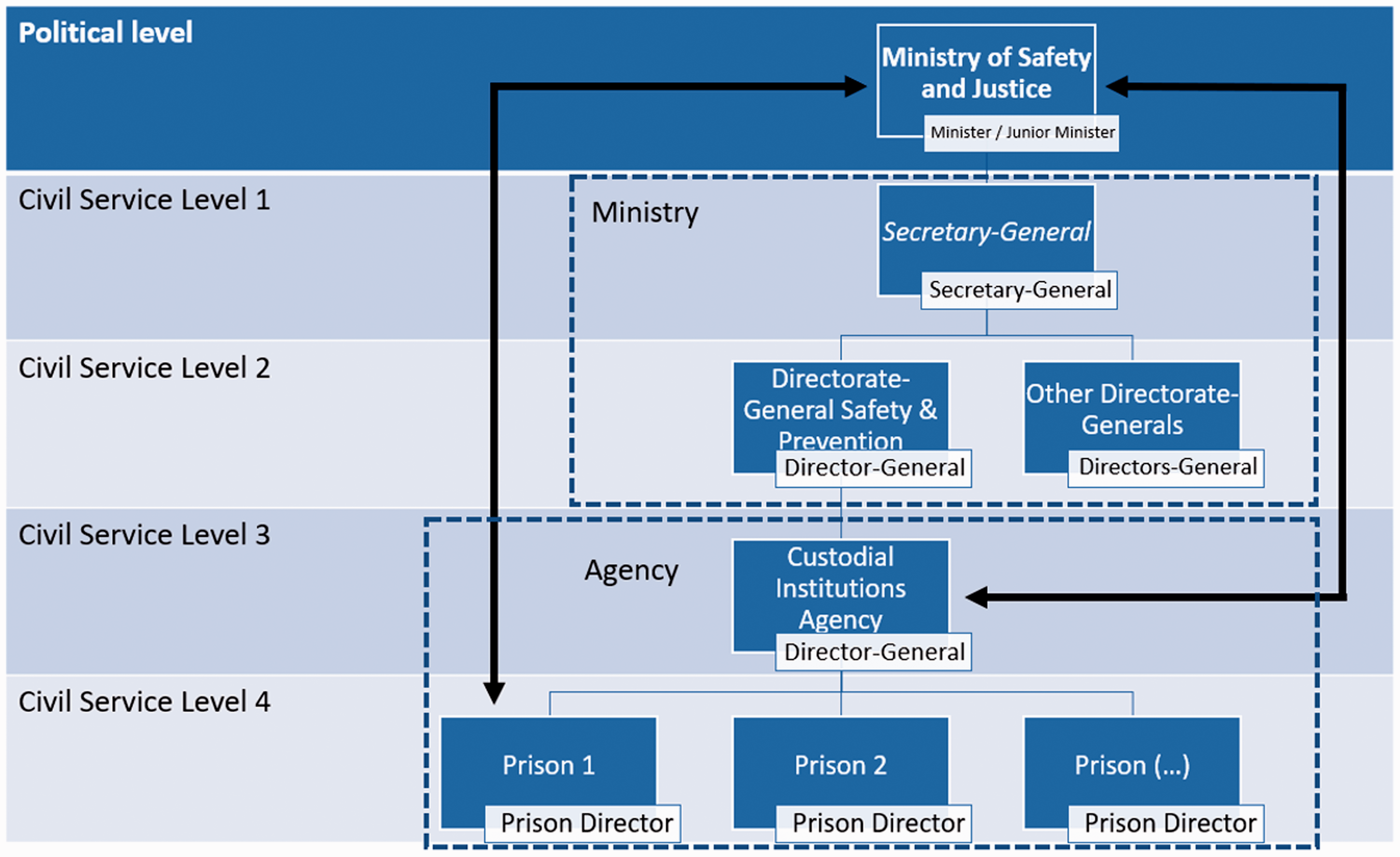
Historically, Dutch prison directors long maintained a high degree of independence and discretionary powers, sometimes described as being emperors of their kingdoms (Boin, 2001). Their independent position made prison directors able to resist reforms or, when reforms were introduced, to keep control of their organisation. NPM-inspired reforms in the 1980s, aimed at increasing strategic control over prisons by executive political actors, resulted in the creation of DJI as an agency yet did little to enhance control over prison directors (Boin et al., 2006). Instead, the DJI headquarters left day-to-day management of prisons in the hands of prison directors. Only after an institutional crisis in 2002 (the result of media and public scrutiny after a series of violent escapes and overall cell shortages), DJI was able to limit discretionary room of prison directors. While their powers have been curbed somewhat, prison directors still have a large degree of autonomy. This, among other things, makes that the relationship between DJI’s headquarter in The Hague and the prison directors throughout the country can be strung, especially during reform episodes. This is important, as we know from historical institutionalism that reform history can shape current relationships and affect new reform episodes (Di Mascio et al., 2013; Pollitt, 2008).
In this article, we focus on the PSB between the political principals and two groups of administrative actors: (1) public managers working at DJI headquarters (level 3) and (2) prison directors (level 4). Both groups are pivotal actors between subordinates (i.e. the prison directors, and their employees) and political principals (i.e. the minister and junior minister), and have considerable autonomy concerning the management of their organization (van Thiel, 2012). This way, these actors are in a position with considerable power and influence, thus resembling the characteristics of administrative elites (Aberbach et al., 1981; Colebatch et al., 2010).
Methods
This study adopts a single-case study design. Given the magnitude and political salience in the penitentiary sector, we consider this to be an extreme case. Extreme cases lend themselves particularly well for exploratory research (Gerring, 2009; Yin, 2009), and is likely to exhibit the key characteristics we are interested in (Rubin and Baker, 2018). 3
The primary source of data was 26 elite-interviews with (former) public and political principals. Seven respondents worked as (deputy) prison directors, eight respondents were public managers at the Custodial Institutions Agency (DJI), eight actors were otherwise involved in the process of managing cutbacks (for example as policy advisor or as top civil servant at level 1 or 2 for the ministry), one political principal and two other political actors were interviewed. Each interview lasted about an hour and covered the process of managing cutbacks from the announcement, through decision-making, to implementation. The interviews were preceded and complemented by an analysis of policy and parliamentary documents, as second source of data (Patton, 2002) and used to select respondents for the study and for developing the topic list.
Interviewing elites comes with several challenges regarding validity and reliability (Aberbach and Rockman, 2002; Berry, 2002). First, access to elites for interviews on a highly sensitive topic can be difficult (Richards, 1996), though willingness to participate in this study was high as the political principal resigned just before the start of the data collection, and decision-making about the plans was finalised, thus making the topic somewhat less sensitive and making elites open to participating. Second, interviewing respondents about past events has the risk of ex-post rationalisation (Ospina et al., 2017) and elites are well equipped to frame or spin interviews (Berry, 2002). We tried to overcome both points by starting each interview by letting all respondents explain how the process of cutback management evolved, and what their role was in this process. This way, respondents started by explaining what they did, instead of directly being asked why they behaved in a certain way. Furthermore, the analysis of policy and parliamentary documents helped in preparing the interviews and checking respondents’ statements, thus serving as a data triangulation tool (Patton, 2002). Because of the sensitive subject of this study, all interviewees were promised confidentiality. Except for the interviews with the political principal and political actors, 4 all interviews were recorded and transcribed ad verbatim.
Interviews were analysed using Nvivo. All transcripts were coded, using two different strategies. First, text fragments were assigned more general codes, based on the literature. In the second round of coding, these coding-containers split into more specific segments. In this round of coding, for example, fragments which were previously coded as PSB were given a code reflecting a dimension of the PSB.
The second part of the analysis was the reconstruction of the process in the right temporal order, to grasp the role of political-administrative interactions in different stages of the process of managing cutbacks. Respondents were classified according to their role in the process and their position within the organisation to allow for in-depth and contextual understanding of the empirical material. This way, we were able to distinguish how actors in different positions experienced the cutback management process, thus also differentiating between public managers within DJI and the public managers working as prison director,
Findings
To give a structured account of the cutback management process, the results of this study are presented in chronological order. The process is divided into four phases differentiated by important developments that changed the interactions between political principals and administrative actors, and the dynamics of the cutback management process. For clarity, we use the term public manager for those public managers working at DJI, and the term prison director for public managers working in prisons.
Phase 1: 29 October 2012–21 November 2012: The PSB in place
The process of managing cutbacks started in fall 2012 after the installation of a new Dutch government consisting of the conservative liberals and the social-democratic party. Shortly after the presentation of the coalition agreement it became clear for many public organisations that they needed to cut back on operational expenses. Among them were the Ministry of Safety and Justice and its agencies, such as DJI. As one of the respondents described, cutbacks were far from new for the organisation: We had a number of different Cabinets throughout the years. With each change of Cabinet, one thing is for sure: it results in new budget cuts for the whole civil service, so including our organisation. (Public Manager DJI) (…) eighty percent of our budget consists of personnel expenses. So, if you want to cut back on penitentiary institutions, really implement substantive cutbacks, then you are quickly forced to look at personnel. (Prison director) The junior minister surely does not know what to cut back. However, some measures might be highly political (…), and therefore, such measures can be shot down immediately. (Public manager DJI) There are a number of options: we can close prisons, we can fire people, that is related. We can also choose to cut back on forensic care. In the end, you make some scenarios with different options to choose from. Then it goes like: ‘These are the options, I am not going to choose, that is not my responsibility.’ (…) You thus prepare political choices. (Public manager DJI)
All in all, within the first phase of the process, administrative actors (public managers and prison directors) were made responsible by political principals for developing scenarios on what to cut back, while political principals kept the final say. From the PSB perspective, we can interpret this as the bargain being in place, as responsibility for internal management affairs is delegated from political principals to administrative actors. While this last group acknowledges that ultimately, formal authority lies with their political superiors, public managers contribute by sharing their knowledge and expertise (hence their competency) to draft plans for their political superiors on how to deal with cutbacks. Although respondents do not make clear whether being involved in the process of drafting plans to cut back would be beneficial for themselves or (in the case of prison directors) for their institution, influence within such delicate processes might be considered a reward.
Phase 2: 21 November 2012–22 March 2013: Loyalty from public managers to political principals breached
A critical moment in the way that the interaction between political principals and public managers developed was 21 November. This day, television program Nieuwsuur broadcasted news that 26 prisons (almost half of the total number of prisons) would close in the plans of the junior minister. This news was, according to respondents from both political and administrative background, leaked to the press by actors from within DJI and the prisons.
While the political principals did not confirm these plans at the time (arguing that “many scenarios are still being considered”), the process changed drastically. The political principals decided that only a limited number of public managers from DJI continued to be involved in the preparation of the plans. Respondents asserted that a breach of trust between the different actors was central to this decision: And the junior minister did not trust DJI either, as information was leaked to the press multiple times while only a limited number of people was aware of that information. (Public manager DJI)
The news about the possibility of closing prisons resulted in the mobilisation of unions but also fuelled interference in the process by political actors outside of the minister and junior-minister, such as parliamentarians, provincial politicians and most notably by mayors of cities where prisons would supposedly close. In some instances, prison directors had direct contact with these political actors and purposefully looked for cooperation to increase the chances of their organisation surviving cutbacks.
Within this phase, we can observe how the interaction between political principals and public managers is put under pressure. Political principals reacted to what they saw as a lack of loyalty from their public managers and prison directors, and hence a break with a part of the bargain. In response to this lack of loyalty, the responsibility of decision-making regarding cutbacks was withheld from (most) public managers and prison directors. From a PSB perspective, the exchange of loyalty and responsibility between the two actors was thus violated. The subsequent cooperation of prison directors with political actors other than their political principals can be seen as cheating on this bargain, as such behaviour goes directly against the PSB where public managers let go of their possibilities to act politically. Being withhold responsibility for managing cutbacks also implies that one of the rewards for public managers in exchange for their competency, namely (policy) influence and a position within government, is being taken out of the bargain. All in all, what started as a break with one part of the bargain, resulted in different inducements and rewards being taken off the table in this context.
Phase 3: 22 March 2013–19 June 2013: Increasing resistance to cutbacks
With the loyalty and responsibility dimension of the PSB breached, decision-making continued. On 22 March 2013, junior minister Fred Teeven sent his plans to cut back on prisons, the so-called Masterplan DJI, to Parliament. Media were quick to announce that indeed 26 prisons had to close. The central message seen in the media was that 3600 public servants would lose their jobs. 5
The plans were drafted for Parliament, which had to approve the measures. Prison directors were informed just before the public announcement of the plans, as the political principals were afraid that the proposals would leak to the press once more. For public managers at DJI, this was a difficult time as they wanted to inform their colleagues, the prison directors, within the different prisons. As one respondent argued: I said: Fred [name of the junior minister], this is unbearable. The prison directors argue that we cannot do this to them. We cannot keep our mouths shut until Friday afternoon, twelve o’clock, about how this ends. (Public manager DJI)
While the junior minister and the prime minister discussed the possibility of sharing information with prisons directors, the prime minister was, in the end, the one deciding that information would not be shared before the weekly cabinet meeting on Friday in which the plans would be discussed. From the junior minister’s perspective, not involving any prison directors was a conscious choice, weighing the consequences of another leak to the press on the one hand, and dissatisfying public managers and prison directors by excluding them from the decision-making process (and thus withholding them their responsibility on this matter) on the other.
The moment that the plans to cut back on prisons were sent to Parliament was a tense moment for many prison directors. They knew that the DJI headquarters would call and explain whether their institution would remain open. Once prison directors were called with whether their prison would stay open, they immediately needed to inform their employees. What previously was still a leaked ‘concept list’ of prisons to close down, was now a reality. Consequently, the process of fighting cutbacks intensified. While the leak of the plans to the press can be interpreted as the administrative actors fighting cutbacks, the publication of the final list of prisons to close was the moment for many prison directors to intensify the struggle for survival of their prison. Examples are giving employees the possibility to protest the plans, going to the media, and lobbying against the proposals indirectly through mayors of cities where prisons were supposed to close. While most prison directors did not explicitly state that they fought cutbacks, they also did not support the decisions openly, even if their prison would remain open. Prison directors argued to their employees that it was unclear how DJI’s public managers and the political principals decided which prisons to close. Also, they felt that the measures that were thought of by DJI would be unachievable without any loss of service quality and safety for personnel. Resistance to the plans thus aimed at both the process of decision-making, as well as to the content of the plans.
Noteworthy is that much of the resistance against the decisions was directed at the public managers of DJI. Some prison directors argued that DJI’s public managers should have fought for a better plan and felt that they were the ones who kept the directors of prisons outside of the decision-making process. In a nutshell, we can interpret the situation not only as a conflict of loyalty between the political principals on the one hand, and prison directors and public managers on the other but also between the prison directors and the public managers of DJI.
In the previous phase, we showed that the interaction between public managers, prison directors and political principals changed, as the bargain was violated. This phase demonstrates how changing interactions between actors can influence the management of cutbacks. The absence of prison directors in the process of decision-making fuelled their resistance to the plans, jeopardised their loyalty to political principals even more and, consequently, feeling little pressure to defend the choices made by the political principals openly. The lack of support from prison directors for the measures was the result of their dismissal of how the plans were developed, as well as their disapproval of what the plans intended.
Lastly, prison directors had difficulties to temper adverse reactions to cutbacks (from personnel, for example), as they did not know what was going to happen or why their prison needed to close. It can, therefore, be questioned to what extent prison directors were able to deliver competence to the political principals. All in all, this phase in the process shows how a violated bargain between public managers and political principals affected the process of managing cutbacks.
Phase 4: 19 June 2013–10 March 2015: Regained responsibility for public managers to deal with cutbacks
The third phase showed how the interaction between public and political actors influenced the process of cutback management. The last phase starts, with the relationship between administrative and political actors being damaged. Opposition to the cutbacks kept rising until junior minister Teeven saw himself forced to revoke his proposal temporarily. Already during the first Parliamentary debate about the plans, it was announced by the junior minister that the sum of cutbacks would be lowered by 69 million euros (a decrease of about 22%), to the surprise of both prison directors and public managers of DJI. Interviewees saw this moment as proof that their resistance was rewarded: If you look at the first and second masterplan, then you can see that we had to cut back 69 million euros less. I think that is really the result of the resistance we showed to the first plans. (Public manager DJI) We just looked for ways to implement cutbacks while keeping our vision and mission alive. (Prison director)
In his defence to Parliament of the revised plans, the political principal thanked prison directors for their input and argued that the new plans were an improvement. While Parliament accepted the masterplan, sessions to discuss how to deal with cutbacks remained an almost permanent activity. Contrary to how cutbacks were managed in the previous months, public managers and prison directors regained the responsibility for organising the process of how and what to cut back. In multiple sessions in 2013, prison directors (and political principals) were invited to share their thoughts, brainstorm about the future of the prison sector, and on ways to realise cutbacks. These sessions resulted in concrete plans on how to decide (with new closures of prisons seemingly unavoidable) what prisons to close. In this new process, public managers and prison directors got a significant say in what indicators had to be of interest when deciding what and where to cut back. As prison directors felt that it would be impossible for them to decide what prisons to close, due to their shared loyalty, the final say in what prisons to close remained the responsibility of the political principal.
From this last phase, we observe how resistance to cutbacks let to public managers, prison directors and political principals finding a new balance in the bargain (and thus a renewed interaction). The restored balance was based on public managers regaining responsibility for managing cutbacks, in cooperation with the political principal. In return, strong opposition to the plans silenced, as the result of the re-negotiation was more bearable to all. Thus, public managers again showed loyalty to their political superiors. Particularly for prison directors, it was important that they could contribute to a better plan in which the vision and mission of the sector could be upheld. With regained responsibility, came the reward of being able to participate in decision-making about cutbacks. In return, public managers’ competency was reflected in their ability to better explain to their employees on what grounds decisions were made to close prisons, without making such decisions themselves. This way, a new balance was found between prison directors’ loyalty towards DJI and political principals on the one hand, and towards their PI on the other.
Discussion
This case study showed how strategic interactions between public managers and political principals came under pressure during cutbacks, and how a changing PSB affected the process of managing cutbacks. These findings have different theoretical implications.
First, our study shows that the extent to which the different dimensions of the PSB came under pressure because of cutbacks differs. The more institutionalised aspects of the bargain (such as pay for public managers as a reward) were never in dispute. Yet, within this institutional setting, public managers and prison directors lost their share of administrative power as part of the rewards. The loyalty and responsibility dimension of the bargain was violated most visibly. Hood (2002) argues that trustee-bargains may break down when political actors feel that public actors “pursue their own interests too strongly relative to those of their beneficiaries” (p. 324). Because political actors felt that the administrative actors cheated on the loyalty dimension of the bargain, a breakdown of the bargain was set in motion. Interestingly, earlier reforms aimed at changing the institutional structure in which public managers and prison directors operated, did not result in much change in behaviour (Boin, 2001). In our study, the behaviour of the different actors and their exchange does change, while the institutional structure in which they act remains similar. Interesting is that changes in behaviour were observed in a short period of time, while other studies have mainly pointed towards the effect of longer-term, incremental changes in behaviour that alter the PSB (Lodge and Hood, 2006). This study thus suggests that cutbacks can indeed be regarded as a sudden shock from the environment that affect and reshape (parts of) the PSB.
Second, this study shows that bargains do not only exist between political principals on the one hand, and public managers and prison directors on the other, but similarly between the different groups of public managers. As explained, prison directors’ criticism of the process was not only targeted at their political superiors but also to their managerial counterparts within DJI. Prison directors expected public managers to help them fight cutbacks. This shows that there seems to be a bargain between public managers and prison directors also shows that especially public managers at DJI have to function as boundary spanners, in between different groups. In line with Hood (2002), it seems that a breakdown of the bargain between political principals, public managers and prison directors might be due to a different understanding of the moral contract or basic agreement between the actors. This also resonates with notions of cheating, as it is often variable and fuzzy what is perceived as cheating on the bargain (Lodge and Hood, 2006).
Third, the results show how political-administrative interactions affect the management of cutbacks. The involvement of prison directors in the first phases of the process of deciding what to cut back, resonates with arguments from the cutback management literature that involving actors from the ‘frontline organization’ (i.e. prisons) in decision-making can benefit the quality and acceptance for the decisions made (Dunsire and Hood, 1989). The scenarios that were developed by public managers and prison directors on what to cut back can be seen as an expression of how their competency (e.g. their expertise) helps political principals with decision-making. The reward for such an inducement is that public managers have a position with policy influence within government.
When the bargain, and especially the loyalty and responsibility dimension, was violated, the decentralised process turned into centralised decision-making. Centralization was motivated by an attempt to regain control of the process by the political principal, and prevent another leak of information. While centralization of decision-making has not been discussed as strategy to prevent leaks (Patz, 2018), leaking was clearly an instrument in the political-administrative struggle for influence (Bovens et al., 1995). While centralisation of decision-making is not uncommon during cutbacks (Raudla et al., 2015; Savi and Randma-Liiv, 2015) or other crises (Boin et al., 2010), the role that public managers got to play in managing cutbacks was diminished. Rather than the blame avoidance strategy to transfer responsibility to others (Hinterleitner, 2017), withholding responsibility was the strategy in this case. Especially for prison director, being withhold responsibility might have helped them in responsibility denial of cutbacks towards their employees (Hood et al., 2009). Due to the changing decision-making process, prison directors were less able to mitigate effects of cutbacks. From cutback management literature, we know that the mere announcement of cutbacks may already affect employee wellbeing (Kiefer et al., 2015). These effects can be mitigated by individual attention, participation in the change process and good communication (Van der Voet and Vermeeren, 2017). However, as prison directors were unaware of the plans, they could not help to clarify the cutback process, demystify decisions taken, or explain what the future would hold for their subordinates, the target groups of services, or even to the wider population (Levine, 1984; McTighe, 1979; Raudla et al., 2015). This made it difficult for public managers to use their competency in making sure that cutbacks have the least possible damage to the organisation. The study thus shows the adverse effects of centralisation of decision-making. Prison directors were excluded from the decision-making process and afterwards, showed strong resistance to the cutbacks. While the political principal, in this case, may have tried to avoid a participation paradox (Levine, 1979), not including any public managers or prison directors only increased resistance.
Conclusion
This article focused on the strategic interaction between public managers and political principals during cutbacks. The results indicate that if we want to understand how cutback management processes unfold, how public managers behave in such situations, and how it is decided what to cut back, it is essential to take the political-administrative context into account, as this has consequences for both the process and content of cutback management. This way, our study contributes to our understanding of cutback management. Furthermore, the analysis shows that cutbacks put the interaction between political and administrative actors under pressure, particularly the exchange between loyalty and responsibility. This study shows that while the institutionalised aspects of the bargain remained unchanged, the informal aspects of the bargain were most visibly broken, and the loyalty and responsibility dimension were the first to be breached. Theoretically, this means that pressure on the PSB may not affect all dimensions equally but may have a different effect on different dimensions. Another contribution to the literature on PSBs is the finding that there seems to have been different bargains in place, between political principals and public managers, but also between public managers and prison directors. Studies on the PSB usually focus on the first, rather than explicating whether there are other bargains in place, between different actors. Further research should also consider how interactions that exist between public managers at various levels affect the bargain between public and political actors.
Given the limitations of a single case study design, we should be careful with generalising the findings. Future research could contribute by focussing on a context with a different PSB as a starting point, to enrich our understanding of how PSBs develop when being put under pressure. Most importantly, we encourage public management scholars in general, and cutback management researchers in particular, to incorporate the political context in their studies, thus following the call by Milward et al. (2016), as this study showed how bargains between public managers and political principals can shape the work and behaviour of public managers.
Supplemental Material
Supplemental material for The role of public service bargains in cutback management: Insights in reforms in the Dutch penitentiary sector
Supplemental Material for The role of public service bargains in cutback management: Insights in reforms in the Dutch penitentiary sector by Eduard Schmidt in Public Policy and Administration
Footnotes
Declaration of conflicting interests
The author(s) declared no potential conflicts of interest with respect to the research, authorship, and/or publication of this article.
Funding
The author(s) disclosed receipt of the following financial support for the research, authorship, and/or publication of this article: The author(s) disclosed receipt of the following financial support for the research, authorship, and/or publication of this article: This work was supported by the Nederlandse Organisatie voor Wetenschappelijk Onderzoek under Grant [406-13-041].
Notes
References
Supplementary Material
Please find the following supplemental material available below.
For Open Access articles published under a Creative Commons License, all supplemental material carries the same license as the article it is associated with.
For non-Open Access articles published, all supplemental material carries a non-exclusive license, and permission requests for re-use of supplemental material or any part of supplemental material shall be sent directly to the copyright owner as specified in the copyright notice associated with the article.
