




Abstract
Do biographies of policy elites make a difference for the policy process and output? Leading theories of the policy process focus on other explanations that mostly have been derived from peculiarities of American politics. This article transfers a French approach to the study of policy processes in German health policy. It emphasizes how this French perspective presents an added value in the form of the programmatic action framework. At its core, the programmatic action framework proposes that programmatic elites in policy sectors form on the basis of shared biographical intersections and connect to a joint program. Applying the programmatic action framework to the German case of a programmatic elite in health policy that dominated the last quarter-century of major reforms, the analysis reveals the explanatory power of the programmatic action framework in other political contexts. A transfer of the programmatic action framework to other countries and policy issues, however, must respect the specificities of the political system and policy subsystem. In Germany, the specific role of self-governance enhances the analytical categories of the programmatic action framework, moving beyond the traditional conflict between custodians and austerians of state.
Keywords
Introduction
Stemming from French public policy research, the programmatic approach (Hassenteufel et al., 2010) has the potential to provide valuable insights into the study of policy processes, also beyond the French borders. The recent decades experienced the development of competing frameworks for the explanation of policy change and stability. In doing so, these frameworks make use of manifold factors, each of which emerged from specific political systems, policies, and scholars’ socialization. Originating from the focus on one or few specific explanations, frameworks integrate more and more different factors to be able to explain as many policies as possible (Weible and Sabatier, 2017). Although most of the currently used frameworks originate from the Anglo-Saxon perspective on policy processes, Dudley et al. (2000) already at the turn of the century called for an increased attention to European perspectives. They advocated an open intercontinental exchange of theories as different lenses on the policy process may enhance theoretical understanding. What the existing American frameworks do not focus on is the exact gap that the programmatic actor approach can fill: its central explanation for policy change and content are shared biographies and experiences of actors which form the basis for collective action and the pursuit of a joint policy program. This contribution points out the added value of this approach and introduces the programmatic action framework (PAF), which deviates from previous strands of the French research traditions on public policy research and administrative reforms (Smith, 2001). Consequently, this article addresses the question in what way the PAF provides insights into reform processes that may not be well explained by other frameworks. It furthermore outlines how to transfer the French perspective to other contexts.
The PAF originated from the French political system and culture. It supposes that within policy sectors, competing groups of elites struggle for authority and financial resources. In France, the approach observed a dual conflict between custodians of state guarding authority and financial resources close to the state, and austerians, on the other hand, trying to minimize the state’s capacity. In the elites’ struggle, common biographical and personal characteristics form the basis for successful alliances (Hassenteufel et al., 2010). How can this perspective be transferred to other political systems? What must be observed when doing so and what fruitful insights does such a transfer reveal? This article applies the framework to German health policy, thereby both outlining the specificities of the German system that must be obeyed when applying the framework and shedding light on the long-term programmatic elite essentially influencing policy change during the last two decades. Empirically, major health reforms in Germany serve as underpinnings of the theoretical argument.
Analyzing the paths of the influential programmatic elite of the last 25 years in German health policy enables the identification of the sectoral programmatic actors of state, self-governance, and industry in the German health system. The success of the programmatic elite is specifically visible when regarding major health reforms passed during its existence. Thus, the contribution will expand on the Health Care Structure Act (Gesundheitsstrukturgesetz, GSG) in 1992, the SHI Modernization Act (GKV-Modernisierungsgesetz, GMG) in 2002, the Act to Enhance Competition in the SHI (GKV-Wettbewerbsstärkungsgesetz, GKV-WSG) in 2007, and the Pharmaceutical Market Restructuring Act (Arzneimittelmarktneuordnungsgesetz, AMNOG) in 2011. These explicitly outline how the constellation of programmatic actors resulted in long-lasting influence of one programmatic elite despite changing circumstances. During this case study, the challenge of complex sectoral structures in Germany becomes particularly visible. Instead of only two competing groups (custodians of state and austerians), the self-governance plays a third role in this struggle and presents a specificity in German health policy. A transfer of the PAF to German health policy must therefore always take into account this triad to appropriately capture the policy process dynamics.
After the subsequent section provides a first overview on the PAF, its origins, foundations, elements, and applications, the third section transfers the framework to German health policy, with explicit attention towards the specificities that must be observed. We then sketch the research design and methodology before proceeding with the empirical case study. A conclusion summarizes the challenges faced by a transnational application of the PAF.
Programmatic action framework
Prominently coined by William Genieys, Patrick Hassenteufel, and Marc Smyrl (Genieys and Smyrl, 2008a; Hassenteufel et al., 2010), the programmatic approach provides a new view on policy change and stability informed by French policy processes. This approach brings in biographies and shared experiences as a central predisposition for collective action and resulting policy change. By contrast, established frameworks follow different assumptions and do not address these explanatory factors. The advocacy coalition framework (ACF) (Jenkins-Smith et al., 2017) assumes that individuals possess beliefs that vary in abstraction and stability, and that individuals form advocacy coalitions based on shared policy core beliefs, which are stable for around a decade (Sabatier and Jenkins-Smith, 1993). Advocacy coalitions finally effect policy change. On the other side, the model of the individual assumed by the multiple streams framework (MSF) (Herweg et al., 2017) bases on the idea of several policy alternatives, whereby ambiguity characterizes actors’ preferences and problem definitions. Policy change is the result of a window of opportunity used by a strategic policy entrepreneur that couples problem, politics, and policy streams and realizes a policy (Zohlnhöfer and Rüb, 2016).
This strategic element is also inherent in the PAF. Contrary to the view that policy alternatives just need a policy entrepreneur to realize it (Deruelle, 2016), the PAF assumes that a policy program is developed within a collective body consisting of programmatic actors that all share the same goals. They strive toward career enhancement and an increase of their influence within the subsystem. These programmatic actors have largely ambiguous ideological preferences before building the joint program. Afterwards, the program is linked to the social group of the programmatic elite, coining a social identity (Béland, 2017; Hogg et al., 2017). Nevertheless, a program is not equal to a stable belief—the program is interchangeable and only exists through the programmatic elite that is bound to it. The actors stick to the program because of their identification with the programmatic elite as a social group and because of strategic reasons to enhance their influence and career in the system.
To realize the policy program, programmatic actors combine their power resources, stemming from the variety of key positions that they occupy. According to the typology by Scharpf (1997: 57), programmatic actors thus can be classified as a movement. Connected to the program is the shared wish for ensuring long-term success and career of each member of the programmatic elite. Throughout the subsequent years, the commonly developed program remains as it is connected to identifiable biographical intersections (e.g., longer cooperation in bodies or committees) of the programmatic elite. A program is larger in scope than a mere policy idea or design, it resembles almost a paradigm or vision for an entire policy sector. Consequently, a policy program can react to outside developments like financial problem pressure without disregarding the broader long-term strategy of the program. Success of a program is furthermore proportional to the strength of the programmatic elite advocating the program, which is more likely the more homogenous and explicit the shared biography of the programmatic actors is and the more coherently the program continues. Once the programmatic elite erodes, the program diminishes with them.
While at first sight biographies may be seen as a potential foundation on which beliefs and attitudes build, the PAF does not present an extension to the ACF, although parts of it certainly may be transferred and adapted. Firstly, the PAF has a much narrower understanding of elites as it regards only those actors as elite actors who hold a position within the sector with the possibility to directly influence policy change and/or policy content. A programmatic actor has the chance to ally with other actors in other key positions and bring in his own competencies and resources. The second major difference compared to the ACF is the binding element of coalitions, or alliances. According to the PAF, it is not stable policy core beliefs like the ACF assumes. Instead, programmatic actors choose to follow a program that promises success. Origins of programs may be transnational policy transfer, scientific advice—for example, in the sense of epistemic communities (Dunlop, 2009)—the administration or, which is usually the case, a combination of all these sources. For analyzing the success of a program, a valuable connection to discursive approaches may be established (Hassenteufel and Zittoun, 2014), as an appropriate public justification of reforms is necessary for success (Zittoun, 2015). The formation of a programmatic elite is determined through biographical events and presents strategic behavior. Subjective belonging to the social group of the programmatic elite and connecting it with the policy program is the driving force of attachment from the individual programmatic actor to the programmatic elite and its program. The elite sticks to its program because of strategic reasons and because the program presents a joint goal of the social group of the programmatic elite.
As opposed to some understandings of policy network analysis, which regards networks as “government links with, and dependence on, other state and societal actors” (Rhodes, 2008: 425), the PAF neither necessarily counts government actors to a programmatic elite, nor does it exclude them. The conflict, thus, does not divide government and bureaucracy but it divides different groups of actors that each exert direct influence on policy making. Direct influence means that actors actively participate in decision-making processes. This excludes, for example, advisors or communicators who might inform decisions but do not make decisions themselves. Compared with the actor-centered institutionalism (ACI), the PAF does not solely focus on rational choice actors and interaction between them within institutional systems. The ACI is an approach that acts on the level of sufficient complexity and seeks to yield most parsimonious explanations (Lindenberg, 2001; Scharpf, 1997). In this sense, the PAF does not regard institutions on a macro level, but it regards elites on a micro level and also encompasses a normative component in the “programmatic” approach. Contrary to epistemic communities, who encompass scientific professionals that share norms and beliefs (Haas, 1992), programmatic actors are collective actors that include politicians, bureaucrats, and other actors with direct influence in policy making and possibly opposing causal beliefs. While epistemic communities primarily advise decision makers (Dunlop, 2017), programmatic elites are those that make decisions. In short, the PAF does not solely focus material interests, nor ideological affiliations (beliefs) but is innovative in its focus on shared experience (professional experience) as an explanation for collective action in the form of a policy program and the resulting social group’s identity of the programmatic elite as a central determinant of long-term cooperation besides strategic interests.
A programmatic elite evolving in one sector and striving towards augmented authority and budget necessarily faces competition within a system. Other programmatic elites emerge in the same or other sectors, and as they pursue the same goals, the competing elites struggle for authoritative and financial power. In France, Genieys (2010) observed a conflict between the “custodians of the state” or “social welfare elite” on the one side, guarding and searching for increased state authority and budget – and the programmatic elite(s) favoring decreased state means on the other side. The latter are labeled “austerians” or “fiscal elite,” derived from the notion of austerity. Since every sectoral elite tries to maximize its resources, a sectoral elite is confronted both with austerians and other sectoral elites in the struggle about regulative and financial power. Thus, there exists for each policy sector some kind of sectoral identity that is salient in the minds of the individuals working in that sector who aim at strengthening their role in the sector by strengthening the sector itself. Figure 1 visualizes this original understanding of the programmatic approach. Relatedly, the conflict over resources ties in with previous findings suggesting that in line with the introduction of new public management (NPM) public executives strive toward greater budgets and autonomy, together with new institutional logics forming new identities (Meyer and Hammerschmid, 2006). It is this kind of liberalization and marketization as in NPM in which Genieys (2010) founds the emergence of new elites as programmatic elites. Nevertheless, it is not a conflict line between bureaucrats and politicians (Niskanen, 1975), but between actors close to the state allying against the outside actors. Thus, the PAF may provide an answer to one of the big challenges for public administrations in Europe (Ongaro, 2015), namely how new ideas and paradigms may be developed and realized within public sectors.
Programmatic action framework (PAF) and exemplary lines of conflict. Source: Authors’ own illustration.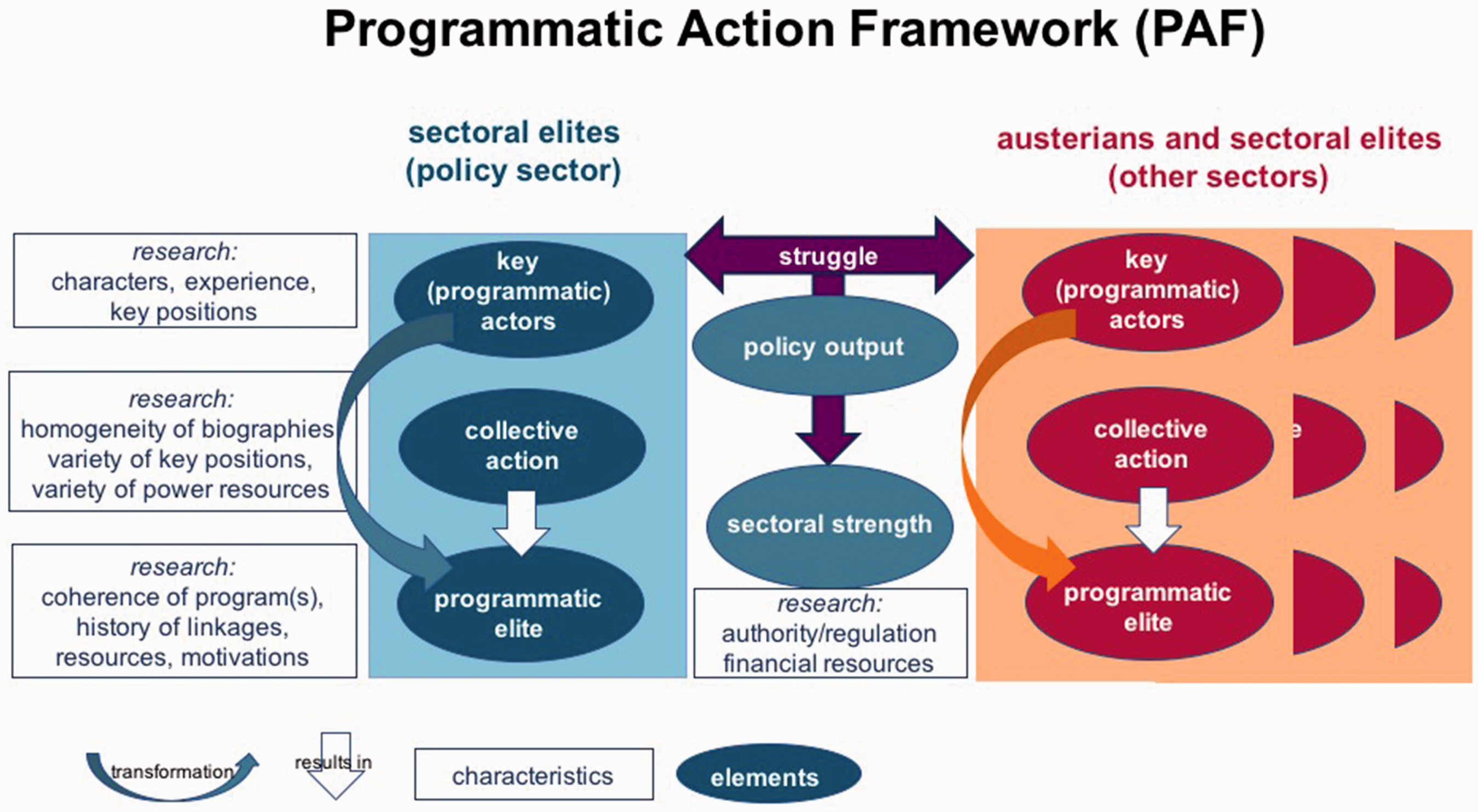
With PAF, this article brings in a new focus in policy process research. This general focus lies on biographies as an explanation for collective action that leads to major policy change. A programmatic elite forms through shared biographies because of individual strategic reasons and the policy program resulting from the shared biography presents a manifest to which the programmatic elite attaches itself to. This attachment occurs out of shared strategic goals, to enhance personal career prospects and influence in the sector. This is independent of general ideological views, party affiliations, or other preferences not related to the topic at stake. Consequently, the PAF can explain cases in which cross-partisan and cross-ideological cooperation occurred or in which a policy program was realized independent of a change in other context variables such as partisan changes in government. The PAF provides a further perspective to explain cooperation that bases on shared biographies and a resulting shared view on problems and proposed solutions. In doing so, it does not aim at substituting existing frameworks but at complementing them with regard to a further potentially important element in the study of policy processes. Although the importance of biographies and elite building is very visible in France, there may be an equivalence in other countries. Within international policy process research, the approach has neither yet been applied to many other countries nor has it yet been used for analysis of other policy issues than health and defense policy (Darviche et al., 2013). However, this article demonstrates that an application to other countries may be fruitful and advocates its application also in other policy issues. As there is not yet a consensual understanding of the perspective, this contribution proposes a comparatively generic perspective of the programmatic actor approach, which we call the Programmatic Action Framework (PAF).
The advocacy of a general perspective of the framework benefits from a categorization of its elements along existing categories in policy process research. In the most recent textbook on theories of the policy process, Heikkila and Cairney (2017) adapted three comparative categories and respective indicators to the systematic comparison of theories. In doing so, they aimed at providing an orientation for comparison and placement of existing theories of the policy process. Therefore, this section classifies the PAF accordingly on a general level before moving on with the specific transfer to German health policy. All criteria discussed below resemble the description and use of the aforementioned authors. A reflection on these single criteria with respect to the PAF ensures that the framework is ontologically and epistemologically consistent in itself, as required by the synthetic approach (Cairney, 2013). The PAF presents a new framework that accounts for studying the relation between the five essential factors of policy making: institutions, networks/subsystems, exogenous factors, actors’ choices, and ideas.
At the outset, a theoretical approach must contain elementary components. The PAF draws on the exploration of programmatic elite formation on the basis of shared biographies to explain policy content and policy change or stability—depending on the point in time. It thereby focuses on the policy subsystem as the level of analysis, although the unit of observation concerns the micro level, the programmatic actors, and the resulting policy program. In giving an explicit definition of programmatic actors and programmatic elites in the aforementioned section, and owing to the previous works of Genieys (2010) on the custodians and austerians divide, the vocabulary and concepts are used in agreement on their meaning. Nevertheless, the relationships among them may differ depending on the country and the issue to which the framework is applied. From a general point of view, programmatic action is commonly defined as the transformation of programmatic actors into a programmatic elite (or collective programmatic actor) and the subsequent realization of the jointly developed policy program. No discord exists concerning this very basic foundation of the framework. Concerning the assumptions of the framework, which are yet implicitly defined, and the model of the individual, the PAF grounds in the understanding that individual action follows both a strategic and a normative rationale, although the latter is adaptable in favor of the former, that is, a policy program must firstly service the strategic goals. The normative rationale is determined through the social identity (Hogg et al., 2017) that coins a programmatic elite once it exists. Both rationales, the strategic and the social identity rationale, effect that the actors stick to the policy program. However, in case of a program being unsuccessful or leaving the programmatic elite promises more individual benefits, actors may discard the program or leave the programmatic elite to join another, newly emerging one. This happens rather rarely, because success is supposed to follow from collective action in line with a coherent, encompassing, and stable policy program. Consequently, competition among programmatic actors is relatively rare, because they do not compete for positions but rather strive toward occupying a variety of positions as a group to maximize their success.
Because the PAF has its origins in French public policy research and has up to now not been labeled PAF but implicitly been applied as a programmatic approach, the research activity still is at its beginning. Nevertheless, biographical research of the French already led to the establishment of the biographical and interview database OPERA, which is accessible online and allows for PAF research (OPERA, 2012). The French community published several books and articles on the programmatic actor approach (Genieys, 2010; Genieys and Smyrl, 2008a, 2008b). Within the framework, it is furthermore possible to focus on a variety of aspects, including—but not limited to—types of bodies shaping programmatic elites, coherence of elites over time, and elite struggle over resources.
The PAF presupposes that elites act collectively. As to the formation of programmatic elites, institutions may influence this process. Institutions equally present constraints that require programmatic actors to possess various key positions, as institutional rules appear less inhibiting to some key positions than others. Calling a programmatic elite a “network” makes sense on a methodological but not on a conceptual level. Programmatic elites strive toward the same goals and act collectively, yet their action may not resemble the interaction of a network but rather a movement in the classification of Scharpf (1997). Therefore, this contribution suggests to rather use the term “alliance” or stick to the original wording of “programmatic elite.” As opposed to the foundation in other frameworks, the PAF assumes that actors do not possess stable beliefs and are largely ambiguous until a joint policy program exists—they stick to the policy program, which is interchangeable and exists only through the programmatic elite. Additionally, a programmatic elite is flexible in its adjustment to the policy context. This flexibility is facilitated when programmatic actors possess more various power positions, and when their program is equally adaptable to a changing context such as public opinion, scandals, and changing institutional rules. Finally, internal and external shocks or events may shift power relations, and the resistance of the programmatic elite toward these changes again hinges on its flexibility regarding composition and program.
Placement of the programmatic action framework (PAF) within comparative theoretical criteria
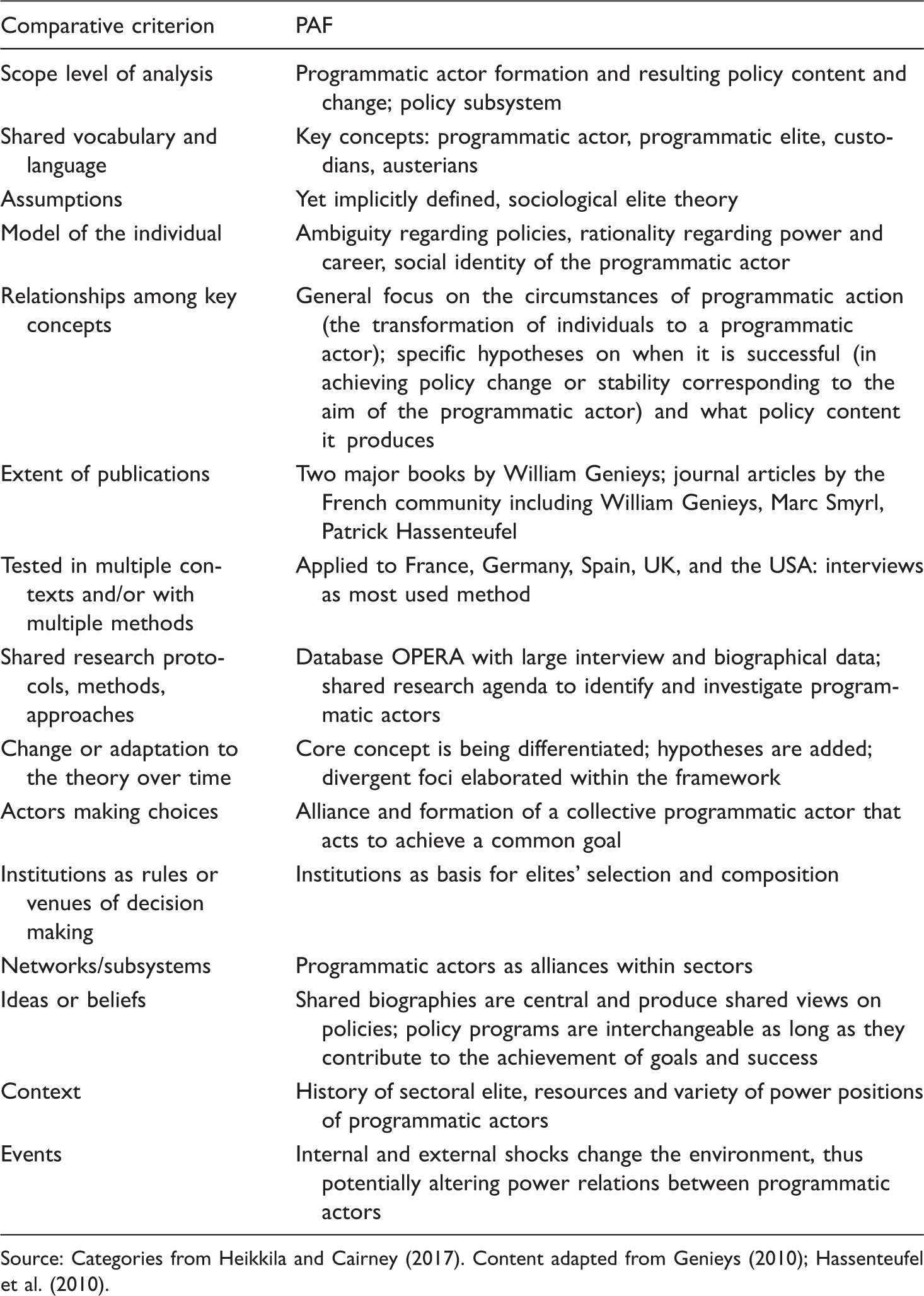
Source: Categories from Heikkila and Cairney (2017). Content adapted from Genieys (2010); Hassenteufel et al. (2010).
Transferring the PAF to German health policy: Methodology
Based on this general groundwork, why and how should the PAF be transferred to Germany and German health policy? Although they both are European countries, Germany and France have very different political structures. In the Lijphart (2012) typology, Germany is assessed as the most distant country from France. France is a centralized semi-presidential majoritarian democracy with a strong president, mostly one-party governments, and a weak corporatist tradition. Germany is a federal parliamentary consensus democracy with a stable party system, coalition governments, and a strong corporatist tradition. Notwithstanding the fact that the health care systems both are examples of the Bismarckian type, the self-governance in Germany presents an evident and important particularity. Thus, the case selection follows the method of agreement by John Stuart Mill (1848) and chooses different systems to emphasize that the customizable concept of programmatic elites is existent also in Germany. Nevertheless, it is important to keep in mind that this article does not target an empirical cross-country comparison but rather wants to show how the framework may be adapted in other countries and political systems and what valuable insights this may provide.
German health policy presents a specific example because of its specific structure of sectoral interests. Following the PAF’s application in France to traditional sectors close to the state—defense and health policy—this contribution sticks to this logic and applies the framework to health policy. But since the health care system in Germany is quite different from the French, especially due to the strong role of the self-governance, it is in line with Mill’s argument in the method of agreement. Again, the analysis will not compare the French and the German case, nor the French and the German health reforms, but it will show the traveling capacity of the framework to a very different country and a very differently organized sector, though dealing with the same policy field.
Figure 2 depicts the “triad of sectoral identity” in Germany that outlines the traditional subsectors of its health system and the potential cross-collaboration of programmatic actors. Either two of the three sectors may form an alliance, combine resources, and act against the third sector. Relatedly, an exclusion of one sectoral elite from negotiations may be a way to success used by programmatic elites. While the original French conflict between custodians and austerians is more complex in the German case, partly because lines of conflict are different, it is fruitful to focus on the biographical bases of alliances. Against the French notion of the framework, the conflict in Germany is not about the identity of a sectoral elite that competes with austerians and other sectoral elites over resources and authority. The identity, and this is what a more general PAF perspective reveals, is connected to the programmatic elite as a social group, which may be dominated by sectoral interests, but often does not include all sectoral actors.
Triad of sectoral identity in German health policy. Source: authors’ own illustration.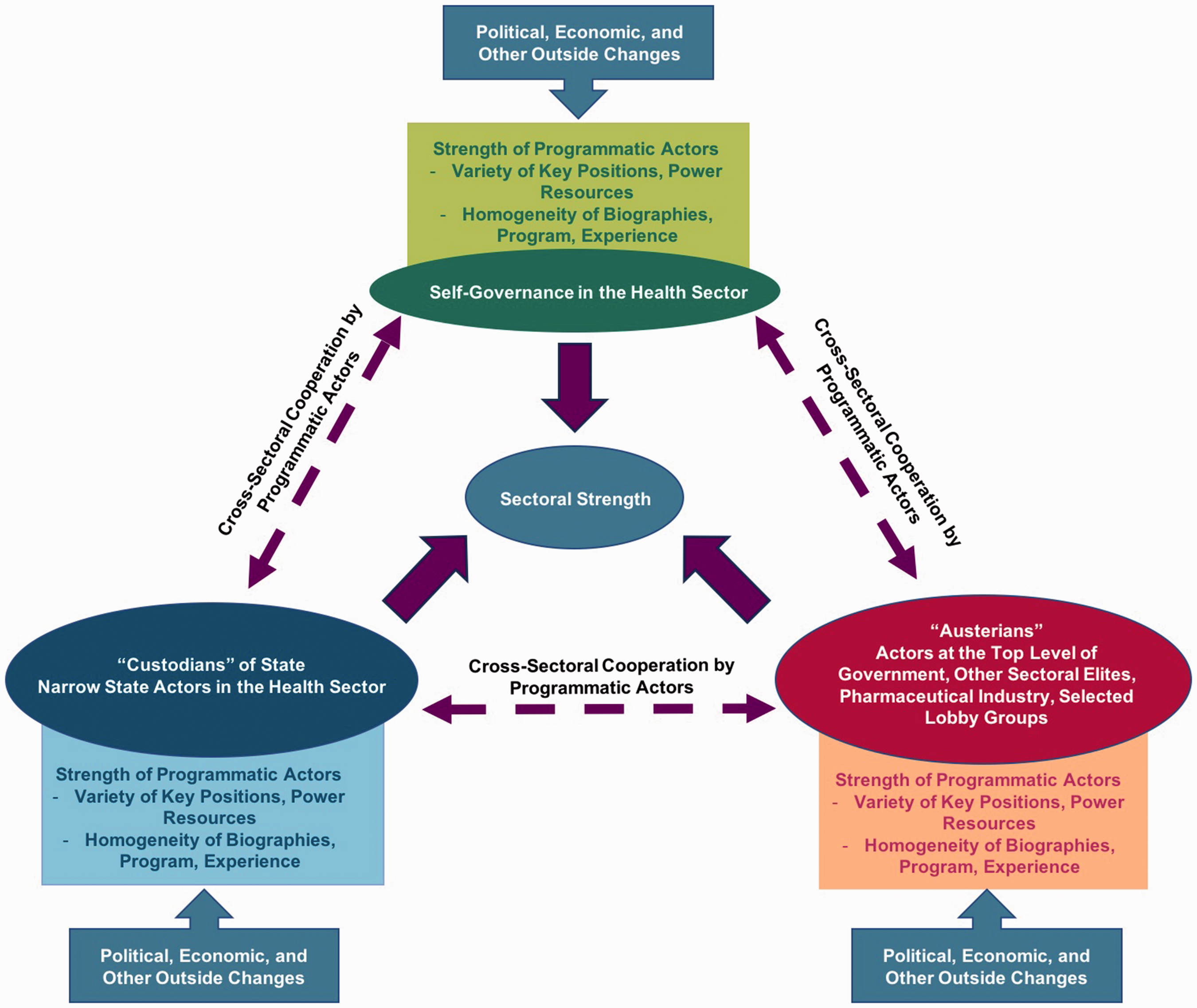
An application of the PAF in any country requires a solid collection of data on alliances and biographical information. Such data can most easily be gathered through interviews, which is why this case study also draws on some 20 interviews with actors and experts of German health policy. Some of these interviews have originally been focused on other theoretical approaches, yet additional information originates from more recent interviews and document analyses. Document analyses concern plenary debates, actors’ statements, and legislative texts, communicated through official press releases or media. If information from interviews is used, it has always been cross-checked by various sources. The consequences and merits of this procedure of data collection are, firstly, that in-depth interviews provide the possibility to repeatedly and closely interrogate the actors who participated in the decision processes. As detailed information is not publicly available, it is virtually the only method to validate data. Secondly, interviewing many of the programmatic actors allows for cross-checking the statements, both with statements from other interview partners and from public reports and documents, which again increases the validity of data. Several relations are visible and can be confirmed also in current policy-making processes.
German health policy has a long tradition of mostly unsuccessful or even failed reform attempts since Second World War. The German health system continued the basic structures introduced by Bismarck in the late 19th century. It comprises a statutory health insurance, which covers about 90% of the population and private insurances that are directed to civil servants and higher income groups. While the quality of the system is rated high by most international comparisons, it is quite expensive and flawed regarding fairness and efficiency (Wendt, 2009). Since the 1970s, there was a rising pressure to build more sustainable financial structures, protect and develop solidarity, enhance quality and enable growth of the health sector, which provides jobs both within the sector itself and within the pharmaceutical industry. It was not until 1992 when the first major reform passed the legislative process, and this is when the triumph of the programmatic elite started.
When reviewing the last 25 years of health policy, it becomes evident that programmatic elite and its program emerging from the enquete commission on structural reform of the health care system (1987–1990) remained powerful and visible at least until 2011 when the Pharmaceutical Market Restructuring Act (Arzneimittelmarktneuordnungsgesetz, AMNOG) passed. Between the first major health reform in 1992 and the AMNOG 2011, there were only few substantial reforms in German health policy but they all bear traces of the programmatic elite. It is this elite, its program, and the resulting policy change that the subsequent section will turn attention to.
A quarter-century of the programmatic elite in German health policy advocating competition in a solidaristic framework
In Germany, commissions and events at times enable exchange between the sectoral identities. A major step in building the programmatic elite in German health policy was the enquete commission on structural reform of the SHI from 1987 to 1990. The enquete commission included representatives from all parliamentary parties, scientific experts, and sectoral bureaucrats. While not all members of the later programmatic elite were part of the commission, it spawned central figures that would present the core of the programmatic elite. Among them is importantly Franz Knieps, then member of the Social Democratic Party (SPD) who alternately worked for the Federal Association of Local Health Insurance Funds and the health ministry. Of similar importance is Christopher Hermann, then member of the research service of the German Bundestag and later working for the social ministry in North-Rhine Westphalia and the public local health insurance company AOK in the state Baden-Wuerttemberg. On the scientific side, Hartmut Reiners and Rolf Rosenbrock, both with a background in economics, were essential personalities that remained influential through the programmatic elite emerging from this commission. The final commission report included a program that Franz Knieps today labels “competition in a solidaristic framework” (Knieps, 2017: 12). Besides this program, the enquete commission built the basis for a long-lasting alliance of actors that understood themselves as a social group.
In the years following the enquete Commission, the alliance won other actors for collective action in line with the developed program. The success of both this programmatic elite and its program began with the Health Care Structure Act (Gesundheitsstrukturgesetz, GSG) in 1992 that paved the way for the inclusion of competition to the system through the freedom of choice regarding sickness funds for health insurance. To compensate the unequal revenues and expenses, a risk structure compensation was introduced and further developed throughout the subsequent years. It was the result of a compromise between health minister Horst Seehofer (Christian Social Union, CSU), Rudolf Dreßler (SPD), and Dieter Thomae (Free Democratic Party, FDP) who negotiated in the town Lahnstein. At this point, it is important to note that Dieter Thomae had been likewise member of the enquete commission so it was through this channel that the ideas spread to the first major reform. Office manager of Horst Seehofer was Manfred Lang (CSU), who would negotiate with Franz Knieps the second major reform 10 years later. Commonly labeled the myth of Lahnstein, the compromise presents a milestone in the programmatic elite’s action.
In 2003, both Franz Knieps as department chief in the health ministry and Manfred Lang as a consultant of the CDU/CSU in health policy occupied posts at the very top of the administrative bodies. They collaborated when the then coalition government consisting of the Social Democrats and the Greens involved the CDU/CSU to find a compromise for realizing the SHI Modernization Act (GKV-Modernisierungsgesetz, GMG). This reform again strengthened elements of competition in the health care system, for example, by allowing sickness funds to manage co-payments and contributions paybacks or selective contracts with ambulatory healthcare centers. At the same time, the reform led to a more hierarchical organization, for example, by merging the associations of SHI physicians on a federal level and granting tax subsidies for extraneous insurance benefits. As a result, the reform highlighted the elite’s program of introducing elements of competition by at the same time centralizing governance of the health care system. When Franz Knieps became department chief in the health ministry under health minister Ulla Schmidt in 2003, he won other actors within the health ministry for the policy program. Franz Knieps, Ulrich Tilly, and Klaus Vater were not accidentally called the “Taliban” of Ulla Schmidt—they were homogenous not just in their appearance but also in their goals.
In 2007, the Act to Enhance Competition in the Statutory Health Insurance (SHI) (GKV-Wettbewerbsstärkungsgesetz, GKV-WSG) presented the most important health reform at least in that decade. It included the implementation of a Health Care Fund to collect and reallocate contributions in the system. Anew visible here is the simultaneous measure of centralization and competition. In the shadow of the financial reform, which is has been the focus of public attention, the structural part of the reform introduced a new federal peak association of all health care insurances and thereby downgraded the former corporate bodies. The reform changed the structure of the Federal Joint Committee (JFC) as the most important element of corporatism in the German health care system. By giving the ministry the power to appoint professionals and reducing the number of other members, the state’s influence was again strengthened. New contracts in ambulatory medical care ensured more competition while the regional associations of SHI physicians’ loss of their monopoly ensured more hierarchization with state power. Substantial and sustainable changes of the power structure of the health care system were the result (Döhler, 1995).
Even though the AMNOG resulted from very different circumstances than the other reforms, these did not impair the success of the long-term program. What was unique about the AMNOG was the first-time obligation of the pharmaceutical companies to assess the additional benefit of newly developed drugs. Besides its direct effects, it also was relevant in increasing the shadow of hierarchy (Töller, 2017). In case that such a drug fails to bring evidence for its additional benefit, it is automatically conveyed to the reference price system. Only for drugs with attested additional benefit, pharmaceutical companies were allowed to set their own prices up until within the subsequent year they had negotiated a fixed price with the SHI peak association. As contrasted with previous reforms, the starting situation of the AMNOG was characterized by a conservative-liberal government (instead of a coalition between the SPD and the Greens or the CDU) with Philip Rösler as a FDP health minister. Moreover, the financial crisis starting in 2008 did not yet give any safety in the knowledge of its consequences (Schubert et al., 2016). Earlier structural reforms had virtually affected all actors and sectors of the health system—except the pharmaceutical industry. Accusations of patronage had rocked the FDP, and the health ministry when Rösler chose Christian Weber, former lobbyist of the private health insurance companies, as a department chief. Especially a press conference of eight sickness funds in January 2010 put the problem of price increases both in terms of additional contributions and drug expenses on the agenda (Bandelow and Hartmann, 2014). While several external factors provided a window of opportunity and might have even made the AMNOG predictable as an answer to them, the reform proposal had been prepared for a long time already by the established programmatic elite. Insofar, the circumstances indeed contribute to the explanation of the timing of the reform, but—and this is a particular strength of the PAF compared to other policy process theories—they do not explain the policy content and why this program had won over alternatives. The content was part of the programmatic elite’s policy program, and they now managed to push through their long-prepared measure for the pharmaceutical market. So, what led to the success of the programmatic elite’s program?
Cornelia Yzer, the then long-standing chief executive of the German Association of Research-Based Pharmaceutical Companies (Verband forschender Arzneimittelhersteller, vfa) (SPIEGEL online, 2011) had once been undersecretary of Angela Merkel in the ministry of family affairs and managed to push through the interests of the vfa for many years. She opposed regulations for the pharmaceutical industry—just like Philip Rösler, his undersecretary Stefan Kapferer, Christian Weber and Jens Spahn, health policy expert of the CDU/CSU did. Rösler and Spahn led the working group on health at that time. When they communicated officially to envision saving measures regarding patented drugs as a response to the problem pressure (dpa, 2010), this was the point when the programmatic elite mobilized its forces to push through a proposal that they had long prepared but that never made it on the agenda. Despite their apparently diminished access to the governmental level of the ministry, they benefited from the crisis and the weakened FDP. Especially Herbert Reichelt (chair of the General AOK Bundesverband), Jan Carels (responsible for politics and corporate development in the AOK Bundesverband), and Wolfgang Kaesbach (head of the drug department in the association of statutory health insurance funds (GKV-Spitzenverband). As this programmatic elite had cooperated extensively during the previous years, they launched the initiative to strengthen the position of state and self-governance against the industrial sector. Health minister Rösler was desperately in need of a success, and as no other program with comparable advocate strength and content coherence was on the table, he decided for the AMNOG proposal to make it his own, as he could not uphold his opposing position against the strength of the programmatic elite.
In times of the AMNOG, the programmatic elite still was present in German health policy. When these programmatic actors came together in the first place, they had divergent ideas and perspectives but shared career interests. The result was a program of centralized competition with strong regulation, presenting both a central guiding principle for decades and a stepping stone for the careers of the participating actors. As the program was new, compatible with many ideologies and interests, particularly coherent and applicable to a wide range of policies, it was sufficiently well-elaborated to persist even when power relations eroded. This was the case under the liberal-led health ministry, which eventually yielded the AMNOG. Thereby, the point in time is no coincidence: The idea had been prepared over the previous years and had always been part of the policy program, but presented the end point of the program to which previous reforms paved the way.
During the past quarter-century, the programmatic elite has included a variety of actors in a variety of key positions bound through biographical events. Regardless of the governing parties and the partisan affiliation of the health minister (Horst Seehofer (CSU), Andrea Fischer (Greens), Ulla Schmidt (SPD), and Philip Rösler (FDP)), the program that was developed in the course of the enquete commission prevailed during the subsequent 25 years and so did the programmatic elite. The concrete members of this alliance are referred to in the interviews with key informants. Some of the most important individual actors changed their position between the health sector of state, the self-governance within the health sector, and other sectors. For example, Franz Knieps changed positions between the self-governance (especially in sickness fund associations) in the health sector and the health ministry several times. Similarly, Christopher Hermann changed positions between the state government of North-Rhine Westphalia and the self-governance. Several other actors of the programmatic elite changed positions between state and self-governance, sometimes on a local level. Other actors, like Horst Seehofer, Rudolf Dreßler, Dieter Thomae, Ulla Schmidt, Klaus Vater, Ulrich Orlowski, and Carola Reimann had leading positions on the political level in the narrow health sector of the state. When depicting the alliance, it becomes clear that the programmatic elite essentially fed on the self-governance and the state (politicians and bureaucrats within the state apparatus). Thus, the self-governance often acted in line with the state apparatus, despite interests partly contradict. In the last 25 years, the state actors in exchange with the self-governance essentially coined health policy reforms, emphasizing the success of the programmatic elite through reforms that belonged to the policy program. The analysis shows that it was particularly helpful for the programmatic elite that members switch sides to fragment their resources and power positions to ensure as much influence as possible in the policy process.
Conclusion
In this article, we have presented a biographical approach to explain alliances in the policy process. When applying this approach originating from French public policy research to the German case, we recognized that similar logics are at work in the two systems but that a specification is necessary to adequately picture the framework in Germany. Applications to other countries and sectors may overcome the original divide of custodians versus austerians and take into account that different programmatic elites emerge at different positions within systems. They may form cross-sectoral alliances to achieve short-term gains. In the presented case, the self-governance is closely linked to the state apparatus though their sectoral interests partly differ. In any case, they strive toward enhancement of the regulative and authoritative resources as opposed to the industrial sector. In Germany, the special role of the self-governance counteracts an understanding of a two-sided conflict in policy subsystems, at least in the German health sector but also in other subsystems with equally strong corporatist actors like pension and labor market policy.
Programmatic action occurs because programmatic actors act strategically to increase their influence in the sector. In doing so, they strive toward a successful policy program. For the emergence of a policy program, biographical ties, events, and experiences are the key—only these ties develop alliances and build programmatic elites. Once established, the elite sticks to the program out of strategic reasons as it promises success and power for the individual actors. Actors merely discard the program and leave the programmatic elite when it is more profitable for them. Yet, this happens rarely as collective action and a coherent program promise more influence than an individual. Once a policy program becomes unsuccessful or the elite diminishes, for example, due to new technological developments or generational change (Obinger, 2012), programmatic action ends.
Homogeneity and strength (in terms of broad scope) appear as essential characteristics of a program to be stable over a long period of time. A programmatic elite attached to that program also needs to cover a variety of key positions and resources with substantial influence on policy formulation to achieve major policy change. However, as our analysis of the AMNOG reveals, formal power positions are not always a guarantor for success. Instead, and especially when the programmatic elite is superior regarding biographical and programmatic homogeneity, crises may leverage formal power and resources. From a theoretical point of view, this finding suggests that windows of opportunity may open and provide the possibility for programmatic elites to realize change (Bandelow et al., 2017). Though the composition of government and outside influences are not directly linked to policy change, they alter the context in which programmatic actors are embedded. Hence, programmatic actors may employ these changes to their advantage. Eventually, the PAF both presents a new perspective on the study of policy processes but also brings in elements that have the potential to enhance existing theoretical frameworks. Correspondingly, theoretical combinations should be subject to future research.
Understandably, a transfer to other issues and countries may—as this article shows for Germany—require a modification of the PAF. The more different the policy issues and countries are compared to the context within which PAF was developed, the more modifications are necessary. However, the central element of the PAF remains the same and is emphasized in this article: Actors form alliances based on shared biographies, and the strength of this programmatic elite (which includes coherence of the program, history of linkage, resources, and motivations) determines its success in realizing policy change. Empirically, the PAF may also be applicable to a wide range of studies, including—but not limited to—studies on changing institutionalizations of self-governance (Baker et al., 2016) and resource allocations (Smith et al., 2014).
Overall, the results prove the relevance of the PAF as a new theoretical framework, which might not only help to explain past reforms but also provides hypotheses for future developments. In any case, the alliances that have been built since the 1980s experience further changes in their compositions. Thus, future research must increasingly address these changes in alliances to observe the programmatic elites’ ongoing influence on policy change in the health sector. Future scenarios include the emergence of new programmatic elites focusing on recent issues and ideas. Disregarding the explanatory factor of programmatic elites in future public policy would lead to missing essential details in analyzing policy content and policy change.
Footnotes
Acknowledgements
The authors thank the anonymous reviewers for their very helpful comments on the manuscript throughout the review process. Furthermore, great thanks go to all project members for the intellectual discussion on the PAF.
Declaration of conflicting interests
The author(s) declared no potential conflicts of interest with respect to the research, authorship, and/or publication of this article.
Funding
The author(s) disclosed receipt of the following financial support for the research, authorship, and/or publication of this article: The authors thank Deutsche Forschungsgemeinschaft and Agence Nationale de la Recherche for funding the ProAcTA project.