



Abstract
The Enoch and Petrine compositions – the Gospel of Peter and the Apocalypse of Peter – are partly thematically linked in Codex Panopolitanus (also known as the Akhmim Fragment), from Upper Egypt. The so-called ‘duplicate’ extract from the Greek Book of the Watchers in the papyrus codex is the subject of debate among scholars regarding its significance, background and textual history. This study considers whether the involvement of two scribes and the presence of a duplicate extract in the Enoch composition reflect Second Temple Jewish scribal practices. By comparing some scribal traditions found in the Nash Papyrus and Qumran corpus, it is proposed that the beginnings and endings in the Enoch sections are harmonised with similar themes in the Petrine corpus. It is also suggested that the unusual binding of the Apocalypse of Peter, which is placed upside down and back-to-front in the codex, is intentional. This research is important for understanding how Jewish and Christian groups developed and adapted apocalyptic literature and for an insight into scribal and book-binding practices for noncanonical use in late antiquity.
Keywords
The important and most substantial Greek version of the Book of the Watchers in Codex Panopolitanus (also known as the Akhmim Fragment) is highly unusual; in the entire 1 Enoch corpus, it is the only version that is bound together with pseudepigraphal (here, Gos. Pet.) apocalyptic and/or apocalyptic (here, Apoc. Pet.) Christian texts. 1 The Enoch booklet is also distinguished by the fact that it was copied by two scribes, the second continuing on from the first. In addition, the first scribe (and editor) also copied a separate extract consisting of two chapters (known as the ‘duplicate text’), which was bound at the beginning of the Enoch booklet. The textual differences between the first scribe’s ‘duplicate’ version of the second scribe’s copy are regarded as minor, leading Larson to conclude that the duplication was accidental, and that both scribes used the same Vorlage. 2 This study examines the structure of the Akhmim Book of the Watchers and its thematic connections with the Akhmim Petrine material. It explores whether the Enoch material in the codex was edited in relation to the Aramaic Vorlagen and subsequently rearranged to harmonise with the Christian Peter books.
My methodology compares some Second Temple Jewish scribal practices in the Dead Sea Scrolls with the arrangement of Book of the Watchers in Codex Panopolitanus. While most studies on Codex Panopolitanus focus on the Book of the Watchers, Gos. Pet., or Apoc. Pet. in isolation from each other, my approach examines the Akhmim Book of the Watchers as part of a collection. I propose that a textual analysis of the Greek Enoch section, as well as the other units, should be undertaken holistically. This perspective offers a new direction in understanding Akhmim Enoch and the codex as a whole. This study is a follow-up to an article considering the history and background of some visual evidence between Upper Egypt and the Levant in late antiquity that was possibly connected to the circulation of Enochic literature. 3
This article is divided into four sections: (1) the background to the codex which includes a comparative discussion concerning the books’ common theme of after-death experiences, the problematic lack of records regarding the discovery of the manuscript and a breakdown of the composition of the codex, to establish our reference points. (2) I consider the links between the Aramaic versions of the Book of the Watchers from Qumran and the Akhmim Book of the Watchers, first by examining the Aramaic and Akhmim Greek overlaps, and then following up the findings by comparing the scribal practices with those from Second Temple Judaism: the Nash Papyrus and Qumran texts (4QCanticles [4Q106–4Q107]; 8QPhyl [8Q3], XQPhyl 1–3, 4QPhyl R, K; and 4QTestimonia [4Q175]). (3) I look at the points of textual contact between Akhmim Enoch and the Peter texts and broadly outline these into three areas to make a case for the textual-comparative approach: (divine) ‘Voice’, (mortal) ‘Fear’ ‘and (mortal) ‘Vision’, with a summary and three tables. (4) Finally, I offer a conclusion, summarising these points of contact and argue that the memory of scribal practices from Second Temple Judaism is evident in Codex Panopolitanus. Thus, the codex is a remarkably constructed literary work that has been undervalued in current scholarship.
Background
After-death experiences
The codex has been dated to the late fifth century by Cavallo and Maehler, and to the fifth to sixth centuries by Grenfell and Hunt. 4 The text’s first editor, U. Bouriant, had dated the codex from the eighth to the twelfth century on paleographical grounds. His critical edition was corrected by Adolphe Lods, who included the héliogravure plates of the entire manuscript in his edition. 5 Bouriant supported that estimate on the basis that the Christian necropolis, where it was presumed to have been discovered, was in use from the fifth to the fifteenth centuries. (E.A. Budge stated, contemporaneously, that the Christian graves were in a cemetery that was in use from the second or third centuries to the eighth or ninth centuries.) 6
George Nickelsburg suggests that there are similarities between descriptive passages relating to 1 En. 108 and 1 Peter and other similar Enoch and Peter references. He proposes that the common themes of postmortem journeys and angelic references intimates that the Book of the Watchers may have been among the Petrine ‘theological repertoire’. 7 As part of his analysis of the historical connections between ancient literary tours of the afterlife and narratives of heaven and hell, Bart Ehrman also drew attention to the fact that heavenly journeys in the Book of the Watchers and the Apoc. Pet. appear in Codex Panopolitanus. 8
Martha Himmelfarb argues that the Apoc. Pet. derived from at least one Jewish apocalypse from the Second Temple period. 9 However, she does not conclude that the Book of the Watchers was its source due the fragmentary nature of the Qumran Aramaic text, and she argues that the format of the queries and responses between the pseudepigraphic figures and their angel guides are different. 10
There is no agreement on whether the redaction in the Akhmim manuscripts took place in antiquity, or in late antiquity (there are no other complete witnesses to the text of Akhmim Gos. Pet.). 11 For Van Minnen, Apoc. Pet. was probably originally copied in second century Alexandria, where anti-Jewish sentiments prevailed; he proposes that philo-Judaic sentiments were removed from the text during that period. 12 He argues that the perceived anti-Jewish factors in Apoc. Pet. originated in an early Greek version of Gos. Pet., and these were followed in Apoc. Pet. 13 According to Van Minnen, the Ethiopic versions and other Greek witnesses of Apoc. Pet. are regarded as less anti-Jewish, which indicate that these copies have greater antiquity. 14
Bart Ehrman proposes that the redacted versions of the Akhmim Petrine texts were related to the problematisation by early Christians of the texts’ docetic Christology, rather than sculpted by anti-Jewish polemics (he agrees with Swete that Apoc. Pet. is a version of Gos. Pet.). 15 Regardless of the theological interpretation, the near consensus is that both texts were written in the second century, possibly originally involving Jewish-Christians, and that the Akhmim codex contains redactions and revisionist editing in the direction of late antique canonical Christianity.
However, the editing of Akhmim Gos. Pet. and Apoc. Pet. may also have been determined by some of the Akhmim Enoch elements. Thomas Kraus comments, ‘of course, it [Akhmim Apoc. Pet.] should be seen as part of a codex in which it was bound together with other writings’. 16 The same argument would naturally apply to all the texts in the codex. It may thus be pertinent to consider a holistic perspective – examining the codex more as an anthology – among the explanations for the redacted forms of the Petrine compositions. It may be that the omitted Petrine material would simply detract from some of the themes in the three texts: heavenly visions (angelic and divine), and in Apoc. Pet., cosmic journeys, and punishments of ‘hell’, for human sinners, which parallel the sufferings inflicted on the transgressive angels in the Book of the Watchers.
The common theme of the afterlife in the Petrine texts and the Book of the Watchers has led some scholars to posit that the codex is a Christian equivalent to the Egyptian Book of the Dead. 17 This view may be connected, historically, to the presumed circumstances of the manuscript’s discovery, discussed next.
The excavation issue
The codex was discovered during a winter excavation in 1886–87 by the Mission archéologique française au Caire, led by Eugene Grébaut. According to Milik, the codex was found in a grave beside the same body with a second manuscript, a mathematical papyrus dating from late antiquity. 18 They are commonly believed to have been discovered in the grave of a monk, 19 or a Christian grave 20 or simply a grave; 21 however, these claims have neither firsthand attribution, nor evidence to support them. No records were kept of any official excavations; moreover, it is documented that the necropolis was practically destroyed by illegal excavations, unsupervised digs and looting. 22
Of the mathematical papyrus that Jules Baillet was given by Grébaut to edit, there is no published mention that it was found in a Christian grave together with the codex. Baillet quotes from his correspondence with Grébaut that the find spot and provenance are insecure, if not unknown. The report reveals that the mathematical papyrus did not come from an authorised excavation and that Grébaut was given the manuscript from the governor of the province. 23 Bouriant, himself, reported the almost-complete destruction of the Akhmim tombs in 1884–85 to the French authorities. 24 From his introduction to the codex, it would appear that Bouriant did not have any direct documentation of the find spot of Codex Panopolitanus either. 25 According to Omran, few graves from necropoleis from the Old Kingdom to the Coptic Period have been systematically recorded. 26
Van Minnen states that the codex need not necessarily have come from a monk’s grave and that it could have belonged to anyone who spoke Greek and who had an interest in apocalyptic literature. 27 However, the belief that the codex was deposited in a grave may have influenced some scholars’ perception of its purpose. Nickelsburg, for example, suggested that the common themes of tours of the realms of the dead in the Enoch and the Petrine texts were the raison d’ être for the creation of the codex and its interment. 28 This view is criticised by Paula Tutty, who is sceptical that Christians would have imitated ancient Egyptian rituals in this way. She argues that the Book of the Dead disappeared with the arrival of Ptolemaic rule and in the Hellenistic period; furthermore, she also argues that Egyptians increasingly embraced Greek culture and education. Tutty suggests that, generally, such books were treasured possessions buried with the dead, but often, they were hidden away and kept in a safe place. 29 One may add that if there was a large chronological difference between the compilation of the codex and its presumed burial (as suggested by Cavallo and Mahler’s dating to the fifth or sixth centuries and the longer use of the cemetery – if that was where the manuscript was discovered), there may have been only a small possibility that it was created as a grave good or a Christian Book of the Dead for the future.
Given the history of illegal excavations and the lack of an archaeological report for its discovery, there is no evidence for the context of the find spot of Codex Panopolitanus. However, if the codex is viewed, instead, as a historical textual witness to Jewish and – Christian apocalyptic and pseudepigraphic writings (so-classified by modern scholars), it may offer an insight into the creation of a thematic literary compilation and the craft of creating a complex compendium in late antiquity.
The composition of the codex
The physical book must be taken into consideration when deciding whether the Enoch texts were bound with the Christian texts by accident, or by design. 30 The codex is a small book measuring 6 by 4½ in. There are 33 leaves of parchment, thus 66 sides, stitched together into covers of pasteboard roughly cased in leather. The Gos. Pet., Apoc. Pet. and most of the Book of the Watchers are stitched between the covers. A one-page extract from the martyrdom of Saint Julian of Anazarbus, penned in a neat, literary hand, was glued inside the rear backboard. 31 In the page order in which the codex was bound, the Petrine texts comprise 21 sides including a decoration and a Coptic cross with an alpha and omega on p. 1 of the manuscript 32 : there are nine sides for Gos. Pet. (pp. 2–10; pls. ii–vi). The book is followed by a final blank side belonging to the end of the Apoc. Pet. (p. 20), which was bound upside down and back-to-front (hence, the end is at the beginning). Apoc. Pet. comprises ten sides (pp. 19–13; pls. VII–X) 33 ; both books were written in the same hand. 34 The text of Akhmim Gos. Pet. ends in the middle of a sentence, at the end of the line, followed by a decorative border which includes three crosses. 35 The text of Akhmim Apoc. Pet. ends mid-line with an incomplete sentence that is written with larger letters to indicate that the book has ended. 36
The large extracts from the Book of the Watchers (pp. 21–66, pls. XI–XXXIII) were written by two scribes. The first scribe wrote Text A: 1 En. 19:3–20:2–21:9 (pp. 21–23) and Text B: 1:1–14:22 (pp. 24–50). A second scribe wrote Text C: 1 En. 1:14:22b–32:6 (pp. 51–66). 37
In the form that we have it, assuming that it is complete, the manuscript of Akhmim Enoch is noticeably visually different from that of the Petrine texts: there are no Coptic crosses, decorations or blank pages in the Book of the Watchers. Since there are no registered sigla, nor a scholarly consensus for naming the parts of Akhmim Enoch (nor a common definition of its parts), this paper will continue to use the references, Text A, Text B, Text C, to identify the three sections individually in their sequential order. Some modern scholars prefer a binary stratification to divide the references along the lines of the first and second copyists, identifying the first copyist as number 2 and the second copyist as number 1, while some earlier scholars distinguished between the ‘duplicate’ text and the rest of the codex. 38
Paul Foster refers to the codex as an ‘amateurish’ compilation, due to the quality of the scribes’ handwriting and the binding, that it was not produced in a ‘professional scriptorium’ and that it was bound by a relatively unskilled individual for their private and personal use, perhaps by the same person ‘in whose grave the book was interred’. 39 However, it is also possible that Apoc. Pet. was bound in this way to make an unequivocal distinction between it and Gos. Pet., as separate texts. Furthermore, it cannot be ruled out that Text A from the Book of the Watchers was included for a particular reason, rather than discarded as a doublet, as a modern bookbinder might do.
Following Peter Van Minnen’s codicological observations on the sizes of the quires for each selection in the codex, 40 Dugan argues that a leaf may be absent from the start of first extract of 1 En. 19:3–20:2–21:9, Text A, as the quire is one page shorter than the other quires in the booklet. 41 Dugan suggests that its copyist, ‘Scribe 1’, deliberately rearranged the text to produce an arrangement that followed the structure of the Enoch narrative in Genesis 5 and that Text A works better as a beginning to the Book of the Watchers than Text B. 42 She observes that the missing text, if there were any, should probably not be compared with the full Ethiopic version, and that it could have contained a cross or decorations, or unrelated material. 43 She further suggests that the Petrine material may need to be considered to appreciate the divisions; this paper develops that idea. 44
Links between the Aramaic and the Akhmim (Greek) Book of the Watchers
It is generally accepted by scholars that the Akhmim Book of the Watchers, and the Aramaic fragments from Qumran, may have been based on similar, but not the same, earlier Aramaic texts. Furthermore, it is argued that Ethiopic versions have the same genealogy as the Akhmim codex. 45 R. H. Charles concluded that there are fewer differences between Akhmim Enoch and the Ethiopic versions than there are between the former and the latter and the Greek Book of the Watchers preserved in Syncellus. 46 Charles argued that the Syncellus Book of the Watchers is descended from a different source from that of Akhmim Enoch and the Ethiopic texts, which have the same (so he thought, Hebrew,) ancestor. 47 He stated that the Ethiopic preserves ‘a more ancient and trustworthy form’ of the text than Akhmim Enoch and that it has ‘fewer additions, fewer omissions, and fewer and less serious corruptions’. 48
Three textual omissions in Charles’ extensive list of errors in Codex Panopolitanus were later found to be extant in the Aramaic manuscripts from Qumran (1 En. 9:1, 10:16, 18:11). 49 Interestingly, there is a scribal correction at 1 En. 9:1 (edited by the first copyist), 50 reflecting a series of differences with the Aramaic text (4Q201 1 iv 6a–8// 4Q202 1 iii 7–9a) in the Ethiopic and Syncellus as well. 51 Some transpositions in Akhmim Enoch include similar verbs in 1 En. 3.1a and 5:1a and verbs repeated in 5:1b. The errors are identified from the Aramaic texts (4Q201 I ii, 4Q204 I i). 52 Referring to 1 En. 3:1, Milik stated that similar nouns, verbs or phrases that were nearly synonymous were commonly transposed by Greek-speaking translators of ‘semitic origin’. 53 He added that the beginning of 1 En. 3:1 in 4Q204 (which is not extant) ‘was probably equivalent to that of the Aramaic archetype of the Greek version’, represented only by the Ethiopic. 54
The purpose of this sub-section is to show the possible scribal parallels between the Qumran Aramaic and Akhmim Enoch texts where both copies have been preserved. This is not to suggest the Qumran texts themselves were the base texts of Book of the Watchers in Codex Panopolitanus, but that some scribal features continued to be copied in late antiquity. The focal point here is the ‘join’ or division between Text B (scribe 1) and Text C (scribe 2) at 1 En. 14:22. Although beyond the scope of this paper, 1 En. 14 has been regarded as the origins of throne mysticism with its description of angels and the throne of Glory. 55 If 1 En. 14:22 was significant in the fifth century among early mystical circles in Coptic Egypt, this may have been indicated by a change of scribe at this point. 56
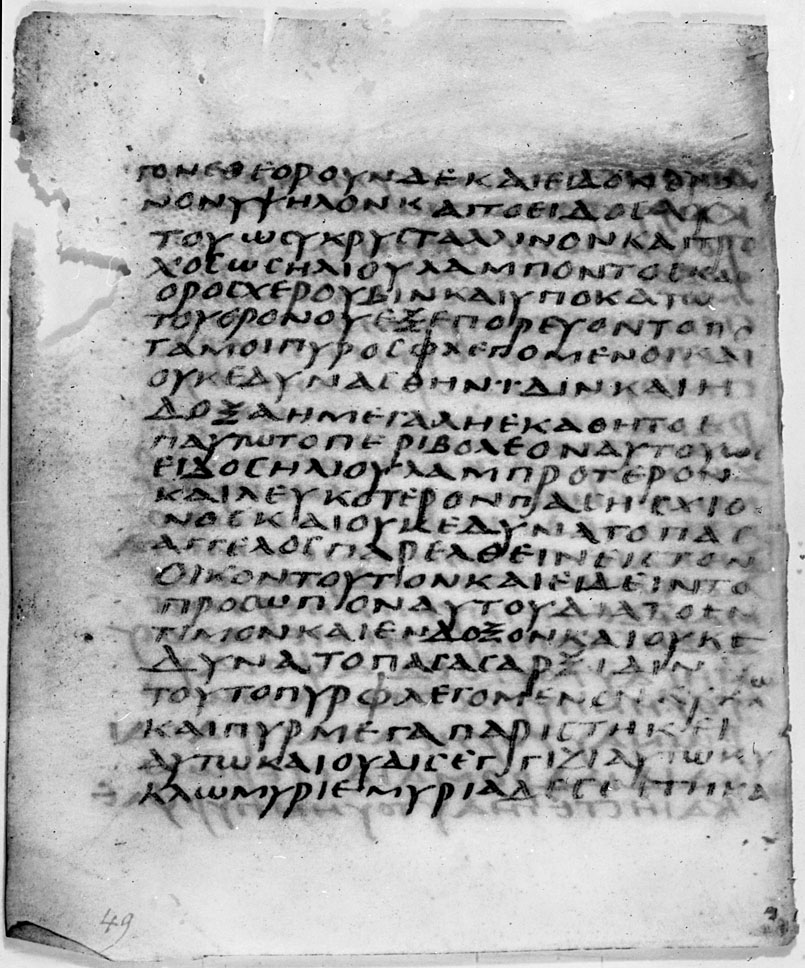
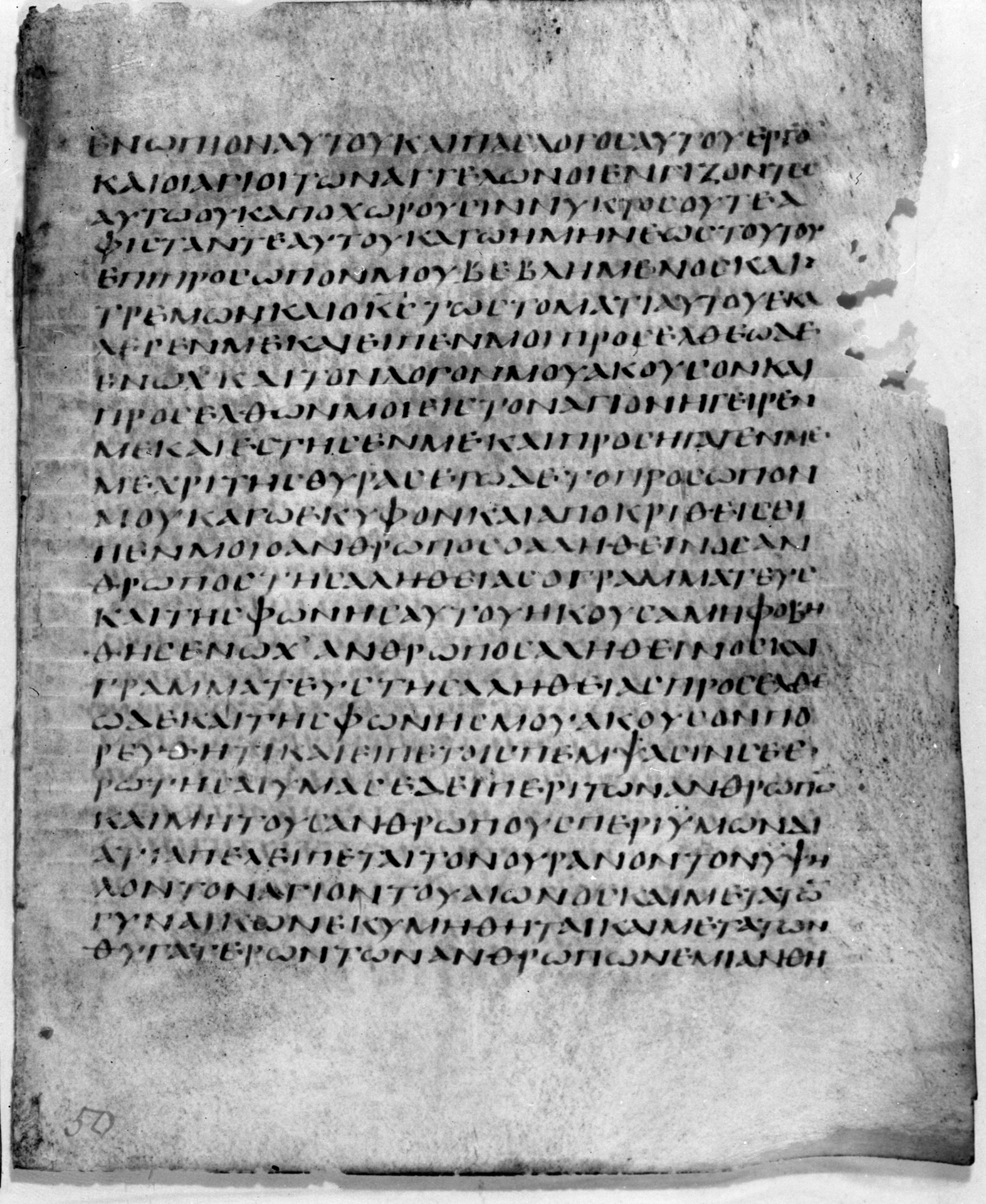
The text at the ending of Text B on page 50 of the codex, 1 En. 14:22 (see, Figure 1), written by the first copyist, describes an encircling fire and a myriad [of angels] standing … κυ-κλω μυριε μυριαδες εστηκα. 57 The line is continued by the second scribe, on page 51, at 14:22b, ‘… before him; his every word was deed’, ενωπιον αυτου; και πας λογος αυτου εργον (see, Figure 2).

The first copyist. Page 50 in Codex Panopolitanus/Akhmim Fragment showing the text corresponding to 1 En. 14:17–22 ‘P. Cair. 10759: Apocalypsis Enochi’. Photographic Archive of Papyri in the Cairo Museum, http://ipap.csad.ox.ac.uk/AE/150dpi/P.Cair.10759-p49.jpg. (The page number follows Lods’s enumeration; page 49 is written on the manuscript). These images are reproduced with permission of the Centre for the Study of Ancient Documents (University of Oxford), photographer Adam Bülow-Jacobsen, the Association Internationale de Papyrologues (AIP), and the Cairo Museum.

The second copyist. Page 51 in Codex Panopolitanus/Akhmim Fragment showing the text corresponding to 1 En. 14:22b–15:3. ‘P.Cair. 10759: Apocalypsis Enochi’, Photographic Archive of Papyri in the Cairo Museum, http://ipap.csad.ox.ac.uk/AE/300dpi/P.Cair.10759-p50.jpg. (The page number follows Lods’s enumeration; page 50 is written on the manuscript).
In several Ethiopic versions, there is an added clause in 14:22b ‘but he needed no counsel’, after ‘before him’, and ‘his every word was deed’ is omitted (I use translations for the Ethiopic text). 58 Regarding the Ethiopic version, Nickelsburg states that there is parallelism between 14:22a and 14:22b, which ‘should be noted’. 59 Thus, the deliberate plus and minus in the Ethiopic texts, in addition to the scribal shift between the end of Text B on page 50 (the first copyist) and the top of Text C on page 51 (the second copyist), draws attention to 1 En. 14:22a and 1 En. 14:22b in both Codex Panopolitanus and the Ethiopic texts. As noted above, one wonders if the splitting up of this verse in Akhmim Enoch between two scribes was intentional since it draws attention to the throne imagery of a centrally important passage. 60
In the extant Qumran text corresponding closely to 1 En. 14:22, 61 4Q206 frg. 1 line 1 aligns with the end of Text B: that which ‘encircles’ the God presence and the myriads of angels standing before the divinity. 4Q206 frg. 1 line 2 closely corresponds with 1 En. 14:22b, retaining ‘deed’ from the final clause. ‘His every word was deed’ aligns with the first line of Text C. The Aramaic and Greek line positions are shown 62 :
Transcription
4Q206 frg. 1, lines 1–2
]סחרין לה[ 14:22 א]ד להו[עוב]
Translation
4Q206 frg. 1
14:22: ] encircle him [
]becomes [dee]d
(Drawnel’s translated reconstructed text) 63 :
14:22: [him from those who] encircle him; [ten thousand times ten thousand stand before him,]
[and his every word] becomes [dee]d. 14:23
(correspondences with the Aramaic text are in boldface)
14:22a
First line of Text C (ms. p. 51, line 1, of the ms.; the second scribe):
(correspondences with the Aramaic text are in boldface)
14:22b
ενωπιον
before
It is clear from the tiny fragment of 4Q206 1–2 64 that there is no line space between the two lines. The final stand-alone poetic beat in 14:22b (without the parallelism in the Ethiopic texts) on a separate line in the Aramaic and Greek adds to its dramatic impact. From a literary point of view, it is effective and may be deliberate rather than occurring in two arrangements by chance.
Adolphe Lods stated that a third scribe, a reviser, edited Text A, Text B and Text C. 65 However, it is now generally accepted that the first scribe edited all three sections. 66 Since Scribe 1 wrote Text A and Text B, and made corrections, they would have been aware of the continuation from Text B to Text C, as well as the repetition of Text A in Text C, although the texts are not identical.
Text C ends at 1 En. 32:6a (the speaker in Akhmim Enoch is the angel Raphael; it is Gabriel in the Ethiopic text) 67 : ‘… the tree of wisdom from which your father ate’ 68 (ων τουτο το δενδρον ϕρονησεως εξ ου εφαγεν ο πατηρ σου). 69 The Greek text ends before the extant Aramaic text equating to part of the remainder of 1 En. 32.6b which begins in 4Q206 frg. 5. 70 Whether this meant that the Egyptian scribe had an incomplete exemplar or that the ending at this point was deliberate is unknown of course (note, there are also abrupt endings in Akhmim Gos. Pet. and Akhmim Apoc. Pet.). Drawnel’s translation of 4Q206 frg. 5 is as follows (since the ending of Akhmim Enoch does not tally with the Aramaic text, there are no parallels to examine): 71
4Q206 5
And] your mother of old, and they learn[ed
[th]ey were naked, m[
Erik Larson concludes that behind the Akhmim Book of the Watchers lay a Vorlage represented by the Aramaic fragments at Qumran (4Q201 and 4Q202). 72 However, Coblentz Bautch disagrees, arguing that the textual evidence from Qumran suggests that the Greek versions of the Book of the Watchers (both ‘Panopolitanus and Synkellos’) as well as 4Q201 and 4Q202 could have drawn on a common earlier Aramaic Vorlage. 73
Second Temple Jewish scribal practices
A few examples of comparable early Jewish scribal practices which may be relevant to the separate extracts of the Greek Book of the Watchers and the Petrine extracts in Codex Panopolitanus include variations on abbreviated and extracted so-called ‘biblical’, and biblically related, texts known from Qumran – without reference to the development of canonization (which is now accepted to be an anachronistic concept with regards to early Judaism). 74 (As suggested above, this does not mean that the Qumran material itself was utilised by the scribes concerned; simply that some scribal traditions were preserved.)
4QCanticlesa-b (4Q106 and 4Q107)
4QCanticlesa (4Q106) and 4QCanticlesb (4Q107) from the Song of Songs are differently abbreviated versions of the Song containing series of separate verses, or blocks of verses. The extracts continue more closely than one might expect by chance from one manuscript to the other, particularly where one text has omissions. There is one extant overlapping text, between the two manuscripts, which are copied by different hands. 75 Tov states that it is evident both texts were created intentionally by both scribes and that the omissions are not the result of scribal negligence. 76 Furthermore, where the two texts overlap, they are shorter in different places. The sections lacking in 4QCanta are fully or partially extant in 4QCantb and vice versa (the latter has shorter extracts), ‘and to some extent the two scrolls supplement each other. The shorter text of the two scrolls [4QCantb] was created consciously by the scribes or their predecessors by shortening the content of the biblical book.’ Tov adds that he hesitates to call these extracts ‘abbreviated texts’ as there are no exact parallels among other Qumran texts. 77 The list of omissions and overlaps in 4QCanta (4Q106) and 4QCantb (4Q107) is set out in Table 1 in a list of passages, numbered for convenience, below. 78
This shows the supplementary-type relationship between 4QCantb (4Q107) and 4QCanta (4Q106).

The summary of Table 1 describing the partial continuations, duplications, omissions, and missing passages in 4QCantb (4Q107) that appear in 4QCanta (4Q106), and vice versa, is as follows:
A. 4QCantb (4Q107) I: 1 = Song 2:9–3:2 (no. 1) is partially followed by (no. 2) 4Q Canta (4Q106) I: 1 = Song 3:4–5, after a textual omission from Song 3:2 (4QCantb) to Song 3:4 4QCanta (4Q106)
B. There is partial duplication between: (no. 2) 4QCanta (4Q106) I: 1 = Song 3:4–5 and (no. 3) 4QCantb (4Q107) I: 2 i = Song 3:5 (no. 3)
C. There is text missing in 4QCantb (4Q107) II: 2 i between Song 3:5 and 3:9 (no. 3). The textual omission is partially represented in 4QCanta (4Q106) II: 2 i–5 = Song 3:7–4:6 (no. 4). Hence, the omitted text in 4QCantb (4Q107) Song 3:6–8 is partially preserved in 4QCanta (4Q106)
D. 4QCanta (4Q106) II: 2 i–5 = Song 3:7–4:6 (no. 4) partially overlaps with the first section of Song 4 in 4QCantb (4Q107) III: 2 ii at Song 4:1b–3 (no. 5.)
E. The textual omission in no. 5, 4QCantb (4Q107) III: 2 ii between Song 4:1b–3 and Song 4:8–11a seems to be partly supplemented in no. 6 by 4QCanta (4Q106) III: 2 ii at Song 4:7 (no. 6). Thus, the absent section of Song 4:7 from 4Q107 is partially represented in 4Q106 (no. 6). This is followed by an omission until Song 6:11?–7:7.
F. The textual omission in no. 6, 4QCanta (4Q106) III: 2 ii, between Song 4:8 and Song 6:10? is partly supplemented in no. 7, 4QCantb (4Q107) IV: 3 = Song 4:14–5:1.
Tov notes that where texts overlap, they are shorter in different places; furthermore, that it is a known scribal practice for the shorter text (4QCantb) to omit complete literary units. 79 4QCantb represents the first half of the biblical book only. 80 Indeed, as can be seen from Table 1 above, three of the four textual absences occur in 4QCantb. According to Tov, the purpose of the abbreviated manuscripts from Qumran was for personal use, or to create anthologies outside of rabbinical circles, and they were not intended to be canonical. 81 However, as stated earlier, the labelling of early Jewish (and Christian texts) as ‘canonical’ or ‘non-canonical’ is now generally regarded as a later scholarly anachronism. 82
The focus in this essay, however, is to consider how early Byzantine-period Egyptian copyists employed much earlier Jewish scribal practices to anthologize earlier pseudepigraphal and apocalyptic texts. Whether the scribes of the Akhmim Fragment regarded early Jewish and Christian pseudepigraphal and apocalyptic literature as ‘canonical’ or ‘authoritative’ is immaterial; what is interesting is how they used historically Jewish scribal traditions to create a thematically interlinked scholarly compendium.
From our point of view, although the scribal practice in the Akhmim Book of the Watchers is not identical to the practice of two scribes partially sharing a text between them (as it were), as in 4QCanta-b, in separate manuscripts, several times, consistently, we do have the second copyist of Akhmim Enoch intentionally continuing one text (Text C) from another (Text B), written by the first scribe. Furthermore, the second scribe also duplicated a text written by the first scribe (Text A). Since the first scribe was the editor, we must conclude that the doubling was deliberate and had a purpose.
The Nash Papyrus and Tefillin
The Nash Papyrus may be relevant to Codex Panopolitanus as an early Jewish Egyptian text, although chronologically distant, that combines thematically similar texts found in the Pentateuch. (In comparison, the Akhmim Fragment contains thematically similar Jewish and Christian apocalyptic literature.) Dated to the second half of the second century BCE, the Nash Papyrus was purchased in the late nineteenth century in Egypt, believed to be in the Fayuum, by W. L. Nash, the secretary of the Society of Biblical Archaeology. Hence, like the Akhmim Fragment, it is without provenience, or social context.
This Hebrew text consists of parts of the Ten Commandments (Exod 20:2–17 and parts of Deut 5:6–21), followed by the verses that constitute what is known today as the Shema prayer in rabbinical Judaism: Deut 6:4; 11:13–21; Num 15:37–41. There are preambles supported in an underlying Hebrew text of the Septuagint, Deut 4:45, 6:1, 3. Its Egyptian origins may be indicated by the fact that it is written on papyrus, and possibly that the clause, ‘house of slavery’, is missing from Exod 20:2 and Deut 5:6. Its differences with the Masoretic Text have points of agreement with the Septuagint (which was written in Alexandria), at Deut 4:45, 6:1, 3. 83 It is possible that the Nash Papyrus is a mezuzah or tefillah slip as it is very small and folded up. 84
A number of tefillin from Qumran include the same or similar extracts from Deuteronomy and Exodus as the later prescribed biblical texts in rabbinic halakhah. Ariel Feldman refers to these tefillin texts as Type 1. These include: Exod 13:1–10, 11–16, 85 Deut 6:4–9, and 11:13–21. 86 A ‘sub-group’ that Feldman terms Type 2 only exists in the Qumran tefillin. These generally have longer extracts of text from both Exodus and Deuteronomy. 87 The texts include Exod 12:43–13:16, Deut 5:1–6:9 and 10:12–11:21. 88 As can be seen, a number of the Qumranic-type tefillin slips have extended extracts from Exodus and Deuteronomy that end at the same place as the later rabbinical, non-Qumranic tefillin while beginning earlier in the passages. Other biblical extracts in the tefillin slips are encompassed by Type 1 or Type 2.
The most complete example of a tefillah which includes extended passages that are related to later rabbinic extracts is 8QPhyl (8Q3), slip 1. In contrast, slip 2 and slip 3, except for Exod 20:11 (see below), contain extended beginnings of these passages. (Slip 4 has an uncertain text): 89
Slip 1
Exod 13:1–10
Exod: 13:11–16
Deut 6:4–9
Deut 11:13–21
Slip 2
Deut 6:1–3
Deut 10:10–22
Slip 3
Deut 10:12–19
Exod 12:43–51
Deut 5:1–14
Exod 20:11
Slip 4
(uncertain text)
Deut 10: 21–22
Deut 11:1
Deut 11:6–12
In slip 1, a blank line separates Exod 13:1–10 from vv. 11–16, and another blank line separates Exod 13:11–16 from the Deuteronomy section. The two Deuteronomy passages 6:4–9 and 11:13–21 are arranged in such a way that they are to be read as separate pericopae. 90 The two Deuteronomy passages in slip 2, 6:1–3 and 10:20–22, are also separated by a blank line. 91 In his conclusions based on a number of revised reconstructions and additions, Feldman argues that 8Q3 contains a number of textual duplications, which are unknown in other tefillin. 92
The sequence of extracts from phylactery slips XQPhyl 1–3, which were placed in an original case, are not arranged in their biblical order (it was purchased, and slip no. 4 may not be original). 93 Each slip includes the biblical passage that is prescribed for tefillin by rabbis in later halakhah (shown in italics, below). 94 (Slip no. 4, which is difficult to decipher was written on both sides, whereas slips 1–3 were inscribed on one side only [which is also the case in later rabbinical practice]): 95
XQPhyl 1–3 96
Slip 1
Exod 12:43–51
Exod 13:1–10 [Type 1]
Deut 10:12–17 97
Slip 2
Deut 5:22–23
Deut 6:1–3 98
Deut 6:4–9 [Type 1]
Slip 3
Deut 5:1–21
Exod 13:11–16 [Type 1]
The biblical extracts from XQPhyl 1–3 are rearranged in summary form, below, to show their sequential biblical order and any overlaps:
Slip 1 ab. Exod 12:43–51, 13:1–10 (Type 2 and Type 1 following on)
Slip 3 b. Exod 13:11–16 (Type 1 [Exod 13:11–21])
Slip 3 a. Deut 5:1–21 (Type 2)
Slip 2 a. Deut 5:22–33 (Type 2) (LXX?)
Slip 2 bc. Deut 6:1–3, 4–9 (Type 2 and Type 1)
The sequence of the biblical texts is not fixed in the Type 2 Qumranic-only style. This is also the case with the Type 1 texts; interestingly, the question of the biblical order is the subject of later rabbinical discussion. 99 Other tefillin slips containing biblical extracts that run on continuously from recto to the verso (contra later rabbinical practice, see above), splitting up the verses, in both Type 1 and Type 2 texts, include (among several):
4QPhyl R recto. Exod 13:1–7a/
4QPhyl R verso. Exod 13: 7b–10 (Type 1)
4QPhyl K recto. Deut 10:12–11:7a/
4QPhyl K verso. Deut 11:7b–12 (Type 2) 100
In sum, the continuation of texts as separate extracts may be seen in 4QCanticlesa-b and in tefillin slips in the Qumranic type, Type 2, where passages end at the same point as those extracts that also appear in later, rabbinical phylacteries. In some other tefillin, the immediately preceding continuation biblical texts to the Type 1 passages are on separate slips within the same phylactery (in others, they continue overleaf). The contents of each phylactery could be read as a composite work, without overlaps (although, as said, Feldman found several some possible duplications in 8Q3). 101 Like the Nash Papyrus, late Second Temple period phylacteries – all of which are known from the Dead Sea Scrolls – may be classified for our purposes as thematic continuation texts. In other words, the scribes continued related themes from within a corpus within the same, or in separate, manuscripts copied by different hands, thereby linking the different manuscripts textually, and the texts thematically. In the case of the phylacteries, in particular, there is evidence that later religious scribal practice can reflect earlier arrangements. Without expecting identical traditions, the Nash Papyrus and phylacteries are the ancestors of later rabbinical practice, containing texts and recognisable presentations. (One may add that if this were not the case, we would not be able to identify the nature of these texts.) The similarity with the Akhmim Fragment is that, as shall be shown, there are related themes between Gos. Pet., Apoc. Pet. and the Book of the Watchers, as they are arranged in the codex, in order to create a unified anthology. 102
4Q175 (4QTestimonia)
Finally, in relation to the pluralistic nature of Codex Panopolitanus, attention may be drawn to 4QTestimonia (4Q175) from Qumran. 4QTestimonia consists of four separate texts from the Pentateuch: the Samaritan version of Exod 20:21; the MT version of Num 24:15–17; Deut 33:8–11 and one extrabiblical composition, 4QApocryphon of Joshuab (4Q379). The text is regarded as a compendium of different genres. Excerpted texts are recognised by the juxtaposition of different biblical texts, either from the different books or the same book. 103 Tov describes how scribes may have compared different scrolls when producing their own copy of a text; for example, the extract of Deut 33:8–11 in 4Q175 has agreements and disagreements with other sources of Deut 33:8–11. 104 He describes 4Q175 as the ‘clearest example of a small anthology’, stating that the common theme between them is ‘probably Messianic’. 105
Although one would not classify Codex Panopolitanus as a compendium of excerpted texts as such, as they are too substantial (even with Text A, notwithstanding), it is a collection of separate literary texts with linking themes. The Book of the Watchers and Apoc. Pet. involve Jewish and Christian canonical figures to whom are revealed divine judgements and visions in the afterlife by their own personal holy guides’ while Gos. Pet. contains a version on this theme, on earth, in life, in its penultimate section. In addition, there are inter-textual connections. These are considered later in the next sub-section concerning the background of the codex section.
A note on the question of the Akhmim Fragment as Jewish-Christian work
In the form that we have it, assuming that it is complete, the manuscript of Akhmim Enoch is noticeably visually different to that of the Petrine texts: there are no Coptic crosses, decorations or blank pages in the Book of the Watchers. This may indicate that the compiler or compilers of Codex Panopolitanus did not regard 1 Enoch as a Christian text per se, but one that had been adopted by Christians (1 En. 1:9 in Jude 14–15). 106 This is important for the study of the complexity of Jewish-Christian work (separate identities appear to have been preserved), as well as for the study of the historical meaning of visual and textual evidence where they appear together.
Gentry and Fountain argue that textual differences between 1 En. 1:9 and Jude 14–15 may suggest that Jude was referencing a common Jewish tradition, rather than a specifically known book. 107 Several scholars propose that as there were different Jewish groups in first-century Palestine, there were also diverse Christian groups in Palestine, 108 including possibly Jewish members of the Jesus movement in Palestine and in Egypt. It is often accepted that the Akhmim Gos. Pet. and the Akhmim Apoc. Pet. are both early Jewish-Christian products from the second century copied in the late sixth, to early seventh century. 109 Their Vorlagen date from before the end of the second century, since Apoc. Pet. was known to Clement of Alexandria, and other witnesses, as canonical, 110 and it was regarded as scripture until the fourth century. 111
Joel Marcus supports the theory that Gos. Pet. was probably originally composed in the second half of the first century in western Syria where Jews were joining Jesus followers, 112 and that Apoc. Pet. had priority. 113 He hypothesizes that the missing text at the end of Akhmim Gos. Pet. may have consisted of a narrative concerning the conversion of Jews to the Jesus movement that was removed by the Akhmim scribe for anti-Jewish reasons. He disagrees with Van Minnen that the missing text was cut out because the copyist ran out of space. 114 Marcus further agrees with the thesis by Dominic Crossan that the first half of Gos. Pet. is anti-Jewish (regarding both the Jewish leadership and the people), and its latter half is pro-Jewish (in terms of the Jewish people). 115 Crossan – whose gave the hypothesis that a now-lost Grundschrift of Gos. Pet. contains the Passion and Resurrection narratives upon which the four gospels are based – dates the original Gos. Pet. to c. 42 CE, to the time of Agrippa I and ‘Jerusalem’s Christian Jewish community’. 116
Some points of contact
I created three tables, based on the divisions of Text A, Text B and Text C, to line up a selection of parallel themes and contextual language with the Petrine manuscripts. 117 I selected the themes and the use of language for the divine Voice, (mortal) Fear ‘and (mortal) Vision, under those headings, respectively. 118 I found that important sections of the Book of the Watchers occurred at the beginning of Text A (Fear and Vision), Text C (Voice) and at the end of Text B (Vision). These joins, or stand-alone breaks, harmonised with similar narrative points in the Peter narratives. One may consider whether Akhmim Enoch was copied with a deliberate scribal arrangement, and if so, whether that structure concerned comparative common themes in the Petrine texts. The parallel themes are summarised below.
Voice
In Gos. Pet. 10, a ‘great voice’ μεγαλη
The appearance of the divine voice summoning Enoch in the present (rather than in a dream, cf. 1 En. 13:8) occurs to the beginning of Text C, the second scribe’s copy. The physical and audio scene in 1 En. 14:24, God commanding Enoch with his ‘mouth’ (στόματι) to stand, begins a new literary section.
121
The emphasis on
Voice.

Fear
In the Akhmim Book of the Watchers, the theme of ‘fear’ is used in the question and response between Enoch and the unnamed angel guide in Text A (breaking off mid-text). The question to Enoch and Enoch’s response are continued in Text C. The emotion,
The women’s fear in Gos. Pet. 13
135
is connected to their experience of the supernatural: an angel in the tomb who asks them questions. Unlike Apoc. Pet. 4–5, there is no angel guide to mediate, or explain what they are seeing, and they do not, or cannot, reply; it is not a dialogue.
136
At this point, the noncanonical pseudepigraphal gospel narrative written in the third person ends. Textual connections with the theme of
Fear.

Vision
The first angelic vision in Enoch’s ascent to heaven in 1 En. 14:20 at around the end of Text B and the final lines of the first copyist is echoed in the Apoc. Pet. 3. The Enoch text states that no angel or ‘(human) flesh (lit.)’ can see the Great Glory. Here, God is described as a presence that cannot be seen by humans (see table, ‘Vision’). In 1 En. 14, the divine clothes are like the appearance of the sun. In Apoc. Pet. 5 145 , the faces of the angels are compared to the sun, and their clothes, light. Similarly, the beautiful angel in the tomb in the final part of the retold resurrection passage in Gos. Pet. 13 wears very bright robes.
By contrast, at the beginning of Text A (commencing mid-sentence in an abbreviated extract, completed in Text C) at 19:3, Enoch describes the experience of being the only human being to have seen the horrors of hell: the imprisonment of the fallen angels. Interestingly, the texts concerning the impossible sight for humans, of sun-like divine and angelic manifestation in Apoc. Pet. 3, and the sun throne imagery in 1 En. 14:20 in Text B are almost interchangeable with the language of 1 En. 19:3. The key words at the beginning of Text A,
Vision.

Conclusion
In this article, I examined the Akhmim Book of the Watchers, bearing in mind that Second Temple Jewish scribal traditions of using continuous, related and duplicated biblical extracts may be reflected in the booklet’s construction. The elements of interest were: ‘continuation texts’ giving 4QCanticlesa-b (4Q106–107) as a comparative example, as Text C follows Text B, each written by different scribes in a continuous literary unit. Thematically connected extracts from separate books from the same corpus, whose text are continuous over time (the Nash Papyrus and Qumran tefillin), were also considered. Here, there is also the question of a possible duplication of texts in 8QPhyl (8Q3); if correct, this may reflect the repetition of Text A in Text C as an intentional inclusion. (I noted the fact that the format and content of some Qumran phylacteries are recognisable in rabbinical Judaism which supports the hypothesis that Second Temple Jewish scribal practices were preserved and adapted in late antiquity.) I also considered the codex as an anthology that consisted of thematically connected texts from different corpora, mentioning 4QTestimonia (4Q175), which is a compilation of possible messianic extracts. In our codex, the compendium overall is pseudepigraphic and apocalyptic, and it includes angelic and supernatural imagery: the overall common thematic narratives in the Book of the Watchers and the Petrine texts.
It was found that the parallel connections occurred, in the main, near the beginnings and endings of Texts A–C, coinciding with similar key literary units in Gos. Pet. and Apoc. Pet. As a result, I suggest that the codex was compiled intelligently and thoughtfully, and not amateurishly, as some scholars have suggested. This included making a distinction between the two Christian Peter manuscripts by binding Apoc. Pet. upside down and back-to-front.
Although we do not know its origins, Codex Panopolitanus offers an insight into ancient literary creative processes to produce a harmonised apocalyptic compendium. The group most likely to have been responsible for the codex are Jewish-Christians, or Jews and Christians working together in Upper Egypt in late antiquity. In Second Temple Judaism, scribes wrote on scrolls, and in late antiquity, other parties, the physical producers of the codex, the bookbinders, had a role to play in the presentation of texts as an aid to understanding authorial intention. When comparing texts across linear timescales, the mode and method of production and presentation need to be considered. This study is a contribution to the field of scribal memory in the long-term circulation of texts and the role of visual evidence in textual formats. The paper concludes that more research is needed on Codex Panopolitanus, holistically, as a book shaped by Second Temple Jewish scribal memory within its Greco-Egyptian and Jewish and Christian scholarly contexts.
Footnotes
Acknowledgements
I would like to thank the anonymous reviewers of this study for their valuable advice on the submitted article and for their refreshing encouragement. A very early draft of this paper, entitled, ‘The Textual Context of 1 Enoch in Akhmim and Oxyrhynchus’, was presented at the European Association of Biblical Studies (EABS) annual conference in Sofia in 2024. I am grateful to Florentina Badalanova Geller for inviting me to give a paper at the research unit, Enoch Within and Outside the Books of Enoch, and for which this research was initiated in response. The session title was ‘Enochic Texts and Related Traditions’. I would also like to thank Loren Stuckenbruck, who participated in the session, for his feedback.

Funding
The author received no financial support for the research, authorship, and/or publication of this article.
Declaration of conflicting interests
The author declared no potential conflicts of interest with respect to the research, authorship, and/or publication of this article.