



Abstract
Scholars have long puzzled over the Parables of Enoch’s depiction of the figure identified as the Son of Man as existing before creation. Previous proposals have suggested that this idea derives from the influence of the depiction of wisdom in Prov 8:22–31, the king in Ps 72:17, or the Servant of the Lord in Isa 49:1–2. In this article, I discuss these three proposals, rejecting the first entirely and suggesting that the latter two have some validity but fall short of explaining the key reason behind the Son of Man’s pre-creation existence. I then propose that the most important scriptural source for this idea is Isa 51:16, which has a syntactical ambiguity that allows it to be read as describing a figure hidden by God before the creation of the world. This verse shares significant parallels with Isa 49:2, and these texts were combined in 1 En. 48:6 and 62:7 in order to depict the Son of Man as a preexistent figure.
Scholars have long recognized that the figure variously identified as the Son of Man, the Chosen One, the Anointed One, and the Righteous One is a central character in the Parables of Enoch (1 Enoch 37–71).
1
His chief task is to preside over the eschatological judgment,
2
and, as his many designations indicate, the descriptions of this character (whom I will refer to as “the Son of Man” for convenience) are often drawn from biblical predecessors.
3
Although the main lines of his eschatological role are relatively clear, there are a few statements about the Son of Man that have occasioned considerable debate among scholars: At that hour, that Son of Man was given a name, in the presence of the Lord of the Spirits, the Before-Time; even before the creation of the sun and the moon, before the creation of the stars, he was given a name in the presence of the Lord of the Spirits. (1 En. 48:2–3)
4
For this purpose he became the Chosen One; he was concealed in his own presence prior to the creation of the world, and for eternity. (1 En. 48:6) For the Son of Man was concealed from the beginning, and the Most High One preserved him in the presence of his power; then he revealed him to the holy and elect ones. (1 En. 62:7)
5
The main issue is that these texts appear to describe the Son of Man as existing before creation. This is surprising for a text within the Jewish tradition, which ordinarily ascribes pre-creation existence to God alone. 6 This has led to debate on two fronts.
First, the nature of the Son of Man’s existence before creation is contested: do these texts have in view real, ontological existence or something less, such as ideal existence in the mind of God or merely the election of the Son of Man to a great destiny? Some find it incredible that a Jewish text would posit a second being existing alongside God before creation and thus claim that being “hidden” by God does not imply ontological existence. 7 Others argue that this conclusion is unavoidable when the texts in 1 Enoch 48 and 62 are read together. 8
Second, there is debate about the relationship between the Son of Man’s existence before creation and scripture: is this idea derived from statements about one or more of the Son of Man’s biblical predecessors, and if so, which one(s)? Those who reject ontological existence before creation often find this to be a less pressing question because on their reading the author of the Parables has not said anything particularly radical, 9 but the majority of those who understand the text to speak of ontological existence have proposed scriptural explanations for this phenomenon.
The purpose of this essay is to contribute to the second of these debates. On the first issue, I find convincing the view that the pre-creation existence of the Son of Man is ontological, and this is the perspective that I will assume throughout the essay. Because I do not have any substantial new contributions to make to this question, I will omit a rehearsal of the arguments and mention it only where necessary. I believe, however, that those who hold a different view on this matter could accept my central argument and incorporate it into their perspective with a few minor adjustments.
On the issue of the origin of the Son of Man’s pre-creation existence, it is, of course, hypothetically possible that the author of the Parables created this idea ex nihilo or even derived it from something within the Greco-Roman world, but these possibilities seem unlikely. Although the Jewish tradition was by no means cordoned off from the broader Mediterranean world, an explanation from within the Jewish tradition is intrinsically more likely than an explanation from outside. As the many scholars who have worked on this question have recognized, such an innovative claim is also unlikely to have appeared without any inspiration, even if the specific claim in and of itself is without precedent. There has thus been a long quest to link the Son of Man’s pre-creation existence to scripture.
There are three main suggestions regarding how scripture inspired the notion of the Son of Man’s pre-creation existence. First, some think the Parables identifies the Son of Man with the figure of wisdom from Prov 8:22–31, where wisdom is described as present with God during creation. 10 Second, a few have suggested that the relevant statements derive from a royal understanding of the Son of Man and express a temporal interpretation of Ps 72:17’s prayer regarding the king, “may his name spring forth before the sun” (several advocates of this view think that the Son of Man’s pre-creation existence is ideal rather than ontological). 11 Third, a recent article by Michael Wade Martin argues that the Son of Man’s existence before creation results from his identification with the Servant of the Lord from Isa 49:1–13. The view that the Parables’ depiction of the Son of Man draws on Isaiah 49 is fairly common, but Martin uniquely claims that the author of the Parables infers the pre-creation existence of the Son of Man from the temporal statements about the Servant of the Lord in Isa 49:1. 12
My central argument is that the first of these views is entirely mistaken, and the second two both contain helpful observations, but neither identifies the main text that enabled the author of the Parables to derive from scripture a figure who existed before creation: Isa 51:16. As we shall see, Isa 51:16 has syntactical ambiguities that enable the possibility of reading this verse to be describing a figure who is hidden by God during the creation of the heavens and the earth. My thesis is that the author of the Parables deduced the Son of Man’s existence before creation by adopting this reading of Isa 51:16 and applying it to the Son of Man, largely because of parallels between Isa 51:16 and Isa 49:2.
In order to demonstrate this thesis, I will begin by considering the proposal that the existence of the Son of Man before creation is derived from the equation of this figure with wisdom from Prov 8:22–31. After this, I will discuss the role of Psalm 72 in 1 Enoch 48, and then evaluate the strengths and weaknesses of Martin’s argument regarding Isa 49:1–2. Finally, I will explore the parallels between Isa 51:16 and Isa 49:2, the ambiguity in Isa 51:16 that enables this verse to be read as describing a figure who exists before creation, and the advantages of this proposal over the alternatives.
The Son of Man and wisdom in proverbs 8:22–31
In Prov 8:22–31, the figure of wisdom speaks in the first-person, and claims to be both the first thing that God created as well as a participant in creation: The LORD created me at the beginning of his work, the first of his acts long ago. Ages ago I was set up, at the first, before the beginning of the earth. When there were no depths I was brought forth, when there were no springs abounding with water. Before the mountains had been shaped, before the hills, I was brought forth, when he had not yet made earth and fields or the world’s first bits of soil. When he established the heavens, I was there; when he drew a circle on the face of the deep, when he made firm the skies above, when he established the fountains of the deep, when he assigned to the sea its limit, so that the waters might not transgress his command, when he marked out the foundations of the earth, then I was beside him, like a master worker, and I was daily his delight, playing before him always, playing in his inhabited world and delighting in the human race.
13
The primary argument for the influence from this text in the Parables is the claim that no other figure in the Hebrew Bible is said to pre-date the creation of the heavens and the earth. Hence, if the Son of Man exists before these things are created, he must be wisdom.
Beyond this primary argument, scholars have occasionally pointed out that the Son of Man is explicitly associated with wisdom in the Parables, 14 and a few suggest that the Son of Man and wisdom share further characteristics, including their relationship to the Lord of the Spirits, their heavenly character, and their roles as revelatory figures. 15 A. Feuillet adds that the Parables applies to the Son of Man the gifts associated with the Spirit in Isa 11:2, and one finds the same gifts applied to wisdom in Prov 8:12. 16
A recent, extensive article by Adam Winn goes even further, arguing that the Parables identifies the Son of Man with not only God’s wisdom but also God’s word, and he adds to the previous observations the claim that, like the Son of Man in the Parables, some Jewish writings describe God’s wisdom and word in proximity to God’s throne and even as worthy of receiving worship. Winn even claims that one text makes the implicit identification abundantly clear: 1 Enoch 69. This text describes the revelation of an oath that sustains God’s creation and subsequent governance of the world but then later speaks of the Son of Man being revealed. Winn concludes that the oath is God’s word and wisdom, which are thereby equated with the Son of Man. 17
These arguments for the identification of the Son of Man have some force, but they are far less compelling than the impressive list of luminaries who support this view would suggest. One of the most notable problems is that there are no instances of significant verbal overlap between any of the relevant passages in the Parables and Prov 8:22–31. The case is entirely based on purported conceptual parallels, and many of the common characteristics are by no means exclusive to wisdom and the Son of Man. Even with respect to their existence before creation, there is a significant difference: wisdom appears to be involved in creation while the Son of Man is only named and hidden.
Winn’s argument for a direct identification between wisdom and the Son of Man in 1 Enoch 69 depends on the unlikely hypothesis that the oath mentioned in this text is a cipher for God’s word and wisdom rather than being what the text says: a secret oath by which God’s creative and providential works are upheld.
Furthermore, although advocates of this view are justified in their claim that the Son of Man and wisdom are related in the Parables, they fail to note that they are consistently distinguished: the Son of Man reveals wisdom (48:7; 51:3) and the spirit of wisdom dwells within him (49:3), but the Son of Man is never said to be wisdom. 18 In fact, even the claim that wisdom and the Son of Man have parallel roles as revelatory agents finds little justification in the Parables. The closest that the Parables comes to this conception of wisdom is 1 En. 48:1, which speaks of “numerous fountains of wisdom” that make wise those who drink from them. Although wisdom traditions outside of the Parables may parallel aspects of what this work says about the Son of Man, the absence of these traditions within the Parables casts doubt on the claim that they are important for its depiction of the Son of Man.
Thus, the case for claiming that the Son of Man and wisdom are equated in the Parables is largely unconvincing, and depends on the need to find a scriptural explanation for the Son of Man’s existence before creation. A compelling alternative would make this theory entirely superfluous, and, as I shall argue, such an alternative explanation is available. Before we consider this directly, however, we have other proposals to consider. We turn now to Ps 72:17.
The Son of Man and the name of the king in Psalm 72:17
Psalm 72 as a whole is a prayer for the king. In verse 17, the Psalmist makes requests regarding the king’s name: “May his name endure forever; may his name spring forth (?) before the sun (לפני שמש ינון שמו).” This verse became the foundation of a rabbinic tradition that taught that God created the name of the messiah before he created the world. This tradition results from reading the phrase “before the sun” (לפני שמש) as a temporal rather than a spatial marker, and several but not all of these texts interpret the verb éðåï, which is otherwise unattested in Hebrew, to be the messiah’s name: Yinnon. Arnold Goldberg proposed that this tradition stands behind the claims about the Son of Man’s name in 1 En. 48:2–3. 19
Goldberg’s suggestion is followed by Richard Bauckham, who claims that 1 Enoch 48 as a whole is a combination of ideas drawn from Psalm 72 and Isaiah 49. Bauckham thinks that these texts were likely brought together as a result of the parallel themes of naming (Ps 72:17; Isa 49:1; 1 En. 48:2–3) and the worship of the nations (Ps 72:11; Isa 49:7; 1 En. 48:5), and he includes a chart of points that 1 Enoch 48 has drawn from these texts. 20
The temporal reading of Ps 72:17 occurs in a number of rabbinic texts: Tg. Ket. Ps 72:17; b. Ned. 39b; b. Pesaḥ. 54a; Lev. Rab. 1:16 §51; S. Eli. Rab. 29; Midr. Tanḥ b, Nasso 19; Midr. Pss. 93:3; Pirqe R. El. 3, 32; Midr. Prov. 8:9; 19:21. Although these texts all post-date the Parables, the occurrence of this reading in such a wide range of sources increases the likelihood that it goes back to an earlier era and may have been held by the author of the Parables. In addition, there is a good fit between what is said in Ps 72:17 and 1 En. 48:3, which locates the naming of the Son of Man “even before the creation of the sun and the moon, before the creation of the stars.” The author of the Parables could very well have drawn from Ps 72:17 the naming of this figure before the creation of the sun and then extended this to the other heavenly bodies.
Bauckham’s suggestion regarding the combination of Psalm 72 and Isaiah 49 is also plausible. The influence of the latter on 1 Enoch 48 is widely recognized, although the extent of this influence is disputed. Many have been impressed by the fact that both Isaiah 49 and 1 Enoch 48 speak in close proximity of a figure receiving a name, being hidden, serving as a light for the nations, and being worshipped. 21 Others think that the only legitimate connection is that both figures are a light for the nations. These minimalists argue that the timing in the Parables is wrong: the Parables speaks of the Son of Man being given a name and hidden before creation while Isaiah describes the naming of the Servant of the Lord “while I was in my mother’s womb,” and presumably understands the hiding to take place after his birth. 22
This objection, however, pays too little attention to the precise wording of Isa 49:1. Although the NRSVUE translates this verse, “while I was in my mother’s womb he named me,” the verb is הזכיר, a hiphil form of זכר, which in the qal stem means “to remember.” Outside of Isa 49:1, the root זכר appears 38 times in the hiphil stem, eight times in conjunction with the word “name” (שׁם), but it never refers to an act of naming. On five occasions, the idea in view appears to be calling to mind or invoking the name of a deity (Exod 23:13; Josh 23:7; Isa 26:13; Amos 6:10; Ps 20:8), and in three instances this phrase refers to causing someone’s name to be remembered (Exod 21:24; 2 Sam 18:18; Ps 45:18). 23 Among interpreters of Isaiah, many think that within Isa 49:1 the meaning is that God pronounced the name of the servant as a part of the servant’s calling, 24 or simply that God called to mind the servant’s name. 25 The important point for our purposes is that the Hebrew may plausibly be construed as the description of an event that assumes the prior naming of the servant rather than the act of naming in and of itself. Thus, whatever the intentions of the author of Isaiah 49, the author of the Parables could have read this text as leaving open the time at which the figure in view was actually named, and filled in this gap through a temporal reading of Ps 72:17.
Nevertheless, Ps 72:17 accounts for only part of what the Parables says about the Son of Man in the time before the creation of the world. The rabbinic interpretations of this verse claim that the messiah was named before creation, but they presume that he did not exist at that time, while the Parables claims that the Son of Man was not only named but also hidden in God’s presence (1 En. 48:6; 62:7), which presumes the opposite. This suggests that, while Ps 72:17 may contribute to what we find in 1 Enoch 48, it falls short of providing a full explanation for the Parables’ depiction of the Son of Man in the pre-creation era. 26
The Son of Man and the servant of the Lord in Isaiah 49:1–2
Isa 49:1–13 describes the commissioning of the Servant of the Lord to his task of being “a light to the nations, that my salvation may reach to the end of the earth” (Isa 49:6). Within this text, the first two verses describe God’s calling and equipping of the Servant: Listen to me, O coastlands; pay attention, you peoples from far away! The
The concept of existence before creation does not appear to be expressed in this text, but Michael Wade Martin nevertheless suggests that it is the source from which the author of the Parables derived this notion.
Martin’s case begins with a defense of the claim that the motifs of naming and hiding in 1 Enoch 48 and 62 come from Isa 49:1–2. 28 He then points out that both 1 Enoch and Isaiah 49 relate these motifs to spatial and temporal markers, and he argues that the spatial and temporal markers in 1 En. 48:3, 6; 62:7 are actually interpretations of the corresponding markers in Isaiah 49. He posits that the Son of Man’s naming “before the Lord of the Spirits” (1 En. 48:2), his being hidden “in his presence” (1 En. 48:6), and his being preserved “in the presence of his might” (1 En. 62:7) are all literal interpretations of God’s concealment of the Servant of the Lord “in the shadow of his hand” from Isa 49:2. Following George W. E. Nickelsburg, Martin also finds it notable that Isa 49:1 and 1 En. 48:3 both relate the act of naming to two temporal markers: “while I was in the womb…while I was in my mother’s belly” (Isa 49:1); “before the sun and the constellations were created…before the stars of heaven were made” (1 En. 48:3). 29 Martin suggests that this structural parallelism indicates an interpretation of Isaiah’s temporal claims: “The alternative, that they convey something different and that the writer has therefore consciously contradicted the text to which he is otherwise referring with approbation, seems unlikely.” 30
Having posited this theory, Martin then attempts to explain how the author of the Parables came to interpret the temporal markers in Isa 49:1 to refer to the pre-creation era. He suggests that the key move that enabled this reading is that the author interpreted the “womb” in the passage to be “the divine womb of Mother God.” 31 This concept, he posits, may have occurred to the author of the Parables at this point because there are references to a “womb” in relation to God in Isa 46:3 and 49:15. He further suggests that the author may have been moved to apply this idea to the messianic Son of Man because of influence from the divine declaration in Ps 2:7: “You are my son; today I have begotten you,” or even the Old Greek version of Ps 110:3: “From the womb, before the morning-star I have begotten you.” 32
These Psalms were often interpreted to have messianic referents, and so the thought that the messiah gestated within the divine womb was likely available to the author of the Parables. 33
As we have already seen, Martin is right to claim extensive influence from Isaiah 49 in 1 Enoch 48, and the same holds true for 1 Enoch 62. The latter chapter as a whole is a part of the judgment scene that Nickelsburg describes as the “dramatic climax” of the whole of the Parables. 34 This scene narrates the fulfillment of the event toward which the earlier portions of the work point: the revelation of the Son of Man and his judgment of the rulers. The relationship between this scene and the preceding material suggests that the motifs that 1 Enoch 62 shares with chapter 48 intentionally recall chapter 48 and recapitulate its dependence on Isaiah 49: the Son of Man, like Isaiah 49’s Servant of the Lord, is worshiped (1 En. 62:6, 9; cp. 1 En. 48:5 Isa 49:7) after a time in which he was hidden by God (1 En. 62:7; cp. 1 En. 48:6; Isa 49:2). Thus, Martin’s claim that the Parables consistently relates the theme of the Son of Man’s existence before creation to Isa 49:1–2 is justified. Nevertheless, his explanation for how the author of the Parables came to this reading is less persuasive.
Martin’s proposal that the two temporal markers in 1 En. 48:3 reflect an interpretation of Isa 49:1 as referring to the divine womb is difficult to accept. The Parables makes no mention of a divine womb; instead, it describes the naming and hiding of the Son of Man as taking place in the presence of the Lord of the Spirits (1 En. 48:2, 6; 62:7). Furthermore, even if one interpreted Isa 49:1 as referring to a divine womb, this does not obviously or automatically mean that the figure in view existed before creation. Martin provides no explanation for why a reference to a figure within the divine womb would lead one to the conclusion that this figure pre-dated the creation of the heavenly bodies.
The most decisive objection to Martin’s interpretation, however, is that a more compelling explanation is available. We have already seen that the timing of the Son of Man’s naming can be plausibly explained as a result of the author of the Parables’ combination of Isa 49:1 and Ps 72:17. In the following section, we will explore how the author derived the Son of Man’s existence before creation not from the temporal markers in Isa 49:1 but from a combination of Isa 49:2 and Isa 51:16.
The Son of Man and the hidden figure of Isaiah 51:16
In Isa 51:16, God addresses an unspecified figure: “I have put my words in your mouth and hidden you in the shadow of my hand, stretching out the heavens and laying the foundations of the earth and saying to Zion, ‘You are my people.’” As the following table illustrates, this verse has significant overlaps with Isa 49:2:
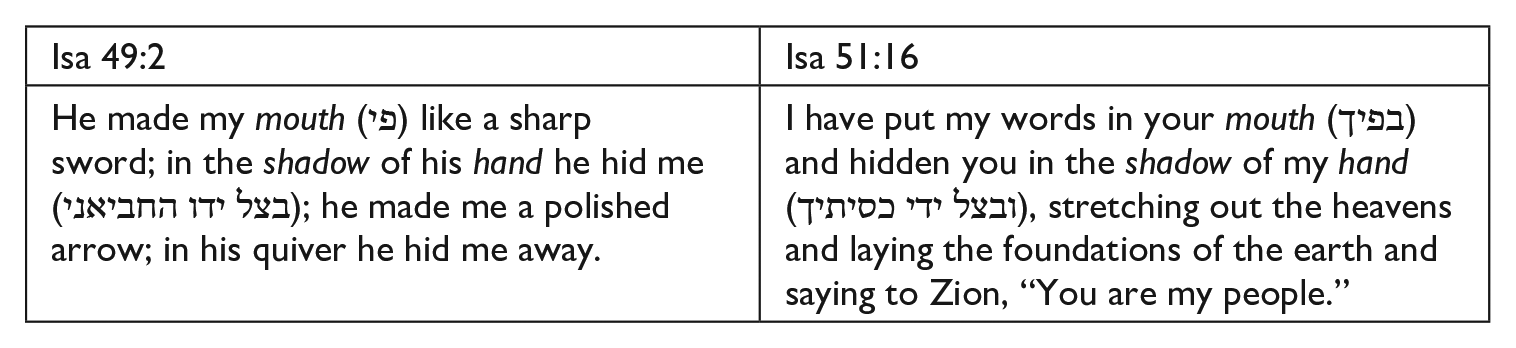
Both texts speak of God equipping the mouth of the figure in view, followed by the image of God protecting the figure by hiding him in the shadow of his hand. Although a different word for “hiding” is used in each verse, these are the only two texts in the Hebrew Bible that speak of the shadow of God’s hand, and the image is clearly the same. This unique feature makes these texts easy to combine, 35 and this is notable because of a significant ambiguity in Isa 51:16.
In Hebrew, the second half of Isa 51:16 is structured by a series of three lamed-plus infinitive constructions. Translated woodenly, the text reads, “And I have put my words in your mouth, and hidden you in the shadow of my hand to plant (לנטע) the heavens, and to found (וליסד) the earth, and to say (ולאמר) to Zion, ‘You are my people.’” The relationship between these three infinitives and the preceding material is ambiguous. The NRSVUE appears to take them as indications of activities that God carries out that bear no essential relationship to the main verbs of the verse. This strategy is understandable given the challenge that the grammar here poses.
There are two central ambiguities: the syntactical function of these clauses is unclear, and the subject of the infinitives is uncertain. The subject of the infinitives could be either God or the equipped figure, and the construction ל + infinitive usually indicates the purpose, result, or attendant circumstances of the main verb. Translators and interpreters have taken a wide range of approaches to these issues in Isa 51:16.
The Old Greek reads: “I will put my words in your mouth and shelter you under the shadow of my hand, by which (ἐν ᾗ) I established heaven and founded the earth, and you will say (ἐρεῖς) to Zion, ‘You are my people.’” 36 This translation attributes the first two infinitives to God and the third to the equipped figure, but relates the first two to the noun “hand” rather than the main verb. It thus adjusts the syntax of the verse and includes plusses that give a clear sense but are an unlikely rendering of the Hebrew
The Targum adopts a different reading strategy: And I have put the word of my prophecy in your mouth, and protected you in the shadow of my might, to establish the people concerning whom it was said that they would increase as the stars of the heavens and to found the congregation concerning whom it was said that they would increase as the dust of the earth, and to say to those who reside in Zion, “You are my people.”
37
This translation retains the infinitives as purpose clauses and identifies the equipped figure as the subject of each, but fills out the content of the infinitives such that they refer to the effects of the equipped figure’s prophetic ministry in establishing the community rather than an act of creation.
Modern scholars have tended to take one of three approaches. Some find the issue so insoluble that they resort to suggesting that the first half of the verse is misplaced. 38 Others understand the infinitives to be purpose clauses and identify the equipped figure as the subject but interpret the text to be speaking of the new creation rather than the origin of the universe. They thus claim that the text has in view the sequence of the equipped figure’s message turning the people back to God, which ultimately leads to the new creation. 39 Others read God as the subject of the infinitives and see the original creation as the referent of the first two infinitive clauses. They appear to read the first two infinitives as attendant circumstances and the third as a purpose clause. Similar to many interpreters of the Parables, however, they suggest that the intended sense is not to affirm that the equipped figure actually existed before creation but rather to claim that before creation God had intentions for this figure in mind. 40 Klaus Baltzer reads the passage similarly, but he identifies the equipped figure as Moses and affirms that the text depicts Moses as a preexistent figure whom God hid while he carried out the work of creation. 41
Although the intention of the originator of this text may remain a mystery, the important point for our purposes is that the interpretation of the text as describing a figure hidden during creation is a viable construal of the Hebrew. Grammatically and syntactically, it can easily be read as stating that God equipped and hid this figure so that God could create the world (while the figure was hidden) and deliver his message of comfort to Zion (through the figure’s equipped mouth). Such a reading is remarkably similar to the statements about the Son of Man in the Parables.
As we have seen, Isaiah 49 is a significant source for 1 Enoch 48 and 62, and chapter 48 in particular draws extensively on this source. The author of the Parables had likely noticed the parallels between Isa 49:2 and 51:16 and read the latter to be describing (similarly to Baltzer) a figure hidden during the creation of the world. As a result, the author wrote of the Son of Man being hidden in the presence of the Lord of the Spirits at the time indicated in Isa 51:16: “he was concealed in his own presence prior to the creation of the world” (1 En. 48:6); “the Son of Man was concealed from the beginning” (1 En. 62:7).
This proposal possesses an elegant simplicity that gives it an advantage over alternative suggestions. Prov 8:22–31 has in its favor that it describes wisdom as preceding creation, but the Parables consistently speaks of wisdom as related to but distinct from the Son of Man, and the relevant passages do not reflect the wording of this text to any significant degree. Isa 51:16, however, corresponds to the Parables in speaking of a figure who is hidden before creation, and has connections with Isaiah 49’s Servant of the Lord, who is clearly a source for the Parables’ Son of Man. Ps 72:17 very well may have influenced 1 En. 48:2–3, but rabbinic traditions about this verse use it only to speak of the pre-creation existence of the messiah’s name. Isa 51:16, like the Parables, implies the existence of the figure in view by describing him as hidden. Isa 49:1–2 is clearly an important influence on these texts, but the suggestion that the Son of Man’s existence before creation is an interpretation of the timing statements in Isa 49:1 requires that the author of the Parables understood this verse to refer to a divine womb, and then determined that the Son of Man’s gestation within this womb took place before creation. This suggestion is in many ways ingenious, but it appears overly complicated in comparison to Isa 51:16, which describes precisely what one finds in 1 En. 48:6 and 62:7: a figure hidden by God during the act of creation.
Conclusion
A 2016 book titled Hidden Figures (adapted into a film the same year) describes the overlooked contributions of African American women to NASA and the space program of the United States. 42 In this article, I have argued that the Parables of Enoch has its own hidden figure: the anonymous addressee of Isa 51:16. The overlooked contribution of this figure, literally described as “hidden” in both Isaiah and the Parables, is that he solves the riddle of the Son of Man’s existence before the creation of the world.
As we have seen, the Parables may have drawn from Ps 72:17 the idea that the Son of Man’s name precedes creation, but the actual existence of this figure before creation is best explained by Isa 51:16. In the Parables, both Ps 72:17 and Isa 51:16 have possibly been combined with material from Isaiah 49, the central passage in view in 1 Enoch 48 and 62, but the distinct contribution of Isa 51:16 is that, on one plausible construal of the syntax, it speaks of a figure hidden by God before the creation of the world. The correspondence between this and the statements in 1 En. 48:6 and 62:7 suggests that the hidden figure of Isa 51:16 is the biblical predecessor who stands behind the Son of Man’s existence before creation.
One of the main reasons scholars have been interested in the Parables’ claims about the origins of the Son of Man is the potential significance of this material for early Christian beliefs about Jesus. 43 Although the Parables depicts the Son of Man as a messianic figure who exists before the creation of the world, the findings of this study suggest that the rationale behind the claims in Parables does not correspond to and thus did not influence the views of the early Christians. Jesus is never identified with the hidden figure of Isa 51:16 in the New Testament or early Christian literature. Athanasius does on one occasion use this text to assert Jesus’ preexistence, but he follows the Old Greek translation of Isa 51:16 and identifies Jesus with the hand of God that hides and creates rather than the figure who is hidden (Decr. 17). Hence, those looking for the source of early Christian claims about the preexistence of Jesus are unlikely to find it in the Parables. Although there is an interesting parallel in broad strokes, the origin of the Parables’ preexistent Son of Man lies in a distinct tradition based on an interpretation of Isa 51:16 that never occurred to the early Christians.
Footnotes
Acknowledgements
Thanks are due to participants at the 2024 SBL annual meeting for their helpful responses to an earlier draft of this essay.
Declaration of conflicting interests
The author(s) declared no potential conflicts of interest with respect to the research, authorship, and/or publication of this article.
Funding
The author(s) disclosed receipt of the following financial support for the research, authorship, and/or publication of this article: This work was supported by the Alexander von Humboldt Foundation and the Deutsche Forschungsgemeinschaft.

1.
As many have pointed out, the English designation “Son of Man” represents three distinct designations in Ge’ez; see VanderKam, “Righteous One, Messiah, Chosen One, and Son of Man in 1 Enoch 37–71,” in The Messiah: Developments in Earliest Judaism and Christianity, ed. James H. Charlesworth (Minneapolis: Fortress, 1992), 169–91, here 174–76; Darrell D. Hannah, “The Elect Son of Man of the Parables of Enoch,” in ‘Who Is This Son of Man?’ The Latest Scholarship on a Puzzling Expression of the Historical Jesus, ed. Larry W. Hurtado and Paul L. Owen, LNTS 390 (London: T&T Clark, 2011), 130–58, here 139–41.
2.
See George W. E. Nickelsburg, 1 Enoch 2: A Commentary of the Book of 1 Enoch Chapters 37–82, Hermeneia (Minneapolis: Fortress, 2012), 15, who argues that the scene of the Son of Man’s enthronement and judgment of the kings and the mighty constitutes the climax of the Parables.
3.
See esp. David Winston Suter, Tradition and Composition in the Parables of Enoch, SBLDS 47 (Missoula, MT: SBL, 1979), 118; James H. Charlesworth, “From Jewish Messianology to Christian Christology: Some Caveats and Perspectives,” in Judaisms and Their Messiahs at the Turn of the Christian Era, ed. Jacob Neusner, William Scott Green, and Ernest S. Frerichs (Cambridge: Cambridge University Press, 1987), 225–64, here 241; VanderKam, “Righteous One,” 188; George W. E. Nickelsburg, Resurrection, Immortality, and Eternal Life in Intertestamental Judaism and Early Christianity, exp. ed., HTS (Cambridge, MA: Harvard University Press, 2006), 284–85; Hannah, “Elect Son of Man,” 144–45; Nickelsburg, 1 Enoch 2, 44; Logan Williams, “Debating Daniel’s Dream: The Synoptic Gospels and the Similitudes of Enoch on the Son of Man,” in Beyond Canon: Early Christianity and the Ethiopic Textual Tradition, ed. Meron T. Gebreananaye, Logan Williams, and Francis Watson, LNTS 643 (London: T&T Clark, 2021), 23–37, here 32–35.
4.
The English translations of texts from 1 Enoch are taken from E. Isaac, “1 (Ethiopic Apocalypse of) Enoch,” in James H. Charlesworth, ed., The Old Testament Pseudepigrapha, vol. 1: Apocalyptic Literature and Testaments (Garden City, NY: Doubleday, 1983), 5–90.
5.
Occasional appeals are also made to 1 En. 39:4–9; 70:1, but these texts are not mentioned as consistently as the others and many find them irrelevant or inconclusive.
6.
Despite the title of this article, I have largely chosen to avoid the ambiguous terms “preexistent” and “preexistence,” which always leave unstated what it is that existence precedes, and opted instead to speak more concretely of “pre-creation existence” and “existence before creation.” I should clarify, however, that I do not mean this in an absolute sense, that is, I do not intend to imply that the Parables hold the view that the Son of Man is not a created being in a sense akin to Trinitarian views of Jesus. The text does not speak to whether the Son of Man is created or not; it only places him before the creation of the heavenly bodies and the world, and it is this and only this that I intend with these phrases. Cp. the warning about over-reading this language in Ruben A. Bühner, Hohe Messianologie: Übermenschliche Aspekte eschatologischer Heilsgestalten im Frühjudentum, WUNT 2/523 (Tübingen: Mohr Siebeck, 2020), 137.
7.
Crawford Howell Toy, Judaism and Christianity: A Sketch of the Progress of Thought from Old Testament to New Testament (Boston: Little, Brown, and Co., 1891), 326; George Holley Gilbert, The Revelation of Jesus: A Study of the Primary Sources of Christianity (London: Macmillan, 1899), 224; T. W. Manson, Studies in the Gospels and Epistles (Philadelphia: Westminster, 1962), 132–41; Leslie W. Walck, “The Son of Man in the Parables of Enoch and the Gospels,” in Enoch and the Messiah Son of Man: Revisiting the Book of Parables, ed. Gabriele Boccaccini (Grand Rapids: Eerdmans, 2007), 299–337, here 304–305; Leslie W. Walck, The Son of Man in the Parables of Enoch and in Matthew (London: T&T Clark, 2011), 97–99; J. R. Daniel Kirk, A Man Attested by God: The Human Jesus of the Synoptic Gospels (Grand Rapids: Eerdmans, 2016), 153–54; Richard Bauckham, “Son of Man,” vol. 1: Early Jewish Literature (Grand Rapids: Eerdmans, 2023), 73–74; and esp. VanderKam, “Righteous One,” 180–82.
8.
Erik Sjöberg, Der Menschensohn im äthiopischen Henochbuch (Lund: Gleerup, 1946), 90–92; Maurice Casey, “Use of the Term Son of Man in the Similitudes of Enoch,” JSJ 7 (1976): 11–29, here 12–13; John J. Collins, “The Son of Man in First-Century Judaism,” NTS 38 (1992): 448–66, here 454–55; Benjamin Reynolds, The Apocalyptic Son of Man in the Gospel of John (WUNT 2/249; Tübingen: Mohr Siebeck, 2008), 45–46; Pierpaolo Bertalotto, “The Enochic Son of Man, Psalm 45, and the Book of the Watchers,” JSP 19 (2010): 195–216, here 208–10; Adam Winn, “Identifying the Enochic Son of Man as God’s Word and Wisdom,” JSP 28 (2019): 290–318, here 297–99; Charles Gieschen, “The Importance of the Parables of 1 Enoch for Understanding the Son of Man in the Four Gospels,” in Jewish Roots of Eastern Christian Mysticism: Studies in Honor of Alexander Golitzin, ed. Andrei A. Orlov (Leiden: Brill, 2020), 52–65, here 58–61; Michael Wade Martin, “Whether and Whence Preexistence in 1 Enoch? Isa 49:1–2 and the Preexistent Servant as the Background for 1 En. 48:3, 6; 62:7,” JSP 32 (2023): 270–84, here 279–80; and esp. Hannah, “Elect Son of Man,” 148–52.
9.
I speak of the “author” of the Parables only as a convenient shorthand for the producer(s?) of this text. This should not be taken to imply that I think the text had a single author and was produced in full at one moment in time. The Parables as it exists is clearly a composite text, and may at various points have undergone the type of rewriting that Molly M. Zahn has argued is pervasive in Second Temple literature; see Molly M. Zahn, Genres of Rewriting in Second Temple Judaism: Scribal Composition and Transmission (Cambridge: Cambridge University Press, 2020). Throughout this article I am assuming only that the thought behind the portions of text that I am analyzing occurred to someone involved in the production of the text and can be reconstructed.
10.
Hans Windisch “Die göttliche Weisheit der Juden und die paulinische Christologie,” in Neutestamentliche Studien, ed. Hans Windisch, UNT 6 (Leipzig: Hinrichs’sche Buchhandlung, 1912), 220–34, here 227–28; Andre Feuillet, “Le Fils de l’Homme de Daniel et la tradition biblique,” RB 60 (1953): 321–46, here 343–44; James Muilenburg, “The Son of Man in Daniel and the Ethiopic Apocalypse of Enoch,” JBL 79 (1960): 197–209, here 207–209; Johannes Theisohn, Der auserwählte Richter: Untersuchungen zum traditionsgeschichtlichen Ort der Menschensohngestalt der Bilderreden des Äthiopischen Henoch, SUNT 12 (Göttingen: Vandenhoeck & Ruprecht, 1975), 130–39; Matthew Black, “The Messianism of the Parables of Enoch: Their Date and Contribution to Christological Origins,” in The Messiah: Developments in Earliest Judaism and Christianity, ed. James H. Charlesworth (Minneapolis: Fortress, 1992), 145–68, here 161; Collins, “Son of Man,” 458; Helge S. Kvanvig, “The Son of Man in the Parables of Enoch,” in Enoch and the Messiah Son of Man: Revisiting the Book of Parables, ed. Gabriele Boccaccini (Grand Rapids: Eerdmans, 2007), 179–215, here 202–6; John J. Collins, “Enoch and the Son of Man: A Response to Sabino Chialà and Helge Kvanvig,” in Enoch and the Messiah Son of Man: Revisiting the Book of Parables, ed. Gabriele Boccaccini (Grand Rapids: Eerdmans, 2007), 216–27, here 225; Nickelsburg, 1 Enoch 2, 44; Winn, “Identifying the Enochic Son of Man,” 311; Peter Schäfer, Two Gods in Heaven: Jewish Concepts of God in Antiquity (Princeton: Princeton University Press, 2020), 46–47.
11.
Arnold Goldberg, “Die Namen des Messias in der rabbinischen Traditionsliteratur. Ein Beitrag zu Messiaslehre des rabbinischen Judentums,” Frankfurter Judaistische Beiträge 7 (1979): 1–93, here 76–77; Joachim Schaper, Eschatology in the Greek Psalter, WUNT 2/76 (Tübingen: Mohr Siebeck, 1995), 96; William Horbury, Jewish Messianism and the Cult of Christ (London: SCM, 1998), 95; James L. Kugel, Traditions of the Bible: A Guide to the Bible as It Was at the Start of the Common Era (Cambridge, MA: Harvard University Press, 1998), 59–60; Kirk, A Man Attested by God, 153–54; Bauckham, Son of Man, 69–70.
12.
Martin, “Whether and Whence,” 270–84.
13.
Quotations of the Bible are from the NRSVUE, unless otherwise stated.
14.
Windisch “Die göttliche Weisheit,” 227–28; Winn, “Identifying the Enochic Son of Man,” 311–12. Windisch also claims that the story of wisdom finding no recognition on earth and returning to heaven in 1 Enoch 42 mirrors the story of the Son of Man, but see the counterpoints of Julius Hellwag, “Die Vorstellung von der Präexistenz Christi in der ältesten Kirche,” Theologische Jahrbücher 7 (1848): 144–61, here 152–53, who notes that the personification of wisdom is a parallel to the personification of unrighteousness.
15.
Theisohn, Der auserwählte Richter, 134–35; Gottfried Schimanowski, Weisheit und Messias: Die jüdischen Voraussetzungen der urchristlichen Präexistenzchristologie, WUNT 2/17 (Tübingen: Mohr Siebeck, 1985), 192.
16.
Feuillet, “Le Fils de l’Homme,” 343–44; cp. Theisohn, Der auserwählte Richter, 137–39.
17.
Winn, “Identifying the Enochic Son of Man,” 310–15
18.
Cp. R. G. Hamerton-Kelly, Pre-Existence, Wisdom, and the Son of Man, SNTSMS 21 (Cambridge: Cambridge University Press, 1973), 28; William D. Davies, Paul and Rabbinic Judaism: Some Rabbinic Elements in Pauline Theology, 4th ed. (Philadelphia: Fortress, 1980), 158–60; Martin, “Whether and Whence,” 281.
19.
Goldberg, “Die Namen des Messias,” 76–77.
20.
For the full list of parallels, see Bauckham, Son of Man, 70–71.
21.
See Paul Billerbeck, “Hat die alte Synagoge einen präexistenten Messias gekannt?” Nathanael 21 (1905): 89–150, here 107–8; Martin Rese, “Überprüfung einiger Thesen von Joachim Jeremias des Gottesknechtes im Judentum,” ZThK 60 (1963): 21–41, here 31; Theisohn, Der auserwählte Richter, 119–21; Suter, Tradition and Composition, 118; Schimanowski, Weisheit und Messias, 188; Collins, “Son of Man,” 458; Black, “The Messianism of the Parables,” 161; Hannah, “Elect Son of Man,” 144; Antti Laato, Who Is the Servant of the Lord? Jewish and Christian Interpreters on Isaiah 53 from Antiquity to the Middle Ages, SRB 4 (Winona Lake, IN: Eisenbrauns, 2012), 112–13; Nickelsburg, 1 Enoch 2, 12–14, 167–68; Martin, “Whether and Whence,” 274–78.
22.
Sjöberg, Der Menschensohn, 123, n. 34; Pierre Grelot, Les poèmes du serviteur: de la lecture critique a l’herméneutique, LD 103 (Paris: Cerf, 1981), 134–35; Joseph Blenkinsopp, Opening the Sealed Book: Interpretations of the Book of Isaiah in Late Antiquity (Grand Rapids: Eerdmans, 2006), 263–64; Kvanvig, “The Son of Man,” 202; cp. Winn, “Identifying the Enochic Son of Man,” 297.
23.
For זכר with שׁם, see Exod 20:24; 23:13; Josh 23:7; 2 Sam 18:18; Isa 26:13; Amos 6:10; Ps 20:8; 45:18
24.
E.g., George A. F. Knight, Deutero-Isaiah: A Theological Commentary on Isaiah 40–55 (New York: Abingdon, 1965), 179; John L. McKenzie, Second Isaiah, AB (New York: Doubleday, 1968), 105; Joseph Blenkinsopp, Isaiah 40–55, AB 19A (New York: Doubleday, 2000), 300; Hans-Jürgen Hermisson, Deuterojesaja, vol. 2, BKAT 11/2 (Neukirchen-Vluyn: Neukirchener, 2003), 342–43.
25.
John D. W. Watts, Isaiah 43–66, WBC 25 (Waco: Word Books, 1987), 182; Klaus Baltzer, Deutero-Isaiah: A Commentary on Isaiah 40–55, Hermeneia (Minneapolis: Fortress, 2001), 306.
26.
Bauckham, Son of Man, 73–74, attempts to resolve this problem by claiming that 1 En. 48:6 is not original to the text and interpreting the phrase “from the beginning” in 1 En. 62:7 as referring not to creation but rather to the moment when Enoch was taken up into heaven (Bauckham places a great deal of weight on the controversial identification of Enoch as the Son of Man in chapter 71). To my knowledge, however, Bauckham’s textual claim is without evidence, although we eagerly await the new critical edition of 1 Enoch that may shed new light on this and many other matters.
27.
This text has been altered from the NRSVUE towards a greater degree of formal equivalence.
28.
Martin, “Whether and Whence,” 274–78, with a helpful chart of parallels on p. 277.
29.
Martin, “Whether and Whence,” 278–82; appealing to Nickelsburg, 1 Enoch 2, 170.
30.
Martin, “Whether and Whence,” 281–82.
31.
Martin, “Whether and Whence,” 282, italics original.
32.
Translation lightly adapted from the NETS.
33.
Martin, “Whether and Whence,” 282–83.
34.
Nickelsburg, 1 Enoch 2, 15.
35.
On the parallel between Isa 49:2 and 51:16, see John Goldingay and David Payne, Isaiah 40–55, vol. 2, ICC (London: T&T Clark, 2006), 246; Ulrich Berges, Jesaja 49–54, HThKAT (Freiburg: Herder, 2015), 167; Hermisson, Deuterojesaja, 278–80.
36.
There are, however, textual variants for the future form of λέγω that have this verb in either the first or third person singular.
37.
Cp. the discussion of the Septuagint and Targum in Goldingay and Payne, Isaiah 40–55, 247.
38.
E.g., Christopher R. North, Isaiah 40–55: Introduction and Commentary (London: SCM, 1956), 122; Claus Westermann, Isaiah 40–66: A Commentary, OTL (London: SCM, 1969), 244; Roger N. Whybray, Isaiah 40–66 (Grand Rapids: Eerdmans, 1975), 161; Blenkinsopp, Isaiah 40–55, 330.
39.
E.g., McKenzie, Second Isaiah, 126; Watts, Isaiah 43–66, 212; John N. Oswalt, The Book of Isaiah: Chapters 40–66, NICOT (Grand Rapids: Eerdmans, 1998), 348–49; Berges, Jesaja 49–54, 168; Hermisson, Deuterojesaja, 282–83.
40.
E.g., Knight, Deutero-Isaiah, 218; Goldingay and Payne, Isaiah 40–55, 247.
41.
Baltzer, Deutero-Isaiah, 364.
42.
Margot Lee Shetterly, Hidden Figures: The American Dream and the Untold Story of the Black Women Mathematicians Who Helped Win the Space Race (New York: HarperCollins, 2016).
43.
E.g., Winn, “Identifying the Enochic Son of Man,” 315, claims that the Parables’ use of Prov 8:22–31 demonstrates a precedent for the wisdom Christology found in the New Testament.