



Abstract
I deal with the content of the vision of Hezekiah in Ascen. Isa. 1:2-5 and argue that it is based on Hezekiah’s prayer or thanksgiving in Isa 38:9-20. The writer of the Ascension of Isaiah argues that in his vision Hezekiah foresees the coming of Christ who fulfills the salvation plan of God and condemns the evil powers—two topics which are related in Ascen. Isa. 4:19-21 to two important key texts in the book of Isaiah, that is, Isa 13-14 (the destruction of the evil power Babylon) and Isa 52:13- 53:12 (the descending of the Beloved One). I argued that the writer of the Ascension of Isaiah presumably accepted the established Jewish interpretation that Immanuel was Hezekiah but argue, additionally, that its deeper secret meaning (according to the interpretive model of Sir 39:1-3) concerned the Beloved.
Introduction
The Ascension of Isaiah contains a short account of the vision of Hezekiah (Ascen. Isa. 1:2-5). 1 The aim of this article is to deal with this vision and its verbal and thematic allusions to the prayer of Hezekiah in Isa 38:9-20. This relationship has earlier been suggested in research on the Ascension of Isaiah. 2 Scholars have noted that Isa 38:9 opens Hezekiah’s written document and Isa 38:10, 18 may refer to Hezekiah’s experience in the underworld and form the background of Hezekiah’s vision. Interestingly, they also mentioned that in Targum Isaiah the prayer of Hezekiah has been interpreted in terms of midrash so that Hezekiah experienced things in the underworld during his illness. However, there is no detailed examination in which way an ancient interpreter would have understood Isa 38:9-20. After having examined Isa 38:9-20 and its relation to the Ascension of Isaiah, and especially to Ascen. Isa 1:2-5, it seems to me that much more could be said.
Methodologically I follow the basic ideas Robert Hall presented in his article where he discussed how Psalm 89 was interpreted in the Ascension of Isaiah.
3
According to Hall, Sir 38:34-39:3 demonstrates how a talented interpreter was able to find secret meanings behind the text. One key term for such a secret meaning is the Greek word parabolē which apparently corresponds with the Hebrew word māšāl in Ben Sira’s original text.
4
The same Hebrew word is used in Ps 78:2, and this verse is quoted in Matt 13:35 indicating that early Christians used such interpretive methods where deeper meanings were sought behind the Old Testament texts. The central theme in Psalm 78 is the exodus tradition and the apostle Paul gives a good example of the theme being interpreted in its deeper meaning as referring to the Christian journey (1 Cor 10:1-11). Another good example is given in Justin’s Dialogue 115. In this paragraph, Justin uses Zechariah 3 and the high priest Joshua as a tupos for Christ and writes:
As Trypho was about to reply and contradict me, I said: Wait and hear what I say first: for I am not to give the explanation which you suppose, as if there had been no priest of the name of Joshua (Jesus) in the land of Babylon, where your nation were prisoners. But even if I did, I have shown that if there was a priest named Joshua (Jesus) in your nation, yet the prophet had not seen him in his revelation, just as he had not seen either the devil or the angel of the Lord by eyesight, and in his waking condition, but in a trance, at the time when the revelation was made to him.
Justin does not oppose the literal and historical meaning of Zechariah 3 but, nonetheless, he insists that the prophet saw something in a trance, and therefore, it contains a deeper meaning which Justin then provides for Trypho.
The ancient Jewish interpretive method—as described in Sir 39:1-3—is also important in the Ascension of Isaiah. In Ascen. Isa. 4:20 the Book of Isaiah is characterized as messālē—the cognate term for the Hebrew māšāl. This indicates that the writer of the Ascension of Isaiah (= the Exegete) desired to find new secret meanings in the Isaiah-texts which he then interpreted to be relevant for his Christological ideas.
James Kugel writes how ancient exegetes viewed the Bible as elliptical: “it said much in a few words and often omitted essentials, leaving the full meaning to be figured out by readers alert to the tiniest irregularities in the text.” 5 The early reception history of the Bible functioned so that the exegetes deduced new details from the text attempting to find their mysterious secrets as Ben Sira describes the work of well-trained scribes (Sir 39:1-3). My aim in this article is to show that the Exegete found many essential words, topics, and themes in the prayer of Hezekiah (Isa 38:9-20) which were suitable for his elliptical reasoning. Hezekiah did not only give thanks to God for becoming well, but he recounted his vision which has been outlined in Ascen. Isa. 1:2-5.
Henze and Lincicum distinguish four different ways to refer to Old Testament scriptures in early Christian writings: 1. Marked Citation (with introductions “as it is written”); 2. Unmarked Citation (with longer verbal quotations); 3. Verbal Allusion (similar or parallel vocabulary used) and 4. Conceptual Allusion (similar thematic parallels). 6 While Ascen. Isa. 1:2-5 does not contain any marked or unmarked quotations from Hezekiah’s prayer I, nonetheless, argue that it has many verbal and conceptual allusions to Isa 38:9-20. Before proceeding, some preliminary comments about the Ascension of Isaiah are offered.
The Ascension of Isaiah is an early Christian writing from the beginning of the second century CE. 7 Scholars today benefit much from the detailed editions made by Enrico Norelli and his research group. This edition contains not only the Ge‘ez text but even other versions of the Ascension of Isaiah. 8 In addition, Norelli has made a detailed commentary on the Ascension of Isaiah. 9 In the light of recent scholarship, there are two fundamental questions which should be considered when exegetical analysis of the Ascension of Isaiah is made.
First, scholars have discussed the ways in which the work should be divided into different parts. 10 From the manuscript evidence, a division between the Ascension of Isaiah 1-5 and 6-11 has been argued for: The Ascension of Isaiah 6-11 exists as a separate text in Latin (the so-called Latin 2) and in the Slavonic (or Paleo-Bulgarian) versions. Today scholars evaluate these two versions as theologically reworked texts describing the ascent of Isaiah. Therefore, they cannot be used as direct evidence for the early literary evolution of the Ascension of Isaiah. Nevertheless, the fundamental division between Ascen. Isa. 1-5 and 6-11 can still be made in terms of the content. While I am not against the idea of the Ascension of Isaiah having been put together from different traditions (which may have existed in early literary forms) it seems to me that there are indications that, from the beginning, the present form of the Ascen. Isa. 1-5 has been formulated in close relationship to the Ascen. Isa. 6-11. This becomes especially apparent in Ascen. Isa. 3:13-4:22 which contain similar theology to chapters 6-11. 11
Second, it is evident that the Ascension of Isaiah uses Jewish interpretive traditions. 12 Earlier this fact was interpreted as the Ascension of Isaiah originally having been a Jewish text which was subsequently adopted by Christians and on which they then made their own interpolations. 13 Today such a hypothesis is no longer popular. Scholars have begun to realize that the so-called Christian apocrypha regularly used Jewish interpretive traditions while the writings themselves were Christian compositions from the start. 14 Accordingly, I regard the Ascension of Isaiah as being composed by a Christian writer who was interested not only in the content of the book of Isaiah but also in the Jewish reception history of Isaiah. 15 The Ascension of Isaiah was written in Greek but there are some indications that Hebrew wordplays lurk behind the text. 16 This being the case, I also consider the Masoretic text when analyzing the ways in which Hezekiah’s vision in Ascen. Isa. 1:2-5 is related to Isa 38:9-20. The Exegete could very well have been bilingual (Hebrew and Greek). With these preliminary reconsiderations to the fore, my analysis in this article starts from the viewpoint that the reading of the Ascension of Isaiah as one literary unit makes sense.
The Ascension of Isaiah is a good test case for Daniel Boyarin’s theory in which he argues that during the two first centuries CE the borderlines between Judaism and Christianity (with their different forms) were not clear. 17 Therefore, a text like the Ascension of Isaiah where older Jewish interpretive traditions 18 were mixed up with Christian theological viewpoints can be taken as a good starting point for interpretation. 19
An interesting question for this article is also the way in which Hezekiah’s vision about Christ in the Ascension of Isaiah is related to the picture of Hezekiah which Justin Martyr gives in his Dialogue. Justin discusses with Trypho Jewish reception history concerning Hezekiah at many points (Dial. 33.1; 43.8; 50.3; 67.1; 68.7-8; 71.3; 77.1-2; 83.1-3; 85.1) and Dial. 120 indicates that Justin knew the martyr death of Isaiah. That he knew this from the Ascension of Isaiah cannot be confirmed from such a short note in Dial. 120, however, because the martyr death of Isaiah is also attested in Vitae Prophetarum 1 and in Hebrews 11:37.
Hezekiah and written documents
Ascen. Isa. 1:2-5 refers to the written report of the vision which Hezekiah saw. Hezekiah’s role in producing written documents is no later reception-historical fabrication. Already in the Hebrew Bible, Hezekiah is the king who was responsible for collecting Israel’s religious traditions (Prov 25:1). In subsequent Jewish (and Christian) traditions, Hezekiah’s role as a transmitter of the biblical texts is emphasized even more. 20 According to the Babylonian Talmud, its tractate Baba Batra 15a, Hezekiah and his colleagues edited Isaiah, Proverbs, Song of Songs and Ecclesiastes (Qohelet). 21 In the Talmudic tradition an important note is that the men of Hezekiah were responsible for editing the final version of Isaiah. This is also reflected in Ascen. Isa. 1:5 in some measure: it was Hezekiah’s initiative to collect Isaiah’s prophetic material together with writings of Samnas, Hezekiah’s secretary, and his own vision. Thus, early Jewish reception history shows that in late antiquity it was natural to think that Hezekiah could have taken the initiative to write the documents. As far as the topic of this article is concerned, the most important question is where an ancient interpreter found proof that Hezekiah himself would have seen a vision which he subsequently wrote down as indicated in Ascen. Isa. 1:2-5.
Ascen. Isa. 1:4 gives a clear hint of the situation when Hezekiah saw his vision. It took place during his sickness as described in 2 Kings 20:1-11 and in Isaiah 38. Therefore, it seems reasonable to assume that in the ancient reception history of the book of Isaiah a special emphasis was laid on the extra material in Isaiah 38 which is not found in the books of Kings. This extra material is the prayer of Hezekiah in Isa 38:9-20. The Hebrew text of Isa 38:9-20 is quite difficult. It contains many difficult Hebrew formulations especially in verse 16 and we may assume that the text has been corrupted in transmission. 22 The Greek translation in the Septuagint is clearer, albeit different textual variations are found in the manuscripts. 23 The original language of the Ascension of Isaiah was Greek, and thus the most natural way is to seek verbal and thematic allusions to Ascen. Isa. 1:2-5 is from the Greek version of Isa 38:9-20. Nevertheless, as already noted, different Jewish reception historical themes lurk behind the Ascension of Isaiah and the Exegete may well have been bilingual (Hebrew and Greek) 24 or dependent on earlier Jewish or Jewish-Christian traditions. Therefore, I also compare the content of Ascen. Isa. 1:2-5 with the expressions preserved in the consonant text of the MT or in more literal Greek translations (which were later exemplified by the translations made by Aquila, Symmachus, and Theodotion). 25 What follows now is my analysis on different themes of Isa 38:9-20 as to what may lurk behind Ascen. Isa. 1:2-5.
Hezekiah’s vision
The Ascension of Isaiah begins with the episode concerning how Hezekiah summoned his son Manasseh and handed him some documents (Ascen. Isa. 1:2-5):
26
(2) He (Hezekiah) summoned him (Manasseh) in the presence of Isaiah, the son of Amoz, the prophet, and in the presence of Josab, the son of Isaiah, in order to hand over to him the words of righteousness which the king himself had seen, (3) and (the words concerning) the eternal judgments, and the torments of Gehenna concerning the leading group of this world,
27
and his angels, and his authorities, and his powers, (4) and the words concerning faith in the Beloved which he himself had seen in the fifteenth year of his reign during his sickness. (5) And he handed to him the written words which Samnas
28
the secretary had written out, and also those which Isaiah the son of Amoz had given to him, and to the prophets also, that they might write out and store up with him what he himself had seen in the house of king concerning the judgement of the angels, and concerning the destruction of this world, and concerning the robes of the saints
29
and their going out, and concerning their transformation
30
and the persecution
31
and ascension of the Beloved.
32
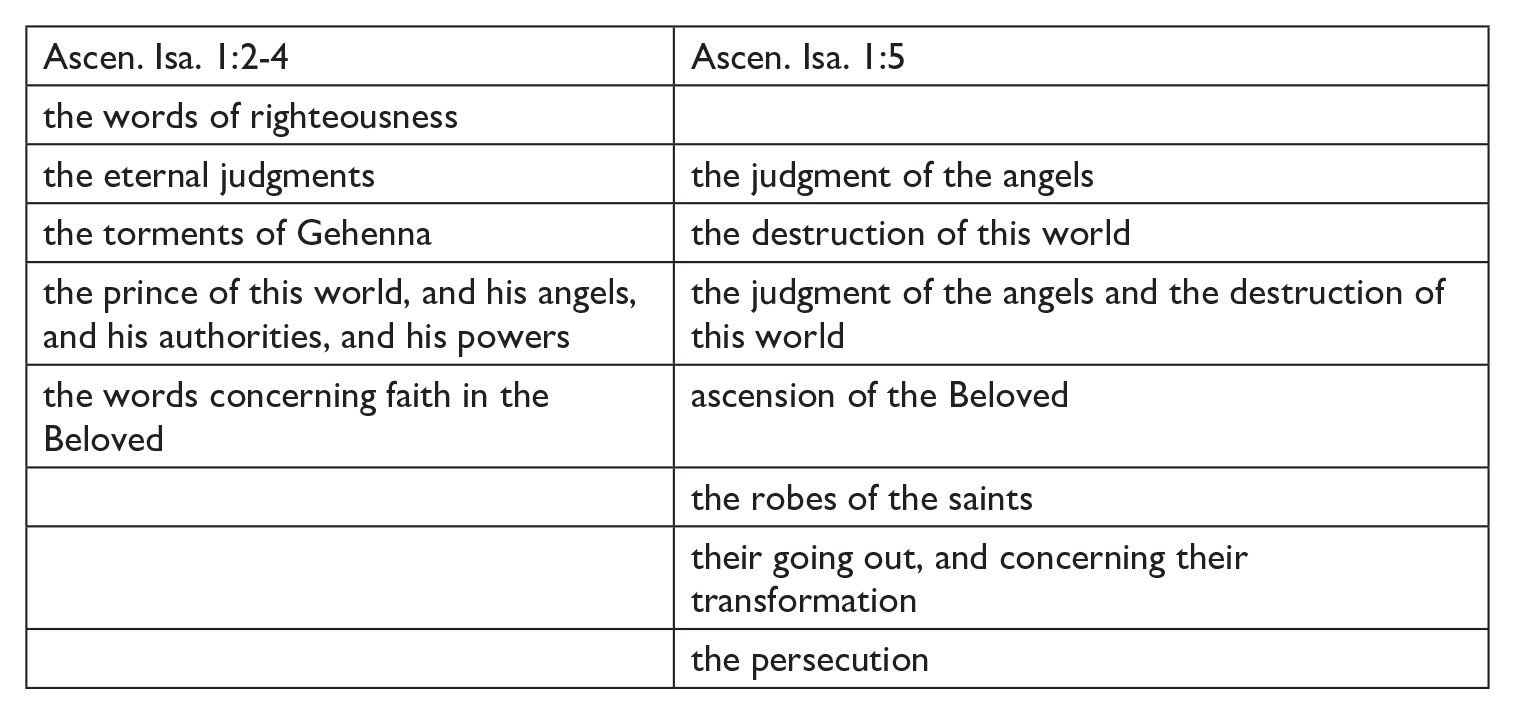
Three documents are mentioned here. Samnas, the secretary of Hezekiah, has written a document, then there is one by Isaiah and finally, reference is made to the document containing the vision of Hezekiah. This last document is described both in Ascen. Isa. 1:2-4 and then again in Ascen. Isa. 1:5. These two descriptions partly overlap with each other:
The Hebrew text in Isa 38:9 refers to the written document: מלך־יהודה לחזקיהו מכתב מחליו ויחי בחלתו, “A writing of King Hezekiah of Judah, after he had been sick and had recovered from his sickness.” The Septuagint version is almost same, but “writing” has been substituted by the Greek προσευχὴ (“prayer”): Προσευχὴ Εζεκιου βασιλέως τῆς Ιουδαίας, ἡνίκα ἐμαλακίσθη καὶ ἀνέστη ἐκ τῆς μαλακίας αὐτοῦ. 33 Isa 38:9 indicates that Hezekiah had formulated a writing after he had recovered from his illness. It is this writing of Hezekiah which lurks behind the king’s vision in Ascen. Isa. 1:2-5. The details in Hezekiah’s prayer in Isa 38:9-20 indicate that the king had seen something and, therefore, ancient interpreters may have understood the text as Hezekiah reporting his own vision. 34 I will now approach the content of Isa 38:9-20 from the perspective that the Exegete saw it to be elliptical containing different words and themes which inspired him to seek new mysterious dimensions which lurk behind the text.
Isa 38:11 refers to Hezekiah’s fear that he “would not see” Jah (so MT; or “the salvation of God” so LXX). However, the king’s report indicates that he had recovered from his illness. The Exegete deduced from this fact the idea that the king did receive contact with God. In a similar way, Isa 38:14 (both in MT and in LXX) recounts that Hezekiah’s eyes are looking upward. What is included in this Hezekiah’s attempt of “seeing” or “looking”? Again, the Exegete had the possibility to argue that Hezekiah’s writing contained more. God allowed Hezekiah to become ill because he wanted to show him a vision and then helped him recover. In this way, the Exegete concluded that Hezekiah “had seen” a great vision “in the fifteenth year of his reign during his sickness” (Ascen. Isa 1:4) and that vision parallels what Isaiah had seen (Isa 6).
Moreover, Isa 38:9-20 contains formulations which gave the Exegete the possibility to understand important cosmological terminology that reflects the worldview which he promoted in the Ascension of Isaiah. 35 Hezekiah laments that he cannot see the “land of living” (MT Isa 38:11 or τῆς γῆς in LXX Isa 38:11) or that his eyes are weary to see “the height” (מרום in MT Isa 38:14 or τὸ ὕψος τοῦ οὐρανοῦ, “the height of heaven” in LXX Isa 38:14). However, Hezekiah’s song of praise ends with the note that God saved him. This salvation implied for the Exegete that God gave the king possibility to see again “the land of living” because the king received the real contact with “the height of heaven.” This being the case, the Exegete concludes that the king’s failure to see implies an overwhelming sight. In Ascen. Isa. 1:5 the Exegete argues that Hezekiah had seen the “ascension of the Beloved.” In the Ascension of Isaiah “ascension” takes place in the heavenly sphere and corresponds well to “the height of heaven” in LXX Isa 38:14.
During his illness Hezekiah was in danger of going down to Sheol or Hades (Isa 38:18). From this detail the Exegete was able to derive an idea that Hezekiah saw the land of the dead, and even the torments of Gehenna (as indicated in Ascen. Isa. 1:2-5). In this way the Exegete was able to conclude that his cosmological view is present in Hezekiah’s prayer. The elliptical reading of the prayer of Hezekiah gave the Exegete the possibility to find terms which were important in the cosmological model of the Ascension of Isaiah. “This world” (Ascen. Isa. 6:15; 7:24; 10:12) is “the world of the flesh” (8:23) corresponding well to “the land of living” in Isa 38:11. Heaven is the central term in the whole document of the Ascension of Isaiah, and it parallels to “the height” (or to “the height of heaven”). Finally, the Exegete also found references to Sheol, the place which is mentioned in Ascen. Isa. 4:21; 10:8, 10; 11:19. As far as “the torments of Gehenna” are concerned the Exegete may have seen references to them in Isa 38:18b where the Hebrew and Greek texts describe the hopeless situation by using expressions “death cannot praise you” (MT; cf. LXX: οὐδὲ οἱ ἀποθανόντες εὐλογήσουσίν σε) and “those who go down to the Pit cannot hope for your faithfulness” (אל־אמתך יורדי־בור לא־ישברו). 36
In its MT form, in addition to “seeing,” the prayer of Hezekiah also refers to the king having heard the voice of God (Isa 38:15): “For he has spoken to me, and he himself has done it” (ואמר־לי והוא עשה). If the Exegete consulted with the Hebrew text, he certainly noticed that God has spoken to the king (ואמר־לי). The Greek text is shorter and somewhat different. Nevertheless, the Greek text also indicates that some sort of contact must have taken place between God and Hezekiah when the king says in the following verse (LXX Isa 38:16): “Lord, you were indeed told concerning it, and you revived my breath, and I, comforted, came to life!” The Exegete may even conclude from “you were indeed told concerning it” (περὶ αὐτῆς γὰρ ἀνηγγέλη σοι) that some words were changed. He concluded that Hezekiah’s encounter with God was possible only if the king had seen a vision and entered the divine sphere.
Finally, it is worth noting that Hezekiah’s prayer in Isa 38:9-20 is a thanksgiving hymn to God. Such a thanksgiving is an important feature in the Ascension of Isaiah where Isaiah, in his journey to the highest heaven, always sees angels praising God in different heavens. While praising is not the expressis verbis mentioned in the vision of Hezekiah reported in Ascen. Isa. 1:2-5 it is, nonetheless, implicit there. Hezekiah has seen the salvation plan of God which concerns the ascension of the Beloved. As is customary in the Hebrew Bible, the salvation which God realizes for his people or for believers receives a response from humans in the form of praise. 37
The coming Redeemer
According to Ascen. Isa. 1:2-5, Hezekiah has seen the Beloved and especially his ascension. The ascension is an important theological concept for the Exegete because he regards it as being an important part of salvation. This is expressed clearly in Ascen. Isa. 2:9 where the faithful are characterized as those “who believed in the ascension into heaven.” The ascension of the Beloved implies his descent into the world—a topic which the Exegete relates particularly to Isa 52:13-53:12 (Ascen. Isa. 4:21). Hezekiah’s prayer, in Isa 38:9-20, contains details which the Exegete could interpret as referring to the messianic Redeemer who would come from Heaven.
First, according to MT Isa 38:11, Hezekiah’s distress is formulated so that he no longer will see God or a man: אמרתי לא־אראה יה יה בארץ החיים לא־אביט אדם עוד עם־יושבי חדל, “I said, I shall not see the Yah, Yah in the land of the living; I shall look upon a man no more among the inhabitants of the world.” The Septuagint version is a little different (“I said, ‘No longer shall I see the salvation of God on the earth; no longer shall I see a man’”). The Greek text refers to the salvation of “God” instead of “Yah, Yah.” Both Aquila and Theodotion follow the Hebrew text by translating “Ia Ia in the land of living.” 38 This indicates that at the time of writing of the Ascension of Isaiah it was self-evident to render the Hebrew version into Greek by reading “Ia Ia” (corresponding to “Yah Yah”). If the Exegete was indeed bilingual or consulted a more precise Greek translation of the Hebrew text, he certainly would have given attention to the double reading of Yah. What kinds of consequences did the Exegete make from the double reading Yah, Yah and the fact that Hezekiah’s prayer referred to a certain man?
If the Exegete read in Isa 38:11 the double reading of the shortened form of Yahweh as indicated in the MT as well as in Aquila and Theodotion, this could provide him a good basis to understand them according to his Christology. The Exegete could relate them to the Christological speculations of the work. Alongside the Great Glory (God Father) there is also another “Lord” that would represent the Beloved who in the Ascension of Isaiah is also called Lord (’egzi,’ see, for example, 9:5). Everyone who reads the prophet’s vision in the Ascension of Isaiah 6-11 notices that the real climax of the vision is how the guiding angel helps Isaiah to understand that beside the Great Glory (= God) there is also another Lord worthy of veneration (see especially Ascen. Isa. 8-9). Another peculiar feature in Isa 38:11 is that God’s salvation is related to “a man.” The Exegete could have seen here an indirect reference to how one of Yah will descend into the world and take the form of man (Ascen. Isa. 10-11). The elliptical reading of Isa 38:11 (MT) gave the Exegete possibility to find traces how even Hezekiah had seen the Beloved (Yah) beside the Great Glory (Yah), and, in addition, that the second Yah will descend in the form of a human being—the topic of Isa 52:13-53:12 according to Ascen. Isa. 4:21.
This being the case, the Exegete’s Christological reading of Isa 38:11 (MT) can be related to Ascen. Isa. 1:5. According to this verse, Hezekiah has in his vision seen the “ascension of the Beloved.” This expression includes that the Beloved has descended from the heaven and become a man and then again returned to the heaven. The double reading of Yah gave the Exegete the possibility to see that beside the Great Glory (Yah) there is another Lord (Yah) and this another Yah is also the man whom Hezekiah wants to “look upon.” In the elliptical reading of this verse the Exegete confirmed his Christological reading according to which another Yah will become a man.
While the reading of the Septuagint in Isa 38:11-12 is different from the MT (and Aquila and Theodotion) it does allow a similar interpretation. According to LXX, the main theme is the salvation of God and the future offspring of Hezekiah (LXX Isa 38:11-12): “I said, No longer shall I see the salvation of God on the earth; no longer shall I see a man from my kindred” (εἶπα Οὐκέτι μὴ ἴδω τὸ σωτήριον τοῦ θεοῦ ἐπὶ τῆς γῆς, οὐκέτι μὴ ἴδω ἄνθρωπον ἐκ τῆς συγγενείας μου). The Exegete could have understood the man in LXX Isa 38:11-12 as being the royal child from the house of David through the lineage of Hezekiah. From these verses the Exegete had possibility to deduce that the coming offspring of Hezekiah will realize “the salvation of God on the earth” (τὸ σωτήριον τοῦ θεοῦ ἐπὶ τῆς γῆς). Such an elliptical reading is related to the interpretation of Isa 52:13-53:12 (Ascen. Isa. 4:21) and to the incarnation accounted in Ascen. Isa. 11.
Early Jewish and Christian interpreters have certainly noted that Hezekiah was childless at the time he became ill. This was easy to calculate mathematically because Hezekiah received fifteen extra years after his recovery from the illness, and Manasseh was only twelve years old when he became king (2 Kings 21:1). Both Josephus and the rabbinical writings refer to this childlessness of Hezekiah before his illness. 39 The Septuagint translator of Isa 38:9-20 has also noticed that the dynasty of David would have ended through the death of Hezekiah, and this would have caused problems for the divine promise concerning the appearance of the Messiah among the offspring of David. Therefore, the Septuagint readings of Isa 38:11-12 quoted above were made with reference to this topic of childlessness. In his prayer, Hezekiah reports that during his vision he received a promise that he would have children and his family line will have continuance.
The prayer of Hezekiah contains other details which the Exegete could have related to Hezekiah’s childlessness. The MT Isa 38:19 indicates that after his recovery from illness Hezekiah would have the possibility to fulfill the task of a righteous father: “fathers make known to children your faithfulness (יודיע אל־אמתך).” According to Ascen. Isa. 1:2, Hezekiah acted accordingly when he delivered to his son Manasseh the documents of righteousness and truth: “to hand over to him the words of righteousness (yāwaffeyo qālāta sedq).” 40 The idea that Hezekiah would receive a child is expressed even more clearly in the translation of the Septuagint where Isa 38:19 is interpreted as follows: “… for from today I will produce children who will declare your righteousness” (ἀπὸ γὰρ τῆς σήμερον παιδία ποιήσω, ἃ ἀναγγελοῦσιν τὴν δικαιοσύνην σου). 41 While the Septuagint version indicates that Hezekiah will receive children who are loyal to God, the Hebrew text contains an idea that Hezekiah himself attempts to lead his children into the right path—as Hezekiah did according to Ascen. Isa. 1:2.
The central theme in the Ascension of Isaiah is that the promised Messiah from the lineage of David and Hezekiah (11:1-19) is the Beloved who will descend from Heaven (10:7-31). In the Septuagint version of Isa 38:14-15 Hezekiah expects that salvation will come from the heights alongside God (the MT has a similar content):
ὡς χελιδών, οὕτως φωνήσω, καὶ ὡς περιστερά, οὕτως μελετήσω· ἐξέλιπον γάρ μου οἱ ὀφθαλμοὶ τοῦ βλέπειν εἰς τὸ ὕψος τοῦ οὐρανοῦ πρὸς τὸν κύριον, ὃς ἐξείλατό με καὶ ἀφείλατό μου τὴν ὀδύνην τῆς ψυχῆς. Like a swallow, so will I cry out, and like a dove, so will I mutter; for my eyes have failed from looking into the height of heaven, toward the Lord, who rescued me and took away the pain of my soul.
LXX Isa 38:14-15 corresponds well to the basic theme of the Ascension of Isaiah according to which the salvation of God was planned in the height of heaven. Hezekiah’s recovery made it possible that his offspring could become the father of the Beloved. Even though, as listed in the Gospel of Matthew (Matt 1:10), 42 this will take place through the godless Manasseh 43 it demonstrates the sovereign salvation plan of God. In this interpretive perspective Hezekiah would have confessed in the account of his vision that his recovery was related to God’s plan of salvation to send the Beloved to earth.
Salvation and judgment
The prayer of Hezekiah contains a contrast between salvation given by God, on one hand, and death and destruction in Sheol, on the other hand. This contrast is also seen in Ascen. Isa. 1:2-5 where the “words concerning faith in the Beloved” are contrasted to “the eternal judgments,” “the torments of Gehenna,” and “judgement of the angels and the destruction of this world.” The message of salvation is especially formulated in the words “ascension of the Beloved.” Later in Ascen. Isa. 3:18 the central “words concerning faith in the Beloved” are expressed in conjunction with the ascension of the Beloved: “… and they will teach all nations and every tongue the resurrection of the Beloved, and those who believe in his cross will be saved, and in his ascension to the seventh heaven from where he came.” I have already shown that Isa 38:9-20 contains expressions which the Exegete has interpreted elliptically as referring to the Beloved who will descend from heaven and give salvation to the righteous ones.
In Hezekiah’s prayer salvation is contrasted with the fate of those who must remain in Sheol or in destruction (Isa 38:18 MT): “For Sheol (שאול) cannot thank you; death (מות) cannot praise you; those who go down to the Pit (בור) cannot hope for your faithfulness.” Especially the terms “death” and “Pit” the Exegete could have understood as referring to the place of Gehenna. Gehenna is the place where Beliar and his hosts will be thrown (Ascen. Isa. 4:14). The content of the Greek text is similar even though the idea of the Gehenna is more difficult to deduce from it—Hades corresponds to Sheol rather than Gehenna: “For those who are in Hades will not praise you, nor will the dead bless you, nor will those who are in Hades hope for your mercy” (οὐ γὰρ οἱ ἐν ᾅδου αἰνέσουσίν σε, οὐδὲ οἱ ἀποθανόντες εὐλογήσουσίν σε, οὐδὲ ἐλπιοῦσιν οἱ ἐν ᾅδου τὴν ἐλεημοσύνην σου). Unlike Hezekiah after he recovered from his illness, those who are not saved from Sheol are not able to sing thanksgiving hymns to God. In the Ascension of Isaiah this giving thanks is a central theme, and it is related to the heavenly life of angels. The ancient interpreter could have understood this as Hezekiah being in danger during his illness because he had been moving toward Sheol and had seen there the awful situation of the dead. This may have given the Exegete reason to formulate that Hezekiah had seen the eternal judgments and the torments of Gehenna.
The Ascension of Isaiah between Judeo-Christian borderlines
I close this article by dealing with the significance of the early Christian interpretation tradition, according to which Hezekiah had seen the vision related to the coming of the Beloved and the salvation plan of God. It is possible to demonstrate that in the early Jewish reception history of the book of Isaiah, Hezekiah played an important role as the righteous king whom Isaiah supported with his prophecies (Sir 48:17-25). 44 The Messiah belongs not only to the lineage of David but specifically to the lineage of Hezekiah (cf. 2 Chr 29:2). The reception history of the Immanuel prophecy signified that Hezekiah was identified with Immanuel. This understanding was already deeply rooted in the Hebrew Bible, especially in 2 Chr 32:7-8, but also in the reception history of the book of Isaiah as I have argued in the monograph Message and Composition of the Book of Isaiah. In that study I demonstrated that in Isaiah 7-9 Judah’s fate has been interpreted according to the Deuteronomistic theology in 2 Kings 16-20. According to this perspective, Israel and Judah are in the midst of the crisis because both the kings of Israel as well as Judah were disloyal, and the Assyrian invasion is an acute threat. However, the situation changes in Judah when instead of the disloyal Ahaz the righteous king Hezekiah is born (Isa 7:14-17; 9:1-6). Even though the doom prophecies about the Assyrian invasion against Israel and Judah will still be realized in Hezekiah’s reign, Assyria will not be able to destroy Jerusalem which will be under divine protection because of its loyal king. The Deuteronomistic editor used Isa 8:5-10 in order to explain in which ways Isaiah prophesied the outcome of 2 Kings 16-20:
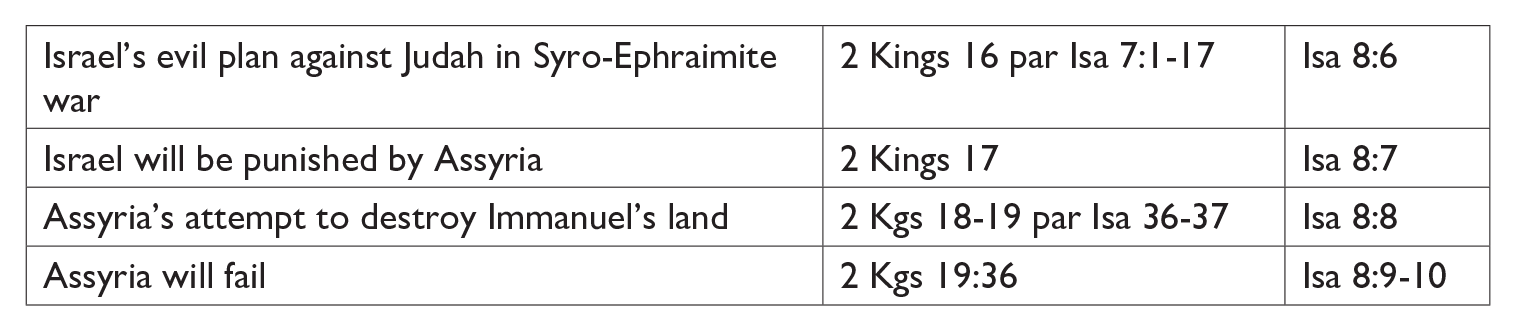
In the early Jewish reception history before the time of Jesus, Hezekiah, thus, became a tupos for the coming Messiah and in this way his birth too could become a tupos for the coming birth of the Messiah. The interpretation of the Immanuel prophecy in the terms of Hezekiah corroborated well with the content of Isa 7:14-17, according to which Immanuel was a child whose birth took place in the time of Isaiah. The positive picture of Hezekiah in the Ascension of Isaiah followed in a natural way this Jewish perspective on the Immanuel prophecy. The Exegete accepted it but wanted to seek deeper meaning in the Immanuel prophecy by also relating it to the birth of the Beloved (Ascen. Isa. 11).
As noted at the beginning of this article, Hall’s way of using Sir 39:1-3 as an early hermeneutical model to understand bipartite interpretation, where in addition to the literal meaning there is another deeper and secret meaning of the text, helps us to understand the role of Hezekiah in the Ascension of Isaiah. The Judeo-Christian spiritual milieu was familiar to the Exegete and therefore he followed the positive picture of Hezekiah in the reception history of the Book of Isaiah. In this spiritual milieu Hezekiah was identified with Immanuel in Isa 7:10-17 as well as with the royal king in Isa 9:1-6. There was, however, another deeper meaning, one which is recounted in Matthew 1. From the height of heaven, the Beloved will descend into the world and fulfill the Immanuel prophecy in its deeper meaning (Ascen. Isa. 11:2-5). The Exegete wanted to emphasize that not only Isaiah but even Hezekiah (Ascen. Isa. 1:2-5) had foreseen the coming of the Beloved. The Exegete reused Hezekiah’s prayer in Isaiah 38 and understood it as the king’s vision concerning the coming of Christ. In this way Isaiah and Hezekiah in concert promoted a deeper Christological meaning to the texts in the book of Isaiah.
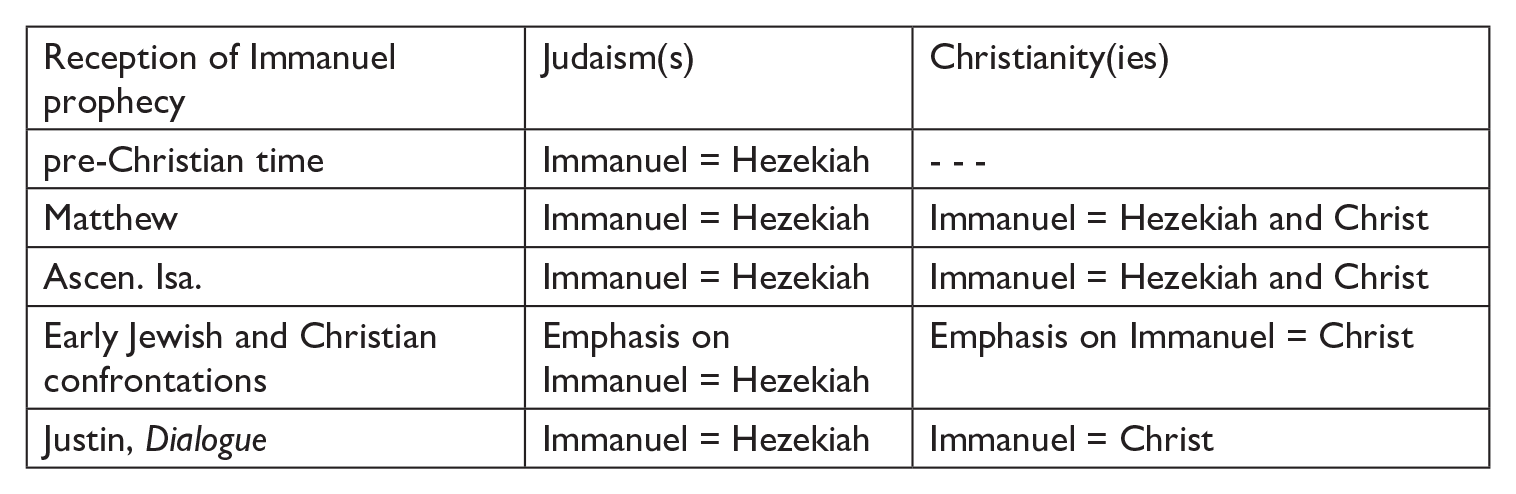
When the Ascension of Isaiah is compared to Justin Martyr’s Dialogue one significant difference can be detected. Justin Martyr presents the identification of Immanuel with Hezekiah as something which is a Jewish alternative promoted by Trypho, while in the Christian interpretation Immanuel is identified with Christ. These two interpretations are opposed diametrically against each other and are exclusive alternatives (Dial. 43 and 66). Why did the situation differ in Justin’s Dialogue? A plausible explanation could be that in the Jewish-Christian confrontations both parts were forced to promote their favorite explanations of the Immanuel prophecy. In this confrontation, the Jewish interpretation of Immanuel prophecy (that is, Hezekiah) and the Christian understanding of the text (that is, the Christ) became exclusive alternatives. Justin followed this tradition.
I have devoted a special study on Justin’s discussion of the Immanuel prophecy and demonstrated that it is based on an earlier Jewish interpretative tradition where Isa 8:4 was placed inside Isa 7:10-17. 45 I argued that Justin’s text involving Isa 7:10-16a + 8:4 + 7:16b-17 originates from earlier Christian writings where the Immanuel prophecy was discussed in more friendly tones with the Jews. In that discussion the Hebrew expressions of Isa 8:3 were understood so that Isaiah wanted to know more details about the Immanuel prophecy. The ancient Jewish exegete interpreted the verse elliptically in the following way: “And I began to consult (i.e., I approached, ואקרב) with the prophetic Voice (הנביאה) concerning ‘She conceived and bore a son’ (that is, the words of Immanuel prophecy). And the Lord said to me: ‘Name him Maher-Shalal-Hash-Baz.’” Such an elliptical reading is apparently behind Exodus Rabbah 18:5, according to which Isaiah gave Hezekiah both names, Immanuel and Maher-Shalal-Hash-Baz. I proposed in that article that Justin’s reading of Immanuel prophecy and Isa 8:4 could have been taken from Controversy between Jason and Papiscus. In that document there may have been a mutual agreement that the literal meaning of the Immanuel prophecy concerned Hezekiah while the Christian interpreter wanted to introduce the mysterious dimension of the Immanuel prophecy which concerns the birth of Christ. However, Justin developed this earlier discussion in another direction where the interpretations of “Hezekiah” and “Christ” were mutually exclusive alternatives.
Oskar Skarsaune has shown that Justin’s Dialogue contains many early Jewish-Christian interpretive traditions where a more tolerant view toward Judaism is prevalent. 46 While Justin clearly constructed a borderline between Judaism and Christianity by giving two exclusive alternatives for the Immanuel prophecy, the Exegete in the Ascension of Isaiah according to my understanding followed a different rhetorical strategy. In his opinion, the Immanuel prophecy was a two-level prophecy. In its historical dimension it was fulfilled in the life of Hezekiah while in its deeper meaning it refers to the birth of Beloved.
I want to emphasize that there is no clear statement in the Ascension of Isaiah that the Immanuel prophecy would have been understood as a birth prophecy of Hezekiah. Nevertheless, the idea that Hezekiah is Immanuel was deeply rooted in the Hebrew Bible and in early Jewish reception history. The Exegete presents Hezekiah as a righteous king, and it is a plausible alternative that he also accepted the established Jewish interpretation that the Immanuel prophecy refers to the birth of Hezekiah. In addition to this historical interpretation, the Exegete sought a deeper meaning of Isa 7:14-17 by interpreting its final fulfillment as having taken place in the birth of Jesus (Ascen. Isa. 11:1-15). The birth of Jesus in the Ascension of Isaiah 11 is dependent on the gospel of Matthew 47 and the same conclusion may also be true of Matthew: the Immanuel prophecy was a prophecy about the birth of Hezekiah and its deeper meaning refers to the birth of Christ. If this interpretive scenario is accepted, we can present thematically how the reception history of the Immanuel prophecy was developed in the early Church:
Summing up, I have dealt with the content of the vision of Hezekiah in Ascen. Isa. 1:2-5 and argued that the Exegete interpreted elliptically Hezekiah’s prayer or thanksgiving in Isa 38:9-20. The Exegete argues that in his vision Hezekiah foresees the coming of Christ who fulfills the salvation plan of God. I have proposed that the Exegete presumably accepted the established Jewish interpretation that Immanuel was Hezekiah but argued, additionally, that its deeper secret meaning (according to the interpretive model of Sir 39:1-3) concerned the Beloved. In this respect the Ascension of Isaiah gives us a good opportunity to see what kind of interpretation Justin Martyr introduced in his Dialogue when he emphasized the borderline between Judaism and Christianity. Unlike the Exegete, Justin no longer emphasized Hezekiah’s active role in seeing the coming of Christ. Justin presented two exclusive alternatives to understand the Immanuel prophecy: Hezekiah or Christ. These exclusive alternatives were then established in subsequent Christian discourse. Nevertheless, the Ascension of Isaiah shows that at the beginning of the Christian Isaiah exegesis Hezekiah was not a Jewish alternative in the Immanuel prophecy contrasted to the Christological interpretation. Rather Hezekiah was regarded as adhering to the Christological interpretation of the Immanuel prophecy. It seems to me that the same conclusion is valid for the gospel of Matthew.
Footnotes
Acknowledgements
This article is a part of the research project “Isaiah between Judeo-Christian Borderlines.” I have currently translated the Ascension of Isaiah from Ge‘ez into Finnish, and this article is one of many contributions I have found as being relevant in our current research project. I received important feedback for this article from two anonymous reviewers, and from Dr. Lotta Valve and Dr. Matthew Goff that is hereby gratefully acknowledged.
Declaration of conflicting interests
The author(s) declared no potential conflicts of interest with respect to the research, authorship, and/or publication of this article.
Funding
The author(s) disclosed receipt of the following financial support for the research, authorship, and/or publication of this article: This article has received finance from the Academy of Finland and the Polin Institute for 2022–2026 support that is hereby gratefully acknowledged.