



Abstract
This paper brings together insights from different research areas by on the one hand examining the Apocalypse of Abraham in its context of ancient Judaism and on the other hand looking at the fourteenth century context of its manuscript-tradition. Special attention is given to how the Apocalypse of Abraham receives Ezekiel in order to create its distinct vision of God’s throne. The copyist/redactor of the manuscript in Old Church Slavonic adds six miniatures to his codex depicting essential scenes from the Apocalypse of Abraham. However, when looking at the miniature of Abraham and the angel Jaoel before God’s throne, one wonders if the miniaturist knew the text of the Apocalypse of Abraham at all or if he wanted to create his own vision of God’s throne thereby correcting/adding to the meaning of the Apocalypse’s vison of the throne. By examining both the original and the manuscript context of the work multiple discourses are opened and new questions of transmission of ancient Jewish texts in Christian transmission arise. The paper wants to encourage further research in the field of Slavonic pseudepigrapha and its transmission which is still a neglected field of academic endeavor.
Keywords
Introduction
The Apocalypse of Abraham was written at the end of the first century C.E., however, its text came down to us in manuscripts which date to the fourteenth century C.E. 1 Originally written in Hebrew, the available texts for it are so far Church Slavonic translations, which in turn are a translation of a Greek Vorlage. 2 The scholarly access to the manuscripts is still unsatisfactory, and the most important critical edition of the Church Slavonic text is out of date. 3 However, this should not prevent us from studying the texts and manuscripts which we can access in order to integrate the Apocalypse of Abraham into the larger picture of ancient Judaism while we hope for further advances in the study of its manuscript tradition. 4 This paper seeks to show how Ezekiel influenced both the assumed ancient Jewish writer of the Apocalypse and the much later medieval producer of the manuscript (script and image). It tries to build a little bridge between the often-separated areas of ancient Judaism and the Slavonic manuscript tradition with the help of Ezekiel hoping that more such bridges can be established in future research which will help us understand better both the provenance of the work and its unique history of transmission. 5
When it comes to Ezekiel, I will focus on the visions of the throne and their reception in the Apocalypse of Abraham and its manuscript tradition. The visions of the throne of God (see Ezek 1; 10; Apoc. Ab. 17–18) and the motif of the idol in the temple, which is seen as a cause for its destruction (see Ezek 8–11 and Apoc. Ab. 25), clearly reference Ezekiel, although Ezekiel is not mentioned, and its text not quoted. Rather, certain motifs are taken up and developed further by the author of the Apocalypse to depict Abraham’s ascent to the throne. Whereas earlier scholars have noted the influence of Ezekiel on the Apocalypse of Abraham, 6 a thorough comparison which takes into consideration both similarities and differences has not been undertaken so far. Due to the manuscript situation and the different languages of the texts we are dealing with, it is clear that no small-scale comparisons can be made on the level of words and syntax. The present analysis is rather indebted to a traditional-historical approach which seeks to demonstrate how shared motifs are incorporated, adapted, and developed in new ways and contexts. In its reception of Ezekiel, the Apocalypse of Abraham stands within a broad stream of textual traditions of authors and communities of ancient Judaism and early Christianity, most notably the Enoch tradition (see 1 En.) and the Qumran community (see 4Q385 4 and Songs of the Sabbath Sacrifice), but especially John the seer (Rev), 7 whose entire work is interspersed with motifs and images from the book of Ezekiel. 8 However, the comparative approach will show how the author of the Apocalypse of Abraham creates his very own narrative of the throne which is marked by a creative use of Israel’s scriptures and his original theological thinking.
In the second part of the paper, I will analyze an image in the oldest manuscript of the Apocalypse of Abraham, the Sylvester Codex, which depicts Abraham and the angel Jaoel before God. In depicting Abraham and Jaoel, the miniaturist clearly receives both the text of the Apocalypse and Ezekiel. However, in other crucial matters he contradicts both texts and implements his own culturally given premises. To my knowledge the miniatures of the codices have not yet been integrated into scholarly research on the Apocalypse of Abraham. I will argue that the integration of the codices and its paratextual details is crucial for understanding the transmission history and how the text was given new meanings in ever changing contexts and communities of reading.
The visions of God’s throne in Ezekiel and in the Apocalypse of Abraham
The Apocalypse of Abraham is divided into two parts: chapters 1–8 describe Abraham’s conversion from the idols of his family to the God of Israel, embellishing in midrashic fashion Genesis 12, 15, 22, and Joshua 24:2–3.
9
The second part consists of chapters 9–31
10
and describes Abraham’s ascent to heaven before the throne of God, where he also gets to see the course of the world in its primordial and eschatological dimensions. Both parts are artfully woven into a coherent text and are related to each other on multiple levels. Chapters 9–14 of the Apocalypse can be seen as the preparatory prelude to the ascension. After Abraham’s house along with his father and all his idols have been burned by God, God meets Abraham to command him to sacrifice (see 9:1–10). Abraham is swept off his feet and filled with fear, but he is raised up by the angel Jaoel, a central figure of the narrative, who is introduced for the first time in chapter 10 and accompanies Abraham from then on. Jaoel takes him by the hand and leads him forty days and nights to the mountain of God, where he gives him the instructions for the sacrifice (see 11:1–12:8). After everything is prepared, an unclean bird comes unexpectedly and begins to dissuade Abraham from obeying God. The bird is identified as “Azazel” and “ungodliness”; after the bird’s efforts are victoriously overcome (13:1–14:7), the ascension can begin, which is described in 15:2–3 with the following words:
2 And the angel took me by the right hand and set me upon the right wing of the dove. But he himself sat on the left wing of the turtledove; those were neither slain nor cut in pieces. 3 And he carried me to the edge of the flames of fire.
Then Abraham is carried up “by many winds” (Apoc. Ab. 15:3: многи вѣтры), where he sees a “strong light” (15:4: свѣтъ силнꙑи) and a “fire of a multitude” (15:5: огнь народу). 11 As at the beginning of Ezekiel’s vision, the natural phenomena of wind and fire set the stage for seeing God’s throne (Ezek 1:4: סערה אש מתלקחת, ענן גדול, רוח), however, Ezekiel is never taken up to the throne of God. Abraham does not only see the throne as Ezekiel does (Ezek 1:1: נפתחו השמים ואראה מראות אלהים) but participates in the events before the heavenly throne as an active agent and worshiper. In this the Apocalypse of Abraham and other writings of the Second Temple period go beyond Ezekiel (see Apoc. Ab. 15–17; 1 En. 14:8-9; Rev 4:1-2; also note Paul’s mentioning of his ascension in 2 Cor 12:1–4).
Once in the throne room, Jaoel prepares Abraham for the encounter with the Eternal One, who will walk toward them but whom Abraham will not see (see 16:1–3). What Abraham subsequently sees is a fire surrounding him and he hears a voice which is further characterized as a voice “of many waters” and the “voice of the sea in its churning” (17:2). Whereas in Ezek 1:24 the sound of the wings of the four living beings and the sound of the Almighty are both described “as the sound of many waters” (כקול מים רבים), in the Apocalypse of Abraham the sound of waters is associated with the voice of God only. 12
Now the description of the throne environment is interrupted for a moment because it is described how Jaoel and Abraham worship the Eternal One and recite the song together. After the song (17:8–18), the throne is further described, clearly showing the influence of Ezekiel. Therefore, the whole description of the throne is quoted here (18:1–11), which is offered in a synopsis with corresponding passages from Ezek 1. 13
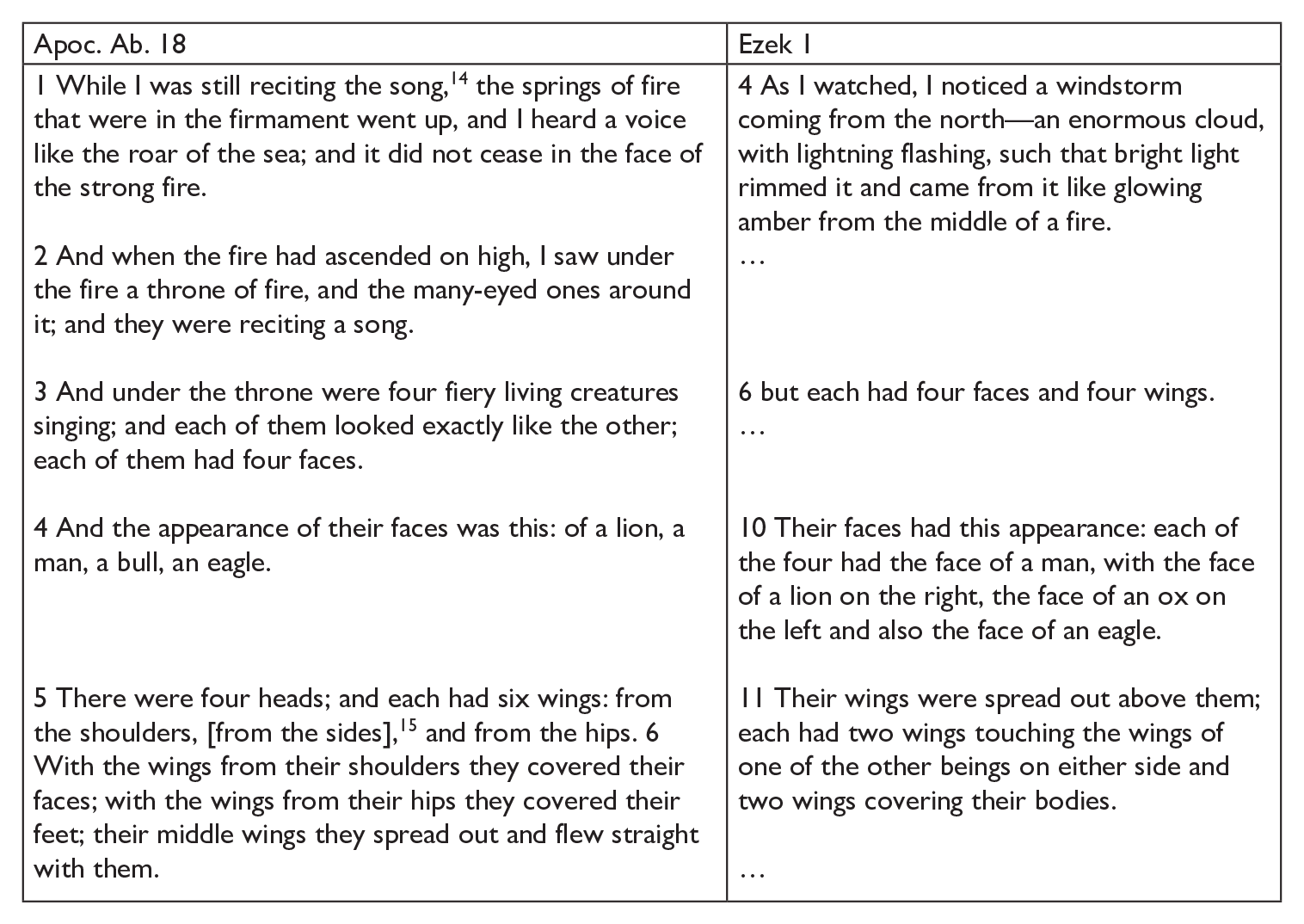
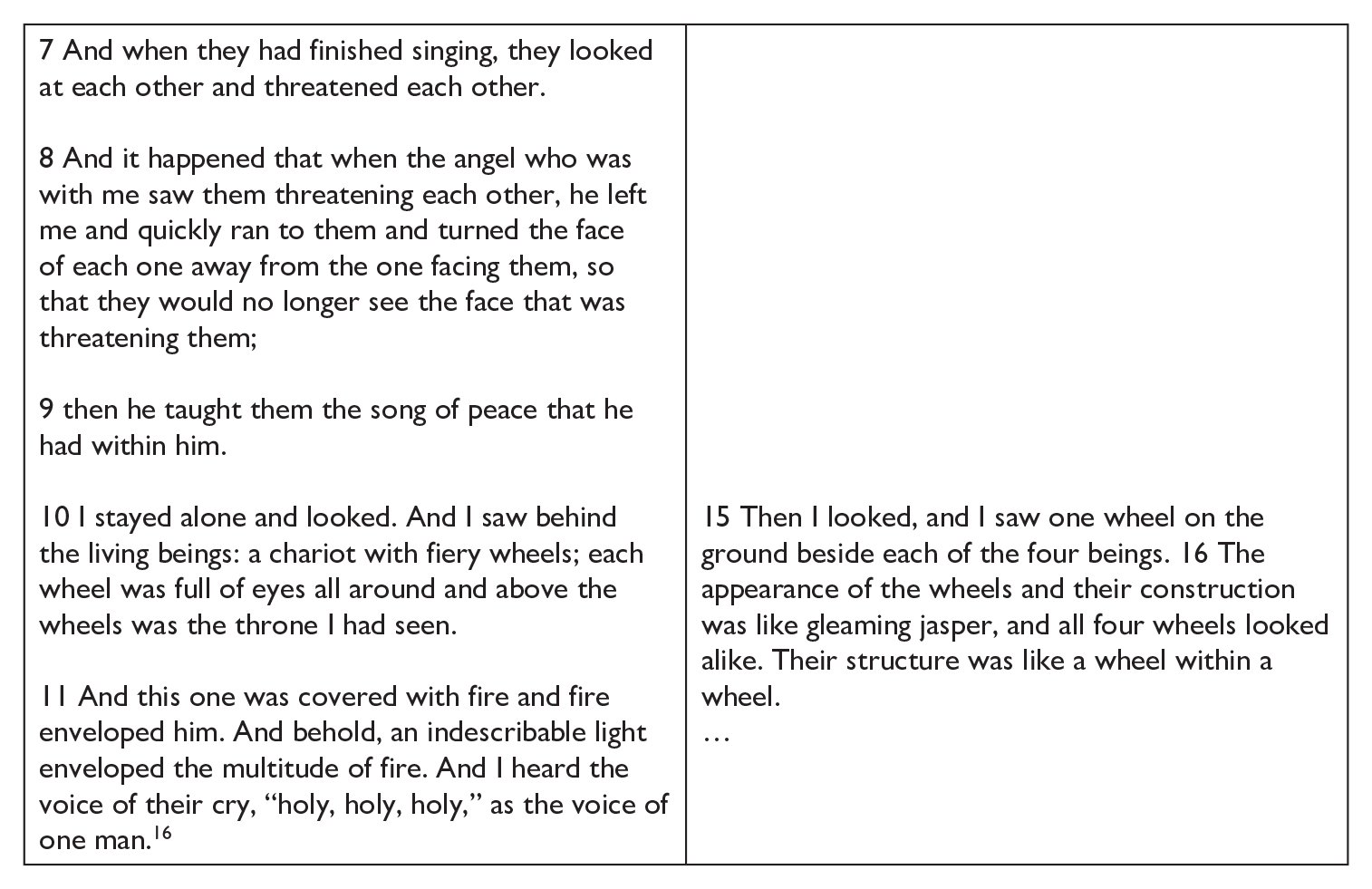
The synopsis highlights parallels and leaves out large portions from Ezekiel which at the same time indicates that Ezekiel’s vision is much longer and detailed than the Apocalypse of Abraham. Let us follow the seer of the throne in the Apocalypse of Abraham and see which motifs he shares with Ezekiel and how he adapts them for his own purposes.
The vision opens with Abraham singing the song (18:1: “While I was still reciting the song”), which is given at length in the preceding chapter (see Apoc. Ab. 17). Singing has a central role for seeing the vision of God in the Apocalypse. When Jaoel is introduced in 10:10 he is presented as the one who teaches the song. In the narrative structure of the work, the actual contents of the song are introduced at a climactic point, namely, as a preparation for the vision of the Invisible. 18:1 is repetitive since the whole of chapter 17 tells us that Jaoel and Abraham are singing the song, which is again stressed in 18:1. It is as though the song is the key to unlock the vision or to bring it to its flourishing: as he sings the springs of fire go up and the roaring of the sea is heard by him. As Andrei Orlov puts it:
By invoking the Deity (or more precisely the divine Name) in praise, the practitioner “brings” the Deity into existence, summoning him from non-being into being, thus replicating the prototypical event of creation recounted in Gen 1 where God himself brings everything into being by invoking the divine Name.
17
The importance which is placed on the singing is a clear expansion compared to Ezekiel, where all singing is nearly absent, and Ezekiel also does not participate—unlike Abraham—in the heavenly liturgy. However, the textual history of Ezekiel shows that already at a very early stage the throne of God could not be thought of without some kind of singing. One interesting example is Ezek 3:12:
ותשאני רוח ואשמע אחרי קול רעש גדול ברוך כבוד יהוה ממקומו “And the Spirit lifted me up, and I heard behind me a voice of great sound, saying: Blessed be the glory of the LORD from its place.”
Just as the ruaḥ occurs at the beginning of Ezekiel’s vision (1:4), it also occurs at its end, causing Ezekiel to hear a tremendous sound, perhaps that of an earthquake. The doxology that follows seems unwieldy and not appropriate to the context. It also seems odd that the LORD’s kavod, not the LORD himself, is praised. Moreover, the adverbial clause “from its place” in conjunction with the verb ברוך is hard to understand. What should blessed “from its place” mean? These and other reasons have led exegetes to assume another original word at this point, namely, ברום. 18 Replacing the kaf with a mem, the verse in translation would read as follows: “And the Spirit lifted me up, and I heard behind me a voice of great sound as the glory of the LORD rose from its place.” Thus, ברום fits smoothly into the syntax of the preceding sentence, and the adverbial clause with the preposition min (ממקומו) now also makes sense. Whether this was a scribal error 19 or a deliberate change in the text, 20 in any case, the interchange of kaf and mem shows that very early on, the setting of God’s throne could not be imagined without praise. In the context of the following verse (v. 13), which continues “And the voice was that of the wings of the beings” (וקול כנפי החיות), the beings around the throne become the ones who praise God, which points to Isaiah 6. The Septuagint and Targumim traditions continue the tendency to increase God’s praise hymnally. 21 This becomes explicit in the Songs of the Sabbath Sacrifice or in Revelation 4–5, where the congregation and eventually the entire cosmos join in the praise of the heavenly hosts. The tradition of the praising beings around the throne extended by the congregation of humans joining them in the praise becomes a central element of Merkava mysticism and has its origins in the textual traditions of Ezekiel 1, 3, and 10—perhaps because of a quite productive scribal error, as we have seen. As Abraham sings, he sees a throne of fire surrounded by fire (see 18:2). While in Ezekiel the living beings, their movements, and their sounds are described in detail (see vv. 5–24), the throne is not mentioned before verse 26. The author of the Apocalypse reverses this order by describing the throne right at the beginning of his vision. In Ezekiel’s vision, the mention of the throne represents the climax of the vision, which is prepared by a long description of the living beings. Also, the vision of the throne in the Apocalypse has a long prelude. However, it is not the description of the living beings but the song from chapter 17 which leads to the seeing of the divine throne.
Ezekiel sees the likeness of a throne (דמות כסא) “and upon the likeness of the throne a figure like a man, upon it” (Ezek 1:26: ועל דמות הכסא דמות כמראה אדם עליו מלמעלה) as the climax of the whole vision. 22 “The most striking detail . . . which radically differs from the Ezekielian account” 23 is the omission of Ezekiel’s climax: the figure on the throne. Instead of a figure, Abraham hears a voice from the midst of the fire (see 19:1). As Orlov and other scholars have observed, this very intentional choice of the author shows an anti-anthropomorphic viewpoint within the larger divine body traditions which can be traced already in the Hebrew Bible. 24 While even the great Moses was not allowed to see God (Ex 33:20: “not can a man see me and live;”לא יראני האדם וחי), there is no problem for Isaiah to see “the Lord sitting on a throne” (Isa 6:1: אדני ישב על כסא). Although Ezekiel is not quite as bold as Isaiah, his statement comes close when he summarizes his vision using the tetragram: “This was the appearance of the likeness of the glory of the LORD” (הוא מראה דמות כבוד יהוה). The book of Deuteronomy and the Deuteronomistic school argue strongly against such corporeal depictions of the Godhead, promulgating the divine Name as the greatest possible revelation which human beings can receive. When the Sinai theophany is described in Deut 4:36, the hearing of God’s voice in placed in the center: “From heaven he spoke to you in order to teach you, and on earth he showed you his great fire from which you also heard his words.” 25 The Apocalypse of Abraham, however, not only replaces the Kavod tradition with the Shem tradition, and the visual experience with an aural experience. 26 As argued in this paper, it firmly places itself within the visual experiences of Israel’s great prophets and contradicts them at key points in order to side with central concerns of the Deuteronomistic school. The Godhead is on the throne and worshipped as such but not seen. This is explained in the conversation between Jaoel and Abraham, when Jaoel explains to him that he will see the Eternal One, but immediately assures him, “But himself you will not see” (16:3). Conspicuously absent from Abraham’s praise are any anthropomorphic descriptions of God except of the “many-eyed One” (17:12). 27
The unmediated beholding of the Godhead is not granted to Abraham, however, the glory of the Godhead becomes visible to Abraham through the mediating figure of Jaoel who is described with divine attributes. See Apoc. Ab. 11:1–3:
1 And when I had risen, I saw him who had taken me by the right hand and had set me again on my feet. 2 His body had the appearance of sapphire, and his face was like chrysolite, and the hair of his head was like snow, and the turban on his head had the appearance of the rainbow. 3 And his robe was of purple, and in his right hand he had a golden staff.
Jaoel is the bearer of God’s name (10:4: “Go, Jaoel, you who bear my name, by means of my ineffable name raise up this man”), in whom God’s action becomes tangible for Abraham: Jaoel raises Abraham up, strengthens him, encourages him, and accompanies him to the sacrifice and then all the way to the throne of God. He meets him “in the form of a man” (10:5: въ подобьи мужьстѣ). Perhaps this expression is a take on Ezek 1:26 (דמות כמראה אדם), however, the Slavonic expression clearly speaks of a male and not only a human figure. The human form that Ezekiel beholds is thus deliberately stripped of the throne and can thus meet Abraham as a man/human being (10:5). The hair of Jaoel resembles snow which takes up the description of the Ancient of Days from Dan 7:9 (“I looked, and thrones were set up, and an aged man sat down. His robe was white as snow, and the hair on his head like pure wool” [ושער ראשה כעמר נקא]). 28 Jaoel’s headdress is described in more detail as having the “appearance of the rainbow,” which could be influenced by Ezek 1:28. Whereas the rainbow is attributed to the throne-figure in Ezekiel, in the Apocalypse it is transferred to Jaoel. 29 As in the case with the Ancient of Days, divine attributes are given to Jaoel. The robe of purple in conjunction with the golden staff in the right hand may reflect kingly metaphors found in the author’s environment rather than in the biblical writings. 30 To summarize: the Godhead which is assumed to be on he throne is ruptured from human sight and cannot be described with anthropomorphic features. God’s glory becomes visible to Abraham by means of the glory of his name-bearer Jaoel; divine attributes which are used for the Godhead in Dan 7 and Ezek 1 are transferred to an angelic figure who accompanies Abraham. However, this angelic figure is not worshipped but worships with Abraham before the throne. 31
The beings around the throne are mentioned directly in connection with the throne (see 18:2). While in Ezek 1:18 it is the rims of the wheels that are full of eyes (here probably the nails of the wheels 32 or special diamonds on the wheels which are interpreted as eyes 33 ), in the Apocalypse of Abraham the beings around the throne are called “the many-eyed ones” (многоочеснꙑхъ); together with Abraham and Jaoel they also recite the song. Here, it becomes clear that the author also receives Ezek 10, which is probably a later redactional stage of chapter one. 34 Among other changes, in Ezek 10:8–17 the cherubim (כרבים) are identified with the four living creatures (חיות) of Ezek 1. It is then no longer only the wheels of the throne, but the wheels (ophanim) become fleshed out with a body, hands and full of eyes (Ezek 10:12:וכל בשרם וגבהם וידיהם וכנפיהם והאופנים מלאים עינים סביב לארבעתם אופניהם), and mutate into independent beings. The author of the Apocalypse knows both Ezek 1 and the vision of Ezek 10 and brings elements from both visions into his own without distinguishing between them. Like the beings in Ezek 1:6-10 and 10:14, those in Apoc. Ab. 18:3 have four faces. In further describing the faces, however, Apoc. Ab. follows MT Ezek 1:10, where each being has four different faces, rather than MT Ezek 10:14, where each cherub is described as having four identical faces. 35 The faces in Apoc. Ab. are the same as in Ezek 1, though the order differs (see Apoc. Ab. 18:4: lion, man, bull, eagle; Ezek 1:10: man, lion, bull, eagle). 36 This small difference is significant in that it shows that the author did not quote the text even when he sticks to it quite closely. The details about the legs, the human hands, and the human-like appearance of the beings (see Ezek 1:7–9) are not of interest for the author of the Apocalypse of Abraham. On the one side the four faces clearly reference Ezek 1:10, on the other side the context of Isa 6:2 is taken up since the beings have six wings (see Apoc. Ab. 18:5), and also the function of each pair of wings corresponds to Isa 6:2:

Thus, the vision of Isaiah flows into Abraham’s vision of the throne, as it already does in the development from Ezek 1 to Ezek 10. This finding suggests that the visions of Ezekiel and Isaiah were read together in ancient Judaism. This may be illustrated by two further examples: first, that of John the seer and how he uses both traditions and second, the discussion of the rabbis about both texts in the Babylonian Talmud (b. Ḥag. 13b). In Rev 4:7, the four living creatures of Ezek 1:6–10 are received; in v. 8 the four creatures are described as having six wings, corresponding to the description of the seraphim of Isa 6:2. The Apocalypse of John goes on to say that the beings are “full of eyes from without and from within” (κυκλόθεν καὶ ἔσωθεν γέμουσιν ὀφθαλμῶν, see v. 6 and v. 8). The four living beings in the vision of the seer invoke the trisagion of the seraphim in Isa 6:3 with additions which are characteristic of the Apocalypse (Rev 4:8) “Holy, holy, holy, is the Lord God, the Almighty, who was and is and is to come” (ἃγιος ἅγιος ἅγιος κύριος ὁ θεός, ὁ παντοκράτωρ, ὁ ἦν καὶ ὁ ὢν καὶ ὁ ἐρχόμενος). John creates a new vision combining elements from both Ezekiel and Isaiah. In contrast to John, who claims a vision of his own, the rabbis do not want to see a vision, but rather aim to understand the visions of Ezekiel and Isaiah by exegesis. Thereby they assume that Isaiah and Ezekiel see the same event, respectively the same place. They also notice the numerous contrasts between Ezek 1 and Isa 6, but try to harmonize them (b. Ḥag. 13b, Wilna):
כתוב אחד אומר שש כנפים שש כנפים לאחד וכתוב אחד אומר וארבעה פנים לאחת וארבע כנפים לאחת להם לא קשיא .כאן בזמן שבית המקדש קיים, כאן בזמן שאין בית המקדש קיים. כביכול שנתמעטו כנפי החיות
One scripture says: “Each one has six wings;” and another passage says: “And each one has four faces and four wings.” This is not a contradiction: one passage speaks of the time when the temple was still standing, and the other of the time when the temple was no longer standing, when the wings of the beings were also reduced.
The reasoning of the rabbis is as follows: after the destruction of the temple, two wings had been taken from the throne beings. Thus, the difference between Ezek 1 and Isa 6 is harmonized. The discussion continues concerning the question which pair of wings had been taken away from the beings. Rev 4:7–8 and b. Ḥag. 13b are quite different receptions of Ezek 1 and Isa 6 with totally different hermeneutical approaches to a text. However, both texts place Ezek 1 and Isa 6 into a common interpretative horizon.
One more influence from Isaiah can be seen in the Apocalypse of Abraham. At several places in the throne vision the singing of the throne beings is mentioned (see 18:2, 3, 7, 9). After Abraham sees the four beings, he sees the throne surrounded by a fiery crowd (v. 11). It is not made clear who this crowd is (the extended heavenly court?), but Abraham hears “the voice of their holiness,” which can be interpreted to mean the trisagion. 37 This would expand the trisagion in the Apocalypse of Abraham to include a multitude before the throne which sings rather than merely the four living beings. Another possible interpretation would be to assume two different songs: the trisagion for the multitude before the throne and a “song of peace” (18:9) to be distinguished from it, which the four living creatures sing. In any case, it is clear that both the Apocalypse of Abraham and the Apocalypse of John merge the four living beings of Ezek 1 and the many-eyed beings of Ezek 10 with the seraphim from Isa 6 who shout the trisagion.
There is a disturbing detail which cannot be found in any other possible source text: “And when they had ended singing, they looked at each other and threatened each other” (Apoc. Abr. 18:8). Jaoel must run to prevent things getting worse; he turns their faces away from each other and teaches them “the song of peace” (v. 9). This unseemly interruption has been prepared in 10:9–12, where Jaoel introduces himself to Abraham as the one who settles the dispute among the throne beings and subdues the leviathans. In short, Jaoel is responsible for the peace of the cosmos in the lowest parts of the earth, the sea (leviathans), and in the highest parts, the sky (throne beings). Heaven and even the nearest surroundings of the throne of God must be protected from the outbreak of the forces of chaos. 38 However, the living beings begin to threaten each other only when they stop singing for God’s praise and start looking at each other instead of looking at God.
This also has a very pragmatic and parenetic effect for the readers and listeners of the text, which the author may have intended: if they stop looking at the throne and praising God, chaos breaks out; if this is already true in heaven, how much more so for human beings on earth.
Let us turn to the description of the throne itself which is mentioned in Apoc. Ab. 18:10–11. Abraham sees a chariot (колесницю) with fiery wheels which are full of eyes; above the wheels is the throne (v. 10) which is wrapped in fire and surrounded by indescribable light (v. 11). Both the wheels and the living creatures are full of eyes, which shows that again elements from both visions in Ezekiel (Ezek 1:18 and 10:12) are seen together. Noteworthy is the explicit mentioning of a chariot which is a plus compared to Ezekiel’s visions, however, this addition has earlier roots. When Ben Sira speaks of the visons of Ezekiel in the second century BC, he describes it as a chariot: יחזקאל ראה מראה ויגד זני מרכבה (Sir 49:8: “Ezekiel saw a face and told of the figures of the chariot”). Perhaps even earlier, the chariot is brought into the text in the Greek tradition of LXX Ezek 43:3 when the genitive τοῦ ἅρματος (chariot) is added to the nomen regens ἡ ὅρασις (vision).
MT ומראות כמראה אשר ראיתי LXX καὶ ἡ ὅρασις τοῦ ἅρματος οὗ εἶδον
The earliest Merkava attestation in the singular (מרכבה) is found in MT 1 Chr 28:18 and is again rendered in Greek as ἅρμα. David gives his son the “plan of the chariot of the cherubim:”
תבנית המרכבה הכרבים τὸ παράδειγμα τοῦ ἅρματος τῶν χερουβιν
The term also occurs in Isa 66:15 and Hab 3:8, but there it is in the plural in connection with the chariots of God for judgment and battle. This is a different idea than that of God enthroned on a single chariot surrounded by living beings, even though influences of both ideas need not to be excluded. LXX Ezek 43:3 and Sir 49:8 testify to the fact that in the reception of Ezekiel’s throne it could not be imagined without a chariot, which had to accompany the wheels. 39 However, in Ezek 1 the movements of the wheels are coordinated only by the Spirit, for “the Spirit of the being was in the wheels” (Ezek 1:21b). The Spirit is left out and the whole construct has been made capable of locomotion by the interpreters of Ezekiel by adding the chariot. As in Ezekiel, also in the Apocalypse of Abraham God cannot be restricted to one place (different from the Deuteronomistic school) but is depicted as quite movable. Does the author thus want to bring God’s presence to the fore especially also for the Diaspora synagogues? This is not said expressis verbis, but can be assumed by analogy with Ezekiel, who lets God’s mobility also benefit those who are in exile. In contrast, John the seer (see Rev 4) omits wheels and chariots altogether: in the face of God’s world-encompassing pantocracy, wheels and chariots are perceived as a restriction of this very omnipresence.
Where does this synoptic view lead us? It has to be mentioned that such a view is artificially created by the researcher; probably the author of the Apocalypse of Abraham did not have the text of Ezekiel before him while creating his visionary account. Ezekiel’s influence cannot be dismissed: the natural phenomena at the beginning of the vision resemble those of Ezek 1:4, the faces of the living beings are exactly those of Ezek 1:10 and are described further with elements from Ezek 10; the surrounding of the throne with wheels and fire is present in Apoc. Ab. and Ezek 1 and 10, and even small motifs such as the sound of the throne-surrounding like the roaring of the sea/waters appear in both texts (Apoc. Ab. 18:1 and Ezek 1:24). It can clearly be seen that the author does not stick to only one text but combines elements from multiple texts of which the most prominent are Ezek 1 and 10, and Isa 6. Moreover, he adds his own imagination to his description of the throne, such as the motif of the four living creatures threatening each other. Most likely the author of the Apocalypse knew the text of Ezekiel in some form. He would have known that the climax of Ezekiel’s vision is the figure on the throne, which is described with anthropomorphic features. However, instead of describing the Godhead with anthropomorphic features, he places the Godhead’s voice into the center of his visual and aural account of God’s throne. While he sides with the Deuteronomic school concerning the Shem ideology, he creates a throne with wheels and a chariot, thus opposing the Deuteronomic ideology of the one place which God chooses (Deut 12:5: המקום אשר יבחר יהוה). Among other aspects, the fact that he is difficult to pigeonhole reveals his high degree of originality.
The Apocalypse of Abraham is not content, like Ezekiel, with a mere vision, but wants to encourage the addressees through the literary text to see and participate in the heavenly liturgy (similar to the Songs of the Sabbath Sacrifice and the Apocalypse of John). This may gain importance especially in light of the catastrophe of the destruction of the temple (see Apoc. Ab. 27:1-6) processed in the text: 40 even though the temple is destroyed, there is access to the heavenly temple for everyone and from every place.
Moving from the first century Jewish context to the one of the fourteenth century manuscript written in the area of medieval Rus in Church Slavonic, we encounter another participant in the polemical ‘clash’ between the Kavod and the Shem ideologies, namely, the miniaturist/copyist who very distinctly adds his own approach to the question of how the Godhead reveals Himself.
The visions of God’s throne in the Sylvester codex
The oldest text we have of the Apocalypse of Abraham dates back just to the fourteenth century and is part of a codex containing several hagiographic tales and apocrypha (Sil’vestrovskij Sbornik). The codex is in the possession of the Russian State Archive of Ancient Files (Rossijskij Gosudarstvennyj Archiv drevnich aktov). 41 There is a facsimile of the Apocalypse of Abraham made by P. Novickij, which is freely available in pdf form as a digital copy by Andrei Orlov. 42 In the codex, the text of the Apocalypse comprises folia 164v–182v with six full pages being illustrations of important events in the narration. The text is written in scriptura continua in two columns per page and, with a few exceptions, is easily readable. The text of the Apocalypse of Abraham is clearly set off from other texts in the manuscript by a heading: “Book of the Revelation of Abraham” (книгꙑ откровления аврамѣ).
The miniature to be analyzed below is found in the manuscript on folio 182v. 43 In a first step, the illustration will be described and interpreted. In a second step, the illustration will be related both to the text found within it, to the contents of the Apocalypse of Abraham, and to the Ezekielian vision.
On the miniature there are four figures, two under the canopy and two to the left of it. Under the canopy, one figure is highlighted by its size; it is seated and holds a crimson rotulus in its left hand; the right hand is extended toward the two figures with the typical Byzantine gesture of blessing, in which the ring finger and thumb touch. The figure is depicted sitting on a red seat cushion; its back leans against a golden backrest, which at first glance could also be understood as the robe of the other figure under the canopy. At second glance, however, no features of a robe can be discerned. Thus, only the head and neck of the second figure are visible; the rest of the body disappears behind the golden backrest. The implied perspective makes it clear that the figure is standing behind the throne. The seated figure is clearly emphasized not only by the dark robe, but also by its posture. It is depicted on a seat cushion indicated by the red color, with the feet resting on a footstool. Its left leg is bent, which is also evident by the robe falling back on its left side and the undergarment protruding underneath. Unlike all the other figures, the seated figure has a cross nimbus, making it clear that he is either God the Father or Christ. The canopy that highlights and frames the two figures is reminiscent of a Gothic stepped portal. The folds represent a curtain that has been drawn back. The line of sight of both is directed toward the figures in front of the canopy.
One figure has two wings and is slightly larger than the other. Both figures are kneeling in front of the one seated under the canopy with the hands of the lower figure visible, facing the seated figure. The one above wears a red robe and looks down at the figure below; the figure below wears a green robe; its gaze is directed at the one seated. Both figures are mobile; their bodies stand out clearly under the fabric, as the drapery of their clothing is carefully worked out. Strikingly, the feet of the upper one are colored red, which in turn connects them to the wings outlined in red. All four figures are depicted in half-profile, implying a self-contained scene that does not involve the viewer but is directed toward him or her. All four are depicted with a nimbus, which links them together. The kneeling and sitting figures wear sandals which might point to a special relationship between them. It is also noticeable that the one in the green robe is depicted as very young since he has no beard. In contrast, the person on the throne has a beard.
Four beings are depicted under the stool and canopy; of these, the two beings on the left are clearly connected by their facial features and the same eyes. No eyes are visible on the being to the right of them; perhaps it turns its back to the viewer and looks in the other direction. Clearly highlighted by the red color is the fourth, lower creature, whose face bears more human features. It is depicted with two wings and merges with the wheel with rims below it. The wheel and wings, not the rims, are full of faces with eyes—nose and mouth indicated in each case. The six wings enclose both wheel and being, which is perhaps to represent the wheel and beings as one entity.
Before I come to the interpretation of the picture, the inscription of the miniature is reproduced, which gives a clear direction for the interpretation for those who understand it:


The text clearly identifies the two figures in the left half of the picture. The figure with the wings is the angel Jaoel, a main figure in the text of the Apocalypse, the other one with him is Abraham. Furthermore, the nimbus of the cross makes it clear that it is either God the Father or Christ the Son sitting on the throne. All other elements in the image raise questions, especially since they do not correspond to or even contradict the text of the Apocalypse. Regarding the relationship between image and text, the question can be raised whether the miniaturist knew the text of the Apocalypse at all; and if he did, whether he did not rather create his very own conception of the throne of God and its surroundings. If this is so, the question arises to what extent he received Ezekiel in the process or rather oriented himself to other contemporary representations of the throne of God. If the miniaturist knew the text of the Apocalypse, did he deliberately want to create a different image because he did not agree with the views of the Apocalypse? Although not all of these questions can be answered, I would like to offer some suggestions.
The most glaring contradiction to the written work is that God is illustrated as a human figure on the throne (see by contrast Apoc. Ab. 16:3: “Himself you will not see”). While the written work recapitulates many elements of the throne vision from Ezekiel 1, it deliberately omits vv. 26–27, which deal with the “likeness of one who had the appearance of a man.” While the topic of God revealing Himself is disputed in ancient Jewish literature and different writings take different positions, for Christian Byzantium and Slavic Orthodoxy in the fourteenth century this question had been resolved long ago: of course, God is depicted as a human being, since he is both God the Father and God the Son. Since it is very common in the religious context of the manuscript to depict God as a human being, it does not have to be a reception of Ezek 1:26–27, although it resonates with these verses. The figure on the throne has many similarities with the iconographic type of the Christ-Pantocrator, which would be an argument for identifying the figure as Christ the Son. Léonide Ouspensky describes this type as follows: “The Pantocrator is seated on the throne, blessing with His right hand and holding in His left hand as scroll or a book.” 45 What remains difficult to interpret is the one behind the one on the throne. It has no cross nimbus and thus cannot be identified as either God the Father or God the Son. Also, one would expect the Son to be more in the place of honor at God’s right hand; however, the figure is in the background and is thus clearly depicted as subordinate.
Also, the depiction of the angel does not really correspond to the text (Apoc. Ab. 11:1–3):
1 And when I had risen, I saw him who had taken me by the right hand and had set me again on my feet. 2 His body had the appearance of sapphire, and his face was like chrysolite, and the hair of his head was like snow, and the turban on his head had the appearance of the rainbow. 3 And his robe was of purple, and in his right hand he had a golden staff.
Jaoel’s body does not have the appearance of a sapphire, nor is his countenance like chrysolite; his hair is not white, he has no turban, nor is there a rainbow around his head. Nor is there a golden staff to be seen. The only thing that corresponds to the text is that he wears a robe that can be associated with purple. Instead, the miniaturist gives the angel, as befits angels, wings. How can the feet of the angel be interpreted? The difference from the feet of Abraham is striking and perhaps the feet are not feet at all, but hooves. This could represent a take on Ezek 1:7, where it is said of the four living creatures that “the soles of their feet were like the sole of a bull’s foot.” If the hooves of the four beings are given to the angel here, then he would be depicted as a mixed creature. 46 Otherwise, however, the angel is depicted in very human features, corresponding to Apoc. Ab. 10:5: “And the angel came, whom he had sent to me in the form of a man.” The angel has no hands, but only two large wings, whose contours are very clearly drawn.
Abraham is depicted as conspicuously young, which can be seen in the missing beard and the redbrown hair. He is connected with the figure on the throne by the fact that they both wear sandals. The hierarchy between God and Abraham, however, is clearly indicated by his subordinate position and the hands extended forward in worship. Abraham worships God and receives the blessing from him. While the angel looks down, Abraham looks toward God, expressing their close relationship. The whole event is celebrated through the raised curtain as a revelatory event. Abraham is granted a glimpse behind the scenes, behind the curtain, where he is beholding the Godhead and not only a surrounding fire as we have it in the text.
The four beings are clearly recognizable, one is turning in the other direction; the other three reveal rudimentary faces. Unlike in the Apocalypse of Abraham, they do not have four faces each, but only one face at a time; also, no lion, bull, or eagle faces are discernible (maybe the miniaturist tried but failed very miserably). The creature in red could perhaps represent a human face. The six wings, in turn, also occur in the written work, but there each being has six wings. In the picture, all four beings together have six wings and it seems that the miniaturist wants to emphasize the six wings. In addition, both the wheel and the wings have eyes which recalls MT Ezek 10, especially vv. 11–14, in which the redactor’s reinterpretation of the wheels (אופנים) as personified angelic beings is evident. The wheels have bodies, hands, wings, and eyes in Ezek 10:12–14. In v. 14, they are even ascribed faces as in Apoc. Ab. 18:10: “every wheel was full of eyes all around.” Since the miniaturist emphasizes the eyes over the other elements of the wheels which are described in Ezek 10:12–14, it is more likely that in this regard he sticks to Apoc. Ab. 18:10 with the difference that the picture has only one wheel full of eyes and not wheels in the plural. However, the miniaturist does not portray a chariot, which is clearly mentioned in Apoc. Ab. 18:10 but does not play a role in the visions of Ezekiel.
I summarize the findings regarding the relation between image and text. The miniaturist stands in the traditions of Byzantine art (nimbus, Byzantine gesture of blessing, rotulus in the left hand, depiction of the throne and sitting position with bent leg) and Orthodox theology (depiction of God the Father or God the Son in human form with the nimbus of the cross). The inscription of the miniature (“Abraham bows down with the angel before the divine throne in heaven”) reveals the main concern of the miniaturist: the united worship of man and heavenly beings before the throne of God, which is again an important motif in the liturgy of Orthodoxy. Boldly the miniaturist contradicts a central issue of the Apocalypse, namely, its anti-anthropomorphic concern, by depicting God in human form. In this both are influences from orthodox theology and from Ez 1:26–27 are detectable. There are too many details in the miniature to claim that the miniaturist did not know the text of the Apocalypse, such as the eyes on the wheels and, of course, Jaoel and Abraham before the throne. To all this the miniaturist adds elements which are found in neither the Apocalypse of Abraham nor Ezekiel, such as the rotulus (the scroll from Rev 5? In Rev 5 it is in the right hand of the One who sits on the throne), the red footstool, and the figure behind the throne. Also, the whole framing with the canopy to demonstrate the revelatory character of the event is a genuine creation by the miniaturist.
Concluding observations
The presence of the Apocalypse of Abraham in a fourteenth century codex in Church Slavonic testifies to the interesting but largely hidden path of its textual transmission. At this point, many questions arise that belong to the domain of Byzantine and Slavic studies, and in the case of the miniature, to art history: what were the exact circumstances of the creation of the codex? By whom and on whose commission was the codex made and why? What effect did the Apocalypse have on church life and on popular piety? Where and how might Greek texts perhaps still be looked for in order to uncover new traces of the textual transmission? How has the text been read and understood by its Christian audience? Has it been perceived as a Jewish text, or has it simply been placed by its Christian tradents in a new context peculiar to them? To my knowledge, there is no research on the codex and the listed questions. On the last question, however, which also touches on the general question of the preservation and transmission of Jewish texts by Christian carriers, I would like to give some hints that arise from the analysis of the miniature and also explain my approach for engaging the Jewish and the Slavic contexts together in the same manuscript.
If the miniaturist is identical with the translator/copyist, then it cannot be said that he has superimposed his own vision of God’s throne on the text without any sense of the theological presuppositions of the Jewish Apocalypse of Abraham and its context. Maybe he did, but we simply cannot judge. The fact that the copyist/miniaturist did not change the text but rather chose to comment on or add to it meaning with paratextual elements, cautions us of accusing him of superimposition. If the copyist/miniaturist was aware or not of the Jewishness of the written work cannot be decided. Probably not. All this makes us aware or not of the fact that we are not simply dealing with Jewish texts but with Jewish texts which are transmitted within certain cultures which leave their imprint on the textual tradition. 47 To analyze these conversations 48 which are going on between these otherwise so different cultures, the Jewish one and the Slavic one preserved in one and the same manuscript, is a very fascinating and promising field of research. One such conversation has been brought to the fore in this paper by asking how both sources are influenced by Ezekiel on the one hand and on the other hand how they formulate their very distinct views regarding the visibility of the Godhead. 49
Footnotes
Appendix
Declaration of conflicting interests
The author(s) declared no potential conflicts of interest with respect to the research, authorship, and/or publication of this article.
Funding
The author(s) received no financial support for the research, authorship, and/or publication of this article.
1.
Alexander Kulik dates the Apocalypse to the reign of Caligula (37–41 CE). See Alexander Kulik, “The Gods of Nahor: A Note on the Pantheon of the Apocalypse of Abraham,” JJS 54 (2003): 228–34. Most scholars assume Judean provenance (John J. Collins, The Apocalyptic Imagination: An Introduction to Jewish Apocalyptic Literature [Grand Rapids, MI: Eerdmans, 2016], 288), however, Michael Sommer made a strong argument for provenance in the Diaspora (“Ein Text aus Palästina? Gedanken zur einleitungswissenschaftlichen Verortung der Apokalypse des Abraham,“ JSJ 47 [2016]: 236–56).
2.
The Church Slavonic contains transliterated words such as ad (hades) or aer (atmosphere), etc. For a more detailed analysis, see Alexander Kulik, Retroverting Slavonic Pseudepigrapha: Toward the Original of the Apocalypse of Abraham (Leiden: Brill, 2005).
3.
The oldest manuscript of the Apocalypse of Abraham is found in the Sylvester Codex (S); it dates to the first half of the 14th century. See Nikolaj S. Tichonravov, Pamjatniki otrečennoj russkoj literatury (Sankt Petersburg, 1868; repr., London: Variorum Reprints, 1973). There is a facsimile edition of the manuscript of which a digital copy has been produced as part of the Slavonic Pseudepigrapha Project under the direction of Andrei Orlov and is available online as a pdf:  . For an overview of the manuscript situation, see Aurelio de Santos Otero, “Die handschriftliche Überlieferung der Apokalypse Abrahams,“ in The Old Testament Apocrypha in the Slavonic Tradition: Continuity and Diversity, ed. Lorenzo DiTommaso and Christfried Böttrich (Tübingen: Mohr Siebeck, 2011), 389–406.
4.
The translations in this paper are mine based on the digital copy of manuscript S. Furthermore, I draw on the editions by Rubinkiewicz and the Philonenkos. See Belikis Philonenko-Sayar and Marc Philonenko, “L’Apocalypse d’Abraham. Introduction, texte slave, traduction et notes,” Semitica 31 (Paris: Librairie Adrien-Maisonneuve, 1981) and Ryszard Rubinkiewicz, “Apocalypse of Abraham: A New Translation and Introduction,” in The Old Testament Pseudepigrapha: Volume 1: Apocalyptic Literature and Testaments, ed. James H. Charlesworth (Garden City: Doubleday, 1983), 681–705.
5.
The need for further interdisciplinary research is stressed in the current discourse again and again. See Alexander Kulik, “Slavonic,” in A Guide to Early Jewish Texts and Traditions in Christian Transmission, ed. Alexander Kulik, Gabriele Boccaccini, Lorenzo DiTommaso, David Hamidović, and Michael E. Stone (New York: Oxford University Press, 2019), 49–72 (69): “Even the most basic level of textual understanding of the Slavonic Pseudepigrapha cannot be assured without utilizing an interdisciplinary approach.” See also Amy Paulsen-Reed, The Apocalypse of Abraham in Its Ancient and Medieval Context (Leiden/Boston, MA: Brill, 2022), 3: “any assessment of the Apocalypse of Abraham as an ancient document must take its medieval context seriously.”
6.
This has been stated already earlier. See, for instance, Ryszard Rubinkiewicz, “L’Apocalypse Abraham en vieux slave. Édition critique du texte, introduction, traduction et commentaire,” Zródla i monografie 129 (Lublin: Towarzystwo Naukowe Katolickiego Uniwersytetu Lubelskiego, 1987), 87: “Parmi les livres prophétique, le livre d’Ezéchiel joue chez notre auteur le même rôle que la Genèse dans le Pentateuche.” Also, Andrei Orlov time and again shows the influence of Ezekiel in his knowledgeable essays on the Apocalypse of Abraham. See his “Praxis of the Voice: The Divine Name Traditions in the Apocalypse of Abraham,” JBL 127 (2008): 53–70, and “‘The Gods of my Father Terah’: Abraham the Iconoclast and Polemics With the Divine Body Traditions in the Apocalypse of Abraham,” JSP 18 (2008): 33–53. These and other essays on the Slavic pseudepigrapha (2 Enoch and Ladder of Jacob) are collected in the volume Divine Manifestations in the Slavonic Pseudepigrapha (Piscataway, NJ: Georgias Press, 2009).
7.
For the role of Ezekiel in Revelation, the New Testament and Early Christianity, see Martin Karrer, “Ezechiel im ersten Christentum,“ in Das Buch Ezechiel. Komposition, Redaktion und Rezeption, ed. Jan Christian Gertz, Corinna Körting, and Markus Witte (Berlin/Boston: De Gruyter, 2020), 255–96. The most detailed analysis of Ezekiel in Revelation is given by Beate Kowalski. See Beate Kowalski, Die Rezeption des Propheten Ezechiel in der Offenbarung des Johannes (Stuttgart: Verlag katholisches Bibelwerk, 2004).
8.
Some comparative remarks on how other Jewish and Christian texts receive Ezekiel will be given in the footnotes since it is not the main topic of this paper.
9.
For other midrashic accounts on the hero of Judaism, Abraham, see Bereshit Rabbah 38; Tanna debê Eliyahu 2; Jub. 11; Josephus, Ant. 1.7.1; Philo, Abr. 15.
10.
The chapter counts partly deviate from each other, since the recensions are of different lengths. S ends with 31:3, which Philonenko-Sayar and Philonenko follow (“L’ Apocalypse,” 105); the translation of Rubinkiewicz goes up to 32:6, because the Palaia manuscripts are added in addition to S.
11.
Although it is not entirely clear what the phrase “fire of a multitude” is supposed to mean, the division of the letters into огнь народу is clearer than о гньна роду (see ms. S, fol. 173r), which Rubinkiewicz then translates as “fiery Gehenna” (“Apocalypse,” 696). The manuscript is written in lectio continua and allows for both readings. But why should Abraham ascend to heaven, see fire and light, and in the next moment Gehenna, which is hardly to be imagined at the throne of God? Nor does the next verse fit this translation, which says of the fiery figures that they bow down (see 15:6).
12.
In Rev 1:15 this divine attribute is applied to Christ: “And his voice as the voice of many waters” (καὶ ἡ φωνὴ αὐτοῦ ὡς φωνὴ ὑδάτων πολλῶν).
13.
The text of the Apoc. Ab. is my translation; the text from Ezek 1 is from NET.
14.
How is the song performed? The verb is “to speak” (глющю, see ms. S, fol. 174v).
15.
Missing in S and thus there are only four wings; Philonenko and Rubinkiewicz add ѡт полоу нх in their editions. This would give the idea of six wings on the torso: two on the shoulders, two on the ribs, and two on the hips. There is no lacuna in S at this point; the scribe probably jumped “from the shoulders” directly to “from the hips.”
16.
Literally, one must translate “voice of their holiness.” This, however, remains cryptic. Some manuscripts (B and K) have therefore suggested that at this point and in 16:3 the trisagion is meant. I follow this suggestion. See also Rubinkiewicz, “Apocalypse,” 696.
17.
Orlov, Divine Manifestations, 167.
18.
For a more detailed argumentation see Daniel Block, The Book of Ezekiel: Chapters 1–24 (Grand Rapids, MI: Eerdmans Publishing, 1997). For the role of the kavod in Ezek, see Thomas Wagner, Gottes Herrlichkeit. Bedeutung und Verwendung des Begriffs kābôd im Alten Testament (Leiden: Brill, 2012).
19.
See Block, The Book of Ezekiel, 135.
20.
See Carol A. Newsom, “Merkabah Exegesis in the Qumran Sabbath Shirot,” JJS 38 (1987): 1–30 (22).
21.
For more detail regarding the hymnic development of the text see Franz Sedlmeier, “‘Ezechiel sah eine Vision und beschrieb die Gestalten am Thronwagen’ (Sir 49,8): zur Rezeption in spätalttestamentlicher und zwischentestamentarischer Zeit,” in Vermittelte Gegenwart. Konzeptionen der Gottespräsenz von der Zeit des Zweiten Tempels bis Anfang des 2. Jahrhunderts n. Chr., ed. Andrea Taschl-Erber and Irmtraud Fischer, WUNT 367 (Tübingen: Mohr Siebeck, 2016), 73–103 (79–82).
22.
The often-used דמות in Ezekiel is not intended to make the image appear blurred and tentative, but rather expresses the tension that for all the possibility of the kavod’s visibility, its transcendence and mystery should nevertheless be preserved.
23.
Orlov, Divine Manifestations, 170.
24.
See Orlov, Divine Manifestations, 153–75; Simeon Chavel, “The Face of God and the Etiquette of Eye-Contact: Visitation, Pilgrimage, and the Prophetic Vision in Ancient Israelite and Early Jewish Imagination,” JSQ 19 (2012): 1–55; Esther Hamori, When Gods Were Men: The Embodied God in Biblical and Near Eastern Literature (Berlin: de Gruyter, 2008).
25.
Another text in this tradition is 1 Kings 19, where Elijah experiences the divine revelation in a “whisper of sheer silence.”
26.
The Kavod and the Shem traditions designate two different ways of encountering the Godhead which both can be found in texts of the Hebrew Bible. The former is connected to anthropomorphic descriptions of the Godhead, in which the term kavod plays a central role to describe God and the surrounding of His throne as e.g. in Ezek 1, 10 and Isa 6. It is usually connected with Gen 1 and the imago-dei concept which is ascribed to priestly traditions and sources by scholars. The Shem tradition stresses the auditory aspect of hearing God’s name or His voice when experiencing a theophany and rebukes the possibility of seeing the Godhead. This line of thought is typically found in Deuteronomy and the Deuteronomic school which polemically engages every anthropomorphic description of God. A classic example of the Shem tradition can be found in 1 Kings 19:11–13 where the Godhead reveals itself to Elijah by a voice. For a more detailed analysis, see Tryggve N. D. Mettinger, The Dethronement of Sabaoth. Studies in the Shem and Kabod Theologies (Lund: Gleerup, 1982).
27.
This is quite different in 2 Enoch, which can also be dated to the 1st century CE and shows numerous parallels to Apoc. Ab. Enoch also comes before the throne of God in order to worship Him. Enoch claims (22:1), “I saw the view of the face of the LORD like iron made burning hot in a fire [and] brought out, and it emits sparks and is incandescent. Thus, even I saw the face of the LORD.” Translation from Francis I. Andersen, “2 (Slavonic Apocalypse of) Enoch,” in The Old Testament Pseudepigrapha: Apocalyptic Literature and Testaments, ed. J. H. Charlesworth (Garden City: Doubleday, 1983), 91–213.
28.
John the seer explicitly transfers the attributes of the Ancient of Days to Christ (Rev 1:14): “But his head and his hair were white like white wool, like snow” (ἡ δὲ κεφαλὴ αὐτοῦ καὶ αἱ τρίχες λευκαὶ ὡς ἔριον λευκόν, ὡς χιών).
29.
In Rev 4:3 the rainbow surrounds God’s throne.
30.
In addition to the here given characterization of Jaoel, Orlov, following Kulik, sees Jaoel as a mixed creature with both “anthropomorphic and pteromorphic features.” See Andrei Orlov, “The Pteromorphic Angelology of the ‘Apocalypse of Abraham,’” CBQ 71 (2009): 830–42.
31.
Similar to Rev 22:8–9 the angelus interpres refuses worship and encourages John to worship God (τῷ θεῷ προσκύνησον).
32.
See Karl-Friedrich Pohlmann, Das Buch des Propheten Hesekiel (Ezechiel) (Göttingen: Vandenhoeck & Ruprecht, 1996), 60–62.
33.
See Block, The Book of Ezekiel, 100–1.
34.
See Othmar Keel, Jahwe-Visionen und Siegelkunst (Stuttgart: Katholisches Bibelwerk, 1977), 125–50. Also, in Rev 4:6 the four living creatures are said to be “full of eyes, front and back” (τέσσαρα ζῷα γέμοντα ὀφθαλμῶν ἔμπροσθεν καὶ ὄπισθεν). See in greater detail on the complex relationship of Ezek 1 and 10 Timothy Mackie Expanding Ezekiel: The Hermeneutics of Scribal Addition in the Ancient Text Witnesses of the Book of Ezekiel (Göttingen: Vandenhoeck & Ruprecht, 2015) and Janina Maria Hiebel, Ezekiel’s Vision Accounts as Interrelated Narratives. A Redaction-Critical and Theological Study (Berlin/Boston, MA: De Gruyter, 2015).
35.
The problem is not encountered in the LXX, since Ezek 10:14 is not present there. Did the translator want to smooth out the tensions in the text, so he simply omitted Ezek 10:14, since 10:15 explicitly identifies the cherubim with the creatures from Ezek 1? Or did LXX have a Vorlage that already did not contain 10:14? This would make the verse an extremely clumsy addition to MT.
36.
Rev 4:7 has the order lion, bull, man, eagle, whereby the beings here resemble lion, bull, man, and eagle respectively in their whole form; not merely in their face; also, the beings in Rev 4 have only one face each. In 4Q385 the order is lion, eagle, calf (עגל), man.
37.
See note 16.
38.
See David L. Halperin, The Faces of the Chariot: Early Jewish Responses to Ezekiel’s Vision (Tübingen: Mohr Siebeck, 1988), 113.
39.
Also, in Qumran the Merkavah/the chariot is present. See 4Q385 4 6: נגה מרכבה וארבע חיות (this text has also been identified as 4Q385 6 6). See Devorah Dimant and John Strugnell, “The Merkabah Vision in ‚Second Ezekiel’ (‘4Q385’ 4),” RevQ 14 (1990): 331–48 (333). On the contrary, in 1 Enoch the throne is imagined without a chariot and wheels.
40.
The reason for the destruction of the temple is seen in idolatry; explicitly mentioned is “an image of the idol of jealousy” (25:1 and 27:5), which is a clear reception of Ezek 8:3–5.
41.
42.
See note 3.
44.
The letters б and в are not always clearly distinguishable in the manuscript. In the text of the miniature the б of би̅имь looks exactly like the в in аврамъ. It has to be би̅имь, since the word ви̅имь does not exist. би̅имь is the abbreviation for божиимь (divine).
45.
Léonide Ouspensky and Vladimir Lossky, The Meaning of Icons (Crestwood, NY: Saint Vladimir’s Seminary Press, 1999), 73.
46.
See note 30 and the evidence in some manuscripts which support the understanding of the angel as a mixed being.
47.
For a compendium on this ongoing debate see Alexander Kulik and Gabriele Boccaccini, A Guide to Early Jewish Texts and Traditions in Christian Transmission (Oxford: Oxford University Press, 2019).
48.
One could criticize the metaphor of “conversation” here. Is it really a conversation? Is it a conversation of equal partners? However, I assume that there are clearly distinctive voices discernible in the text, which have to be brought into a relationship with each other.
49.
A further project would be to analyze the other miniatures and see if and how they comment on the text in the same manner.
50.
See https://vk.com/photo-8523990_394676899. The complete codex with all color images can also be viewed on the website of the Russian State Archives of Ancient Files: