



Abstract
This article re-examines the material reconstruction of the copies of 4QWords of Ezekiel olim 4QPseudo Ezekiel (4Q385 and 4Q386) via the use of digital tools and the Stegemann method. The findings evince that 4Q385 frgs. 2, 3, and 6 share the same deterioration patterns, suggesting that they originated in consecutive columns. The new sequence of the visions that emerge is as follows: “accelerating time” (4Q385 4), the divine merkabah (4Q385 6), and the resurrection of the dry bones (4Q385 2 + 3). 4Q385b is tentatively identified a replacement sheet. In light of the material differences in the parchment, top-margin height, and orthography, 4Q385b most likely belonged to the beginning of the composition—as per Qimron, although on different grounds. This material proposal establishes the name of the composition as 4QWords of Ezekiel. The reconstruction is followed by a transcription of the discussed fragments.
Keywords
Introduction
The group of manuscripts known as Words of Ezekiel or Pseudo-Ezekiel (henceforth: WoEzek) has long been the subject of scholarly debate. While originally identified with the Apocryphon of Jeremiah C (4Q385a, 4Q387, 4Q387a, 4Q388a, 4Q389, 4Q390), the two texts are now distinguished thanks to Devorah Dimant’s analysis. WoEzek is represented by at least three copies—4Q385, 4Q386, and 4Q388. Dated to the late Hasmonean or early Herodian periods, these contain a parallel textual section. Preserved in 78 small papyrus fragments, 4Q391 is also very likely a copy of WoEzek: while not sharing any textual parallels with the other copies, its writing style resembles with 4Q385, 4Q386 and 4Q388.
The nature and framework of WoEzek are controversial due to its poor material preservation and enigmatic context. Since the text reflects some of Ezekiel’s visions (yet not in their scriptural order), alongside material identified as “non-Ezekielian,” Zahn categorised WoEzek as “Rewritten Scripture.” It means that the text reworks the scriptural, literary inspiration by setting it in a new framework and putting it to a different use. The principal orientation of WoEzek appears to be apocalyptic, as can be learned from the eschatological notation and apocalyptic elements which embedded with the Ezekielian material.
While most of the material is too fragmentary to allow any conclusive identification of their context, several of the larger fragments clearly reflect Ezekielian oracles and themes—the visions of the merkabah (4Q385 6), dry bones (4Q385 2 and 3), the temple (4Q391 65), and the third oracle regarding Egypt in Ezek 30:1–19 (4Q385b). Other fragments are not directly associated with specific prophecies or chapters, yet, their visions and events being set within an Ezekielian framework and engaging with its narrative. Popović, for example, has argued that the divine promise to fulfill Ezekiel’s visions of resurrection in 4Q385 4 (which adduce accelerating time) draws on Ezek 12:23 and meant to answer the doubts regarding the veracity of Ezekiel’s prophecies. The scroll author thus contextualizes his message within the Ezekielian visions even if not consistently employing rewriting of the scriptural text.
Some of the fragments mentioned above serve as the basis for the material reconstruction of the composition. Reconstruction of the composition, which based on both material and thematic factors, was proposed by Dimant’s in the DJD 30, and has not been challenged since its publication. Dimant suggests that the reconstructed consecutive sequence of WoEzek (which contains 4Q385 and 4Q386) may draw on Ezekiel 37–43. However, since the composition neither reflects the biblical text nor the order of the oracles within it, this setting highly doubtful.
The current paper re-evaluates the material reconstruction of the copies of WoEzek by means of the new images of fragments made for the Leon Levy Dead Sea Scrolls Digital Library and modern digital tools. In addition to the multi-spectral images, it also relates to the small fragment 4Q385 5 as it appears in the PAM (Palestinian Archaeological Museum) images as now the fragment is in a very poor condition. The images have been adapted (via GIMP) and placed on a digital canvas (Adobe InDesign). 1 The methodological approach espouses Hartmut Stegemann’s work concerning reconstruction of fragmentary scrolls, and later elaborated by Annette Steudel. 2
Reconstruction of 4QWords of Ezekiel and transcription
The majority of the text is preserved in 4Q385 and 4Q386. These scrolls thus serve as the foundation for the reconstruction. All together, these scrolls preserve 5 legible fragments. While three fragments are attributed to 4Q386, only frg. 1 contains a significant amount of text, reflected three consecutive columns. 4Q385 is preserved 6 separate fragments, yet only frgs. 2-4 and 6 contain more than a few letters. Since the three columns 4Q386 1 are fixed in consecutive order, the main challenge is to determine the order of the fragments of 4Q385 within the text of WoEzek and their relation to 4Q386. The overlap between 4Q385 2, 4Q386 1 i, and 4Q388 7, 3 which reflects virtually identical version of the dry bones vision, is of particular significance in this regard. 4
Before turning to the justification for the reconstruction, let me first present it on a digital canvas. The fragments of 4Q385 are integrated with the text of three consecutive extant columns of 4Q386 based on the parallel. The similarities in shape and shared damage patterns of the fragments of 4Q385 suggest that these also, stood in three consecutive columns.
The scrolls each attesting to their own layout, thus combining the fragments into a single reconstruction is methodologically problematic. I therefore created a computer font based on the handwriting of the 4Q385 scribe, using it to insert the text of 4Q386 into the layout of 4Q385. This move has little bearing upon the reconstruction however, with only the width of the writing block being known, the proposed height of the columns remaining tentative. The layout here is based on Dimant’s initial assumption - the writing block of 4Q386 may be assumed to be longer than this of 4Q385 2, while the lines are narrower than these of 4Q385 2. Thus, the three consecutive columns of 4Q386 remain separate in the 4Q385 layout.
Since 4Q385 2 shares no deterioration pattern with any other fragment in the scroll (as will be demonstrated below), I have placed it above the area in the scrolls that contained frg. 6, reconstructing 27 lines per column on a column height of 19.5 cm. 5 This is on the small side of the large writing blocks of Qumran scrolls. 6 This division of the preserved fragments into two groups – fragments from the upper and the bottom parts of the scroll – assumes that the scroll had a stress fracture at the middle. The pressure of the outer thread which held the scroll together is thus reflected as the two empty reconstructed lines in the area between 4Q385 2 (top) and the 4Q385 6 (bottom). With the lack of further evidence, this is, however, only a tentative reconstruction.
The stitches between the reconstructed sheets are represented in red. The fragments’ shared profile suggests that they formed consecutive columns rather than being separated by two columns as per Dimant’s initial reconstruction. The columns are unnumbered since the available data regarding the length of the scroll does not permit any determination of column numbers.
Transcription
4Q385 4
תחת דוניֿ[ 1
ש̇מח את נפשיֿ ויתבהלו ה̊י̇מים מהר עד אשר יאמרו 2
האדם הלא ממהרים הימים למען יירשו שוכני ישראל 3
ויאמר יהוה אלי לא אש[י]ב̇ פניך יחזקאל ה[ננ]י̊ ג̊[ו]דד 4
]את הימים ואת השני[ם ]ל 5
]מצער כאשר אמרת ל 6
va]cat כי]פ̊יֿ יהוה דבר אלה] 7
4Q385 6 + 4Q388 7 1–2 (underlined) 7
]והיו עמי ה 1
]◦בלב טוב וב̇ 2
]יֿחבא כמעט̇ ק 3
]◦ומבקיע̇י̇ם̇ 4
המראה אשר ראה יחז̇ק̇[אל 5
]נגה מרכבה וארבע חיות חית 8 ̇ 6
אחור על שתים ת̇לך̇ ה̇ח̇יה האחת ושתי ר̇ג̊ל̊[ים 7
]ל̇ל̇[ ]◦◦[ ]ת̇ היה נשמה ופניהם זה בעקר ז̇ה֯[ 8
[הפ̇[נ]י[ם אחד אריה ואח]ד̇ נשר ואחד עגל ואחד של אדם והיֿ[תה יד 9
[ אדם מח̊ברת מגבי החיות ודבקה ו̊ב̊[ ]ו̇ה̇א̊[ופנים 10
אופן חובר אל אופן בלכתן ומשני עברי הא֯[ופנים 11
]ו[ה]יה בתוך גחלים חיות כגחלי אש 12
]האופנ̇[י]ם 9 והחיות והאופ̇נ̇י֯ם̇ ויה̇[י ע]ל̇ 13
]הקרח ]הנור[א וי]הי קול] 14
]◦[ ]י֯וכ◦[ ]ל̇[ ] 15
ים ולא תמו[ 16
4Q385 2, par.: 4Q386 1 i (red), 4Q388 7 (
Top margin
vacat הגוא̇[ל] עמוֿ לתת להם הברית[ ] 1
ראיתי רבים מישראל אשר אהבו את שמך וילכו[ ] 2
ב֯דרכי̇[כה וא]לה מתי יה[יו] והיככה 10 ישתלמו חסדם ויאמר יהוה 3
vacat א֯לי אני אראה את בני ישראל וידעו כי אני יהוה 4
ויאמר] בן אדם הנבה 11 על העצמות ואמרת ויד֯ב֯ק֯ו֯ עצם אל עצם ופרק] 5
ולפרקו ויה]י כן֯ ויאמר̇ שנית הנבא ויע֯לו עליהם גדים וירקמו עור] 6
מלמעלה ]וי̇א̇[מ]ר שוב אנבא̇ על ארבע רוחות 12 השמים ויפחו רוח֯] 7
[בהרוגים ]◦ ו̇י̊[חי]ו̇ 13 עם רב אנשים ויברכו את יהוה צבאות אש[ר] 8
[ ו]אמרה יהוה מתי י̇הי̇[ו] א֯לה ויאמר יהוה אל[י ] 9
[ ]בטרם יהיו הד]ב̊ר̇ים 14 יכף עץ ויזקף ] 10
4Q385 3
]◦ת֯◦◦◦[ ]◦ה֯◦[ 1
יהוה ויקומו כל העם ויע֯[מד]ו̇ על[ רגליהם ◦[ 2
]להל]ל את̇ י̇הוה צבאות ואף אני מ̇[לל]תי 15 עמהם̇ 3
]להם ◦◦◦[ ויאמר יהוה אלי בן[אדם vacat ◦[ 4
]תם וֿשכבו עד אשר֯◦[ 5
מקב]ר֯יכם ומן הארץ ◦[ 6
] 16 ◦וֿל מז̇◦ לאשר[ 7
Factors relating to the material reconstruction
The reconstruction rests on the material similarities between 4Q385 frgs. 3, 4, and 6 (Figure 2). Their deterioration patterns suggest they lay on top of one another in consecutive columns—, representing each an additional turn in the scroll.
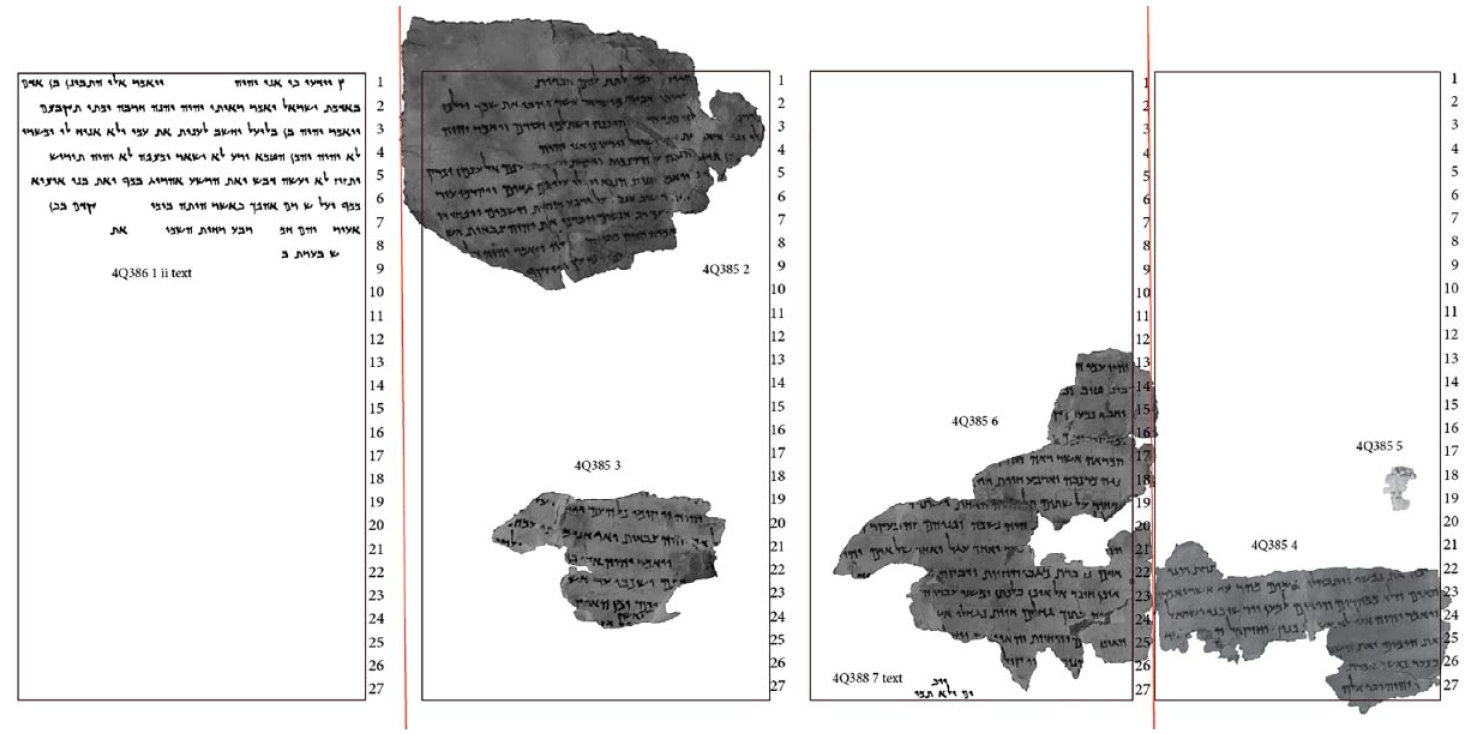
Reconstruction of a consecutive sequence of WoEzek containing the fragments of 4Q385 and text of 4Q386 1 ii inserted in the 4Q385 font. Courtesy of the Leon Levy Dead Sea Scrolls Digital Library, Israel Antiquities Authority. Image: Shai Halevi.
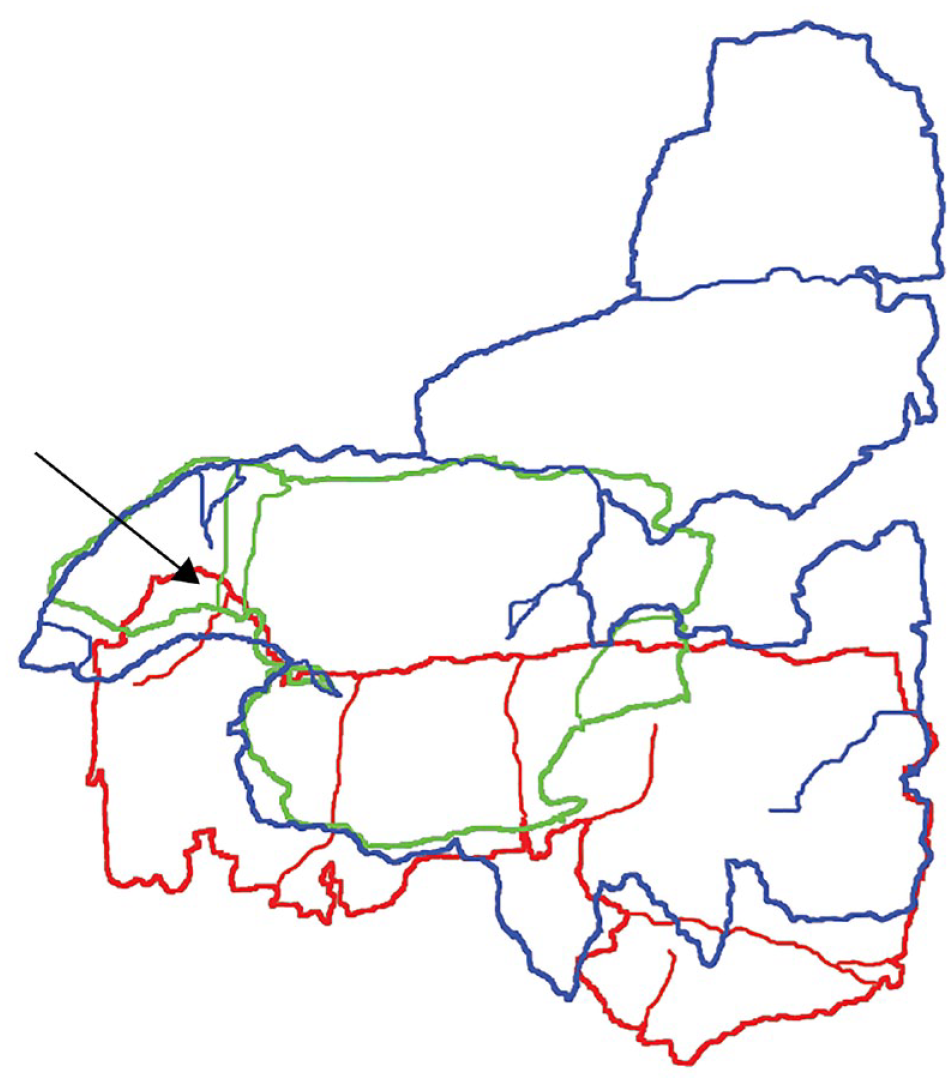
4Q385 frgs. 3 (green), 4 (red), and 6 (blue) placed on top of one another on the basis of their recurring patterns. The borders, cracks, and surface damage are also marked. 17
The “pile” contains two pairs of fragments with similar deterioration patterns—4/6 and 3/6. With the possible exception of a crack (see the arrow in Figure 2), frgs. 3 and 4 share no damage patterns. The material affinities support several further observations. In oppose to Dimant’s claim, frg. 4 has no upper margin. 18 The wide space at the bottom of the fragment, nevertheless, likely reflects bottom margin. The lines spacing in this fragment ranges between 6.25 and 7 mm, the height being measured from the rulings from which the letters hang. Lines 3 and 4 anomalously lie 8.3 mm apart. The gap between the final line and the bottom of the fragment (before the parchment begins peeling, visible right at the bottom) is 7.1 mm; no ink is noticeable in this area. Thus, it is plausible to suggest that the fragment was originated at the bottom of the column. Fragment 6, which shares the same deterioration pattern as frg. 4, therefore also likely lay toward the bottom of the column.
As reflected in Figure 3, frgs. 4 and 6 share a similar deterioration pattern, primarily on the right-hand side, as well as several other points of damage at the top and bottom of fragment 4. Frg. 6 preserves stitches throughout its right-hand margin, while the stich marks of frg. 4 lie on its left-hand side. 19 Thus, the hole on the right hand side of frg. 4 (which correlates with frg. 6) may result from the pressure of the thread from the right margin of frg. 6.
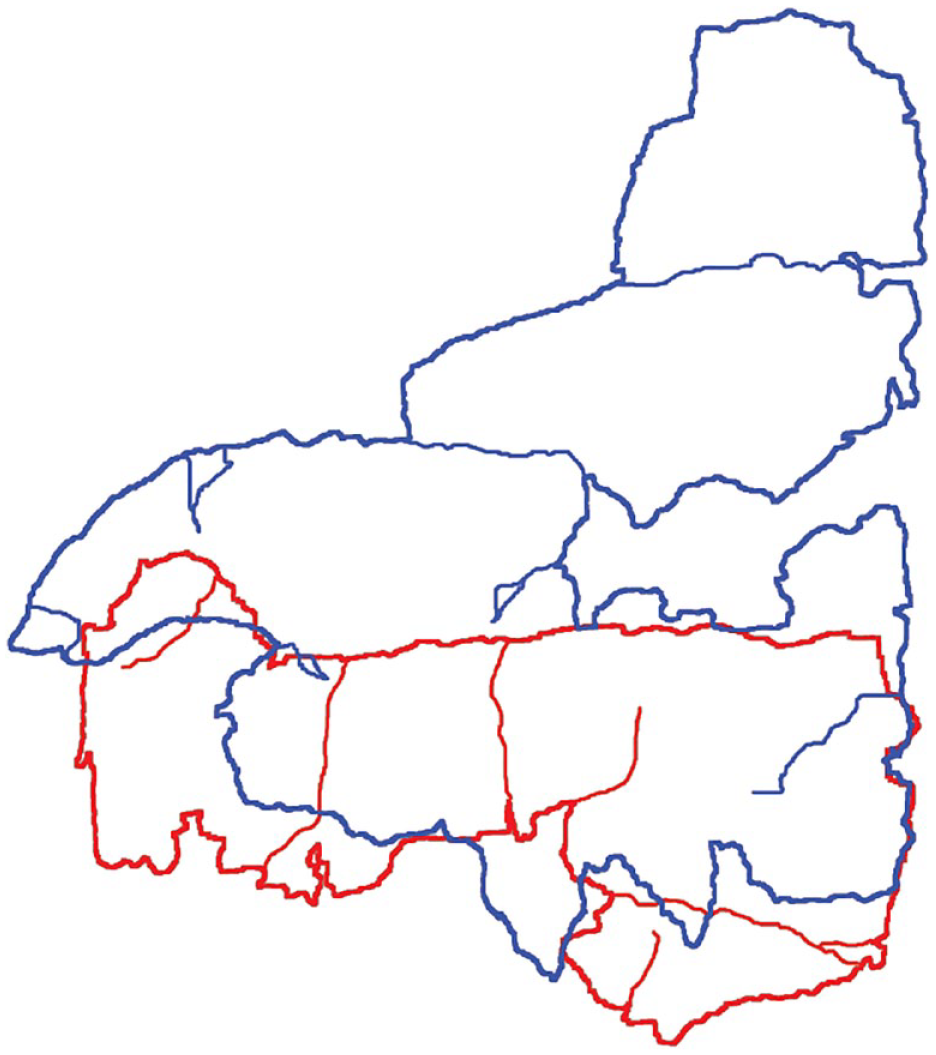
Fragments 6 (blue) and 4 (red) placed on top of one another.
Figure 4 represents the similar material profile frg. 3 shares with the middle section of frg. 6 (made up from several smaller pieces). The common damage points relate to the borders of the fragments and the cracking in the left-hand “horn.” The shared deterioration patterns between 4Q385 frgs. 3,4, and 6 suggest that the fragments stood one above the other in the scroll when it was rolled.
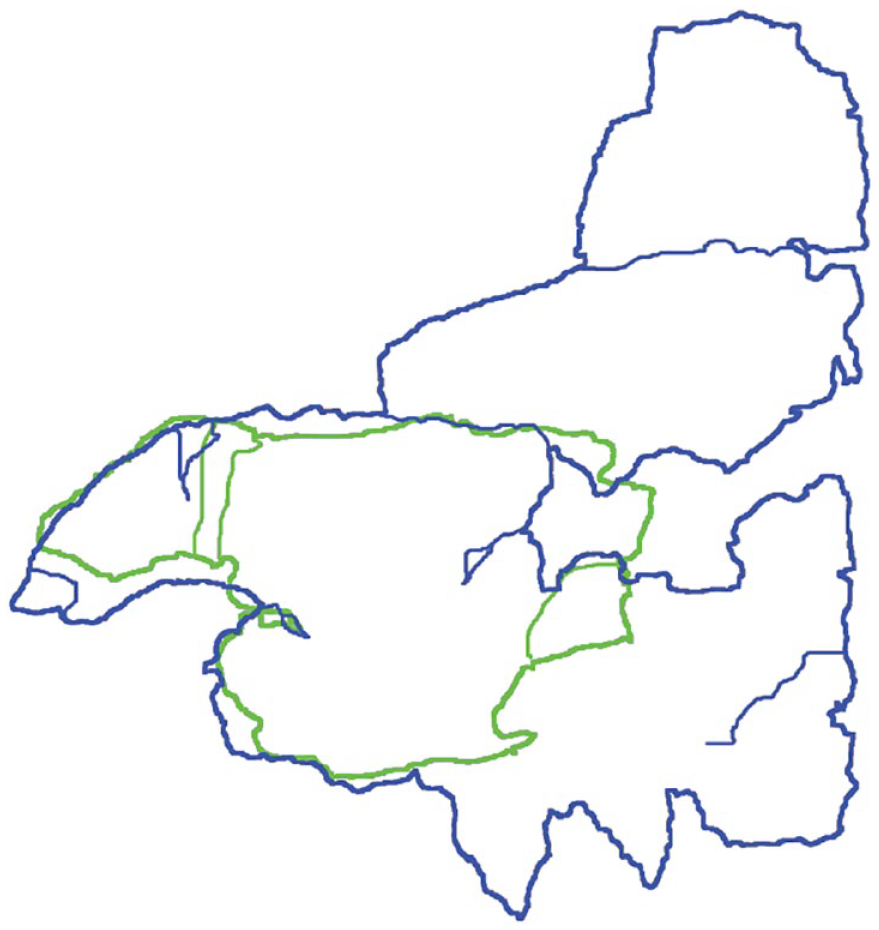
Fragments 3 (green) and 6 (blue).
Now, we may approach the order of the discussed fragments in the scroll of 4Q385. Fragments 3 and 4 cannot belong to the same column (preceding or following fragment 6) because the parchment would overlap. One fragment must thus have lain before frg. 6, and one followed it. The Stegemann method may help us determine the order, given we would know the direction in which the scroll was rolled and the distances between three sequential points (or two pairs) of damage in the scroll. This would allow to calculate the incremental growth, an expanding circumference between three points of damage indicating that the broadest measurements lay on the outside as the scroll was rolled. 20
This calculation cannot be applied to 4Q385, however, due to missing information.The location of frgs. 4 and 6 within their columns is fixed by their margins, and thus we may measure the distance between shared damage point in these fragments (9.125 cm). However, we do not know the location of frg. 3 within its column. While the height of frg. 3 within its column will parallel to the height of the middle part of frg. 6, we do not know where within the width of the column it should be located. It may lie at any horizontal point along this the assumed height, closer to the right-hand side of the column or the opposite. With the absence of further information (margins, or reconstructed text), we cannot measure the circumference between frg. 3 and its paired frg. 6.
One potential possibility for measurement of circumference is to recognise the crack at the left side of fragments 3 and 6 (marked with an arrow on fig. 2) as the result of the pressure of stitches between sheets in the scroll. Based on the observations that will be offered below, this identification is, however, less plausible. Since the damage on the recto of frg. 3 is greater than the damage of frg. 6 (see figure 5 below) the surface (recto) of frg. 3 received the majority of the pressure. The origin of the stitches is therefore in the following turn of the scroll, between the column that contained fragment 3 and the column that contains the text of 4Q386 1 ii in the reconstruction. Now, we can measure the distance between the stitches and their impressions on the left hand horn of fragment 6 (as the placement of fragment 3 within its column is unknown) – 15.41 cm. 21 This measurement constitutes two turns in the scroll (see Figure 5 below).
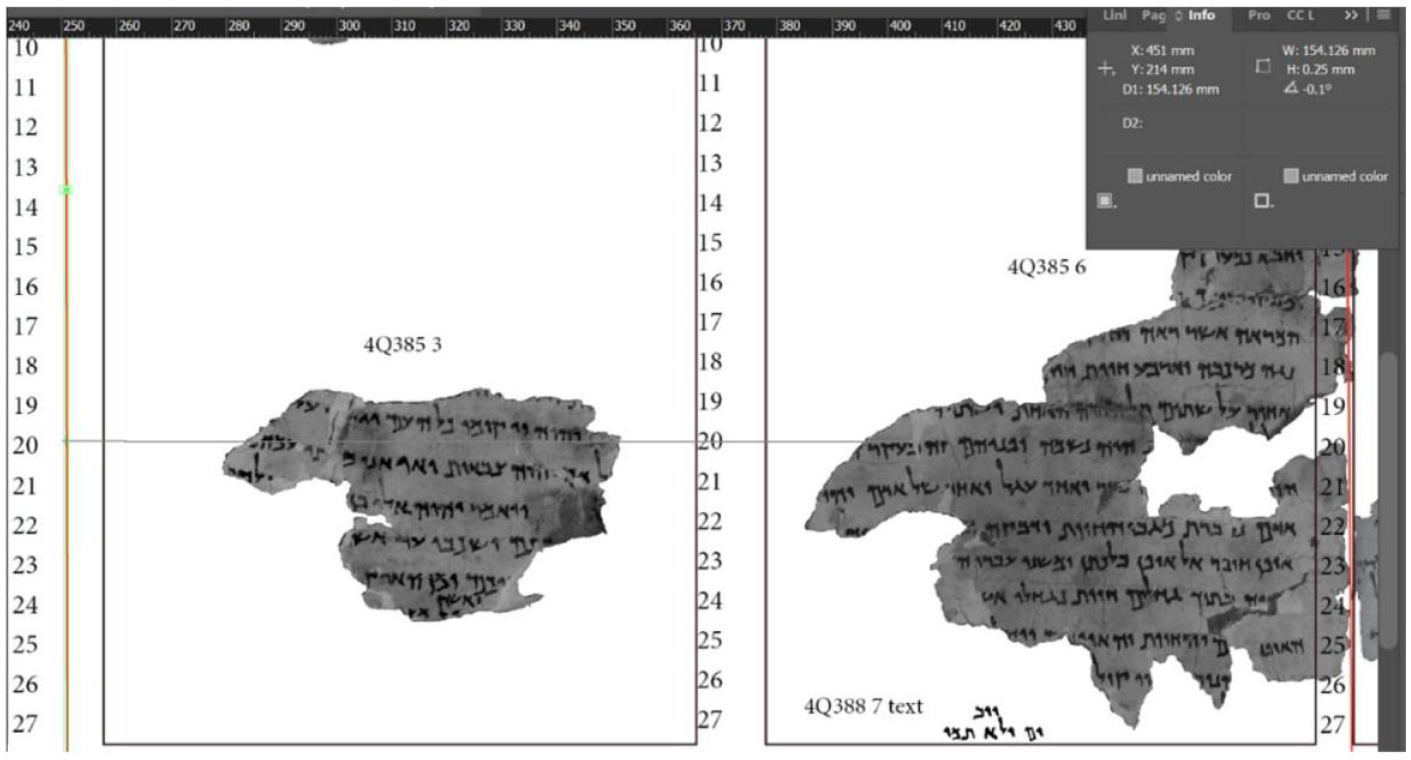
The measurement of the potential circumferences on two turns in the scroll. Courtesy of the Leon Levy Dead Sea Scrolls Digital Library, Israel Antiquities Authority. Image: Shai Halevi
As two turns, according to this proposal, measure circumference of 15.41 cm, one turn should have been 7.455 cm, while the other 7.955 cm (their recognition as outer and inner turns depends on the direction the scroll was rolled) 22 . These circumferences, however, do not allow to place fragment 3 within the width of the column, since it would require locating the fragment within the outlined margins. Thus, in order to determine the order of frgs. 3, 4, and 6 in 4Q385 I relied on further material considerations and textual evidence.
Both 4Q385 2 and 3 clearly relate to Ezekiel’s dry bones vision (Ezek 37:1–14). 23 As Dimant notes, the two fragments form part of the same column, the author not being likely to have dealt with the same prophecy in two separate sections of the scroll. 24 Fragment 2 thus probably belonged to the same column as frg. 3.
The text of 4Q385 2 overlaps with 4Q386 1 i, while 4Q386 1 in its turn preserves three consecutive columns. Thus, the column which followed 4Q385 2 necessarily contained some text, as 4Q386 1 ii contains 11 lines. 4Q385 6 (which reflects 15 lines) must thus have preceded 4Q385 2 + 3. 4Q385 6 (the merkabah) and 4Q386 1 ii (a prophecy against foreign ruler) both relatively extensively preserved, and do not address associated topics, thus implausibly belonging to the same column. The merkavah vision in 4Q385 6 thus precedes the dry bones vision in WoEzek. It would mean that the remain fragment, frg. 3, which shares deterioration patterns with frg. 6 stands in the preceding column. As Figure 1 demonstrates, the fragments follow the order: 4Q385 4–4Q385 6–4Q385 2+3 (parallel text 4Q386 1 i)–4Q386 1ii.
The sheet containing 4Q385 6 and 4Q385 2 remains problematic. The stitches preserved on the right- (4Q385 6) and left-hand (4Q385 2) margins suggest that at least one sheet of the scroll contained two columns. While this sheet size diverges from the average at Qumran (3–4), it is not impossible. 25 Similarly, Targum Job from Cave 11 (11Q10) contains two sheets with two columns per sheet, alongside seven sheets which contain 3 columns each, and three sheets with four columns. 26 4QNumb (4Q27) also reflects one sheet with two columns, while the majority of the sheets contain four or five columns. 27 Another possibility is that these fragments (4Q385 frg. 6 and 2), despite their material similarities, may have been separated by an unpreserved column. A wider gap is yet less likely, as fragments that share similar deterioration patterns belong close together.
Another matter is the placement of the small fragment 4Q385 5, although it contains no significant text. As noted by Dimant and attested on PAM 42.508, Strugnell inserted handwritten numbered notes next to 4Q385 frgs. 5 and 6, indicating the order in which they were peeled off from one another—frg. 5 from the verso of frg. 6. 28 Depending on the direction in which the scroll was rolled—from the outside in or inside out—4Q385 5 may belong to the column preceding or following frg. 6. Here, I follow Dimant’s proposal, placing the small frg. 5 in the column preceding frg. 6. 29
4Q385b (4Q385 7?)
According to the official edition, 4Q385b contains a single fragment. The text of the fragment contains a rewritten version of the third prophecy against Egypt which attested in Ezek 30:1–19. 30 Although the fragment preserves no overlaps with the other copies of WoEzek, it is assigned to our composition on the strength of its use of first-person speech and naming of the prophet.
While the theory that 4Q385b constitutes a fragment of WoEzek has been broadly accepted, the question of whether it forms an additional copy is still debated. Distinguishing 4Q385b from 4Q385, Dimant adduces significant paleographical differences between the two, in particular the tet, zayin, final mem, final nun, ayin, and qof. Since it is less likely that 4Q385 was initially written by two scribes, she identifies 4Q385b as a separate copy. 31 Dimant further notes that while the skin of 4Q385b is bright, the ink and rulings from which the letters hang being clearly visible, that of 4Q385, is significantly darker and less well preserved. Her microscopic examination also suggests that the two scrolls come from different skins. Qimron rejects these paleographical disparities, arguing that 4Q385b is another fragment of 4Q385. 32
I concur with Dimant’s conclusion that 4Q385b differs from 4Q385. As we shall see below, however, it may still form part of 4Q385, originating in a replacement sheet. Arguments in favour of distinguishing between 4Q385b and the fragments of 4Q385 are largely based on material aspects and the orthography of 4Q385b. While 4Q385b exhibits a clear preference for a fuller orthography (e.g., יפולו / תואבד), this style is virtually absent in 4Q385. 33
Another factor favoring the separation is the height of the top margin. While the top margin of 4Q385b is 21.8 mm, that of 4Q385 2 18 mm. The difference is thus approximately one written line. Even if 4Q385 2 has shrunk, this disparity is significant. 34 Although not serving as a conclusive argument, the skins of 4Q385b and 4Q385 also present a different appearance: while the 4Q385 fragments are mostly dark, and the text occasionally being legible only with the assistance of infra-red images, 4Q385b is bright, and the ink being clearly visible. 35
According to Qimron, the wider top margin of 4Q385b and the phrase that appears in the first line דברי יחזקאל (“The Words of Ezekiel”) and likely serves as the title of the work, indicate that this fragment forms the opening of the composition. The height of the top margin in other scrolls that preserve the opening column rarely differs from the top margin of other columns, however. 36 Such disparities are even less likely in scrolls with consistent line markings (e.g., 4Q385 [4Q385b]). The lack of orthographical uniformity and divergences in top-margin height further suggest that 4Q385b is not another fragment of 4Q385.
It being difficult—albeit not impossible—to argue for the existence of another manuscript of the composition in Qumran based on one fragment, I propose that 4Q385b may be a fragment from a repaired sheet of 4Q385. This explains the difference in the parchment, top-margin height, and palaeography without assuming the existence of another copy of WoEzek.
As attested elsewhere in Qumran, a replacement was made for a scroll when a sheet was damaged beyond repair—by human touch, dust and dirt, or humidity. 37 This was most frequently the first sheet of the scroll, due to its position on the outer edge of the scroll (when rolled with the end inside). 38 The poor current condition of the 4Q385 fragments (e.g., 4Q385b) may be the culmination of a process of wear and tear that began as soon as the scroll was put into use. If so, the need for a repaired sheet is quite plausible. Recognition that 4Q385b was produced separately, also explains the orthographical disparities (defective orthography in 4Q385, fuller in 4Q385b). While we do not have further material evidence for the matter, the identification of the fragment as the beginning of the composition may support the proposed theory.
4Q385b as the beginning of the composition
If 4Q385b is a replacement sheet for 4Q385, it likely belonged to the beginning of the composition. This theory supports Qimron’s recent proposal that the characteristic title (“Words of Ezekiel”) indicates that it forms the opening column. Many of the Qumran scrolls not preserving their beginning or end, only partial information is available regarding the name of texts and their representations. According to Tov, the majority of the biblical psalms and non-scriptural compositions give the title of the work in their opening words, employing no special format (see Figure 6 below). 39
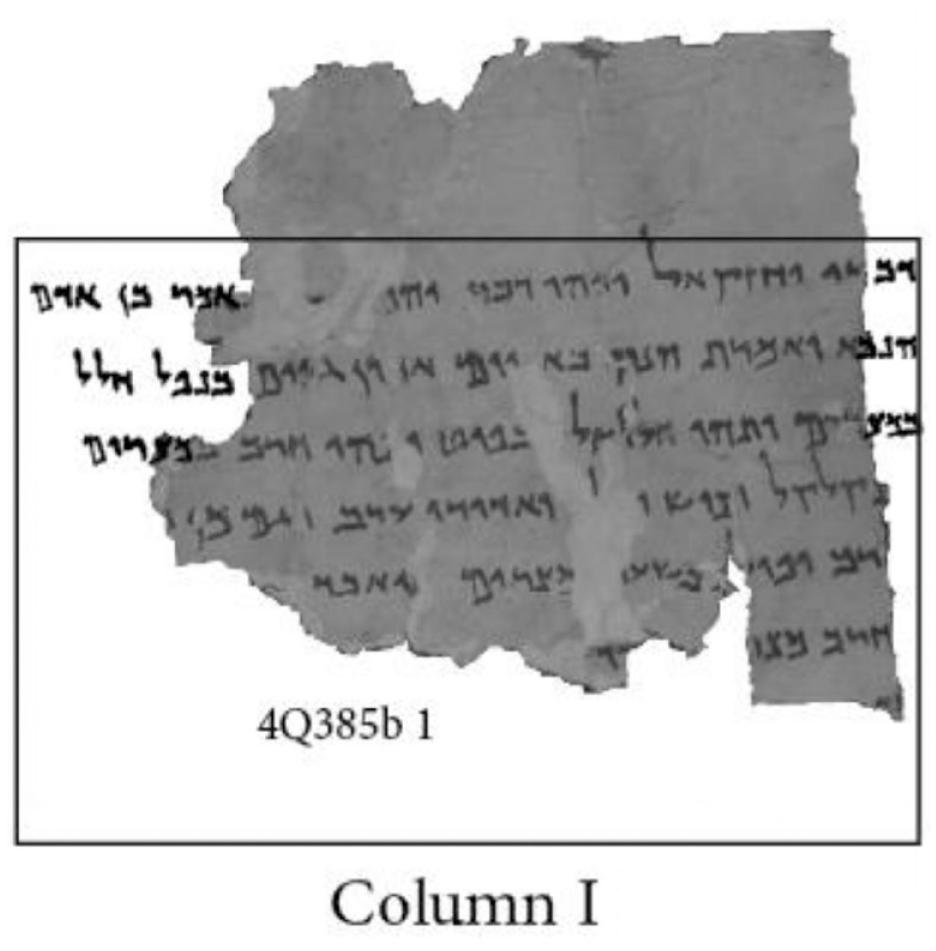
4Q385b reconstructed within a column. The width of the column is based on the proposed material reconstruction and constitutes 8.3 cm. Courtesy of the Leon Levy Dead Sea Scrolls Digital Library, Israel Antiquities Authority. Image: Shai Halevi.
Transcription
Top margin
דב]ר̇י יחזקאל ויהי דבר יהוה֯ א֯ל̇[י] ל̇א̇מ̊[ר בן אדם 1
הנב]א ואמרת הנה בא יום אב̇דן גוים [בנפל חלל 2
במ]צ֯רים ותהי חלחל[ה] בפוט ות̇הי חרב במ̇[צרים 3
]◦ ות]תקלקל וכוש יֿ[פו]ל̇ ואדירי ערב וגם מן 4
] ב]חרב 40 יפולו בשער 41 מצרים [ת]ואבד 5
]ב]חרב מצר̇[ים ]ת̊צ̊וֿד̇ד̊ 42 6
]◦◦[ 7
The title of a composition customarily identifies its literary genre—compare, for example, Serekh (“Rule”). 43 The heading “Words of . . .” is employed in various types of compositions, while Tov defines this type of heading as “authorship” or “attribution.” 44 4Q298 (= 4QCryptic A Word of the Maskil), for example, opens with the phrase [משכיל אשר דבר לכל בני שחר י̊[ דבר (“The word]s of the Instructor which he spoke to all sons of dawn”). 45 The Aramaic Words of Michael (4Q529) is similarly titled מלי כתבא די אמר מיכאל למלכיא (“The Book of the Words of Michael to the Angels”). 46 The notation דב]רי יחזקאל (“Words of Ezekiel”) may well thus represent the heading of the work, formatted in the running text.
The phrase “Words of . . .” may also indicate a new textual unit within a text, however—as in 1QSb דברי ברכה למשכיל (“Words of Blessing of the Maskil”). 47 Dimant thus contends that the formula in 4Q385b marks the beginning of a new section (cf. 4Q385 6 5 [“The vision Ezek[iel] saw”]). She suggests that the formula, which is absent from the biblical Ezekiel, being based on a model known from other prophetic texts (cf. Jer 1:1, Amos 1:1 and Neh 1:1). 48 The location of the formula in the scriptural prophetical works, however, rather supports the identification of the phrase “Words of Ezekiel” as the composition’s title, claiming prophetic attribution. The formula “Words of Ezekiel” and the suggestion that 4Q385b constituted part of a repaired first sheet of the scroll support Qimron’s proposal that this fragment formed the first column of the composition. The title “4QWords of Ezekiel” should therefore be preferred over the more commonly used “4QPseudo Ezekiel.”
WoEzek Opens with a rewritten version of the oracles against Egypt known from Ezek 30:1-19. While Dimant argues that the exegetical interpretations of this vision may rest on a historical core, I suggest that the decision to open the composition with this prophecy is due to its eschatological nature and interpretation. 49 The oracle in Ezek 30:1–19 is unique among the seven prophecies against Egypt in Ezekiel 29–32. Unlike the other prophecies in this scope, it remains undated. 50 According to Joyce, Ezek 30:1-19 many be understood as a reference to an indeterminate eschatological day. 51 Embracing this reception of the oracle, the author of WoEzek may have chosen to imbue his work with eschatological overtones.
Conclusion
This article proposes an alternative reconstruction of 4QWords of Ezekiel. Based on the new multi-spectral images made available by the Leon Levy Library, it evinces that the pattern of deterioration the fragments of 4Q385 share, indicates that fragments 3, 4, and 6 of this copy are originated in consecutive columns. This new material evidence allows us to propose a new sequence for the visions in the composition as a whole, and 4Q385 in particular: accelerating time (4Q385 4)—the divine merkabah (4Q385 6, Ezek 1)—the resurrection of the dry bones (4Q385 2 + 3, Ezek 37:1–14). Finally, 4Q385b (associated with Ezek 30:1–19) is identified as another fragment of 4Q385, constituting a repaired opening sheet of the scroll. This finding yields two significant insights concerning the nature of the composition—namely, its title and opening vision. I hope to explore the implications of this reconstruction for the understanding of the text of WoEzek in a separate contribution.
Footnotes
Acknowledgements
I wish to thank Prof. Charlotte Hempel for supporting this research and sharing her valuable comments on this paper. I am also thankful to Prof. George Brooke for his insights on the proposed reconstruction. In addition, I want to thank Prof. Jonathan Ben-Dov, Dr. Eshbal Ratzon, and Dr. Asaf Gayer for introducing me into the world of material reconstruction. All the images in this article are courtesy of the Leon Levy Dead Sea Scrolls Digital Library, photographer Shay Halevi.
Declaration of conflicting interests
The author(s) declared no potential conflicts of interest with respect to the research, authorship, and/or publication of this article.
Funding
The author(s) disclosed receipt of the following financial support for the research, authorship, and/or publication of this article: College of Arts and Law Doctoral Scholarship, University of Birmingham.
