



Abstract
Several Greek catena manuscripts preserve material from Jubilees, offering valuable witness to the largely lost Greek version of the book. Yet how did material from this Second Temple composition become part of a late ancient Christian anthology? This article interrogates the transmission of Jubilees material in catena manuscripts of Genesis. Rather than offering direct witness to Greek manuscripts of Jubilees, this material had already been appropriated and restructured before the compilers of catena manuscripts collected and reorganized it around the textual frame of Greek Genesis. Two conduits account for the availability of this material: the use of Jubilees among late ancient chronographers and a widespread genealogical tradition, derived from Jubilees, that names the wives of biblical patriarchs. In late antiquity, the Book of Jubilees often circulated not as a unified composition but as individual units which were assimilated into other structuring frameworks, whether the schemata of chronographers or the (margins of) the Greek Bible itself. The late ancient reception of Jubilees thus foreshadows the atomism of modern text-critical appropriations. The conclusions of this article invite similar exploration for other Second Temple texts.
Introduction
Late ancient and medieval exegetes often engaged in biblical scholarship by creating catena commentaries (catenae), “chains” of extracts structured around a continuous biblical text. 1 A catena weaves together material from diverse sources to offer a new commentary, both reflecting the insights of its creators and invoking the authority of previous interpreters. 2 Catenae were reference texts of choice for many readers from late antiquity onward. As anthologies, they preserve a wealth of earlier material, much of it otherwise unattested. 3 The study of catena is still beginning, and the composition and use of many catenae remain insufficiently understood. Although scholars quarry catena manuscripts for lost extracts of earlier works, they often fail to consider how material entered these catenae or how it might have been changed by those who transmitted it. 4 Recent scholarship has likewise neglected catenae as evidence of the ongoing use and reconfiguration of both the varied texts which they contain and the biblical texts which they surround. 5
As a case study for the composition of catenae and their reception of earlier texts, this article analyzes the use and reuse of material from the Second Temple work Jubilees in Greek catena manuscripts of Genesis. Citations of Jubilees attest a largely lost Greek version of the book. Yet how did material from this Second Temple work become part of late ancient Christian anthologies? The reception of Jubilees in catena manuscripts illuminates both the construction of catenae and the interwoven reading of Genesis and Jubilees in late antiquity. 6
Greek Catena manuscripts of Genesis and the Book of Jubilees
As “open” texts, Greek catenae continued to evolve throughout late antiquity and the Middle Ages. 7 While names may be attached to individual editions and recensions, catenae vary at every stage of transmission. 8 Differences between the manuscripts disrupt simplistic claims about a single catena, even for individual biblical books. Every catena manuscript is a unique work. 9
In this article, I analyze material from catena manuscripts of Genesis as collected by Françoise Petit. 10 Petit’s edition represents a corpus of exegetical material that might have been accessible to a Christian reader in the mid-fifth century CE, likely in Palestine. 11 This editorial approach omits a significant amount of material that appears in later catena manuscripts of Genesis and Exodus. Although these inclusions and omissions are contestable, Petit’s edition contains most of the Second Temple material occurring in catenae manuscripts of Genesis and Exodus. 12 These two features—an approximate (although reconstructed) context and a wealth of Second Temple material—render Petit’s edition suitable for this project.
Greek catena manuscripts included material not only from Christian exegetes, but also from various Second Temple Jewish compositions. One of these Second Temple texts is the Book of Jubilees, an anonymous work composed in Hebrew in the second century BCE. Jubilees corresponds in scope to much of Genesis and part of Exodus (chapters 1–12), filling gaps and adding details. The author reframes material from these familiar narratives as a second-person address to Moses, spoken by the Angel of the Presence on Mount Sinai. A distinctive feature of Jubilees is its rigorous and theologized chronological framework, which organizes the narrated events in years from the creation of the world (anno mundi), counted in seven-year weeks and forty-nine-year jubilees (hence the commonly used name of the book). This chronological structure made Jubilees particularly interesting for later chronographers. 13
While Jubilees was written in Hebrew, a largely lost translation into Greek underlies later Armenian, Latin, Syriac, and Ethiopic (Geʿez) sources as well as the Greek catena materials that are the focus of this article. 14 Orienting discussion toward the receptions of this Greek text invites fruitful comparison with other texts transmitted in Greek, regardless of the language in which they were first composed.
All identifiable Jubilees material in Petit’s edition is attached to passages from Genesis. The absence of material for Exodus may result from the greater narrative pace in that portion of Jubilees (only chapters 1 and 46–50 of Jubilees re-tell events that correspond to the Book of Exodus) and from its tendency to avoid recounting to Moses additional details about his own life. In short, the creators of catena manuscripts had less Jubilees material to work with for Exodus. The Jubilees material in Genesis is attached to a relatively small number of passages, and vanishes entirely for roughly the middle half of the book (Gen 11:28–37:29). These observations suggest that this Jubilees material may have been already fragmentary or only available indirectly, a point to which we will return.
Petit identifies thirteen units (nos. 551, 585, 590, 833, 839, 857, 861, 867, 1804, 1829, 1850, 2268, 2270) as potential examples of Jubilees material in the catenae. Two (nos. 839, 1829) are attributed to a work called ἡ διαθήκη, only one of which (no. 839) exhibits any identifiable relationship with Jubilees. 15 For two other units (nos. 857, 1850), any connection with Jubilees is so tenuous as to exclude them from further discussion. This article focuses on the remaining ten instances (nos. 551, 585, 590, 833, 861, 839, 867, 1804, 2268, 2270), which reflect material known from other versions of Jubilees.
Complex receptions
In this article, I focus on a methodological problem: the evidence that catena manuscripts can and cannot offer for earlier works, including Second Temple compositions like Jubilees. Numerous scholars have quarried catena manuscripts for fragments of Jubilees, hoping that these manuscripts might offer older readings than those preserved in the extant Latin or Ethiopic versions. 16 Yet such text-critical appropriation underestimates the extent to which Jubilees material in catena manuscripts has been reworked. Other questions must come first. How did material from Jubilees arrive in catena manuscripts of Genesis? And what is this material doing there? This investigation must precede attempts to quarry catena manuscripts for the study of Jubilees, text-critical or otherwise. Such questions are relevant not only for Jubilees, but also for the many other Second Temple and early Christian texts which are excerpted and anthologized in catena manuscripts.
In the first section of this article, I discuss chronography as one significant avenue of transmission for material derived from Jubilees. Both thematically and in the shared use of individual traditions, most Jubilees material in catena manuscripts parallels the long afterlife of Jubilees in Christian chronography. In the second section, I discuss a widespread tradition which lists the wives of biblical patriarchs. Here, genealogical lists provide a more elegant solution for what appears in catena manuscripts. In the third section, I consider a brief excerpt about Enoch which could fit in either category. This example demonstrates the uncertainty that remains given the flexible nature of catenae.
I am not the first to discuss chronographic and genealogical receptions of Jubilees. Nonetheless, scholars reconstructing the text of Jubilees using catena material have not yet grappled with the full implications of these complex receptions. Each of these examples disrupts the idea that the creators of Genesis catenae simply copied from manuscripts of Jubilees and that, as a result, catena manuscripts provide straightforward textual witness to a Greek Jubilees. Instead, Jubilees material arrived in catena manuscripts by more circuitous routes. This evidence demands methodological caution when using material from catena manuscripts to reconstruct lost texts from earlier periods, including an “original” Greek text of Jubilees.
These examples not only reveal the methodological problems with quarrying catena manuscripts for earlier texts but also demonstrate how “Jubilees” was used creatively by later scholars. They compel us to consider what one could do with material from “Jubilees” and how this material might function for readers even when it had a form and content that were quite different from the Ethiopic text that present-day scholars often use to study a Second Temple Book of Jubilees.
Chronography
I begin with the chronographic use of Jubilees material. Given Jubilees’ calendrical obsessions, it is not surprising that the work proved useful for Christian authors engaged in projects of universal history. Indeed, as William Adler has observed, most late ancient and Byzantine authors using Jubilees do so via this intellectual milieu. 17 Chronographic sources preserving parallel Jubilees material include the ninth-century Byzantine chronographer Georgios Synkellos, 18 the eleventh-century historian Georgios Kedrenos, 19 and the anonymous Syriac Chronicle to 1234. 20 Further sources employing Jubilees have been noted by Gelzer, Denis, Milik, VanderKam, and Adler. 21 None of the three main chronographic sources depends directly on catena manuscripts of Genesis. They cite numerous passages from Jubilees which are not found in catena manuscripts and, on occasion, parallel citations differ significantly. For their part, the catena manuscripts contain material absent in extant chronographic sources. While Synkellos and his intellectual heirs sometimes confuse Josephus and Jubilees, this is not the case in catena manuscripts. 22 Nonetheless, all of them employ some of the same material. What are the implications of this circumstance for our understanding of the catena material?
Common sources may underlie the use of Jubilees material in catena manuscripts and in chronographic sources. But those sources are not available to us, and I do not venture into the hazardous terrain of reconstruction. 23 Instead, I demonstrate the significance of chronographic sources for the presence of Jubilees material in catena manuscripts of Genesis and for the evident changes that some of this material has undergone. 24 Jubilees had already been digested into Christian chronography before it was incorporated by the compilers of catena manuscripts. The two case studies to which I now turn are among the most widely discussed questions of first-millennium chronography. 25
Abraham and the Idols
A citation attached to Genesis 11:23 in several catena manuscripts illuminates how late ancient scholars could use “Jubilees.” As with several other units derived from Jubilees, the passage is anonymous in the manuscripts. Chronographic concerns dominate in the section, which describes Abraham’s burning of the idols in Ur:
(a) ‘Ἀρρὰν ἀπέθανεν ἐν τῷ ἐμπυρισμῷ ᾧ ἐνεπύρισεν Ἅβραμ τὰ εἴδωλα τοῦ πατρὸς αὐτοῦ, ἐν τῷ εἰσελθεῖν αὐτὸν τοῦ ἐξελέσθαι αὐτά. (b) Ἦν δὲ Ἀβραὰμ τότε ἐτῶν ξʹ ὅτε τὰ εἴδωλα ἐνεπύρισεν, ἅτινα οὐδὲ ἀριθμοῦνται εἰς ἔτη ζωῆς αὐτοῦ διὰ τὸ μέχρι τότε ἐν ἀπιστίᾳ αὐτὸν εἶναι, καθὼς γέγραπται ἐν τῷ Ἰωβηλαίῳ.
26
(a) Arran died in the fire by which Abram burned the idols of his father, when he went in to rescue them. (b) And Abraham was at that time, when he burned the idols, sixty years old; and these years are not counted in the years of his life because until that time he was in unbelief, just as it is written in Jubilees.
27
This material corresponds to Ethiopic Jubilees 12:12–15:
(12:12) ወበዓመት፡ ዘሰሳ፡ ዘሕይወተ፡ አብራም፡ ውእቱ፡ ሱባዔ፡ ራብዕ። በዓመት፡ ራብዑ፡ ሎቱ፡ ተንሥአ፡ አብራም፡በሌሊት፡ ወአውዐየ፡ ቤተ፡ ጣዖታት፡ ወአውዐየ፡ ኵሎ፡ በውስተ፡ ቤት፡ ወሰብእ፡ አልቦ፡ ዘአእመረ። (12:13) ወተንሥኡ፡ ሌሊተ፡ ወፈቀዱ፡ ያድኅኑ፡ አማልክቲሆሙ፡ እማእከለ፡ እሳት፡ (12:14) ወሰረረ፡ አራን፡ ከመ፡ ያድኅኖሙ፡ ወነደደ፡ እሳት፡ ላዕሌሁ፡ ወውዕየ፡ በእሳት፡ ወሞተ፡ በኤኑር፡ ዘከላዴዎን፡ በቅድመ፡ ታራ፡ አቡሁ፡ ወቀበርዎ፡ በኤኑር፡ ዘከለዳዊያን። (12:15) ወወፅኣ፡ ታራ፡ እምነ፡ ኡር፡ ዘከለዳቂያን፡ ውእቱ፡ ወወሉዱ፡ ከመ፡ ይምጽኡ፡ ውስተ፡ ምድረ፡ ሊባኖስ፡ ወውስተ፡ ምድረ፡ ከናአን፡ ወኀደረ፡ ውስተ፡ ካራን፡ ወኀደረ፡ አብራም፡ ምስለ፡ አቡሁ፡ ውስተ፡ ካራን፡ ክልኤ፡ ሱባዔ፡ ዓመታት።
28
(12:12) In the sixtieth year of Abram’s life (which was the fourth week, in its fourth year [AM 1936]), Abram got up at night and burned the temple of the idols. He burned everything in the temple, but no one knew (about it). (12:13) They got up at night and wanted to save their gods from the fire. (12:14) Haran dashed in to save them, but the fire raged over him. He was burned in the fire and died in Ur of the Chaldeans before his father Terah. They buried him in Ur of the Chaldeans. (12:15) Then Terah left Ur of the Chaldeans, he and his sons, to go to the land of Lebanon and the land of Canaan. He settled in Haran, and Abram lived with his father in Haran for two weeks of years.
29
The first half of the catena unit (what I have here labeled “a”) relates to the death of Haran in Gen 11:28, and parallels Ethiopic Jubilees 12:14. We will focus on the second half (what I have here labeled “b”). This comment, paralleling Ethiopic Jubilees 12:12, does not mention Haran’s death, but claims that Abraham was sixty years of age when he started the fire. Other chronographers also cite the tradition of Abraham’s burning of the idols:
30
Syriac Chronicle:
When Abraham was fifty-six years old, he burned the temple of Kainan. But Abraham’s brother Haran went in to save the temple and was burned in the fire and died. When he was sixty years old, Abraham, his father Terah, his brother Nahor, and Haran’s son Lot, left Ur of the Chaldeans and went and stayed in Haran for fourteen years.
32
Synkellos: (12:12) Τῷ ͵γτογʹ ἔτει τοῦ κόσμου, Ἀβραὰμ δὲ ξαʹ ἐνεπύρισεν Ἀβραὰμ τὰ εἴδωλα τοῦ πατρὸς αὐτοῦ, (12:14) καὶ συγκατεκαύθη αὐτοῖς Ἀρρὰν θέλων σβέσαι τὸ πῦρ ἐν νυκτί. (12:15) καὶ ἐξῆλθε Θαρὰ σὺν Ἀβραὰμ τοῦ ἐλθεῖν εἰς γῆν Χαναάν, καὶ μεταγνοὺς ᾤκησεν ἐν Χαρρὰν εἰδωλομανῶν ἕως θανάτου αὐτοῦ.
33
(12:12) In anno mundi 3373, when he was 61 years old, Abraham burned the idols of his father. (12:14) Desiring to extinguish the fire, Arran was burned up with them at night. (12:15) And Terah went out with Abraham to go to the land of Canaan. But he changed his mind and settled in Haran, enthralled by idolatry until his death.
34

Unlike the other chronographic sources, the catena material uses Jubilees 12:12 to respond to a particular exegetical difficulty: Two narratives in Genesis seem to contradict one another. The problem is as follows. 35 If, as Gen 11:26 states, Abraham’s father Terah was seventy years old when Abraham was born, and Terah died at the age of 205 years (as we find in Gen 11:32), then Abraham must have been 135 years old when his father died. But Gen 12:4 states that Abraham departed Haran at the age of seventy-five and that this was after the death of his father Terah. We thus have a sixty-year discrepancy.
The problem vexed Christian interpreters. 36 Perhaps this was especially because the chronology of Genesis contradicts Stephen’s statement in Acts 7:4 that “after the death of his father, [God] had [Abraham] migrate from there [Haran] to this land.” 37 The discrepancy was significant enough that it offered material for Jerome’s Hebrew Questions in the Book of Genesis. 38 Chronographers also dealt with the problem. If Synkellos is correct, chronographers had grappled with the discrepancy as early as Sextus Julius Africanus (ca. 160–post 240 CE). 39 Synkellos and his successors in both Greek and Syriac proposed their own varied solutions. 40
The appeal to Jubilees in the second part of no. 867 is another attempt to resolve this problem. A sixty-year period in Abraham’s life must have seemed the obvious solution to a sixty-year discrepancy. By inserting just a few words—ἅτινα οὐδὲ ἀριθμοῦνται εἰς ἔτη ζωῆς αὐτοῦ διὰ τὸ μέχρι τότε ἐν ἀπιστίᾳ αὐτὸν εἶναι—the exegetical problem was resolved. Conveniently, this comment was placed between the attribution to Jubilees and the material actually derived from Jubilees. 41 Never mind that Jubilees itself is not aware of this chronographic difficulty—oddly, given its obsessive chronographic interests. Furthermore, Jubilees 11 asserts that from the age of fourteen onward, Abraham was not in unbelief. The catena material not only attributes to Jubilees a claim that the work does not make but, in so doing, even contradicts Jubilees’ broader narrative.
While this form of the catena explicitly claims Jubilees (γέγραπται ἐν τῷ Ἰωβηλαίῳ) as support for the exegetical claim, other known forms of Jubilees support only one rather minor detail. This example shows the need for caution in quarrying material from catena manuscripts. Here we can compare the catena material with a more extensive Ethiopic text of Jubilees, a luxury often not available for other texts reconstructed from catena manuscripts. Nonetheless, the divergence warns us against assuming that catena manuscripts offer straightforward textual evidence. 42
This example also demonstrates how late ancient readers re-used material from Jubilees. The Genesis catena seems to derive from a source that had already repurposed Jubilees material. An exegetical addition, responding to a specific and vexing chronological problem, supplements and reinterprets the material from Jubilees. Although Jubilees has been filtered through a source with chronographic concerns, this need not have been a chronicle; it could have been an exegetical or antiquarian work with an interest in chronographic questions, like Jerome’s Hebrew Questions. In any case, material from Jubilees was transmitted through an intermediate source. This leads to a broader point: These late ancient scholars supported historical and exegetical claims by appealing to “the Book of Jubilees.” Yet this did not require textual accuracy or even, necessarily, a text of Jubilees at all. “Jubilees” in late antiquity could say something quite different from “Jubilees” as we are used to studying it.
Between Genesis and Exodus
On occasion, catena manuscripts of Genesis not only use Jubilees to advance specific claims but also reproduce extensive passages out of historical interest—in this, hewing closely to a standard paradigm of Christian chronography.
43
A noteworthy example is an extensive scholion placed (without an explicit attribution) at the conclusion of Genesis.
44
I cite the first part of this scholion—that is, the material from Jubilees—at length:
45
Ἐξώρκισεν Ἰωσὴφ τοὺς ἀδελφοὺς αὐτοῦ περὶ τῶν ὀστῶν αὐτοῦ, ὅτι ἐγίνωσκεν ὅτι οὐ μὴ ἐπιτρέψωσιν οἱ Αἰγύπτιοι ἀπενεχθῆναι αὐτὸν εἰς γῆν Χαναὰν ἐν ἡμέρᾳ τῆς τελευτῆς αὐτοῦ, διότι Μαχμαρὼν βασιλεὺς Χαναὰν ἐποίησε πόλεμον μετὰ τοῦ βασιλέως Αἰγύπτου καὶ ἐθανάτωσεν αὐτὸν ἐκεῖ ἐν τῇ κοιλάδι. Καὶ ἐπεδίωξεν ὀπίσω τῶν Αἰγυπτίων ἕως τῶν ὁρίων Αἰγύπτου, καὶ οὐκ ἠδυνήθη Μαχμαρὼν εἰσελθεῖν εἰς Αἴγυπτον, διότι ἀνέστη βασιλεὺς ἕτερος νέος ἐπ’ Αἴγυπτον και ἐνίσχυσεν ὑπὲρ αὐτόν. καὶ ἐκλείσθησαν αἱ πύλαι Αἰγύπτου καὶ οὐκ ἦν ὁ εἰσπορευόμενος καὶ ἐκπορευόμενος εἰς Αἴγυπτον. Καὶ ἐτελεύτησεν Ἰωσὴφ καὶ ἔθαψαν αὐτὸν ἐν τῇ σορῷ ἐν Αἰγύπτῳ· καὶ ἐτελεύτησαν πάντες οἱ ἀδελφοὶ αὐτοῦ μετ’ αὐτόν. Καὶ ἐξήνεγκαν οἱ υἱοὶ Ἰακὼβ τὰ ὀστᾶ τῶν υἱῶν Ἰσραὴλ πάντα, παρεκτὸς τῶν ὀστῶν Ἰωσὴφ, καὶ ἔθαψαν αὐτὰ ἐν τῷ ἀγρῷ τοῦ σπηλαίου τοῦ διπλοῦ ἐν Χεβρών ἐν τῷ ὄρει. Καὶ ἀπέστρεψαν πολλοὶ εἰς Αἴγυπτον, καὶ ὀλίγοι περιελείφθησαν ἐπ’ αὐτῶν ἐν τῷ ὄρει Χεβρών. Καὶ περιελείφθη Ἄμβραμ ὁ πατὴρ Μωϋσέως μετ’ αὐτῶν. Καὶ ἐτροπώσατο βασιλεὺς Χαναὰν βασιλέα Αἰγύπτου, καὶ ἀπέκλεισε τὰς πύλας Αἰγύπτου ὁ βασιλεὺς Αἰγύπτου. Καὶ ἐλογίσατο λογισμοὺς πονηροὺς ἐπὶ τοὺς υἱοὺς Ἰσραὴλ τοῦ κακῶσαι αὐτούς. Ἐπανελθὼν δὲ Ἄμβραμ ἀπὸ γῆς Χαναὰν εἰς Αἴγυπτον, γεννᾷ τὸν Μωϋσέα. Οὗτος ἦν ὁ καιρὸς θλίψεως ἐπὶ τοὺς υἱοὺς Ἰσραήλ.
46
Joseph placed his brothers under oath concerning his bones, because he knew that the Egyptians would not permit [them] to carry him away into the land of Canaan in the day of his death, because Machmaron the king of Canaan made war with the king of Egypt and killed him there in the valley. And he pursued after the Egyptians as far as the borders of Egypt, but Machmaron was not able to enter Egypt, because another, new king arose over Egypt and he prevailed over him [Machmaron]. And the gates of Egypt were closed and there was no one who entered or exited Egypt. And Joseph died and they buried him in a coffin in Egypt. And all his brothers died after him. And the sons of Jacob carried all the bones of the sons of Israel out, except the bones of Joseph, and buried them in the field of the double cave [sic, cf. OG-Gen 50:13] in Hebron in the mountain. And many returned to Egypt, and a few remained with them in the mountain of Hebron. And Amram, the father of Moses, was left with them. And the king of Canaan put to flight the king of Egypt, and the king of Egypt shut the gates of Egypt. And he planned evil plans concerning the sons of Israel, to treat them badly. But when Amram returned from the land of Canaan to Egypt, he fathered Moses. This was the time of tribulation for the sons of Israel.
47
Here a text resembling Ethiopic Jubilees 46:6–12; 47:1 (cf. Gen 50:25–26) describes a war between Egypt and Canaan, occurring in the unwieldy gap between the end of Genesis and the beginning of Exodus. 48 The core problem for both Jubilees and the catena manuscript is the same. The texts of Genesis and Exodus read as if only a generation or so has passed between Gen 50:26 and Ex 1:1. Other texts, however, assert that the period was 400 or 430 years (Gen 15:13; Ex 12:40–41). This Jubilees-derived bit of narrative gap-filling provided continuity, simultaneously explaining how the situation of Jacob’s descendants could be so significantly altered and how the generational gap fit with this biblical chronology.
Yet this material from Jubilees occurs in a composite citation with another block of material, derived from the Oratio ad Graecos of the second-century intellectual Tatian (fl. ca. 170–180 CE). 49 This juxtaposition has gone undiscussed in literature on both Jubilees and the Oratio ad Graecos, and recent editions of Tatian overlook this passage. 50 Like Jubilees, Tatian discusses the relationship between the events of Genesis and Exodus. Unlike Jubilees, however, Tatian focuses on the chronological relationship between the events of the Exodus and other events of Greek antiquity, a widespread concern among ancient Christian chronographers. 51 The two blocks of material may have entered the catena separately, since both naturally fit at the end of Genesis. But the manuscript does not offer textual or paratextual cues to distinguish between the two blocks of material. 52 From the adapted citation of Jubilees, the catena manuscript simply proceeds into an extended and (likewise) adapted citation of Oratio ad Graecos 38–39. The lack of attribution or transition suggests that they may have entered the catena together. A chronographic source would account for all the data. Here the material that we recognize as “Jubilees” breaks free from that attribution, taking on a life of its own, unconstrained by either the title or the text of our familiar (Ethiopic) Jubilees, in order to shape ongoing encounters with biblical texts.
The two examples we have considered thus far both suggest that Jubilees material was filtered through sources with chronographic concerns, leading to various transformations. 53 Other units exhibiting prominent chronographic concerns include nos. 839 (the Tower of Babel), 1804 (Reuben and Bilhah), 54 and 2268 (Joseph’s age for significant events). In the light of this chronographic reception, the concentration of Jubilees material attached to the patriarchal narratives of Genesis makes sense: these offered the longest periods requiring chronological data and narrative material. Yet even more significant than this particular conduit of transmission is the broader observation that the Jubilees material from these catena manuscripts reflects diffuse patterns of reception and reconfiguration.
Genealogy
Chronography is not the only way in which material from Jubilees circulated in late antiquity. 55 Epiphanius of Salamis cites extended portions of Jubilees’ creation narrative in his Weights and Measures, as well as briefer sections in his Panarion. 56 In Syriac, some material was absorbed into the Cave of Treasures. 57 A handful of midrashim also contain material resembling that in Jubilees. 58 Most significantly for the present discussion, lists of matriarchs were popular in late antiquity and appear in several catena manuscripts, although this Jubilees material is not attributed to an author or work by those manuscripts. 59
This genealogical material is distributed across Genesis to provide information about the matriarch wherever the patriarch appears (Gen 4:17; 6:6–32; 10:24–25; 11:20–25). For clarity, I present them together. Further reasons motivating my act of editorial collecting will become clear shortly:
(no. 551
60
) Ἡ γυνὴ Κάϊν, Ἀσαούλ, ἡ ἀδελφὴ αὐτοῦ. (no. 585
61
) Γυνὴ Σήθ, Ἀζούρα, ἡ ἀδελφὴ αὐτοῦ. Γυνὴ Ἐνώς, Νωα, ἡ ἀδελφὴ αὐτοῦ. Γυνὴ Καϊνᾶν, Μαωλιθ, ἀδελφὴ αὐτοῦ Γυνὴ Μαλελεήλ, Δινα, θυγάτηρ Βαραχιὴλ πατραδέλφου αὐτοῦ. Γυνὴ Ἰάρεδ, Βαραχα, θυγάτηρ Ἀρουὴλ πατραδέλφου αὐτοῦ. Γυνὴ Ἐνώχ, Ἐανί, θυγάτηρ Δανιὴλ πατραδέλφου αὐτοῦ. Γυνὴ Μαθουσάλα, Ἔδνα, θυγάτηρ Ἐζριὴλ πατραδέλφου αὐτοῦ. Γυνὴ Λάμεχ, Βεθενώς, θυγάτηρ Βαραχιὴλ πατραδέλφου αὐτοῦ. Γυνὴ Νῶε, Ἐμμαζάρα, θυγάτηρ Βαραχιὴλ πατραδέλφου αὐτοῦ. (no. 833
62
) Γυνὴ Καϊνᾶν, Μελχά, θυγάτηρ Μαδαῖ υἱοῦ Ἰάφεθ. Γυνὴ Σαλά, Μωχά, θυγάτηρ Χεεδὲμ πατραδέλφου αὐτοῦ. Γυνὴ Ἔβερ, Ἀζοδρά, θυγάτηρ Νεβρώδ. Γυνὴ Φαλέγ, Δόμρα, θυγάτηρ Σενναάρ. (no. 861
63
) Γυνὴ Ῥαγαῦ, Ὄρα, θυγάτηρ Οὖρ υἱοῦ Χέζα. Γυνὴ Σερούχ, Μελχά, θυγάτηρ Χαβέρ πατραδέλφου αὐτοῦ. Γυνὴ Ναχώρ, Ἰεσθά, θυγάτηρ Νεσθά, τοῦ Χαλδαίου.
Each note follows a similar pattern, for example, “the wife of Cain was Asaoul, his sister.” The content derives from Jubilees, although the formulaic pattern simplifies the corresponding passages. Despite changes in the names, the similarity is unarguable when compared with the Ethiopic texts or the similar lists of matriarchs discussed below. 64 This material may seem unrelated to chronography. It includes no dates and offers no solutions to exegetical problems. Yet, the chronographers employ an expansive definition of relevance. 65 For example, Synkellos records the name of Cain’s wife and Kedrenos mentions the wife of Terah. 66 Nonetheless, this is uncommon; almost all such material from the catena has no analogue in preserved chronographic sources.
When we compare catena material with chronographic sources, we also observe a key distinction. For example, the ninth-century chronographer Synkellos reflects Jubilees 4:9 as follows:
67
Τῷ πεʹ ἔτει ἐγεννήθη αὐτοῖς θυγάτηρ, καὶ ὠνόμασαν αὐτὴν Ἀσουάμ. […] τῷ ρλεʹ ἔτει ἔλαβεν ὁ Κάιν τὴν ἰδίαν ἀδελφὴν Ἀσαυνᾶν, οὖσαν ἐτῶν νʹ. αὐτὸς δὲ ἦν ἐτῶν ξεʹ.
68
In the eighty-fifth year, a daughter was born to them [Adam and Eve], and they named her Asouam. […] In the one hundred thirty-fifth year, Cain married his own sister Asaunan (sic), who was fifty years old. He himself was sixty-five years old.
69
This roughly corresponds to Ethiopic Jubilees 4:9.
ወነሥአ፡ ቃየን፡ ለኣዋን፡ እኅቱ፡ ሎቱ፡ ብእሲተ፡ ወወለደት፡ ሎቱ፡ ኤኖኅሃ፡ በፍጸሜ፡ ራብዕ፡ ኢዮቤልዉ። ወበአሐዱ፡ ዓመት፡ ዘሱባዔ፡ ቀዳሚ፡ ዘኃምስ፡ ኢዮቤልዉ፡ ተሐንጹ፡ ኣብያት፡ ውስተ፡ ምድር፡ ወሐነጸ፡ ቃየን፡ ሀገረ፡ ወስመያ፡ ስማ፡ በስመ፡ ወልዱ፡ ኤኖኅ።
70
Cain married his sister Awan, and at the end of the fourth jubilee [AM 148–96] she gave birth to Enoch for him. In the first year of the first week of the fifth jubilee [AM 197] houses were built on the earth. Then Cain built a city and named it after his son Enoch.
71
Now contrast again the abbreviated format of no. 551 in catena manuscripts:
Ἡ γυνὴ Κάϊν, Ἀσαούλ, ἡ ἀδελφὴ αὐτοῦ.
The other genealogical notes follow this same pattern. As I have noted, the material is dispersed in catena manuscripts so that each matriarch is named at the appropriate point. Nonetheless, the formulaic pattern suggests that the catena material derives from a list, and not from a text of the “Book of Jubilees.” We find confirmation in lists of matriarchs that circulated independently in Syriac and Armenian. Even when chronographic sources contain genealogical data, the catena manuscripts find a closer parallel in these lists of matriarchs. Consider a Syriac list from the eighth-century British Library Add MS 12,154, fols 180r–v:
72
The name of Adam’s wife was Eve; of Cain’s wife was ʾSWʾ. And the name of Seth’s wife was ʾZWRʾ, his sister; and of Enosh’s wife was NʾWM, his sister; of Cainan MHLLWT, his sister; of Mahalalaʾel Dina, the daughter of his uncle; <of Yaʾar BRKʾ, the daughter of his uncle; of Enoch, ʾDNY, the daughter of his uncle;> of Methuselah ʾDNʾ, the daughter of his uncle; of Lamech ʾNWŠY, the daughter of his uncle. The name of Noah’s wife was ʾMYZRʾ, the daughter of his uncle; of Shem’s wife ZDQTNBB; of Ham NḤLMḤWQ; of Japheth ʾDNTNŠʾ. The name of Arpachshad’s wife was RWSʾ, the daughter of ŠWŠN; of his son Cainan MLKʾ, the daughter of MDY; of his son Shelah, MʿKʾ, the daughter of his uncle; of Eber’s wife ʾZWRʾ, the daughter of NBRWD; of Peleg MNʾ, the daughter of SNʿR. In the days of Peleg, the tower was built; its height was 5433 cubits, <13> stadia. The name of ʾRʿW’s wife was ʾRWʾ, the daughter of ʾWR; of Serug MLKʾ, the daughter of KBR his uncle; of Nahor his son ʿSQʾ, the daughter of NSTG the Chaldean; of Terah ʾDNʾ, the daughter of his uncle Abram. She bore a son and named him Abram after her father.
78
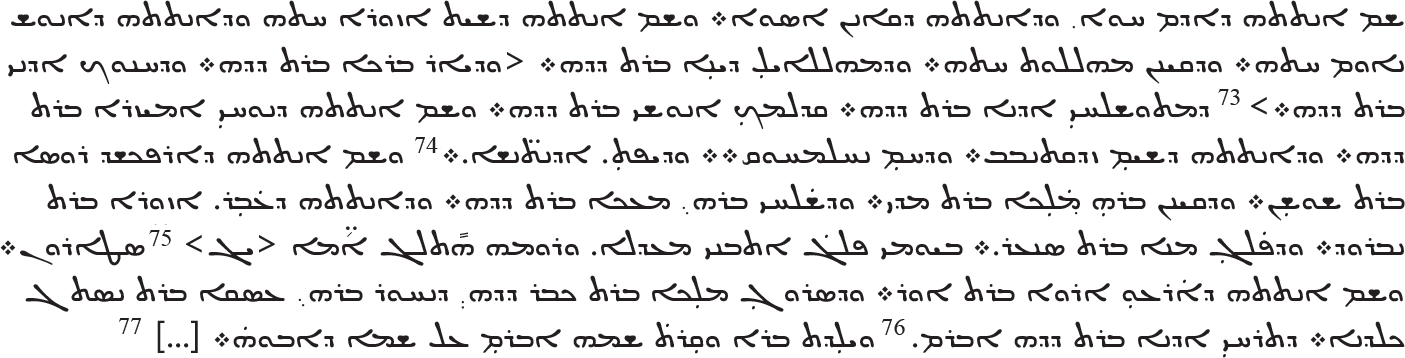
This genealogical list does not occur alongside other material from Jubilees or even accompanying other material related to the Book of Genesis. Rather, it appears in a quite miscellaneous eighth-century manuscript, in a section titled “Words and Riddles for Students for Fun.” A rubricated heading identifies the list as “the names of the wives of the patriarchs according to the book which is called Jubilees among the Hebrews” (ܗܐܫ̈ܡ ܐܕ̈ܢܫ ܝܫܝܕ̈ܖ ܬܐ̈ܐܒܗ ܡܝ̣ܐܩ̈ܕ .ܐܝܟ ܒܬܒܐ ܕܠܘܬ ܗܘ ܕܡܬܩܪܐ ܝܘܒܝܠܝܐ). This Syriac list is not the conduit by which this genealogical material entered Greek catena manuscripts of Genesis. It does, however, illuminate the contexts in which such material from Jubilees might circulate. A similar Armenian list, preserved in a fifteenth-century manuscript, names the patriarchs from Adam to Jacob with their wives. 79
Given the organizing principle of catena manuscripts, in which exegetical supplement is organized around the frame of the biblical text, these genealogical data are redistributed according to the sequence of Genesis. If one collects the material as above, however, the catena list closely corresponds to the format of the Syriac and Armenian lists. Such a list also offers a plausible source for a second major block of Jubilees material in the Genesis catena. Even so, it remains uncertain whether a Greek list of matriarchs circulated independently or as part of a chronographic work. 80 For the first possibility, we have comparative evidence in Syriac and Armenian manuscripts. Given the penchant for lists evident in so many chronographic sources, the second possibility is equally plausible. In either case, the evidence suggests that the Jubilees material reached the catena tradition through an intermediate step.
Just as in the case of Abraham and the idols, so also here in these lists we find that the “Jubilees” available to late ancient scholars could be rather different from what we might expect based on either the Ethiopic Jubilees or the fragmentary manuscripts from the Judean Desert. This again impels us to caution in using such later receptions to reconstruct an “original” Greek text of Jubilees. Moreover, we observe that material which once circulated as part of something called “Jubilees” could break free of that bibliographic attribution, as in the case of the genealogical material in catena manuscripts. Here again, catena manuscripts offer the reader something that is not-quite-Jubilees.
Blurring the categories: Enoch
A brief note about the antediluvian patriarch Enoch (no. 590, ad Gen 5:21–24) initially appears incongruous with either chronography or lists of matriarchs. The catena reads,
Ἐνὼχ πρῶτος ἔμαθε γράμματα, καὶ ἔγραψε τὰ σημεῖα τοῦ οὐρανοῦ καὶ τὰς τροπὰς καὶ τοῦς μῆνας.
81
Enoch was the first person who learned letters, and he wrote the signs of the heaven and the seasons and the months.
Derived from Jubilees 4:17, the unit exhibits no compelling interest for chronographic projects. It contains no dates and affords no clever solutions to chronological problems. Nor does the unit seem to belong in a genealogical list. Yet, on closer examination, we discover that this unit could fit into either of our two categories; it thus illustrates the uncertainties that remain. 82
On occasion, the Syriac list cited above breaks from its formulaic structure. For instance, it provides an extra detail about Peleg:
ܘܕܦܿܠܓܼ ܡܢܐ ܒܪܬ ܣܢܥܪ. ܀ ܒܝܘܡܝ ܦܠܓܿ ܐܬܒܢܝ ܡܥܕܠܐ. ܘܪܘܡܗ ܗًܬܠܓ ܐ݇̈ܡܐ <ܝܓ> ܣܛܐܪܘܢ܀ of Peleg MNʾ, the daughter of SNʿR. In the days of Peleg, the tower was built; its height was 5433 cubits, <13> stadia.
83
Despite a format which condenses unnecessary detail, the Syriac list still made room for an exegetical note that cited part of Jubilees 10:21. Compare Ethiopic Jubilees:
ወሐነጽዎ፡ አርብዓ፡ ዓመተ፡ ወሠለስተ፡ ዓመተ፡ ሀለዉ፡ የሐንጽዎ፡ ግንፉለ፡ ፍጹመ፡ ሠለስተ፡ ወዐሠርተ፡ ውስቴቱ፡ ወሣልሰተ፡ ኣሐቲ፡ ኀምሳ፡ ምእት፡ ወአርባዕቱ፡ ምእት፡ ወሠላሳ፡ ወሠላስ፡ በእመት፡ ዐርገ፡ ኑኁ። ወክልኤ፡ ስዝር፡ ወዐሠርቱ፡ ወሠለስቱ፡ ምዕራፍ።
84
They built it; they spent 43 years building it (with) complete bricks whose width was 13 (units) and whose height was a third of one (unit). Its height rose to 5433 cubits, two spans, and thirteen stadia.
85
If the brief note about Enoch had appeared in the formulaic genealogical list that lies behind numerous catena units (nos. 551, 585, 833, and 861), this would provide an elegant solution for its presence.
86
If so, it might have been inserted in that list as follows, within the material now attached to Gen 5:6–32 as no. 585:
[…] Γυνὴ Ἐνώχ, Ἐανί, θυγάτηρ Δανιὴλ πατραδέλφου αὐτοῦ. <Ἐνὼχ πρῶτος ἔμαθε γράμματα, καὶ ἔγραψε τὰ σημεῖα τοῦ οὐρανοῦ καὶ τὰς τροπὰς καὶ τοῦς μῆνας.> Γυνὴ Μαθουσάλα, Ἔδνα, θυγάτηρ Ἐζριὴλ πατραδέλφου αὐτοῦ. […] […] The wife of Enoch [was] Eani, the daughter of his uncle Daniel. <Enoch was the first person who learned letters, and he wrote the signs of the heaven and the seasons and the months.> The wife of Methuselah [was] Edna, the daughter of his uncle Ezriel. […]
Just as the Syriac list attaches an additional description of Peleg (derived from Jubilees 10:21) between genealogical data derived from Jubilees 10:18 and 11:1, so also a description of Enoch from Jubilees 4:17 could have been placed in a list between genealogical data from Jubilees 4:20 (about Enoch’s marriage to Edni) and Jubilees 4:27 (about Methuselah’s marriage to Edna). 87 A subsequent scholar distributed the genealogical material across Genesis. As a result, the brief biographical note about Enoch is now attached to Gen 5:21–24, even though it might once have appeared with no. 585. Genealogical traditions derived from Jubilees thus provide a plausible explanation for the inclusion of this puzzling unit about Enoch. This observation lends further weight to the idea that the genealogical material in catena manuscripts derives from a formulaic list containing Jubilees material, and not just an exegetical source that repeats individual names and narrative elements.
Yet, this is not the only possibility. A conventional chronographic source also offers a plausible intermediate source for the material about Enoch. Parallel traditions appear in both Kedrenos and the anonymous Syriac Chronicle.
88
Compare Ethiopic Jubilees 4:17 with the two chronographers and the catena:
Ethiopic Jubilees: ውእቱ፡ ቀዳሚ፡ ተምህረ፡ መጽሐፈ፡ ወትምህርተ፡ ወጥበበ፡ እምእጓለ፡ እወሕያው፡ እመሕያው፡ እምእለ፡ ተወልዱ፡ ዲበ፡ምድር። ወዘጸሐፈ፡ ተአምረ፡ ሰማይ፡ በከመ፡ ሥርዓተ፡ አውራኂሆሙ፡ ውስተ፡ መጽሐፍ። ከመ፡ ያእምሩ፡ እጓለ፡ እመሕያው፡ ጊዜ፡ ዓመታት፡ በከመ፡ ሥርዐታቲሆሙ፡ ለለ፡ ወርኆሙ።
89
He was the first of humans who were born on the earth who learned (the art of) writing, instruction, and wisdom and who wrote down in a book the signs of the sky in accord with the fixed patterns of their months so that humans would know the seasons of the years according to the fixed patterns of each of their months.
90
Syriac Chronicle:
This Enoch was the first to learn writing, instruction, and wisdom. And he wrote in a book the signs of heaven to inform humanity concerning the alternations of times and of years, according to their fixed patterns and according to their months.
92
Kedrenos: οὗτος πρῶτος γράμματα μανθάνει καὶ διδάσκει, καὶ θείων μυστηρίων ἀποκαλύψεως ἀξιοῦται.
93
This was the first person who learned and taught letters, and was worthy of the uncovering of divine mysteries. Petit no. 590: Ἐνὼχ πρῶτος ἔμαθε γράμματα, καὶ ἔγραψε τὰ σημεῖα τοῦ οὐρανοῦ καὶ τὰς τροπὰς καὶ τοῦς μῆνας.
94
Enoch was the first person who learned letters, and he wrote the signs of the heaven and the seasons and the months.
Ethiopic Jubilees and the Syriac Chronicle correspond closely, while the two Greek witnesses are condensations. The latter half of Kedrenos’ version diverges especially from these other texts (and, unlike the material in the Syriac Chronicle, consists only of the short segment cited above). Despite the presence of this tradition in chronographic sources, variations in content and phrasing make a direct relationship unlikely. Nonetheless, repeated use of the same Jubilees material in chronographic sources suggests that the catena material might derive from a similar source. If it derives from a chronographic tradition, then the textual differences might reflect variation either before or after the creation of the catena. An intermediate chronographic source thus offers a second plausible conduit for transmitting this Jubilees material.
Conclusion
In this article, I have traced some of the ways that readers encountered “Jubilees” in late antiquity. I have demonstrated that the creators of Genesis catenae probably did not draw directly from a text of “Jubilees” as we are familiar with it. Rather, this material had already been appropriated and restructured before it was organized around the textual frame of Greek Genesis. I have focused on the two clearest conduits for the transmission of this material (1) the use of (material from) Jubilees by late ancient chronographers and (2) a widespread genealogical list tradition that names matriarchs. These two conduits may have intersected; a brief comment on Enoch demonstrates that some material could be explained by either. All Jubilees material in the catena fits with at least one possibility or the other.
These intermediate receptions shape the Jubilees material in catena manuscripts and have wider implications for the receptions of Jubilees and other Second Temple texts in late antiquity. 95 Citations of “Jubilees” do not necessarily reflect the familiar (that is, medieval Ethiopic) shape of the text. They can even be used to justify statements that disagree with that “Book of Jubilees.” Furthermore, familiar “Jubilees” material sometimes circulated without attribution. Considering this complex history of transmission and reappropriation is a prerequisite for using catena material for larger arguments or textual reconstructions.
The atomistic text-critical “quarrying” of Jubilees material does not adequately account for these varied contexts of reception. Material in catena manuscripts passed through intermediate stages of transmission and was shaped at every stage to serve particular ends. Various smaller blocks of material were reconfigured and assimilated into other governing frameworks, whether the schemata of chronographers (such as Synkellos and Kedrenos) or the (margins of) the Greek Bible itself. 96 In paradoxical similarity to the atomism of modern quarrying, we discover that, even in late antiquity, Jubilees—or perhaps better, material from Jubilees—often functioned less as a unified composition than as a plethora of discrete units. In this sense, late ancient scholarly receptions of Jubilees foreshadow the modern text-critical project, in which scholars reconfigure and assimilate textual “witnesses” of various dates and origins into the controlling framework of the critical edition. Projects of scholarly recyclage are inescapable. Strategies for organizing knowledge not only transformed “the Book of Jubilees” in late antiquity, but they continue to do so even still.
Further research on the composition of catenae remains a desideratum. The processes by which late ancient scholars created and adapted catenae could be explored further even from the data discussed in the present article. Yet nothing guarantees that the same conclusions would hold true for the reception of another text. Other catenae might likewise exhibit their own tendencies. Scholars must continue to examine the varied ways in which material was collected, adapted, and interwoven to form catenae—and attend to the larger cultures of reading and scholarship that these practices reflect. 97
Footnotes
Acknowledgements
I am grateful to Warren Campbell, John Fitzgerald, Matthias Henze, Liv Ingeborg Lied, David Lincicum, Matthew Monger, Hindy Najman, Tzvi Novick, James VanderKam, and several anonymous peer reviewers for generous feedback on earlier stages of this project. I thank Logan Williams for his expert assistance in correcting the manuscript.
Author’s note
Earlier versions of this article were presented at the 2017 Midwest Regional Meeting of SBL and in the Pseudepigrapha Program Unit at the 2017 SBL Annual Meeting.
Declaration of conflicting interests
The author(s) declared no potential conflicts of interest with respect to the research, authorship, and/or publication of this article.
Funding
The author(s) disclosed receipt of the following financial support for the research, authorship, and/or publication of this article: This project has received funding from the European Commission’s Horizon 2020 research and innovation program under the Marie Skłodowska-Curie grant agreement no. 891569, “Expanding the Gospel according to Matthew: Continuity and Change in Early Gospel Literature.”
