



Abstract
Much of the sapiential treatise Instruction (=4QInstruction) can be read as a systematic attempt to support one basic ideological principle: Each person has a divinely assigned share, and every interaction that requires mixing that share with other agents is a breach of the metaphysical order. This idea was first formulated with regard to Instruction by Menahem Kister. In the present article, I apply this notion to the prologue (preserved in 4Q416 1) and to the sections on family relations (parents, wife) in 4Q416. These latter cases explore the financial relations within a family and align them with the overall principle of Instruction. The various sections highlight the person’s spirit as a commodity, intertwined with the life and capital of that person. The literary focus is on the phenomenology of the spirt, as it shifts during various transactions. The biblical allusions in these sections are explained along the same line of argument.
A large portion of the wisdom text Instruction is dedicated to interpersonal, financial or vocational interactions.
1
More than earlier wisdom literature, Instruction stresses that every individual has a share in the world, urging the individual to retain that share, not exceed it, and not let others take part in it. This insight was developed by Menahem Kister, who writes as follows (my translation of the Hebrew): . . . the main concern of Instruction is not the financial aspect but rather the religious aspect. All of one’s capital comes from God and is measured by Him . . . Therefore in principle one should abstain from counting on “the wealth of men” . . . It seems that the passage (4Q416 2 i 22—ii 7, JBD) refers to the person who allows his capital to be mixed with the capital of someone else (whether by partnership or surety). The main argument is that such a situation incurs great danger, for every person has his inheritance from God, and one might thus risk his own share (נחלה) . . . Partnership in the material inheritance equals also partnership in the spiritual inheritance.
2
Based on selected passages in Instruction, Kister also stresses how the treatise strongly interlinks financial interaction with matters of the spirit רוח: “capital, life, and the spiritual share are apportioned to man all at once, and are mutually dependent.” 3
According to this mode of thought, problems would rise, for example, if one takes a loan or is sold into slavery, or even accepts the property of a neighbor for custody or repair. Various paragraphs in Instruction deal with such situations, mainly in the large fragments 4Q416 2 and 4Q417 2. While such themes as abstaining from loans and pledges are a recurrent motif in traditional wisdom literature, Instruction is unique in underscoring their metaphysical dimension. The author is loyal to the general outlook of Instruction, which regularly merges pragmatic advice with a wider metaphysical worldview.
In this article, I aim to show how the same financial-metaphysical concern can account for additional paragraphs of Instruction, which concern the acceptance of new individuals into the household, creating a relation of dependency. For the author of Instruction, these are religious-metaphysical events which must be accounted for, and which dictate specific regulations for the actors in each of these scenes. The passages about honoring one’s parents and about taking a wife in 4Q416 2 should accordingly be understood as part of the same discourse, in which the rhetorical focus is to show how one leaves his parents’ authority, establishing his own legal-metaphysical entity; how the newly wed wife is torn from her parents’ authority and why it is justified for her to take part in the husband’s financial-metaphysical domain. Many features of these sections in 4Q416 are better understood if read with the suggested prism. In these sections, as in the economic perocipae, Instruction considers the addressee’s spirit as a transferrable commodity, focusing on the transition points between dependent and independent authorities. Legal portions from the Pentateuch are used to buttress these sensitive points.
The conceptual framework suggested here following Kister may serve as an interpretative key to the entire treatise, beyond the points discussed below. It seems to me that this trajectory was not sufficiently followed in research because much attention was given to the questions of revelation, authority, and the Raz Nihye. Important as these questions are, they do not encompass the entire theological-metaphysical scope of Instruction, which should be sought also in the passages of pragmatic wisdom. The constraints of the present article do not allow a full elucidation of this message, which should be carried out in further studies.
I will describe the metaphysics of finance in Instruction by means of the flow of the argument in the prologue and in 4Q416 ii-iv. Departing from the sections in Ben Sira about parents, wives and other beneficiaries, I will then describe how the financial ideals of Instruction lead to a refined understanding of the pericope on honoring one’s parents in 4Q416 2, and of the subsequent pericope on marriage in the same fragment.
The Metaphysics of Finance in Instruction
The Qumranic wisdom composition Instruction is a loyal heir to the wisdom tradition in offering systematic advice on interpersonal financial interaction, yet it differs from its predecessors in the theological framing of this matter, which is part and parcel of the apocalyptic outlook of this composition. 4 As indicated above, the economic advices in Instruction are guided by the metaphysical insight that God has assigned the due portion for each individual, and that nobody should transgress their assigned share, neither for the good nor for the bad. Mixing one’s share with the share of others is equally sinful.
This idea is first expressed at the very beginning of the composition, in the extant remains of the prologue.
5
The first known section (4Q416 1 1–6) is often seen as a cosmological section, mentioning the stars and the heavenly host, with its primary message resembling that of 1 Enoch 2–5: observe the orderly manner of the luminaries and apply it in your life.
6
However, the passage also employs vocabulary which is typical of the financial section of Instruction, notably the phrases מחסור צבאם and ]ולתכן חפצי. Tigchelaar, who noted these terms, could not explain how they function in this cosmological section.
7
I claim that this section is not strictly cosmological but rather that it serves as an introduction to the doctrine of the personal economic-metaphysical share, amply propagated in the body of the composition. A few lines from this section serve as a good example (4Q416 1 1–6; Parallels:
1. every spirit ... stars of light 2. and to mete out their [measured] sustenance [ ... they run from eternal time 3. Season upon season, and [ ... standing still, in all of ... 4. According to their host, to measure with a measuring tool
9
and to[... 5. to each kingdom, to each city, to each man[ 6. according to the provision of their multitude. The portion of them all lies with Him[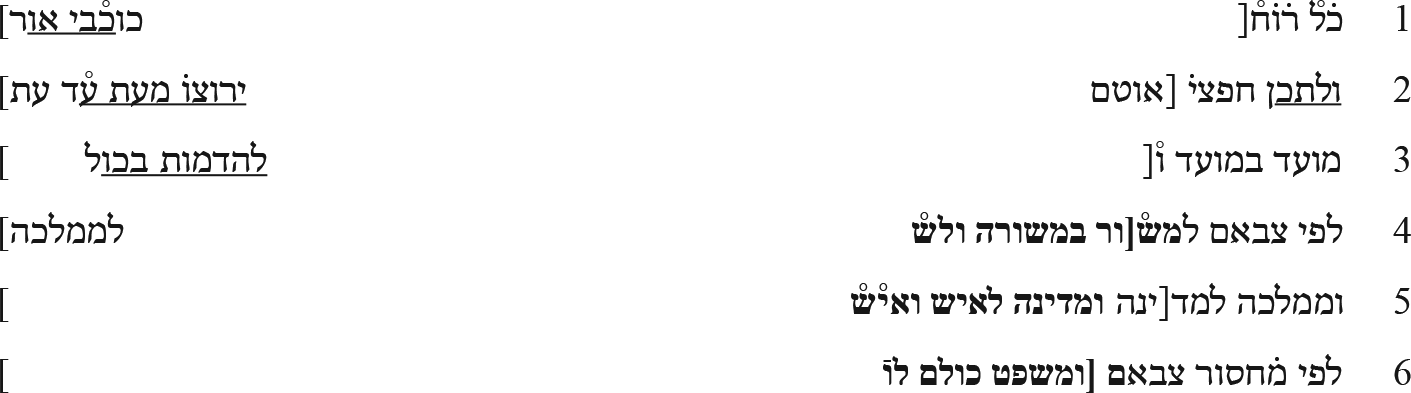
The section builds on the image of both humanity and the divine beings as צבא, “multitude, working group,” this term being used not in the military but rather in the civil sense. 10 That not only the heavenly host but also humans are discussed here, must be deduced from line 5, which mentions kingdoms and cities. The section begins by stating how provisions were assigned to the heavenly multitude, using the term לתכן חפצי “to mete out the sustenance” (line 2). 11 Provisions are similarly meted out to the human multitude, according to its national divisions and dwelling places, reaching each and every individual. God has installed a deliberate plan of providing for them all, as expressed in the statement משפט כולם לו, “the portion of them all lies with Him” (line 6). 12 The provision is further called מחסור (line 6). While this term usually means the exact opposite, that is, “lack,” in the idiosyncratic vocabulary of Instruction it is used in the positive sense of provision, something that can be spent or shared with others. 13 The prologue of Instruction thus states, at the commencement of the entire composition, that the measured supply (see line 4) for each individual, and for the multitude of humankind, is its primary concern.
This credo, expressed only sketchily in the extant lines of the prologue, acquires concrete dimensions in the instructions on economic conduct later on. The reader encounters the main principle in 4Q417 2 i 17–19, excerpted here for the sake of clarity (4Q417 2 17–19 + 4Q418 7b, 64, 66): .ונחלתכה קח ממנו ואל תוסף עו֯ד ואת אשר יטריפכה א֯כ֯ו֯ל ואל תוסף ע֗ו֗ד פ֗[ן תק]צור חייכה Your share you should take from Him, no more. What he feeds you, you should eat, do not overdo it, les[t you sh]orten your life.
Alluding to Proverbs 30:8, the author states that one should not exceed the limits of his assigned portion, neither for less nor for more. Any protrusion is a sin, and may even lead to shortening one’s life. The material means assigned to a person are intertwined with the essence of that person’s life; overdoing one part of the combination may lead to diminution of the other. 14 These two directives serve as a basic premise for the following pericopae (for example, 4Q416 2 iii 8–9 and many others), which are all attuned to the same general program. It is derived from the general statement in the prologue, yet in a more specific way.
The metaphysics of ownership arises in every case of transaction, when one takes over the property of someone else or pledges his property to his neighbor. In such cases, Instruction describes how enslavement of property entails also the enslavement of one’s spirit. The addressee is urged to quickly repay loans (4Q416 2 i 21–24), 15 to avoid taking other people’s capital in deposit (4Q416 2 iii 3–6), or to even indulge in business with a stranger (4Q418 103 ii 6–9). A further case in 4Q416 2 ii 4–6 (+ 4Q417 2 ii 6–8 + 4Q418 8) discusses a loan, when the addressee pledges his property to bail out a friend (בעד רעיכה). 16 I will not quote in full this oft-discussed section, but shall rather recount its central message, that by bailing a friend one takes his hidden purse (כיס צפונכה) and entrusts it in the hand of the creditor. The addressee is urged to quickly redeem it. This “purse,” however, is not merely financial goods, as such goods would not be referred to as “secret.” Rather, the purse indicates one’s metaphysical share, saved for him in heaven. 17
The metaphysical implications of the bail are also apparent from the subsequent sentences (lines 6–7), which focus closely on the vicissitudes that may be caused for one’s spirit as the result of financial interaction. Two short statements involve the person’s spirit: ובדבריכ֗ה֗ אל תמעט֯ [את] רוחכה בכל הון אל תמר רוח ק<ו>דשכה כי אין מחיר שוה֗ [בה ... do not let your words lessen your spirit. Do not exchange your holy spirit for capital, for so sum shall equal [it].
The assigned portion of the individual can take the form of רוח, or is at least closely associated with it. It may be compromised or traded, just like the wealth switches hands. Since the words uttered during negotiation might diminish the person’s spirit, such negotiation should be avoided.
18
Furthermore, one should do anything possible to guard his spirit, and certainly not trade it (תמר) for a price, the kind of result that may arise from economic conduct. The spirit is attached to the material inheritance; compromising the latter may also compromise the former. In the rhetoric of Instruction, the reader’s attention is drawn to the spirit, as it exchanges hands between the various financial agents. Similar statements to that effect recur later on, as, for example, in 4Q416 2 ii 17–18 (+ 4Q417 2 ii 22–23):
19
.אל תמ]כור נפשכה בהון / טוב היותך עבד ברוח] .וחנם תעבוד נוגשיכה / ובמחיר אל תמכור כבודכה ואל תערבהו {תערב הון} בנחלתכה / פן יוריש גויתכה Do not sell your soul for money / it is better that you remain a slave in spirit. Serve your oppressor for free / but do not sell your dignity for a price. Do not involve him/capital in your inheritance / lest he dispossess your body.
As line 15 indicates, one should not undertake commitments beyond his capacity. He should not sell his soul for money, that is, indulge in such transactions as described in the previous columns (i-ii). Rather, even as a slave he should retain his holy spirit. 20 Such a level of independence can be achieved if the addressee preforms the work for his superior without a payment (חנם), and thus avoids trading his dignity for a price. Granting the superior access to one’s spirit by means of accepting his payment, will advertently involve him in the person’s private share, which may lead to dire consequences. In this unit too, רוח acts as a commodity, which changes hands with financial activity: one can trade his spirit, pledge it, diminish or increase it, retain it in his property or pass it on to others. 21
With this reading in mind, the sequence of the composition proves to be a coherent logical elucidation of various economic scenarios, analyzing each of them in the metaphysical terms defined here and providing a solution for each of them within the same conceptual framework. The stress is not so much on poverty, as commonly read, but rather on acknowledging one’s role in the world without transgressing it. Rather than a haphazard collection, I therefore see this section of Instruction as a deliberate effort, providing a comprehensive philosophical account for inter-personal relations.
Having accounted for the situations of loan and slavery, the author must also account for the addressee’s support of other individuals, both within the household and outside it. In the view described here, such situations require justification, as one lets others join in his divinely ordained share. This act is commendable, however, as explained in several passages. Thus, for example, in 4Q418 81 18 the addressee is commanded: הוצא מחסורכה לכול דורשי חפץ “let out your provisions for all those who seek sustenance” (4Q418 81 18).
22
More clearly in 4Q418 122 ii + 126 ii 14–15, a passage that describes the responsibility of the Mevin toward those who depend on him:
You, walk in sincerity with all those who require su[stenance ... ... his assigned portion is in your hand, and from your basket he shall require his sustenance
The share of the mevin’s dependent was entrusted in his hand, while he acts as a mediator of supply. This is the meaning of the phrase בידכה אוטו, the mysterious term אוט designating “measured portion” in the idiosyncratic vocabulary of Instruction. 23 The author of Instruction is thus concerned by the need to sustain the needy and develops a comprehensive justification for it.
Family and the metaphysics of property
The Book of Ben Sira contains a section (7:19–38) in which the addressee is instructed how to interact with his dependents. 24 This section is not about almsgiving, but rather about the sustenance of household members or those closely associated with it. Importantly for the present purpose, both the wife and the parents are counted among this list of dependents. Honoring one’s parents is a financial issue as much as it is a moral one: in a household that hardly meets its needs, feeding the elderly parents may be difficult. Thus, while Ben Sira 3:1–16 stresses the respect people should practice toward their parents, chapter 7 counts the parents in a list of beneficiaries that involve a cost. The elderly depend on their son for their livelihood, yet they also contribute to the success and sustainability of the household by invoking God’s blessing. The main motivation is utilitarian: supporting them will ultimately pay back to the household.
Two sections in 4Q416 2 involve the parents (iii 15-19) and the wife (iii 20—iv 10) respectively, yet they follow a different line than the sections in Ben Sira. These two sections immediately follow the 4Q416 sections on financial relations. While they do not evidently focus on financial interaction, they stand in the sequence of passages that do explicitly involve it. In addition, both passages take issue with verses from the Torah, quoting and interpreting them to fit their message. 25 I believe that the recourse to the Torah derives from a special motivation in this case, required for the unit’s a special message. While other passages in Instruction discuss the regulations of marital life (mainly in 4Q415), 26 the sections in 4Q416 are specifically focused on the transformations of personal inheritance. Moreover, it seems to me that the meaning and intention of these pericopae has been previously misunderstood and can now be improved. The section on parents has been understood as making the point that “being humble and ethical is way of honoring one’s parents.” 27 The section on marriage was understood as intending that “he should exercise proper control over his family.” 28 I suggest a different reading of both sections following the financial lines described above.
In the life situations of honoring one’s parents and of taking a wife, a transformation takes place in both spirit and financial status. Every person had once been a child under parental custody, while later acquiring an independent spirit and establishing an inheritance and a family (cf. 1QSa I 9–10). At this very moment the person also becomes committed to support his parents, letting them share in his own personal lot. This situation is even more conspicuous with regard to a wife. A young girl had once stood in the custody of her parents, yet she moves to the custody of the husband: he acquires ownership of her spirit, while she is nourished from his personal lot. These shifts of the personal inheritance are not trivial in the author’s eyes, and require a dedicated explanation, which is the goal of the sections discussed here. 29 Since many of the issues arising from these sections have been adequately addressed by previous authors, and due to the limited space assigned to the present article, I cannot provide full commentary, but shall rather focus on the points that involve my suggested interpretation.
4Q416 2 iii 15–19 +
15 (Even) in your poverty you should respect your father / 16 and your mother (even) in dire times. For as father/god to a man is his father, and as master to a man is his mother. For 17 they are the crucible that conceived you. As He made them sovereign over you and appointed them over (your) spirit you shall serve them. And when 18 He
32
revealed your ear in the Mystery of existence you should honor them, for your honor. With a[ll your might] you should respect their face 19 for your life and longevity.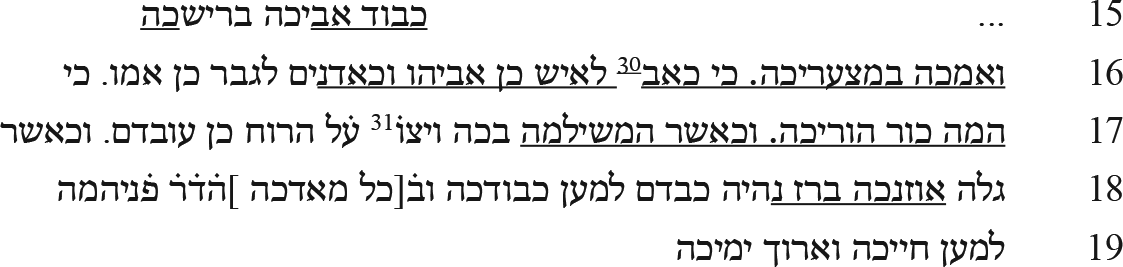
The section on parents begins with economy, stressing the monetary cost and the difficulty to respect one’s parents in times of poverty. 33 As the argument moves on, it embraces the language of hierarchy and mastery: the parents are like god or like master to the addressee. While mastery and enslavement must usually be avoided (4Q416 2 ii 17–18), this time they are legitimate, because God gave the parents mastery (המשילם) over their minor son. Moreover, line 17 states that the parents have also been appointed (ויצו) over the son’s spirit. Lines 17 and 18 are an analytical attempt to dismantle the problem of honoring one’s parents into two separate questions: (1) how is it that a person acquires his own share after having stood under his parents’ custody, and (2) having gained that share, how is it justified that he should feed his parents from his own, recently acquired share.
The answer to these two questions is recounted as a sort of narrative, by means of juxtaposing the two statuses, before and after puberty: כאשר המשילם בך ויצו על הרוח כאשר גלה אזנך ברז נהיה
In the second sentence, the moment when God reveals the Raz to the young adult marks his coming of age. This revelation in some way parallels the coming of age with the knowledge of Good and Evil in 1QSa I 10–11. Examining the author’s rhetoric, we can see that the attention narrows down to the exact point of transition between two legal statuses. The moment of transition occurs when the young man gains Raz Nihye, as he comes of age and gains his own share. At that very stage he also becomes indebted to his parents. Salient here is the term רוח, which denotes, here as before, one’s spiritual inheritance, switching status as the pericope continues. In the same way that the author is concerned above with the way one’s spirit switches hands as he becomes a slave, here too the focus rests on the point when one gains his own independent spirit. Just as above the author justifies one’s commitment toward his dependents, here too an effort is made to justify this particular aspect of the gift economy. The justification is drawn from reliance on scriptural verses (Exod 20:12, Deut 5:16) quoted here in paraphrase. 34
The next pericope on marriage reinforces the author’s interest in the shifting of statuses, which exceeds the usual sapiential interest in the marital relationship. This section (4Q416 iii 20—iv 14) is somewhat enigmatic. It is not typically sapiential since it does not plainly advise the addressee to practice his right as paterfamilias, but rather spends much effort on justifying this status, using an elaborate midrash on Gen 2:24 and 3:16. What seems like an assertion of the husband’s dominion, such as the conjugations of the root משל, is not plainly so, as I demonstrate below. Moreover, if the idea is to show the husband’s dominion over his wife following Gen 3:16, why emphasize the dominion over her spirit, which does not appear in Genesis? The section shows a pronounced halakhic interest in the vows of women (Num 30), but as Schiffman has observed, it does not offer much innovation or take any particular legal stance vis-à-vis other texts. 35 The allusion to the Pentateuch seems to make an ideological claim rather than a legal one. The entire move by the author is smoothly explained if seen as an attempt to trace the economic status of the wife and her move to the husband’s household.
4Q416 2 iii 20—iv 10 +
20 You have taken a wife in your poverty. Examine her horosco[pes... 21 from the Raz Nihye. When you join together, walk with the helper of your flesh... 1 [... for] one should le[ave his father and his mother and… into] one flesh. 2 He made you sovereign over her, and ... [her] des[ire shall be to you. Her father] 3 He did not make sovereign over her, from her mother He separated her, and she will stick to you [and become] 4 for you one flesh. Your daughter he shall (also) separate for another (man), and your sons [to] the daughters of your mates. 5 And you should be one with the wife of your bosom, for she is the flesh of your nakedness. 6 Whoever governs her except you has exceeded the border of his livelihood. Over her spirit 7 He made you sovereign, to walk according to your will, and not to make additional vows or votiv[e gifts.] 8 Turn her spirit to your will, and all of her punitive oaths, whether vows or votive [gifts], 9 you shall annul according to your word of mouth. According to your will you shall prevent [her (from vowing), and God ] 10 will forgive her [the utterance] of your mouth for you. ...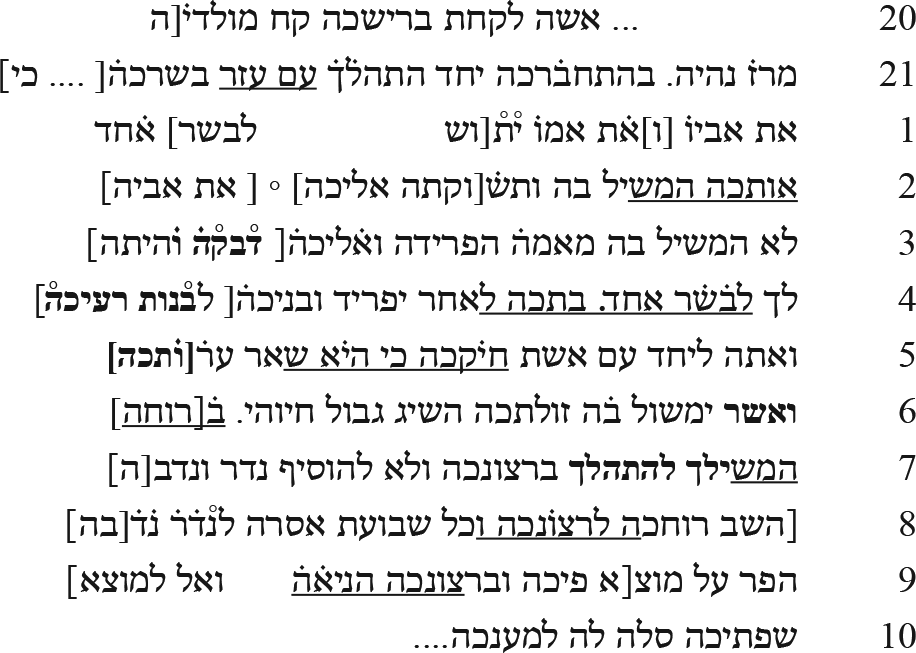
The unit shows recurring interest in the demarcation of inheritances and the switching between authorities, far beyond what is required to make the sapiential or halakhic point. Thus in line 6, he who rules another person’s wife “has exceeded the border of his livelihood,” a language which is employed above (4Q416 2 iii 9) to denote the economic-metaphysical inheritance of the addressee. The root משל is invoked several times in lines 6–8, once again in compliance with its use to denote the person’s financial inheritance (4Q416 2 iii 12, 4Q418 9 12; 81 3, 9, 15; 4Q423 1 2). The mention of the wife’s spirit should also be seen in this light, as described in quite a few passages above. The passage thus cannot be seen simply as encouraging the addressee to practice control over his wife, but rather as employing a conceptual, or maybe better: a phenomenological exploration of the notion of sovereignty and its transfer. The author is not equipped to run this investigation in philosophical terms, but the effort to make a logical argument stands out from several factors. A series of examples and derivations is presented in lines 2–4 to exemplify the shift of sovereignty: just like you gained sovereignty over your wife’s spirit, so will you do the same for your own sons and daughters. This is the reason also for the assertion that no one else is allowed to demand sovereignty over your wife, otherwise a rather self-evident detail.
The investigation is further enriched by exploring two scriptural passages, which in turn add vigor to the argument: Gen 2:24 and Num 30. The phenomenology of the status switch is examined by recourse to Gen 2:24, the proof text par excellence for the changing status, where the author finds two important assertions. The point is not only that one takes dominion over his wife (v. 24b), but also that the young adults first leave the authority of their parents (v. 24a). As the reader recalls, this initial stage of the relationship has also been discussed above in the section on honoring one’s parents (4Q416 2 iii 18). The proof text Gen 2:24 introduces the term בשר “flesh” to interact with the spirit: once the wife’s joins her husband’s בשר, her spirit becomes also subservient to him (lines 5–6).
The author then moves to the law of women’s vows in Numbers 30. This law cannot be the main aim of the pericope, because it does not make a distinctive halakhic point. Nor is it a case of “biblical interpretation,” because it does not add any significant interpretation on the scriptural formulation. The point is that this law, like Gen 2:24, adds vigor to the author’s emphasis on the changing status. This scriptural law explicitly describes how the girl switches from the father’s authority to that of the husband. What is not explicit enough in the Torah, gains further explication in the present section. The law of vows is not merely a religious-sacred regulation, but also an economic one: it is the pronounced interest of the husband to make sure that his wife does not commit to exceeding expenses due to her acts of piety. Since he pays the bill, he is entitled to gain control over the promised expense. 36
Lines 6–10 constitute a rhetorical homily aiming to correlate the husband’s responsibility for his wife’s vows with the switch in the status of her spirit. The spirit (line 6, 8) is the main extra-scriptural addition in this passage. In line 8, the spirit is correlated with the husband’s רצון “volition.” 37 It is not mentioned in neither Genesis 2 nor Numbers 30, and is required here only in order to correlate the change of status with the terms of the financial sections indicated above.
I have not been able to provide a full commentary on the marriage pericope in 4Q416. Instead, I concentrated on showing how it is preferably read as part of a larger message, encompassing the entire composition of Instruction, with regard to the addressee’s financial-metaphysical share in the world. The author has an idea to convey, which he strives to elucidate and exemplify in a quasi-philosophical manner, to the best of his ability. This line of thought accounts for the ideas and vocabulary employed in the pericope in the most efficient and comprehensive way.
Conclusion
The economic pericopes preserved sequentially in 4Q417 2 and 4Q416 2 i-iv are not a haphazard collection of wisdom statements. Rather, they constitute a deliberate treatise aimed to support one basic message: that every person was assigned a lot from heaven, that he should not increase nor diminish it, and that he should not compromise it by placing it as subservient to other masters. Unique vocabulary was minted to convey this message, and the prologue of the entire treatise is devoted to stating this general principle, as shown briefly in this article. Every change of the divine order constitutes a metaphysical problem, and requires special elucidation. While some such occasions are legitimate and even recommended, others are breaches, which should be condemned. Classical cases of dependencies—parents and wives—are represented here as economic commitments, and justification is brought for them. In these cases, the author focuses on the points of transition, where the spirit leaves one sovereignty and joins another one. In promoting this idea, Instruction departs from the utilitarian interests of traditional wisdom, embracing a wider theological-philosophical attitude. Most notably, the author makes significant attempts to present a formalized argument, even almost a syllogism, making recourse to multiple examples and providing interpretation of these precedents in order to validate the general claim. I believe that such a view of the treatise Instruction will prove useful for explaining many more points in it as well as its overall message.
Footnotes
Declaration of conflicting interests
The author(s) declared no potential conflicts of interest with respect to the research, authorship, and/or publication of this article.
Funding
This study is funded by a grant from the DIP foundation (Deutsche-Israelische Projektkooperation), Grant Number BE 5916/1-1, as part of the project Scripta Qumranica Electronica.
1.
This article refers to the wisdom composition commonly called 4QInstruction or Musar le-Mevin. However, I find both designations problematic. The former is insufficient because the composition is also represented in the copy 1Q26, and in addition I find that the numbers do not do justice to the essence of this text. The latter option is better, but it conveys the wrong impression that this Hebrew name is a native designation mentioned in the text. I prefer calling it Instruction using italics.
2.
Menahem Kister, “Wisdom Literature at Qumran,” in The Qumran Scrolls and Their World, ed. Menahem Kister (Jerusalem: Yad Ben Tzvi, 2009), 313–16 (Hebrew); quotation from p. 315. Kister phrased this insight briefly in English, too, although in this later essay the sectarian factor of Instruction is stressed more than in the earlier formulation; see idem, “Qumran, Jubilees, and the Jewish Dimensions of 2 Corinthians 6:14-7:1,” in The Religious Worldviews Reflected in the Dead Sea Scrolls. Proceedings of the Fourteenth International Symposium of the Orion Center for the Study of the Dead sea Scrolls and Associated Literature, 28-30 May, 2013, ed. Ruth A. Clements, Menahem Kister, and Michael Segal; STDJ 127 (Leiden: Brill, 2019), 103–39, esp. 11–114. Kister’s earlier ideas are further developed in a Hebrew dissertation by Amit Gevaryahu, “Lending at Interest in Rabbinic Literature: Law, Homiletics, and Cultural Contacts” (Ph.D. diss., Hebrew University of Jerusalem, 2019), 33–42. This dissertation will soon be published as a book.
3.
Ibid., 315. For a similar assessment of ruah in this composition see Matthew Goff, The Worldly and Heavenly Wisdom of 4QInstruction; STDJ 50 (Leiden: Brill, 2003), 163–64; Benjamin Wold, 4QInstruction: Divisions and Hierarchies; STDJ 123 (Leiden: Brill, 2018), 127–45, dedicated a long discussion to “spirit” with many helpful insights. The financial aspect of the spirit is only discussed in pp. 135–38.
4.
For a convenient survey of financial instruction in wisdom literature, see Goff, The Earthly and Heavenly, 127–40. For the combination of apocalyptic and pragmatic wisdom in Instruction see Matthew Goff, 4QInstruction SBLWAW 2 (Atlanta: SBL), 2013, 19–23; earlier Lawrence M. Wills and Benjamin G. Wright, eds, Conflicted Boundaries in Wisdom and Apocalypticism; SBLSS 35 (Atlanta: SBL, 2005).
5.
The prologue was reconstructed and discussed by Eibert Tigchelaar, To Increase Learning for the Understanding Ones. Reading and Reconstructing the Fragmentary Early Jewish Sapiential Text 4QInstruction; STDJ 44 (Leiden: Brill, 2001), 175–93. I suggest some modifications for Tigchelaar’s reconstruction.
6.
Tigchelaar, ibid., 182; Goff, 4QInstruction, 45–49.
7.
Ibid., 184.
8.
The reconstruction supplied here follows Elisha Qimron, The Dead Sea Scrolls. The Hebrew Writings (Jerusalem: Yad Ben Zvi, 2001-2010), (henceforth: DSS), II, 147, with further improvements suggested by Dr. Shlomi Efrati and the team of the SQE Project, University of Haifa. My interpretation of the prologue agrees with Tigchelaar’s reconstruction, yet sheds doubt on his placement of the small fragment 4Q418 229, whose cosmological tone does not match the surrounding lines. In a forthcoming edition of Instruction we move frg. 229 from its current place to a place later on in the prologue. The first lines of the prologue thus do not mention the heavenly host at all but rather only involve provisions for the human multitude. See meanwhile in the forthcoming dissertation by Asaf Gayer, “Measurements of Wisdom: The Measuring and Weighing Motif in the Wisdom Composition Instruction, and its Roots in Second Temple Literature.”
9.
I prefer this meaning of משורה based on its explicit occurrence in Lev 19:35 et al. See Émile Puech, “Les fragments eschatologiques de 4QInstuction (4Q416 1 et 4Q418 69 ii, 81-81a, 127)”, RevQ 22 (2005): 89–119, esp. 91.
10.
See Exod 38:8, 1 Sam 2:22, Isa 40:2, Job 7:1 (see HALOT). This meaning of the noun צבא is frequent in Numbers 1–3, and in the paraphrases of these chapters in Serekh HaEdah (1QSa).
11.
The term חפץ appears in Instruction in this meaning, as for example 4Q418 81 18. Cf. Isa 58:13 (twice). Thus it should not be read as “delight, desire” (Goff, 4QInstruction, 46), but rather closer to “besoin” (Puech, “Les fragments”, 91).
12.
The word משפט in this phrase means “due portion, lawful assignment,” as in Deut 18:3, rather than “order / regulation,” as often assumed (for example, Goff, 4QInstruction, 48).
13.
See Jonathan Ben-Dov, “Lexical Notes on Musar LeMevin: מחסור, אוט,” in Festschrift Emile Puech, ed. J. S. Rey (forthcoming). This meaning of the noun מחסור is apparent in passages like 4Q418 81 18 הוצא מחסורכה לכול דורשי חפץ “let your mhswr out for all those who seek sustenance,” where the noun must mean something positive that can be shared, rather than “lack.” A similar meaning can be demonstrated in 4Q418 127. In that article I demonstrate that the word אוט means “share, measured share”.
14.
The two general directives in 4Q417 2 i 17-19 are interspersed with two other, more elaborate statements regarding one’s life provisions: אם תחסר טרף, מחסו֗ר֗כ֗ה ומותריכה הבא ביחד. א֗ם תותיר הובל למחוז חפצו “If you lack food, your lack and surplus you should count together; and if you have surplus, bring it to its trading place”; and later ואם תחסר לוא מבלי הון מחסורך “If you lack, you shall find your provision not from wealth.” These two short statements are notoriously difficult, with numerous earlier scholars dedicating interpretative efforts to solve them. I cannot survey them in detail here, but will only remark that, whatever the exact interpretation, these statements aim to buttress the same fundamental principle about one’s measured portion of provision that should not be exceeded. Some clarifications are required here.
The phrase הבא ביחד does not refer to pooling the resources of a community (as understood for example by Jean-Sébastien Rey, 4QInstruction: Sagesse et eschatology. STDJ 81 (Leiden: Brill, 2009), 47, 51; Kister, “Qumran, Jubilees and the Jewish Dimensions,” 112), but rather conveys the message that lack and surplus are alternating circumstances in one’s life, which ultimately even out (with Goff, 4QInstruction, 205, following an earlier study by Tigchelaar). Kister, ibid., calls attention to an analogy for this phrase in 2 Cor 8:14.
The phrase לוא מבלי הון מחסורך makes use of the negation לא rather than the imperative “borrow” (with Wold, 4QInstruction, 135; pace Rey, 4QInstruction, 51–52; Goff, 4QInstruction, 185). The sense of the sentence is that the addressee will find his provision not from wealth, but rather (as implied here) from God. See Kister, “Wisdom Literature,” 315; Qimron, as quoted in DJD 34, p. 188. Gevaryahu, Lending at Interest, 35, adds nuance: the lack is not caused by money, but rather by the trespassing of one’s inheritance.
15.
Gvaryahu, Lending at Interest, 36, compares this passage with Deut 15:7–8, 24:13 and contrasts it with Ben Sira 29:2–3. He suggests an analogy between the noun מחסור and the cognate צורך (κρεία) in Ben-Sira.
16.
For the general sense of the unit see Goff, 4QInsruction, 70–71. However, Goff does not fully appreciate the metaphysical significance of the pericope, reading it rather as pragmatic advice.
17.
Kister, “Wisdom Literature,” 315. The term כיס צפונכה is not typical of economic transactions in wisdom literature, and must therefore indicate the involvement of another, metaphysical level, alongside the actual bailed goods.
18.
Wold, 4QInstruction, 137, adds more nuance to this scene. Spirit is not straightforwardly traded for money, but rather such exchange is the result of the social interaction between the Mevin’s friend, his creditor, and the Mevin himself. Rey, 4QInstruction, 81-85, understands the diminishing of the spirit as a warning to the Mevin that giving bail may lead to his enslavement, but I do not think this is necessary. Mishandled loans or bails constitute a diminution of one’s spirit.
19.
The lines are divided into hemistichs following Kister’s arrangement (“Wisdom Literature,” 314). This new parsing solves some interpretative problems.
20.
This is the presumed meaning of the awkward phrase טוב היותכה עבד ברוח. This phrase cannot be taken at face value, since we cannot expect that the addressee will be ordered to enslave his spirit. This will go against the grain of the prevalent argument in Instruction.
21.
Much of this interpretation of “spirit” in Instruction appears in Goff, The Worldly, 163–65, and is carried forward by Kister, “Wisdom Literature”, 313–15. The precise formulation of the spirit as a commodity is novel, as far as I know.
22.
The word מחסור in this sentence must mean something positive that can be offered out, otherwise how can one offer out his lack? Thus I suggest that it means “provision”; see Ben-Dov, “Lexical Notes.” The noun חפץ means “sustenance, need,” rather than “desire, delight,” which do not match the context. Goff’s “business” (4QInstruction, 260) is also possible. This meaning of חפץ is supported by 4Q418 126ii 12 (discussed immediately below), as well as by its usage in CD XIV:12 וזה סרך הרבים להכין כל חפציהם. This usage seems to depend on the use of the term in Isa 58:13. For the use of this verse in the Sabbath laws of CD and elsewhere see Alex Jassen, Scripture and Law in the Dead Sea Scrolls (Cambridge: Cambridge University Press, 2014).
23.
See Ben-Dov, “Lexical Notes.” In that article I establish the meaning of the word אוט on account of its context in several passages, and suggest a possible etymology for it. The sense of the passage suggested here is not far from that suggested by Goff, 4QInstruction, 284–86.
24.
Segal aptly defined the theme of the unit 7:19–38 as חובות האדם לתלויים בו: Moshe Z. Segal, Sefer Ben Sira Hashalem. (Jerusalem: Magnes, 1958), 48 (Hebrew). The order of the list runs as follows: Friend (18), Wife (19), servant, worker (20–21), Cattle (22), Sons (23), Daughters (24–25), Wife (26), Parents (28–29, omitted from the Hebrew by homoioarchton), Priests (29–31), Needy (32), Dead and mourners (33–34). The section is then concluded in vv. 35–36.
25.
Wold (4QInstruction, 154–72) promotes a unique message with regard to the relationship of revelation and Torah in Instruction, and with regard to the authority imbued to the latter. Special attention is paid to the section on parents in 4Q416 2 iii and its relation with Philo and other Hellenistic writers, In the present paper I do not take issue with this distinction, as my argument does not reflect on the exact definition of scriptural authority in Instruction. Nor shall I take issue with the classification of the allusion to Numbers 30 as “Rewritten Bible” as suggested by Daryl Jeffries, “Scripture, Wisdom, and Authority in 4QInstruction: Understanding the Use of Numbers 30:8-9 in 4Q416”, HS 49 (2008): 87–98. I basically agree with the claims of both authors, but would like to present another angle for evaluating this passage.
26.
Rey, 4QInstruction, 157–66 considers also the section 4Q416 2 ii 21 – iii 5 as involving marriage. I am not convinced, and consider that these fragmentary lines discuss other financial matters. Part of the disagreement involves the reading of ii 21 אל תקל כלי [ח]יקכה. While Rey follows DJD in reading this way, Qimron (DSS, II, 151, with further argumentation) accepts Kister’s reading אל תקל בלו [ח]וקכה, “Do not contempt (yourself) by exceeding your assigned portion” (Kister, “Wisdom Literature,” 314). Rey’s objection (4QInstruction, 158, based on a study by F. García-Martínez) is answered by Qimron, ibid., who claims that the reading οf bet is possible. Wold, Women, Men and Angels, 192–97 discusses the matter at length and supports DJD, and so does Tigchelaar, To Increase Learning, 47 albeit without detail on this particular reading. In my opinion, the reading of bet is indeed possible, especially so in the parallel 4Q417 2 ii 25 (see also Wold, ibid., 193). But the main argument stems from the context (pace Wold, ibid., 193; Rey, ibid., 166). Kister’s reading is the most natural continuation of the previous lines 4Q416 2 ii 18-20, ordering one not to outlive his financial means. The following lines in iii 1-5 are also better understood as referring to financial matters rather than to marital life. In fact, Strugnell and Harrington (DJD 34, 104) acknowledge the difficulty, and suggest that the unit on marital relations must have been a very short one in the midst of longer financial discussions. (I thank Shlomi Efrati for this reference). Therefore, the parallel for כלי חיקכה from 1 Thess 4:4, attractive as it is, cannot be accepted.
27.
Goff, 4QInstruction, 109.
28.
Jeffries, “Scripture, Wisdom and Instruction,” 89.
29.
This point is acknowledged by Rey, 4QInstruction, 170, with regard to the section on marriage. In his view, the section explains the unity of man and his wife, her separation from her parents, and the husband’s sovereignty over her.
30.
4Q418 reads כאל. All commentators relate at length to the importance of this variant, which will not be discussed here.
31.
DJD 34, 122, read here ויצר על הרוח “and fashioned (thee) according to the spirit.” This reading is preferred by Wold, 4QInstruction, 138; see Tigchelaar, To Increase Learning, 48 (albeit with no detailed comments). Others retain the reading suggested here, which is also defended by Rey, 4QInstruction, 190; Goff, 4QInstruction, 94.
32.
The verb גלה is quite clearly in the singular. DJD 34, 122, however, read it as a plural verb relating to the parents, based on the meaning expected from the context. They explain that the phrase גלה אזן is a fixed expression, hence it is used in the singular although it is ostensibly plural. This idea is embraced by Wold, 4QInstruction, 163. However, the explicit singular voice is hard to deny and yields a reasonable sense as it is. It is God, not the parents, who revealed the ear of the addresee in the Raz Nihye. So also Goff, 4QInstruction, 113.
33.
I read the first sentence as an optative, positing the state of poverty as a possibility rather than as a matter of fact. One is of course obliged to honor his parents when he is prosperous too, but it requires special motivation to do so while in a state of poverty. I believe that many of the indications of poverty in Instruction should be read in a similar way. See Eibert Tigchelaar, “The Addressees of 4QInstruction,” in Sapiential, Liturgical, and Poetical Texts from Qumran, eds. Maurice Baillet, Daniel Falk, Florentino García Martínez. STDJ 35 (Leiden: Brill, 2000), 65–72. This does not come to deny that poverty is present in Instruction more than it is in Ben-Sira for example. As Goff, 4QInstruction, 23–25 aptly observes, the addressees of this composition may appear in various economic situations, poverty being quite common for them but not an essentiality. This is exactly the case in the present section.
34.
For the exact scriptural sources and their reworking see Wold, 4QInstruction, 161–71; James Kugel, “Some Instances of Biblical Interpretation in the Hymns and Wisdom Writings of Qumran,” in Studies in Ancient Midrash (Cambridge: Harvard University Press, 2001), 166–68.
35.
Lawrence Schiffman, “Halakhic Elements in the Sapiential Texts from Qumran,” in Sapiential Perspectives. Wisdom Literature in the Light of the Dead Sea Scrolls. Proceedings of the Sixth International Symposium of the Orion Center for the Study of the Dead Sea Scrolls and Associated Literature, ed. J. J. Collins and R. Clements; STDJ 51 (Leiden: Brill, 2004), 89–100, esp. 90–94.
36.
Jacques Berlinerblau, The Vow and the ‘Popular Religious Groups’ of Ancient Israel. A Philological and Sociological Inquiry; JSOTSup 210 (Sheffield: Academic Press, 1996), 148.
37.
Compare CD III ולא בחר רצון רוחו. The terms רוח and רצון are connected or even synonymous; see 1QS IX 4-15. While the term רצון in Instruction always refers to divine volition, in this case it refers to the volition of the husband. The subversion of the woman’s spirit to the husband’s dominion is also mentioned in 4Q415 9 lines 7-8, and should possibly be read in the same light. Note that the next line in that passage mentions the couple’s mutual provisions: מחסורמה זה מז[ה.