




Abstract
Empirical studies have found that although parties focus disproportionately on favorable issues, they also address the same issues—especially, salient issues—through much of the ‘short campaign’. We present a model of multiparty competition with endogenous issue salience where parties behave in line with these patterns in equilibrium. In our model, parties’ issue emphases have two effects: influencing voter priorities, and informing voters about their issue positions. Thus, parties trade off two incentives when choosing issues to emphasize: increasing the importance of favorable issues (‘the salience incentive’), and revealing positions on salient issues to sympathetic voters (‘the revelation incentive’). The relative strength of these two incentives determines how far elections constrain parties to respond to voters’ initial issue priorities.
Introduction
Which issues do parties choose to talk about in campaigns and why? Does electoral competition force parties to address the issues that voters consider important? Prior research on issue selection by parties in campaigns has repeatedly documented five empirical patterns. First, political parties disproportionately emphasize issues on which they are ‘advantaged’ relative to their opponents—issues on which a party’s policies are more popular with most voters, or issues which they are more trusted to handle by most voters. Second, parties do nevertheless address issues on which they are disadvantaged with most voters as well. Third, as a consequence, political parties discuss multiple issues during election campaigns. Fourth, parties spend a significant fraction of their campaigning time discussing the same issues as each other (‘issue engagement’), and fifth, this is especially the case when these are issues important to voters.
Understanding what motivates parties to behave in this way is essential for assessing when and how the electoral mechanism is able to discipline parties’ behavior. However, extant formal models of issue selection by parties during campaigns provide support for the empirical tendency of parties to focus more on advantaged issues, but generally do not match the other empirical patterns documented above. Rather, most of this formal literature has concluded that parties will typically campaign only on their most favorable issue in equilibrium to increase its salience, and two parties will never campaign on the same issue if each is advantaged on a different issue. 1 In comparison, we develop a formal model of multiparty competition where several parties choose how much to emphasize multiple issues and where, in equilibrium, parties behave in accordance with these patterns.
Our model starts from the premise that the extent to which a party emphasizes an issue has at least two effects: it may influence the importance, or salience, of an issue for voters, but it also influences voters’ certainty regarding the party’s policies on the issue. Thus, party emphasis decisions involve a trade-off between two competing incentives. The first is the more frequently studied ‘salience incentive’, which is the incentive to emphasize an issue on which a party’s policies are relatively popular in order to increase the proportion of voters who consider the issue important. The second, which we term the ‘revelation incentive’, is the incentive to emphasize an already salient issue to increase the proportion of voters who are aware of the party’s policies on the issue. Doing so benefits the party electorally because voters are less inclined to support a party if they do not know its policies on a salient issue. Therefore, even if a party’s position on an issue is unpopular with the majority of voters, the party still has an incentive to emphasize that issue to reveal its policies to the minority of sympathetic voters for whom the issue is important. Consequently, parties will emphasize the same issue as one another if this issue is highly salient.
By incorporating the ‘revelation’ incentive into a model of party strategy with endogenous issue salience, we propose an explanation for why parties tend to disproportionately focus on issues that favor them, while also spending much of their campaigns discussing the same issues as each other (even if unfavorable)—and especially when these issues are particularly salient to voters. In our model, multiple parties take distinct policy positions on multiple issues and strategically choose which issues to emphasize in order to maximize their vote share. Parties trade off two competing incentives when deciding how much to emphasize each issue. First, as in prior literature, emphasizing an issue increases the proportion of voters who consider the issue important, which is advantageous for a party if its position on the issue is relatively popular (the ‘salience incentive’). Second, emphasizing an issue also increases the proportion of voters who are aware of the party’s position on the issue. Even if a party’s position is only popular with a minority of voters, placing some emphasis on the issue is electorally beneficial, as those voters will be less inclined to support the party if they do not know its position on an issue salient to them (the ‘revelation incentive’).
In order to tractably model the revelation incentive, we depart from most of the literature by assuming that voters are ambiguity averse rather than standardly expected utility maximizing. Ambiguity averse agents are not comfortable assigning probabilities to uncertain future events and so instead maximize their utility in the worst-case scenario. Models with ambiguity averse voters have been studied by Ashworth (2007), Ellis (2016), Ghirardato and Katz (2006), and Yang (2024), who have argued that this assumption helps explain a range of otherwise puzzling empirical voting phenomena. In our context, ambiguity aversion means that voters who do not know a party’s position on an issue important to them ‘fear the worst’ – that the party might be very far from their ideal point on the issue—and so always prefer to vote for a party whose position they know over one whose position they do not know. This therefore provides a revelation incentive for parties to reveal their positions to voters. While this is a much more tractable assumption about voter behavior than standard expected utility maximization in our setting, it is much less common in the literature. For this reason, we also study the case of standard expected utility maximizing voters as an extension. We are unfortunately unable to solve the expected utility maximizing case analytically, but results from numerical simulations we consider with two parties and two issues are qualitatively similar for the expected utility maximizing case and the ambiguity aversion case, provided party positions are not too extreme. This is suggestive that our main qualitative conclusions do not depend upon ambiguity aversion. We conjecture that this would also be true numerically with a larger number of parties and issues.
With ambiguity averse voters, and under some special assumptions about the structure of voter information, we show analytically that the revelation incentive is sufficiently powerful that all parties choose to campaign on all issues in equilibrium. Nevertheless, parties tend to emphasize more salient issues relatively more and also emphasize issues on which they have a comparative advantage relatively more. If one issue is much more salient than all others, then the resulting strong ‘revelation incentive’ leads all parties to primarily talk about the issue regardless of their positions on the issue. Similarly, if voter priorities are not very flexible—for example, late in the electoral cycle (Seeberg, 2022)—then the revelation incentive will dominate parties’ calculations, and parties will primarily focus on the issues already important to voters.
An additional contribution of this study is the tractability of our framework, which may prove useful for future models of campaign strategy. To our knowledge, this is the first formal model of party competition with endogenous issue salience where an arbitrary number of parties are able and motivated to choose a continuous and non-extreme level of emphasis on an arbitrary number of issues. Nevertheless, under some strong restrictions on voters’ information structure, the assumption of ambiguity averse voters makes it possible to solve for the equilibrium analytically. Furthermore, we show in the appendix that the model can be solved numerically with expected utility maximizing voters and alternative voter information structures in the two-party two-issue case (the principal setting studied in the literature), and these numerical results are qualitatively very similar to the cases that can be studied analytically. Moreover, while our analysis focuses on parties’ emphasis decisions on positional issues, our model and results are also straightforwardly extended to a case with one or more non-positional, or valence, issues, as discussed in Section 3.4.
The existence of a ‘revelation incentive’ is consistent with a sizable literature arguing that the more uncertain a voter is about candidate positions, the less likely she is to support the candidate (e.g. Alvarez, 1998; Bartels, 1986; Ezrow et al., 2014). However, our argument that individuals are less inclined to vote for a party if uncertain of its position on a salient issue may appear to jar with recent research that, instead, stresses the electoral benefits of positional ambiguity (Bräuninger and Giger, 2018; Somer-Topcu, 2015; Tomz and van Houweling, 2009). In fact, our findings are actually consistent with this literature, as our analysis clarifies that the incentives parties face to avoid, or to speak less, about an issue—that is, a party’s level of emphasis on an issue—are distinct from those encouraging parties to present a less precise stance on an issue—that is, a party’s positional ambiguity on an issue.
To illustrate this, in Section 5.1, we extend our model to include the effects of positional ambiguity on voter decisions, allowing parties to choose a level of precision of messages as well as a level of emphasis on each issue. This generates an additional trade-off for parties: parties do face a ‘revelation incentive’ to communicate precise positions on issues important to many voters, but also face an additional ‘projection incentive’ to communicate slightly different positions to different voters. Consistent with the empirical research on the electoral benefits of positional ambiguity, our analysis establishes that, if able to, parties will want to communicate slightly imprecise positions during campaigns. Nevertheless, we find that parties’ emphasis decisions show the same qualitative patterns as our baseline model, and so the imprecise campaigns model can also account for the same empirical patterns in parties’ issue emphases.
Related literature
A large literature on what has variously been described as ‘heresthetic’, ‘issue competition’, ‘saliency theory’ or ‘issue ownership theory’ has documented the following five empirical patterns in party behavior in campaigns.
First, political parties disproportionately emphasize issues on which they are ‘advantaged’ relative to their opponents, ostensibly in order to increase the salience of these issues to voters and thereby to alter the dimensions on which they are evaluated (Budge and Farlie, 1983; Petrocik, 1996; Riker, 1993). To date, empirical researchers have amassed considerable evidence from a wide range of countries supporting this general pattern (Green and Hobolt, 2008; Green-Pedersen and Mortensen, 2010; Vavreck, 2009). 2
Second, parties do nonetheless also campaign on issues where they are disadvantaged relative to their opponents among most voters—with the consequence that, third, each party addresses multiple issues over the course of an election campaign. This has been documented in national election campaigns in the US (Sides, 2006), as well as in the United Kingdom and Austria (Green and Hobolt, 2008; Meyer and Wagner, 2016). For instance, Sides (2006) finds that, during the 1998 midterm elections, Republicans and Democrats spent a similar amount of advertising time on Social Security, the environment, jobs and Medicare, even though many more voters trusted the Democrats on all four issues. Similarly, Wagner and Meyer (2014) find in 17 countries that parties devote, on average, only twice as much time to owned (i.e. advantaged) issues as non-owned issues in election manifestos.
Fourth, as a result, parties actually spend much of their campaigns addressing the same issues as each other. For instance, when analyzing presidential campaigns in the US, (Sigelman and Buell, 2004) found that all candidates spoke on the same issue, on average, a staggering 75.3% of the time. However—fifth—this is especially the case for issues which are already salient to voters (Green and Hobolt, 2008; Klüver and Sagarzazu, 2016; Sides, 2006)—a strategy described by Ansolabehere and Iyengar (1994) as ‘riding the wave’. In keeping with this observation, (Seeberg, 2022) finds that parties in Denmark are significantly more likely to focus on their owned issues early in the election cycle, as they try to shape the political agenda in their favor. Even so, as the election draws closer, and as further movements in voter priorities become less likely, parties shift their focus to the issues dominating the political agenda instead. Along similar lines, Kristensen et al. (2022) presented evidence from six West European countries that parties are more likely to talk about the same issue – even if some of those parties do not own that issue—when it relates to a particularly pressing societal problem, elevating it on the ‘party system agenda’ (Green-Pedersen and Mortensen, 2010).
Extant formal models of issue selection by parties during campaigns provide support for the empirical tendency of parties to focus more on advantaged issues, but generally do not match the other empirical patterns documented above. Most of this formal literature has concluded that parties will typically campaign only on their most favorable issue in equilibrium to increase its salience, and two parties will never campaign on the same issue if each is advantaged on a different issue. Indeed, apart from a few exceptions, discussed below, models in the literature imply that parties will not campaign on the same issue when each is advantaged on a different issue. For example, according to Dragu and Fan (2016), parties never advertise the same policy issue in equilibrium. 3 Meanwhile, according to Aragonês et al. (2015), while two parties may ‘invest’ in the quality of their proposals on the same issue, parties only communicate on issues where they (weakly) come to hold a comparative advantage (unless one party is advantaged on all issues). Some studies have found multiple parties campaigning on the same issue in equilibrium—but only when these parties share ownership of the issue (Ascencio and Gibilisco, 2015), or when one party is majority preferred on all issues, but its comparative advantage on any one issue is not too large (Amorós and Socorro Puy, 2013).
Our paper relates most closely to four other works in the formal literature, which, to our knowledge, are the only other models that predict that parties may, at times, campaign on the same issue when each is advantaged on a different issue. 4 These four models are those of Barberà and Gerber (2023), Denter (2020), Demange and Van der Straeten (2020), and Egorov (2015).
The model of issue selection by Denter (2020) is also able to match the five empirical features of party behavior in campaigns that we have identified, and is, to our knowledge, the only other model in the literature able to do so. However, there are two key differences between our model and that of Denter.
First, Denter limits attention to a model with two candidates and two issues, whereas we provide a model of issue competition with multiple parties and multiple issues that can account for these patterns.
Second, while both models are able to match the empirical facts above, we differ in the campaign incentives we ascribe to parties. In both models, parties (or candidates) choose how much to emphasize each issue, and doing so affects the salience of issues, creating an incentive for parties to campaign more on issues on which they are comparatively advantaged in order to maximize expected vote share. In both models, parties also face a competing incentive to emphasize already salient issues. In our model, this is the revelation incentive; in Denter’s, parties are motivated to campaign on already salient issues due to the potential of campaigns to persuade voters to support them on that issue. More precisely, his model, unlike ours, assumes valence rather than policy issues, and a candidate’s valence on an issue is an increasing function of the amount they campaign on the issue. However, we view the revelation incentive as an (at least) equally plausible explanation for this empirical tendency, given prior research that voters often do not know parties’ positions on key issues and learn about these positions during campaigns (Le and Pons, 2023; Lenz, 2013). That said, further empirical research is needed to evaluate the relative importance of revelation and persuasion incentives for parties.
Other studies of party campaigns that relate closely to ours are Egorov (2015) and Demange and Van der Straeten (2020). In both studies, campaigns are informative, which generates a very similar incentive for issue engagement to our ‘revelation incentive’. According to Egorov (2015), parties choose which of two issues to campaign on and may choose to campaign on the same issue if the loss of voter information from campaigning on different issues is large. According to Demange and Van der Straeten (2020), parties are able to inform voters (or not) regarding their issue positions by communicating more or less precise information in their campaigns. As such, parties have an incentive to campaign more precisely on issues where their issue positions are more popular. However, neither of these papers allows for endogenous issue salience. Furthermore, Egorov (2015) assumes issues are equally salient, and according to Demange and Van der Straeten (2020) salience does not affect party campaign strategy. As such, neither model accounts for why issue engagement is more common on salient issues.
Finally, in very recent work, Barberà and Gerber (2023) developed a parsimonious framework that can rationalize essentially any pattern of issue convergence and divergence in campaigns. Unlike us, however, they do not seek to defend a specific theory to account for empirically observed patterns about election campaigns: rather, their framework is intentionally abstract and not tied to a specific theory of how campaigns affect vote choice. Furthermore, unlike us, they do not discuss the possibilities that campaigns reveal information to voters about parties’ unknown positions, or change the issues that voters consider important.
A model of party emphasis decisions
Voters may be less likely to support a party if uncertain about its position on an issue, and particularly if that issue is electorally salient. Given this, we suggest that parties possess an incentive to address even unfavorable issues in their campaigns in order to reveal their positions on these issues. In this section, we develop a model of electoral competition with multiple vote-maximizing parties and multiple issues, where this ‘revelation incentive’ arises. We formally explore the implications of this incentive for equilibrium party strategy in Sections 4 and 5.
Parties
There are
At this stage, we make no further assumptions about how these issue positions are chosen by nature. The resulting issue positions for each party
Each party campaigns in order to maximize its vote share. Although party positions are set by nature, each party is able to choose how much to emphasize each issue in its election campaign.
5
As we discuss in Sections 3.3 and 4.1, the extent to which a party emphasizes each issue has two effects: it influences the salience of issues for voters, and also influences the probability with which voters observe parties’ positions on each issue.
Voters
There is a continuum of voters. Each voter

We use
In addition to differing from one another in their ideal points, voters also vary on how much they care about one issue rather than another. For each issue
Voter information
Voters prefer to vote for parties whose policy positions are closer to their ideal points. However, voters do not observe all parties’ positions on all issues. In particular, whether a voter
Consider an issue-
Since voters have limited time to pay attention to politics, it is assumed that witnessing one party’s campaign on one issue may reduce the time available for them to witness other parties’ campaigns on the same or other issues. In particular, the probability of a voter witnessing

where
Whether or not a voter witnesses a party’s campaign matters because it affects how much voters care about particular issues and also the probability that a voter observes party positions on an issue. These correspond to the ‘salience’ and ‘revelation’ effects of campaigns, respectively.
To capture the ‘salience’ effect of campaigns, it is assumed that voters are to some degree ‘impressionable’. Specifically, we assume that voters who witness at least one party’s campaign on an issue will ultimately come to care about (and will cast their votes entirely based on) the issues on which they witness party campaigns, and will not be strongly concerned with other issues. 8
Furthermore, witnessing campaigns affects the probability that voters observe parties’ policy positions (the ‘revelation effect’). We assume that, if a voter does witness some party
Here,
Note that a consequence of these assumptions is that every voter either observes either no party’s position on a particular issue, only one party’s position on that issue, or all parties’ positions on that issue. This limited range of possible cases increases the tractability of the model. 10
We assume that a law of large numbers holds, so that, for instance, the total proportion of issue-
Voters gain utility from voting for parties whose positions are close to their ideal points on the issues that they ultimately care most about (itself a function of the campaigns they witnessed). Suppose a voter
We assume that which issue a voter is initially oriented towards is independent of the voter’s ideal point on all issues. Furthermore, whether a voter observes a party’s campaign or position on an issue is also independent of the voter’s ideal point.
Voters have to decide which party to vote for under conditions of uncertainty: frequently they do not observe all parties’ positions on the issues they care most about. In the article and the Supplemental Appendix, we study two different assumptions about how voters deal with this uncertainty. In the baseline case that we focus on in the main article, we assume that voters are ambiguity averse in the sense of Gilboa and Schmeidler (1989) and cannot know parties’ positions for certain unless they observe them in the campaign.
11
As such, we assume that each voter chooses to support the party that maximizes her utility in the worst-case scenario that is consistent with what she has observed. That is, voter

A consequence of this assumption is that, if a voter observes party
In Section 5 and Supplemental Appendix C, we also discuss and present results for the model with two parties when the assumption that voters are ambiguity averse is replaced with the alternative assumption that voters are expected utility maximizers. That is, they vote for the party that maximizes their expected utility, based on their posterior beliefs about party’s positions, which are assumed to be Bayesian rational. The case of ambiguity averse voters is considerably more tractable than the case where voters are expected utility maximizing. As such, we are only able to obtain numerical solutions in the latter case. Nevertheless, our numerical results presented in Supplemental Appendix C indicate that equilibrium party emphasis decisions are virtually identical across the two cases for the parameter values we consider, except when party positions are relatively extreme.
Finally, we assume throughout that, if a voter would be indifferent between voting for two different parties, then she votes for each with equal probability. Thus, for instance, if a voter observes no parties’ positions on any issue, she has no reason to expect higher utility from one party than another, and so votes for each party with probability
In this section, we review the key exogenous parameters introduced so far and discuss their role in the model. Table 1 summarizes these parameters and their role. Of central importance to the analysis are the
Key parameters governing voter information and priorities.
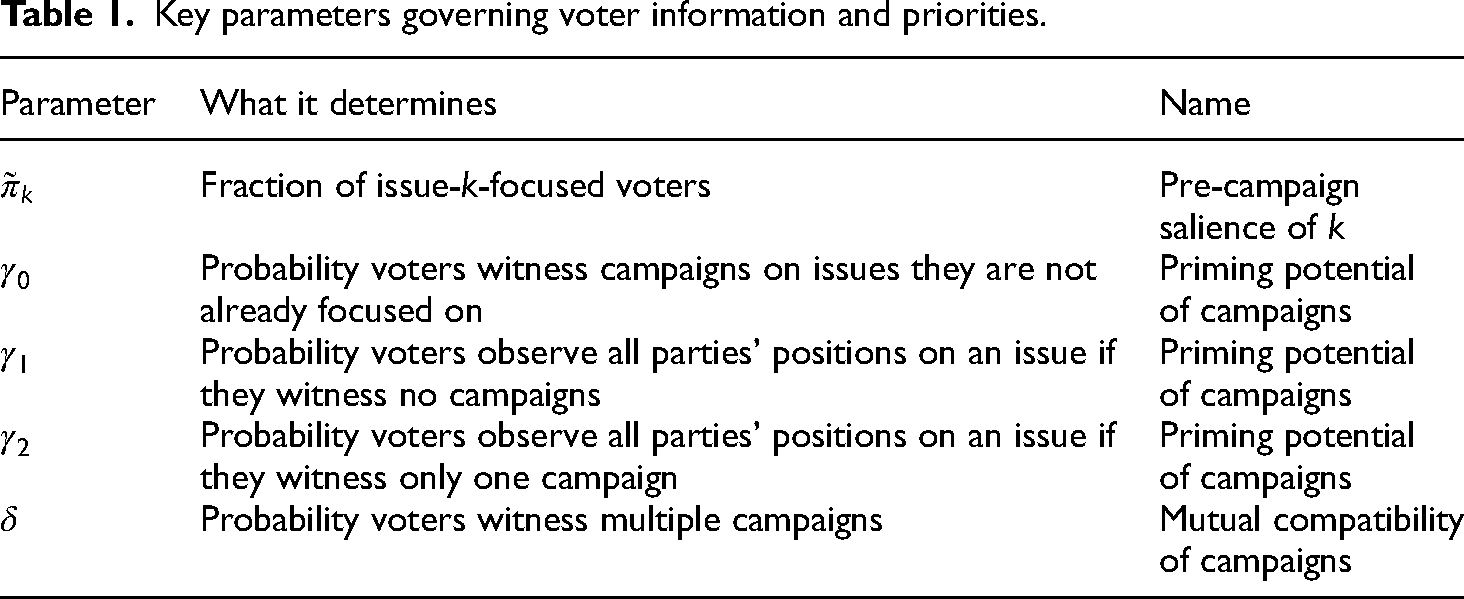
Key parameters governing voter information and priorities.
Our assumptions about campaigns and voter information imply that, in addition to the function
The three
Higher values of the
We refer to
As such, we present analytical results for the
Nevertheless, this extreme assumption is hard to defend empirically, since real world voters do have knowledge of party positions on multiple issues. For this reason, we also solve the model with
As explained above, we now study the properties of the model analytically in the case with
We first characterize the vote share of each party with 


For convenience, we will use
Our assumptions about vote choice imply, under ambiguity aversion, that if a voter observes no party positions on any issue, she votes for each party with probability
Among voters who observe all party positions on (only) the issue 
To see how the
Recall that a strategy 
where the values of the
This formal framework implies that campaigns may affect the salience of issues for voters, which we term the ‘salience effect’ of campaigns, and campaigns may also influence the probability with which voters observe parties’ positions on issues salient to them, which we term the ‘revelation effect’ of campaigns. In this section, we show how the strength of these effects can be quantified in our model.
Recall that 
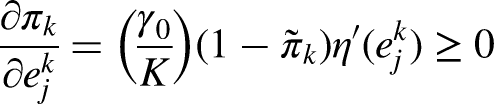

However, in addition to affecting the salience of issues, party campaigns also affect the fraction of voters that observe party positions, as discussed in Section 3. Using the definitions in equation 3 and immediately after, the probability that a randomly chosen voter 

The first term on the right-hand side is the revelation effect of campaigns—campaigns on issue
The second term on the right-hand side is the salience effect of campaigns. As a party campaigns more on an issue, the salience increases, which directly increases the proportion of voters who observe party positions on the issue, since voters are more likely to see party positions on issues they care about. A higher priming potential of campaigns raises the size of the salience effect, both directly in (10) and via increasing the magnitude of
We define an equilibrium in this model as a strategy profile
We solve for party
The first-order condition for party 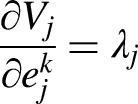
Substituting equations (3) to (5) into equation (7), and simplifying, we obtain that
and so 




where
The marginal benefit of emphasizing issue 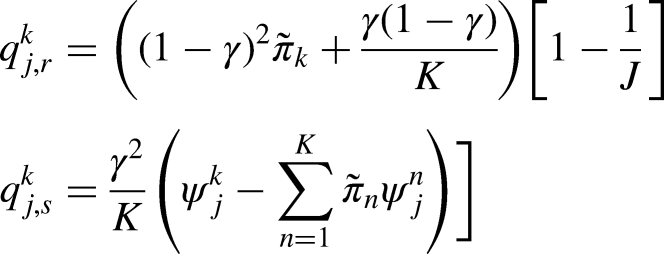
The term
As the revelation effect in equation 10 is larger when the pre-campaign salience of an issue (i.e.
The term
The optimal choice of the party is shown graphically in Figure 1. The
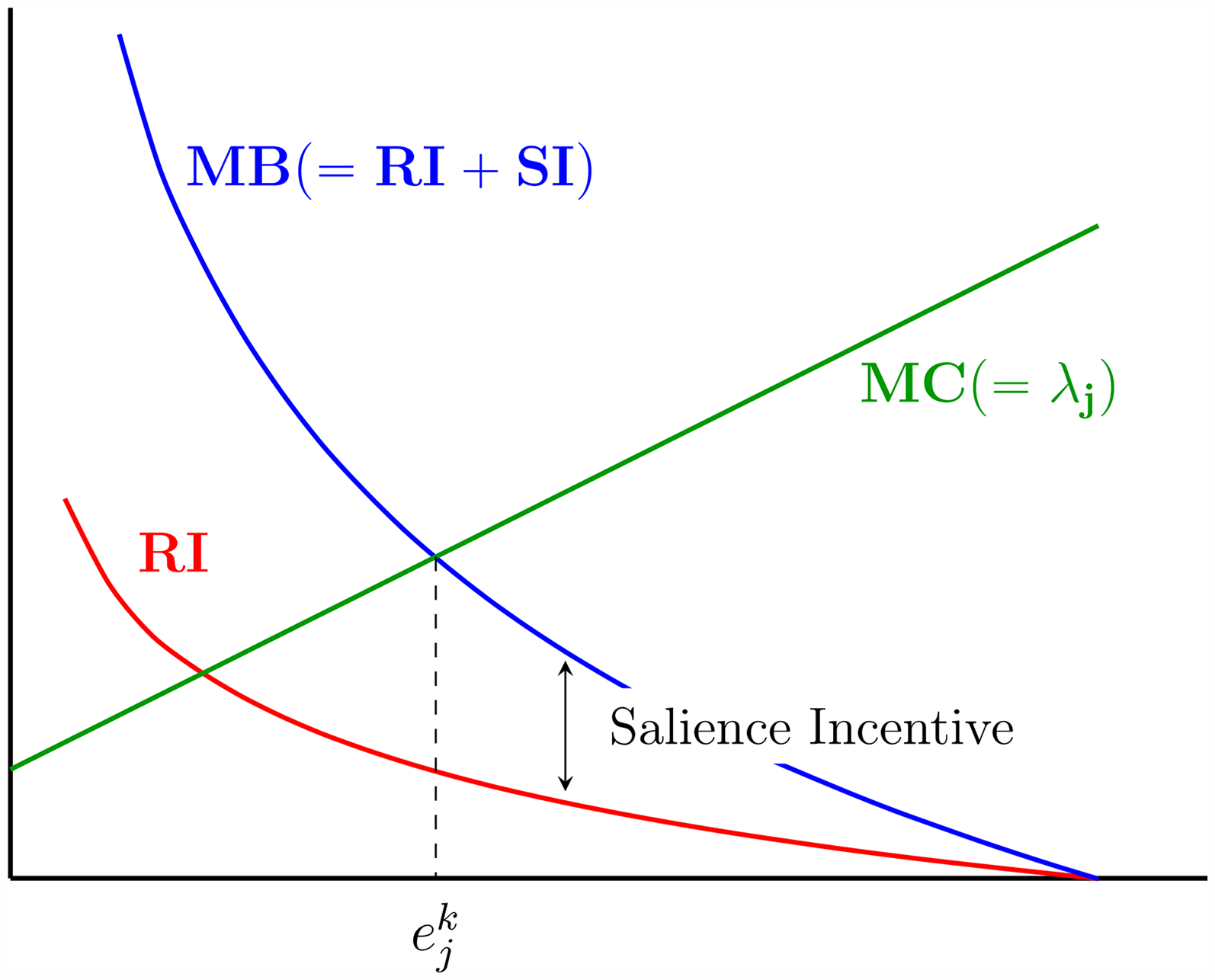
Optimal choice of
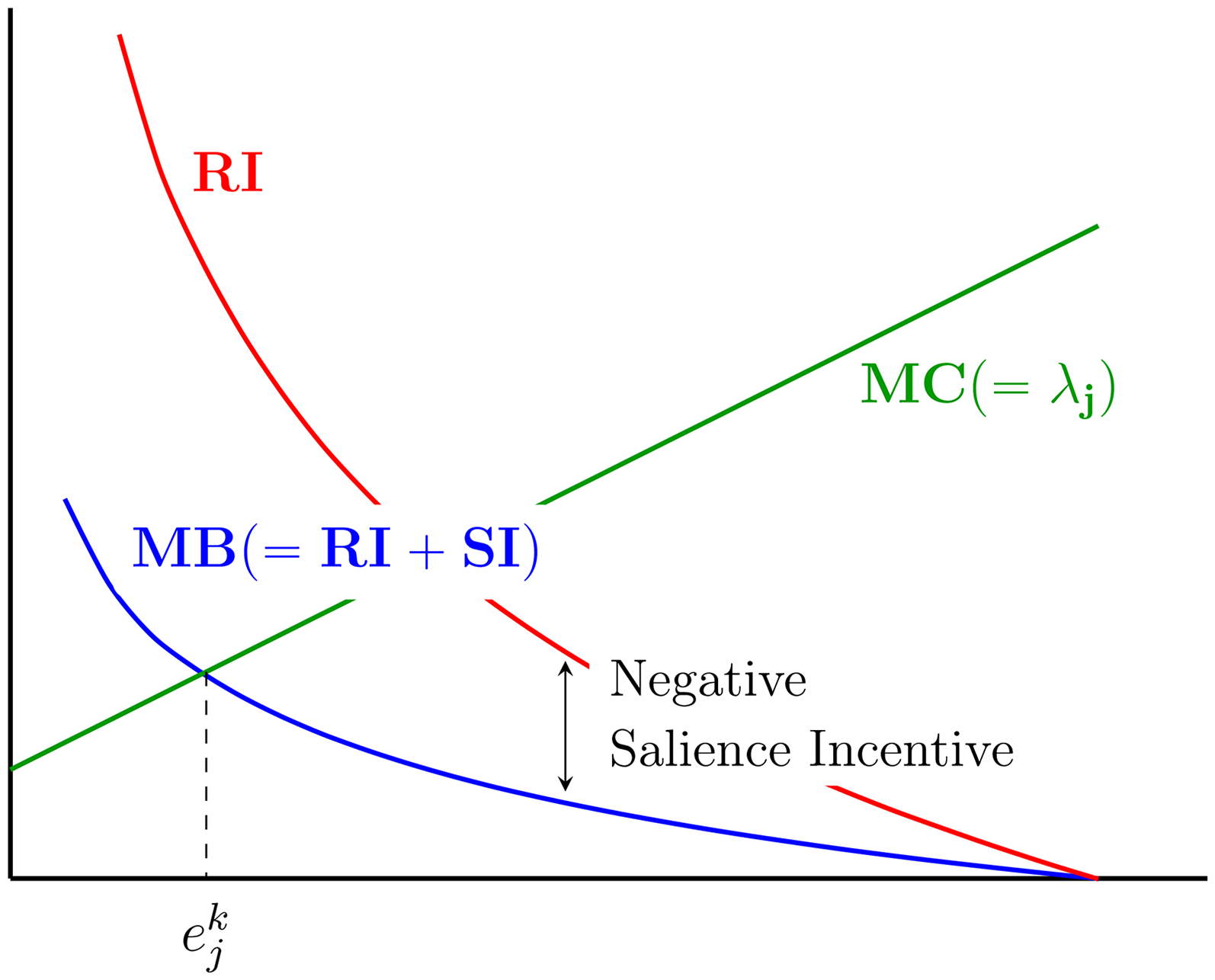
Choice of
Note that the definitions of
There exists a unique equilibrium of the model for all parameter values. In the equilibrium, party
We now show that the model has a number of novel implications for party emphasis strategies, which differ from the results of much of the formal literature. To illustrate some key properties of the model equilibrium, we first present two numerical examples. We derive more general analytical results about these properties of the model in Section 4.4. For both numerical examples, we assume that there are two parties and two issues. Voter ideal points are uniformly distributed on the interval
We assume that Issue 1 has a higher pre-campaign salience
Table 2 summarizes the key parameters of the model and their values in the numerical examples.
19
Table 3 summarizes the equilibrium issue emphases in the two numerical examples and the corresponding values of the
Key parameters in numerical examples.
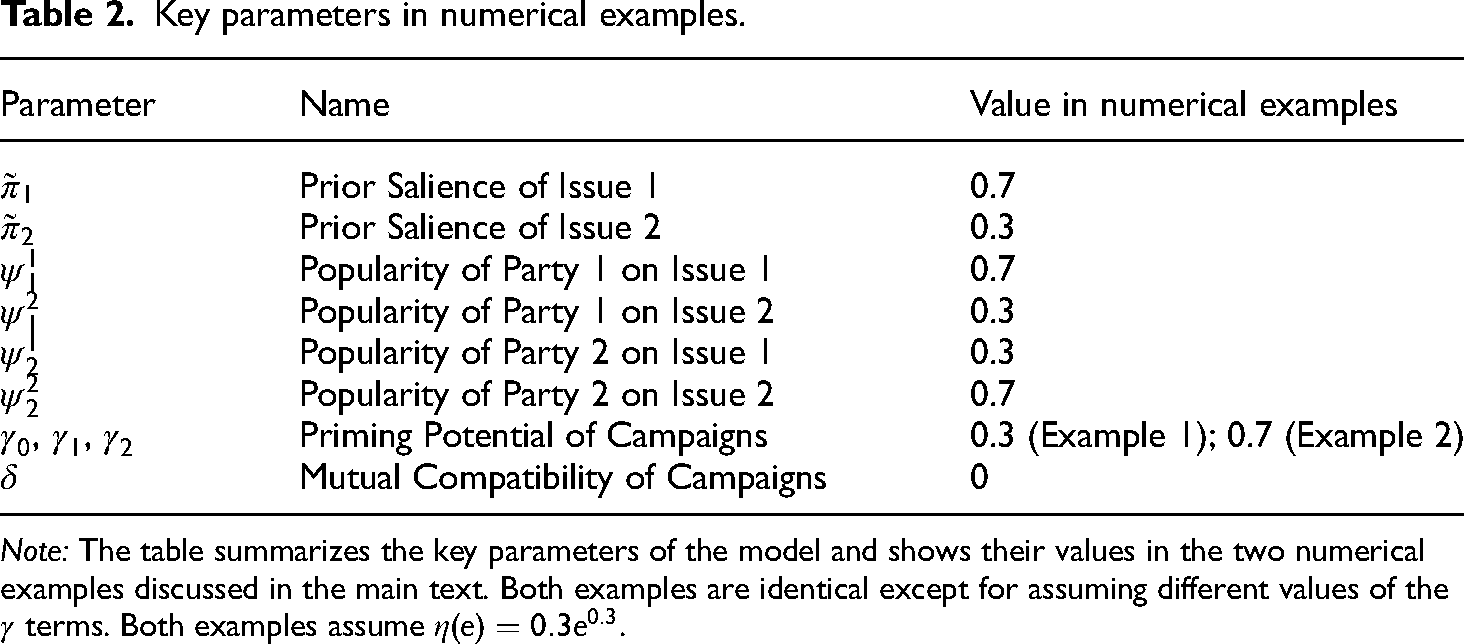
Key parameters in numerical examples.
Note: The table summarizes the key parameters of the model and shows their values in the two numerical examples discussed in the main text. Both examples are identical except for assuming different values of the
Party issue emphases and values of
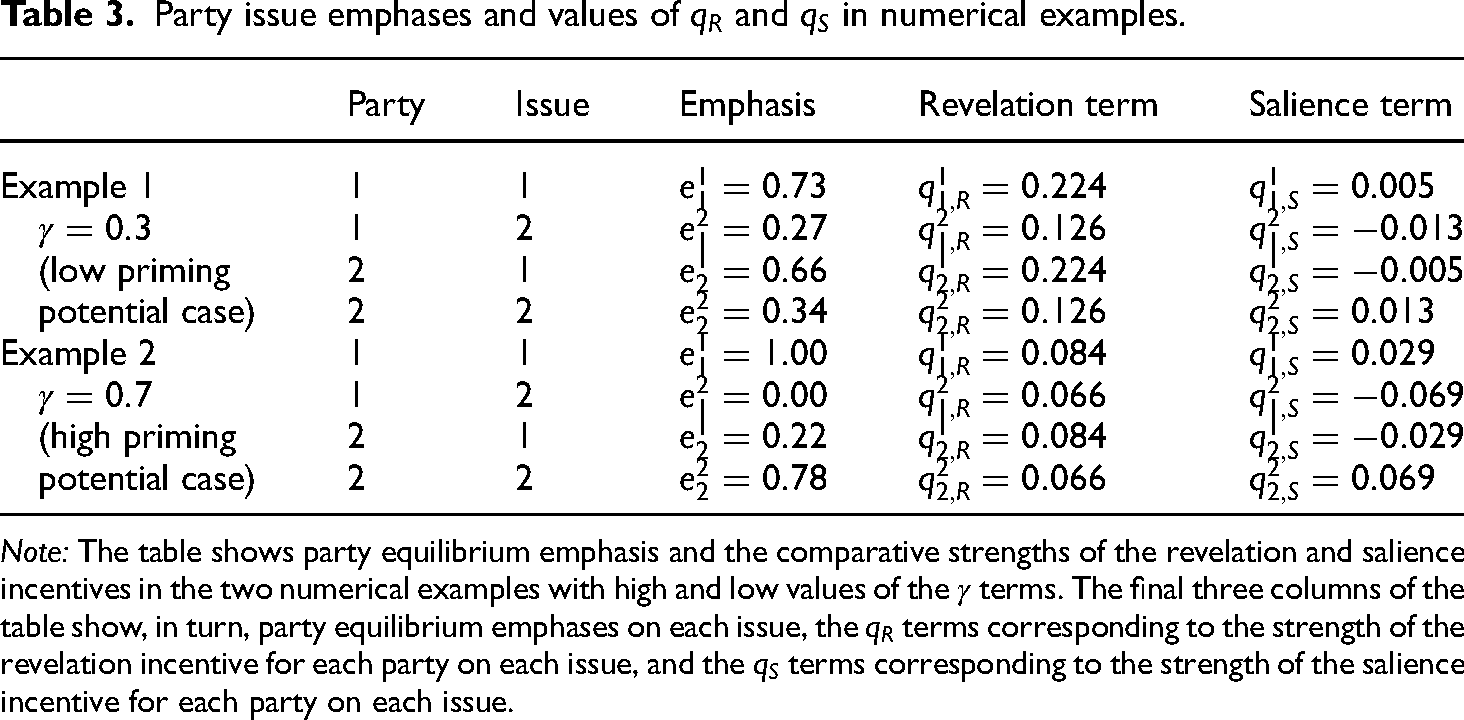
Note: The table shows party equilibrium emphasis and the comparative strengths of the revelation and salience incentives in the two numerical examples with high and low values of the
Inspecting the last two columns of Table 3, we first note that, across the two examples, the revelation incentive terms are positive and identical for the two parties, whereas the salience incentive terms have opposite signs for the two parties. Examination of equations (13) and (14) reveals that these will always be true in a two-party two-issue case if
The ‘Emphasis’ column of Table 3 shows the implications of these incentives for parties’ equilibrium issue emphases in the two examples. Strikingly, in Example 1, both parties place positive emphasis on both issues, even though Party 1’s position on Issue
To understand these patterns, recall that the marginal benefit to party
Lastly, comparing the two examples, we see that the salience incentive terms are larger in Example 2 than in Example 1, and the revelation incentive terms are smaller in Example 2. This is because, as discussed previously, the revelation incentive tends to become small when the priming potential of campaigns is very high, and the salience incentive becomes larger. The consequence is that, in Example 1, party equilibrium behavior is largely driven by the revelation incentive, and, in Example 2, it is largely driven by the salience incentive. As such, in Example 1, Party 1 and Party 2 both emphasize Issue 1 much more than Issue 2 (as it has higher prior salience) even though Party 2 is advantaged on Issue 2, but, in Example 2, each party focuses on the issue on which it is comparatively advantage.
The results of these two examples suggest that the model equilibrium may potentially be able to account for the empirical literature’s findings on party strategy discussed in Section 2: while parties do tend to campaign disproportionately on issues that favor them, they may often find themselves campaigning on the same issues, particularly when these issues are highly salient (as occurred in Example 1). In the next section, we show that these key properties of the model equilibrium are not unique to these two numerical examples, but rather hold more generally, over a large class of parameter values.
We now show that some key properties of the equilibria in the two numerical examples above hold generally for a large class of parameter values in the model.
First, we show that, if the priming potential of campaigns is sufficiently low, then the revelation incentive is sufficiently strong (compared to salience incentives) for all parties to emphasize all issues in equilibrium, as occurred in numerical Example 1 above. Conversely, we show that when the priming potential of campaigns is high, then salience incentives will dominate and all parties will ‘talk past each other’ and exclusively emphasize different issues, in accordance with much of the previous formal literature. Numerical Example 2 above tended in this direction.
Next, we derive comparative statics for how the model equilibrium depends upon the values of the parameters. We show that all parties tend to emphasize an issue
Finally, we show that, if the priming potential of campaigns is sufficiently low (and so the revelation incentive is sufficiently dominant) and if the pre-campaign salience of issue-
Together, these properties of the model equilibrium can account for the empirical literature’s findings on party strategy discussed in Section 2: while parties do tend to campaign disproportionately on issues that favor them, they may often find themselves campaigning on the same issues, particularly when these issues are highly salient.
We now derive these formal properties of the equilibrium in turn. First, we to derive conditions under which the revelation incentive is sufficiently strong for all parties to emphasize all issues in equilibrium. From Proposition 1 it is immediate that this will be the case if and only if
Manipulation of equations (13) and (14) for
If 
Proposition 2 establishes that, if the priming potential of campaigns is sufficiently low (i.e. all
On the other hand, Proposition 2 also shows that, when the priming potential of campaigns is sufficiently high, party
We now show how parties’ emphasis strategies change in the model when the model parameter values and party positions change. Based on the representation of the choice of
Let 


The three comparative statics contained in Proposition 3 are intuitive. The first result (18) arises because, when
Finally, we show that if the priming potential of campaigns is sufficiently low and the initial salience of an issue
For any
As shown in the previous section, the model is analytically tractable when voters are ambiguity averse and see party positions on (and ultimately care about) at most one issue. Nevertheless, these assumptions are arguably relatively extreme, and it does not seem empirically plausible that voters only care about a single issue. For this reason, we study extensions of the model where
For reasons of space, we omit discussion of the results of these extensions here. Full results for numerical simulations of these extended models are given in the Supplemental Appendix. Supplemental Appendix C provides results for the case when voters maximize expected utility, and Supplemental Appendix D provides results for the case with
In Section 5.1, we discuss an additional extension of the model: where parties are able to provide voters with imprecise campaign messages.
Campaigns with imprecise messaging
Thus far, we have assumed that voters are ambiguity averse and so less likely to support a party if they do not know its position on the issue most important to them. 20 If this accurately characterizes voter behavior, one might also expect parties, when emphasizing an issue, to be extremely precise in their campaign messages, communicating very specific policy proposals in order to minimize voter uncertainty about their positions. However, this is clearly at odds with many real-world campaigns as well as much research on party position-taking, as parties are known to frequently use imprecise language or to tailor their messaging to different audiences—even on issues central to their campaigns. Indeed, many studies have demonstrated that this approach may even be electorally beneficial for parties (Rovny, 2012; Somer-Topcu, 2015; Tomz and van Houweling, 2009). 21
To consider such issues, we extend our model in Supplemental Appendix B to incorporate the possibility that parties are able to send more or less precise messages in their campaigns. There, we examine whether and when they might choose to send imprecise messages, and how this possibility affects their emphasis strategies in a context with ambiguity averse voters and endogenous issue salience. Sending imprecise messages, we suggest, can help a party win over voters who would not be particularly favorable to the party’s true issue positions. Nevertheless, we show analytically that the key qualitative results for party emphasis strategy from our baseline model remain unchanged in this imprecise campaigns model, because the revelation and salience incentives continue to operate.
Concluding remarks
In the article, we develop a formal model to match five general patterns of party emphasis strategy noted by the empirical literature. A key force that allows our model to match these five patterns simultaneously is the ‘revelation incentive’ in our model. This incentive provides a novel explanation hitherto missing from the formal literature for why parties often emphasize unfavorable issues, and also why multiple parties often campaign on the same issues when these issues are particularly salient to voters. While we only qualitatively compare our model to the empirical literature here, future work could examine how far a model of this kind is able to quantitatively match empirical data on party issue emphases.
Our model also speaks to the question of how and when elections can force parties to respond to voters’ priorities in their campaigns, versus when parties are able to shape the electoral agenda in their favor instead. This article suggests that conditions that strengthen the revelation incentive vis-á-vis the salience incentive are key to voters’ ability to use elections to hold politicians’ accountable on issues important to them. The relative strength of the revelation incentive varies inversely with what we have called the priming potential of campaigns, that is, how far electoral campaigns alter voters’ issue priorities versus informing voters about parties’ positions. In Footnote 14, we suggest that the priming potential of campaigns might be determined by long term structural features of the political system and technology that affect levels of voter information and attentiveness. Future work might consider, both formally and empirically, whether and how the priming potential of campaigns varies across countries and over time, as well as the implications of this for party campaigns and electoral outcomes, for instance in an estimated structural model.
Supplemental Material
sj-pdf-1-jtp-10.1177_09516298251334331 - Supplemental material for The revelation incentive for issue engagement in campaigns
Supplemental material, sj-pdf-1-jtp-10.1177_09516298251334331 for The revelation incentive for issue engagement in campaigns by Chitralekha Basu and Matthew Knowles in Journal of Theoretical Politics
Footnotes
Acknowledgements
We are grateful to audiences at NICEP 2017, ECPR 2020, the University of Barcelona, the London School of Economics and Political Science, and the University of St Andrews for helpful comments. An earlier version of this paper was circulated under the title ‘The Clarity Incentive for Issue Engagement in Campaigns’. Support from the Deutsche Forschungsgemeinschaft (DFG, German Research Foundation) under Germany’s Excellence Strategy—EXC 2126/1-390838866 is gratefully acknowledged.
Declaration of conflicting interests
The author(s) declared no potential conflicts of interest with respect to the research, authorship, and/or publication of this article.
Funding
The author(s) received no financial support for the research, authorship, and/or publication of this article.

Supplemental material
Supplemental material for this article is available online.
Notes
References
Supplementary Material
Please find the following supplemental material available below.
For Open Access articles published under a Creative Commons License, all supplemental material carries the same license as the article it is associated with.
For non-Open Access articles published, all supplemental material carries a non-exclusive license, and permission requests for re-use of supplemental material or any part of supplemental material shall be sent directly to the copyright owner as specified in the copyright notice associated with the article.
