




Abstract
This article analyzes the possible electoral advantages and disadvantages of a unique party that competes in two simultaneous elections with respect to those obtained when it competes as two different parties. I assume that a unified party has a larger strategy set but it is forced to choose the same policy in both elections. I analyze different scenarios depending on the features of the electorates and of the party configuration that it faces: the same party or two different parties. In all cases, I show that a unified party can only fare better than two independent parties when the two electorates are similar enough. In this case, the party may obtain the vote of the moderates in both elections. If the electorates are aligned with the opponent the gains from unification are more likely in more polarized electorates. Otherwise, the losses from unification increase with the intensity of the electoral competition.
Introduction
There are many instances in which several elections are held at the same time. Different regional elections in a given country, different state elections in a federation, elections for the European Union parliament in each one of the countries. In addition, we can also observe that elections for different government levels take place simultaneously: elections for a central government and for regional governments in a given country, elections for a federal government and for state governments in a federation, and in some instances even the elections for the European Union parliament coincide with other elections, such as regional or municipal, in some countries (Callander, 2005; Fabre, 2010).
In all these cases, we observe a great variety of party configurations. In particular, we see that in some cases there are large parties (state-wide parties) that compete over all the territories of a given country (Libbrecht et al., 2011). And at the same time, we observe that in some cases these large parties coexist with smaller parties (sub-national parties) that are defined only in a certain part of the territory (Brancati, 2008; Müller, 2012; Toubeau, 2011). The aim of this article is to shed some light on the possible gains and losses that a party may derive from competing as a single entity in several simultaneous elections relative to the payoffs that the party could expect if it was split into different parties that specialize their competition on a given territory.
It is clear that parties may enjoy advantages from their larger sizes derived from the economies of scale and scope. The larger the number of territories that a party may cover the more efficiently that it can overcome the fixed costs of its internal organization. This advantage is also relevant in terms of the visibility of the party in the media and the possible electoral gains that this visibility may induce. However, we argue that when competing in simultaneous elections large parties involve strategic complications that may end up representing an electoral cost and the characterization of this electoral cost is precisely the main goal of this article.
The fact that elections take place at the same time, or within a short period of time, may imply that the most relevant political dimension in all of them is the same, that is all parties are competing on the same issue in all elections. When this is the case, the main difference among the elections is that they face different electorates because the distribution of the voters’ preferences is bound to be different in each one of the elections. The design of the best policy proposal for a party that faces an electoral competition depends mostly on the policy preferences of the electorate that it is facing, on the characteristics of the opponent or opponents that it is confronting, and on the party’s own objectives. Accordingly, differences in the policy preferences of the voters will imply differences in the policy decision. Therefore, when a party is facing two different elections, with possibly two different electorates, the best policy proposal in each one of the competitions is bound to be different, because the best policy proposal in any given election is independent of the features and conditions of the other election. Thus, the design of the best policy proposal should take into account the features of the corresponding electorate (Libbrecht et al., 2011). For parties that care only about their own policy proposal (purely ideological), the simultaneous competition in more than one election does not affect the trade-off that they have to solve in a regular single election because its best policy proposal depends only on its own ideology. However, for parties that care about their chances of winning elections the analysis of the party’s strategic behavior becomes more relevant.
If a party that is not purely ideological is facing two different elections that take place at the same time, the choice of a different policy proposal in each case may induce a problem of credibility that may end up causing large electoral losses. As mentioned before, the fact that the two elections are taking place at the same time implies that the policy dimension that is relevant in each one of the elections is likely to be the same. That is, the most salient issue at a given time can be considered to be common in the different electorates, and more so given the current intense information globalization. And this implies that if a party sends a different message to each electorate at the same time, voters may interpret it as a weakness in terms of credibility and the party’s electoral prospects in both elections may be jeopardized. From the point of view of the voters, a party that claims that a given policy is the best one in front of an electorate and at the same time proposes a different policy as the best one in another election may not be entirely convincing. This phenomenon is known in the literature as ideological inconsistency (Kreps et al., 2017; Andreottola, 2021; Stone and Simas, 2010). It affects negatively the party reputation and it induces voters to punish those parties that show ideological inconsistency over time. This effect has been analyzed in the literature about primaries (Hummel, 2010; Agranov, 2016).
However, when elections are held simultaneously this effect can only be thought to be much stronger. If voters from both electorates lose confidence in a party’s proposal when it exhibits ideological inconsistency, a unified party that proposes two different policies in two different simultaneous elections could suffer a loss in its electoral support from both elections. The electoral cost implied by the loss of credibility may end up being very large as this credibility loss can be attached as a stigma to the party and carried on by voters to future electoral contests. This argument is bound to be at work even if the two elections are not simultaneous but very close to each other in terms of time.
In order to avoid this large future electoral cost, a party that faces two simultaneous elections may decide to choose a unique policy proposal for both of them. Competing in the two elections with a unique policy platform, a party would not be able to confront each election with the best policy choice, but it would be able to avoid future electoral costs due to its loss of credibility. Thus, it would be sacrificing some current electoral benefits instead of engaging in large electoral costs in the future. The current electoral losses are determined by the difference between the expected payoffs of a party that competes in the two simultaneous elections with a unique policy proposal, and the sum of the expected payoffs from two different parties that compete separately in each election which choose different policy proposal without jeopardizing any future electoral costs. The aim of this article is to characterize the current electoral gains or losses that a party may suffer from facing two different elections at the same time, when it is forced to choose the same policy proposal for both of them. These losses are going to depend on the differences between the voters’ policy preferences in the two electorates and also on the types of the competitors.
When facing simultaneous elections a party may also face different party configurations depending on whether the opponent is a state-wide party or a sub-national one. We will study different scenarios that a party may encounter in terms of the configuration of the party competition when facing two elections simultaneously. On the one hand, we will evaluate the electoral benefits or losses from party unification when facing different parties that compete as separate entities in each election; and on the other hand, we will evaluate the electoral benefits or losses from party unification when competing against a unified party that runs as a unique entity in all elections. And changes in the characteristics of the opponent will also be reflected in changes in the determination of the best policy platform (Müller, 2012).
This article proposes a model of two simultaneous electoral competitions. In each election, two parties are competing on the same one-dimensional policy space. The difference between the two electorates is determined by the expected location of the ideal point of the median voter in each case. All parties have policy preferences, thus in each election, we have a leftist party competing with a rightist party. Parties care about the policy outcome and they maximize their expected utility. The preferences of the median voter are represented by a probability distribution that assigns some probability to each one of the parties’ ideal points (at the extremes of the policy space) and to some moderate policy. This reduced model is enough to reproduce the main trade-off that parties face in any electoral competition, that is, the party’s strategic choice between the expected ideal point of the median voter and the party’s own ideal point.
The strategy set of each party is restricted to the policies that are contained in the support of the probability distribution that represents the electorate that the party is facing. The strategy set of a unified party that competes in the two elections is given by the union of the supports of the probability distributions that represent of each one of the electorates. Notice that even though the restriction that a unified party faces with respect to its policy choice having to be the same in both elections represents a disadvantage for a unified party, it is compensated by the fact that the strategy set of a unified party is larger than any of the strategy sets of the parties that compete in a single election. Thus, it is not obvious ex ante whether this combination would produce a net gain or a net loss for a unified party.
We consider two different scenarios in terms of the features of the electorate: one in which the ideal points of the expected medians of both electorates are ideologically aligned (and in turn ideologically aligned with one the parties), and one in which the ideal points of the expected medians of both electorates are not ideologically aligned (each one of them is ideologically aligned with a different party).
We also analyze two different scenarios in terms of the party configuration of the opponents that a party is facing in the two elections: one in which a party is facing a different independent party in each election, and one in which a party is facing the same party in the two elections. In each case, we compute two sets of the equilibrium policies and payoffs: those obtained when it competes as a unique party, and those obtained when it competes as two different parties. And then we compare the payoffs obtained in each case in order to evaluate the gains or losses produced by the party unification relative to compete as two independent parties.
Overall we find that in all cases the equilibrium strategies show some degree of polarization as by Callander (2005). With respect to the comparison of the parties payoffs, we observe that a unified party performs better than two independent parties in simultaneous elections whenever the ideal points of the expected medians are ideologically aligned with it to some extend. On the other hand, if the ideal points of the expected medians are extremely different from the party’s ideal point, its best response is to forgo the competition and propose its own ideal point, and thus party unification does not produce any change in its payoffs. Otherwise, the unified party exhibits worse payoffs than the sum of two independent parties, and this case becomes more significant when the electoral competition becomes more intense.
In particular, we show that if both medians are ideologically aligned, the payoff of the party that is ideologically aligned with the medians is not affected by a possible party unification. Instead, the party that is not ideologically aligned with the medians obtains a benefit from party unification when both medians are moderate enough. If both medians are very extreme party unification does not make a difference. If one median is extreme and the other is moderate party unification produces a loss. These results hold independently of whether the opponent competes as a single party or as two independent parties.
If the two medians are not ideologically aligned with each other, a party may benefit from unification only if both medians are ideologically favorable and this case becomes less significant when the electorates are less polarized (electoral competition is more intense). The party’s payoffs are not affected by the unification if the median that is ideologically opposed to the party is rather extreme. Otherwise, the unification exhibits losses and this last case becomes more likely when the electoral competition is more intense (less polarized electorates). Gains of a unified party that competes against a two independent parties are obtained only for very extreme values of the median that is ideologically aligned with the party. Instead, gains of a unified party that competes against the same party in both elections are obtained for more moderate values of the median that is ideologically aligned with the party, and the required moderation decreases with the polarization of the electorates. The possibility of obtaining gains from the party unification becomes smaller when the electorates are less polarized (electoral competition increases). Thus in both cases, decreasing polarization in the voters’ preferences (increasing the intensity of the electoral competition) makes losses more likely for the party unification.
The rest of the article is organized as follows: first, I describe and solve the basic model for a unique electoral competition. In Section 3, I analyze the case of two simultaneous elections and characterize the gains and losses of a unified party. Section 4 offers a discussion of the comparison among the different cases analyzed. Finally, Section 5 contains some concluding remarks and possible extensions.
The basic model
There are two parties L and R that compete on a unidimensional policy space represented by
Voters have a utility function characterized by an ideal point with utility of the alternatives given by the negative distance between the voter’s ideal point and the location of the proposed policy. Let
The location of the median voter’s ideal point is unknown to both parties and they have the same beliefs about its distribution. These beliefs are common knowledge and they are represented by a probability distribution function. The support of this distribution is given by a set of three alternatives
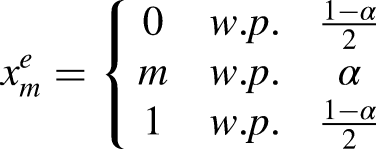

We assume that the set of strategies for each party coincides with the support of probability distribution that represents the parties’ beliefs about the location of the median voter which in this case is
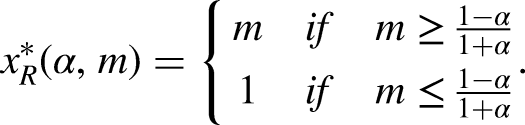
First, we consider the case that
If
All proofs are relegated to the Appendix.
If the expected median voter is leftist,
In the full polarization equilibrium
The analysis of the case
Overall, we obtain that for extreme values of the ideal point of the expected median voter the party whose ideal point is aligned with it obtains a payoff that decreases with the polarization of the electorate α (increases with the intensity of the electoral competition). Instead for moderate values of the ideal point of the expected median voter the party whose ideal point is aligned with it obtains a payoff that decreases with the intensity of the electoral competition
We extend the basic model in order to consider two different elections that take place at the same time, denoted by
The set of strategies of each party depends on the scenario they are competing. In particular, at
If a party competes simultaneously in the two elections, its strategy set


The Nash equilibrium strategies in the case of two simultaneous elections are denoted by
In order to evaluate the advantage or disadvantage for a unified party that competes in the two elections simultaneously we will analyze two different scenarios. First, we will solve the case in which a unified party competes against two different parties. This scenario is denoted by either
For instance,

Competing against two different parties
In this section, we first solve the case in which a unified party competes against two different parties in the two different elections. This scenario may be represented by either
We divide the analysis into two different cases, depending on whether the expected medians of the two electorates are ideologically aligned with each other: the expected medians are ideologically aligned if we have either
First consider the case
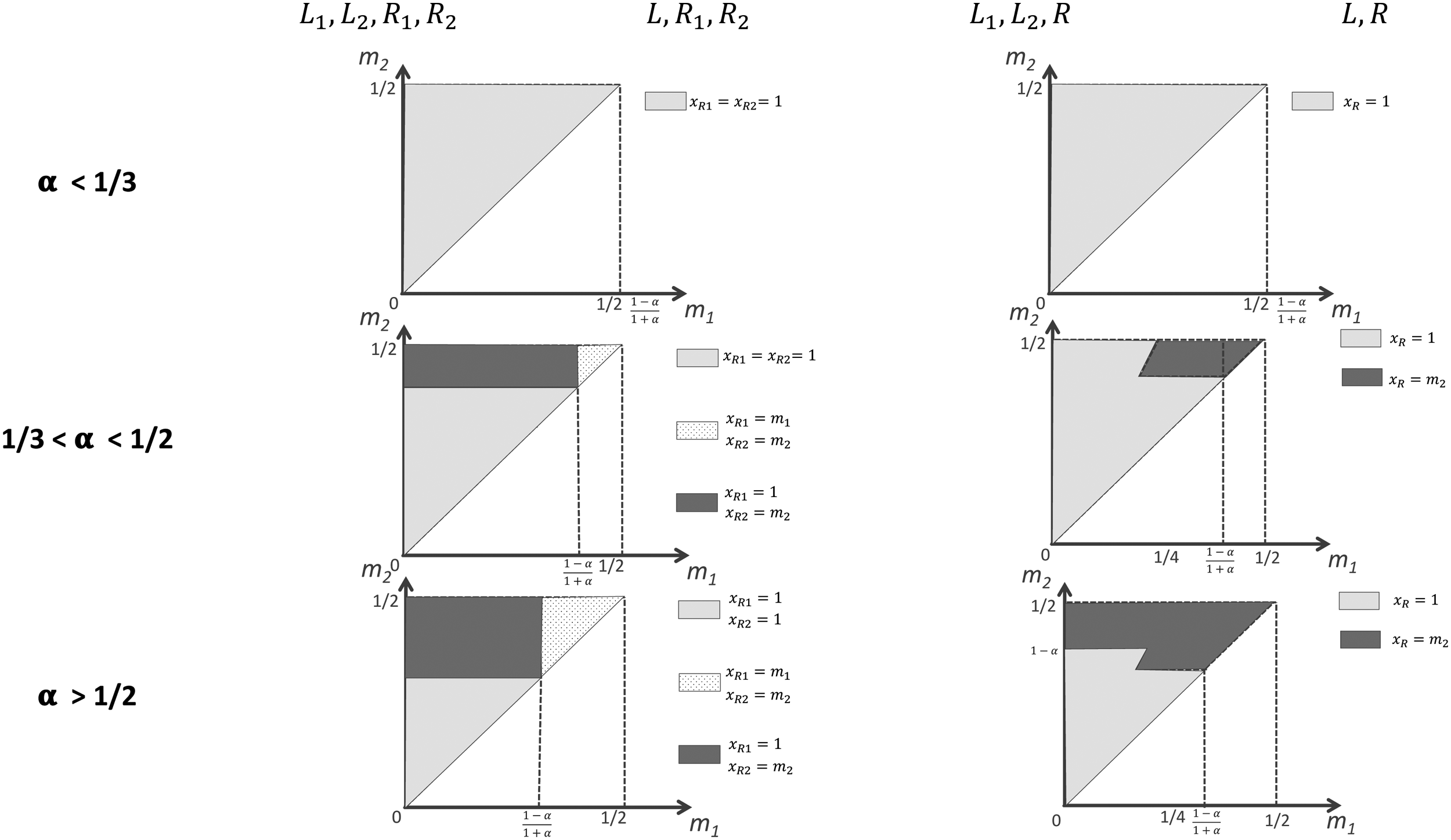
Equilibrium for two elections if
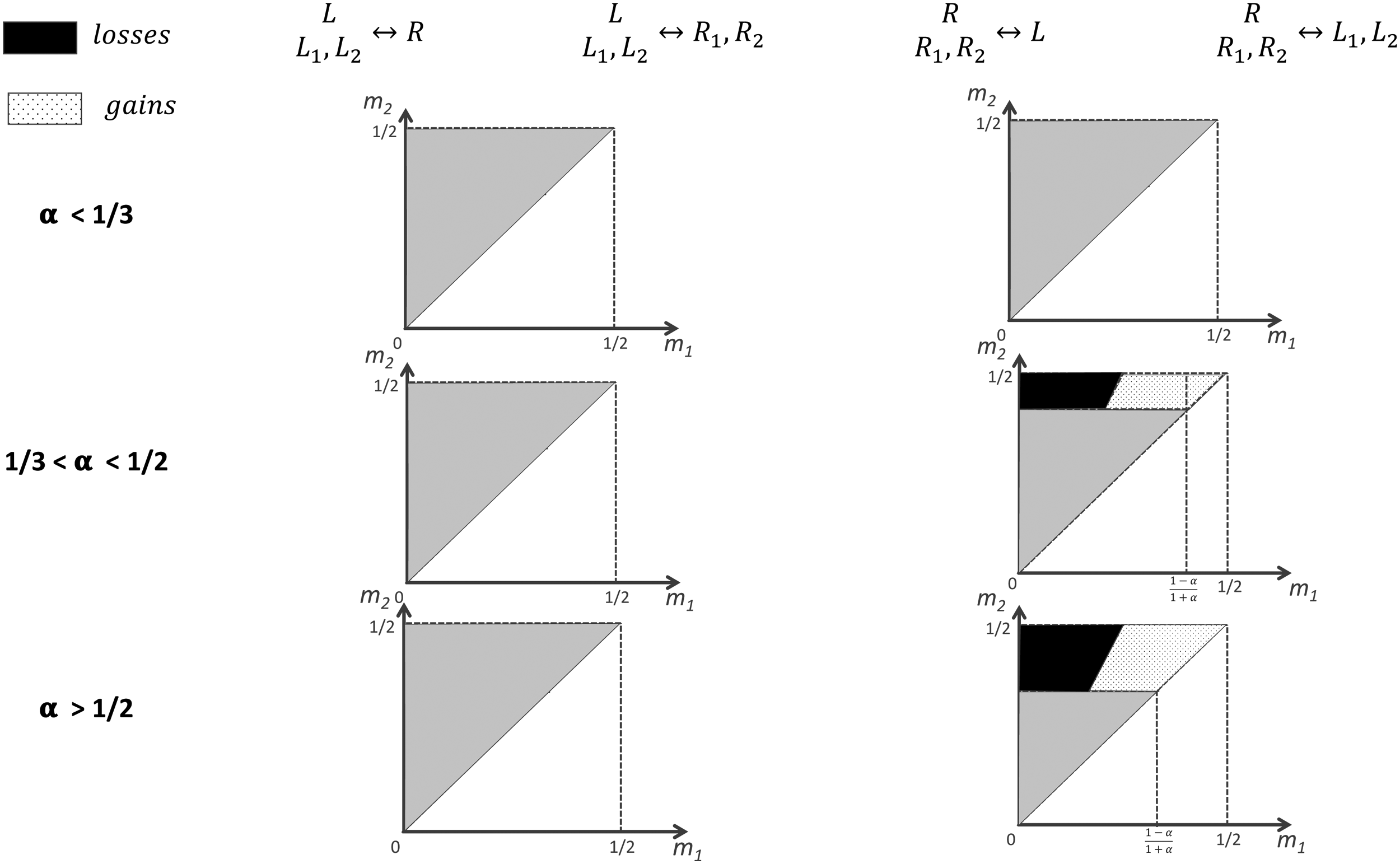
Gains and losses for the unified party if
If instead we consider a unified rightist party that competes in the two elections we have to analyze the scenario denoted by
If

Notice that
The relationship between the values of
Equilibrium outcomes for

In the full polarization equilibrium
We want to compare the payoffs obtained by party R in this equilibrium with those that would obtain if party R was competing as two different parties. If
If
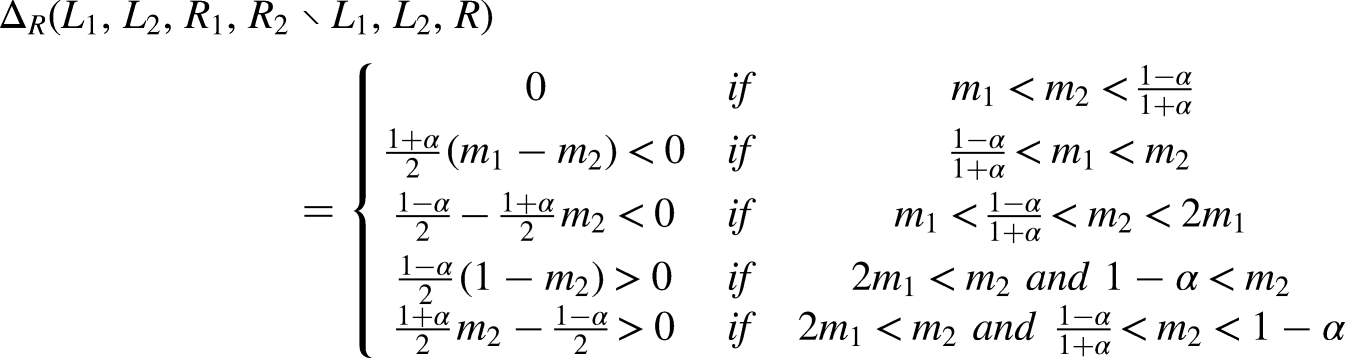
If the two medians are extreme leftist
When the values of the two medians are very different
Finally, when the values of the two medians are very different but
A similar analysis could be performed for
Now we turn to the case in which the two expected medians are not ideologically aligned, that is,
If
Notice that for
If 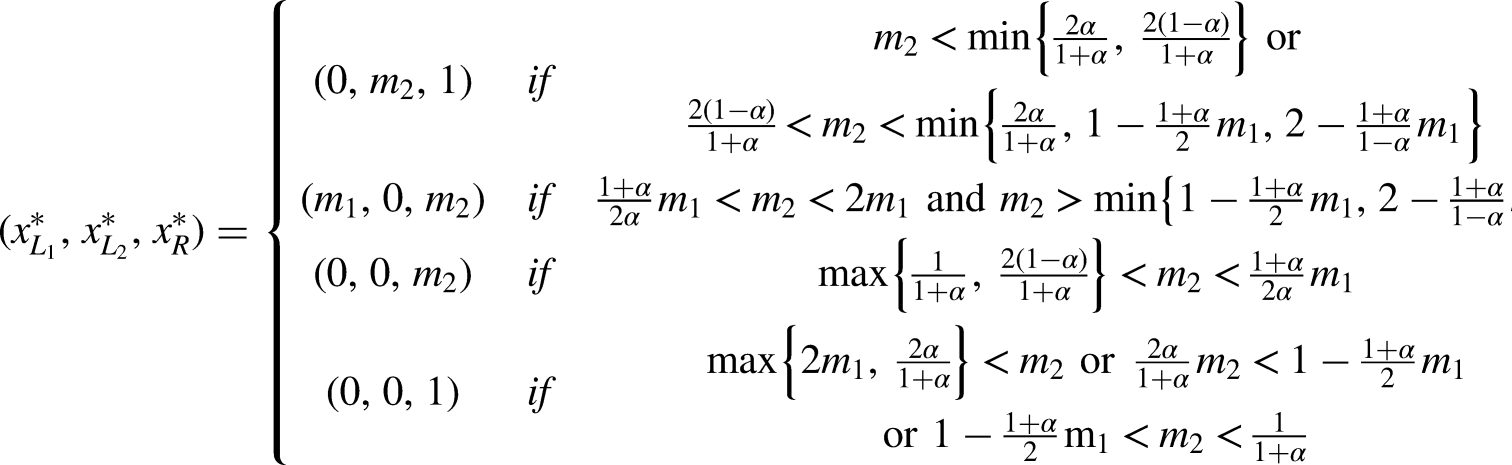
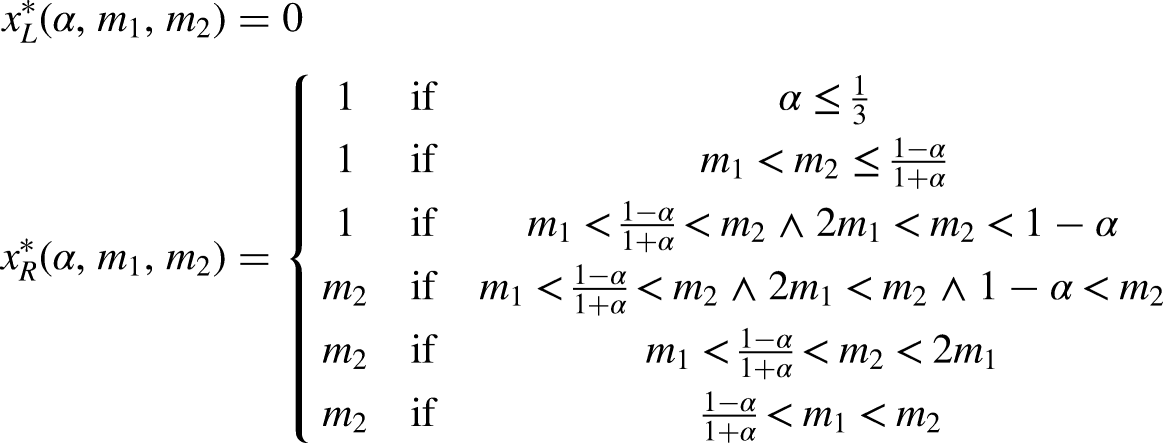
The best responses of party R (developed in the proof of Theorem 2) are as follows. The best response of R is
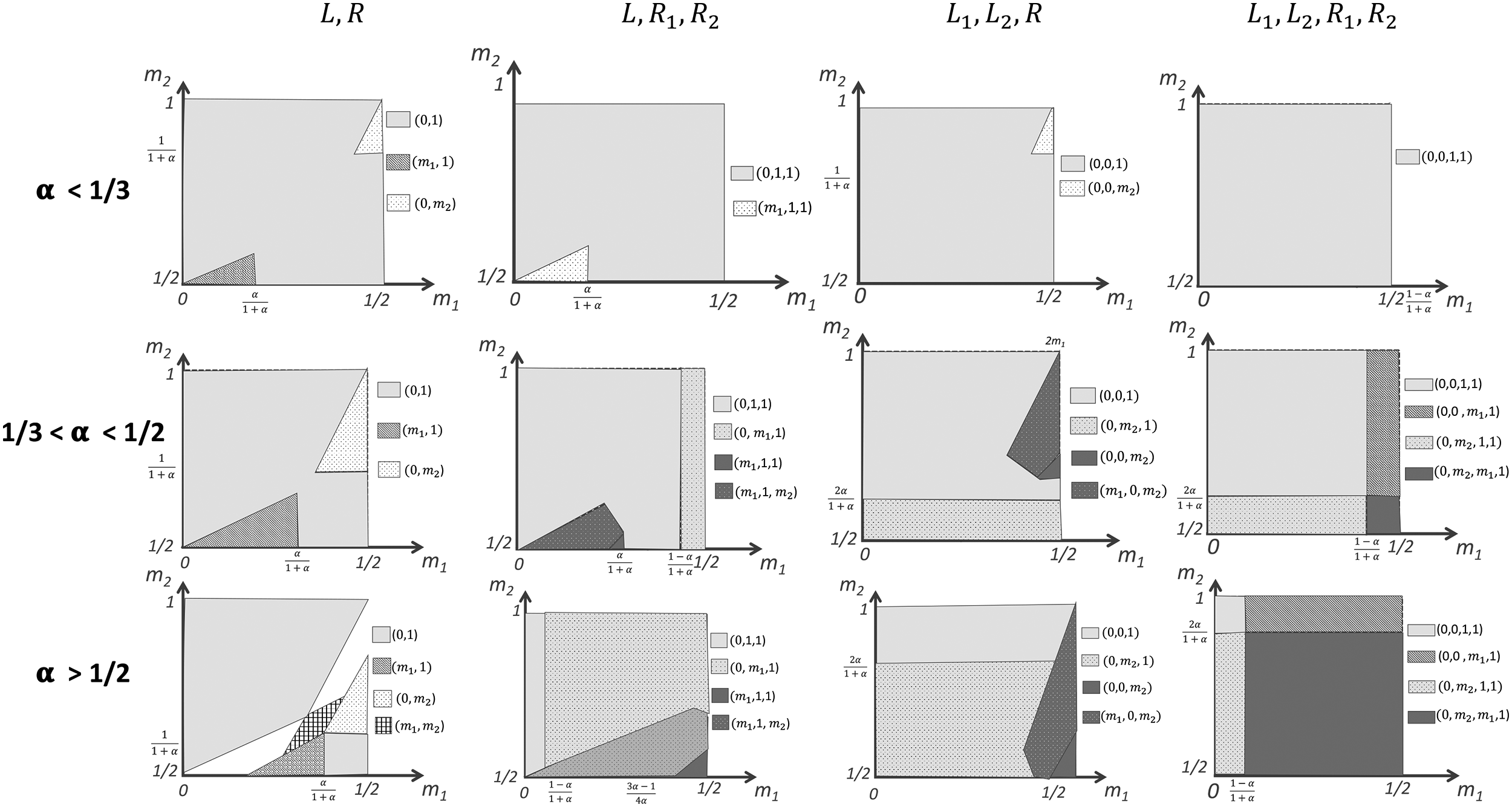
Since for very small values of α
For larger values of α, the equilibrium strategies are characterized by the four different regions in the parameter space 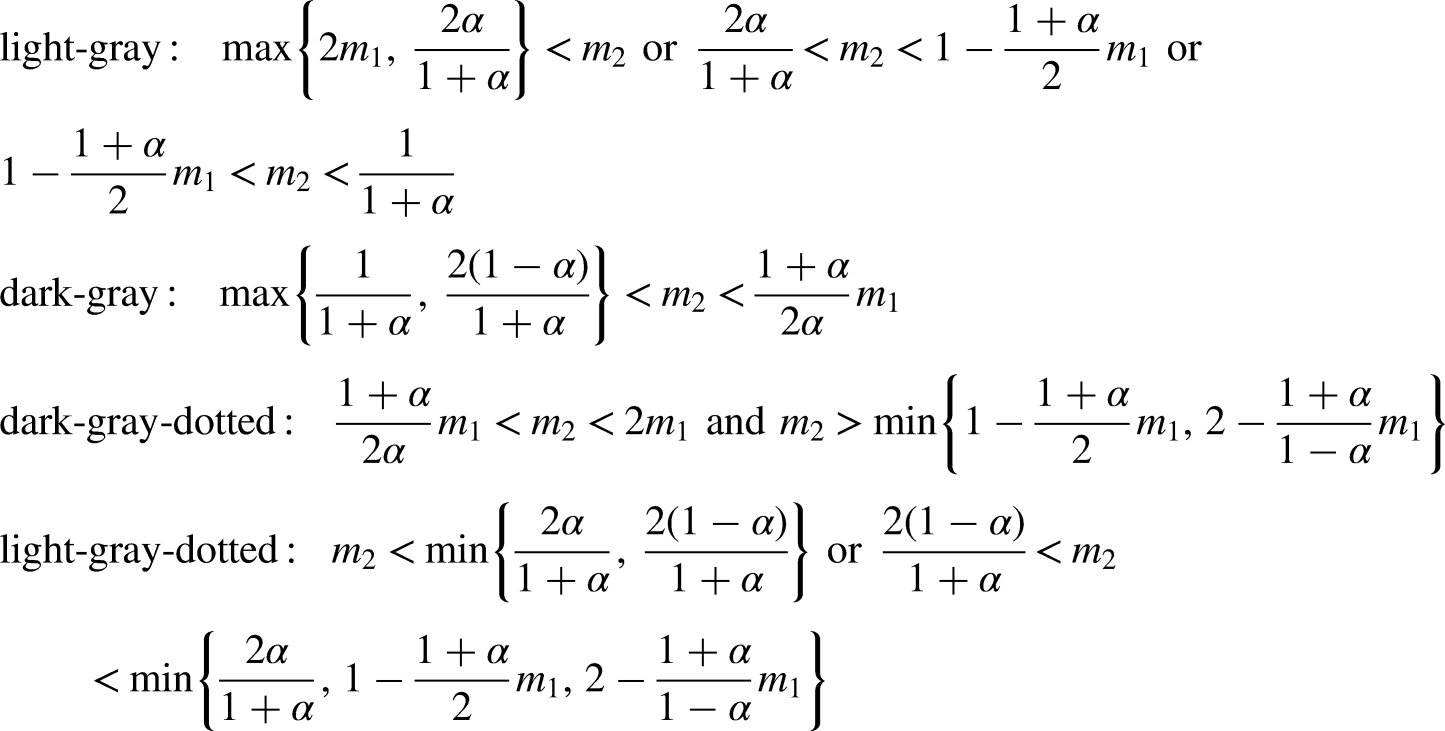
Equilibrium for two elections if
In all the light-gray areas, the equilibrium strategy of party R is
For very small values of α
We want to compare the payoffs obtained in this equilibrium with those that would obtain if party R was competing as two different parties
We now compare these payoffs to the ones obtained by party R when competing as a unified party in the two elections.
If 
For
For
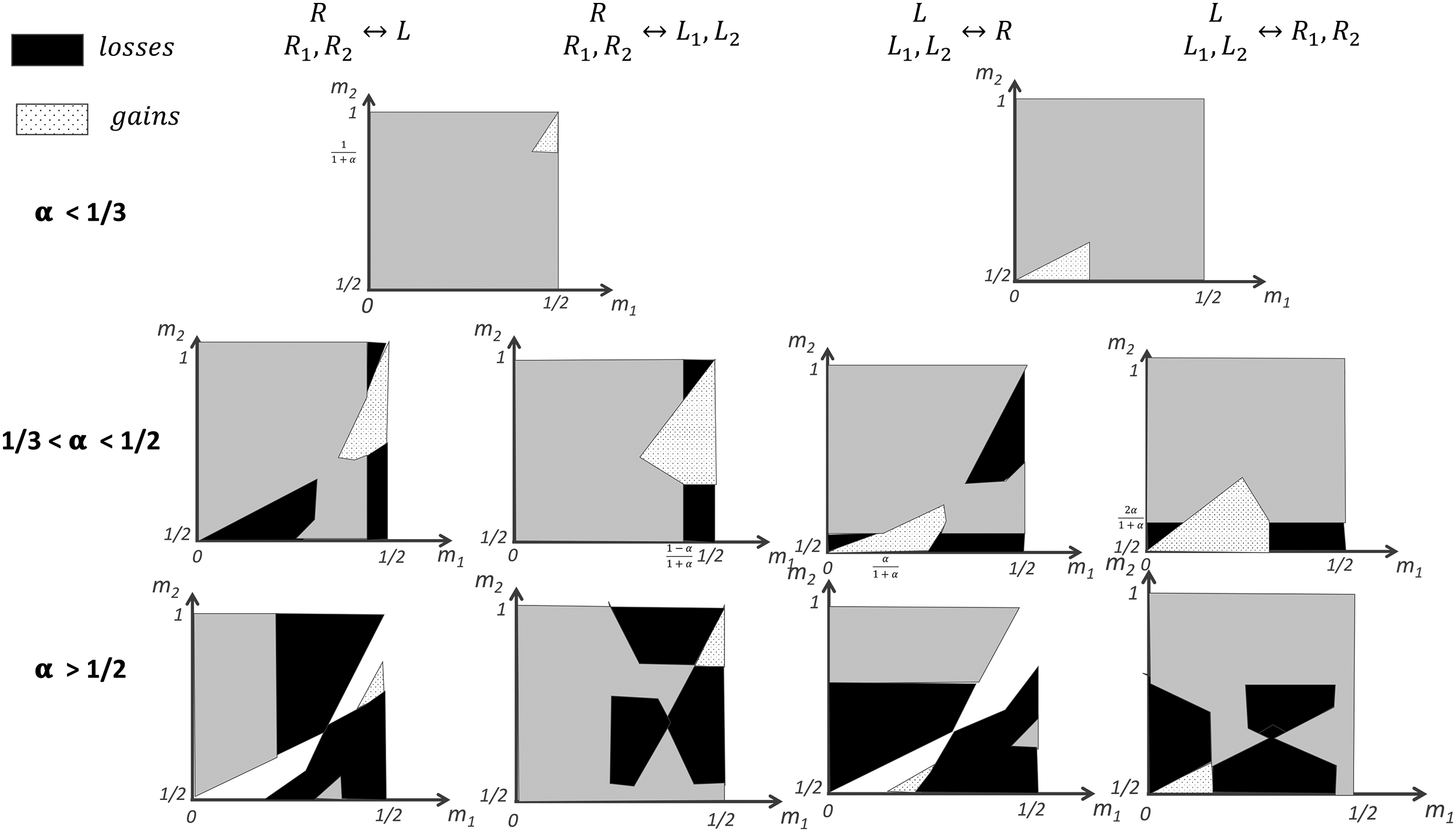
Gains and losses for the unified party if
For intermediate values of
The set of parameter values that produce a gain for the unified party are concentrated around large values of
Thus we find that the unification exhibits increasing areas of losses for larger values of α. Therefore, we have that for less polarized electorates (as electoral competition becomes more intense) it becomes more likely that the unification of the rightist party produces a loss. These losses take different forms in the different subareas and they are fully described in the proof of Proposition 4. They decrease with α and
Overall, we have shown that when competing against two different parties if both medians are ideologically aligned, the parties that are ideologically aligned with medians have no incentive to unite since there are no expected gains from it because they have a dominant strategy which is equal to their ideal point. Instead the parties that are not ideologically aligned with the medians have an incentive to unite only if both medians are close to each other, so that the united party has a strategy that guarantees the vote of the moderate voters from both elections. If there is only one moderate median the unification produces a loss to the unified party because it cannot reach the moderate votes of one of the elections, and thus it is harmed by the restriction of having to choose the same policy in both elections. If both medians are rather extreme, unification does not affect the payoffs of the parties because in all cases parties are better off proposing their ideal points and forgoing the chance to convince any moderate voter. As the electoral competition becomes more intense (larger values of α) this last case becomes less significant (only holds for more very extreme medians) and thus the possibilities of obtaining gains or losses for the united party become more likely.
We have also seen that when competing against two different parties if both medians are not ideologically aligned, again unification produces gains only if the two medians are close enough to each other (so that the unified party can obtain the vote of the moderate voters of both elections) and it also needs one of the medians to be closely aligned with the ideology of the party. However, as opposed to the previous case, as the intensity of the electoral competition increases, it becomes less likely that the unified party obtains gains and the possibility of gains disappear as α approaches 1.
If the median that is aligned with the opponent is rather extreme, unification does not affect the payoffs of these parties because the party is better off forgoing the chance to convince any moderate voter in that election, and the party prefers to choose its own ideal point. This condition holds for more extreme medians when α increases. Therefore, unification is more likely to produce losses when medians are not aligned with each other, and as opposed to the case of ideologically aligned medians, in this case, the losses caused by the party unification becomes a general result for less polarized electorates (intense electoral competition).
In this section, we first analyze the competition between two unified parties
Again we divide the analysis into different cases, depending on the values of the expected medians of the two electorates. Recall that for
For the same reason, if 
If
However, when the two medians are not aligned (
If
for 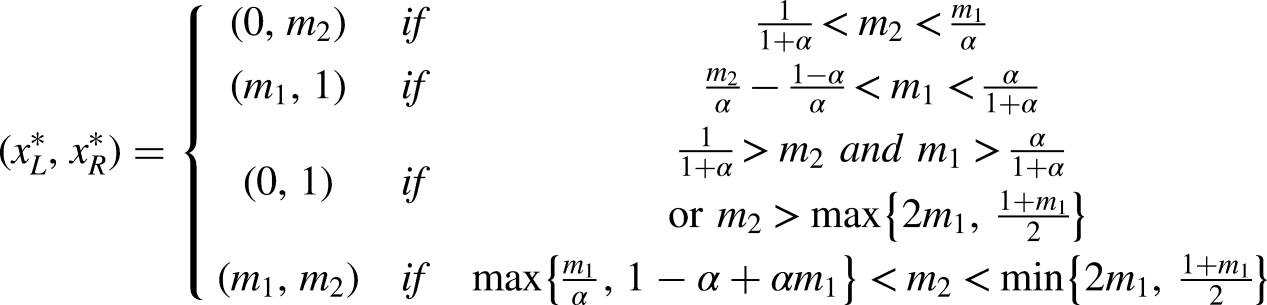
This case produces symmetric equilibria in which the strategies of the parties are in
For 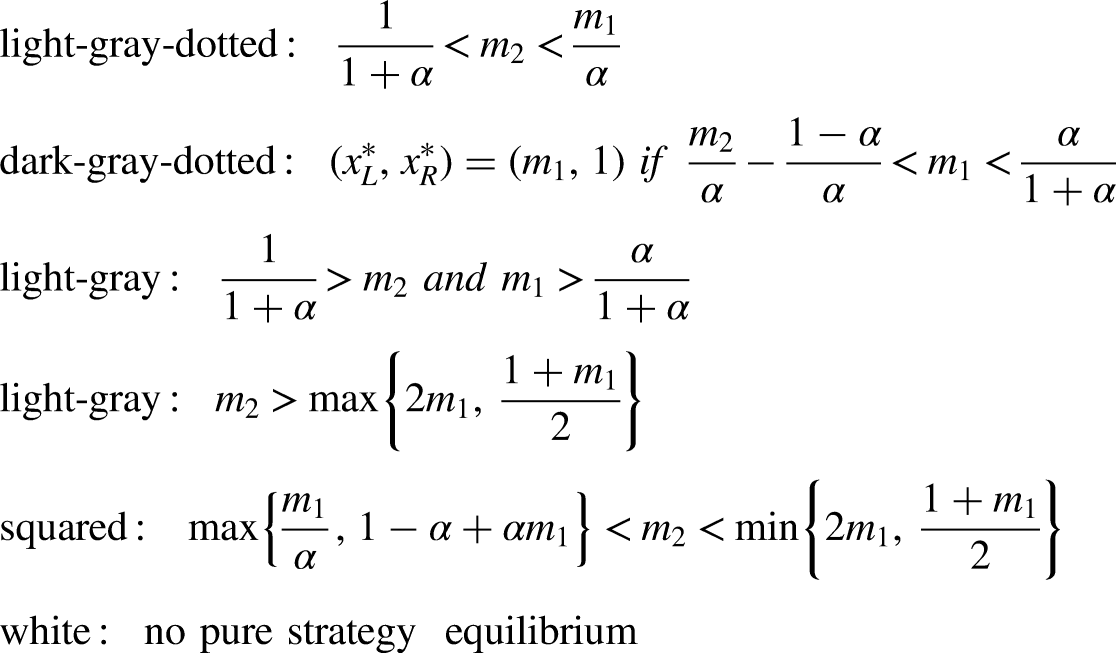
We now compare the payoffs obtained in this equilibrium where only two parties compete in the two elections with those obtained if one of the parties was split into two different ones. Without loss of generality suppose it is the leftist party. Thus we compare the equilibrium just obtained for
If 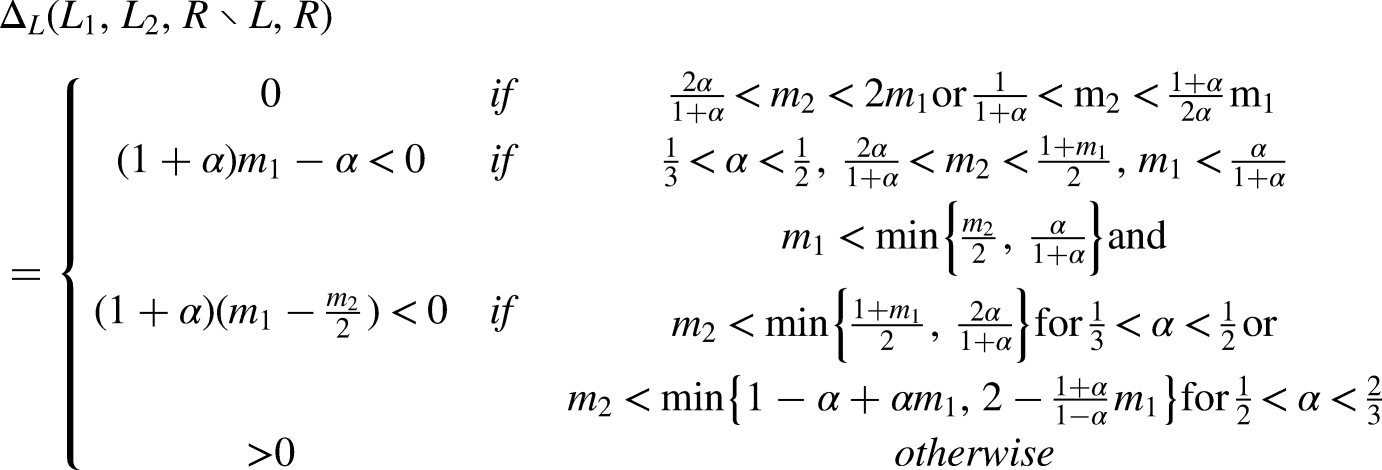
This proposition shows that the unified party L obtains gains only in the dotted area (see column 3 of Figure 4). Notice that as always gains from unification only occur whenever the party L has a strategy that guarantees the vote of the moderate voters from both elections, which in this case is
For
In the light-gray-dotted area, the unified party shows a loss for the less moderate values of
The squared area shows a loss for the union. This loss increases with
For
In this case, we have that for values of α larger than
Overall, we have shown that if both medians are ideologically aligned, the advantages and disadvantages of a unified party are the same independently of whether the party is competing against the same party or two independent parties. Thus, as we showed in the previous section: the payoffs of the parties ideologically aligned with the medians do no change whether they are united or they are independent. Instead, the payoffs of the parties that are not ideologically aligned with the medians are larger if the party is unified when both medians are moderate, and they are larger for independent parties if one median is extreme and the other one is moderate. The payoffs of these parties are not affected by the union only if both medians are very extreme.
And we have also shown that if both medians are not ideologically aligned, when competing against the same party, unification produces a gain only for very moderated values of the non-aligned median, and for increasing (with
This article has analyzed a model of two simultaneous elections considering different scenarios with the aim of evaluating the benefits for party unification. The different scenarios analyzed are defined according to the features that the electorates of each election can exhibit and also according to the party configurations that the party under consideration may be facing. In particular, with respect to the features of the two electorates we have taken into account the possibility that the expected medians of the two electorates are aligned with each other, and the possibility that they are not aligned. And with respect to the party configurations we have analyzed the case in which the party competes against the same party in both elections and also the case in which it competes with a different party in each election.
All these scenarios are studied for a wide range of parameter values. With respect to the expected ideal points of the median voter the results depend on whether they are rather extreme or they are rather moderate. Regarding the parameter that represents the distribution of the voters’ preferences the results rely on the degree of polarization of the electorate which related to the intensity of the electoral competition. This article shows the importance of the value of this parameter that can also be interpreted as the proportion of moderate voters that an electorate exhibits. Low intensity of the electoral competition represents a highly polarized distribution of the voters’ preferences and it induces polarized equilibrium policies in most scenarios. Instead high intensity of the electoral competition represents a unimodal distribution of the voters’ preferences and implies the choice of more aggressive (moderate) strategies by all parties in competition.
In particular, for extremely low intensity of the electoral competition (
For more intense electoral competition, the equilibrium strategies exhibit a larger variety of features. First consider the case of two electorates with expected medians that are aligned with each other. The party whose ideal point is also aligned with the medians has no incentives to choose anything that is not its own ideal point, and thus for this party the decision of unifying or splitting becomes irrelevant in all scenarios. The party whose ideal point is not aligned with those of the expected medians only forgoes the competition for the vote of the moderate voters if the two medians are very extreme, and it is only in that case that the decision of unifying or splitting becomes irrelevant for this party. This case becomes less relevant when the intensity of the electoral competition increases. Instead the party will have strong incentives to unite when the two medians are rather moderate and close to each other, and this restriction becomes more relaxed when the intensity of the electoral competition increases. Otherwise, when the two medians are aligned with each other but they are not very close to each other the unification of the party that is not aligned with them will produce losses. In this case, two independent parties will fare better. The results described for the case of two medians that are ideologically aligned hold independently of the party configuration, that is, whether the party under analysis is facing the same party in the two elections or two different independent parties.
When the expected medians of the two electorates are not aligned with each other we find that a unified is more likely to produce losses than gains. When competing against two different parties if the median that is aligned with the opponent is rather extreme the party is better off forgoing the chance to convince any moderate voter in that election and prefers to choose its own ideal point. A party competing against two different parties has incentives to unite only if the medians are close enough (so that the party can obtain the vote of the moderate voters of both elections) and it also needs one of the medians closely aligned with the ideology of the party. As the intensity of the electoral competition increases, it becomes less likely that the unified party obtains gains and the possibility of gains disappear as α approaches 1.
If both medians are not ideologically aligned, when competing against the same party, unification produces a gain only for very moderated values of the non aligned median, and for moderate values of the median aligned with the party, that are required to be more moderate when the intensity of the electoral competition increases. The possibility of gains disappears with increasing electoral competition. Therefore, independently of the party configuration, unification is more likely to produce losses when medians are not aligned with each other and these losses become a general result for intense electoral competition independently of the party configuration.
In any scenario, the necessary condition to obtain gains from a unified party is that the two expected medians are close enough to each other so that they guarantee the existence of a strategy that allows the unified party to obtain the vote of the moderate voters in both elections.
Concluding remarks
This article has presented a framework to study the possible electoral advantages and disadvantages of a unified party when facing simultaneous elections. It concludes that unification can only produce gains with respect to competing with an independent party in each election under very particular conditions, and that the most general prediction is that a unified party performs worse that independent parties in simultaneous elections.
These results are based on the analysis of a theoretical model that relies on two main assumptions. On the one hand, a unified party is supposed to use a unique policy proposal in the two elections that it is facing. This assumption represents a restriction for the unified party with respect to two independent parties that can choose different policy proposals in the different elections. On the other hand, a unified party has a larger strategy set from which to choose its policy proposal, and each independent party has a strategy set which is only a proper subset of it. This assumption offers an advantage to the unified party. In particular, it allows the unified party to be able to obtain the vote of the moderates in both elections with a preferable policy proposal under certain conditions. The analysis provided here solves this trade-off and predicts that even though the larger strategy set allows the unified party to improve upon the results of the competition with two different parties in some cases, the result that should be expected is that independent parties perform better in simultaneous elections.
The implications of this result can be twofold. On the one hand, it provides of arguments as to when two different parties may decide to unite in order to enhance their electoral success, or as to when a party may decide to split into different sub-territorial parties in order to increase its overall electoral support. On the other hand, this analysis also provides arguments as to whether parties should support the call for simultaneous elections or they should rather induce a time delay between elections in order to guarantee themselves a better electoral performance. In particular, the results obtained from the analysis of the proposed model offer support for the argument that nation-wide parties should always try to avoid simultaneous elections, while sub-national parties should not care much about having to face elections that are close to each other in terms of time.
The model presented here can be extended in several ways. There are two obvious ways to generalize it that imply a relaxation of the two main assumptions: the restriction of the unique policy choice by a unified party and the definition of the composition of the strategy sets. I argue that these generalizations cannot provide new insights. Furthermore, there are at least two additional ways to generalize the present model that involve the introduction of new parameters and new trade-off, and they are bound to produce new insights.
The restriction of the unique policy choice can be understood as a reduced form expression of the punishment induced by the ideological inconsistency that voters could apply to parties that propose different policies. Thus, this assumption can be introduced in the model in a more elaborated form. However, the reduced form adopted here includes the effects found in the models that analyze parties’ ideological consistency. Thus, a more complicated model should produce the same kind of predictions.
The assumption about the size of the strategy sets can be relaxed by considering that the strategy space is equal to the policy space for all parties. In such a model parties would have to deal with a well-known main trade-off: whether to pander to the expected median in order to increase its chances of winning or to implement a policy close to the party’s ideal point in order to increase the value of its chances of winning. And this is precisely the trade-off that presents the reduced form game analyzed in this article. Thus the results from this generalization are expected to be qualitatively equal to the ones obtained here.
There are at least two more ways to extend the present model that imply the introduction of new parameters in the model and therefore new trade-offs in the analysis: the assumption that different electorates might have different probabilities of having a moderate expected median voter, that is, the assumption of different electoral intensities
If we assume that each electorate has a different probability that the median voter is a moderate voter we are increasing the internal conflict of a unified party because it becomes more likely that two different policies are going to perform better than a unified one. This extension would complicate the formal analysis because it would require to analyze many more combinations of parameter values. But at the same time it would include more realistic features of the simultaneous electoral competition, because when we consider two different elections it is plausible that we have to deal with two completely different distributions of the preferences of the voters. Here we have assumed that the two expected medians of the two electorates are different. However one should also expect that shape of the distribution of the voters’ preferences is different in each case. Thus, a different probability of a moderate expected median voter, which can also be interpreted as a different proportion of moderate voters, would represent a proper generalization and bring the model closer to a real life situation.
If a unified party values the payoffs obtained from the two elections with different weights, the trade-off that the party has to solve is clearly affected and the results are bound to be different from the ones obtained here. This extension also brings the model closer to representing a real world case. Indeed, many of the elections that take place simultaneous involve elections for different levels of government: national and regional, regional and municipal, supranational and national, etc. In all these cases, it makes sense to consider that a party may be much more interested in its electoral success in the election that is held for the higher government level. Thus the strategies chosen by a unified party are going to lean more towards the maximization of the payoffs that it derives from the higher level election, and may even imply a complete disregard of its results derived from the lower level election.
Footnotes
Acknowledgements
The author gratefully acknowledges financial support from the Generalitat de Catalunya grant number 2021-SGR-00416; from the Severo Ochoa Programme for Centres of Excellence in R&D ‘(Barcelona School of Economics CEX2019-000915-S)’, funded by MCIN/AEI/10.13039/501100011033; and from grant PID2021-126200NB-I00 funded by MCIN/AEI/10.13039/501100011033 and by ERDF A way of making Europe.
Author Note
Enriqueta Aragones is also affiliated with Barcelona School of Economics, Barcelona, Spain.
Declaration of conflicting interests
The author(s) declared no potential conflicts of interest with respect to the research, authorship, and/or publication of this article.
Funding
The author(s) received no financial support for the research, authorship, and/or publication of this article.

Appendix
We also have that
Finally, we have that
Therefore,
Next we need to find the best responses of party R to
We know from Proposition 1 that the best response of parties
Now we compare the remaining payoffs considering different cases:
If If If Observe that since: Thus If Observe that since: Notice that for If Observe that since: Thus If Observe that since: Thus Overall we have that (1) and (2) imply that for
We compare these payoffs to the ones obtained by party R when competing as a united party
First of all notice that if both medians are extreme,
If both medians are moderate,
For intermediate medians,
For intermediate medians,
Notice that in the last two cases, the parties strategies are the same but the payoffs are different, because in the last case choosing
For
For
From Proposition 3, we have the best responses of
First we consider
Now we compare the rest of the payoffs:
If
Now we compare the remaining payoffs considering different cases:
If Notice that Since And for If Otherwise, for Notice that If If We have that And for Therefore, the best responses of party R in this case are If Thus, the best response of party R is If Since Since For Therefore, the best responses of party R in this case are Combining cases 4 and 6, we find that for if if if Notice that if We also have that Combining cases 1, 2, 4, and 6, we have that if if if if if Summarizing the previous results, the best responses of party R, given the corresponding best responses of the leftist parties are as follows: otherwise And the equilibrium is given by the following equations:
We will compare these payoffs to the ones obtained by party R when competing as a unified party in the two elections
First of all notice that if
For
In the
In the
In the
If
The last result also holds for
Next suppose that
If
In the
Now suppose that
And if
Next suppose that
Finally, suppose that
If instead
Suppose that First we look for the best responses of party R:
Thus, the best response of party R against
Thus, the best response of party R against
Thus the best response of party R against Finally Thus the best response of party R is Now we look for the best responses of party L to
Thus, the best response of party L to Next suppose that We first look for the best responses of party R:
Thus the best response of party R to
Thus the best response of party R to
Thus the best response of party R to Finally, Thus the best responses of party R are Thus, the best responses of party L are Suppose that We first look for the best responses of party R: Finally, Thus the best responses of party R are
Thus the best response of party L to
Thus the best responses of party L to And the best responses of party L are for for Suppose that We first look for the best responses of party R:
Thus the best response of party R to
Thus the best responses of party R to
Thus the best response of party R to Finally, Thus the best responses of party R are
And the corresponding best responses of party L:
Thus, the best responses of party L to
Thus, the best response of party L to Thus, the best responses of party L are
And in equilibrium we must have: for Overall the equilibrium strategies are for for
for
and for
We will compare these payoffs for
First of all notice that if
The remain of the proof proceeds to analyze each one the areas for
For
If
If
For
For
For
For
If
If
If
For
If
If
If
If
For
If
Otherwise, the equilibrium for
For
On the large light-gray area:
If
If
On the small light-gray area:
If
If
If
Overall for
or
or
This area increases with α for
There are no losses nor gains from the union if
Otherwise the union obtains a loss.