Abstract
In most real-life binary voting situations, multiple challenger alternatives can potentially contest the status quo alternative, but only one of them can be listed on the ballot. Consequently, Condorcet cycles cannot be detected by analyzing voting data alone, even when they exist. This paper considers a standard theoretical framework where Condorcet cycles cannot exist, but demonstrates that this need not be the case when voters experience status quo bias. Necessary and sufficient conditions for the existence of Condorcet cycles are provided. Monte Carlo simulations predict the probability that Condorcet cycles exist in binary voting situations with status quo bias to roughly one percent under different assumptions and scenarios.
Introduction
Condorcet cycles have been one of the centerpieces of voting theory ever since the seminal work by Marquis de Condorcet in the late 18th century (classical references include Black, 1958; Gehrlein and Fishburn, 1976; Riker, 1982; Saari, 2001; Sen, 1970: among others). Such cycles are defined by at least three alternatives, say
In this paper, we investigate Condorcet cycles in binary voting situations with a status quo alternative. In such situations, the democratic dilemma associated with Condorcet cycles can always be avoided if there exists a unique plausible challenger alternative (because it is impossible to close Condorcet cycles in the absence of a ‘third alternative’). For example, in the 1955 Swedish referendum, the status quo alternative ‘continue traffic on the left-hand side of the road’ was contested by the challenger alternative ‘traffic on the right-hand side of the road’. In this referendum, the challenger alternative was unique given it would be extremely impractical for the population not to always drive on the same side of the road. One can also imagine that such situations can occur in, for example, parliamentary votings where the elected assembly votes on introducing or abolishing bans and embargoes, and in candidate elections, such as mayoral and primary elections, where only one challenger decides to contest the incumbent candidate.
However, in many binary voting situations, there are multiple plausible challenger alternatives even if only one of them is allowed to contest the status quo alternative in the actual vote. For example, in a binary referendum 1 regarding whether the presidential term should be shortened or not, as in the 1994 Cook Islands referendum, the yes-alternative could, for instance, be represented by ‘yes, reduction by one year’ or ‘yes, reduction by two years’. Another example is the United Kingdom European Union membership referendum in 2016, commonly referred to as the Brexit referendum, where the electorate was asked whether the country should remain a member of, or leave, the European Union. Clearly, the status quo alternative to ‘remain’ was fixed, but there was more room to define the ‘exit alternative’. One plausible challenger alternative is to make a ‘hard exit’ and leave both the European Union and the European economic area. A more ‘soft exit’ is to leave the European Union, but stay in the European economic area. It is easy to imagine a similar type of multiplicity of plausible challenger alternatives in binary voting situations in, for example, committees, electoral districts, juries, legislative bodies, and parliaments.
In such binary voting situations, the presence of Condorcet cycles cannot be excluded because at least two plausible challenger alternatives potentially can contest the status quo alternative. Consequently, the selection of the challenger alternative in the binary voting situation may be decisive for the outcome of the vote in the usual sense. 2 But even if Condorcet cycles are present, they cannot be detected by studying election data alone because only two alternatives are listed on the ballot (see the discussions in Bochsler, 2010; Gehrlein, 2006). Information about plausible challenger alternatives that were not on the ballot also must be taken into consideration, but since this type of information normally is lacking, it is difficult to know if Condorcet cycles are present or not. Furthermore, in non-binary voting situations, voting methods that detect Condorcet cycles can be used, for example, various methods for ranked-choice voting, score voting (e.g. the Borda count), and pairwise voting (e.g. the Condorcet method). Even if these methods are informative about the existence of Condorcet cycles in non-binary voting situations, they are non-informative in binary voting situations. One additional factor that may complicate matters even further is the presence of a status quo alternative. It is empirically well-established that voters often experience a status quo bias, meaning that they experience some type of reluctance to abandon the status quo alternative (see, e.g. Bowler and Donovan, 1998; Grofman, 1985; Kuran, 1988; Lupia and Matsusaka, 2004; Samuelson and Zeckhauser, 1988: or the discussions in Section 2.2). It is difficult to obtain information about this type of bias, but it can affect the probability that Condorcet cycles exist. However, not much is known about the connection between status quo bias and Condorcet cycles. The purpose of this paper is to shed some light on this in binary voting situations with multiple plausible challenger alternatives by characterizing conditions under which Condorcet cycles exist and by quantifying the probability of their existence.
We consider the simplest possible theoretical framework with finite sets of voters and alternatives, but where only one of the plausible challenger alternatives is allowed to contest the status quo alternative in the binary voting situation. Voters are endowed with one-dimensional symmetric single-peaked preferences. In this framework, it is well-known that there cannot be any Condorcet cycles (see, e.g. Black, 1958; Downs, 1957: or Section 2.4). However, as demonstrated in this paper, if voters experience status quo bias, Condorcet cycles can be present even in this framework. 3 This type of bias is modeled through ‘voter frictions’ that capture the idea that some voters may abandon the status quo alternative, but only if the challenger alternative deviates ‘sufficiently much’ from the status quo alternative.
Focus is directed toward binary voting situations that are interesting from an analytical perspective, so-called non-trivial binary voting situations. These are situations where the status quo alternative does not win against each of the plausible challenger alternatives or does not lose against all plausible challenger alternatives. The main theoretical contribution of this paper is to provide new necessary and sufficient conditions for the existence of Condorcet cycles in the considered framework with status quo bias. We then follow the tradition in the literature to evaluate the theoretical findings using Monte Carlo simulations (see the discussions in, e.g. Bochsler, 2010; Gehrlein, 2006). Mores specifically, the simulations are used to predict the proportion of non-trivial voting situations and the probability that Condorcet cycles exist. The numerical findings show that almost all binary voting situations are non-trivial and that the probability that Condorcet cycles exist is roughly one percent. The latter finding is robust under different assumptions on, for example, the number of voters, plausible challenger alternatives, and peak distributions.
Related literature
The democratic dilemma, associated with Condorcet cycles, has inspired a large theoretical literature that aims to characterize preference domains under which these types of majority cycles cannot exist (classical references include, e.g. Black, 1958; Downs, 1957; Gaertner, 2001; Inada, 1964; McKelvey, 1976; Sen and Pattanaik, 1969). But when they exist, for example, because preferences are not single-peaked, another strand of the literature holds that deliberation can protect against Condorcet cycles, not by inducing unanimity (which is unrealistic), but by bringing preferences closer to single-peakedness. This has been suggested by, for example, Dryzek and List (2003), Knight and Johnson (1994), and Miller (1992). Another approach in this vein is based on structure-induced equilibrium, which views restrictive rules either as devices for avoiding the chaos that would presumably occur when, for instance, Condorcet cycles are present or as part of an institutional arrangement for exchanging support across the various committee jurisdictions. This direction of research was pioneered by Shepsle (1979) and Shepsle and Weingast (1981).
The common theme in the articles cited in the preceding paragraph is that they either consider preference domains where Condorcet cycles cannot exist or, if they exist, the focus is on identifying structures and restrictions on the environment that eliminate, or at least drastically reduce, the probability of their existence or practical relevance. In this paper, we analyze the problem from a different angle. Namely, we position our analysis in the classical Downsian framework with one-dimensional symmetric single-peaked preferences where Condorcet cycles cannot exist and then demonstrate that they, in fact, can be present when accounting for the empirically grounded observation that voters often exhibit a status quo bias. This approach is most closely related to the part of the literature that analyzes and explains why election and voting outcomes often deviate from equilibrium predictions, that is, not only why off-equilibrium outcomes can often be expected but also how they can be explained (say, for example, why the outcome deviates from the position of the median voter even if preferences are single-peaked). One such explanation rests on non-policy factors that give candidates or alternatives so-called valence advantages. These advantages include factors such as name recognition, track record, and certainty about the incumbent’s position, and have been extensively analyzed in the literature (see, e.g. Groseclose, 2001; Stokes, 1963, 1992: and references therein). Off-equilibrium outcomes have also been explained using, for example, arguments that build on voter loyalty and the benefits of the doubt (Feld and Grofman, 1991; Sloss, 1973) as well as various voting-related costs (Buchanan and Tullock, 1962; Herzberg and Wilson, 1990; Hinich and Ordeshook, 1969; Tullock, 1967). But even if this paper also focuses on off-equilibrium outcomes, it deviates from previous literature because the main focus is not on the actual off-equilibrium outcome, but rather to demonstrate that status quo bias reintroduces Condorcet cycles in the considered framework with binary voting situations. The main theoretical contribution is to provide necessary and sufficient conditions for the existence of Condorcet cycles. These conditions are not presented as a representation of the probability that Condorcet’s Paradox is observed (that part of the literature is thoroughly reviewed by Gehrlein, 2006).
To obtain a general understanding of the prevalence of Condorcet cycles, researchers have attempted to calculate the probability of their existence and, when possible, to empirically investigate their occurrence. The findings are not conclusive and depend on a number of different factors, such as the number of voters and alternatives. The probability that a Condorcet cycle exists varies between 0% and 10%, both in simulated and empirical environments (see, e.g. Black, 1958; Gehrlein and Fishburn, 1976; Gehrlein, 2006; Gehrlein and Lepelley, 2011; May, 1971; Tideman, 2006; van Deemen, 2014). Researchers have also provided mathematical formulas for calculating the expected probability of the Condorcet Paradox in various information and voting environments (see, e.g. DeMeyer and Plott, 1970; Gehrlein, 1981; Niemi and Weisberg, 1968). This paper contributes also to this literature in that we estimate the probability that Condorcet cycles exist, specifically for binary voting situations with multiple plausible challenger alternatives where voters may experience status quo bias.
Outline of the paper
The remaining part of this paper is outlined as follows. In section 2, we introduce the model and some basic definitions. The theoretical findings and the Monte Carlo simulation can be found in sections 3 and 4, respectively. Some concluding remarks are provided in section 5. Appendix A provides a theoretical foundation for a utility representation of single-peaked preferences with status quo bias.
The model and basic definitions
In this section, we introduce the simplest possible model that captures the essential features of binary voting situations where voters may experience a status quo bias, noting that all results presented in the paper hold under more general assumptions. Throughout the paper, remarks related to generalizations are delegated to footnotes. We start by introducing the basic model.
The basic model
The voters are gathered in the finite set
Each voter
Voter types and status quo bias
The fact that voters often experience status quo bias is well-established in the literature.
6
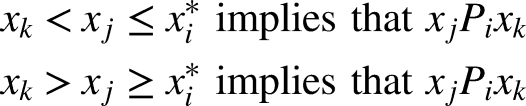
This type of bias will be modeled by assuming that all voters have ideological preferences (represented by the symmetric single-peaked preferences), but that they may experience some type of ‘cost’ when abandoning the status quo alternative. To model this, voters are partitioned into two distinct types. The type-S voters (S stands for ‘status quo’) have their peaks at the status quo alternative
This type of assumption can be justified in the existing literature. Samuelson and Zeckhauser (1988), Shepsle and Weingast (1981: Example 3), and Tullock (1967) all argue that it should be unfeasible to place alternatives on the agenda that are within a certain distance from the status quo alternative because they most likely only are dilatory, for example, as voters are unlikely to cast their vote on them anyway. This is exactly what we intend to capture in the considered model via so-called voter frictions. A voter friction describes all challenger alternatives that are considered to be ‘too close’ to the status quo alternative to even be considered by the voter. Note that it is possible to provide a theoretical foundation for a utility representation of single-peaked preferences with voting frictions using a cost-based approach (for more on costs and single-peakedness, see Coombs and Avrunin, 1977). However, given that we do not need such a representation to prove the theoretical results in this paper, we refer to Appendix A for the details.
The friction
Binary voting situations
A binary voting situation is a majority vote between the status quo alternative and some challenger alternative in
To investigate if the voters in

For a given profile
On the relation to the Downsian framework
There are two assumptions that cause the model described in this section to deviate from the classical framework of political competition (Black, 1958; Downs, 1957): namely, that some political candidates must represent the status quo alternative and that some voters may experience a status quo bias. If both these assumptions are dropped, the model reduces to the classical frameworks of political competition. Among other things, this implies that the peak of the median voter
Theoretical results
Throughout this section, the insights from the four panels of Figure 1 will be used to illustrate the main theoretical findings. Each panel in the figure describes the one-dimensional symmetric preferences of three voters.
11
In panel (a), there is one type-S voter and two type-A voters. The latter two voters have their peaks at
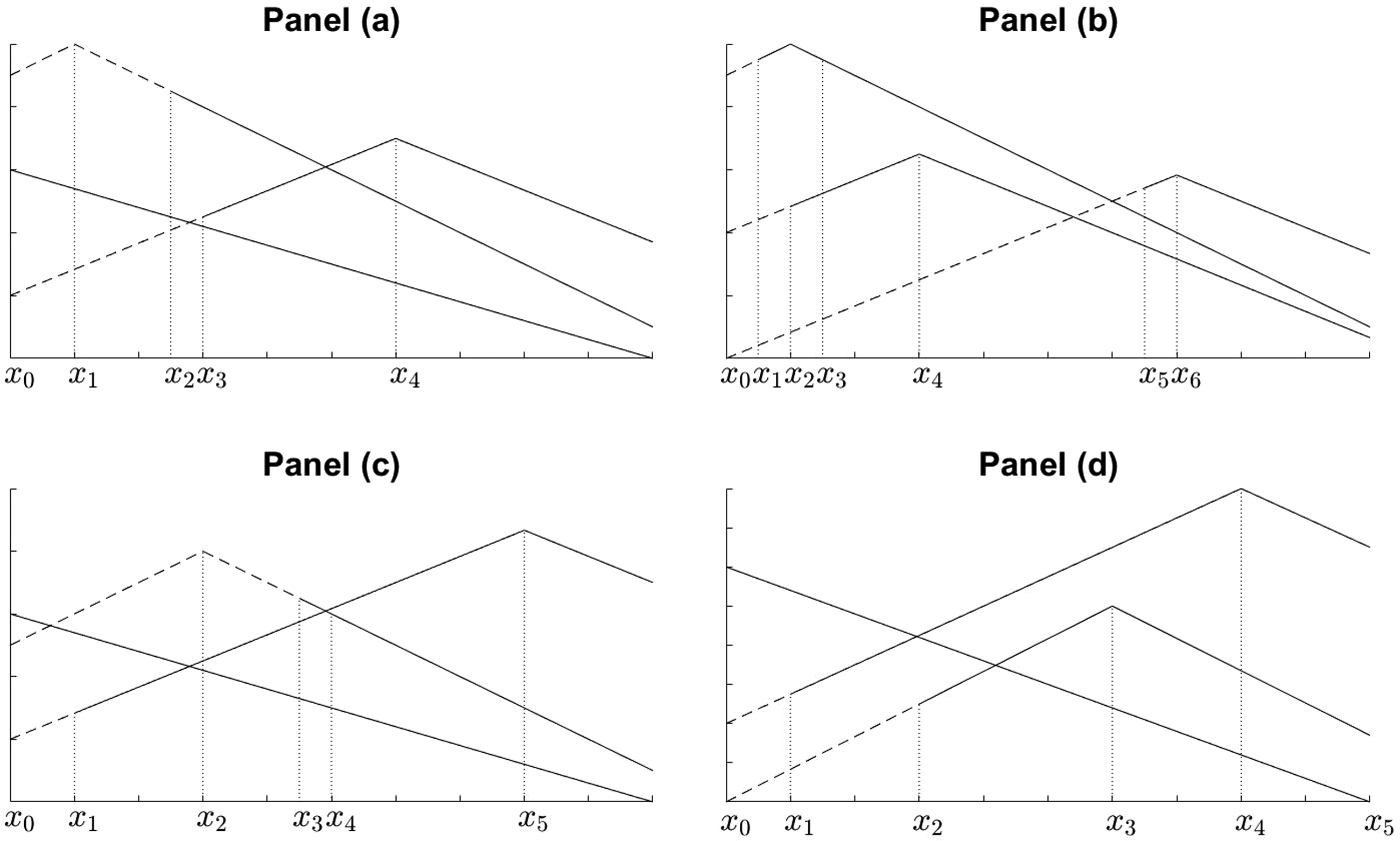
(a)–(d) Illustrate the four leading examples considered in this paper.
The restriction will be directed toward profiles
For a given profile
A voting situation based on the profile illustrated in Figure 1(a) is not non-trivial because the status quo alternative wins over any other challenger alternative in
The following result shows that there exists a special challenger alternative, called
For any profile
The fact that there is an alternative
In Figure 1(b) to (d),
In the classical framework, where voters do not have frictions, for any two alternatives
For profiles
To prove the lemma, it suffices to find one example of a non-trivial binary voting situation with an alternative
Figure 1(b) shows that the median peak
Figure 1(c) shows that the median peak
Lemma 2 shows that the median peak need not play the same decisive role when voters have frictions as it does in the classical framework, previously discussed in Section 2.4. As will become clear shortly, this insight also means that Condorcet cycles may be present (which obviously does not mean that they are always present; there is, for example, no Condorcet cycle in Figure 1(b)). But even when Condorcet cycles are present, the challenger alternative need not be selected in such a way that the Condorcet cycle is problematic from a democratic perspective, in the sense that a majority prefers another alternative to the winning. To make this point clear, consider Figure 1(d) where there is a Condorcet cycle because
To neutralize Condorcet cycles (if they exist), the distribution of peaks as well as the distribution of frictions must be known. In any real-life binary voting situation, an agenda setter is unlikely to possess that type of information, so the process for the agenda setter to nominate the challenger alternative must somehow be approximated, for example, based on various investigations and polls. 13 But there is always a positive probability that such information is misinterpreted or biased in some way, so the agenda setter enters the binary voting situation with a ‘non-optimal alternative’ from a voting maximizing perspective. This is particularly true given it has been established in Lemma 2 that the median peak is not as informative when frictions are present as in the classical framework without frictions. Thus, if the agenda setter enters the binary voting situation with a ‘non-optimal alternative’, the Condorcet cycles may in fact not be neutralized and thus become problematic from a democratic perspective. For that reason, it is important to characterize under which circumstances Condorcet cycles exist.
For any profile
Note first that there exist profiles
We start by proving that if condition (i) or (ii) holds, then there is a Condorcet cycle. Because the binary voting situation is non-trivial, there exists a challenger alternative that wins a majority vote over the status quo alternative. This observation together with Lemma 1 imply that there exists an alternative
We next prove that if there is a Condorcet cycle, then condition (i) or (ii) must hold. Suppose that there is a Condorcet cycle, but that neither of the two conditions holds. The latter means that
As observed in the aforementioned, there is no Condorcet cycle in Figure 1(b), and the reason is that condition (ii) in Theorem 1 is violated. This follows because
As already concluded in the Introduction section, even if Condorcet cycles may exist in binary voting situations with multiple plausible challenger alternatives, they are impossible to identify using voting data alone. To shed some further light on this potential problem, we follow the tradition in the literature to evaluate the theoretical findings using Monte Carlo simulations (see, e.g. Bochsler, 2010; Gehrlein, 2006: for further discussions). The purpose of the simulations is to provide an estimate of the proportion of non-trivial voting situations and the probability that Condorcet cycles exist. The latter can be achieved by employing Theorem 1.
The results are presented for averages over 1,000 simulations for each of the 600 considered instances (i.e.
Variables and values for the Monte Carlo simulation. There are 600 instances in total, and for a given number of voters, there are 120 instances.
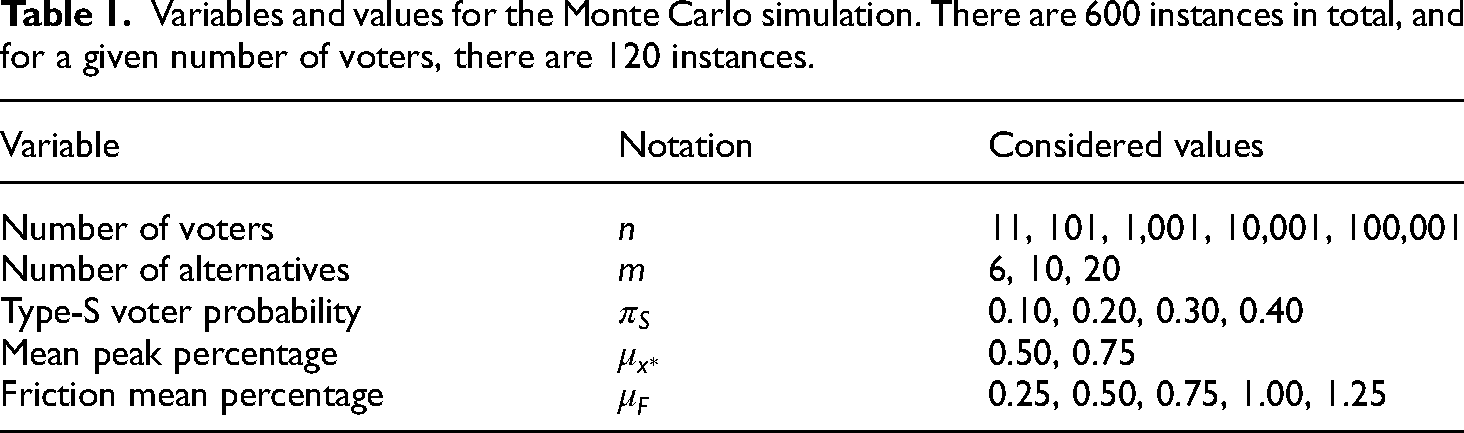
Variables and values for the Monte Carlo simulation. There are 600 instances in total, and for a given number of voters, there are 120 instances.
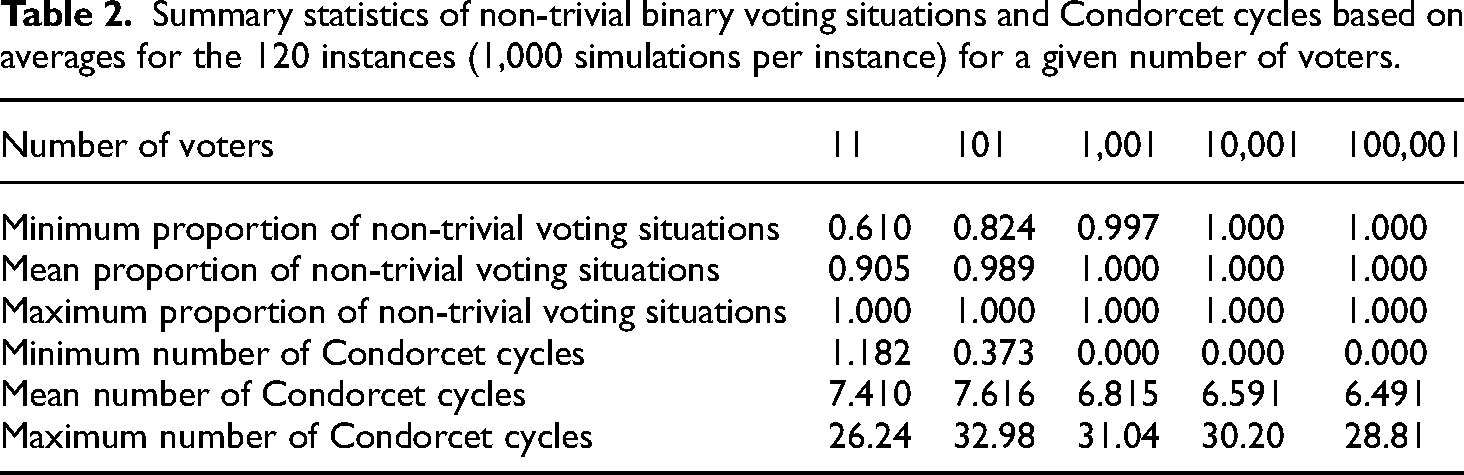
For a given number of voters, all 120 instances (i.e.
Summary statistics of non-trivial binary voting situations and Condorcet cycles based on averages for the 120 instances (1,000 simulations per instance) for a given number of voters.
A more detailed visualization related to non-trivialness can be found in Figure 2. The figure considers the
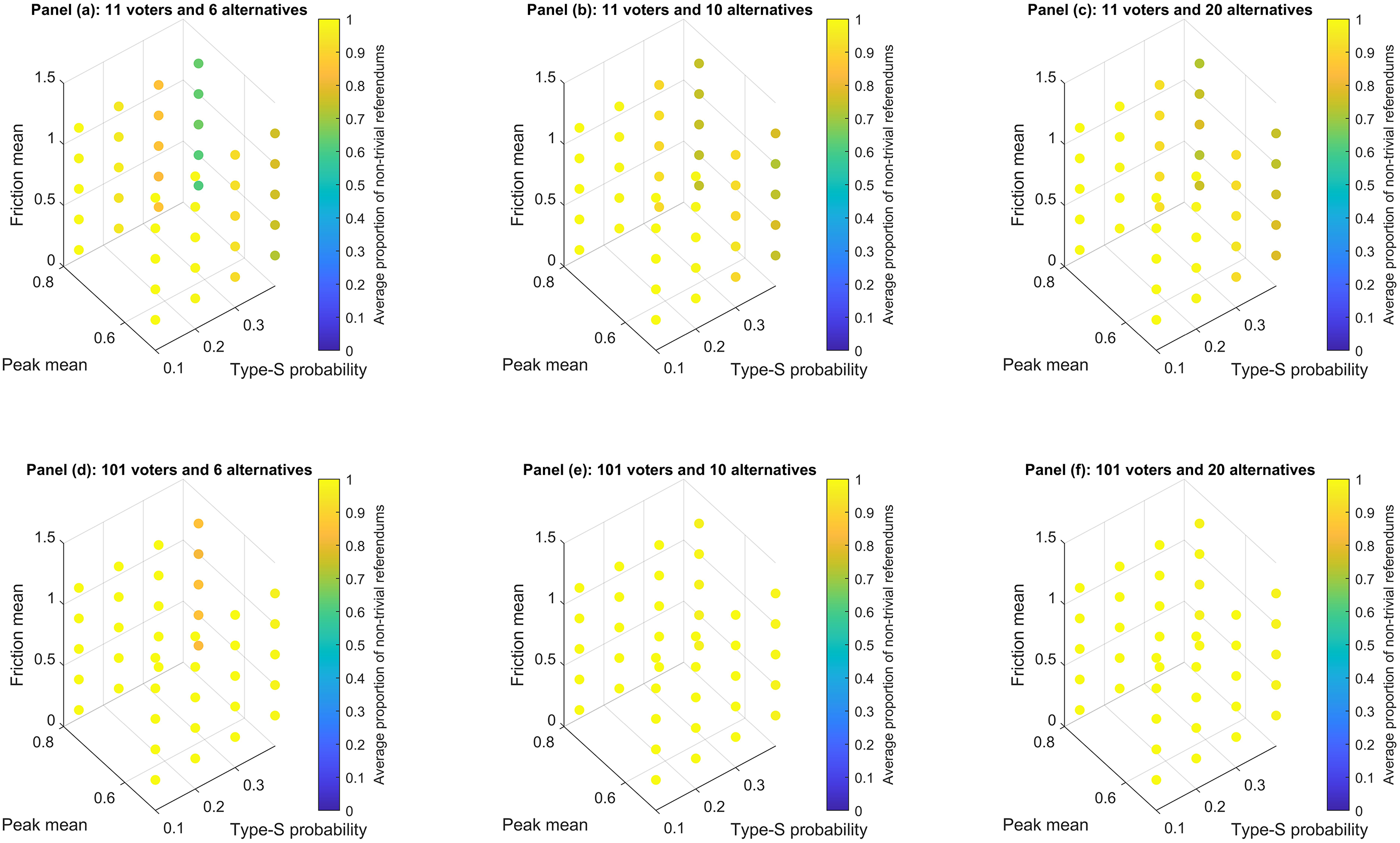
(a)–(f) Illustrate the average proportion of non-trivial binary voting situations for the 240 instances specified in Table 1 when
The lower half of Table 2 displays the average number of Condorcet cycles based on the 120 instances for a given number of voters. A general take-away from the table is that it consistently seems to be around seven cycles on average per 1,000 simulations, implying that the probability of a Condorcet cycle is roughly 0.7% (the largest number of Condorcet cycles found in any of the 600,000 simulations was 97). A more detailed visualization can be found in Figure 3. The figure should be interpreted exactly as Figure 2, but is here displayed for the
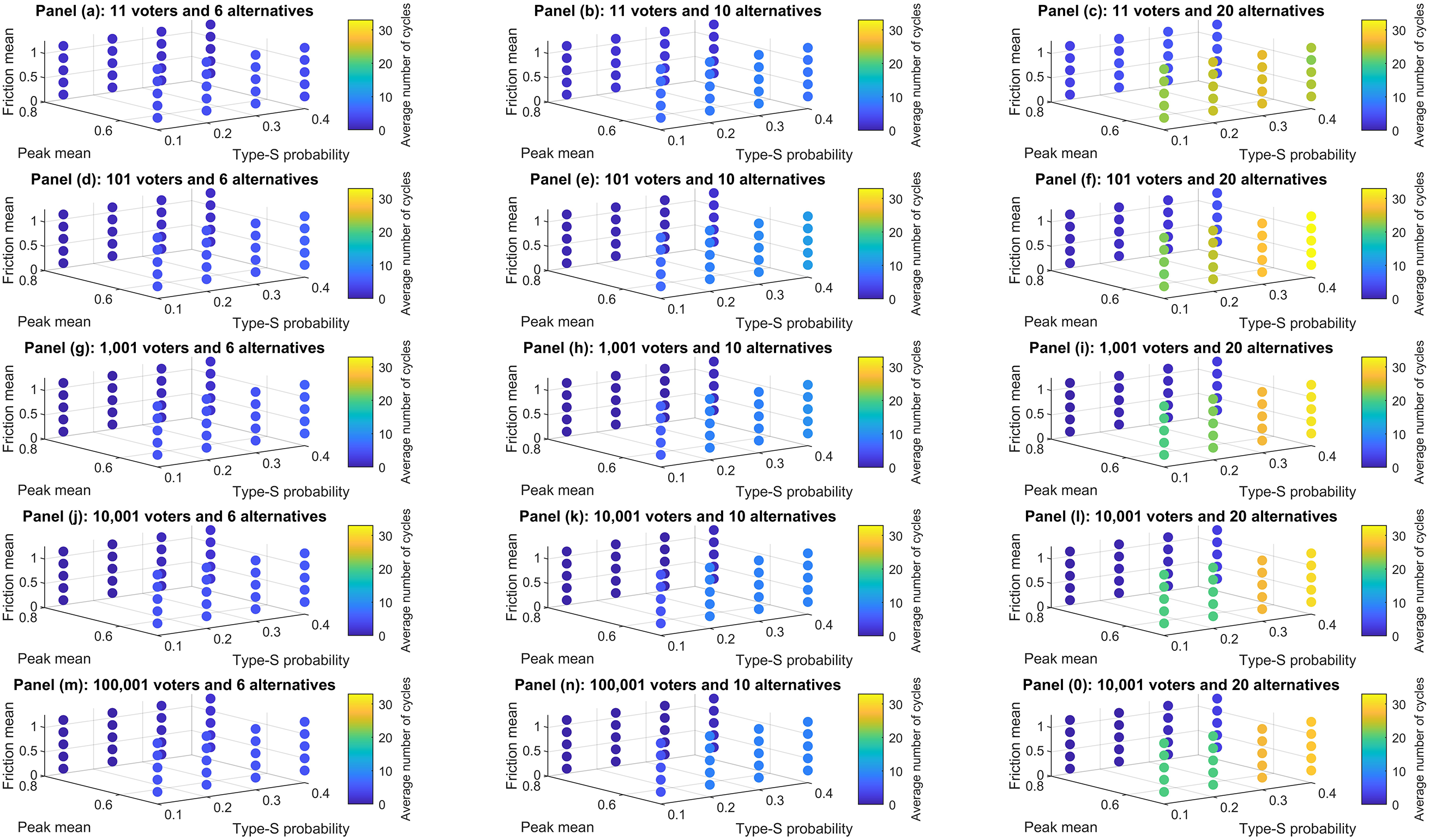
(a)–(o) illustrate the average number of Condorcet cycles for the 600 instances specified in Table 1.
The analysis in this paper has been based on the observations that the challenger alternative not necessarily is unique in binary voting situations, and depending on which alternative is selected, the voters may be differently likely to cast their votes on it. Specifically, if voters experience some type of status quo bias, for example, because of switching costs, voter loyalty, or benefits of the doubt, Condorcet cycles can be present even in the standard one-dimensional framework with symmetric single-peaked preferences.
Further work on the empirical side includes a thorough investigation of various polls and voter investigations to see if Condorcet cycles can be identified in real-life binary voting situations with multiple plausible challenger alternatives (here the technique in Eggers, 2021: may be helpful). On the theoretical side, future work includes more general models and careful modeling of various incomplete information settings. In this paper, no such information structure has been imposed on the model, simply because it is not needed to make the main points related to the existence of Condorcet cycles when voters have a status quo bias.
Footnotes
Acknowledgements
The author would like to thank the Editor and two anonymous referees for their excellent comments and remarks.
Declaration of conflicting interests
The authors declared no potential conflicts of interest with respect to the research, authorship, and/or publication of this article.
Funding
The author disclosed receipt of the following financial support for the research, authorship, and/or publication of this article: This work was financially supported by the Jan Wallander and Tom Hedelius Foundation (grant number P22-0087).

Appendix A: Utility representation with frictions
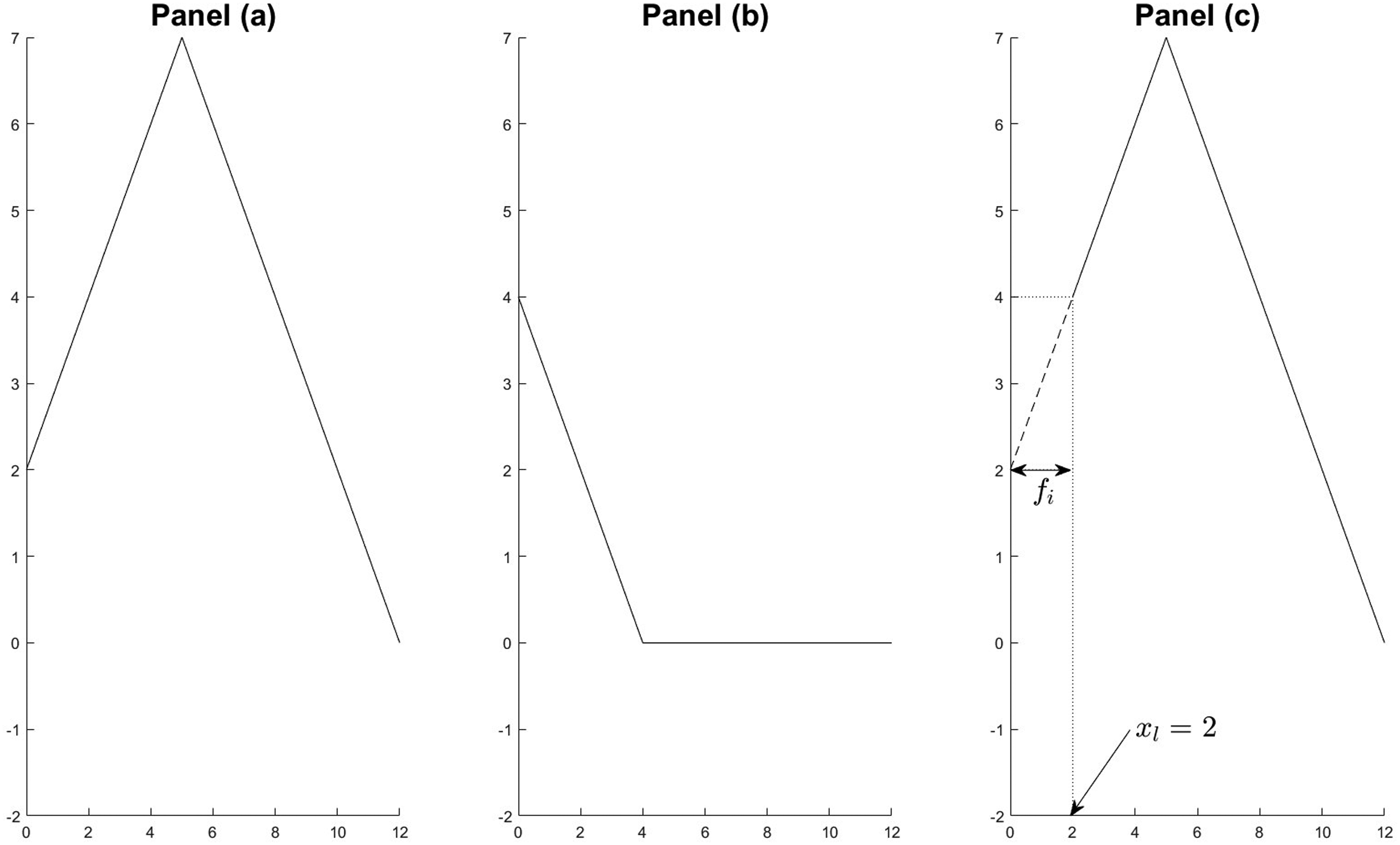
The purpose of this Appendix is to show that a utility representation of single-peaked preferences with voting frictions can be theoretically founded using a cost-based approach (see also the discussions in section 2.2). To achieve this, recall first that a standard utility representation of one-dimensional symmetric single-peaked preferences is:
Consider now the following utility representation of preferences (a)–(c) Illustrate a standard single-peaked utility representation, the cost function, and single-peaked preferences with voting frictions, respectively.