




Abstract
Informal, ‘notice-and-comment’, rulemaking is the prototypical mechanism employed by US regulators. However, agencies frequently claim their actions exempt from the process, and courts typically agree. Agencies thus face an important strategic choice between informal rulemaking and avoidance. To study this choice, we analyze a model of rulemaking with exemption and empirically analyze agency avoidance. Our model implies that more biased agencies engage in less avoidance, as they face more skepticism from the courts and, thus, require support from group comments to have their rules upheld. Empirically, we find support for this prediction. As for policy implications, we show it is more beneficial to allow exemptions when the agency is more biased.
Keywords
Introduction
Despite their lack of direct public accountability, federal agencies have significant discretion to make policy through rulemaking. To address concerns over the extent of agency authority, Congress enacted the Administrative Procedure Act (APA). This ‘bill of rights for the hundreds of thousands of Americans whose affairs are controlled or regulated in one way or another by agencies of the Federal Government’ 1 implemented a number of stipulations for the agency’s establishment of regulations. The APA’s provision for informal, notice-and-comment, rulemaking is especially noteworthy given its widespread implementation across classes of rules and agencies. Indeed, participation through this venue appears to play an important role in shaping agency decisions and benefits groups that comment (Balla, 1998; Yackee, 2006; Libgober, 2020a). In this sense, notice-and-comment appears to achieve the goal of making agencies more responsive to outside interests. 2
The notice-and-comment process, however, does not always function as intended, as agencies are often able to avoid engaging the public for comments. A 2012 Government Accountability Office (GAO) report found that 35% of major rules and 44% of nonmajor rules avoided notice-and-comment. 3 Figure 1 plots trends in avoidance versus notice-and-comment. While there are fluctuations over time, in particular a spike in avoidance following the September 11, 2001 terrorist attacks, throughout this period agencies regularly circumvent notice-and-comment on a significant proportion of rules. There are a number of situations in which agencies can choose to engage in such avoidance. For example, if the rule is interpretive or, perhaps most flexibly, if the agency claims a ‘good cause’ exemption. 4 , 5 This potential for avoidance may undermine earlier arguments in favor of using administrative procedures to control the bureaucracy (e.g., McCubbins et al., 1987).
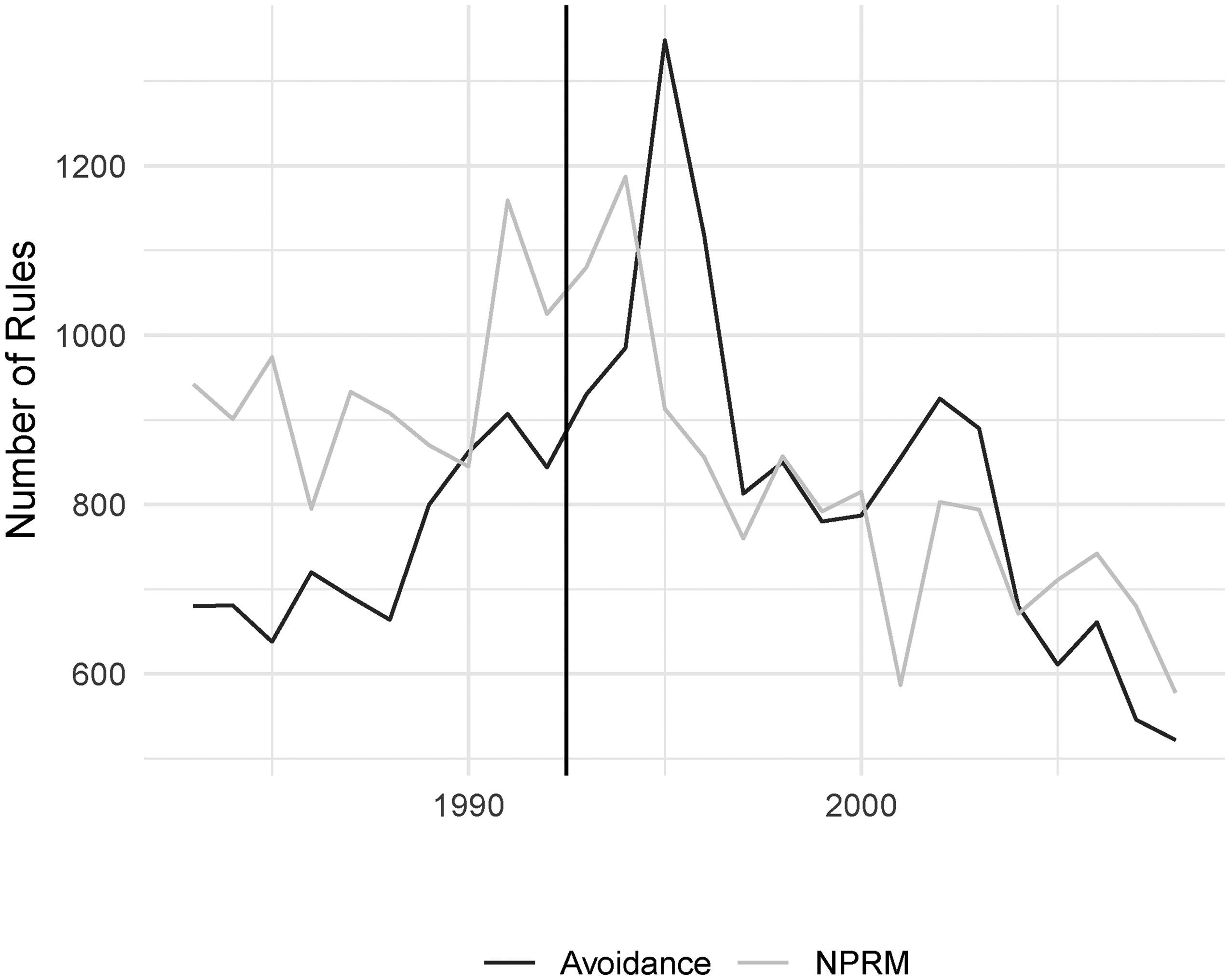
Notice-and-comment versus avoidance choices by regulation publication date. Data compiled by O’Connell (2008); the vertical line indicates the beginning of our empirical analysis.
Indeed, agencies do not only avoid when the issue is non-controversial or politicians and stakeholders are inattentive. In June 2019, the Environmental Protection Agency (EPA) claimed itself exempt from notice-and-comment and updated its procedures for responding to Freedom of Information Act requests. 6 The change gave political appointees at the EPA significant discretion to block the release of public records. Members of Congress from both parties and environmental groups criticized the change as reducing transparency and giving too much power to political appointees. The EPA, however, maintained that it was exempt from notice-and-comment and did not revise the change. Consequently, the possibility of avoidance creates a strategic opportunity for an agency to obtain its preferred policy. Furthermore, such avoidance is consistent with work that shows bureaucrats use their extensive knowledge of rulemaking procedures to obtain their goals (Potter, 2019). Figure 2 shows the use of avoidance by agency and demonstrates that (a) agencies avoid at different rates; and (b) most agencies employ a blend of notice-and-comment and avoidance strategies.
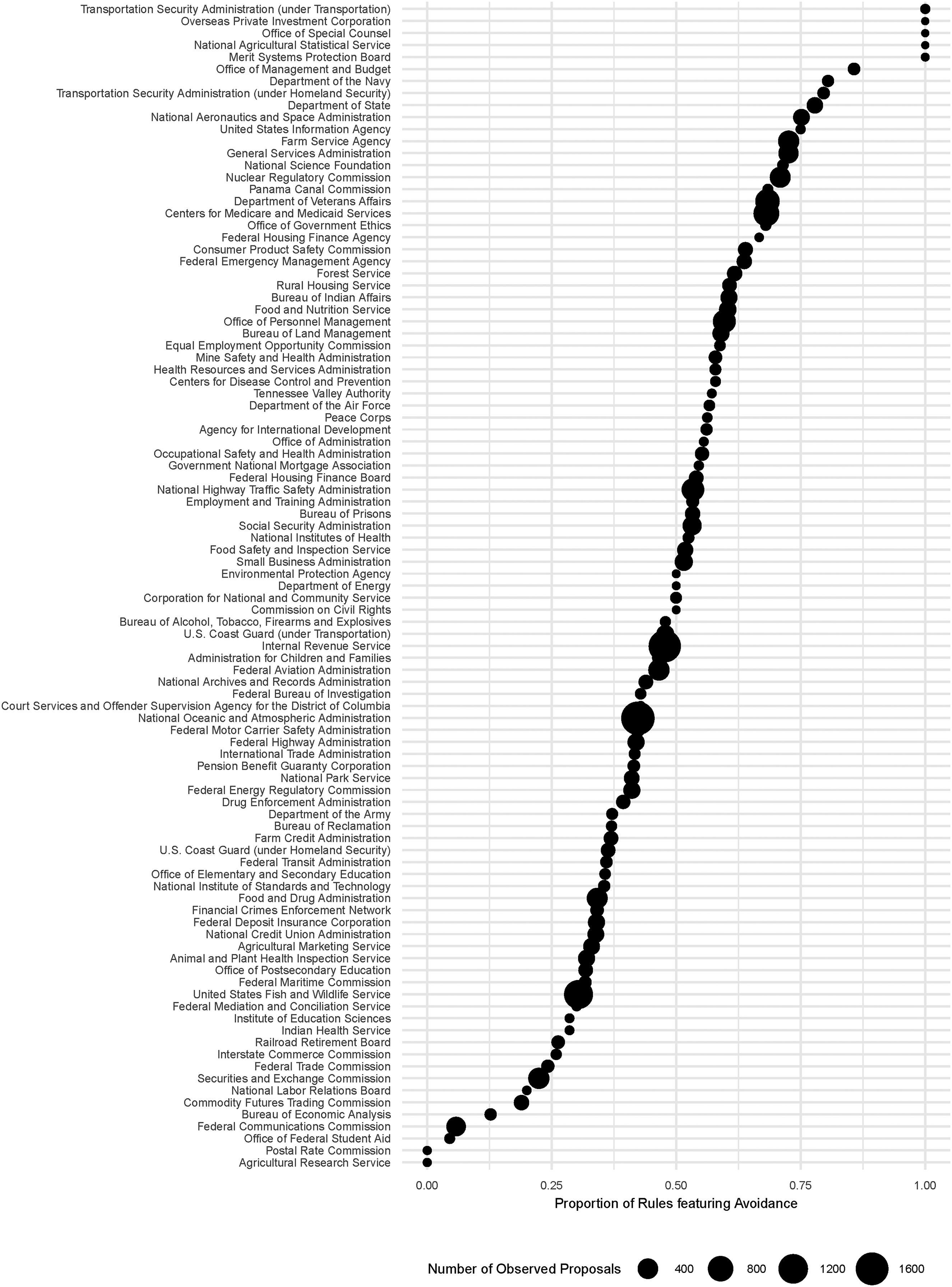
Avoidance by agency.
In this paper, we ask: under what conditions do agencies avoid notice-and-comment? In particular, we are interested in how the existence of the exemption option generates strategic rulemaking incentives for agencies. We analyze this question by developing a formal model of rulemaking and testing its predictions using data on agency rulemaking. Our model incorporates four players: an agency, two competing interest groups, and a court. The agency decides both which rule to propose and whether to attempt to avoid notice-and-comment. If it makes policy through avoidance, the court reviews the available evidence and may reject the agency’s claimed exemption, in which case the agency must use notice-and-comment. Otherwise, if the court upholds the exemption then the game ends and the rule takes effect. Should the agency enter into notice-and-comment, the groups may expend effort to learn about and comment on the proposed rule. After the groups comment, the court reviews the evidence and, as in the previous case, upholds or overturns the agency’s proposed rule.
Importantly, our model allows us to both make predictions about patterns of avoidance and to understand the mechanisms underlying these patterns. The theory highlights the salience of the costs of notice-and-comment—often talked about in the relevant literature with great frustration—to courts and agencies, conditioned by the expected participation of interested groups, in determining what we observe. When the court is mostly concerned with the costs of delay, it approves policies generated through agency avoidance even if it believes that the policy is poorer than the alternative; the agency, in turn, uses avoidance to realize its preferred policies. By contrast, when the court places greater importance on the actual policy outcome, for example, if the potential rules that can be adopted differ significantly, then outcomes depend on the agency’s notice-and-comment costs relative to its policy motivations.
Intuitively, if the agency has high notice-and-comment costs then it always claims exemption, even though this requires implementing its least preferred policy. On the spectrum’s other end, with low costs the agency always proposes its preferred policy and engages in notice-and-comment, hoping for supporting evidence from favorable groups or a lack of comments from unfavorable groups. Most interesting is when the agency has moderate costs: in this case, the agency uses notice-and-comment when its information is favorable toward its preferred policy, but when it lacks favorable information it claims itself exempt and implements its least preferred policy. In this moderate cost case, the agency only turns to notice-and-comment when it expects group comments to confirm its proposed rule. 7
Our model generates two empirical implications about the relationship between agency characteristics and the frequency of agency avoidance. First, agencies with strong ideological biases employ notice-and-comment more than moderate agencies. In equilibrium, highly ideologically biased agencies are more willing to the incur costs of delay to generate comments from supportive groups, which allows the agency to obtain its preferred policy. Second, our model provides a nuanced result relating an agency’s political skill to notice-and-comment rulemaking: more skilled agencies use notice-and-comment more if they view the process as highly costly.
To test these claims, we analyze data on agency avoidance using measures of agency skill and ideology. We estimate a model of exemption use and find support for our theoretical predictions. Supporting our first claim, we find that agencies that are more ideologically extreme use notice-and-comment more often. Remarkably, the result obtains for both very liberal and very conservative agencies, indicating that it is indeed ideological bias, rather than any particular ideology, driving this result. As for the second claim, we find that more skilled agencies use notice-and-comment rulemaking more on significant policies and, what is more, that this effect is magnified during times where a delay is likely to be costly, such as the year immediately following the terrorist attacks of September 11, 2001. These results provide support for our theoretical approach and suggest new directions for theoretical and empirical research in the field. Previous empirical research on avoidance finds that agencies claim exemptions more often when there is a lower risk of a lawsuit (Raso, 2015). By incorporating measures of agency ideology, our results further our understanding of what factors shape exemption decisions.
Modeling the avoidance process yields insights into the policy debates over agency exemptions as well. Certainly, many in the legal community have found exemptions troubling and have called for clarifying when they apply and reducing their employment (for a recent example, see Golinghorst (2018)). Emblematic, the Administrative Conference issued recommendations in 1969, 1973, 1983, and 1992 to such effect. However, no legislative act has been forthcoming and case law has not clearly identified exemption boundaries. 8 While occasionally talking tough, 9 judges have proven unwilling to step in and systematically stop agencies’ frequent invocations of notice-and-comment exemption. Indeed, the Supreme Court recently expanded the power of agencies to avoid by ruling that agencies need not engage in notice-and-comment rulemaking when amending or reversing interpretive rules (see Perez v. Mortgage Bankers Ass’n, 2015).
While having important policy implications, our results provide no unambiguous policy recommendation about whether having an exemption available is generally good or not. The welfare effects of exemptions depend both on the costs for the delay and, in instances where these costs are not too high, the agency’s ideological bias in favor of one policy alternative over another. However, we show that the value of allowing exemptions is increasing in the agency’s ideological bias.
Our theory complements existing work that models the rulemaking process. 10 In particular, our work relates to Gailmard and Patty (2017) and Libgober (2020b). Gailmard and Patty focus on the normative issue of optimal judicial review and show that biased courts improve welfare by incentivizing agency information acquisition. Libgober studies how agency bias affects which policies it proposes, anticipating comments from groups, and argues that empirical findings are consistent with agencies having preferences that are not overly biased in favor of either public or industry interests. Importantly, neither paper incorporates agency avoidance; as such, we focus on a different set of empirical implications and policy issues. Furthermore, our analysis suggests that what we observe coming out of notice-and-comment rulemaking should be interpreted as endogenous to the agency’s choice to use the process in the first place.
Our analysis proceeds in four parts. We initially describe and analyze our model, with a specific focus on its empirical implications. We then estimate our empirical model of notice-and-comment avoidance. Before concluding, we discuss our findings and analyze key social welfare implications.
Our model features an agency (
Timing of the game
The game proceeds as follows:
Nature draws the state of the world The agency receives a private signal After observing signal The agency decides whether to avoid the notice-and-comment process or not.
11
Denote this choice If the agency circumvents notice-and-comment, If the agency does not declare an exemption or the court rejects its claimed exemption, then the game enters notice-and-comment. Each group simultaneously expends resources to try and learn the state of the world. That is, each group Finally, after observing the comments by the groups, the court decides to uphold or overturn the agency’s policy choice.
13
If the court upholds the policy then the proposed policy
Payoffs
Having laid out the stages of our game, we now describe the components of each player’s payoff. There are both policy and non-policy elements for each player.
As for policy, the agency has preferences over the final outcome. In particular, it is biased in favor of policy
Increasing
Turning to non-policy components of the final payoffs, the agency’s payoff is impacted by whether it endures delay costs either because it goes through notice-and-comment or because it avoids notice-and-comment but the court rejects its policy on grounds of failing to qualify for exemption. Whatever the reason for delay, the agency incurs a cost
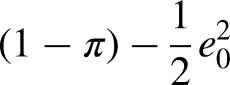
Therefore, the agency’s final payoff is


Comments on the model
Before proceeding to the analysis, we comment on a number of aspects of the model.
First, we model delay as costly for the agency and court (i.e., society). The costliness and frustration of delay are part of the textbook discussion of informal rulemaking (Kerwin and Furlong, 1992, 2018). As the Administrative Conference of the United States put it in its 1992 round of APA recommendations, agency costs from notice-and-comment could include ‘the time and effort of agency personnel, the cost of Federal Register publication, and the additional delay in implementation that results from seeking public comments and responding to them.’ 15 Almost all would agree that, at least in some instances, these costs are substantial, for example, the process sometimes drags on for years and even across presidential administrations. Furthermore, the existence of exceptions recognizes that delay may be costly for society in general, for example, due to wasted resources on routine issues or matters that require immediate action.
Second, group comments are modeled as hard information rather than, for example, cheap talk. This captures that the APA directs agencies to focus on comments that provide ‘relevant matter’. It is also consistent with evidence that sophisticated comments are more influential (Cué llar, 2005), and that agencies are less responsive to mass commenting campaigns (Balla et al., 2022). Additionally, this form of information transmission follows previous models of notice-and-comment, such as Gailmard and Patty (2017) and Libgober (2020b).
Third, we assume the court decides whether to overturn immediately following commenting. Instead, we could assume that the agency can revise its policy choice after observing comments from the groups. In this case, instead of being overturned by the court, the agency would update its policy choice. We note that, under this alternative formulation, the model would predict we should rarely see agencies overturned. However, as equilibrium avoidance decisions and policy outcomes are not affected by this change, we maintain the simpler formulation.
Fourth, as noted in the Introduction, we are primarily interested in how the exemption’s existence, and the ambiguities surrounding when it can be claimed, impacts the agency’s strategic rulemaking decisions. As such, the model is agnostic on whether claiming the exemption is legally justified. That is, we do not capture matters that are routine or non-political, where the agency’s claimed exemption is clearly valid.
Finally, we assume that the court wants to match the state of the world,
Equilibrium rulemaking
Our equilibrium concept is pure strategy perfect Bayesian equilibrium (henceforth ‘equilibria’). Players maximize their expected utility at each stage of the game and update their beliefs according to Bayes’ rule whenever possible. See the Appendix for proofs and additional details of the equilibrium characterization.
Let
To commence our analysis of equilibrium behavior, Lemma 1 details the equilibrium behavior of the groups and court when the agency enters notice-and-comment rulemaking. Group
Notice-and-comment rulemaking.
In every equilibrium, if There exists an equilibrium in which Group
If, absent new information, the court would uphold a group’s preferred policy, then the group expends no effort and does not comment as there is no benefit to doing so. Conversely, if changing an outcome from unfavorable to favorable is possible, then the group expends positive effort and this depends on the group’s belief that the state matches its preferred policy. This leads to two equilibria because the court’s belief
Lemma 2 analyzes the court’s decision to overturn the agency if it claims exemption from notice-and-comment. This decision hinges on the court’s belief that the agency’s choice matches the state and whether the agency avoided notice-and-comment.
Assume the agency avoids notice-and-comment. When
When the agency employs notice-and-comment, the court upholds the policy when it believes that the agency’s choice is more likely to be correct than the alternative, as the court wants to match the state. However, if the agency avoids notice-and-comment then the court upholds the agency’s choice for some beliefs that are
Finally, we turn to the agency’s decision. We start by analyzing the case where
If
When the situation is ex ante favorable to the agency, it is able to always use avoidance to obtain its preferred outcome. Although
Our next proposition characterizes the agency’s policy choice and decision to avoid notice-and-comment.
Assume If If If
As shown in Figure 3, which depicts equilibrium rulemaking for combinations of agency and courts costs, the agency takes advantage of exemptions when the court faces high delay costs. In this case, exemptions have the downside, discussed by previous scholars, of allowing a biased agency to avoid comments and to always implement its preferred policy.
Rulemaking is more nuanced with more moderate court costs, as agency costs are now crucial. There are conditions where the agency always uses notice-and-comment, where it conditionally employs notice-and-comment, and where it always uses exemption. We now outline the intuition behind these different cases.
First, an agency facing high costs is incentivized to avoid notice-and-comment and not get overturned by the court. Consequently, after either signal it claims exemption and, by selecting its least preferred policy, is upheld by the court (by assumption that
Second, with moderate to high agency costs, the agency’s action depends on its information, with the agency only using notice-and-comment when confident that the outcome will support its preferred policy. When the agency has favorable information it goes through notice-and-comment. When
Finally, if the agency’s costs for notice-and-comment are low then the agency always attempts to push its preferred policy through using notice-and-comment. Again, if
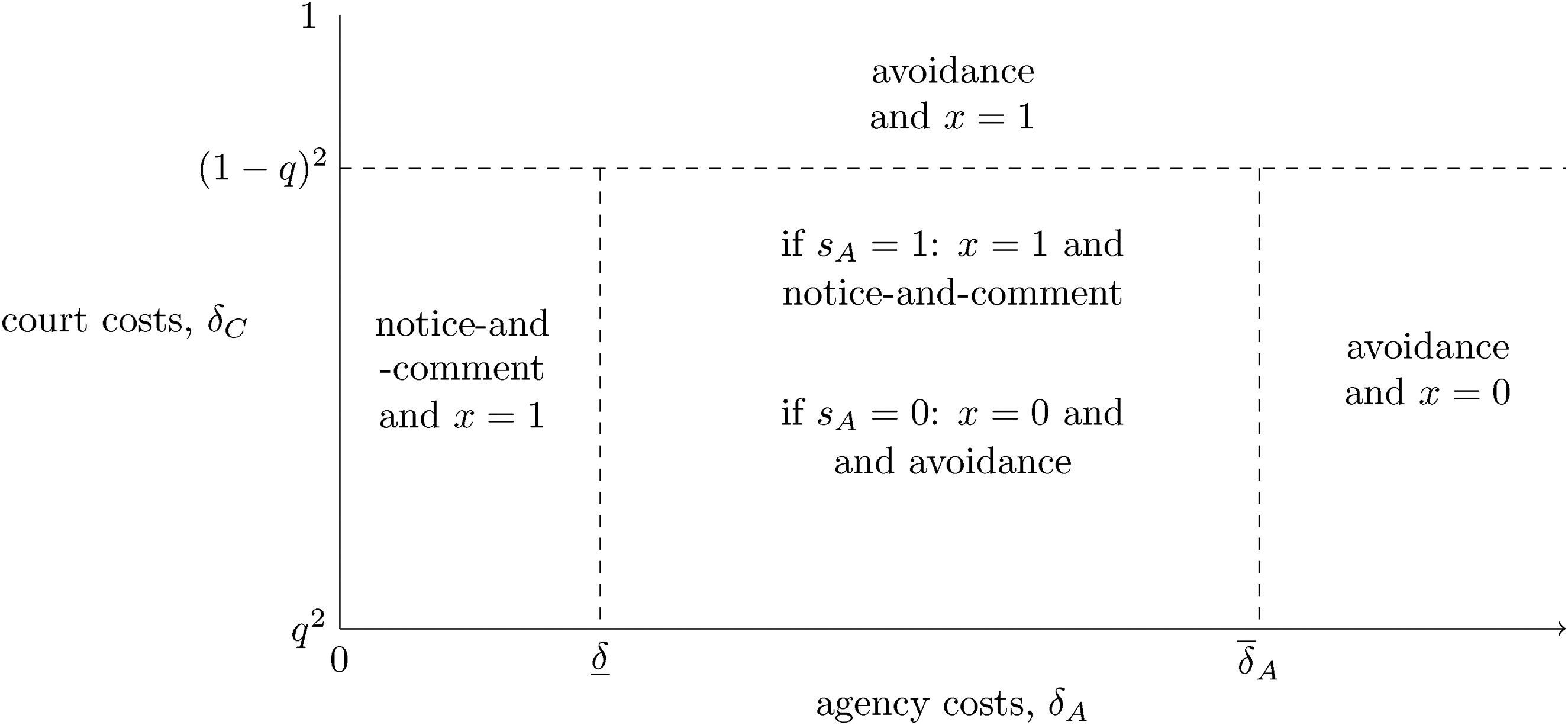
Agency’s equilibrium use of notice-and-comment and avoidance options.
We now lay out our model’s empirical implications. We first focus on agency ideology and skill, and then turn to when a group should inject itself into the rulemaking process. Predictions that can be, or have been, examined empirically are produced about ideology, skill, and group effort. Additionally, our findings about group commenting lead to inferences about organizational influence on rulemaking.
We now state the relationship between the agency’s ideological bias and the equilibrium thresholds.
Assume the
Proposition 2 demonstrates that an increase in
Increasing the agency’s ideological bias increases the probability it uses notice-and-comment.
Besides an agency’s bias, its skill—captured by the informativeness of its signal—affects notice-and-comment’s probability. Unlike agency bias, increasing the agency’s skill has more cross-cutting effects on the probability of notice-and-comment. To start, Proposition 3 characterizes how skill affects the equilibrium thresholds.
Assume the
Increasing
Unlike increasing bias, increasing skill has countervailing effects on whether we should expect to see more or less notice-and-comment. Increasing
To make this discussion more concrete, assume
If the agency has low costs of delay, then increasing its skill decreases the probability of notice-and-comment. If the agency has high costs of delay, then increasing the agency’s skill increases the probability of notice-and-comment.
We specified our avoidance theory with the explicit idea of taking it to data. In particular, we investigate how bias and skill affect the probability of avoidance and interpret the evidence through the lens of our model.
The data
The core of our data on rulemaking and its avoidance is from O’Connell (2008), who created a comprehensive database from the Unified Agenda of Federal Regulatory and Deregulatory Actions. Executive Order 12866 tasks agencies with semi-annual submissions regarding pending and anticipated rulemaking. Importantly, this includes whether or not agencies employ notice of proposed rulemaking (NPRM) procedures, allowing us to examine agency avoidance choices. Our dependent variable is dichotomous, scored 0 when the proposed rule does not go through NPRM procedures and scored 1 when it does go through NPRM procedures. 18
While O’Connell’s data spans 1983–2008 and includes 256 agencies, our analysis begins in 1993 and covers 82 agencies so that, as we detail, we can incorporate measures of agency bias and skill. 19 Specifically, we employ measures developed by Richardson et al. (2018: henceforth RCL), who surveyed over 1,500 federal executives and used a measurement model to transform these skill/ideology perceptions into agency-specific measures. 20 While using the RCL measures limits our time frame and agencies (although virtually all major agencies are included), we nonetheless have 16,575 proposed rules to study. We focus our attention on the 3,602 proposed rules identified as either ‘economically significant’ or ‘other significant’, dropping those coded as ‘substantive but nonsignificant’, ‘routine and frequent’, or ‘other administrative’. Among these, 59.7% feature NPRM procedures.
Testing the bias hypothesis
To test Implication 1 (more agency bias yields more NPRM), we reduce the data further by operating at the agency level. Doing so allows us to begin our analysis without having to worry about the lack of variance for agency-level variables. We consider the straightforward linear regression model
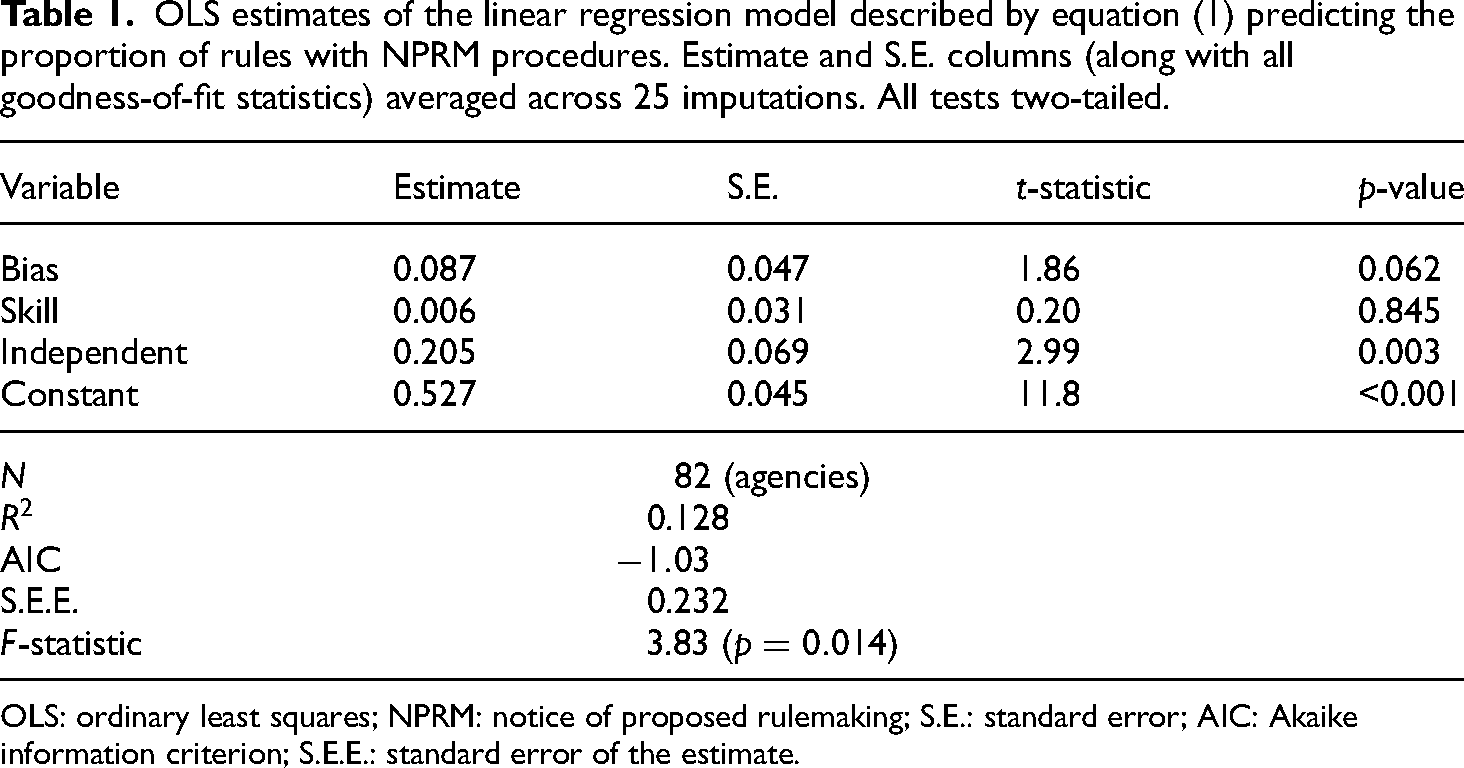
We estimate the model via ordinary least squares (OLS) and summarize the results in Table 1.
23

OLS estimates of the linear regression model described by equation (1) predicting the proportion of rules with NPRM procedures. Estimate and S.E. columns (along with all goodness-of-fit statistics) averaged across 25 imputations. All tests two-tailed.
OLS: ordinary least squares; NPRM: notice of proposed rulemaking; S.E.: standard error; AIC: Akaike information criterion; S.E.E.: standard error of the estimate.
Though the model’s fit is relatively weak, the picture is clear enough to assess Implication 1. We see that a one-unit increase in an agency’s bias 24 is associated with an 8.7 percentage-point increase in the proportion of rules promulgated with NPRM procedures. The estimate is not statistically significant at the 0.05 cutoff but is significant at the 0.10 cutoff; it is worth noting that our strong theoretical hypothesis and modest sample make one-sided testing appealing, and we leave the task of further inferential judgment at the reader’s doorstep. We see also that, in this model, an agency’s skill level has a negligible effect on whether they use NPRM procedures. Finally, independent agencies indeed use NPRM procedures (much) more often than non-independent agencies.
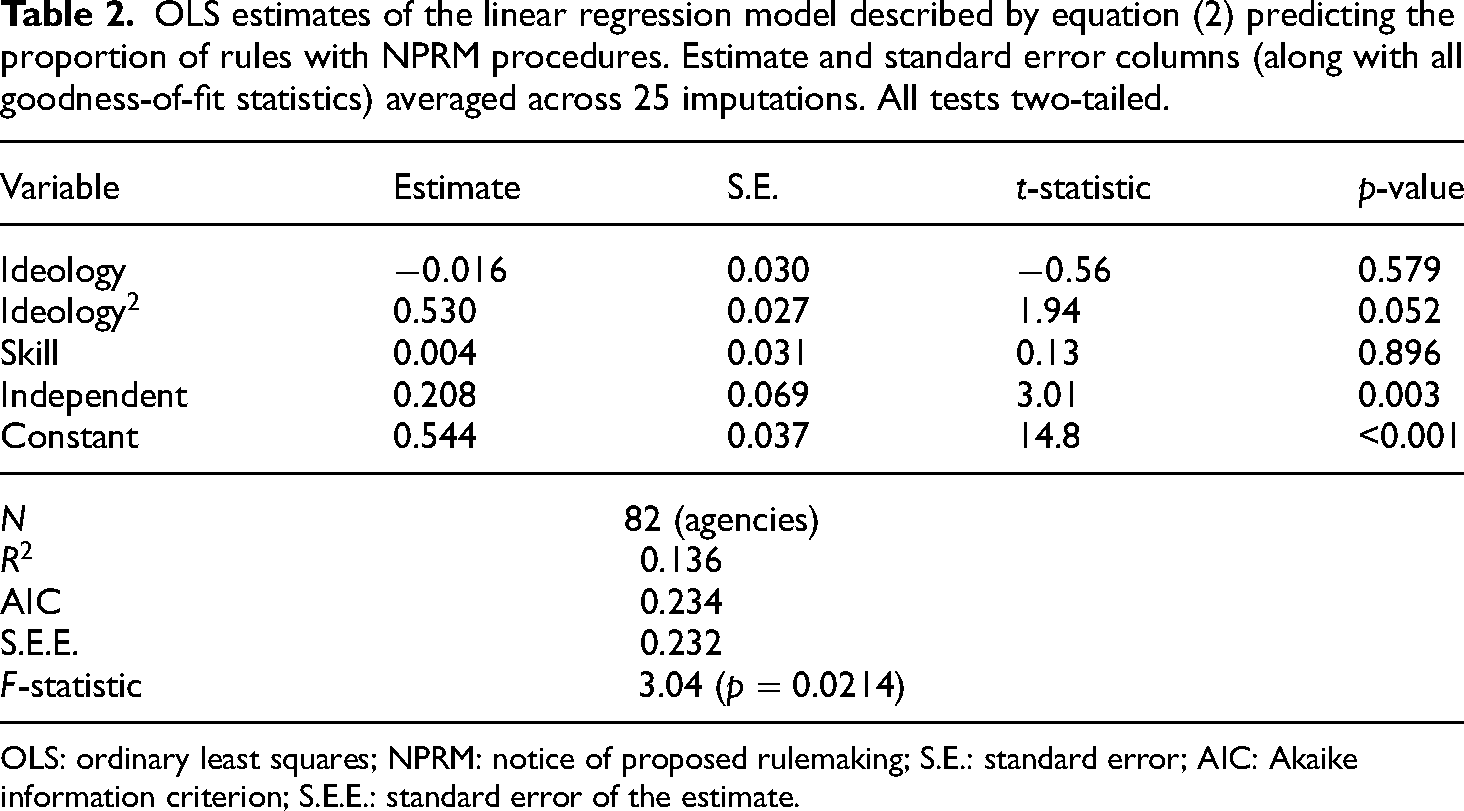
As we have measured bias using the absolute value of the RCL ideology score, we have assumed away any possibility of asymmetric effects across the ideological spectrum. Put differently, our empirical model treats very liberal and very conservative agencies the same, which is in keeping with our theoretical model. To make sure this assumption is reasonable, we consider a second linear regression model:
where all other variables are the same but
The fact that
OLS estimates of the linear regression model described by equation (2) predicting the proportion of rules with NPRM procedures. Estimate and standard error columns (along with all goodness-of-fit statistics) averaged across 25 imputations. All tests two-tailed.
OLS: ordinary least squares; NPRM: notice of proposed rulemaking; S.E.: standard error; AIC: Akaike information criterion; S.E.E.: standard error of the estimate.
In the previous subsection, both of our reported models yielded null effects of agency skill in the proportion of proposed rules featuring NPRM procedures. This comes as no surprise, as our theoretical analysis anticipated cross-cutting effects for the skill variable depending on the associated costs of delay. However, it is difficult to know whether any given proposed rule—much less agency—has high or low costs of delay, so it is difficult to determine the effect of skill on NPRM utilization.
We now take advantage of our full rule level, rather than agency-level, data structure. Our dependent variable is dichotomous and coded 1 when a proposed rule features NPRM procedures. Our independent variables include:
Bias, the absolute value of proposing agency’s RCL ideology score; Skill, the proposing agency’s RCL skill score; Extreme Costs, a dummy variable coded 1 for rules proposed in the 365 days after September 11, 2001, where our motivating idea is that agencies faced much higher costs of delay in the aftermath of the World Trade Center attacks; Independent, a dummy variable coded 1 if the proposing agency is independent; State, a dummy variable coded 1 if the proposed rule affects state agencies; and Federal, a dummy variable coded 1 if the proposed rule affects federal agencies.
26
We estimate a logistic regression using this battery of predictors and cluster our standard errors at the agency level.
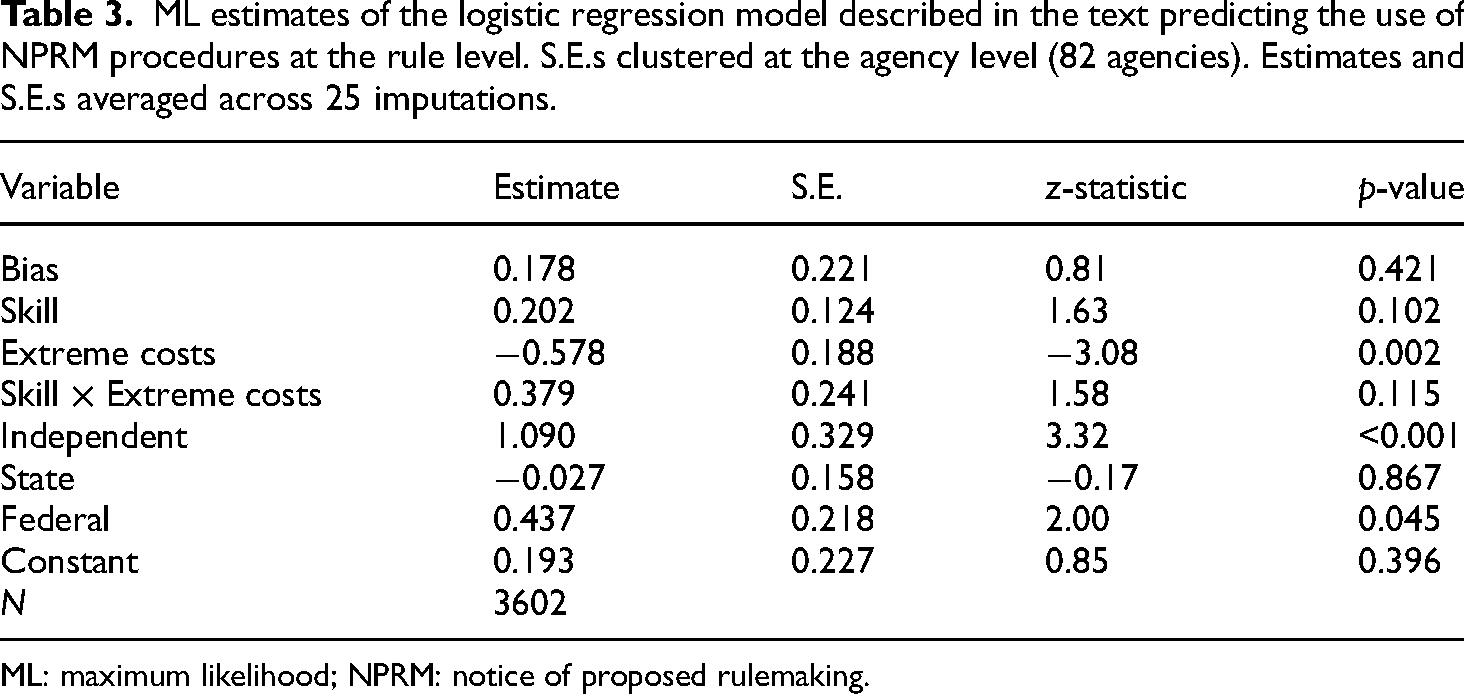
The results of that analysis are summarized in Table 3.
ML estimates of the logistic regression model described in the text predicting the use of NPRM procedures at the rule level. S.E.s clustered at the agency level (82 agencies). Estimates and S.E.s averaged across 25 imputations.
ML estimates of the logistic regression model described in the text predicting the use of NPRM procedures at the rule level. S.E.s clustered at the agency level (82 agencies). Estimates and S.E.s averaged across 25 imputations.
ML: maximum likelihood; NPRM: notice of proposed rulemaking.
As a check of the premise motivating this exercise, it is heartening that there exists a strong, negative effect of our 9/11 dummy on NPRM procedures—this suggests that this is indeed a period of high costs of delay, at least among agencies with median skill. Independent agencies remain far more likely to employ NPRM protocols than non-independent agencies. It is also the case that rules influencing federal agencies are more likely to feature NPRM. The bias variable retains its positive sign, but inferences are weaker compared to the previous subsection.
Here we are mainly concerned with the skill variable. Recall that the model predicts that the effect of skill on the probability of notice-and-comment is conditioned by whether the agency expects costs of delay to be high or low. For observations outside our Extreme Costs timezone, we see a positive effect of skill on the probability of NPRM procedures for a given rule, though the effect is not statistically significant. This offers some suggestive evidence that day-to-day costs of delay are relatively high, so that it is the second part of Implication 2 (high costs of delay encourage skilled agencies to employ NPRM more often than unskilled agencies) that is relevant for our purposes rather than the first part of the implication (low costs of delay encourage skilled agencies to employ NPRM less often than unskilled agencies). This makes sense, as we have focused only on significant proposed rules. Given this result, it seems reasonable to expect the Extreme Costs timezone to feature a larger positive effect of skill, as the costs of delay in the immediate aftermath of the 9/11 attacks were only higher than normal. 27
We therefore turn our attention to the estimated interaction term and expect to see a positive influence of enhanced costs of delay on the effect of skill on the probability of NPRM procedures. We plot the coefficients in Figure 4.
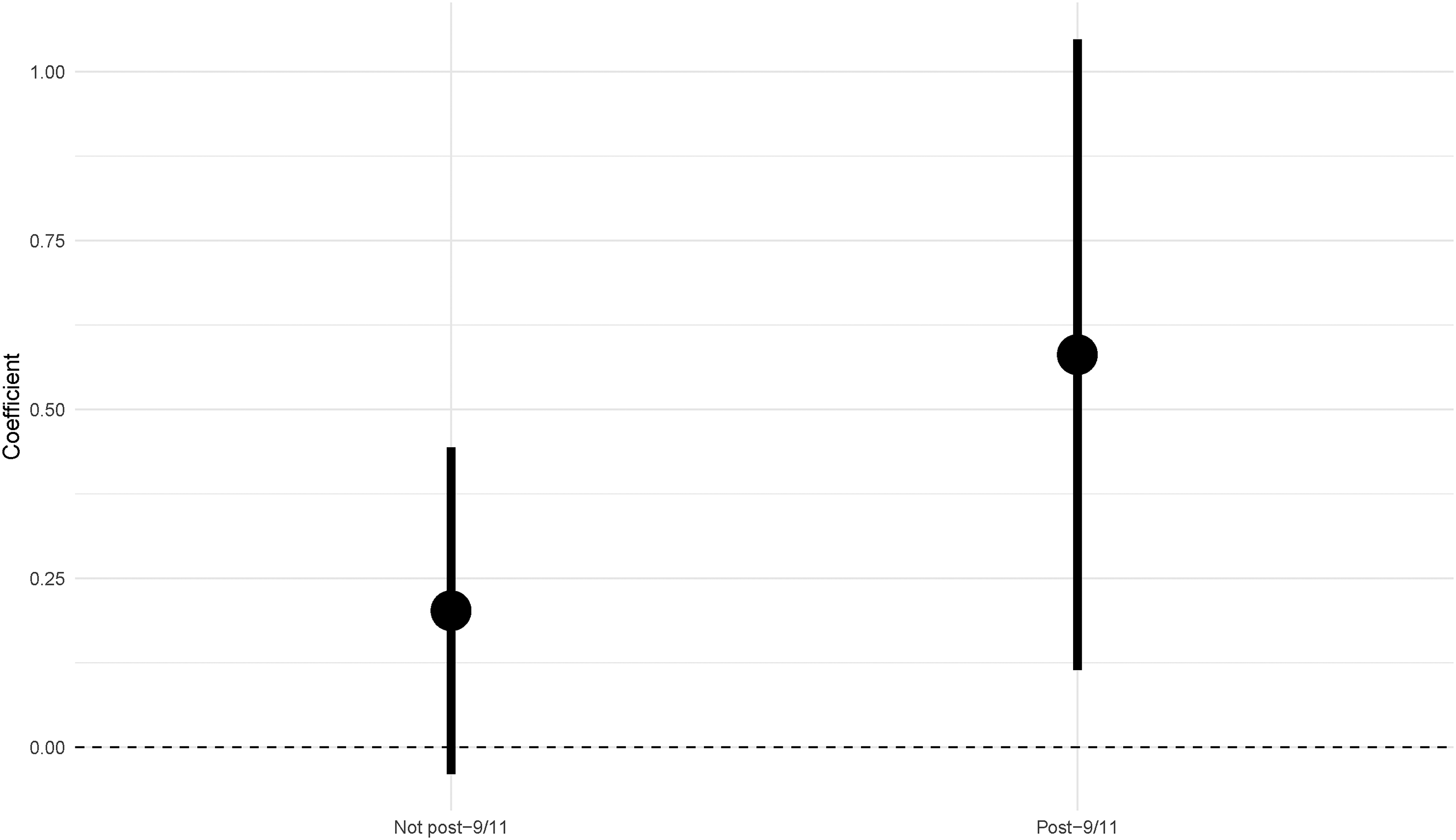
Estimated coefficients from the model summarized in Table 3. Results averaged across 25 imputations. All other predictors held at their respective means.
We see that more (less) skilled agencies made more (less) use of NPRM procedures in the immediate aftermath of the 9/11 attacks, even though far fewer rules at that time were proposed using NPRM procedures.
To get a sense of how the Extreme Costs variable introduces large differences in degree, but not in kind, on the effect of skill on NPRM, consider the predicted probability plot in Figure 5.
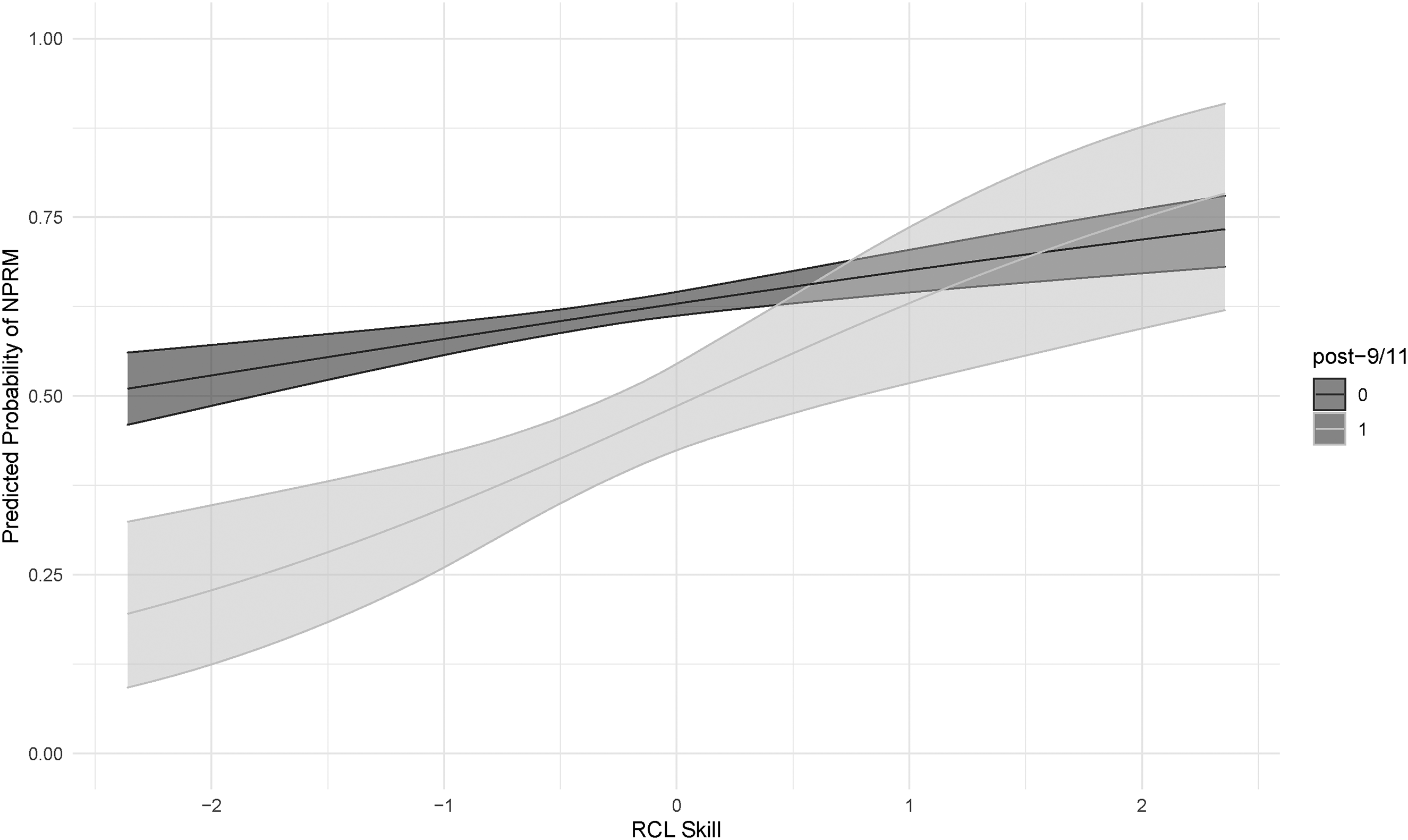
Predicted probability of NPRM as a function of agency skill and extreme costs. Results averaged across 25 imputations. All other predictors held at their respective means. Standard errors obtained via a bootstrap balanced by agency.
The darker ribbon is during normal times, and (to repeat) it features a positive marginal effect of skill on NPRM utilization, suggesting that day-to-day rulemaking on significant policies is a high-cost affair. It would be very bad news for our theoretical model if the Extreme Cost time period featured a null or negative effect of skill on NPRM usage. However, this is not the case; indeed, during the Extreme Costs timezone, the effect of skill on NPRM utilization is positive and (by any reasonable standard) substantively meaningful.
All things considered, the empirical results provide promising suggestive evidence that we are on the right track with our theoretical model. In particular, it appears that those agencies with more political bias do indeed use NPRM procedures more often than those without bias, which is consistent with our Implication 1. Perhaps more interestingly, our analysis of significant rules, both in normal times and in the immediate aftermath of a catastrophe, suggests that skilled agencies use NPRM procedures more often, which is consistent with the second part of our Implication 2. Of course, our data are somewhat limited and the measures are themselves the output of a measurement model, so it is important to maintain humility in light of these results. That said, we are confident that these results are strong enough, not to mention consistent enough with our theoretical model, to warrant further attention from empirically minded scholars in this area as the literature continues to unfold.
By modeling the notice-and-comment process we can also study how allowing exemptions impacts welfare. In particular, we study when the court benefits from the existence of an exemption to notice-and-comment. In cases where
Assume Assume If If If
Intuitively, with very high delay costs,
When
Proposition 4 implies it is optimal to allow exemptions whenever
The court’s expected value for allowing exemptions instead of removing them is increasing in the agency’s bias.
Understanding the structure and impacts of the rulemaking process has been a subject of interest to social scientists, legal scholars, and policy analysts. Rulemaking has been a particularly relevant topic given a gridlocked world where moving policy statutorily has proven extraordinarily difficult and attention has increasingly focused on how agencies can adjust policies directly. To date, most consideration has been given to notice-and-comment per se even though past work has acknowledged that agencies have promulgated many rules, including very important ones, via an end run around the process. Our analysis provides insights into how rulemaking is impacted by the strategic use of avoidance by agencies.
There are a variety of ways in which we can build on the analysis here. Broadly, continued back-and-forth between theoretical and empirical work should prove fruitful for improving our understanding of rulemaking and our ability to make policy recommendations for how to organize the bureaucracy.
For example, our theoretical and empirical models consider notice-and-comment and avoidance conditional on rulemaking occurring. Moving forward it would be productive to integrate selection into rulemaking. Theoretically, this would entail adjusting our model so that the agency either engages in rulemaking, incurring a cost to observe a signal about the state before playing per our model or does nothing and retains the status quo, getting a payoff between
Further exploring the ties between different theories should also prove informative about the rulemaking process. For example, Libgober (2020b) shows that patterns of notice-and-comment rulemaking can be rationalized without invoking judicial oversight. However, the shadow of judicial review plays an important role in our model. In particular, absent judicial oversight, more biased agencies would always avoid more. However, our empirical results find the opposite, that is, the data are consistent with our model in which agencies anticipate judicial review. This holds despite the court never overturning the agency’s claimed exemption in equilibrium. Hence, while oversight may not be necessary to explain notice-and-comment rulemaking, our paper suggests that it is an important determinant for explaining avoidance.
Finally, moving forward it would be beneficial to further distinguish between claimed exemptions that are legitimate, versus those that are not. Theoretically, it would be interesting to consider a model in which there is uncertainty about whether the exemption is valid. Empirically, it would be useful to develop a rule-level measure of whether an agency would be legally justified in claiming exemption. Doing so could generate new insights into how agencies use exemptions, and provide further evidence on the role of bias.
Footnotes
Declaration of conflicting interests
The authors declared no potential conflicts of interest with respect to the research, authorship, and/ or publication of this article.
Funding
The authors received no financial support for the research, authorship, and/or publication of this article.
