How does justice affect individual incentives and efficiency in a political economy? We show that elementary principles of distributive justice guarantee the existence of a self-enforcing contract whereby agents non-cooperatively choose their inputs and derive utility from their pay. Chief among these principles is that your pay should not depend on your name, and a more productive individual should not earn less. We generalize our analysis to incorporate inclusivity, ensuring basic pay to unproductive agents, implemented through progressive taxation and redistribution. Our findings show that without redistribution, any self-enforcing agreement may be inefficient, but a minimal level of redistribution guarantees the existence of an efficient agreement. Our model has several applications and interpretations. In addition to highlighting the structure of economies and organizations in which fairness and efficiency are compatible, we develop an application to the formation of rent-seeking political alliances under the threat of fake news.
It is generally acknowledged that justice is the foundation of a stable, cohesive, and productive society.1 However, violations of fundamental principles that define justice are highly prevalent in real-life settings.2 These realities raise the important question of how basic principles of justice affect individual incentives and whether such principles can guarantee the stability and efficiency of contracts among private agents in a political economy. In addressing this issue, we refer to the long tradition of ethical and normative principles in economic theory and the relevance of these principles to the real world (Sen, 2009).
In this study, we incorporate elementary principles of justice and ethics into a political economy through the lens of non-cooperative game theory and uncover a new class of strategic form games with various applications to classical and recent economic and political problems. We precisely address the following questions:
How do basic principles of justice affect the existence of self-enforcing contracts in a political economy?
Under which conditions do ideals of justice lead to efficient self-enforcing contracts in a political economy?
To formalize these issues, we introduce a model of a fair political economy, denoted as a list , where is a finite set of agents, is a finite set of actions (or inputs) available to agent , and is the Cartesian product of the s, is a reference profile of actions, is a production (or surplus) function (also called technology) that maps each action profile to a measurable output , is a fair (to be defined below) allocation scheme that distributes any realized surplus to agents, and is the utility function of agent . The reference point can be interpreted as an unproduced endowment of goods (or resources) that can be either consumed as such or may be used in the production process when production opportunities are specified. Agent ’s action set can be interpreted broadly, as we consider it finite. One can view as a capability set (Sen, 2009), a set of different occupations (or functions) available to agent based on agent ’s skills, or a set of effort levels that agent may supply in a production environment. The nature of the actions can also differ for each agent. For each input profile , the allocation scheme distributes the generated surplus following four elementary principles of market (or meritocratic) justice, which are:
Anonymity: Your pay should not depend on your name.3
Local efficiency: No portion of the surplus generated at any profile of input choices should be wasted.
Unproductivity: An unproductive agent should earn nothing.4
Marginality: A more productive agent should not earn less.
We abbreviate these four principles as ALUM. Each agent derives utility from their payoff . The pay scheme is a multivariate function defined at each input profile . The utility can be any positive monotonic transformation of the function , with the transformation function being possibly different for each agent, yielding a large class of political economies. It follows that in any political economy, agents’ utilities are byproducts of the normative principles that guide the distribution of surplus resulting from their actions. Agents are self-interested and do not display other-regarding preferences. Thus, they prefer action profiles that award them higher utility.
The formalization of ALUM differs depending on the context. Ours is a generalization of the classical formalization of Shapley (1953) and Young (1985) to our political economy environment. Indeed, Proposition 1 shows that ALUM uniquely characterizes a pay scheme that generalizes the classical Shapley value.5
To define an equilibrium concept that captures individuals’ incentives in a fair political economy, we first observe that any political economy induces a corresponding strategic form game .6 Then, a profile of actions is said to be an equilibrium in the fair political economy if and only if it is a pure strategy Nash equilibrium of the game . Theorem 1 shows that ALUM guarantees the existence of an equilibrium in any fair political economy. This finding implies that fair rules ensure self-enforcing contracts between private agents in a political economy. Moreover, from a purely theoretical viewpoint, we identify a class of strategic form games that always have a pure strategy Nash equilibrium even though each player has a finite action set.7
Although a self-enforcing contract always exists in any fair political economy, this contract may be Pareto-inefficient. We uncover a simple structural condition that ensures equilibrium Pareto-efficiency. Theorem 2 shows a fair political economy admits a Pareto-efficient self-enforcing contract if its technology is weakly monotonic and that this self-enforcing Pareto-efficient contract is the unique equilibrium if the technology is strictly monotonic. One direct implication of Theorem 2 is that fair rules yield production stability and economic efficiency, given that action choices at the unique equilibrium are pure strategies. Additionally, our analysis reveals that when a monotonic political economy fails to satisfy the principles of market justice, even if a self-enforcing contract exists, it may be Pareto-inefficient.8 This finding implies that in the class of monotonic political economies, any allocation scheme that violates the principles of market justice is welfare inferior to the unique scheme that respects these principles.
In Section 5, we extend our analysis to inclusive political economies. ALUM implies that unproductive agents (e.g., agents with severe disabilities) should earn nothing. In most societies, however, social security benefits ensure that a basic income is allocated to agents who, for specific reasons, cannot produce as much as they would like to.9 To account for this reality, we extend our model to incorporate social justice or inclusion in political economies. Social justice or inclusion principles include solidarity and moral values, vying for equal access to social rights and opportunities among individuals. These additional principles require consideration beyond talents and skills since some agents have natural limitations, not allowing them to be productive.
We incorporate inclusion principles in a political economy through progressive taxation and redistribution. At any production choice, a positive fraction () of output is taxed and shared equally among all agents, and the remaining fraction () is allocated according to ALUM.10 This allocation scheme satisfies the principles of anonymity and local efficiency, but violates unproductivity and marginality when . Earnings are redistributed from the highly skilled and talented (or more productive agents) to the least well-off. However, the earning rank of agents of the corresponding fair political economy (without inclusion) is maintained, provided the entire surplus is not taxed. We generalize each of our previous results. In particular, Theorem 3 shows that a self-enforcing contract always exists regardless of the tax rate. In line with Theorem 2, we find in Corollary 1 that if the production technology is strictly monotonic, there exists a unique equilibrium. Moreover, this unique self-enforcing contract is Pareto-efficient.11
We uncover additional results on the efficiency of self-enforcing contracts in inclusive political economies. In particular, Theorem 4 states that one can find a tax rate threshold above which a Pareto-efficient self-enforcing contract exists, even if the inclusive political economy is not monotonic. Moreover, Theorem 5 shows that one can always change the reference point of any non-monotonic inclusive political economy to guarantee the existence of a Pareto-efficient self-enforcing contract. This result implies that if a political economy can choose its reference point, it can always do so to induce a self-enforcing Pareto-efficient outcome. Finally, we develop an application for self-enforcing political alliances in a small networked political economy where rational political parties non-cooperatively form and sever bilateral political alliances. The pairwise-Nash equilibrium determines self-enforcing political alliances.
Contributions to the closely related literature
Our study contributes to several strands of literature. First, it adds to the literature examining how to value individual efforts in teams and how valuation schemes affect incentives. In particular, it is related to Pongou and Tondji (2018). The latter paper mainly analyzes input valuation in an environment characterized by uncertainty in input supply. It also introduces the Bayesian Shapley value to address the problem of paying agents when their actions are not observed. We depart from Pongou and Tondji (2018) in four essential dimensions. First, Proposition 1 provides a new characterization of the Shapley pay scheme in a production environment where input supply is not constrained by probabilistic uncertainty. In line with the uncertainty consideration of Pongou and Tondji (2018), there is an emerging field studying algorithmic fairness, where principles of distributive justice are considered in a noisy environment. Our framework involves normative principles of distributive justice in a complete information setting, reducing the challenging issue of efficiency in noisy environments (Kleinberg et al., 2018; Patty and Penn, 2023).12 Second, we analyze equilibrium existence in a general political economy where no assumption is imposed on the production function, and the Shapley value (or a positive transformation of this value) gives payoffs at each input profile. Third, we study conditions under which equilibrium outcomes are Pareto-efficient in a political economy. Fourth, we generalize our findings to political economies that value social inclusion, deriving a class of political economies not considered in Pongou and Tondji (2018). Whereas all self-enforcing contracts of a political economy without social justice can be Pareto-inefficient, we show that minimal redistribution guarantees that at least one Pareto-efficient agreement exists. This latter finding implies that social justice and Pareto-efficiency are compatible.
Our study is also related to studies of group incentives in multi-agent problems under certainty. Holmstrom (1982) explores the effects of moral hazard in individual incentives and efficiency in organizations with and without uncertainty. Like Holmstrom (1982), we consider that in a political economy, any agent is free to choose any action (or input) from their set of strategies, and the combination of agents’ actions generates a measurable output. However, unlike Holmstrom (1982), there is no uncertainty in the supply of inputs, and we assume that our allocation scheme follows basic principles of justice. It follows that our scope, analysis, and applications are very different. Moreover, Holmstrom (1982) finds an impossibility result in their setup (see, Holmstrom (1982: Theorem 1, p. 326)). Still, our analysis implies that this result does not extend when we consider principles of market justice in a framework with finite action sets. Moreover, Proposition 2 shows that any fair political economy with a strictly monotonic technology admits a unique self-enforcing contract, which is Pareto-efficient. Our findings, therefore, underscore the role of justice in shaping individual incentives, stabilizing contracts among private agents, and enhancing welfare.
Our study also contributes to the literature that seeks to uncover conditions under which a pure strategy Nash equilibrium exists in a non-cooperative game with simultaneous moves. Nash (1951) shows a foundational result on the existence of equilibrium points in finite non-cooperative games. Although Nash discovers that there always exists at least one pure strategy equilibrium in finite symmetric games, he did not study the existence of pure strategy equilibrium in either finite or infinite non-symmetric strategic form games. Subsequent research has searched for sufficient and necessary conditions for pure strategy Nash equilibrium in different classes of strategic form games. Early and recent contributions in this respect include, among others, Debreu (1952), Glicksberg (1952), Gale (1953), Schmeidler (1973), Radner and Rosenthal (1982), Mas-Colell (1984), Khan and Sun (1995), Athey (2001) for continuous games; Rosenthal (1973) for congestion games; Dasgupta and Maskin (1986), Reny (1999), Carbonell-Nicolau (2011), Reny (2016), Nessah and Tian (2016) for discontinuous economic games; Hart and Mas-Colell (1989); Monderer and Shapley (1996) for potential games; and Ziad (1999) for fixed-sum games. Most of these studies use concepts of continuity, convexity, and appropriate fixed point results, along with some structures on utility functions, to prove the existence of a pure strategy Nash equilibrium. Unlike these studies, we analyze self-enforcing contracts in political economies from a normative angle and offer new insights.
Finally, our work can also be viewed as contributing to the Nash program (Nash, 1953), which bridges non-cooperative and cooperative game theory (Holt and Roth, 2004). The Nash program has generally sought to define a non-cooperative game whose solution coincides with the outcomes of a cooperative solution concept; see Serrano (2021) for a recent survey on this literature. Our approach, on the contrary, follows the opposite direction. We ask if equilibrium can be found in a strategic form game in which payoffs obey natural axioms inspired by cooperative game theory.
The rest of this study is organized as follows. Section 2 formalizes the notion of a fair political economy. Section 3 proves the existence of a self-enforcing contract in this environment. Section 4 examines Pareto-efficiency. Section 5 incorporates social justice and inclusion into our primary model and generalizes our results. Section 6 presents an application of our theoretical framework, and Section 7 concludes. All the proofs are collected in an appendix for clarity in the exposition.
A fair political economy
A fair political economy is a tuple denoted as:
in which the surplus distribution scheme satisfies elementary principles of market justice. These principles are those of anonymity, local efficiency, unproductivity, and marginality stated in Section 1. These principles are naturally interpreted, but their formalization varies depending on the context. A few preliminary definitions and notations will be needed for their formalization in our setting.
Let be a profile of actions. An outcome is a sub-profile of if either or , for .
For each , we denote by the set of all the sub-profiles of . One can view as a distribution of tasks, with being, for instance, the number of working hours per day assigned to agent . Then, would be the possible profile of arrivals at work, with worker fulfilling their number of hours, according to , when they reach the political economy (e.g., organization, firm, and campaign headquarters). We denote by the set of production functions on . We normalize the surplus at the reference point to for expositional purposes. It is possible that the surplus realized at is not zero, and in this case, should be interpreted as net surplus at , that is, the realized surplus at minus the realized surplus at . We assume the reference to be exogenously determined. Given a production function , and an outcome , we define the function as the restriction of to :
Let . We define the relation on by:
Let be an outcome. We denote by , the set of sub-profiles of in which agent chooses their reference point . We also denote by the set of agents whose actions in differ from their reference points. We also denote the cardinality of .
Let , , and . The marginal contribution of agent at a pair is:
where is the outcome in which agent chooses , and every other agent chooses .
Let . Agent is said to be unproductive if for each and all , .
A permutation of is a bijection of into itself. We denote by the set of permutations of . Let be a profile of inputs, and let be a permutation of whose restriction to is the identity function, that is, for each . Remark that permutes only agents that are active in the profile , and is therefore equivalent to a permutation over ; we denote by the set of such permutations. Let , , and . We define the profile , where
We now formalize the principles of market justice below.
Anonymity. An allocation satisfies -Anonymity if for each and , The value satisfies Anonymity if satisfies Anonymity for all .
Local Efficiency. for any and .
Unproductivity. If agent is unproductive, then for each and .
Marginality. Let , and be an outcome. If for an agent , then .
These axioms are interpreted naturally. Anonymity means an agent’s pay does not depend on their name. It states that the allocation rule treats every agent similarly: if two agents exchange their identities, their payoffs will remain unchanged. An important property that is implied by anonymity is symmetry (or non-favoritism), which means that equally productive agents should receive the same pay. Local efficiency requires that the surplus resulting from any input choice be fully shared among productive agents participating in the political economy.13Unproductivity means that an agent whose marginal contribution is zero at an input profile should get zero pay at that profile. Marginality means that if adopting a new technology increases the marginal contribution of an agent, that agent’s pay should not be lower under this new technology relative to the old technology. In other words, more productive agents should not earn less than less productive agents. Recall that we abbreviate these four principles as ALUM.
A fair political economy is a tuple such that the distribution scheme satisfies ALUM.
We have the following result.
A unique distribution scheme denoted satisfies ALUM. For any production function , and any given outcome and agent :
In equation (1), we can interpret, for each agent , the value as agent ’s average contribution to output . It can be easily shown that the allocation rule generalizes the classical Shapley value (Shapley, 1953). To obtain the classical Shapley value, one only has to assume that each agent’s action set is the pair ; the classical Shapley value is where , which effectively corresponds to the assumption that the grand coalition is formed.14 Our setting generalizes the classical environment in three ways. First, assuming that all players have the same action set is unnecessary. Second, the action set of a player may have more than two elements. Third, the value can be computed for any input profile , which effectively means that is a multivariate function of . The function is related to the domain of allocation schemes introduced by Pongou and Tondji (2018) but differs in significant respects. In fact, Pongou and Tondji (2018) develops a framework in which agents’ choice of inputs (or actions) is uncertain. In the current study, agents choose inputs with certainty, which implies a different axiomatic characterization. Indeed, we provide a novel characterization of the scheme in a political economy under certainty thanks to Proposition 1. Subsequent studies by Aguiar et al. (2020) use to axiomitize an index of unfairness, while Aguiar et al. (2018) propose a non-parametric approach to testing the empirical content of with limited datasets. Following these latter studies, we will call the Shapley pay scheme.
Below, we illustrate the notion of a fair political economy and provide an example of an unfair political economy.
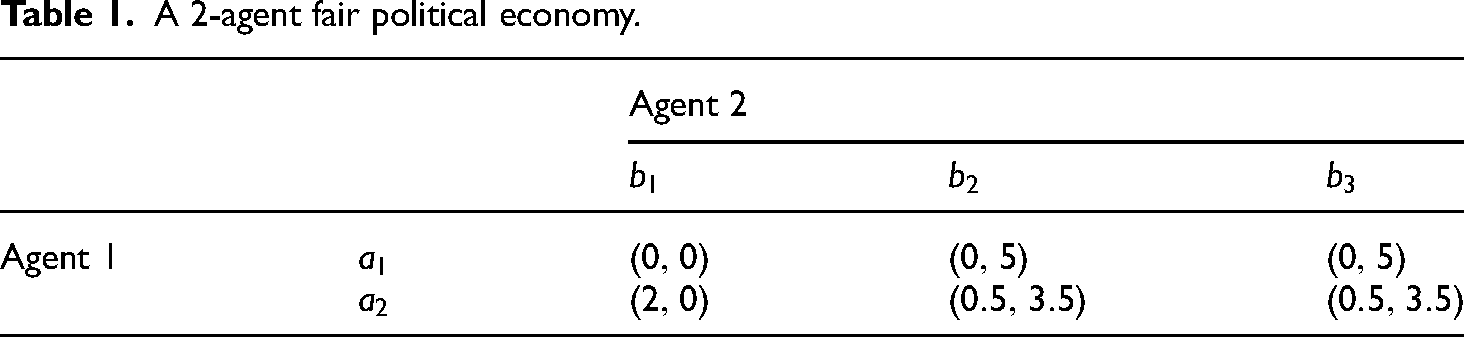
Consider a small political economy , where , , , , , is given by , and for each , is given in Table 1.
A 2-agent fair political economy.
Agent 2
Agent 1
For each of the six payoff vectors presented in Table 1, the first component represents agent 1’s payoff (e.g., ) and the second component represents agent 2’s payoff (e.g., ). We can check that for each , . Therefore, is a fair political economy.
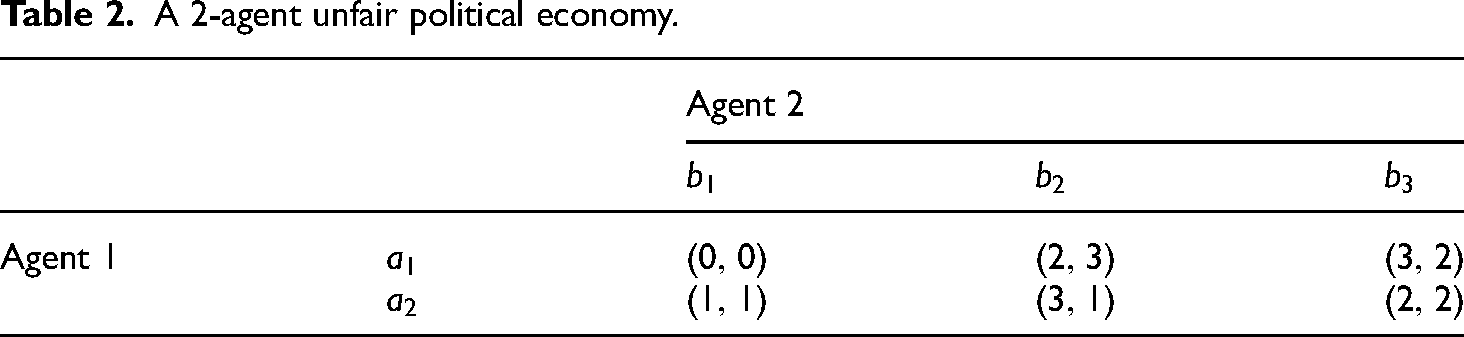
Now, we consider another political economy with the same characteristics as in except for the distribution scheme that is replaced by a new scheme described in Table 2. In addition to , we can show that the distribution violates the marginality axiom. Therefore, is not a fair political economy. We can observe that in the fair political economy described in Table 1, there are two pure strategy Nash equilibria (or self-enforcing contracts) (Nash, 1951), which are and . However, the modified political economy represented in Table 2 admits no self-enforcing contract. In Section 3, we will show that ALUM guarantees the existence of a self-enforcing contract in a political economy, and when a political economy violates these principles, such a contract may not exist.
A 2-agent unfair political economy.
Agent 2
Agent 1
Self-enforcing contracts in a fair political economy
In a fair political economy, agents make decisions that affect their payoff and the payoffs of other agents. One natural question that, therefore, arises is whether an equilibrium or a self-enforcing contract exists. In this section, we first show that a political economy can be modeled as a strategic form game and use pure strategy Nash equilibrium to capture incentives and rationality. We will show that a strategic game derived from a fair political economy always admits a self-enforcing contract.
A fair political economy as a strategic form game
A strategic form game is a 3-tuple , where is the set of players, is the strategy space, and is the payoff function. For each , is agent ’s payoff at strategy profile , for each . A strategic form game is considered finite if the set of agents is finite, and for each agent , the set of actions is also finite.
A strategy profile is a pure strategy Nash equilibrium in the game if and only if for all , , for all , where is the strategy profile in which agent chooses and every other agent chooses . A political economy generates a strategic form game , where for each and each , . We introduce the following definition.
Let be a political economy. A profile is a self-enforcing contract if and only if is a pure strategy Nash equilibrium in the strategic form game .
When is a fair political economy, it holds that for each outcome , since the distribution scheme satisfies local efficiency. For this reason, when is a fair political economy, we may refer to the production function as the total utility function of the strategic game .
Existence of a self-enforcing contract
We state the result of this section.
Any fair political economy admits a self-enforcing contract.
Although Theorem 1 is not our main finding, it is a fundamental existence result. We can prove this finding by showing that the game associated with any fair political economy admits a potential function (Monderer and Shapley, 1996). In this study, we propose a shorter proof that uses the concept of a cycle of deviations, which we introduce below.
Let be a strategic form game and be a list of outcomes, where each () is a pure strategy. The -tuple is a cycle of deviations if there exist agents such that for each , and .
To prove Theorem 1, we use the following result.
Let be a fair political economy, and the strategic form game generated by . Then, the sum of excess payoffs in any cycle of deviations in equals zero.
Lemma 1 states that in the strategic form game generated by a fair political economy, the sum of excess payoffs in any cycle of deviations equals zero.
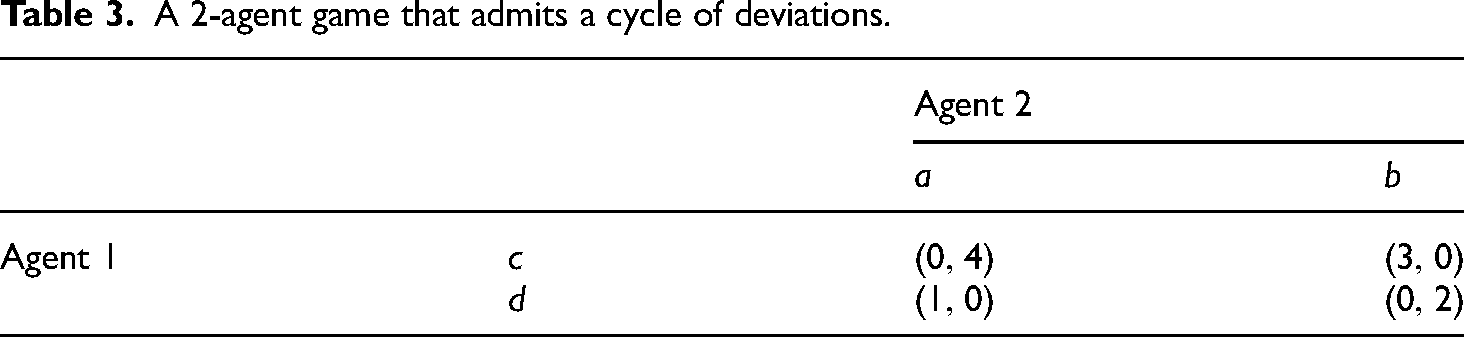
In the strategic form game represented in Table 3, consider the list , where , , , and .
A 2-agent game that admits a cycle of deviations.
Agent 2
Agent 1
forms a cycle of deviations. Indeed, Agent 1 has an incentive to deviate from to . By doing so, Agent 1 receives an excess payoff of . Similarly, Agent 2 receives an excess payoff of 2 by deviating from to . Agent 1 receives an excess payoff of 3 by deviating from to , and Agent 2 receives an excess payoff of 4 by deviating from to . The sum of excess payoffs in the cycle equals .
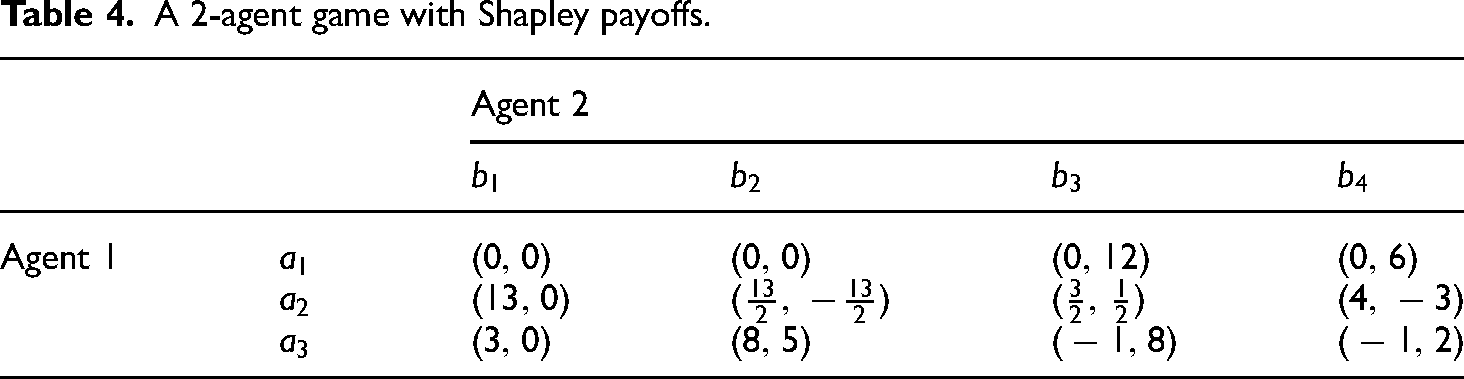
In the strategic form game in Table 4, the sum of excess payoffs in any cycle of outcomes equals zero. Therefore, the game described in Table 4 does not admit a cycle of deviations. The profile is the game’s only self-enforcing contract.
A 2-agent game with Shapley payoffs.
Agent 2
Agent 1
Note that the strategic form game in Table 4 is generated from a fair political economy. From Definition 7, a sufficient condition for a finite strategic form game to admit a pure strategy Nash equilibrium is the absence of a cycle of deviations. The sum of excess payoffs in any cycle of deviations has to be strictly positive, as illustrated in Table 3 in Example 2.15 Such an example of a cycle of deviations can not be constructed in a strategic form game generated from a fair political economy (see Table 4 in Example 2).
Efficiency of self-enforcing contracts in a fair political economy
In Section 3.2, Theorem 1 proves the existence of a self-enforcing contract in a fair political economy. However, some or all of these contracts may not be Pareto-efficient. For instance, consider the strategic form game described in Table 4 in Example 2. The game admits a unique self-enforcing contract with . But, the contract is Pareto-dominated by the strategy with . Below, we provide two conditions on the production function that address this issue. The first condition—weak monotonicity—guarantees the existence of a Pareto-efficient self-enforcing contract in a fair political economy, and the second condition—strict monotonicity—ensures that there is a unique self-enforcing contract and that this contract is Pareto-efficient. We also find that in an unfair political economy, these monotonicity conditions do not guarantee the existence of a Pareto-efficient self-enforcing contract. Before presenting these results, we need some definitions.
Let be a political economy. For agent , we denote by the set of all profiles of agents’ actions except agent .
An order defined on is semi-complete if for all and , the restriction of to the set is complete.
is:
weakly monotonic if there exists a semi-complete order on such that for any , if , then .
strictly monotonic if there exists a semi-complete order on such that for any , implies .
A fair political economy is weakly (resp. strictly) monotonic if is weakly (resp. strictly) monotonic.
We have the following result.
A weakly monotonic fair political economy admits a Pareto-efficient self-enforcing contract. If is strictly monotonic, the self-enforcing contract is unique and Pareto-efficient.
Theorem 2 ensures the uniqueness and Pareto-efficiency of the self-enforcing contract in a strictly monotonic fair political economy. The strategic form game described in Table 4 admits the profile as the only self-enforcing contract. However, is Pareto-dominated by the profile , which is not a self-enforcing contract. Such an undesirable result cannot arise in a strictly monotonic and fair political economy. In addition to providing a condition that guarantees the existence of a Pareto-efficient self-enforcing contract, Theorem 2 also provides a condition that rules out the multiplicity of such contracts in fair political economies.
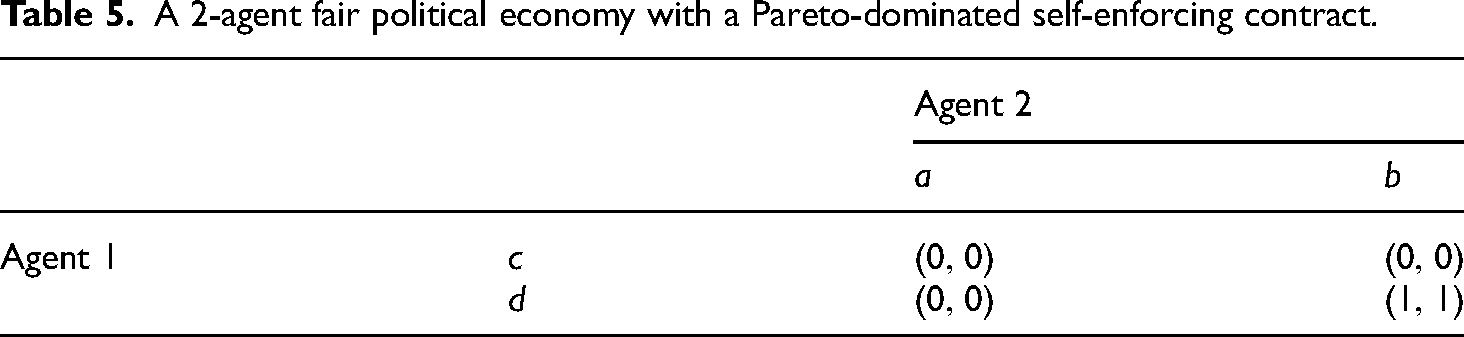
Theorem 2 shows that each weakly monotonic fair political economy admits a Pareto-efficient self-enforcing contract. Consider the strategic form game described in Table 5. Table 5 is derived from a fair political economy with the profile as the reference point. This political economy admits two self-enforcing contracts: outcomes and . The profile is Pareto-efficient and dominates the outcome .
A 2-agent fair political economy with a Pareto-dominated self-enforcing contract.
Agent 2
Agent 1
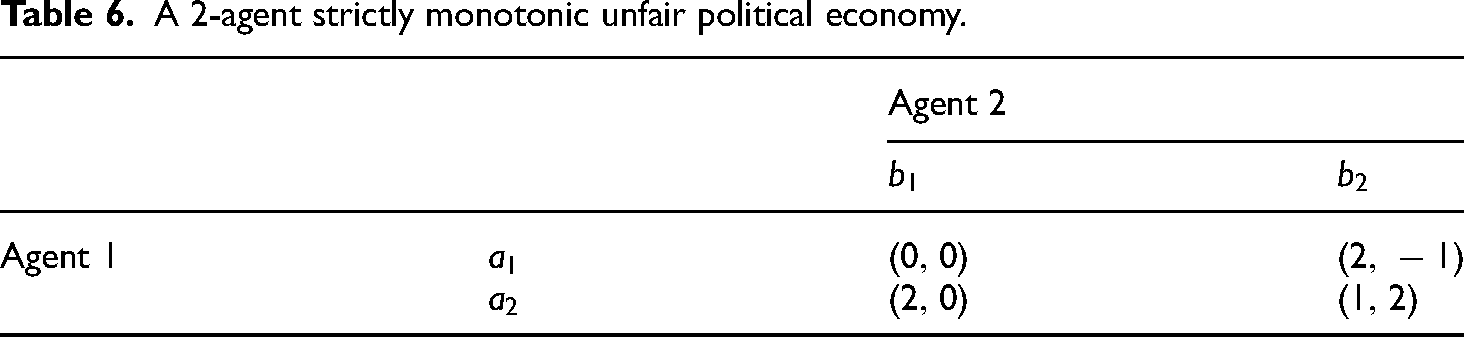
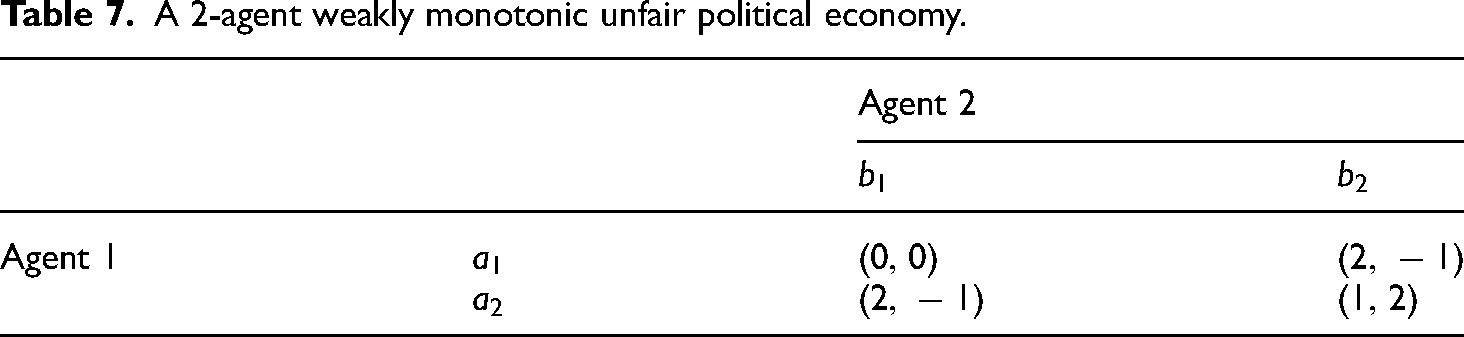
We relate the existence of a Pareto-dominated self-enforcing contract in the fair political economy described in Table 5 to the fact that the production function is weakly monotonic. However, it is essential to emphasize that a self-enforcing contract exists because the political economy is fair and not because of the monotonicity property of the technology. For instance, consider a political economy , where Agents 1 and 2 have strategies, , and , and the production function is given by: , , , and . Agents’ payoffs are described in Table 6. The environment describes a strictly monotonic and unfair political economy. Similarly, by replacing the production function by another function defined by: , , and , we obtain a weakly monotonic and unfair political economy with agents’ payoffs described in Table 7.
A 2-agent strictly monotonic unfair political economy.
Agent 2
Agent 1
A 2-agent weakly monotonic unfair political economy.
Agent 2
Agent 1
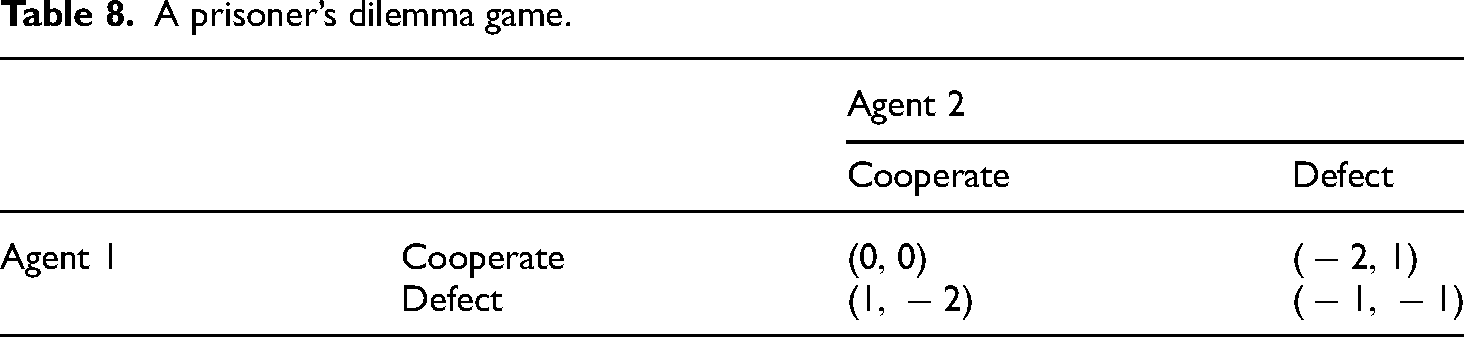
Note also that neither the strategic form game described in Table 6 nor the game described in Table 7 admits a pure strategy Nash equilibrium. This shows that the monotonicity conditions do not guarantee the existence of a self-enforcing contract in an unfair political economy, and even when a self-enforcing contract exists in such a political economy, it may be Pareto-inefficient. As an example, a political economy that is represented by a prisoner’s dilemma game is monotonic, but its unique self-enforcing contract is Pareto-inefficient (see the game described in Table 8; the unique self-enforcing contract (Defect, Defect) is Pareto-inefficient).
A prisoner’s dilemma game.
Agent 2
Cooperate
Defect
Agent 1
Cooperate
Defect
Inclusive political economies
Our conception of an inclusive political economy hinges upon a productive environment that values social justice and inclusion principles. These ethical considerations embody both the ideals of market justice and social inclusion. Members of a society generally have different abilities. Consequently, distribution schemes based on market justice (ALUM) alone will penalize individuals with fewer opportunities or those unable to develop productive organizational tasks. Social inclusion differs from market justice in that everyone should receive an essential worth for living. One allocation scheme consistent with this principle is the linear convex combination of the Shapley value (Shapley, 1953) and the equal split scheme. This convex allocation is also known as the egalitarian Shapley value (Joosten, 1996). Intuitively, this pay scheme can be viewed as implementing a progressive redistribution policy where a positive amount of the total surplus in a political economy is taxed and redistributed equally among all the agents. We will see that the existence and efficiency of self-enforcing contracts in inclusive political economies depends on the tax rate. First, we define the equal-split and an egalitarian Shapley value schemes.
Let be a political economy. The payoff function is an egalitarian Shapley value if there exists such that for all , and , , for all .
By , we denote the egalitarian Shapley scheme associated with a given . Note that is the equal-split distribution scheme, and is the Shapley payoff scheme.
Consider a simple case in which , , and two production functions and defined as follows: , , , , and . We can show that for any . However, for any , it holds that and . The latter shows that in addition to violating unproductivity, the mixing equal split and Shapley value violate marginality. It is direct that satisfies the principles of anonymity and local efficiency.16 The allocation scheme has a very natural interpretation. The parameter makes the reconciliation between marginalism and egalitarianism. Given an outcome , the technology produces the output . A share () of the latter is shared among agents according to their marginal contributions, while the remaining () is shared equally among the entire population; the fraction is the tax rate. Immediately, those who are more talented will still receive more under a given egalitarian Shapley value scheme. Indeed, consider a production function , and two agents and such that for . It is direct that for any , , since . Additionally, those who do not have the opportunity to contribute to their optimum scale will still be rewarded. Therefore, interpreting , one could say that higher values of represent more ‘fair-allocations’ (in terms of marginal contributions) as opposed to ‘equal’ (or inclusive) allocations.17
We have the following definition.
is an inclusive political economy if there exists such that . We call an -inclusive political economy.
Section 5.1 analyzes self-enforcing contracts and Pareto-efficiency in inclusive political economies. Our methodology is similar to the one followed in Sections 3 and 4. In Section 5.2, we prove that a political economy can always choose its reference point to induce efficient self-enforcing contracts, even when the political economy is not monotonic.
Self-enforcing contracts and efficiency in inclusive political economies
In what follows, we study the existence of equilibrium in an -inclusive political economy. As defined in Section 3.1, an inclusive political economy admits a self-enforcing contract if the strategic form game derived from that political economy possesses a pure strategy Nash equilibrium. A meritocratic manager will choose a higher when allocating resources since talents and merits have more value in such a political economy. An egalitarian manager will put a higher weight on equal distribution. A choice of reveals a tradeoff between market justice (or marginalism) and egalitarianism. We show that there exists a self-enforcing contract irrespective of the size of . Theorem 3 follows.
Any -inclusive political economy admits a self-enforcing contract.
The following lemma is immediate.
Let be an -inclusive political economy. Assume that only takes non-negative values. Then, each agent receives a non-negative payoff at any self-enforcing contract.
The intuition behind Lemma 2 is straightforward. Assuming that at a given outcome , is non-negative, then for all , agent ’s payoff is non-negative if instead of choosing , the agent chooses the reference point . Next, we provide a condition under which an inclusive political economy admits a Pareto-efficient self-enforcing contract. The following result is deduced from Theorem 2.
A weakly monotonic -inclusive political economy admits a Pareto-efficient self-enforcing contract. If is strictly monotonic, the self-enforcing contract is unique and Pareto-efficient.
The proof of Corollary 1 is similar to that of Theorem 2. Next, we provide another result about the Pareto-efficiency of self-enforcing contracts in inclusive political economies. Before stating Theorem 4, we introduce the following definition.
Let be an -inclusive political economy. An optimal outcome is any outcome at which is maximized.
There exists such that for all , the -inclusive political economy admits a Pareto-efficient self-enforcing contract.
Theorem 4 implies that social inclusion and efficiency are compatible. All self-enforcing contracts can be Pareto-dominated in a non-inclusive political economy. Self-enforcing Pareto-efficient contracts exist when production functions satisfy a weak-monotonicity condition thanks to Corollary 1. Absent monotonicity, Theorem 4 provides a lower bound on (or an upper bound on the tax rate ) that guarantees the existence of a self-enforcing contract that is Pareto-efficient. Indeed, the set of Pareto-efficient contracts includes optimal outcomes. We illustrate an inclusive political economy in Example 3.
(Taxation and Social Inclusion)
Consider a small political economy involving three agents, , who live in three districts in a local city. One can assume that each agent is the representative of each district. Agents face different occupational choices. Agent 1 can decide to stay unemployed (strategy ‘’), work in a middle-class job (strategy ‘’) that provides an annual salary of $188,000, or accumulate experience to land a higher skilled job (strategy ‘’) that pays an annual salary of $200,000. Agent 2 can only choose between strategies ‘’ and ‘’. For many reasons, including health concerns, Agent 3 does not have the opportunities available to other agents; they cannot work and are therefore considered unemployed. The economy uses marginal tax rates to determine the income tax each agent must pay to the tax collector. The aggregate annual fiscal revenue function depends on agents’ strategies: , , , , , and .18 With the tax revenue collected, the economy provides public goods. However, the type of public investment received by an agent’s district depends on the agent’s marginal contribution to the aggregate annual fiscal revenue.
Using the Shapley scheme in the distribution of public investments yields the outcome as the unique self-enforcing contract in this fair political economy. In this contract, the district of Agent 1 receives a public good that is worth $45,015.5, Agent 2’s district receives a public investment of $41.175.5, and Agent 3’s district receives nothing. If the egalitarian Shapley scheme is used instead to redistribute the fiscal revenue, then is still the unique self-enforcing contract in this inclusive political economy. In that case, the outcome is still Pareto-efficient, and the ranking of investment size across districts does not change. Agent 3’s district receives a public investment of $5,746, Agent 2’s district receives $38,686.5, and Agent 1’s district receives $41,758.5. Although the allocation might not be the ‘best’ contract for some people living in the city, it is a significant improvement (at least for Agent 3’s district) from the market allocation .19
Choosing a reference point to induce efficient self-enforcing contracts
So far, we have assumed that the reference point is exogenously determined and that in a political economy, the surplus function is such that . This latter point is just a simplifying normalization. We have also shown that in a fair political economy, all self-enforcing contracts may be Pareto-inefficient, especially in the absence of monotonicity. Similarly, a Pareto-efficient self-enforcing contract may not exist if the tax rate () is too small in an -inclusive political economy. This section shows that we can induce efficient self-enforcing contracts simply by changing the reference point of any fair or inclusive political economy.
Without loss of generality, we assume that is strictly positive and modify the Shapley distribution scheme such that for , and , agent ’s payoff at , denoted , is given by
Let us denote by , the set of production functions that hold positive real value at the reference point. Our following result says that any optimal outcome can be achieved via a self-enforcing contract profile in any -inclusive political economy endowed with the distribution scheme , where and .
For any -inclusive political economy , there exists another reference outcome such that the -inclusive political economy admits an optimal self-enforcing contract.
Remark that this result holds for any value of , including for , which corresponds to a situation where the tax rate is zero. In that case, the entire surplus of the political economy is distributed following the Shapley pay scheme. The analysis implies that if a political economy can choose its reference point, it can always do so to induce equilibrium efficiency. Below, we provide an application for self-enforcing alliances in a networked political economy.
An Application: Rent-seeking alliances
We provide an application to self-enforcing political alliances in an economy facing the threat of misinformation (e.g., fake news). We illustrate how the costs of such misinformation can affect political parties’ decisions to form and sever bilateral political alliances. Consider a political economy involving political parties who non-cooperatively form and sever bilateral links according to their preferences (or ideologies). Political parties’ choices lead to a network of bilateral alliances that generate a revenue called rent.20 We examine parties’ decisions to form links in response to the threat of random misinformation that may hit the political economy. As the misinformation spreads in the political economy, will some parties consolidate or sever existing alliances? How does the self-enforcing political alliance structure depend on the cost of misinformation?21
To illustrate these concepts and answer the above questions, we consider a political economy involving a finite set of political parties . All parties simultaneously announce the alliances or links they wish to form. For every party , the set of strategies is an -tuple of 0 and 1, . Let be an element in . Let denote the th coordinate of . Then, if and only if chooses a direct alliance with , or (and thus , otherwise). We assume that political alliance requires mutual consent; a link is formed in a network if . We denote . An outcome yields a unique network . However, a network can be formed from multiple outcomes. We denote the reference outcome, and the empty network. It follows that the networked political economy can be represented by a political economy , where is the production function and is the payoff function (see below).
Assume that rationality is captured by pairwise-Nash equilibrium as defined by Calvó-Armengol (2004). The concept of pairwise-Nash equilibrium refines Nash equilibrium, building upon the pairwise stability concept by Jackson and Wolinsky (1996). Pairwise equilibrium networks are such that no political party gains by reshaping the current configuration of political alliances, neither by adding a new alliance nor by severing any subset of the existing alliances. Let be a network and a link. We let denote the network found by adding the alliance to , and denote the network obtained by deleting the alliance from . Formally, is a pairwise-Nash equilibrium network if and only if there exists a Nash equilibrium outcome that supports , that is, , and for all , implies .
The contagion function is the contagion potential of a network (Pongou, 2010). To define this function, we consider a network that has components, where a component is a maximal set of agents who are directly or indirectly connected in ; and is the number of political parties in the th component . Pongou (2010) shows that if a random political party receives misinformation, and if that party passes this information to their allies who also misinform their other allies, and so on, the contagion potential of gives the fraction of misinformed parties, which is . However, in a network , each political party is exogenously misinformed with probability , and assuming that political parties are not responsible for exogenous misinformation, the part of contagion for which political parties are collectively responsible in is . We assume that the misinformation is costly to manage. Therefore, measures implemented to fight this issue yield economic and political costs. To assess these costs, we assume that the collective contagion function generates a misinformation cost function so that, for each network : , being a well-defined function. The formation of a network generates a rent to the political economy. Given the cost function, , the net value or economic surplus of a network is .
We examine each political party’s behavior in forming or severing bilateral alliances as misinformation spreads in the political economy. Let be a network and be a set of political parties. We denote by the restriction of the network to . This restriction is obtained by severing all the political alliances involving parties in . Also, let be a political party. We denote by the network obtained from by connecting to all the parties in to whom is connected in the network .
The structure of the networked political economy provides a natural setting for the use of the Shapley distribution scheme. In an environment where marginal contributions are the only inputs that matter in the political economy, we can expect that a political party that adds no value to any network configuration receives no payoff. Along this line, it is natural that a more productive political party in the political economy receives a payoff more significant than that of less productive ones. Assuming that the output from individual contributions is entirely shared among political parties, it becomes natural to consider that party ’s payoff in a network is given by the Shapley payoff scheme (1):
where . The networked political economy describes a fair political economy. In the political economy, self-enforcing political alliance structures are equivalent to pairwise-Nash equilibrium networks. We have the following result.
Self-enforcing political alliance structures exist.
Proposition 2 partly follows from Theorem 1, but they differ in that the notion of pairwise-Nash equilibrium refines the Nash equilibrium. The proof of Proposition 2 is deduced from the demonstration of Theorem 1. Below, we illustrate our application.
Illustration
Let . Assume the set of a political party ’s direct political alliances in a network is , of size . The size of is . Note that if is the empty network (). We assume that for each network :
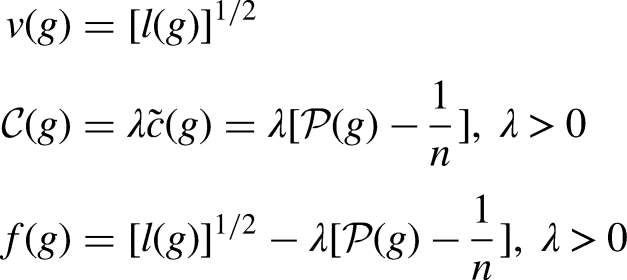
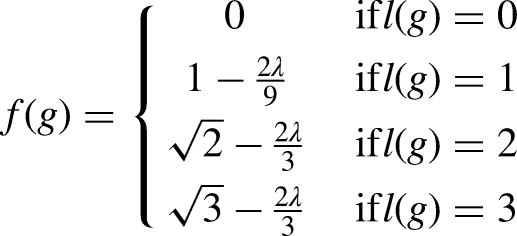
We can rewrite as follows (note that :
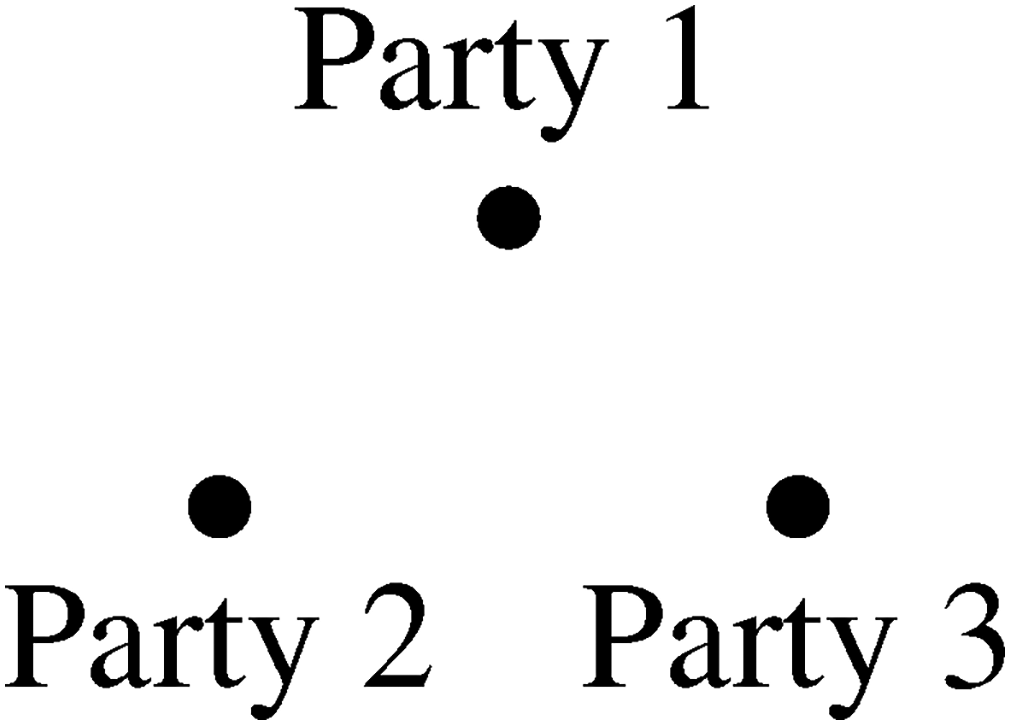
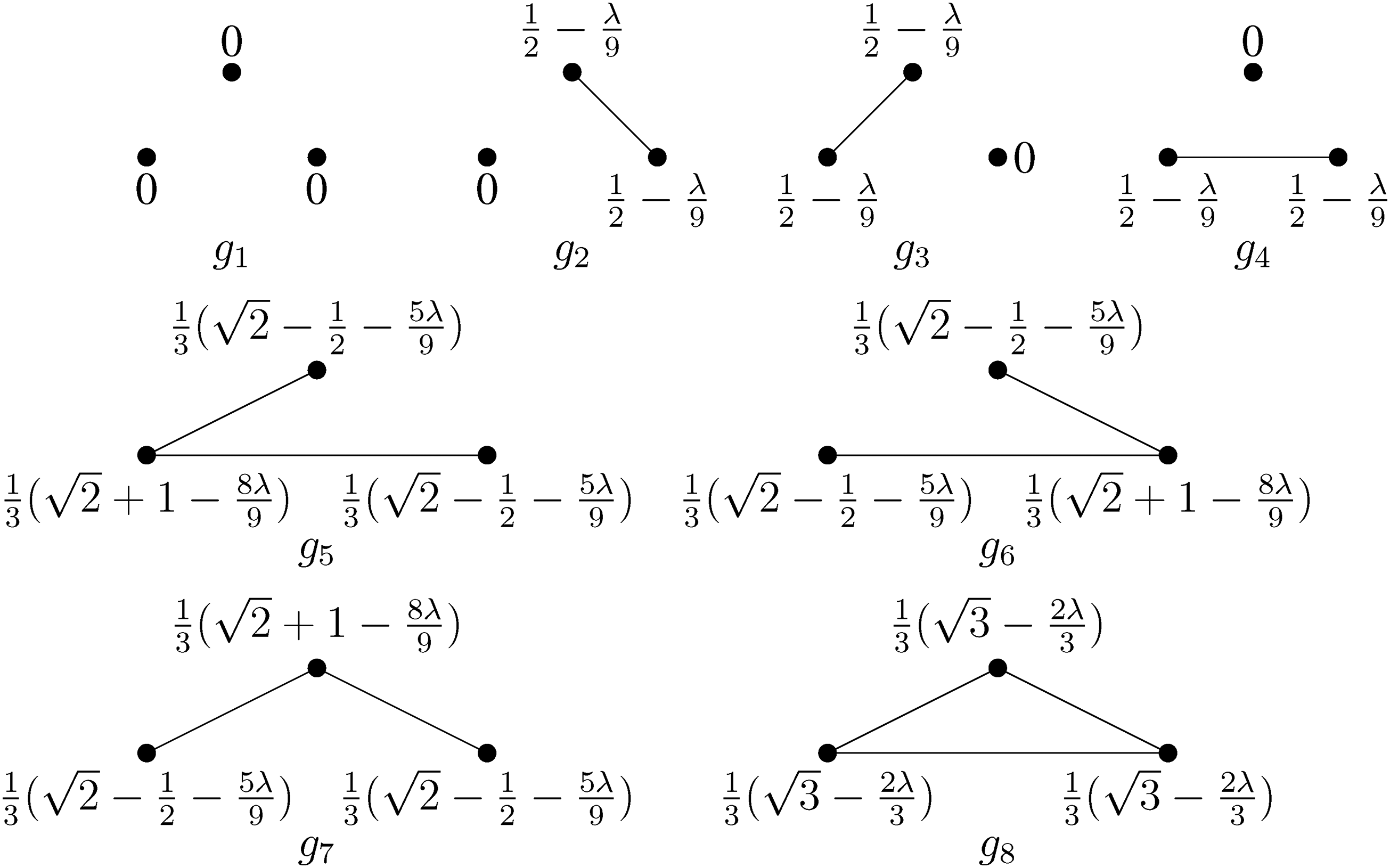
Given that we only have three political parties in the model, we can fully represent the networks in . The parties are labeled as described in Figure 1. Figure 2 displays the different network configurations in . Each network gives each political party’s payoff next to the corresponding node. The pairwise stability concept facilitates the search for self-enforcing political alliance structures.
Political parties.
Possible pairwise-Nash political alliances.
We denote by the complete network. The following result shows how the parameter affects the configuration of emerging alliances.
The following hold. If:
, is the only self-enforcing political alliance structure.
, is a self-enforcing political alliance structure if and only if .
, is a self-enforcing political alliance structure if and only if .
, the empty network, , is the only self-enforcing political alliance structure.
The proof of Proposition 3 results immediately from the definition of pairwise-Nash equilibrium. Proposition 3 shows that misinformation costs affect political parties’ decisions to form alliances. The parameter summarizes the adverse effects of misinformation in the political economy. When there is no misinformation outbreak, or the misinformation costs are very low (lower values of ), each political party gains by keeping bilateral political alliances with others. In that situation, the complete network emerges as the unique self-enforcing political alliance structure in the political economy; no party is incentivized to self-isolate. However, political parties respond by severing some alliances as the costs of misinformation rise. For intermediate values of (), only networks with one alliance will be sustained at equilibrium. This means that some parties find it rational to partially or fully self-isolate to reduce the cost of misinformation. In the extreme case, where misinformation costs are very high (), a complete polarization arises, and the empty network is the only self-enforcing political alliance configuration. Interestingly, the value of depends on the nature of the misinformation. The latter causes different severity levels, inducing different self-enforcing political alliance configurations. Therefore, the network structures in Figure 2 can be interpreted as the self-enforcing political alliance configurations that will arise in response to the nature of the misinformation in the political economy.
Conclusion
In this study, we examine how elementary principles of justice and ethics, of a long tradition in economic theory, affect individual incentives in a political economy and determine the existence and efficiency of self-enforcing contracts. To formalize this problem, we introduce a model of a fair political economy, in which each agent non-cooperatively chooses their input from a finite set, and the surplus generated by these choices is distributed following four ideals of market justice, which are anonymity, local efficiency, unproductivity, and marginality. We show that these ideals guarantee the existence of a self-enforcing contract. However, such a contract does not need to be unique or Pareto-efficient. We uncover an intuitive condition—strict technological monotonicity—, which guarantees equilibrium uniqueness and efficiency. Interestingly, this condition does not ensure equilibrium efficiency (or even the existence of a self-enforcing contract) when ideals of market justice are violated in a political economy. Therefore, our findings suggest that the ideals of justice we analyze and a natural assumption on the technological environment lead to positive incentives, given their desirable equilibrium and Pareto-efficiency properties.
We extend our analysis to inclusive political economies, where inclusion is implemented through progressive taxation and redistribution, ensuring a basic income to unproductive agents. In this more general setting, we generalize all of our findings. Additionally, we examine how the tax policy affects Pareto efficiency. We find that a tax rate threshold guarantees a Pareto-efficient equilibrium, even without technological monotonicity. Therefore, while any self-enforcing contract may be inefficient in the absence of redistribution, a minimal level of redistribution guarantees the existence of a Pareto-efficient self-enforcing contract. Thus, inclusion and efficiency are compatible notions. Our analysis also reveals that if a political economy can choose its reference point, it can always do so to induce an efficient self-enforcing outcome, even if this political economy is not monotonic.
Finally, by incorporating normative principles into non-cooperative game theory, we define a new class of finite strategic form games that always admit a pure strategy Nash equilibrium. We develop an application for self-enforcing political alliances in a networked political economy facing misinformation.
Footnotes
Acknowledgements
We thank Editors John Patty and Torun Dewan and two anonymous referees for their constructive comments on an earlier version of this paper. We thank Ghislain Junior Sidie for valuable research assistance and seminar participants at various conferences and workshops for helpful comments and suggestions.
Declaration of conflicting interests
The author(s) declared no potential conflicts of interest with respect to the research, authorship, and/ or publication of this article.
Funding
The author(s) received no financial support for the research, authorship, and/or publication of this article.
ORCID iD
Jean-Baptiste Tondji
Appendix
Notes
References
1.
AguiarVPongouRTondjiJB (2018) A non-parametric approach to testing the axioms of the Shapley value with limited data. Games and Economic Behavior111: 41–63.
2.
AguiarVHPongouRSerranoR, et al. (2020) An index of unfairness. In: Handbook of the Shapley Value (Algaba et al., Eds.). CRC Press.
3.
AlgabaEFragnelliVSánchez-SorianoJ (eds) (2019) Handbook of the Shapley Value. 1st ed.Boca Raton: Chapman and Hall/CRC. https://doi.org/10.1201/9781351241410
4.
AtheyS (2001) Single crossing properties and the existence of pure strategy equilibria in games of incomplete information. Econometrica69(4): 861–889.
5.
BapujiHErtugGShawJD (2020) Organizations and societal economic inequality: A review and way forward. Academy of Management Annals14(1): 60–91.
6.
BergantinosGMoreno-TerneroJD (2020) Sharing the revenues from broadcasting sport events. Management Science66(6): 2417–2431.
7.
BertrandMMullainathanS (2004) Are Emily and Greg more employable than Lakisha and Jamal? A field experiment on labor market discrimination. American Economic Review94(4): 991–1013.
Calvó-ArmengolA (2004) Job contact networks. Journal of Economic Theory115(1): 191–206.
10.
CappelenAWMollerstromJRemeBA, et al. (2022) A meritocratic origin of egalitarian behavior. The Economic Journal132(646): 2101–2117.
11.
Carbonell-NicolauO (2011) On the existence of pure-strategy perfect equilibrium in discontinuous games. Games and Economic Behavior71(1): 23–48.
12.
CarmonaGPodczeckK (2020) Pure strategy Nash equilibria of large finite-player games and their relationship to non-atomic games. Journal of Economic Theory105015.
13.
ChoudhuryDBorkotokeySKumarR, et al. (2021) The egalitarian Shapley value: A generalization based on coalition sizes. Annals of Operations Research301(1): 55–63.
14.
DasguptaPMaskinE (1986) The existence of equilibrium in discontinuous economic games, I: Theory. The Review of Economic Studies53(1): 1–26.
15.
DavidHDugganMG (2006) The growth in the social security disability rolls: A fiscal crisis unfolding. Journal of Economic Perspectives20(3): 71–96.
16.
DebreuG (1952) A social equilibrium existence theorem. Proceedings of the National Academy of Sciences38(10): 886–893.
17.
GaleD (1953) A theory of n-person games with perfect information. Proceedings of the National Academy of Sciences of the United States of America39(6): 496.
18.
GlicksbergIL (1952) A further generalization of the Kakutani fixed point theorem, with application to Nash equilibrium points. Proceedings of the American Mathematical Society3(1): 170–174.
19.
GoldinCKerrSPOlivettiC, et al. (2017) The expanding gender earnings gap: Evidence from the LEHD-2000 Census. American Economic Review107(5): 110–14.
20.
HannaROlkenBA (2018) Universal basic incomes versus targeted transfers: Anti-poverty programs in developing countries. Journal of Economic Perspectives32(4): 201–26.
21.
HartSMas-ColellA (1989) Potential, value, and consistency. Econometrica0: 589–614.
22.
HolmstromB (1982) Moral hazard in teams. The Bell Journal of Economics0: 324–340.
23.
HoltCARothAE (2004) The Nash equilibrium: A perspective. Proceedings of the National Academy of Sciences101(12): 3999–4002.
24.
HylandMDjankovSGoldbergPK (2020) Gendered laws and women in the workforce. American Economic Review: Insights2(4): 475–490.
25.
JacksonMOWolinskyA (1996) A strategic model of social and economic networks. Journal of Economic Theory71(1): 44–74.
26.
JoostenRAMG (1996) Dynamics, equilibria, and values. PhD Thesis, Maastricht University.
27.
KhanMASunY (1995) Pure strategies in games with private information. Journal of Mathematical Economics24(7): 633–653.
28.
KleinbergJLudwigJMullainathanS, et al. (2018) Algorithmic fairness. In: AEA Papers and Proceedings, volume 108. American Economic Association 2014 Broadway, Suite 305, Nashville, TN 37203, pp. 22–27.
29.
KoffiM (2021) Gendered citations at top economic journals. AEA Papers and Proceedings111: 60–64.
30.
KoffiMWantchekonL (2023) Racial justice from within? Diversity and inclusion in economics. Econometric Society World Congress Monograph, Forthcoming.
31.
MallickI (2011) On the existence of pure strategy Nash equilibria in two person discrete games. Economics Letters111(2): 144–146.
32.
Mas-ColellA (1984) On a theorem of Schmeidler. Journal of Mathematical Economics13(3): 201–206.
33.
MondererDShapleyLS (1996) Potential games. Games and Economic Behavior14(1): 124–143.
34.
NashJ (1951) Non-cooperative games. Annals of Mathematics286–295.