




Abstract
States create customs unions to accrue consumer welfare gains. Given the incentives to cheat to protect domestic firms from foreign competition, they create regulatory regimes with international courts to manage noncompliance. I develop a formal model that explains how the politics of compliance in regulatory regimes systematically distorts the welfare gains that states accrue from developing customs unions. The model predicts that regulatory regimes are most effective at enforcing compliance (i.e., at reducing trade barriers) in industries with intermediate levels of firm homogeneity in terms of productivity. In highly homogenous industries, regulatory regimes are not effective because noncompliance is minimal enough that litigation is not cost-effective; in highly heterogenous industries, regulatory regimes are not effective because courts, concerned about noncompliance with their rulings, are unlikely to rule against the defendants, deterring the plaintiffs from bringing cases. The model also predicts the downstream consequences for the performance of individual firms and consumer welfare.
States create customs unions—a form of economic integration in which a regional trade bloc eliminates discriminatory internal trade barriers—to improve consumer welfare. 1 Customs unions are critical in the modern global economy. Both the United States and the European Union (EU)—the two largest economies in the world—are customs unions. 2 Like trade agreements, customs unions improve consumer welfare by altering the composition of the economy: productive, exporting firms gain market share at the expense of unproductive, import-completing firms, causing prices to drop, and improving consumer welfare (Melitz, 2003; Chaney, 2008). 3 However, governments also have short-term political incentives to cheat by imposing discriminatory trade barriers that protect those unproductive, import-completing firms from foreign competition, thereby reducing the negative impact of the customs union on their profitability. Given these incentives to cheat, under what conditions do customs unions actually generate the intended welfare gains?
In this paper, I argue that customs unions can generate welfare gains, but because of the politics of the regulatory regimes that states establish to enforce them, how well they actually work in practice varies by industry. The primary contribution of this paper is to identify the characteristics of the industries in which these regulatory regimes are most effective at enforcing the rules of customs unions, as these will be the industries in which customs unions are most effective at generating welfare gains for their member states—the reason they are created. Contemporary models of trade in economics (e.g., Melitz, 2003; Chaney, 2008) imply that customs unions should be most welfare-enhancing in industries where firms are highly heterogeneous in terms of their productivity (there is more price competition, creating incentives for governments to protect domestic firms from foreign competition). 4 In contrast, the main finding of my analysis is that, because of the politics of noncompliance, customs unions generate the largest welfare gains in industries with intermediate levels of heterogeneity in terms of firm productivity.
This finding builds on several insights from the recent literature on international institutions and noncompliance. Aware of the incentives to protect unproductive domestic firms, governments create regulatory regimes by empowering courts—like the United States Supreme Court (USSC) and the Court of Justice of the European Union (CJEU)—to adjudicate disputes in which a member state government is accused of violating the rules of the customs union. This will only improve welfare gains (by improving compliance with the rules of the customs union) when (a) private plaintiffs or prosecutors (like the Justice Department in the US and the Commission in the EU) are willing to bring cases against noncompliant member states and (b) courts are willing to rule against those member states. However, recent research shows that courts care about noncompliance with their rulings, and are therefore hesitant to rule against defendants when it is costly for the defendant to come into compliance (Carrubba and Gabel, 2015). Research also shows that prosecutors, anticipating this strategic behavior, only bring cases they expect to win (König and Mäder, 2014; Fjelstul and Carrubba, 2018).
In highly heterogeneous industries, where the potential welfare gains of a customs union are greatest (allowing in foreign firms by lowering trade barriers will reduce consumer prices), governments have the strongest incentives to protect unproductive, import-competing firms. These are the industries in which courts are needed to prevent cheating. However, in these industries, courts will be more hesitant to rule against noncompliant defendants, who could ignore the ruling due to short-term political incentives to protect unproductive domestic firms. Anticipating this strategic behavior, plaintiffs are deterred from bringing cases, and noncompliance goes uncorrected. In short, when the potential gains are greatest, the politics are most pernicious. In highly homogeneous industries, courts are also ineffective at reducing noncompliance, as noncompliance is minimal enough that litigation is not cost-effective. Thus, customs unions generate the largest welfare gains in industries with intermediate levels of firm homogeneity. Existing trade theories that do not explicitly account for the politics of noncompliance will incorrectly predict that customs unions will generate the largest welfare gains in highly heterogeneous industries.
To identify the characteristics of the industries in which customs unions improve consumer welfare, given the politics of noncompliance, I embed a model of international trade (with firms and consumers) in a model of compliance (with a government, a plaintiff, and a court). I do this by micro-founding the costs of compliance for the government in the compliance model in the economy of the trade model. This allows the costs of compliance to be a function of the distributive consequences of trade liberalization. I model the government as having politically motivated preferences over economic outcomes in the trade model. The trade barriers it chooses directly affect those outcomes.
In addition to predicting the characteristics of the industries in which a custom union will generate the intended welfare gains, my model also predicts the downstream consequences for individual firms. Since courts are most effective at enforcing the rules of customs unions in industries with intermediate levels of firm homogeneity, these are also the industries in which the magnitude of the impact of a customs union on the performance of individual firms is the largest. I identify which firms are most helped and hurt.
In sum, this paper contributes to the literature on trade liberalization by developing a theoretical account of how the politics of noncompliance affects the ability of states to generate welfare gains from a customs union. The model predicts the characteristics of industries—those with intermediate levels of heterogeneity in terms of firm productivity—in which regulatory regimes will be most effective at enforcing compliance and in which customs unions will generate the largest welfare gains. It also predicts the downstream consequences for the performance of individual firms.
International regulatory regimes
Noncompliance with the rules of customs unions (i.e., the imposition of trade barriers) is very common, even in the EU (König and Mäder, 2014). To manage noncompliance, states rationally design international regulatory regimes to adjudicate disputes over compliance with the rules of the customs union (Koremenos et al., 2001; Carrubba and Gabel, 2015). States create bureaucracies to monitor and prosecute member state noncompliance and international courts to adjudicate disputes over noncompliance. (In some regimes, private actors can also bring noncompliance cases.) Once states create courts, there are two aspects to compliance. There is initial compliance with the rules of the regime (ex ante compliance), and there is compliance with the rulings of courts in noncompliance cases (ex post compliance). There is no guarantee that member states will respect adverse court rulings (Garrett et al., 1998; Alter, 2000; Conant, 2002; Slepcevic, 2009; Panke, 2010; Carrubba and Gabel, 2015).
Member state governments, plaintiffs, and courts all operate strategically within the formal procedures of regulatory regimes. This produces a political process in which regulatory regimes successfully prevent or correct some violations, but permit others (Carrubba and Gabel, 2015). Moreover, the politics of noncompliance generates systematic bias in the types of noncompliance cases that actually make it to court. Existing literature on compliance provides some general intuition about when noncompliance should get litigated: it depends on governments’ costs of compliance (e.g., Carrubba and Gabel, 2015).
Courts are concerned with ex post compliance with their rulings, and are therefore less likely to rule against governments when the costs of compliance are high (Alter, 2000; Pollack, 2003; Vanberg, 2005; Carrubba, 2005; Carrubba et al., 2008; Carrubba, 2009; Gilligan et al., 2010; Carrubba et al., 2012; Johns, 2012; Carrubba and Gabel, 2015; Martinsen, 2015; Larsson and Naurin, 2016). Plaintiffs anticipate this behavior and drop cases when they are unlikely to win. The literature on international bureaucracies, like the European Commission, has long suspected that institutional plaintiffs strategically choose which noncompliance cases to pursue (Mbaye, 2001; Börzel, 2003; Thomson et al., 2007; Hartlapp and Falkner, 2009; Steunenberg and Rhinard, 2010). The most recent literature finds empirical evidence that the Commission drops cases when the costs of compliance are high (König and Mäder, 2014; Fjelstul and Carrubba, 2018). The key takeaway is that the politics of noncompliance leads to uneven enforcement outcomes, and that this variation is not random.
Since this bias in which cases are litigated is driven by the costs of compliance, we should expect the value of a regulatory regime to depend on the character of those costs. But without a theoretical model that explains where the costs of compliance come from, we cannot characterize how this bias will affect the ability of the regime to facilitate deep cooperation—the degree to which an international agreement causes states to behave differently than they would have otherwise (Downs et al., 1996). 5 In this paper, I provide a theoretical account of where those costs come from and show how the politics of noncompliance leads to a systematic bias in the welfare gains that states expect to enjoy by creating customs unions.
Formal model
I develop my formal model in three steps. I start with a two-country open economy based on Melitz (2003), which is the starting point for most new-new trade theory (NNTT) models (Chaney, 2008; Demidova and Rodríguez-Clare, 2009; Melitz and Redding, 2014; but not Melitz and Ottaviano, 2008). This is a simplified version of a NNTT model that preserves the basic equilibrium behavior, but leaves out some machinery that is not critical to my theoretical story.
Second, I add a policy-making subgame at the start of the game in which the government of one of the countries, which I call the home country, can choose trade barriers, holding the trade barriers of the other country constant. This is one of the first studies that explores how a strategic government with political preferences would choose trade barriers in a NNTT framework. This model serves as a counterfactual—it identifies the trade barriers that a government would choose in the absence of a regulatory regime.
Third, I add a regulatory regime by adding a litigation subgame between the policy-making subgame and the economy subgame. After the home government chooses trade barriers, a plaintiff can bring a noncompliance case against the government. A reduced-form strategic court adjudicates the case. I calculate comparative statics to identify the characteristics of the industries in which a regulatory regime will be most effective at reducing trade barriers relative to the counterfactual. Then, I identify the downstream effects on firm performance and consumer welfare.
I micro-found the costs of compliance for the government of the home country, which allows the compliance decision of the government (i.e., the trade barriers it chooses) to depend on how trade liberalization impacts the performance domestic firms and the welfare of consumers, which governments care about (like Rosendorff, 2005; but unlike Carrubba and Gabel, 2015; Johns, 2012). Existing models of trade in economics almost always treat trade barriers as exogenous (Melitz, 2003; Chaney, 2008; an exception is Demidova and Rodríguez-Clare, 2009), but I allow the home government to choose optimal trade barriers. Unlike optimal tariff models from economics, the government is not a social planer or a welfare-maximizer (e.g., Demidova and Rodríguez-Clare, 2009). It has competing, politically motivated preferences: it cares about the performance of import-competing domestic firms (due to lobbying) and consumer welfare (due to electoral incentives), both of which depend on the trade barriers that are ultimately implemented after any litigation.
I base the economy on NNTT models (i.e., Melitz, 2003; Chaney, 2008; Melitz and Redding, 2014), which more accurately captures the process by which firms select into exporting—a firm’s productivity determines whether exporting is profitable—than classical models (Heckscher-Ohlin and Ricardo-Viner) or new trade theory (NTT) models (Krugman, 1980). Unlike these other trade theories, NNTT correctly predicts that only the most productive firms export. Firm selection into exporting affects prices, which affects consumer welfare. Since my goal is to identify how the politics of noncompliance distorts the distributive consequences of trade liberalization (i.e., firm profits and consumer welfare gains), it is important to model firm selection appropriately.
An open regional economy
I start by modeling a single-industry open economy with two countries: a home country
There is a mass of firms in each country
In the model, all firms choose whether to produce for their own domestic market and whether to export to the other country. Conditional on serving a market, each firm chooses a price to charge. Then, the representative consumer in each country observes the available varieties and chooses a quantity of each variety to purchase.
Demand: Consumer preferences
The representative consumers have constant elasticity of substitution (CES) preferences (Dixit and Stiglitz, 1977). This is the standard approach to modeling consumers in NTT and NNTT models (Krugman, 1980; Melitz, 2003; Chaney, 2008; but not Melitz and Ottaviano, 2008). Each consumer demands at least some of each available variety.
9
In this sense, they have a love for variety. Their income limits the quantity of available varieties they can buy. The utility of the consumer in destination country

CES preferences introduce monopolistic competition. Under monopolistic competition, firms perceive competition from other firms, but pricing is not a strategic game between firms (unlike oligopolistic competition). Firms also have market power, which means that a firm can change consumer demand for its variety by changing the price that it charges. In equilibrium, firms can make a profit in the short run (unlike the perfect competition, where firms do not make a profit). Thus, using CES preferences will allow me to study how regulatory regimes will impact firm performance.
Firms care about net profit. The net profit that a firm with productivity

Firms pay additional variable costs when exporting due to trade barriers. Substantively, trade barriers include tariffs (i.e., taxes on imports) and non-tariff barriers that have an equivalent effect, like product standards that de facto discriminate against foreign firms. Destination country
I assume that firm productivity in each country is Pareto distributed (e.g., Chaney, 2008). The empirical literature in economics finds that firm productivity is approximately Pareto distributed (Axtell, 2001; Luttmer, 2007; Helpman et al., 2004; Gabaix, 2009), so this is a realistic assumption. The probability density function (PDF) and the cumulative distribution function (CDF) for the Pareto distribution are, respectively:

Proposition 1 summarizes equilibrium behavior in the economy.
13
Although the setup of the model is slightly different from canonical NNTT models (e.g., Melitz, 2003; Chaney, 2008), to reduce complexity, equilibrium behavior is similar. Firms in country
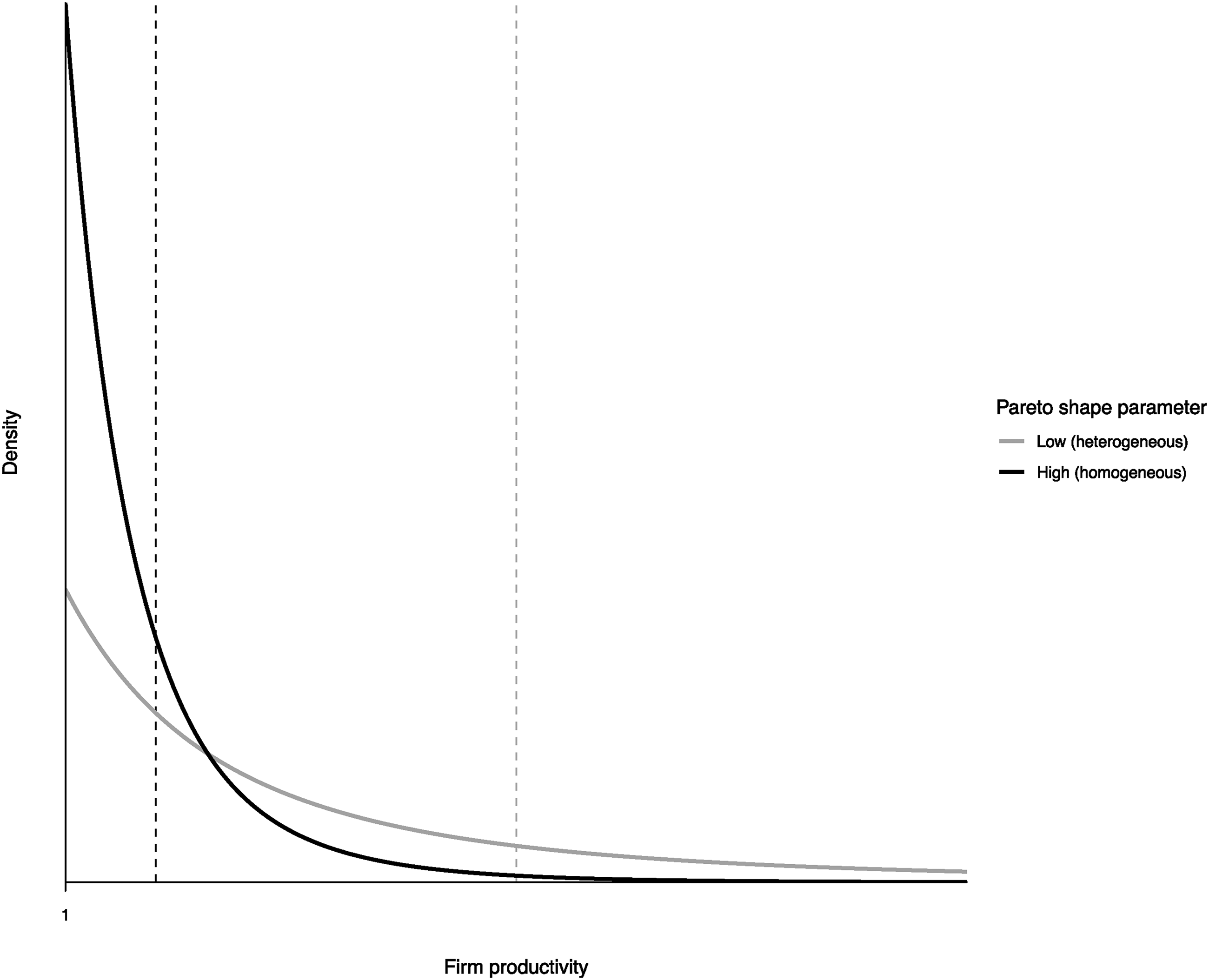
Distribution of firm productivity. Note: As the shape parameter of the Pareto distribution increases, firms become more homogeneous in terms of their productivity (i.e., more firms are concentrated at lower levels of productivity) and the average productivity of firms decreases.
Each representative consumer
The equilibrium of a single-industry open economy with two countries, Firms in origin country Each firm Each representative consumer

To lay the groundwork for the remainder of the paper, I present several key comparative statics.
15
See the Appendix for details. First, I look at how changes in the trade barriers
As trade barriers
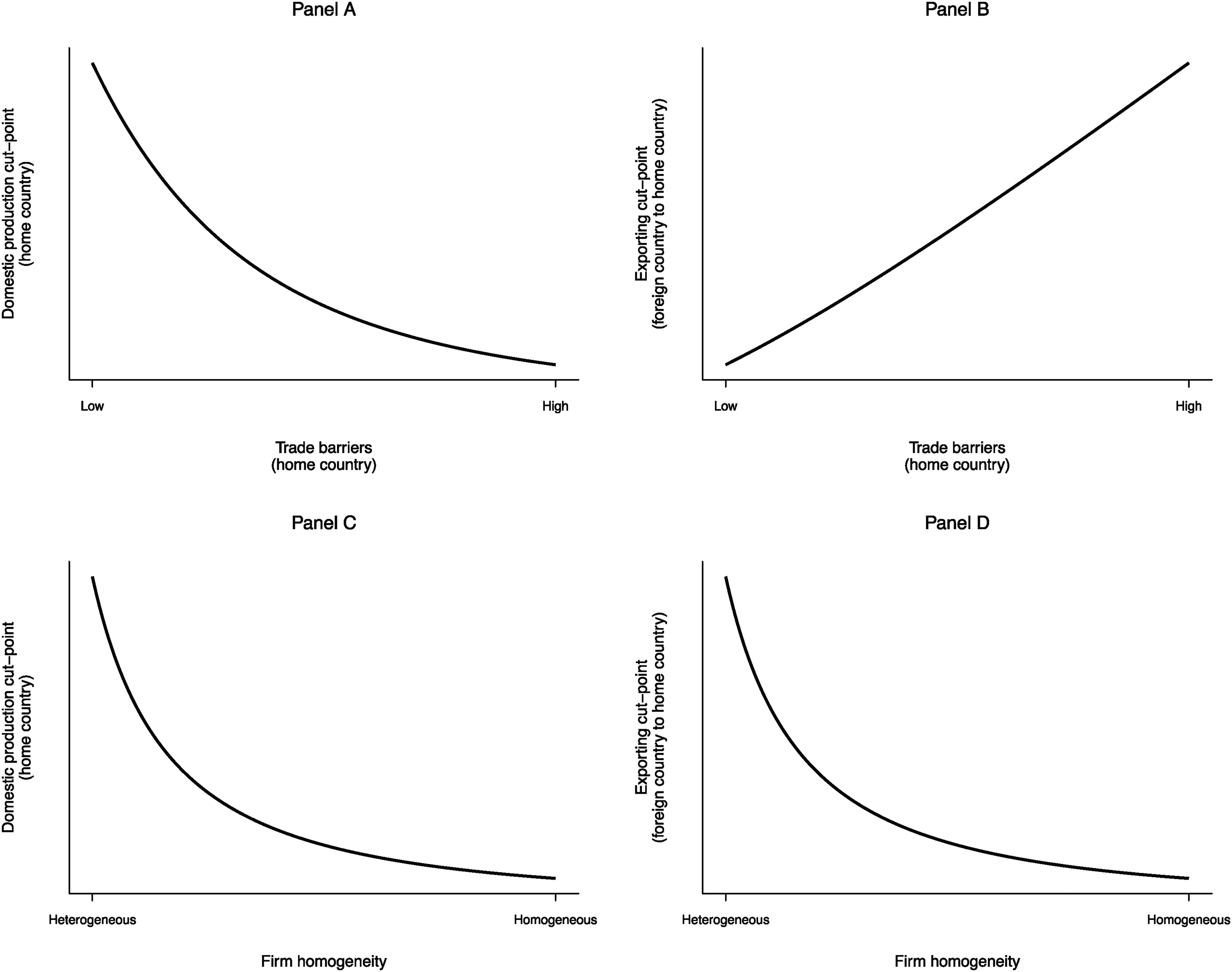
Comparative statics in an open economy. Note: The domestic production cut-point in country H is decreasing in trade barriers and the exporting cut-point for firms in country F that export to country H is increasing in trade barriers. Both cut-points are decreasing in firm homogeneity.
Second, I look at how changes in the distribution firm productivity affect these cut-points. We can manipulate the shape of this distribution by varying
As the trade barriers
Next, I relax the assumption that the trade barriers
I micro-found the preferences of government
The government
The government also cares about consumer welfare. In NNTT models, consumer welfare is the inverse of the price index. The government has an electoral incentive to keep prices low (inflation is unpopular), which it can do by lowering trade barriers. In equilibrium, firms in country
The utility function for government

It is important that the government cares about the profit of the average firm in country
In equilibrium, government
The government
In equilibrium, as firms become more homogeneous (i.e., as
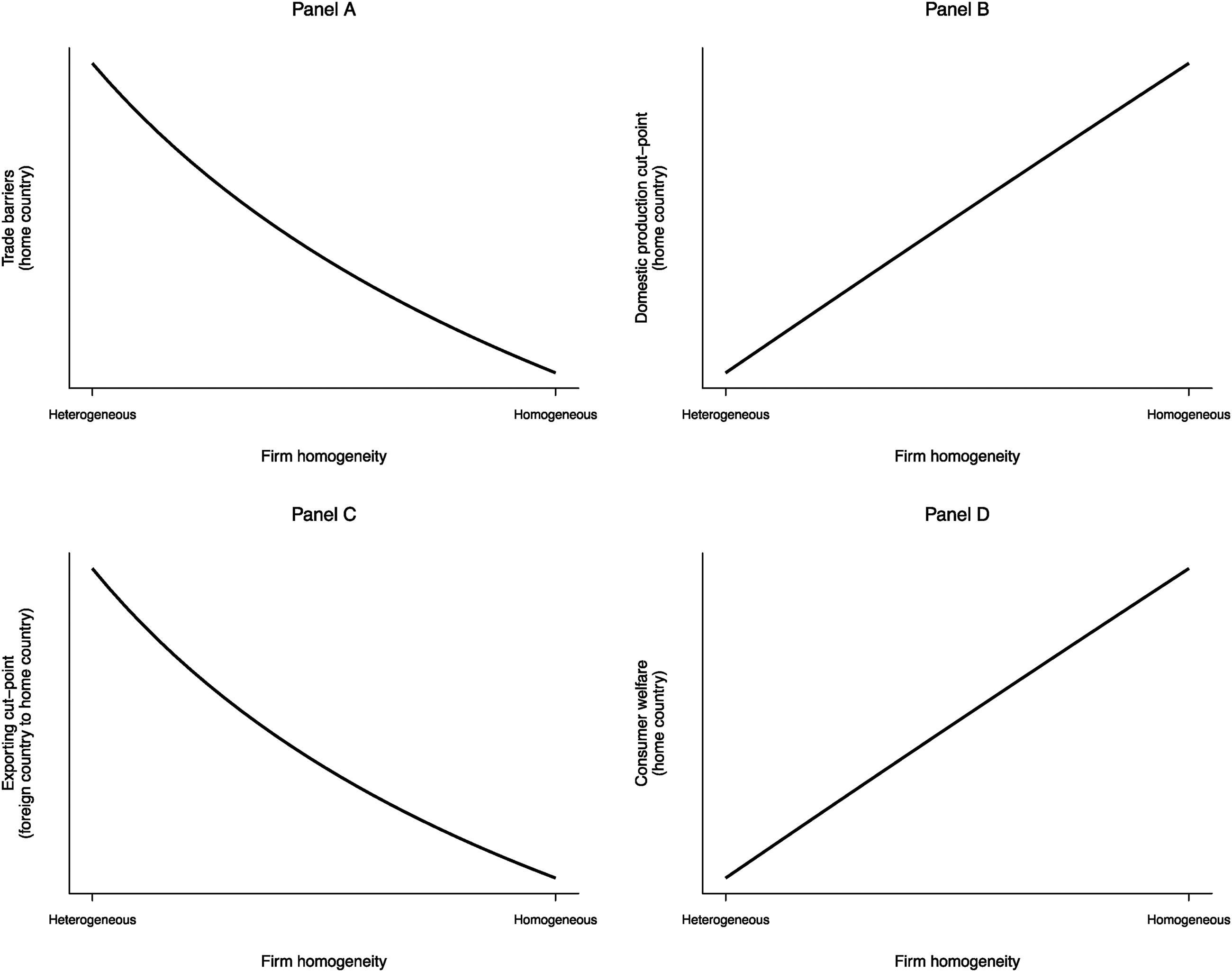
Optimal trade barriers without a regulatory regime in equilibrium. Note: The optimal trade barriers imposed by the government of country H are deceasing in firm homogeneity. The domestic production cut-point in country H is increasing, the exporting cut-point for firms in country F that export to country H is decreasing, and consumer welfare in country H is increasing.
The optimal trade barriers
Next, I add a regulatory regime to the model. A regulatory regime has three basic elements: (a) a treaty that establishes a customs union by prohibiting intra-bloc trade barriers; (b) a court that can adjudicate noncompliance cases against governments; and (c) a plaintiff that has standing to bring cases against noncompliant governments. The plaintiff could be a private actor, like a foreign firm that wants cheaper access to the defendant’s market, or third-party institution that has the authority to prosecute noncompliance, like the Justice Department in the US or the European Commission in the EU.
To model a regulatory regime, I add a litigation subgame between the policy-making subgame and the economy subgame. The government
The parameter
For example, the present-day governments of EU member states, which have to decide how closely to comply with Article 30 of the Treaty on the Functioning of the European Union (the article that prohibits intra-EU trade barriers), are not the same governments that signed the Treaty of Rome back in 1957. The present-day government of a member state could have very different ideological preferences over trade liberalization than the government that signed the treaty, committing the member state to eliminating trade barriers. Changing the treaty requires unanimity, and there are always some member states that prefer intra-EU free trade, so the rules of the customs union are exogenous from the perspective of individual governments making day-to-day compliance decisions.
The customs union has a court that adjudicates disputes over noncompliance. Recent studies view courts as strategic actors (Vanberg, 2015; Carrubba, 2005; Carrubba and Gabel, 2015, 2017). Courts care about the degree to which member states comply with their treaty obligations (ex ante compliance), but they also care about compliance with their rulings (ex post compliance). As such, courts anticipate how likely a government is to comply when they issue rulings (Carrubba and Gabel, 2015; Martinsen, 2015; Larsson and Naurin, 2016). Carrubba and Gabel (2015) show that a government is more likely to ignore the ruling of the court when its cost of compliance is high, and that a court is therefore less likely to rule against a government when the government’s cost of compliance is high. 19
I incorporate this insight into my model by modeling the court as a reduced-form player. Conditional on the plaintiff bringing a case, there is some probability
I micro-found the cost of compliance
If the court rules in favor of the government, or if it rules against the government and the government does not comply with the adverse ruling, then the ex post trade barriers are the same as the ex ante trade barriers,
Plaintiff preferences
The plaintiff

In equilibrium, the plaintiff
Under a regulatory regime, the plaintiff
In equilibrium, government


Under a regulatory regime, government
I use this equilibrium to show how the politics of noncompliance in regulatory regimes generate systematic bias in the types of noncompliance cases that get litigated, and that this bias creates a distortion in the economy: regulatory regimes reduce trade barriers most in industries with intermediate levels of firm homogeneity. Then, I identify the downstream consequences for firm performance and consumer welfare.
I start by calculating the effect of a regulatory regime on ex ante trade barriers and ex post trade barriers in expectation. To review, equilibrium ex ante trade barriers are
In equilibrium, the existence of a regulatory regime causes the government to reduce ex ante trade barriers,
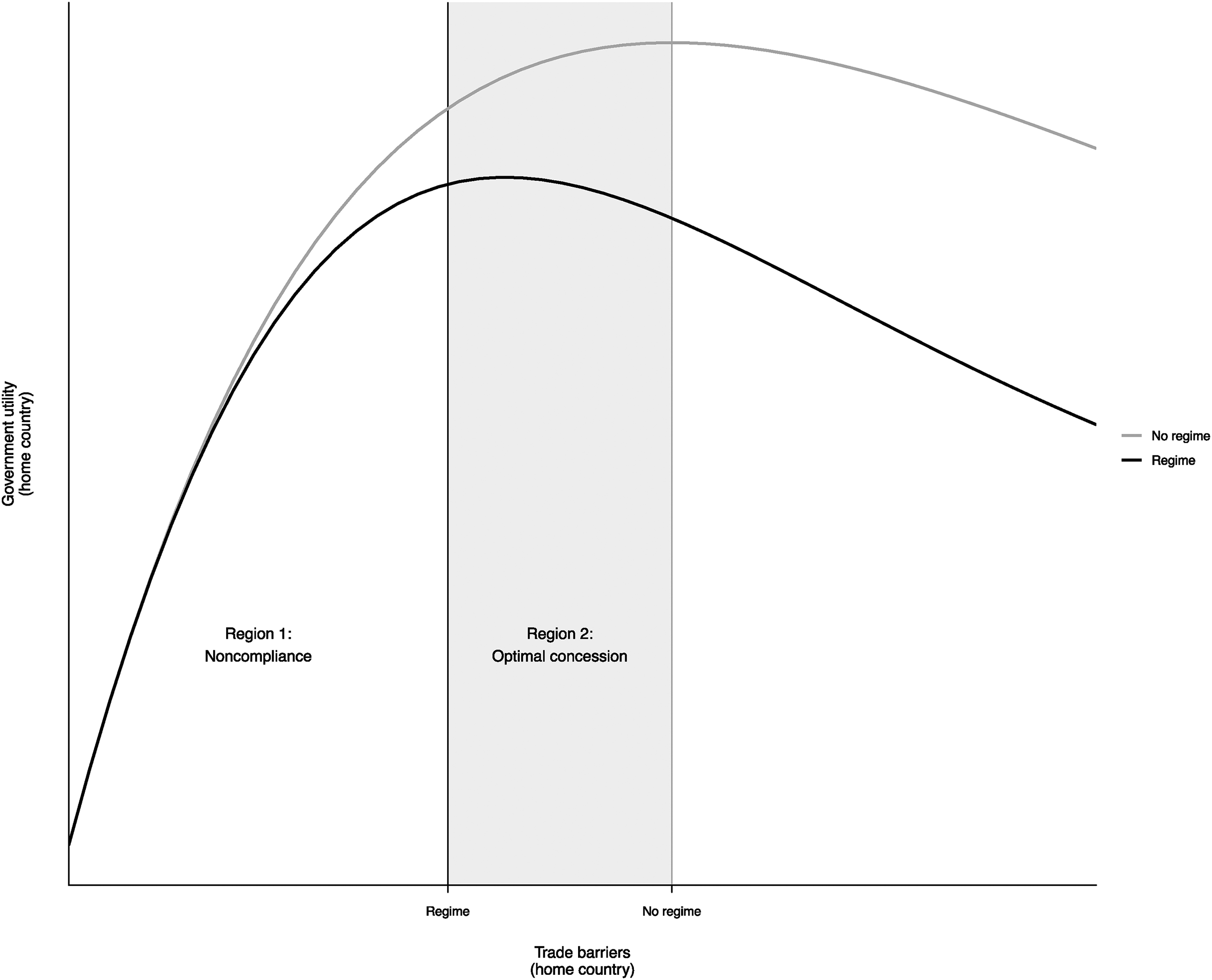
Optimal concession under a regulatory regime in equilibrium. Note: Under a regulatory regime, the government makes an optimal concession to avoid litigation. The size of this concession in equilibrium is the effect of the regime on trade barriers. The width of Region 1 indicates the amount of ex ante noncompliance and the width of Region 2 indicates the size of the concession.
The regulatory regime causes the government
In equilibrium, ex ante trade barriers
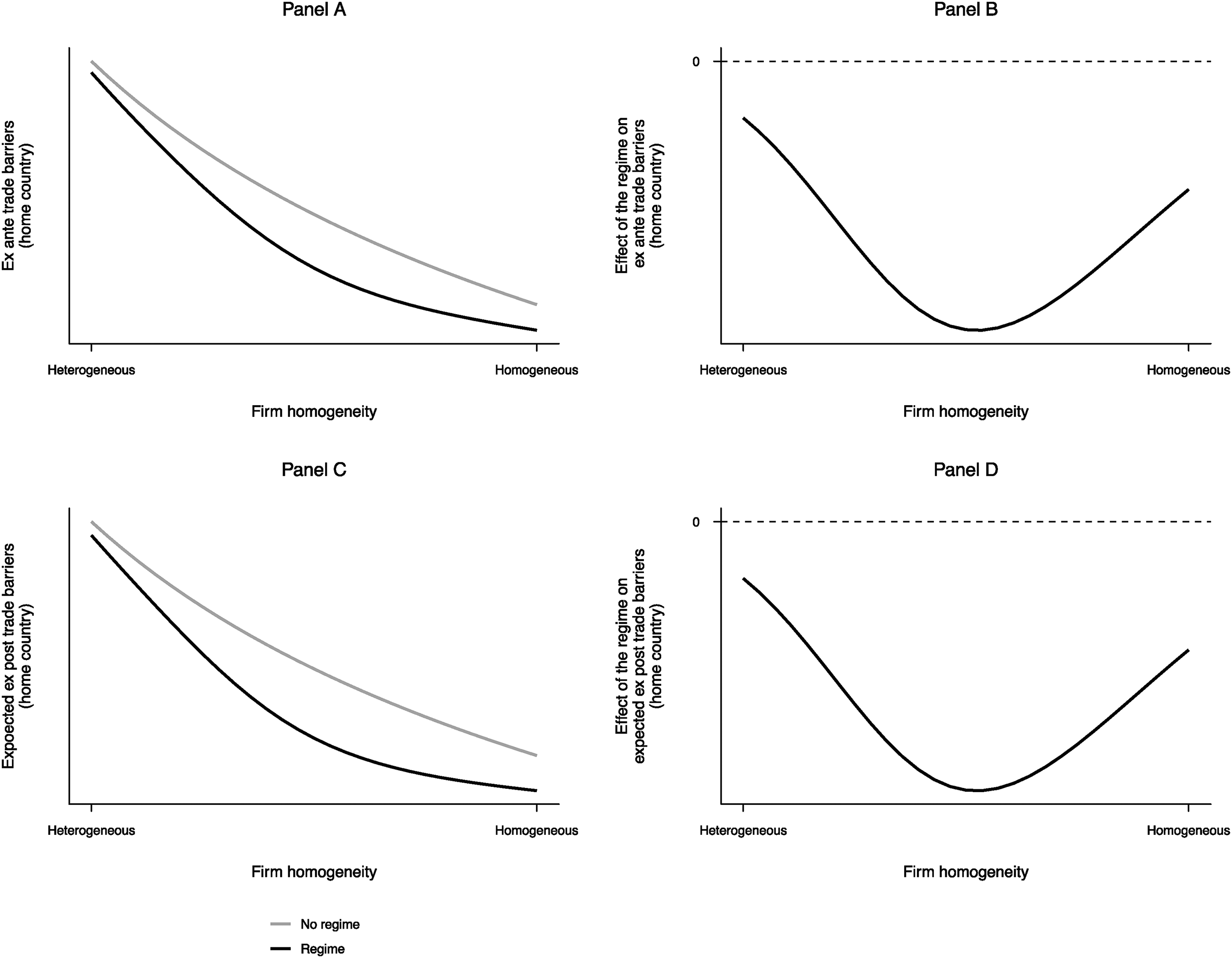
Effect of a regulatory regime on trade barriers in equilibrium. Note: The negative effect of a regulatory regime on ex ante and ex post trade barriers in equilibrium is largest in industries with intermediate levels of firm homogeneity.
However, the fact that both ex ante and ex post trade barriers decrease as firm homogeneity
As firm homogeneity
This non-monotonic result is because the plaintiff has competing incentives to bring a case. As firms become more homogeneous, the government prefers lower, more compliant trade barriers (see Result 2). Consequently, the cost of compliance decreases (Figure 6, panel A). This increases the probability of ex post compliance (Figure 6, panel B). In other words, the court becomes more likely to rule against the government because the government is more likely to comply with an adverse ruling. Thus, when firms are heterogeneous, ex ante noncompliance is high, and the plaintiff would like to bring a case, but the probability of ex post compliance is low, so the benefit of litigating does not outweigh the cost, and the plaintiff is deterred. On the other hand, when firms are homogeneous, the probability of ex post compliance is high, but ex ante noncompliance is low, so again, the benefit of litigating does not outweigh the cost, and the plaintiff is deterred.
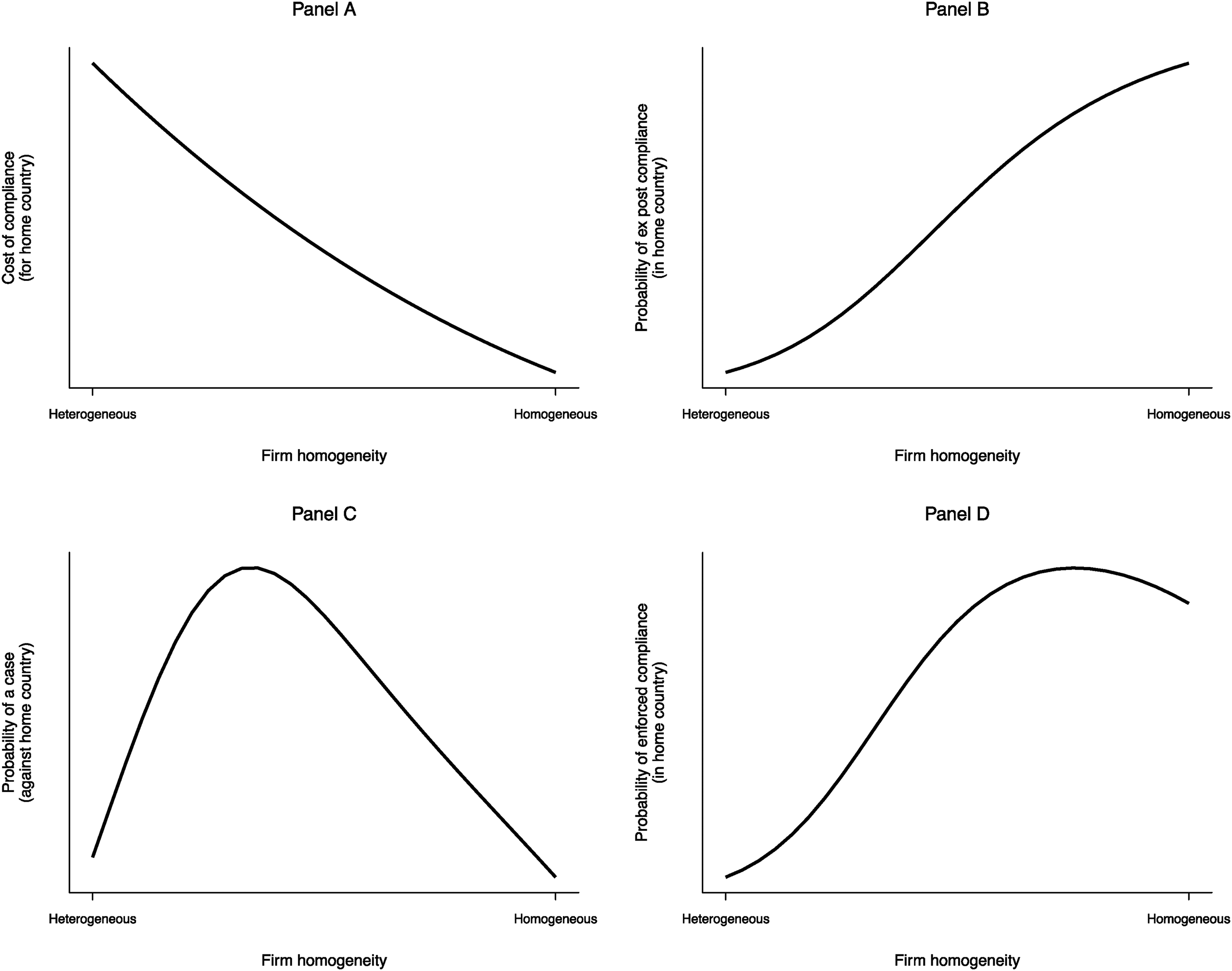
Comparative statics with a regulatory regime. Note: With a regulatory regime, the cost of compliance is decreasing in firm homogeneity. The conditional probability of ex post compliance is increasing. The probability of a case and the probability of enforced compliance are largest in industries with intermediate levels of firm homogeneity.
For intermediate levels of firm homogeneity, the benefit of correcting ex ante compliance and the probability of ex post compliance are both high enough, relative to the cost of litigating, that the plaintiff is willing to bring a case. Thus, the probability of litigation is the highest in industries with intermediate levels of firm homogeneity (Figure 6, panel C). The probability of enforced compliance, which is the joint probability that the plaintiff brings a case, that the court rules against the government, and that the government comes into compliance, is also the largest in these industries (Figure 6, panel D). The government makes a larger concession when the threat of enforced compliance is higher.
In sum, the politics of noncompliance lead to a systematic bias in the noncompliance cases that get litigated. The plaintiff drops cases (a) in highly heterogeneous industries, where noncompliance high, but the court is unlikely to rule against the government, and (b) in highly homogeneous industries, where noncompliance is low, and the benefit of correcting it does not outweigh the costs of litigation. Thus, while compliance is always better when firms are more homogeneous, regulatory regimes reduce trade barriers most in industries with intermediate levels of firm homogeneity.
A customs union with a regulatory regime affects firm performance by reducing trade barriers. Reducing trade barriers helps productive, exporting firms in country
By incentivizing government
The regulatory regime increases the domestic production cut-point
Figure 7 shows the how a customs union with a regulatory regime distorts firm performance by plotting profits in equilibrium as a function of productivity in a world with a regime and in a world without a regime (the counterfactual). Panel A shows firms in country
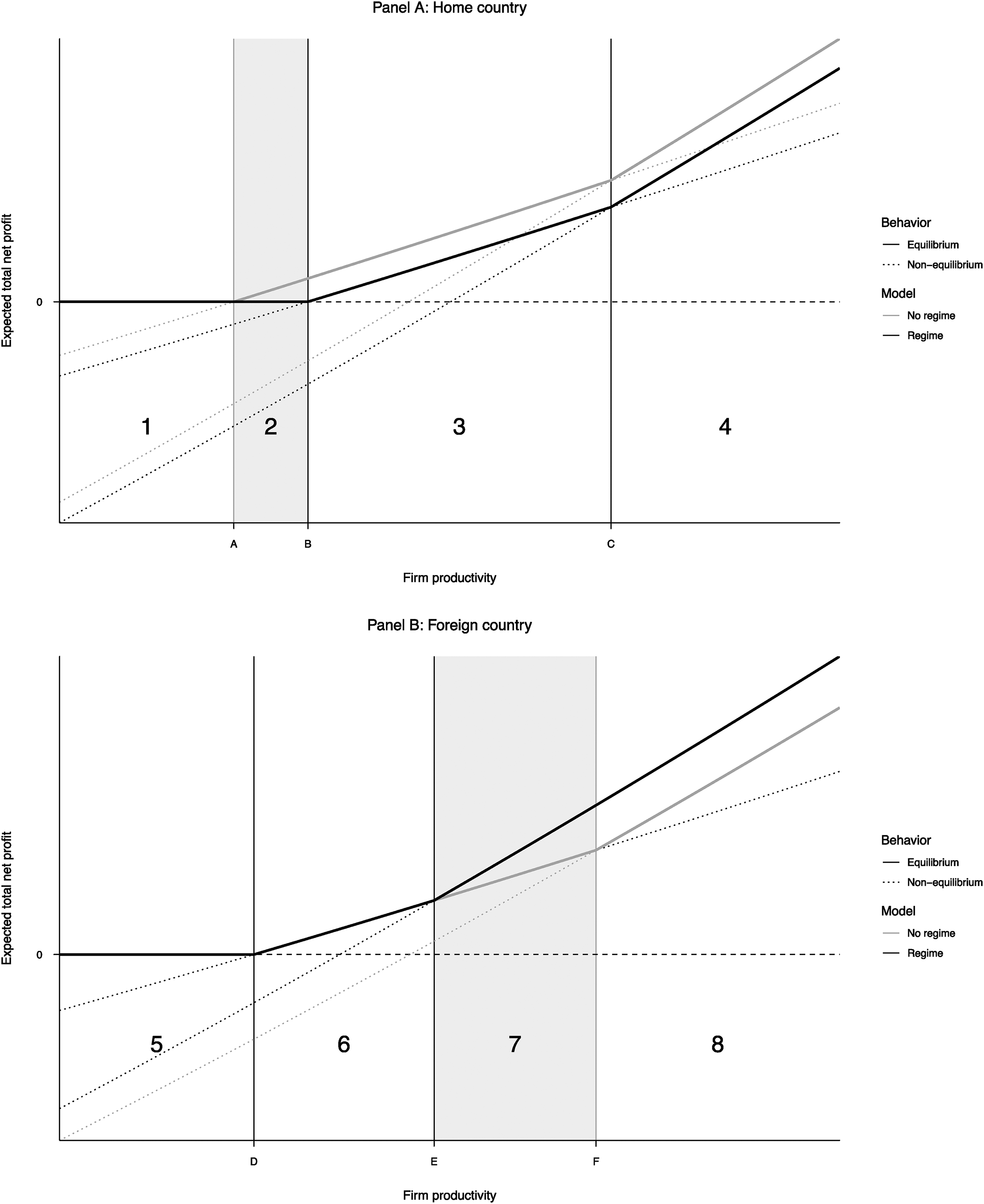
Distributive consequences of a regulatory regime for firms. Note: The regulatory regime has distributive consequences for firms. Panel A shows firms from country H and Panel B shows firms from country F. Firms in Region 2 go out of business because of the regime, and firms in Region 7 start to export to country H.
Panel B shows firms in country
Due to the politics of noncompliance, the regulatory regime decreases trade barriers most in industries with intermediate levels of firm homogeneity. Thus, these distributive consequences of the regime—the impact on firm performance and consumer welfare—are also largest in industries with intermediate levels of firm homogeneity. Figure 8 shows these effects. The domestic production cut-point
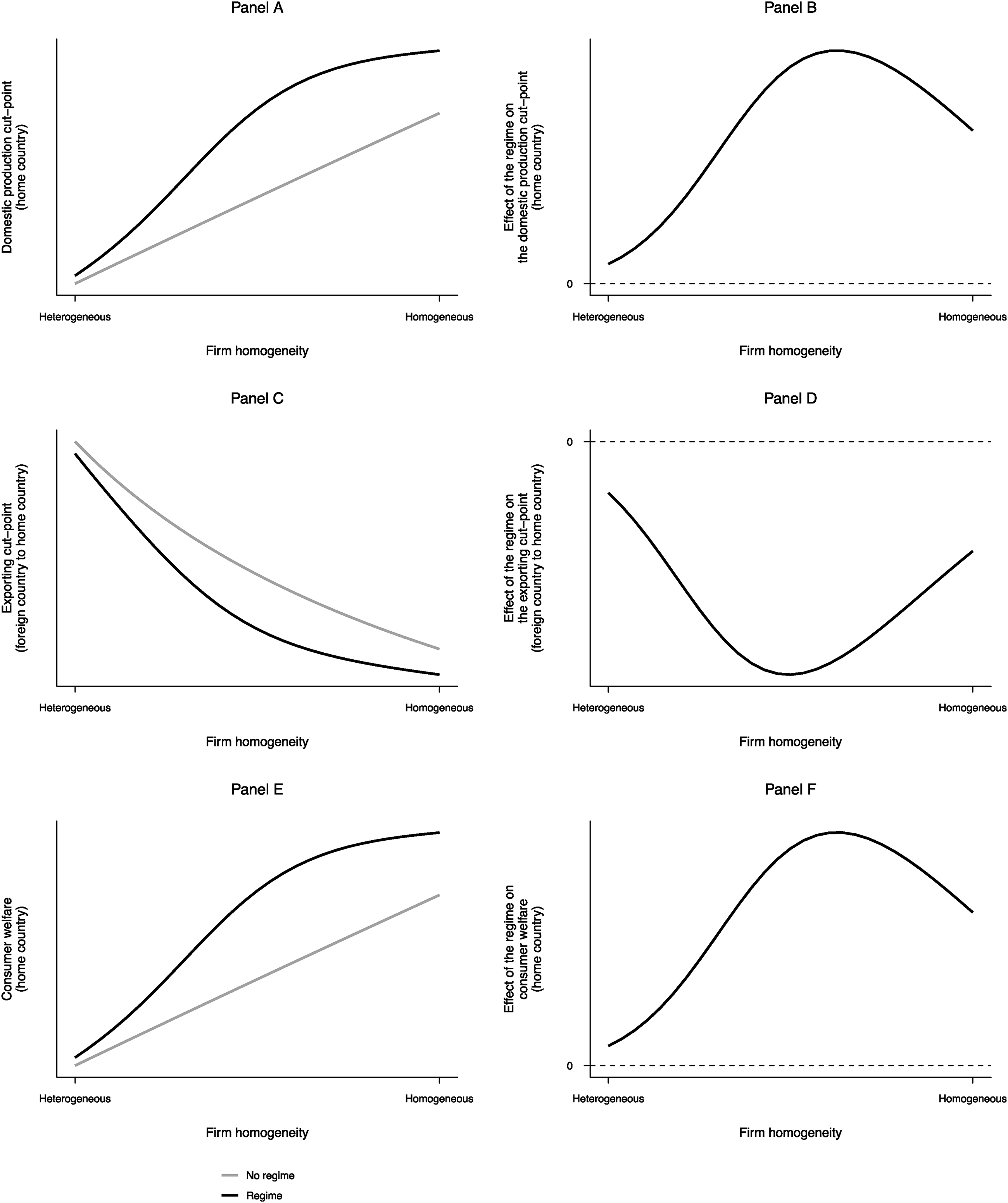
Distortions in the distributive consequences of regulatory regimes. Note: The effect of a regulatory regime on the domestic production cut-point in country H (positive), the exporting cut-point for firms in country F that export to country H (negative), and consumer welfare (positive) are largest for industries with intermediate levels of firm homogeneity.
The positive effect of the regulatory regime on the domestic production cut-point
In sum, by reducing trade barriers, regulatory regimes create distributive consequences: they allow new firms to export and push unproductive firms out of business. This raises average firm productivity, lowers average prices, and improves consumer welfare. But the politics of noncompliance generates systematic bias in the types of cases that get litigated, causing the regime to reduce trade barriers more in industries with intermediate levels of firm homogeneity. The consequences of the regime for firm performance and consumer welfare are therefore largest in these industries.
Governments create customs unions to accrue consumer welfare gains. To ensure that they actually realize these gains, they rationally design regulatory regimes to manage noncompliance with the rules of the customs union. But the politics of noncompliance generates systematic bias in the noncompliance cases that get litigated. I develop a formal model that explains how the politics of noncompliance in regulatory regimes systematically distorts the welfare gains that states accrue—the very reason they create customs unions in the first place. I show that if we do not take into account the politics of noncompliance, our theoretical predictions about the distributive consequences of trade liberalization—how lowering trade barriers impacts firms and consumers—will be systematically biased.
The model predicts the industries in which regulatory regimes will be effective at reducing trade barriers—those with intermediate levels of homogeneity in terms of firm productivity—as well as the downstream consequences for the performance of individual firms and for consumer welfare gains. Regulatory regimes are most effective at reducing trade barriers in industries with intermediate levels of firm homogeneity. In highly homogeneous industries and highly heterogeneous industries, regulatory regimes are not as effective at helping member states accrue consumer welfare gains.
However, the reason why regulatory regimes are ineffective in highly heterogeneous industries is very different than the reason they are ineffective in highly homogeneous industries. In heterogeneous industries, price competition is higher, giving governments more incentive to impose trade barriers to protect domestic firms. Regulatory regimes are ineffective because governments are less likely to comply with adverse court rulings, making the court hesitant to rule against them (Carrubba and Gabel, 2015). This deters plaintiffs from bringing noncompliance cases, creating a persistent compliance deficit (König and Mäder, 2014; Fjelstul and Carrubba, 2018).
In homogeneous industries, on the other hand, regulatory regimes are ineffective because the benefits of successfully prosecuting noncompliance are low relative to the costs of litigation. In homogeneous industries, price competition is low and governments are more willing to comply. The court is more likely to rule in favor of the plaintiff, but compliance is good enough that the benefit of bringing governments into compliance is not worth the cost of litigating. In homogeneous industries, the regime is ineffective because it is not used, not because it cannot correct violations.
There are several directions for future research. First, future research can explore empirical variation in the kinds of actors that can bring cases in customs unions and micro-found the preferences of those actors in the economy. Second, future research can examine whether the distortions in welfare gains caused by the politics of noncompliance explain variation in public support for economic integration within and across countries. Third, future research can assess the long-term consequences of uneven welfare gains for the political stability of customs unions. Finally, future research can explore how variation in the institutional design of regulatory regimes conditions their effectiveness. Better designed regimes could minimize these distortions. Regimes that rely on retaliation-based punishment mechanisms, rather than a court, could create different distortions.
In sum, if member states always complied with the rules of customs unions, they would accrue the largest welfare gains from creating customs unions in industries with high levels of firm heterogeneity. Taking into account the politics of noncompliance in the regulatory regimes that states create to enforce those agreements, I predict that the largest gains from trade will actually be in industries with intermediate levels of firm homogeneity. Thus, factoring in the politics of noncompliance is critical to our understanding of the conditions under which regional economic integration via the development of customs unions actually generates the intended welfare gains in practice.
Supplemental Material
sj-pdf-1-jtp-10.1177_09516298221130262 - Supplemental material for The political economy of noncompliance in customs unions
Supplemental material, sj-pdf-1-jtp-10.1177_09516298221130262 for The political economy of noncompliance in customs unions by Joshua C. Fjelstul in Journal of Theoretical Politics
Supplemental Material
sj-r-2-jtp-10.1177_09516298221130262 - Supplemental material for The political economy of noncompliance in customs unions
Supplemental material, sj-r-2-jtp-10.1177_09516298221130262 for The political economy of noncompliance in customs unions by Joshua C. Fjelstul in Journal of Theoretical Politics
Footnotes
Acknowledgements
I thank Cliff Carrubba, Matt Gabel, Pablo Montagnes, Adam Glynn, Siv Cheruvu, participants at the 2018 Emory-Duke-Rochester Political Economy Research Conference, the anonymous reviewers, and the editor for their helpful comments and suggestions.
Declaration of conflicting interests
The authors declared no potential conflicts of interest with respect to the research, authorship, and/or publication of this article.
Funding
The authors received no financial support for the research, authorship, and/or publication of this article.

Supplemental material
Supplemental material for this article is available online.
Notes
References
Supplementary Material
Please find the following supplemental material available below.
For Open Access articles published under a Creative Commons License, all supplemental material carries the same license as the article it is associated with.
For non-Open Access articles published, all supplemental material carries a non-exclusive license, and permission requests for re-use of supplemental material or any part of supplemental material shall be sent directly to the copyright owner as specified in the copyright notice associated with the article.
