



Abstract
We propose six axioms concerning when one candidate should defeat another in a democratic election involving two or more candidates. Five of the axioms are widely satisfied by known voting procedures. The sixth axiom is a weakening of Kenneth Arrow’s famous condition of the Independence of Irrelevant Alternatives (IIA). We call this weakening Coherent IIA. We prove that the five axioms plus Coherent IIA single out a method of determining defeats studied in our recent work: Split Cycle. In particular, Split Cycle provides the most resolute definition of defeat among any satisfying the six axioms for democratic defeat. In addition, we analyze how Split Cycle escapes Arrow’s impossibility theorem and related impossibility results.
Keywords
Introduction
In the abstract of his lecture at a 2017 Lindau Nobel Laureate Meeting, Eric Maskin (2017) claimed that “The systems that most countries use to elect presidents are deeply flawed,” a claim defended in writing by Maskin and Sen (2016, 2017a, 2017b). In fact, the issue goes far beyond presidential elections: the same voting systems are used in elections ranging from national elections to elections in small committees and clubs. In our view, the key issue highlighted by Maskin and Sen can be stated in terms of the following normative principle (closely related to what voting theorists call Condorcet consistency, defined below
1
): Majority Defeat: if a candidate loses an election (before any tiebreaking), they must have been defeated by some other candidate in the election, and a candidate should defeat another only if a majority of voters prefer the first candidate to the second.
2
In the 2000 US presidential election in Florida, George W. Bush defeated Al Gore and Ralph Nader according to Plurality voting, which only allows voters to vote for one candidate. Yet based on the plausible inference that most Nader voters preferred Gore to Bush (see Magee 2003), it follows that a majority of all voters preferred Gore to Bush.
In the 2009 mayoral election in Burlington, Vermont, the Progressive candidate Bob Kiss defeated the Democratic candidate Andy Montroll according to Instant Runoff Voting (defined in Example 14), but Montroll was preferred to each of the other candidates including Kiss by majorities of voters, according to the ranked ballots collected.
During the 2016 US presidential primary season, an NBC News/Wall Street Journal poll (3–6 March) asked respondents both for their top choice and their preference between Donald Trump and each of Ted Cruz, John Kasich, and Marco Rubio. Trump was the Plurality winner, receiving 30% of first-place votes, but Cruz, Kasich, and Rubio were each preferred to Trump by 57%, 57%, and 56% of respondents, respectively (see Kurrild-Klitgaard 2018 concerning statistical significance). For further discussion of whether another Republican might have been majority preferred to Trump, see Maskin and Sen 2016, Maskin 2017, Kurrild-Klitgaard 2018, and Woon et al. 2020.
For related examples outside the US, see, for example, Kaminski 2015, Section 20.3.2 and Feizi et al. 2020.
The above failures of Majority Defeat involve spoiler effects. In Example 1, although it is likely that a majority of voters preferred Gore to Bush and also preferred Gore to Nader, Nader’s inclusion in the race spoiled the election for Gore, handing victory to Bush. In Example 2, although a majority of voters preferred Montroll to Kiss and a majority preferred Montroll to the Republican candidate, Kurt Wright, Wright’s inclusion in the race spoiled the election for Montroll, handing victory to Kiss. Finally, in Example 3, although the NBC News/Wall Street Journal poll did not ask for respondents’ preferences between Cruz, Kasich, and Rubio, if one of them was majority preferred to the other two, then it would be reasonable to call the latter two spoilers for the first, as their inclusion in the poll handed the plurality victory to Trump.
What other benefits might respecting Majority Defeat provide besides mitigating spoiler effects of the kind shown above? Maskin and Sen (2017a) make the following conjecture: [M]ajority rule may reduce polarization. A centrist like Bloomberg [in the 2016 U.S. presidential election] may not be ranked first by a large proportion of voters [and hence cannot win under Plurality], but can still be elected [with the backing of majorities against each other candidate] if viewed as a good compromise. Majority rule also encourages public debate about a larger group of potential candidates [since more candidates can participate without worry of their being spoilers], bringing us closer to John Stuart Mill’s ideal of democracy as “government by discussion.”
To respect the principle of Majority Defeat, we need to collect ballots in which voters rank the candidates in the election. 3 Due to the possibility of strategic voting, we cannot guarantee that voters’ rankings of the candidates always reflect their sincere preferences (see Taylor 2005), but one can try to choose voting procedures that provide fewer incentives for strategic voting (see, e.g., Bassi 2015; Chamberlin 1985; Holliday and Pacuit 2019; Nitzan 1985). Assuming we collect ranked ballots, a wide variety of voting procedures become available (see, e.g., Brams and Fishburn 2002; Pacuit 2019; and Examples 14 and 19).
One obvious idea for satisfying the principle of Majority Defeat is to say that one candidate defeats another if and only if a majority of voters prefer the first candidate to the second. Notoriously, however, this can result in every candidate being defeated, leaving no candidate who wins. In particular, there can be a majority cycle, wherein a majority of voters prefer
In the absence of a Condorcet winner, Maskin and Sen (2017a) suggest “having a runoff between the two top candidates,” but defining “the two top candidates” faces some of the same difficulties as defining “the best candidate.” In a recent paper (Holliday and Pacuit 2020), we study a voting procedure that we call Split Cycle, which provides a different backup plan for the case where no Condorcet winner exists.
6
Instead of saying if there is a Condorcet winner, elect that person, and if not, do something else with a different justification, Split Cycle provides a unified rule for cases with or without Condorcet winners: In an election with candidates
Although there may be no Condorcet winner, there is always an undefeated candidate according to Split Cycle (if there is more than one, a tiebreaking process must be applied—cf. Remark 46). An intuitive way
7
to determine the Split Cycle defeat relation is as follows:
In each majority cycle, identify the wins with the smallest margin in that cycle. After completing step 1 for all cycles, discard the identified wins. All remaining wins count as defeats.
As we show, Split Cycle mitigates spoiler effects (see Section 4.3) and has several other virtues, including avoiding the so-called Strong No Show Paradox (see Holliday and Pacuit 2020, 2021).
In this paper, we arrive at Split Cycle (defined formally in Section 3) by another route. We propose six general axioms concerning when one candidate should defeat another in a democratic election involving two or more candidates (Section 4). Five of the axioms are widely satisfied by known voting procedures. The sixth axiom is a weakening of Kenneth Arrow’s famous condition of the Independence of Irrelevant Alternatives (IIA) (Arrow 1963). We call this weakening Coherent IIA. Arrow’s IIA states that if in two elections, all voters rank candidate
The first half of the paper culminates in a proof that the five axioms plus Coherent IIA single out Split Cycle (Section 5). In particular, our main result is that Split Cycle provides the most resolute definition of defeat of any satisfying the six axioms for democratic defeat. In the second half, we analyze how Split Cycle manages to escape Arrow’s Impossibility Theorem and related impossibility results in social choice theory (Section 6). The answer is twofold: we weaken IIA to Coherent IIA, and we relax Arrow’s assumptions about the properties of the defeat relation between candidates. We explain how neither of these moves is sufficient by itself to escape Arrow-like impossibility theorems. But by doing both, Split Cycle provides a compelling response, we think, to both the Paradox of Voting and Arrow’s Impossibility Theorem.
A key aspect of our characterization of Split Cycle using the six axioms for defeat is that we work with a model in which elections can have different sets of voters and different sets of candidates, just as they do in reality. Given the importance of this variable-election setting to our characterization, we consider how standard impossibility results for a fixed set of candidates/voters can be adapted to and even strengthened in the variable-election setting, and yet how Split Cycle still escapes them (Sections 6.2 and 6.3). One of the methodological lessons of the paper, in our view, is the value of working in a variable-election framework.
We start in Section 2 by reviewing the formal framework we will use to conduct our analysis.
As suggested in Section 1, we work in a variable-voter and variable-candidate setting. This means that our group decision method can input elections—formalized as profiles below—with different sets of voters and different sets of candidates (see Remark 9.1 for a comparison with a fixed-voter and fixed-candidate setting). To allow sets of voters and candidates of arbitrary (but finite) size in elections, we first fix infinite sets asymmetry: if transitivity: if connectedness: if
We take
We formalize the notion of an election as a function associating with each voter their ranking of the candidates. For a set
A profile is a function
When we display profiles, we show their “anonymized form” that records only the number of voters with each type of ballot, rather than the identities of the voters. For example:
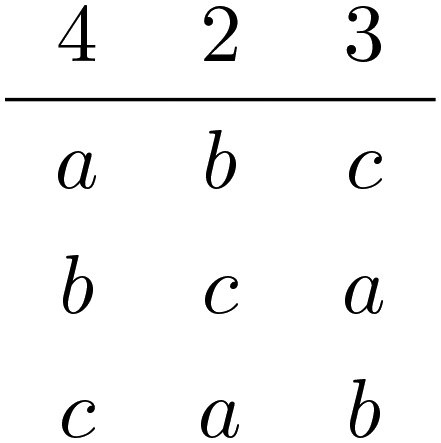
The above diagram indicates that two voters rank
It will be important later to consider the restriction of a profile to a subset
Given a binary relation
We now consider two different kinds of group decision methods, differing in what they output. The first kind outputs a set of potential winners for the election.
A voting method is a function
As usual, if
The second kind of group decision method outputs an asymmetric binary relation on the set of candidates. In social choice theory, this relation is typically called the “strict social preference” relation. We interpret this binary relation as a defeat relation for the election in the sense of Section 1.
A variable-election collective choice rule (VCCR) is a function
A well-known special case of a collective choice rule (CCR) is what Arrow called a social welfare function (SWF). The output of an SWF is a strict weak order, that is, a binary relation if
Note that these conditions imply that
A variable-election social welfare function (VSWF) is a VCCR
For readers familiar with the standard setup in social choice theory, we note some subtleties about our definitions.
We add the modifier “variable-election” because the term “collective choice rule” due to Sen (2017, Chapter 2 In social choice theory, one often defines the output of a CCR (as Sen does) to be a “weak social preference” relation For simplicity, we build the axiom of Universal Domain into the definition of a VCCR, but one could of course define a notion of VCCR where only certain profiles are in the domain of
Any VSWF
Let
Any acyclic VCCR induces a voting method that outputs for a given profile the set of undefeated candidates. All defeated candidates are excluded from the rest of the process that leads to the ultimate winner.
Given any acyclic VCCR

Given a voting method
Let
Let us now review some standard VCCRs. Several of the VCCRs are based on the majority preference relation, defined as follows.
Given a profile
A majority cycle in
VCCRs 2–6 are all acyclic—but 1 is not, due to the possibility of majority cycles—and 3–6 are VSWFs. For axiomatic characterizations of the Copeland and Borda VSWFs, see Rubinstein 1980 for Copeland and Nitzan and Rubinstein 1981 and Mihara 2017 for Borda.
VCCRs 1–4 all have an important property in common: their output depends only on the margins between candidates in the given profile.
Let
The margin graph of
For a profile
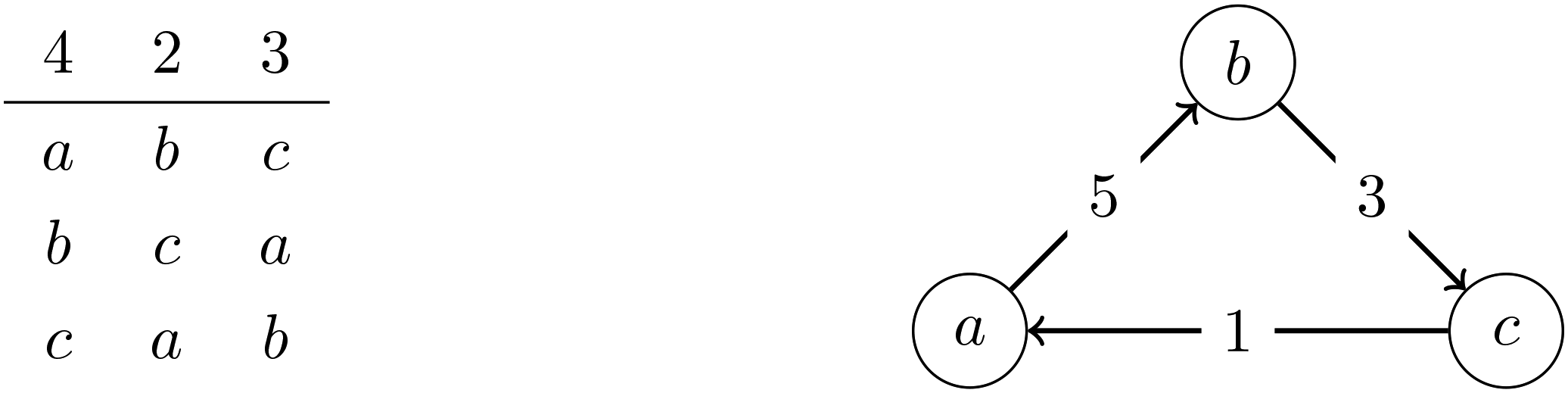
Clearly the edge relation in
Now the idea that the output of a VCCR depends only on margins can be formalized as follows. 13
A VCCR
It is obvious that VCCRs 1–3 in Example 14 are margin based, but this is less obvious for Borda.
For any profile
Other examples of margin-based VCCRs include the following.
Within the family of margin-based VCCRs, we can make a useful three-way distinction.
A majority graph is any directed graph A qualitative margin graph is a pair A margin graph is a weighted directed graph
Finally, a useful fact for the study of margin-based VCCRs is that any abstract margin graph as in Remark 20.3 can be realized as the margin graph of a profile.
For any margin graph
In light of Debord’s theorem, one can construct margin graphs at will, without deriving them from particular profiles, when experimenting with the operation of margin-based VCCRs.
This concludes our review of basic notions. In the next section, we turn to our preferred VCCR.
Split Cycle
In Holliday and Pacuit 2020, we studied a voting method that we call Split Cycle. Here we formulate the Split Cycle VCCR that defeat rationalizes the Split Cycle voting method (recall Definition 12). We give two formulations in Definition 22 and Lemma 3.5, respectively. The first definition of Split Cycle formalizes the definition given in Section 1. For a profile
Given a profile
The basic idea is that when the electorate’s majority preference relation is incoherent, in the sense that there is a majority cycle, this raises the threshold required for one candidate
Consider a profile
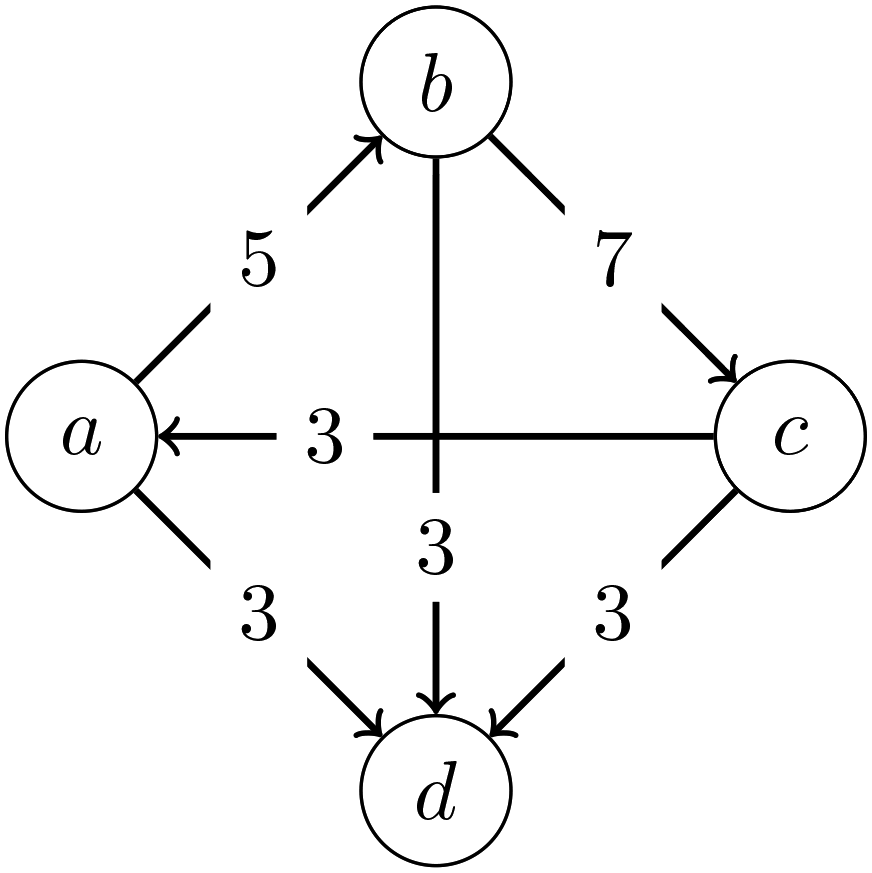
The only majority cycle is
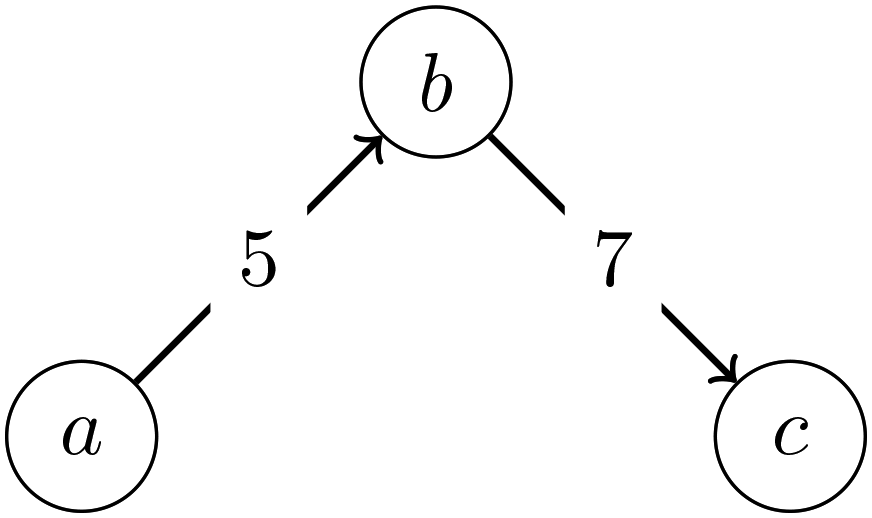
Hence there is no incoherence involving
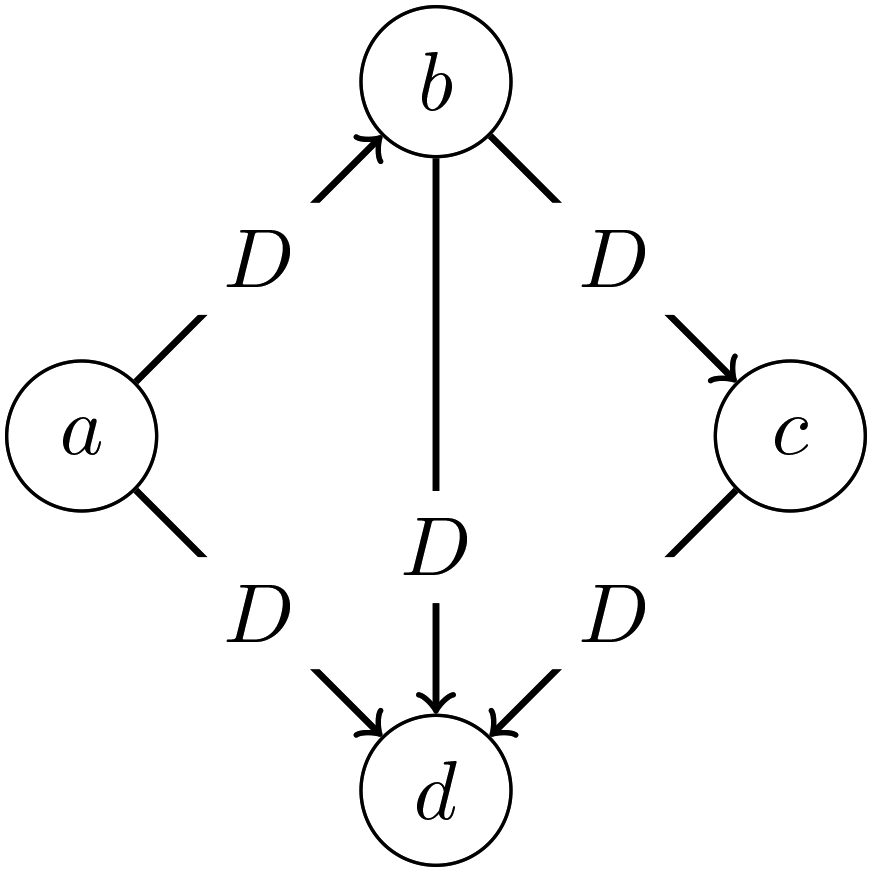
Note that just as in a sporting tournament, it can happen that while team
Where
An equivalent definition of Split Cycle can be given in terms of the following concept.
Let
For example, the splitting number of the cycles
Let

Thus, in Example 23,
It is important to note that two candidates may be contained in multiple majority cycles, as in the following margin graph, repeated three times with the majority cycles highlighted:
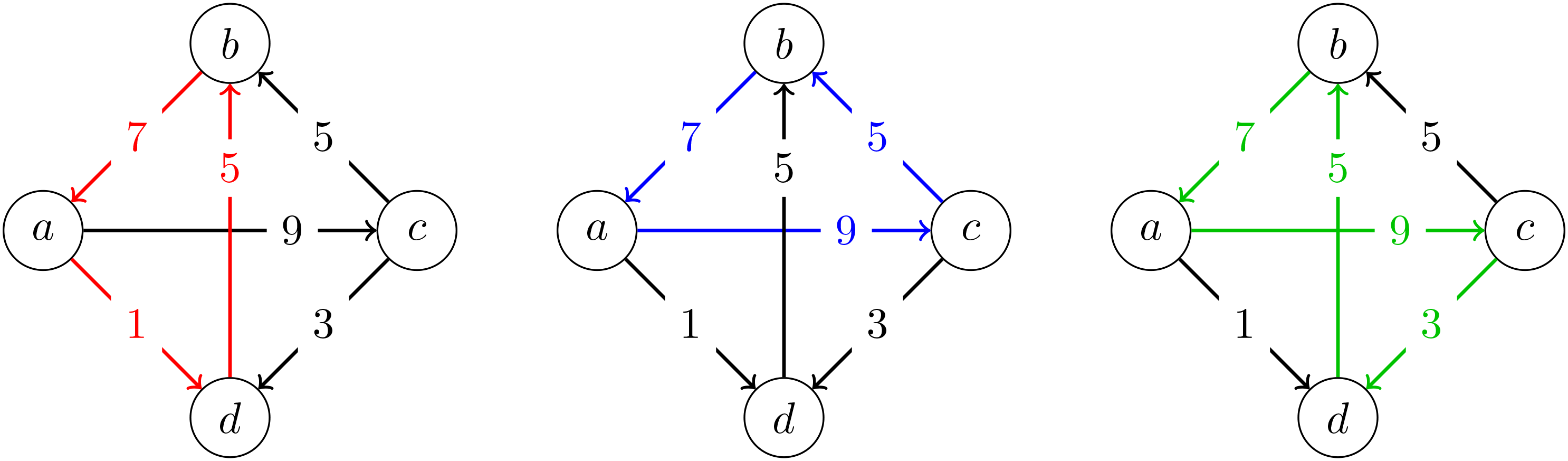
The splitting number of the cycle
Since
Additional examples of determining the Split Cycle defeat relation will be given below (Example 36, Remark 38, and Example 62). For still more examples, see Holliday and Pacuit 2020.
A useful fact, proved in Holliday and Pacuit 2020, is that it suffices to only look at majority cycles in which
Let

In Holliday and Pacuit 2020, we show that Split Cycle—understood as a voting method, that is, as
In this section, we propose six axioms concerning when one candidate should defeat another in a democratic election involving two or more candidates. Four axiom are standard (Section 4.1); one is less well known but also from the previous literature (Section 4.2); and the key axiom is new (Section 4.3).
Standard axioms
The first four axioms are ubiquitous in social choice and voting theory. The first axiom appears already in May’s (1952) characterization of majority rule for two-candidate elections:
A1. Anonymity and Neutrality: if
It is clear that all VCCRs defined so far in this paper satisfy Anonymity and Neutrality.
The second axiom is definitive of the problem of choosing winners that we aim to solve:
A2. Availability: for every
To say that in some profiles all candidates are defeated and hence excluded from further consideration—so no candidate is available to become the ultimate winner—is to give up on solving the problem. Unlike the Simple Majority VCCR (Example 14), Split Cycle satisfies Availability.
Split Cycle satisfies Availability.
Suppose there is a profile
Note that Availability is strictly weaker than the assumption that a VCCR is acyclic. There being no defeat cycles implies that some candidate is undefeated (given that the set of candidates in a profile is finite), but some candidate being undefeated does not imply that there are no defeat cycles (e.g.
For the third axiom, given any profile A3. (Upward) Homogeneity: for every
Homogeneity is usually stated as the condition that for any
The fourth axiom is one of the most widely discussed principles in voting theory. The term “Monotonicity” is used for a number of different conditions, but our formulation is equivalent (for profiles of linear ballots) to Arrow’s (1963) axiom of Positive Association of Social and Individual Values:
20
A4. Monotonicity (respectively, Monotonicity for two-candidate profiles): if
One might argue that Monotonicity should hold for any number of candidates, but Monotonicity for two-candidate profiles is sufficient for the proof of our main result. This is noteworthy because the Instant Runoff VCCR in Example 14 (as well as VCCRs based on other standard voting procedures, e.g. Baldwin, Coombs, and Nanson) does not satisfy Monotonicity for arbitrary profiles (see Felsenthal and Nurmi 2017) but does for two-candidate profiles. All other VCCRs defined above satisfy Monotonicity for all profiles.
The axioms proposed so far imply the principle of Majority Defeat for two-candidate profiles. The proof is essentially part of the proof of May’s (1952) characterization of majority rule.
If
Suppose
Monotonicity is weaker than May’s (1952) condition of Positive Responsiveness, which in addition requires that if
Like the axiom of homogeneity, the next axiom is a variable-voter axiom. Say that two voters
A5. Neutral Reversal: if
Not only Split Cycle but all other margin-based VCCRs (recall Example 14) satisfy Neutral Reversal. However, Neutral Reversal is weaker than the assumption that a VCCR is margin based.
We define the Positive/Negative VCCR (cf. García-Lapresta et al. 2010 and Heckelman and Ragan 2021) as follows. In a profile
Not all common VCCRs satisfy Neutral Reversal, as Examples 33 and 34 below show. To analyze violations of Neutral Reversal, we distinguish its two directions:
Upward Neutral Reversal: if Downward Neutral Reversal: if
Consider the Plurality VCCR from Example 14. Let
The Pareto VCCR
The Pareto VCCR seems reasonable for certain special purposes; for example, in a small club, unanimity may be valued and often possible. However, in elections where disagreement is expected, the Pareto VCCR would be of little help in narrowing down the range of potential winners, as so few candidates would defeat others. Of course, we agree that it is a sufficient condition for
For any VCCR
The implication from 1 to 2 is easy to check. From 2 to 1, we already proved in Lemma 30 that if
We prefer this characterization of majority rule to that of May (1952) for the reason given in Remark 31.
Suppose
Although there is a perfectly reasonable notion of the advantage of
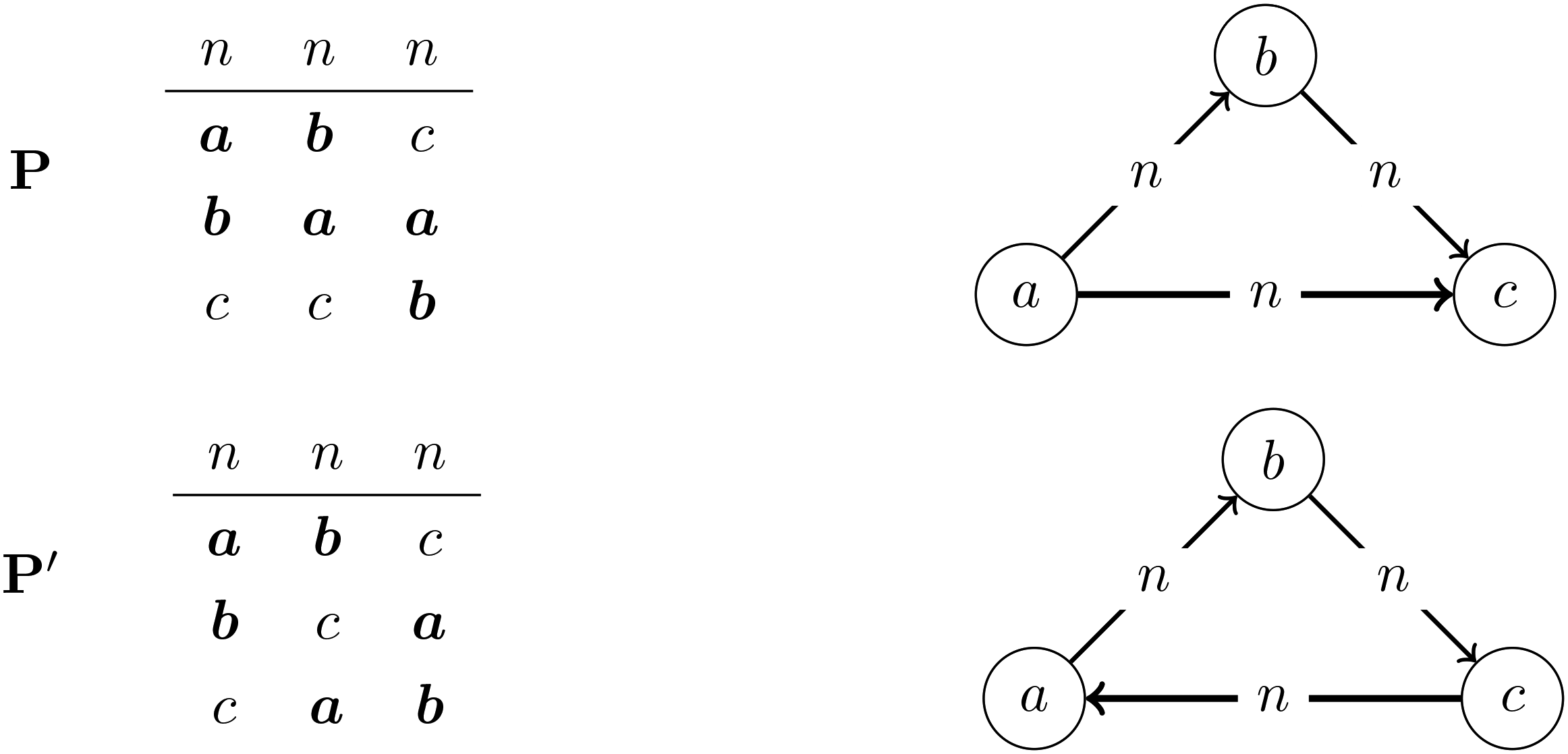
In the profiles
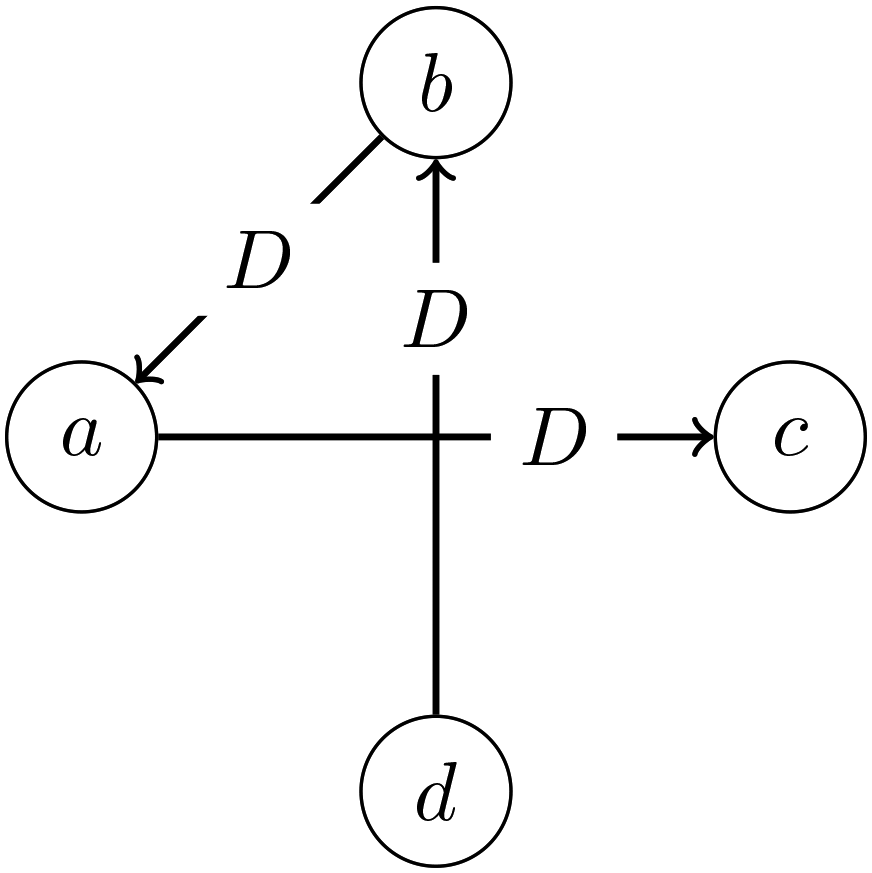
However, it is not as if the standard for defeat in every case of a majority cycle is unattainable. In the profile
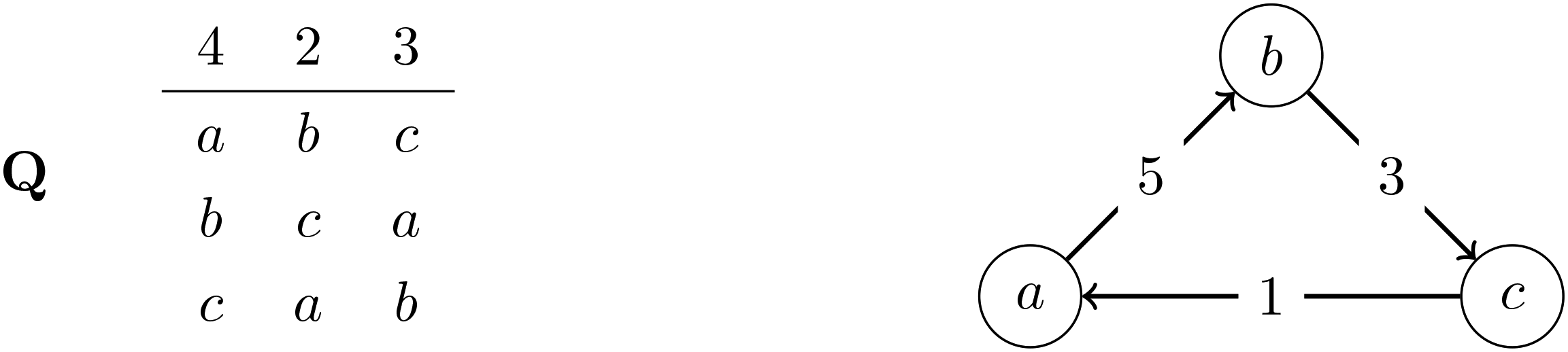
According to Split Cycle, the standard for
In an illuminating result, Patty and Penn (2014) prove that Arrow’s IIA is equivalent to the condition of unilateral flip independence, which states that if two profiles are alike except that one voter flips one pair of adjacent candidates on her ballot, then the defeat relations for the two profiles can differ at most on the flipped candidates. They write that this theorem “demonstrates a fundamental basis of the normative appeal of IIA” (p. 52) (cf. Patty and Penn 2019, 155).
24
However, observe that for the profiles
Maskin (2020) proposes a weakening of IIA called Modified IIA, which states that if profiles
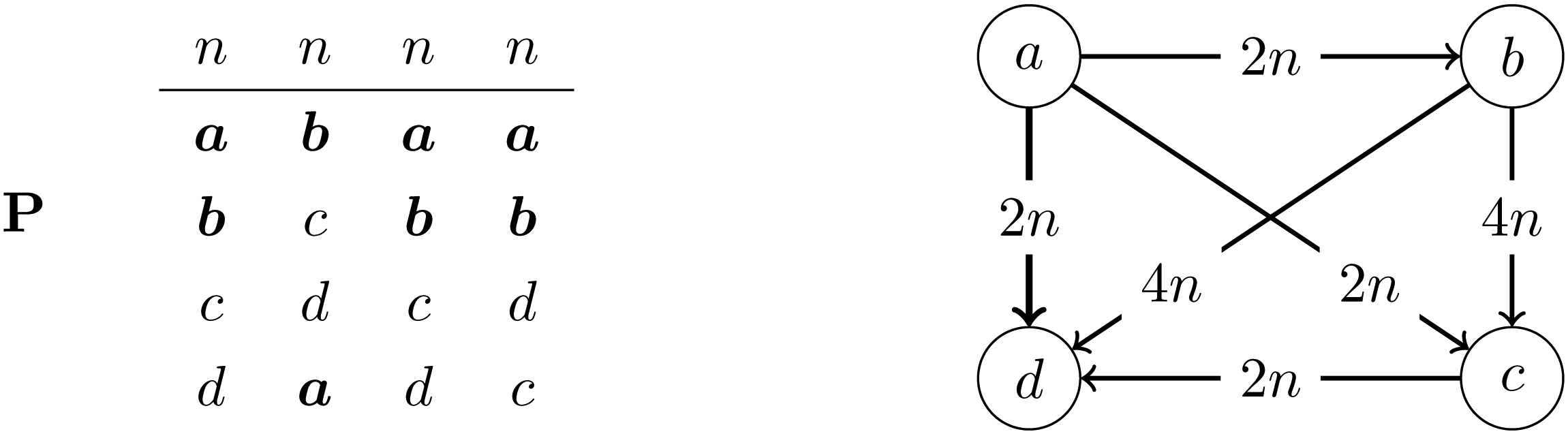
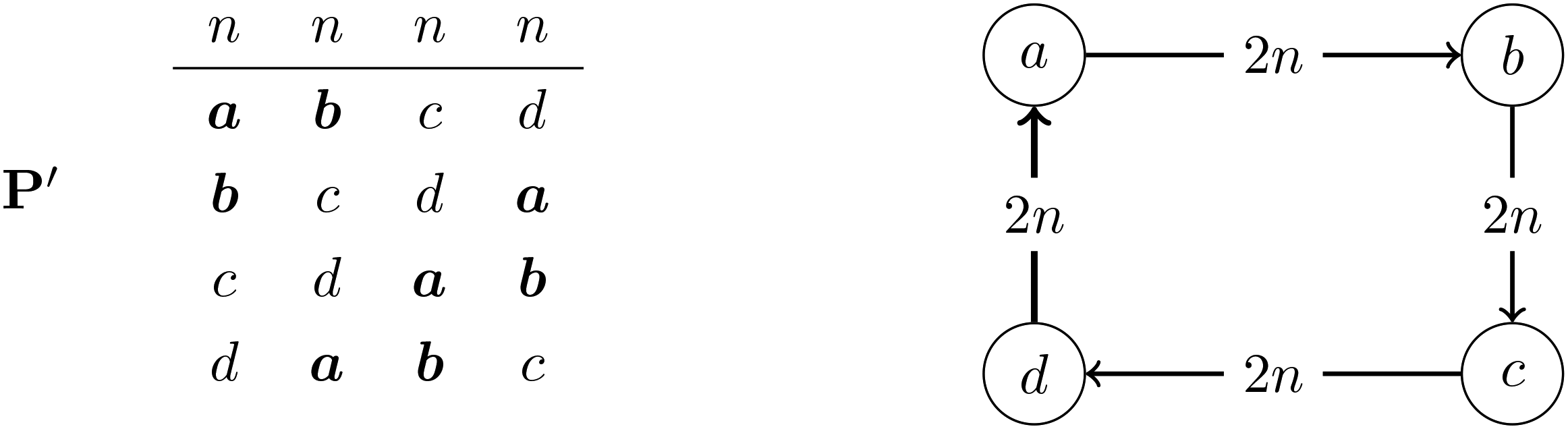
Maskin (2020) suggests the benefit of Modified IIA is that it rules out vote-splitting, which he illustrates using spoiler effects in Plurality voting as in Examples 1 and 3. However, Modified IIA is neither necessary nor sufficient for a voting procedure to have good anti-spoiler properties. Split Cycle does not satisfy Modified IIA—it correctly says that
Avoiding the Fallacy of IIA does not mean abandoning the idea behind IIA entirely.
25
We need only depart from its local evaluation of
A6. Coherent IIA: if
In Section 6.1.2, we show that Coherent IIA implies Weak IIA (Baigent 1987): if two profiles are exactly alike with respect to how every voter ranks
Split Cycle satisfies Coherent IIA.
Suppose
Unlike our proposed axioms in previous sections, Coherent IIA significantly cuts down the space of allowable VCCRs, ruling out all the VCCRs in Examples 14 and 19 except for Simple Majority. For example, it rules out the Borda VCCR as follows.
To see that Borda fails Coherent IIA, consider the following profiles
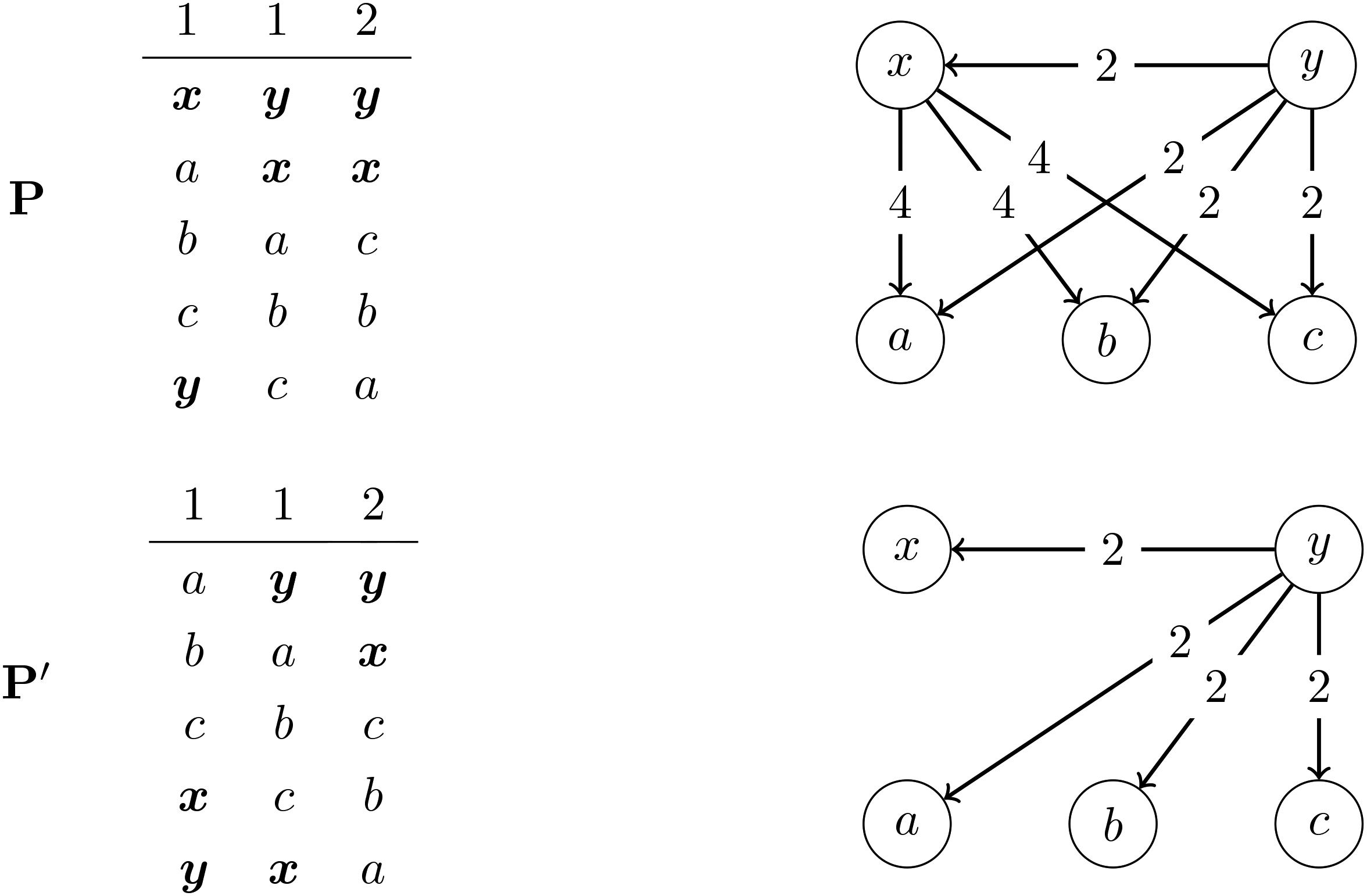
According to the Borda VCCR,
Example 62 shows that Borda fails to satisfy the principle of Majority Defeat from Section 1: if
Anonymity, Neutrality, Monotonicity (for two-candidate profiles), and Coherent IIA together imply Majority Defeat.
Suppose
Whenever an election has a Condorcet winner, Majority Defeat implies that the Condorcet winner is undefeated, but it does not imply that the Condorcet winner is the only undefeated candidate. Thus, Majority Defeat does not by itself imply Condorcet consistency.
Finally, we will show that Coherent IIA (together with Anonymity, Neutrality, and Monotonicity) rules out the kind of spoiler effects shown in Examples 1 to 3. For this, we must consider an election with and without a potential spoiler. Given a profile Immunity to Spoilers: if
Examples 1 and 3 show how Plurality voting can violate Immunity to Spoilers. In the first example, assume Gore would win in the two-candidate profile
To see how Borda violates Immunity to Spoilers, consider the following.
Let

According to Borda,
In fact, Coherent IIA (together with the other mentioned axioms) implies an even strong anti-spoiler axiom from Holliday and Pacuit 2020:
Stability for Winners (respectively, Strong Stability for Winners): if
Anonymity, Neutrality, Monotonicity (for two-candidate profiles), and Coherent IIA together imply Strong Stability for Winners.
Suppose
Thus, contrary to Maskin 2020, it is Coherent IIA rather than Modified IIA that mitigates spoiler effects.
In this section, we prove our main result using the axioms proposed in Section 4. Given VCCRs
Given a class
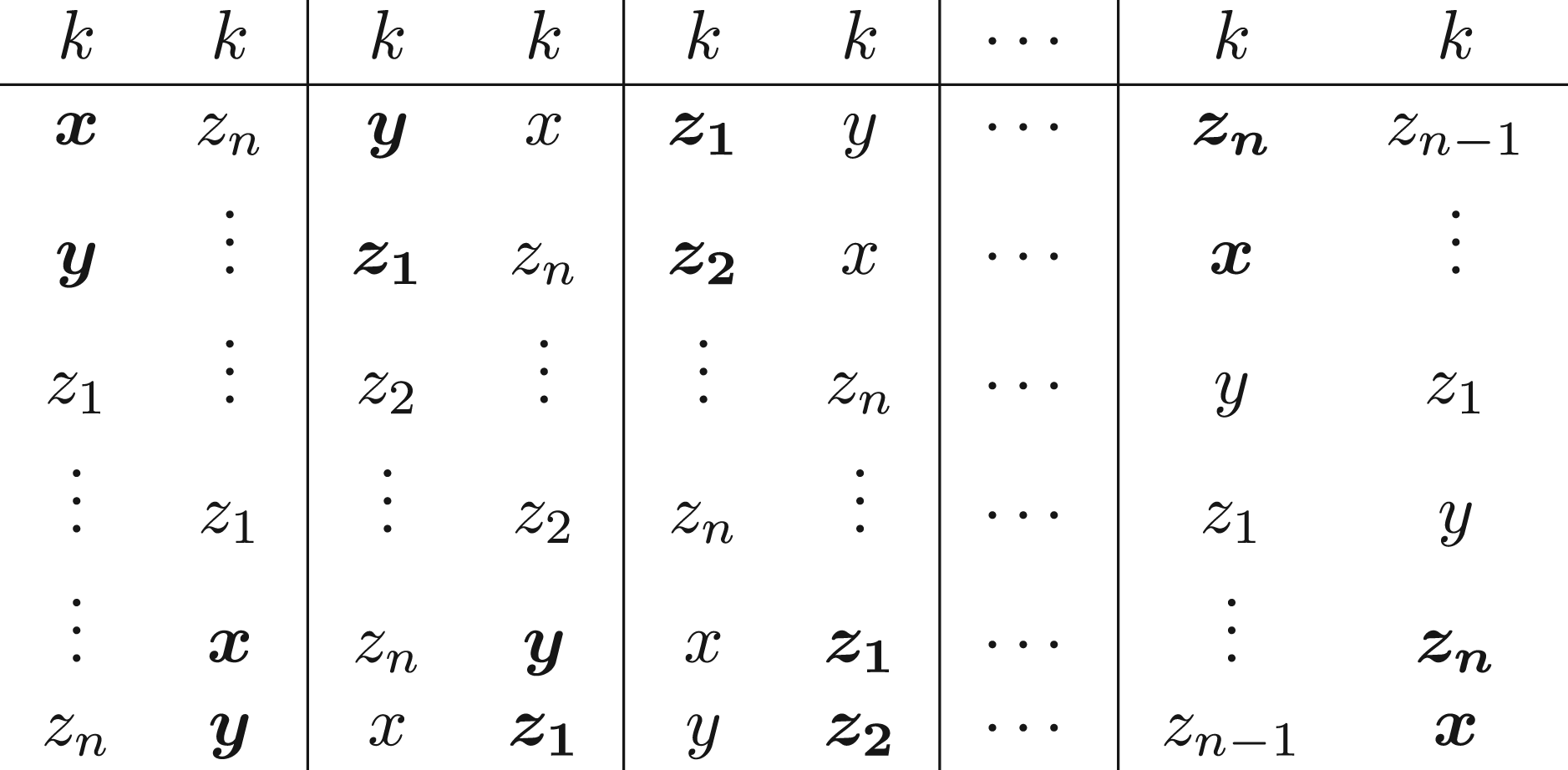
The profile
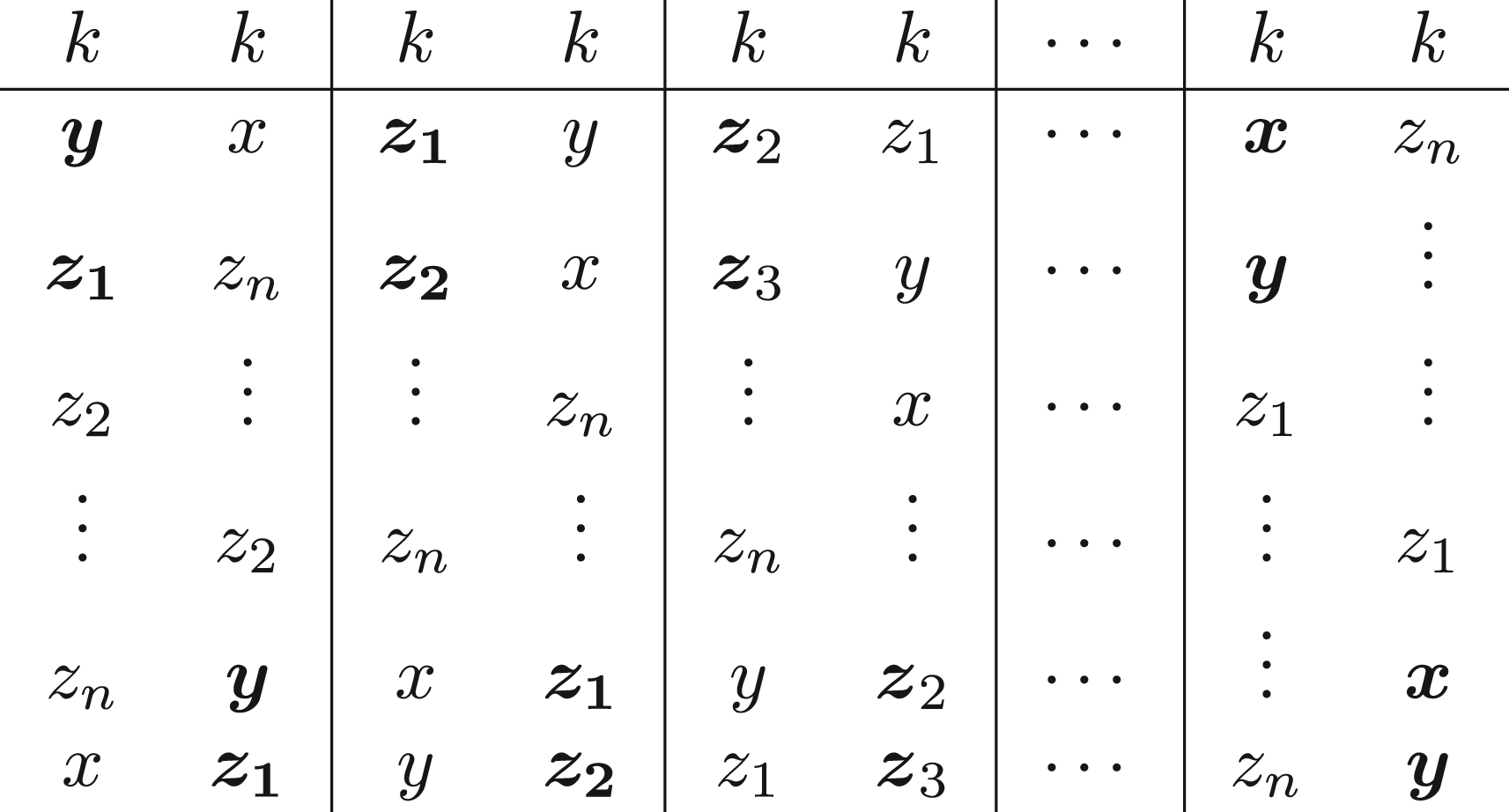
The profile
Split Cycle is the most resolute of all VCCRs satisfying the six axioms for defeat:
A1. Anonymity and Neutrality: if A2. Availability: for every A3. (Upward) Homogeneity: for every A4. Monotonicity (for two-candidate profiles): if A5. Neutral Reversal: if A6. Coherent IIA: if
We have already observed that Split Cycle satisfies the axioms. Next, we show that for any VCCR If If If
This construction uses
Now we claim that
By Neutrality,
29
since
Since
Thus, by Coherent IIA, since
Of course Split Cycle is not the only VCCR that satisfies the six axioms for defeat. For example, the null VCCR according to which no one ever defeats anyone else satisfies all six axioms—although it can easily be ruled out by other axioms that Split Cycle satisfies, such as the Pareto axiom. Another example is the VCCR according to which
Theorem 45 shows that using a VCCR other than Split Cycle requires either violating one of the six axioms for defeat or sacrificing resoluteness. For these and other reasons (see Holliday and Pacuit 2020), we settle on Split Cycle as our preferred VCCR and hence as our preferred answer to the question of when one candidate should defeat another in a democratic election using ranked ballots.
When there are multiple undefeated candidates, but a single winner must be chosen, some further tiebreaking process must select the ultimate winner from the undefeated candidates. However, we need not interpret that process as establishing additional relations of defeat between candidates in the politically significant sense of defeat. This is obvious if we randomly choose the ultimate winner from the undefeated candidates. But the point may also apply if we first make a deterministic choice of a subset of undefeated candidates before resorting to random choice if necessary.
In this section, we address the question: how does Split Cycle escape Arrow’s Impossibility theorem and related impossibility results? That is, how did we relax Arrow’s assumptions to avoid the existence of a dictator, vetoers, etc.? In Section 6.1, we recall the standard formulation of Arrow’s theorem and related results, and we explain how Split Cycle escapes these results. In Section 6.2, we reformulate these results in the variable-candidate setting in which we characterized Split Cycle. Finally, in Section 6.3, we consider some simple impossibility results based not on IIA but instead on a choice-consistency principle sometimes conflated with IIA, allegedly even by Arrow himself (see Appendix B).
Impossibility theorems in the fixed-candidate setting
Arrow’s Theorem
Arrow (1963) worked in a fixed-voter and fixed-candidate setting (see Campbell and Kelly 2002 and Penn 2015 for modern presentations). Fix nonempty finite sets
Let an
Then Arrow’s famous Impossibility theorem can be stated as follows.
32
(Arrow 1963)
Assume
Since our profiles are profiles of linear ballots, the conclusion of Arrow’s theorem can be strengthened to say that
The Split Cycle We weaken IIA to Coherent IIA.
33
We weaken Arrow’s assumption that the defeat relation is a strict weak order to it being acyclic.
Neither of these move by itself is sufficient to escape Arrow-style impossibility theorems, as we show below.
To see that weakening IIA to Coherent IIA is not sufficient, we first observe that Coherent IIA implies a weakening of IIA known as Weak IIA, which states that if
If
Suppose that
Under Weak IIA, Baigent (1987) proved an Arrow-style impossibility theorem asserting the existence of a vetoer instead of a dictator.
34
Given a
Assume
The existence of a vetoer for an SWF is inconsistent with the SWF satisfying both Pareto and Anonymity.
Suppose
Suppose there are two vetoers
As a corollary of Theorem 50 and Proposition 51, we have the following.
Assume
In light of Lemma 49, Theorem 50, and Corollary 52, only weakening IIA to Coherent IIA is not sufficient to escape Arrow-style impossibility results.
Weakening Arrow’s assumption that the defeat relation is a strict weak order to it being acyclic is also not sufficient by itself. Blau and Deb (1977) prove a vetoer theorem for acyclic CCRs under IIA together with Neutrality and Monotonicity (recall Section 4.1). Let
(Blau and Deb 1977)
Let For any partition of If
Part 2 is an immediate consequence of part 1 by considering the finest partition.
Inspection of the proof of the Veto Theorem in Blau and Deb 1977 shows that the assumption of acyclicity may be replaced by the weaker axiom of Availability (recall Section 4.1).
As an example of applying Theorem 53.1, if there are five candidates, then for any partition of the electorate into five coalitions—say, five coalitions of equal size—one of the five coalitions has veto power (and hence, assuming Anonymity, all coalitions of the same size would have veto power). Moreover, in the variable-candidate setting, we can use Theorem 53 to prove the existence of a single vetoer under a variable-candidate version of IIA (see Proposition 61 below), without the assumption that
It is the combination of weakening IIA to Coherent IIA and weakening Arrow’s strict weak order assumption to acyclicity that allows Split Cycle to escape Arrow-style impossibility theorems.
Since we have analyzed Split Cycle as a VCCR in this paper, to properly make claims about how Split Cycle relates to Arrow-style impossibility theorems, we should recast these results in the variable-election setting. In this setting, there are two versions of Arrow’s IIA.
Let
We suggest in Appendix B that if asked to formulate his axioms for VCCRs, Arrow would formulate IIA as VIIA. Our Coherent IIA is a weakening of VIIA, as Coherent IIA strengthens the assumption from
Any VCCR satisfying VIIA also satisfies Coherent IIA.
We reject VIIA in favor of Coherent IIA for the reasons explained in Section 4.3.
Arrow’s Impossibility Theorem can be stated in the variable-election setting using some additional notions. First, given a finite
Suppose If If
For part 1, let
For part 2, consider any finite
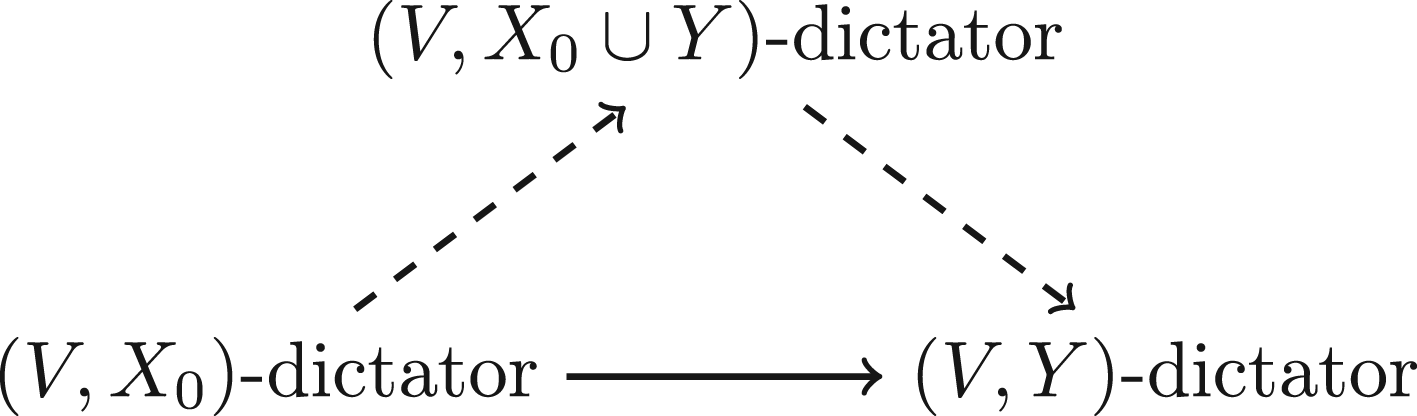
To show that any
As in Remark 48, since our profiles are profiles of linear ballots, the conclusions of parts 1 and 2 of Theorem 58 can be strengthened with “strong dictator” in place of “dictator.”
There are VSWFs satisfying Pareto and VIIA for which there is no
Just as Arrow’s theorem can be adapted to the variable-election setting, so can Baigent’s theorem (Theorem 50), which we leave as an exercise to the reader (hint: use Proposition 51 to obtain the analog of Theorem 58.2). More interesting is the reformulation of the Blau–Deb theorem (Theorem 53) in the variable-election setting—in particular, the variable-candidate setting—as VIIA allow us to strengthen the conclusion of the theorem to state the existence of a vetoer without the restriction that
To state the variable-candidate version of the Blau–Deb theorem, we need the following notions. Given finite
If
Consider any finite
Theorem 61 shows how moving to the variable-candidate setting and interpreting IIA as VIIA can strengthen impossibility theorems. But by weakening VIIA to Coherent IIA, impossibility results like Theorem 61 disappear. Split Cycle satisfies Coherent IIA, Availability, Neutrality, and Monotonicity but has no vetoer.
Our rejection of VIIA in favor of Coherent IIA also leads us to reject another well-known principle that is related to VIIA, at least under one interpretation. In particular, the term “IIA” is sometimes used in the theory of rational choice for a condition that differs from Arrow’s but also leads to impossibility theorems when applied in a certain way to voting, as explained below.
A choice function on a set
A choice function satisfies Sen’s (1971) condition

How can a choice-consistency axiom such as Sen’s the global choice function the local choice function
Intuitively, the local choice function chooses from the feasible set


The distinction between the global choice function and local choice function can be illustrated by the well-known distinction between global Borda count and local Borda count.
38
Let
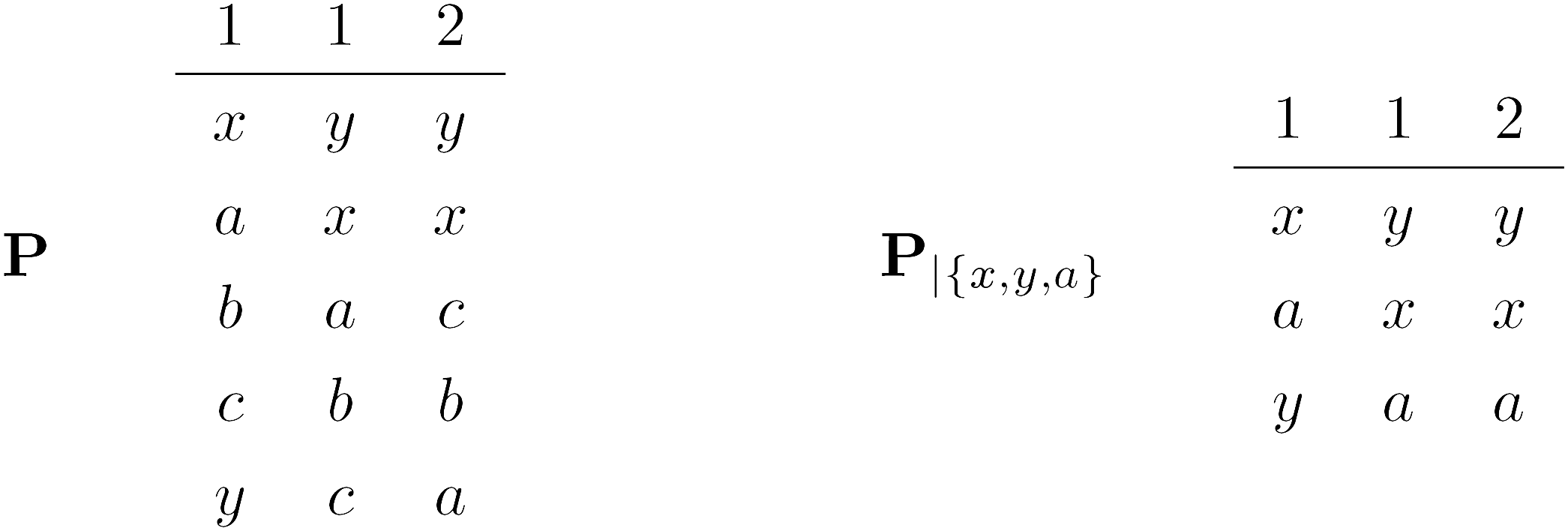
Global Borda count yields
Before using the global and local choice functions to define two senses of Sen’s
Let for any profile
Suppose
Hence
Suppose condition 2 holds. Consider profiles
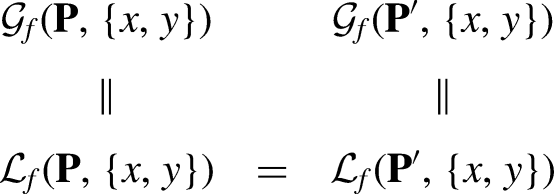
The vertical equations hold by condition 2, while the horizontal equation holds since
Assuming we weaken VIIA, we can make the local–global distinction and hence distinguish two senses of Sen’s
Let
To illustrate this definition, let us return to the discussion of Borda count from Example 62.
To see that the Borda VCCR


It is no accident that the Borda VCCR satisfies Global-
If
The claim that
Let us now consider Local-
If There are acyclic VCCRs satisfying Local-
For part 1, assuming that
For part 2, let
Although weaker than VIIA, Local-
A VCCR
We have the following easy impossibility result.
There is no VCCR satisfying Local-
Consider a profile
Combining Propositions 67.1 and 69, we have the analog of Proposition 69 under VIIA.
There is no VCCR satisfying VIIA, Availability, and Binary Majoritarianism.
Finally, let us come full circle and return to voting methods in the sense of Definition 6, as opposed to VCCRs. What are the implications of the impossibility result above for voting methods? To answer this question, we first adapt the definition of
A voting method
Simply put,
If
Since
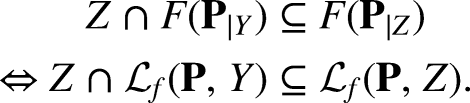
We can now answer our question about voting methods with the following impossibility result, whose proof is easily obtained by adapting that of Proposition 69.
There is no voting method satisfying
As a voting method (respectively, VCCR) Split Cycle satisfies Binary Majoritarianism but not
The same example used against IIA in Example 36 can be adapted to argue against Local-

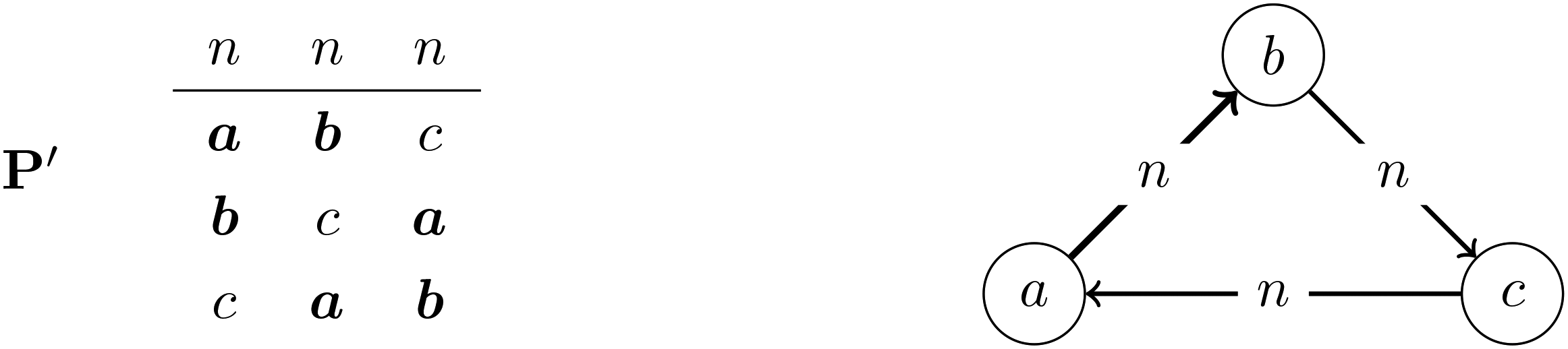
In the context of the perfectly coherent profile
Our conclusion concerning
The pessimistic conclusions about democracy that some have drawn from the Paradox of Voting and Arrow’s Impossibility Theorem are not justified. Like most voting theorists, we are more optimistic. In particular, we believe that many majority cycles can be resolved in a rational way, while respecting the principle of Majority Defeat, as shown by Split Cycle. Of course there remain some cycles, such as a perfect cycle
Far from justifying pessimism about democracy, social choice theory leads the way to voting procedures that can improve democratic decision making. We agree with Maskin and Sen (2017a, 2017b) that a major improvement would come in replacing Plurality voting with a voting procedure using ranked ballots that elects a Condorcet winner whenever there is one. In this paper, we have arrived at a unique collective choice rule, Split Cycle, via six axioms concerning when one candidate should defeat another in a democratic election—with the key axiom being the axiom of Coherent IIA that weakens Arrow’s IIA and explains why the latter is too strong. As theorists, we sleep well at night knowing that we have a solid theoretical justification for handling majority cycles in a certain way should they arise. As citizens and committee members, we hope that in practice our elections will have Condorcet winners and that we will elect them.
Footnotes
Acknowledgements
We thank Mikayla Kelley, John Patty, and the two anonymous referees for the Journal of Theoretical Politics for helpful comments. We are also grateful for useful feedback received at the Work in Progress Seminar and Logic Seminar at the University of Maryland in July 2020 and at the FERC reading group at UC Berkeley in August 2020.

Notes
Appendix A. Proofs for Section 3
Appendix B. Arrow’s alleged confusion and VIIA
Arrow has been accused of confusing his own condition of IIA, an interprofile condition, with a choice-consistency condition such as Sen’s
In contrast to global choice FIIA, which is a significant restriction on an acyclic VCCR, local choice FIIA is no restriction.
Now consider one of Arrow’s (1963, 26) supposed arguments for IIA: Suppose that an election is held, with a certain number of candidates in the field, each individual filing his list of preferences, and then one of the candidates dies. Surely the social choice should be made by taking each individual’s preference lists, blotting out completely the dead candidate’s name, and considering only the orderings of the remaining names in going through the procedure of determining the winner. That is, the choice to be made among the set
We agree with the literature cited above (Hansson 1973; Ray 1973; Suzumura 1983) that this is not an argument that one’s VCCR should satisfy IIA. But neither is it an argument that one’s VCCR should satisfy Local-
However, Arrow does not officially make the distinction between the global and local choice functions. He only officially defines the global choice function induced by a CCR. 40 But if in the example above, Arrow wants the global choice function to act like the local choice function, this leads to VIIA according to Proposition 63. Thus, one can understand the otherwise puzzling example of the dead candidate as possibly related to Arrow’s implicit commitment to VIIA.
Arrow (1963, 27) gives another supposed argument for IIA, based on the Borda count: [S]uppose that there are three voters and four candidates,
Let since since since since
In fact, options 2, 3, and 4 are equivalent. Since Arrow only officially discusses the global choice function induced by a CCR, he could not have officially meant 3 or 4. Moreover, since Arrow assumes that all of the profiles in the domain of a given SWF have the same set of candidates, he could not have officially meant 2, which requires that both
Arrow’s passage above certainly shows that the Borda VCCR