



Abstract
Why do some poor people engage in clientelism whereas others do not? Why does clientelism sometimes take traditional forms and sometimes more instrumental forms? We propose a formal model of clientelism that addresses these questions focusing primarily on the citizen’s perspective. Citizens choose between supporting broad-based redistribution or engaging in clientelism. Introducing insights from social psychology, we study the interactions between citizen beliefs and values, and their political choices. Clientelism, political inefficacy, and inequality legitimation beliefs reinforce each other leading to multiple equilibria. One of these resembles traditional clientelism, with disempowered clients that legitimize social inequalities. Community connectivity breaks this reinforcement mechanism and leads to another equilibrium where clientelism takes a modern, instrumental, form. The model delivers insights on the role of citizen beliefs for their bargaining power as well as for the persistence and transformation of clientelism. We illustrate the key mechanisms with ethnographic literature on the topic.
1. Introduction
The last few decades brought a wealth of new insights on the nature, mechanics, and drivers of clientelism. We have learned a great deal about party strategies (e.g., whether to target swing or core voters) and the mechanics of the exchange (e.g., the role of monitoring, reciprocity, and brokers). The literature made particular strides in understanding vote-buying, which it has come to view often as synonymous with clientelism. 1 We have learned far less about why voters engage in clientelism. The calculations of voters have remained relatively simplified, mostly involving a simple trade-off between material benefits from clientelism and expressive benefits from voting for a programmatic alternative. The key result is that poorer individuals tend to sell their votes because their marginal utility of material benefits offered for their votes is higher (see Dixit and Londregan, 1996; Stokes et al., 2013). Variation in the poor’s engagement in clientelism is mostly explained as the result of differences in party targeting (e.g., Finan and Schechter, 2012; Gans-Morse et al., 2014; Stokes, 2005)
The current emphasis on the supply side of the vote-buying variety of clientelism has left two significant gaps in our understanding. First, the political choices of the poor remain inadequately understood. Although clientelism indeed correlates with poverty (Brusco et al., 2004; Justesen and Manzetti, 2017; Stokes et al., 2013) and the mechanism in the literature explaining this correlation is compelling, poor individuals often purposefully establish political linkages other than clientelistic ones. A relevant literature on demand for redistribution argues that the poor ought to support political platforms promising income redistribution, precisely because their low income implies that they stand to gain the most from it (Alesina and Giuliano, 2011; Alesina and La Ferrara, 2005; Meltzer and Richard, 1981). The apparent contradictory conclusions of these two strands of literature suggest that factors in addition to income may matter for the poor’s political choices. Second, the focus on vote-buying (or one-shot, material exchanges for votes) fails to shed light on the variation in forms of clientelism. As evidenced by classical literature on the topic (see the articles in Schmidt et al. (1977)), and increasingly acknowledged by current research (e.g., Hilgers, 2009; Lawson and Greene, 2014; Nichter, 2014, 2018; Pellicer et al., 2020), clientelism not only exists in its one-shot election-time instrumental form, but also in forms involving long-standing relations of insurance and support. These ‘traditional’ or ‘relational’ forms of clientelism may include affective ties and are embedded in social norms and personal relationships. Importantly, this type of clientelistic relationship is not a phenomenon of the past, but often still forms the backbone of modern, machine-style clientelistic organizations at the local level or organizes votes for candidates in the absence of such machines (Gottlieb, 2017; Lemarchand, 1972). Reaching a more complete understanding of clientelism requires considering both forms of exchanges.
Following these observations, this paper seeks to address two core questions. First, what factors other than income drive the choice between clientelism and redistribution? Second, under which circumstances do the poor engage in traditional forms of clientelism, socially embedded, hierarchical, personal, and long-term, rather than in modern, essentially vote-buying, types?
We argue that broadening the theoretical framework of clientelism choice can yield insights into the two questions posed here. We propose to broaden this focus by integrating recent research from social psychology, and in particular on the legitimation of inequality. Prominent theories in social psychology such as ‘belief in a just world’ or ‘system justification’ argue that it can be psychologically adaptive in certain contexts to legitimize inequality (Jost et al., 2004; Lerner, 1982). Social psychology work on collective action argues that inequality delegitimation is one of the key psychological prerequisites of horizontal mobilization (Jost et al., 2012; Van Zomeren et al., 2008)). These insights have already expanded our understanding of demand for redistribution beyond material determinants (Alesina and Giuliano, 2011; Benabou and Tirole, 2006). Integrating inequality legitimation into the study of clientelism can also help understanding why some poor people engage in clientelism and others do not, and why some engage in traditional versus modern types of clientelism.
This article proposes a model that incorporates recent social psychology work on inequality legitimation to the study of clientelism. The model has the following key features. First, citizens choose whether to engage in clientelism or support a redistributive platform. Second, citizens hold efficacy perceptions concerning the chances of success of the redistributive platform, and perceptions on the legitimacy of inequality. Third, efficacy perceptions and inequality legitimation values are endogenously determined and interact with clientelism choices to generate different types of equilibria.
The model delivers three equilibria. One equilibrium features a high degree of inequality legitimation, low perceptions of efficacy, and widespread clientelism, the characteristics of traditional clientelism. A second equilibrium features the opposite characteristics, with the poor strongly condemning inequality and supporting the redistributive platform.
The key mechanism generating these equilibria is the complementarity between the extent of clientelism, perceptions of inefficacy, and legitimation of inequality. Perceptions of inefficacy induce citizens to believe that inequality is inevitable; facing this prospect they adapt psychologically by legitimizing inequality. Legitimizing inequality, in turn, leads them to better tolerate clientelism, leading to more clientelism, more inefficacy, and even more inequality legitimation.
These complementarities, however, can break down when communities become more informationally connected. This leads to a third equilibrium where clientelism and support for redistribution co-exist. Crucially, inequality in this equilibrium is not legitimized by the poor, in contrast to the traditional clientelism equilibrium. Clientelistic exchanges in this form can be considered more instrumental from the citizen’s perspective, corresponding to vote-buying or modern clientelism.
The results of the model emphasize the role of clients and their beliefs for the characteristics and dynamics of clientelism. First, the fact that clients in traditional settings legitimize inequality decreases their bargaining power and leads them to get a worse deal out of clientelism than in modern settings. Second, and related, the legitimation of inequality in traditional clientelism also makes it resilient and stable, requiring massive alterations of the environment in order for it to be eliminated. However, both the legitimation of inequality and the traditional form of clientelism that it supports can be gradually eroded. This can occur with increasing informational connectivity of the community, leading to a transformation of clientelism into a modern type. We illustrate the model’s core insights with work from the ethnographic literature.
Our insights complement existing work on the role of supply factors for the bargaining power of clients (Corstange, 2018; Hilgers, 2009; Shami, 2012). We also contribute to an ongoing debate about the factors driving the persistence and decline of clientelism. So far, studies emphasize socio-economic or institutional factors and focus on the transformation of clientelistic into platform-driven, programmatic, politics (Bustikova and Corduneanu-Huci, 2017; Kitschelt and Kselman, 2013; Stokes et al., 2013). Our paper considers a potential transformation of traditional-style into electoral clientelism in addition to programmatic politics and shows how client beliefs affects these pathways. Our focus on the agency of clients and the important role clients play for the persistence of different types of clientelism links with an important nascent body of work in political science that puts the perspective of the citizen center stage (Kramon, 2016; Nichter, 2018; Nichter and Peress, 2017).
More generally, our model adds to the important growing literature that emphasizes the endogenous determination of values and perceptions of citizens for understanding political choice and political outcomes (Acharya et al., 2018; Minozzi, 2013). In our model, it is precisely the feedbacks between political choices and perceptions that drives our key insights on different types of clientelism. The psychological complementarity that underlies our results, between inefficacy and inequality legitimation, has received support in recent experimental work in social psychology and economics (Johnson and Fujita, 2012; Kay and Friesen, 2011; Pellicer et al., 2018; Van der Toorn et al., 2015).
The model also has important limitations. In particular, our aim to bring detail to the political choices and perceptions of the poor leads us to make simplifying assumptions which are needed to keep the model tractable. First, the model considers the supply side only in an extremely simplified way: we consider that there is a patron that chooses the level of clientelistic transfers, but the choice of the patron is modeled in the simplest possible way. The model does not consider politicians competing in elections. This implies, among other things, that we do not consider the credibility problems often addressed in clientelism models (Gallego, 2015; Keefer and Vlaicu, 2008; Robinson and Verdier, 2013; Stokes, 2005). The model is best thought of as representing informal political mobilization rather than formal voting, i.e., a model about grassroots mobilization in the pursuit of broad-based redistribution. Second, the model focuses particularly on poor individuals that stand to gain from redistribution; this implies that the model is best thought of as describing a community with high levels of inequality where the overwhelming majority of citizens are relatively poor. Third, the political choice we consider for the poor is a stark one between engaging in clientelism and supporting full redistribution. A priori this could appear to restrict its applicability to situations where there is a credible redistributive party, a situation not present in many developing countries. However, our interpretation of the model in terms of community mobilization renders it more widely applicable. The ethnographic literature provides ample evidence that a key trade-off faced by prospective clients in a variety of settings is between clientelistic benefits and horizontal grassroots organizations (e.g., Fernández et al., 2017; Holzner, 2004; Mitlin and Mogaladi, 2013; Rutten, 2007; Svampa and Pereyra, 2009).
2. Static model of clientelism
2.1. Set-up
General set-up
We consider a society of citizens (indexed by
The main decision that citizens take is between engaging in a clientelistic relationship with the rich patron or supporting a redistributive platform. The redistributive platform might achieve a given level of income redistribution (yielding
Each citizen holds an individual belief regarding
Citizens care about their income as well as about inequality and its legitimacy. We denote individual beliefs on how much inequality is delegitimized by
The timing of the model is as follows. First, individuals are born with benchmark efficacy
We assume that the actual probability of redistribution
Utility and choices
We assume that citizen’s utility depends on their income, and on their views of inequality and its legitimacy. We capture inequality by the difference between mean income and citizen’s income

The first two terms are the utility from net income, which we assume as linear for simplicity. Even if the individual chooses clientelism, successful redistribution might still occur, with perceived probability
The second term is the utility consequences of inequality. A key innovation of the model is the manner we introduce these consequences. Typically, inequality is introduced directly in the utility function as inequality aversion. It is considered that inequality generates disutility to the individual, and the strength of aversion depends among others on how legitimate the income distribution is viewed (Alesina and Giuliano, 2011). This corresponds to
The social psychology literature, however, provides a more nuanced account that focuses on the self-esteem consequences of legitimizing or delegitimizing inequality. In a synthesis of social psychology theories, Major and Schmader (2001) argue that perceiving inequality as illegitimate can be protective in the short run, but is harmful if sustained ‘chronically.’
5
We model this in the simplest possible way by considering that viewing inequality as illegitimate (high
We now consider citizen’s utility when supporting the redistributive platform. We assume that if an individual chooses to support the redistributive platform, she believes that her choice increases the chances of redistribution from
Citizens’ utility in case of supporting the redistributive platform is, thus,

Citizens choose whether to engage in clientelism or support the redistributive platform by comparing
Citizens are able to determine the degree of inequality delegitimation beliefs to maximize their self-esteem. We assume that citizens can choose a set of behaviors and information processing choices conductive to a given inequality delegitimation belief

The weight
For simplicity, we assume that citizens choose

where this maximand depends on benchmark efficacy
The level of transfers offered as a clientelistic inducement

Equilibrium
To close the model, we impose a rational expectations equilibrium condition. In particular, benchmark efficacy
Formally, the equilibrium of the model is a benchmark efficacy
(1) citizen

(2) the true probability of redistribution

and the level of clientelism is the complementary share
(3) the patron chooses transfers

(4) choice


thus

(5) citizens have rational expectations in the sense that

2.2. Results static model
The model delivers multiple equilibria as shown in the following proposition. 8
There are three possible equilibria:
traditional clientelism,
modern clientelism,
no clientelism,
Using the subscript

The model delivers three possible equilibria. Two of them are extreme, one with full clientelism, minimum efficacy, and the least possible inequality delegitimation
In addition to these extreme equilibria, there is also an intermediate one. In this equilibrium, levels of efficacy, clientelism, and inequality legitimation are intermediate. We denote this equilibrium ‘modern clientelism’ because it does not involve the legitimation of inequality.
The multiplicity of equilibria result from two types of complementarities in the model. In order to understand how these complementarities come about, we explain the result in three steps. First, we consider how the actual probability of redistribution
Figure 1 shows how the probability of redistribution
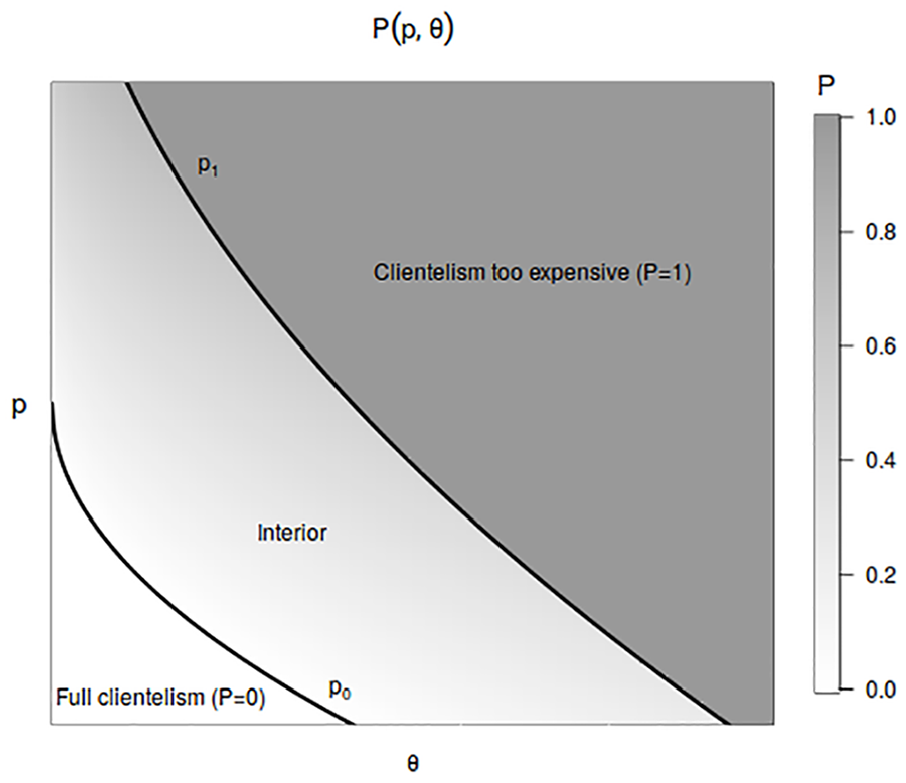
Probability of redistribution
The probability of redistribution
The clientelism choices of citizens also depend on the level of transfers
Figure 1 shows the probability of redistribution
Benchmark efficacy
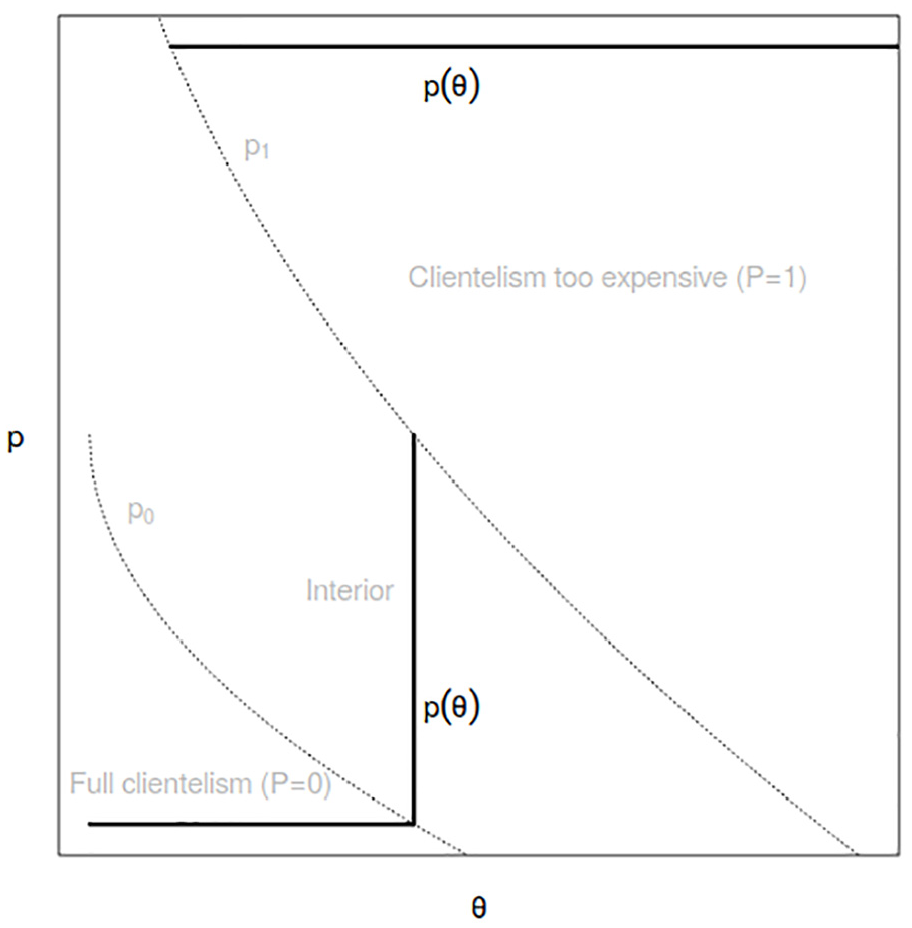
Benchmark efficacy levels consistent with rational expectations.
The figure shows that it is possible to ‘rationally’ sustain high, medium, and low benchmark efficacy beliefs in this model. In other words, a priori,
However, as the figure shows and the notation
The third and final step of the model solution integrates the endogeneity of delegitimation beliefs
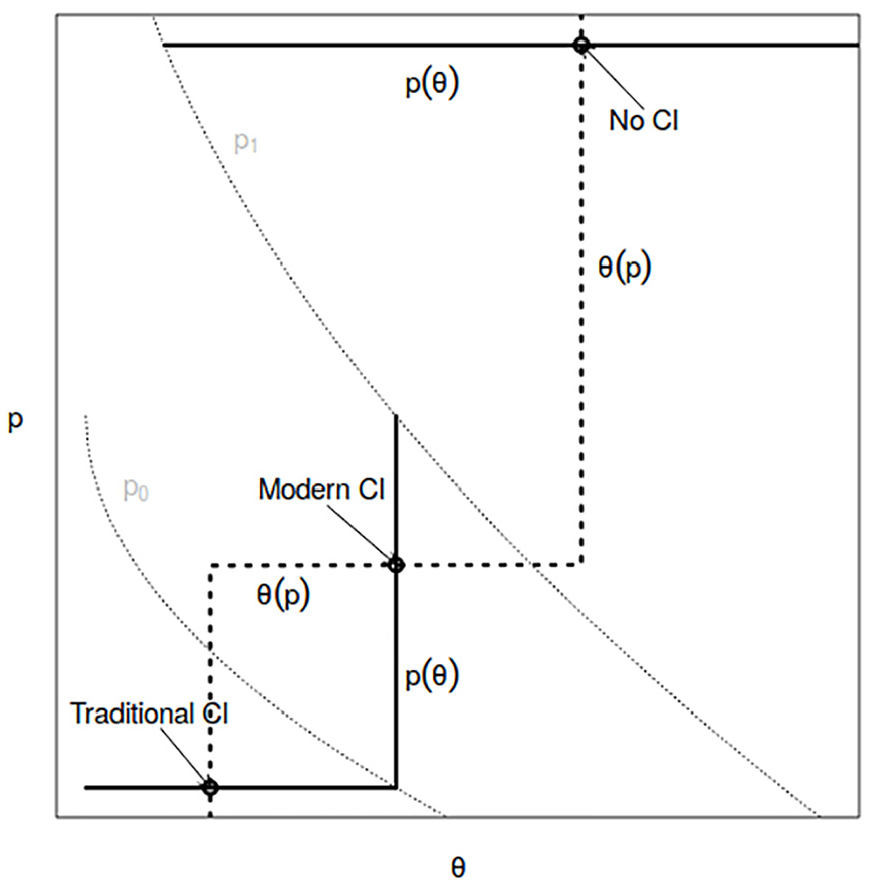
Static equilibria.
The schedule
The equilibria of the model are the intersections between the schedules
The second part of Proposition 1 shows that clients get a better deal from clientelism in the modern clientelism equilibrium relative to the traditional one. The decomposition shown in the proposition shows that there are two reasons for this.
First, the delegitimation of inequality in the traditional clientelism equilibrium
Second, even for given inequality delegitimation, there is a positive difference between the transfers in the two equilibria. This difference comes the fact that the traditional clientelism equilibrium features ‘full clientelism’ (the transfers chosen by the patron are a corner solution); whereas the modern clientelism equilibrium features citizens at the margin between clientelism and redistribution (transfer choice is an interior solution). The patron gives more transfers when transfers are useful, and transfers are more useful when they manage to sway many voters. When there are few or no ‘marginal’ voters (as in the traditional clientelism equilibrium), the patron can afford to lower transfers without losing much.
3. Dynamic extension
The static equilibrium tells us that communities may end up being highly redistributive, or clientelistic in the traditional or in the modern sense. We consider here a dynamic extension of the model that provides insights on the conditions under which communities will converge to each of these equilibria.
In keeping with the paper’s focus on the client, and in particular on client’s perceptions, we keep the patron side as simple as possible, and focus on the dynamics of clientelism, efficacy, and inequality delegitimation beliefs.
3.1. Set-up
In the dynamic extension, each citizen has one offspring, and dynasties are indexed by
There are two main additions to the static model. First, the choice of inequality delegitimation is made (arguably) more realistic. In the static model, individuals themselves selected their own delegitimation beliefs. Now we assume that the level of delegitimation belief of generation
Second, in order to keep the model tractable, we assume that income is generated from capital
The timing is as follows. Citizens, again indexed by
Most of the elements of the model remain as in the static model. The utility function of citizens when choosing clientelism or support for redistribution
As before, actual delegitimation perceptions are a combination of (parental) choices and the ‘true’ (il)legitimacy of inequality in the community

The weight
In addition, as before, we assume that parents transmit legitimation values in order to maximize self-esteem, in this case their children’s. However, it is reasonable to assume that there are adjustment costs in the transmission of values, in the sense that it is psychologically costly for parents to transmit values far away from those they believe themselves. For simplicity, these costs are assumed to be quadratic. The maximization problem of the parent is therefore

Because, in this case, the solutions to the maximization problem are bounded, it is not necessary to impose the additional condition that
In the static model, we imposed rational expectations in the formation of benchmark efficacy beliefs
For completeness, we assume there are exogenously given initial levels of capital, benchmark efficacy, and inequality delegitimation at the start of life of generation 0:
3.2. Dynamics and stable steady states
The dynamic model yields the following key result.
If, for given
- there are two stable steady states, the traditional clientelism steady state and the no clientelism steady state;
- if initial levels of efficacy and/or inequality legitimation are low, communities will converge to the traditional clientelism steady state; otherwise, they will converge to the no clientelism steady state.
If, for given
- there are two stable steady states, the modern clientelism steady state and the no clientelism steady state;
- communities will converge towards the modern clientelism steady state unless initial efficacy and inequality delegitimation are sufficiently high to make clientelism not worth it for the patron.
Proposition 2 states that the path that a community follows depends on the extent of diversity of opinion in the community, on how much influence parents have on children’s values, and on its starting levels of efficacy and delegitimation. Figure 4 illustrates the main results, depicting the dynamics of the system for the two regimes in the proposition.
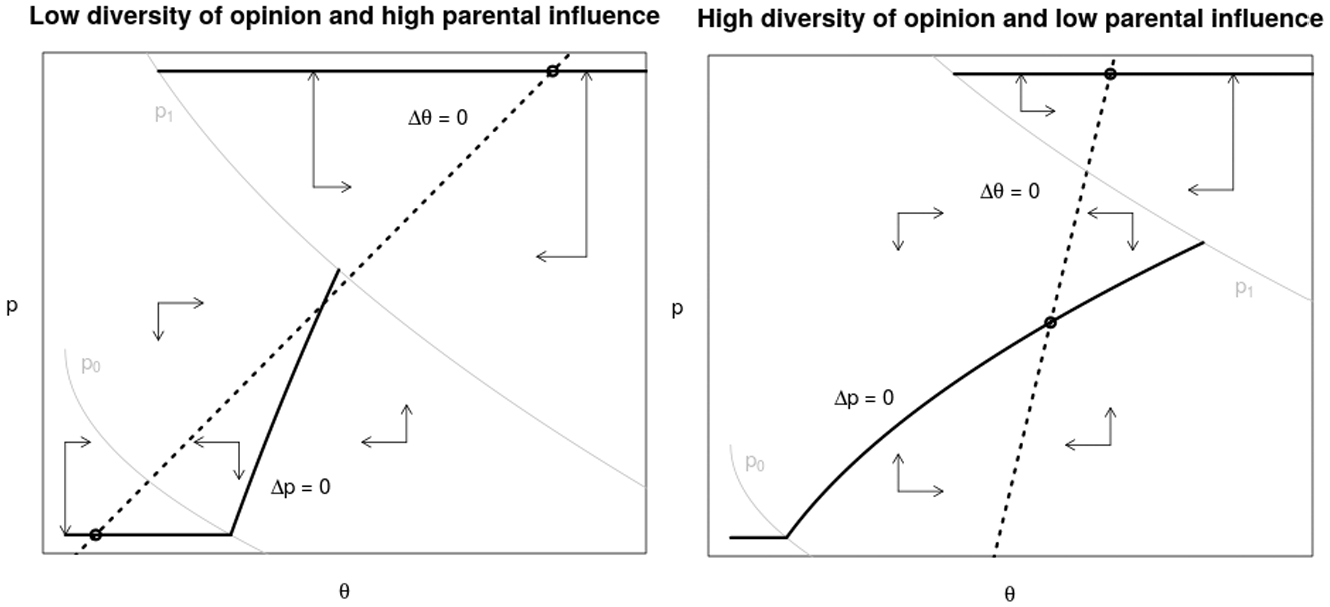
Dynamics.
To understand Figure 4, it is useful to recall the solution of the static model. The graphs in Figure 4 are very similar to the graph for the static equilibrium in Figure 3. Both have as axis efficacy
There are two important differences between the static and dynamic figures. First, we now have information on how the system moves outside these resting positions. This is given by arrows in the figure. This gives us which equilibria are stable and which are unstable. Second, in contrast to the static model, the slopes of the equilibrium curves are neither horizontal nor vertical. They now depend on the parameters, and in particular the parental influence parameter
Proposition 2 states that traditional clientelism will be stable if there is little diversity of opinion in the community and if parents have a major influence on their children’s values (low
The intuition behind this result is that high diversity of opinion and low paternal influence tend to break the complementarities that support traditional clientelism. When there is little diversity of opinion, the dynamic path of efficacy is explosive: efficacy tends to go towards extremes where either everyone becomes a client or no one does. Then, the complementarity between inefficacy and clientelism in the static model prevails. If efficacy is low, essentially everyone will find it worthwhile to engage in clientelism; the next generation will have as benchmark a perception of almost zero efficacy, and the society will remain clientelistic. Diversity of opinion, however, can break this cycle. If idiosyncratic shocks are sufficiently large, even in a situation where most parents are clientelistic, there will be a substantial amount of children that are exposed to experiences that lead to entertain relatively high efficacy, and the society will avoid becoming totally clientelistic. Efficacy will then tend to converge towards intermediate values.
Regarding, inequality delegitimation, there are two forces that govern its dynamics. First, there is a tendency to go towards the ‘true’ level
The relative importance of ‘reality’ considerations versus parental influences is determined by
A good way to summarize this discussion is to interpret Proposition 2 in terms of the degree of informational connectivity of the community towards the outside world. The complementarities that drive traditional clientelism in the dynamic model rest on the intergenerational linkages of efficacy and legitimation. It is the parental clientelism choices and their attempts at protecting children self-esteem that set the community in a path towards traditional clientelism. These intergenerational linkages are most prominent in informationally isolated communities. In communities that are strongly connected to the outside world, alternative external political narratives have a stronger contribution on children perceptions. This breaks the complementarities between inefficacy, clientelism, and legitimation, and allows the community to settle in an intermediate equilibrium. Proposition 2 can be interpreted as saying essentially that traditional types of clientelism are more likely to occur in informationally isolated communities. As communities become more informationally connected, clientelism may transform into a more instrumental, ‘modern’ type.
Whereas the type of clientelism equilibrium that is stable depends on parameters, the ‘no clientelism’ equilibrium at the top right of the graphs is always stable, regardless of diversity of opinion or the extent of parental influence. Communities end up in the no clientelism equilibrium if citizens start (or exogenously become) sufficiently efficacious and delegitimizing. Then, the community gets into a definitive path away from clientelism with no turning back: citizens become too expensive and the patron gives up clientelism.
4. Discussion
The model delivers insights on different types of clientelism, and on how traditional clientelism may transform into a modern variety. This section discusses these mechanisms and illustrates them with examples from the literature.
4.1. Traditional and modern clientelism
An important insight from the model concerns different types of clientelism. The model predicts two types of clientelistic equilibria, ‘traditional’ and ‘modern,’ that differ in inequality legitimation, stability, and in the benefits that the clients obtain.
The distinction between traditional types and modern types of clientelism is clearly made by scholars of clientelism in the 1960s and 1970s (e.g., Weingrod, 1968). Traditional clientelism is embedded in social relations, involves an exchange of loyalty in a setting viewed as largely legitimate by the clients, and is considered to be more durable and stable. Modern clientelism, such as machine clientelism or vote-buying, is generally viewed as a one-shot and largely anonymous quid pro quo exchange of money or small goods for votes.
The term traditional might lead to the misperception that this form of clientelism is waning or outdated. Traditional ties often underlie clientelistic exchanges. Even in settings that appear ‘modern,’ the type of clientelism experienced from the client’s point of view, is often closer to the traditional type. Discussing the operation of party machines in African countries in the 1960s, Lemarchand (1972) described the ‘neo-traditional machine,’ in which ‘traditional micro-level solidarities provide the essential linkages between the party and the masses.’ In this case, he argues, ‘the machine is superimposed upon, and in some ways tributary to, the clientelistic subsystem’ (p. 114). Similarly, Archer’s (1990) analysis of broker clientelism in Colombia shows that a ‘primary’ patron–client cluster ‘strongly dependant on kinship and localist ties is the basic building block’ of these modern networks (pp. 22–23). Such primary relationships involve high levels of affect and respect (p. 31) as in the traditional form of clientelism. More recently, Gottlieb (2017) and Kramon (2017) also noted the importance of traditional leaders as brokers in clientelistic exchanges in some African countries.
Legitimation
One of the main differences between the two types of clientelistic equilibria in the model is the degree of inequality legitimation by citizens. In particular, citizens are predicted to legitimize social inequalities in the ‘traditional’ steady state. It is this distinction that largely warrants the use of the terms traditional versus modern.
Legitimacy is one of the key notions in the characterization of traditional forms of clientelism. Traditional clientelism involves ‘loyalty’ and ‘deference’ from the client’s side and affection as a key feature of the links between client and patron (Landé, 1977: p. XXIX). These ties are often likened to father–children relations, where the patron affords protection and security and the client reciprocates with deference and respect. Accordingly, Silverman’s (1977) work on clientelism in Central Italy notes the ‘close connection between “patronage” and “paternalism”’ (p. 297).
More recent ethnographic work suggests a similar role of paternalism and deference in traditional clientelistic ties. Arghiros (2001) described patrons in traditional forms of clientelism in Thailand as ‘archetypal paternalistic and authoritarian leader,’‘respected by villagers of all ages’ (pp. 74–75). Paller’s (2014) work on political patrons (‘big men’) in urban Ghana argued that ‘leaders are expected to be the patriarchs not only of their biological families, but also of a broader constituency’ and become ‘the head of a group of followers who perceive their leader as a father figure’ (p. 127).
A somewhat different way of legitimizing unequal relations is the traditional-style broker client relations described by Auyero (1999, 2000) in present-day Argentina. Instead of perceiving patrons as father figures, they are described as ‘friends.’ Clients depict brokers as ‘being so good’ or ‘always lending a hand.’ Although brokers control material resources on which clients rely, clients de-emphasize and rationalize the inequality in their relationship. Similarly to more standard traditional relations, the unequal status-quo in which the relation takes place is not put into question by the clients.
In contrast, modern clientelism is typically characterized as an exclusively material transaction involving purely opportunistic patrons and clients. Rather than legitimizing the relationship or inequality in general, clients are portrayed as having a highly cynical attitude towards politicians (Becerra Mizuno, 2013; Gay, 1998; Lazar, 2004). This attitude is exemplified by a vote-seller in the Dominican Republic: ‘(the parties) are all the same. They come around during elections, and never again. If I can get a few pesos for voting, then that’s enough for me’ (Gonzalez-Acosta, 2008).
Stability
The dynamics of the model suggest that modern clientelism will be relatively fluid, whereas traditional clientelism will be very stable. In the modern case, any change in parameters will affect the schedules
Indeed, in the literature, one of the key characteristics of traditional clientelism is its stability. Moreover, as in the model, authors link this stability directly to legitimacy (Archer, 1990; Powell, 1970; Silverman, 1977; Weingrod, 1968). An example of the role of legitimation practices for the resilience of clientelistic relations is given by the work of Foltz (1969) on Senegal. A ‘patron does not buy client’s support and recognition’ (emphasis in the original). ‘Public gift-giving is a patterned process, designed to ennoble the giver and reflect “high concern for honor”, not an underhanded and reprehensible attempt to buy support and status.’ Thus, the author concludes: ‘As such, it is a particularly difficult pattern to extirpate, and one that is likely to continue to pervade many aspects of Senegalese life’ (p. 244). Other authors note how the stability of traditional clientelism is cemented by creating vertical kinship between patron and client, for example by patrons becoming godfathers of clients’ children (e.g., Archer, 1990; Silverman, 1977).
Authors have also noted how the legitimation patterns in traditional clientelism may delay horizontal mobilization, as in the model. As Silverman (1977: pp. 296{297) observes, ‘the paternalism of the mezzandria [the landlord–peasant relation giving rise to “traditional” clientelism], has often been pointed to as a factor in delaying the spread of labor agitation to the Central Italian hill region for several decades after its onset in many agricultural areas of the nation about 1870.’
Client’s benefits
The model suggests that clients will receive a better deal in modern settings relative to traditional ones. This point has been frequently made in the literature. The argument is usually made from the supply side. Modern clientelism has brought an increase in patron competition that decreases their relative bargaining power (Corstange, 2018; Hilgers, 2012: e.g.,).
Our model complements this insight by focusing on the demand side. In the model there are two reasons why traditional clients get a worse deal. First, traditional steady states are situations of full clientelism, where the patron has already secured the whole community and can thus afford to save on transfers. This is also about competition: it is the fact that the patron does not need to compete for clients in traditional settings that gives her extra bargaining power. Our model adds to the literature in showing that competition need not be about how many patrons there are, but more generally about the availability of other valued political alternatives for clients. Traditional settings reduce the bargaining power clients because the horizontal alternative is pushed out of the competition.
The second reason why, in the model, clients get a bad deal in traditional settings is that the very legitimation of inequality associated with traditional clientelism weakens their bargaining power. This can address the puzzle of how this type of clientelism can survive even in current settings, even if there are many socio-economic and institutional breaks to clientelistic politics (see Nichter (2018) for a discussion of such factors). Clients can get stuck in a situation where their very own values weaken their bargaining power because these values are a psychological adaptive reaction to a situation where citizens feel inefficacious.
4.2. Breaking versus transforming clientelism
There are two paths by which traditional types of clientelism may disappear in the model. Traditional clientelism may either fully give way to horizontal, programmatic, mobilization or it might transform into a more modern type.
Current literature proposes several explanations for how clientelism gives way to programmatic politics. Studies focus on how increases in citizen income or institutional changes such as the introduction of the secret ballot increased the cost of clientelism for patrons (see Aidt and Jensen (2017), Kitschelt and Kselman (2013), and Stokes et al. (2013) as well as the discussion in Nichter (2018)). 12
Our model emphasizes the role of clients beliefs for the disappearance of clientelism. In the model, dramatic shifts of parameters that massively strengthen clients can bring communities to a path that leads them away from clientelism. For instance, an exogenous increase in efficacy beliefs can turn the dynamics of efficacy and legitimacy perceptions upside down leading to ever more efficacy, less legitimation, and less clientelism.
A good illustration of these dynamics is given by Thompson (1963), the classic account of the emergence of worker organization in 19th century England. Before the 19th century, the status quo was maintained by a mix of deference, clientelistic inducements, and force. This changed during the beginning of the 19th century, as horizontal organization consolidated: there was a ‘general and radical change in the character of the labouring classes. The poor, when suffering and dissatisfied, no longer make a riot, but hold a meeting -instead of attacking their neighbors, they arraign a Ministry’ (p. 464).
Thompson (1963) showed that the process of horizontal organization was accompanied by working class self-confidence (i.e., efficacy), and away from deference towards elites (i.e., delegitimation). Summarizing the main point of his book in a later postscript, he argued: ‘I have tried […] to show that they were coming to act, think, and feel, not in the old modes of deference and parochial seclusion, but in class ways’ (p. 937). Thompson emphasized the critical role of efficacy perceptions: ‘It was a question of morale [emphasis in original]; at its simplest level it meant that it was possible for individual working men to have a sense […] of sustained commitment to a movement for their own class objectives, and a confidence that enabled them to stand up against the physical and moral resources of their opponents’ (p. 938). These changes in horizontal organization, self-confidence, and delegitimation were mutually reinforcing: ‘The effect upon the reformers’ morale of each successive demonstration was instantaneous. With each breach in the walls of deference, the waters of insubordination swept through’ (p. 748).
What kickstarted this process? This was a turbulent moment with many major simultaneous structural changes, but two major ‘exogenous shocks’ may have played a role. First, the French Revolution of 1789 represented a massive shock to efficacy perceptions. Second, the Industrial Revolution eroded deference: ‘This growth in self-respect and political consciousness was one real gain of the Industrial Revolution. It dispelled some forms of superstition and deference, and made certain kinds of oppression no longer tolerable’ (p. 464).
The other way in which traditional clientelism may disappear in the model is by becoming transformed into a more modern type. Scott (1972), describing the transformation in the nature of clientelistic linkages in South East Asia, argues that one of the key developments has been a loss of its ‘traditional legitimacy.’ This implied a shift in the balance between affective and instrumental ties in the direction of the latter, with exchanges becoming more ‘monetized’ and focusing ‘more on the rate of return from the relation rather than on its durability’ (pp. 106–107). Silverman (1977) gives another example of such transformation in her study of Central Italy during the second half of the 19th and first half of the 20th century. She argues that as traditional clientelism disappeared, the political linkages of citizens changed, including more ‘structurally horizontal links’ as well as clientelistic relations, but of a short and more targeted nature (p. 303).
In the model, such transformation can come about via an increase in informational connectivity of the community, which changes the dynamics of the system, breaking the complementarity between efficacy and delegitimation. Weingrod (1968) studied such transformation of clientelism in the Italian island of Sardinia. His work explicitly attributes the reason for such transformation to an increase in the community’s connectivity to the outside world. Through the evolution of indicators of community isolation, such as intra-village marriage or intra-village godfathering, he shows how such evolution coincides with the transformation in clientelism. Noting the increasing connections with the outside in terms of education, economic ties, or the spread of mass media such as radio or television, he argues that this new participation in the ‘mass society’ breaks old linkages and gives predominance to new ones where political party patronage becomes key. More recent studies (see Archer (1990) for Colombia, Arghiros (2001) for Thailand, and Shefner (2001) for Mexico) note a similar role of connectivity for the transformation of clientelism away from paternalistic types and towards a more instrumental vote-buying type.
5. Concluding remarks
This article has argued that bringing insights from social psychology, notably on inequality legitimation, can fruitfully advance research on clientelism. In particular, this can provide a novel perspective on why some poor people engage in clientelism whereas others do not, and on why some communities experience traditional as opposed to vote-buying types of clientelism.
We have proposed a model where citizens decide whether to engage in clientelism or support a redistributive platform and hold beliefs on efficacy and the legitimation of inequality. Many insights of the model derive from the fundamental insight that people adapt their values and beliefs to features of their environment, as emphasized in recent research in social psychology (Duckitt and Sibley, 2010; Jost et al., 2003). In the model, the clientelism choices of the poor affect their efficacy and inequality legitimation beliefs, and vice versa. This interaction between political choices and beliefs generates multiple equilibria with different levels and different types of clientelism.
We believe that bringing the client and her beliefs and values into the center stage of studies of clientelism can broaden our understanding of the mechanics, dynamics, and welfare implications of clientelism.
Footnotes
Appendix
Proof. 1. We proceed as follows. First, we derive the clientelistic decisions of citizens given all the others variables and parameters of the model. Second we compute the probability of redistribution
Comparing
The probability of redistribution
where
The patron chooses transfers in order to maximize his utility
where
The interior solution
which also implies clearly that the second-order condition holds.
There are three potential corner solutions. First, from the constraint
The other two potential corner solutions correspond to the range of values where
The corner solution
It can be readily checked that
The thresholds
By plugging-in the expression for transfers
where
We now turn to the citizens choice of inequality delegitimation. Citizens choose
The function
One possible way to finalize the solution of the model from here is to plug
We follow another possible avenue. First, we apply the rational expectations equilibrium condition
From here onward, we focus for simplicity on the case where
The condition
To see this, note that, first,
We now just need to solve the system of equations given by
By the same argument,
Finally,
The transfers in the ‘modern clientelism’ equilibrium are those applying in the interior regime in (4). After setting
The fact that transfers in the traditional clientelism equilibrium are lower than in the modern one follows directly from comparing
The difference between the transfers in the two regimes can be decomposed into two positive parts, where the subscripts
This expression decomposes the difference in equilibrium transfers into a part owing to differences in inequality delegitimation
The first part is positive because
Proof. In each generation
Comparing expressions (1) and (2) from the static model, with the appropriate time subindices, gives a critical value of efficacy above which people support redistribution. This critical value is the same as in the static model, with appropriate time subindices:
The probability of redistribution
The patron decision of
Therefore, the probability of redistribution accounting for the patron choice
According to the assumptions of the dynamic model, benchmark efficacy of generation
where
For given
We now consider the choice of
Because delegitimation beliefs of generation
The equations in differences (11) and (10), together with the initial conditions
From here onwards, we provide an informal proof of the proposition using a phase diagram. We start by constructing the schedules that keep
The schedule for
where
These schedules can be used to construct a phase diagram depicting the dynamics of the system. It is straightforward to see that the
The
Allowing
To further characterize the schedule, note that its derivative relative to
It is easy to show that this expression is decreasing in
The dynamics of
Putting together the dynamics of
The results in the proposition follow by noting from the discussion before that
Acknowledgements
We would like to thank Harold Kincaid, Juanita Vasquez, Viola Lucas, Marina Dodlova, Bo Rothstein, Jeff Staton, Marcia Grimes, Victor Lapuente, and participants at the 2016 QoG Internal Conference in Nice, and the 2016 EPSA, EPCS, and APSA conferences for very helpful comments. All remaining errors are ours.
Declaration of Conflicting Interests
The author(s) declared no potential conflicts of interest with respect to the research, authorship, and/or publication of this article.
Funding
The author(s) received no financial support for the research, authorship, and/or publication of this article.
