




Abstract
Some agencies derive legitimacy from their political independence: for example, political meddling in monetary policy is problematic, as politicians favor short-term electoral goals over long-term economic stability. Nevertheless, the process of agency reform, even for agencies that are thought to be independent, is seldom onerous and often follows standard legislative procedures. Furthermore, citizens frequently lack expertise to hold policymakers accountable for new bureaucratic policies. Why then do politicians abstain from exercising influence through agency reform? This article delineates an informational cost to agency reform. In issue areas where politicians are frequently biased and citizens cannot perfectly observe the quality of agency reforms, citizens assume that reforms serve the politicians’ self-interest and punish politicians for any reform at all. Agency independence then comes more from informational challenges than from institutional design. This article develops a formal model to explain when agencies are reformed and when they retain their independence.
Keywords
1 Introduction
Politicians are perceived to be biased in many issue areas, as interest groups or politicians themselves benefit from policies that harm the public. Central banking provides a prominent example: citizens prefer low rates of inflation and stable monetary policies that facilitate economic transactions. At least in the short term, politicians can benefit from monetary expansion, as it increases growth and improves electoral prospects (Rogoff, 1985). The time-inconsistent preferences of politicians, preferring expansionary monetary policies in the short term but stable policies in the long term, creates a divergence between politician and citizen preferences. Other areas of potential bias include: regulatory policy, where politicians may benefit from the economic growth facilitated by lax regulation (Aklin and Kern, 2020; Carpenter, 2004); judicial policy, as courts can privilege government supporters or punish political opponents (Firth et al., 2011; Popova, 2010); and electoral institutions, where incumbent politicians may seek to avoid political competition (Bermeo, 2016).
Citizens are likely to be skeptical of political interference in these issue areas where the public interest differs from the interests of politicians. To overcome this bias, policymaking is frequently delegated to independent regulators. Monetary policy again illustrates the idea: central banks are often designed to be politically independent, with fixed tenure for the banker or an inflation or growth mandate (Garriga, 2016; Kern et al., 2020). However, there is little guarantee that the independence of agencies will be respected. If the delegation is made, it may also be taken away (Clark and Arel-Bundock, 2013; Franzese, 1999). US Senator Rand Paul introduces a bill in every legislative session that would audit the central bank. 1 Although the bill would alter the functioning of an independent agency, it only requires approval from the House of Representatives, Senate, and President to become law, like any other piece of legislation.
What prevents politicians from reforming independent agencies and executing their preferred policies? The literature emphasizes fixed costs that are imposed on reversal (Jensen, 1997; Lohmann, 1992), including: audience costs (Alexiadou and Hoepfner, 2020); the size of the political coalition needed for reforms (Baron and Ferejohn, 1989; Gamson, 1961; Groseclose and Snyder, 1996); or institutional constraints on political authority (Bodea and Hicks, 2015; Henisz, 2000; Keefer and Stasavage, 2003; North and Weingast, 1989; Tsebelis, 1995). These arguments have some limitations. Fixed costs are convincing, but they are often assumed; we know little about where the costs come from. Cross-national theories do not explain variation in the independence of agencies within countries. In this article, I introduce a new theoretical obstacle to reforming agencies. Rather than assuming a fixed cost to reform, the cost of reform comes from the information provided by the reform decision.
In the following, I first present a standard principal–agent model, where a representative citizen delegates policymaking to a potentially biased politician. The biased politician’s preferences differ from the citizen’s preferences, whereas the unbiased politician shares the citizen’s preferences. The citizen receives a noisy signal about the bias of the policy and may then remove the politician from office. 2 In equilibrium, unbiased politicians select the optimal policy from the citizen’s perspective, and biased politicians select a policy between the optimal policy and their ideal point, balancing re-election interests against bias. The citizen removes the politician if the policy signal is sufficiently biased. I then extend the model to an environment where the politician does not have direct control over the policy. In order to change the policy, he must first reform the agency. Through the reform process, I assume that he can obtain whatever policy he would like. The citizen has two sources of information in this model; he observes the reform decision and receives the noisy signal about agency (and, thus, policy) bias. Because citizens cannot perfectly observe the bias of politicians or of the agency, they use the reform decision and the signal to discern the biases of the politician and of the reform.
The model thus makes two important assumptions, which depart from conventional models and help motivate the findings. First, the agency is assumed to be independent. In order to alter policy, the policymaker must reform the agency. This seems like a reasonable assumption in issue areas where politicians are likely to be biased, as independent agencies were often granted operating autonomy, owing to concern about the bias of politicians. Second, the reform process has informational implications for citizens that are different from the information drawn from policy outcomes. In the model here, the citizen can gain information from policy outcomes, albeit noisily, and from the reform process. Because policymaking frequently requires highly specialized knowledge (Gailmard and Patty, 2013; Potter, 2019), citizens (especially a representative citizen) are unlikely to understand how exactly the reform will affect them. They are likely to understand that the agency is being reformed though and they observe, with some noise, the policies that result after the reform.
In practice, reforms of independent agencies are likely to be politically salient, raising at least the potential for punishment by voters. Agency heads themselves can raise awareness. Central bankers frequently point out that reforms would violate their independence. 3 Although Rand Paul’s proposed central bank reform likely sounds reasonable to a layman, Janet Yellen and Jerome Powell, the former and present Chairs of the Federal Reserve Board, have explicitly and repeatedly said that this sort of political interference would undermine the credibility of the central bank. 4 Because citizens listen to central bankers (Baerg et al., 2019) and bankers point out violations of independence, reforms draw attention. The dual signal in the model opens up the opportunity for citizens to punish and reward politicians not just for policy outcomes but also for their reform decision.
The model shows that when citizens observe reform of a relatively unbiased agency, they are likely to conclude that the politician had acted in an opportunistic way. The biased type of politician has more to gain from this reform than the unbiased type. The citizen then punishes the politician by removing him from office. 5 Because politicians want to retain office, there is a pooling equilibrium, where both the biased and unbiased types refrain from reform. I interpret this equilibrium as necessary for maintaining agency independence. Independent agencies thus deter both the most egregious applications of political bias but also completely unbiased reforms. Agency independence is only possible when reform would be interpreted as serving the politician’s interest and thus punished by removal from office; some sort of accountability is therefore necessary to sustain agency independence. The theory presents informational challenges to explain the absence of political interference in independent agencies.
By a similar logic, there is no separating equilibrium where the unbiased politician reforms the independent agency and is rewarded by voters whereas the biased politician does not. In the model, the biased politician would instead mimic the behavior of the unbiased politician and reform the agency. Reform carries no direct costs, which are assumed and used to sustain agency independence in canonical models (Jensen, 1997; Lohmann, 1992). Without a direct or informational cost, the biased type would also reform the agency and select a biased policy. The full separation of the two types of politician is only possible when the unbiased politician refrains from reform. In the only fully separating equilibrium of this game, the unbiased type refrains from reform and the biased type imposes a biased reform.
There is also an equilibrium outcome where both types of politician reform the agency, and the citizen removes the politician if he does not reform or if the signal is sufficiently biased. This equilibrium is consistent with empirical findings that financial policy is likely to be reformed following crises (Abiad and Mody, 2005). Citizens do not typically trust politicians to intervene in financial policy, but, when outcomes are sufficiently bad, they are willing to defer to politicians, even knowing that they will likely impose a biased policy (as it is still likely better than the status quo). The implementation of biased policies by biased politicians could help explain the cycle of crisis and reform that we observe in many countries (Calomiris and Haber, 2014).
In sum, the theory suggests four main points. First, agency independence can result not only from veto players, but also from an informational cost to reform. This source of agency independence only applies when citizens punish politicians for reforms, which suggests that it is more feasible under representative institutions. Second, agency independence is most likely at intermediate levels of bias. In issue areas or institutions that create substantial bias, independence is unlikely to endure. When bias is small, there is no need for independence. Third, when politicians are biased and the quality of reforms uncertain, it is difficult to reward unbiased politicians for implementing unbiased reforms. This is because biased politicians will mimic the reform action of unbiased politicians, although not the reform content. Finally, although agency independence prevents biased reforms, it also prevents unbiased politicians from implementing reforms that would improve the agency.
2 Related literature
The article contributes to the large literature on firm influence, whether from lobbying (Grossman and Helpman, 2001), the revolving door (Cohen, 1986; Shepherd and You, 2020), or strategic information provision (Perlman, 2019). Pressure from interest groups is a plausible source of bias among politicians. By allowing citizens to derive information from policy changes and agency reforms, the model shows that politicians sometimes abstain from making agency reforms, even when they would like to change policy. The distinction between policy and reform is especially important where voters are not well-informed (Lupia and McCubbins, 1998). If voters are not able to garner much information from the actual policy, they may rely on relatively coarse informational cues such as reform decisions.
Gailmard and Patty (2013) posit an informational logic to bureaucratic delegation. It is only when the bureaucracy has sufficient autonomy and influence over policy that bureaucrats are willing to invest in the information acquisition necessary to make policy. Here, I take agency information as given and instead exploit differences in information between politicians and voters. The article thus complements an existing literature on informational asymmetries and pubic support for politicians. Canes-Wrone and Shotts (2007) and Canes-Wrone et al. (2001) show that when voters and politicians have different policy preferences, because politicians are better informed, politicians may nevertheless pander, or act in ways that are consistent with the voters’ perceived interests, even though they are incorrect. The mechanism here also emphasizes accountability in the presence of uncertainty, but stresses the importance of bias as a source of agency independence.
The article corroborates a broader set of findings about how uncertainty affects political constraints. If judicial review is uncertain, politicians may need to adopt more extreme policies in order to differentiate themselves (Fox and Stephenson, 2015). Similarly, politicians may refrain from accepting donations from special interest groups, even if the donations would reveal policy-relevant information, because they fear the signal sent to the public by accepting these donations (Schnakenberg and Turner, 2019). Likewise, politicians may not create independent agencies (Betz, 2018) or fix exchange rates (Milesi-Ferretti, 1995), even when these policies are consistent with their ideology, if they benefit from keeping these issues electorally salient. Perhaps most similarly, both honest and biased politicians spend too little on disaster preparedness, as the biased type gains more from spending so voters believe both types are corrupt when they observe spending (Gailmard and Patty, 2019). Gailmard and Patty (2019) suggest that the creation of ‘politically independent auditors’ should provide voters with information about the needs for disaster preparedness. The article here builds on a similar logic to better understand when these auditors could retain their political independence. Understanding reform decisions and political independence is tantamount to explaining which institutions, including election rules or central bank independence, will endure.
3 Baseline model
I first introduce a standard principal–agent model of policymaking, where the citizen is the principal who delegates policymaking to his agent, the politician. I then compare this model to a model with endogenous agency reforms. There are three actors in the model: an incumbent politician, a challenging politician, and a representative voter. 6 To motivate politicians with the possibility of being retained, the game includes two stages.
Stage 1
Nature selects the bias of the status quo policy,
The incumbent selects the bias of the policy,
The voter decides whether to retain or remove the incumbent.
Stage 2
The incumbent, the same if retained and a new incumbent drawn by nature if removed, selects policy,
The voter prefers unbiased policies and suffers quadratic loss from departures from his ideal point; his utility function is
The politician can be one of two types, biased or unbiased. Nature selects the unbiased incumbent with probability
3.1 Solution
The solution concept is perfect Bayesian equilibrium. When indifferent, I assume the citizen retains the incumbent. I solve the game in two steps, first considering the second stage equilibrium play and then turning to play in the first stage.
In the second stage, there is no electoral consequence for implementing a biased policy, as the citizen cannot punish the incumbent. The incumbent of either type thus selects his ideal point. The unbiased incumbent selects
Although somewhat unsatisfying, as play is obviously repeated many times (especially if term limits are absent or if parties are strong and thus less sensitive to individuals), using a two-period framework is a common strategy in the literature. It can capture dynamic problems such as commitment and time-inconsistency, without having to consider the vast number of equilibria that result in an infinitely repeated game.
In the first stage, the voter updates his beliefs based on the signal he receives and retains the incumbent as long as his signal is sufficiently favorable. The unbiased incumbent selects the unbiased policy, as this is his ideal point and it maximizes the probability of his being retained.
7
The biased incumbent would like to select his ideal point, which is biased, but he is constrained by his desire to be retained. He thus selects an intermediate policy between his and the voter’s ideal points,
4 Model with an independent agency
In this section, I extend the model to incorporate delegation to an agency. The politician must reform the agency to alter the policy. I view the politician’s decision to abstain from reform as the defining characteristic of an independent agency.
Stage 1
Nature selects the bias of the status quo agency, which determines the policy,
The incumbent decides whether to reform the agency; if he reforms the agency, he also selects the new agency bias, which determines the policy,
The voter decides whether to retain or remove the incumbent.
Stage 2
The incumbent, the same if retained and a new incumbent drawn by nature if removed, decides whether to reform the agency and, if reforms are made, selects agency and thus also policy bias,
The actors and objective functions are identical to the baseline model. There is no direct cost to agency reform. 8 However, rather than being able to directly change policy, the politician must reform a bureaucratic agency to change the policy made by that agency. Because biased and unbiased politicians prefer different policies and thus different agency designs, their preferences for agency reform differ. The decision to reform an agency, apart from the citizen’s signal of policy bias, can inform the citizen about the bias of the politician.
The model assumes the citizen is aware of agency reforms. The citizen’s awareness of reforms likely depends on the issue under consideration. Certain issues, central banking and judicial independence for example, are closely watched, because politicians can gain from tailoring policy to benefit themselves or their supporters and from ignoring the public interest. Even many disinterested citizens will note reforms of these agencies.
4.1 Solution
All possible perfect Bayesian equilibria are described in the following. When indifferent, I assume that the citizen retains the incumbent and the incumbent reforms the agency. I omit discussion of the second stage as behavior in equilibrium is described in Lemma 1: both types of incumbent select their ideal point. Equilibrium refinements are used to identify a unique equilibrium for each set of parameter values. Proofs are given in the online appendix. Table 1 summarizes each equilibrium. The first column reports the parameter space when each equilibrium applies; the second and third columns detail the citizen’s and incumbent’s strategies in the first stage.
Model equilibria.
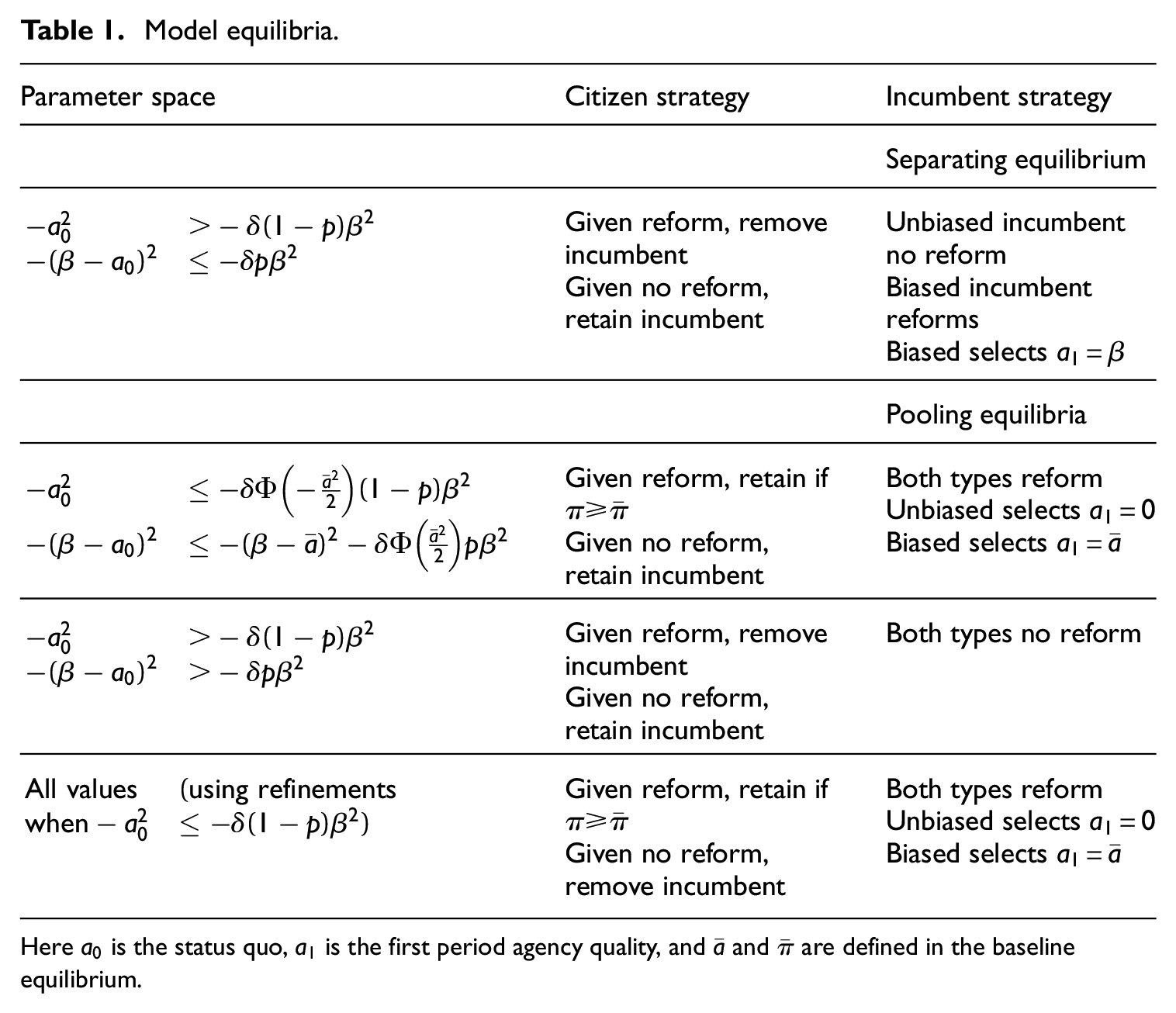
Here
The first equilibrium is fully separating. As in any separating equilibrium, the citizen knows the type of the incumbent with certainty, because the two types take different actions. The citizen can then behave optimally, removing the biased and retaining the unbiased incumbent. As the biased incumbent has already revealed himself, he has no incentive to select a moderate policy and instead selects his ideal point in the first period.
The biased type’s ability to misrepresent himself as the unbiased type will drive both types to abstain from reform in the next equilibrium where both types pool on not making reforms. I interpret this equilibrium as sustaining agency independence.
This is the only equilibrium where the agency retains its independence from political interference when either the biased or the unbiased politician are in office.
There are two possible equilibria where both incumbent types reform the agency. In the first, the citizen removes the incumbent when no reforms are made. Following reform, the two incumbent types and the citizen behave like they did in the baseline model. 9
This equilibrium exists for all parameter values, but is implausible for some. By analyzing beliefs off-the-eq1-path, the refinements help us think rigorously about which equilibrium is likely to apply. The intuitive criterion relies on the idea of equilibrium dominance, which eliminates an action for a player if the best possible payoff she could get from taking the action is strictly worse than the payoff she could get by shifting to a different equilibrium (Cho and Kreps, 1987). The D1 refinement is similar, but it places all the probability on the type that would benefit the most by changing to that outcome, assuming that the other player is playing best responses (see Fudenberg and Tirole, 1991: 446–440). Both refinements produce the efficient separating equilibrium, when it exists, in two-player signaling games.
To sustain the both-reform equilibrium, the citizen must believe the incumbent is biased following no reforms (with probability greater than
There is a second possible equilibrium where the two incumbent types pool on reform. The difference from above is that the citizen retains the incumbent when no reforms are made.
5 Comparative statics and empirical predictions
The model has a number of important predictions for the empirical literature, both within and across countries. Figure 1 presents the equilibrium strategies as a function of the status quo agency bias,
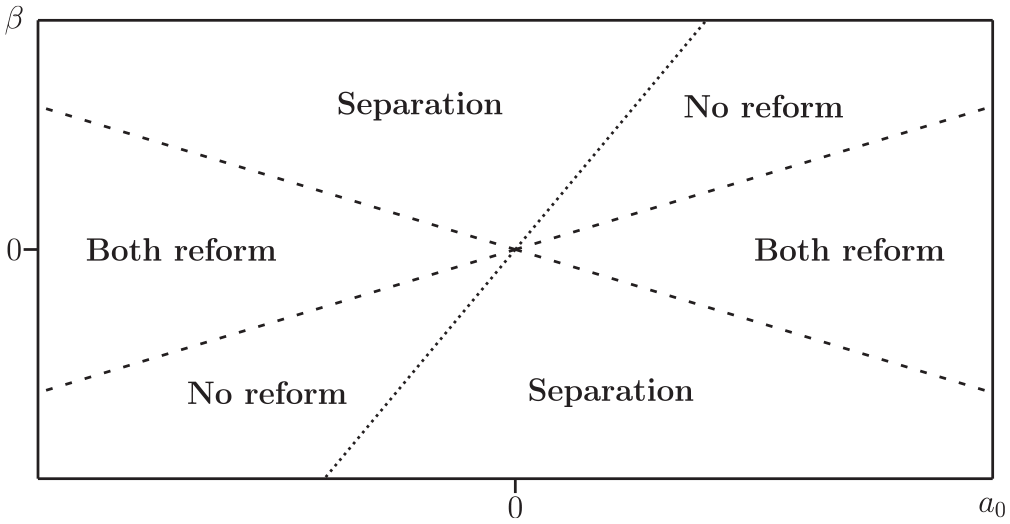
First stage equilibria as a function of the politician’s bias,
5.1 Separating equilibrium
In the unique separating equilibrium, the unbiased type does not reform the agency and the biased type does. There is no separating equilibrium where the unbiased incumbent reforms and the biased incumbent abstains from reform, as the biased incumbent would deviate from his strategy: if the unbiased incumbent reforms, the biased incumbent has a dominant strategy to reform as well, to implement his biased policy and to pretend to be unbiased. The biased type prefers not to identify himself and reforms carry no direct cost.
The separating equilibrium is incentive compatible when
When the status quo is close to zero it is relatively unbiased and thus close to the citizen’s and the unbiased politician’s ideal point. This makes the unbiased type willing to refrain from reforms to signal his type, as retaining the status quo for one period is not terribly costly for him. Conversely, a status quo closer to zero makes the biased type less willing to abstain from reforms, as when the status quo moves closer to zero it also moves further from his ideal point. Similarly, when the bias is larger, the biased type is less willing to wait to secure his preferred policy and is thus willing to separate himself, even knowing that he will be removed from office.
The separating equilibrium is also more likely when the probability that the incumbent is replaced with the unbiased type,
Jackson’s political priorities were plausibly biased. Federalism in the US privileged American farmers who distrusted banking elites; this created bias against effective banking regulation and financial development. Jackson favored small banks in rural areas, who provided credit to local farmers, over the national interest. The probability that Jackson would be replaced by a biased politician was also relatively high: his favored successor Martin Van Buren secured the Democratic party’s nomination, and the opposition Whig party was disorganized. 11 Despite mounting pressure, Jackson ultimately decided not to recharter the bank. His refusal to recharter the bank undermined financial development (Calomiris and Haber, 2014: Chapter 6) and plausibly caused the Panic of 1837, which cost Van Buren a second term.
5.2 Pooling on no reform, agency independence
The only way to support full agency independence is when politicians would be removed from office if they reformed. Otherwise, politicians of both types would gain by reforming.
That agencies only retain their independence when politicians would be punished for reforms is consistent with empirical findings on central bank independence. Independence is credible, and thus results in lower inflation, when political institutions allow citizens to hold politicians accountable through democratic processes (Bodea and Hicks, 2015). This result is separate from results that emphasize constraints on executive authority or veto players, which would be more closely related to theoretical models with fixed costs to reform.
The pooling on no-reform equilibrium results when the incentive compatibility conditions are met:
Intermediate values for status quo bias, political bias, and the probability of a replacement by an unbiased politician make waiting acceptable to both the biased and unbiased incumbents. The unbiased incumbent is willing to refrain from reform when existing agency bias is sufficiently small, political bias is large, and he is likely to be replaced by a biased politician; this makes the existing agency more acceptable and the expected cost of replacement larger. Conversely, the biased incumbent is willing to refrain from reform under the opposite conditions: when agency bias is sufficiently large, political bias is small, and he is unlikely to be replaced by a biased politician; this makes the status quo policy more acceptable to him, and the expected cost of replacement larger. Thus, we should observe higher independence, within countries, among issue areas with middling benefits to political control: not so much that the biased type cannot abstain from reform, but not so little that there is no reason to make the institution independent. There are two common sources of bias: the policy type and the political institutions.
Some policies may be associated with larger political benefits than others. For example, monetary policy is plausibly at this middling level of political bias (although the benefits of monetary policy control are likely larger when exchange rates are flexible (Clark and Hallerberg, 2000)). Unless economic outcomes are unusually bad (then the both-reform equilibrium would result), politicians generally abstain from reforming central banks in order to prevent voters from assuming that their reform is biased and punishing them. For example, the structure and method of US central banking was laid out in the Federal Reserve Act of 1913. Despite being biased, owing to regional districts that are not proportional to population or economic activity and to concerns about the destabilizing impact of ‘too big to fail’ financial institutions (Jeong et al., 2008; Moe, 1989; Volcker, 2018), this structure largely remains intact.
Although the literature has emphasized bias in monetary policymaking, politicians may be even more biased in other areas. Spending, for example, is easily targeted to supporters, yet we seldom observe independent fiscal agencies. This could be because fiscal bias is so large that independence is not possible. Politicians would frequently reform independent fiscal agencies, violating their independence and signaling their bias to voters. Rather than communicating their bias, politicians frequently retain discretion over fiscal policy as a cabinet function. The model here anticipates that agency independence will be respected only when bias is of intermediate size: sufficiently small that biased politicians abstain from reform and sufficiently large that unbiased politicians do so as well. Although the distinction between fiscal and monetary policy here is admittedly ad hoc, an empirical measure of the political benefit to policy control across issue areas would allow researchers to evaluate this prediction.
Another common source of bias is from political institutions. If political institutions are perfectly representative, citizens expect politicians to carry out their preferred policies and they have little need for policy delegation. If political institutions are perfectly unrepresentative, then politicians need not delegate because they are unresponsive to citizen demands. It is at middling levels of representation, where delegation is attractive. Delegation is supported by citizens to prevent politicians from acting on their biases. The quality of representation may come for example from the size of the politician’s selectorate (Bueno de Mesquita et al., 2003), proportionality (Genicot et al., 2019; Rickard, 2012), rural or urban bias (Bates, 1981; Chen and Rodden, 2013), personalism (Carey and Shugart, 1995; Geddes, 2003; Johnson and Wallack, 2012), or democracy (Cheibub et al., 2010; Marshall et al., 2017).
Agency independence is also more likely as the discount factor,
That this equilibrium is likely to result when status quo and political bias are of middling values shows up in Figure 1, as this equilibrium results near the line:
5.3 Pooling on reform
In the both-reform equilibrium, the biased politician selects a somewhat biased policy, balancing his re-election interests against his own bias. This finding is consistent with the empirical model of Franzese (1999, 2003) where the central bank implements a weighted combination of the banker’s and the politician’s preferred policies. 12
For the both-reform equilibrium to result, reform must be incentive compatible for the unbiased politician, which requires,
Deviations for the unbiased politician are not profitable, when the initial bias in the institution is so large that he is willing to risk removal in order to reform the institution. He is also willing to risk removal when, if falsely removed, he is likely to be replaced by an unbiased politician or, if replaced by a biased politician, bias is relatively small. Small discount factors (or impatience) also make him more willing to take risks to secure a high payoff in the first period, even if it comes at the cost of more bias in the second period.
That reform frequently follows poor economic outcomes, such as crises (Abiad and Mody, 2005; Brooks and Kurtz, 2007; Chwieroth, 2013; Mansfield and Milner, 2018), is consistent with the equilibrium. For example, after the financial crisis of 2008, it became clear that existing economic regulation was insufficient to prevent crisis and that reform was needed. US legislators enacted the Dodd–Frank Wall Street Reform and Consumer Protection Act. The act is supposed to improve regulation, but concern remains about policy bias resulting from the capture of politicians by the financial industry. Owing to this perceived bias, reforms are only likely when economic outcomes are sufficiently bad. During normal times, incumbents are likely to be punished for reforms. In issue areas where politicians are usually biased (
5.4 Status quo comparison
Because the status quo agency may generate a set of supporters (Greif and Kingston, 2011; Shepsle, 2008; Weingast et al., 1981), these are individuals who have thrived under the existing agency, it is useful to compare the status quo policy to the outcomes identified in each equilibrium presented previously. Agency independence in the pooling on no-reform equilibrium is strictly preferred by supporters of the status quo policy. This is the only equilibrium where the status quo remains in place, regardless of the politician type. Between the separating and the pooling on reform equilibria, preferences are more complicated. The tradeoff between the two equilibria depends on whether accuracy, correctly identifying the bias of the politician, or moderation, encouraging biased politicians to impose a moderate policy, is more valuable. The separating equilibrium is accurate, but not moderate: the two types are identified perfectly in the first period and the citizens are able to retain the unbiased politician. Accuracy is valued by status quo supporters when their interests align with citizen interests (the status quo is relatively unbiased) and they value second period payoffs.
The both-reform equilibrium is more moderate but less accurate: the biased politician selects a more moderate policy in the first period, but the citizen only learns about the type of the politician from the policy signal. Moderation is more important for status quo supporters when the status quo is relatively unbiased and they value first period payoffs more. If the status quo is closer to the unbiased politician’s ideal point, then status quo supporters value both accuracy and moderation – which they value more depends for example on their discount factor and the accuracy of the signal. If the status quo is closer to the biased politician’s ideal point, then status quo supporters do not want accuracy or moderation.
5.5 Information quality
The effect of reducing the quality of the signal, this is an increase in
Increasing noise in the signal has two effects: it makes it harder to reward unbiased reforms and also harder to punish biased reforms. To provide some intuition for the result, consider the case where the policy reform is relatively unbiased (close to zero). When the signal becomes less precise, the politician selects a more extreme policy, because it is harder for the citizen to infer anything from his policy choice. Alternatively, if the policy is relatively biased (far from zero), the biased politician moderates his policy to increase his chance of being retained.
It is helpful to distinguish between the voter’s knowledge about the bias of the agency and about the bias of the politician. Knowledge about the bias of politicians is necessary to remove corrupt politicians from office (Ashworth and Bueno de Mesquita, 2014). Knowledge about agency bias is necessary to inform preferences for agency reform. The voter gains full information about both in the separating equilibrium: the unbiased politician does not reform and the status quo remains in place (which is known to the voter); the biased politician reforms and creates a biased agency. In the both-reform equilibrium, the voter learns limited information from the signal about both the political and the agency bias. In the no-reform equilibrium, where the agency retains its independence, the voter does not learn about the politician’s type. This is the worst equilibrium in terms of developing knowledge about the bias of the politician. However, the voter is fully informed about the agency bias, as the status quo again remains in place. In countries or issue areas with many independent agencies it may be difficult for citizens to connect political performance to policy and outcomes. 13 This could reduce incentives to become politically active.
6 Conclusion
The article here identifies an informational cost to reforming agencies. The reform decision may help citizens distinguish biased politicians from unbiased politicians. When politicians are frequently biased, citizens expect politicians to erode the quality of the agencies when reforms are made. Citizens observe reform, and they assume the politician and his reforms must be biased. The cost of reform in the model thus comes from the information the reform provides about the type of the politician. The informational cost of reform introduces a new rationale for the continued independence of bureaucratic agencies, even when politicians would benefit from biased policies and they have control over agency reforms. This independence, however, cuts both ways, preventing both biased and unbiased reforms.
The model has several implications. For democratic institutions, legitimacy often comes from accountability and public influence over practices (McCubbins and Schwartz, 1984). However, citizens are often poorly informed about the actions taken by politicians, making it difficult for them to exercise oversight (Lupia, 1992). In the case of many bureaucratic agencies, this informational challenge is made more complicated by diverging interests between citizens and policymakers. 14 Citizens cannot trust politicians to act in the public interest. In these cases, paradoxically, legitimacy comes from the absence of political intervention. This creates a tension between the desire for independence due to political bias alongside the desire for accountability under democratic institutions (Bernstein, 1955; Dietsch, 2020; Tucker, 2018).
The phenomenon presented here does not solely apply to bureaucratic agencies. The same logic would apply to any policy where: the politician is likely biased and citizens are poorly informed. In the United Kingdom, many democratic proceedings follow a long precedent but are not legally codified. If the democratic process becomes ineffective or unrepresentative, from a public interest perspective, it should be reformed. However, reforms may be punished, because it is likely unclear which reforms serve the public’s and the politician’s interests and, under many conditions, the two diverge. In this instance, modestly biased institutions are likely to endure. The informational cost of reform provides a new rationale for the continued existence of biased institutions, beyond veto players (Bodea and Hicks, 2015; Henisz, 2000; Keefer and Stasavage, 2003; Tsebelis, 1995) and beyond the creation of interest groups who benefit from the institution (Greif and Kingston, 2011; Shepsle, 2008; Weingast et al., 1981).
Supplemental Material
sj-pdf-1-jtp-10.1177_09516298211003129 – Supplemental material for Biased politicians and independent agencies
Supplemental material, sj-pdf-1-jtp-10.1177_09516298211003129 for Biased politicians and independent agencies by Amy Pond in Journal of Theoretical Politics
Footnotes
Declaration of conflicting interests
The author(s) declared no potential conflicts of interest with respect to the research, authorship and/or publication of this article.
Funding
The author(s) received no financial support for the research, authorship, and/or publication of this article.
Supplemental material
Supplemental material for this article is available online.

Notes
References
Supplementary Material
Please find the following supplemental material available below.
For Open Access articles published under a Creative Commons License, all supplemental material carries the same license as the article it is associated with.
For non-Open Access articles published, all supplemental material carries a non-exclusive license, and permission requests for re-use of supplemental material or any part of supplemental material shall be sent directly to the copyright owner as specified in the copyright notice associated with the article.
