



Abstract
Without a strong state, how do institutions emerge to limit the impact of one group’s predation on another’s economic activities? Motivated by the case of northern Somalia, we develop a model that highlights the monitoring challenges that groups face in making cooperation self-enforcing, and two key factors that influence their likelihood of overcoming this challenge: the ratio of economic interests across productive and predatory sectors, and the existence of informal income-sharing institutions. Our model explains why conflicts between pirates and livestock traders can be resolved in the region of Somaliland, where the ratio of economic interests favors the productive sector and traditional institutions promote income sharing between groups, but not in the region of Puntland, where these conditions do not hold. The model also accounts for several of the empirical patterns in the relationships between piracy, livestock exports, and conflict in both regions.
1. Introduction
An important function of the state is to promote cooperation among groups, limiting the inefficient externalities that one group’s predation creates for the productive activities of another. 1 To provide this function, the state requires the institutional capacity to maintain law and order, enforce contracts, and engender peace. In some states, the formal institutions that support cooperation are insufficient or even absent entirely, and it is up to rival groups to locate and implement a self-enforcing agreement that finds peace between them. 2
Existing work, particularly the literature on repeated games, provides some answers to when and how cooperation can be made self-enforcing when relational contracts must substitute for formal contracts due to the absence of formal contracting institutions. 3 Much of this theory is abstract, however, and does not provide specific insights into how cooperation is sustained in particular applications. As Kandori and Obayashi (2014) have argued, empirical studies motivated by the theory of cooperation, such as those in Ostrom (2015), provide detailed studies of particular cases but do not fit the cases to models built on existing theory. 4
This paper contributes to filling the gap by developing a new application of the theory of cooperation to the case of northern Somalia, where formal state institutions have been largely absent. In this region of the world, traditional clan-based authorities operating locally at the level of sub-clans or lineage groups (hereon simply ‘clans’) have had to discover and support a system of cooperation between their members to maintain peace. The case of Somalia provides us with some variation in the degree of success of these authorities, shedding light on the factors that are most important for fostering cooperation in such a setting. We first provide an overview of the case, and then move on to describe our formal analysis of it.
For the past 20 years, and throughout much of Somalia’s history, the provision of basic public goods such as economic governance and security has been the purview of clan leaders who rely on the informal institutions of traditional clan authority (LeSage, 2005). Somalia’s longtime ruler, Siad Barre, sought to dismantle traditional institutions and limit the authority of clan leaders, but clan structures were resilient to his efforts and the country reverted to these institutions after his regime and the Somali state collapsed in 1991. Clanship remains the fundamental basis of security in Somali society (Gundel, 2006; Lewis, 2004).
As the key providers of local governance in northern Somalia, clan leaders have grappled with the dramatic rise in maritime piracy in the Gulf of Aden that took place after 1991. In addition to damaging international trade, this increase in piracy has affected the terms of Somalia’s crucially important livestock sector. Even when piracy attacks are not directed at ships transporting Somali livestock abroad (as they typically are not), piracy hurts the livestock trade because it increases shipping and insurance costs. The income of Somalia’s livestock herders is thus inversely related to the frequency and scale of piracy attacks off the Somali coast, creating the potential for conflict between clans that vary in the extents to which piracy and the livestock trade contribute to their income. Without a state to enforce cooperation, clan leaders have had to find peaceful ways to resolve their differences.
Clans in the two northern Somali regions of Somaliland and Puntland have shown markedly different levels of success in their ability to find peace. Clan leaders in Somaliland have been able to find ways of cooperating, building an agreement that has begun to resemble a formal state. They have done so by promoting a traditional system of cooperative income sharing that goes back to pre-colonial times. Puntland, in contrast, remains an economically fragmented, conflict-ridden society, with high levels of violence and weak state institutions.
Motivated by the differences between Somaliland and Puntland, we develop a model that explains why cooperation would be more plausible in Somaliland than in Puntland. The model highlights two key features of the relationship between livestock traders and pirates. The first is that the livestock traders have incentives to sanction piracy when they have evidence that it is on the rise. The second is that it is difficult to monitor piracy. The traders cannot know just how much piracy is taking place, and must infer it from noisy signals of pirate activity such as their own revenues and the observable income of the pirates. This feature makes it impossible to sustain a self-enforcing agreement in which there is perpetual cooperation between the two groups; but some cooperation may be possible with the help of these noisy signals.
In times when livestock exports are up, clans that rely comparatively more on livestock income cooperate with those that rely relatively more on piracy income by sharing part of their income from the livestock trade in exchange for the pirates reducing their overall level of predation. This benefits the livestock group because it mitigates the negative externality that piracy has on the livestock trade. However, to provide the pirates with the incentive to lower their piracy, the livestock traders must (credibly) threaten the piracy clans with conflict when they have evidence that piracy is on the rise. Because the evidence for piracy is noisy, conflict will sometimes take place even if the pirates are not cheating.
For this mode of cooperation to be self-enforcing, two conditions must be met: (i) the punishment to pirates for cheating should be sufficiently great so as to deter it, which happens when livestock interests overwhelm piracy interests; and (ii) the rewards to pirates for cooperating must be sufficiently great, which happens when clan leaders can successfully encourage existing practices of income sharing in society. Both of these conditions are met in Somaliland but not in Puntland.
Our model helps make sense of three patterns that we see in the data from Somalia. The first is that piracy is lower off the coast of Somaliland when livestock export levels are high, but there is no relationship between piracy and livestock exports in Puntland. The second is that increases in conflict appear to follow increases in piracy in both regions, but this relationship is subject to more noise in Somaliland. The third is that export price drops appear to be followed by periods of conflict in Somaliland, but not in Puntland.
Our paper contributes to the literature on inter-group cooperation and political order under anarchy. In this literature, Bates et al. (2002) developed a theory in which property rights can emerge in stateless societies, provided that ‘citizens … also invest in the capacity for violence’ (p. 624). Skaperdas (1992) argued that cooperation can result if one group dominates the other, consistent with our argument that the dominance of the livestock sector helps explain why we see greater cooperation in Somaliland. Fearon and Laitin (1996) studied the role of in-group social sanctioning in enforcing cooperation across groups, suggesting that group leaders (in our case, clan elders) play an important role in encouraging cooperation. 5
Our paper also relates to prior studies of the consequences of statelessness in Somalia, and the divergent development trajectories of Somaliland and Puntland. 6 Eubank (2012), for example, attributed the success of Somaliland to the absence of a foreign aid curse. Hansen (2009) focused on formal institutions in Somaliland and their conspicuous absence in Puntland. Like us, Azam (2006, 2010) emphasized the importance of income sharing in Somaliland, and suggested that ethnic heterogeneity and fiscal institutions play a key role in explaining the differences between Somaliland and Puntland. However, in his model, ethnic heterogeneity has made Puntlanders relatively myopic, which, combined with the weaker ability of the Puntland government to raise revenue and discipline bandits, has hindered cooperation.
Finally, our paper relates to work on the effects of economic shocks on conflict (e.g. Bazzi and Blattman, 2014; Dal Bó and Dal Bó, 2011; Dube and Vargas, 2013). This literature has focused on the effects of economic structure through a traditional ‘resource curse’ channel and an alternative ‘opportunity cost’ channel. According to this literature, if predation is more labor intensive than production, predation rises with positive shocks to capital-intensive industries but declines with positive shocks to labor-intensive industries. Our work suggests a different possibility: price shocks affect conflict by acting as noisy signals of cheating and cooperation. Thus, a key difference between our work and this prior work is that a negative price shock in our model does not directly affect the material tradeoff between production and predation; instead, it serves only as a noisy signal of defection in a low information environment. This is also the mechanism that destroys the possibility of perpetual collusion in the oligopoly model of Green and Porter (1984). 7
2. Background to northern Somalia
Our model simplifies the northern Somali economy into two sectors, livestock trading and piracy, and Somali society into two groups based on clan heritage: those that rely comparatively more on the livestock trade for income and those that rely comparatively more on piracy. In this section, we justify this approach. We first provide a brief background to the two main economic sectors of our focus, the livestock trade and piracy. We then describe how clan structures and authority vary across Somaliland and Puntland. The key differences are that: (i) clans with relatively greater interest in livestock trading, as opposed to piracy, are more predominant in Somaliland than in Puntland; and (ii) although clan authority is important in both regions, clan leaders are a significantly stronger source of authority in Somaliland, especially when it comes to promoting cooperation through income sharing across groups.
2.1. The livestock trade
The largest economic sector in northern Somalia is the livestock trade, which accounts for about a third of GDP in northern Somalia. 8 Majid (2010: p. 11) reported that the northern Somali livestock trade involves the export of more than US$200 million worth of live animals across the Gulf of Aden each year. Livestock exports through the port of Bosasso in Puntland alone brought in US$113 million in 2011 (Oliver et al., 2014).
The main foreign importer of Somali livestock is Saudi Arabia, and the main export among varieties of livestock is goat, though camels and cattle are also common. Saudis prefer Somali livestock to alternatives from other major providers such as Australia, owing to its provenance from a Muslim country. This is especially the case during the Hajj season when demand is high due to the sharp increase in pilgrims visiting Mecca. Somali livestock traders employ shipping companies to move livestock across the Gulf of Aden with the majority of these companies owned by businessmen from Somalia, Yemen, Saudi Arabia, and Pakistan. These merchants typically start their shipments at the two main shipping ports of Berbera in Somaliland and Bosasso in Puntland. Local sellers at these ports are often middlemen who buy livestock from nomadic pastoralists and bring them to the ports, which are linked to the hinterland through a series of clan-based networks that manage the transportation and trade of livestock (Majid, 2010). These trade networks are of ancient origin, with clan-based protection for livestock caravans noted from the 14th century (Umar and Baulch, 2010).
Clan authority is critical to the operation of the livestock trade. The clan-based insurance system mitigates risk for herders and traders in a context where clan arrangements provide the only form of security against issues such as infringements of grazing rights, animal theft, and reneging on loan agreements (Umar and Baulch, 2010). For example, dispute resolution falls under the purview of clan leaders who act as judges in an ad hoc court known as guddi in which traditional xeer law is expected to prevail. This is a form of customary law, which has evolved to maintain a set of principles that are applicable to any type of situation or conflict, and as such is almost never silent on any given conduct (van Notten, 2005). 9 This system of informal local economic governance provides strong disincentives against economic misconduct through a norm of collective liability known as the diya system, under which the entire clan becomes liable for a breach of contract by any one of its members.
Our main data on the livestock trade are depicted in Figure 1, which shows livestock exports over time from the two ports of Berbera and Bosasso, measured as the number of heads of livestock (summing over camels, cattle, and goats) exported monthly from each of the two ports. 10 The data reveal three patterns worth noting. First, there is a seasonality in trade with exports rising sharply during the Hajj. Second, there has been a gradual increase in exports since November 2009 after the removal of a Saudi ban on Somali livestock that started in 2000 following an outbreak of Rift Valley Fever in Yemen and Saudi Arabia. 11 Third, exports from Berbera have been higher after 2009 than exports from Bosasso.
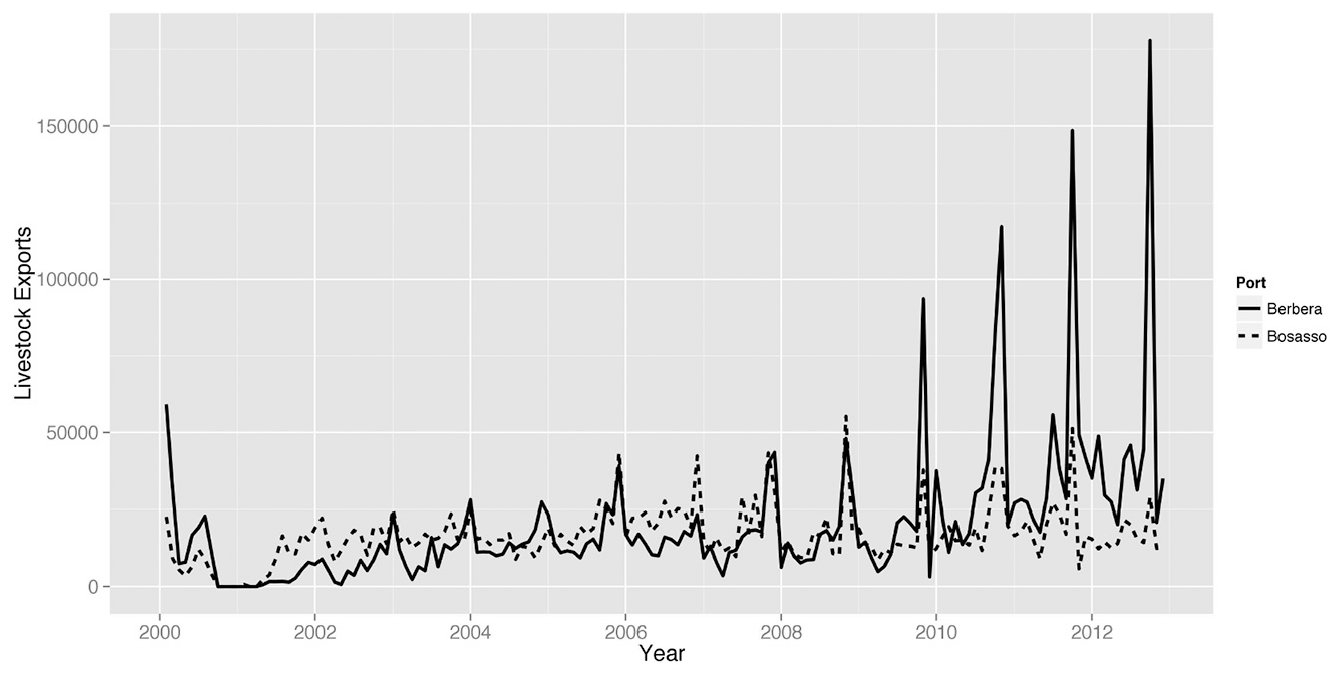
Monthly total livestock exports from the ports of Berbera and Bosasso, 2000–2012, collected by the Food Security and Nutrition Analysis Unit, Somalia (http://www.fsnau.org/).
2.2. Piracy
There is a long history of predation against foreign vessels around the Somali coast, and of piracy directed against the dhow (shipping) trade that plies the Gulf of Aden (de Wijk et al., 2010). While these predatory activities were restricted under the Barre regime, maritime piracy off the Somali coast exploded after the regime collapsed in 1991. Figure 2 shows monthly counts of piracy incidents from February 2000 to December 2012 within a 250 km radius of the ports of Berbera and Bosasso. The figure highlights the significant variation in rates of piracy, both spatial and temporal, across the northern Somali coast. In terms of spatial variation, the key notable pattern is the greater number of pirate attacks off the coast of Bosasso than off the coast of Berbera.
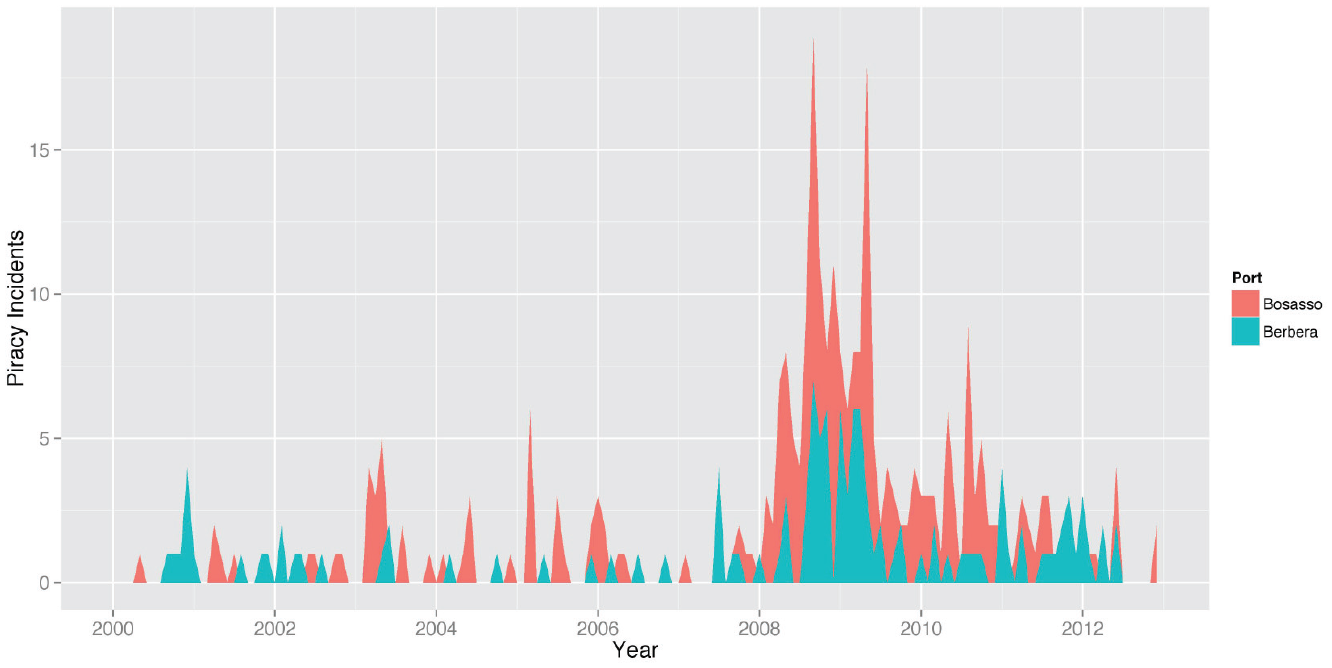
Monthly counts of pirate attacks within a 250 km radius of the ports of Berbera in Somaliland and Bosasso in Puntland, 2000–2012. These are all attacks reported in the Anti-Shipping Activity Messages (ASAM) database compiled by the United States National Geospatial-Intelligence Agency. ASAM can be accessed at http://msi.nga.mil/NGAPortal/MSI.portal. Our data were accessed on July 9, 2015.
The World Bank estimates that ransom payments from piracy have brought in an annual average of US$53 million to the Somali economy since 2005, and ransom payments in 2011 alone from pirate attacks in the Gulf of Aden generated US$163 million in revenue. 12 These numbers indicate that although piracy is a smaller sector than the livestock trade, it is still a large income generator in northern Somalia. At the same time, it has the potential to produce negative spillover effects on the wider Somali economy, including the livestock trade. For example, during periods of intense piracy the number of ships willing to ply the routes between northern Somalia and the Arabian Peninsula declines, often leading to an over-supply of livestock at Somali ports, which in turn drives down the prices received by traders and herders.
Another channel by which piracy hurts the livestock trade is by increasing shipping and insurance costs. Agreements between traders and shipping agents factor in some potential losses that may occur during the sea journey, with exporters bearing up to 1% of loss of sheep and goats, and 2% of cattle. Any losses exceeding these are typically compensated by the shipping company (Umar and Baulch, 2010). As a result, increases in piracy that make sea journeys across the Gulf of Aden more dangerous increase the risks that shipping companies face, raise transportation costs, and drive down their value from trade. Besley et al. (2015) estimated that the upsurge in Somali piracy in 2008 led to an 8–12% increase in international shipping costs, which they attributed mostly to higher insurance and security costs. Therefore, although the vessels attacked by pirates might not themselves always represent local victims, Somali piracy is harmful to the livelihoods of many Somalis if it negatively affects the terms of the Somali livestock trade. 13
We lack direct quantitative estimates of the harmful effects of piracy on the terms of the livestock trade. However, some qualitative evidence is borne out by local news reports that highlight the increased shipping costs, as trade ships charge higher transportation costs due to greater security expenses. 14 Although the international media tends only to report the most audacious attacks on international tankers and container ships, for many years Somali pirates have targeted the cargo dhows and light coastal freighters that make up the bulk of the area’s maritime trade. 15 This includes vessels of different sizes transporting livestock to the Arabian peninsula out of both Berbera and Bosasso. 16 In 2011, for example, pirates captured a livestock ship in the runup to the Hajj, the most lucrative part of the year for the livestock trade, and were reportedly killed within hours by ‘irate traders and herders.’ 17
As a result of its negative externalities for the livestock trade, piracy has the potential to invoke sanctions from different parts of Somali society. When pirate attacks are successful the pirates typically route the captured vessel to a private port, which in the face of potential sanctions requires protection and support from local accomplices. To function effectively, therefore, pirate groups require the complicity of groups on land, in particular local clan leaders. Interestingly, these leaders, in an attempt to allow both the livestock and piracy sectors to flourish, provide both support for and sanctioning against piracy. Shortland and Varese (2012) described how clan complicity facilitates piracy, with some clans providing ‘protection’ to pirates. At the same time, xeer law forbids criminal activities such as abduction, theft, extortion, and fraud, and many clan leaders view piracy as belonging to this category, in addition to being haraam, i.e., forbidden, under shari’a law. Clan leaders are therefore able to provide meaningful sources of incentives for and disincentives against piracy. 18
The influence of clan elders over pirates is reinforced by the fact that pirate gangs tend to organize within rather than across clans, maintaining these ‘familial’ ties by transferring Qaaraan (livestock or money for the needy) to the clan (Hansen, 2009). 19 Reports of clan elders pressuring pirates to release vessels in Puntland, and mediating conflicts involving pirates in both Puntland and the central region of Galmudug, also suggest that clan leaders often have authority over pirates that formal authorities lack. 20
2.3. Clan structure and authority in Somaliland and Puntland
Despite the importance of clan structures and authority in both Somaliland and Puntland, clan interests and composition vary considerably across the two regions. We focus on the two key differences highlighted by our model: the ratio of interests, and income sharing.
2.3.1 Ratio of economic interests
In Somaliland, the Isaaq clan-family makes up the vast majority of the population. The Isaaq contains a number of confederacies, themselves consisting of various sub-clans. The largest of these in Somaliland is the Habr Awal, a merchant class that has benefited from proximity to Somaliland’s crucial trading port of Berbera. Despite their various tribal delineations, the Isaaq are unified by the fact that they are almost entirely nomadic pastoralists (Lewis, 1969). In this regard they are very similar to the Esa and Gadabursi sub-clans in the furthest north-west part of Somaliland, who belong to the Dir clan-family. Much like their Isaaq neighbors, the Esa and Gadabursi are pastoral nomads, who rely heavily on the livestock trade as a source of income (Lewis, 1969).
A very small proportion of Somaliland’s population come from the Dulbahante and Warsangeli sub-clans, concentrated in the north-eastern province of Sanaag (Lewis, 2008). Both the Dulbahante and Warsangeli are primarily pastoralist groups, though the Warsangeli ‘are much given to seafaring and compose the bulk of the crews manning the dhows which ply between Aden and Somaliland’ (Lewis, 1969: p. 21). Owing to their comparative advantage at sea, members of this group have also been known to engage in piracy, and a major pirate network operated for some time out of Las Qoray in north-eastern Somaliland (Murphy, 2011; Palmer, 2014). Thus, piracy represents a small part of the economic interests of Somaliland, and ‘pirate clans’ are a very small minority in the region. As the majority of clans rely on pastoralism, the ratio of economic interests in Somaliland favors the livestock trade.
Clan structure and authority in Puntland is considerably different. Although most clans fall under a single clan-family (the Darod), the varied distribution of economic preferences across these clans has made governance more difficult. As noted previously, the Darod contains numerous confederacies and sub-clans, including the Dulbahante and Warsangeli, which straddle the border between Somaliland and Puntland. Far more numerous in Puntland, however, are the Mijerteen, another Darod sub-clan. As with the Warsangeli, the Mijerteen have traditionally engaged in both pastoralism and seafaring activities, and a sizable proportion of the Mijerteen (roughly 12%) are fishermen and sailors (Lewis, 1969).
The Mijerteen actually also have a long history of engagement in maritime predation dating back to the early nineteenth century (Durrill, 1986). This was true for communities across the north-eastern and eastern coastlines of Puntland, with ships being lured onto the rocks to be pillaged and shipwreck survivors being taken hostage for ransom. Pirates, moreover, were linked to a broader political system of predation (de Wijk et al., 2010). These predatory activities resurfaced in the 1990s, with pirate gangs operating out of a number of locations around the Puntland coast.
The relevant fact is that the piracy business is much larger in Puntland than it is in Somaliland, both in absolute and in relative terms. While the various Darod sub-clans all have sizable interests in pastoralism, many of them also have an interest in piracy, much more so than any of the groups in Somaliland. As a result, the ratio of economic interests in Puntland is more balanced between piracy and the livestock trade.
2.3.2. Cooperative income sharing
The differences between Somaliland and Puntland in terms of clan influence are not just limited to the numerical composition of clans groups and interests in these regions. Clans are much more a part of the governance structure of Somaliland, and their role in society has been recognized even somewhat formally by the Somaliland state. Starting in 1991 a series of congresses and peace talks involving clan elders were held in northern Somalia, bringing together all the major clans in the region (Farah and Lewis, 1997; Huliaras, 2002; Walls, 2009). By 1993 this led to a National Charter establishing a government, rights, and basic national institutions. Key to this development was the formation of the Guurti assembly of clan elders as a chamber of Somaliland’s bicameral legislature to facilitate cooperation across clan groups. This assembly has, to a large extent, succeeded in promoting cooperation across groups through the guarantee of national revenue-sharing, including export revenues from the port of Berbera and those from the national airport at Hargiesa, which include air taxes and landing charges (Lewis, 2008). In general, the numerous confederacies of clans and their constituent sub-clans in Somaliland have been able to negotiate competing interests to settle both inter- and intra-clan disputes.
Groups in Puntland have attempted to form clan-based agreements akin to those in Somaliland, but with almost no success. Attempts to form a unified state have been less successful, in large part due to inter-clan conflicts but also the policies of Colonel Abdilliahi Yusuf, who emerged as relatively unconstrained executive and iron leader of Puntland, and showed an interest in emulating the attempt by Siad Barre to limit the influence of clan elders and stamp out ‘clannism’ (Hesse, 2010). A key implication of this has been the lack of any broad-based commitment to national revenue-sharing along the lines of that seen in Somaliland.
3. Model
Our model simplifies the northern Somali economy into the two sectors that we have highlighted, livestock trading and piracy, and Somali society into two groups based on clan heritage: those that rely comparatively more on the livestock trade for income and those that rely comparatively more on piracy. While our discussion above recognizes that economic interests and occupational choices do not perfectly delineate along clan boundaries, we will for simplicity refer to these groups as ‘livestock traders’ and ‘pirates.’ 21
The population share of the traders is
3.1. Fundamentals
In each period the two groups move simultaneously, deciding whether or not to cooperate with each other.
At the start of each period
When the pirates cooperate, they self-regulate by lowering the number of pirate attacks that they launch. By doing this, they are foregoing some of the returns from piracy, but they may be providing considerable benefits to the traders through the creation of a safer trading environment during periods of highly productive trade. When the pirates choose not to cooperate, they engage in unregulated piracy, creating a negative externality on productive trade in these periods.
More precisely, suppose that when productivity is low the income of each trader from productive trade is 0 regardless of what the pirates do. When productivity is high, the income of each trader is a random variable
To capture the idea that the self-regulation of piracy is costly for the pirates, we assume that the pirates have a lower chance at making a high return from piracy if they self-regulate. In each period, each pirate receives a return of
3.2. Monitoring structure
We assume that the model has one-sided moral hazard: the pirates’ decision to self-regulate piracy is not directly observed by the traders. This assumption is motivated by the fact that piracy is often an activity that is planned and carried out in a way that may not be publicly observable. In particular, it is difficult for the trading group based on land to always know how much piracy is going on at sea, and where it is being targeted.
In our model, the traders have access to two noisy public signals of whether or not the pirates are self-regulating: the pirates’ period
We define
3.3. Payoff structure and assumptions
The expected payoffs per individual in each group have the following structure, where the row player is the trading group and the column player is the pirate group:

These payoffs are subject to the previous assumptions as well as some additional assumptions, two of which are as follows.


We use the first assumption to establish that the traders have short-run incentives to sanction piracy despite the costs of conflict if they expect the pirates to not self-regulate. We use the second to establish that if piracy is successful, then the income that it generates is high in comparison with the potential costs of being punished for it. This gives myopic pirates a short run incentive to not self-regulate.
3.4. Social states
We have described a stochastic game with imperfect public monitoring. If the players are patient (
Our strategy for analyzing the game will be to take an approach that focuses on particular kinds of social agreements. We characterize conditions that make these agreements incentive compatible. The equilibrium concept is perfect public equilibrium (PPE). 26
We characterize social agreements using three categories of ‘automaton states’ and derive conditions that are necessary and sufficient to sustain particular ‘path automata’ in equilibrium. Informally, a path automaton specifies actions that are chosen only on the path of play. 27 As such, it is an incomplete description of a strategy profile. Our approach is to characterize conditions under which there exists a way to complete the description of the strategy profile such that it becomes an equilibrium of the game for high values of the discount factor. 28 The following describes the three categories of automaton states.
Conflict: In these states, the traders choose conflict and therefore they do not share any of their income with the pirates. Note that there are several possible automaton states in this category, depending on whether the payoff relevant signal
Peace and no self-regulation: In these states, the traders make peace with the pirates but the pirates do not self-regulate. If
Peace and self-regulation: In these states, the traders make peace with the pirates and the pirates self-regulate. The pirates are forgoing some of the expected returns from piracy by lowering their chance of obtaining the high return
3.5. Cooperation and no cooperation regimes
We now describe two types of regimes: one that we call the ‘no cooperation regime’ (NCR) in which the pirates do not self-regulate, and another that we call a ‘some cooperation regime’ (SCR) in which they do. These correspond to different classes of path automata.
3.5.1. NCR
Suppose that the players are myopic (
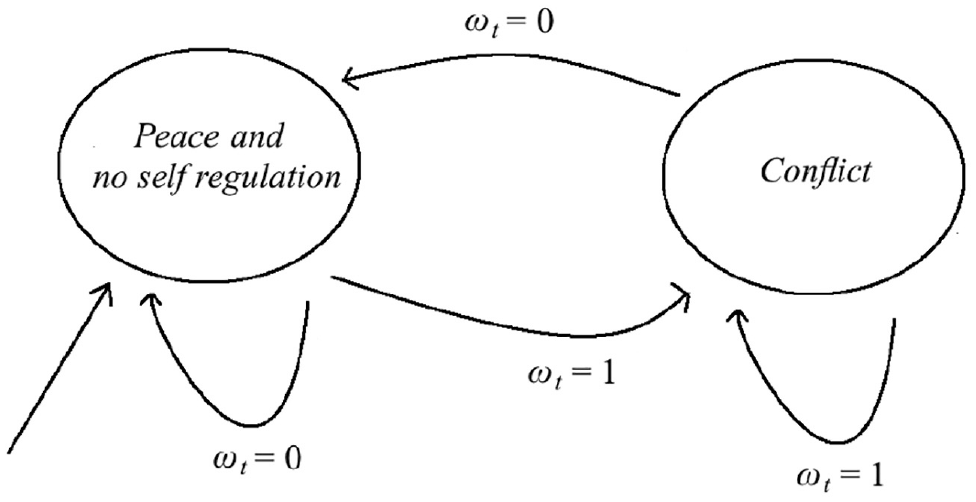
No cooperation regime (Puntland).
3.5.2. SCR
Now we describe two versions of the SCR, both of which are represented in Figure 4. In both versions, the following describes which of the three categories of states society is in for any period
Consider the following situations: (i)
Consider the following situations: (i)
Consider the following situations: (i)
Thus, in both versions of the SCR, there is revenue sharing at the level
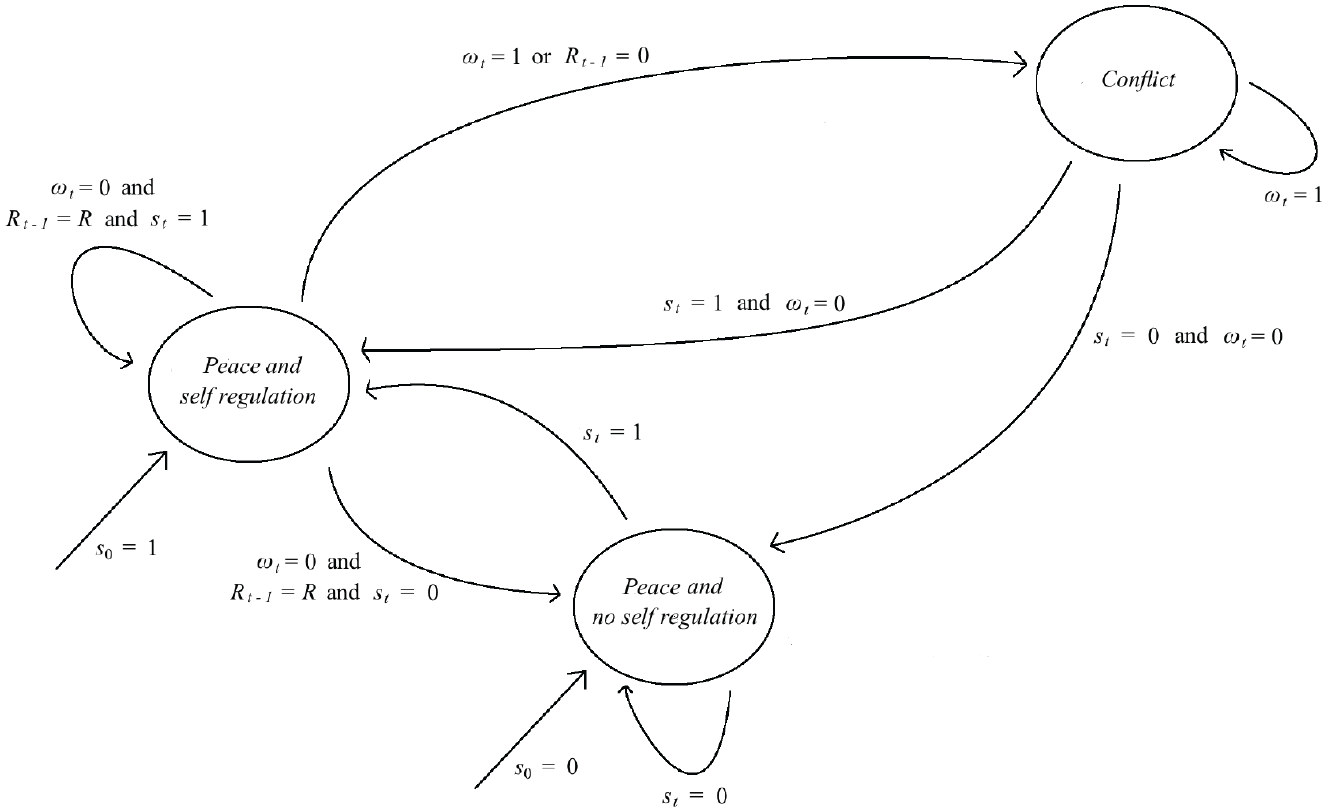
A some cooperation regime (Somaliland).
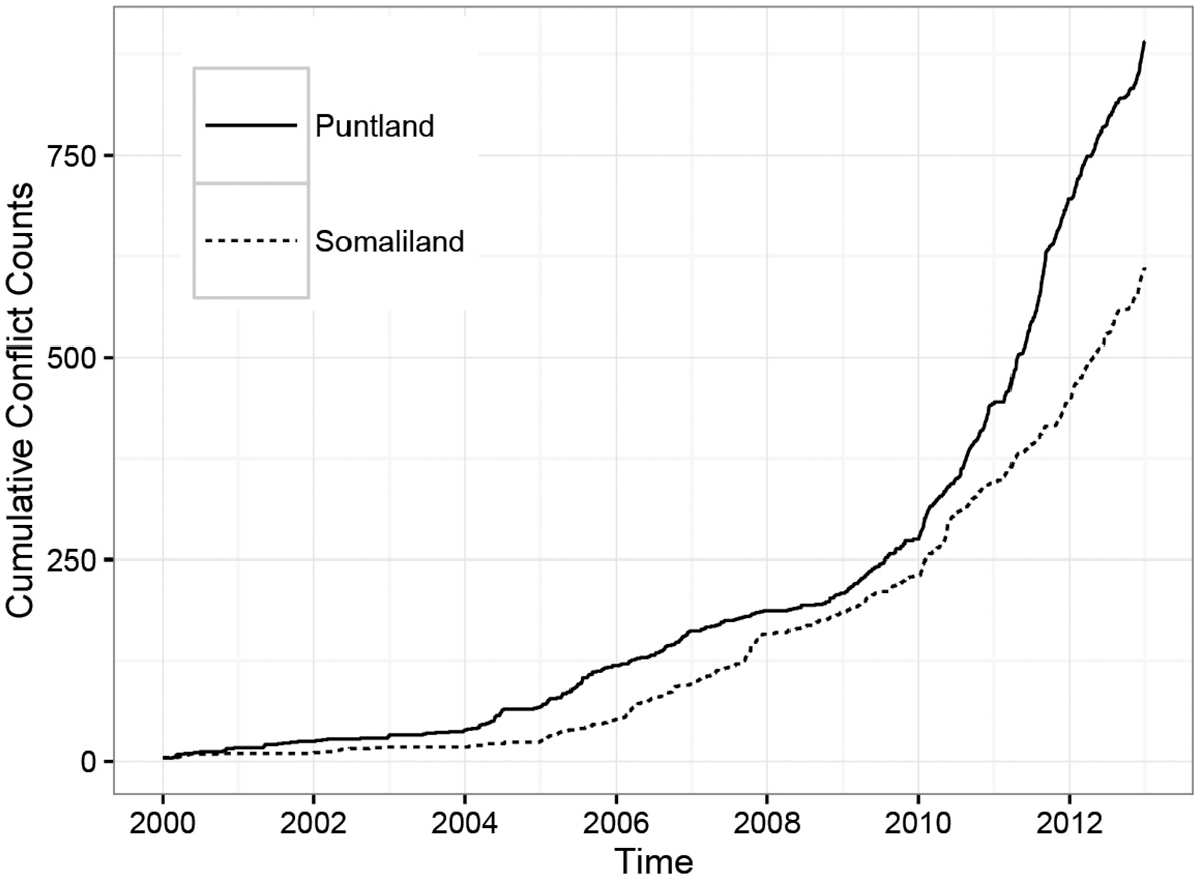
Cumulative counts of ACLED conflict events in Puntland (solid line) and Somaliland (dotted line), 2000–2012.
3.6. Supporting the regimes in equilibrium
In an equilibrium, neither the pirates nor the livestock traders have a profitable one-time deviation from any of the automaton states that are reached on the path of play. Deviations by the livestock traders are perfectly observable, so their incentive to not deviate from the SCR can be provided by a switch to the NCR if the NCR gives a lower payoff to them than the SCR and discounting is sufficiently low. Thus, to focus our attention on the monitoring problems that complicate the incentives of the pirates to not deviate, we make an assumption that guarantees that the livestock traders’ payoff from either SCR exceeds their payoff from the NCR for all values of

As the right-hand side of (A3) is positive, this implies that the left-hand side is positive. Therefore, the ex ante expected income to livestock traders when they share the maximum amount under Peace and self-regulation (i.e., the quantity
The following proposition summarizes our main result. 29
There is a PPE that supports the NCR for all values of the discount factor
There exist three continuous real-valued functions
We prove this proposition in the appendix. In what follows here, we interpret it and briefly remark on its implications.
Parts (i) and (ii) imply that either the SCR[
Similarly,
3.7. Putting the model into context
Our explanation for the different situations in Somaliland and Puntland is that the two regions differ in terms of the fundamental parameters of the model, particularly
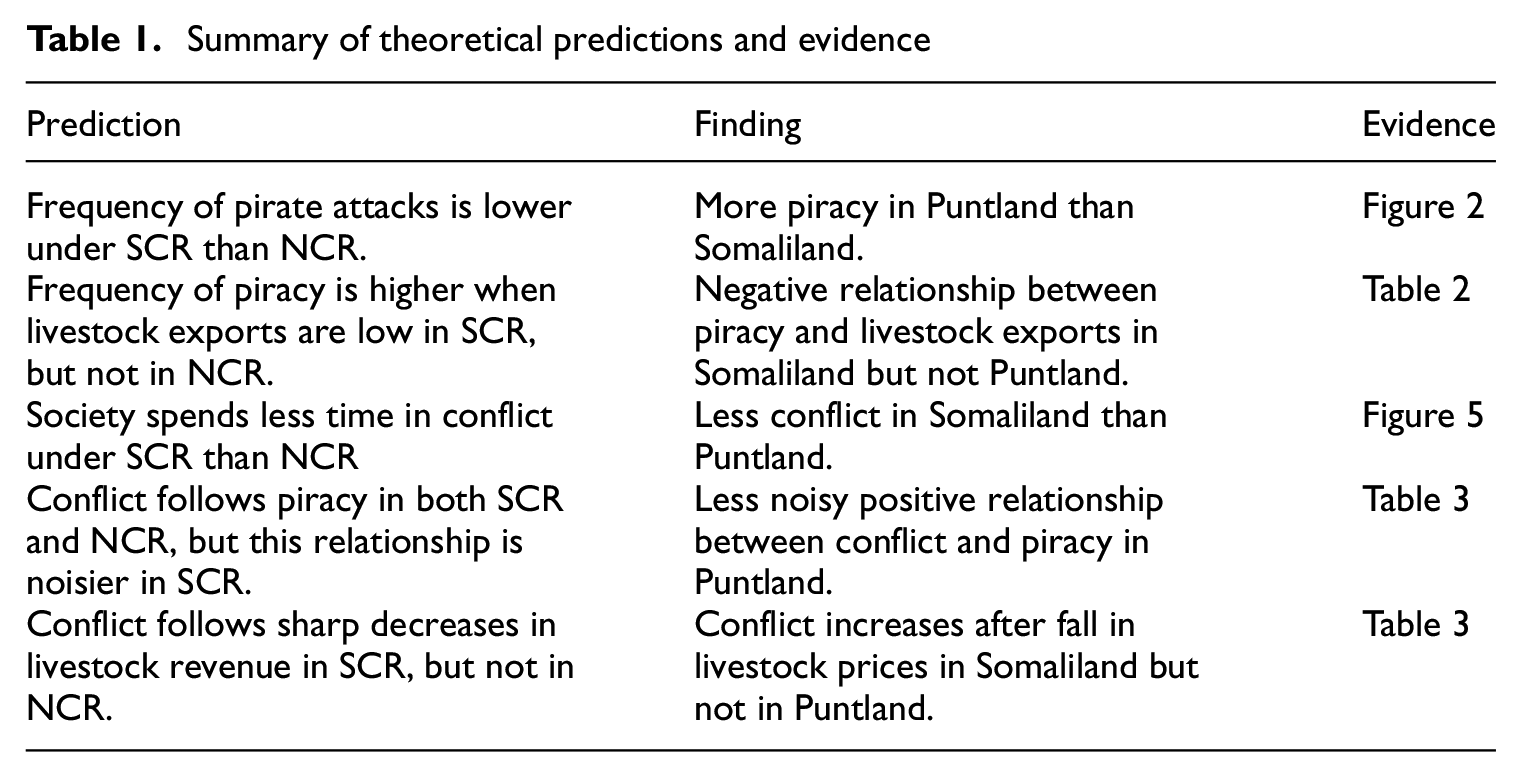
We now compare the two regimes in terms of their predictions for Somaliland and Puntland, focusing on explaining the variation in piracy and conflict. We summarize these predictions in the left column of Table 1.
Summary of theoretical predictions and evidence
3.7.1. Piracy
Piracy takes place in an unregulated way under the NCR and the pirates are able to make successful attacks with probability
In addition, under the SCR, piracy attacks are more frequent when livestock exports are low and less frequent when livestock exports are high, whereas under the NCR there is no relationship between livestock exports and the timing of piracy attacks. The reason is that the SCR represents a social agreement that is designed to mitigate the externality caused by piracy attacks on the livestock trade. When trade is low, there is almost no externality so there is no reason for the livestock traders to want the pirates to self-regulate, and for the pirates to do so. Given this, we expect to see a negative relationship between livestock exports and piracy off the coast of Berbera in Somaliland. By contrast, the relationship between livestock exports and pirate attacks off the coast of Bosasso in Puntland should be much weaker, because the distribution of interests in Puntland is such that groups are unable to reach an agreement whereby piracy will always be regulated in periods when livestock revenues are high.
3.7.2. Conflict
What fraction of time do the two societies spend in the Conflict automaton states in the long run? This quantity can also be derived by finding the stationary distribution of the Markov process governing state transitions when the agents implement the paths associated with the NCR and either of the SCRs. The quantity is given by
As well as differing with regard to the amount of conflict that occurs, the NCR and SCR also differ in terms of when conflict starts. Under the NCR conflict takes place after piracy attacks because the pirates bring back income that creates a windfall of resources to compete over, and/or because of the social incentives to sanction piracy. Under both SCRs, there is also a relationship between conflict and piracy attacks; but, because attacks are less frequent, the relationship is subject to more noise. If piracy attacks occur only when piracy does not hurt the livestock trade, for example, there should be only a weak relationship between piracy attacks and conflict. Conflict does take place, however, after a sharp decline in livestock revenue because the livestock traders use conflict as a means to provide incentives to not launch too many pirate attacks. As a result, we expect that in both Puntland and Somaliland, conflict increases after piracy attacks, but the relationship is less noisy in Puntland. We also expect that in Somaliland, conflict takes place after a sharp decline in livestock revenue, whereas in Puntland there is no relationship between livestock revenue and conflict.
4. Empirical patterns
Our model helps make sense of three notable empirical patterns that we see in the data from Somalia. The first is that piracy tends to be lower off the coast of Somaliland when livestock export levels are higher, but there appears to be no relationship between piracy and livestock exports off the coast of Puntland. The second is that in each region, conflict appears to rise after increases in pirate attacks off its coast but this relationship is measured with more noise in Somaliland. The third is that drops in the export price of Somali livestock trigger conflict in Somaliland but not in Puntland. These findings are also summarized in Table 1. We present the data patterns in three successive subsections, and conclude the section with a discussion of why our theory provides a better account of these patterns than alternative theories.
4.1. Piracy and the livestock trade
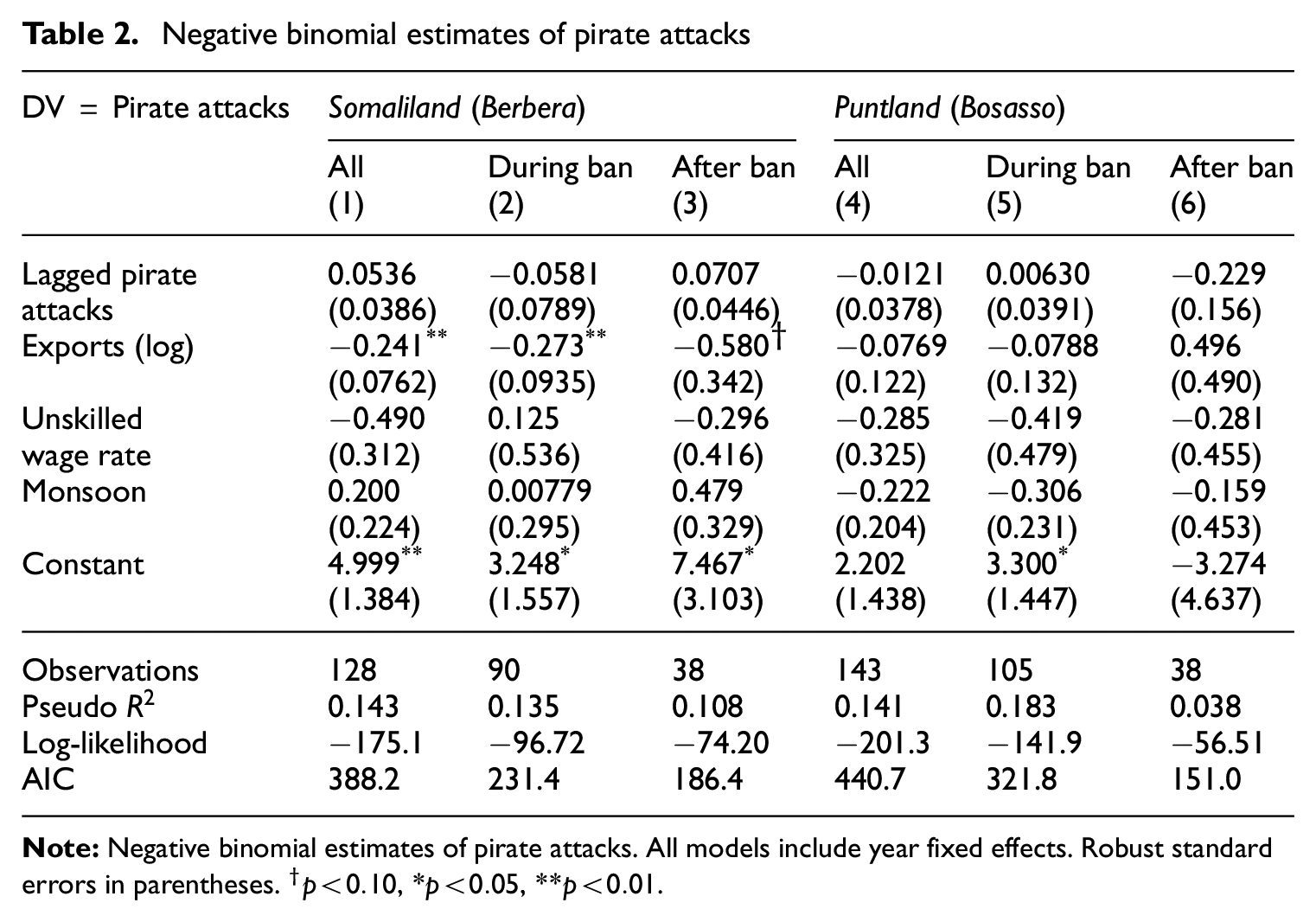
To examine the relationship between piracy and the livestock trade, we estimate negative binomial regression models in which the dependent variable is a count of pirate attacks and the main independent variable is the (logged) number of heads of livestock exported monthly from each port. Livestock export data are the same data depicted in Figure 1 and piracy data are the data depicted in Figure 2. 32
Because pirate attacks closer to ports are likely to have a greater impact on shipping and insurance costs, we use a spatially smoothed version of the piracy variable, down-weighting those attacks that occur further away from the ports. 33 We estimate separate models for pirate attacks off the two ports, Berbera and Bosasso. In addition, given the importance of the Saudi ban on Somali livestock that we noted in Section 2, and which is depicted clearly in Figure 1, we also examine the relationship prior to November 2009 separately from the relationship after this date when the ban was lifted. This takes into account the possibility of a statistical regime change taking place as a result of the removal of the ban.
In all models, we include a lag of the dependent variable, as well as year fixed effects. In an effort to control for seasonal effects, we also include a dummy variable for monsoon months to capture whether the month falls in one of Somalia’s two monsoon periods. 34 Finally, we include monthly data on the average daily unskilled wage rate for each region, taken from the Food Security and Nutrition Analysis Unit, Somalia (the same source as our livestock data in Figure 1), to account for the possibility that the relationship between piracy and the livestock trade is driven by changes in local labor market opportunities (Jablonski and Oliver, 2012).
The results, which are consistent with our theory, are presented in Table 2. The table shows that in Somaliland, the coefficient for livestock exports is negative whether we look at the whole time period or look separately during and after the Saudi ban. However, the coefficient is more than twice the size in the period after the ban was lifted. The implied effect of a one standard deviation increase in livestock exports is therefore a reduction in the number of pirate attacks by 0.59 per month during the period in which the ban was in place, and by 1.27 per month after the ban was lifted. By contrast, in Puntland the coefficient on livestock exports is closer to zero (or positive).35,36
Negative binomial estimates of pirate attacks
4.2. Piracy and conflict
We now estimate the relationship between piracy at sea and conflict on land separately for Somaliland and Puntland. To measure conflict in these regions, we use geo-referenced conflict data from the Armed Conflict Location and Event Data Project (ACLED) and generate monthly conflict counts in Somaliland and Puntland from these geo-references (Raleigh et al., 2010). These data are depicted in Figure 3, which plots the cumulative number of violence counts in Somaliland (dotted line) and Puntland (solid line) between 2000 and 2012. During this period, Puntland saw 45% more ACLED-reported conflict incidents overall, experiencing on average eight incidents per month compared to Somaliland’s five. This is consistent with our model and qualitative accounts of the on-ground situation in these two regions.
To examine the relationship of interest we take a monthly count of conflict incidents between 2000 and 2012, estimated separately for Puntland and Somaliland, as our dependent variable and a lagged monthly count of pirate attacks within a 250 km radius of the ports of Berbera for Somaliland and Bosasso for Puntland as our main explanatory variable. Lagging this variable enables us to evaluate whether conflict occurs as a result of pirate attacks. As a control, each model also includes a lagged version of the conflict variable to deal with the fact that conflict instances may be correlated over time. We also include the monsoon dummy and year fixed effects.
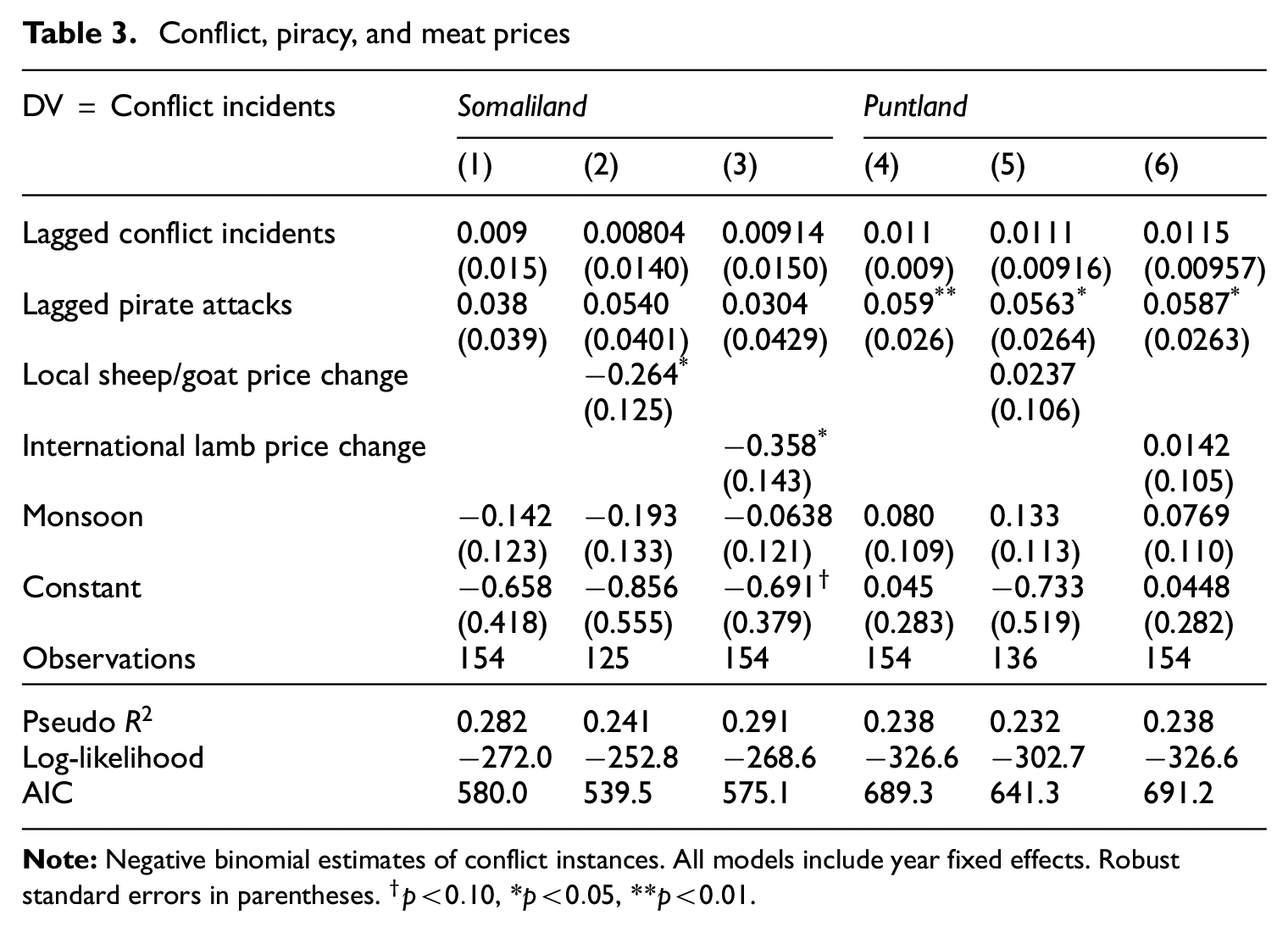
Columns (1) and (4) of Table 3 present estimates of negative binomial regression models of the relationship between pirate attacks and conflict in Somaliland and Puntland, respectively. Column (4) shows that there is a significant and positive relationship between pirate attacks and conflict in Puntland. Column (1) shows that there is also a positive relationship between piracy and conflict in Somaliland, but it is noisy. 37 Nevertheless, these results are consistent with our theoretical model, which predicts a positive relationship between conflict and piracy in both regions, but greater noise in the relationship in Somaliland.
Conflict, piracy, and meat prices
4.3. Export price shocks and conflict
Columns (2), (3), (5), and (6) in Table 3 also speak to the role of the livestock economy in the relationship between conflict and piracy. Our theoretical model predicts that a drop in livestock revenue serves as a signal of cheating from the cooperative agreement in place in Somaliland, and hence should increase conflict in that region but not in Puntland, where no such agreement is in place. Columns (2) and (5) explore this possibility by adding local goat prices to the models estimated in columns (1) and (4). For ease of interpretation, and to capture the effect of substantial price changes, this variable is operationalized as a variable equal to 1 if the month-to-month percent change in price was greater than one standard deviation above the mean,
While drops in local livestock prices may be the most relevant signals of cheating in a setting of imperfect monitoring, herders may adjust their market behavior in the face of low prices. This raises the possibility of endogeneity in these estimates. In order to avoid this kind of endogeneity, we also use a source of exogenous variation in international lamb prices from the International Monetary Fund.
38
Specifically, these data refer to the price in US cents per pound of frozen lamb carcasses at London’s Smithfield market. Somali livestock herders are price-takers in the international market, so London sheep prices serve as an exogenous source of variation in local livestock revenues in Somalia. The idea is that sheep and goats are close substitutes in the world market, so their prices are positively correlated.
39
Thus, the London price data reflect fluctuations in international meat prices and at the same time are unlikely to be affected by the actions of pirates or herders in northern Somalia. We operationalize the international price data in the same way as the local price data: the variable takes a value of 1 if the month-to-month percentage change in price was greater than one standard deviation above the mean,
Results for local and international prices are substantively similar. As expected, substantial drops in livestock prices are negatively related to conflict in Somaliland. 41 These results provide support for the expectation that conflict in Somaliland occurs at least partly in response to imperfect signals about piracy that traders in Somaliland receive from changes to meat prices. Thus, to provide the pirates with incentives to self-regulate during the high trade season, the traders in Somaliland respond to a drop in prices with conflict in order to deter piracy.
4.4. Alternative explanations
We conclude the empirical part by arguing that our theory does a better job at explaining the full set of empirical patterns than alternative accounts.
One popular explanation for the relationship between downward price shocks and conflict, of the kind we see in columns (2) and (3) of Table 3, is the simple theory that says conflict rises when people become poorer as a result of the downward shock to prices. This could be because of labor market effects: when the income from productive activities goes down, criminal occupations involving theft, extortion, and fraud become more attractive, leading to greater social conflict. A similar kind of labor market substitution story could also explain why piracy is greater during periods of low trade in Somaliland, as Tables 1 and 2 reveal. Similarly, the fact that conflict is higher in both regions following increases in piracy could be explained by a ‘resource curse’ argument: pirate attacks bring more conspicuous wealth to society, so fighting rises after these attacks because there is more to fight over. 42
The problem with explanations that rely on labor market effects is that they fail to account for why we see the relationship between piracy and livestock exports, and price shocks and conflict, in Somaliland but not in Puntland. If the livestock trade constitutes a substantial share of the economy in both regions, as we know it does, then shocks to the industry should result in discernible labor market effects in both areas.
More importantly, studies such as Majid (2010), Eid (2014), and Umar and Baulch (2010) stress the importance of clan and family ties in the livestock trade, suggesting that labor markets do not work in the way that the labor market substitution theory posits. In fact, these studies show that herders tend to follow their herds throughout the year, and that the actual shipping business is in the hands of a few specialized traders. Put another way, one does not just quit piracy, buy a herd, and start being a herder when short-term livestock prices go up. There are considerable fixed costs that impede this kind of labor market substitution. A more likely possibility is that pirates are switching between piracy and working as laborers at the ports during the high-trade season, but the lack of a significant relationship between piracy and the unskilled wage rate suggests that this is not the case.
In addition, the resource curse argument fails to account for why the relationship between pirate attacks and conflict is noisier in Somaliland than in Puntland. 43 Moreover, while the resource curse argument may make sense of the relationship between conflict and piracy, its predictions run counter to the pattern we see in the relationship between price shocks and conflict. Downward shocks lower the overall income of society, reducing the aggregate value of wealth that is contestable. Therefore, according to this explanation we should see less conflict after steep price drops in both regions, whereas we see the opposite in Somaliland and no discernible relationship in Puntland.
Our model, in contrast to these theories, provides a unified explanation for the data patterns. These patterns and the qualitative evidence that we have presented suggest that the structure of cooperation between clans is fundamentally different in Somaliland than it is in Puntland. Resource curse and labor market substitution arguments do not take into consideration these social differences, whereas our explanation does. According to our theory, the differences between the two regions are attributable to the fact that clans with diverse interests have discovered a way (albeit imperfect) to cooperate in Somaliland whereas they have not discovered an analogous self-enforcing mode of cooperation in Puntland.
5. Concluding remarks
A key contribution of this paper is the characterization of the conditions under which cooperation such as that which appears to be in place in Somaliland can be maintained informally through pre-existing social arrangements. In particular, we have addressed the question of how restraint of predatory economic activities such as piracy can be obtained via a decentralized social contract in the absence of an exogenous ‘protector state’: conditions that we see in both Somaliland and Puntland. Our theory suggests that piracy is best controlled by expansion of alternative economic activity such as livestock trading, and improving the social and political institutions that promote income-sharing in society.
Although our model is particular to the Somali case, its main features may be portable to other settings in which the predatory sector has an indirect negative externality on the productive sector. Take, for example, the increased operating costs faced by oil producers in Nigeria, which, owing to security challenges including frequent kidnapping and armed robbery, Alike (2017) estimates to be between 15% and 35% higher than in other countries, with over US$500 million spent on security services in 2016. Importantly, even if the nefarious activities of the predatory group are not aimed directly against those operating in the productive sector, criminal activities may still have negative externalities that are detrimental to productivity, which makes the setup of our model relevant to that case as well. 44 Other settings to which our model may apply are the drug trades in Colombia and Mexico, and other organized crime syndicates such as those operating in Italy, Japan, and Hong Kong.
From a methodological perspective, our paper demonstrates the value of the theory of cooperation under imperfect monitoring in describing real-world social equilibria in specialized settings. By specifying an exact theoretical relationship between piracy, livestock trading, and land-based conflict, we were able to generate a number of predictions that rationalize a set of empirical patterns specific to a particular case. Our analysis suggests new ways of integrating theory with case analysis that could be especially valuable in contexts where data are limited.
Footnotes
Appendix A. Summary statistics and instrumental variables results
Table 4 presents summary statistics for the data used in this paper. In the remainder of this section, we present the instrumental variables estimation strategy for estimating the relationship between livestock exports and piracy attacks mentioned in note 36.
Estimating the relationship between livestock exports and piracy attacks is difficult since many unmeasured factors may affect both export volume and piracy attacks. One such factor is current weather conditions, which might not be sufficiently controlled for by our monsoon dummy, and which may simultaneously decrease the ability of pirates to carry out attacks while decreasing the volume of livestock offered for export. For example, in periods of plentiful rainfall and ample grazing forage, pastoralists face less pressure to sell their animals to purchase food. At the same time, heavy rains make it harder to undertake pirate attacks. If both livestock exports and pirate attacks are higher in periods of limited rainfall, this unobserved factor may lead us to underestimate the negative relationship between exports and piracy.
To address the possibility of such confounding, we examine how exogenous variation in demand for livestock due to the annual Hajj affects exports and, in turn, piracy. As the Hajj is scheduled by reference to the Islamic lunar calendar, which is shorter than the Gregorian calendar, its timing is plausibly exogenous to pirate attacks as well as longer-term seasonal weather that may affect piracy. This makes it a reasonable candidate as an instrument for exports, albeit with some caveats. In particular, the exclusion restriction, that piracy incidents are affected by the Hajj via the livestock export route alone, may be violated in other ways. For example, one might argue that, since Somali pirates are Muslim, they may reduce the organization of piracy activities during particularly salient religious periods. Although this ‘pious pirate’ argument does not appear to find support elsewhere in our data (in particular, pirate attacks are no less likely on Fridays) we cannot rule out this possibility so we must interpret the results of this strategy with equal caution. 45
Table 5 shows the results from this instrumental variables estimation strategy. All models include lagged exports and year dummies to control for changes in export volumes across time. The first notable result is the positive coefficient of the Hajj indicator on export volumes across all first stage models in the lower panel. As expected, the Saudi livestock ban attenuated the relationship between the instrument and exports during the ban, which can be seen by comparing the coefficient estimates during and after the ban for each port. This attenuation is particularly acute for Somaliland, demonstrating the importance of the Saudi livestock market for Somaliland’s Berbera port.
We report the second stage estimates in the upper panel of Table 5. Given that we use a negative binomial model for the pirate attack count data, we use the second-stage residual inclusion method for non-linear models, which provides a way to control for unmeasured confounders in the second stage. Our interest is in the coefficient of the log of exports (third row). The upper panel shows how the estimates for each region follow our expectation. There is a negative relationship between exports and pirate attacks in Somaliland, consistent with the argument that pirates self-regulate their piracy therein. This relationship is especially strong after the Saudi ban ended and Somaliland’s export market expanded. The larger size of the estimates in Table 2 as compared with Table 1 in the main text indicate that unobserved factors do lead us to underestimate the negative relationship between exports and piracy in the first part of the table. In Puntland, there is no evidence of such a relationship, consistent with the lack of coordination between Puntland’s diverse economic interests.
Appendix B. Proof of Proposition 1
A PPE supports a path automaton if, on the path of play, the PPE prescribes the same action choices that are prescribed by the path automaton.
We organize the proof as follows. We first characterize the payoffs for each group in each automaton state of the NCR, SCR[
Acknowledgements
We are grateful to Dawud Abdirahman, Ben Ansell, Bob Bates, Oeindrila Dube, Claire Elder, Jim Fearon, Michihiro Kandori, David Laitin, Jacob Shapiro, Takuo Sugaya, Michael Tiernay, and audiences at APSA, the University of Chicago, MPSA, Oxford, the University of Rochester, Stanford, and UCLA for valuable feedback.
Declaration of Conflicting Interests
The author(s) declared no potential conflicts of interest with respect to the research, authorship, and/or publication of this article.
Funding
The author(s) received no financial support for the research, authorship, and/or publication of this article.