




Abstract
With Brexit imminent, the debate on the need for differentiated integration (DI) by means of opting-out has gained new momentum. At the same time, non-member states decide to adopt European Union (EU) rules as exemplified by the European Neighbourhood Policy. In light of these opposing observations, we examine the EU’s disposition to supply DI. We outline the strategic interactions of the EU member states or non-members in the context of two forms of DI: opting-out and inducing-in. In the case of opting-out, EU member states can refrain from adopting EU rules; inducing-in refers to providing non-member states with incentives to adopt EU rules. We show that the information asymmetries inherent to the strategic interactions result in a situation in which the EU is likely to supply opportunities to opt-out for member states to a much greater extent than necessary. Furthermore, the EU is likely to offer more compensation to non-member states in exchange for adopting EU rules than it would actually need to.
1. Introduction
European integration has been accompanied by debates on differentiated integration (DI). Notions such as ‘multi-speed’ Europe, ‘flexible integration’, ‘unity in diversity’, or ‘core Europe’ have emerged, all of which share the idea that the member states integrate to different degrees with the European Union (EU) (e.g., Dyson and Sepos, 2010; Holzinger and Schimmelfennig, 2012; Hvidsten and Hovi, 2015; Jensen and Slapin, 2012; Leuffen et al., 2013; Schneider, 2009). The European Monetary Union (EMU) represents the most prominent case of DI: while some member states refused to participate, others were not permitted to join the club (see, e.g., Sandholtz, 1993).
Secondary law differentiation was already a reality from the very beginning of European integration: in many cases, member states were granted exceptions from individual rules in legal acts (see Kroll and Leuffen, 2015). More importantly, since the Treaty of Maastricht and most notably with the Treaty of Amsterdam, DI also became an option in primary law. Moreover, in the context of EU enlargement, some accession candidates requested and/or were given temporary ‘opt-outs’ to gradually adapt to the legislative requirements (Tosun, 2011). In some cases, permanent or temporary opt-outs were the result of incapacity, in others they were based on deliberate choice (Warleigh, 2002).
Adding to the overall degree of DI, some non-member states chose to ‘opt-in’, either unilaterally adapting their national policies to EU law or being induced to do so by the EU. For processes of opting-in, Switzerland transfers EU legislation into national law despite not being a member state (Holzinger and Schimmelfennig, 2012; Schimmelfennig and Lavenex, 2009). The EU itself supports opting-in frequently: for example, the non-EU countries of the European Economic Area (Norway, Liechtenstein and Iceland) are required to apply the respective EU law. Another example is the European Neighbourhood Instrument, providing financial incentives to European neighbourhood countries in an attempt to induce them to align their policies with the EU (Börzel and van Hüllen, 2014; Bossuyt et al., 2017). In these cases, the EU strives to export its policies to third countries and induce them to join in for specific sectors.
As opt-outs and opt-ins are becoming increasingly common, the EU is expected to become more heterogeneous, rendering the assessment of the economic, political, and social impacts of integration more complicated (De Búrca and Scott, 2000). At the same time, granting opt-outs does not seem to work as a facilitating factor of European integration anymore. The United Kingdom has received the greatest number of concessions and special rules in the past (Duttle 2016; Duttle et al., 2017), and yet the British public voted against remaining in the EU in the Brexit referendum.
In the following, we refer to all these processes uniformly as ‘DI’. We are interested in the question as to why we observe such a large degree of DI despite the existence of one very strong motive for European integration – the harmonization of policies and markets. Why are EU member states and the supranational institutions willing to grant so many opt-outs and, at the same time, to entice others to join and even compensate them? The motives of the EU members or third states vary across the diverse processes of DI. We concentrate on two forms of DI, which Leuffen et al. (2013) labelled as internal and external differentiation. International differentiation refers to a situation in which a member state receives an exception from EU law, leading to DI within the territory of the EU. The specific behaviour that leads to internal differentiation and which we examine here is ‘opting-out’ (see Jensen and Slapin, 2012). External differentiation describes a situation in which the EU asks non-member states to import European rules (usually accompanied by compensation payments), leading to a situation of DI outside EU territory. The corresponding behaviour we examine here is ‘inducing-in’. 1
In the next section, we give a brief overview of the literature addressing the phenomenon of DI. Next, we develop a formal model for explaining the supply of DI. We discuss this finding and draw some conclusions in the closing section.
2. Building on the state of research
Differentiated integration has many facets and so has the academic literature dealing with this topic (e.g., Holzinger and Schimmelfennig, 2012). Many studies have indirectly addressed de facto DI by looking at the implementation of European law in the member states. An overarching finding of these studies is that non-compliance with European legislation is widespread among member states (see, e.g., Börzel, 2002; Haverland and Romeijn, 2007; Zhelyazkova, 2014). Holzinger (1991, 2011) showed that the differentiated outcome of the EU’s environmental policies is the consequence of multiple factors: apart from variation in implementation, there are many routes for differentiation laid out in the EU rules themselves. The various harmonization techniques used by the EU are the most prominent example. Furthermore, vague statutory terms provide opportunities for differentiation. Finally, temporary or permanent exceptions for individual member states allow for incomplete integration.
In this study, we use the concept of de jure DI. We define DI as the territorially fragmented validity of EU legal rules, that is, we refer only to differentiated integration if through a ‘differentiation act’ EU rule validity varies across the member states and non-member states (see Leuffen et al., 2013). Three broad groups of literature have dealt with DI in terms of different rule validity: normative concepts; empirical studies; and theoretical approaches.
First, a host of normative conceptions has been developed on how EU integration should progress given growing heterogeneity. Most prominent are the political proposals of a multiple speed Europe, Avant-Garde Europe, core Europe, Europe of concentric circles, flexible integration, variable geometry, and Europe à la carte (e.g., , Holzinger and Schimmelfennig, 2012; Leuffen et al., 2013; Stubb, 1996). The influential typology put forward by Stubb (1996) distinguishes forms of differentiation according to the dimensions of time, space, and matter. The legal literature offers typologies of the various legal instruments of differentiation (e.g., Tuytschaever, 1999). Economic theories were concerned with designing optimal institutional arrangements that accommodate heterogeneity of preferences in order to avoid externalities between lower level jurisdictions (e.g., Frey and Eichenberger, 1996).
Second, there is a wide range of descriptive literature that relates to differentiation at the level or primary and secondary law as well as to internal and external differentiation. Most relevant for the purpose of this article are studies that directly address the negotiation of European rules (e.g., Falkner, 1996). One of the first studies to address the DI in this way is Sandholtz’s (1993) analysis of the bargaining of the Treaty of Maastricht and the EMU that traces Denmark’s and the United Kingdom’s decisions to opt out from the EMU back to low public support. This finding conforms to the ‘two-level models’ as put forward by Sandholtz (1993), Moravcsik (1997), or Holzinger (2008).
In an encompassing quantitative approach, the EUDIFF1 and EUDIFF2 datasets comprise all opt-outs from EU primary and EU secondary law for the time period 1958 to 2012. Duttle et al. (2017) find that differentiation arising from the accession of new member states and treaty differentiation accommodating strong opposition against the integration of core state powers drive both primary and secondary law differentiation. For secondary law, the data reveals some ‘oversupply’, as the number of potential differentiations is by far greater than the number of actual differentiations. As actual differentiation counts one that is in fact applied by a given member state, a potential differentiation opens up the opportunity for some or all member states to apply for derogation with the European Commission (Duttle, 2016).
External differentiation is dealt with in contributions to the EU’s Neighbourhood Policy (ENP). These studies do not explicitly aim at explaining why external differentiation emerges; they are rather concerned with the modes of external governance (Börzel and van Hüllen, 2014; Lavenex, 2011; Lavenex et al., 2009). However, insofar as they deal with the question of which EU rules are adopted by non-member states, they use a bargaining perspective. The stronger the interdependence and the higher the bargaining power of the EU in a given policy field, the more likely it is that a non-member state will adopt a rule (Schimmelfennig and Lavenex, 2009). Likewise, the higher the financial incentives provided to countries, the more likely the European Commission is ‘to give ownership to the countries and to “buy” reforms from the neighbouring governments’ (Bossuyt et al., 2017: 420; see also Börzel and van Hüllen, 2014).
Third, there are very few theoretical models and explanatory approaches to DI. Kölliker’s (2001) study examines the impact of differentiation on integration and unity among EU member states and discusses which initially reluctant member states participate in an EU policy. Based on case-study evidence, Kölliker argues that an ultimately broader integration is more likely in policy areas involving excludable network effects and less likely in areas dealing with common pool resource problems.
Schneider’s (2009) approach to DI deviates from the previous studies in two ways. Firstly, she applies the concept of DI to the EU enlargement process and addresses a situation in which bargaining occurs between accession aspirants and the EU, arguably in the presence of power asymmetries in favour of the latter. Secondly, Schneider’s analysis presents another form of DI, namely one in which the EU denies the adoption of certain rules.
Jensen and Slapin (2012) deal with one specific form of DI – that is, opting-out – and introduce a spatial decision-making model, which emphasizes the importance of centrifugal effects. Once granted, opt-outs will lead to a differentiation between member states that either support or oppose further integration, which has implications for the decision-making dynamics and may result in opting-out cascades.
Finally, Hvidsten and Hovi (2015) turn the explanatory question around: instead of asking why integration has become differentiated, they inquire why it has not become more differentiated. They argue that European integration remains a single-track enterprise because of positive network externalities. Based on an n-person battle of the sexes game they show that twin-track integration may also be a stable solution if two sizeable coalitions exist. Twin-track integration will however lead to discontent, as it diminishes network benefits for both coalitions. Discontent may push back towards the single track. Hvidsten and Hovi conclude that the underlying centripetal effects of integration can accommodate substantial preference heterogeneity among member states.
In reviewing the existing scholarship, we find valuable insights upon which we can build. First, we have learned that opting-out is not the only form of DI. Second, the literature reviewed underlines the relevance of both domestic and EU preferences for integration levels. As a result, theoretical treatises of DI must take into account the two-level strategic logic inherent to DI. At the same time, however, the literature leaves some important questions unresolved. Most importantly, the literature is silent about the circumstances under which the EU is willing to accept or even pursue DI. This is the aspect to which we turn in the next section. In particular we concentrate on information constraints.
3. Explaining DI
In this section, we develop a theoretical model that explains both types of DI: opting-out and inducing-in. We conceive of DI as any situation in which there is a temporary or permanent difference in the territorial validity of EU rules and distinguish two basic types of differentiation. Internal DI refers to the ‘opting-out’ of an EU member state from a common policy. With external DI, we refer to a situation in which certain EU policies are extended to non-member states. As this is usually a consequence of a political preference of the EU to integrate its neighbourhood by offering financial incentives for the implementation of reforms, we label this process ‘inducing-in’. This section provides empirical insights for both processes to motivate our research question.
We argue that DI can be conceived as a strategic game between EU actors seeking further integration on the one hand, and exemption-seeking member states or compensation-seeking non-members on the other hand. Our main argument contends that limited information and information asymmetries lead to (excessive) differentiation and compensation. It leads us to two propositions, one for opting-in, one for opting-out.
Proposition 1
With the opting-out scenario, integration-willing EU actors cannot precisely estimate the political constraints of the less integrationist member states in implementing new legal rules. In consequence, they are willing to accept their demands for (an excessive degree of) legal differentiation.
Proposition 2
With the inducing-in scenario, the EU actors cannot judge how much compensation is actually needed in order to induce non-EU states to adopt EU law. Consequently, the EU is willing to supply (an excessive amount of) compensation to non-members in order to induce them to voluntarily adopt EU policies.
For our model, we assume rational actors for the EU, the member states, and third states. We distinguish member states (M) potentially willing and capable of opting-out; third states (T) potentially willing and capable of joining-in; and the ‘EU’ 2 , that is, the aggregate of all member states willing to participate in a step of further integration (m) for the opting-out game, respectively all member states (n) for inducing-in. In line with Hvidsten and Hovi (2015), we assume that the ‘EU’ is generally interested in the full integration (FI) of all member states, is prepared to accept opt-outs if no better solution is possible, and is interested in inducing-in third states for certain policies. We conceive of supranational institutions as part of the ‘EU’. The European Parliament and the Commission can be safely assumed to prefer FI. Further, we assume that national governments represent their states in the negotiations of further internal integration or external integration (EI). Their preferences, integration-willing or reluctant, are assumed to be a consequence of domestic political processes, just as in the theory of Moravcsik (1997), but we do not explicitly model the domestic process. In this context, it should be noted that national parliaments or populations can factually force integration-willing governmental actors to opt-out, as demonstrated by the United Kingdom’s opt-out from the Social Protocol and the Danish opt-out from the EMU (Falkner, 1996; Holzinger, 2008; Sandholtz, 1993).
We thus assume two players for each game, the ‘EU’ and M or T respectively. We further assume asymmetric information between the ‘EU’ and M or T: M and T have private information. The willingness to participate in further integration or to opt-out (for M), to accept an integration proposal or to reject it (for T), depends on the domestic political costs of the integration step. The (member or third) states may signal their willingness to opt-out (M) or to join-in (T). The ‘EU’, however, cannot know how serious the signal is because it does not possess sufficient information about the domestic costs. It is important to note that our models relate to secondary law. Secondary law can be quite technical, the implementation cost is very specific and varies for each member state. Predicting the political and administrative cost of implementation in the member states or third countries is thus difficult for the ‘EU’.
The costs of domestically implementing the new integration step may have several sources. First, there may be direct financial costs arising in the public sector or private sector, depending on the type of project. Second, there may be administrative costs that arise from the need to adapt law and change procedures. These costs will most often emerge in public administration but may also appear in the private sector. Finally, and most relevant for the governments representing the member states in the negotiations, the direct and administrative costs can turn into political costs. If lobby groups from the private sector or public officials oppose further integration, this might influence opposition parties (see, e.g., Sandholtz, 1993) or the general public (see, e.g., Jensen and Slapin, 2012). Consequently, the government faces loss of public support, future vote loss, or even legislative defeat if the opposition comes from true veto players. This cost structure is complex, and even if the ‘EU’ may have some clues in cases of high politics decisions in primary law, it can rarely evaluate the domestic costs for rather technical secondary law policies. It is thus justified to assume asymmetric information in this respect. Therefore, the national governments can misrepresent their cost information during the bargaining with the ‘EU’– which is at least confronted with residual uncertainty.
Based on our information assumptions, we rely on a specific category of negotiation games, namely signalling games, which are useful for examining interactions characterized by asymmetric incomplete information (see, e.g., Bechtel and Tosun, 2009). One player has private information on which ‘type’ it is, that is, how its payoff structure looks like, while the other player does not know the type of its counterpart. The uninformed player knows the set of possible types for the informed player and the probability distribution over these types (the probability distribution is common knowledge).
Otherwise, the characteristics of the game follow the common procedures. These games start with a chance move by Nature that picks the type of the player with private information. The signalling element in the game emerges from the player with private information and the actions it undertakes, which the other player might interpret as a signal about its type. If both types send the same signal, however, the uninformed player cannot draw any inferences. For both games, we first introduce the game structure, followed by a justification of the players’ preferences, before deriving and discussing the equilibrium solution.
3.1. The opting-out game
The game starts after the ‘EU’ asks M to join a further integration step. M can either accept the invitation to participate in the project (not demand DI) or demand an opt-out (demand DI). By accepting the invitation (not demand DI), the game would end with FI. Otherwise, the players enter the second stage, where the ‘EU’ has to decide how to react to the demand. The ‘EU’ can adopt two strategies. First, the ‘EU’ could decide that it is desirable to offer M the possibility of opting-out, thereby deciding to pave the way for DI. This happened in the case of the United Kingdom and the EMU in 1992 (Holzinger, 2008). Second, the ‘EU’ could renew its suggestion of further integration and not offer DI, showing that it is serious about the integration project. This happened, for instance, in the case of the United Kingdom and the Social Policy Protocol, when the EU re-approached the British government to opt-in, which eventually worked out in 1997. In the third stage, M can decide either to use its veto power to prevent the further integration step, leaving the ‘EU’ with the status quo (SQ), or to give in, leading to FI again (see Figure 1).
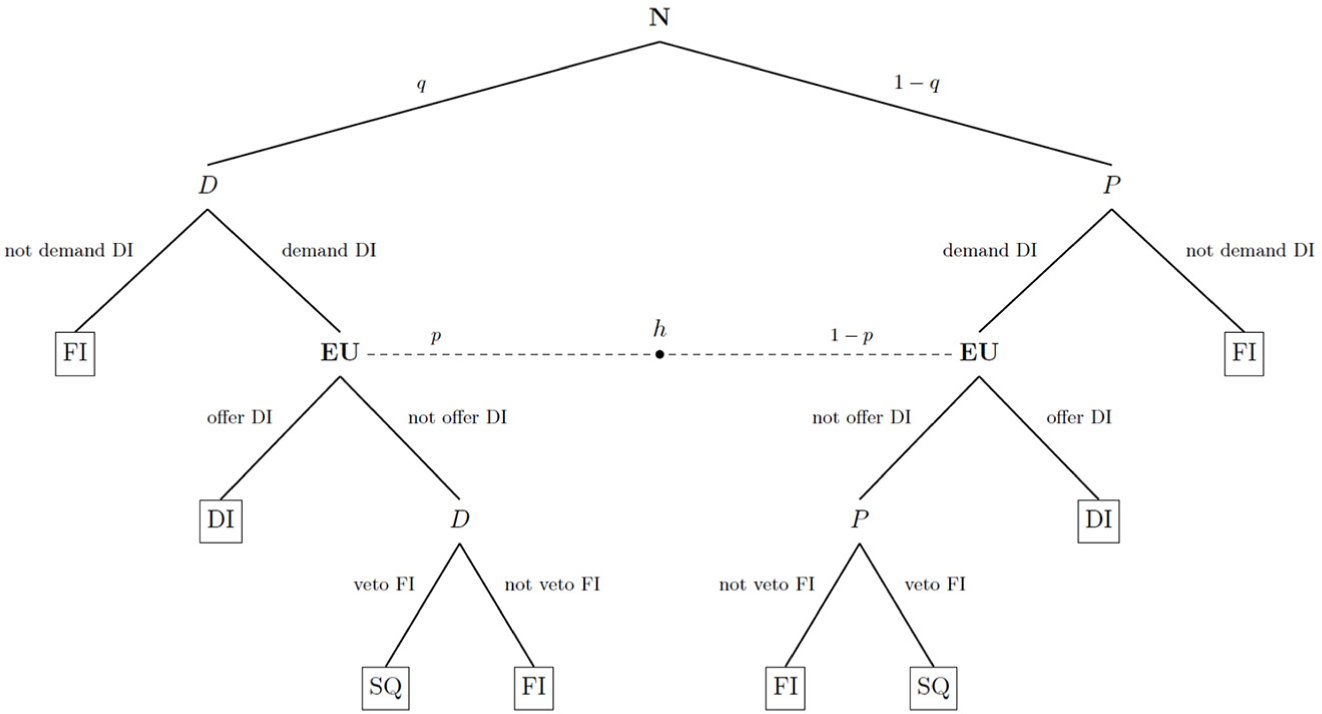
Extensive-form illustration of the opting-out game.
Depending on the actions taken, payoffs for each of the players are realized. What are the preferences of the actors across the three possible outcomes, FI, DI, and SQ? Concerning the ‘EU’, that is, the majority of member states that wish to realize the integration project, the preference ordering should be straightforward, as it clearly prefers FI over DI and ranks the SQ last. The preference order for the ‘EU’ is thus U (FI) > U (DI) > U (SQ).
The preferences of the pivotal member state M differ according to its type. Both types of M – D and P – are confronted with domestic costs arising from agreeing to the new integration project – just as any member state. For D, the decent type, the domestic costs related to the integration project in question are considered very high and expected for certain, and therefore this player is determined to oppose unitary integration. Due to the high costs faced by D, its most preferred outcome would be the participation in an integration project that allows the opting-out from the most controversial parts, that is, to practise DI. If opting-out is not possible, this player would prefer the SQ over FI. Thus, the preference order for D is U (DI) > U (SQ) > U (FI).
For P, the pretending type, while there are also domestic costs expected, they are considered not as high as for the determined type. Moreover, P might be uncertain about the actual size of its political costs. P is therefore principally willing to agree to integration, most ideally on its terms. To be on the safe side, however, it will pretend to have high costs and demand an opt-out. While P prefers DI in order to accommodate political costs, it rather supports FI than bringing the integration process to a complete halt. Thus, the preference order for P is U (DI) > U (FI) > U (SQ).
To solve the game, we employ the concept of a Perfect Bayesian Equilibrium (PBE) as developed by Harsanyi and Selten (1988). The PBE solution is well-suited for signalling games where one player has several types and takes an action that may signal its type. The other player, who does not observe the type directly but observes its action, updates its beliefs about the first player’s type and takes an action itself. This concept takes into account the beliefs of the uninformed player or receiver (here: ‘EU’) about the type of the informed player or sender (here: M). The a priori beliefs of the ‘EU’ are the probability that ‘Nature’ assigns to the nodes of the information set (q, 1-q). Further down in Figure 1, there is an information set (dashed lines, h) at which the ‘EU’ must choose an action. This corresponds to a posteriori information, that is, the updated belief of the ‘EU’ about the type of M after observing the player’s reaction to the invitation to join an integration project. Part of solving the game is thus calculating a posteriori probabilities (p, 1-p).
In signalling games, equilibria fall into three classes: separating equilibria; pooling equilibria; and semi-separating equilibria. For the case at hand, a semi-separating PBE is not possible since there are only two types of M, that is, D and P. This leaves us with the possibility of having a pooling equilibrium, a separating equilibrium, or both. In a separating equilibrium, the types choose different actions and the receiver will therefore be able to infer the type by observing her action. In the present case, D and P would choose different signalling actions, which would allow the ‘EU’ to identify their type and to react accordingly, offering DI to D and not offering DI to P. In a pooling equilibrium, the types choose the same action and the receiver’s updated beliefs p about the sender’s type are thus the same as her prior beliefs q. In the present case, D and P would both demand DI, which would not allow the ‘EU’ to identify their type such that the ‘EU’ does not learn anything and the Bayesian updating does not change her prior beliefs.
For obtaining the PBE, we examine the optimal actions of both players at each move and information set given their beliefs, consistency with Bayes’ rule, and the strategies of the other player. We arrive at two pooling PBEs, depending on p = q with

This implies that the ‘EU’ will not offer DI when it believes that the probability of M being the determined type D is less than q*, but will offer DI when it believes the probability of M being D is at least q*. Inserting the ‘EU’’s example payoffs of (FI = 6, DI =3, SQ = 0; cf. below in Figure 3) in the above equation yields q* = 0.5, implying: if the ‘EU’ expects the pivotal member state demanding DI to be the determined type D with a probability of 0.5 or higher it will offer differentiations. The exact q* depends on the relationship of the payoffs across the outcomes (as is visualized in Figure 3 below).
In consequence, we have two pooling PBEs for the game, depending on p = q.
If p = q ≥ q*, a pooling equilibrium exists in which
M demands DI regardless of its type,
the ‘EU’ proposes the possibility of opting-out, which gets accepted by M.
If p = q < q*, a pooling equilibrium exists in which
M demands DI regardless of its own type,
the ‘EU’ does not offer DI, and
type D vetoes FI, whereas P does not veto FI.
In this game, no separating equilibrium exists as it could only do so if it would pay off for P to send a signal that identifies its type, but this is not the case here. For the same reason, there is no pooling equilibrium in which M chooses to abstain from demanding DI. Since there is no cost to the signal in our game, both types will always demand DI. We thus remain with the pooling equilibrium outlined above. This equilibrium basically contends that in a situation of incomplete information, a bluffing pivot member state can have its way and receive the most preferred outcome of DI, even if this player would, in principle, also be willing to back down and accept FI. This outcome stems from the same signal both, the determined and the pretending state, send as being reluctant to accept further integration.
In reaction to this signal, the best that the ‘EU’ can do is to offer differentiation – as long as the probability of dealing with the pretending type is below the critical expectation q*. For the integration-willing actors such a proceeding still yields benefits, as, without knowing the type of the pivot player, differentiation is associated with a higher utility than the complete failure of an integration project. The asymmetric information assumption captures the fact that it is difficult for the ‘EU’ to identify the right type of member state: seriously unwilling or just bluffing to achieve an outcome easier to sell at home.
In practice, that is, leaving aside the strict assumptions of the model for a moment, there are additional reasons for offering differentiation. First, the integration-friendly EU actors have insufficient information to truly estimate their beliefs a priori: the structure of domestic expected costs is complex and they cannot know from outside what the true costs in all member states are, and thus what the probability distribution (Nature) looks like. There may be some clues, for example, during election times member states may demand more differentiation; in general, however, there is no objective frequency of the determined versus pretending types. Therefore, the EU actors cannot perform the expected utility calculation. Second, if the integration-friendly EU actors were (contrary to the model’s assumption) risk-averse rather than risk-neutral, the ‘EU’ would always choose differentiation as it would be accepted by both types and represents a sure outcome.
In conclusion, it follows from the model that differentiation is highly likely offered to the reluctant member states more often than necessary. It is important, however, that the offer is only made to pivots. For unanimous decisions, each country can potentially get DI offers. In qualified majority decision-making, a minority of countries can be outvoted and thus be forced to FI. The consensus culture of the EU, however, renders it probable that DI is offered even to small minorities in order to avoid too much discontent with FI.
3.2 The inducing-in game
Our inducing-in game is structurally equivalent to the opting-out game. The two players are the ‘EU’ and a third country (T), which can again be of two types: P and D, representing two different preference orders across the potential outcomes. The ‘EU’ is interested in inducing the third country to adopt EU rules in its territory and, in this way, in extending its rule beyond the EU territory. The reasons may vary; for example, the EU may want to prepare the third countries for future membership or perhaps the member states can economically gain from strengthened relations with these states. The most prominent example in this respect is the EU’s ENP. The adoption of EU rules entails adjustment costs for the target governments. If necessary, the ‘EU’ is willing to balance these costs with tangible incentives, such as direct budget supports (see Bossuyt et al., 2017). T, however, is free to accept the offer of EI or not, with or without compensation.
Figure 2 presents the structure of the inducing-in game. The game starts with Nature drawing a type D or P according to the probability distribution 0 < q < 1 for the two possible types. At the first stage of the game, T can decide whether to make rule adoption conditional on compensation (C) payments or to adopt the EU rules without demanding compensation. In the latter case, EI will be achieved without compensation. In the first case, we proceed to the second stage, in which the ‘EU’ has to decide whether to offer compensation to T or not. The offer will depend on the ‘EU’’s beliefs about the type of T. If the ‘EU’ offers compensation we arrive at the outcome external differentiation with compensation (EI + C), if it does not offer compensation, we proceed to the third stage of the game in which T decides whether to accept the EU rules without compensation or not. In the first case, EI is realized, whereas in the second, we fall back at the SQ.
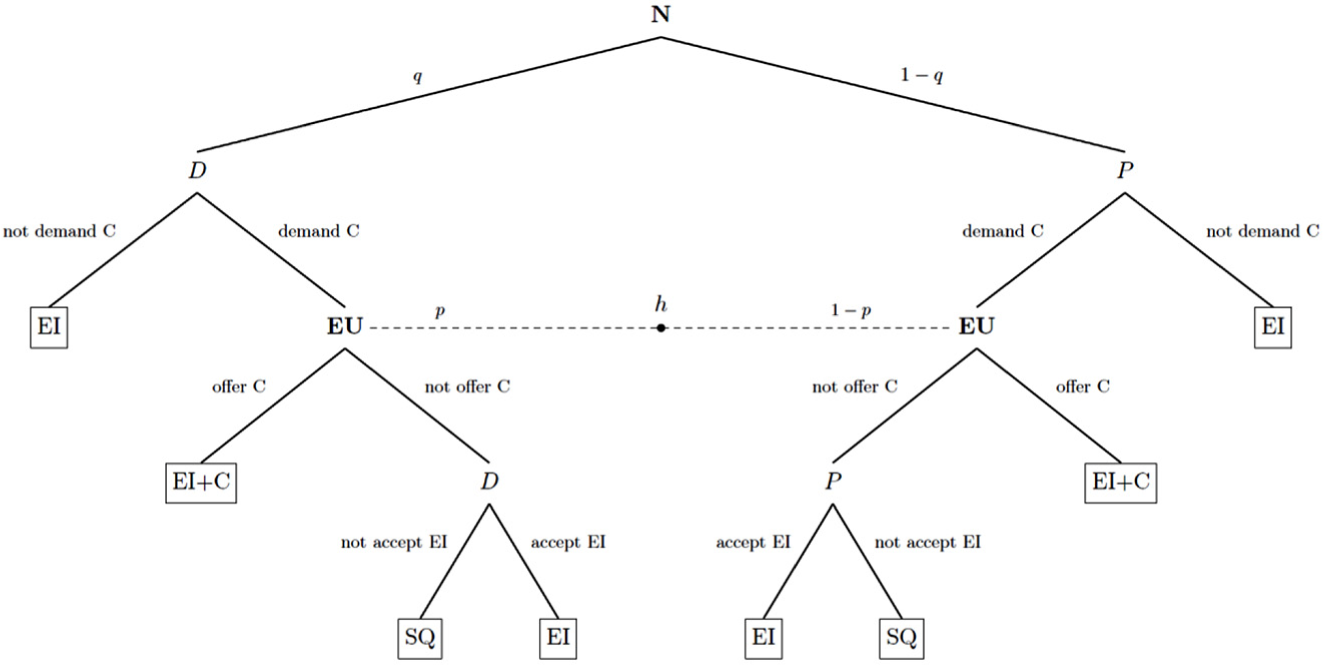
Extensive-form illustration of the inducing-in game.
Based on the ‘EU’’s decision, the payoffs for the players are realized. The ‘EU’ prefers the outcome in which T immediately follows its suggestion of rule transfer without asking for compensation, thereby achieving external DI (EI). Its second preference is a situation in which T indeed transfers EU rules while being compensated at a given level (EI + C). Her least desired option is that rule export does not take place. Thus, the preference ordering for the ‘EU’ is U (EI) > U (EI + C) > U (SQ).
The adoption of EU rules entails costs which arise from the same sources as in the opting-out game. D is a sincere player who will only agree to transfer EU rules if it is offered a compensation level that corresponds (or supersedes) the adjustment costs. If the ‘EU’ does not offer compensation, it will not adopt EU policy and no EI will occur. While this country is generally interested in adopting EU rules, it only wants to make this step when it is adequately compensated for the emerging costs (EI + C). If this is not granted, D is willing to accept the maintenance of SQ. What this player prefers least is obviously the occurrence of a rule transfer without appropriate compensation (EI). The preference ordering for this type is U (EI + C) > U (SQ) > U (EI).
P represents the type whose gain from cooperating with the ‘EU’ supersedes its adjustment costs. Nevertheless, the player pretends to be reluctant to adopt the EU policy in order to receive the compensation payment. The preference structure of P differs from D with respect to the ordering or EI and SQ. P is willing to adopt EU rules if induced by the ‘EU’. Yet, as it is still a rational player, P will try to attain a certain compensation level (EI + C) before accepting EU rules (EI). Consequently, its least preferred outcome is SQ. The preference ordering for this type is U (EI + C) > U (EI) > U (SQ).
To solve the game, we again rely on the concept of PBE. Just as in the opting-out game, we arrive at the following two pooling equilibria, depending on p = q, with

Inserting the example payoffs of the ‘EU’ (EI = 12, EI+C = 3, SQ = 0) from Figure 3 yields q* = 3/4; that is, if the ‘EU’ expects the third state demanding compensation to be the determined type D with a probability of 3/4 or higher it will offer compensation payment. The two pooling equilibria read as follows:
If p = q ≥ q*, a pooling equilibrium exists in which
T demands compensation regardless of its type,
the ‘EU’ offers compensation, which gets accepted by T regardless of its type.
If p = q < q*, a pooling equilibrium exists in which
T demands compensation regardless of its type,
the ‘EU’ does not offer compensation, and
D does not accept EI, whereas P does accept it.
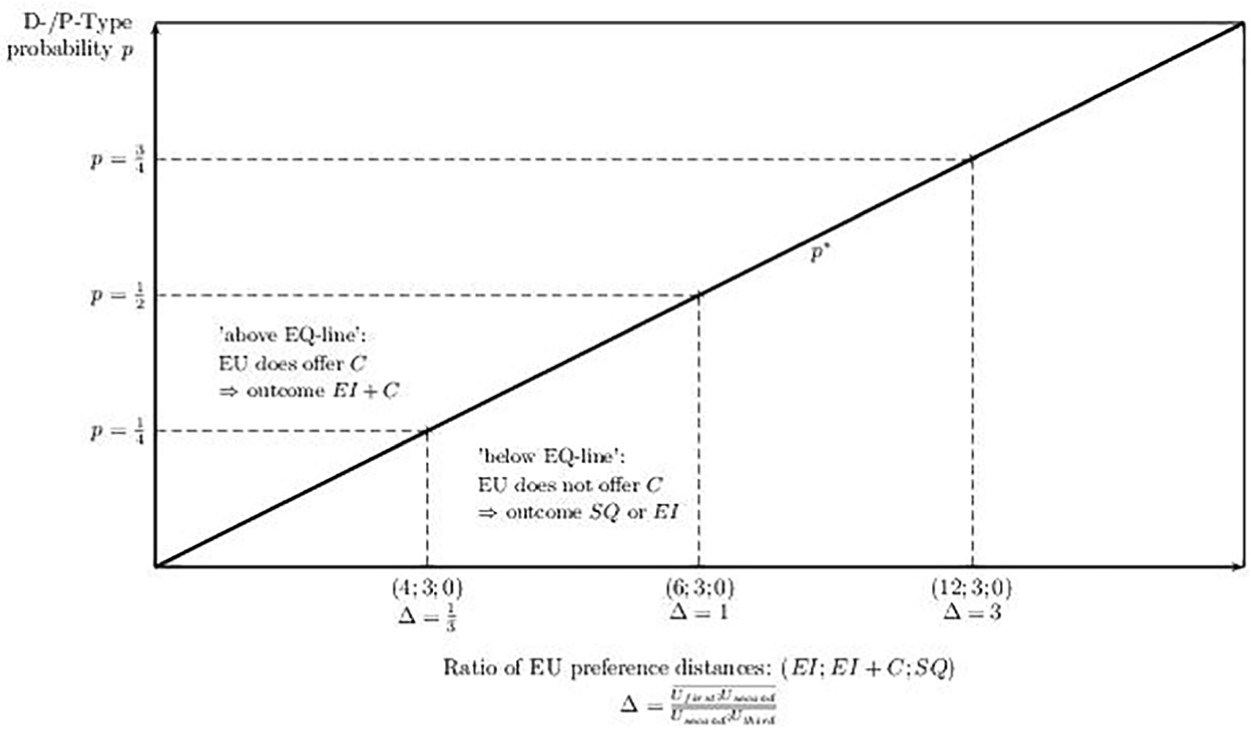
Visualization of the pooling equilibria for the inducing-in game.
In practice, it is important to note that a priori beliefs of the integration-inducing EU are even more difficult to develop than in the opting-out scenario. The EU actors have little information as to what the costs of implementing the EU rules in neighbouring countries are. Hence, they have a limited basis for assigning probabilities, doing the expected utility calculation and consequently accept a demand for compensation more easily. As with the opting-out game, risk-averse EU actors would choose to offer compensation anyway, as they prefer the sure EI+C outcome over the lottery.
In conclusion, the equilibrium implies that the ‘EU’ might be paying too much in terms of compensation for her desired extent of EI. While compensation is needed for induce-in type D, it is not necessary for type P. Thus, it might be too costly to achieve EI by the inducing-in strategy of the ‘EU’.
Finally, Figure 3 visualizes the two pooling equilibria of the inducing-in game. Above the equality line (EQ) the ‘EU’ will offer compensation and the outcome will be EI+C. Below the EQ line, the ‘EU’ will not offer compensation and the outcome will be either the SQ EI. The belief q* the ‘EU’ must hold (shown at the y-axis) to arrive at either one outcome depends on the ratio (Δ) of the ‘EU’ preferences, as shown on the x-axis. Further to the left, the difference between EI and EI+C is smaller which leads the ‘EU’ to offer compensation in order to avoid SQ; this even holds if the probability of T being type D is very low. Further to the right, the difference between EI and EI+C is larger, leading the ‘EU’ to abstain from offering compensation, except for very high probabilities of the country being type D. As the ratio Δ is also determined by the difference between EI+C and SQ, varying this difference has the reverse effect. While Figure 3 illustrates the inducing-in game, it can easily be adjusted to illustrate the opting-out game by substituting EI with FI and EI + C with DI.
We can draw two conclusions from the condition for q*, that is, the beliefs the integration-friendly actors must have about the type of the reluctant state, for both, internal and external integration. First, the stronger the ‘EU’ prefers full (external) integration to differentiation (compensation), the higher must be its expectation that the state is the determined type, in order to offer differentiation (compensation). Second, the stronger the EU prefers differentiation (compensation) to the status quo, the lower can be its expectation that the state is the determined type, in order to offer differentiation (compensation).
4. Conclusion
In this article, we investigated a topic of increasing importance, namely DI among the member states (internal differentiation) by means of opting-out and differentiation in the degree harmonization between EU policies and the policies of non-members (external differentiation) by means of inducing-in. Despite referring to different empirical phenomena, we presented a game-theoretic model of asymmetric information that can be employed to explain these outcomes. Drawing on the assumption that the majority of EU actors is keen to further European integration, the model showed that the EU is likely to ‘over-supply’ opting-out arrangements and to ‘over-compensate’ neighbouring countries for adopting European rules. Both sets of findings have important implications for the present and future of the European integration project.
With regard to internal differentiation, the ‘over-supply’ of opting-out arrangements may threaten the functioning of one of the main achievements of European integration: the internal market and the free movement of goods, capital, services, and labour. While the opt-outs are granted typically to one or a small group of member states, the accumulation of these arrangements eventually affects all EU citizens. Conversely, the lowering of the actual or perceived benefits from EU membership are likely to lower public support for further integration (see, e.g., Hobolt and de Vries, 2016). This can then induce political parties to adopt a less integration-friendly position and to work towards slowing down further integration once voted into office (see, e.g., Börzel and Risse, 2018; Spoon and Williams, 2017). A case in point for this dynamic is the federal elections in Austria in 2017, in which all political parties demonstrated scepticism towards further European integration (see, e.g., Bodlos and Plescia, 2018).
In terms of over-compensation, in times of the macroeconomic austerity, allocating too many resources to the European neighbourhood could potentially lead to (perceived) distributional conflicts within the EU and a drop in the public’s trust in the EU (see, e.g., Hobolt and de Vries 2016). This drop in public confidence could in turn further harm the EU’s overall political legitimacy, which is in danger not only because of the financial crisis (see, e.g., Tosun et al., 2014), but also because of the handling of the refugee crisis and the Brexit (see, e.g., Cappelen and Peters, 2018).
While the game-theoretic models presented here offer a powerful way of exploring the logical robustness of decisions taken by strategic actors, we must not forget that the insights they provide are contingent on the modelling decisions. Therefore, we see at least three ways in which the models presented here can be developed by further theoretical work as well as empirical investigation. The first avenue for future research is to make the game-theoretic model more complex by considering it as a repeated game (e.g., Evans and Thomas, 1997). Considering the nature of interactions in the context of European integration, it is plausible to model it as a repeated game, in which reputation and learning effects have an impact on the strategic choices of the individual actors (see, e.g., Zollman et al., 2012). Second, the theoretical model can be modified to better capture the characteristics of the member states that are reluctant to join an integration project or of the neighbouring countries that demand an excessive amount of compensation. This second avenue for future research should be particularly suitable for a theoretically informed empirical analysis that draws on data for the demands and outcomes of a series of integration negotiations (see, e.g., Lorentzen et al., 2017) . The third avenue for future research concerns the impact of the Brexit negotiations for the future of external differentiation. The German ministry of foreign affairs was cited in the newspapers as saying that the Brexit negotiations could serve as a blueprint for EI. From this perspective, we would expect that the learning experiences to be made in the context of the Brexit negotiations could limit the non-member states’ possibility to demand excessive compensation for voluntarily adopting EU policies. This aspect can be addressed theoretically and once the Brexit regime has been defined empirically. Furthermore, our model can serve as the point of departure for analysing the negotiation of the Brexit regime.
Footnotes
Acknowledgements
We thank Andreas Fleig (Heidelberg University), Christopher Bickerton (University of Cambridge), Daniel Finke (University of Aarhus), Mareike Kleine (London School of Economics and Politics), Dirk Leuffen (University of Konstanz), Jörg Oechssler (Heidelberg University), and the panel participants at the 14th European Union Studies Association Conference in March 2015 and the 73rd Midwest Political Science Association Conference in April 2015 for their valuable comments. Zachary Herriges and Jennifer Shore deserve credit for language editing and Simon Schaub for research assistance.
Funding
The author(s) disclosed receipt of the following financial support for the research, authorship, and/or publication of this article: We acknowledge joint funding by the German Research Foundation (DFG, HO 1811-7/1) and the Swiss National Science Foundation (Project ‘Differentiated Integration in Europe’).