




Abstract
The production of animal proteins ex vivo using approaches in cellular agriculture has potential to meet expanding global demands for sustainable and nutritious foods. Growth in the field of cellular agriculture is reflected by the emergence of companies focused on supporting the cultivation of cell-based and acellular products from animal and microbial cell lines. Accelerating research and development in cellular agriculture requires an interdisciplinary workforce that is fluent across disciplines including science, engineering, law, ethics, and behavioral science. PhD graduates who are trained in research projects specific to cellular agriculture are now emerging, but there is still a shortage of a skilled workforce that meets industry demands. Using three complementary theoretical models—human capital theory, skill formation theory and the triple helix model, and the actiotope model—we developed a framework to understand industry needs. We used this framework to develop and launch a survey for 18 cellular agriculture companies to assess their current and future workforce requirements, including the disciplinary backgrounds of future employees they are seeking to achieve their goals. We then analyzed the survey data, contextualized the findings, and summarized short-term and long-term strategies to identify educational pathways and resources that could produce candidates with cellular agriculture training and industry-readiness that match current and anticipated industry needs.
Keywords
Introduction
Cellular agriculture is an emerging field of biotechnology that cultivates animal cells, fungi, or microbes in bioreactors to produce foods traditionally derived from animal agriculture, such as meat, dairy, and eggs (Tufts University Center for Cellular Agriculture, 2024; McNulty et al., 2025). As engineering cells for food production becomes a rapidly growing pillar of the global future food industry, companies face a critical challenge: building a highly qualified workforce.
Producing sustainable foods through cellular agriculture requires expertise that spans cell biology, engineering, food science, law and policy, ethics, and behavioral sciences. Success in translating cellular agriculture products will also depend on collaboration and effective communication among colleagues from across disciplines (Choi and Richards, 2017; Schummer, 2008). However, developing training programs that integrate multiple disciplinary perspectives is challenging because academic programs typically have a narrow scope; for example, they are often designed around a PhD or Master’s thesis and generally do not provide the same level of collaborative training as industry (Börner et al., 2018; Delebecque and Philp, 2019). Furthermore, professionals recruited from related fields often lack the unique knowledge combinations needed for cellular agriculture. For example, tissue engineering for biomedical applications rarely considers constraints relevant to food production, such as scalability and the use of edible ingredients. Therefore, comprehensive workforce development for cellular agriculture requires tailored academic training programs to bridge the gap between foundational education and specialized industry needs.
Academic institutions can play a crucial role in preparing students for this future workforce in cellular agriculture. A recent review by Stout et al. (2024) emphasizes: “Training a new workforce with specialized and interdisciplinary skills will be vital for developing, studying, marketing, and regulating these products” (p. 488). Existing programs provide foundational skills in problem solving and training in fields such as chemical and biomedical engineering, and some institutions have introduced cellular agriculture into their curricula (Gordon, 2021; Stanford University, 2024; University of North Carolina, 2024; Wolf, 2021). For example, Tufts University offers undergraduate courses and a minor, as well as a graduate-level Certificate in Cellular Agriculture, while UCLA initiated an introductory undergraduate course in cellular agriculture. New undergraduate classes have also been launched by student-run Alternative Protein Project (APP) groups, which have been established by students at over 50 academic institutions globally; this also reflects the growing student demand for cellular agriculture courses, programs, and formalized education pathways. Taken together, these efforts represent important first steps toward formal degree programs focused on specialized skills for cellular agriculture.
Beyond technical expertise, advancing a new research field requires leaders who can effectively communicate across disciplines and adapt quickly to industry demands. Programs led by the non-profit organization New Harvest provide a model for strengthening interdisciplinary training: researchers from different disciplines were strategically placed in a cohort and met weekly to discuss research challenges, gaining research advice from fellow researchers across various scientific backgrounds and familiarity with specific challenges in cellular agriculture from bioreactor culture to media development while building supportive networks (Rowat et al., 2026).
These emerging strategies for training the future workforce in cellular agriculture offer models that other institutions could adapt, but they also raise an important question: “What minimal set of academic requirements will meet industry needs for a skilled workforce in cellular agriculture?”
Theoretical background for developing a workforce in cellular agriculture
Building a resilient talent pipeline in cellular agriculture requires educational programs that can iteratively co-evolve with the changing demands of this emergent industry. To analyze workforce development needs, we use a framework that integrates three complementary theoretical models—human capital theory (Becker, 1993), skill formation theory (Busemeyer and Trampusch, 2012; Thelen, 2004) along with the triple helix model (Etzkowitz and Leydesdorff, 2000), and the actiotope model (Ziegler, 2005; Ziegler and Stoeger, 2017). This framework informs both the design of our inquiry and the interpretation of workforce development in cellular agriculture at the economic, societal/institutional, and individual levels.
At the economic level, human capital theory explains why individuals, organizations, and societies invest in workforce development, clarifying the incentive structures that drive workforce expansion in emerging technological fields (Becker, 1993). In cellular agriculture, incentive structures are shaped by several factors: (1) The need for specialized technical expertise to address unique challenges in scaling up cell cultures, developing animal-free media, and optimizing production processes; (2) The drive for innovation and competitiveness, which motivates organizations to invest in training and education to accelerate the commercialization of novel products and maintain a leading edge in a rapidly evolving field; (3) The necessity to align with market and regulatory demands, requiring a workforce that can adapt to changing consumer preferences and regulatory landscapes; (4) The pursuit of long-term sustainability and growth, which depends on cultivating interdisciplinary and adaptable skills that enable companies to respond to technological advances and broader societal challenges such as climate change and food security. These incentive structures collectively motivate organizations, educational institutions, and individuals to invest in the development of relevant human capital, ensuring that the workforce can meet both current and future demands of the cellular agriculture industry.
At the societal and institutional level, skill formation theory (Busemeyer and Trampusch, 2012; Thelen, 2004) and the triple helix model of innovation (Etzkowitz and Leydesdorff, 2000) delineate how universities, employers, and the government coordinate the production of trained workforces with specific skills and innovation capacities. The triple helix model is particularly relevant in cellular agriculture because the sector’s rapid evolution depends on dynamic collaboration among academic institutions, industry stakeholders, and regulatory bodies. For example, universities may develop new curricula and research programs in response to industry needs, while companies provide practical training opportunities and feedback on skill requirements, and government agencies establish policies and standards that shape workforce competencies. This ongoing, co-evolutionary partnership fosters innovation, ensures that educational programs remain aligned with technological advances, and supports the development of a workforce equipped to address the complex challenges unique to cellular agriculture.
At the individual level, the actiotope model (Ziegler, 2005; Ziegler and Stoeger, 2017) conceptualizes workforce development as the emergent result of dynamic interactions between learners and their environments (Bateson, 2000). In the context of cellular agriculture, this means that future professionals must develop advanced competencies not only through formal education but also through hands-on experiences, interdisciplinary collaboration, and engagement with diverse learning resources such as laboratory work, industry internships, and participation in cross-disciplinary teams. The actiotope model emphasizes that competencies evolve as individuals adapt their skills and knowledge to new challenges, technologies, and organizational contexts (Balestrini and Stoeger, 2021). Furthermore, it highlights the importance of non-cognitive skills—such as communication, creativity, adaptability, and mission alignment—which are essential for thriving in the complex, rapidly changing landscape of cellular agriculture. By fostering environments that encourage ongoing learning and adaptation, the actiotope model supports the development of professionals who are prepared to lead and innovate in this interdisciplinary field.
This framework—with its economic, institutional/societal, and individual perspectives—is well suited to workforce development in the dynamic cellular agriculture space. Complex, interdisciplinary competencies must evolve rapidly as actors adapt to novel practices, technologies, and organizational contexts; trainees are often motivated by a commitment to address grand challenges in climate, planetary health, and social justice while facing the challenges of aligning these intrinsic motivations with economic, market, and societal constraints. This perspective locates workforce development within a broader food-systems transformation and acknowledges the motivational drivers—climate, planetary health, and social justice—that may attract and retain emerging leaders. Together, this framework integrates economic incentives, societal and institutional coordination mechanisms, and individual and team-level competency-development processes, offering a coherent basis for designing and evaluating workforce strategies in the emerging cellular agriculture sector.
The aim of this study is to understand the elements of educational programming that can meet workforce demands in cellular agriculture from these economic, societal/institutional, and competency-development perspectives. To this end, we conducted an industry survey to assess the desired skillsets and disciplinary backgrounds that are being sought by companies in the cellular agriculture space. Our findings can guide the design of educational resources for academic institutions and graduate cohort training groups that provide interdisciplinary training to prepare students for careers in cellular agriculture.
Survey overview and methodology
The survey contained 17 questions with either multiple-choice options or space for individual entries. The purpose of the survey was to assess the specific skills companies require in their current workforce and in their future workforce over the next 3–4 years. We specifically focused on the most relevant professional backgrounds that constitute the backbone of research and development in cellular agriculture such as tissue engineering, food science, and cell and developmental biology, as well as additional specific skills or traits including mission alignment, science communication, and innovative drive. We derived the survey questions from the three theoretical perspectives described above: (1) economic concerns as understood by human capital theory (Becker, 1993), (2) societal/institutional concerns as understood by skill formation theory (Busemeyer and Trampusch, 2012; Thelen, 2004) and the triple helix model of innovation (Etzkowitz and Leydesdorff, 2000), and (3) systemic competency development of individuals and teams as understood within the actiotope model (Balestrini and Stoeger, 2021; Ziegler, 2005; Ziegler and Stoeger, 2017).
Number of companies, company sizes, and company types
Eighteen companies participated in the survey with 10 companies identifying as Business to Business (B2B) only, 1 identifying as Business to Consumer (B2C) only, and seven identifying as both (B2B and B2C). Company sizes ranged from 3 to 80 people, with an average of 17.5 employees (based on 16/18 numerical responses). In the summer of 2023 we reached out to cellular agriculture companies via email and LinkedIn to participate in an online industry needs assessment survey. Most respondents were CEOs or CTOs of companies, and some were founders or co-founders. The most frequent product types listed were cultivated meat (55%) and cell line development (50%) (Figure 1). Cultivated fat and cell media development (33%) followed in ranking, and scaffolding and precision fermentation (22%) placed closely behind. While this is a relatively small sample of companies surveyed, the proportional breakdown of products or services roughly mirrors larger collections of aggregated data such as that of GFI’s Alternative Protein Company Database (The Good Food Institute, 2024a). Types of cellular agriculture products that are the focus of companies that participated in the survey. N = 18.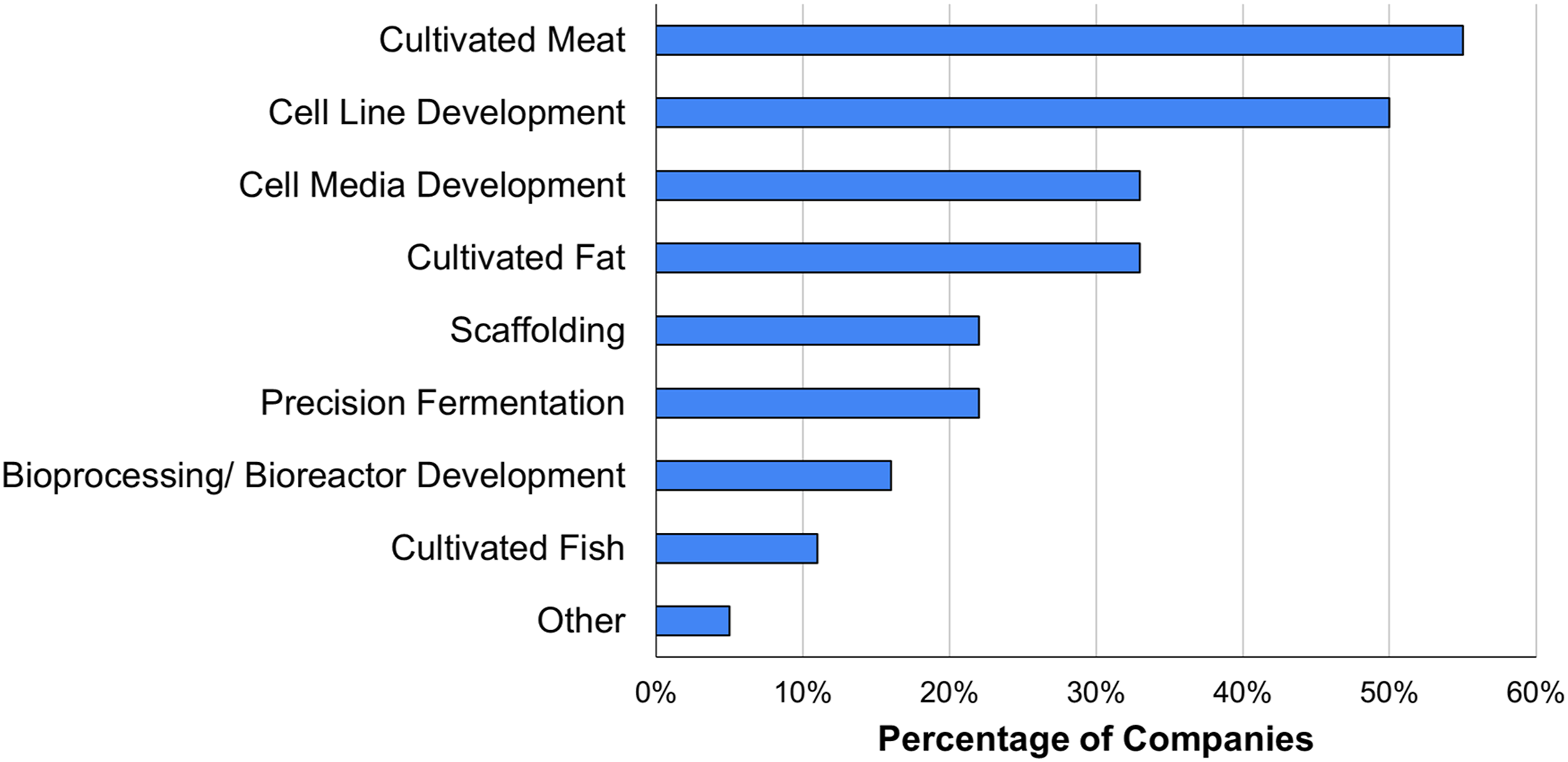
Current workforce needs versus future workforce needs
All companies were asked to complete free-form text responses to describe the positions they were currently trying to fill and positions they anticipate filling within the next 3–4 years (Figure 2). Three out of 18 companies did not have any open positions to fill at the time. The remaining 15 companies were actively looking for PhD researchers (i.e., R&D positions, senior scientists, protein scientists), business developers, bioprocess engineers, food scientists (i.e., engineering, materials scientists), production managers, cell biology technicians, data scientists with expertise in artificial intelligence (AI), bioreactor operators, laboratory operators, strain engineers (i.e., bioinformatics, sequencing), manufacturing technicians, and regulatory safety scientists. Current hiring needs and anticipated future positions over the next 3–4 years listed by companies in the industry survey. N = 18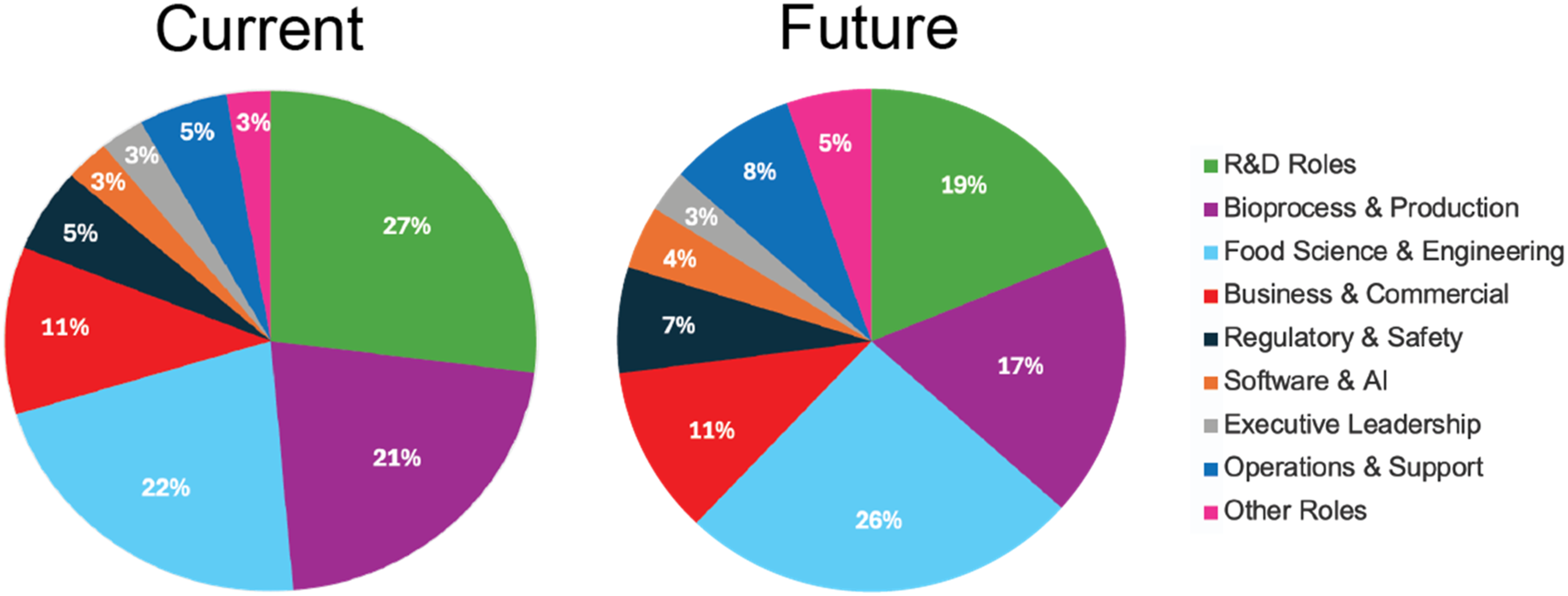
Companies reported a strong outlook for expansion, with all 18 respondents projecting significant hiring needs across various roles in the next 3–4 years. Anticipated positions spanned R&D positions, productions teams, synthetic biologists, cell biologists, bioprocess engineers, food scientists, production managers, industrial engineers, hardware engineers for facility scale-ups, senior technicians, production leads, regulatory affairs leads, cellular and tissue engineers, biochemists, cellular biologists, cell culture specialists, laboratory associates, software developers, commercial directors, laboratory and production technicians, chemical engineers, microbiologists, business developers, fermentation experts, quality controllers, regulatory experts, accountants, marketers, legal experts, lead or senior scientists. Major themes in current hiring needs emerge around roles in research and development (R&D), bioprocess and production, and food science and engineering. For future hiring needs, there was a slight shift to more anticipated positions in regulatory and safety and operations and support, with a slight decrease in hiring needs for R&D.
Relevant or necessary scientific academic backgrounds
To assess the needs for trainees with specific academic backgrounds, we asked companies which backgrounds were most relevant or necessary for the positions they were currently working to fill (Figure 3). We compiled a list of majors in science and engineering disciplines based on current knowledge about the field and inspired by GFI’s Building Alternative Protein Courses and Majors (The Good Food Institute, 2024b). Majors in science and engineering for current and future workforce needs in cellular agriculture. Future workforce needs considers hiring needs over the next 3–4 years.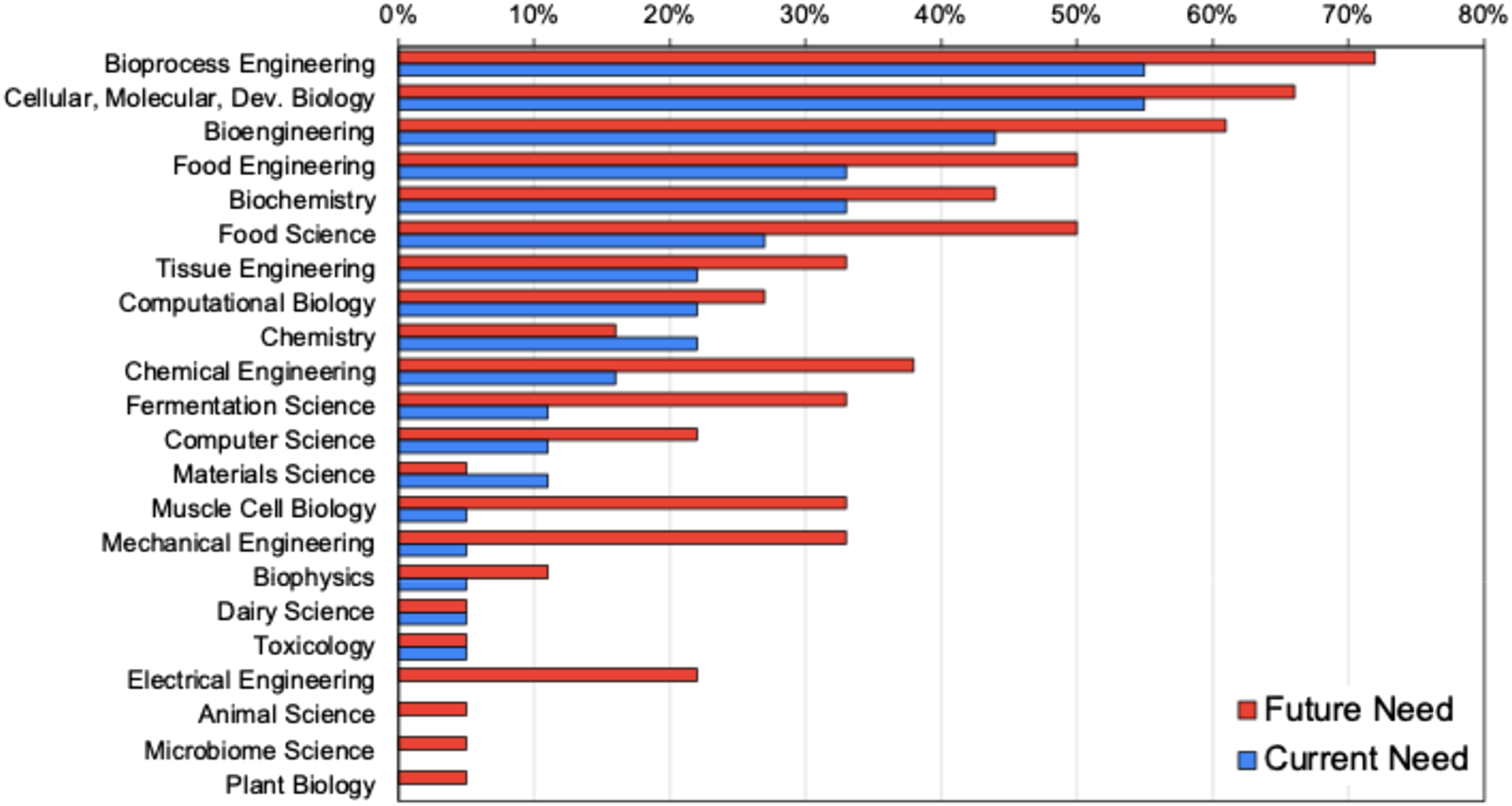
The three most currently needed or desired types of graduates would have backgrounds in Bioprocess Engineering (55%), Cellular, Molecular, and Developmental Biology (55%), and Bioengineering (44%). The next set of majors currently needed were Food Engineering (33%), Biochemistry (33%), and Food Science (27%). Chemistry (22%), Computational Biology (22%), and Tissue Engineering (22%) placed third, and Chemical Engineering (16%), Computer Science (11%), Fermentation Science (11%), and Materials Science (11%) placed in the fourth tier.
Companies were then offered the same list of scientific disciplines to choose from in anticipation of filling future positions over the next 3–4 years (Figure 3). The three most anticipated graduates to be required in the future would come from programs in Bioprocess Engineering (72%), Cellular, Molecular, and Developmental Biology (66%), and Bioengineering (61%). The next set of anticipated majors were Food Engineering (50%), Food Science (50%), Biochemistry (44%), Chemical Engineering (38%), Tissue Engineering (33%), Fermentation Science (33%), Mechanical Engineering (33%), and Muscle Cell Biology (33%). Majors in the third tier included Computational Biology (27%), Computer Science (22%), Electrical Engineering (22%), and Chemistry (16%), followed by Biophysics (11%).
Need for students with experience in cellular agriculture research
We next queried industry respondents about other experiences their ideal candidates would have. In free-form answers, the majority of industry respondents (14 out of 18) expressed a desire for students to have research experience in food colloidal behavior, fermentation, bioinformatics, data analysis, AI technologies, bioreactor operation and optimization, bioprocess optimization and industrialization, bioprocess development for cell proliferation, differentiation methodologies for various cell types and species, cell differentiation for mass production, serum-free media for mammalian cells, growth factor replacements, and inducible gene expression platforms using food-safe inducers.
Some respondents also expressed a desire for graduates that have hands-on experience, internship experience, project management skills, and creativity. One respondent also noted that they would “prefer students to make the innovations at the company so as to have control over the intellectual property”, while another suggested that “bioprocessing and working at a large scale would give fresh graduates a unique background.”
Relevant professional and interpersonal skills
In addition to the scientific skills that take clear priority in the developmental trajectories of cellular agriculture companies, professional and interpersonal skills can be important for effective teamwork and for companies to translate findings to have societal impact. Candidates who can explain scientific concepts to general audiences; are passionate about sustainable food futures; and have mission and vision alignment will be crucial to integrate public or non-academic stakeholder perspectives and realize the potential societal impact of cellular agriculture (Lawrence et al., 2022; Rocha et al., 2020; Steger et al., 2021; Thapa et al., 2022). To understand which specific professional and interpersonal skills companies found to be most important to the next generation of employees in the industry, we asked them to rank these skills by order of importance. As shown in Figure 4, Most companies value Mission Alignment, Innovative Drive, Scientific Curiosity, Teamwork Skills, and Scientific Communication. Conversely, a substantial number of companies ranked knowledge of animal agriculture, public health, or environmental science to be less important. Professional and interpersonal skills ranked in order of importance. N = 18.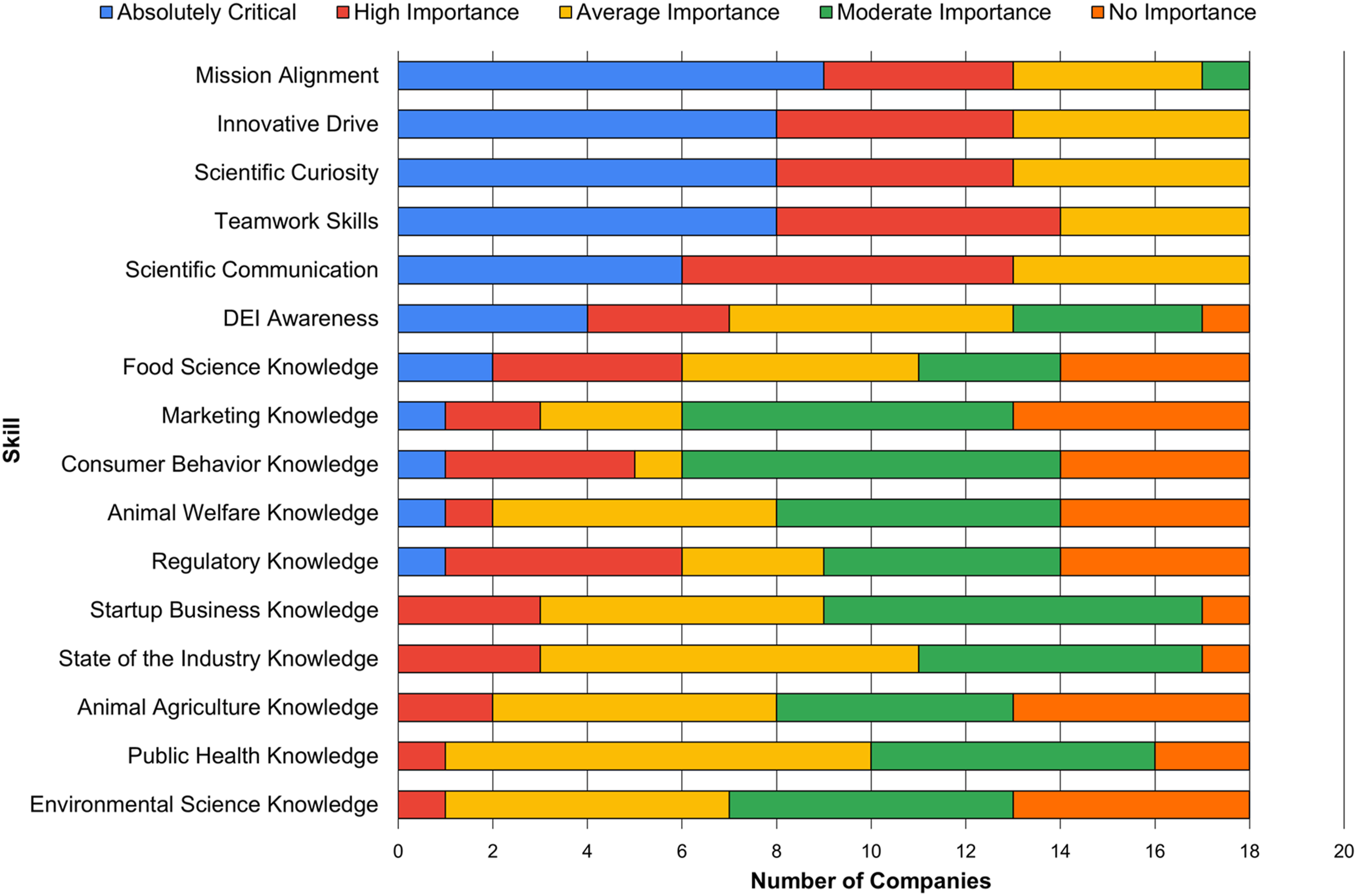
Discussion
Our findings can be described along the three theoretical perspectives—economic, institutional/societal, and individual perspectives—that guide the framing of our survey.
At an economic level, the current workforce needs of the cellular agriculture industry broadly reflect existing technical bottlenecks in the field, such as cell line optimization, animal-free cell media development, and bioprocess scaling. For example, 33% of surveyed companies identified cell media development as a core product area (Figure 4), and 55% listed bioprocess engineering as a priority background for current hiring needs (Figure 3). These findings corroborate previous reports (The Good Food Institute, 2024a; 2024b) on growth trends in the alternative protein industry that reflect a high priority for innovation and skill development. In comparison to more mature industries (i.e., biofuels, vaccine production, renewable energy) that might seek more practical, known operational labor already taught in many academic programs (Linsenmeier and Saterbak, 2020), the skills sought in the context of cellular agriculture are typically acquired through an individual’s engagement in cutting-edge scientific research aimed at tackling similar challenges in related sectors. In this sense, the economic drivers of workforce needs point clearly to unmet needs at the level of individual/group competency development.
This interpretation is consistent with previous reports (Delebecque and Philp, 2019) indicating that current and anticipated workforce needs require skilled researchers to drive research advances and broadly trained technicians for day-to-day operations. Formal training programs should focus on various educational levels to fill the demand for relevant industrial-level biotechnology job skills. Designing courses at multiple post-secondary stages with an emphasis on industry needs will be essential for preparing a multi-faceted workforce that has both practical, technical skills, as well as an in-depth understanding of problems common to industrial scaling of biotechnology (Faiez and Geng, 2020).
At the societal/institutional level, the survey results also indicate the need for improved infrastructure for academic researchers to support research that is aligned with scale-up processes. Access to bench-scale bioreactors, for instance, would directly address one of the most frequently cited hiring needs in bioprocess engineering (55% current; 72% future; Figure 3) by strengthening student expertise in scaling mammalian cell culture.
At the level of individual competencies, our data highlights a clear alignment between workforce needs and the most sought-after scientific majors as well as key ancillary non-cognitive competencies (e.g., interpersonal skills) beyond the core expertise areas.
The top three fields in demand for both current and future positions are bioprocess engineering, cellular, molecular, and developmental biology, and bioengineering (Figure 3)—majors that align with the industry’s priorities to solve existing technical bottlenecks in scale-up of mammalian cell culture (Eibl et al., 2021; Humbird, 2021). However, we see the largest projected growth in demand for expertise in muscle biology (28%), mechanical engineering (28%), food science (23%), chemical engineering (22%), electrical engineering (22%), and fermentation science (22%). These trends suggest an opportunity to establish core, foundational coursework for all cellular agriculture students that could complement existing programs, such as muscle biology or mechanical engineering. Ultimately, our analysis of workforce demands reveals the importance of offering both rigorous training in fields like muscle biology or mechanical engineering, which is relevant for the cellular agriculture industry, alongside specialized training tailored to industry needs.
For example, consider the training of a student in muscle biology. The training and recruitment of scientists with expertise in skeletal muscle biology is critical for the cellular agriculture industry, particularly for companies focused on cultivated meat. Muscle biology students are trained in areas highly relevant to the field, including cell proliferation, differentiation, and growth-factor signaling, which are essential for producing high-quality cultured meat products. Their foundational knowledge could be tailored through modified curricula to better address industry-specific challenges, including those directly represented in our survey results, such as optimizing cell differentiation for mass production (reported as a need in free-response answers by multiple companies) and developing serum-free media (33% of companies working in media development; Figure 4). These skills would make muscle biology graduates more effective in addressing technical bottlenecks in cellular agriculture, including developing texture and scaling bioprocesses, which are key to commercializing cultivated meat. By incorporating emerging industry needs into existing curricula, students could be better prepared to address key challenges across disciplines, ensuring that their education remains aligned with the industry’s vision for interdisciplinary training.
Our findings also indicate that companies value professional and interpersonal skills, such as mission alignment, innovative drive, scientific curiosity, and teamwork. Scientific communication was another skill that the majority of companies ranked as ‘absolutely critical’ or ‘high importance’. Together these company priorities highlight the need for non-scientific coursework that supplements traditional technical training for future workforce leaders. For example, faculty from different disciplines could co-teach courses that—beyond scientific skills—expose students to the industry culture and team science approach that is important to advance research and development. Emphasizing science communication within workforce development programs directly addresses these industry priorities and may also strengthen cross-disciplinary collaboration and successful teamwork.
Interestingly, there was lower priority on categories of skills including “Animal Agriculture,” “Public Health,” and “Environmental Science” (Figure 4); these findings may reflect the industry’s immediate focus on solving technical hurdles as evidenced by the high demand for bioprocess engineers (55% current; 72% future; Figure 3) and strong emphasis on media and cell line development (Figure 4). Alternatively, this pattern may reflect a deeper trend in which foundational scientific and engineering competencies are viewed as prerequisites, while domain knowledge in agriculture or public health is considered supplementary or more relevant at later stages of commercialization. Future efforts should increasingly prioritize these knowledge areas to ensure that cultivated meat production systems are technologically viable and deeply integrated into broader food supply chains and responsive to community needs and concerns.
Short-term strategies
The first step in creating a comprehensive training program in cellular agriculture should be to complement existing degree programs with courses and/or educational programming. Students need strong foundations in fields including but not limited to bioengineering, chemical engineering, cell and developmental biology, and molecular biology. Hands-on classes specific to cellular agriculture could include problem-based approaches that give students opportunities to work on “real world” issues that cellular agriculture companies are trying to solve. Although our survey did not delineate needs for undergraduate or graduate students, we envision that curriculum and programs should be developed at all levels of the educational pipeline. (1) (2)
Solving complex problems in scaling up animal protein production that currently challenge the industry will require approaches that span disciplines. To cultivate interdisciplinary problem-solving, student discussion groups that bring together students from across disciplines, for example in the form of a journal club, can be productive in exchanging ideas about recurring problems from different disciplines (Van Den Beemt et al., 2020). Training for graduates entering this industry should frame educational approaches around interdisciplinarity (Borrego and Newswander, 2010; Chang et al., 2017; Filho et al., 2015; Lattuca et al., 2017; Lavadia et al., 2018; Van Den Beemt et al., 2020) and community building (Rowat et al., 2026). Student-led groups, such as the Alternative Protein Project (APP), which are being chartered in universities worldwide, can further provide opportunities for students to form interdisciplinary peer research communities and to create their own networking spaces. (3) (4) (5)
Longer-term strategies
Building on coursework, degree programs—including minors or certificate programs—could provide a more formalized framework for trainees to advance their knowledge and fluency in cellular agriculture. The exchange of students across campuses, or even across academic-industry partnerships, could promote trainees gaining relevant research experiences. (1) (2)
Integrating knowledge depth and breadth across disciplines
Education and training of the future workforce in cellular agriculture needs to be highly flexible and should evolve with the rapidly changing knowledge in the field. Speaking to the “need for a paradigm shift of how education is structured” Delebecque and Philp note that “[t]o keep pace in a changing world, beyond the traditional debate of depth versus breadth in education, one of the answers lies in training for adaptability and dynamism” (Delebecque and Philp, 2019: p. 10). This presents a challenge for developing curricula that transmit knowledge and skills for production processes that either are not yet standardized or formalized, or infrastructure that has yet to be built (for example, commercial scale bioreactors). Hence, innovative approaches to production need to be reflected in innovative approaches to education in the field; this means that traditional degree program trajectories may not be the most useful ways to produce the next generation of full-fledged cellular agriculture professionals. To foster interdisciplinary cross-pollination of knowledge and skills, the field could follow the framework previously promoted by the National Science Foundation’s former Integrative Graduate Education and Research Traineeship (IGERT) Program (National Science Foundation, 2015), which was “intended to establish new models for graduate education and training in a fertile environment for collaborative research that transcends traditional disciplinary boundaries.”
Compared to other educational programs that were designed to match industry growth, Linsenmeier and Saterbak note that mechanical and chemical engineering began with the industrial revolution (Linsenmeier and Saterbak, 2020) and rapidly expanded with the industrial scale production of chemicals and equipment in the wake of the world wars (Van Antwerpen, 1980). “In contrast,” Linsenmeier and Saterbak note “the medical device and biotechnology industries did not create a need that biomedical engineers filled. Biomedical companies relied on engineers in the fields that already existed, and, of course, they still do for many engineering roles. Instead, biomedical engineering started in academia when engineers within ‘traditional’ departments became interested in biomedical problems” (Linsenmeier and Saterbak, 2020: p. 1591). Similarly, many scientists working in cellular agriculture also follow their interest to apply their skills to advance sustainable food systems; hence, we feel that an integrated approach that adapts traditional education to industry needs should be the goal of a high quality training program for cellular agriculture.
Addressing professional and interpersonal skills, Linsenmeier and Saterbak also note that one of the major trends for all engineering disciplines (but specifically for biomedical engineering) is “more emphasis on communications, ethics and other professional skills, driven in part by the ABET [Accreditation Board for Engineering and Technology] Engineering Criteria 2000 and the NAE’s [National Academy of Engineering] Engineer of 2020, in both of which these skills were specifically highlighted” (Linsenmeier and Saterbak, 2020: p.1593). The University of California Davis’ Design Emphasis in Biotechnology (DEB) Program similarly describes the need for a more inclusive educational approach based in interdisciplinary training. Kjelstrom et al. adds that “The DEB encourages pre-doctoral scholars to take an interdisciplinary approach to research, maintaining excellence in the deep, narrow focus of the doctoral discipline while adding professional skill sets that allow communication and problem-solving across many groups of stakeholders, including scientists from other disciplines, but also members of the wider community” (Kjelstrom et al., 2012: p.89).
To produce well-rounded graduates with industry-ready skills and a solid knowledge foundation of scientific and non-scientific aspects of production and commercialization, academic institutions should systematically assess what relevant coursework and research specialty already exists and identify gaps to fill with novel research and educational opportunities. The resulting curriculum would thus constitute a new specialization (and eventual degree program) that would allow for measurement of program outcomes and industry placement trajectories of graduates. In the case of workforce development in a rapidly changing field such as cellular agriculture, this process can be systematized by considering the three perspectives that provide a framework to guide workforce development for an emerging new field into the future: economic, institutional/societal, and individual perspectives. This framework informs how institutions can collaborate with industry to define workforce needs and create a supportive environment with structured mentorship, science communication, and professional skill-building that will support trainees in thriving as leaders of an emerging industry.
Limitations
We recognize the small sample size may limit the generalizability of the findings. Moreover, the data represents a snapshot from 2023. Future longitudinal studies will be necessary to understand workforce needs in a rapidly changing field and funding climate.
Despite these limitations, the data collected serve as an important foundational baseline. Establishing an early assessment of workforce needs enables future longitudinal research to track how industry demands evolve over time, identify persistent gaps in training, and measure the efficacy of emerging educational programs. Systematic follow-up studies, ideally with a larger and more diverse sample of companies, will be essential for validating and expanding upon the trends documented here.
Conclusion
Comprehensive education programs in cellular agriculture are essential for preparing the future workforce and advancing the mission of higher education institutions to deliver education and job training that is aligned with both student aspirations and industry needs. While this study is primarily descriptive, it provides a strategic framework for how universities can remain agile, innovative, and contribute meaningfully as emerging technologies reshape society. We identify foundational elements—curricula and training programs that provide domain-specific expertise, hands-on training, science communication, and structured mentorship programs—as essential for translating industry needs into actionable educational strategies within academic structures. The specific areas of expertise and training must evolve in step with the changing needs of industry, which can be assessed at regular intervals through stakeholder engagement and feedback. The community and social support provided by training programs and structured mentorship programs should foster sense of belonging that can support students as they forge their way into a new field. By adopting this approach, graduates should develop adaptable skill sets that position them for success in cellular agriculture and are transferable to other emerging sectors, such as biomanufacturing.
Looking ahead, industry trends—such as companies shifting away from end-to-end production toward specialized roles within supply chains—might suggest a growing demand for niche specialization. At the same time, educational priorities should remain focused on addressing the most pressing production and commercialization hurdles that affect the entire field. This dual approach will enable graduates to contribute across a diverse range of companies and roles in the cellular agriculture space and beyond. Entering the workforce with a solid foundation in the history and current state of cellular agriculture, technical proficiency, innovative research capabilities, and the ability to engage stakeholders beyond industry and academia will be essential. Coupled with effective science communication skills, these competencies will empower future graduates to advance the field cellular agriculture, drive progress, and tackle societal challenges.
As we design the next generation of biotechnology programs, cultivating leaders who are fluent across disciplines and equipped to navigate the complex landscapes of grand societal challenges should be a central goal.
Footnotes
Acknowledgments
The authors would like to thank Amanda F. Lipsey, MFA, GPC, for her assistance in preparing this manuscript for publication.

Ethical considerations
This survey was exempt from IRB review.
Consent to participate
All participants consented to participate in the survey.
Funding
The authors disclosed receipt of the following financial support for the research, authorship, and/or publication of this article: This work was supported by the State of California; United States Department of Agriculture National Institute of Food and Agriculture, AFRI project CALW-2021-09608; the Good Food Institute; the New Harvest Foundation (Fellowship to NSK); the National Science Foundation (BRITE Fellow Award CMMI-2135747 to ACR; Innovations at the Nexus of Food, Energy, and Water Systems (INFEWS) training grant DGE-1735325, which supported NSK; and a Graduate Research Fellowship Award to CS) the UCLA California NanoSystems Institute and the Noble Family Innovation Fund.
Declaration of conflicting interests
The authors declared no potential conflicts of interest with respect to the research, authorship, and/or publication of this article.