




Abstract
As expectations for graduate employability intensify, higher education institutions are increasingly challenged to align academic learning with career preparation in meaningful and sustainable ways. While universities have expanded external partnerships with employers, less attention has been given to the internal collaboration required to embed employability within the academic core. This article presents an account of practice grounded in sustained collaboration between faculty and career services at a regional university. Drawing on professional experience and engagement with relevant literature, the authors articulate the Faculty-Career Services Integration Model, a four-domain framework encompassing Structural, Process, Cultural, and Outcome dimensions of collaboration. The article contributes a practice-informed framework that supports institutional reflection on faculty-career services integration and positions graduate employability as a shared institutional responsibility.
Keywords
Introduction
As labor markets become more complex and dynamic, higher education institutions face mounting pressure to prepare graduates who can navigate evolving industry expectations and contribute meaningfully to economic and social progress. Employers, policymakers, and the public increasingly scrutinize graduate outcomes, emphasizing job preparedness and practical skills alongside academic achievement (National Association of Colleges and Employers [NACE], 2024). In response, universities are increasingly framing graduate employability as a core indicator of institutional effectiveness and societal relevance (Oraison et al., 2019). This shift has prompted institutions to embed employability more intentionally within academic programs and to expand strategies related to workforce alignment, innovation, and community engagement (Ferns and Lilly, 2015).
Despite these outward-facing developments, many institutions have struggled to address the internal coordination required to sustain employability as a shared institutional priority. In particular, collaboration between academic faculty and career services professionals varies widely across institutions and is rarely embedded in sustained institutional structures. These groups bring distinct but complementary forms of expertise. Faculty provide disciplinary depth and curricular oversight, while career services professionals contribute labor market insight and employer engagement capacity. However, longstanding institutional structures often reinforce parallel operations, reflecting cultural divides and role ambiguity (Kezar, 2005).
The lack of coordinated faculty-career services collaboration represents a critical, and frequently overlooked, gap in institutional employability efforts. While research on academia-industry alignment has expanded, much of this work has focused on external partnerships, such as cooperative education programs and collaborative curriculum design with employers (Mahalingam, 2024). At the same time, universities are increasingly engaging with their third mission, understood as a responsibility to contribute to economic, technological, and social development alongside teaching and research (Stolze and Sailer, 2022). Enhancing graduate employability is central to this mission, requiring institutions to prepare students not only with disciplinary knowledge but also with the skills and experiences needed for workforce participation.
Meeting these expectations requires more than expanding employer relationships or co-curricular programming. It calls for intentional collaboration across university units to align academic programs with career development. Bridging the divide between faculty and career services is therefore a necessary condition for embedding employability within the academic core and for advancing the third mission in practice.
Drawing on professional experience and engagement with the literature, this article examines how sustained collaboration between faculty and career services can develop over time and how such collaboration can be institutionalized. Through reflection on practice at a regional university, the authors articulate a strategic integration model organized around four interdependent domains: Structural, Process, Cultural, and Outcome. The model serves as a practice-informed framework for understanding how internal alignment can be strengthened to support graduate employability across academic contexts.
Practice context: Faculty-career services collaboration in a regional university
The Faculty-Career Services Integration Model developed through sustained professional collaboration between faculty and career services at a regional U.S. university. The authors worked in complementary roles, one as a business faculty member teaching management and a required career development course for undergraduate business majors, and the other as director of career services responsible for employer engagement, career readiness programming, and cooperative education. Over several years, their collaboration deepened in response to shared concerns about student career preparation and a growing recognition that employability outcomes depended on more intentional coordination across academic and career functions.
Early collaboration was informal and largely reactive. Students frequently sought career guidance from the faculty author, asking questions about industry expectations, career pathways, and skill development within their discipline. While the faculty author was well positioned to contextualize career conversations within disciplinary and curricular content, she lacked access to real-time information about internships, recruiting timelines, and employer engagement activities coordinated through career services. At the same time, the career services author maintained strong employer relationships and a centralized view of recruiting activity but had limited visibility into curricular design or how career concepts were addressed within academic programs. These disconnects were not the result of misalignment in purpose, but rather of limited transparency and few established mechanisms for collaboration.
Initial efforts to bridge these gaps focused on modest, low-risk initiatives. Employer guest speakers were integrated into business courses, while career services staff contributed targeted skill-building sessions and reflection activities tied to coursework. Over time, these efforts expanded into more intentional collaborations, including co-designed assignments, coordinated alumni panels, site visits, and networking events embedded within academic programs. Career services became a visible presence in business classrooms, and faculty contributed to career development courses, reinforcing shared responsibility for student preparation. A significant milestone in this progression was the co-development of a study abroad program with an industry partner, which combined global learning with professional skill development and employer engagement.
As collaboration deepened, persistent challenges also became more visible. Structural constraints, such as siloed reporting lines, limited shared planning time, and reliance on informal relationships, made it difficult to sustain and scale successful initiatives. Cultural differences emerged as well, including variations in language, expectations, and perceptions of role legitimacy. Some faculty questioned the academic value of career-focused content, while some staff perceived faculty as disconnected from students’ vocational concerns. These experiences echoed themes in the collaboration literature regarding trust, shared purpose, and boundary-spanning roles (Kezar, 2005; Wood and Gray, 1991), and underscored the importance of addressing both structural and cultural dimensions of collaboration.
The absence of shared data and feedback mechanisms further complicated coordination. Although both authors were committed to improving student outcomes, they initially lacked access to common metrics that could inform joint decision-making. Over time, more regular sharing of employment data and career outcomes helped foster transparency and collective awareness, supporting more informed conversations about program effectiveness and alignment. This shift highlighted the importance of visible, timely feedback loops, a principle central to systems thinking, which emphasizes that organizational learning depends on accessible and actionable information (Senge, 1990).
Throughout this process, the authors engaged in ongoing reflection on their professional practice, treating their institutional context as a learning environment. Informal documentation, iterative adjustments, and dialogue across roles helped surface recurring patterns related to coordination, communication, and accountability. These reflections clarified the conditions that enabled collaboration to progress and the barriers that consistently constrained it.
It was through this sustained engagement that the key dimensions of the Faculty-Career Services Integration Model became apparent. Structural arrangements influenced access, continuity, and visibility. Shared processes shaped how academic and career learning were connected. Cultural norms affected trust, legitimacy, and willingness to collaborate. Outcome alignment determined whether employability efforts were evaluated collectively or in isolation. Together, these dimensions became visible through sustained engagement as the authors made sense of what supported, and what hindered, meaningful integration.
Importantly, this collaboration was not driven by a top-down mandate. It developed from the ground up, fueled by professional trust, aligned values, and a shared desire to model the kind of cross-functional engagement students would later encounter in the workplace. As such, the model is grounded in adaptive, context-specific practice rather than in a fixed implementation blueprint. It is intended to be flexible, offering institutions a way to reflect on their own structures and relationships rather than prescribing a single approach.
While this experience yielded meaningful progress, it also revealed persistent challenges that extended beyond individual relationships or local context. Many of these challenges are well documented in the literature and reflect broader structural and cultural barriers to faculty-career services collaboration. Understanding these barriers is essential to explaining why employability initiatives often struggle to gain traction and why more intentional, systemic approaches are required. The following section examines these barriers in greater detail.
Barriers to faculty-career collaboration
Many of the challenges encountered in the authors’ own efforts to collaborate across academic and career services are widely reflected in the literature. Despite shared goals related to student success and employability, faculty and career services often operate in parallel rather than in integrated ways. Career development content is frequently treated as a peripheral or optional component rather than woven into academic programs in sustained and systematic ways (Bridgstock et al., 2019). As a result, collaboration between academic departments and career services remains limited across much of higher education.
National data underscore the extent of this disconnect. While a majority of faculty report incorporating some form of career readiness content into their courses, far fewer are aware of institution-wide strategies for aligning curriculum with career outcomes, and many report no meaningful collaboration with their career center (NACE, 2024). This misalignment is particularly consequential given that students frequently seek career advice from faculty. More than 90% of faculty report engaging in career-related conversations with students, yet many do so without formal connections to career services professionals who could support or extend those discussions (NACE, 2024). These patterns mirror the authors’ own experience, in which shared commitment to employability was not matched by shared structures or communication channels.
Cultural norms within higher education further complicate collaboration. Academic environments have historically privileged scholarly knowledge over applied learning, leading some faculty to view career-oriented content as vocational or misaligned with disciplinary rigor. At the same time, employer research consistently demonstrates strong demand for applied competencies such as critical thinking, communication, and problem-solving alongside disciplinary knowledge (Hart Research Associates, 2013). Subsequent studies have reinforced the persistence of gaps between graduate skill development and employer expectations, suggesting that applied learning continues to be undervalued or inconsistently integrated across academic programs (Hart Research Associates, 2016; Helbig and Matkin, 2021). These tensions were evident in the authors’ experience, where differences in language, priorities, and perceived legitimacy shaped how faculty and career services professionals engaged with one another.
Structural factors also play a significant role. The organizational separation of academic and student affairs reinforces siloed operations and limits opportunities for shared planning, joint decision-making, and coordinated assessment (Gibson, 2022). Faculty autonomy and decentralized governance structures, while central to academic culture, can make cross-unit collaboration difficult to mandate or sustain without strong leadership support (Kezar, 2005). Career services professionals may also lack visibility or authority within academic spaces, constraining their ability to influence curriculum or pedagogy. In response, some institutions have begun relocating career services units within academic affairs in an effort to increase legitimacy, access to resources, and alignment with instructional priorities (Helbig and Matkin, 2021).
Even when institutions acknowledge the importance of graduate employability, efforts to integrate it into academic programs often struggle to achieve consistency or longevity. Initiatives linking academic and student affairs frequently depend on individual relationships rather than shared ownership, leaving them vulnerable to staff turnover and shifting institutional priorities (Banta and Kuh, 1998). Without clear roles, shared metrics, or formal mechanisms for coordination, collaboration between faculty and career services is difficult to sustain, and employability efforts risk remaining fragmented or unevenly implemented (McGrath, 2002).
Some institutions have demonstrated more integrated approaches to faculty-career collaboration. Positioning career services professionals within academic departments has been shown to increase visibility, trust, and day-to-day collaboration with faculty (Schlesinger et al., 2021). Other institutions have established joint curriculum committees or planning structures that bring together academic and student affairs professionals to align learning outcomes, programming, and assessment (Dey and Cruzvergara, 2014). Coordinating co-curricular initiatives with academic learning goals through shared frameworks and embedded career modules has also shown promise. However, such approaches remain the exception rather than the norm. Most universities continue to lack a systemic, institution-wide strategy for aligning career preparation with core academic structures.
Viewed collectively, these barriers illuminate why sustained collaboration between faculty and career services continues to be challenging in many institutional contexts. Rather than reflecting isolated issues, they point to broader structural and cultural conditions that shape how graduate employability efforts are organized across higher education. The following section draws on relevant theoretical perspectives to help interpret these recurring challenges and to provide a lens for understanding how collaboration can evolve in practice.
Conceptual foundations
As the collaboration between faculty and career services unfolded, the authors drew on several established theoretical perspectives to better understand the challenges and patterns emerging in their work. Systems thinking, collaboration theory, and student and career development theories provided useful lenses for interpreting why internal alignment around employability proved difficult, how cross-functional collaboration developed over time, and why some approaches gained traction while others stalled. These perspectives were used to interpret practice and to inform the articulation of the Faculty-Career Services Integration Model.
Systems thinking
Systems thinking offers a lens for understanding the university as a complex, interdependent system in which outcomes are shaped by interactions, feedback loops, and shared processes rather than by isolated actions (Senge, 1990). This perspective is particularly relevant in higher education, where deeply siloed organizational structures often undermine efforts to improve student outcomes. In the authors’ experience, academic programs and career services frequently pursued complementary goals through separate initiatives, such as capstone courses and employer engagement activities, yet without intentional coordination these efforts remained disconnected and less effective.
From a systems perspective, graduate employability reflects the cumulative impact of coordinated institutional design and alignment across the university. Kezar (2013) helps explain why lasting change requires attention to the interdependencies between academic and administrative subsystems. Integrated governance structures, shared data systems, and cross-functional planning processes create conditions in which academic learning and career development can reinforce one another rather than compete for attention.
Oshry’s (1995) work further illuminates how individuals within complex systems often operate from limited vantage points. Faculty and career services professionals may act with positive intent while remaining unaware of how their decisions intersect, or fail to intersect, in shaping student readiness. In practice, these blind spots contributed to misalignment between curricular priorities and career programming. Systems thinking made such disconnects more visible and highlighted the importance of shared understanding and feedback mechanisms, laying the groundwork for the structural and process-related dimensions of the integration model.
Collaboration theory
Many of the challenges encountered in faculty-career services partnerships align closely with insights from collaboration theory. Collaboration differs from coordination or cooperation in that it requires shared ownership of purpose, mutual accountability, and joint decision-making across organizational boundaries (Wood and Gray, 1991). Within higher education, where academic and student affairs functions are often structurally and culturally separated, achieving this level of collaboration is particularly difficult.
Kezar (2005) describes collaboration as a developmental process that unfolds over time, beginning with relationship building and progressing toward shared governance and resource alignment. This perspective helps explain why early, informal collaborations between faculty and career services, while valuable, proved insufficient for sustaining employability initiatives at scale. Without institutional structures to support collaboration, such efforts remained vulnerable to staff turnover, shifting priorities, and competing demands.
Boundary-spanning practices emerged as especially significant in addressing these challenges. Approaches such as embedding career services professionals within academic units, establishing liaison roles, or involving career services in curriculum development reflect organizational redesigns that legitimize career services professionals as educational partners rather than peripheral service providers (Amey and Brown, 2005; Kezar and Lester, 2009). In practice, these arrangements supported reciprocal relationships with faculty and created clearer pathways for integrating career development into disciplinary learning.
Leadership support and formal incentives also proved essential. Kezar and Lester (2009) emphasize that collaborative initiatives gain traction when institutions invest in structures, rewards, and norms that signal their strategic importance. These insights underscore that collaboration must be institutionally reinforced through structures, incentives, and shared norms, rather than left to individual goodwill.
Student and career development theories
The integration of career services into academic life is also shaped by how students develop academically and vocationally during college. Student and career development theories provide insight into why alignment between faculty and career services professionals matters for student learning. Chickering and Reisser’s (1993) model highlights college as a period of identity formation, purpose development, and competence building. Faculty play a central role in shaping academic identity, while career services professionals support vocational exploration and decision-making, together contributing to a more holistic developmental trajectory.
Experiential learning theory further reinforces the value of coordinated academic and career programming. Kolb’s (1984) emphasis on concrete experience, reflection, and application aligns closely with practices such as internships, project-based learning, and employer-engaged coursework. In practice, these experiences were most effective when academic and career units collaborated to connect learning objectives with professional contexts.
Career-specific theories offer additional insight into how students navigate educational and occupational choices. Social Cognitive Career Theory highlights the role of self-efficacy and outcome expectations in shaping career persistence and adaptability (Lent and Brown, 2013), while person-environment fit theories emphasize alignment between individual interests and work contexts (McMahon et al., 2014). These perspectives helped explain why fragmented career support limited students’ ability to integrate academic learning with career decision-making.
Career Development Learning (CDL) provided a particularly useful organizing framework. CDL emphasizes the intentional integration of career learning into curricula and co-curricular experiences, helping students understand the world of work, reflect on goals, and develop transferable competencies (Watts, 2006). Research suggests that CDL is most effective when co-developed by faculty and career services professionals and embedded across programs rather than delivered as isolated interventions (Bridgstock, 2011; Hooley et al., 2011). Viewing employability through a CDL lens clarified why stand-alone workshops or optional programming were insufficient without curricular integration. Bridgstock and Tippett (2019) further argue that CDL should be approached as a connected learning strategy spanning policy, advising, and curriculum. Frameworks such as the NACE Career Readiness Competencies provide a shared language that supports this integration across academic and career domains (NACE, 2024).
Synthesizing theoretical perspectives to inform the integration model
Theoretical foundations and their connection to model domains.
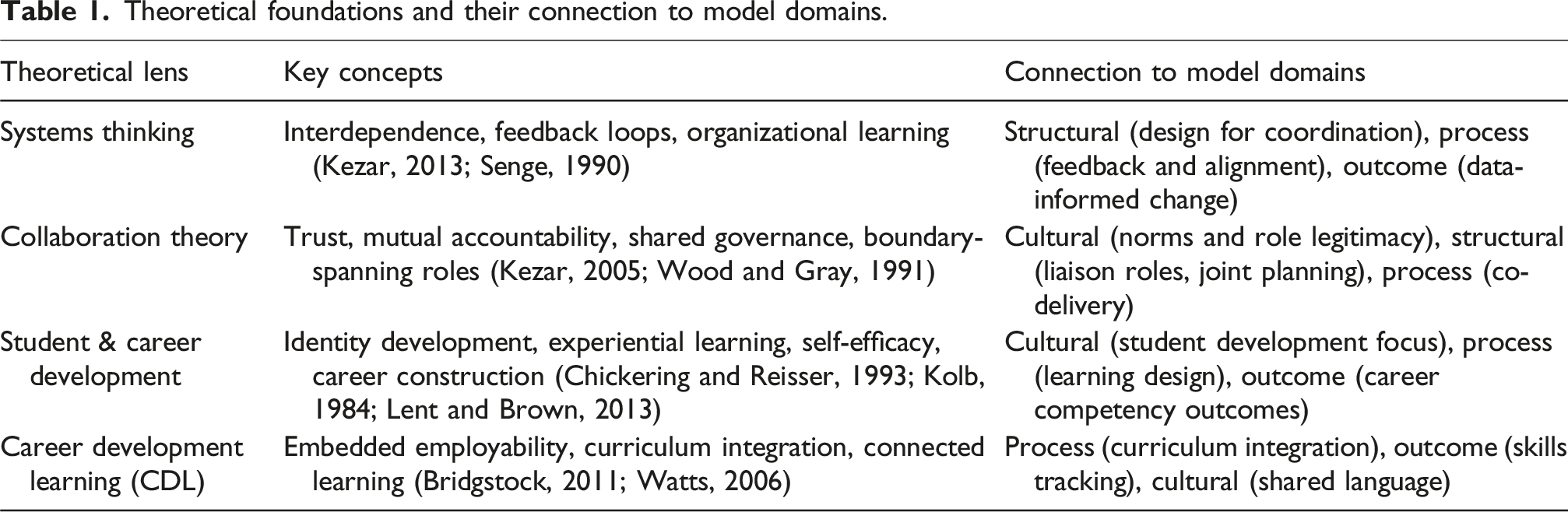
The Faculty-Career Services Integration Model presented in the next section synthesizes these insights into four interdependent domains: Structural, Process, Cultural, and Outcome. The model captures patterns that became visible through sustained collaboration and provides a reflective framework for understanding how employability can be embedded more intentionally within the academic core.
The faculty-career services integration model
Building on sustained collaboration between faculty and career services, the authors identified recurring patterns in institutional structures, collaborative practices, role relationships, and employability outcomes. To make sense of these patterns, the authors articulated the Faculty-Career Services Integration Model, a four-domain framework encompassing Structural, Process, Cultural, and Outcome dimensions of collaboration. The model synthesizes insights drawn from sustained professional practice and informed by systems thinking, collaboration theory, and career development learning. Figure 1 presents the model as a reflective framework illustrating how coordinated faculty-career services collaboration across structural, process, cultural, and outcome domains supports the intentional embedding of employability within the academic core. The sections that follow elaborate each domain in turn, drawing on the literature to illustrate how these dimensions are commonly operationalized in higher education contexts. The faculty-career services integration model.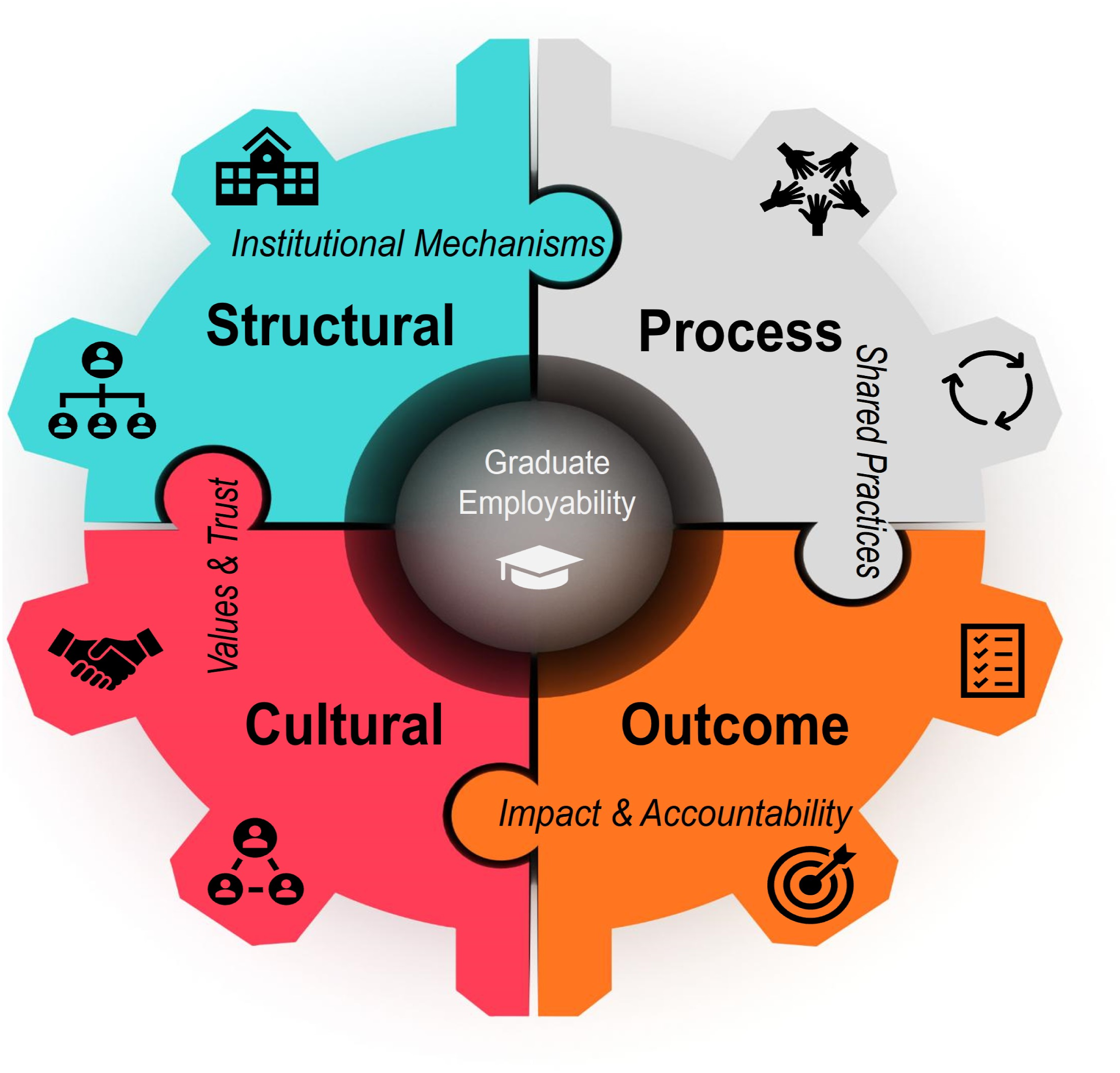
Structural domain: Institutional mechanisms and design
Structural mechanisms form the foundation for sustainable collaboration. Without formal structures, such as reporting lines, co-governance bodies, and embedded roles, efforts often remain ad hoc or dependent on interpersonal relationships (Kezar, 2005). Structural alignment legitimizes career services as academic partners and facilitates shared decision-making.
One structural practice gaining traction is the career services liaison model, in which staff are located within academic colleges to foster day-to-day collaboration, co-plan initiatives, and provide targeted student support (Schlesinger et al., 2021). Institutions are also forming joint advisory committees composed of faculty, career professionals, and employer partners to oversee curriculum review with an emphasis on employability, creating structured forums for cross-functional input and employer alignment (Dey and Cruzvergara, 2014). In addition, some universities are engaging academic and industry stakeholders in co-designing curriculum to ensure course content reflects evolving labor market needs and national employability standards (Bridgstock et al., 2019).
Some universities have restructured academic governance systems to formally include career outcomes in program review and accreditation processes (Ferns and Lilly, 2015), recognizing that employability is not an ancillary concern, but a core component of program quality. These examples reflect the systems thinking insight that organizational performance is shaped not only by discrete activities, but by how subunits are structurally positioned to work together (Senge, 1990; Kezar, 2013).
Process domain: Shared practices and feedback loops
Where structure provides the foundation, process represents the active mechanisms through which collaboration occurs. This includes joint planning routines, integrated programming, and bidirectional feedback loops that allow both faculty and career services to iteratively respond to student and employer needs.
A growing number of institutions are experimenting with co-delivered programming, such as classroom-integrated career labs or discipline-specific employability modules. For instance, Bridgstock et al. (2019) document a model in which academic and career staff co-develop workshops used in capstone courses, with outcomes aligned to national career readiness frameworks. Such models operationalize Career Development Learning (CDL) principles, ensuring that employability is woven into, rather than appended to, academic content (Watts, 2006).
Shared digital tools also support feedback and alignment. Universities using platforms like ePortfolios or competency dashboards allow career advisors and instructors to view student progress in real time, supporting mutual guidance and reflective practice (Bridgstock and Tippett, 2019). Employer feedback gathered through internship evaluations or advisory boards can be systematically shared with academic units, informing updates to course content or assessment rubrics (Terzaroli, 2019).
Process integration reflects the interdependence emphasized by systems theory: disjointed units cannot improve outcomes without coordinated, transparent, and iterative practice.
Cultural domain: Shared values, trust, and role legitimacy
Even the most robust structures and processes will falter without cultural alignment. The Cultural Domain emphasizes the norms, assumptions, and legitimacy that underpin faculty-career collaboration. Misaligned paradigms often persist, with career development seen as outside the purview of academic learning or career professionals viewed as service providers rather than educators (Helbig and Matkin, 2021).
Changing these perceptions requires intentional culture work. This includes language framing, such as referring to career staff as “co-educators”; recognition mechanisms, such as integrating employability contributions into faculty evaluation; and cross-training opportunities that build mutual understanding (Gibson, 2022; Kezar and Lester, 2009). Initiatives like Career Champion Programs, used in institutions across North America, train faculty to embed career concepts in their courses while positioning them as visible career influencers (Byrd-White, 2019).
Leadership signaling is equally critical. Executive-level support for career integration, such as including employability goals in strategic plans, allocating joint resources, or formally recognizing cross-functional contributions, can accelerate cultural alignment and reinforce institutional priorities (Bridgstock et al., 2019; Kezar and Lester, 2009). Such endorsements not only legitimize collaboration but also set expectations for faculty and staff participation. Collaboration theory reminds us that trust and shared purpose must be cultivated over time and rooted in organizational culture to achieve lasting change (Kezar, 2005; Wood and Gray, 1991).
Outcome domain: Impact and accountability
The final domain focuses on measuring progress and sustaining accountability. Too often, employability initiatives lack shared metrics or fall short of closing the loop between preparation and performance. The Outcome Domain encourages institutions to track both student-facing indicators, such as placement rates, skill development, and satisfaction, and collaboration health indicators, such as the frequency of joint programming and the alignment between academic and career learning outcomes.
In Australia, for example, several universities align career development learning with graduate attribute assessment, making career preparedness an explicit curricular goal (Boffo and Fedeli, 2018). Other institutions use multi-source data, combining employer feedback, course evaluations, and student reflections to inform curriculum review cycles (Bridgstock, 2011). Some have created shared scorecards or dashboards that enable joint interpretation of outcome data by academic and career teams (Lee and Patel, 2019).
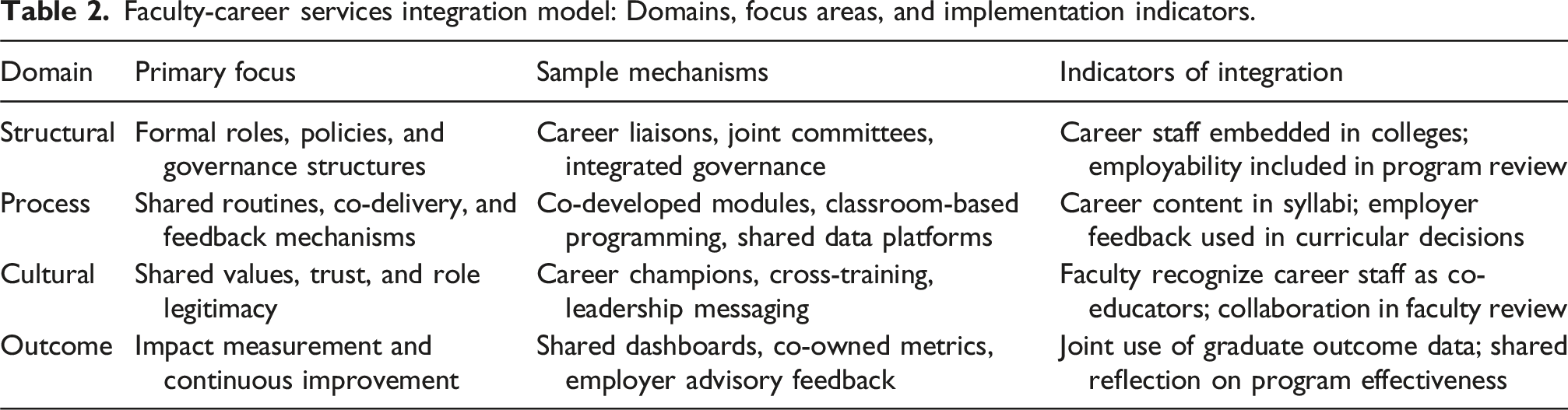
Faculty-career services integration model: Domains, focus areas, and implementation indicators.
A dynamic, interdependent model
The four domains of the Faculty-Career Services Integration Model function as interdependent dimensions rather than sequential stages. Trust and shared norms create the conditions for structural change, structural arrangements enable shared processes, and transparent processes support more meaningful outcomes that then shape future decisions across domains. Viewed holistically, the model offers a diagnostic and reflective framework for strengthening internal coordination in support of graduate employability across varied institutional contexts.
Conclusion
As expectations for graduate employability continue to intensify, internal coordination between academic and career services units has become as consequential as external partnerships with employers and industry. Yet, as this account of practice shows, sustained collaboration across these internal boundaries remains difficult to achieve within the structural and cultural realities of higher education. The experience documented here suggests that employability cannot be effectively advanced through isolated initiatives or individual efforts alone.
The Faculty-Career Services Integration Model offers a practice-informed way to make sense of how collaboration develops, where it tends to stall, and which conditions support progress. Rather than positioning employability as a peripheral or add-on concern, the model frames it as a shared institutional responsibility shaped by interconnected structural, process, cultural, and outcome dimensions. In doing so, it highlights how cross-functional partnerships can emerge and be strengthened over time through trust, shared understanding, and intentional design.
Embedding employability within the academic core requires more than expanding programming or introducing new tools. It calls for a cultural shift in which collaboration is normalized, incentives are aligned, and institutional structures support shared ownership of student preparation. Institutions that engage in this work are better positioned not only to enhance graduate readiness but also to advance their broader economic and social missions, contributing more effectively to regional development, innovation ecosystems, and workforce resilience.
Footnotes
Author note
Kate Zimmerman is now at Bucks County Community College, Newtown, PA.

Consent to participate
There are no human participants in this article and informed consent is not required.
Funding
The authors received no financial support for the research, authorship, and/or publication of this article.
Declaration of conflicting interests
The authors declare no potential conflicts of interest with respect to the research, authorship, and/or publication of this article.
Data Availability Statement
This research did not generate or analyze any datasets; therefore, no data are available.