




Abstract
This case study introduces a complementary approach to teaching entrepreneurial education through practice in a region with low economic diversity. This study pairs graduate fellow researchers from the Mike Loya Center for Innovation and Commerce with the Office of Technology Commercialization, and connects technologies developed at the University of Texas at El Paso with students seeking to understand what is needed to start a company. We utilized an interdisciplinary cohort to apply practical entrepreneurial education by applying theory to practice. The outcome is students who understand market positions, regulatory compliance, and challenges in developing a technology into a new economic driver for the region. This process is laid out and reproducible for other universities seeking to develop practical entrepreneurial education in areas of low economic diversity. The project pairs students in entrepreneurial fellowships with the technology transfer office to apply pedagogical education to practical application. This study demonstrates alternatives to internships in a region with low entrepreneurial activity and a risk-averse environment for skill development for students interested in entrepreneurship as a path to employment.
Introduction
Universities worldwide share three common goals: education, research, and the dissemination of innovation (Davey et al., 2024; Donelli and Panozzo, 2024; Etzkowitz, 2000). The latter of these initiatives is often regionally focused, and success is observed in areas with high economic support. To fulfill the university’s three objectives, an institution must be able to educate individuals with diverse educational backgrounds. It has been found that adding entrepreneurial education to the curriculum creates a greater likelihood for students to expand beyond the university teachings and go into action on future ideas or discoveries to result in research translation or economic development (Fayolle and Gailly, 2009).
Universities worldwide are in the midst of the second academic revolution, which focuses on universities’ three common goals and shifting from solely academic universities to entrepreneurial universities (Etzkowitz et al., 2019). While this revolution faces issues related to economic status, regional economic support, and internal support from universities worldwide. In regional areas with strong economic support, including technology parks, diverse industry partners, and region-rich entrepreneurial support, this revolution is seen as a seamless transition. However, in regions lacking these regional supports, universities often shoulder the challenges of driving change to improve economic support. We posit this position of education based on the latter of these two scenarios. How does one foster an entrepreneurial culture and enhance student education when local and regional ecosystems lack robust economic support systems? Building upon the university’s mission to educate the totality of its students, the university also must develop the next generation to learn entrepreneurship and translate this skill set into the workforce through strengthening regional skills or developing new startup workplaces to enrich the economic state, as well as improve the opinions of entrepreneurial education and practice (Jena, 2020). There has been a split in educational approaches to entrepreneurship and innovation: one focuses on successful individuals and firms, while the other emphasizes long-term development (Guerrero et al., 2016), but neither outlines a set of skills to hone for the next generation.
One challenge universities recognize when located outside the economic hotbeds is finding regional support for research translation. It has long been proposed that economic change can be stimulated by educational advances in entrepreneurship to breathe life into a stale economic environment (Kuratko, 2005). However, when regional support is sparse, driving change outside of the university becomes a significant challenge. The limited examples of what it takes to achieve success, and the lack of businesses’ new efforts to model to create change, make this theoretical, with no regional partners to develop practical education. Thus, we have had to depart from the traditional academic model to develop a practical approach to educating the next generation of entrepreneurs in the region, focusing on the challenges of building a successful business.
It is important to note several key differences between traditional and university startup accelerators, particularly in their affiliations, missions, structures, and resources. University startup accelerators are typically designed to foster entrepreneurship among students, faculty, and alumni. Non-university-affiliated accelerators tend to be highly selective, admitting only the most promising startups. University accelerators are often more inclusive, welcoming a broader range of entrepreneurs since their applicants are students, faculty, and staff. Mentorship and curriculum offerings vary significantly; university accelerators leverage their academic network by providing access to faculty, researchers, and industry partners, focusing on educational components and long-term business viability. Another distinguishable difference is industry access — universities provide access to research labs and faculty expertise; however, they generally have fewer direct connections to investors and high-profile mentors than traditional accelerators. These regions, absent in this resource from either or both types of accelerators, have limited support for individuals seeking to embark on this endeavor and provide limited practical education.
This case study focuses on the University of Texas at El Paso, a minority-serving institution (MSI) located on the US-Mexico border and geographically separated from major technology hubs. The university is classified as a Carnegie R1 research institution (with few academic spin-offs (ASOs)) seeking to uncover new ways to empower student education through practical applications. The region lacks a strong entrepreneurial community, a technology park, diverse industries, and robust entrepreneurial support (Angel investors, venture capital, etc.). Driving change at UTEP is led by the Mike Loya Center for Innovation and Commerce (MLCIC), which offers students and alumni mentorship and access to its two main programs: Studio G, UTEP’s idea accelerator, and the Blackstone Launchpad, UTEP’s business incubator.
Graduate Research Fellows and Undergraduate Student Employees at the MLCIC learn and teach practical approaches for establishing and running successful small businesses. Considering this background, we posit that one can teach technology entrepreneurship through practical business experience when the activity is essentially absent from the local ecosystem. Other empirical and systematic reviews propose that overcoming this deficit involves using the Technology Transfer Office to build entrepreneurial skills through practical education (Etzkowitz et al., 2019; Pittaway and Cope, 2007). In this study, we set out to establish a pilot education program for three MLCIC graduate research fellows (one from engineering and two from business) to work with the Technology Transfer Office to explore the benefits of entrepreneurial education through the commercialization process and apply theory to practice. This pilot program was established to complement pedagogical models of academic education. We focused on bringing theory into practice, entrepreneurship value creation, and planned behavior throughout the stages of this project to overcome the traditional educational deficits seen through the split between innovation education and entrepreneurial education.
Methodology
In this pilot project, our 3 selected students focused on understanding what should be considered in the early phases of establishing a business (Figure 1). The sample size was small due to the limited number of fellows enrolled in the program at the time this additional practical approach to entrepreneurship was launched. We segmented this project into 2-week efforts, focusing on market analysis, customer discovery, potential partners, and, finally, deciding whether the invention was ready for research translation or if further research was needed to prepare the product for licensure. The students were presented with instructions on what to look for. We applied a combination of design thinking and problem-based methodology, in which students presented objectives as problems to be solved through their own approaches, along with predefined objectives to guide the analysis (Dolmans et al., 2005; Ilyas et al., 2024). The main problem faced by the cohort was that we provided them with scientific inventions that, in this form, were solutions to problems the students needed to find. We did not provide guidance on which fields to search or how to complete the project, and we encouraged teamwork to simulate the dynamic that would likely occur if they were to start their own companies based on patented technologies. We utilized the open-ended nature of this type of problem to reinforce teamwork, creative problem-solving, and simulation of what would occur if they were starting their own company based on these technologies. Enabling students to experience risk and problem-solving techniques that would be mimicked in establishing their own companies (Dolmans et al., 2005; Ilyas et al., 2024). The participants, who had received prior training in an entrepreneurial mindset, drew on this knowledge throughout this project. They had to shift their mindset to align with this initiative’s unique demands and context, enriching the case study’s approach and outcomes. Over the fall of 2024, we broke this project down into the following four sections: Lean Canvas Development, Market Analysis, Competitive Analysis, and finally, Strategic Decision-Making. At each task, the students prepared a presentation on what they found and how this related to building a business. This pilot program had 4 major areas of focus and followed these throughout the project.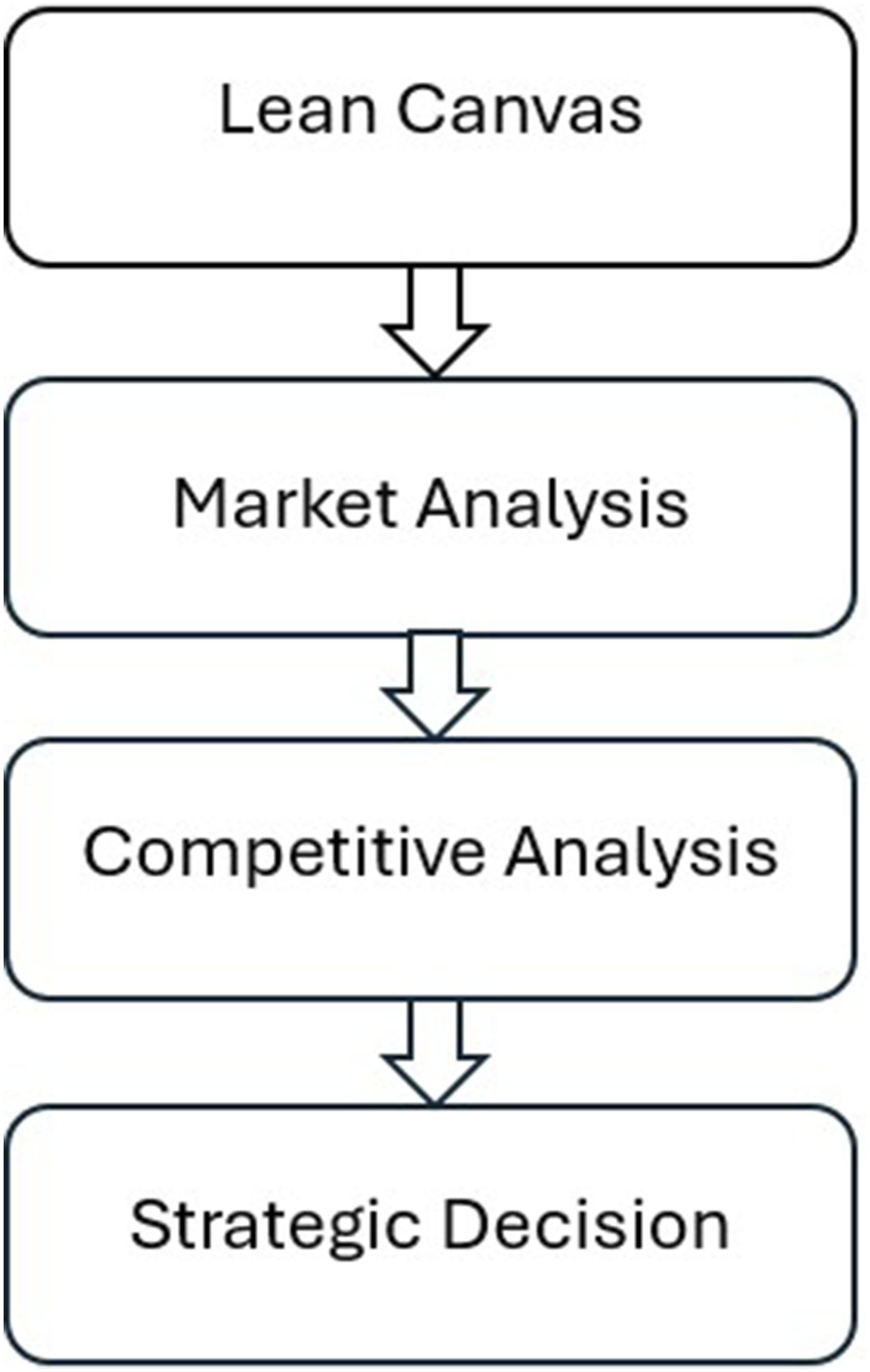
Entrepreneurial education program
Lean canvas development
A key element in business development and start-ups is the Business Model Canvas, taught in classwork, business programs, and incubators (Felin et al., 2020). We utilized this as the first milestone of our project, using five technologies provided to the three students. We used the Lean Canvas tools to help students understand the background of the five technologies presented in this project. In this stage, the students underwent the first phase of deciding to establish a company by first understanding the technologies and the marketplace for each. This was one of the most challenging aspects of the project for the participating students, as they had to familiarize themselves with new terms and vocabulary they were not previously acquainted with. After applying the lean canvas tool, the students were instructed to pick the most interesting technology to explore the steps of starting a company.
Market analysis
The next focus of this educational experience was understanding the industry, market, and commercial viability of their selected technologies. The fellows involved in this pilot study explored two medical treatment technologies and one wearable biotechnological device. The first step was the mile-high approach, in which the students were tasked with understanding the industry for each technology, the regulatory rules that applied, and the typical industry lifecycle. From there, the students were tasked with understanding the individual markets in which the inventions of investigation existed. Students were challenged to understand the market size and growth, needs and gaps, and the target audience (companies) to attract. After this, the students were tasked with assessing the commercial viability of the research, whether their selected technology was ready for the market, and the steps needed to bring the product to market. At this point, the students were tasked with determining the revenue potential and the market adoption rate for each industry. This stage was broken down into 2-week segments over 6 weeks. At each of the 2-week segments, the students were brought to present the information they had gathered, and feedback was provided to shift the direction if the student was not comprehending what was being asked. After all this information had been gathered, a competitive analysis was conducted.
Competitive analysis
The next stage of this project leveraged the requirements from the previous stage. In this task, we aimed to teach students that, while ideas may be novel, they must be aware of the risks involved in creating a business. Therefore, the students were tasked with exploring what existed of similar products and identifying how the invention they were exploring compared to the current market status. The students were tasked with exploring current products, competitors’ patents, and how they could achieve the market position for the invention they chose to explore. This was conducted over 4 weeks, with reporting done every 2 weeks. Again, the students were reconvened every 2 weeks for progress feedback and directed toward the goals of applying theory and achieving desired outcomes.
Strategic decision-making
The final section of this project required the most input and creative thought from the students. First, we had them analyze the financials to determine what was needed to develop the invention. This was the first stage of determining whether the investment in the invention was vital to the student’s decision. The students discovered the development cost through compliance, production, and marketing. Next, the students were tasked with understanding the strategic fit of their invention and how it aligns with the current market. The students, rather than looking to start their own company, explored this to see how it would align with the target-audience companies. They explored the financial value of their target companies, their business goals, and how these align with the companies’ current business models. Finally, we concluded the project with a simple question that prompted the students to reflect on all their work. We asked them to create a decision-making process for whether to pursue product development through company outreach, with a pro and con list to explain their decision. This project stage took 6 weeks with a 2-week interval check-in. In the final meeting, the students presented all their findings, discussed what they learned throughout, and provided feedback on the areas where they experienced the greatest growth. An interesting finding was the market alignment between industry and the understanding of where the product fit, which brought to light that not all technology had a place in the market.
Discussion
This case study aimed to raise awareness of the challenges entrepreneurs face and of how to assess the product to bring to market. While the stages are just the beginning of creating a business, the fundamental skills gained are transferable to the entrepreneurial mindset. Teaching this entrepreneurial mindset poses the challenge of designing effective learning techniques that marry academic knowledge with practical application to stimulate learning (Kuratko, 2005). This, partnered with the described experimental educational adventure, led this project to test the bounds of practical education for experiential entrepreneurial learning.
Bridging theory to practice
In this educational study, the students applied several theories they learned in the classroom, specifically those of entrepreneurship value creation and planned behavior. By applying these theories, the students could create comprehensive projects that identified the goals outlined at each step of the project, to the level of other technology transfer professions that mimic entrepreneurship skills to translate research at institutions. One of the key areas we sought to teach was the practical application of entrepreneurship, often regarded as the final aspect of entrepreneurship, in a setting where students can learn without the risk of starting their own company (Kuratko, 2011).
Theory of entrepreneurship value creation
The fundamental theory we followed in creating an educational project on entrepreneurship was the value-creation theory of entrepreneurship. The study focused on the main aspects of the theory of entrepreneurship value creation, specifically following the guide of Mishra and Zachary (Mishra and Zachary, 2015) around value creation and appropriation of the technology to the proper market. We posed the problem to the students, explaining that the technology they selected was the foundation of their new business and, therefore, they needed to apply the steps of licensing the technology with an entrepreneurial mindset to observe research translation. As outlined in the methods, this project placed significant emphasis on technology transfer, and the skills were applied to launching a new business.
Theory of planned behavior
The theory of planned behavior is rooted, either formally or informally, in all the tasks an entrepreneur must face (Lortie and Castogiovanni, 2015). This behavior is evident throughout the stages presented in this study. The application of this theory is the last of the three theories focused on in this manuscript, but it has traces throughout the project. This case study explored the four stages of the theory of planned behavior: action, target, context, and time frame (Ajzen, 2020). In the first stage of this project, the students used this to understand the market’s motives. By understanding the market’s needs, they could determine what intention the invention of interest must fulfill (action). In this same step, the students identified the target audience to understand where the action must occur. Through the competitive analysis, the students identified the context in which the invention fits not only within the field but also relative to competitors. Finally, the students determined the time frame for bringing the invention to production and market by understanding which compliance standards needed to be met before the invention was ready.
Interdisciplinary collaboration on perspectives
The fellows involved were composed of an interdisciplinary team from both business and engineering fields. As previously outlined, the project was open-ended at each stage, with the provided tasks determining the techniques they used to solve them. The fellows chose when to work individually or when to form teams to accomplish the task. Using this study technique, we found that individuals chose to work together in areas where they were less knowledgeable, forming novel teams throughout the project.
Interdisciplinary research integrates methods and insights from multiple disciplines to address complex questions, ensuring that diverse knowledge contributes to more applicable solutions. However, several barriers hinder such collaborations, including a lack of career incentives favoring interdisciplinary work, difficulties securing funding, bureaucratic challenges within institutions, and structural limitations in research methodologies. Despite these challenges, interdisciplinary research has significantly advanced by fostering collaboration across fields, leading to both positive and negative outcomes (Leahey and Barringer, 2020). The rise of interdisciplinary fields, such as Mexican American studies and cognitive science, as well as the expansion of university research centers, highlights their growing acceptance and institutional support (Leahey and Barringer, 2020). These developments underscore the increasing recognition of interdisciplinary research as a valuable approach that fosters creativity while addressing societal challenges, such as sustainability. Still, it is essential to consider all perspectives discussed in existing studies to gain a broader understanding and anticipate potential outcomes based on past collaborations within the research field (Newman, 2024).
Impact
Encouraging other universities to adopt interdisciplinary research will increase the likelihood of tackling global challenges with innovative and applicable solutions (Fam et al., 2020). It has been proposed through other empirical and systematic reviews that a way to overcome the challenges of interdisciplinary research is to utilize the Technology Transfer Office to employ the basis of entrepreneurial skills to educate students through practical education (Etzkowitz et al., 2019; Pittaway and Cope, 2007). The students involved in this effort were given the opportunity to develop skills in assessment, placement, and decision-making related to establishing a company. Thus, we strayed from the pedagogical model of academic instruction and created an opportunity to develop the skill set needed to become an entrepreneur. As suggested by recent educational approaches to entrepreneurship (Compagnucci, 2024), this approach emphasizes the skills needed to succeed before starting an entrepreneurial endeavor. Additionally, skills gained through entrepreneurial efforts have been shown to translate into all areas of professional growth, developing students into more rounded employees post-graduation (Klofsten et al., 2019).
Conclusion
This case study was conducted to enhance entrepreneurial education through practical experience. This was presented as a novel approach to teaching entrepreneurship through application, when external entrepreneurial campaigns are scarce. This approach allowed the students to overcome the lack of familiarity with technology companies and experience, in a microcosm, the challenges of tech entrepreneurship. This pilot program was launched as a practical approach, it is acknowledged that the sample size is limited by the desire to keep it small to ensure concepts are reinforced. Further longitudinal studies must be conducted before concluding whether this study succeeded through qualitative and quantitative data. This study aimed to highlight areas of strength and to propose a complement to pedagogical approaches for economically challenged regions seeking to improve their entrepreneurial education. We highlighted the skills utilized in the Technology Transfer Office, which translates to an entrepreneurial experience that strengthens the education and skill set throughout the case study.
Footnotes

Author contributions
MR: Writing – Original draft preparation, Writing- Reviewing and Editing.
MG: Writing – Original draft preparation.
MD: Writing – Reviewing and Editing.
JC: Conceptualization, Methodology, Writing – Original draft preparation, Reviewing, Editing, and Finalized manuscript.
Funding
The authors received no financial support for the research, authorship, and/or publication of this article.
Declaration of conflicting interests
The authors declared no potential conflicts of interest with respect to the research, authorship, and/or publication of this article.