




Abstract
Building and managing university-external stakeholder relations in regional innovation ecosystems (RIE) has been a challenge for European higher education institutions. How does a Central Eastern European mid-range university sustain such relations, and what factors promote and hinder their effective operation? Using multimethod qualitative research and the Regional Innovation Impact model, our data shed light on the operating conditions of the ’RII Delivery Space’, confirming such promoting factors as supply-demand match, actors’ relevant resources, openness and trust between key people, esp. alumni, while low proactivity, divergent interests, distrust among RIE actors, shortage of personnel, a different educational profile and path dependency impede collaborations. This questions the effectiveness of university contributions to the regional innovation ecosystem, despite a well-institutionalised partner management system with strong personal relations, and underlines meaningful communication and ongoing trust-building as key promoting factors. The findings endorse the regional innovation paradox in Europe, divergent RIE actor interests, and the time and capacity barriers listed in the European and Central Eastern European higher education literature. However, the lack of proactivity and the need for wider communication among RIE actors are specific to this case.
As green and digital transition have moved into the focus of European Union development policies, regional innovation ecosystems (RIE) gain new impetus as regional skills ecosystems. The implementation of such programmes necessitates effective collaboration between all parties concerned with the upskilling and reskilling of regional workforce (Tijssen et al., 2021; Oughton et al., 2002). Among them are universities of applied science who may need to reinforce their partnerships with relevant external stakeholders, i.e. regional authorities, local municipalities, businesses, other educational providers, and the various possible employers of graduates in civic society (EURASHE, 2023a), to collaborate successfully on new knowledge and skills provision for organisations’ green transformation and advanced digitalisation. However, managing external stakeholder relations effectively, accountably, and sustainably has long been a challenge for higher education institutions (Goldstein et al., 2019; Jongbloed et al., 2008; Kempton, 2019; Pinheiro et al., 2012), especially as bridge-builders in regional innovation ecosystems (Benneworth and Hospers, 2007; Goddard, 2018). This seems to be even more important for Central Eastern European mid-range universities, i.e. non-metropolitan, small-to-medium size higher education institutions (Gál and Ptáček, 2011), who as members of regional innovation systems (Bajmóczy and Lukovics, 2009; Gál and Ptáček 2011, 2019), or ’challenge-oriented’ regional innovation systems (Tödtling et al., 2021) may increase their social capital by the systematic management of relationships with local-regional public and private sector actors via networking, trust-building and collective learning (Benneworth et al., 2018; Gál and Ptáček, 2019; Goldstein et al., 2019). What are the specifics of such universities’ management of local-regional external stakeholder relations? What are the operating conditions of these cooperations? To what extent do these factors reflect the mainstream European literature, or are unique to the case?
To answer these questions, an in-depth case study was conducted on a typical example of a Central Eastern European mid-range university to start exploring their reality, as opposed to the experiences of large, metropolitan higher education institutions in the macroregion, which dominate the European research landscape. This is also the presentation of some of the findings on the Hungarian case of a comparative case study conducted in 2020-22 on a Hungarian and a Romanian regional university, some of whose results with a similar focus were published in a summative-comparative way by Sitku (2025), but in less detail. 1 Finally, this case may provide a strong empirical starting point for a future large-scale survey or further comparative analysis on regional higher education institutions in Central Eastern Europe.
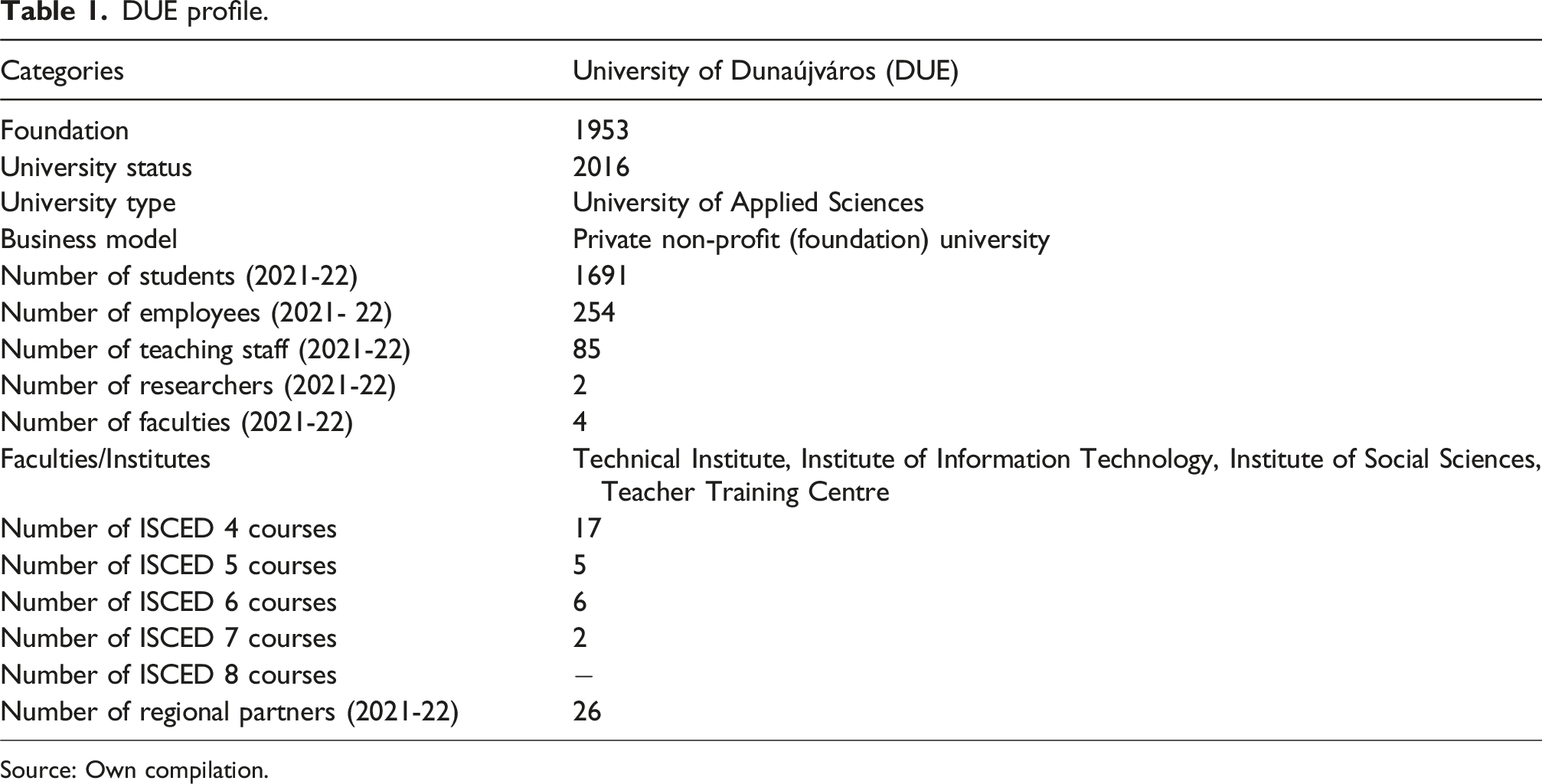
Selecting a typical case (Flick, 2018), the experience of a Hungarian university of applied science, the University of Dunaújváros (DUE) was investigated: how it built, managed, and sustained external stakeholder partnerships, what factors promoted, and what hindered the effectiveness of its collaborations. Applying multimethod qualitative research, the data detail DUE’s networking practice, highlight several facilitating and impeding factors from the European literature, and add several new aspects. For theoretical framework, we relied on the latest European model for university regional engagement, the Regional Innovation Impact (RII) model, to shed light on higher education institutional policies, programmes, projects and people, and the operating conditions of ‘the RII delivery space’ (Tijssen et al., 2021: 29).
The paper first outlines the specifics of Central Eastern European mid-range universities as actors in regional innovation ecosystems, summarizes the existing European research on the promoting and hindering factors of such cooperations, and presents the RII model. After the Method, Results summarize the findings of the two qualitative methods, which are explained in the RII model and evaluated against the cited literature to detect connections, divergence, and possible directions for future research. Here ‘local’ is understood as the urban area hosting the university, and ‘region’ as the geographical territory surrounding the urban area in an 80-km radius. The term ‘local-regional’ intends to capture the territory of both.
Central-Eastern European mid-range universities in regional innovation ecosystems
European higher education institutions have long been considered the heart of local clusters and regional innovation systems (Benneworth and Hospers, 2007; Chatterton and Goddard, 2000; Goddard, 2018; Pálné Kovács, 2009; Tijssen et al., 2021; Sitku, 2025). They may play this role due to their extended governance, business and academic networks, immense knowledge base, and long-term planning perspective (Benneworth and Hospers, 2007; Sitku, 2025). They are deeply embedded in their relevant geographical area, be that the national and global levels for a metropolitan research university, or the regional and urban levels for a small, specialized higher education institution in an underdeveloped region (Bajmóczy and Lukovics, 2009; Chatterton and Goddard, 2000; Gál and Ptáček, 2019). In their own way, they all contribute to the economic and social sustainability of their respective regions via teaching, research, and outreach activities (Benneworth et al., 2018; Huggins and Kitagawa, 2011; Laredo, 2007; Tijssen et al., 2021; Sitku, 2025).
Central Eastern European mid-range universities are typically located in a country’s non-metropolitan areas with a population size under 500,000 (Ženka and Slach, 2016; Gál and Ptáček, 2019). If situated in peripheral regions, they have heightened importance for the local innovation system (Gál and Ptáček, 2019; Kozma et al., 2015; Tödtling and Trippl, 2005), which is often overestimated in the face of certain constraints emerging from path-dependence (Erdős, 2018; Gál and Ptáček, 2019). These include whether the university’s educational and research profiles are compatible with the region’s economic base, if the university size provides the necessary critical mass, and if there is local demand for innovation (Erdős, 2018; Gál and Ptáček, 2019). Although proximity and long-standing relationships are major conditions for effective university-industry collaboration (Bajmócy and Lukovics, 2009; Drucker and Goldstein, 2007), if university offer and regional industry needs do not align, and the absorption capacity of the local economy is not adequate (Gál, 2016; Gál and Ptáček, 2019; Kempton, 2019), there can be little real economic improvement. Moreover, non-metropolitan, Central Eastern European regions have lower R&D potential, sparse density of contacts, and new knowledge often remains localized (Gál and Ptáček, 2019) due to the scarcity of agglomeration effects that would be crucial for a wider spillover to happen and promote regional economic development (Bajmóczy and Lukovics, 2009; Varga, 2009). Therefore, a re-evaluation of international good practice models of university-industry R&D collaboration in RIE seems to be necessary for Hungary (Erdős, 2018) and the Central Eastern European region, while mid-range universities should work towards heightened regional engagement in the creation of regional innovation systems. This may be achieved by an approach which extends university-stakeholder partnerships, fosters innovation, maximizes human capital development, and increases social capital via networking, trust-building and collective learning. However, it requires the systematic cultivation and sustainability of external stakeholder relations by the university (Gál and Ptáček, 2019).
Promoting and hindering factors of university-external stakeholder collaboration
Promoting factors
Focusing on the practice rather than the policy level, there are several facilitating factors besides geographical proximity and long-standing relationships (Bajmócy and Lukovics, 2009; Drucker and Goldstein, 2007) for cooperation among partners in a Central Eastern European RIE. In the Hungarian context, Pálné Kovács (2009) highlights that local economic development clusters come together based on mutual interest, a shared local identity, common financial resources, and shared responsibility. The local higher education institution may be the initiator, the bridge, and the integrator between the various participants. However, the effectiveness of these roles depends on constant dialogue, mutual dependence, trust, and the inherent socio-political culture of the locality. Furthermore, local clusters tend to represent their interests more effectively than coalitions formed at the level of NUTS2 statistical regions (OTKA, 2009 cited by Pálné Kovács, 2009).
Adding to this, Bajmóczy and Lukovics (2009) emphasise the role of spatiality for mid-range universities in a regional innovation system and underline the importance of local participants, their relations, the local embeddedness of the university, and the user absorptive capacity of the regional economic community. They also recall earlier findings on the fundamentality of the unique local resource-set (Ács et al., 2000), as well as the range and distribution of spillover effects (Varga, 2009).
Hindering factors
The politically and socially expected role of European higher education institutions in regional innovation systems and its effectiveness depend on various external and internal factors, most of which hinder the success of the collaborations (Kempton, 2019; Tijssen et al., 2021). Besides the restrictions of path dependence in the history and profile of Hungarian mid-range universities, as well as the spatial, economic, and social specifics of a region, university entrepreneurial activity in Hungary has been constrained by several major factors. Erdős (2018) provides an overview in the historical context and highlights such aspects as the unsuitable and changing legal framework for university entrepreneurship, the low academic acceptance of knowledge-transfer offices, the mainly top-down motivations for university spin-off activity, and the lack of entrepreneurial perspectives and abilities on the academic side. On the other hand, businesses have high expectations of state financing, their fundamental motivation for university collaborations is materialistic, the hybrid organisational forms for the collaborations are underdeveloped, and university incubation capabilities are insufficient.
Widening the scope to Europe, much research has highlighted the importance of the actual national legislation for university regional engagement (Goddard, 2018), which is often lacking in, or is unclear about regulating university and external stakeholder cooperations (Benneworth, 2018; Compagnucci and Spigarelli, 2020; Pinheiro et al., 2012, 2017). Furthermore, a lack of autonomous intermediary organisations, aiming to initiate contacts, facilitate a variety of knowledge transfer activities and coordinate collaborations, can be another serious hindrance (Balduzzi and Rostan, 2016).
As for the specifics of a region, its type (e.g. a metropolitan innovation hub, a failing industrial zone, or a peripheral agricultural area) shapes the role local higher education institutions are expected to play in the RIE. This can be that of a source of information for heightening regional economic competitiveness, a coach for local economic recovery and capacity building, or the only source of knowledge and contact to international networks (Goddard, 2018; Goldstein et al., 2019; Kempton, 2019; Pinheiro et al., 2012).
Summarising decades of research, Kempton (2019) repeats the innovation paradox of European regional development (Oughton et al., 2002; EC, 2007): the industrial structure, the extent of innovation demand, and the knowledge absorption capacity of local-regional businesses heavily constrain the utilisation of university RDI output. This hinders the realisation of regional innovation policies and depreciate university contribution. Underdeveloped, peripheral regions are even more impacted as they are characterised by institutional thinness, weak and fragmented industrial clusters, and lack the critical mass of innovation-promoting organisations (Gál and Ptáček, 2019). As a result, they depend heavily on the local university, seen as the only source of innovation (Tödtling and Trippl, 2005). However, universities operate on various geographical levels, and the ’government’ actor of the triple helix may restrict possibilities for effective university-industry collaboration on either the national or local level (Tijssen et al., 2021).
As for the higher education institution, besides the importance of a matching education and research profile to the regional innovation demand (Goldstein et al., 2019; Kempton, 2019; Pinheiro et al., 2012; Tijssen et al., 2021), the historical pathway (Benneworth, 2018) and the specifics of university organisational structure (Maassen et al., 2019; Pinheiro et al., 2012) and culture, the management style (Farnell, 2020; Goldstein et al., 2019; Pinheiro et al., 2012; Sánchez-Barroluengo and Benneworth, 2019) and the strategic focus of the university (Compagnucci and Spigarelli, 2020) may hinder, or promote meaningful regional engagement (Farnell, 2020; Goldstein et al., 2019; Pinheiro et al., 2012; Sánchez-Barroluengo and Benneworth, 2019). A major barrier is ‘the spatially blind reward system for academic excellence’ (Kempton, 2019: 2258; Goddard, 2018; Maassen et al., 2019; Farnell, 2020; Compagnucci and Spigarelli, 2020), and eventually it is the extent to which the university knowledge base and its resources, including academics’ attitude (Benneworth, 2018; Compagnucci and Spigarelli, 2020), are made available for university partners which determines much of the outcomes of the collaborations (Compagnucci and Spigarelli, 2020; Farnell, 2020; Kempton, 2019; Maassen et al., 2019; Tijssen et al., 2021).
University-external stakeholder relations are also influenced by the university’s prioritisation of stakeholder expectations (Jongbloed et al., 2008) and the need for increasing their income, which often leads to preferring externally funded research projects with MNEs over smaller, often self-financed collaborations with local SMEs, or community engagement projects with financially weaker societal partners (Goldstein et al., 2019; Sánchez-Barroluengo and Benneworth, 2019). Aligning academics and regional actors along mutual interest has proved to be an arduous task (Compagnucci and Spigarelli, 2020; Pinheiro et al., 2012), while collaboration may be constrained by the establishment of incompatible norms and structures, thus increasing the cognitive and organisational distance between partners (Pinheiro et al., 2012). Moreover, reaching consensus on the appropriate and mutually acceptable way of common knowledge creation can also be a challenge, and KTOs often fail to be effective channels for university-stakeholder communication (Compagnucci and Spigarelli, 2020).
As for regional actors, they may have negative preconceptions of higher education institutions, like considering them self-serving, unreliable, and cumbersome organisations (Goldstein et al., 2019), which are better not to be involved with. Some may also find it difficult to voice their needs, or have serious capacity barriers to exploiting the inherent advantages of university collaboration (Benneworth, 2018). Or they may be indifferent for a particular reason (Benneworth, 2018; Compagnucci and Spigarelli, 2020), like SMEs, which see universities only as educational institutions, rather than sources of technology transfer (De La Torre et al., 2018), or expert advice (Sánchez-Barroluengo and Benneworth, 2019).
Regional Innovation Impact model
The Regional Innovation Impact (Assessment), or Regional Engagement Impact (RIIA/REI) modell (Tijssen et al., 2021; EURASHE, 2023b) maps the collaborative practice of a higher education institution with its external stakeholders on the regional level, its range understood flexibly (Tijssen et al., 2021). Via a complex system (Figure 1), it attempts to capture the socio-economic impact of universities, i.e. their regional innovation impact, which refers to both their collaborative capability with regional stakeholders and their actual effect on the region. In this model, the needs, problems and challenges from universities’ regional environment motivate the higher education institution to mobilize its aims, motivations, resources and incentives to unite with the resources and incentives of the external stakeholder(s) to collaborate via ‘RII pathways’ in the ‘RII delivery space’ in order to produce various effects (‘outputs and outcomes’) that in turn have an impact on both external stakeholder needs and resources, and university aims, resources and practices, and lead to direct and indirect, short-, medium-, or long-term impacts on the regional economy and society (Tijssen et al., 2021: 29). Owing to the depth of capturing the complexity of these relationships, this model was used for the interpretation of the research data. The regional innovation impact model. Source: Tijssen et al. (2021). Note. Reprinted from Regional innovation impact of universities (p. 29), by Tijssen et al. (2021), Edward Elgar Publishing, licensed under CC BY 4.0 (https://creativecommons.org/licenses/by/4.0/). That figure is based on Jonkers et al. (2018) and European Comission (2004), which are licensed under CC BY 4.0 (https://creativecommons.org/licenses/by/4.0/), or Commission Decision 2011/833/EU respectively.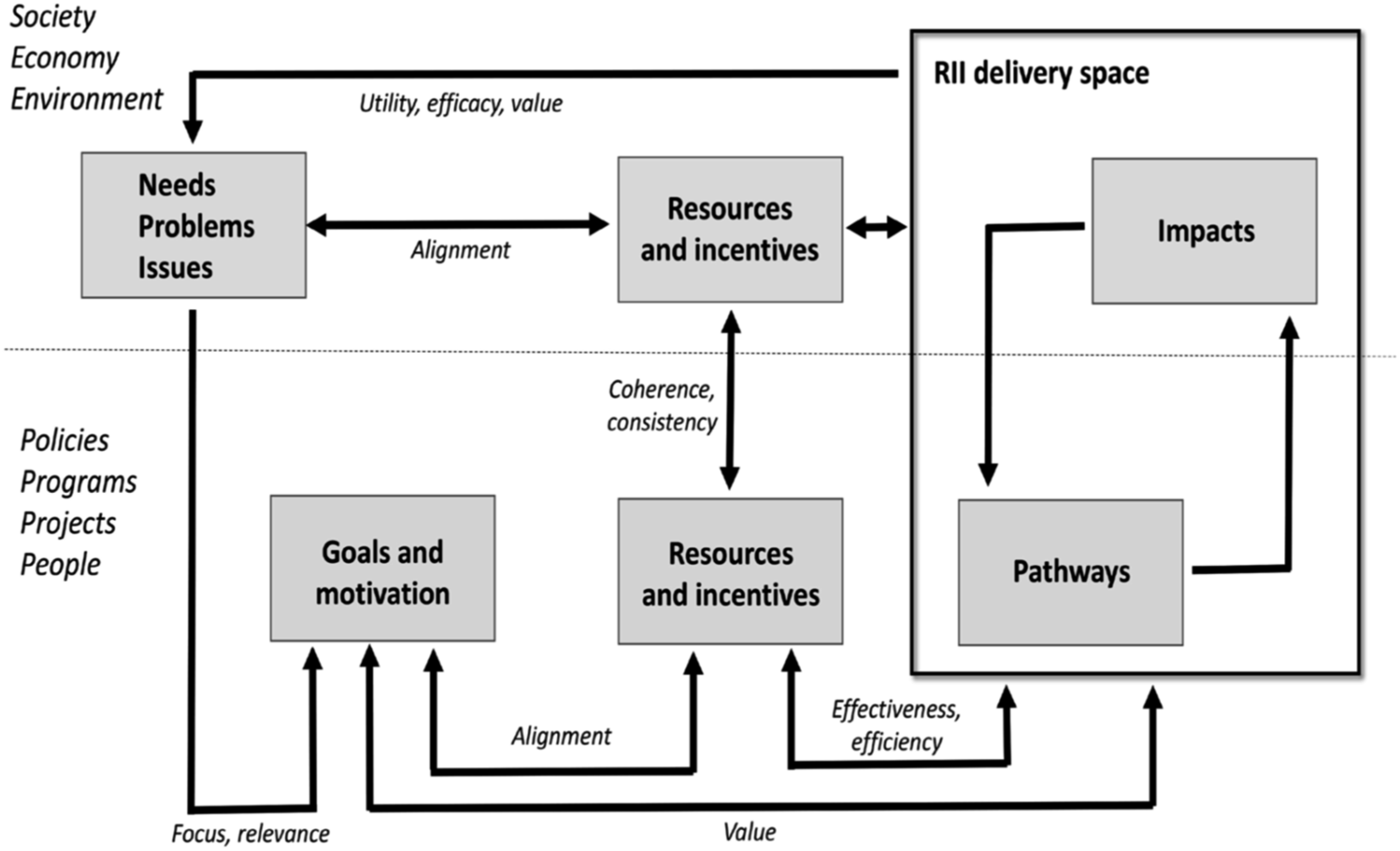
Method
To gain insight into ‘the RII delivery space’ (Tijssen et al., 2021: 29) of a Central Eastern-European midrange university’s external stakeholder relations, two research questions were set up: how do the case university built, managed and sustained partnerships with local-regional external stakeholders; and what factors promoted, and hindered effective collaboration. To draw a more complete picture of university-local-regional society relations than in most similar research to date, a wider range of external stakeholders were addressed: not only the main public and business actors, but also a broader range of societal partners, including the less influential stakeholder groups (Benneworth et al., 2018). Therefore, the interpretative-constructivist approach was chosen to represent their different perspectives and contexts, and grasp a multifaceted social reality (Flick, 2018; Merriam, 2009; Mik-Meyer, 2020). Besides, as data was to come from interviewees’ subjective accounts of social reality, this research approach relates to symbolic interactionism, too (Flick, 2018).
DUE profile.
Source: Own compilation.
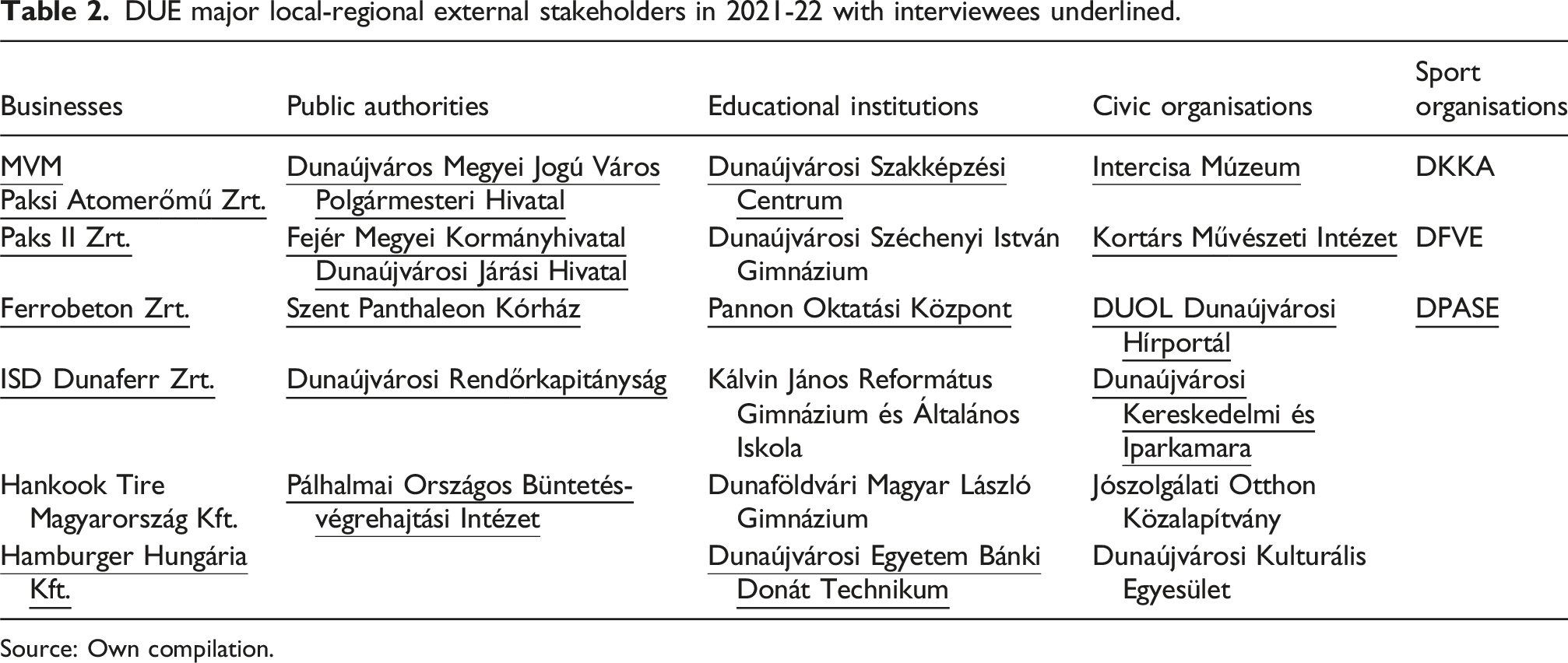
DUE major local-regional external stakeholders in 2021-22 with interviewees underlined.
Source: Own compilation.
The selected internal documents were analysed by Braun and Clarke’s (2006) thematic analysis applied as a realist method in an inductive way to identify patterns in the dataset and report them in rich detail at the semantic level. As a result, the following themes emerged: the way external stakeholder partnerships are initiated (in terms of organisational processes and university capacities), the function and university structures external stakeholders are involved with, the legal forms of the collaborations, and the ways they are maintained.
Reliability indicators for the coding frameworks.

Source: Own compilation.
The main coding process was performed with MAXQDA 2022, which was chosen for its adaptability to qualitative content analysis and ability to handle multi-level hierarchical categorization systems (Schreier, 2012). The coded thematic segments of either manifest or latent meaning were analysed by absolute frequency via the Code Matrix Browser function (see Tables 5 and 6 in the online Supplemental Material). The findings are presented below, then evaluated in the light of the major European literature.
Results
The following summarizes the findings for the research questions as resulted from the multimethod qualitative data analysis. The first question explored the ways DUE developed, handled and maintained its external stakeholder relationships. We identified three major themes in the analysed documents: DUE external partnerships (range of partners, and ways of active involvement in university decision making and operation); university resources allocated; and management practices for handling them.
Institutional practice for managing stakeholder relations
DUE external stakeholders
The university has a wide range of external stakeholders locally, regionally, and nationwide. In the 2021-22 academic year, it had over 50 active industrial partnerships with national- and multinational enterprises, and SMEs, of which 30 were local-regional. These represent some of the major employers, who offer students professional practice and internships, or participate in the university’s dual study programmes. Besides, governmental organisations in various fields of administration, the local chamber of commerce, public and private secondary schools, representatives of the local cultural industry, the major local churches, and a few civic and sports organisations complete the picture (see Table 2 above).
The university prioritizes regional external stakeholder needs. One way of answering them is their involvement in the formulation and execution of its educational, research and community engagement strategy. Thus, some of them sit, or sat on DUE’s highest governance boards: the national railway company (MÁV Zrt.) and Hungary’s nuclear power plant (MVM Paks Atomerőmű Zrt.) were members of DUE’s consistory board between 2016 and 2021; their integration into the university’s decision-making processes intensified with the 2019 foundation of the Territorial Innovation Platform (Területi Innovációs Platform), which involves industrial and civic experts to inform regional actors of current directions in innovation policy and foster new co-operations. Besides, the 2021 business model change has placed a board of trustees in governing position with the representative of the Paks II. Project in the chair’s position. External stakeholders are also engaged in regular curriculum development with the aim of ensuring the relevance of DUE educational programmes for local-regional industry needs and requirements. Furthermore, they participate in joint research projects and contribute their expertise and resources to various community engagement activities.
Institutional capacity for partner management
The institutional background for managing stakeholder relations includes several senior management positions and organisational units. The rector and vice-rector for institutional development are directly responsible for handling governmental, industrial, business, educational and civic stakeholder relations. They delegate some of the latter to the Student Union (DUE HÖK), who are responsible for most local-regional civic stakeholder relations and student volunteering. Industrial relations are organised by the Industrial Development Centre (Ipari Fejlesztési Központ), which acts as the technology transfer office of the university; the Dual Study Centre (Duális Képzési Központ), which is dedicated to the coordination of the dual study programmes; and Ecotech Non-Profit Ltd, a university-owned company, which offers applied research and adult education services to the private sector. Two additional units serve external stakeholder relations in a more comprehensive way: the Technical and Service Centre (Műszaki és Szolgáltatási Központ), which runs the university facilities (e.g. library, publishing office, sports facilities, canteen); and the Communication Centre (Kommunikációs Központ), which manages all university public relations, organises events and runs the recruitment campaign.
Institutional practice for partner management
The system of DUE partnerships is the outcome of several years of development towards creating an educational-research-innovation ecosystem. External stakeholders are invited into university partnerships in various ways: written communication, oral discussions, and personal contacts. The former includes surveys on various topics (e.g., graduate tracking, employer satisfaction, job market developments, professional training needs assessment), reports and written feedback on student placements, and the final examination chairs’ evaluation of graduate professional proficiency. Oral discussions may take the form of personal meetings or roundtable talks, either informally or formally. For example, higher education exhibitions, job fairs, professional conferences organised at DUE, or local community events provide the occasion, while the Industrial Development Centre, The Dual Study Centre, or the Rector’s Office are the channel. Personal contacts are based on DUE alumni employed at the stakeholder organisation, or mutual colleagues, who are utilised for initinating relations.
Once contact is established, prospective partners’ needs are expressed and analysed at informal consultations and formal negotiations resulting in various cooperation agreements. These may be informal agreements, memoranda of cooperation, institute-level partnership agreements, dual study programme agreements, cooperation contracts, etc., which lay down the principles and criteria of the partnership, and specify the nature and scope of the collaboration. This is quite diverse and include guest lecturing in several forms (e.g., dual study programme, conference, intensive programmes); student placements/internships; exhibitions at DUE Open Day; technical support for relevant DUE projects; professional event and meeting organisation; various forms of knowledge transfer (e.g., contract research, or expert consultancy); common R&D projects; professional trainings for third parties in collaboration; university lab facility development; DUE professional scholarship and talent promotion programmes; university curricula development;dual study partnership assessment; case study and study project provision; factory visits; career consultancy; open positions announcement (Career Day, DUE social media); and exclusive career pathways for DUE students. Annual meetings are organised for industrial partners to collect feedback on the ongoing collaborations and map their future needs. Then those that can be aligned with the university’s educational, research and community engagement profiles are integrated into the institutional development plan, which is disseminated to all university units to derive their own strategic objectives from it.
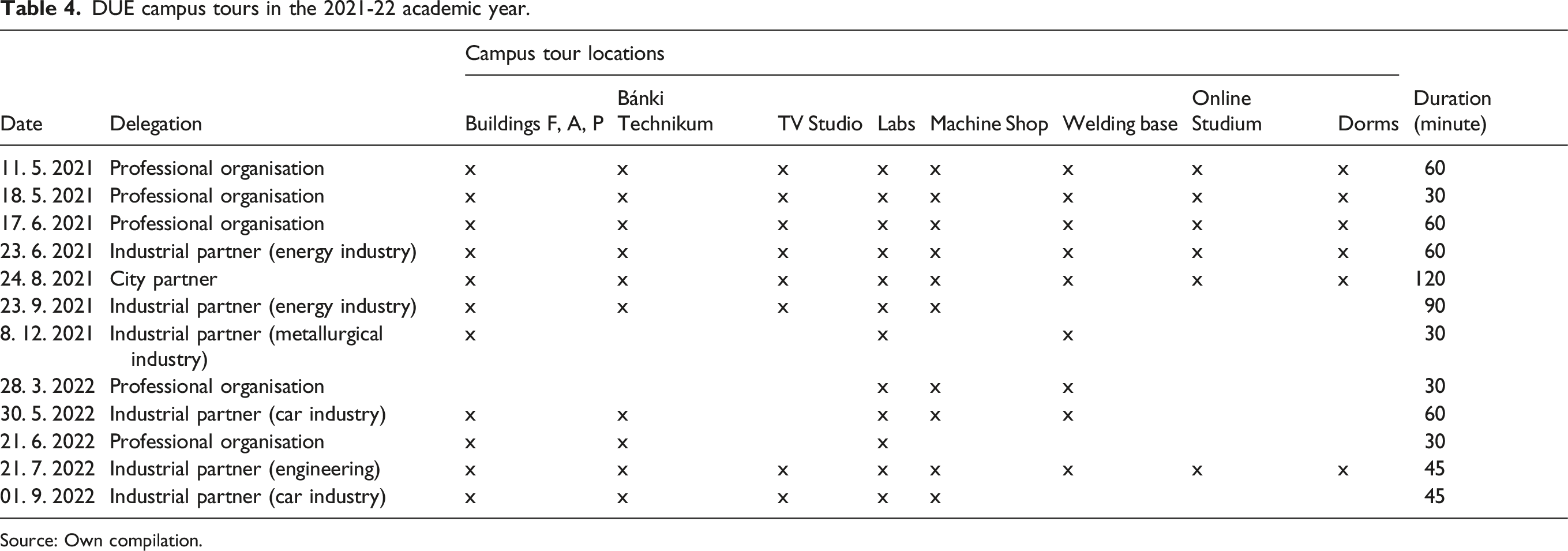
DUE campus tours in the 2021-22 academic year.
Source: Own compilation.
The second research question aimed to find out the operating conditions of DUE’s local-regional external stakeholder relations in terms of their facilitating and hindering factors.
Facilitating factors of DUE-External stakeholder collaborations
Facilitating factors were understood as any conditions that enabled the establishment, or supported the realisation of the collaborations. We built a 3-layer coding framework by mixed coding relying on the relevant cited literature, and new categories emerging from the interviews. Thus, altogether 55 factors were identified that promoted cooperation between DUE and its sampled external stakeholders in some way (see Table 5 in the Online Supplemental Material). Almost all the 17 deductive dimensions in the coding frame have proven to be relevant with the one exception being the ‘user absorptive capacity of the RIE’, referring to local regional innovation ecosystem members’ ability to absorb new knowledge in terms of their capability and capacity. In the 380 units of coding the most often occurring category (37 mentions), is ‘study programme offer’, i.e., the kinds and variety of university study programmes relevant to external stakeholder needs. This is followed by an attitudinal factor, ’being open to collaboration with any local-regional stakeholders’ (30), and an infrastructural one about the relevance and availability of university buildings, labs, equipment, etc. for external stakeholders (20). There are three other factors right after: stakeholder provision of expert knowledge, funds, equipment, connections and special events (19), university staff’s relevant and available professional-technical knowledge (18), and the good personal relationship between the top managers of the partner organisations (18). However, their share of the total mentions is rather low (8-5%), which already indicates what is found in the entire data set: there is a wide range of collaboration-promoting factors with a great variety of relevance for the sampled external stakeholders, with even the most frequently cited factors constituting only between 5 and 10% of all mentions.
In the lower than 5% absolute frequency group, six factors are mentioned more than 10 times: the match between university supply and external stakeholder demand (16), actors’ informal approach to starting new collaborations (15), ’openness to doing something new’ (14), the relevance of the specific research interests, achievements and experience of the university faculty for the external stakeholders (12), and either DUE alumni as employees, or key-operatives knowing and trusting each other (10-10).
As for the least mentioned factors, there is a plethora of categories with between 9 and 1 citations. In terms of their main categories, it seems that mutual trust based on earlier positive institutional relationship (9), committment in the form of flexibility in problem-solving during the collaboration, the business value of serving the local community, and keeping regular meetings in terms of communication (8-8) are the most frequent supporting conditions. Even less frequently mentioned (7-6) are university staff’s local embeddedness, key local-regional public figures’ mediation, geographical proximity, local patriotism, tender opportunities, the university as a medium of communication, stakeholders’ placement capacity, and such attitudinal factors as mutual support and sincere communication among the partners.
Proceeding further in the frequency distribution, while there are somewhat common factors with 5 to 2 mentions (e.g. actors’ diplomatic skills, networking activity, legal obligations, HR policy, student volunteering, etc.), such conditions as the collaboration supporting the university strategy, certain university assets, political impartiality, university monetary incentives, actors’ position in the local community, an enabling legal environment, or some external opportunity received only one mention.
Hindering factors to DUE-External stakeholder collaborations
Summarizing the hindering factors of DUE–regional stakeholder collaborations (see Table 6 in the online Supplemental Material), the interviewees disclosed 47 negative aspects out of the 81 categories in the coding frame. Interestingly, all irrelevant categories were concept-driven ones, and only 10 such were considered somewhat important: local-regional actors’ divergent interests (14 mentions), capacity barriers (shortage of personnel) (12), an unfavourable local industrial structure (many micro-enterprises and only a few MNEs and SMEs) (9), the time necessity for effective change (5), a shortage of stakeholders’ funds for the university collaboration (4), and some other, unspecified capacity barriers (3). Furthermore, the fact that the actors come from different sectors, organisation sizes, and university faculties, thus with different approaches, attitudes and ways of thinking (3), is seen as a problem, as it creates a diversity difficult to manage (1), especially in the absence of effective intermediaries between the university and the NGOs (3), or when some stakeholders are uncooperative (1).
However, the most often cited problem was the lack of proactivity in terms of initiative (17). This is followed by divergent interests (14), distrust among the actors (MNEs) (14), personnel shortage (12) and the path-dependency of the local industrial structure (9), which constitute the five most frequent barriers. Further down the scale, the next group (8) includes university supply–stakeholder demand mismatch for local MNEs, low need for fresh graduates, and indifference to collaborating with the local university. A lack of information about each other’s needs and priorities, as well as decision-making being with MNE headquarters abroad are mentioned seven times, while no/ineffective channel for regular inter-organisational communication, and the timespan of change received 5 citations.
At the bottom of the frequency-ranked list, there are several conditions mentioned only a few times (4–2), some external (e.g. Covid-19 closedown for NGOs, study programme termination), some attitudinal (e.g. contesting political loyalties, market competition, hard feelings, lack of care for the locality), some bureaucratic (e.g. organisational processes), others administrative (e.g. timing of events, operatives’ continuous communication). The least mentioned barriers relate to university personnel’s negative attitude, various practical problems (e.g. RDI at mother company, students’ study programme preferences), or differences in organisational culture, to name just a few.
Overall, when evaluating these results one should note that even a single mention may refer to a highly important factor for a given stakeholder, either strengtheing or weakening the collaboration. Our objective with presenting the findings by absolute frequency was to obtain the range of facilitating and hindering factors operating behind the relationships, and to detect their relative importance to inform future research. How these factos relate to the cited European literature is presented in the Discussion.
Discussion
This research first investigated the way DUE handled its local-regional external stakeholder relations by its internal structures and mechanisms, allowing insights into the ’Policies, Programmes, Projects, People’ element of the RII model (Figure 1). It seems that DUE has developed a practice that is institutionalised enough for the systematic cultivation of external stakeholder relations (e.g. careful stakeholder needs assessment, dedicated units, scheduled campus tours), yet it remains flexible enough to cater for individual stakeholder requests, as it is founded on long-term, trustworthy personal relations (e.g. alumni initiated contacts, strong senior management relations, a collaborative organisational attitude to stakeholders). This practice increases DUE’s social embeddedness and enables its contribution to the regional innovation system, as suggested by Gál and Ptáček (2019).
Adding our findings on the facilitating factors to this, the delicate efficiency–informality balance seems to even tilt towards the latter, which confirms an Eastern-European networking feature, the decisive role of direct, personal contacts and their maintenance (Lengyel, 2009; Gál and Ptáček, 2019; Goldstein et al., 2019), together with the marginality of utilizing inter-organisational mediators (Kempton, 2019) in Hungary (Erdős, 2018; Gál and Ptáček, 2019; Sitku, 2025). Yet, the fundamental dependence on personal relationships endangers the sustainability of relations (Compagnucci and Spigarelli, 2020), which may be prevented by more decentralised decision making, leadership development, and succession planning.
Another, positive practice is the ways of involving external stakeholders in university education and research, as this increases the practical relevance and societal impact of DUE’s output, which may alleviate the constraints of path dependence arising from a somewhat disparate local-regional supply-demand profile (Erdős, 2018; Gál and Ptáček, 2019).
We then investigated the operating conditions of the collaborations, i.e. the ‘Pathways’ in the ‘RII delivery space’ of the RII model, dividing them as facilitating and hindering factors (Kempton, 2019). Relating them to the cited European literature, some promoting conditions are absent in the sample, namely regional innovation system actors’ knowledge absorption capacity (Bajmóczy and Lukovics, 2009; Gál and Ptáček, 2019), the membership of local-regional stakeholders in university management (Kempton, 2019; Maassen et al., 2019) and participation in such collaborations contributing to faculty’s academic progression (Compagnucci and Spigarelli, 2020; Kempton, 2019; Sitku, 2025). However, many known factors were confirmed: relevant university training and research offer (Erdős, 2018; Goddard, 2018; Goldstein et al., 2019; Pinheiro et al., 2012), university openness to cooperation initiatives (Benneworth et al., 2018; Pálné Kovács, 2009), faculty’s professional knowledge and university infrastructure (Benneworth et al., 2018; Maassen et al., 2019), good personal relationship between senior managements (Maassen et al., 2019; Pálné Kovács, 2009), and available external stakeholder resources (Ács et al., 2000; Benneworth et al., 2018; Sitku, 2025).
The fundamental role of available financial resources on the appropriate scale (Compagnucci and Spigarelli, 2020; Kempton, 2019; Maassen et al., 2019) is also true for this case: the majority of DUE―Dunaújváros municipality cooperations are financed by EU and national fundings open to cities and their universities at a given time. However, they have several pitfalls: they limit the purpose, scope, and nature of the collaborations; and are linked to EU and national budget cycles, the respective budgetary situation of the funding providers, and a number of other external circumstances. As a result, they may dry up, thus causing university-external stakeholder activities to dwindle or cease. The dedicated annual allocation of the university’s own financial resources may be a solution (Holland, 2001), which we found references to in the sample, but the present research did not explore this area.
A particularly important facilitating condition is constant and meaningful communication between the partners, which DUE facilitates by the regular assessment of local-regional social actors’ knowledge needs, thus also providing tailored activities (Benneworth et al., 2018; Compagnucci and Spigarelli, 2020). Finally, the supporting factors only appearing here are new findings, most of them attitudinal: DUE’s flexible problem solving, partners’ willingness to innovate, university managers’ diplomatic flair, a goal-oriented attitude, informal personal relationships on all levels, mutual employees, and honest communication.
As for the hindering conditions, only some of the theory-driven factors indicated in the literature were confirmed by our data: the oft-cited misalignment of regional stakeholder demand and local university supply (Maassen et al., 2019; Pinheiro et al., 2012), the path dependency of the region and/or the university (Gál and Ptáček, 2019; Goddard, 2018; Kempton, 2019; Pinheiro et al., 2012), autocratic management style (Compagnucci and Spigarelli, 2020), actors’ capacity constraints (Benneworth et al., 2018; Compagnucci and Spigarelli, 2020; Kempton, 2019; Tijssen et al., 2021), and an unstable and inadequate regulatory environment (Compagnucci and Spigarelli, 2020; Erdős, 2018; Pinheiro et al., 2012, 2017).
The mismatch between local-regional knowledge demand and supply is due to the characteristics of DUE’s history and present profile, the distortions of the local industrial structure (Baranyai, 2016), and the capacity/capability gaps of local-regional micro-enterprises. This confirms the findings of Erdős (2018), Goldstein et al. (2019), and Gál and Ptáček (2019) for regional universities in Hungary and the Central-Eastern European region. Also, the indifference or negative opinion of local SMEs and NGOs towards DUE co-operation is rooted in perceptions like universities being simply educational institutions, or cumbersome, bureaucratic organisations (Compagnucci and Spigarelli, 2020). Among institutional barriers (Kempton, 2019), a particularity of student involvement was confirmed: while compulsory internships for students strengthen DUE’s knowledge transfer function and increase benefits for the most potential partners (Maassen et al., 2019), students’ participation in local community engagement activities is mostly voluntary. As there are inherently fewer internships at NGOs, the differences between collaboration areas and the weighting of external partners are even more obvious (Benneworth, 2018; Kempton, 2019; Sitku, 2025).
Additionally, several new factors were identified: diverging strategic goals and interests, and low commitment to serving the local community as obstacles to entering into university partnership; conflicting political loyalties of senior management; parties’ different expectations of and approaches to the collaboration; diverging organisational cultures of MNE partners; restrictive sectoral legislations; a lack of adequate information flow and commitment to problem solving on the operative level; a range of practical problems (e.g. timing the joint activities, keyperson leaves; governmental bureaucracy, termination of university course); and the time-span for effective change.
This presentation of a neglected case for the everyday operation of university-external stakeholder relations enriches existing knowledge with several new contextual factors, and frames them in the Regional Innovation Impact model (Tijssen et al., 2021). In particular, it endorses the regional innovation paradox in Europe (Oughton et al., 2002), the divergence of local-regional university stakeholder interests, and the time and capacity barriers listed in both the European and Central-Eastern European higher education literature.
We may recommend university management to strengthen the university knowledge base and promote the open, proactive attitude to external stakeholder collaborations throughout the organisation. Committed staff participation should be motivated, e.g. by openly acknowledging and rewarding goal-oriented, effective performance. Student engagement should be increased, recognised and advertised; just as collaboration outputs should be communicated to partners and local-regional society in a regular and targeted way. University bureaucracy surrounding the collaborations should be streamlined; partners’ preferred communication channels should be regulary updated, and operated effectively to ensure the efficient flow of information on all levels; training and the delegation of responsibility for the external relations function should be included in management succession programmes; and a code of ethics might be developed to regulate participants’ attitude and contribution to the collaborations.
In terms of future research directions, the case study design creates the need for examining these contextual factors on a wider Central-Eastern European sample to understand the extent to which they are specific, or generalizable to (mid-range) universities in this macro-region. The interplay of promoting and hindering conditions in shaping the dynamics of a university’s external relations may also be of scientific and practical interest. Furthermore, the exploration of how selected obstructing factors impact the RII outputs and outcomes (Tijssen et al., 2021) of such collaborations could be yet another research avenue.
Supplemental material
Supplemental material - University practice for sustaining regional innovation ecosystem relations: A central-Eastern European case
Supplemental material for University practice for sustaining regional innovation ecosystem relations: A central-Eastern European case by István András, Krisztina Sitku, Mónika Rajcsányi-Molnár in Industry and Higher Education
Footnotes

Ethical Consideration
No individual information of research participants (interviewees) have been used in this research.
Author contributions
Conceptualization: I.A. and K.S.; Methodology, K.S. and M.R.M.; Formal analysis, I.A. and K.S.; Writing−original draft paper, K.S., I.A., and M.R.M.; Writing−review and editing, M.R.M. and K.S.
Funding
The authors received no financial support for the research, authorship, and/or publication of this article.
Declaration of conflicting interests
The authors declared no potential conflicts of interest with respect to the research, authorship, and/or publication of this article.
Supplemental material
Supplemental material for this article is available online.
Note
References
Supplementary Material
Please find the following supplemental material available below.
For Open Access articles published under a Creative Commons License, all supplemental material carries the same license as the article it is associated with.
For non-Open Access articles published, all supplemental material carries a non-exclusive license, and permission requests for re-use of supplemental material or any part of supplemental material shall be sent directly to the copyright owner as specified in the copyright notice associated with the article.
