




Abstract
This inquiry flags the shortage of evidence on the distinctive effect of technology use on defined learning skills. To tackle this inertia, it identifies (1) video gaming, (2) internet searching and (3) smartphone usage as ubiquitous forms of technology. Then, it characterises (1) abstract conceptualisation, (2) concrete experience and (3) reflective observation and active experimentation as dominant learning skills. Investigating a Nigeria and UK sample of 240 generation Z students, the associations are examined alongside the effects of gender and country. Based on a structural equation model, the analysis showed that although alternate uses of technology have mostly significant influences, their impact is largely negative with only internet searching having a positive effect on learning. The findings are explained through a cognitive load lens and insights are offered to learning providers to temper the appetite for technology use in instructional designs with thought and caution.
Keywords
Introduction
The utility of information technology for enhancing communication, collaboration and productivity has since been reported (Ali et al., 2020; Olesen and Myers, 1999). Yet, there are behavioural peculiarities in how different generations interact with technology (Persada et al., 2019; Urick et al., 2017). Accordingly, Aithal and Aithal (2020) highlight distinctions between generations A, B, S, X, Y and Z, and draw attention to the ramifications of technology use in the unique development of these groups. By definition, a generation is a cohort of people shaped by events, possessing a collective memory and sharing a common way of thinking that bind them together over time (Eyerman and Turner, 1998). Yet, in no generation has the adoption of technology been more extensive as among generation Z, a cohort Francis and Hoeful (2018: 9) describe as ‘true digital natives’ because they have been exposed to the internet, social networks and mobile systems from an early age. Born between 1997 and 2012 (Dimock, 2019), generation Z are naturally proficient in technological advances such as multimedia and social media, and are accustomed to interacting and communicating in a permanently connected world (Turner, 2015: 104). Likewise, Broos (2005) consider generation Z to be exceptionally tech-savvy, content centric and computerised to the extent that they shape everything and influence market decisions. ‘It will not be an exaggeration to state that most innovations are due to them’ (Broos, 2005: 4). Moreover, ‘instructors teaching generation Z must be prepared to teach using software, hardware, digital, technological and social media’ (Cilliers, 2017: 195). They also comprise a teeming majority of app developers, cloud computing specialists, software and hardware developers (Baldassari and Roux, 2017; Barhate and Dirani, 2022).
Generation Z also draw scholars and practitioners’ attention because of their demographic size and purchasing power. For the former, they already constitute 40% of all consumers (Chamberlain, 2018). For the latter, generation Z commands $143 billion worth of discretionary spending which makes them a segment of keen economic interest for brands and retailers (Davis, 2020). Alongside their financial appeal, the significant contribution of generation Z to technological advancement has been alluded to. Roblek et al. (2019) stress that much of recent technological growth has been achieved through tracking and assimilating the social preferences of generation Z as evident in the use of geocaching in the tourism industry (Skinner et al., 2018) and mobile investment solutions in stock trading (Khaerani and Pohan, 2023). In their framework for leveraging the uniqueness of generation Z, Pichler et al. (2021) urge technology developers to understand the viscerality of internet and smartphone use in their lives. To this end, Charalampous et al. (2019) note that generation Z’s difficulty with face-to-face interaction compels organisations to design or commission virtual interaction solutions for remote work and communication. In the same breath, they seek choice and customisation in their transactions that is mostly enabled by technology. For such reasons, Setiawan et al. (2018) affirm that today’s rapid technological development is conditioned as well as influenced with generation Z in mind as a potential market.
In the main, technology dependence manifests in video games, internet searching and smartphone usage (Ng and Wiemer-Hastings, 2005; Rosen et al., 2013; Ružic-Baf et al., 2015), which are particularly common among generation Z (Turner, 2015). These three forms of technology use particularly appeal to generation Z because of their portability and ubiquity in different economic contexts (Ozdemir-Guzel and Bas, 2021; Vyugina, 2019). Regarding video games, Wood (2013) views generation Z as an attractive cohort for products that cater to escapist consumption. Indeed, video games are now ‘more real and compelling and offer greater 24/7 access to social networks’ where immersion in a ‘virtual world’ has produced an idealistic generation (Wood, 2013: 3). For internet searching, generation Z’s overreliance on search engines (such as Google) has also been noted, to the extent that their capacity to critically evaluate the merits of various sources of information has been weakened (Moore et al., 2017). Also, smartphone usage is significantly higher among generation Z (Priporas et al., 2017), but it generates an addiction that weakens the development of the groups’ social life and psychology (Ozkan and Solmaz, 2015). In this vein, Twenge (2017) believe that persistent use of smartphones, videogames and social media are linked with technology addition, sleep deprivation, attention deficit and clinical depression. In learning terms, Lee (2020) also associate technology addiction with attention deficit as well as loss of flow and control in independent learning. To synopsise these claims, a teeming contingent of scholars has drawn parallels between technology use and the learning ability of generation Z (Chicca and Shellenbarger, 2018; Mohr and Mohr, 2017; Persada et al., 2019).
Despite the above, and notwithstanding considerable interest in the link between technology use and learning among generation Z, there is still room for insights explaining this cohort’s all-round technology use as a predictor of their learning skills (Albadi and Zollinger, 2021; Seemiller et al., 2019). Therefore, Lu et al. (2007) appraised (1) online discussion, (2) online reading, (3) flash animation and (4) online observation as precursors of generation Z learning. Likewise, Ajmain et al. (2020) signalled online media to be an antecedent to generation Z’s learning. From an empirical stance, what seems to be missing in the corpus is research that contemplates holistically, in one stroke, the extent to which video games, internet searching, and smartphone usage predict generation Z’s learning propensity. The shortage of evidence in this regard is especially surprising considering the emergence of a thriving global educational technology [EdTech] industry valued at $43 billion (Choudry, 2020), and one which already generates £170 million in exports receipts in the UK (Williamson, 2019). Most notably the ‘big 5’ tech firms [Apple, Alphabet, Amazon, Microsoft and Facebook] are actively developing solutions in this domain (Mirrlees and Alvi, 2019).
Bearing in mind organisations’ social responsibility mission, it is reasonable to suggest that EdTech solutions ought to be carefully designed to augment rather than reduce learning in a landscape largely populated by generation Z. Afterall, in its essence, education should empower learners (Seemiller and Grace, 2017). Hence, this paper seeks to offer a primer on how discrete forms of technology use interact with dominant learning skills. Precisely, its aim is to conceptualise novel links between video gaming, internet searching, and smartphone usage and Kolb’s (1984) learning skills of (1) abstract conceptualisation, (2) concrete experience, (3) reflective observation and active experimentation (Manolis et al., 2013). On this basis, its contributions are threefold. First, it offers a more holistic and robust view of alternate technology uses and their varied impact on learning among generation Z. Second, it reflects on cognitive load theory as an explanatory mechanism in the technology use – learning skills nexus. Third, to advance the empirical literature, rare evidence is offered from a gender and cross-country perspective [Nigeria vs. the UK]. Regarding the latter, Cappelini et al. (2019) specifically solicited comparative generation Z studies, and this is one of the first to be set in Nigeria.
To proceed, this rest of this article is presented as follows: The succeeding part briefly describes the generation Z demographic in Nigeria and the UK. Following this, the cognitive load lens is espoused before embarking on conceptualising links between each form of technology use and Kolb’s (1984) learning skills. Subsequently, the data, measures and sample characteristics are outlined, flanked by details of the findings. The penultimate part initiates a discussion in advance of a reflection on the theoretical and practical implications arising in the conclusion.
The contexts of Nigeria and the UK
To begin with, Nigeria has a population of 218.5 million (The World Bank, 2024b). It is the largest information and communication technology (ICT) market in Africa with 82% of the continent’s mobile phone users as well as 29% of its internet demand (International Trade Administration, 2023). Its internet access is estimated to be 55% of the population (The World Bank, 2024c). The country operates a 6-3-3-4 system of education requiring 6 years of elementary school, 3 years of junior high school, 3 years of senior high school, and 4 years of tertiary education (Maduagwu and Otusinkama, 2024). Despite being the leading ICT market on the continent, and notwithstanding progress prompted by the COVID pandemic (Okagbue et al., 2023), technology use in the country’s centres of learning remains low (Eli-Chukwu et al., 2023). Bolaji and Jimoh (2022) recount shortcomings in inadequate funding and implementation of ICT, power cuts, limited broadband coverage and poor technology literacy as common pitfalls across the nation’s education provision. Culturally, the Nigerian population lean towards high power distance, collectivism, masculinity, moderate anxiety, short-term orientation and high indulgence (Hofstede Insights, 2024). Politically, it maintains a presidential system of government with three tiers [the executive, legislature and judiciary] (Murana, 2023).
The UK, on the other hand, has a smaller population of 66.9 million people compared to Nigeria (The World Bank, 2024b). However, similar to Nigeria, the UK is the largest ICT market in Europe albeit in commercial activity terms rather than technology demand (International Trade Administration, 2023). Mobile phone penetration is 93% in the country, trailing France [96%] and Germany [94%], and it has the second highest smartphone connections in the continent [82 million] (GSMA, 2023). 97% of UK residents have internet access (The World Bank, 2024c). The country’s education system is organised in a five-stage format of preschool, elementary school, high school, further education [FE] and higher education [HE] (Mylian, 2021). Technology use in UK education is well-established and extensive (Browne et al., 2006; Hramiak and Boulton, 2013). In contrast to Nigeria, virtual learning environments, smartphones, tablets, and computers are in optimal supply to enhance learning and widen access in the UK (Kennedy and Dunn, 2018; Lewin and Luckin, 2010). Culturally, the UK population generally exudes low power distance, individualism, masculinity, low anxiety, long-term orientation and high indulgence (Hofstede Insights, 2024). Politically, the UK follows a parliamentary system of government (Russell, 2021).
In summary, there is palpable evidence of high technology use in both settings notwithstanding divergent fortunes in national education. Both countries tend to be competitive [masculinity] and impulsive [indulgence] but vary in their acceptance of hierarchy [power distance], interdependence [collectivism vs individualism], pursuit of future rewards [short vs long-term orientation], and systems of government [presidential vs parliamentary]. In terms of the population of interest, 25% of the Nigerian (CIA World Factbook, 2021) and a corresponding 25% of the UK population (Clark, 2021) are generation Z. Recent studies have reported a high rate of technology use among this group in both contexts (Ezurike, 2023; Priporas et al., 2017). In Nigeria, greater access to digital libraries and education more generally has been reported among generation Z (Sanjeev et al., 2022; Ewurum et al., 2024). All the same, (Nwajiuba and Onyeneke, 2023) draw attention to the shortage of evidence pertaining the learning preferences of Nigerian generation Z. In the UK, generation Z have been reported to pass 4 h daily on two or more forms of technology use (Parry and Battista, 2019), yet ‘there is very little written about generation Z in the UK so far’ (Parry and Battista, 2019: 99). Empirical evidence seem limited to Dobson et al.’s (2019) examination of e-professionalism among dental students not limited to generation Z. On account of this, it is fitting to assess and compare the effect of boundless technology use among the generation Z subpopulation in these two prominent ICT contexts.
Theoretical background and hypothesis development
Beginning with video games, Shaffer et al. (2005: 105) noted their ‘tremendous educative power’ while Squire (2013) contended that they are a powerful medium for offering immersive experiences in which players solve problems. Thus, Annetta et al. (2009) hinted that video games can satisfy users’ entertainment and educational needs. Yet, as Gee (2006) pondered whether video games were good for learning, Bayeck (2020) cautioned for effective tailoring of their content to support local contexts and desired learning outcomes. In the case of internet searching, this pertains to the integration of information from various online sources in open-ended learning environments (Rouet, 2006). As a measure of students’ internet self-efficacy (Strømsø and Bråten, 2010), Segers and Verhoeven (2009: 425) find that internet searching in ‘sheltered environments’ that provide a layer of structure between the learner and the internet bodes well for learning. Along these lines, Yumuk (2002) since observed that internet searching encourages learning to take greater responsibility and autonomy of their own learning. In terms of smartphone usage, the effects of mobile device content on individual outcomes has been much discussed as negative (Haug et al., 2015; Meng et al., 2020). Nevertheless, Starcevic and Aboujaoude (2017) have challenged this view by asserting that smartphones are merely delivery mechanisms rather than problems per se. Accordingly, Alsayed et al. (2020) state that although learners may be addicted to smartphones, the devices appear to enable active learning.
Furthermore, as affirmed by Kolb (1984), learning is a cognitive process in which knowledge is generated from the transformation of experiences by (1) thinking [abstract conceptualisation], (2) feeling [concrete experience], (3) watching [reflective observation] and (4) doing [active experimentation] (Leite et al., 2020; Manolis et al., 2013). These four learning skills epitomise how ‘people prefer to learn’ (Diegoli and Gutierrez, 2018: 3). Explaining further, Kolb (1985a and 1985b) postulated that, based on the degree of ease in the four learning skills, individuals will demonstrate a preference for diverging, assimilating, converging and accommodating learning styles. First, diverging learners are naturally enamoured by concrete experience and reflective observation (Sugarman, 1985). They exude imagination and creativity (Turesky and Gallagher, 2011), prefer group work, communicate effectively and are open to feedback (Kolb and Kolb, 2005). Second, assimilating learners personify abstract conceptualisation and reflective observation (Sugarman, 1985), and they are able to internalise a range of information for logical organisation (Muro and Terry, 2007). This group is gravitated by valid and thought-through information (Kolb and Kolb, 2005). Third, converging learners are oriented to abstract conceptualisation and active experimentation and are pragmatic in applying ideas and theories (Muro and Terry, 2007), as well as competent in goal setting, problem-solving and decision-making (Turesky and Gallagher, 2011). Last, accommodating learners channel concrete experience and active experimentation to convert information into knowledge (Muro and Terry, 2007). They tend to be actively involved in real-life situations (Sugarman, 1985), rely on intuition rather than logic, and work in teams to accomplish tasks (Kolb and Kolb, 2005).
Recognising the volume of literature linking video games (Justesen et al., 2020; Squire, 2013), internet searching (Tsai and Tsai, 2003; Yin et al., 2013) and smartphone usage (Clayton and Murphy, 2016; Ng et al., 2017) to learning, Sweller (2020) recently evoked cognitive load theory to shed light on the perceptive modus of technology-led instructional procedures. Building on this, cognitive load theory is espoused here to explain the mechanism by which different forms of technology use enhance or inhibit learning among generation Z. This is corroborated by Wong et al.’s (2012) view that there is a modality effect of technology on cognitive load as, for example, tablet learning systems that cause less cognitive load for students (Shadiev et al., 2015). Reverting to its definition, cognitive load theory suggests that individuals embody two kinds of mental architecture (Chandler and Sweller, 1991; Sweller, 2010). They are (1) the conscious information processor known as the working memory and (2) the knowledge reserve which serves as long-term memory (Blayney et al., 2015). Hence, the theory goes that working memory is finite in its capacity and differs from the infinite long-term memory (Klepsch and Seufert, 2020).
Moreover, when individuals are exposed to information, three types of mental strain impinge on working memory namely (1) intrinsic, (2) extraneous and (3) germane loads (Sweller, 1988). The first one, intrinsic load, arises from the natural complexity of the information being processed as triggered by element interactivity (Seufert et al., 2007). Second, extraneous load arises from deficiencies in instructional design and redundant information that impede rather than enable learning (Sweller, 2008a). Third, germane cognitive load are exposures that lead to the deposit of new information in long-term memory without overloading the working memory (Debue and Van de Leemput, 2014). For generation Z and their technology use, in addition to networking and socialising, it is desirable for video gaming, internet searching and smartphone usage to enable the development of schemas that intellectually empower. That is to say, technology provided by stakeholders taking a marketing 3.0 approach could also serve the purpose of increasing germane load by exposing generation Z to content that minimises extraneous cognitive load and redundant information.
Having defined the independent variables and outlined cognitive load theory as a theoretical base, hypothesis development is now commenced.
Technology use and abstract conceptualisation
Focusing on abstract conceptualisation, individuals oriented towards this learning skill benefit from exposure to information that support the logical exploration of concepts and ideas (Furnham, 1992). At the same time, abstract conceptual learners are driven by cognition rather than emotion, eschewing interpersonal issues or feelings (Richmond and Cummings, 2005). In Kolb’s (1984: 69) own view, as a learning skill, abstract conceptualisation pertains ‘systematic planning, manipulation of abstract symbols, and quantitative analysis.’ Learners adopting this style favour the reading of texts to grasp concepts and formulate ideas. Thus, prior studies including Fernández (2004) and Kirby and Savage (2008) have associated textual reading with individuals’ logical learning that culminates in abstract conceptualisation. To explain the mechanism of this association with technology, Mangel and Van der Weel (2016: 120) affirm that ‘what we read is therefore not only the text itself but also the material and technical features of the device or technology presenting or displaying the text.’ This is telling because learners who prefer abstract conceptualisation tend to conduct substantial research typically aided by some form of technology (Ally and Fahy, 2002), including games (Nielsen-Englyst, 2003). Nevertheless, studies associating forms of technology use with abstract conceptualisation are rare, and the probability of video games, internet searching and smartphone usage having an influence on abstract conceptualisation remains undetermined. To test this likelihood, a first hypothesis is framed as follows:
Technology use in the form of (a) video games, (b) internet searching and (c) smartphone usage is significantly and positively associated with abstract conceptualisation
Technology use and concrete experience
The second learning skill, concrete experience, immerses learners in phases of observation and reflection from which concepts and generalisations are formed to allow for testing in real-life situations (Lee, 2020). As a learning skill, concrete experience affords opportunities for learners to experience some event or phenomenon (Svinicki and Dixon, 1987). This may include the narration of real-world experiences that stimulate individual reflection (Endersby and Maheux-Pelletier, 2020). Concrete experience learners show a preference for addressing real situations, exploring decision-making, assessing past events from different perspectives, and taking a case study approach (Leite et al., 2020). Likewise, exposures to experiential training may also provide a sense of concrete experience (Pruett, 2012). While Dringus and Terrell (1999) contend that technology use, and web-based material in particular, is unlikely to enhance concrete experience, Du (2004) argues that it may be preferred by individuals for offering exposure to diverse resources that could satisfy users’ penchant for concrete experience. To stress the latter, technologies in the form of simulations, for instance, may recreate real world scenarios or phenomena to support individuals’ learning (Lunce, 2006). In the same vein, Dholakiya et al. (2019) intimate that advanced software in modern games and smart phones offer a high level of realism that bodes well for learning. Nonetheless, to address Dringus and Terrell (1999) circumspection, the succeeding hypothesis contemplates links between video games, internet searching, smartphone usage and learning skills among generation Z. Thus:
Technology use in the form of (a) video games, (b) internet searching and (c) smartphone usage is significantly and positively associated with concrete experience
Technology use, reflective observation and active experimentation
For the third and fourth learning skills, Manolis et al. (2013) assert that reflective observation and active experimentation are positively correlated and should, therefore, be assessed together. Reflective observation implies the formulation of critical opinions and the consideration of events from multiple standpoints, while active experimentation underscores individuals’ inclination for practical application and projects on which to test acquired knowledge (Leite et al., 2020). Besides, active experimentation enables individuals to summon theory in the course of decision-making and problem solving (Kolb, 1984). Hence, Morris (2020) explains that the correlation between active reflective observation and active experimentation holds because problem solving compels critical reflection. Scholars including Brookfield (2001) and Harper (2018) have also advanced this view. In terms of the reflective observation and technology nexus, Kori et al. (2014) describe technical tools with predefined guidance and technical tools with human interaction as the mechanism by which the latter affects the former. This occurs through users’ reaction to the display, prompts and forum conversations embedded in technologies which provide scaffolding for reflection (Lin et al., 1999). Thus, there are ample indications that technology enhances students’ introspection (de Jong et al., 2012; Pedaste and Sarapuu, 2006; Pedaste and Serapuu, 2014). Yet, Kori et al. (2014: 45) note that although technology supports reflection, not all studies report a positive effect. As for active experimentation, Roehl et al. (2013) believe that engagement with technology triggers higher order thinking needed for creativity which, in turn, bodes well for active experimentation. Likewise, (Ariza, 2023) demonstrates how digital media such as videos provide an illustrative resource to support users’ active experimentation. Huang et al. (2020) concur by affirming how video technology offers an immersive experience to improve individuals’ creativity, performance and self-efficacy. Accordingly, the third hypothesis investigates the degree to which:
Technology use in the form of (a) video games, (b) internet searching and (c) smartphone usage is significantly and positively associated with reflective observation and active experimentation
The role of gender in technology use and learning skills
Wider literature suggests that opposite genders develop varied learning abilities (Sullivan, 2001), particularly in the presence of technology (Malik et al., 2020). Accordingly, among other themes, scholars have examined differences in male and females’ internet use (Odell et al., 2000), mobile phone use (Economides and Grousopoulou, 2008), mobile assisted learning (Dehkordi and Taki, 2018), technology anxiety (Broos, 2005) and attitudes towards technology (Cai et al., 2017). As it pertains to learning skills, “D’Amore et al. (2012) found that female students show higher levels of reflective observation than males. Nonetheless, Biabani and Izadpanah (2019) found the opposite, with males scoring higher than females in all skills (abstract conceptualisation, reflective observation and concrete experience) with the exception of active experimentation. As such, there are inconsistent findings in this regard and, more to the point, previous studies have not examined gender differences in the learning skills adopted by generation Z. To address this gap, a fourth hypothesis tests whether:
The influence of technology use on learning is influenced by gender
The role of country in technology use and learning skills
Much of the current generation Z literature has been based on a country perspective as researchers have weighed up the cohort’s attitude towards tourism in New Zealand (Robinson and Schänzel, 2019), Australia, China, India, the UK and the US (Entina et al., 2021). Other studies have investigated generation Z’s purchase decisions in Vietnam (Nguyen, 2019) and Indonesia (Simangunsong, 2018), as well as social media branding in Finland and the UK (Reinikainen et al., 2020). Not least, Ameen and Anand (2020) studied the characteristics of generation Z in the UAE to inform tailored corporate strategy formulation, while Goh and Baum (2021) examined the work motivations of generation Z in Australia. Although studies taking a comparative stance abound (such as Entina et al., 2021), on the subject of generation Z, the pairing of Nigeria and the UK has eluded the literature. To be sure, in view of longstanding social and economic ties between the two countries (Oriloye, 2016), scholars have perennially undertaken comparative studies between Nigeria and the UK on themes such as firm performance (Ihua, 2009) and entrepreneurial skills (Abdul, 2018). To add original perspective on matters concerning generation Z in both countries, a fifth hypothesis is evaluated along this line:
The influence of technology use on learning is influenced by country
To conclude, the theoretical framework in Figure 1 summarises this conceptualisation with VID representing video gaming, INT representing internet searching, SMTFON representing smartphone usage, ABS representing abstract conceptualisation, CON representing concrete experience, and REF&ACT representing reflective observation and active experimentation. Theoretical framework.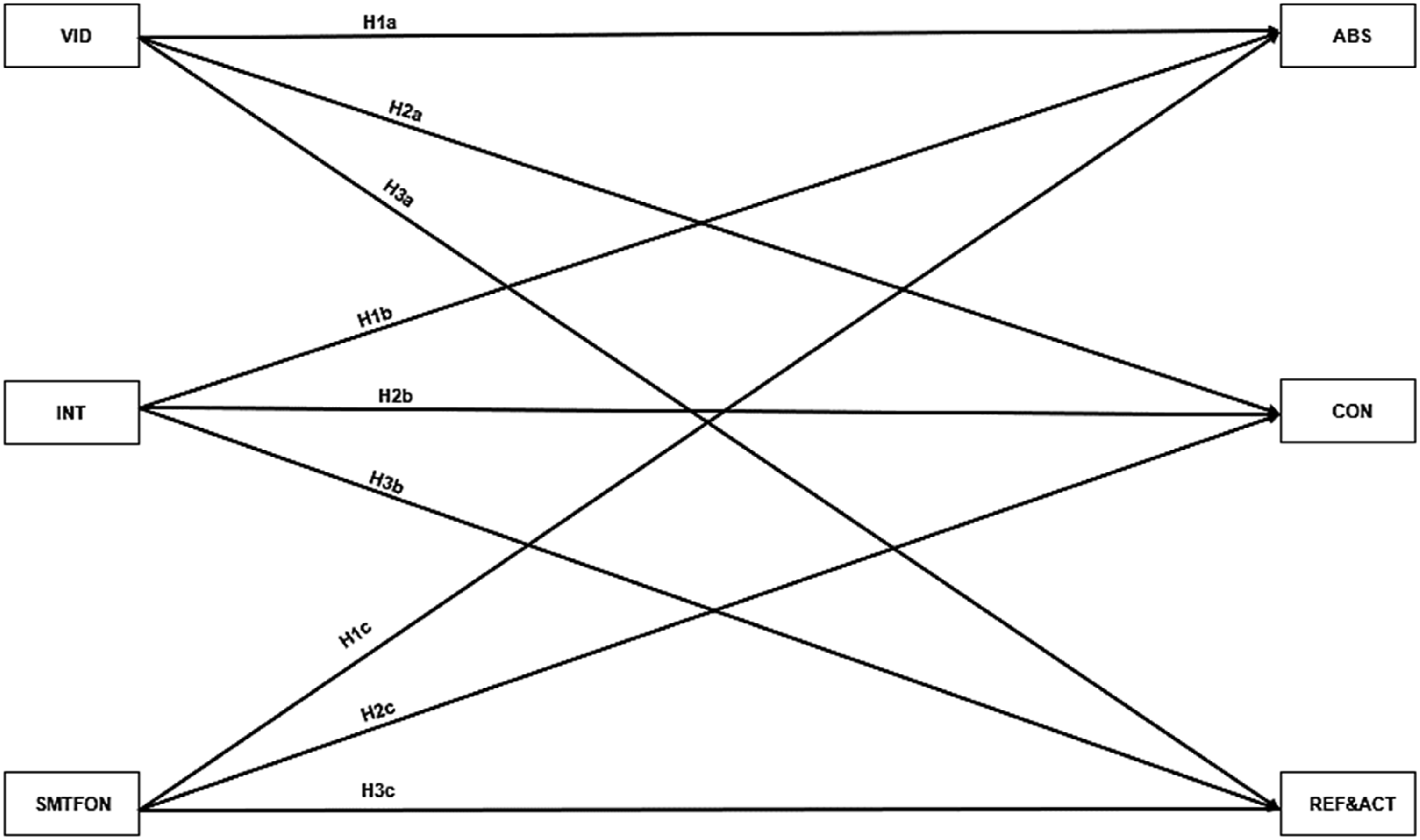
Method
Data
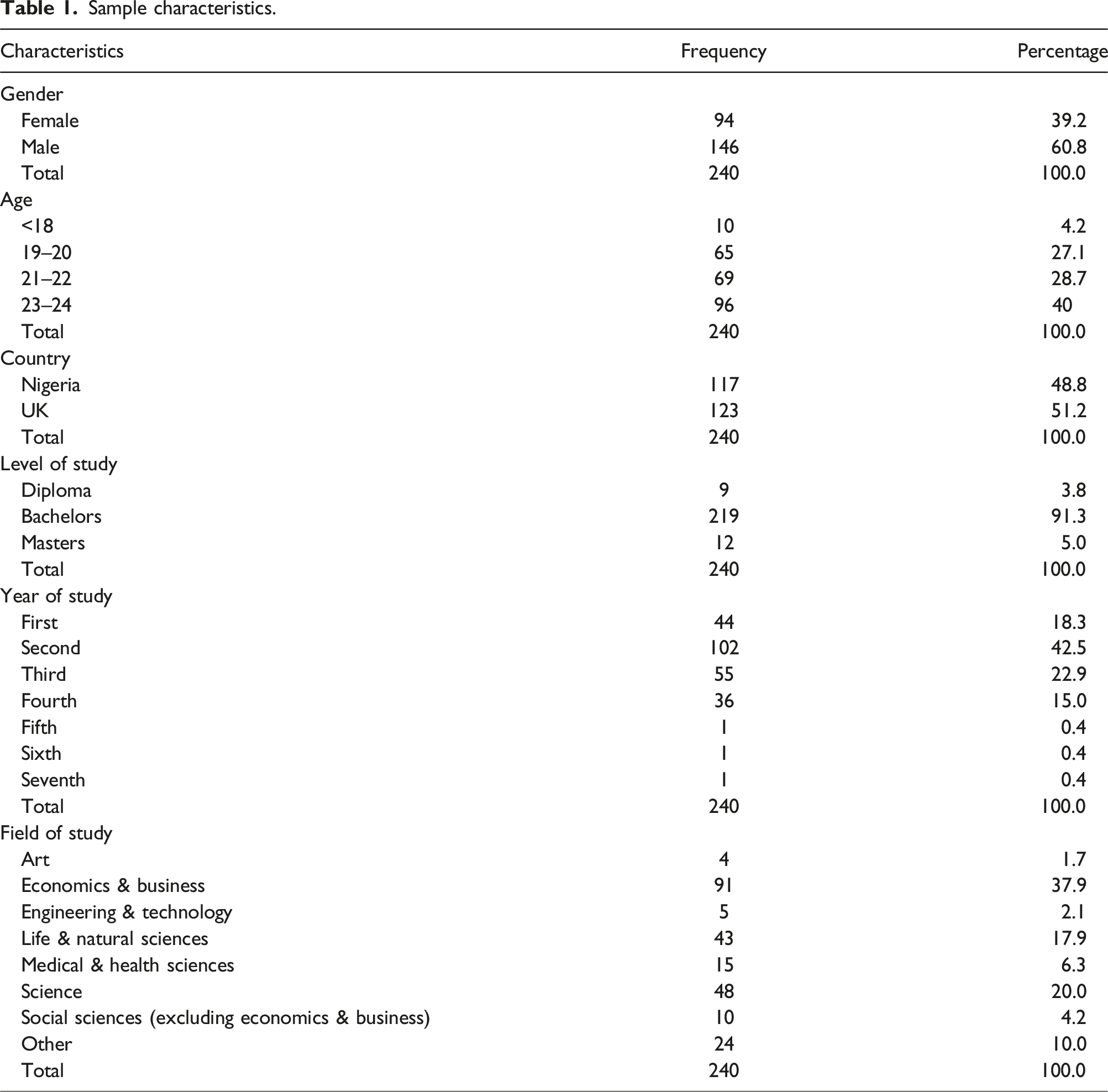
To test the hypotheses, ethical approval was obtained to survey students in three universities. These were (1) Kaduna State University in Nigeria, (2) Coventry University and the (3) University of Wolverhampton in the UK. Students were targeted because they constitute a large proportion of the global generation Z population (Johnson and Sveen, 2020; Persada et al., 2020). This social group is also ideal for investigating learning skills (da Costa et al., 2020; Nulty and Barrett, 1996). The data collection instrument was an online survey circulated to students by the authors in the UK. In Nigeria, a local data collection agency [Fourzet Acute Data Enterprises] was commissioned to collect data using the same online survey with a knock-on-the-door approach. The sampling approach was a non-probability technique that is common is psychology, marketing and higher education studies (Ganesan et al., 2018; Haddoud et al., 2020; Onjewu et al., 2021; Sarstedt et al., 2018). Even though there are generalisability concerns with non-probability sampling, Coviello and Jones (2004) argue that the technique still yields quality data when high response rates are achieved. In total, 317 students completed the online survey but respondents older than 24 years were withdrawn for empirical interest in generation Z. In the end, 240 cases remained for analysis.
Measures
To assess the independent variables, 11 items from Rosen et al.’s (2013) validated media and technology usage and attitudes scale were adopted, following precedent in Özgür (2016) and Sabbah et al. (2019). The items were placed on a 10-point frequency scale ranging from ‘never’ to ‘all the time’ to probe how regularly the respondents, for example, ‘play games on a computer,’ ‘search the internet for news on any device’ and ‘use mobile phones during class or work time.’ To capture the dependent variable, 17 items from Manolis et al.’s (2013) reduced Kolb learning style inventory 1 was adopted, similar to Van der Lingen et al. (2020). On a 7-point scale, respondents were asked to indicate the extent to which they strongly disagreed or strongly agreed with brief statements including ‘when I learn I like to watch and listen,’ ‘I learn best when I rely on logical thinking,’ and ‘I learn by doing.’ The full items and their loadings are provided in the appendix.
Sample characteristics
Sample characteristics.
Analysis
The data were analysed by non-linear partial least squares structural equation modelling (PLS-SEM) in WarpPLS 7.0. (Kock, 2020). This procedure enables the simultaneous testing of outer (measurement) and inner (structural) models in nonparametric conditions (Moqbel et al., 2013). A variance-based approach was also elected for high greater predictive power over covariance methods (Hair et al., 2017). In PLS-SEM, the explained variance is estimated by latent variable scores that minimise the residuals (Richter et al., 2015). This feature is especially important to the current study’s focus on predicting learning skills.
Reliability and validity of the constructs
Constructs’ reliability and validity.

Hypothesis testing
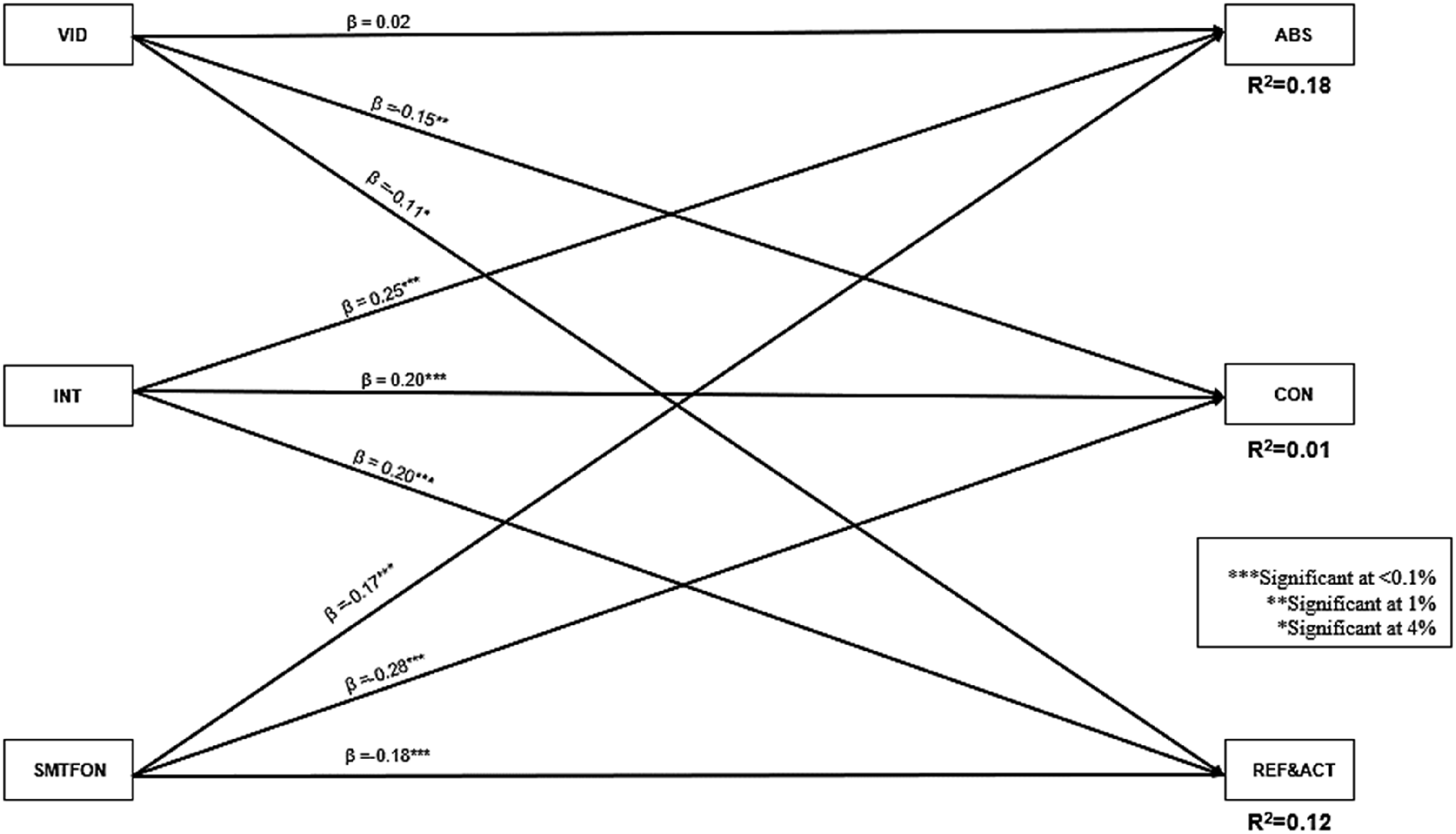
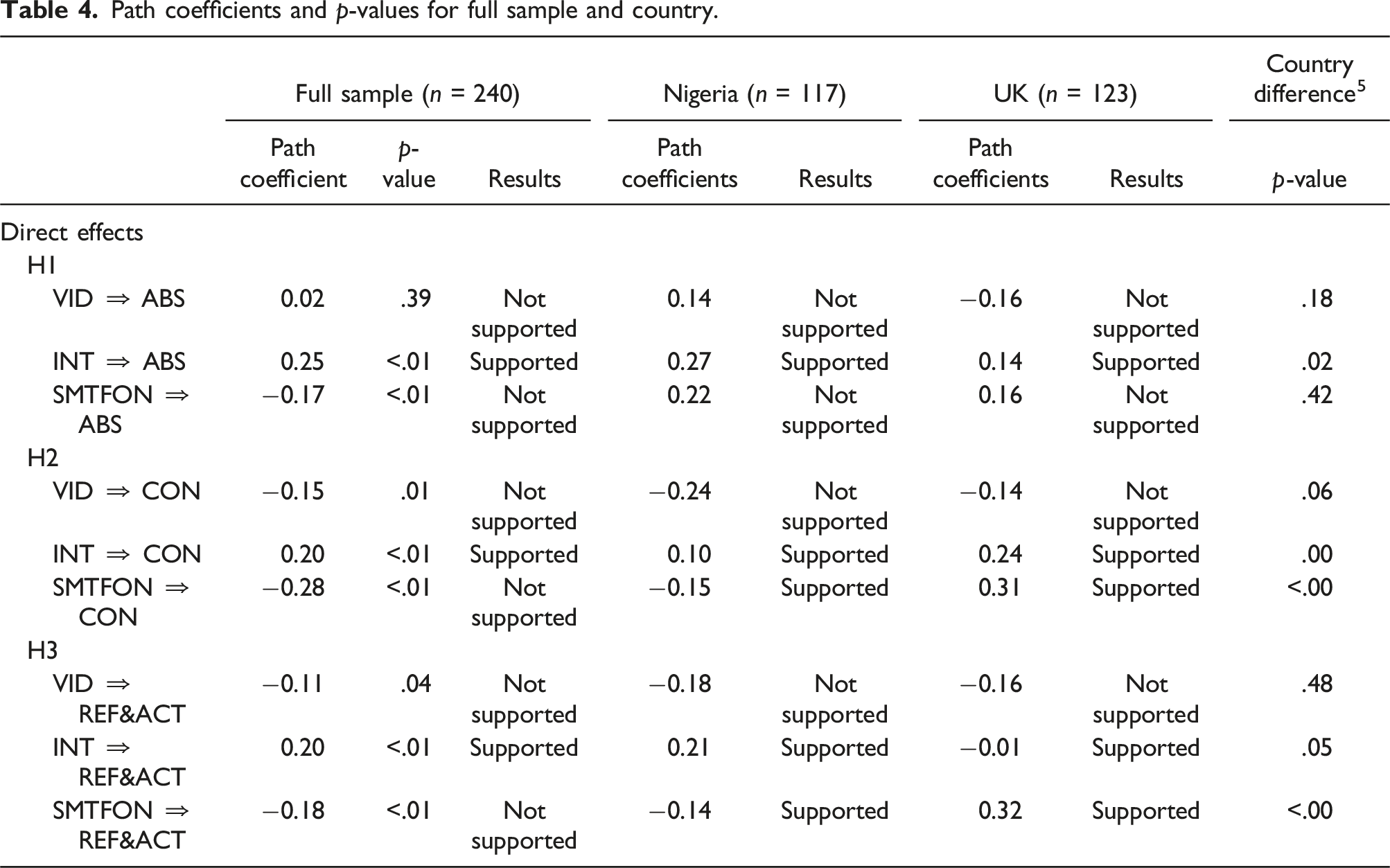
To interrogate the six hypotheses, path coefficients (β) and p-values of the relationships in the structural model were interpreted as shown in Figure 2. First, the path analysis indicated that generation Z’s technology use in the form of video games has a negative impact on concrete experience (β = −0.15**), reflective observation and active experimentation (β = −0.11***) and bears no relationship with abstract conceptualisation (p-value = .39). Second, it was found that technology use for the purpose of internet searching boosts concrete experience (β = 0.20***), reflective observation and active experimentation (β = 0.20***) and abstract conceptualisation (β = 0.25***) among generation Z. Third, current evidence suggests that generation Z’s use of smartphone technology significantly reduces concrete experience (β = −0.28***), reflective observation and active experimentation (β = −0.18***) and abstract conceptualisation (β = −0.17***). Based on these findings, H1a, H2a, H3a, H1c, H2c and H3c are rejected while H1b, H2b and H3b are accepted; as only internet searching has a positive effect on the three learning skills. Overall, the path model explains 18% of the variance in abstract conceptualisation, 1% in concrete experience, and 12% in reflective observation and active experimentation. Structural model.
3
In further examination of the data, a multi-group analysis [MGA] was undertaken to ascertain the influence of gender and country in the sample. However, to ensure that the constructs were equivalent across the groups as recommended by Williams et al. (2009), measurement invariance was first assessed using the constrained latent growth with loadings feature in WarpPLS 7.0 (Kock, 2020). Following this protocol, no significant differences in the items’ p-values were found in the gender and country groups.
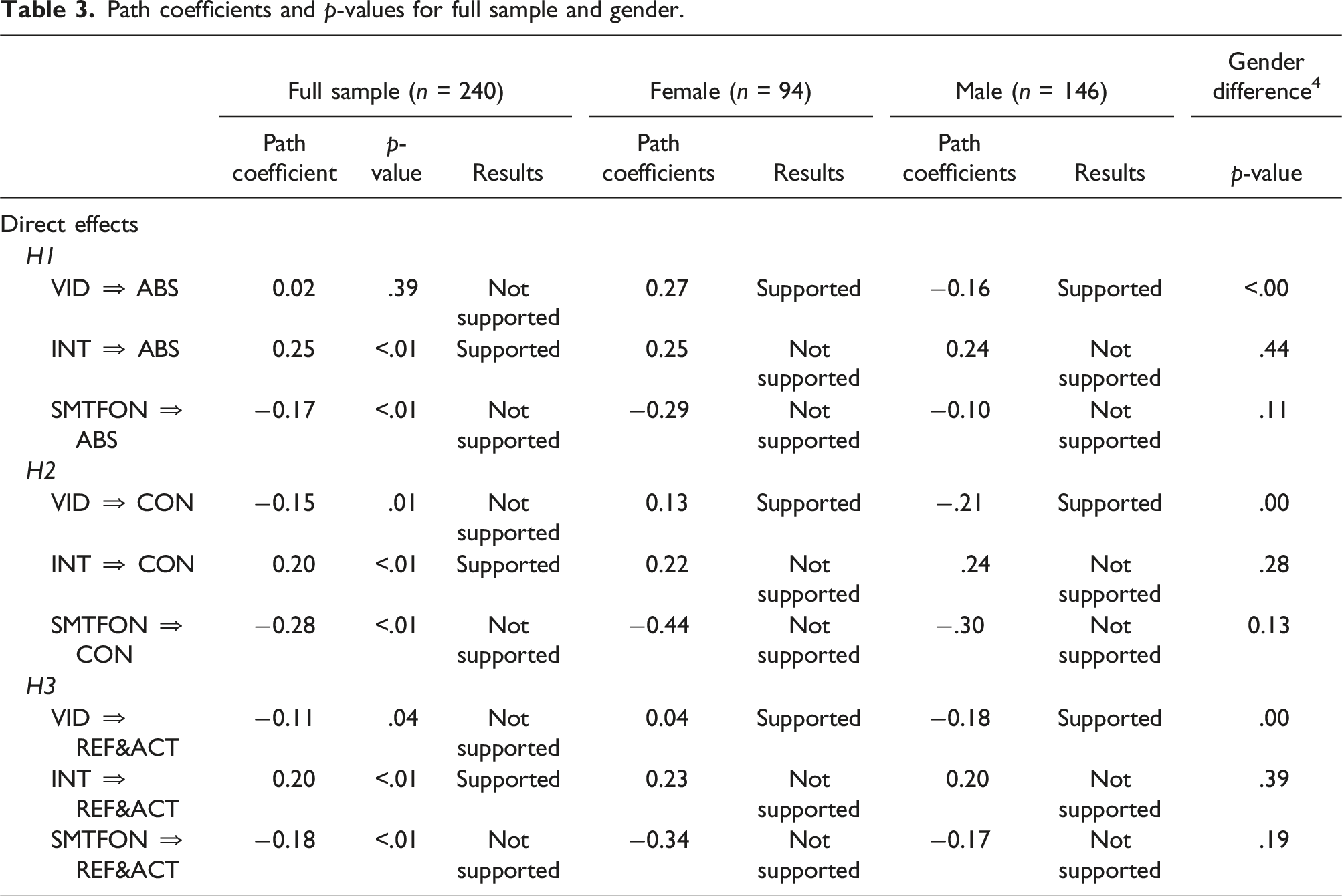
Path coefficients and p-values for full sample and gender.
Path coefficients and p-values for full sample and country.
Discussion
Parallels between Kolb’s experiential learning theory and technology use have long been drawn (Lai et al., 2007). This is fathomable in the rapid advancement of software and hardware applied in academic settings, and stakeholders’ belief that these technologies optimise learning and excite learners (Chan et al., 2006; Ogata and Yano, 2004). Thus, educators have found reason to integrate technology to inspire experiential learning as a composite of abstract conceptualisation, concrete experience, reflective observation, and active experimentation (Mayer and Schwemmle, 2023). It [technology] has the power to deliver authentic and seamless learning, enable real-time instruction, provide instant feedback, and breakdown complex phenomena (Christian, 2003; Liang et al., 2005). As Kolb’s theory focuses on learners’ experience (Lai et al., 2007), technology may enrich or transform that experience in ways that generate divergent outcomes. As found in this study, technologies in the guises of (a) video games, (b) internet searching and (c) smartphones do indeed generate divergent outcomes which are now discussed.
To recap the findings, examining the three forms of technology use in the full sample, it has been deduced that only internet searching enhances learning skills while video games and smartphone usage adversely affect these outcomes. Then, in the split male and female samples, it was found that video games boost learning among females but have the reverse effect in males. Furthermore, in the country samples, the results were relatively more convoluted. First, internet searching has an altogether positive influence on all learning skills among Nigerian and UK generation Z, except for inhibiting reflective observation and active experimentation in the latter [UK]. Secondly, smartphone usage had a negative influence on concrete experience as well as reflective observation and active experimentation in Nigeria, whereas the correlations were positive for UK generation Z. To unpack these findings, cognitive load theory is revisited by way of discussion to synthesise the effects of technology use on the learning skills, while reflecting on the role of gender and country in the relationships.
In the first instance, the results showed that video games bear no statistical relationship with abstract conceptualisation. As far as abstract conceptualisation is concerned, this challenges Shaffer et al.’s (2005: 105) assertion that video games have a ‘tremendous educative power.’ Rather, it is internet searching that is found to boost abstract conceptualisation while smartphone usage has the reverse effect. From a cognitive load perspective, echoing Seufert et al. (2007) and Debue and Van de Leemput (2014), it would seem that internet searching amasses intrinsic and/or germane information that would support the development of logical thinking. At the same time, smartphone usage seems to accumulate extraneous load that would impede generation Z’s logical thinking (Sweller, 2008b).
Second, it was found that video games and smartphone usage hinder the development of concrete experience. This outcome is somewhat surprising in view of Wood’s (2013) supposition that video games are now more real to the extent that they mimic real-life situations. Yet, it is corroborated by Ozkan and Solmaz’s (2015) argument that the use of smartphone weakens generation Z’s social life. The virtual socialisation provided by video games and smartphone are arguably not sufficiently reflective of real-life situations that Lee (2020) believes are essential for stimulating observation and reflection. The exception here is internet searching which adequately supports concrete experience. This is supported by Yumuk’s (2002) view that internet searching provides greater responsibility and autonomy in individuals’ learning. Furthermore, this seems to be reflected in generation Z’s ability to observe and reflect before applying theories and concepts in real life. In a cognitive load sense, where concrete experience is anticipated, video games and smartphones could be deemed as sources of extraneous load which undermine working memory (Sweller, 2008a), while internet searching comprises germane load for developing long-term memory (Debue and Van de Leemput, 2014; Seufert et al., 2007).
Third, video games and smartphones were found to reduce the skills of reflective observation and active experimentation. In effect, this means that video games and smartphones encumber generation Z’s ability to formulate critical opinions as well as their capacity to practically apply the knowledge they have gained during decision-making and problem-solving activities. This finding is inconsistent with Annetta et al.’s (2009) view that video games now transcend entertainment and enable learning, but corroborates Haug et al. (2015) and Meng et al.’s (2020) thinking that smartphone content has a negative effect on individual outcomes. However, this does not seem to be the case with internet searching which substantially improves reflective observation and active experimentation. For this reason, the current results validate Segers and Verhoeven’s (2009) view that internet searching supports learning without weakening the ability to critically evaluate as claimed by Moore et al. (2017). Reverting to cognitive load theory, once more, it could be said that video games and smartphones introduce extraneous load (Sweller, 2008b), while internet searching elicits germane load (Debue and Van de Leemput, 2014; Seufert et al., 2007) to ignite reflective observation and active experimentation.
Fourth, turning to the role of gender in the technology use – learning skills nexus, video games appeared to boost all learning skills among females but have the reverse effect in male generation Z. To explain, Hartmann and Klimmt (2006: 910) state that ‘on average, girls and women are less involved with video games than are boys and men.’ In a similar vein, males ‘played video games at twice the weekly average of the females…and preferred physically oriented video games over the females’ preference for more traditional, thoughtful games' (Greenberg et al., 2010). This suggests that the frequency and nature of video games played by males and females may lead to divergent outcomes. Following the current MGA, on the one hand, these outcomes can be described as extraneous cognitive load from redundant information that males are exposed to from physically oriented games. On the other hand, females playing more thoughtful games arguably generate intrinsic cognitive load from the natural complexity and elemental interactivity of such exposure.
Lastly, the role of country (Nigeria vs the UK) in the assessed relationships also compels reflection. The finding that internet searching inhibits reflective observation and active experimentation in the UK corresponds with Moore et al.’s (2017) suggestion that overreliance on search engines weakens individuals’ capacity to critically evaluate various sources of information. To recall, reflective observation and active experimentation entail the formation of critical opinions, considering events from multiple standpoints, and practically applying acquired knowledge to real life problems (Leite et al., 2020). This does not seem to be an issue in Nigeria where there is a lower internet connectivity which may reduce the range of online information sources available to the country’s generation Z. To recall, only 55% of the Nigerian population have internet access, far less than 97% in the UK (The World Bank, 2024c). Hence, limited connectivity could be a blessing in disguise for harnessing generation Z’s reflective observation and active experimentation. Turning to smartphone usage, these devices have a negative effect on concrete experience, reflective observation and active experimentation in Nigeria, but seem to support these skills in the UK. This could be explained by the degree of smartphone penetration in both countries which stands at 44% in Nigeria (Premise, 2022) and 93% in the UK (GSMA, 2023). Limited smartphone penetration appears to have the opposite effect to limited connectivity on reflective observation and active experimentation. Thus, Starcevic and Aboujaoude’s (2017) reasoning that smartphones are not problematic per se but mere delivery mechanisms, and Alsayed et al.’s (2020) contention that they enable active learning, are both supported by the present findings.
Implications, limitations and areas for future research
From the outset, this inquiry sought to gather and examine evidence of the broad impact of technology use on the learning skills of generation Z. This approach was taken to offer a primer and, possibly, catalyse studies in more defined fields and contexts where the influence of technology on the cognitive development of generation Z is of urgent and strategic interest. To conclude, turning to the implications, the theoretical and practical ramifications of the study are outlined, followed by limitations that elicit avenues for future research.
Theoretical implications
In a bid to advance knowledge on technology use and learning skills, this study has isolated video games, internet search and smartphone usage as predictors of three distinct learning skills. In this sense, the measurement specificity needed to avert underestimation of correlations, as recommended by O’Mara et al. (2006), has been achieved. This has shed rare light and yielded empirical clarity in the technology use – learning skills nexus concerning generation Z. Furthermore, as a theoretical lens, cognitive load theory has been integrated into the generation Z technology use and learning skills discourse for the first time. As a result, the manner in which video games, internet search and smartphone usage influence learning skills is deemed to be a function of how much intrinsic, extraneous and germane loads are placed on generation Z’s working and long-term memories. The finding that video games enhance females’ learning skills but not males is also a telling contribution. On an empirical level, no previous studies have investigated the current attributes from a gender perspective in the population of Nigeria and UK generation Z. Therefore, this paper paves way for new comparative studies based on country, sectoral, cultural and gender characteristics.
Practical implications
The present findings speak to socially responsible stakeholders with a mission to elevate the learning skills of the generation Z population. This includes EdTech providers such as Udacity, Coursera and their competitors, and the big five tech firms [Apple, Alphabet, Amazon, Microsoft and Facebook] currently developing mass market platforms and content to disrupt traditional learning. Drawing on the current findings, these entities can adapt their solutions to suit different gender and country profiles, and reflect more carefully on what may produce intrinsic, extraneous or germane load among generation Z. Schools, universities, apprenticeships and training providers seeking to expand technology use for their generation Z cohort will also be able to do so more thoughtfully and less haphazardly.
Limitations and future research
Notwithstanding the key contributions of this study, there are limitations to be acknowledged. First, despite their utility, the learning styles in Kolb’s experiential learning theory do not address the psychodynamic and institutional aspects of learning (Akella, 2010). Also, the learning styles are presented as discrete and fixed whereas learners are more likely to exude them flexibly and simultaneously (Garner, 2000). Secondly, this inquiry only observes generation Z students in Nigeria and the UK. Accordingly, generalisation of the findings in other social groups should be exercised with caution. Future studies can investigate the generation Z population outside universities to validate the current evidence in non-learning environments. Thirdly, cultural differences between Nigeria and the UK were not controlled for, and this could have a bearing on the MGA results which upcoming studies can also address. Fourth, although Kaduna is a diverse and multicultural metropolis (Tuki, 2024), the study’s sample could be supplemented from other parts of Nigeria to augment the generalisability of the findings. Akin to Onjewu et al.’s (2023) study, universities in different geopolitical zones could be targeted. Fifth, the explication by cognitive load theory is only conceptual. Scholars are invited to adopt, for example, Klepsch et al.’s (2017) cognitive load instrument as a mediating construct in the link between generation Z’s technology use and learning style. Sixth, the cross-sectional nature of the data should be considered when inferring causality. The links in the structural model are only interpreted as associations based on explanatory theory. New studies can take a longitudinal approach to confirm causality. Last, the research instruments used were self-reported questionnaires which may not be free of bias. Considering the attributes measured, there is room for researchers to embark on studies with a psychophysiological approach to further unravel the technology use – learning skills nexus.
Footnotes
Declaration of conflicting interests
The author(s) declared no potential conflicts of interest with respect to the research, authorship, and/or publication of this article.
Funding
The author(s) received no financial support for the research, authorship, and/or publication of this article.

Data availability statement
The data that support the findings of this study are available from the authors upon reasonable request.
Notes
Appendix
Items
Loading
Video gaming
I play games on a computer, video game console or smartphone by myself.
0.734
I play games on a computer, video game console or smartphone with other people in the same room.
0.892
I play games on a computer, video game console or smartphone with other people online.
0.899
Internet searching
I search the internet for news on any device.
0.739
I search the internet for information on any device.
0.883
I search the internet for videos on any device.
0.905
I search the internet for images or photos on any device.
0.870
Smartphone usage
I send and receive text messages on a mobile phone.
0.645
I check for text messages on a mobile phone.
0.870
I use apps for any purpose on my mobile phone.
0.886
I use my mobile phone during class or work time.
0.830
Concrete experience
When I learn I like to watch and listen.
0.726
I learn best when I listen and watch carefully.
0.787
When I am learning I tend to reason things out.
0.735
I learn by watching.
0.748
I learn best when I can try things out for myself.
0.776
Reflective observation & active experimentation
When I learn I like to think about ideas.
0.679
I learn best when I rely on logical thinking.
0.616
I learn by doing.
0.774
When I am learning I am an observing person.
0.757
When I am learning I am a logical person.
0.742
I learn best from a chance to try out and practice.
0.783
When I learn I like to be active.
0.812
Abstract conceptualisation
I learn best when I trust my hunches and feelings.
0.734
When I am learning I have strong feelings and reactions.
0.808
I learn by feeling.
0.681
I learn best from observation.
0.758
When I learn I like to observe.
0.705