




Abstract
This study developed and tested a model of higher education environmental science program review through industry-wide surveys of environmental science graduate employers. We surveyed 62 environmental professionals who manage recent environmental science graduate employees in eastern Australia. The survey captured expectations of graduates’ skill performance compared to workplace expectations in the first 6 months of employment in both degree-specific skills and general employment skills. Graduate employee skill importance was ranked significantly higher than their actual performance in degree-specific skills including field work, formal correspondence, policy development, data analysis/interpretation, and understanding environmental legislation. Performance was also significantly lower than expectations of generic employment skills including foundation, collaborative, and employability skills. Work placement within undergraduate programs was reported as being pivotal in efficiently preparing graduates, although workplace time limitations hinder participation. This study provides new evidence for universities to adopt work placement or other work integrated learning as a core program component, embed skill awareness and skill portfolio development in curricula, and periodically undertake industry review of graduate employee performance compared to workplace expectations. The new model presented here, of higher education program review, incorporating both graduate employee performance and employer expectations, will assist universities continuing relevancy in a dynamic employment market.
Keywords
Introduction
Universities are increasingly seeking to prepare work-ready graduates, shifting the focus from producing an intellectual class of higher-level thinkers to one of professional training for diverse employment opportunities (Hill et al., 2018; Oraison et al., 2019; Stewart, 2021). Consequently, universities frequently seek industry accreditation for their programs/degrees as this signifies that a graduate meets minimum competency standards expected by relevant employment sectors (Rhodes, 2012). Accredited study pathways have been established so that students can maximise employment opportunities, workplaces can employ graduates who can undertake specific tasks relevant to their industry, but also so that the needs of employers can be incorporated into curricula (Oraison et al., 2019; Stewart, 2021).
With universities placing greater emphasis on the work-readiness of graduates, myriad studies have explored employer satisfaction (Quality Indicators for Learning and Technology, 2020, 2021, 2022), employers’ preferred skills (Cullen, 2007; Stewart, 2021), undergraduate expectations (Fuller and France, 2016; Jackson, 2013; Jackson and Dean, 2022), graduate experiences (Hill et al., 2018) as well as academic perspectives on work readiness (Whelan, 2017). A recent Australian study found of 3450 employers surveyed, 85.3% were satisfied with recent graduate employees’ skills (Quality Indicators for Learning and Technology, 2022). However, industry-specific surveys reveal that there are still deficiencies to fully meet industry needs, including business graduates in Australia (Jackson, 2012), accounting graduates in China (Nguyen et al., 2020), manufacturing and financial sectors in Slovakia (Lisá et al., 2019) and science and engineering in New Zealand (Khoo et al., 2020). Deficiencies within graduates’ skill sets, such as teamwork and communication skills, have been attributed to a lack of previous work experience (Jackson, 2014; Nguyen et al., 2020). Khoo et al. (2020) also found discrepancies between what employers and academic teaching staff thought were important skills for graduates to have and what skills they were competent in.
Including employer reviews of graduate competency into internal program review and curriculum development processes provides universities with the opportunity to bring individual courses and programs/degrees in line with industry expectations. Jollands et al. (2012) reported that skill-specific training defined by both professional accreditation bodies and employers improved graduate work-readiness. In Australia, the Tertiary Education Quality and Standard Agency (TEQSA) require that all accredited programs of study be periodically and extensively reviewed, overseen by a peak academic governance process, including external referencing and benchmarking (Department of Education, Skills and Employment, 2021). However, rarely are programs reviewed and updated according to industry-wide perceptions and expectations (e.g. Jollands et al., 2012; Whelan, 2017), more commonly incorporating advice from an individual stakeholder.
Environmental science graduate employees provide a suitable case study to explore employer perspectives on work-readiness due to the increasing demand for environmental science supporting government policy and industry practice (Australian Council of Environmental Deans and Directors, 2022; Barrata et al., 2023). The resulting increasing demand for positions in the industry raises issues on the competencies of individual environmental scientists and organisations as a whole. However, the organisational fit of graduates within the department or firm has been found to be of critical importance to individual performance (Collet et al., 2015). It is therefore timely to assess not only the relevant skills required of environmental scientists in the public and private sector but also the competency of the next generation of graduates on the job.
The primary aim of this study was to develop and test a model of higher education program review through an industry wide survey of expectations of graduate skills compared to their performance as perceived by their managers. This was achieved in a case study of Australian environmental professionals’ that work with or directly employ environmental science graduates. Data were captured in an online survey of environmental science practitioners, many of whom are members of the Environment Institute of Australia and New Zealand (EIANZ) 1 , which provides accreditation of environmental science degrees in Australia and New Zealand. This study therefore provides a deeper understanding of environmental science government and industry expectations of graduates while providing a model for review of higher education programs/degrees more broadly to improve program delivery of graduate outcomes.
Methods
Model for higher education program review
We developed a model for university program/degree review, with this study focusing on an industry-wide review of graduate performance in terms of (a) skills that are important for graduates to have, and (b) how well these skills are applied (Figure 1). This model provides data to assess graduate performance in a real-world context, building upon program reviews based on accreditation standards, academic perspectives, undergraduate expectations, and graduate employment records. This model is underpinned by industry assessments of recent graduate employee core skill sets typically used to categorise a variety of work-place skills: foundation, adaptive, collaborative, employability, and technical skills (Oliver and De St Jorre, 2018; Jackson and Dean, 2022; QILT, 2021). Foundation skills are focused on general literacy, numeracy, communication, and the ability to investigate and integrate knowledge. Adaptive skills are focused on the ability to adapt and apply skills/knowledge and work independently. Collaborative skills are centered on teamwork and interpersonal skills. Employability skills include the ability to perform and innovate in the workplace. Technical skills are focused on the application of discipline-specific and technical knowledge and standards. Conceptual model situating the inclusion of industry-wide review into university program / degree review, incorporating an assessment of industry expectations on important skills for graduate employees to have and how well these skills are applied in the workplace.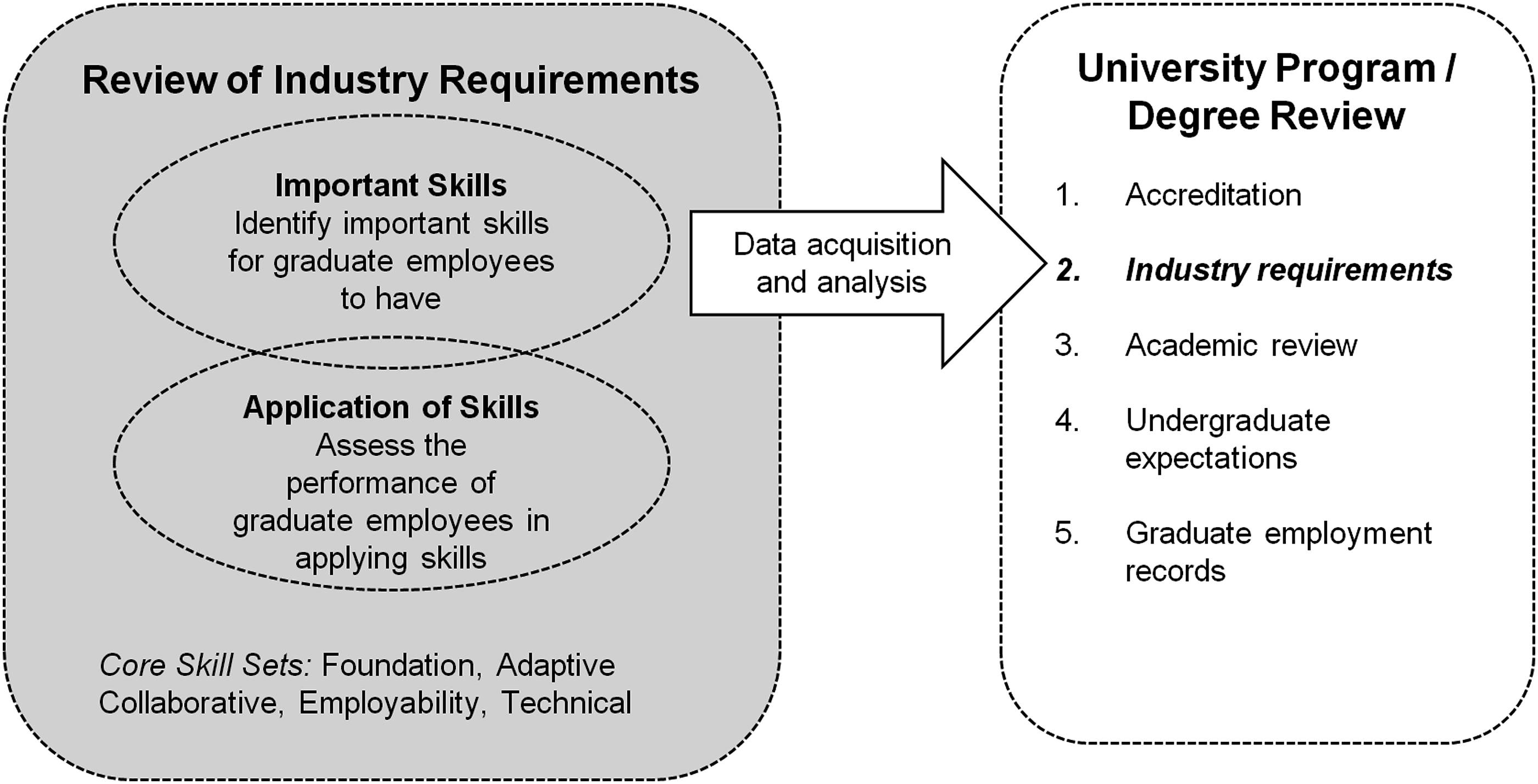
Survey design
An online survey was developed and structured around the conceptual model in Figure 1 to capture industry perspectives of required skills and application of skills in recent graduate employees. The survey was designed by the authors who represented (a) academia (JGC), i.e., familiarity with the design and delivery of programs and courses to undergraduates, (b) employability/pedagogy (GB) i.e., familiarity with development of students’ transferable skills, and (c) industry (ST, SR), i.e., familiarity with the expectations from an ‘environmental consulting/science’ industry perspective.
The survey was designed and distributed using LimeSurvey software that automatically collated responses from participants for each question to facilitate subsequent analysis (LimeSurvey GmbH, 2003). Once developed, a pilot survey was sent to a small number of environmental professionals (n = 15), including representatives from the EIANZ. Feedback from the pilot survey was used to refine the final survey before wider circulation.
The final survey included 8 questions capturing demographic information about the participants and their workplace and 12 questions designed to capture (a) the participants’ expectations of graduates’ work-readiness, and (b) the participant-stated performance of environmental science graduates in the first 6 months of employment (Supplemental Information). Participants were also asked if graduate employees typically have prior work experience and what skills had improved/developed compared to graduates who had no prior experience. Additionally, participants were asked if there were existing or potential work integrated learning (WIL) opportunities at their workplace. A 10-point Likert scale was used to quantify the strength of participant agreement with a question, with a score of 1 being ‘strongly disagree’ and 10 being ‘strongly agree’. Likert scales are one of the most common survey attitude scale formats for surveys on any issue (Robinson 2014).
Survey participants
The survey was conducted from 13 August 2021 to the 17 September 2021. Invitations to participate in the survey were distributed to members of the EIANZ through a link to the survey posted on the EIANZ website as well as inclusion in the weekly EIANZ e-newsletter, Institute Insider, in the 20 August 2021 and 27 August 2021 editions. The 20 August 2021 edition was emailed to 2067 members, with 928 emails opened, 13 clicks on the article explaining the survey and 10 clicks on the survey link. The 27 August 2021 edition was emailed to 2070 members, with 943 emails opened, 9 clicks on the article explaining the survey and 4 clicks on the survey link. This target group includes professionals working across the breadth of the ‘environmental science’ sphere in natural and built environments, ecological applications, habitat management and remediation, urban planning and development, soil and water management, conservation, environmental management, and impact assessment amongst others. An additional 105 individuals, of which 32% are also EIANZ members, who work in environmental consulting and environmental science within government agencies in south-east Queensland, and employ environmental science graduates, were personally invited to participate in the survey using industry network contacts. This included individuals from environmental consultancies, environmental restoration specialists, local and state government environmental agencies, and non-government environmental agencies.
Ethical issues and participant consent
The survey was entirely voluntary, and consenting participants were able to choose to exit the survey at any time. The survey did not involve the collection, access, storage and/or use of identified personal information and all responses remain confidential and anonymous. The survey and consent mechanisms were reviewed and granted approval by the Griffith University Human Research Ethics Committee (HREC # 2020/981) prior to the survey going live.
Analyses
The ranking of participants’ scores of how well-prepared graduates are for work was compared among environmental consulting, government and other industry sectors using a Chi-square test of independence. The R base function chisq.test was used with alpha set at 0.05 (R Core Team 2021). The mean score and 95% confidence interval for the importance and the application of each skill within the core skill sets (foundation, adaptive, collaborative, employability and technical) were quantified. The difference between the scores of importance and application of each skill was tested for significance (α = 0.05). Prior to analysis, the normality of the distribution of paired differences (d) between importance/application for each skill (paired by participant) was checked using Shapiro-Wilk normality tests using the base R function shapiro.test (R Core Team, 2021). When normally distributed, the paired t test was applied using the base R function t.test (R Core Team, 2021). The non-parametric two-sample paired signed-rank Wilcoxon test was used where the distribution of paired differences was not normally distributed. The function wilcoxsign_test in the Coin package in R was used with the Pratt method (Hothorn et al., 2006) as it handles zero differences that were present between some paired scores (Hothorn et al., 2008).
Results
Survey participation and demographics
A total of 82 submissions was made to the online survey across eastern Australia, a response rate of 68% of the 119 individuals who opened the survey. Sixty-two of the submissions were included in the final analyses, 44 completed responses and 18 partially complete responses. The remaining 20 partially completed responses were excluded from the analysis as their responses only included demographic information, with no questions on graduate skills answered. This resulted in a response rate of 52% with useable data that were analysed (n = 62). Fifty-one participants were located primarily in south-east Queensland, with the remainder in northern Queensland, Newcastle, and Melbourne postcodes. The average survey duration of completed responses was 33 minutes, with the minimum duration 12 minutes and maximum duration 2 h 47 minutes.
Workplaces were primarily represented by the environmental consulting sector (72%). The remaining sectors included local government (8%), natural resource management (5%), the mining industry (5%), state government (5%), transport (3%), and the construction industry (2%). Most participants had over 10 years’ experience in their current position, with ‘senior scientist’ the most represented position (26%). The size of participants’ workplaces in terms of number of employees varied from less than 10 to over 100. In the largest represented sector, environmental consulting, there was minor variation between workplace size groups, although the 10-50 employee size had the highest representation (27% of workplaces).
The number of environmental scientists (or equivalent) working at the workplaces varied from less than 5 to greater than 50. Within the environmental consulting sector, workplaces typically had between 5 and 20 environmental scientists employed (29%). The mean number of environmental scientist graduate positions filled annually out of all participant workplaces was 2.4 ± 0.3. State government workplaces had the highest number of graduate positions but exhibited considerable variation with 4.0 ± 3.1 positions annually. Participants’ scope of work within their current position was represented by 18 different areas, with these dominated by environmental management (20.4%), environmental impact assessment (18.6%) and ecological services (16.7%).
How well prepared are graduates?
The ranking of how well prepared recent environmental science graduates are for work varied widely among survey participants, with an average score of 4.8 ± 0.5/10. Only 5% of participants thought that recent graduates had an elevated level of work-readiness, with 2% scoring 9/10 and 3% scoring 8/10. Overall, 34% of participants scored graduates as being ready (score of >5/10). There was a similar distribution of scores within each sector, with no significant difference found (χ2 = 8.1, p = .5).
Importance and application of core skill sets
We compared participants’ scores of specific skills, quantifying the importance of graduates having the skill, to how well the skill is applied. For foundation skills (Figure 2(a)), important skills included verbal communication, report writing and knowledge synthesis (µ score >8/10). Participants scored graduates lower in the application compared to the importance of most of the foundation skills. Of note, was the significantly lower score for the application of verbal communication (t46 = −8.7, p < .001), report writing (Z = 8.4, p < .001), knowledge synthesis (Z = 8.4, p < .001), data management (t46 = −4.4, p < .001), IT (t46 = −2.1, p < .001), and email skills (t46 = −2.7, p < .001). A review of the written responses reveals graduates lack the skills to complete high-quality, concise written reports, communicate key messages to varied audiences, and verifying findings using factual research evidence. Additionally, one participant noted that graduate employees were less likely to undertake detailed analyses to demonstrate findings. Environmental science professionals scores of environmental science graduate employees’ skills, ranked from 1 to 10 (mean ± 95% CL) for (a) technical field skills and (b) technical desktop skills based on how important the skill is for graduates to have (importance), and how well the skill is applied by graduates in the first 6 months of employment (application) (n = 47). Significant difference between importance and application is reported as *p < 0.05, ** p < 0.01, *** p < 0.001.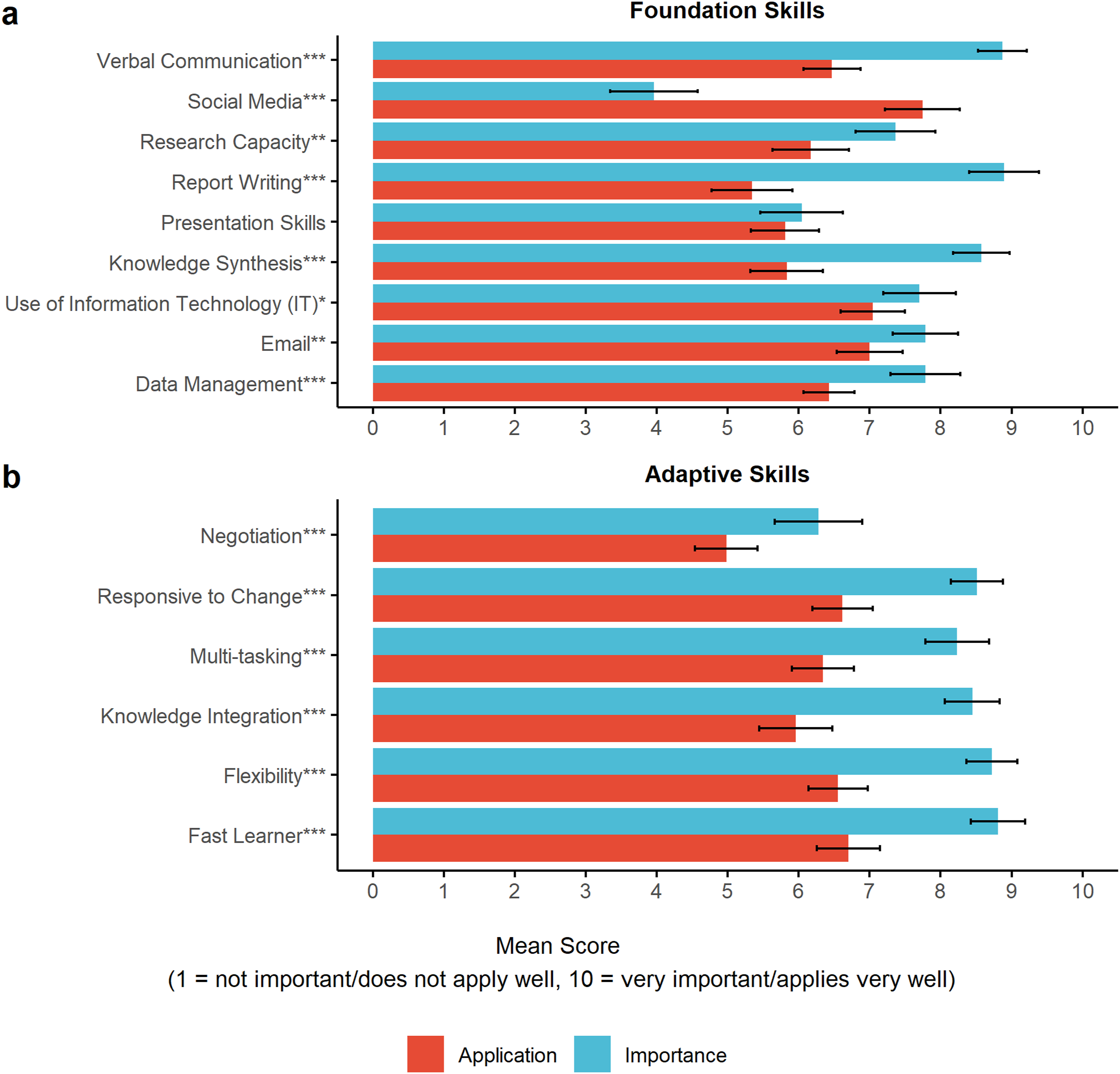
The only skill where graduates performed better in their application compared to importance was social media skills, which was also the most competently applied skill out of the foundation skill set (µ score = 7.7/10). A review of the written comments indicated that recent graduate employees’ social media skills were greater than what was required and seen as a distraction from undertaking and completing the work required.
For adaptive skills (Figure 2(b)), most skills were scored as being important (µ score = 8 / 10), with ‘being a fast learner’ the most important skill (µ score = 8.8 / 10), while the importance of negotiation skills scored lowest (µ = 6.3 / 10). The mean score for the application of each skill ranged from 5.0 / 10 for negotiation skills to 6.7 / 10 for being a fast learner. This was significantly lower than the importance of each skill, including for negotiation (t46 = −4.4, pp < 0.001), responsive to change (Z = 8.4, pp < 0.001), multi-tasking (Z = 8.4, pp < 0.001), knowledge integration (Z = 8.4, pp < 0.001), flexibility (Z = 8.4, p < 0.001), and fast learner (Z = 8.4, p < 0.001).
Graduate employees’ collaborative skills (Figure 3(a)) were scored as important (µ score >8 / 10), with teamwork scoring the highest (µ score = 8.9/10). Leadership skills were scored the lowest importance with a mean score of 6.1/10. The mean scores for the application of each collaborative skill ranged from 5.7 / 10 for contextual awareness to 7.1/10 for teamwork skills. This was significantly lower than the importance of most collaborative skills, including for teamwork (Z = 8.4, p < 0.001), understanding roles and responsibilities (t46, p < 0.001), reasoning (Z = 8.4, p < 0.001), open mindedness (t46 = −5.4, p < 0.001) and contextual awareness (Z = 8.4, p < 0.001). There was no significant difference between the importance and application of leadership skills. Environmental science professionals scores of environmental science graduate employees’ skills, ranked from 1 to 10 (mean ± 95% CL) for (a) collaborative and (b) employability skills, based on how important the skill is for graduates to have (importance), and how well the skill is applied by graduates in the first 6 months of employment (application) (n = 47). Significant difference between importance and application is reported as *p < 0.05, **p < 0.01, ***p < 0.001.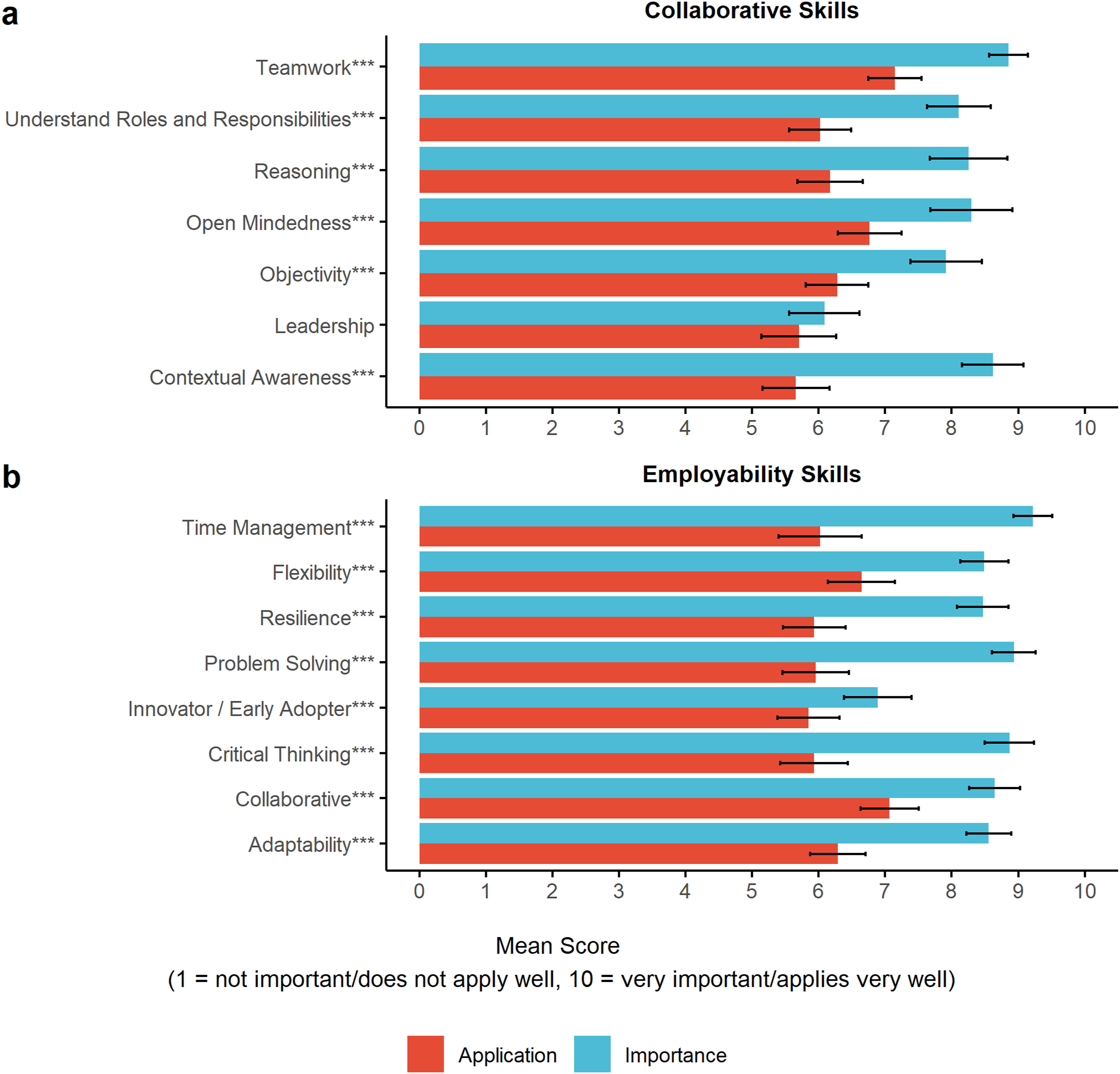
The importance of most employability skills was scored as being important (µ score >8 / 10,Figure 3(b)). Time management was scored as the most important skill, as well the most important across all the core skill sets (µ score = 9.2 / 10). Early adopter skills were scored low in the employability core skill set (µ score = 6.9 / 10). The mean scores for the application of each collaborative skill ranged from 5.8 / 10 for early adopter to 7.1 / 10 for collaborative skills. This was significantly lower than the importance for all employability skills, including for time management (Z = 8.2,p< 0.001), flexibility (t44= −6.2,p< 0.001), resilience (t44= −8.3,p< <0.001), problem solving (Z = 8.2,p< 0.001), innovator / early adopter (Z = 8.3,p< 0.001), critical thinking (Z = 8.2,p< 0.001), collaborative (Z = 8.3,p< 0.001), and adaptability (Z = 8.3,p< 0.001).
Comparison of the technical skills revealed that the most important field/laboratory skill was field survey methods (Figure 4(a)),with a mean score of 7.8 / 10. Other important skills were GIS (Geographical Information Systems) capabilities (µ score = 7.1/10), flora ID (µ score = 6.9 / 10), and fauna ID (µ score = 6.5 / 10). The remaining skills mean scores ranged from 4.9 / 10 for fauna handling to 5.4 / 10 for water quality testing. The application of each skill ranged frommean scores of 3.0 / 10 for drone aerial surveys to 5.8 / 10forfield survey methods. Application of these skills scored significantly lower than the importance for most technical field/laboratory skills, including for water quality testing (t44= −4.1,p< 0.001), GIS capability (t44= −5.3,p< 0.001), flora ID (t44= −6.2,p< 0.001), field survey methods (t44= −5.2,p< 0.001), fauna ID (t44= −3.82,p< 0.001), fauna handling (t44= −1.8,p< 0.001). There was no significant difference between the importance and application of chemical and other laboratory skills. Environmental science professionals scores of environmental science graduate employees’ skills, ranked from 1 to 10 (mean ± 95% CL) for (a) technical field skills and (b) technical desktop skills based on how important the skill is for graduates to have (importance), and how well the skill is applied by graduates in the first 6 months of employment (application) (n = 47). Significant difference between importance and application is reported as *p < 0.05, **p < 0.01, ***p < 0.001.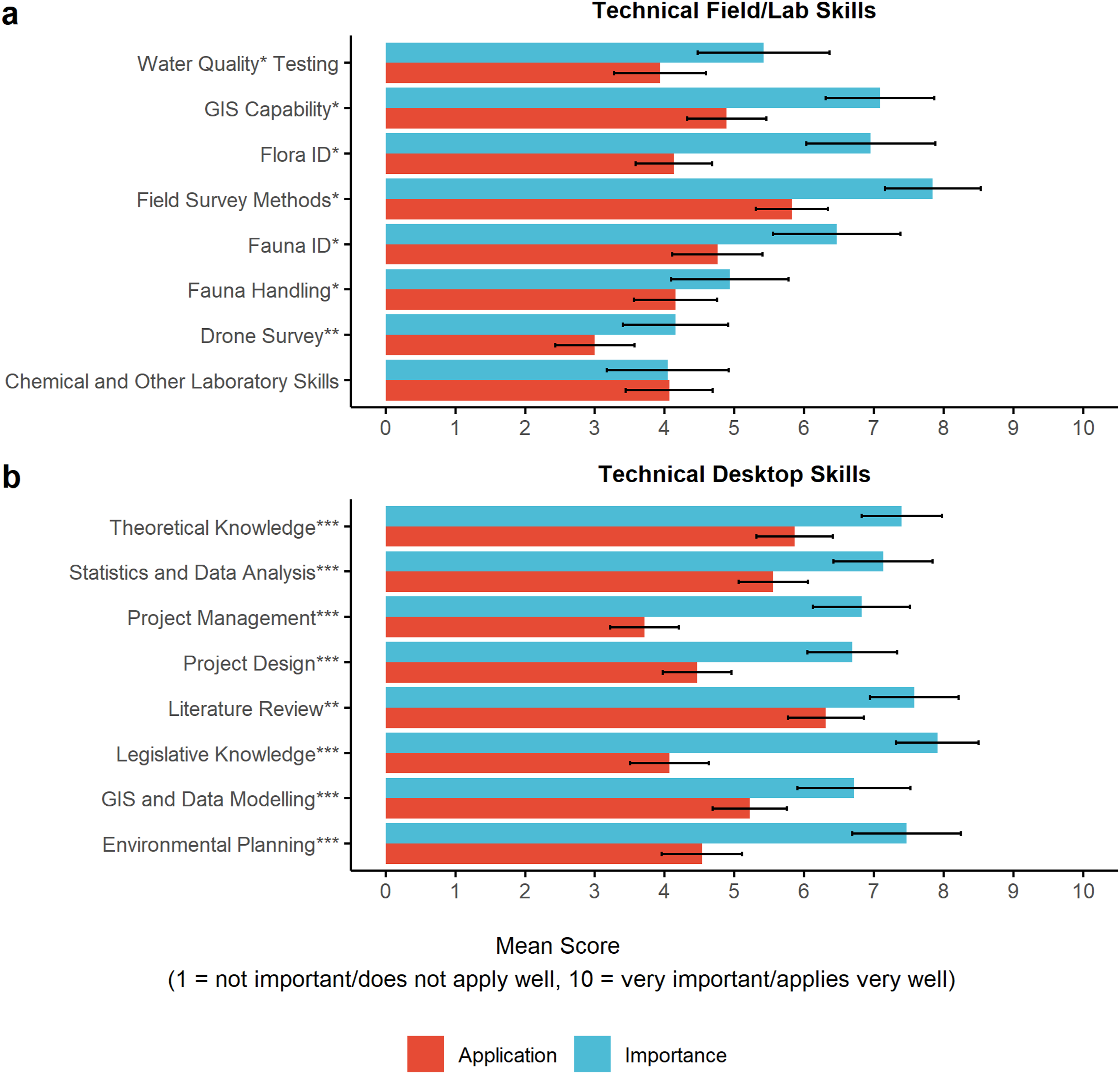
All technical desktop skills were scored as having high importance (), with mean scores ranging from 6.7 / 10 for project design to 7.9 / 10 for legislative knowledge. Application of the skills ranged from mean scores of 3.7 / 10 for project management to 6.3 / 10 for literature review skills. Skill application was scored significantly lower than the importance of each skill including for theoretical knowledge (t44= −4.5,pp < 0.001), statistics and data analysis (t44= −4.1,p< 0.001), project management (t44= −8.9,p< 0.001), project design (t44= −6.8,p< 0.001), literature review (t44= −3.2,p< 0.001), legislative knowledge (Z = 2,p< 0.001), GIS and data modelling (t44= −3.6,p< 0.001)and environmental planning (t44= −6.9,p< 0.001).
Training, previous work experience and internships
Additional training requirements for recent graduate employees varied from zero to 2 years, with an average training time of 2.4 months (n = 56). Training for the workplace overall, including all employees, was scored highly with a mean score of 9/10. Written responses from participants revealed that in general it takes 3 to 6 months to upskill graduate employees to a basic level and 12 to 18 months to an elevated level of functioning in the workplace.
Participants were also asked if their workplace accepted work experience students and if the core skills of recent graduate employees were improved by having previous experience. Of the 43 participants who answered this question, 27% said recent graduate employees had previous work experience, with technical (µ score = 8.6/10) and employability skills (µ score = 8.1/10) the most improved compared to recent graduate employees without previous work experience. Adaptive (µ score = 7.6/10) and collaborative skills (µ score = 7.7/10) were also scored as being highly improved, whereas foundation skills were only slightly improved (µ score = 6.5/10).
Forty-six percent of participants reported environmental science students from multiple universities undertake internships within their workplace. An additional 12% of participants reported that their workplaces would offer internships for students in the future. Workplaces that currently accept or would offer internships in the future were represented uniformly by small (<10 employees), medium (10-50 employees) and large workplaces (>100 employees). However, 9% of participants reported that their workplace would not accept intern students, stating that this is due to insufficient time and a lack of capacity to train and directly supervise interns. Additionally, one participant noted that they would prefer to allocate training time for graduate employees than interns. These participants were from two small (<10 employees) and two medium sized (10-50 employees) workplaces.
Discussion
This study developed a model of higher education program/degree review and tested a case study of the preferred skills as well as the performance of recent environmental science graduate employees according to managers that are environmental science professionals in eastern Australia. The results showed that desirable graduate skills were broadly consistent with previous studies (Bruce, 2018; Roberts et al., 2021; Stewart, 2021; Thomas, 2019; Thomas and Day, 2012; Thomas et al., 2007). However, a high proportion of responders felt that graduates were not work-ready (61%), while only a small proportion (5%) considered graduates to be well prepared. Similar sentiments around the inadequacy of graduate training have previously been expressed in the field of conservation science (Muir and Schwartz, 2009), prompting calls for greater appreciation of industry needs. Our study has specifically identified graduate skills that are important to have, expanding on previous surveys of environmental professionals and changes in these requirements (Rayner and Papakonstantinou, 2015; Thomas, 2019). Additionally, our analysis reports on how well graduates meet these industry expectations. Consequently, these results provide insights into mechanisms to develop the work-readiness of graduates and a model for program/degree review that can be implemented in higher education more broadly.
Preparing work-ready graduates
The perception of environmental science graduate employees as not being work-ready in this study is concerning given that they were reported as been deficient in core foundation skills such as report writing, knowledge synthesis and oral communication skills are taught at universities (Jackson and Dean, 2022; Oliver and de St Jorre, 2018). Similar findings for inadequate adaptive, collaborative and employability skills have also been detected in science and engineering graduates by Khoo et al. (2020), as well as deficient technical skills such as taxonomic skills by Mauchline et al. (2013) and Sundberg et al. (2011). Undergraduate programs still do not fully prepare graduates for what is expected of them in the workplace even though degree accreditation implies that graduates are suitably qualified for relevant employment (Rhodes, 2012).
The perception that graduate employees are not work-ready partially explains why additional on-the-job training of 2.4 months on average was reported to be required. On-the-job training has a long history, with the practice being used for decades, acknowledging that graduation from an academic program is the start of a longer-term process of skills development and specialisation (Mincer, 1962). Investment in on-the-job training is essential in developing skills (Valdez et al., 2015). However, the success of the investment depends on how quickly graduate employee performance meets employer expectations, revealing potential hidden costs and risk. Despite this risk, graduates are hired so that employers can specifically mould them in the practices of the workplace. For example, they can undertake tasks more experienced staff no longer want to or can do, such as field work, and free up more experienced staff for higher level tasks such as project management, verbal communication, negotiation, and client liaison. Due to this, employers perceive graduates as necessary but long-term investments due to the expected lengthy on-the-job training requirements.
Mechanisms to improve work-readiness
The development and implementation of specific mechanisms and tools to improve graduate work-readiness will assist with reducing the on-the-job training required by employers. This will assist universities meeting industry expectations that graduates are work-ready (Khoo et al., 2020). Increasingly, graduate employees are expected to be proficient across a wide variety of skills, both technical and generic, ranging from field and laboratory work to formal report writing, oral communication, research, collaborative, and adaptability skills (Jackson, 2014; Khoo et al., 2020; Nguyen et al., 2020). Indeed, proficiency in all core skill sets may be required to render a graduate employee truly work-ready. The fact that graduates are lacking in skills across the board indicates that a collaborative approach involving all stakeholders needs to be taken to bring skill sets in line with industry expectations.
Work placement is one mechanism identified in this study to improve the work-readiness of environmental science graduates. This finding is supported by myriad studies in STEM disciplines showing that students are more prepared for work when given the opportunities to develop and practice their skills through WIL programs (Khoo et al., 2020; Rayner and Papakonstantinou, 2015; Roberts et al., 2021). Work integrated learning is also widely considered by undergraduate students in Australia as fundamental to preparing them for work (Jackson, 2015). Furthermore, Stewart (2021) found that over 75% of environmental science job advertisements in Australia for early-career positions required at least some field experience and supported embedding WIL into science programs. Employers more generally also expect graduates to have more industry-based experience in Australia, and yet fewer than 45% of graduates indicate that their degree program had prepared them well enough (Graduate Careers Australia, 2016). Given there is low-level student-led work-placement and other employability education outside of curricula (Bradley et al., 2021), industry-based experiences need to be facilitated by universities as part of core program requirements (Stewart, 2021).
There are barriers to work-placement, however, with this study finding time limitations for workplaces to train and supervise students restricting 42% of participant workplaces from taking on, or likely to take on, students in the future. This is despite the widespread acknowledgement of the importance of work-placement for preparing work-ready graduates and its capacity to reduce on-the-job training time. It appears that training, whether in the undergraduate work-placement phase or graduate employee phase, can be a considerable burden on workplaces and potentially prohibit both work-placement programs and employing graduates. This burden could be offset by financial support packages akin to trade apprenticeships for both hiring interns and recent graduates in the environmental science industry, however no such programs currently exist in Australia or are known of internationally. In the interim, greater dialogue between employers and academics may assist with breaking down barriers to work-placement courses, especially if universities assist in the program design for individual workplaces, thereby removing one aspect of time burden in taking on students (Rayner and Papakonstantinou, 2015). Increasing industry awareness of the benefits of WIL will also improve uptake, particularly if the focus is on investment returns when graduates are employed.
Expansion of field course work and integration of disciplines is another mechanism to prepare work-ready graduates in terms of technical and employability skills. This is supported by Meehan and Thomas (2006), who found improvements in team-work skills in final-year students from multiple degrees after completing a collaborative and multidisciplinary project. While field course work is considered essential to environmental science higher education (Fuller et al., 2006; Munge et al., 2018), there are constraints to implementing or expanding field-based assessments and courses. These include financial, OH&S (occupational health and safety) (occupational health and safety), inclusivity around transport, and student/staff mobility, staffing, student numbers and timetabling issues (Munge et al., 2018; Thomas and Munge, 2017). Not surprisingly, since 2004 it has been reported that fieldwork in higher education is on the decline (Smith, 2004). To supplement the decline of course fieldwork, work-placement is seen as a tool to help improve student’s field and employability skills, as it provides authentic and deep learning (Mauchline et al., 2013; Smith, 2004; Stewart, 2021). However, industry alone should not shoulder the burden of fieldwork training via work-placement courses and instead should further build on a foundation of field skills garnered during university studies.
Improvement in skill awareness and practice during undergraduate study is another mechanism to improving graduate work-readiness. Science undergraduates often do not recognise or value skill development without prompting, despite universities increasingly incorporating employability skills in their degrees (Hill et al., 2018). Recognition and proactive articulation of these skills is critical for undergraduates to be successful in both applying for and keeping jobs after graduation (Hill et al., 2018). The value of graduate skills for both employability and society citizenship need to be made more visible to students and the public, particularly skills such as independence, critical thinking, problem solving, and foundation skills including written and oral communication (Oliver and Jorre De St Jorre, 2018). This can be achieved by embedding graduate skills in assessed curricula explicit to skill demonstration, repeatedly communicating skills during coursework, and regularly revising skills based on employer expectations (Oliver and Jorre De St Jorre, 2018), but also ensuring that students can reflect on the development of these skills (Mello and Wattret, 2021). Advancing the development of these core practical skills can also benefit from industry perspectives and expectations as demonstrated by Roberts et al. (2021). For example, graduates might consider certain skills to be well-developed, while employers consider these skills the most need of improvement (Sundberg et al., 2011; Lisá et al., 2019).
Demonstration and documentation of graduate skills through portfolio development may enable prospective employees to match preferred skills to graduate employees. The organisational fit of graduates based on specific skill competencies has found to be critical to graduate employability (Collet et al., 2015) and may influencing employer satisfaction. Universities can offer co-curricular micro-credential programs for developing cores skills, particularly for transferable and interpersonal skills (Brent, 2019). Incorporation of skill portfolios with work placement also further enhance skill development and documentation. Skill portfolios with demonstrated experience will also assist graduates being competitive in the workplace and the often-competitive job market (Stewart, 2021). Universities should communicate the importance of portfolio development to students for both job prospects as well as instilling confidence in their ability to both seek employment and apply their skills.
Conclusion
We recommend a six-point process to improve undergraduate degree programs to bring graduates skills up to date with the expectations of industry employers: • Implementation/restructuring of co-curricular programs through the development of modules that focus on micro-credential skill sets required by industry. • Embed graduate skills in assessed curricula with assessment explicit to skill demonstration making students aware of industry expectations. • Include work-placement courses within universities as core course requirements. • Provide opportunities for students to develop skill portfolios which reflect on their learning experiences, including work-placements, in a way that provides an assessment of such experiences. • Establish ongoing periodical reviews of graduate skill requirements and performance using this studies model of program/degree review, incorporating industry review for higher education more broadly.
This study provides a broad perspective of environmental science graduate employee performance compared to manager expectations across a range of employment and technical skills in eastern Australia. Findings from this study provides insights into potential interdisciplinary mechanisms for improving the work-readiness of graduates as well as a model for reviewing programs/degrees based on industry assessment of graduate employee performance and workplace expectations. Implementing this model of program review will strengthen the partnership between universities, employers and undergraduate students and thereby improve graduate work-readiness and employer satisfaction.
Supplemental Material
Supplemental Material - An industry review of recent graduate employee’s performance compared to workplace expectations: An environmental science case study
Supplemental Material for An industry review of recent graduate employee’s performance compared to workplace expectations: An environmental science case study by Sarah Ann Richardt, Steven Towner, Gayle Brent and J. Guy Castley in Industry and Higher Education.
Footnotes
Declaration of conflicting interests
The author(s) declared no potential conflicts of interest with respect to the research, authorship, and/or publication of this article.
Funding
The author(s) received no financial support for the research, authorship, and/or publication of this article.

Supplemental Material
Supplemental material for this article is available online.
Note
References
Supplementary Material
Please find the following supplemental material available below.
For Open Access articles published under a Creative Commons License, all supplemental material carries the same license as the article it is associated with.
For non-Open Access articles published, all supplemental material carries a non-exclusive license, and permission requests for re-use of supplemental material or any part of supplemental material shall be sent directly to the copyright owner as specified in the copyright notice associated with the article.
