




Abstract
Public universities have sought to leverage innovation hubs as physical environments to enable new collaboration models and partnerships between students, academics, budding entrepreneurs, and wider industry. In particular, innovation hubs have allowed public universities to position themselves as active participants in the entrepreneurial arena. These innovation hubs, however, experienced a tremendous degree of disruption because of COVID-19-induced lockdowns, social distancing, closed borders, and a reduced number of persons allowed in a given space. Thus, it is essential to gain an understanding of how innovation hubs in public institutions have responded to these issues, ascertain the degree to which such disruption has impacted them, and identify the strategies that have allowed hubs to stay operational in such a disruptive environment. To do this, personnel involved in the management and administration of such hubs were interviewed, together with a selection of industry experts. This qualitative interrogation allowed a thematic analysis to be undertaken, thereby resulting in several emergent themes that contributed to identifying key learnings that could assist the operation of these innovation hubs in times of future disruption.
Introduction
Innovation hubs in recent years have gained a foothold in various contexts, including publicly funded institutions such as universities (Malik et al., 2021). This study builds on previous research on public institutions, particularly that concerning public universities and their efforts to facilitate the creation of public value through impact and engagement with an array of stakeholders and end-users (Ansell et al., 2021; Groh, 2014), but does so against the backdrop of the effects of the disruption caused by the COVID-19 pandemic. In particular, the study focuses on innovation hubs in Australian public universities given the increased importance that has been given to such hubs in recent times with respect to engendering and nurturing relationships with a wide array of stakeholders (Nguyen et al., 2022; Nnanna et al., 2023). All of this assumes a high degree of organizational resilience, especially in the context of universities attempting to use such hubs to situate themselves better in innovation ecosystems currently existing within their intended sphere of operations, or their regional or national footprint (Florida et al., 2017).
Public universities have been increasingly encouraged to raise revenue from means other than public funding to cover cuts in funding and maintain public accountability (Lombardi et al., 2019; Sánchez-Barrioluengo and Benneworth, 2019). As a result, innovation hubs within these universities have been tasked, in an environment reflecting the political rhetoric attached to the rapid commercialization of intellectual property (Aarikka-Stenross et al., 2014; Cooper, 2021), with providing an operating environment that nurtures the development of innovative business ideas (Breznitz and Zhang, 2019; Zaring et al., 2019; Qureshi, 2022). Before COVID-19, an innovation hub was widely regarded as a physical space that creates an environment that supports co-presence and networking (Audretsch et al., 2020; Easterday et al., 2018; Leclercq-Vandelannoitte and Isaac, 2016), knowledge sharing (Cabral, 2021), mentoring (Washburne, 2017), and education through workshops, seminars, hackathons, training and business ideation (Carvalho and Goodyear, 2018; Medina Angarita and Nolte, 2021). Such activities are aimed at facilitating the development of entrepreneurial skill-sets and fostering the scalability and growth of start-ups, often through direct funding or assisting with the identification of funding sources (Sharma and Meyer, 2019; Szymanska.et al., 2020). Considering these generally-agreed-upon pre-COVID hub characteristics, questions can therefore be raised regarding (i) how innovation hubs in Australian public universities coped with the constraints placed on them by government reaction to the pandemic during the period 2020 to early 2022, and (ii) how they responded to a highly disrupted operating environment that likely problematized the ability of these hubs to facilitate the kinds of public value that their host institutions intended to realize.
Many of the activities associated with innovation hubs concern people working together through various relational networked arrangements, with an implicit emphasis on physical co-location and personal interactions (Avelino et al., 2020; Hook and Lowgren, 2021). Yet innovation hubs in public institutions clearly experienced significant disruption in their operational environment during the pandemic, so much so that one wonders how they were able to fulfil their intended functions (Malik et al., 2021). While some innovation hubs might have responded negatively to the disruption and thus closed down or significantly reduced their operations, especially as their host institutions scaled down their operations because of reduced international student revenue (Hogan et al., 2021a, 2021b), others might have been able to absorb these shocks and adapt. This investigation will therefore help to inform strategies that innovation hubs can implement when faced with future disruptions, together with the ways in which hubs can build sufficient resilience into their operations, services, and overall design to ensure that they continue to provide public value for their target audiences.
Innovation hubs, resilience and the contextual environment
The operating environment of public institutions is constantly changing and has been impacted by various drivers, especially the recent pandemic. Alongside this disruption is the complexity generated by the arrival of new technologies and processes, thereby leaving managers less confident that they can understand, predict, and effectively react to trends affecting their organizations (Ahammad et al., 2020; Anand and Barsoux, 2017). In such circumstances, it becomes essential that public organizations remain operational by adopting new systems, and adapting processes and practices to ensure a continuation of service provision (Tanda and Marco, 2021). From there, they are expected to be able to return to normal when the disruption is over and learn from the experience (Smart et al., 2021; Ewerttowski, 2022).
The pandemic was a catalyst for forced change and thus significantly tested the operational resilience of public institutions (Sampson and Parikka, 2021; Yilmaz Borekci et al., 2021). Operational resilience requires a dynamic and considered mix of elements, including compliance with relevant regulation, sound investment, a solid social capital base, dynamic stakeholder engagement, and sound governance, all of which, when in the correct combinations and configurations, can assist public organizations to survive and succeed during disruptions (Schmidt and Raman, 2022). It also requires an entity to become a learning organization so that it can continually transform itself in response to exogenous events, and thus take control of its own future (Bui and Baruch, 2010). In particular, learning organizations leverage strategic processes to create and disseminate knowledge among stakeholders with diverse needs and expectations. In a disruptive operating environment, this helps to embed resilience in the organization’s routines and practices (DiBella et al., 2023).
To ensure that their stated public value propositions are realized, public institutions such as university-sponsored innovation hubs are expected to adapt quickly to the changing operational landscape, and thus shift from reactive responses to negative situations to a more agile and proactive approach that can deal effectively with challenges, all the while continuing to respond to stakeholder needs (MacLean and Titah, 2022). According to Floetgen et al. (2021), the sudden disruption resulting from COVID-19 exposed organizations with no forward-looking strategy to deal with the unexpected, and concomitantly highlighted the importance of flexibility, adaptability, and continuity. Encouragingly, Huggins and Thompson (2022) found that innovation ecosystems were quite resilient across the board during COVID and are likely to survive and prosper. But the degree to which the efforts of public universities to use their innovation hubs as a vehicle to enmesh themselves in such ecosystems still requires attention.
Having looked at macro-level considerations of relevance to public organizations, it is necessary to reflect further on the operational characteristics of innovation hubs. Hubs have been described by various terms, such as makerspaces and accelerator labs, or have been regarded as springboards for new ideas to develop, and as a collaborative arena for industry experts and academic researchers where ‘co-presence’ is fostered, and innovative ideas are actualized (Eriksson et al., 2020; Gadille et al., 2021; Rosli and Cacciolatti, 2022). Nnanna et al's. (2023) recent review of the broad academic literature shows that an ‘innovation hub’ is generally regarded as an entity where innovation is supported in alliance with critical stakeholders and organized to bring about, through knowledge transfer between industry and academia, improved socio-ecological and economic outcomes for businesses and society at large (Berbegal-Mirabent, 2021; Spinuzzi, 2012). Some have even seen innovation hubs as part of a higher-level system of ‘education hubs’ that embed the innovation agenda more deeply (Beecher et al. 2020). In this sense, innovation hubs are being recognized as essential components in contemporary innovation ecosystems (Alvedalen and Boschma, 2017), an aspect which assumes a high degree of resilience, regardless of the contextual circumstances.
In addition, innovation hubs are likely intended to play a significant role in Australian universities’ intentions to be part of a broader innovation ecosystem, especially with respect to developing both an entrepreneurial university, and promoting entrepreneurial capacity within the broader ecosystem itself (Nguyen et al., 2022). In that sense, a more entrepreneurial university should ideally be less-reliant on public funding for its innovation activities (Fuller and Pickernell, 2018), and should be able to instil entrepreneurial capabilities among not only students and staff, but also the private sector and community clients (Spigel, 2017), thereby offering a kind of public value that has hitherto often been overlooked by Australian universities. This is important given that the federal government will increasingly use measures of ‘engagement’ (such as income derived from such activity) – worth up to 53% for some block grant types – to determine the degree of public funding that the university receives for its research endeavors (Australian Government, 2022). This also has the potential to impact federal funding allocated to university teaching given the current discourse on achieving a higher degree of research-led teaching in Australian public universities (Coaldrake, 2019: p. 34). That said, there is clearly work to be done on determining the ambit of such hubs and their role in the knowledge economy, and the types of stakeholder needs that they should service (Beecher et al., 2020).
As is the case for most publicly-oriented entities, the changing landscape of the operational environment is both forcing and enabling a shift in the focus of public universities. Indeed, these institutions appear to be leveraging innovation hubs to respond to the ambitions of student researchers and founders, find new sources of funding, connect academic staff to industry, and encourage the community to develop entrepreneurial skills (Fisher et al., 2020; Jimenez and Zheng, 2021; Maritz et al., 2020), together with an over-arching political narrative that privileges the importance of innovation to the nation’s economic wellbeing (Berbegal-Mirabent, 2021; Noble et al., 2017; Spinuzzi, 2021). Given their stated importance to both industry and university, understanding the impact of recent disruption and the strategies that these hubs subsequently developed to mitigate possible future disruptions and thus enhance their ability to continue offering their services, which Keast et al. (2022) suggest should be regarded as the ‘new normal’ for public entities, should be of clear interest to those tasked with ensuring a more resilient innovation landscape that enables entrepreneurs and start-ups to continue commercialization activity in the midst of significant societal disruption.
Research approach
The pandemic resulted in forced and unexpected change. A qualitative research method, which is better suited to capturing unfolding contexts, was used to understand if and how hubs responded to this disruption (Cote-Boileau et al., 2020). To achieve this, online interviews were chosen as the primary data collection method because they provided unique access to the subjects and their perspectives during the disruption period (Levitt et al., 2021; Mohajan, 2018). These subjects, wherever possible, would be those responsible for running hubs situated within public institutions, together with a smaller number of industry experts with knowledge of the university environment and how it intersects with government and industry expectations. All interviews were conducted during the pandemic, which limited the opportunity for face-to-face engagement.
One-to-one engagement with the interview participants occurred via Zoom (Falter et al., 2022). As with comparable platforms like Skype, Zoom offered the ability to communicate in real-time with geographically dispersed individuals via ICT. Zoom poses several additional advantages that enhanced its potential research utility, such as its ability to securely record and store interview sessions without recourse to third-party software, including the ability to backup recordings to online remote server networks (“the cloud”) or local drives, which can then be shared securely between researchers (Gray et al., 2020; Sedgwick and Spiers, 2009).
The Zoom interviews were conducted at times convenient for the participants. Reassurance was given regarding the confidentiality of the information they were sharing (Oliffe et al., 2021). The interviews generally ranged from 30 to 50 minutes. Since the conversations were conducted in a relaxed and friendly manner, they generally enabled the building of rapport and allowed the participants to be transparent and provide detailed answers. Verbal reactions to a specific question or a change in tone when addressing certain questions were noted. The recordings of the interviews allowed for the experiences shared by hub managers and industry experts to be fully transcribed and presented for analysis.
Summary of hub managers and industry experts, funding source, and target audience for the hubs.
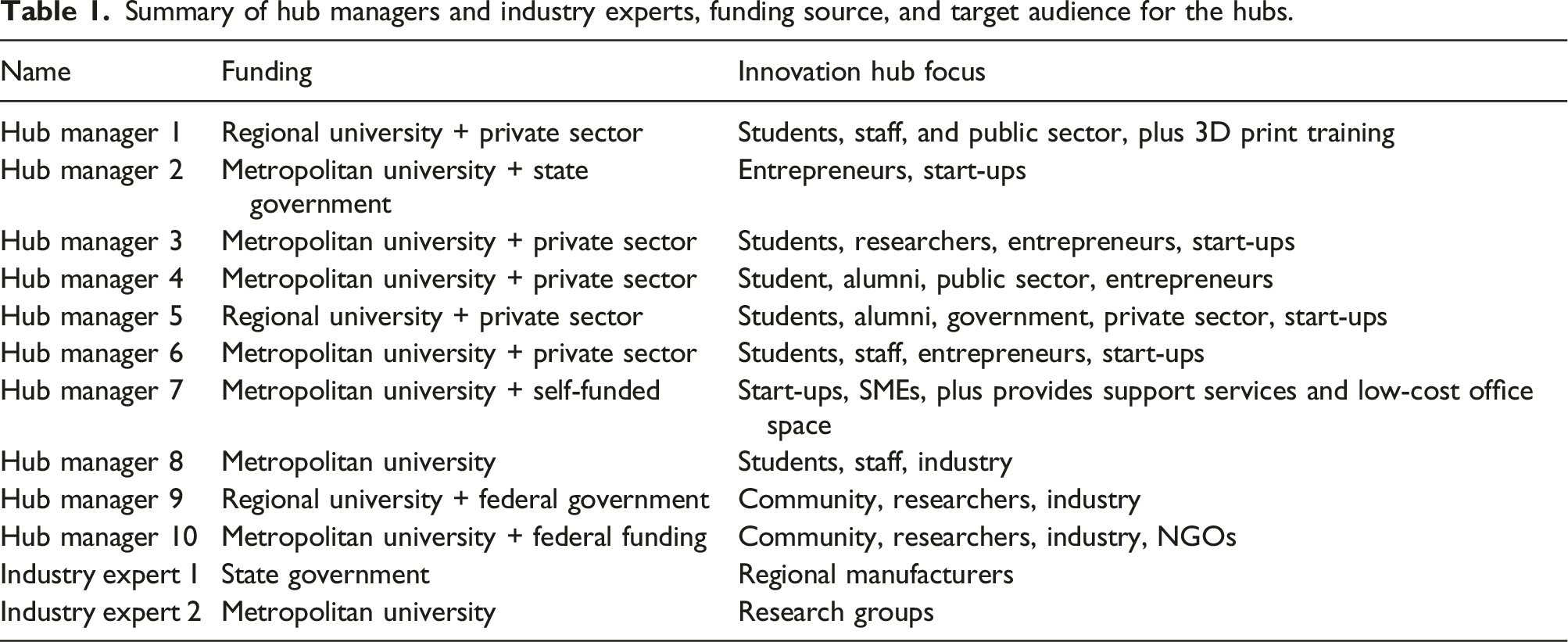
Manual inductive thematic analysis was applied to the data because of the flexibility it afforded. Using thematic analysis as described by Clarke and Braun (2016), the following steps were used to analyze the transcript data. First, the researchers familiarized themselves with the entire data set. Second, initial codes were generated from inspection of the data, coupled with suggestions from the literature, to assist with organizing data at a specific level. Third, codes were examined and collated from the data extracts to identify potential themes of broader significance. These themes were constructed by analyzing, combining, and comparing how the codes related to each other. In inductive analysis, themes are expressly derived from the coded data, so the themes identified are more closely linked to the original data and reflect of the entire data set (Ozuem et al., 2022). Fourth, the coded data were placed within each theme and checked to ensure that coherent patterns were present (Kiger and Varpio, 2020). In this phase, data extracts were re-sorted, and themes were modified to better reflect and capture coded data (Braun and Clarke, 2022). The final phase involved creating a definition and narrative description of each theme, and its importance to the study’s broader aims.
Findings
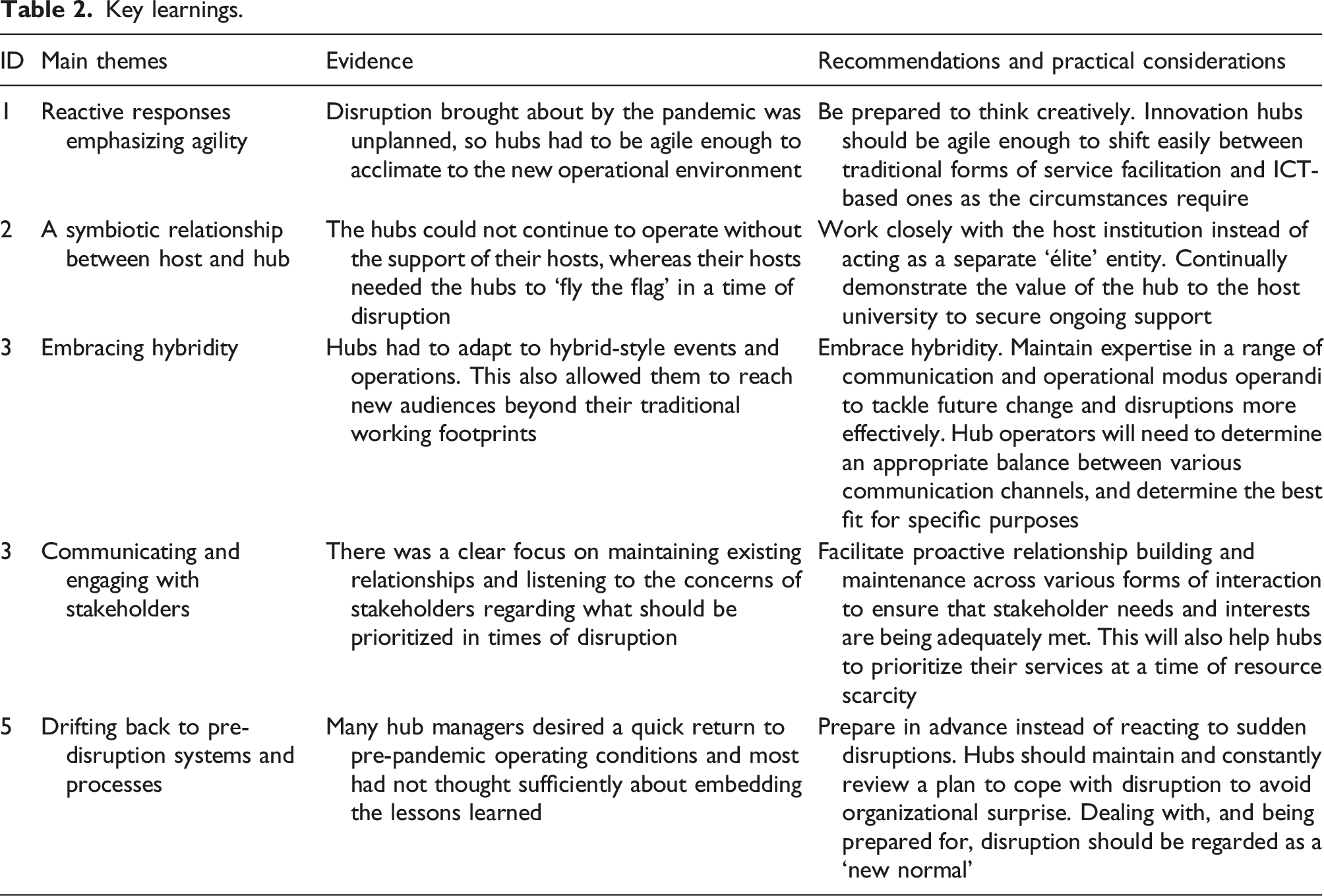
Overall, the findings confirmed that the pandemic resulted in considerable disruption to innovation hubs operating within Australian public universities, and revealed some questionable elements with respect to maintaining resilience. The nature and intensity of this impact and the strategies taken to mitigate it are made clear from the data analysis, with five main themes emerging: (i) reactive responses emphasizing agility; (ii) a symbiotic relationship between host and hub; (iii) embracing hybridity; (iv) communicating and engaging with stakeholders; and (v) drifting back to pre-disruption systems and processes.
Reactive responses emphasizing agility
The study identified several operational challenges requiring an immediate response by hub managers. For example, when the pandemic manifested, there had been no planning for such a circumstance, and sudden multiple national lockdowns interrupted the flow of raw materials and equipment that hubs needed to continue their core business activities. Additionally, the pandemic exposed unseen vulnerabilities such as staff shortages and losses in revenue, as Hub Manager 4 explained, while Hub Manager 7 referred to many hub tenants having to cancel their agreements, despite subsidies having been put in place. Several respondents identified supply chain issues as an immediate issue. On this, Industry Expert 2 commented, amid the pandemic, “supply chain resilience and stress are definitely a challenge”.
Hub Manager 5 identified lockdown policies and border closures, which varied in their severity, as a further constraint on the hubs, with the series of lockdowns and restrictions resulting in significant geographical difficulties in supply and demand. The negative effect of this was made clear by Hub Manager 1, who expressed concerns about how they could not complete a project owing to material shortages. Some staff got around this through improvisation. Evidently, this was a way to navigate supply chain disruptions and stay operational, with materials being purchased from alternative sources. Hub Manager 5 specifically commented about “improvising and getting ready to change direction”.
Unsurprisingly, the pandemic led to a loss of revenue owing to a slowdown in operations and in some cases prevented the fulfilment of production of proof-of-concept projects. In relation to this, Hub Manager 4 stated that “… we had to find a way to remove $330 million from … our [university’s] operating costs, by reducing staff numbers significantly, and reducing operational budgets significantly”, including that of the hub. Similarly, Hub Manager 5 commented on how they had to stay operational “with limited staff”. Two factors were thought to have contributed to the above. The first arose from state health policy requiring staff to self-isolate under COVID rules, while the second centred on the voluntary resignation of personnel, or those lost to funding cuts. Both factors took a toll on the hub’s operational continuity. Taken together, the findings show that unexpected staff shortages and displacement and loss of revenue were two initial, serious challenges faced by the hubs, both with respect to short-term operational continuity and longer-term development.
The need to adapt and change was not confined to the hubs, with the wider university sector also having to make significant adjustments, with knock-on effects for the hubs. Hub Manager 3 added that “It was just extraordinary watching and being part of a university switching”. They further commented that “everything went fully online within 2 weeks, which is extraordinary, and we were a small part of that process”, even though the same hub had previously carried out all its activities face to face.
Overall, instead of the pandemic prompting recourse to some sort of insightful long-range planning, most hub managers seemed to embrace being adaptive and highly flexible, with hub managers citing “adaptability” as the key to working through disruption, ahead of developing firm contingency plans. Hub Manager 5 provided further evidence of such ‘work arounds’ by noting that, when universities banned on-campus visits, people just met in coffee shops outside, where COVID-safe plans were in place, emphasizing that health protocols become secondary to keeping hubs operational in some form.
A symbiotic relationship between host and hub
Most hub managers acknowledged the importance of building on strategic collaboration, which is defined here as temporary lower-risk and lower-intensity working relationships such as cooperation and coordination to meet primarily individual goals (Keast, 2016). To increase their resilience against future disruption and prepare for rebound and growth, it was deemed vital to work closer with internal staff from hubs and other units in the host university to create expanded communication pathways and new relationships and work processes. This collaborative interaction was seen as crucial to remaining operational within the umbrella of the host institution, as well as fulfilling stakeholder needs.
During lockdowns and when social distancing requirements were in place, participants noted how the revised approach of interacting with the host institution helped them to continue to accomplish work goals. In the face of new social distancing norms, Hub Manager 2 stated that, “when we were coming back into the office, it was clear that we had facility support in helping us [to] measure offices and measure desks to understand how close they are”. This response epitomizes the cooperative effort between the innovation hub and its host institution in helping the hubs to stay operational to at least a minimum level. That said, Hub Manager 9, whose hub commenced at the same time as the pandemic, reported that, because of the “complex layer of governance and operations” it was difficult to “actually start doing work on the ground and generate impact”.
Hub Manager 3 spoke about sharing resources. They commented that, although centralized, university ICT assistance, despite prioritizing student learning, could also “squeeze us in so that we could develop online resources as well”. This typifies that the challenges of COVID-19 disruption were resolved by sharing resources such as making available systems and tools for filming workshops and filming videos and pieces for student use online. Hub Manager 4 also commented that, while the hub was intended to operate “quite independently”, it came to rely more on its host institution’s resources as disruption continued, a feeling also expressed by Hub Managers 8 and 10, who had to rely entirely on the host institution’s support.
Furthermore, Hub Manager 4 discussed the “trickle-effect”, commenting “we’re part of a leadership group working out what to do collectively”. They further explained that “we’re part of the university and the things that are happening to that university are happening concurrently. And every part of the institution is working out how to work through it”. This elucidates the importance of strategic collaboration and how it can help to improve teamwork and problem-solving within and across work units. By working together more closely, sharing resources and support, more efficient administration and operating processes were enabled, and communication also improved. In contrast, another Hub Manager (6) revealed that they had adopted a more ‘hands-on’ approach instead of relying on the availability of centralized university resources: “we’re probably a bit more dynamic”. They further explained that “we just got straight in there and tried to work out how to do this without sort of waiting on processes or protocols”. But this was the exception rather than the rule.
Perhaps the most significant lesson, as espoused by Hub Managers 4 and 5, is the necessity of demonstrating that the hub adds value to the host institution, especially in times of disruption. This is because, without the hub institution and its resources, many hubs would not have survived. As Hub Manager 4 pointed out, “it’s very important to always remember you’re part of this broader institution”, even if many hubs had traditionally tried to position themselves as somewhat distanced from their host with respect to mission, purpose and governance. In short, hub managers presented themselves as boundary spanners between the university and outside stakeholders (Williams, 2013), thereby highlighting an amplified need for their services, with much of the university ‘shutting up shop’ during the pandemic’s most restrictive phases. Accordingly, hubs became the university face, with hubs reportedly being required more than ever to put industry into contact with potential academic partners.
Embracing hybridity
The pandemic prompted a need to interact virtually, or at least accept that doing everything face-to-face was no longer feasible. One of the ways that the hubs adapted was by adopting and accelerating the use of Zoom and other online technologies to assist them in meeting the challenges resulting from a reduction in co-presence. Remote working also became the norm to adhere to the requirements of their host institutions. Hub Manager 2 commented on how their program was moved to an online platform owing to lockdowns and social distancing. They reflected on the unexpected benefits of this approach by stating that … the program elements of the workshops and the mentoring moved online, which was really good during COVID … and this was because we were just constantly having to shift and adapt or change dates or cancel, or postpone for a year, or withdraw ourselves from events that we really liked to have been part of because we couldn’t travel interstate.
Hub Manager 2 observed that “I think more and more, we’re starting to think about things in either an online or a hybrid event style”. This implies that, to survive and succeed, adopting a hybrid style, which encapsulates both structure and fluidity, together with the virtual and the physical, could allow hubs to continue providing acceptable services to stakeholders in a disrupted environment. Hub Manager 1 also pointed to the need to be “more flexible”, while Hub Manager 8 described adopting a “multi-channel approach” as the most significant outcome from the pandemic.
Hub Manager 3 expanded this conceptualization of planned hybridity and commented that “we plan to continue to deliver and expand the numbers that we have engaged in our programs and activities”. He further explained that “we engage a wide range of, not just students, but also staff, alumni, and the broader community in a hybrid way, a combination of face-to-face and online tools is where we’re headed”. Hub Manager 4 added that “I think we’ve adapted a lot of our programs now where we are quite adept at switching from a face-to-face to a hybrid, to a fully-virtual experience”. Despite these positive outcomes, Hub Manager 10, whose clients are mainly based in rural areas, lamented the poor state of the Internet in their state, which, combined with their clients not being very “tech savvy”, problematized the use of ICT.
Returning to the forced changes discussed previously, Hub Manager 6 remarked that “we had plans to run our start-up sprint and accelerator programs and even our researcher program in person, but then we’ve ended up doing all of them online”. Hub Manager 6 also pointed out that the pandemic forced the hub to run its first-ever “virtual event”, although Hub Manager 2 did not face such issues as their hub had been moving “our workshops and mentoring online” owing to their already geographically dispersed clientele. In a discussion about flexibility, Hub Manager 7 mentioned that “we’ve also continued to provide a bit of a mix of service delivery online and face to face”. She further explained that “we have quite low rates for license agreements so, at any point, our enterprise residents can terminate their license agreement with 30 days’ notice”. This initiative allows young businesses to avoid locking themselves into long-term contacts with the hub, and ensures that appropriate levels of flexibility are in place.
Several hub managers reflected on the pre-existing move to virtual operations noted above. Hub Manager 4 remarked that “we are quite adept at switching from face-to-face to a hybrid, to a fully virtual experience”. They further explained that “we use Miro, which is an online whiteboarding tool and Zoom, a really nifty combination. We developed a program to educate educators on how to use Zoom and Miro to create experiential experiences in that peak time”. Also, Hub Manager 6 spoke about the validity of using online platforms and remarked that “virtual learning is a valid thing, and it shouldn’t be devalued”. However, this respondent pointed to the pandemic as providing the incentive for change and explained that “we hadn’t done virtual things before that, everything was in a room, on campus, with a presenter at the front… we literally just moved them to a Zoom call”.
Hub Manager 5, whose hub is located in a rural Australian town, noted that the move to online activities and events had the serendipitous outcome of attracting participants from far-off places. For example, “We had people connecting in from the Midwest in the US, who would never have connected had we been a face-to-face event”. The same respondent also emphasized that the pandemic pushed their hub from thinking locally to thinking globally, with geographic considerations no longer being restrictions. Hub Manager 6 even reported attendees from around the world being online at unusual times, “like four o’clock in the morning”, to log into their programs. Reaching audiences that probably would not have been reached via face-to-face activities was also reported by Hub Manager 8, who added that the online nature of such events allowed guest speakers to participate from beyond Australian shores. Similarly, the pandemic also encouraged start-ups to think more globally. Hub Manager 4 also reported engaging with US-based contacts that might not have occurred in a business-as-usual environment. They also described “scaling up” through using technology in general as a way to garner more revenue and look for opportunities to conduct programs for more clients.
Communicating and engaging with stakeholders
The pandemic instigated and accelerated shifts and changes in how innovation hubs operated. As was indicated above, the challenge was for hubs to shift to a hybrid operation that combined the best of face-to-face meetings and remote work, consistent communication, acknowledging the needs of stakeholders as well as students via feedback, and productively engaging with them. In a disrupted business environment, engagement emerged as particularly important. The participants reported that communicating changes, receiving feedback, and acknowledging stakeholders were deemed essential to operating responsibly. Consistent communication, acknowledging stakeholder needs, and engaging with various end-users in a disrupted operational environment engendered a more engaged relationship between hub operators and stakeholders, and a more productive approach to facilitating proposed public value outcomes (Gustafsson et al., 2021).
Participants commented on the significance of consistent communication in responding to the disruption, with this communication coming from both top-down and bottom-up sources. In this regard, Hub Manager 5 stated “we [will] … wait for feedback from our founders as to what we could do differently”. Hub Manager 6 added that “we kept talking to our community”, while Hub Manager 3 commented that resorting to Zoom for governance and advisory panel meetings resulted in less difficulty getting everyone together in the same place and time, so “our attendance has never been better”. Hub Manager 9, despite generally not being happy with the increase in Zoom meetings, suggested that the pandemic did spur intended user groups to start going online to enhance their connection to knowledge and innovative practices.
The above indicates that hub managers listened to the opinions of stakeholders as well as investors providing external funding, all of which contributed to several hub managers being able to identify new trends and emerging issues that needed to be addressed. Hub Manager 7 also highlighted the importance of securing feedback from stakeholders and expressed some regret that they did not start communicating with stakeholders sooner, including receiving feedback about transitioning activities from a face-to-face to an online platform so that these activities could be tailored more directly to client needs.
To maintain external partner engagement and continue funding support, understanding the most salient stakeholder needs turned out to be of critical importance. Industry Expert 2 spoke about this, stating that “the sector needs to get better at communicating why external partners might want to fund research … innovative research to a greater degree”. The expert further explained that, to encourage more external funding, communication of outcomes and engagement with end-users and stakeholders was significant as well as keeping people informed”. This exemplifies that communicating effectively encourages collaboration and trust, which, in turn, assists innovation hubs to: (a) stay operational and deliver on their proposed public value; (b) focus their attention and effort on stakeholders’ needs; (c) ensure that agenda items are addressed; and (d) prevent the hub from getting off track.
Industry Expert 1 spoke about facilitation and the hub’s translational role between the industry sector and academia, which helped to make academic ideas more applicable in the real world. This respondent stressed that this translational role is vital to finding academic researchers for the industry sector, something which continued to remain important through the period of disruption. They commented that “there was a translational role because, quite often with industry people, they say what they want in their own terms, and academics speak a slightly different language”. They added that “consistently communicating between these two parties was important to establish a network connection, acquire academic researchers, and interpret intent from an industry perspective”.
To continue operating successfully and providing meaningful services in a hybrid operating environment, Hub Manager 5 emphasized that hubs must be learning organizations, more so given that they “operate lean”. Because of that leanness, they cannot afford to make mistakes, or carry out activities and services that stakeholders do not truly value. Moreover, they must work on (a) securing “a stronger network of investors” given that public funding does not cover all the expected operations of the hub, and (b) positioning the hubs within a wider system of resources and opportunities.
Drifting back to pre-disruption systems and processes
With digital technologies disrupting market dynamics and creating unprecedented opportunities, such as extending the horizon of innovation hubs within public institutions, innovation hubs have realized that their footprint can be much larger – but, from the interview responses, it appears that the temptation looms of returning to what ‘used to work’ instead of accepting change as the ‘new normal’.
For Hub Manager 8, when asked about what they would do in the event of another major disruption, they acknowledged that they were “unsure, at this point”, a view shared by Hub Manager 10: “I really haven’t thought about it”. Without embedding the increased adaptation, Industry Expert 2 warned that some hubs might start forgetting the lessons learned from the pandemic and that all hubs needed to plan for the possibility, or indeed the likelihood, of future disruptions. Of all the hub managers, only Hub Manager 2 hinted at a real change to forward planning by stating that “All our plans are [now] developed in mind of the worst possible scenario”.
For some hub managers, the online approach, while useful and adequate, was not ideal for relationship building or deep learning, with Hub Manager 8 saying that they were still deliberating about how to design training courses for online facilitation. Industry Expert 1 contended that “we value that face-to-face time much more than we did before… when that’s taken away from you, you realize that… actually, that’s not the best thing to do in all cases because it could be solved with a Zoom meeting more efficiently”. That said, this expert noted that such things were more possible after relationships had already been established, while starting a relationship via digital means could be problematic: “for new projects, it was a bit difficult”. Likewise, Hub Manager 9 reflected on “face-to-face” representing “the best opportunity” to build new relationships with potential users. In fact, this manager held that their hub had so far failed to have “significant impact” among their expected user group precisely because face-to-face opportunities to disseminate information and innovative techniques had to be abandoned. Also, Industry Expert 2 commented that, while co-presence is usually preferable, “you can still engage with people to an extent”, with that comment perhaps suggesting that Zoom has its limitations. They expounded that “any work can be done virtually from home via the Internet, via Zoom … we can do things which in the past weren’t possible, but I guess also being particularly technologically aware [about new possibilities]”.
Although all of Hub Manager 3’s activities were migrated online during the peak of the pandemic, they lamented that online engagement was not always ideal: “not having our guest speakers in person really impacts the ability of students to connect with them”. They added that a hackathon “worked quite well”, but was “not the same as in person”. Similarly, Hub Manager 4 described such activities as “contact sport” that do not always translate well in an online environment – indeed, they described the “physical experience” as a “differentiation [point]” in a world of “digitization”.
Hub Manager 1 expressed even greater consternation about having to shift all activities online, as their hub’s emphasis on creative design, including the use of things such as 3D printers, did not translate well to a purely digital environment. Hub Manager 8 even decided that proposed training activities should be delayed instead of attempting them online. Additionally, Hub Manager 7 referred to some “drop off” with small business clients given that “running a small business can be quite lonely” and that face-to-face “personal aspect” with advisors is so important – instead of being involved in more generic online workshops where they “wouldn’t be able to ask for feedback” regarding their own particular circumstances and projects. That said, those who continued to use the hub’s services reported a 92% satisfaction rate. Hub Manager 9 was of a broadly similar view and felt that “more creative ways to electronically engage” were need to keep clients interested.
Hub Manager 3 described entrepreneurial folk as precisely the sort of people who respond to a challenge and want to keep working in the face of disruption, which means that is important to embed innovative practices and not simply return to the old ways, even if they feel more comfortable. Hub Manager 5 spoke similarly about their hub, with demand for the hub’s services outstripping the resources available, and noted their hub’s role in connecting small players in the innovation landscape so that they can support each other, all of which suggests that learning how to respond to disruption must be ongoing in order to allow innovators to continue to thrive during potential future disruptions.
Discussion
As was expected, the interviews revealed the impact of supply chain issues during the pandemic. As global supply chains struggled to adapt, shortages in special equipment, medical equipment, materials, and other goods, staff shortages, and transport delays occurred simultaneously. For the hubs, lockdowns, social distancing, self-isolation orders, and travel uncertainty interrupted the flows of people, resources, and information, leading to some succumbing to resource scarcity, while others proactively restructured their supply sources by broadening their networks of connection. The study further revealed how some hub managers had to improvise and source materials from local suppliers, similar to what Butt (2022) found in their study of innovation hubs in South Asia.
The study revealed that much of the response to disruption occurred through improvising with existing human, financial, knowledge, and relational capital, that is to say, a form of bricolage (Baker and Nelson, 2005). This creative approach to ‘making do’ by applying combinations of the resources at hand to new problems (Levi-Strauss, 1966) allowed many of the hubs to continue their operations in some form. In effect, the hubs appeared to be utilizing bricolage as a strategy to draw together, and where necessary, reconfigure the existing resources to better meet demands and ‘get things done’.
The participants highlighted the significance of consistent communication, thereby acknowledging stakeholders’ needs and engaging with them. For instance, consistent communication and obtaining feedback from stakeholders, including the host institution, helped to break down silos as the lockdowns and social distancing policies forced business partners apart. This finding is significant as consistent communication helps to address emerging challenges more quickly and avoid negative downstream effects in the near term (Gustafsson et al., 2021), which points to the need for ongoing and mutual information sharing to keep stakeholders and founders engaged and committed to shared projects. The findings suggest that it is essential for hub managers to be committed to listening to inbound messages from stakeholders as this strengthens the communication loop and demonstrates that stakeholder views are valued. Such communication and acknowledgement also ensured that the hubs concentrated on what their stakeholders wanted most so that meagre resources could be harnessed optimally.
The importance of strategic collaboration for short-term operational responses and staying operational in a disrupted environment for long-term success was made clear. Aligned with the broader collaboration literature (see, e.g., Huxham, 1996; Keast, 2016), the findings indicate that innovation hubs require a collective effort to assemble experts with unique, cross-functional perspectives to solve rapidly changing, complex problems that have long-term implications. Working collaboratively in a well-constructed and cross-functional team can create a culture of self-responsibility and accountability and improve institutional practices, which is what Silberman et al. (2022) found in their study of innovation hubs in the United States, where a diversity of perspectives and ideas provided the foundation for dialogue and exploration of ideas necessary to adapt to changing situations. The interviewees also revealed that strategic collaboration enables innovation hubs to work together with other units within the same host institution to provide value to stakeholders and founders, while sustaining their operations. In short, it became clear that hubs could not exist as ‘standalone’ or ‘elite’ entities, but required the ongoing support of their hosts, particularly regarding resource provision and ITC support. In addition, strategic collaboration creates reciprocal accountability and stronger communication channels between founders and other stakeholders.
The literature suggests that, in the face of increasingly accelerated disruption, public institutions need to rethink and retool their offerings and operations (Trondal et al., 2022). Not unexpectedly, the study revealed the accelerated adoption of online technology such as Zoom and MS Teams. In particular, the pandemic forced innovation hubs to find new ways to continue operations owing to social-distancing rules. Like many others, the hubs turned to collaborative technology and adopted remote working practices to achieve continuity. Indeed, online collaboration has become increasingly important as hubs continue to adopt a greater emphasis on working from home. Online platforms were also adopted to facilitate workshops and other programs and events. This helped to keep stakeholders updated, address their concerns, and assist with regrouping activities. The study also revealed that, in the face of disruption, it is necessary to ensure that basic operations intrinsic to the hubs’ overall function remain sufficiently active so that relationships between stakeholders do not lose momentum.
Key learnings.
Concluding remarks
Drawing on the first-hand experience of hub managers and industry experts, this study explored how hub managers responded to significant disruption. The findings suggest that innovation hubs in public institutions intentionally, if reluctantly, reacted to the ‘forced change’ by temporarily altering the nature of how they went about realizing their stated public value propositions, shifting from mostly physical co-presence spaces and face-to-face interactions to a remote-work policy characterized by digital collaboration and a dispersed workforce and stakeholders. Effective communication was vital to maintaining connections, while drawing together stakeholder and end-user feedback provided guidance and support to hub managers, and vice versa. Strategic collaboration, in the form of horizontal, relationally based coordinated efforts between the hubs and their parent institutes, and to a lesser extent between hubs and their partners, proved to be an effective mechanism to keep projects operating. The adoption of online platforms demonstrated that there is an overall validity in using such platforms to run programs and workshops, and resulted in the realization that a wider audience can be reached through such channels. That said, hub managers pointed to the inadequacy of relying on ICT for particular tasks, such as forming new relationships, negotiating project parameters, or working with certain clients, particularly those in rural areas.
This study not only provides new knowledge on how innovation hubs in public institutions have coped or indeed have prospered in some areas in a disruptive environment, but also serves as a foundation upon which future studies could help to understand if the disruption resulted in enhanced public value propositions. While short-term, day-to-day interventions/responses and management decisions are vital for addressing immediate/arising disruption needs, they are often insufficient for longer-term uncertainties and disruptions. It appears that hubs, despite being often under-staffed and caught up in day-to-day demands, need to allocate time and develop strategies to search for ‘over the horizon’ changes, challenges and disruptions – including early sensing and scenario-based planning. They also need to draw on recent experiences to navigate through or lessen the impact of future disruptions. Natural and human-made disruptions can only persist – so it will be important to strengthen resilience beyond mere survival capacity, especially if innovations hubs are to continue as important cogs in the efforts of Australian public universities to present value propositions to the national innovation ecosystem.
Footnotes
Declaration of conflicting interests
The author(s) declared no potential conflicts of interest with respect to the research, authorship, and/or publication of this article.
Funding
The author(s) received no financial support for the research, authorship, and/or publication of this article.
