




Abstract
There is a deep divide between the worlds of education and working life. Differences comprise culture, values, processes, tools and more. This divide hinders many people from reaching their fullest potential, instead often demotivating them. Collaboration across the divide can be facilitated by semantic concepts that both sides can relate to. This article attempts to propose a new unifying concept – “work-learn balance” – that the two worlds can appreciate and use when working together. It is defined as when people on a weekly basis combine new value creation for others (“work”) and own personal development (“learn”). It was inductively articulated through action research. Extant research has shown that many people with a good work-learn balance get more motivated and feel a deeper sense of meaning in life, making them work harder and achieve more. Examples are provided from entrepreneurship, innovation, vocational education and entrepreneurial education. Work-learn balance could be used as a visionary organising principle informing leadership strategy. This could facilitate collaboration and unleash the human potential of more students and employees. Work-learn balance as a concept is novel and unexplored, but not previously unheard of. This could be the first attempt to define, describe, substantiate and sense-make it.
Introduction
What is the similarity between a bankrupt corporation and a school dropout? Imagine a bankrupt corporation which failed to learn in a quickly changing business environment, thus finding itself in a wrecked state of bankruptcy as more and more customers chose a more up-to-date supplier. Then imagine a school dropout who failed to see the meaning of schoolwork for many years, experiencing motivational and academic failures that eventually forced the student to drop out of school and leave the classroom for good. What could possibly be a common pattern here?
This article explores the possibility that a commonality could be a poor balance between focus on creating value for others (“work”) and focus on own learning (“learn”), here labelled work-learn balance. The organisation was working without learning. It was so busy creating yesterday’s value for its clients that it failed to learn about what customers might ask for in the future. The bankruptcy was then due to an unbalanced situation of much work but no learning. The school dropout was learning without working, and left the classroom due to an overwhelming sense of meaninglessness, triggered by failed academic achievements. This was in turn caused by a too theoretically oriented learning experience void of any school motivation. Never were good answers given to the question “Why are we learning this?”. The student failed due to an unbalanced situation of much theoretical learning but no practical work.
The two stories are extreme cases, but they nevertheless illustrate that education and working life are two separate worlds. In education, the main focus is on learning. Success is in most cases measured in student learning outcomes only. Teachers have 50 words or more to describe and assess learning, but they seldom, if ever, talk in value creation terms. In working life, the main focus is instead on creating value for clients. Success is measured in value created, in most cases economic value only. Managers and economists have 50 words or more to describe and measure value creation, but seldom, if ever, talk in terms of learning. The two worlds are sharply separated, not only semantically, but also through differing processes, goals, organising principles and values. Therefore, in certain matters, they will have a hard time understanding each other.
Many studies have shown how education and working life can strengthen each other (Okolie et al., 2022). Students who get to work with creating value for others while in education become more motivated and learn more in-depth (Celio et al., 2011; Freinet, 2018/1948; Hattie, 2008; Smith et al., 2014). Organisations that succeed in learning more systematically become more successful and profitable long-term (Bouchard and Fayolle, 2018; O'Connor, 2008; O'Reilly and Tushman, 2004). Crossing boundaries between different worlds can trigger valuable learning and reflection around tacit assumptions (Akkerman and Bakker, 2011). Peripheral “wisdom” can trigger creative ideas, potentially disruptive insights and new kinds of value not available at mainstream resource centres (Rae, 2017: p.491-493). However, when it comes to boundary-crossing collaboration between education and work, there are significant cultural and semantic differences. The two worlds “typically do not cooperate effectively, if at all” (Ryan, 2012: p.409). In most cases, people instead first lead their lives in a closed system of learning for two decades, between age seven and 25. Then comes a transition to a working life focused on creating value for clients, where they spend four decades of their lives working until they retire. Such an unbalanced and siloed life of pure learning or pure work is fine for some people and organisations. There is indeed much value in focused learning and in dedicated work. However, it can still be detrimental for motivation, productivity, development and innovation.
What if the siloed state could be mitigated by new and bridging semantic concepts? The language we use limits our lifeworlds, wrote philosopher Ludwig Wittgenstein (1923/1975) famously a century ago. Bridging concepts can instead facilitate collaboration between different worlds, serving as a common ground that enables discussion and everyday exchange (Akkerman and Bakker, 2011; Star and Griesemer, 1989). What if a new semantic concept that both sides understand and appreciate could be used as an organising principle, informing leadership strategy both in educational institutions and in public and private organisations of what is to be aimed for in collaboration initiatives? The purpose of this article is to define, exemplify and discuss such a new concept – work-learn balance.
First, the article describes some key tenets of collaboration between education and working life. Then the methodology that triggered the articulation of the new concept is described, followed by a detailed definition and description of work-learn balance as such. Six examples are given that have been found to illustrate some key patterns across different contexts. These findings are then discussed, followed by implications and conclusions.
Background
Education and working life are as separate as oil and water
People often choose paths that minimize the resistance they experience. Cultural confusion, goal ambiguity and miscommunication are not what most people dream about in their daily life. Therefore, collaborating with an alien culture is seldom high on most people’s agenda. This is one reason why education and working life in practice are as separate as oil and water. The two worlds repel each other on a deeply fundamental, chemical-like level (cf. Nowacki and Eecke, 2003). Differences in culture, values and norms are well documented in extant literature (Akkerman and Bakker, 2011: p.138-139). If you want to have a smooth career, focus on the main target of your organisation – student learning outcomes or client value creation. Don’t worship two goals simultaneously, it makes life complicated and it’s risky for your career. Even the Bible advises against it: “No one can serve two masters: for either he will hate the one, and love the other; or else he will hold to the one, and despise the other.” (Matthews 6:24).
On a societal level, it makes sense to divide humanity’s varied strivings into distinct categories such as for example education institutions, corporations, government entities and non-profits. This allows for specialisation, diversification, efficiency, accumulation of expertise and division of labour (Roth and Lee, 2007). But it also contributes to dividing the world into many different silos with scant interaction across disciplinary borders. Sayer (2010, p.72) describes what then can happen when silos clash: “Members of different systems will only talk past one another and disagreements will always be based on mutual misunderstanding.”
In such a divided world, most students experience a complete focus on learning. Rarely if ever do they get to create value for others in their education. Having then transitioned to working life, they experience a complete focus on value creation for clients. Rarely do they get to experience formal learning experiences. Most learning is informal and unarticulated, taken for granted or neglected altogether.
Marginal bubbles of rebellious efforts to combine learning and value creation
There are, however, boundary-crossing rebels in both worlds. Some teachers try to deliver a fine-grained mix of learning and value creation activities for their students, despite the cost and complexity. Some managers embed structured learning experiences in their organisation on a regular basis, despite the cost and risk for deviation from set targets.
In education, these rebellious and marginal activities go under many different labels. Work-integrated learning is an umbrella term for approaches integrating theory and practice within the curriculum through authentic learning experiences (Ferns et al., 2014). Apprenticeship education is a “systematic long-term training, alternating periods at the workplace and in an education institution or training centre” (CEDEFOP, 2018: p.19), and where students typically get a salary (Coletti, 2019). Service-learning situates curricular concepts in real-life situations in a way that gives equal emphasis on learning goals and service goals (Desplaces et al., 2009; Furco, 1996). Vocational education is a broader education type, putting emphasis more in general on what people can do, not only on what they know, and being mainly about developing occupation-oriented and applied knowledge and skills (Moodie, 2002). Other bridging activities in education are project courses involving external stakeholders (Blumenfeld et al., 1991) and practicum experiences where students are embedded in a workplace setting for a limited time period (Ryan et al., 1996). A more specialized bridging activity in education is experiential entrepreneurship education, where students get to learn entrepreneurship by doing it for real (e.g. Lundqvist et al., 2015; Smith et al., 2022; Urzelai and Vettraino, 2022). Entrepreneurship educators have been pioneering experiential learning approaches for some time, for the simple reason that entrepreneurship is a profession difficult to learn in theory only (Hyams-Ssekasi and Caldwell, 2018).
In working life, many different concepts describe attempts to bridge from the usual client value creation into the very different world of learning and education. Some concepts are about informal learning, whereas others are more explicitly connected to formal educational institutions. The most obvious unit in charge of informal learning is the product development unit. Such learning is often incremental, project based and focused on making minor improvements to existing offerings (Garcia and Calantone, 2002). Another incremental learning type is employee training, often under the control of the Human Resources (HR) department (Blomberg, 1989; Jacobs and Washington, 2003). There is also an active community exploring what it means to be a learning organisation (Argyris and Schön, 1978; Basten and Haamann, 2018; Senge, 1990). More transformative learning is often less organised, instead relying on individuals pursuing their deviant pet projects despite efforts from the organisation to make them conform (Birkinshaw and Ridderstråle, 1999). These people sometimes go under the label of intrapreneurs or corporate entrepreneurs running more or less hidden skunkworks projects (Bouchard and Fayolle, 2018). In some rare organisations, such projects are a formalized part of an established “ambidextrous” organisation, that is capable of managing both routine and explorative value creation at the same time (O'Reilly and Tushman, 2013). Outside established organisations, learning about new approaches that might create value for new clients is simply called entrepreneurship, and the corresponding learning is termed entrepreneurial learning (Cope and Watts, 2000; Rae and Wang, 2015). It is a largely unorganised and self-organising type of learning that relies on individual agency. The most sophisticated forms of formalized workplace learning are systemic in their nature, often involving multiple organisations from private, public and academic sectors in what is termed an “entrepreneurial ecosystem” (Fetters et al., 2010) or a “triple-helix configuration” (Etzkowitz and Leydesdorff, 2000). Key components in such a system are university incubators, technology transfer offices, entrepreneurship programs, public as well as private funding entities and a thriving business community of small, medium and large firms that collaborate with adjacent universities (Volkmann et al., 2009). Some famous ecosystems are centred around universities in Silicon Valley, Boston, Tel. Aviv, Monterrey, Stockholm and Singapore (Fetters et al., 2010; Henton et al., 2002).
This review of marginal bridging activities makes it clear how different the semantics are, depending on whether the bridging is initiated from the education side or from the working life side. An overview is shown in Figure 1 below. There seems to be no unifying term that both sides broadly use in their daily work. Similarities are nevertheless there, in terms of the engagement, motivation and joy many people feel when they get to experience a bubble phenomenon that bridges between learning and working. This contrasts sharply to the routinized and often dull experience offered by vast oceans of traditional pedagogy and traditional business-as-usual. Bubbles of work-learn balance amid oceans of traditional education and working life.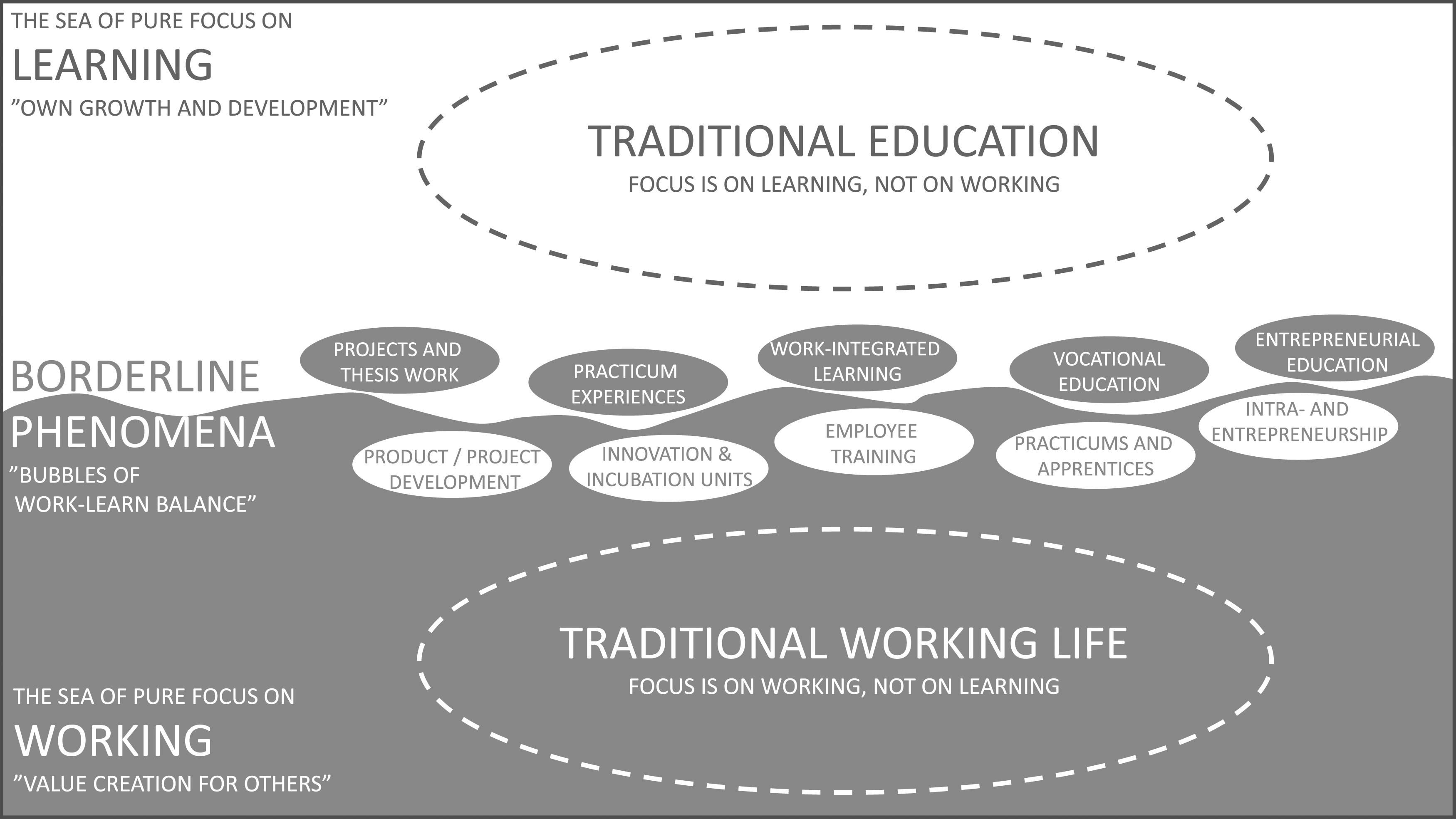
Methodology – spotting patterns across the bubbles
The process of articulating a novel boundary-spanning concept that purports to capture a similar pattern across two very different worlds was anything but linear. No research question was ever articulated that aimed to result in a new bridging concept. No research design was ever crafted with this aim in mind. The methodology applied here was rather of an implicit kind and stretching across a decade. Through a broad array of action research projects conducted from 2009 to 2019, an itch was increasingly making itself known. Strikingly similar mechanisms kept reappearing in very different contexts. University students went from not so engaged in what they were doing in their education, to reaching a tipping point where they started to work harder than they had ever worked on anything in their life. Young kids in primary schools went from traditional school days to staging a nation-wide lobby campaign to save a TV program they were passionate about. Employees in both private and public sector organisations went from being rather disengaged, even contemplating to quit, to instead assume a more personal and potentially exposed role within the organisation centred on an idea for a new concept, product, service or process they were part of coming up with and developing.
What was the pattern here? Could there be an overarching principle with enough explanatory power to describe the mechanisms at play, regardless of whether it was an education-induced process or not, and regardless of whether it was a child, a university student, a preschool teacher, or a private sector employee going through the very characteristic emotional roller-coaster process that kept reappearing again and again (cf. Arpiainen et al., 2013; Duening and Metzger, 2017)?
Dissonance and friction between worlds – a headache to endure or a research opportunity?
The research methodology employed in this work is aptly described by sociology professor David Stark in his book about how humans go about searching for new opportunities by exploring the dissonances inherent in competing regimes of value (Stark, 2011). Education and working life represent two very different regimes of value. In education, learning is valued the most, whereas in working life, happy paying clients are valued the most. This makes the intersection between these two worlds a promising setting “rife with uncertainty and yet, precisely because of that, also ripe with possibilities” (Stark, 2011: p.2). In the marginal and complex hybrid space between two worlds (cf. Gutiérrez et al., 1999; Zeichner, 2010), the author has engaged in a search that Dewey has described in the following way (Dewey, 1938/1998, as cited by Stark, 2011): “There is not at first a situation and a problem, much less just a problem and no situation. There is a troubled, perplexed, trying situation, where the difficulty is, as it were, spread throughout the entire situation, infecting it as a whole. If we knew just what the difficulty was and where it lay, the job of reflection would be much easier than it is […] In fact, we know what the problem exactly is simultaneously with finding a way out and getting it resolved.” (Italics in original)
The perplexed situation in this specific case was the many challenges faced by all those people in charge of the many different bubble types shown in Figure 1. Despite friction and tension such as lack of funding, pressures to conform to a culture of pure learning or pure working, as well as frequent miscommunication across the two worlds, the studied pioneers persisted in their endeavours to mix work and learning on a fine-grained level.
Metaphorical storytelling to sense-make a tense situation
To sense-make and illustrate this perplexed and tense situation, the author developed a metaphor of presenting it as comparable to a lava lamp, where oil and water are mixed through constant heat from below. Oil was the learning and water was the value creation for others. A new role as “mixer” was articulated, that is, a person being in charge of the difficult and laborious job of constantly heating the lava lamp, or in the words of a closely related metaphor, stirring the oil and water like in a vinaigrette. As soon as the stirring stopped, for example when the temporary project-based funding ran out, the two liquids in the vinaigrette would soon go back to their original separated state. This metaphorical story was first presented to a group of vocational teachers in March 2018. The presentation was then revised and fine-tuned over a period of 2 years through around 20 keynote presentations. Video animations with lava lamps, vinaigrettes and even bearnaises were used to illustrate the oil versus water metaphor. These presentations can methodologically be seen as a kind of reflecting-through-presenting, described by Russian pedagogy professor Piotr Galperin as “overt speech” or “communicated thinking” (see Haenen, 1996: p.140-141).
After 2 years of talking about learning and value creation as being like oil and water, a new concept was unexpectedly articulated by the author – “work-learn balance” – that described a focus needed to make them mix. This was a moment of creative reflective insight, and cannot be meaningfully described in replicable research methodology terms. The process as it happened is outlined here only for transparency reasons. It was a search process of the kind described by Stark (2011, p.4): “[T]he process of innovation is paradoxical, for it involves a curious cognitive function of recognizing what is not yet formulated as a category. It is one thing to recognize an already-identified pattern, but quite another to make a new association. (…) Whether we refer to the process as research, innovation, exploration, or inquiry, the kind of search that works through interpretation rather than simply managing information requires reflective cognition.” (Italics in original)
Presenting the new concept to practitioners
Having articulated work-learn balance as a new and potentially useful concept, it was in subsequent keynote presentations presented as the main idea. This way of framing what is needed to make collaborations between education and working life function better triggered much interest among many listeners, thus motivating the author to write this article as a way of also reflecting-through-writing. The idea of work-learn balance was also incorporated in two books, aiming to help practitioners achieve a better work-learn balance for students as well as for teachers (Lackéus, 2021, 2022). The first book focused on helping teachers structure their own professional learning at work in a more scientific way. The second book focused on helping teachers change their pedagogy towards allowing students to learn through creating value for others. Both these books aimed at helping practitioners achieve a better work-learn balance, but from two different directions. Students were helped to focus more on creating value for others, complementing their current focus on learning. Teachers were helped to focus more on their own learning, complementing their current focus on creating value for others, that is, for students.
Findings - work-learn balance as a new concept
Defining the new concept
The pattern emerging from different studies in the hybrid space between education and working life will now be disclosed. Many people who have a good everyday balance between work and learning, preferably on a weekly basis, seem to feel a higher sense of meaning and purpose in what they do. This makes them more motivated, engaged and diligent. The effect has been observed on students of many different ages, and on employees in many different professions. On an organisational and collective level, this then seems to lead to higher quality, increased efficiency, deeper learning and better solutions that fulfil their function to citizens in a better way. The pattern is illustrated in Figure 2. Work-learn balance and its effects.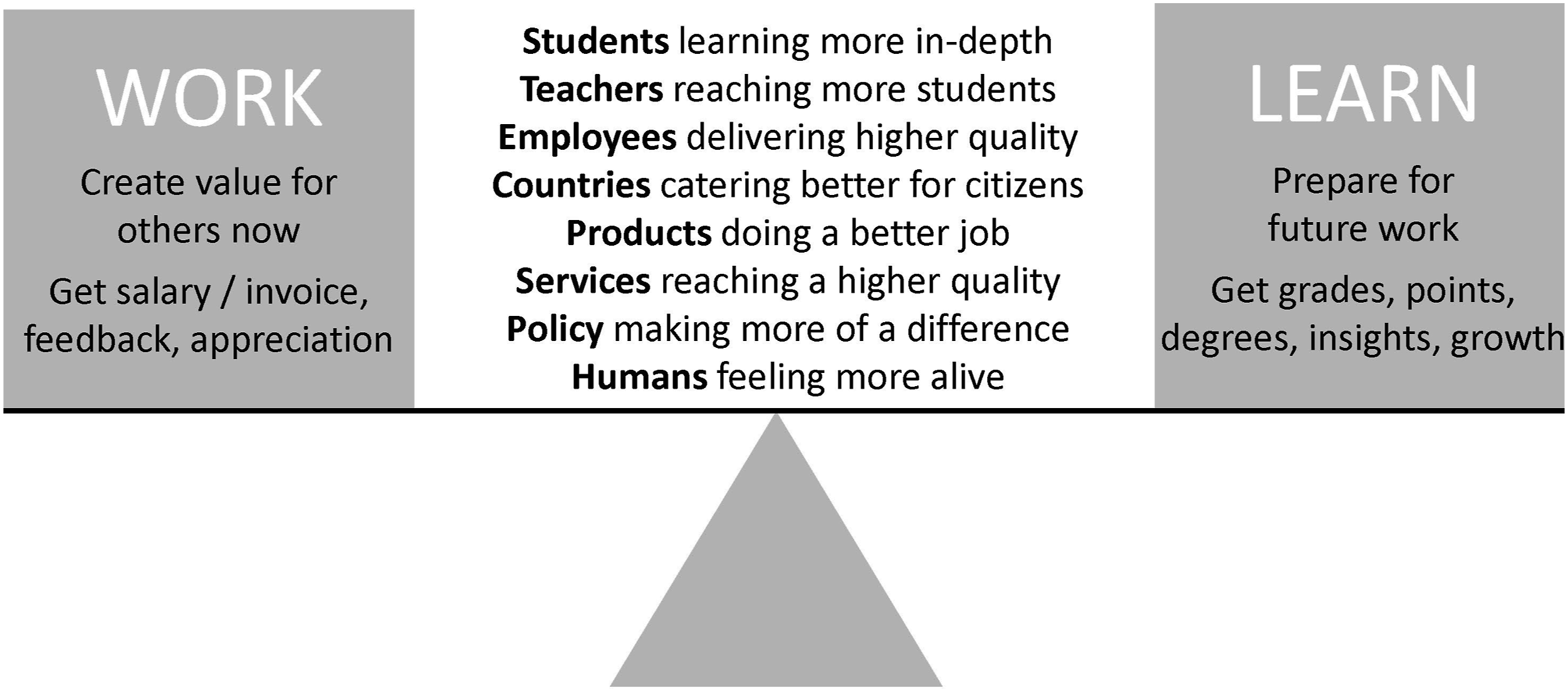
Three conditions need to be fulfilled in order for a person to experience work-learn balance. First, the person needs to be involved in a relational 1 activity that impacts other(s) to the extent that this or these others provide some kind of feedback on how it affected them. The impact can be positive, but to some extent also negative. The feedback renders the activity meaningful, implying that the activity meant something for others. This condition is here termed “work”. Second, the person needs to experience a feeling of growing or developing as a person, that is, some kind of learning experience that touches the person on a more personal level. This condition is here termed “learn”. Third, the two aforementioned conditions need to take place repeatedly within a reasonably short period of time. The mixing should preferably take place on a weekly basis. This condition is here termed “balance”. Together the three conditions form the new concept work-learn balance.
Two generic activity types that can trigger work-learn balance
Two generic activity types are given here as examples of what can trigger work-learn balance. Both activity types have been described in various publications stemming from the empirical action research discussed in the methodology section above, and are illustrated and defined in Figure 3. Two different ways to achieve a better work-learn balance.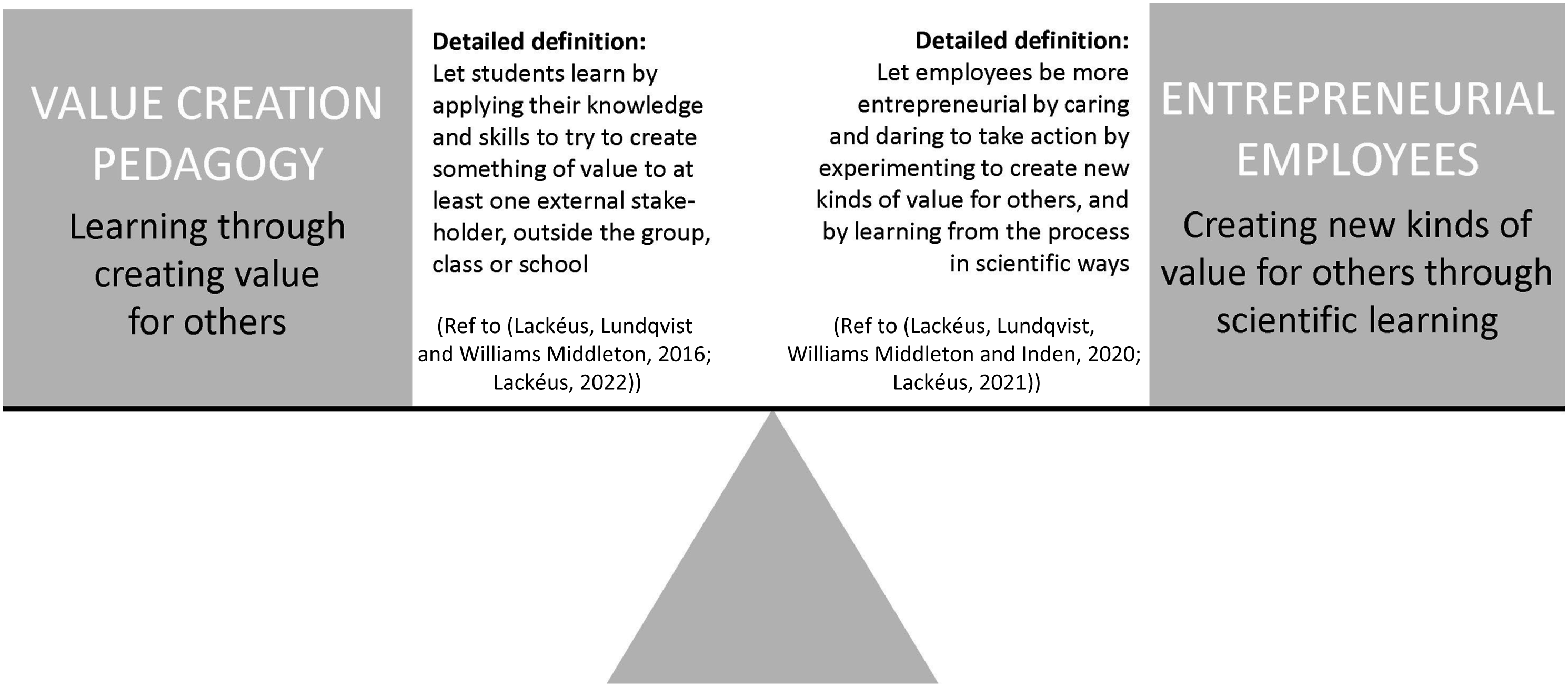
In education, letting students learn through creating value for others has shown to be a powerful means to trigger work-learn balance. More in detail, it is about letting students learn through applying their knowledge and skills to try to create something of value to at least one external stakeholder outside their own group, class or school (Lackéus et al., 2016). This has been termed ‘value creation pedagogy’, and has empirically shown to lead to a number of desirable effects in education, such as a strong increase in school motivation, a strong development of curricular knowledge and skills, and a strong development of soft skills such as initiative-taking, resilience, empathy, self-efficacy and uncertainty tolerance (Bell, 2020; Jones et al., 2020; Lackéus, 2020).
In working life, letting employees create new kinds of value for others through structured learning has also triggered powerful work-learn balance. More in detail, it is about letting employees be more entrepreneurial by caring and daring to take action, by experimenting to create new kinds of value for others, and by learning from the process in scientific ways (Lackéus et al., 2020). Employees acting entrepreneurially impact both themselves, their colleagues and the organisation as a whole. On an individual level, effects include a more meaningful, motivating and satisfactory everyday inner work life, higher autonomy than normally allowed in one’s work life, and more frequent inclusion in important discussions and decision processes (Amabile and Kramer, 2011; Bouchard and Fayolle, 2018). On an organisational level, effects include improved efficiency and profitability, development of new capabilities, and a revitalised organisation with an entrepreneurial culture (Birkinshaw, 2000; Fredberg and Pregmark, 2018; Kuratko et al., 2011).
Six examples of good work-learn balance
Outlining a new concept in a conceptual way has its limitations. Humans understand better through examples. Throughout the research leading up to the articulation of work-learn balance as a new concept, the author has come across a number of striking examples. They are briefly described below. They exemplify work-learn balance, but also aim to substantiate this new concept as a meaningful theoretical lens to interpret and analyse practice.
Learning mixed with work
Germany is a leader in collaboration between education and working life. Their dual system for vocational education (Eicker and Hartmann, 2002) has been admired worldwide, and for good reasons (Pilz, 2012). German firms are required to collectively contribute to the funding of work-based learning where apprentices all over Germany get paid while learning-by-doing at the workplace. This well-balanced approach is also popular among students. More than 50% of Germany’s students follow a vocational track where they get to combine theory and practice on a daily basis. Many see Germany’s global success on industrial markets illustrated by a huge trade surplus, its low youth unemployment rates and its comparatively low education–wage gap as direct effects of their dual vocational education system (Brinton, 2005).
In Sweden, the primary school teacher Maria Wiman has become famous among many thousand teachers for her work with value creation pedagogy. Her students have done numerous projects combining curricular learning with work that aims to help others in society. She has written two much appreciated books about her pedagogical approach (Wiman, 2019, 2022). Early on, two of her twelve-year-old students wrote a widely diffused text that claimed Wiman’s pedagogical approach to represent a new era in the history of schooling, allowing them to become resilient in making a real difference to the world (Sandén and Jonsson, 2016). In her two books, Wiman has also herself described the strong positive effects she has seen on curricular learning, student grades and student motivation.
From Finland comes an international export success in higher education. A model for entrepreneurship education labelled “Team Academy” has spread to France, Spain, Hungary the United Kingdom and beyond (Tosey et al., 2013). The idea is simply to start and run a real-life company for 3 years while learning about entrepreneurship. This establishes a micro-culture in class which results in strong identity development among students. While the model certainly challenges traditional education principles, it has been claimed by leading management scholar Peter Senge to represent the future of management education (Urzelai and Vettraino, 2022).
The above examples are all conceptually related to French education philosopher Célestin Freinet, who already in the 1930s wrote extensively about “pedagogy of work”. Freinet experimented vigorously with different technologies that could support teachers and students. The printing press is the most well-known example (Carlin and Clendenin, 2019), but Freinet also experimented with movie cameras, tape recorders, radio transmitters, typewriters and limographs (Freinet, 2018/1948). He tirelessly tried out any gadget that could help students bridge between language learning and journalistic work. This makes him a pioneering work-learn balancer on the borderline between education and working life.
Work mixed with learning
Entrepreneurship as a phenomenon epitomizes what it means to balance between working and learning in working life. Entrepreneurs have been described as exceptional learners (Smilor, 1997), and as researchers in search for a new and repeatable theory (i.e. a business model) that can empower their future business venture (Felin and Zenger, 2009). Many entrepreneurs build successful new firms through intuition and trial-and-error based learning around what might be valuable for prospective customers.
Silicon Valley in the United States is the world’s most prominent example of the immense economic value that can be created through maintaining a good work-learn balance. The region is birthplace to three of the world’s 10 most valuable companies – Apple, Google and Tesla. But is Silicon Valley also an example of good collaboration between education and working life? This is less obvious. Many entrepreneurs overstate their own role in successes, underplaying the role of academic roots and early-stage state grants (Etzkowitz, 2003). Silicon Valley‘s heroic entrepreneurs had never been as successful without the massive state support and formalized learning processes put in place by the state (Mazzucato, 2018). Stanford University also had a key role in Silicon Valley’s evolution (Saxenian, 1996). Therefore, instead of overstating the role of heroic individuals, we should perhaps see Silicon Valley as the world’s most sophisticated system of work-learn balance.
The French cosmetics corporation L’Oréal is an illustrative example of the tremendous growth that a good work-learn balance sustained for more than a century can result in. A culture of formalized entrepreneurial learning has contributed to their current position as the largest firm in the world in personal care. Bouchard and Fayolle (2018) have described some core tenets of L’Oréal’s entrepreneurial culture. These include a decentralised organisation, entrepreneurial leadership emphasis in key recruitments, openness for unlearning through confronting the old with the new, generous spending on innovation and a culture that accepts failures and mistakes. Much of what L’Oréal does is aligned with research on corporate entrepreneurship. Headquarters need to resist believing that the best ideas always come from them, they need to continually challenge their existing world-views and instead overcome the internal resistance to change and unlearning of old truths (Birkinshaw, 2000). The rewards will often come in the form of more or less radical offerings that disrupt existing markets and propel firms into hypergrowth (O'Connor, 2008).
In Brussels, the European Commission has for a decade invested heavily in public sector innovation, following recommendations from an expert group assembled in 2013 (Bason et al., 2013). Challenges have been tackled around for example digital transformation, cross-border interoperability and health services (Karakas, 2020). Competitions such as the European Public Sector Award (EPSA) have been created for public sector intrapreneurs and their projects. Still, public sector innovation lags behind its private sector counterparts. Impact is so far mostly visible in terms of examples collected through the Observatory of Public Sector Innovation (OPSI) established in 2013. In a Danish example, elderly have been empowered to become more self-sufficient again through fitness training and other social services, resulting in better lives and annual cost savings of 15% (Bason et al., 2013: p.34). Examples are also gathered outside Europe. In Mongolia, the threat from counterfeit drugs has been mitigated through use of blockchain technology to track each batch of medicine (Karakas, 2020: p.6-7). So far in the European Commission’s work, the potential of inviting students to the public sector’s innovation activities seems largely unacknowledged. Neither the expert group’s report from 2013 nor the recent policy brief from 2020 mention any potential role students can take by learning through creating value for the public sector. Collaboration between education and working life therefore seems to be an unexplored opportunity for the European Commission.
Discussing the new concept and its implications
What is work-learn balance?
Work-learn balance is first and foremost a linguistic contribution. A new unifying term has been proposed that describes a recurring pattern in what boundary-spanning people from two different worlds do at the periphery and in the intersection between their two rather different worlds. These people’s everyday balancing between work and learning has previously been described and studied under a wide plethora of other terms. The claims made here are thus not causal, but rather interpretative, providing “a description of a distinctive sort” (Little, 1991: p.74). The new term could thus be seen as a semantic crystallization of a rare kind of “peripheral wisdom” generated through a decade of action research into peripheral practices (cf. Rae, 2017: p.491).
The new term could also represent a more holistic way to describe the fundamental human condition. What if a basic tenet of the human species is that we are work-learn balancers? If so, any attempt at separating learning from working is as futile as trying to separate a beam of light into either of its two indivisible properties wave and particle (cf. Roth and Lee, 2007: p.197 and 203). What is light? Now it’s a particle, now it’s a wave. What is a human? Now she’s a learner, now she’s a worker creating value for others. What if any separation of work from learning will inevitably diminish the potential of many human beings? According to Csikszentmihalyi (2008, p.49, 54, 68, 74, 118 and 221) we humans are at our best and most productive state when we take action in a way that requires our knowledge and skills, that makes us grow personally, that leverages both our thinking mind and our acting body, that impacts both self and others, and that generates powerful feedback from others. This sounds very much like work-learn balance, a concept that could then “aspire to be [a] categorical universal because [it] assert[s] the mutual presupposition of opposites” (Roth and Lee, 2007: p.197). A strive towards work-learn balance could then be seen as a deliberate high-tension approach, taking its energy and power to trigger change and development from the constant contradictions and tensions inherent in the dialectical dualism of work versus learning (cf. Engeström, 2009; Holt, 2008). Maybe it is truer to the human condition to talk about one single concept – work|learn – where the use of the Boolean Sheffer stroke | signifying “NAND” or “not both” is an approach that “leads to new categories – for instance, agency|structure – that encompass built-in contradictions.” (Roth and Lee, 2007: p.197).
Another approach is to see work-learn balance as a new focusing device for human activity, a macro-level objective that could structure human efforts on a micro level of daily activities (cf. Mazzucato, 2021: p.6-7). It is difficult to focus on something we cannot describe in words. What if work-learn balance is something most humans want in their daily life, but have not had a term for, thus making them unable to strive towards it? This positions work-learn balance as a new cultural tool for humans to “think with” (cf. Egan, 2002: p.67 and 113), a new “thinking device” (Wertsch and Toma, 1995: p.166). Many such cultural tools possess a powerful ability to “transform action because they determine the structure and flow of action.” (Daniels, 2008: p.61). This leans on the idea of tool-mediated activity, first articulated in the 1930s by scholars at the Kharkov school of psychology in Ukraine (Haenen, 2001: p.158).
A fourth interpretation of work-learn balance is to see it as a bridging concept that alleviates the mutual misunderstandings between people on either side of the confrontation line between education and working life. When people from working life propose teachers to adopt an “entrepreneurial” approach, a common reaction is contempt and refusal to integrate allegedly capitalist values (Johannisson, 2010; Komulainen et al., 2011). When teachers propose education initiatives to corporations, a common reaction is that it is a rather poor investment, or even a “great training robbery” (Beer et al., 2016). If viewing this whole situation partly as a semantic confusion, a proposal by Sayer (2010, p.73) is then to rely on “mundane concepts which [both worlds] share and to which appeal can be made in trying to resolve disputes.” Combining work and learning is a mundane proposal that both sides could then understand and appreciate. Managers could be offered work-learn balance as an alternative to yet another isolated bubble of pure training. Teachers could be offered the same proposition, but in their case contrasted to isolated bubbles of work experience for their students.
How novel is work-learn balance as a concept?
A search for “work-learn balance” on Google Scholar yields only 15 hits. 2 A German research project has explored facets of what they label work-learn-life balance, but seems to have been focused mainly on work-life balance for knowledge workers (Antoni et al., 2014). A digital platform described in a conference article gives students an opportunity to learn and earn money through helping companies to solve various challenging tasks (Krause et al., 2018). A few other occurrences show up, but nowhere has the author found literature that defines work-learn balance as a new concept, describes it in detail, explores its effects on humans, or discusses what it can mean on a deeper level. A conclusion here is that work-learn balance as a concept seems to be rather novel and unexplored, but not previously unheard of.
While the term work-learn balance is rather novel, there are many different literature streams that explore various facets of the intersection between education and working life, and its overarching category of interactions between different disciplinary worlds and worldviews. Useful insights have here been generated through careful study of literature on boundary objects (Akkerman and Bakker, 2011; Star and Griesemer, 1989), activity systems (Engeström et al., 1999; Roth and Lee, 2007), transfer between school and work (Tuomi-Gröhn and Engeström, 2003), critical realism (Hedström and Ylikoski, 2010; Little, 1991; Sayer, 2010), vocational education (Bakker and Akkerman, 2019; Ryan, 2012) and work-life balance (Schneider and Waite, 2005).
A resulting conclusion around novelty is that no other term known to the author is (1) neutral in relation to either of the two worlds of education and working life, (2) mundanely comprehensible in seconds by practitioners, (3) composed of mundane terms that anyone can understand and immediately use, and (4) emphasizes balance between two different worlds inherently in its construction as a term.
What are some effects of a good work-learn balance?
The purpose of this article is not to make new causal claims. The findings presented here are not intended to evidence any effects on humans who have, or do not have, a situation of good work-learn balance. Such effects have already been extensively evidenced in extant literature on the many different phenomena characterised by a good work-learn balance. Service-learning has been associated to positive effects on “attitudes toward self, attitudes toward school and learning, civic engagement, social skills, and academic performance.” (Celio et al., 2011: p.164). Work-integrated learning has been associated to positive effects on students’ “resilience, motivation and self-awareness” (Smith et al., 2014: p.63). Value creation pedagogy has been shown to trigger “high levels of positive emotion and motivation, high levels of perceived meaningfulness and deep learning of core curriculum knowledge and skills” (Lackéus, 2020: p.958). Experiential entrepreneurship education has been shown to impact students’ motivation, personal development, desire to contribute to others and courage to take action (Haneberg and Aadland, 2019).
The impact of balancing attempts from the working life side has also been extensively studied. On a societal level, entrepreneurship is considered to be “a pillar of economic development”, creating jobs and building up society’s prosperity (Kasseeah, 2016: p.896). On an organisational level, it has been shown how “firms that engage in radical innovation enjoy supranormal returns” (O'Connor, 2008: p.314) and are “nine times more likely to create breakthrough products and processes” (O'Reilly and Tushman, 2004: p.1). On an individual level, work performance peaks when employees get to be creative. Amabile and Kramer (2011, p.49) found empirically that “creativity – coming up with novel and useful ideas – is probably the most crucial aspect of performance in today's business world.” This connects business performance to work-learn balance, since coming up with novel and useful ideas requires both a learning mindset and a focus on what is useful to others. They further label the strong motivational power in learning what works as a “progress principle”, defined as when employees have “made progress, finished a task, moved forward, [been] productive, or achieved an accomplishment” (Amabile and Kramer, 2011: p.231). Outside established organisations, entrepreneurs have been found to develop a number of valuable competencies through learning-by-doing, such as opportunity recognition, problem-solving skills, self-efficacy, proactiveness and leadership skills (Morris et al., 2012).
This brief and incomplete review of effects illustrates a key point. Work-learn balance seems to bring out the best of many people. It seems to make many of us motivated, passionate, engaged, competent, open to new experiences and resilient in the face of setbacks. For some people, it even constitutes a large part of what makes life meaningful and worth living.
Implications of work-learn balance as a new concept
Work-learn balance can be used to establish and maintain a focus on phenomena that really matter for many people, but that have hitherto been regarded as insignificant or irrelevant in education and working life. The new concept can help articulate a new purpose against which people can measure their progress. Managers can use it to describe something they want people in their organisation to strive towards or to facilitate for colleagues. Teachers can use it to describe what they want their students to experience.
If acted upon by managers and teachers this way, peripheral activities in education and in working life could become more valued in the eyes of people at power centres in these two worlds. Bubbles of work-learn balance could evade the current “tyranny of distance” from their respective power centres (Warntz, 1967). Instead of being “lone voices or dissident groups with alternative perspectives” (Rae, 2017: p.491), these bubbles could become regarded as more central, where directors in education and working life start caring more about what happens at the periphery. Such a stronger focus on work-learn balance could also contribute to establishing a power centre of its own at the crossroads, providing better access to resources and priority in society (Roth and Lee, 2007: p.217).
Using work-learn balance as a tool to “think with” can contribute to skewing people’s view of the hybrid marginal space between education and working life from a peripheral barrier to a valuable source of learning and development, thus also helping people at these borders to go from confrontation to collaboration (cf. Akkerman and Bakker, 2011: p.137). Boundary-crossers could become more able to understand and have dialogues with different actors, thus contributing to their boundary competence: “ability to manage and integrate multiple, divergent discourses and practices across social boundaries” (Akkerman and Bakker, 2011: p.140).
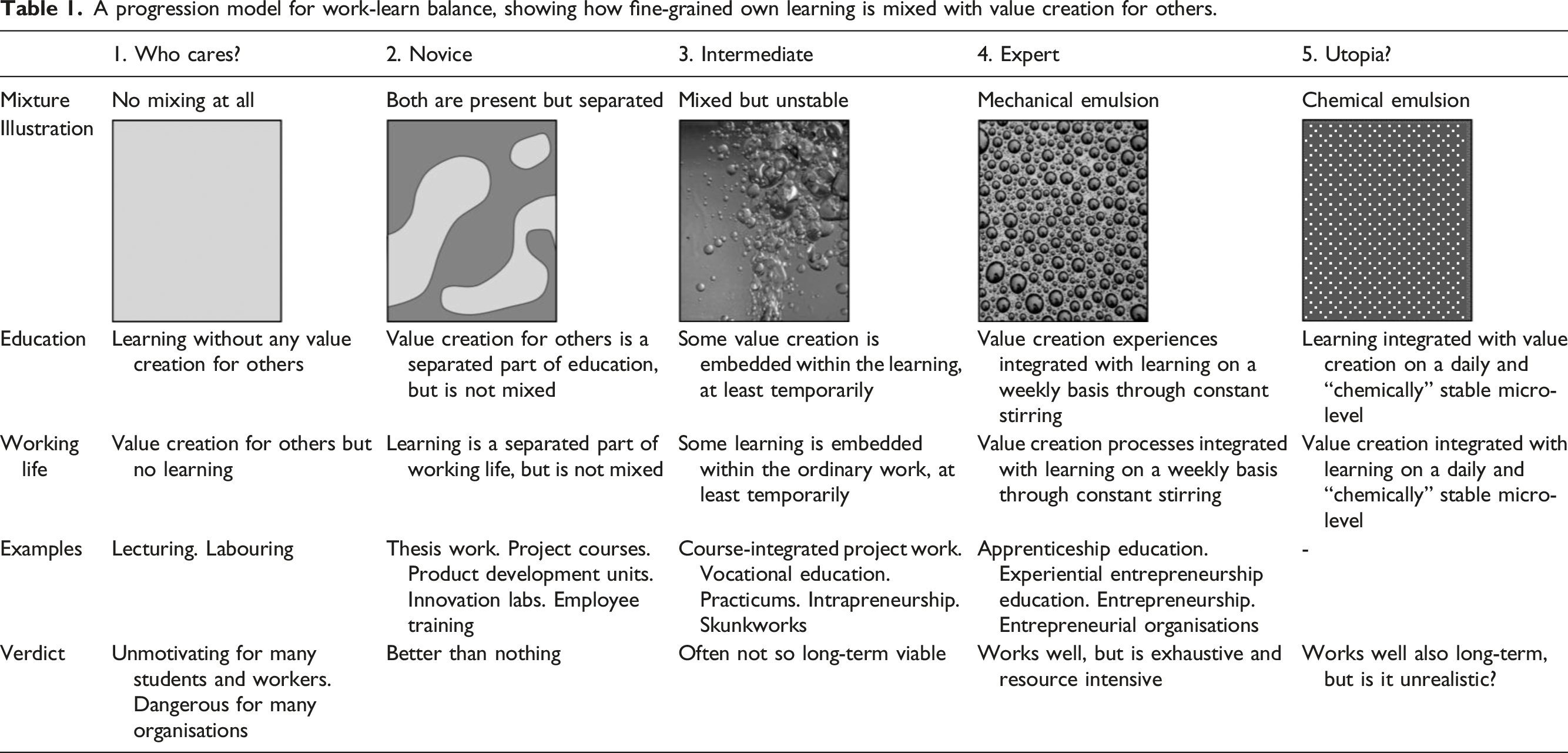
A progression model for work-learn balance, showing how fine-grained own learning is mixed with value creation for others.
Conclusions
An idiosyncratic method has resulted in the articulation of a new concept – work-learn balance – that can help boundary-crossers bridge a problematic divide between education and working life. The new concept was found to capture a recurring pattern across many different marginal phenomena on the borderline between education and working life. Whether it was a vocational student at a work placement, an intrapreneur in a large corporation, a child trying to save a TV program, a public servant helping elderly or a teacher trying to learn how to teach better, they all seem to have experienced a healthy and weekly balance between own learning and value creation for others. Such experiences seem to bring out the best of humanity, and could represent a more holistic description of what it means to be a human being. Time will need to determine if this new concept will be appropriated by society as a valuable addition to our collection of conceptual tools to “think with” and make sense of our world, or if it is a mere semantic pastime that scholars sometimes occupy themselves with.
Footnotes
Declaration of conflicting interests
The author(s) declared no potential conflicts of interest with respect to the research, authorship, and/or publication of this article.
Funding
The author(s) received no financial support for the research, authorship, and/or publication of this article.
