




Abstract
Notwithstanding a recent upsurge in interest in knowledge intermediaries and their roles in innovation support systems, we know little about the interplay between the activities of academia-driven intermediaries and their publicly financed counterparts. Building on a combination of principles derived from the resource-based theory and entrepreneurial ecosystems literature, this paper investigates the potentials of cooperation between different knowledge intermediaries. Therefore, the authors analyze the alignment of financial, knowledge, market and network resources in politically funded regional alliances between university-internal and university-external intermediaries by means of a qualitative approach. They find that, while knowledge intermediaries can benefit from access to additional ecosystem-specific resources, the urge to improve their own position within the ecosystem hampers the will to cooperate and can lead to non-performing resource alignments. The paper contributes to current scholarly discussions by suggesting and testing a theoretical foundation for analyzing the cooperative behavior of knowledge intermediaries in innovation support systems.
Keywords
The reciprocal transfer of knowledge between academic and non-academic actors in innovation systems has long been seen as an important conduit of innovation and knowledge-based regional development (Etzkowitz and Leydesdorff, 2000; Hassink, 1996; Rothwell and Dodgson, 1992). In this context, various public, semi-public and private actors contribute to the implementation of a supporting regional innovation infrastructure (Hassink, 2002; Swenberg et al., 2020). A major constituent of these innovation support systems is the knowledge intermediary, a term which has gained scholarly and political attention as a description of organizations that foster knowledge exchange between academic and non-academic stakeholders (Clayton et al., 2018; Smedlund, 2006; Swenberg et al., 2020).
Knowledge intermediaries represent an increasingly heterogonous group of actors including university-administered transfer and start-up support units and public agencies established by municipalities or ministries, as well as private actors (Villani et al., 2017; Wright et al., 2008; Yusuf, 2008). Despite the acknowledgement of them as an important part of innovation support systems and a concomitant upsurge in interest in their roles and functions, relatively little is known about the requirements for successful knowledge intermediation and the interdependencies between the work of different intermediaries and accruing potentials for cooperation (Caloffi et al., 2015; Clayton et al., 2018; Hayter, 2016; Wright et al., 2017).
In Germany, the promotion of innovation support systems, has been high on the agenda of national and federal ministries (see, e.g., Federal Ministry of Education and Research, 2020; Niedersächsisches Ministerium für Bundes-und Europaangelegenheiten und Regionale Entwicklung, 2020; Innovationszentrum Niedersachsen GmbH, 2020) as well as non-governmental actors such as the Science and Humanities Council (Wissenschaftsrat, 2016). However, policy actors can provide only a regulatory framework and top-down incentives for cooperation, while it remains difficult to incorporate regional actor constellations and peculiarities that result from path dependencies. Therefore, this study focuses on investigating the adoption of policy incentives for collaboration by knowledge intermediaries in three regions in the federal state of Lower Saxony (Northern Germany).
The study uses resource-based theory (Barney, 1991; Wernerfelt, 1984) as a theoretical foundation to develop a framework capable of elucidating strategic cooperation between different intermediary organizations. More specifically, it takes an explorative, qualitative approach based on the resource-based theory of strategic alliances (Das and Teng, 2000) in combination with empirical insights by Larty et al. (2017) and Silva et al. (2018), who suggest that intermediaries mostly benefit from acquiring additional financial resources (financial), new technical and operational capabilities (knowledge), up-to-date information concerning ‘their’ ecosystem and its actors (market), and access to more networks and contacts (network) that are indispensable for successful intermediation. By means of this approach, the study aims to ascertain how long-term cooperation with other intermediaries affects the everyday work and activities of organizations and individuals supporting academic entrepreneurship and technology transfer. The research question addressed is: How do financial, knowledge, market and network resources align in alliances between different knowledge intermediaries, and affect their cooperative behaviour among each other?
The paper contributes to current debates about knowledge intermediaries in innovation support systems in three ways. First, it analyzes a novel policy instrument that shifts the focus to cooperation between different knowledge intermediaries. The paper builds on themes raised by Wright et al. (2008) and elaborated by, for example, Hayter (2016), Wright et al. (2017) and Clayton et al. (2018) by showing that different knowledge intermediaries are tied to different innovation subsystems and therefore, even if well designed, may have difficulties in connecting different groups of actors.
Second, the paper provides empirical support for recently expressed calls for holistic approaches to analyze the dynamics of regional innovation support systems (Good et al., 2019; Swenberg et al., 2020). Consistent with the ecosystem analogy, understanding fragile and idiosyncratic regional cooperation structures and networks is not achieved by isolated analyses of subsystems and, consequently, such that focus on individual intermediaries. By focusing on the interplay between different knowledge intermediaries, this paper addresses the lack of empirical insights regarding different modes of collaboration between different groups of intermediaries (Feser, 2022).
Third, the paper questions the predominant image of knowledge intermediaries as will-less supporters and administrators of regional entrepreneurs (Dalziel, 2010; Yusuf, 2008) by focusing on their organizational missions and objectives. Additionally, it derives policy implications for the design of knowledge intermediaries and thereby addresses recent calls for the identification and evaluation of appropriate public policies for the support of innovation and entrepreneurial ecosystems (Feldman et al., 2019) and the roles of universities in them (Schiuma and Carlucci, 2018).
The remainder of the paper is organized as follows. The second section, below, commences by outlining central insights into the interplay of knowledge intermediaries in regional innovation support systems and basic principles of resource-based theory in order to develop the theoretical framework. The third section provides information on the methodological approach and introduces the assessed alliances. The fourth section presents central empirical findings. The fifth section discusses the findings against the background of existing research and, finally, the sixth section sets out the initial implications and identifies opportunities for future research.
Theoretical framework
Well-established and mature approaches to regional innovation dynamics, such as the Regional Innovation Systems (RIS) approach (Autio, 1998), as well as currently emerging conceptualizations of entrepreneurial ecosystems, act on the assumption of a segregation between academic and non-academic networks. Overcoming this segregation represents a major challenge and objective of innovation support systems (Swenberg et al., 2020). The paper builds on this assumption to analyze the cooperative behaviour of actors that develop and process manifold activities to interconnect academic and non-academic subsystems within innovation systems.
Regional innovation support systems and knowledge intermediaries
The last two decades of innovation research have been dominated by an increasingly systemic perception of innovation as the outcome of multilateral and reciprocal knowledge exchange processes between different actors, with a particular emphasis on regional dynamics as the basis for innovation (Autio, 1998; Asheim and Gertler, 2009; see Doloreux and Porto Gomez, 2017 for a review). The ubiquity of innovation systems in research and policy led to the formation of regional structures dedicated to the support of innovators (Hassink, 2002; Tödtling and Kaufmann, 2002). One central component of these innovation support systems is the intermediary organization – “an infrastructure for support services, functions and mechanisms” (Swenberg et al., 2020: 373). The concept of intermediation within systems of innovation has attracted significant attention in innovation studies during the last two decades (Howells, 2006; Pollard, 2006; Smedlund, 2006). Intermediation describes a broad set of activities that aim to establish and shape regional structures, networks and channels that foster inter-organizational knowledge exchange (Dalziel, 2010; Nauwelaers, 2011; Pollard, 2006).
One of the main and most vibrant scholarly debates about intermediation arose in the knowledge transfer and entrepreneurship literature and addresses knowledge intermediaries as organizations fostering reciprocal knowledge exchange between academic and non-academic actors (Pollard, 2006; Yusuf, 2008). Hayter (2016: 636) broadly defines knowledge intermediaries as “organizations that facilitate knowledge exchange between universities and external stakeholders through the creation of bi-directional, value-added network relationships”.
Most earlier research on knowledge intermediaries focuses on the role of universities’ technology transfer offices (TTOs) in supporting the commercialization of academic knowledge via licenses and patents (Siegel et al., 2007), fostering linkages between university and firms (Debackere and Veugelers, 2005) and promoting academic entrepreneurship in the form of start-up and spin-off firms (Markman et al., 2005). Studies reviewing the results of these works usually conclude with a critical perception of TTOs and their incapability to create additional value (see Siegel and Wright, 2015a for a brief summary of the relevant discussion; see Hülsbeck et al., 2013 for empirical insights regarding the situation in Germany). These studies provide the first hints of the importance of structured support for academic entrepreneurship and knowledge-based innovation (Etzkowitz and Göktepe-Hultén 2010; Wright et al., 2004). More recently, novel approaches have shifted the focus of discussion towards the formation of nascent, university-centered support structures in which multiple intermediaries and stakeholders enhance “their” region’s entrepreneurial potential (Breznitz and Zhang, 2019; Feldman et al., 2019; Heaton et al., 2019; Miller and Acs, 2017; Wright et al., 2017). Knowledge intermediaries represent important constituents of this regional innovation infrastructure as their functionality has proven to be an important determinant of the whole system’s orientation and efficiency (Clarysse et al., 2014; Good et al., 2020; Hayter, 2016; Vedula and Kim, 2019).
This progression of the scholarly discussion indicates that knowledge intermediaries have advanced from their previous role of supportive administrators of knowledge commercialization towards important actors in innovation systems. However, research on strategic cooperation between them within regions is emerging at best. This scarcity of research prevails despite several indicators for the desirability of cooperation between knowledge intermediaries (Sinell et al., 2018; Schaeffer and Matt, 2016; Roxas et al., 2011).
Rationale for cooperation between knowledge intermediaries
Differentiation between university-internal and university-external knowledge intermediaries.
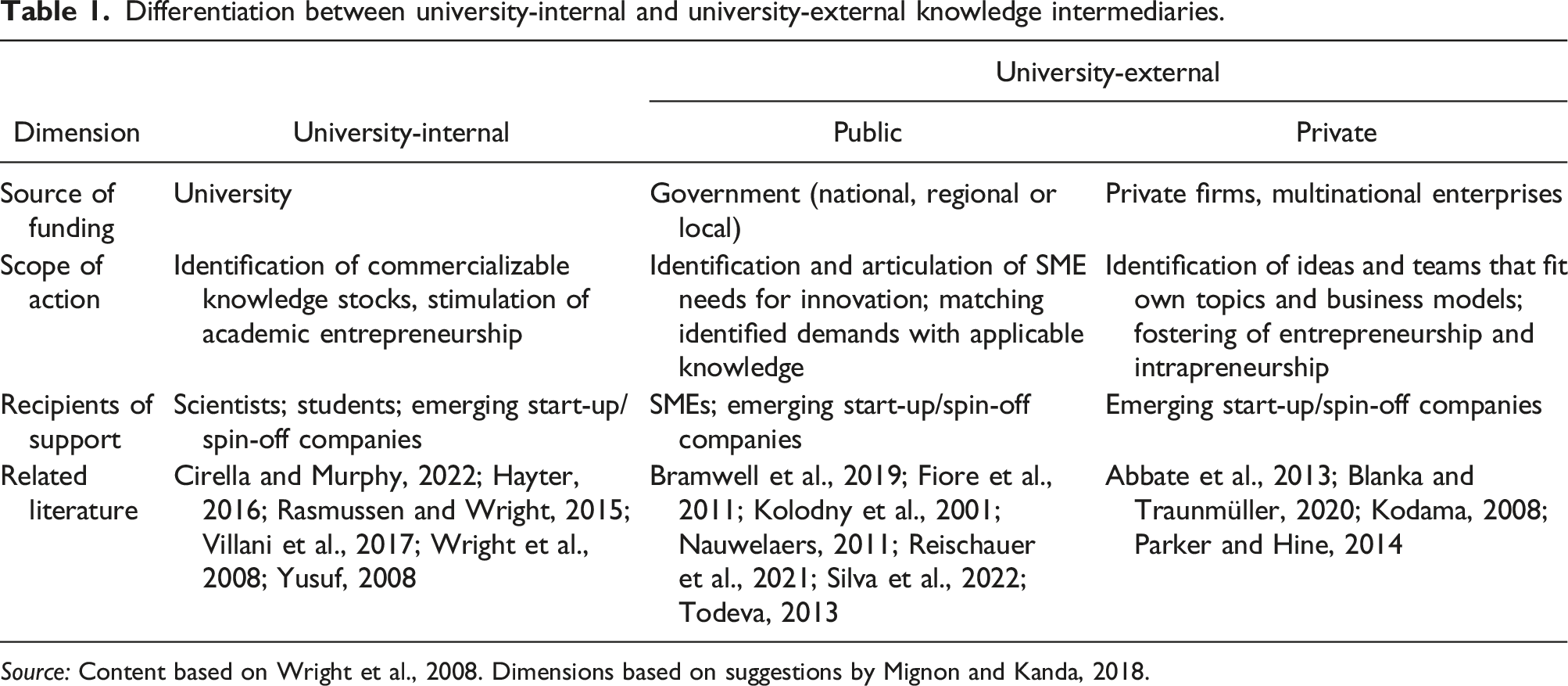
Source: Content based on Wright et al., 2008. Dimensions based on suggestions by Mignon and Kanda, 2018.
Accordingly, university-internal knowledge intermediaries focus on the identification and support of academic entrepreneurs to foster financial returns for “their” universities and the fulfilment of knowledge transfer as the third academic mission. They aim to create a supportive infrastructure that provides academics with all resources required for research commercialization via industry collaboration or spin-off firms (Cesaroni and Piccaluga, 2016; Cirella and Murphy, 2022; Siegel et al., 2007; Siegel and Wright, 2015b). In contrast, publicly financed university-external intermediaries focus on the support of regional firms, especially SMEs, by trying to establish institutional settings that foster the articulation of firm demands for innovation and match them with appropriate knowledge from academia (Bramwell et al., 2019; Fiore et al., 2011; Kodama, 2008; Kolodny et al., 2001; Nauwelaers, 2011). In this sense, university-internal intermediaries can be perceived as “knowledge codifiers” focusing on newly created knowledge stocks and their transfer, whereas university-external intermediaries can be grouped as “knowledge enablers” or “knowledge facilitators” that steer knowledge production towards a required direction (Radko, 2022: 95–101). Privately funded knowledge intermediaries usually are much more limited in their focus and purposefully search for ideas and teams that work in their own field of specialization and yield a financial return (Abbate et al., 2013; Kodama, 2008). Extant studies indicate that interconnection among intermediaries specialized in different aspects of innovation enhances their performance between the dynamically evolving relations among various actors and that this interconnection in turn requires special governance (Todeva, 2013).
The respective foci lead to scenarios in which knowledge intermediaries seem tied to the context and demands of their main target groups and struggle with overcoming the chasm between academic and non-academic systems (Fernández-Esquinas et al., 2016) and are evaluated as rather irrelevant by their target groups (Inkinen and Suorsa, 2010) or, as Hayter (2016: 648) puts it from the perspective of university-internal knowledge intermediaries, “may or may not possess relationships with non-academic contacts”. Further, recent research emphasizes that knowledge intermediaries’ services can benefit from an overall enhancement of regional cooperation structures (Goswami et al., 2018) and, more specifically, that university-internal knowledge intermediaries rely on actors with a non-academic background in order to enhance their services (Rasmussen and Wright, 2015; Schaeffer and Matt, 2016; Sinell et al., 2018). Sinell et al. (2018: 87) sum up these insights by concluding that “if transfer offices were to more actively network within the innovation ecosystem, they could increase their collaboration opportunities and access to resources such as funds, knowhow, and labs”. Roxas et al. (2011) conclude with a similar finding concerning university-external knowledge intermediaries, who could access suitable solutions for their clients’ challenges by collaborating with other intermediaries. Consequently, recent research articulates a need for research emanating from the ambiguity and apparent overlaps between different knowledge intermediaries in order to investigate “taxonomies of these support mechanisms” (Wright et al., 2017: 920).
The paper takes these conceptual approaches and empirical insights as a starting point to shed further light on the requirements for and effects of collaboration between knowledge intermediaries. Therefore, it works on the assumption that the focus of university-internal intermediaries on academic entrepreneurs in combination with their organizational affiliation ties them to the academic context and endows them with an advantage in meeting academics’ demands. Accordingly, the focus of university-external intermediaries on firms’ supply of the resources required for innovation makes them experts in firm support. Since the interconnection of academic and non-academic actors is at the heart of innovation support systems, coordination of the two specializations seems highly desirable.
Towards a resource-based approach
The resource-based theory of strategic alliances
Originating from the management literature, the resource-based theory focuses on firm-internal characteristics to analyze strategies for the creation of competitive advantage (Barney, 1991; Peteraf, 1993). According to the seminal work of Wernerfelt (1984), the firm is perceived as a particular, idiosyncratic combination of resources, with resources being defined as “those (tangible and intangible) assets which are tied semi permanently to the firm” (Wernerfelt, 1984: 172). Despite the strong focus on firm-internal characteristics, overlaps between firms’ resource endowments lead to complementarities and favour the formation of inter-organizational alliances (Mowery et al., 1998), 1 which extend and diversify firms’ resource endowments (Lavie, 2006). From a resource-based perspective, strategic alliances are a costly yet effective means of mutually accessing additional resources, which are required to gain competitive advantage but are not accessible in an alternative way (Eisenhardt and Schoonhoven, 1996; Tsang, 1998; Wernerfelt, 1984).
The resource-based theory of strategic alliances divides the analysis into formation, structural preferences and performance. The formation of strategic alliances depends on the characteristics of the resources sought. Alliance formation is favoured by the imperfect mobility, imitability and substitutability of those resources (Das and Teng, 2000). These characteristics determine the value of resources and preclude other means of access (Barney, 1991). Firms will be willing to form alliances if the resources they seek to acquire meet these criteria as well as their individual needs and opportunities (Eisenhardt and Schoonhoven, 1996).
Das and Teng (2000) explain how the alignment of shared resources affects the performance of strategic alliances. The framework considers strategic alliances as performing – that is, achieving the agreed alliance objectives and yielding a competitive advantage for the alliance partners – if the alliance partners manage to integrate the additionally accessed resources. Therefore, the model differentiates between performing resources that facilitate the agreed alliance objectives and non-performing resources that are usually shared in alliances because they are inseparably tied to performing resources. The resources shared in an alliance can either be similar or dissimilar. Similar resources can align either in a supplementary or surplus way while dissimilar resources can align in a complementary or wasteful way. Resources in an alliance align in a supplementary way when both partners contribute similar performing resources. In our case, this could be, for example, financial resources being pooled for joint activities. A surplus alignment of resources describes the contribution of similar resources that are not fully utilized in the alliance. For intermediaries operating in the same regional context, this might be double structures if different organizations offer the same sort of innovation support. The complementarity of resources in alliances refers to dissimilar yet compatible resource contributions – for example, non-redundant competencies or contacts. In contrast, wasteful resource alignment describes an incompatibility of resource contributions – that is, resources that cannot be utilized by the alliance partner. According to the model, strategic alliances will be “performing” if the relationship between the alliance partners’ respective resources is either supplementary or complementary but will not yield any benefits if the resources align in a surplus or wasteful way (see Das and Teng, 2000: 49, for a detailed overview over the different forms of resource alignment).
The resource-based theory of strategic alliances represents a well-established framework for analyzing the cooperative behaviour of separate actors. However, being penned by management researchers, the empirical utilization of the framework is mostly restricted to the analysis of private actors (i.e., firms). This is despite several extensions of resource-based principles that have shown the value of the approach for analyzing strategy development in public (Bryson et al., 2007) and not-for-profit organizations (Arya and Lin, 2007). Arya and Lin (2007: 699) argue that “although not-for-profit organizations do not compete in the traditional sense, they do compete for clients, funds, and government approval” and therefore require a set of valuable, idiosyncratic resources in order to strive for “organizational competitive advantage” as well. Hence, the resource-based perspective represents a promising framework for elucidating cooperative behaviour between knowledge intermediaries.
Intermediary resources
To make the resource-based theory of strategic alliances applicable to the analysis of knowledge intermediaries, this paper complements it with empirical insights from two of the few studies with a distinct focus on the requirements for successful intermediation.
Larty et al. (2017) investigate combinations of resources that underpin intermediaries’ capabilities to create and expand industry-specific regional innovation networks between regional firms. The authors emphasize the importance of knowledge resources and network resources that are required to comprehensively address all regional actors and subsequently facilitate knowledge sharing between them. Accordingly, possessing trust-based networks that include individuals in nodal regional positions while at the same time possessing sufficient knowledge resources to grasp the range and depth of the clients’ innovative endeavours represents a crucial prerequisite for successful innovation networks (see Larty et al., 2017: 10 for details).
Assessed resources and current understanding in the literature.
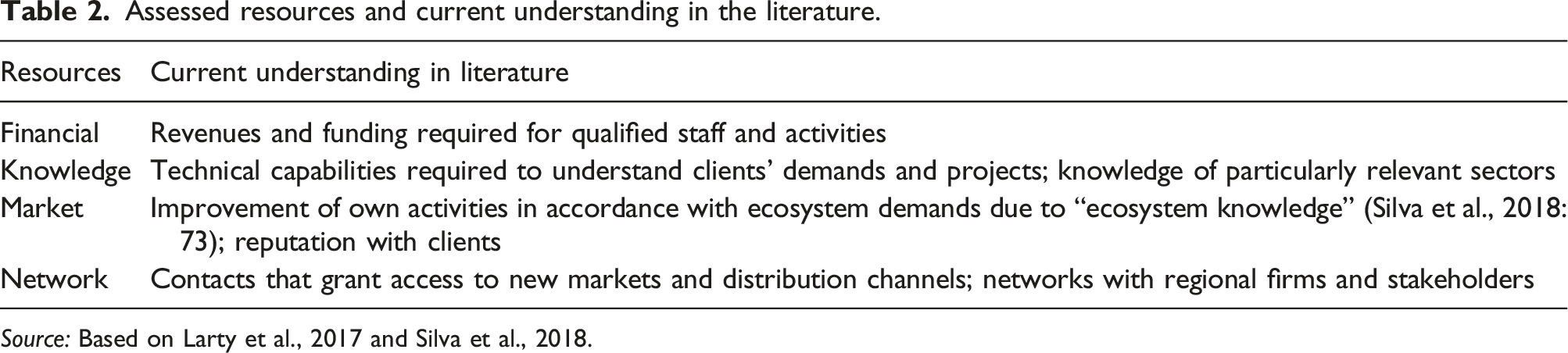
Source: Based on Larty et al., 2017 and Silva et al., 2018.
Figure 1 summarizes the aspects discussed above in a comprehensive conceptual framework that builds the foundation for our empirical investigation. The general structure of the framework depicts the separation of science and business subsystems as suggested in the entrepreneurial ecosystem literature (e.g. Lahikainen et al., 2019; Miller and Acs, 2017). The strategic alliance between knowledge intermediaries is positioned in the overlap between the two subsystems and characterized by the forms of resource alignments suggested by Das and Teng (2000). The analysis of these alliances in turn builds on the resources suggested by Silva et al. (2018) complemented by Larty et al. (2017)’s insights regarding the recurring knowledge and network resources. Theoretical framework. Source: Own elaboration, partly based on Das and Teng, 2000, Larty et al., 2017 and Silva et al., 2018, inspired by Miller and Acs, 2017 and Lahikainen et al., 2019.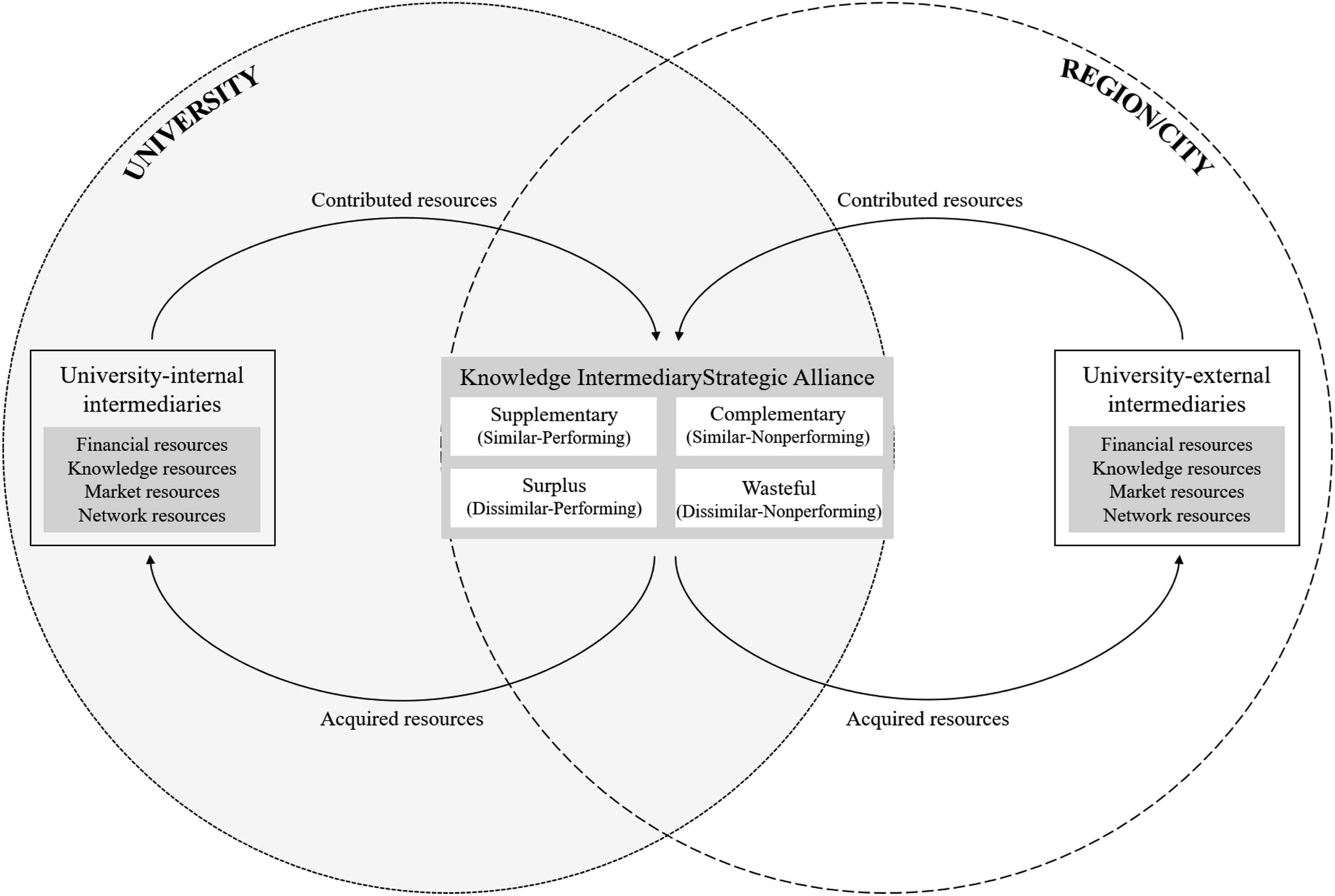
Case context and methodological approach
This paper draws on an exploratory multiple case study approach (Yin, 2009) to gain in-depth insights into the alignment of resources in alliances between knowledge intermediaries. Bearing in mind the dynamically evolving character of the research question, the study adopts a qualitative approach that directs the focus onto particular resources and their alignment. Such qualitative approaches have proven to be feasible in researching knowledge intermediaries (Cirella and Murphy, 2022; Good et al., 2020; Goswami et al., 2018; Hayter, 2016; Lahikainen et al., 2019; Larty et al., 2017).
Case context
Policy initiatives that aim to foster innovation support systems usually focus on a regional scope and, more specifically, the local environment of HEIs. The objective of this paper is a comprehensive analysis of the cooperative behaviour displayed by different sorts of actors within such initiatives. Hence, the analysis focuses on particular, publicly funded alliances at the regional level. Consequently, the study is based on empirical data on projects that emerged from a funding guideline that aims to enhance the connectivity between university-internal and university-external knowledge intermediaries within regional innovation support systems.
The assessed alliances have recently been established as partnerships between knowledge intermediaries in the regions of Goettingen, Hanover and Osnabrueck. All alliances are funded from the same funding guideline by the federal government of Lower Saxony for a 5 year period (2019–24) and share the same state law as an institutional foundation. To apply for public funding, the intermediaries in all regions formed consortia and commonly identified fields of activities and developed strategies for cooperation in accordance with existing regional innovation strategies and specializations (see Eickelpasch and Fritsch, 2005 for an overview of the funding approach). Each alliance consists of a variety of different actors and pursues specific, commonly identified and agreed objectives, with HEIs leading and coordinating each alliance. Thus, all three alliances are centred on cities with a comparably strong science base and try to cross the chasms between science and business subsystems by creating an organizational overlap between university-internal and university-external knowledge intermediaries. The alliances also include actors from surrounding counties and municipalities. Alliance (1). On the one hand, the Goettingen region/Southern Lower Saxony (about 659,338 inhabitants) is characterized by a business landscape consisting mainly of SMEs while being home to only a handful of bigger firms. On the other hand, the region is characterized by a remarkable scientific landscape, consisting of a large research university including a medical faculty, a technical university, an applied university, a private university and numerous non-university research institutions. However, as indicated by a recent study, “an open-up towards regional companies had only been happening over the last 7 years” (Bennat and Sternberg, 2020: 329). One aspect of this opening up is the formation of the Southern Lower Saxony Innovation Campus (SNIC). Including the four aforementioned HEIs with their transfer units, eight non-university research institutions and eight university-external intermediaries (mostly municipal innovation agencies), the alliance aims to strengthen the ties between science and industry and foster the formation of start-up and spin-off firms. Originally, the alliance did not focus on a particular industry or technology. However, during previous activities and in accordance with the research foci of regional firms and HEIs, the focus has been directed to the life sciences. Alliance (2). The Osnabrueck region (about 527,000 inhabitants) is characterized by a predominance of SMEs and a strong focus on agricultural machinery and equipment. This concentration is also reflected in the research focus of a relatively large applied university which, in addition to a medium-sized research university, builds the scientific core of the region. The alliance PROACTOS, centred on the two HEIs and municipal innovation agencies, aims to strengthen this specialization by streamlining knowledge transfer activities and establishing specific innovation networks. Alliance (3). Hanover region (about 1 158 000 inhabitants), including the eponymous capital of the federal state of Lower Saxony, represents the political as well as the economic centre of the state. Being home to numerous large companies, a large research university, a medical university, a university of applied sciences, a university of arts as well as various non-university research institutions, the region unfolds a considerable innovative potential already. Nevertheless, the Hanover Transfer Campus, consisting of the above mentioned HEIs, several university-external intermediaries and non-university research institutions, aims to strengthen the reciprocal exchange of knowledge between regional firms and entrepreneurs.
Overview of assessed alliances and their self-proclaimed objectives.
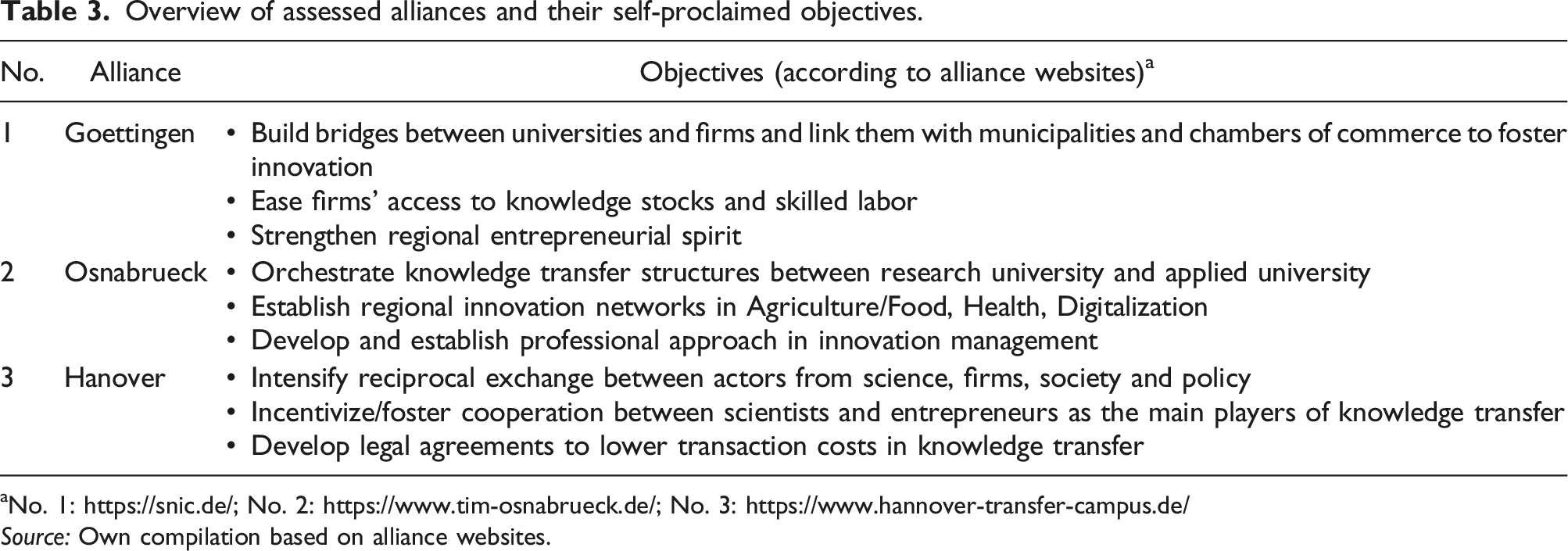
aNo. 1: https://snic.de/; No. 2: https://www.tim-osnabrueck.de/; No. 3: https://www.hannover-transfer-campus.de/
Source: Own compilation based on alliance websites.
Data collection and analysis
The analysis is based mainly on explorative semi-structured interviews (Yin, 2009) with knowledge intermediaries working in the context of the assessed alliances. The selection process focused on intermediaries at the operational level for whom cooperation with other intermediaries represents a central part of their daily business. Hence, the set of interviewees consists largely of employees in TTOs and municipal regional innovation consultancies (see Appendix B). The differences in the composition of the final sets of interviewees in the alliances reflect location-specific differences regarding alliance members and superordinate objectives. Based on a semi-structured questionnaire (Appendix A), the interviews commenced by collecting information on personal the background of each interviewee before broaching the issues of valuable intermediary resources and the effects of their alignment on cooperation in strategic alliances.
A total of 15 interviewees was identified and selected from initial dialogues with people in charge and online research (Appendix B). Because of the Covid-19 pandemic, all interviews were conducted via online conferencing tools. They took place in 2021, lasted from 38 to 81 min and were recorded and transcribed. In addition, documents and information published on the intermediaries’ websites were reviewed, as were regional and federal innovation strategies. Furthermore, both authors have been involved in strategic support of Alliance (1), enabling insights into additional internal documents and discussions for this particular alliance. Further, impressions and information from an online conference centred on the alliances were incorporated. Finally, preliminary results were presented and discussed at an online conference and during an internal research seminar.
The empirical data were examined by means of qualitative content analysis (Mayring, 2014). Coding commenced on the basis of the conceptual framework and was then supplemented by inductive coding along the transcripts. Informed by the conceptual framework, the process of analysis started by deductively coding notions of the different types of resources by the different intermediaries and subsequently applying the different forms of resource alignment suggested by the framework during an iterative coding process (Appendix C).
Results
We find different forms of alignment that directly affect alliance performance for all assessed resources (see Appendix D for an overview). We structure the presentation of our empirical results in accordance with the categories derived from our conceptual framework.
Alignment of financial resources: New sources of funding v. forced cooperation
Our analysis reflects three ways in which knowledge intermediaries rely on financial resources. First, some of their activities require a certain budget for locations, technical equipment, catering, keynote speakers, etc. Second, interviewees perceived the diversification of their fields of activity as highly time-consuming. Therefore, access to an extended base of qualified personnel represents an important success factor. Third, interviewees from all alliances emphasized the importance of innovation spaces such as makerspaces, incubators and start-up accelerators as nuclei of networking. Providing their clients with access to such innovation spaces is a third, indirect form of financial resources sought by knowledge intermediaries.
Operating in regional alliances enables knowledge intermediaries to supplement each other’s budgets for particular activities. For instance, interviewees reported that they had benefitted from extended budgets for events hosted in cooperation. Accordingly, cooperating for networking events enables larger audiences to be addressed, well-known speakers to be acquired, prestigious locations to be used, new formats to be tested and the regional offer to be differentiated so that it is adjusted to more specific groups (Row 1 in Appendix D). “Of course, sharing budgets is attractive to us, just to hold bigger events. Offer more. Eventually pay a well-known keynote speaker from an additional budget.” (No. 2)
The pooling of resources also includes the immanent upsurge in personnel that enables additional activities. Interviewees welcome the opportunity to share tasks with colleagues from other organizations (Row 2 in Appendix D). “We don’t have to do the research ourselves. That means that Mr [external intermediary] who has been doing this job since 2012, formerly did both the scouting and the consulting.” (No. 3)
In addition to supplementing already available money and personnel, operating in an alliance yields the opportunity to access complementary public and private funding sources. University-external intermediaries maintain strong networks with regional firms that in some cases chip in with financial resources for new projects and personnel. For example, interviewees from one alliance reported that close connections to innovative firms enabled the establishment of a new regional innovation network (Row 3 in Appendix D). “The [external intermediary] chipped in with money from regional firms and secured the funding. They contacted 50 to 100 firms to secure the private funding of the project.” (No. 9)
Further, collaboration in an alliance allows for the placement of clients in appropriate facilities. This aspect was mainly brought forward by university-internal start-up support units. According to European and German regulations, universities maintaining their support once a spin-off has been founded must ask for an equivalent market price in return. Because the need for support does not abate as quickly, they are reliant on university-external partners that can proceed the support (Row 4 in Appendix D). “Everything about facilities. Because start-ups need to leave the academic context after being founded. But also the knowledge about how to continue. There are other, next players. We are familiar with the funding programs applicable as a university. But, of course, there are other programs after being founded.” (No. 6)
On the downside, the new institutional settings that emerge from regional intermediary alliances can lead to a surplus allocation and utilization of existing financial resources. Interviewees reported the incidence of surplus alignments due to the new regional division of work, in the sense that some funds were administered by certain actors and not used in a way that all partners supported. Accordingly, some alliance partners’ extended activities in fields that were formerly ascribed to another actor are not always viewed as adequately compensated, which leads to bitterness among the people involved (Row 5 in Appendix D). “I would say, on an average, I work for the HEI for two hours a day. But we don’t get anything from them and that’s a little bitter. I would appreciate a partnership at eye level, in which they cherish our work. And I know their budget situation. The money is available.” (No. 9)
Furthermore, the federal funding of the assessed alliances required detailed cooperation strategies and working plans. According to the interviewees, these specifications did not always reflect regional peculiarities and may have led to wasteful scenarios, in which the applications did not automatically represent the most effective solution regarding the partners involved and the topics addressed (Row 6 in Appendix D). “In the end, everything is very much top down instead of bottom up. Casually speaking, someone tries to think of something nice and then there are several requests or must-haves in the calls. You need to cooperate for this topic. You need to include this actor.” (No. 11)
In sum, knowledge intermediaries benefit from pooling financial resources, access to additional funding sources and an overall increase in public funding. Notwithstanding these positive effects, our results also reveal potential negative effects. Institutionalizing collaboration processes can lead to additional administrative restrictions that in turn can lead to the inefficient allocation of financial resources if the restrictions do not meet regional peculiarities.
Alignment of knowledge resources: Including new skills and perspectives v. maintaining individual status
Our interviews reflect a differentiation between two sorts of relevant knowledge. First, a minimum of technological understanding is needed to grasp, articulate, and handle clients’ demands. Second, in addition to technical aspects, formats of knowledge intermediation often include support in strategic questions. This requires a high level of expertise in business strategy, business models and business development. In addition, knowledge about funding acquisition is indispensable.
Interviewees stated that the different knowledge resources in an alliance could be supplementary since cooperation enabled them to provide their clients with expertise that was not available in-house. For instance, university-internal start-up support units report increased requirements concerning multiple aspects of tax law. Highly individual and sophisticated demands cannot be met for all disciplines and business models that emerge in universities. Close collaboration with university-external experts increases the chances of meeting the existing demands (Row 7 in Appendix D). “Then there are mentors for particular expertise. For instance, we can draw upon the knowledge of law experts. Oftentimes, students address us with questions concerning tax law. It would be insane to cover all topics on our own and therefore it is important to work with different actors.” (No. 8)
Furthermore, interviewees emphasized that their alliance partners possessed complementary technical and managerial competences, and combining them in an alliance enabled them to specialize in certain aspects. According to this perspective, one expert or one organization cannot address all challenges arising in knowledge transfer and entrepreneurship. Instead, the interviewees saw it as desirable to develop a regional pool of experts that would collaboratively support local entrepreneurs (Row 8 in Appendix D). “That means exchange on a short way. Fast exchange and clearly defined contact persons. This is very, very important. Because they have different competences. […] There is little value in having one person for everything. It is better to have experts for particular topics that meet up with other experts and identify matches.” (No. 1)
However, this collaborative development is often hampered by non-performing alignments of knowledge resources. A main reason for surplus knowledge resources being pooled in knowledge intermediary alliances is the intentional provision of unsuitable information in order to strengthen the position and the image of one’s own organization (e.g., suggesting unsuitable collaborators or experts from the organization). Interviewees reported that alliance partners in some cases claimed to be capable of fulfilling certain tasks although it later turned out that the provided knowledge was not applicable. This behaviour resulted in a breach of trust and an avoidance of future cooperation (Row 9 in Appendix D). “But I don’t need to ask ten [internal intermediaries] if they have anyone who can do a certain thing. Five will say ‘yes’, but in the end it turns out ‘no, not really’. So for me it’s more important to talk to an expert right away. And that’s why it works that way and not the way the [internal intermediaries] would prefer.” (No. 3)
In addition, some interviewees emphasized significant discrepancies in approaches between university-internal and university-external intermediaries. The interviews revealed that the science-based approach of university-internal intermediaries is only partially compatible with the existing demands and challenges of regional firms. The firm-focused approach of university-external intermediaries in turn does not necessarily address high-tech aspects but puts a distinct emphasis on current challenges related to the selection and implementation rather than the development of technologies. These different approaches can lead to inapt forms of knowledge and in turn to a wasteful resource alignment (Row 10 in Appendix D). “From my perspective, we have a different depth, or how you want to call it, in which we work with firms. We indeed develop funding proposals with them. But concerning the current state of technology, we do not really address the current international state of technology. That’s not the case.” (No. 12)
Results concerning knowledge-based resources show that knowledge intermediaries might benefit from each other’s knowledge as it seems impossible to provide in-depth knowledge about all innovation-relevant topics in one organization. However, due to the diverging demands of the core target groups, not all activities are suitable for cooperation between intermediaries.
Alignment of market-based resources: Extending ecosystem knowledge v. dissolving specialization
According to the interviewees, bundling and supplementing each other’s information about regional actors led to an acceleration of the identification of entrepreneurs and innovation potentials. Each of the intermediaries tracks and screens the activities in “their” innovation subsystem in order to identify innovative knowledge stocks and entrepreneurs. Without cooperation, the results of this screening run the risk of ebbing away due to a lack of matching contacts. The current demands of regional firms in particular are considered to be very fast moving and require on-time support (Row 11 in Appendix D). “Because the [external intermediaries] simply lacked the connection into the universities. That means, they inquired potentials, barriers, and demands for innovation in regional SMEs but they had no contact person in academia. They had to search for contacts and by the time that happened and they had made a contact, the topic had already become irrelevant.” (No. 1)
According to the interviewees, supplementary pooling of contacts within innovation subsystems is fuelled by complementary insights and understanding of modes of operation in the respective subsystem. This results in a mutual “translating” (No. 9; No. 14) function of all alliance partners to foster the understanding of mechanisms and demands (Row 12 in Appendix D). “The partners are some kind of translator for ways of thinking and operation by other target groups. For instance, the [external intermediaries] know how firms think and work and we have insights into science and can translate for each other.” (No. 5)
Furthermore, this particular understanding is reinforced by a higher level of trust that results from experience within the respective subsystem or, in the case of university-internal knowledge intermediaries, an affiliation to the same organization. Interviewees report higher levels of trust shown by academic as well as non-academic actors if the intermediary comes from within their organization; that is, from the same innovation subsystem. Affiliation to either subsystem is perceived as beneficial in addressing the target group. However, this beneficial effect is ascribed not only to the organizational affiliation of an intermediary but also to an individual’s background and experience (Row 13 in Appendix D). “If he is from [internal intermediary], there is another leap of faith comparing to someone who comes from a [external intermediary] to ask what they are doing. […] I don’t think it’s effective to send someone into the firms, who has hitherto only been active in academia. They have to speak the same language. That’s an important success factor.” (No. 1)
The incorporation of numerous regional partners in an alliance can result in a high level of bureaucracy that may slow down or inhibit innovation processes. A compulsion to cooperate and include all alliance partners’ inputs to actually achieve a surplus may overshoot as some may not have anything to contribute or may require the others to interpret the governing institutions in a very restrictive manner. To push forward innovation projects requires a high level of dynamics that sometimes overstrains administrative units or units that are afraid of breaching any rule (Row 14 in Appendix D). “And then the administration cannot cope with it. Somehow, the research is too fast and then it is too dynamic to be included in everyday business because meanwhile the agenda has changed. New objectives, new resources etc. I think, everything must function more dynamically and faster and that requires a more regular exchange.” (No. 14)
Further, additional activities that emerge from collaborating on a regional level may hamper the participants’ original specialization. According to the interviewees, the sheer maintenance of alliances represents a time-consuming activity. While this yields the opportunity to diversify own resources and competencies, it may also distract from the original mission and focus. For instance, university-internal start-up support units reported an emerging lack of time for the development of new support instruments due to the necessity of participating in regular exchange formats and an additional focus on regional development (Row 15 in Appendix D). “On the one hand, it may improve our service, if we can think about additional services demanded by the clients. On the other hand, it also distracts us from our main task. And that is supporting start-ups the whole time.” (No. 9)
Insights concerning market-based resources corroborate the initial hypothesis of knowledge intermediaries’ affiliation to one innovation subsystem and the opportunity to benefit from the resulting trust-based relations. Nevertheless, the newly implemented focus on collaboration led to administrative challenges as well as to a diversification of some intermediaries’ activities because they engage in additional topics.
Alignment of network resources: New contacts v. regional lock-in effects
The interviewees report supplementary network contacts with their alliance partners that allow them to extend their range of addressed participants for events. Further, the additional network resources accessed via the alliance comprise supplementary experts and potential keynote speakers that are required for the dissemination of knowledge among clients (Row 16 in Appendix D). “To raise the number of participants. The [external intermediaries] possess a large network of contacts. That means, if we cooperate, in all probability, we gain a higher number of participants. And of course, they possess contacts to potential key note speakers. Hence, we exchange information about appropriate speakers a lot.” (No. 2)
In addition to this supplementary character of network contacts, networks of university-internal and university-external knowledge intermediaries can align in a complementary way as they differ in scope and composition. For instance, university-external intermediaries reported that they perceived academic structures as very complex and sometimes confusing and thus found it difficult to identify access points to academic networks (Row 17 in Appendix D). “It was brought into the HEI by Ms [internal intermediary]. And Ms [internal intermediary] knows the HEI better. And knows where the strands meet and whom to contact. The HEI itself is a very complex structure of more or less autonomous professors and [an internal intermediary] has a good overview and can support us.” (No. 11)
These supplementary and complementary alignments of network resources are reported to be especially helpful in the initial phase of an alliance. The more an alliance is established, the more the alignment of different network resources is perceived as surplus as the frequent cooperation with different target groups endows alliance partners with contacts. The remaining urge to coordinate own activities with all alliance partners can hence turn into an everyday imposition that slows down the activity itself (Row 18 in Appendix D). “For example, talking about firm contacts, we always contact the [external intermediary] and we coordinate our activities with them. Even if we have an idea of who to talk to because we know them from previous events.” (No. 5)
Further, close long-term cooperation in a formalized alliance poses the risk of lock-in effects in well-established networks. According to the interviewees, maintaining an adequate level of openness represents a major challenge for the alliances. Hence, restricting the search for contacts and competences to an existing alliance can lead to a wasteful alignment (Row 19 in Appendix D). “Of course, this poses the danger of people only relying on the networks they already created. To maintain the openness and make sure to include new actors and competences and expand the base is a big and important challenge for the sake of a technology transfer incorporating the whole regional innovation system.” (No. 1)
Knowledge intermediaries can benefit from each other’s network resources. However, interviewees mention the fear that close, institutionalized networks might thwart the openness required to incorporate additional actors in own activities.
Discussion
Knowledge intermediaries and their interplay in innovation support systems are at the centre of ongoing scholarly and political debates. This paper contributes to this debate by suggesting and testing a well-established theoretical framework for assessing the premises and effects of cooperation between different knowledge intermediaries. This investigation enriches current debates with regard to three aspects.
First, the results corroborate the importance of financial resources, knowledge resources, market resources and network resources for the successful intermediation of knowledge between academic and industrial networks (Larty et al., 2017; Silva et al., 2018). The results of the study show that the suggested resources play important roles in the design and functionality of intermediary cooperation. However, the novel level of granularity that characterizes the investigation of valuable intermediary resources suggests several revisions and addenda regarding the understanding of how these resources unfold their value for knowledge intermediaries and accruing challenges in their alignment. The value of financial resources includes basic funding for qualified personnel as well as budgets for particular activities. More specifically, knowledge intermediaries rely on access to diversified public and private sources of funding. Hence, the relevance of financial resources in an alliance between knowledge intermediaries exceeds the sharing of existing funds as it provides the opportunity to tap additional funding sources. This, however, may be thwarted by administrative restrictions that come with formalized collaboration. Valuable knowledge resources include technological as well as managerial knowledge (Lichtenthaler, 2013). Our data emphasize the dependence on managerial and strategic skills that are in many cases sought by clients. Notwithstanding the opportunity to benefit from accessing knowledge resources, the demands differ between the respective core target groups. These discrepancies limit opportunities for cooperation to a comparatively small number of projects.
Accordingly, market resources consist of what Silva et al. (2018: 73) term “innovation ecosystem knowledge” and refer to information that helps actors to align their own activities with the ecosystem and regional actors’ demands. The results highlight the relevance of university-internal and university-external intermediaries’ constant focus on different target groups, which leads to an enhanced understanding and broader perspective that cannot be obtained by the respective partners in isolation.
Network building being at the core of intermediary tasks makes network resources important. Most notably, interviewees pointed to the threat of lock-in effects that may emerge from dense regional networks and well-established communication channels. This observation leads to a questioning of the optimum density of relations and alliances in innovation support systems. According to the interviewees, close alliances bear the risk of neglecting external inputs.
Secondly, our results support the call for the development of holistic approaches to the analysis of innovation support systems (Good et al., 2019). The analyzed alliances show that the differences between intermediaries lead to the creation of highly idiosyncratic resource sets that are tied not only to the ecosystem but to the mainly addressed subsystem. The results indicate that being an integral part of either subsystem may lead to two effects. First, considering the intermediaries’ internal strategies and objectives, it may lead to a lack of reciprocity within each portfolio of activities. Being evaluated by the success of a particular core actor group eclipses all other actor groups and strengthens the ties between intermediaries and their clients. Second, their focus on a certain actor group provides knowledge intermediaries with an increase of trust by this group. These effects in turn can serve as an explanation for individual intermediaries’ difficulties in connecting academic and non-academic networks as observed in prior studies (Clayton et al., 2018; Hayter, 2016; Hülsbeck et al., 2013) as well as shortcomings in individually assessed university innovation strategies (Salomaa et al., 2022). Hence, our study indicates that understanding the roles and potentials of knowledge intermediaries in and for entrepreneurial ecosystems requires approaches that restrict their focus neither to academia nor to industry. Instead, assessing the dynamics of innovation and entrepreneurial ecosystems requires holistic perspectives in order to grasp the complex interdependencies between the manifold actors, networks and support mechanisms (Good et al., 2019, 2020). In this sense, our findings support the positive effects of ecosystem improvement on the performance of particular actors and actor groups operating within the system (Lahikainen et al., 2019; Goswami et al., 2018). Furthermore, our investigation shows that regional cooperation between intermediaries can support each intermediary in accessing additional resources (Comacchio et al., 2012; Larty et al., 2017; Sinell et al., 2018). However, our resource-based perspective on the peculiarities of long-term cooperation between knowledge intermediaries reveals that close cooperation inevitably provokes the sharing of resource facets that do not align in a performing way. Intermediary cooperation represents a non-trivial objective that requires policy instruments such as publicly financed strategies and alliances in order to commonly define objectives, responsibilities and processes.
Third, our research supports the necessity of aligning policy instruments with regional structures and characteristics as argued in earlier RIS approaches (Tödtling and Trippl, 2005) as well as in recent entrepreneurial ecosystem approaches (Audretsch and Belitski, 2022; Reischauer et al., 2021). The assessed initiatives were established in the context of similar political conditions that – presumably – left room for individual adaptations to meet regional demands. Nevertheless, interviewees reported that regional competitions for funding as such could lead to scenarios in which regional actors focus on what is best for fund acquisition and their own position within the emerging setting rather than on what is best for the region. According to the interviewees, competitive funding programs can lead to undesirable side effects because regional actors try to address funding criteria rather than endogenous regional demands and potentials. Further, the results indicate that, despite being parts of commonly funded alliances, the participating organizations try to enhance their individual positions within the alliance by pointing out their particular contribution and in some cases trying to perform activities inefficiently to enhance their visibility for ministries and other fund-providing institutions. This questions the predominant perception of intermediaries as altruistic actors supplying “midwifery” services (Yusuf, 2008: 1170) for their clients’ innovation projects since “their purpose is not their own success, but the success of their clients or members” (Dalziel, 2010: 13). To the contrary, our findings outline a picture of knowledge intermediaries as self-confident actors in innovation systems that, in addition to supporting others, do indeed strive for their own success. Accordingly, our findings support the perception of knowledge intermediaries as a group of stakeholders in entrepreneurial ecosystems rather than merely a means to an end (Russo et al., 2019).
Concluding implications
The starting point of this study was the oftentimes presupposed but insufficiently analyzed interdependencies between different types of knowledge intermediaries in regional innovation support systems. Aiming to close this gap, the study builds on a differentiation between university-internal and university-external intermediaries. The resource-based approach assesses the potential for resource sharing by strategic collaboration between knowledge intermediaries.
The results show different forms of alignment for all assessed resources. In particular, the non-performing ways of alignment yield interesting implications as they question predominant policy strategies and perceptions of intermediaries. For instance, merging intermediaries’ financial resources yields the opportunity to add and access new sources of money but inevitably creates a setting in which money acquisition trumps ecosystem establishment as the major objective. Similarly, relying on diversified stocks of knowledge in an alliance can enhance an organization’s own performance but can also lead to undesirable behaviour in order to maintain or strengthen its own position within the alliance. A closer look at the alignment of market and network resources reveals the reasons for this behaviour. Being tied to either innovation subsystem endows knowledge intermediaries with unique, idiosyncratic and trust-based relationships and networks with their core target groups. Emanating from their own organizational affiliation and experiences, these represent highly valuable resources that cannot be recreated by actors operating in other contexts. Hence, too close collaboration yields the risk of making one’s contribution gratuitous.
While, from a policy perspective, the results generally support current strategies that aim to induce strategic collaboration between different knowledge intermediaries, they imply certain modifications. To tap intermediaries’ full potential for the support of particular target groups, new strategies require an emphasis on the differences between intermediaries while fostering strategic cooperation. These differences result in custom-fit resources and capabilities to support own target groups while hindering the support of other actors. The successful intermediation of knowledge between academia and industry requires separate but orchestrated actors to create an institutional environment in which all relevant actors are provided with customized support. This orchestration represents a core task of innovation policy in regional innovation support systems.
Finally, the study disentangles the interactive dynamics between different knowledge intermediaries at the work level. The results show that knowledge intermediaries try to consolidate their own position within the regional innovation support system even if this does not foster the greater public good. Policies aiming to strengthen regional innovation support systems need to perceive knowledge intermediaries as a group of actors that contribute unique sets of resources while pursuing their own objectives. Hence, policies and funding schemes need to take account of intermediaries’ objectives rather than perceiving them as an instrument for pursuing political goals.
From a scholarly perspective, the empirical observations reported here represent a first step in disentangling the interdependencies between different knowledge intermediaries, the peculiarities of cooperation between them and the effects on innovation support systems. Tailored to covering intermediaries’ internal perspectives, our research provides a small yet sophisticated database for identifying and illustrating motivations for certain cooperative behaviour.
Of course, the study has some limitations. It does not elaborate on the perception of clients or other stakeholders and nor does it rely on longitudinal data. Moreover, the framework is limited to analyzing alliances in the context of a strong science base. Thus, the findings may not apply to innovation support systems servicing a less distinctive scientific landscape. Finally, although the involvement of both authors in one alliance enhanced the understanding of certain dynamics and the broader regulatory framework, it cannot be precluded that this involvement affected the perspective on this particular alliance.
Future studies could link their research designs to these limitations. Thus they might incorporate views from scientists, firms, regional policy makers and other relevant stakeholders to create a multidimensional perspective. Further, future studies could enrich current discussions by conducting longitudinal data at different stages of alliance development. Further, scientifically less endowed regions probably rely on different resource mixes in their innovation support and should be assessed separately.
Supplemental Material
Supplemental Material - A resource-based analysis of strategic alliances between knowledge intermediaries in regional innovation support systems
Supplemental Material for A resource-based analysis of strategic alliances between knowledge intermediaries in regional innovation support systems by Philipp Bäumle and Kilian Bizer in Industry and Higher Education
Footnotes
Acknowledgements
The authors would like to thank two anonymous reviewers for their insightful comments on an earlier draft that helped to improve this paper significantly.
Author contributions
Philipp Bäumle: Conceptualization, Methodology, Formal Analysis, Investigation, Writing – Original Draft, Writing – Review and Editing, Visualization; Kilian Bizer: Conceptualization, Writing – Review and Editing, Supervision.
Declaration of conflicting interests
The author(s) declared no potential conflicts of interest with respect to the research, authorship, and/or publication of this article.
Funding
The author(s) disclosed receipt of the following financial support for the research, authorship, and/or publication of this article: The research is funded by the Lower Saxony Ministry of Science and Culture under grant number ZN3492 within the Lower Saxony “Vorab” of the Volkswagen Foundation and supported by the Center for Digital Innovations (ZDIN).

Supplemental Material
Supplemental material for this article is available online.
Note
References
Supplementary Material
Please find the following supplemental material available below.
For Open Access articles published under a Creative Commons License, all supplemental material carries the same license as the article it is associated with.
For non-Open Access articles published, all supplemental material carries a non-exclusive license, and permission requests for re-use of supplemental material or any part of supplemental material shall be sent directly to the copyright owner as specified in the copyright notice associated with the article.
