




Abstract
The need for employees in the exact and natural sciences sector with both work experience and academic qualifications, especially combined with an entrepreneurial mindset, is rising. The University of Groningen offers an alternative Master’s program entitled Science, Business and Policy (SBP). SBP combines entrepreneurship education with the integration of a disciplinary science domain and thereby prepares students in science advising. This includes a work placement of 6 months, provided by companies, policy organisations and NGOs. To examine the impact of work placements from the perspective of the employer, this article analyses 20 semi-structured interviews with providers of placements. The results show that employers judge students who have undertaken a work placement as attractive future employees, and the quality of science advice given by students is seen as high. From a work floor perspective, work placements are a strong component in the optimal education of future employees. Integrating academic theory and experience in practice contributes to the employability of science students. The impact of work placements goes further than employability, since employers also indicate a direct effect on work dynamics and see the direct impact of advice reports in their organisation. The work-based learning approach chosen to achieve this specific entrepreneurship education fits the need of industry and other non-academic employers.
Keywords
In industry there is a need for employees who combine a science background with a broad view (Borrell-Damian et al., 2010) and for professionals who possess different skills than those are needed for an academic career (Hart, 2019; Pang et al., 2019). This increases the need for universities to extend their education beyond preparation for a career in research, preferably as an integral part of the curriculum (Moira et al., 2018). In this context, Abreu et al. (2016) signal a global trend in which universities tend to profile themselves as entrepreneurial entities. Uyarra (2010) defines the regional importance of universities and their connection to the rest of the economy, requiring a revision of their role and their interactions and different mechanisms of engagement. It is argued that universities should strengthen their social engagement to respond to societal needs, and for this multiple models are available (Cuesta-Claros et al., 2021).
After obtaining their Master’s degree, in reality most graduates pursue non-academic career paths. Of those who do continue the academic path and undertake a PhD, the majority still do not ultimately pursue a career in academia (Etmanski, 2019). These graduates encounter problems like experiencing organisational culture shock (Skakni et al., 2021) or having skills that do not seem to be transferable from academia to the work floor (Enders, 2004; Pedersen, 2014). Despite the needs of employers and the career paths of most graduates, current mainstream science education at the Master’s level still focuses on disciplinary theory, content knowledge and skills needed for an academic career (Sarkar et al., 2020). There is a need for professionals with a new type of expertise in the domain where science and business meet (Retra et al., 2016).
The above situation creates a functional employability gap, with higher-educated students still lacking essential professional skills (Jackson, 2010; Sarkar et al., 2020). Universities have different approaches to increasing the employability of their students (Winkel, 2010), but so far curricula do not systematically cover elements in terms of the theoretical and practical learning of entrepreneurship (Blankesteijn et al., 2021).
Gaining real work experience has been suggested as a key factor in bridging the employability and skills gap (Chi and Gursoy, 2009). Since education and expectations from the work floor do not always match in practice (Gomes and Yasin, 2011), it is crucial to ascertain whether academically designed work placements actually align with the skills needed on the work floor (Matthews et al., 2021).
The Science, Business and Policy (SBP) program of the University of Groningen is designed specifically to bridge this gap. SBP trains science students as science advisors and broad entrepreneurial professionals, connecting academia with the workplace. It has a multidisciplinary approach and a focus on broader skills, such as teamwork and project management. It is based on gaining experience through a work-based learning (WBL) design with a focus on entrepreneurship education. From a student’s perspective, SBP students feel better prepared for careers outside academia compared to those from a classical research Master’s program (Grooters et al., 2022a). The question is whether this is also the view of societal organisations and industry. In this study, we carried out 20 semi-structured interviews with providers of SBP work placements (called clients in SBP). We interviewed the daily supervisors of the work placement, who are all professionals working for companies, policy organisations or NGOs.
The main objective of the present research is to map the client-perceived societal impact of the alternative science Master’s SBP program. When it comes to bridging the academic–practitioner gap, the point of view is often that of academia or policy makers; practitioners' voices are often neglected. Our research questions therefore are the following. How do clients experience SBP and WBL, and, more specifically how do they experience the learning outcomes, skills and the work placement? What is the impact of the work placement? And finally, is the SBP student distinctive and employable? We hope the answer to these questions will contribute to bridging the employability and skills gap.
Entrepreneurship education
Entrepreneurship education was originally designed to foster start-up firms. Many universities seem to focus on this aspect (Etzkowitz 2003). However, the meaning of entrepreneurship has since, such that it does not relate solely to starting and running one’s own company but is seen in a broader perspective. For instance, the concept now includes a so-called ‘entrepreneurial mindset’ (EM) (Hagg and Gabrielsson, 2019). It is precisely this EM that is interesting for industry and for other employers, because it can be a highly relevant element in the training of a broad scientist (Jones, 2005). The problem with EM is that the concept is ill-defined (Robinson and Gough, 2020), and thus so are the competencies, skills and cognitive abilities derived from this mindset (Larsen, 2022), which often form the basis of educational learning goals.
Intrapreneurship is used to describe entrepreneurial behaviour in existing organisations (Antoncic and Hisrich, 2001). A major difference between intrapreneurship and entrepreneurship is the financial risk (Antoncic and Krathwohl, 2001), since the intrapreneur operates in an existing company and therefore does not take a personal risk with their own investment. On the other hand, the skill sets of intrapreneurs and entrepreneurs seem to be strongly related (Blanka, 2019; Smith et al., 2016) and also relevant in the corporate world (Coulson-Thomas, 1999). Recently, the term intrapreneurship has been described as outdated (Smith et al., 2016) and is now included in the much broader definition of entrepreneurship (Kuratko et al., 2013).
Larsen (2022) stresses that entrepreneurship education should take a critical position and provide a theoretical foundation for the educational strategies that institutes choose to impart an EM. To streamline this process, she explains that the EM can be conceptualised in three different ways, each of which is hypothesised to have different consequences for the educational set-up. The first conceptualisation implies the recognition of the cognition component underlying a supposed mindset (how to think as an entrepreneur). This enlargement of knowledge can be based on traditional lectures and practising cognitive skills. The second conceptualisation of the EM is as a frame of mind (a positive attitude towards entrepreneurship) that can be taught by, for example, reflection and simulation. The third and last conceptualization is of an EM as capability (the assets, skills and competencies needed for entrepreneurial behaviour), which can be taught, for example, with experiential learning which includes real-life projects and situations in which entrepreneurship is really done and practised.
Larsen (2022) also notes that developing an EM is a time-consuming process. In the SBP program, there is the luxury of having a complete study year and thus the time to unfold an educational approach that is a hybrid of all three conceptualisations. SBP starts with two courses, which both begin with learning entrepreneurial theory, to expand the knowledge of business and policy acquired through classical lectures and an exam (conceptualisation 1). The next element in the courses are group projects in which students are trained in the process of change and reflect together and by themselves (matching the aim of conceptualisation 2). The final goal of SBP is to prepare students to be able to display more integration and practice-oriented behaviour on the work floor, and to bridge science and society. Therefore conceptualisation 3 of the EM is the main objective of SBP––to equip the students with the capabilities they need to become a professional. This is reflected in the curriculum, with individual and long (40 ECTS) work placements being offered.
Another way of defining the EM concept is by looking at the learning goals. The SBP learning goals (described in details in Grooters et al., 2021) are formulated using the Bloom taxonomy (Anderson and Krathwohl, 2001), arriving at the highest level in which students have to create their own science advice. This can be met only when an EM has been developed, with the EM conceptualised as capability and the matching skills and competences substantiated (conceptualisation 3).
Beyond entrepreneurship education
In the SBP program, the entrepreneurship education goes further than teaching an EM, or obtaining a general degree of entrepreneurship. SBP goes beyond entrepreneurship because it is about the building of an entrepreneurship education against the background of the integration of different domains––in this case the domains of science and business or policy. This approach differs from that of a classical research-oriented science Master’s program, in which the focus is on disciplinary education (e.g. biomedical science, or more specific mechanisms in oncology).
The SBP program aims not only to increase knowledge about the student’s own discipline but also to teach them how to use this knowledge to create solutions for societal issues. This can be achieved only through the integration of both domains. An example would be the development of a policy for population screening in oncology. This approach creates an educational program that has a different career aim, as is shown in Figure 1. In practice students are not familiar with the overview of the labour market. Presenting this figure creates an awareness of potential professions and the matching educational programs available. The careers in the bottom row (7, 8, and 9) are covered by a classical research Master’s program, while SBP covers professions for which the integration of science with business or policy is needed or for which students have gained an EM. Matrix of professions.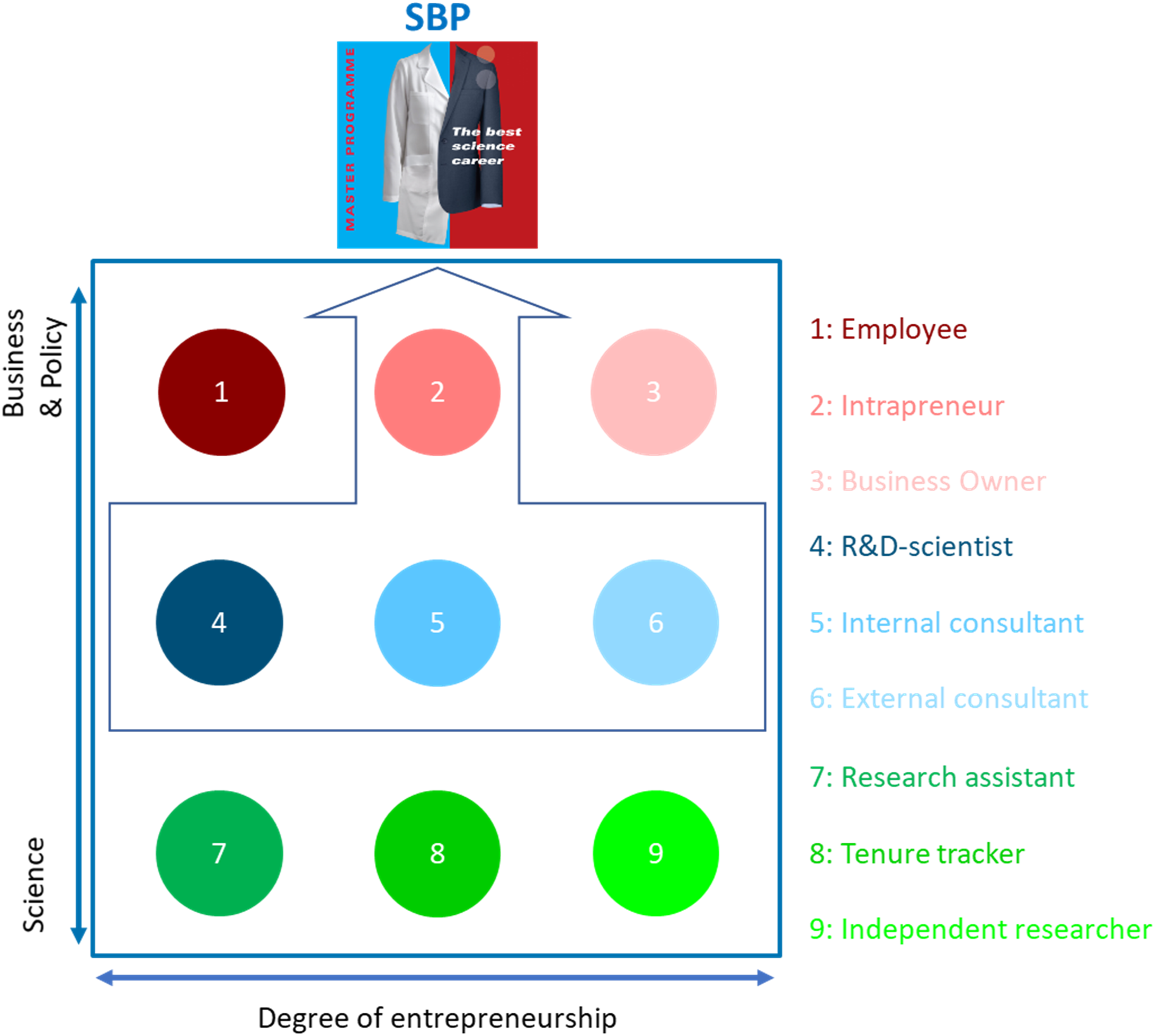
In science advising, students deal with multiple stakeholders. This is one of the skills developed by working with actual clients (Foster and Yaoyuneyong, 2016), increasing the needed workplace competencies (Cooke and Williams, 2004). In preparation for a professional life, it is also important that students learn to function in a complex situation (Dede, 2005), to work in different teams (Geissler et al., 2012) and to deal with ill-defined problems (Lombardi, 2007).
The SBP program
Bridging the employability and skills gap can be achieved using the work-based learning (WBL) method, with students gaining working experience in real professional settings, for instance in work placements. In the SBP program, students gain practical experience through a long work placement at the employer’s location. This work placement falls entirely within the curriculum. WBL is described in the literature as an important approach (Lester and Costley, 2010; Raelin, 2008) and has been used for some time, but is rare at the Master’s level (Graf, 2016). The Netherlands seems to be advanced in implementing WBL (Perusso and Wagenaar, 2021), and business and engineering are the disciplinary areas in which WBL appears to be most developed (Perusso and Wagenaar, 2021).
At the University of Groningen there are three options for the 2-year science Master’s degree (EQF level 7): the classic research-oriented Master’s (ROM) with two research internships, an education Master’s variant (which is not considered further here), and the SBP Master’s variant. The SBP variant is the same as the classic variant in the 1st year and in the second year the focus is completely on SBP. During this SBP year, the various science students form a multidisciplinary cohort; for example a mathematician, a marine biologist, a pharmacist and an astronomy student all do the same program. This cohort starts in the second (SBP) year, which is entirely WBL-based. It contains two courses (both 10 ECTS) on business and policy, including entrepreneurship aspects, which both include multidisciplinary project education in groups. The literature confirms that similar projects prepare students well for workplace environments (Foster and Yaoyuneyong, 2016) and are more effective than traditional methods (Keppell and Carless, 2006). The courses are followed by a long work placement (40 ECTS), which is the focus of this article (for a more in-depth description of the curriculum, see Grooters et al., 2021).
Work placements in SBP are individual and full-time, and take place at an external location (i.e. the location of the client) which may be a company, a policy organisation or an NGO. Local, regional or international placements are all allowed. An individual project should deal with a relevant and current topic and must be completed within 6 months. During this time, the student is project owner and has full responsibility for the project.
The content of the work placement is always based on the scientific discipline in which the student was trained. An example would be a biomedical student looking at whether a certain vaccine should be added to a national vaccination program. The scientific findings are integrated into business and/or policy plans to create a solution for the client’s problem. The student’s final product is an advisory report for the client containing a solution based on the integration of different disciplines, a consideration of different scenarios and an implementation plan. In this way the student gains experience as a science advisor, with a potential impact on society.
During the work placement, interactions between four different players are obligatory––that is, between the student and three supervisors. Each student has a supervisor from SBP, who is an expert in the field of project education and integration. An additional university teacher serves as discipline supervisor, an expert on the science topic of the project. The last supervisor is from the workplace and is responsible for the daily supervision. Due to this interplay of supervisors, the university has control over the quality of education (Grooters et al., 2021). A second way to control these interactions is through curricular education in the placement process. There are three pre-set events, starting with two preparatory weeks on campus. During these weeks, the students make a plan of action for their work placement; this is followed by workshops at which they get to know about each other’s projects through presentations and peer reviews. This preparatory phase is followed by a 6-month block on location, broken by a week’s return to the university in the middle of the period. During this mid-term evaluation, adjustment and input from peers are collected. The last educational event of the work placements is a conference in which all SBP students present their science advice to the public (consisting of clients, supervisors, fellow students, family, potential employers and other interested parties). In addition to final presentations, there is room for networking. First career offers are often made at this closing congress.
During this whole process, the student is seen as an important partner and an active player. Science students can hereby take a different educational approach and use their scientific knowledge and academic skills to contribute to solving problems in real life. This can be illustrated also by the way the placements are arranged: students have to do this themselves. This ensures a proper fit of interest and an internal locus of control (a work placement does not happen to you, but you arrange it yourself), both of which benefit the quality of education (Naude et al., 2016).
Method
This interview study is approved by the ethics committee of the University of Groningen (CETO submission number; 69813564). All tables are available as supplemental data, referred to in the text as supplemental table with number (ST#).
Participants
Twenty SBP work placement supervisors (also referred to as clients) who had supervised one or more students in 2017, 2018, or 2019 participated in a semi-structured computer-assisted personal interview (CAPI) study. Thirteen participants were business placement supervisors (Nmale = 8, Nfemale = 5) and 7 were policy placement supervisors (Nmale = 4, Nfemale = 3), which reflects the division of actual business and policy work placements (Grooters et al., 2021). Based on a random number generator, participants were randomly selected from a database that contained contact information on 129 work placement supervisors. Forty-seven supervisors were invited before we reached 20 participants. Of those who did not participate, the majority did not respond to the invitation. Five potential participants (10.6%) worked in the frontline of the COVID-19 pandemic or did not have time to participate due to COVID-19 for other reasons, while explicitly noting that otherwise they would have liked to participate. Five potential participants (10.6%) did not work at the work placement organisation any longer and could not be contacted via the work placement organisation. Excluding these potential participants, our response rate was 54.1% (i.e. based on 37 invitations). Interviews took place between April and June 2020. 19 interviews took place in Dutch, and 1 in English.
Questionnaire, data collection and procedure
A questionnaire was constructed and pre-tested by means of cognitive interviewing. Based on the outcomes of six cognitive interviews (which served as a pre-test, not included in the results), the questionnaire items were discussed by all authors of this paper. Questions that turned out to be unclear or wrongly interpreted during the pre-test were adjusted or removed. The revised version of the questionnaire was pre-tested again with a cognitive interview. No comments were made during this test interview, so the same version was used for the 20 final interviews. For data collection, we used the survey software Qualtrics. Before participating, respondents had to give informed consent. When consent was given, participants were first asked to conceptualise their perception of SBP and work-based learning. Then, they were asked to evaluate the students they supervised. When they supervised multiple students, we asked them to provide an average evaluation of all supervised students. After this, participants received questions on the quality of the advice report and the perceived societal impact of the SBP work placement. Lastly, respondents were thanked for their participation in the interview and were asked whether they wanted to receive the results of the study and whether they had any comments or questions about the interview. All interviews were transcribed in full (available on request) and the transcriptions were used as the basis for coding the data.
Content analysis
We used a combination of conventional content analysis (CCA) and directed content analysis (DCA) (cf: Hsieh and Shannon, 2005). For most questions we used CCA, a primarily inductive approach for which coding categories were constructed by the coders themselves. This coding practice consisted of two rounds: an open coding round, in which themes were connected to text fragments of the interview, followed by an axial coding round, in which the assigned codes were compared with each other and combined in an overarching code. In addition, for some questions we used DCA, which meant that we based coding categories on existing theoretical knowledge. Based on theory, we devised a set of predetermined codes while still allowing for additional categories that did not fit in this code set (i.e. using CCA). For instance, when we asked participants to define academic skills and academic level we used coding categories based on the Science Student Skills Inventory (SSSI), an instrument developed to measure science students’ skills (Matthews and Hodgson, 2012). In addition, we used skills based on SBP’s learning outcomes (e.g. Grooters et al., 2022a). We also allowed for additional categories, as these coding categories were not expected to be exhaustive because SBP students are not “common” science students (e.g. because of the program’s additional focus on entrepreneurship).
Initial coders were Master’s students and a research assistant, all of whom had training and prior experience in quantitative and qualitative coding. We determined the trustworthiness of the codes based on intercoder reliability using Cohen’s Kappa (for the questionnaire topics for the open questions, items used and Cohen’s Kappa per question, see ST1). To do this we let two independent coders code 30% of the data again, based on the coding categories determined in the axial coding round and a codebook that explained these codes for the coders (for an example of the codebook, see ST2). Quotations from individual employers have been added to the results section when they have added or illustrative value.
Student evaluation, closed-ended items
Next to the open-ended questions (ST1), we asked participants to evaluate the SBP students’ skills on a five-point Likert scale. More specifically, they were asked to evaluate statements about the learning goals they perceived the average SBP student had achieved during the entire work placement (1 = I totally disagree that the student has developed skills, and 5 = I totally agree that the student has developed skills). In order to measure the perceived learning skills gained, we used items from the SSSI (Matthews and Hodgson, 2012): scientific content knowledge in your field(s) of study; communication skills (i.e. scientific presentations); writing skills (i.e. scientific writing); quantitative skills (i.e. mathematical and statistical reasoning); teamwork skills (i.e. working with others to accomplish a shared task); and ethical thinking (i.e. ethical responsibilities and approaches). In addition, we added items based on the learning outcomes of the SBP program that were not included in the SSSI: practical research skills (i.e. lab work & modelling); academic reasoning (i.e. analytical and critical thinking); project-based working skills (to achieve a certain goal with limited resources); and leadership skills (i.e. guiding and managing a team).
Results
General perception of SBP program/WBL education
The most prominent characteristic of SBP mentioned by employers was the combination of theory and practice (ST3). A business supervisor specified this, commenting: “I think it’s a very nice way to ensure that people with a somewhat numerical background come into contact with the business community.”
A more general view was given by a policy employer: “It is precisely this connection from science to policy and implementation that can actually have an effect on society, that I think is very important. So I think it’s a bull’s eye.”
The more explicit theme of “bridging the gap between academia and the work floor” was mentioned by 25% of the clients. From a business employer’s perspective came the observation: “And then SBP came along and gave them the opportunity to get to know companies with people like me who say to an academic question “yes, but how are we going to earn money from this?’”
Another comment translated the way SBP strives to overcome the academia–work floor gap from a student’s perspective: “I’ve seen it a bit like giving the student tools that might make them an ideal project manager in large complex development projects with a strong science component and ultimately whatever you develop that you bring to market. That's what the industry is all about. […] If you are able to talk to all customers at a substantive scientific level and thanks to that you can estimate what the business needs of that customer are and how the company they work for, organisation, how they will fill in and can support that. Yes, I think a good foundation is being laid.”
The overall evaluation of SBP was that it was interesting and valuable more often in policy than in business work placements (ST3). Three clients mentioned that the program is unknown to the outside world.
Focusing on definitions given by employers of work-based learning, the combination of learning and working is present in most answers (75%, ST4). As an employer from a policy background commented: “Well, that’s acquiring knowledge while you’re working actually. So not everything in advance, in principle you try to gain as much knowledge as possible in a scientific education, but if you apply the term you use, you also have to pick up skills while you are already more or less at work.”
More directly, a business employer stated: “[It’s} reading books, but understanding that you don’t get that far with books. So also put into practice and try to express that theoretical knowledge there. Cycling, say with training wheels, while during your studies you often only read about cycling.”
More specifically, the application of theory in practice was mentioned as well as project-based working skills and gaining hands-on experience.
As the main positive points of SBP (ST5), employers mentioned: connection with the labour market; its multidisciplinary nature; the application of theory in practice; project-based working skills; the societal value; the combination of science and entrepreneurship; and business insight. Negative (ST6) factors mentioned were a reduction in in-depth knowledge and gaps that were sometimes still present between theory and practice and in knowledge. Incidental comments referred to a less executive attitude, insufficient work placement and career preparation, too high a degree of independence and insufficient supervision.
General perception of the SBP work placement
Overall, clients were very satisfied with the SBP work placement and satisfied with the extent of preparation of the SBP student (ST7). Most of the clients (90%, ST8) would recommend a SBP student to another company or organisation. A business supervisor said: “Yes sure, well. I would certainly give a positive reference.” The majority of clients (70%, ST9) would offer a work placement to SBP students again within the next 6 months; some others would do this only at the request of the student. A small group would not offer a work placement again: reasons given included COVID-19, the placement had been too demanding for them, or they not working in a scientific function anymore (ST9).
The main reason for offering work placements was because of demand and supply (35%, ST10), as literally stated by a policy supervisor (“Yes, it is also a question of supply and demand”). Another reason was to provide education (29%), illustrated by a business client: “The developments of students [...]. I think I can offer good daily guidance and fun projects that really add value to students.”
Other important arguments for offering work placements contain codes on research possibilities, knowledge development of staff and to have extra capacity (all 24%), and to recruit new staff (18%). Two clients (12%) indicated that they offered work placements because of their ambition, the knowledge levels of the student, recommendations from others, for fun, or to connect to the university.
The most important factor that made a work placement a success, as perceived by the clients, was the combined supervision of the university and the company or organisation (58%, ST11). A policy client said: “I think that one of the most important factors, may I add, is the direct contact between the supervisors of the university and in this case the municipality. It was really very good.”
A business client added: “Good daily guidance. So the guidance from the internship.”
Furthermore, ambition (37%) seems to be a success factor, as stated by a business instructor: “Both the student and the company must have real ambition around the project. If that ambition is there from both sides, you will find a way to make it a success.”
Other success factors that appeared in the answers of multiple clients were general skills (37%), scientific content knowledge and the matching of the assignment (both 26%), the matching of the work placement itself and independence (both 21%).
Beside success factors, clients also deliberated on factors that could contribute to an unsuccessful work placement (ST12). Similar causes appear, like bad supervision (41%), lack of ambition (41%) or lack of knowledge and skills (29%). Sometimes these causes were found literally in the answers of the clients: “Poor guidance, poor student skills.” Mismatch was also a recurring item: an employer with a business background stated, “Mismatch in any case.” This was more often ascribed to mismatch of the assignment (53%) than to mismatch of the work placement (24%), the latter illustrated by another business employer: “Not a good fit with the usual organisations where students will work in the future.”
Learning outcomes
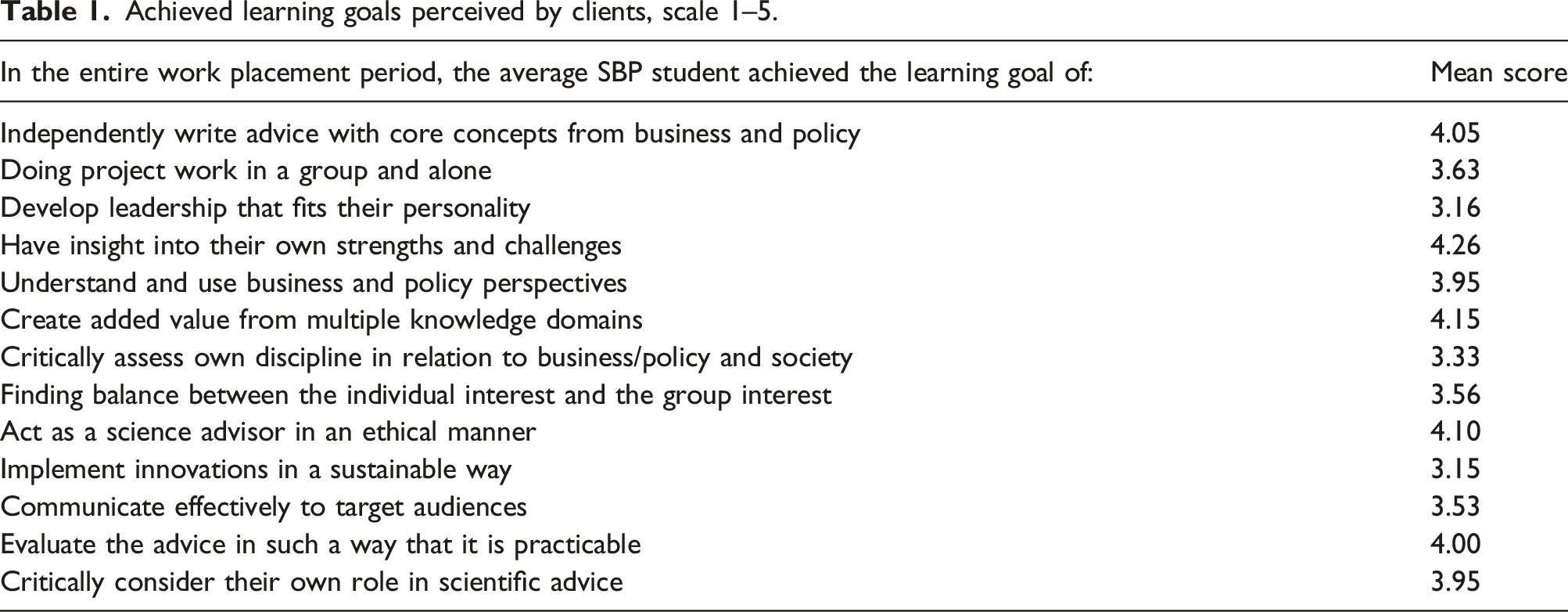
Achieved learning goals perceived by clients, scale 1–5.
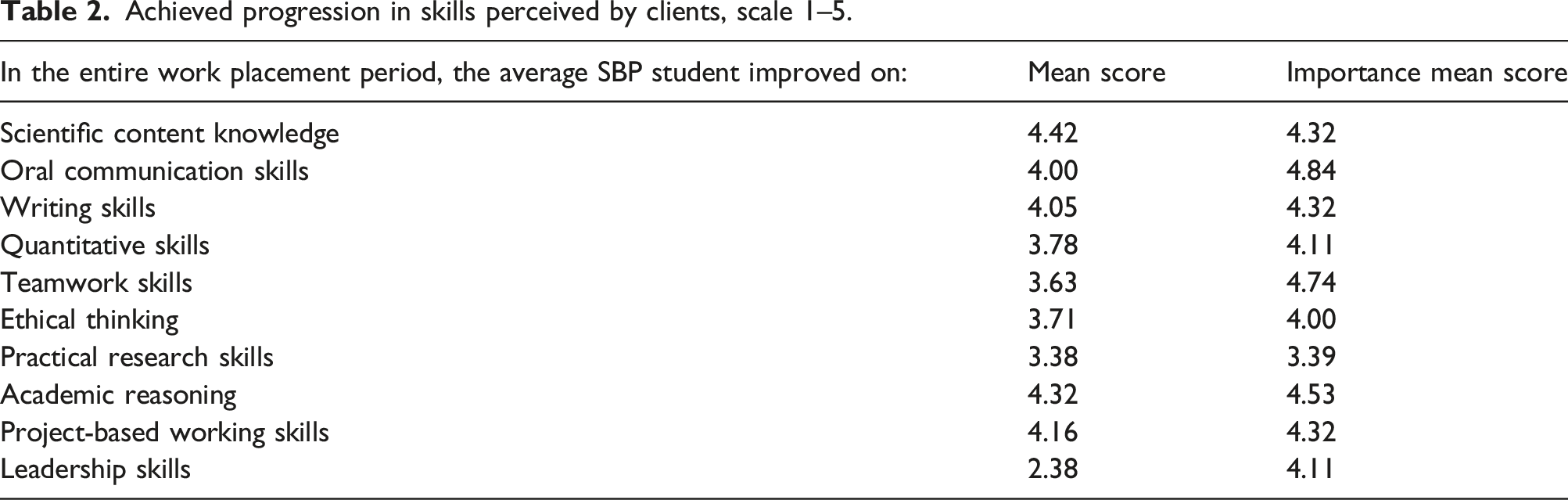
Achieved progression in skills perceived by clients, scale 1–5.
Impact of the work placements
The majority of the employers saw the impact of the SBP work placement on the dynamics of the work floor (ST14). This was seen (ST15) in terms of a better working environment (54%), the gaining of knowledge and skills (31%) and new inspiration (31%). A business supervisor explained: “She brought a skill set but also a certain energy that we didn’t have, which was very good for the group dynamics.”
A proportion of the clients (21%) did not see a direct impact on the work floor. For example, a policy supervisor commented: “Not on the work dynamics, but in the outcome of our work. Ultimately, this student did produce a report that was used for further policy development.”
When zooming in on the advice reports, the employers seemed very satisfied and gave a high average grade (8.1, ST16). Most clients (79%, ST17) reported an influence of the SBP report on the organisation. In the short term (ST18) influences included the implementation of science advice (33%) or new customers, products, insights or knowledge (all 13%). Long-term effects (ST19) included the implementation of science advice (38%), change in workflow and a general inspiration for change (both in 23% of the answers).
Distinctiveness of the SBP student
Difference between SBP students and ROM students, applied university students and consulting companies.

When we zoom into those differences, we see that, compared to ROM students, SBP students (ST20) are perceived by supervisors to be more versatile (noted by 42% of the clients) and to have a different focus (58%). Also, a difference in skills was noted by employers, with SBP students perceived to have better soft skills and ROM students better scientific content knowledge.
Compared to students of the University of Applied Sciences (EQF level 5 or 6, ST21), SBP students (EQF level 7) were perceived to have more academic skills, a higher academic level and better academic reasoning. Clients characterised SBP students (ST21) as more independent and as having higher scientific content knowledge. Applied science students were sometimes seen as executive only (32% in our sample).
Some companies (18%, Table 3) did not see differences between the advice report written by an SBP student compared to that of a professional consultancy. A large majority of employers, however, did note differences (82%, Table 3), citing various factors (ST22), including, for example, the higher costs of hiring a consultancy firm (25%). It is noticeable that differences in other categories are ambivalent. SBP, compared to consultancy, was seen as slower (19%) or faster (6%), as more independent (19%) or less independent (13%). Consultants were perceived to have a higher knowledge level (25%) and better practical execution (31%) than SBP students, whose work was variously reported to be more academic (13%), more original (6%), better suited to the needs of the organisation (13%), and more in-depth (19%).
Employability
Most clients (60%, ST23) offered the student a job after their work placement. When there was no job offer, reasons varied from “no vacancies” to “personal misfit” to “student wanted to continue studying.”
The majority of supervisors (73%, ST24) thought that the university was responsible for letting students gain experience on the work floor. The responses, however, show a remarkably large range (from 2 to 10), so not all supervisors agree. Additionally, the majority (64%) also thought that there was responsibility on the part of the consumer, the student in this case.
All employers agreed that it was important for the university to offer work-based learning programs like SBP (ST25). The most prominent reasons given were the connection to the labour market and the opportunity for an all-round education. A business client illustrated this by commenting: “Yes that stems from the fact that I think that far too many people with a technical education are trained as researchers and that this is not at all in line with the needs of the labour market. You could say that I think it is essential that you have people with a technical education (Bachelor). That you also train those towards management positions. People who have completed their PhDs have sometimes gone so far in depth that they are also difficult to fill in generic team roles afterwards. […] In summary, connecting with the labour market and also broadly training smart technical people so that they can still be deployed in positions wherever they thrive.”
Discussion
Based on the interviews with employers from industry and governmental organisations, the experience on the work floor with students from the SBP program was positive. Employers were generally satisfied with the work placements and saw the program as valuable and its students as positively distinct from applied science students and research-oriented science students. Overall, employers indicated that they would like to hire SBP students, and this is seen in practice, with job offers often made immediately after the placement. Furthermore, clients are usually happy to offer work placements again. All 20 employers agreed that it was important to offer programs like SBP at an academic level.
These findings suggest that there is a need for an academic program that produces professionals. SBP seems to meet the current high demand for employees with a theoretical science background combined with an entrepreneurial mindset and experience on the work floor. It is important to note that the work placements within the SBP program form a very specific niche: all are placements in which science can provide answers for problems in society––these which can be very diverse, ranging from innovative technical products to health policy to energy consultancy, but all require an academic-level response. An entry requirement for a work placement is a work floor supervisor who has been trained at least to Master’s level, but who in practice has often obtained a higher degree. The conclusions set out in this paper are therefore limited to this market, which is very specific on the one hand but on the other constitutes a large segment of the career opportunities for science Master’s students. For this market, the functional employability gap (Retra et al., 2016), describing the lack of highly educated professionals (Jackson, 2010; Sarkar et al., 2020), might be bridged by using WBL education that includes work placements leading to a strong connection with the labour market.
The positive aspects of WBL experienced by employers are in line with the university’s view, in which the integration of theory and practice is considered most important. The integration of different knowledge domains and the importance of a good match are also noted by employers. This is in line with the literature, in which a proper fit of interests is found to be beneficial for educational quality (Naude et al., 2016), as is enabling students to choose and own their own project (Larsen, 2022). The most important success factor is good supervision of the work placement, for which cooperation is emphasised. The views of the academic supervisors on this matter are very relevant for further research.
The skills gap (Enders, 2004; Pedersen, 2014) seems to be bridged through the use of SBP education. In order to achieve this, the match between what is needed and what is learned should be optimised (Matthews et al., 2021). The three skills seen as most important by the employers were, respectively, oral communication, teamwork and academic reasoning, while practical research skills were viewed as the least important for professional life. In a study on the career development of SBP students (Grooters et al., 2022b), using an alumni survey, we see that in both the SBP group and the ROM group practical research skills were perceived to decrease after graduation and soft skills tended to increase. This is interesting because it reflects the difference between the SBP and ROM programs.
With regard to SBP, the skills students are supposed to learn are seen by the clients as achieved. SBP seems to be narrowing the skills gap while ROM students seem to be less prepared for a career in industry. The exception is, interestingly, leadership skills. While the supervisors perceived these skills as important, they did not find that SBP students developed them during the work placement, unlike the other soft skills for which significant improvements were reported. Perhaps this could point to room for improvement in the program, where the time spent on developing leadership skills is minimal. Further research is needed to discover how these leadership skills can be trained in a way that will align with employers’ perspective. It would also be interesting to further evaluate how employers define leadership, which is a term that can be interpreted in many ways (Kort, 2008).
Zooming in on learning outcomes, the SBP learning goals were also perceived as well met by the employers. This is a relevant finding because entrepreneurship education is still an upcoming and turbulent field (Hagg and Gabrielsson, 2019) in which different models or approaches can be chosen (Cuesta-Claros et al., 2021; Uyarra 2010), with multiple interpretations of goals and definitions. The entrepreneurial mindset (EM), which is one of these constructs, seems key in entrepreneurship education but educators have the responsibility of defining it and clarifying its meaning this for all parties (Larsen, 2022). Thinking about the conceptualization of the EM and theorising the offered education before it starts should be a basic requirement for entrepreneurship programs. The SBP program is in a fortunate position since the students who choose it already have an internal company or policy interest and start with a positive attitude towards entrepreneurship––and the EM as cognition is formed during the courses. With this factor as a starting point for the SBP work placement education, the conceptualization of EM as a capability is clear. The idea is to teach students all they will need as entrepreneurs and to train them to develop their knowledge, skills, capabilities and competences for a professional entrepreneurial career.
Clearly defined learning goals by the university are a tool to do this. It is crucial that all parties understand and commit to those goals and that they are met. As a quality check for entrepreneurship education, universities can ask if work placement providers think that their interns reach the learning goals.
The impact of SBP for the work floor seems to go further than enhancing the availability of suitable employees, bridging skill gaps or improving the entrepreneurial mindset after graduation. It also relates to the integration of science and societal aspects and this integration seems to occur during work placement, so that interns are already of interest for organisations before they become available on the job market. The development of an entrepreneurial mindset is judged by most supervisors to be valuable for the dynamics of the work floor, helping towards a better working environment, an increase in knowledge and skills and new ideas. The final advice report in the SBP curriculum has an impact in itself because of the implementation of science advice, leading to the acquisition of new customers, product development, new insights, workflow adjustments and/or a general inspiration for change. All these benefits seem to be results of an entrepreneurial mindset that is combined with the ability to integrate science with business or policy. Overall, we believe that SBP as science education meets the expectations of employers and has been seen to go beyond entrepreneurship.
Supplemental Material
Supplemental Material - Beyond entrepreneurship, raising broad academic professionals: Work-based learning in science from the employer’s perspective
Supplemental Material for Beyond entrepreneurship, raising broad academic professionals: Work-based learning in science from the employer’s perspective by Saskia Grooters, Emma Zaal and Menno Gerkema in Industry and Higher Education
Footnotes
Acknowledgements
We thank H. J. van der Windt, J. Zevenberg and J. C. Graver for their helpful comments, and student assistants Allard de Vries, Nina van der Velden and Marloes Kochi for data support.
Declaration of conflicting interests
The author(s) declared no potential conflicts of interest with respect to the research, authorship, and/or publication of this article.
Funding
The author(s) received no financial support for the research, authorship, and/or publication of this article.
Ethics approval
For this study the general principles of research involving human participants were applied. Ethical approval was given by the ethical committee of the University of Groningen, which approved the approach of the study and thus asking alumni to participate in a web-based questionnaire (CETO submission number 69813564). The CETO has established that the research protocol follows internationally recognised standards to protect the research participants.
Data availability
The datasets used and/or analysed during the current study are available from the corresponding author on reasonable request.

Supplemental Material
Supplemental material for this article is available online.
References
Supplementary Material
Please find the following supplemental material available below.
For Open Access articles published under a Creative Commons License, all supplemental material carries the same license as the article it is associated with.
For non-Open Access articles published, all supplemental material carries a non-exclusive license, and permission requests for re-use of supplemental material or any part of supplemental material shall be sent directly to the copyright owner as specified in the copyright notice associated with the article.
