




Abstract
This article explores how UK students and recent graduates experience the process of transitioning to the labour market, based on a secondary analysis of 1969 survey responses from current students and recent graduates using an online jobs board. It finds that gender, class and ethnicity all structure students’ experience of transition in a multitude of ways. The article reports 24 aspects of the transition process with statistically significant differences between students from different demographic backgrounds. These include students’ vocational focus and career aspirations, mobility, values, the social aspects of work, whether they feel informed about career and recruitment, how they want to communicate with employers, and their experience of the Covid-19 pandemic. Most of these differences are small, but cumulatively they suggest that demographics are shaping the process of transition in complex, intersectional and heterogeneous ways. There is a need for key stakeholders involved in this process, notably higher education careers services and employers, to attend to these differences and use them to reform the graduate transition process in ways that make it more equitable.
This article focuses on UK students’ perceptions and attitudes regarding their transition to the labour market following a period in higher education. Most graduates make relatively smooth transitions to the labour market, at least if measured in terms of their ability to get a job or a ‘highly skilled’ graduate job in an occupation which is defined as being in the Standard Occupational Classification major groups 1–3 (HESA, 2021; HESA, n.d.). But there is also evidence of a substantial minority of graduates who find these transitions difficult, find themselves underemployed (Scurry and Blenkinsopp, 2011), move into precarious employment or unemployment after university (Formby, 2017) and/or return to the family home as a safety net for a difficult transition (West et al., 2017).
As Tomlinson (2007) notes, there is a need to increase our understanding of how students and graduates perceive and experience the process of transition (both when it goes smoothly and when it is more rocky). In this article we are going to shift the focus away from the important, but heavily researched, questions of what prepares graduates for transition (Artess et al., 2017; Bridgstock, 2009; James et al., 2013) and what the outcomes of transition processes are (Hunt and Scott, 2020; Pitman et al., 2017; Purcell et al., 2012) to their perceptions and attitudes about the actual transition process.
The experience of transition has been variously discussed by Nabi et al. (2009), Parris and Saville (2011) and Lynn Glassburn (2020), as well as many others, but these studies are typically qualitative and are focused on small and specific cohorts of students. We will discuss the extant research in the literature review below, but in this study we were keen to look more broadly and to use quantitative approaches to examine the patterns that emerge with respect to the key demographics that have been found to segment graduating cohorts. The principal research question addressed is: • How do ethnicity, class and gender influence students and recent graduates’ experience of the process of transitioning to the labour market?
The research was conducted during the summer of 2020, whilst Covid-19 was reducing hiring and disrupting the normal process of graduate transition (Inman, 2020; Institute of Student Employers and AGCAS, 2020; Office for Students, 2020). This offered the opportunity to find out more about how the crisis was impacting on graduates thinking about the transition process during this challenging period.
Literature review
The process of graduate transition can be a challenging one which induces considerable anxiety and uncertainty in those undertaking it (Kirby et al., 2018). It is also a highly subjective process, with different students, often differentiated by their demographics as well as by individual differences, experiencing it differently and holding varying perspectives on what constitutes a successful transition (Donald et al., 2018; Papafilippou and Bathmaker, 2018). Despite its challenges and subjectivities, the process of transition matters; as Okay-Somerville and Scholario (2017) note, it exerts a substantial influence on graduate employability and outcomes.
The extant research on graduate transitions highlights a range of factors that are important in shaping both the experience of transition and its outcome. These factors include the level of preparation of the graduate for the transition (Rush et al., 2019), with pre-graduation placements a particularly important form of preparation (Reddy and Shaw, 2019), the skills and other personal attributes the graduate possesses (Baird and Parayitam, 2019), the support they receive during the transition, such as mentoring and training (Innes and Calleja, 2018; Turpin et al., 2021), the nature of the workplace into which they are transitioning and the alignment between the individual and the environment (Bell et al., 2019). Authors have conceptualised this process of transition in different ways – for example as a process of managing different career and organisational boundaries (Santos, 2020), of socio-cultural learning (Popov, 2019) or of social sorting (Burke et al., 2020; Ingram and Allen, 2019).
More discretely, there is a body of literature which has looked at the recruitment processes employers use to attract, select and appoint candidates to jobs. While much of the wider literature is focused on the broader experience of transition from education to employment, this literature focuses on the technical processes through which this transition is achieved. It notes that employers use a wide range of recruitment techniques (Institute of Student Employers, 2021) and that graduates are advantaged in this process when they have prior experience of it (Bradley et al., 2021) and when they are able to correctly analyse what employers are looking for and so transform themselves into ‘ideal recruits’ (Gebreiter, 2019). And yet both the articulation of these ‘ideal recruits’ and the processes that are used to identify them are often flawed in ways that lead to social reproduction and an inequitable distribution of opportunities in the graduate market (Ingram and Allen, 2019; Pollard et al., 2015).
We know that students’ outcomes in the labour market are structured by a variety of demographic factors (Macmillan et al., 2015; Sianou-Kyrgiou, 2012; Zwysen and Longhi, 2016). There is also some literature that suggests that the experience of the processes of transition are shaped and structured by demographic factors (Monteiro et al., 2020). In this article we will further explore how demographics shape students’ and graduates’ perceptions of graduate transitions. We will focus on gender, ethnicity and class, examining how they structure the way students and graduates experience transition. These three foci were chosen in part because the available data supported their investigation, but also because gender, ethnicity and class have been widely observed to exert an influence on the process of graduate transition.
Beginning with gender, there are observed differences in women’s experience of graduate transitions, with women often reporting that they feel less prepared for transition and have less confidence about achieving a positive outcome (Montiero et al., 2016). Such differences may contribute towards those that exist in the employment outcomes of female graduates in comparison with male graduates (Sianou-Kyrgiou, 2012). Evidence from the recession that followed the global financial crash suggests that these differences are exacerbated during periods of crisis (Sianou-Kyrgiou, 2012).
Similarly, there are notable differences in the employment of black and ethnic minority graduates in comparison with their white counterparts (Zwysen and Longhi, 2016). Many of these differences are baked into wider social and educational inequalities rather than being spontaneously produced during the process of graduate transition. Nonetheless, existing inequality does not account for all the differences in employment outcomes. For example, Lessard-Phillips et al. (2014) show how ethnicity influences graduate outcomes even when ethnic minorities attend elite universities and, as Zwysen and Longhi (2016) demonstrate, the ‘ethnicity gap’ in employment outcomes is particularly marked for those graduates from lower socio-economic backgrounds and with weaker links to a local co-ethnic community.
Finally, social class has also been observed to be important in determining the employment outcomes of university education both as a factor in its own right and as a predictor of attendance at elite higher education institutions (Bradley and Waller, 2017). Macmillan et al. (2015) particularly highlight the way in which students from higher socio-economic backgrounds, especially those who have had a private education, have access to increased social capital that supports their transitions and career building. But it is not just attendance at higher-status institutions during schooling that is important; the stratification of higher education institutions is important in shaping graduates’ labour market outcomes (Wakeling and Savage, 2015).
Methodology
Research design and procedure
Questions identified by employers about students’ experience of transition.
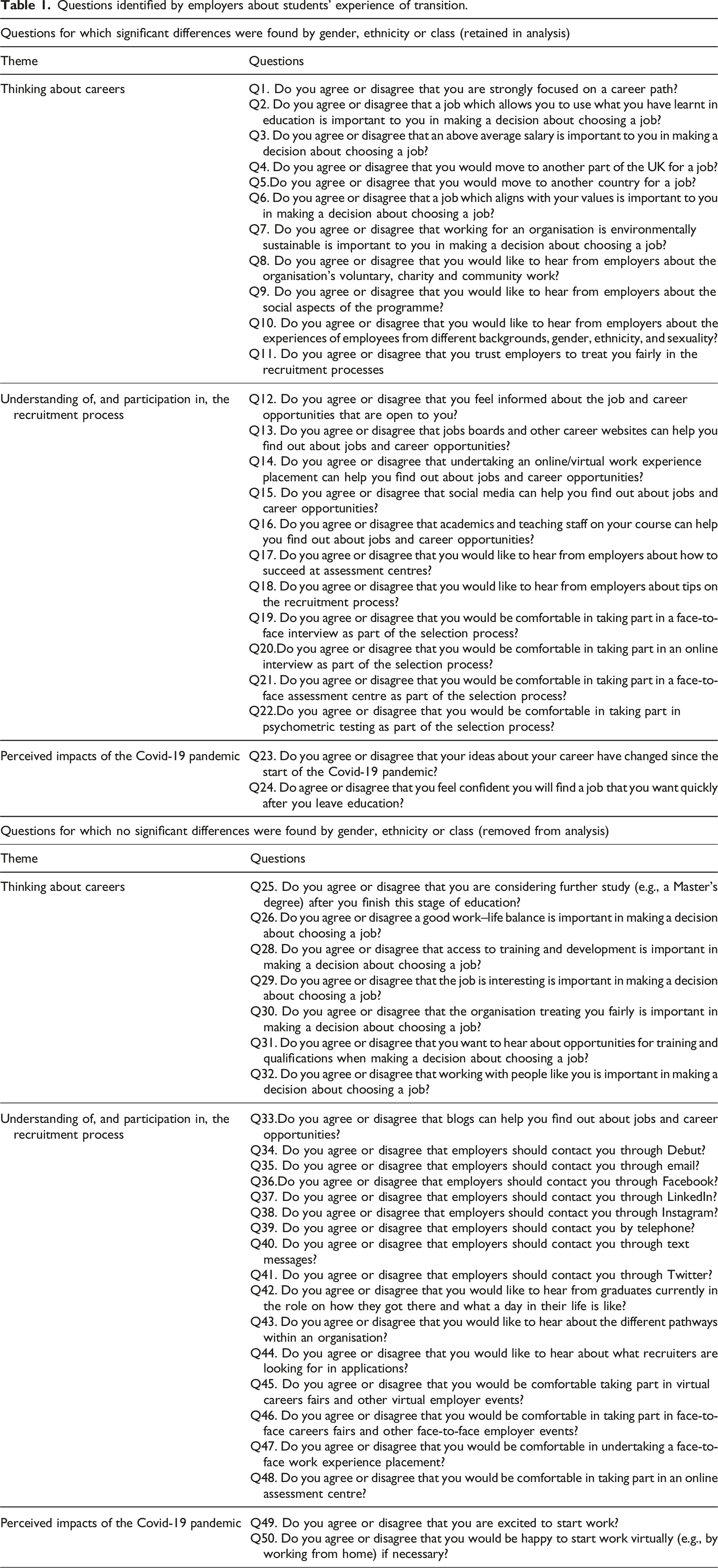
Users of the online jobs board were asked to respond to these questions during July and August 2020 via an online survey. Respondents were asked to indicate whether they agreed or disagreed with the 24 questions addressing participants’ career thinking, career transitions and experience of careering in Covid-19 on a 4-point agree/disagree scale.
A limitation of analysing secondary data like this is that the researchers were not involved in the survey design and sampling processes. This meant we had no control over the way questions were structured and how responses were collected (Johnstone, 2017). If we had been involved in the sampling process, we might have opted to stratify our sampling to ensure that people of all genders, ethnicities and classes were more strongly represented. Furthermore, if we had designed the data collection instrument, we might have opted for a more conventional 5-point Likert scale allowing more standard analyses. However, there is precedent for using 4-point Likert scales in social research and, indeed, there are some arguments for their usefulness. Chyung et al. (2017) argue that they overcome concerns about respondents using the mid-point of a 5-point scale as a dumping ground and an alternative to a ‘don’t know’ option and suggest that 4-point Likert scales are less subject to social desirability bias. They note that a 4-point scale provides a useful alternative if the data are understood as ordinal and analysed accordingly.
On reviewing the data we concluded that they provided a series of interesting insights into the process of graduate transition. We were interested in exploring how the experience of graduate transition varied by demographic group and designed the analytical approach to explore these differences.
Approach to analysis
The 4-point response scale led to the need for non-parametric regression analyses. With a 4-point scale we might have opted for multinomial regression, which is appropriate when the dependent variable has more than two alternatives. However, when there are more than two alternatives it is also important to consider whether those alternatives are independent from each other, are ordered or are nested within each other (Grace-Martin, 2020; Taylor, 2020). Multinomial regression is appropriate when the alternatives are independent from each other and there is no ordering. The alternatives in the present data included some ordering and were not appropriate for multinomial regression. Although ordinal regression analysis was an option, the proportional odds assumption was not met and interpreting the output in a way that would still answer the objectives would also have been difficult.
In this study we instead collapsed responses to each question into ‘agree’ (if they responded ‘strongly agree’ or ‘agree’) or ‘disagree’ (if they responded ‘strongly disagree’ or ‘disagree’). This is an appropriate approach because ‘agree’ and ‘strongly agree’ are naturally ordered as are ‘disagree’ and ‘strongly disagree’, but ‘agree’ and ‘disagree’ are two intrinsically distinct attitudinal states. With two responses rather than four, we were able to use binomial regression analysis whereby the data would not violate any assumptions and the analysis would facilitate interpretation of the data o answer the research objectives (Grace-Martin, 2020)
The gender variable was comprised of only those respondents who indicated either male or female, removing respondents who did not wish to respond. Ethnicity was comprised of white and non-white respondents, with those preferring not to say being removed from further analysis. This approach facilitated simplicity. Whilst there is an argument that Asian, Black and other ethnic groups are qualitatively different, the number of Asian or British Asian, Black or Black British, mixed ethnicity and ‘other’ were unevenly split and in some cases too small for analyses to provide meaningful output.
Constructing the class variable was more complex. There was no direct measure of class available from the data. However, there were three variables which collectively could be considered indicators of class: whether respondents had attended a state or independent school; whether or not they were first in their family to attend university; and whether they attended one of the elite UK universities (known collectively as the Russell Group) or another higher education institution. Respondents who indicated that they had attended an independent school, who were not first in family and who attended a Russell Group university were categorised as higher-class. Those who had attended a state school, were first in family to attend university and those who did not attend a Russell Group university were categorised as lower-class. All other respondents were filtered out due to lack of reliability in categorisation.
Respondents
The survey received 2162 valid responses from a diverse group of young jobseekers. Most were either current undergraduates (38.7%) or had recently graduated from an undergraduate degree (36.3%), but there were also several school students (5%), school leavers (2.6%) and postgraduates (7.5%).
In the present study the focus was on current students (at both undergraduate and postgraduate levels) or recent graduates so other respondents were removed from the dataset, leaving 1969 respondents. Of these, 57% were female and 43% male. Regarding ethnicity, 49.3% of respondents were white, 21.7% described themselves as Asian or British Asian, 18.1% as Black or Black British and 4.5% as mixed ethnicity. The remaining 5.8% included 2.8% who described themselves as ‘other’ or preferred not to say. In terms of social background, most (65%) were state-schooled, with 18% reporting they had attended a private school (17% did not respond to this question). A substantial minority (41%) were the first in their family to attend university and around a third (35%) had attended or were attending a Russell Group institution.
Results
Our research question explores how different demographic aspects shape students’ and graduates’ experience of the process of transition from higher education to work. Our first finding is that there is a wide range of aspects of the transition process that are not significantly shaped by these demographic factors.
Male and female, white and non-white and high and low social class participants all responded in similar ways to many of the questions. In their desire for information about potential careers, their perceptions of the usefulness of higher education careers services, their desire to hear from employers and former students about various aspects of the transition process, their desire for various features of decent work and the level of excitement they reported about making the transition, demographics were not significant predictors of differences between respondents.
However, there were differences in the way demographic groups responded to other aspects of the recruitment and transition process. These findings suggest that who you are in terms of your background makes a significant difference to how you are likely to feel about and experience the process of transitioning from higher education to employment.
The analysis focuses on those items that address: how current students and graduates are thinking about their careers; how current students and graduates understand and participate in the process of career transition; and how they perceive the Covid-19 pandemic impacted on their thinking and participation (with other issues covered in the survey removed). A series of binary logistic regressions was run to understand the differences between genders, ethnicities and class groups on 24 questions. The dependent variable was transformed into a dichotomous variable, where those who agreed or strongly agreed with the question were coded as 0 and those who disagreed or strongly disagreed were coded as 1. It should be noted that, where the relationship between predictor and dependent variable is negative (Exp(B) < 1), the positive corollary is used in the interpretation of the statistical output to provide consistency and accessibility in understanding the relationship(s).
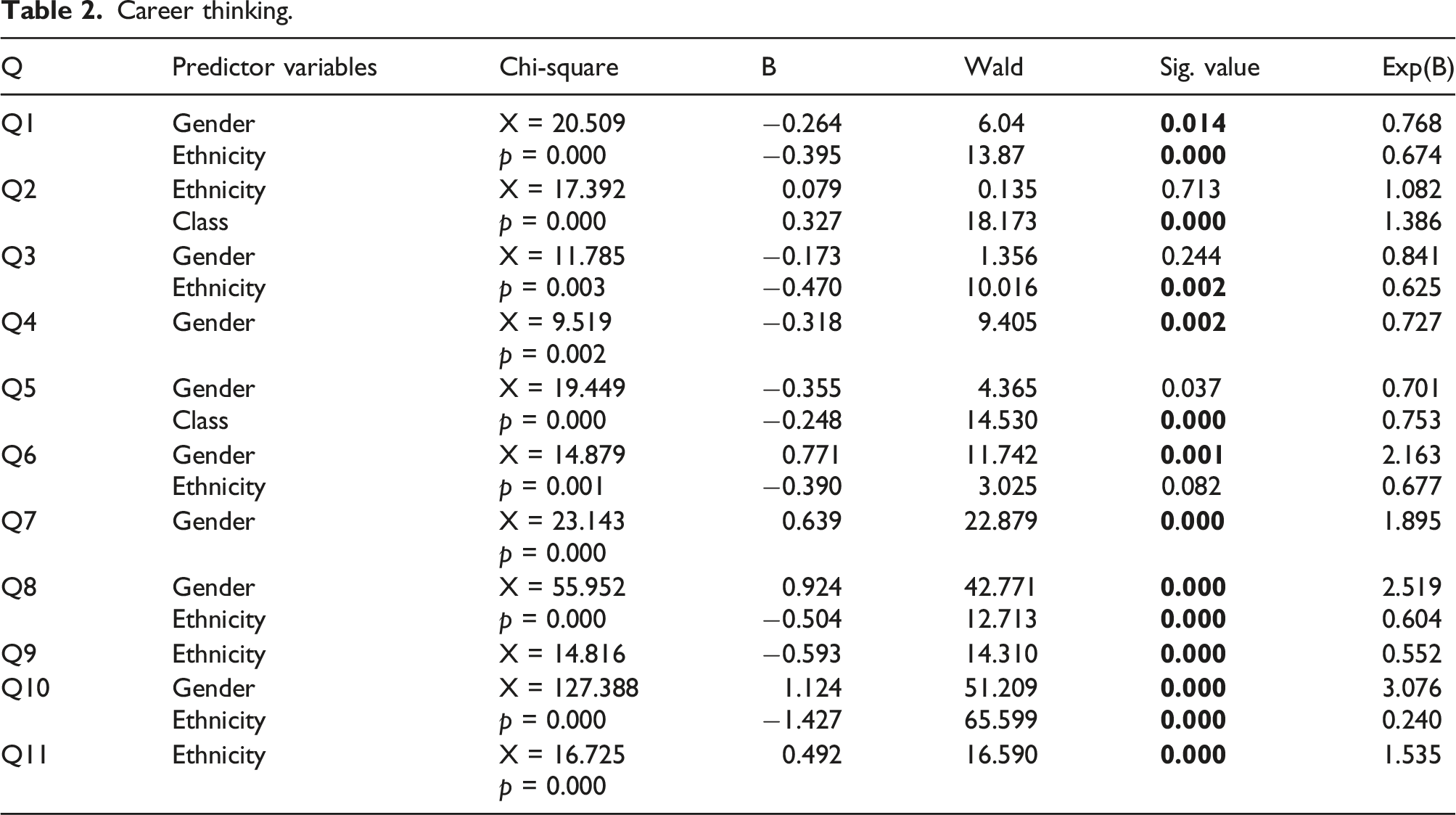
Career thinking.
Career transition.
Careering in Covid.

Career thinking
The first 11 questions address how participants were thinking about their careers and what factors they were likely to consider as they made choices and developed their plans. Analyses of these questions significant relationships with gender, ethnicity and class.
Gender
Male and female participants gave significantly different answers to a number of the questions about their career thinking. Broadly, these differences can be summarised as male participants being more focused on career advancement, while female participants were more focused on their values and ethics as they pursued their careers.
Male respondents were 1.3 times more strongly focused on their career path than female respondents (a small effect). Male respondents were 1.3 times more likely than female respondents to agree that they would be willing to move to different places in the UK for their career (a small effect) and were also 1.3 times more likely to agree that they would be willing to move to places outside the UK for their career (a small effect).
Female respondents were 2.2 times more likely than male respondents to agree that a job that aligns with their values is important to them when making a decision about choosing a job (a small–medium effect). Females were also 1.9 times more likely than males to agree that working for an organisation that is environmentally sustainable is important to them when making a decision about choosing a job (a small effect).
In terms of learning about the recruiting organisation, female respondents were 2.5 times more likely than male respondents to agree that they would like to hear from employers about the organisation’s voluntary, charity and community work (a small–medium effect). They were also 3.1 times more likely than male respondents to agree that they would like to hear from employers about the experiences of employees from diverse backgrounds, gender, ethnicity and sexuality (a medium effect).
Ethnicity
Ethnicity also proved to be important. Broadly, the findings suggest that non-white participants are both more career-focused and that they do more due diligence on the culture of the organisations they plan to work for than their white counterparts. On the other hand, white respondents have greater trust in the fairness of recruitment processes.
Non-white respondents were 1.4 times more strongly focused on a specific career path than white respondents (a small effect) and were 1.4 times more likely than white respondents to agree that an above-average salary is important to them when making a decision about choosing a job (a small effect). White respondents were 1.5 times more likely than non-white respondents to agree that they trust employers to treat them fairly in the recruitment process (a small effect).
In terms of learning about the recruiting organisation, non-white respondents were 1.6 times more likely than white respondents to agree that they would like to hear from employers about the organisation’s voluntary, charity and community work (a small effect). White respondents were 1.8 times more likely than non-white respondents to agree that they would like to hear from employers about the social aspects of the organisation (a small effect). The most significant finding was that non-white respondents were 3 times more likely to agree that they would like to hear from employers about the experiences of employees from diverse backgrounds than were white respondents (a medium effect).
Class
There were also some class differences in relation to participants’ career thinking. Higher-class respondents reported a greater willingness to be mobile in their careers, while lower-class participants were more keen to find a job that related to their education.
Lower-class respondents were 1.4 times more likely than higher-class respondents to agree that a job which allowed them to use what they had learnt in education was important to them when choosing a job (a small effect). Meanwhile higher-class respondents were 1.4 times more likely to agree than lower-class respondents that they would be willing to move to different countries (outside the UK) for their career (a small effect).
Intersectionality
There was significant intersectionality in the data – several of the questions were predicted by more than one demographic characteristic. Firstly, we found that ethnicity and gender intersected when respondents were asked about their focus on their career paths. Non-white males had an 80% probability of agreeing that they were strongly focused on their career path compared to female white respondents, who had only a 67% probability of agreeing.
There was also intersectionality in relation to mobility, with males ranked as higher-class having a 47% probability of agreeing that they would be willing to move to another country, compared to females ranking as lower-class who had only a 20% probability of agreeing.
Further intersectionality between gender and ethnicity was found in relation to the information respondents would like from organisations. Female non-white respondents had a 92% probability that they would agree that they would like to hear from employers about the organisation’s voluntary, charity and community work, compared with male white respondents who had only a 74% probability. In relation to agreeing that they would like to hear about the experiences of employees from different backgrounds, gender, ethnicity and sexuality, female non-white respondents had a 97% probability that they would agree, male non-whites had a 91% probability that they would agree, female white respondents had an 88% probability and male white respondents only a 70% probability that they would agree.
Career transition
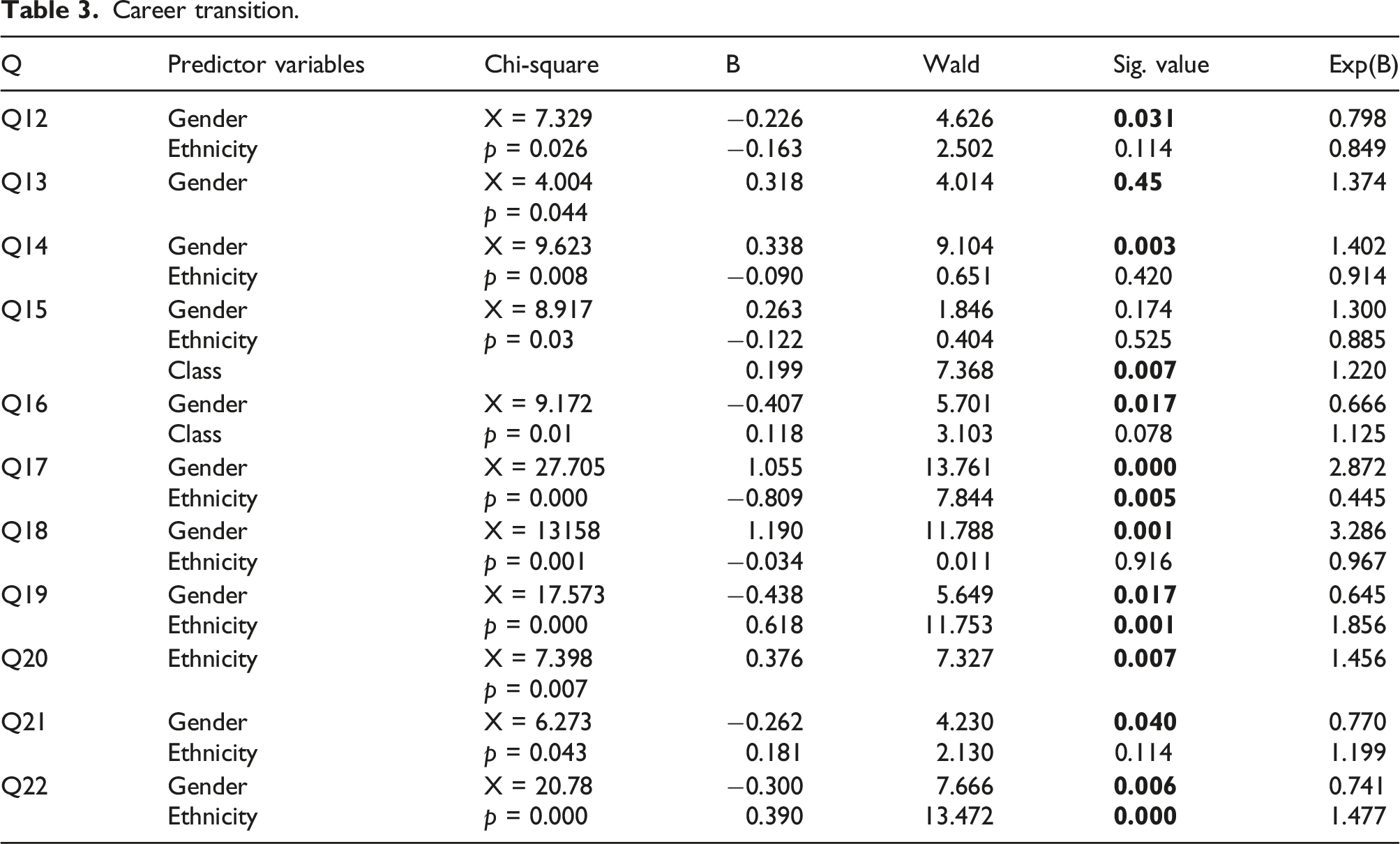
Questions 12–22 explored how students understood and anticipated the process of recruitment and transition to the graduate labour market. Statistical output from the binary logistic regression is displayed in Table 3. We present interpretations of the statistical output in Table 3 by demographics followed by significant intersectional relationships.
Gender
Participants’ understanding of career transitions differed in a variety of ways by gender. Male participants typically felt more informed, were more likely to find academic staff and support within their university helpful in supporting their career transition and were more comfortable taking part in key elements of the recruitment process. Female participants were more likely to draw on online help in their transitions and were more keen to gain tips and insights from employers about the recruitment process.
Male respondents were 1.3 times more likely than female respondents to agree that they felt informed about the job and career opportunities that were open to them (a small effect). They were also 1.3 times more likely than female respondents to agree that academics and teaching staff on their course could help them find out about jobs and career opportunities (a small effect).
Female respondents, however, were 1.4 times more likely than male respondents to agree that job boards and other career websites could help them find out about jobs and career opportunities (a small effect) and 1.4 times more likely than male respondents to agree that undertaking online/virtual work experience placement could help them find out about jobs and career opportunities (a small effect).
In terms of employers offering support for the recruitment process, female respondents were 2.9 times more likely than male respondents to agree that they would like to hear from employers about how to succeed at assessment centres (a small to medium effect) and were 3.3 times more likely than male respondents to agree that they would like to hear from employers about tips on the recruitment process (a medium effect).
With respect to participating in the recruitment process, male respondents were 1.6 times more likely than female respondents to agree that they would be comfortable in taking part in a face-to-face interview as part of the selection process (a small effect), 1.4 times more likely than female respondents to agree that they would be comfortable in taking part in face-to-face assessment at an assessment centre as part of the selection process (a small effect) and 1.3 times more likely than female respondents to agree that they would be comfortable in taking part in psychometric testing as part of the selection process (a small effect).
Ethnicity
Ethnicity also appeared to shape participants’ experience of transition. Non-white participants were keen to gain insights and tips from employers and were also more positive about participating in a face-to-face interview, whilst white participants were more positive about online interviews and psychometric testing.
Non-white respondents were 2.3 times more likely to agree that they would like to hear from employers about how to succeed at assessment centres than white respondents (a small to medium effect).
Whilst non-white respondents were 1.9 times more likely than white respondents to agree that they would be comfortable taking part in a face-to-face interview (a small effect), white respondents were 1.5 times more likely than non-white respondents to agree that they would be comfortable in taking part in an online interview as part of the selection process (a small effect) and 1.5 times more likely than non-white respondents to agree that they would be comfortable taking part in psychometric testing as part of the recruitment process (a small effect).
Class
Class appeared to be less important in shaping the experience of transition, with the only significant effect being that lower-class respondents were 1.2 times more likely than higher-class respondents to agree that social media could help them find out about jobs and career opportunities (a small effect).
Intersectionality
There were three items for which the intersection between gender and ethnicity was significant. In one case this was in relation to what respondents wanted to hear about from employers and the other instances concerned what they felt comfortable participating in as part of the selection process. Female, non-white respondents had a 98% probability that they would agree that they wanted to hear about how to succeed at assessment centres compared with white males, who had a 90% probability. Non-white male respondents had a 95% probability of agreeing that they would be comfortable taking part in a face-to-face interview whereas female white respondents had an 87% probability. Male white respondents had an 81% probability of agreeing that they would be comfortable taking part in psychometric testing compared with non-white females, who had 68% probability.
Careering in Covid
Participants were asked two questions to gauge their thoughts on the impact Covid-19 might be having on their careers. Females were 1.398 times more likely than males to agree that their career ideas had changed since the Covid-19 pandemic. Females were 0.671 (or 33%) less likely than males to agree that they felt confident that they would find a job they wanted quickly after leaving education.
Discussion
Our research questions explore how different demographic aspects shape students’ and graduates’ experience of the process of transition from higher education to work. Our first finding is that there is a wide range of aspects of the transition process that are not significantly shaped by these demographic aspects.
Male and female, white and non-white and higher and lower social class respondents all responded in similar ways to many of the questions. In their desire for information about potential careers, their perceptions of the usefulness of higher education careers services, their desire to hear from employers and former students about various aspects of the transition process, their desire for various features of decent work and the level of excitement they reported about making the transition, their demographics were not significant predictors of differences between respondents.
However, there were differences in the way demographic groups responded to other aspects of the recruitment and transition process. These findings suggest that who you are in terms of your background makes a significant difference to how you are likely to feel about and experience the process of transitioning from higher education to employment.
Gender
Women were less likely to be focused on a career path than men and less likely to feel confident that they would find a job quickly after they leave education. These differences echo wider international findings that explore the influence of gender on career confidence and related concepts and which report that women tend to score significantly lower than men (Bharti and Rangnekar, 2019; Pitan and Muller, 2019). Women were also more likely to change their career aspirations in response to Covid-19 and less confident about their chance of getting a good job after they graduated during the pandemic. Such findings chime with wider research which found that, although there were fairly minor gender differences in the labour market impacts of Covid-19 in the UK (Hupkau and Petrongolo, 2020), women expressed a greater level of concern about the pandemic and were more pessimistic about the economic future (Oreffice and Quintana-Domeque, 2021).
Women also felt less informed about the opportunities that were open to them and were less likely to agree that academics and teaching staff could help them find out about jobs, but they were more likely to find jobs boards helpful and to agree that a virtual work placement would help them learn about jobs. They were also more likely to want information and tips on the recruitment process and less confident in some recruitment processes. There is very limited wider work on the gender differences in the need for and availability of career and employability support, but the work that does exist suggests there may be differences which interact with the wider ways in which gender structures participation in higher education; for example, around the predominance of different genders in different subjects (O’Leary, 2021).
Women were more likely to want to hear from diverse employees during the recruitment process. This desire for diversity can probably be understood as a desire to hear from other women during the process of transition into the labour market; this is supported by wider research which highlights that female students are keen to learn about careers and to receive career support from other women (Gaule and Piacentini. 2018; Jones and Merritt, 2020).
Women were less likely to agree that they were willing to be mobile for their career – although wider research suggests that the rates of geographical mobility for young women and men transitioning to the labour market are actually fairly similar (Pelikh and Kulu, 2018).
Women were also more likely to agree that it was important that a job aligned with their values and was environmentally sustainable, which again bears out wider research on the relationships between environmental attitudes and gender, including specific work with students (Vicente-Molina et al., 2018).
Ethnicity
Non-white respondents were more likely to be strongly focused on a career path, more likely to be interested in considering further study and more likely to agree than their white counterparts that an above average salary was important to them when choosing a job. Lessard-Phillips et al. (2014) have also observed this difference in in engagement with postgraduate study, with ethnic minorities (aside from Black Caribbean) more likely to be pursuing postgraduate courses than their white counterparts.
Non-white participants agreed more than their white counterparts that they would like to hear from employers about how to succeed at assessment centres and felt more comfortable in participating in online interviews, but less comfortable about completing psychometric tests. They were less likely to agree that they trusted employers to treat them fairly. This is perhaps unsurprising when the overwhelming majority (82%) of corporate graduate employers report that they need to do more on race to achieve a diverse and representative workforce, with many making substantial reforms to their recruitment and selection processes as part of this effort (Institute of Student Employers, 2020a).
Non-white participants were more likely to agree that they would like to hear about an organisation’s voluntary, charity and community work. They were also more likely to want to hear about the social aspects of employment and to hear from diverse employees. All of these suggest that non-white respondents are keen to do a greater amount of due diligence on the values and organisational culture of their prospective employers. This is likely to be a sensible strategy, given that non-white graduates typically report lower levels of career satisfaction (Bermingham et al., 2020). These kinds of differences in satisfaction are likely to be strongly influenced by issues of organisational culture.
Class
Students from a lower class were more likely to agree that a job which allowed them to use what they had learnt in education was important to them in making decisions about choosing a job. Burke et al. (2020) argue that students from lower socio-economic backgrounds are also more naïve with regard to the relationship between higher education and the labour market and expect a more straightforward return on their ‘investment’ in higher education. Their more advantaged students have a better ‘feel for the game’ of participation in the graduate/professional labour market (Burke et al., 2020: 1718). The attempt to draw a straight line between degree subject and occupation may be an example of this process in action.
Students from a lower social class were less internationally mobile, which fits with existing evidence from Furlong and Cartmel (2005). They were also more likely to agree that social media were a useful source of career information and that they would like employers to engage with them through text messages.
Cumulative impacts
Most of the relationships that we observed were small. The only relationships that moved up into the ‘medium’ category were women’s desire for tips and advice on the recruitment process and the desire by both women and non-white respondents to hear from a more diverse range of current employees. These findings fit closely with existing literature on the tendency towards social-reproduction in graduate recruitment and the construction of the ideal graduate subject as a white male (Bradley and Waller, 2017; Friedman and Laurenson, 2019; Gebreiter, 2019). Our results suggest that respondents recognise these challenges and are seeking to address them by accessing more information and demystifying. Such findings pose important questions for both graduate employers and university careers services in how best to support students transitions if they wish to make the transition process more equitable.
Although it is important that these bigger issues are attended to, it is also important to recognise that the small effects matter as well, in part because they are small and are therefore easy to miss. The fact that men feel a little more confident about finding a job than women provides some insights into the psycho-social operations of inequality. Schoon and Lyons-Amos (2017) have highlighted the importance of attending to both structural and psycho-social factors, and to the interaction between them, in their work on school to work transitions, and it appears that this is also important in shaping graduate transitions. When we see the variety of psycho-social impacts begin to pile up, it becomes clear that these various factors are structuring graduates experience of transitions in a range of demographically related ways. So, when we view men’s increased confidence about finding a job in the context of all of the other things that men feel slightly more confident about, we begin to see why there are some substantial differences in outcomes for different groups.
It is also important to recognise the intersectionality that characterised responses to at least some of these questions. Gender and ethnicity interacted to increase the differences between respondents in relation to their focus on their career paths, their desire to access information about organisations’ culture and values, how the recruitment process worked and their level of confidence in participating in recruitment. Such findings are unsurprising given the consistent patterns that exist in the data around gender and ethnicity and the existing literature that highlights the importance of recognising intersectionality to understand discrimination in employment (Di Stasio and Larsen, 2020).
Inequality is operating on a wide range of levels, some intensely mundane like the fact that lower class students are more likely to accord value to the career information they gather from social media than are their upper-class peers. Others are more obviously speaking to structural inequalities in the formal recruitment process, such as the concerns that any access to current employees should allow students to engage with people like them. It is as these various micro-inequalities stack up together that they begin to exert substantial pressure on the experience of students in transition, often resulting in a situation in which the smoothest transition path is available to the white male from a higher-class background.
Finally, the results of this study remind us that inequalities are heterogeneous and manifest in different ways for different groups. While gender, ethnicity and class all structured the experience of graduate transition, they did not structure it in the same way. So, all the demographic factors shaped participants’ career thinking and their experience of transitions, albeit in different ways. Both gender and class shaped participants’ sense of whether they felt informed about their career options and their willingness to be mobile in their career. Gender and ethnicity shaped their ideas about the relationship between their values and their careers, their confidence about participating in the recruitment process and the confidence that they would be able to access fair and decent work. Finally, ethnicity shaped participants’ ideas about the importance of the social aspects of the organisation that they were joining.
Conclusion
The research shows us that graduates’ transitions from education into employment are structured in a myriad of ways by their background. This is important because it suggests that the process of transition itself may have a role in producing some of the differences of outcome that were highlighted in the literature review. Despite the power of higher education to raise students’ earning power and status, it has not washed away social and demographic inequalities for graduates (Marginson, 2019). While both higher education institutions and employers have a role to play in the reproduction of inequality, there also seem to be some important processes going on during students’ transitions to the workforce.
For employers, particularly those that are actively seeking diversity, this is an important reminder that recruitment processes are unlikely to be ‘neutral’. Different groups of students are likely to experience these processes differently, to have different levels of confidence about navigating them and to seek different kinds of help. The fact that these differences map onto under-represented demographic groups should prompt employers to look at their recruitment processes and consider how they can be adapted in ways that signal their openness to diversity and provide the kinds of support and reassurance that certain students may need. This call to attend to diversity and inequality in graduate recruitment is not a new one (e.g. Pollard et al., 2015) but this research provides some greater precision about the experiences of differing groups of students as they are going through the process of transition.
For higher education institutions, these findings reinforce the importance of providing transition support through institutional careers services, the curriculum and placements and other forms of employer engagement. Such support, particularly if it attends to the areas of concern highlighted in this article, has the potential to contribute to better graduate outcomes for diverse students.
Finally, it is important to acknowledge that this work throws down several questions for researchers. It would be interesting to repeat the study and to explore in greater depth how the three factors we have focused on (class, race and gender) intersect with other demographic factors that have been observed to have an impact on graduate transitions, such as subject studied (Chen et al., 2022), geography and career orientation. Furthermore, it is also important to explore the links between the kinds of attitudes and perceptions that we have examining in this study and graduate outcomes and to look at how class, gender and race mediate and mitigate those relationships.
Footnotes
Declaration of conflicting interests
The author(s) declared no potential conflicts of interest with respect to the research, authorship, and/or publication of this article.
Funding
The author(s) received no financial support for the research, authorship, and/or publication of this article.
Disclosure
This research builds on data originally collected by one of authors as part of his work for the Institute of Student Employers. The original research was produced by the Institute of Student Employers in partnership with Debut, a graduate careers Web site and app.
