




Abstract
Microbusiness owners face significant challenges in accessing, acquiring and controlling resources, including human resources. This research examines the resource value(s) gained by microbusiness owners when they engage in a temporary human resourcing strategy using interns. Qualitative, information-rich, narrative interviews with microbusiness owners examined resourcing motives, management experiences and perceptions of human resource value. The data were subject to thematic analysis. The findings indicate that the unforeseen value of working with an intern was learning “management by doing”, which arose due to a challenging of owner–intern dynamics, compelling owners to develop their skills, knowledge and practice of management and leadership. Second, microbusiness owners were strategically motivated to fill human resource skill and expertise gaps at little or no cost, gaining expected value. Thus, temporary human resources enable microbusiness owners to gain both expected and unforeseen value. Future research should focus on examining the value of unforeseen learning from low/no cost resources on microbusiness growth and sustainable development potential.
Introduction
Obtaining resources – human, financial, or social – is especially challenging for microbusinesses (Neeson et al., 2007; Kelliher and Reinl, 2009; Young, 2013; Jones and Jayawarna, 2010; Winborg and Landström, 2001). In particular, Hornsby and Kuratko (2003: 73), highlight that ‘employees in small firms are frequently the key factor distinguishing successful from unsuccessful ventures’, consequently affecting business performance, growth, development and the exploitation of new opportunities (Rauch and Hatak, 2016; Wapshott and Mallett, 2015; Edwards and Ram, 2006). Thus, finding the “right” human resource in a cost-effective manner is unsurprisingly important for microbusiness owners (e.g. Heneman et al., 2000; Salimath and Jones III, 2011; Öhman and Yazdanfar, 2015).
Galloway et al. (2014) find that interns provide organizations with access to low- or no-cost human capital resources and expertise. Consequently, a resource-strapped microbusiness may pursue a human resourcing strategy using interns, thus accessing a valuable resource at minimal financial cost. The extant research on student internships as work-based learning activities however, often focuses on the value of the activity for the student intern and the impact on their learning and professional development (e.g. Varghese et al., 2012; Jackson, 2015; Kapareliotis et al., 2019). The value(s) of such temporary human resources to microbusiness owners remains under-investigated therefore (Kelliher and Reinl, 2009; Wapshott et al., 2014; Jeske and Axtell, 2016; Wond and Rambukwella, 2018). With recent acknowledgement of the role that internships may play in important aspects of competitive advantage such as knowledge transfer (Franco et al., 2019), this research paper asks two questions: • RQ1: What value(s) sought provide(s) the strategic motive for using a temporary human resource such as an intern? • RQ2: What value (anticipated or unforeseen) is gained from using a temporary human resource such as an intern?
This study examines the experiences of microbusiness owners and the value(s) they gain from working with interns. The research extends understanding of the use and value(s) of temporary human resources in a microbusiness context, highlighting in particular that microbusiness owners gain unforeseen value through the owner–intern dynamic in the form of learning management by doing, and consequently enhance their management and leadership skills.
The remainder of the paper is structured as follows. First, the literature on human resources in microbusiness, their anticipated strategic value and how that may be gained is examined. Thereafter, the methodology is outlined. Following that, the findings are presented and discussed. The paper then concludes and highlights implications for theory and practice.
Human resources in microbusinesses, internships and resource value
Firm-specific resources affect business performance (Masakure et al., 2009; Barney, 1991), with human resources making a particularly important contribution (Brush et al., 2001; Hornsby and Kuratko, 2003; Khan and Quaddus, 2018; Bilan et al., 2020). For example, innovation potential in smaller firms is enhanced by the recruitment of graduate human resources (Jones and De Zubielqui, 2016) and HEI knowledge transfers can lead to innovation, positive organizational change and new learning for microbusiness owners (Cowdean et al., 2019; Strydom and Kempen, 2021). However, the human resource practices of microbusinesses often limit their ability to survive and grow (Rauch et al., 2005; Young, 2013; Rauch and Hatak, 2016). First, the human resource management practices of microbusiness owners are often idiosyncratic, subjective and informal (Benmore and Palmer, 1996; Ram, 1999; Wapshott et al., 2014). Existing work practices, industry sector and the “strategic” decision making of the owner shapes this informality (Ram et al., 2001). Informality extends to recruitment also; for example, informal networks are used to source potential employees, reducing transaction costs (Ram et al., 2007; Grant et al., 2012). Future employees are often “tested out” to assess their level of ‘fitting in’ before making a formal offer (Ram, 1999). Yet improved business growth or productivity outcomes are linked to formal human resource management practices (Barrett and Mayson, 2007; James et al., 2019). Second, microbusinesses face the challenge of attracting and retaining specialist staff (Kelliher and Reinl, 2009) and, due to the financial leverage and liquidity of such businesses, job creation is limited (Öhman and Yazdanfar, 2015). Third, the management human capital of business owners may be limited as owners lack formal strategic planning, leadership skills and organizational knowledge (Heneman et al., 2000; Beaver and Jennings, 2001; Reinl and Kelliher, 2010).
When facing resource constraints microbusinesses may use alternative means, such as accessing resources through networks, to mitigate or overcome such constraints (Jones and Jayawarna, 2010). In the case of human resources, an intern may constitute a particularly pertinent human resource strategy for a microbusiness. Internships are temporary and often transitional employment placements that may or may not be facilitated by educational institutions and they can take a variety of forms (Jeske and Axtell, 2016). For host organizations, internships provide an opportunity to ‘try before you buy’ (Coco, 2000: 41), access to low-cost expertise and ideas (Staus and Moreau, 2001; Galloway et al., 2014), or function as a cost-reduction measure (Bhide, 1992). With approximately 70,000 or more internships occurring in the UK, for example (Montacute, 2018), a sizable opportunity exists for microbusiness owners to access such a cost-effective resource – according to Brooks and Greene (1998: 56), ‘there doesn’t seem to be a downside for employers’. Despite the potential positive resource implications for employers, however, there is also extensive criticism of low-pay or unpaid internships and issues regarding social reproduction (Graduate Fog, 2014, 2018; Malik and Syal, 2011; Butler, 2018). Nevertheless, recruiting an intern could offer access to a potentially valuable resource and still meet the resourcing, especially financial costing, strategy of a resource-constrained microbusiness.
Resource-based theory, however, indicates that the strategic selection and exploitation of the ‘right’ rare, valuable and non-substitutable resources are what contribute to competitive advantage (Barney, 1991) rather than ‘making do’ (Baker and Nelson, 2005). According to Salimath and Jones III (2011), competitive advantage is not guaranteed simply as a result of controlling resources with objectively perceived value. Newbert (2008) asserts that resources must ‘fit’ (p.746) with the idiosyncratic firm and, according to Foss et al. (2008), resources must be coordinated and used creatively in order to realize their value. Thus, the value of a resource may be subjectively perceived rather than objectively anticipated from the resource in question. Business size may also have implications for the perceived value of a tangible or intangible resource (Alvarez and Busenitz, 2001; Kellermanns et al., 2016; Huang, 2016). The arguments regarding the objective or subjective value of a resource suggest that the entrepreneurial learning capability of an individual may make a significant contribution to their ability to gain value from resources (Ravasi and Turati, 2005).
Valuable learning opportunities for business owners can take many forms; for example, interactions with peers, customers and suppliers (Cope, 2003; Kempster and Cope, 2010; Jones et al., 2010). Learning from experience can generate competitive advantage knowledge (Deakins and Freel, 1998), and Macpherson et al. (2015) find that new, competitive advantage knowledge can be realized as a result of learning and managing resources in a crisis. Learning also contributes to the ability to gain access to specialized resources (Deakins and Freel, 1998; Lumpkin and Lichtenstein, 2005; Reinl and Kelliher, 2010) and contributes to firm success (Keith et al., 2016). Thus, a link between entrepreneurial learning and accessing and using resources exists (Mäkinen, 2002). This might suggest that resources, even when temporary, may offer an opportunity for entrepreneurial learning, particularly when learning is experiential and informal (Beaver and Jennings, 2001; Cope, 2003; Kempster and Cope, 2010). Indeed, several researchers find that learning “on-the-job” is especially useful for business owners (Neeson et al., 2007; Martin and Smith, 2010; Cowdean et al., 2019).
In summary, human resources are an important component of potential competitive advantage in business, yet access to such resources presents a significant challenge for microbusinesses. Consequently, resource-constrained microbusinesses may seek a free or low-cost (human) resource to overcome such resource constraints. Research examining microbusiness owners and their use of interns is limited, however (Jeske and Axtell, 2016). This research closes gaps in our understanding of the value(s) of interns for the owner and their microbusiness.
Methodology
Examining resource value requires understanding individual perceptions of anticipated or unforeseen value, including ‘right’ resources and their ‘fit’ (Welter et al., 2016; Newbert, 2008; Barney, 1991). Investigating human resource management is often complex, especially in smaller businesses (Wapshott et al., 2014). Similar to prior equivalent research (e.g. Ram, 1999; Ram et al., 2001), this study employs a qualitative approach, which facilitates access to the thinking processes of business owners (Hindle, 2004).
Theoretical sampling approach
Research has established that business size impacts (owner) conceptualizations of resources and their value, and this aspect is under-investigated (Kraaijenbrink et al., 2010; Kellermanns et al., 2016). Therefore, this study focuses on microbusiness owners who have worked with interns. A microbusiness is defined as a business with nine or fewer employees and with an annual turnover below 2 million Euros (Microbusiness Research Portal, 2017). Microbusinesses are not assumed in this study to be homogenous. Nevertheless, the variability of approaches to working with interns in a microbusiness will likely be less different than when compared to a medium-sized organization of 240 employees.
Theoretical sample characteristics.
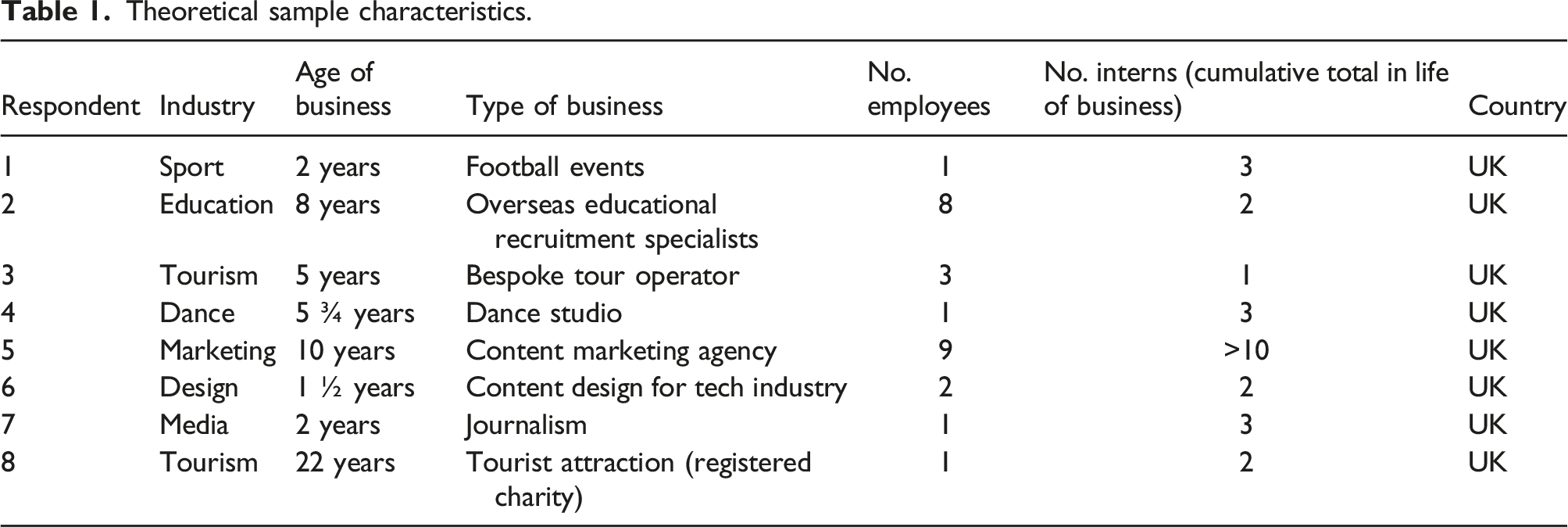
Information power sampling and the data collection strategy (Malterud et al., 2016), aligned with thematic analysis, enable the observation of instances of anticipated themes and permit examination of patterns within the data (Malterud et al., 2016; Clarke and Braun, 2013). All microbusinesses recruited for this study were UK-based and had been trading for at least one year. Previous studies of employment relations in small businesses or investigations of potential learning events for firm owners have focused on similar-sized samples (e.g. Ram, 1999; Ram et al., 2001; Deakins and Freel, 1998).
Data collection
Prior to data collection, sample recruitment materials and the interview guide (see Appendix 1) were reviewed and given ethical approval. Interviewees were asked about motives for intern recruitment and associated processes, the resource history of the firm, the anticipated and unforeseen results of intern recruitment and business demographic data. Microbusiness owners were sourced through two channels: university affiliate programs and personal connections. Eight in-depth, semi-structured interviews were conducted. The interviews took place either in person or via virtual meeting software at the convenience of the business owner. All interviewees were assured confidentiality and anonymity. The recorded interviews, which lasted between 40 and 60 min, were transcribed in full. It was not the intention to generate generalizable findings in this study. Rather, this research seeks to contribute to the development of theory and understanding as per Jack and Anderson (2002) regarding the perceptions, thinking and behavioural processes, and experiences of microbusiness owners when using low- or no-cost intern human resources.
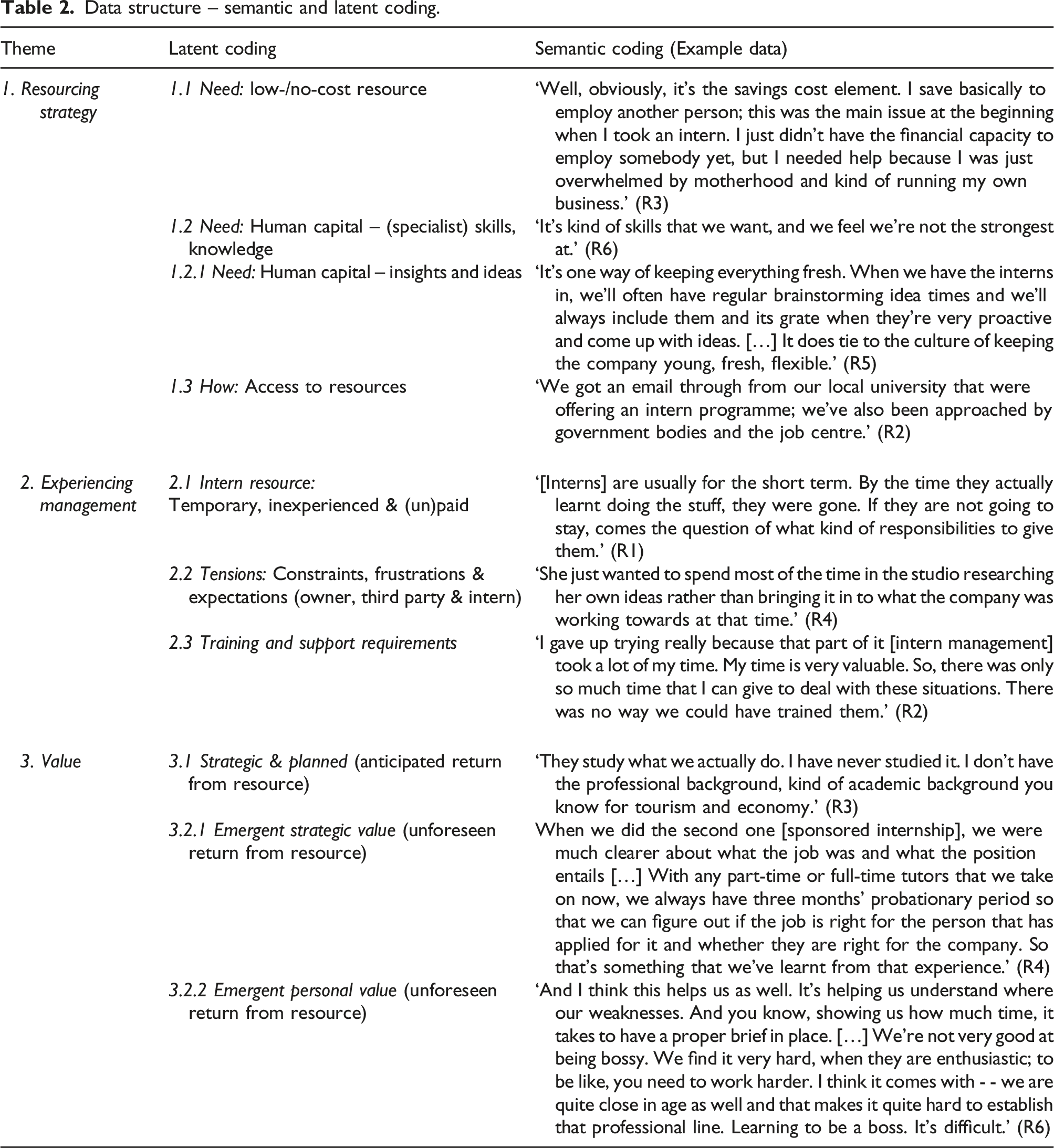
Data coding
Data structure – semantic and latent coding.
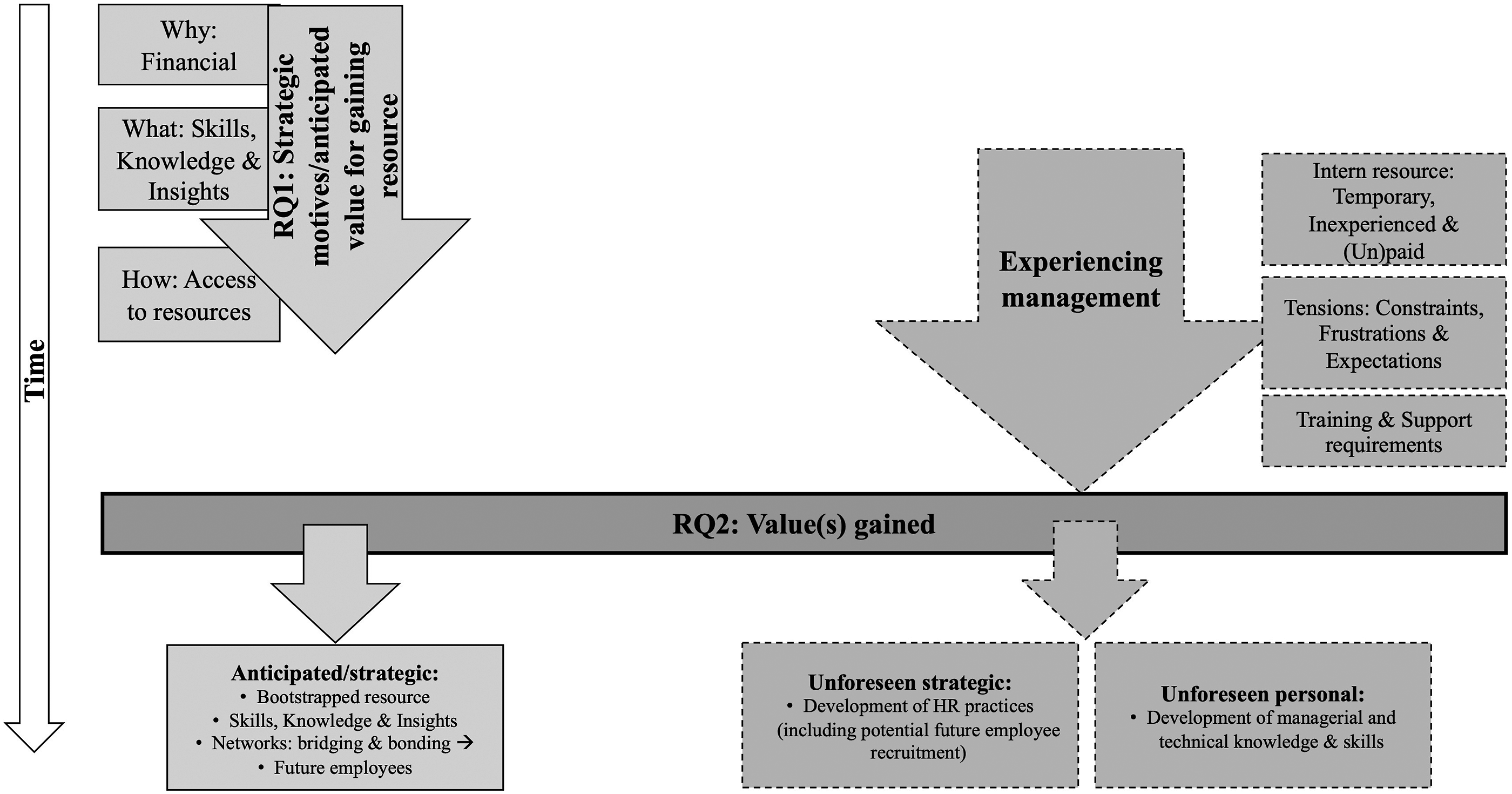
Thematic map: strategic motives, experiencing management and value(s) gained.
As with all research, efforts were taken to address potential limitations. Thus, informed by Lincoln and Guba’s (1985) criteria for trustworthiness, extensive measures were employed to address the credibility, transferability, dependability and confirmability of this research (Daniel, 2019). To that end, while it is acknowledged that these findings may not be transferable to other microbusinesses or the experiences of all owners or interns, common perceptions and experiences expressed in the data, despite sample diversity, are indicative of a truth value of the data (Krefting, 1991). The description of the data, with a focus on gathering and presenting rich data about the unique experiences of a small group of interviewees and their perceptions of the value(s) of a temporary human resource, facilitates comparison with other contexts and thus aids transferability. The study considers the variability of the experiences of the sample and presents data across the range of experiences, set out in clear tables, thus demonstrating data dependability (Cloutier and Ravasi, 2021). Confirmability is evident in the presentation of the data, which conforms to truth value and transferability criteria (Krefting, 1991). Finally, working with deep and rich descriptive findings, underpinned by trustworthiness (Nowell et al., 2017), was the motivating decision for thematic analysis. Thematic analysis is a robust and accepted approach in entrepreneurship studies (Jones et al., 2011).
Findings
Data analysis revealed three core thematic findings: the strategic motives, or anticipated value, for obtaining a resource, experiences of management and perceived (anticipated and unforeseen) value(s) gained. These are illustrated in the thematic map (Figure 1) and provide the structure for the findings reported hereafter. Each theme is addressed in turn and supported with data excerpts.
Strategic motives for obtaining a resource – anticipated value
The microbusiness owners in this study exhibited strategically orientated motives for accessing and recruiting an intern: first, to overcome financial constraints and, second, to meet human capital needs. Access was enabled through microbusiness owner resource-provision networks.
Financial. A central strategic motive for owners was an acknowledgement of his or her limited financial resources to enable formal recruitment of a human resource. Sourcing an intern enabled them to partially overcome this limitation, as R3 summarizes: “Well, obviously, it’s the savings cost element; I save basically to employ another person. This was the main issue at the beginning when I took an intern.” (R3)
Integral to the appeal of an intern is the ability of the owner to manage costs or get access to a ‘free’ or subsidized human resource, as R4 explains: “We were able to get some extra help in the studio at busy times and there was no financial cost to us.” (R4)
Nevertheless, in one case there was evidence of an ethical tension for the owner regarding interns as ‘free’ resources: “I try not to be a really bad capitalist and totally exploit them. What I do is pay for their accommodation.” (R4)
Despite acknowledging this inner conflict, and taking some steps to mitigate their conscience, the owner remained focused on the strategic value that could be attained from the human resource.
Human capital. The financial driver converges with a second strategic motive to meet human capital needs. These owners sought to gain access to specialist human capital, specifically knowledge and skills that they otherwise could not afford or did not possess as part of their existing skillset: ‘What the job entails, she was better at than us and that was sort of the purpose of having the interns. […] she did have knowledge in her head that we needed.’ (R2) ‘It’s kind of skills that we want, and we feel we’re not the strongest at.’ (R6)
Interns were also perceived as valuable for meeting flexible business requirements – for example, seasonal work or ‘outsourcing some of the jobs’ (R1) – which enabled the owner to focus on other business activities. Additionally, interns were viewed as a source of inspiration, creativity and ideas for the owner and their business. This aspect was consistently discussed as an important anticipated value of recruiting an intern, in the sense that the intern brought a ‘fresh breeze into the business’ (R3). This was noted with regard to planning activities, improving the enthusiasm of the established team, or for specific aspects such as technology. The following comment articulates the value: ‘There is something to be said for constantly replenishing business with young, enthusiastic people who are much more open to adapting to your culture as well as embracing and keeping the business young. […] You get random ideas from them that you wouldn’t get from someone who’s been in the industry for a while.’ (R5)
Access to resources. Critical to obtaining an intern was the practical and financial support available from a third-party network relationship (e.g., a university) to facilitate access and manage the (recruitment) arrangements. Thus, the support available from third parties enabled access, provided an additional incentive to recruit an intern and minimized perceived recruitment responsibilities like training requirements as respondents expressed perceptions that a university-affiliated intern would be “pre-trained”. For example, R2 said, ‘We were more interested in the graduates [which was an option for intern selection…]; someone with more experience and education’, and thus such interns were perceived as ready to commence “work”. Overall, owners perceived that they could access a trained human resource at little or no cost and did not have to commit to the intern long-term (as would be the case with a formal employee). R2 explained: ‘I was a bit worried about employing someone else [traditional employee], because it was short-term, and I didn’t really know how that would work and would we get the right number of candidates for only a short period of time because nobody is looking for something for three months. And literally, at that point, we got an email through from our local university that they were offering an intern program.’ (R2)
Thus, access to a human resource with desirable or required human capital, at reduced or no cost, enabled these microbusiness owners to gain access to specialist skills, knowledge and ideas, and filled human resourcing gaps.
Experiences of management: working with an intern
For these microbusiness owners, the experience of working with an intern was characterized by challenges, benefits and surprises.
Intern as resource. The “employment” conditions of an intern were a challenge for these microbusiness owners as they restricted the “functionality” of the human resource. The temporary nature of internships limited their durable contribution to the business and restricted potential future capability and competency gains, as this comment illustrates: ‘By the time they actually learnt doing the stuff, they were gone. If they are not going to stay, comes the question of what kind of responsibilities to give them?’ (R1)
In several cases, the commitment of the intern to the organization and their allocated work project was also temporary: ‘They come with a misguided view of the role and [the organization]. When they realize there are no resources, they move on.’ (R8)
Further, work activities had to be self-contained and comprise a discrete project: ‘[An intern] project [had to be something] they could start from beginning to end so it couldn’t really be something that could carry on or that you would employ someone after to carry on.’ (R2)
The payment conditions of interns – either unpaid or not paid directly by the microbusiness owner – affected owners’ expectations of how much an intern could contribute to the business. This had management implications, as R1 noted: ‘You can’t really punish interns or say this was done wrong because you’re not paying them.’ The conditions that define the role of an intern (e.g. low, or unpaid, temporary and likely inexperienced) were, therefore, the source of different intersecting tensions, related to the constraints, frustrations or expectations of the owner, the intern or the third party.
Tensions: constraints, frustrations, and expectations. The owners in this study reported that interns had expectations of their internship that did not align with those of the owner: ‘She just wanted to spend most of the time in the studio researching her own ideas rather than bringing it in to what the company was working towards at that time.’ (R4) ‘I think there’re different motivations for why they’re doing this. So, for our first intern, they are a second year. So, they’re doing this to have something on their CV to do a year in industry and like money. Whereas our second intern, they’re in their final year, so they are actually looking to progress and have a place within the company. So, their motivation is different.’ (R6)
Indeed, R8 said, ‘I was thinking I was getting something I wasn’t.’ The experience of R8 suggests that the initial strategic motive of accessing a human resource “jigsaw puzzle piece” that would fill a ‘hit the ground running’ resourcing gap in the organization was misleading. Indeed, internship recruitment procedures, which conformed to third-party conditions, could result in compromising on which candidate was subsequently recruited: ‘Relying on infrastructure/procedure of third party also imposed restrictions on when and for how long business owners could advertise for the jobs […] we would have just kept that application open until we found [a] better match. We wouldn’t have had that deadline.’ (R4)
Consequently, due to the limited and not necessarily adequate pool of interns available, the interns recruited were not always aligned with organizational requirements. With regard to the owners’ initial strategic motives for accessing and recruiting an intern, this outcome was frustrating and was perceived at face value as a limitation of working with interns.
Training and support requirements. The owners found that it was necessary to teach and train interns, an emerging and unanticipated challenge, especially as they had expected a fully-trained intern to fit into the workplace and require little or no support. For example, R2 found that: ‘There is no way you could have trained them. […] my time is very valuable, because I work part-time; every hour I’m in the office counts towards my job and the running of the business. So, there was only so much time that I can give to deal with these situations.’ (R2)
In most cases, these owners rarely, if at all, provided induction and/or training. Indeed, on occasion, this was reported as a positive; because there’s ‘no time to train them’ (R6) it was perceived that the short-term engagement of an intern minimized training requirements. If training did occur, it was ad hoc or on a case-by-case basis. Rather than offering training and support that enabled job role autonomy, owners often worked intensively with their interns on-site instead; interns had to be “overseen”: ‘I had to be with them, you know, and show them how to do the stuff. So, it wasn’t really time saving of my own or my business time.’ (R1)
This made the time investment of the owner in any training seem higher than the potential gains that might be obtained in the time available: ‘Often with interns, particularly with design ones, it can work out that we spend a lot more time helping them than we get value back.’ (R5)
Indeed, time becomes an unanticipated cost, especially as working with interns was considered very time-consuming: ‘Interns aren’t terribly efficient. There’s a lot of work in having them. They need to be told everything’ (R7).
Further, when owners did not consider the learning needs, expectations or fulfilment of interns, working relations were affected or could lead to the sudden departure of the intern. Thus, some of the characteristics of an internship – training needs, duration of placement, having to ‘make do’ – affected how these microbusiness owners engaged in, and experienced, management and leadership. For many of the owners, working with an intern was their first experience of managing another person; this unanticipated challenge had implications for the value the owner gained from this resource, which is addressed next.
Value gained – anticipated and unforeseen
Anticipated strategic value. In this study, the strategic motives expressed by these owners informed their perceptions of the anticipated value of the resource. First, engaging an intern, most often through a third party, meant access to external financing of resources at little or no cost to the microbusiness. Owners felt able to demand somewhat more from their interns and it alleviated a sense of guilt for not remunerating the intern directly. Second, interns provided specialist human capital skills, knowledge, ideas and insights for the business; R7 commented, ‘We use the [team] meeting to throw around and ask ideas and questions and I find that incredibly useful.’ Occasionally the ideas offered by interns were not well received: ‘She told us what to do quite a lot, rather than us telling her!’ (R2). Third, interns facilitated formal and informal network building, whereby owners gained access to future potential networks via their interns and developed experience of negotiating and liaising with third-party organizations (e.g. universities). For example, R5 explained how, by working with interns, he had created ‘more and more ambassadors [for his business]’. In addition, owners identified that they could benefit from the combined financial, recruitment and, especially, supervisory resources that were available to them via affiliated university and external partners, which included the potential to minimize the perceived management responsibility of the owner. Finally, owners had the opportunity to identify future employees, or freelancers, to whom tasks could be outsourced: ‘She did exactly what was asked of her. She definitely added value. She was worth every penny. We even offered her a job at the end of it.’
Unforeseen value. The unforeseen value of an intern resource – including both personal and strategic aspects – arose due to the successes, failures and conflict experiences arising from working with an intern (or by extension a third-party provider). Thus, learning management by doing opportunities for the owner were created by owner–intern conflicts and the experiences of the owners compelled them to develop their skills, knowledge and practices of management and leadership.
First, managing an intern and their work performance was often a first management experience for many of these owners and exposed their lack of business-specific, management and leadership knowledge or skills. As R6 described it, they were ‘learning to be a boss’; recruiting and working with an intern provided an opportunity to overcome such knowledge and skill gaps. Further, working with an intern encouraged the owners to explore what it would be like to have a formal employee as a precursor to employing someone in the future: ‘I didn’t want to straight away employ somebody. I thought I’ll give it a try [working with an intern]; how it is to work with somebody? It was really helpful to slowly start to progress my business because the thought of employing somebody was really scary to me.’ (R3)
There were also technical skills and knowledge that owners learned from working with an intern, such as contemporary approaches to the use of technology. In this way, the owners appropriated the skills of the formally educated interns, especially when the owners were not formally trained in the industry sector in which they were operating.
Unforeseen strategic value refers to the development of human resource practices, due to pressures on the basic, or absent, human resource policies or processes of these businesses. Through challenging experiences with an intern, some owners recognized that changes to their human resources practices were required and increased their knowledge and learning about human resource management. Due to failed recruitment efforts for instance, several of the owners improved their recruitment, selection and mentoring processes accordingly for the next recruitment iteration, as this comment from R6 illustrates: ‘At the beginning when we first conducted an interview, we’d never done it before, and we weren’t really exactly sure what the right process was. And now, looking back, we’re much better at spotting if someone is trying to fib about how good they are; we can pick up on that much sooner which is really important. And often asking the right questions! When we had our first interview, we just had no idea what was the formal way to conduct and interview, let alone, what to ask and what to ask for. And now we can pinpoint that a lot quicker.’ (R6)
Discussion
This study explores low- or no-cost human resourcing strategy, specifically using interns, in a microbusiness context and the value(s) (anticipated and unforeseen) of such a resource. There is little existing research that examines these factors from the perspective of a microbusiness (owner) (Jeske and Axtell, 2016). Given that Kellermanns et al. (2016) identify that business scale is a significant factor when seeking to understand resources and value, this research overcomes an important gap in the theoretical and practice-oriented literature. This empirical study illuminates the strategic expectations and unforeseen value gained from temporary human resources, making both theoretical and practical contributions to knowledge.
First, the strategic motives for using a temporary human resource indicates that minimizing costs and accessing specialist skills were the values initially sought. These microbusiness owners were motivated to access and recruit a temporary human resource to strategically fill resource gaps in their business at little or no cost, as per the findings of Winborg and Landström (2001) (also Jones and Jayawarna, 2010; Grichnik et al., 2014). Furthermore, as interns are temporary resources, a further cost-related benefit was that potentially high, or long-term, employee-type costs were minimized or eliminated. Interns also provided access to specialist skills and knowledge and, as hiring specialists is often not an option for microbusinesses (Kelliher and Reinl, 2009), this strategic approach enabled owners to temporarily fill human capital gaps in their business. Additionally, owners also fostered potential future work opportunities with and via the interns, and previous research has demonstrated the importance of such local networks for business owners (Jones and Jayawarna, 2010; Grichnik et al., 2014). These findings complement the work of Franco et al. (2019) who identify the knowledge transfer value of internships for firms. However, the utilitarian approach to attaining strategic value, with a focus on the benefits to the owner/microbusiness rather than shared benefits, echoes the concerns that have been expressed about internships more generally (Graduate Fog, 2014; Butler, 2018). Moreover, a lack of sustained involvement by an intern affects the long-term acquisition and capture of skills and knowledge within a microbusiness, thus constraining the strategic potential of the business to build competitive advantage (Foss et al., 2008; Kelliher and Reinl, 2009).
The strategic motives of the owners were facilitated by access to resources, which was largely dependent on existing or fortuitous social networks, as per Jones and Jayawarna (2010). However, whilst a third-party provider may be convenient and reduce time costs in sourcing a human resource (Ram et al., 2007; Ozdemir et al., 2016), the interns recruited were not necessarily the “best” for the role, but those available to fill the positions; this might suggest that, whilst seeking resources aligns with strategic motives, it also entails a requirement of ‘making do’ (Baker and Nelson, 2005). Given that the rarity, distinctiveness and uniqueness of a resource is critical for competitive advantage (Barney, 1991), this may limit microbusiness development and growth, especially as Barrett and Mayson (2007) find that formal human resource management is associated with growth-orientation in small firms. Alternatively, the previously unforeseen value gained from resources, which arises as a result of idiosyncratic ‘fit’ (Newbert, 2008), may lead to new learning and heightened resource value, providing eclectic competitive advantage for the business and specific professional managerial development for the owner.
The study found that managing an intern was challenging and that this appeared to be a source of unforeseen value gained by the owner from a temporary human resource. First, owners perceived that the training needs of interns were addressed by the third-party provider prior to commencing the internship, yet this was often not apparent in practice. Thus, intern development, training and mentoring needs were viewed as a costly time-based impediment to making the best use of the intern within and for the business, irrespective of other value benefits such as owner personal development. This reflects other studies which show that interns or employees are required to “hit the ground running” in small firms (Ram, 1999). Furthermore, the informal, often ad hoc nature of human resource management in small firms (Benmore and Palmer, 1996; Ram, 1999) and the importance of formal human resource management for growth and productivity are highlighted (Barrett and Mayson, 2007; James et al., 2019). Importantly, therefore, the significance of management skills and practices for microbusiness owners – a skills and knowledge area that is frequently limited in this size of organization (Beaver and Jennings, 2001; Rauch et al., 2005) – is evident.
These microbusiness owners benefited from the opportunity – indeed they were compelled – to learn management by doing which, as it was unforeseen, emerges as the most surprising and significant outcome for the owners. Specifically, the challenges of working with an intern generated personal value in the form of management skills, knowledge and learning. Microbusiness owners often lack management skills and experience, factors that affect business growth (Rauch et al., 2005). In particular, Martin and Smith (2010) report that the human resource management competencies of early-stage entrepreneurs are a significant weakness and a key area for learning and development opportunities. The importance of management learning and capabilities, which contribute to entrepreneurial success (Keith et al., 2016), cannot, therefore, be underestimated. Consequently, working with interns may help to address formal strategic planning and organizational knowledge limitations (Kelliher and Reinl, 2009) and to develop competitive advantage (Deakins and Freel, 1998; Lumpkin and Lichtenstein, 2005; Macpherson et al., 2015). Indeed, as mirrored in research focused on interns and their learning experience (Varghese et al., 2012), working with interns provided owners with a rich learning experience that developed valuable professional skills. Learning by owners is idiosyncratic, however. The skill and knowledge gains (e.g., learning how to formalize tasks, accommodating the training needs of the intern) depended on how engaged the owner was with management successes and challenges, and how defensive or reflective they were in response to challenges or failure. Thus, individual learning abilities and competence matter; it is likely that the value gained by a microbusiness owner from a resource will be in part due to learning competences and ability and individual attributions of value (Kor et al., 2007; Foss et al., 2008).
There are several practical implications of this research. Hosting an intern enables owners to have a learning management by doing experience which provides them with valuable management competency and capability development opportunities without the need to take time away from running the business. However, these unforeseen advantages could benefit from explicit promotion to microbusiness owners as a valuable outcome – the challenge of management of an “untrained” intern is potentially the most valuable benefit. This would require careful consideration by those promoting internships and may necessitate additional resources or making training available to microbusiness owners, even though finding or making time to attend training activities is very challenging for them (Neeson et al., 2007). Communicating the “challenge” value could be complemented by the other more utilitarian value benefits of an intern, such as the fact that they offer microbusinesses the potential to access skilled labour and knowledge specialists (Alvarez and Busenitz, 2001). This increases the owner’s ability to meet strategic targets (Jones and De Zubielqui, 2016) and creates further potential to build dynamic capabilities if managed appropriately and over time (Kurtmollaiev, 2017). Additionally, collaboration with institutional partners (a) is a source of funding that microbusinesses can use to meet resource constraints, and (b) provides further complementary learning opportunities such as experience and management of the collaborative recruitment processes. Working with institutional partners also builds additional forms of social capital, which has been shown to be valuable for gaining access to resources (Jones and Jayawarna, 2010; Ozdemir et al., 2016).
Conclusions
Until now, little has been known about the acquisition, use or value of interns in microbusinesses (Jeske and Axtell, 2016) or the effect of business size on the conceptualization of such resources and their value (Kraaijenbrink et al., 2010; Kellermanns et al., 2016). This study reduces those gaps and makes important contributions towards better understanding the anticipated and/or unforeseen value of human resources, specifically interns, in the microbusiness context. In addition, the practical implications of this research are considerable.
The findings of this study indicate that the microbusiness owners had to ‘make do’ (Baker and Nelson, 2005) with the intern available to them and this resulted in an unforeseen value gain opportunity to learn management by doing. Due to limited financial resources and a dependence on third-party institutional intermediaries, the human resource acquired may not represent the “best” human resource option and thus anticipated value was moderated by the intern in question. Owing to this ‘make do’ requirement, and associated mismatches in skills, knowledge and competing intern role expectations, business activities and business owners can experience owner–intern tension. Nevertheless, and of most importance to this sample, ‘making do’ was an unforeseen benefit resulting in personal learning opportunities. Owners enhanced their human and social capital through management learning and capabilities development and accessing networks for work opportunities and employees. Thus, recruiting an intern may have considerable unforeseen benefits for the skills and knowledge development of microbusiness owners; an area which has previously been identified as a significant limitation to the growth potential of microbusinesses (Beaver and Jennings, 2001; Kelliher and Reinl, 2009; Young, 2013). Notwithstanding the potential for personal development gain value, there was also evidence that the defensiveness or reflectiveness of the owners had an impact on the attainment of such gains, and this is a topic worthy of future research.
In addition, owners were strategically motivated by specific value considerations when seeking a temporary (human) resource. First, they use interns as a low- or no-cost human resource to meet business-related skills, expertise or knowledge gaps. Second, as per previous research (e.g. Winborg and Landström, 2001; Jones and Jayawarna, 2010), they use existing, and occasionally new, networks to fill resource gaps. Thus, as these owners anticipated, an intern offers a microbusiness owner the opportunity to overcome some of the significant (financial) challenges microbusinesses face when accessing (valuable) resources (e.g. Jones and Jayawarna, 2010; Young, 2013).
Overall, the study findings indicate that the resource value of an intern for a microbusiness encompasses both anticipated and unforeseen value. This is an important theoretical contribution, improving understanding of resource value – in particular regarding the use of temporary resources, such as interns, in microbusinesses. Specifically, unforeseen value gains may be particular to the learning capacity of the owner, which is informed by the microbusiness context in which they operate. Future studies could examine the importance of (dual) resource value and learning capacity on the willingness of business owners to develop other forms of capital, recruit “formal” employees, pursue business growth strategies and tackle future managerial challenges. Furthermore, given that the importance of management knowledge and skills is acknowledged in the human resource management oriented literature (e.g. Beaver and Jennings, 2001), it is surprising that the learning value gained as a result of managing an intern was perceived as unforeseen by this sample of microbusiness owners. This suggests a gap between academic scholarship and the practices of (micro)business owners, a fruitful area for future research, and evidence of the importance of a wider dissemination of academic scholarship.
Footnotes
Acknowledgements
The author sincerely thanks and acknowledges Dr Deborah Jeske, Professor Nick Williams, the Editor, and the anonymous reviewers for their many insightful and useful comments.
Declaration of conflicting interests
The author(s) declared no potential conflicts of interest with respect to the research, authorship, and/or publication of this article.
Funding
The author(s) received no financial support for the research, authorship, and/or publication of this article.
