




Abstract
The concept of an innovation system is used to understand how innovation contributes to economic growth. However, innovation systems do not evolve evenly in different parts of the world. This paper contributes to the ongoing debate on the emergence of innovation systems in the context of developing countries. It uses the Rwandan case, where agriculture is a dominant socio-economic sector with high innovation potential. It explores how stakeholder interactions and policies contribute to the emergence of an agriculture innovation system in Rwanda. Based on interviews with relevant stakeholders and a review of policy documents, the authors use the Triple Helix model to analyze interactions among stakeholders. They also explore the policymaking approaches used to formulate policy instruments and how these policy instruments contribute to the promotion of innovation activities. The study shows that stakeholder interactions and policies are important factors in providing the preconditions for innovation performance. There is a clear expression of interest and commitment to promote innovation activities in different policy instruments. Nevertheless, further strategic issues, such as evidence-based policymaking, institutional capacity building, better allocation of resources and platforms for promoting collaboration among stakeholders, need to be improved in order to build a functioning agriculture innovation system in Rwanda.
Innovation can drive growth and create jobs, and happens in the least developed countries as well as in the most developed. Innovation is not only the conception of a new product; it is also a complex phenomenon involving the production, diffusion and translation of knowledge into new products or new processes that address societal problems. The innovation process starts with the conception of a new idea or a thought which is converted into a tangible product, process or service that can be exploited commercially to address technical, economic or social needs and problems (OECD/Eurostat, 2018). However, innovation processes cannot be decomposed into several isolated phases that take place in a strictly proceeding sequence. It is a systemic process that involves complex and interactive learning activities. Innovation system has become a popular analytical framework to organize the innovation process to achieve the desired socio-economic outcomes (Hall et al., 2005).
Traditionally, an innovation system can be described as the set of institutions that jointly and individually contribute to the development and diffusion of new technologies and which provide the framework within which the government formulates and implements policies to influence the innovation process (Metcalfe, 1995). In particular, innovation systems are defined as social systems made by social actors, namely institutions and organizations (Johnson, 1997). Institutions constitute sets of habits, practices and rules or laws that regulate and facilitate the relationships and interactions of participating actors, while organizations are entities such as enterprises, research institutes, farmers’ cooperatives and governmental and non-governmental bodies (Edquist and Hommen, 2008; Högselius, 2005; Lundvall, 2010).
The innovation system framework emphasizes the importance of studying innovation as a process in which knowledge is accumulated, diffused and applied by heterogeneous agents through interactions that are shaped by social and economic institutions. The nature of social systems is that they are dynamic and open to external interactions (Lundvall, 1992). Yet, innovation systems must have a certain degree of internal coherence that must be higher than the respective degree of the external environment. Given that social systems are influenced in an irreversible way by the external reality, innovation systems are argued to be path-dependent; that is, they are the result of the local socio-economic history (Johnson, 1997).
Understanding the linkages among stakeholders of the innovation process and designing policy instruments to facilitate these linkages are also argued to be critical to improve the innovative performance of a country (Lundvall, 1992; Nelson, 1993). Policies, both innovation policies and other supporting public policies, influence behaviors and practices of actors in the innovation system. Thus, when designing effective policies, it is important to take into account the behaviors and practices that are likely to be affected by the policies (Mytelka and Smith, 2002). However, the all-encompassing nature of innovation systems often poses a challenge to policymakers to essentially understand the process of knowledge production and diffusion between different stakeholders (e.g., between universities and firms or between firms). To a certain extent the Triple Helix model (THM) has emerged to address these complex relations among the actors in the innovation system by streamlining the theoretical focus on the three salient actors: universities, firms and government (Etzkowitz and Dzisah, 2008; Etzkowitz and Leydesdorff, 2000). The THM helps us to explore two major dimensions: university–industry relationships and policymaking. Both dimensions are, as a matter of fact, critical for establishing a functioning innovation system, and thus for its ensuing performance.
Innovation systems have been used as a framework to strengthen innovation at different levels (national, regional and sectoral) (Högselius, 2005). Similarly, the THM can also be used as an appropriate tool for analyzing interaction at different levels, such as sectoral innovation systems (Leydesdorff and Fritsch, 2006). Sectoral innovation systems can be based on a specific sector of the economy or a specific technology or product, and comprise specialized organizations and institutions in a specific sector that interact to enhance innovation performance for its socio-economic impact on national development (Coenen, 2006; Högselius, 2005).
These approaches make “innovation” more explicable and measurable, and eventually rationalize the initiation of specific policy instruments, such as those intended to enhance collaboration among different actors at the regional level through innovative clusters and incubators (Isaksen and Asheim, 2002). Moreover, some innovation policy reforms are designed to boost the entrepreneurial and innovative potential of universities and firms (Etzkowitz, 2013). Furthermore, some innovation policies are introduced to enhance the innovation potential of particular sectors, such as agriculture, health, finance, ICT biotechnology, manufacturing, energy, etc. (Juma, 2016; Malerba, 2007).
As discussed by Schut et al. (2015) and Yongabo and Göransson (2020), agriculture is one of the critical sectors with high innovation potential for most developing countries. This has increased interest in understanding the dynamics of technology and innovation in the agriculture sector. The agricultural innovation system (AIS) could be defined as the application of innovation systems perspectives about agricultural research and technological change to the study of how society generates, disseminates and utilizes knowledge to respond to complex problems in the agriculture sector (Schut et al., 2015; Spielman et al., 2009). The AIS approach looks at multiple conditions and relationships that promote innovation in agriculture. As does the broader innovation system, the AIS takes into account the facilitation of the application of knowledge and associated policy actions. The efficiency of the AIS and associated policy actions are likely to be dependent on public policy frameworks and governance in the sector (Clark, 2002).
Due to the prominent role of the agriculture sector in most developing countries as a source of income, employment and food security, a focus on “improving the conditions for agriculture” has been a popular point of departure for many scholars to study the AIS and development (Hall et al., 2005; Juma, 2015; Schut et al., 2015). Over the years, the AIS has moved from a concept to a subdiscipline with principles of analysis and action (Klerkx et al., 2012).
In Rwanda, agriculture is one of the most promising sectors for innovation, dominating societal and economic lives. Around 69% of the total population in Rwanda are employed in the sector, of whom 80.2% live in rural areas (NISR, 2018). Despite some improvements, the agriculture sector in Rwanda faces challenges due both to natural causes (such as climate change, diseases and pests) and to human-made problems, such as land degradation, financing and youth engagement in farming (Gahakwa et al., 2014; MINAGRI, 2018b). One particular issue for Rwanda, especially within the scope of this study, is the lack of collaborative partnerships and interactions among the key stakeholders in the agriculture sector to address these challenges. A salient issue in relation to collaboration is the utilization of available research capacity at research institutes and universities to provide innovative solutions to pertinent problems for farmers (see Bizoza and de Graaff, 2012; Ngaboyisonga et al., 2014).
In this paper we focus on efforts to provide conditions for innovation as a means to build the Rwandan AIS. The paper aims to assess how stakeholders’ interactions and policies contribute to the emergence of the Rwandan agriculture innovation system. We explore the role of stakeholders and the associated institutional set-up in fostering innovation and how policies and policy instruments contribute to the emergence of or enable the formation of the AIS.
We use the THM to map out key stakeholders and assess how they interact to perform their roles and functions to foster innovation. We also assess the policymaking approaches that are used to design policies and policy instruments and how they support innovation activities. It is our contention that policies and stakeholder’ interactions are key factors that define preconditions for the innovation process in emerging innovation systems. However, the way policies are made and norms and institutional set-ups for stakeholders’ interactions are context-dependent.
After this brief introduction, we present the context of the study, our literature review and the methodological framework used to address our research question. We present empirical findings on stakeholders’ roles and their interactions, followed by an analysis of how institutional set-ups, policy instruments and policymaking approaches contribute to facilitate the emergence of an AIS in Rwanda. We conclude with a discussion and summary of the key findings and of how this study contributes to the ongoing debate in innovation studies about factors and conditions for the emergence of innovation systems in developing countries, particularly African countries. Despite a number of policy or consultancy reports, this study is one of the first academic works focusing on an AIS in Rwanda. Our purpose is not to provide a final response to this debate; it is rather to present our findings to emphasize the importance and relevance of the AIS for Rwanda while also showing the hurdles of innovation policymaking within the agriculture sector.
We aim to increase awareness among all stakeholders that establishing a well-functioning innovation system does not happen instantly, requiring not only capacity building among individual stakeholders but a more systemic approach that encourages public–private partnership—for example, the intensification of university–industry relations within the spirit of the THM. Our focus on the agriculture sector should not mislead readers; we believe our findings have relevance for other sectors in Rwanda. Agriculture is not an isolated sector, but rather is connected to several others, including industry, service, ICT, energy, finance and health. Furthermore, Rwanda is participating in several international and regional initiatives and collaborative projects (e.g., within the East African Community), and, by presenting the situation in Rwanda, we expect our study to provide relevant insights to such partnerships.
Setting the stage: Overview of the Rwandan agriculture sector
The Rwandan economy has experienced continuous growth over the past decade, with an average GDP growth of around 7% for the period 2007–19 (NISR, 2019). This economic growth is a result of joint efforts in different sectors of the economy led by the service, agriculture and industry sectors. The agriculture sector contributes significantly to the national GDP (Figure 1), although its contribution has been varying, with a slight decrease due to climatic conditions (heavy rains and drought) and soil fertility decline, as well as crop pests and diseases that have affected production over time. The sector also contributes to the Rwandan performance on the international market through the increase of exports (Ministry of Trade and Industry, 2013; NISR, 2015, 2019; MINECOFIN, 2012). Besides its overall contribution to national economic growth, agriculture contributes to the development of other socio-economic sectors, including industry, business, health and community livelihood improvement in general. This is done through the provision of raw materials for agro-processing, enabling access to sufficient, nutritious and healthy food and offering business and entrepreneurial opportunities at different stages of the value chain.
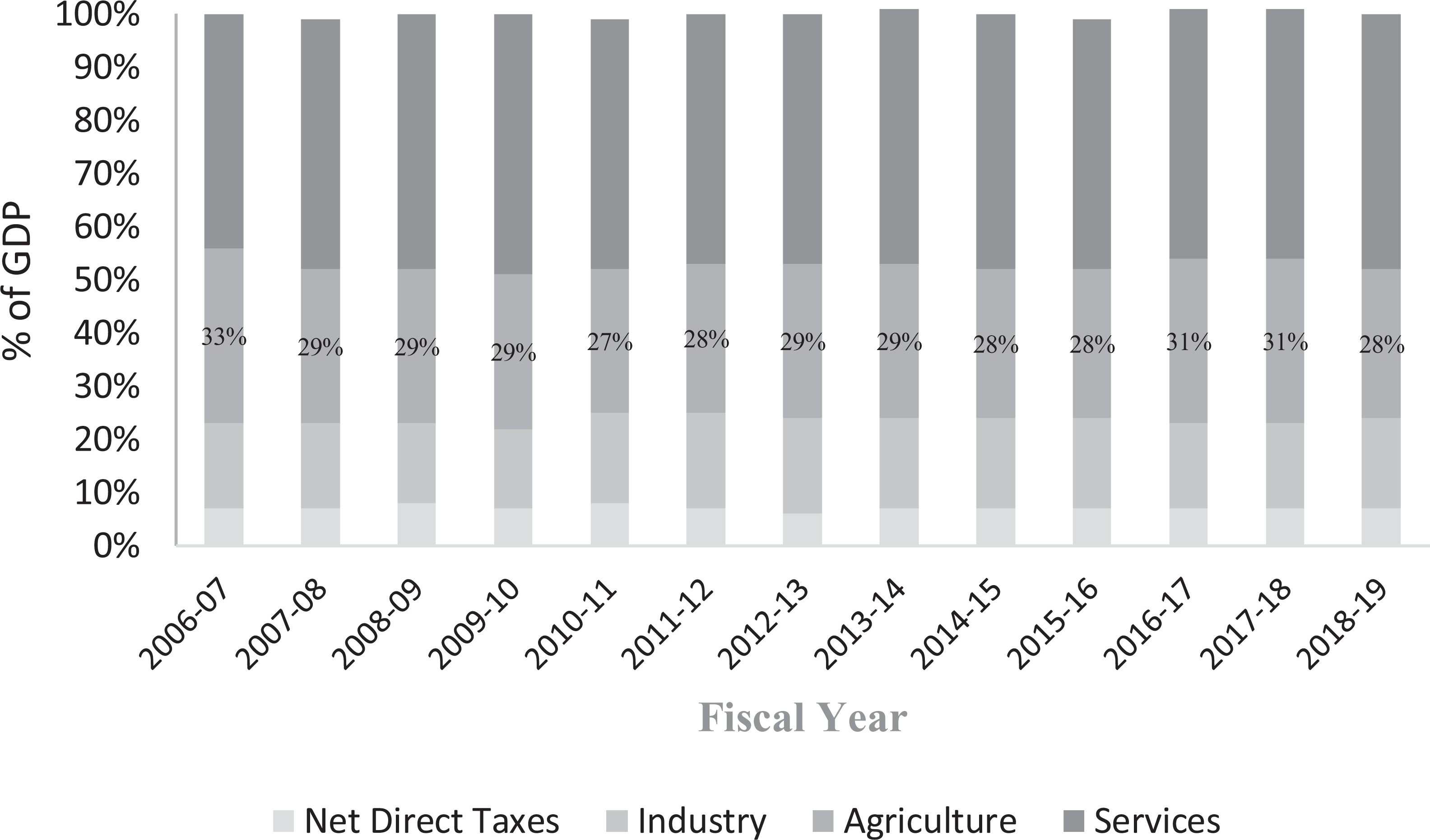
Contribution of the agriculture sector to the national GDP, 2007–2019.
Additionally, the agriculture sector offers jobs and further job creation opportunities for Rwandans. As noted above, currently the sector employs around 69% of the total population in Rwanda, of which 80.2% live in rural areas. About 86.5% of non-educated people and 75.7% of people with only primary education are employed in the sector. However, less than 8% of highly educated people (7.9% with a university degree) participate in the agriculture sector (NISR, 2018), and this may have limited the opportunity for interactive learning and experience sharing. This consequently limits the potential complementarity between new knowledge (technologies) and traditional knowledge.
The Rwandan Vision 2050 and the National Strategy for Transformation (NST1) are major national development programs that inspire agricultural development strategies and policies in Rwanda. These programs are based on Vision 2020 and EDPRS I&II, which phased out in 2013 and 2018 respectively. The National Agriculture Policy and the 4th Strategic Plan for Transformation of Agriculture 2018–2024 (PSTA4) are major guiding policy documents for agricultural development in Rwanda. These are accompanied by sub-sector strategies and policies as well as District Development Plans (MINAGRI, 2018b). The implementation process of the plans and programs follows a vertical flow in a normative way toward the ambitious aspiration to effect a transformation from subsistence to market-oriented agriculture which will ultimately contribute to Rwanda’s move toward the middle-income countries category by 2025 (Gatete, 2016; MINECOFIN, 2017).
These plans and policies have induced several policy actions aimed at transforming the sector. Various priority areas were set to address major challenges, including agricultural intensification, land and water resources management, agricultural mechanization, agro-processing, agricultural market development with an emphasis on export promotion, the pricing system and certification and standardization for global market integration, among others. Given the importance attributed to increasing production, genetic resource improvement is among the core priorities, with a focus on seed diversification and improvement. This is combined with crop protection efforts, as it is believed that the combination of the two will provide solutions including crops that resist harsh conditions caused by climate change and diseases. In addition, the promotion of agribusiness is seen as a means for extending the agriculture sector’s operations, increasing the number of actors involved and connecting agriculture to other economic sectors, including the service sector and other industries. The promotion of agribusiness is effected by supporting the value chains of promising commodities: among those identified as promising are horticulture, dairy, poultry, potato, coffee and tea (MINAGRI, 2018b; MINECOFIN, 2017).
The Rwandan agriculture sector, through its specialized sub-sectors and value chains, accommodates a wide range of stakeholders that contribute to its development in different ways and with different capacities. They are generally grouped into the main categories of farmers, agro-dealers, processors, traders (retailers and wholesalers), research institutes, public organizations (ministries and government agencies) and non-governmental organizations (local and international). All these stakeholders are expected to interact while performing their roles for meeting their collective interest, the development of the agriculture sector. Based on the wide range of stakeholders in the sector and the diversity in operations, it is important to understand how they interact and their role in building the AIS in Rwanda.
Literature review
National innovation system and the THM
A consensus in the literature and among policy circles has more or less emerged about what is meant by innovation, a national innovation system and the Triple Helix and about their relevance for economic growth and national competitiveness and societal well-being. Both the national innovation system model (NIS) and the THM emphasize the importance of interaction among the key actors for knowledge production and sharing, aside from a strong capacity in R&D. The ability to innovate is often related to collective action, coordination, the exchange of knowledge among diverse actors, the incentives and resources available to form partnerships and develop businesses, and the conditions that make it possible for firms and entrepreneurs to use innovation (Chaminade et al., 2018; Etzkowitz and Leydesdorff, 2000; Fagerberg and Srholec, 2008). Technological skills, innovative solutions, functional institutions and stakeholders’ capacity (financial and knowledge) are imperative for the needed systemic approach (Juma, 2015; Lundvall, 2010). Such an approach echoes the importance of joint efforts in policies and policymaking processes as a means for ensuring collective interest in the system and inclusivity. This ultimately defines the functioning and success of the system as policies and aligned instruments play an important role in decision-making for collaborations among actors and investments, leading to high innovation propensity (Mytelka, 2016).
The NIS literature engages directly with the concept of system as a kind of loose metaphor to describe broad relationships among the relevant stakeholders whose activities affect innovation (cf. Lundvall, 2010). In a series of empirical studies, scholars had shown that systems of innovation can be achieved at national or regional level (e.g., while a national system may be more visible in the Netherlands, the regional level prevails in Germany—see Cooke and Leydesdorff, 2006; Isaksen and Asheim, 2002; Leydesdorff and Fritsch, 2006). Moreover, one can analyze whether innovation systems are technology-specific or sector-based (Carlsson, 2006; Malerba, 2007; Pavitt, 1984). The core idea of the regional innovation system (RIS) or the sectoral innovation system (SIS) does not differ from the overall concept of the NIS, except in the level of operationalization (Cooke, 2002; Lundvall, 2005).
The THM is employed to understand the specific roles of three key stakeholders, university, industry and government, and the synergy between them (Etzkowitz and Leydesdorff, 2000). The model encourages closer relations among actors, with each not only playing its own role but also taking over each other’s roles, as well as creating hybrid organizations at their interfaces. An example is the science park, in which research results and knowledge developed in a university are transferred to private firms or commercialized in incubators by entrepreneurs with the financial support of governmental agencies. In this model, the traditional university transforms into the “entrepreneurial university” which becomes the main organizational actor. Universities in the THM keep their autonomy but develop reciprocal relations with the other actors (Etzkowitz, 2013; Leydesdorff and Etzkowitz, 1996). 1 Using the THM, analysis can be more specific than using NIS as it embraces interaction among all organizations and institutions at the national level.
Despite some limitations and critique, the THM is being used as a research tool in several studies focusing on both developed countries (e.g., Sweden, Denmark, Netherlands, Finland, Israel) and developing countries (e.g., China, Latin America, South Africa, Kenya). It has become popularized even as a policy framework or concept by numerous national organizations (e.g., Vinnova in Sweden, Magnet in Israel) and supranational organizations (e.g., the European Union) (for more information, see Benner and Sandstrom, 2000; Göktepe, 2003; Jongwanich et al., 2014; Liu and Huang, 2018; Nordfors et al., 2003; Sutz, 2000; Tuunainen, 2002).
The THM has evolved from a descriptive framework and an analytical tool into a normative model used in many countries and regions to foster technological innovation and economic growth. Many national agencies and ministries in developing countries have tried to learn from the success of developed countries or from countries that have managed to catch up quickly (such as South Korea or China). They have relied on external experts and scholars to obtain the recipe for innovation policy. These experts often simplify the process of knowledge creation and innovation into public–private partnerships in different spatial and other contexts as the key for innovation policy frameworks in many countries (Jongwanich et al., 2014; Leydesdorff and Zawdie, 2010). However, it is still hard for the policymakers or policy analysts to learn from these frameworks and to use the underlying ideas rigorously.
Policymaking approaches and policy goals for innovation
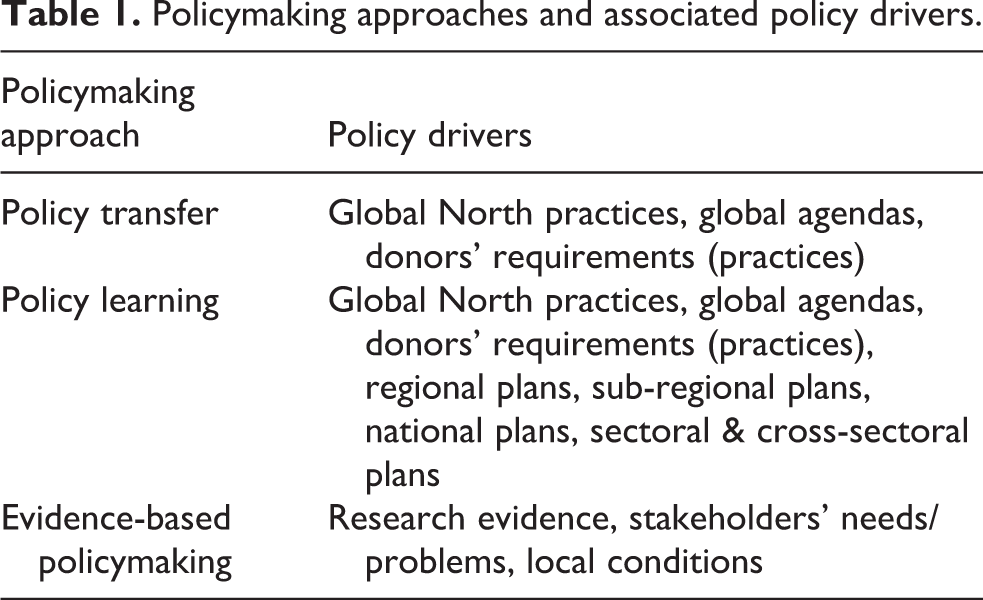
Up to this point, we have discussed the emergence of systemic approaches (NIS, THM) for innovation as a scholarly field. In this section, we delve into a complementary discussion on policymaking approaches and how the choice of policymaking approach can lead to policy actions that influence innovation performance. We give a brief overview of policymaking approaches and how they are related to innovation policy goals. We discuss the literature related to policy transfer, policy learning and evidence-based policymaking. From this discussion, we suggest a simplified analytical tool (Table 1) that we apply to policies and policy instruments to identify key policy drivers and how they orient policy actions that support innovation in the Rwandan agriculture sector.
Policy transfer (whether voluntary or coercive or a combination of both), in particular, between developed and developing countries underlines the partition of countries into “donor/lending and borrowing” countries. It is often labeled as “lesson-drawing” or “lesson-learning,” and countries that look at successful experiences frequently expect that the policy lessons will generate similar success for them (Howlett, 2009; Stone, 2017). This misapprehension, however, ignores the importance of local capacities, competencies, resources, infrastructures and, particularly, local culture and needs. Policy transfer is rarely a perfect process of transmission (Meseguer, 2005).
Policy learning, by contrast, may result in a more coherent adaptation of ideas, policies and practices (Stone, 2017). However, there is no clear-cut distinction between policy transfer and policy learning. Depending on how the transfer is done, there might be a soft transition between the transfer and the learning, but in other cases there may be a direct transfer of policy such as often happens between developing countries (the Global South) and their donor countries (the Global North). Learning occurs in specific institutional contexts: that is, in systemic environments shaped inter alia by regulation, law, political culture and the “rules of the game” of economic institutions. These environments of course include policy institutions and actions. Policy learning, like policy transfer (emulation), may therefore fail to capture the holistic nature of problems and solutions. This may result in a lack of support for innovation development, which is the primary motivation for learning from best practices and success stories.
Direct policy transfer, in particular learning and implementing successful policy instruments from one context to another, can be a too complicated and risky option, as there is no detailed blueprint for making innovation happen at a given time in a given place for a given result. The formulation of innovation policies and development plans based on success stories is problematic due to the complexity of the innovation process (Clark, 2016; Stone, 2017). Innovation policy must build on the key characteristics of how innovation comes about: it is uncertain, cumulative and collective (Lazonick and Mazzucato, 2013). It has to take into account national factors, historical path-dependencies, local conditions, economic inequities, demographic challenges and informal economic activity (Fagerberg and Srholec, 2008; Muchie et al., 2003). This requires evidence to inform policy on these issues. Thus, evidence-based policymaking becomes a more efficient and strong approach.
Evidence-based policymaking and stakeholders’ engagement are among the effective approaches that are used in places where efficient policies are observed. Policy efficiency at both macro and micro levels solicits a systemic approach with the ability to set priorities and proper resource allocation (Chaminade and Lundvall, 2019; Howlett, 2010; Mytelka and Smith, 2002). Evidence-based policymaking emphasizes that the government must produce policies that are forward-looking and shaped by evidence rather than a response to short-term pressures; that tackle causes not the symptoms. This approach requires a pool of accurate pieces of evidence that will ensure the potential for policy success. Those pieces of evidence are obtained from diverse sources, with research-based evidence preferred in most cases—although the active engagement of actors in the process is also considered a means of capturing real problems in their actual context.
Howlett (2009) considers problem examination as a starting point in policy design for organizing thinking and analytical efforts in a more productive way that can lead to effective and efficient policies and policy instruments. The acquisition of evidence and real problem analysis are key challenging stages in the policymaking process. They are expected to be systematic processes that consider different dimensions in order to generate realistic and implementable policy tools in the context of operationalization. Efficient frameworks and avenues for consultation and experience/ideas sharing play an important role in the process. Based on the complexity of the innovation process, it is hard to rely on a single approach to provide policies and policy instruments that capture all policy demands for conditions to innovate. A balance in the use of these approaches is needed, depending on learning capabilities and the capacity to generate and use evidence. Undeniably, due to the dynamics of globalization, it is often suggested that a mix of policy transfer, policy learning and evidence-based policymaking is “on the rise” as an empirical phenomenon (Davis, 2009; Howlett, 2010).
However, navigating all the dynamics involved in this mix is challenging, and criticisms have been emerging with regard to evidence-based policymaking, which is considered an efficient policymaking approach in many places. Criticisms concern how the evidence is generated, its accuracy and objectivity, and how it provides answers to policy problems. There are arguments about the influence of personal and policy agendas in evidence production as well as uncertainty in the research process, which is considered the main source of trustworthy evidence. There is also concern that policymakers can manipulate evidence to make sense of their own narrative or political agenda (Greenhalgh et al., 2020; Hulst and Yanow, 2016). Thus, it may be wise to adopt any policymaking approach with caution and to engage in critical reflections that will allow a balanced view of the policy problems and the policy options to answer those problems.
In this paper, we build on the fundamental principles of the above policymaking approaches to understand how Rwandan agriculture policies and policy instruments are designed and how they provide an operational framework for innovation. As noted above, lessons are drawn from success stories in developed countries (Global North practices) and international development goals and programs (the global agenda) or are imposed by donors (donors’ requirements). Moreover, some lessons are learned within regions (from regional plans) or within a country at different levels (national, sub-regional, sectoral plans). As for evidence, it can be acquired through research, the analysis of stakeholders’ problems and the analysis of local conditions (Howlett, 2010; Stone, 2017). These sources of lessons and evidence are in principle the main policy drivers that provide the foundation of policy orientations. However, the influence of power and politics cannot be neglected in the policymaking process. On this basis, we designed a guide (Table 1) to organize policymaking approaches and their associated policy drivers. 2 The guide helps in the exploration of how policies and policy instruments in the Rwandan agriculture sector support innovation activities for facilitating the emerging AIS. It helps to connect the policymaking approach, policy drivers and policy initiatives, and how stakeholders build on them to orient innovation activities that increase the innovation propensity in the sector.
Policymaking approaches and associated policy drivers.
Methodology
In this study we use both primary and secondary data collected through semi-structured interviews and a structured review of official documents to address our research question. As a point of departure for the empirical study, we have utilized secondary data gathered from different official documents and policy reports for the agriculture sector at different levels (national, regional and international). 3
In addition to the secondary data, we collected primary data using semi-structured interviews with key stakeholders, including policymakers, researchers, farmers, industrialists (processing) and non-governmental organizations (NGOs) participating in the Rwandan agriculture sector. There were two rounds of interviews: the first round was conducted in December 2017–February 2018 and the second was conducted in January–February 2019. Interviewees were selected purposively in a systematic way based on their institution, position, seniority and experience. In government institutions, we selected senior policymakers; in research and academic institutions, senior researchers; and in farmers’ cooperatives, cooperative managers. For NGOs and the private sector, staff in decision-making positions were selected. A specific guide was developed for each round of interviews, with approximately 10 questions (see Appendix 1).
In the first round, we interviewed 16 policymakers, 6 researchers and 2 representatives from NGOs. We focused on more general issues related to the promotion of innovation, the institutional setting and the collaboration and policy environment. The second round focused specifically on the Rwandan agriculture system and four policymakers, three researchers from agricultural universities, eight farmers and five representatives from industry (private firms in agro-processing) were interviewed. The main themes for the interviews were the policy framework for promoting innovation, policymaking approaches, stakeholders’ interaction and their role in the agriculture innovation system, and major challenges for innovation in agriculture.
Interviews lasted for between 30 minutes and 1 hour for both rounds and for all stakeholders. They were conducted as a guided discussion, with notes taken during the discussion and edited for analysis. The interview guide included an introductory section setting out the purpose of the study and with a request for consent. Before each interview, interviewees granted their consent. Their identity was kept anonymous and interview notes were treated as confidential, with only researchers in the team having access to them.
The interview notes were analyzed using thematic analysis, based on the key parameters relating to our research question—these included the policymaking approach (Table 1), major policy initiatives from policy instruments, the role of stakeholders in the innovation process and institutional set-up. The NIS and TH models were used as frames of reference for analysis of the themes. These concepts were instrumental in analyzing the stakeholders’ categories, their functions and their modes of interaction.
Findings
The empirical findings from the secondary and primary data are organized into three main themes to address our research question: (a) stakeholders and their roles in fostering innovation in the Rwanda agriculture sector; (b) the institutional set-up to facilitate the innovation process; (c) major policy instruments and policymaking approaches to promote innovation in the Rwandan agriculture sector.
Stakeholders and their roles in innovation
Stakeholders in the Rwandan agriculture sector are grouped into farmers, government, non-governmental organizations, the private sector and knowledge institutions. The farmers’ group is mainly composed of farmers’ federation and cooperatives as well as individual farmers, small-scale farmers and large-scale farmers. The small-scale category consists of farmers with less than 0.7 ha of farming land, while large-scale farmers have 1 ha or more (Ayalew Ali and Deininger, 2014; Rwirahira, 2009). The NGO category comprises both local and international bodies (including UN agencies and regional/transboundary organizations directly or indirectly engaged in the agriculture sector). Line ministries, aligned agencies and local administration entities are the main components of the government category. The private sector category is composed of agro-dealers and agribusiness entrepreneurs, including industries. Research and training institutions (i.e. higher education) make up the knowledge institutions group.
These stakeholder groups have a wide range of roles and functions to perform for the development of innovation in Rwanda’s agriculture sector. The government plays the central role of providing an operational environment through planning and policymaking. Knowledge institutions conduct research and technology transfer to provide needed skills and technology to address problems in the sector. The research dissemination and technology transfer roles are accomplished through interaction—still meager due to weak collaborations and a lack of joint activities. The interaction involves knowledge institutions as technology providers, public agencies and NGOs as facilitators and farmers as technology end-users. Innovation propensity is expected to increase through interaction and mutual learning among the stakeholders, particularly between knowledge institutions and technology end-users (farmers and industries). To translate all these efforts into economic significance, roles related to financing and commercialization are fulfilled by the private sector.
As noted above, interaction among stakeholders is still low and this was highlighted by all the interviewees (Figure 2). However, they recognized emerging efforts to enhance interaction through consultative meetings and workshops, although these means are not seen as satisfactory in light of the high expectations of research, technology and innovation as the main drivers for the transformation of the agriculture sector. A cooperative representative commented: We are not consulted for technologies that are brought to us and sometimes we find them not useful based on our needs. And the same happens for different training that we attend; they are many times like normal classes and yet we want hands-on practices to increase yield in our farms. We have been trying different extension tools but it is hard to realize the impact as many of them require ownership of farmers and investment from different actors. An example is the initiation of Innovation Platforms: at the beginning, with donors’ funds, they were performing well but after the project most of them failed because farmers could not sustain them. The same for FFS, after we have completed the trials, it is hard to observe farmers using technologies in their own fields.
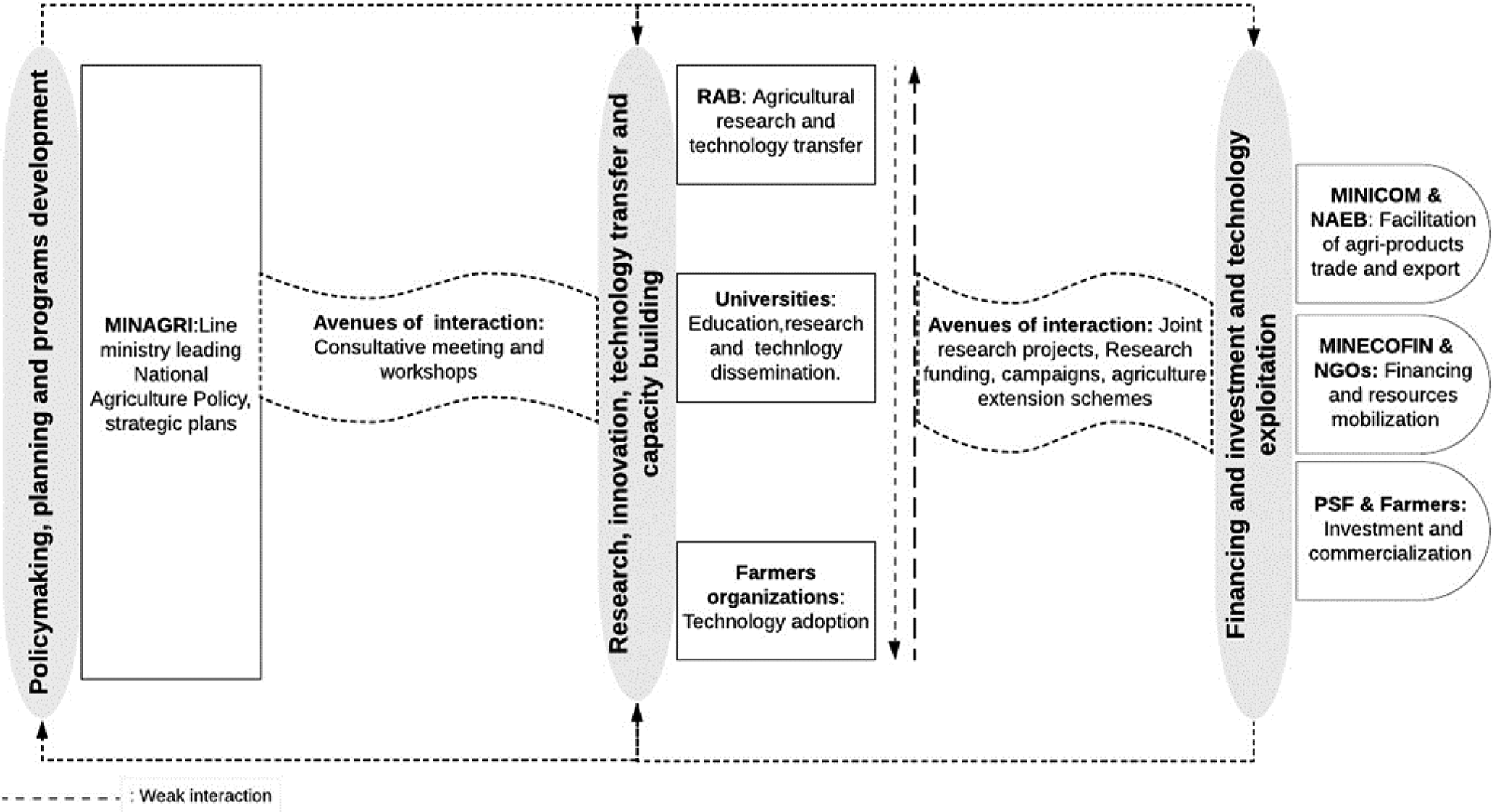
Status of stakeholder interactions in the Rwandan AIS.
The level and quality of interactions among stakeholders, investment and the consideration of critical issues in a specific context are key for increasing innovation propensity (cf. Lundvall, 2007b). These are likely to be observed if there are: a joint planning framework that allows what is in the collective interest to happen; participatory research approaches; active learning processes; and a clear perspective on the complexity of the system by considering all dimensions (Ngaboyisonga et al., 2014). Well-accomplished stakeholder roles are essential to these factors, and the adoption of engaging avenues for interaction can help to overcome the lack of cooperation in emerging innovation systems such as the Rwandan AIS (Dosso et al., 2018; Jiggins et al., 2016).
Institutional set-ups to facilitate the innovation process
The above discussion provides an overview of the actors involved in building the Rwandan AIS. However, as pointed out by Lundvall (2010), to stabilize and mature innovation systems need strong institutions to support actors (organizations) in performing their roles and functions in the innovation process. In our study, we noted that institutional frameworks were being set up to ensure proper coordination and collaboration. Specialized institutional structures, policies, law and regulatory frameworks are major institutional patterns that are emerging. Specialized public agencies and their regulatory frameworks have been established to facilitate research, technology transfer, innovation, capacity building and agribusiness (including export). Among the established agencies are the Rwanda Agriculture and Animal Resources Development Board, which deals mainly with research and extension activities in the agriculture sector. The National Agriculture Export Board was established to promote agribusiness, particularly export. In addition to these specialized agencies in agriculture, the National Industrial Research Development Agency was put in place to promote industrial activities in different sectors of the economy, including agriculture. All these institutional structures are aligned with different policies and policy instruments to support innovation activities in the agriculture sector. The National Agriculture Policy, the National Industrial Policy and the Strategic Plan for Agriculture Transformation are among the key policies that have been put in place (Table 2).
Moreover, farmers’ organizations (cooperatives and federation) have been established to facilitate technology transfer among farming communities. Capacity building schemes have also been developed, from formal education to farmers’ training. There are specialized agriculture universities, colleges and technical colleges. For example, 6 of 22 certificate courses offered as Technical Vocation Education and Training are in agriculture (WDA, 2018) and there are Higher Learning Institutions which specialize in agriculture (HEC, 2019).
In addition to institutional structures, there are regulations and regulatory frameworks that favor the adoption of new technologies and facilitate dynamics in markets from the local to international level. The interviewed stakeholders from the private sector appreciated the established subsidy schemes for the importation of technical equipment as an important regulatory mechanism for supporting product diversification and enhancing their innovation propensity. The same applies to the local certification and standardization framework which helps local industries to ensure the quality of products, particularly for agro-processing and export.
Although there was an appreciation of these efforts, the stakeholders also highlighted issues that were hampering the current institutional structure in facilitating innovation in the agriculture sector. These included a lack of budget to support innovation activities, limited interaction among organizations, a lack of consistent strategies to build internal capacities and a lack of policy feedback channels. Institutional coordination, trust among actors and institutional stability were other areas considered in need of improvement. As highlighted by a researcher at an international NGO, there is a need to match institutional strategies and policies with resources allocation: Both the National Agriculture policy and the 4th strategic plan for the transformation of agriculture place a lot of emphasis on research and innovation (actually it’s the first pillar in PSTA4). In other words, government policies are supportive. The main challenge is that a very limited budget is made available for research and extension.
Policymaking approaches and policy instruments to promote innovation
Rwanda has put in place policies and policy instruments (Table 2) to support innovation for agriculture sector development and national socio-economic development in general. They provide key priorities and implementation guidance to increase innovation propensity in the agriculture system, and have been formulated using different policymaking approaches. Policy transfer and policy learning appear to be the most popular approaches in the Rwandan agriculture policy cycle, whereas evidence-based policymaking is less in evidence. Policy transfer is observed mainly in development plans influenced by global and continental agendas. Policy learning and evidence-based policymaking are observed in contextual priority-setting based on national realities or specific agro-ecological zones. Consultation with stakeholders is used as the main tool in the learning process and the acquisition of evidence.
For policy transfer and learning, global and regional development agendas are the main policy drivers. The Sustainable Development Goals of the United Nations, Agenda 2063, the Comprehensive African Agriculture Development Plan (CAADP) and the East African Vision 2050 are the main frames of reference and influence national priorities (African Union Commission, 2014, 2015; EAC, 2015; NEPAD, 2003; United Nations, 2015). These agendas are seen as motivations to set national development strategies targeted at global integration and harmonization with regional initiatives. Rwanda’s Vision 2020 and Vision 2050 are the main development strategies that provide orientation to other national policies and strategies. From these guiding strategies, there is a vertical transfer of development priorities from central government to specific sectors, including agriculture. The transfer of ideas and priorities appears to be state-driven, as highlighted by one of the policymakers interviewed: “We follow the guidelines from the national leadership.” However, consultations with stakeholders at workshops and meetings provide the main sources of evidence and interaction that inform policies. These consultations, though, are perceived by some stakeholders (particularly farmers, researchers and processors) as unsatisfactory because they follow a predefined agenda and the audience may not be well informed about the policy problems that need to be addressed.
Policy instruments and policymaking approaches to support innovation.
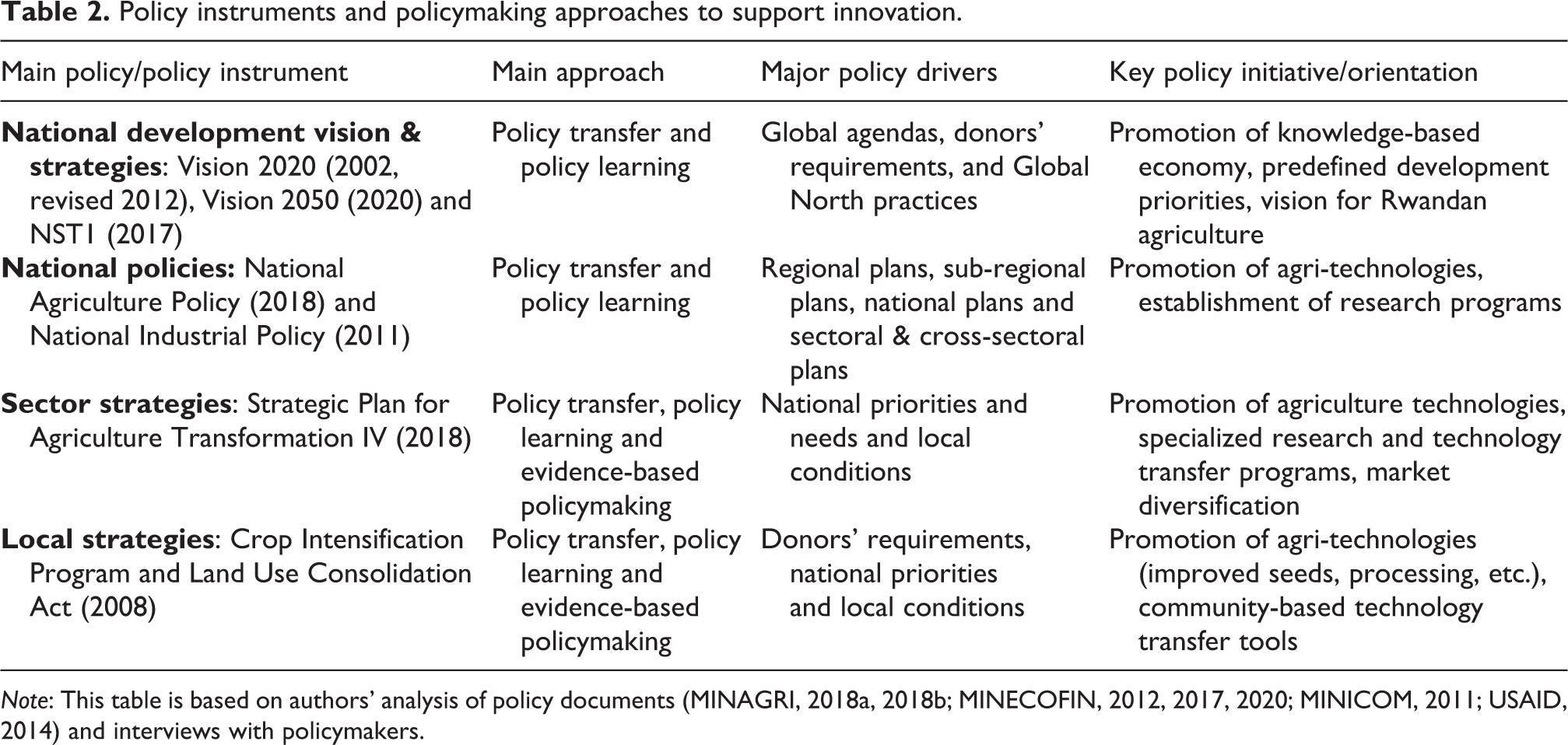
Note: This table is based on authors’ analysis of policy documents (MINAGRI, 2018a, 2018b; MINECOFIN, 2012, 2017, 2020; MINICOM, 2011; USAID, 2014) and interviews with policymakers.
Given the process described above, the level of learning is still low because policy is formulated top-down, with the government leading. Farmers in particular claim that policies do not take into account their problems, reflecting the dominance of policy transfer in policy learning and evidence-based policymaking, as lessons learned are not put into context so that policies do not capture the practical reality faced by stakeholders. To enhance learning and the contextualization of lessons learned from the global and regional agendas, there is a need to enhance the active engagement of stakeholders and consider bottom-up interactions with research-based evidence.
However, although the policymaking process has shortcomings, the policies and policy instruments that are in place do provide an orientation toward what needs to be done to establish favorable conditions for innovation in the Rwandan agriculture sector. Major policy goals and actions emphasize enhancing research and technology transfer efforts as a means of addressing the issues identified. An example is Pillar 2 of the National Agriculture Policy (2018), which sets out a direction for the agriculture research agenda and policy actions for “technological upgrading and skills development” in the Rwandan agriculture sector, and identifies priority areas for research and technology transfer efforts. Accordingly, research programs and infrastructures have been developed to address seed improvement, disease and pest control, and genetic resources improvement in both animals and crops as major challenges in the sector.
Infrastructures like gene banks, seed centers and germplasm centers have been established to facilitate research and agricultural technology advancement. As means for community outreach and technology dissemination, technical tools for helping farmers have been developed and platforms for interaction and capacity building have been initiated. The Farmer’s Field School (FFS) is among the policy instruments initiated to facilitate technology transfer between researchers and farmers (Gahakwa et al., 2014). Policies indicate an interest in innovation platforms, FFS Master Trainers and Farmer Promoters as facilitators of technology transfer and innovation development (MINAGRI, 2018a). However, these are still at the early stage of adoption and face challenges of coordination, ownership and investment (Adam et al., 2018).
Discussion
The development of an AIS requires identification of stakeholders, understanding of their behaviors, practices and habits, and analysis of triggers of innovation such as the policy framework, actors’ interactions and dynamic capabilities (cf. Jacob, 2016; Juma, 2015; Klerkx et al., 2012; Schut et al., 2015). In this study, we noted that the main stakeholders were in place and the main functions could be accomplished in the Rwandan AIS. However, there is still only limited interaction among stakeholders, and interaction is important for the performance of any innovation system. The underlying causes for the limited interaction relate to the lack of an appropriate framework and to behaviors and habits. A lack of trust and collective interest among stakeholders, a common problem in emerging innovation systems, is apparent in the Rwandan AIS. To overcome this, previous studies (see Chaminade et al., 2018; Etzkowitz and Leydesdorff, 2000; Lundvall, 2007a) suggest early interaction in knowledge production and transfer processes, particularly between industry and the higher education system. Clark (2002) and Mytelka (2016) emphasize the importance of proper governance and appropriate policy interventions to support innovation.
The potential of policies and policy instruments to support innovation depends on how responsive they are to pertinent and complex problems in the system. This in turn depends on the policymaking approach and how policy goals are identified (Howlett, 2010; Mytelka and Smith, 2002). The use of appropriate frames of reference and policy drivers is a key factor in successful policy formulation (Dobbin et al., 2007; Hulst and Yanow, 2016). This study identifies policy transfer and policy learning as the main approaches used for many policies and policy instruments designed to support agricultural development in Rwanda. The adoption of evidence-based policymaking is still low, with only national needs identified through consultation with stakeholders used as evidence. The use of research evidence is very low and this weakens policy instruments, which are alleged to be under-informed and insufficiently responsive to local conditions. In policy transfer and policy learning, global and regional agendas, donors’ requirements and best practices in the Global North are the main policy drivers. Combining realities of the local context with these drivers requires hands-on experience in evidence-based policymaking and access to reliable and accurate evidence that clearly articulates issues that policy needs to address.
However, policy learning and policy transfer may in principle be obstacles to the promotion of innovation in Rwanda’s agriculture sector. The adopted approaches and practices in the transfer and learning processes are key: they may lead to unexpected results if they are not carried out with due consideration and caution. Direct policy transfer can be inappropriate in many contexts, whereas policy learning may offer a good option the lessons learned can be adapted to the local context. The policy learning process, however, requires sufficient capacity to reflect on the core issues and on how the lessons can be usefully applied and contextualized. This involves human capital, infrastructure and efficient institutional structures (Borrás, 2011; Mytelka and Smith, 2002; Sanderson, 2002).
The ensure the appropriate application of lessons learned and best practices to increase innovation propensity in Rwandan agriculture, we recommend analysis of how stakeholders interact in specific activities (production, processing and commercialization), as particular issues may require different approaches depending on how the relevant activities are performed. This approach will contribute to an understanding of the merits of an AIS and the most appropriate policy actions and tools. The enhancement of interaction, particularly among higher education, government and industry (or farmers) will produce more knowledge-based solutions and increase the technology/innovation absorption capacity.
The policies and policy instruments discussed in this paper tend to consider innovation as a linear process from inputs to outputs—they do not seem to consider innovation as a socially embedded interactive learning process. This perspective may conflict with the intended move toward inclusive development and a knowledge-based economy, slowing down innovation uptake despite high expectations (Chaminade et al., 2018; Mytelka, 2016). A more systematic and inclusive approach in policymaking that uses research evidence and farmers’ most critical needs would be more helpful, as suggested by Juma (2015) as a strategic action for African agricultural development. Such an approach would contribute to the development of a dynamic AIS built on proven knowledge and real societal problems.
It is important to understand that farmers (or society at large, as the main beneficiary of innovation) do not want models per se; rather, they are in need of information, tools and infrastructure that will enhance their productivity and help them solve problems. Policy tools must therefore be embedded in decision support mechanisms that respond to farmers’ and society’s needs. Although it is challenging to change the policymaking process, this study highlights the importance of making that process more inclusive: it should be open to feedback from all stakeholders with a bottom-up approach. In this way policy goals and policy tools can be aligned with the end-users’ (farmers’) problems and expectations. Another important area for improvement is resource mobilization and resource allocation. The current system needs a more consultative approach among stakeholders for the efficient use of resources; joint initiatives that allow synergetic actions and complementarities among actors can serve as a point of departure for this policy orientation. Although these suggestions cannot be implemented overnight, they may serve as a starting point for future studies that focus on the improvement of innovation policy in general.
Conclusion
In this paper we have explored the question of how policies and stakeholder interactions contribute to the emergence of the Rwandan AIS. We thus contribute to the ongoing debate about factors and conditions for emerging innovation systems in developing countries, particularly African countries. Despite some limitations, this study is one of the first to focus on the AIS in Rwanda. Several scholars (Juma, 2015; Lundvall, 2007a; Muchie et al., 2003; Scerri, 2016) have contributed to this debate and have argued that the factors and conditions needed for innovation systems to evolve are context-specific and depend on the operational environment, economic structures, historical conditions and the collaboration of stakeholders. The definition of an innovation system emphasizes the importance of policies as a factor in influencing the innovation process (see Metcalfe, 1995). Mytelka and Smith (2002) and Hall et al. (2005) also stress the importance of the policymaking process and of how contextual issues are taken into account to meet policy goals.
In keeping with these studies, this paper highlights the potential significance of an AIS for Rwanda while setting out the obstacles to innovation policymaking in the agriculture sector. It is clear that stakeholder interactions are a key factor in building the AIS, but it is hard to create synergies in an environment with limited interaction and a lack of strong facilitating frameworks. Stakeholders’ capacity to perform their roles and functions is also an important factor in creating synergies. We find that policymaking approaches are key in developing appropriate conditions for innovation performance. The study shows that policy transfer and policy learning may not favor innovation development because they reflect an understanding of innovation as a linear process. However, their combination with evidence-based policymaking should lead to policy actions that promote innovation.
Moreover, it is important to increase awareness among all stakeholders that a well-functioning innovation system cannot be established instantly. A systemic approach that encourages public–private partnership—for example, the intensification of university–industry relations in accordance with the THM—is a strategic point of departure in the initial phase. This can sharpen the focus on the key preconditions for capacity building and public–private partnership and avoid the riskier route of attempting to develop a broader innovation system with a wide range of stakeholders and complex interaction while lacking the basic conditions for collaboration.
Our empirical findings show that it is important to frame policies and policy instruments around stakeholders’ problems and to take into account r the available capacity to materialize them in the Rwandan context. This does not mean that Rwandan policies and plans should not consider global issues, but rather that strategic and systematic approaches to positioning Rwanda in terms of global trends should be adopted. Policy learning for the promotion of innovation in the agriculture sector in Rwanda can lead to positive outcomes if it is applied through active learning and efficient policymaking mechanisms. The main point of this paper has been to stress the essential complementarity between stakeholder interaction and policy dynamics, at least in the context of agriculture in Rwanda. While there is no question that R&D is an essential component of an effective innovation system, it is also clear that R&D activities need to be supplemented by other mechanisms designed to ensure productivity improvements, especially for the poor farmer.
Future research and policy discourse need to take into account the difficulties of policy learning and policy transfer in the contexts of developing countries. The shortage of good examples of the use of research for innovation uptake in agriculture in Rwanda, or in other developing countries, is not reducible to discernible factors such as lack of finance or lack of research skills, since much more could be made of existing capacities. What is really needed are institutional structures that encourage interaction between the key stakeholders of innovation—universities, industry and government. Only when that is successfully achieved will the innovation propensity increase and the AIS become, ultimately, efficient and sustainable.
On a final note, agriculture is not an isolated sector; it is closely connected to several others. Thus innovation in the agriculture sector does not happen in a vacuum but in close connection with sectors such as industry, service, ICT, energy, finance and health. We therefore suggest that our single-sector focus be expanded to a cross-sectoral study to examine innovation policymaking in other sectors as well as to deepen understanding of national innovation systems. Rwanda is participating in international and regional initiatives and collaborative projects (e.g., within the East African Community), and our study provides insights into such partnerships by presenting the situation in Rwanda. Cross-national and cross-regional studies, however, will further our current understanding of innovation policymaking and agriculture innovation systems in developing countries like Rwanda.
Footnotes
Acknowledgements
This article could not have been written without the enthusiastic participation of our interviewees who provided with us their ideas, views and experience. We acknowledge the great work done by the two anonymous reviewers who provided with us great suggestions to improve our initial draft. We also appreciate comments from the Triple Helix and Africalics conferences communities that helped us to improve the paper. We thank the Swedish International Cooperation Development Agency (SIDA) to fund this research through the UR-Sweden Program. Moreover, we thank Beth A. Keplin for reviewing the near-final draft of our paper.
Declaration of conflicting interests
The author(s) declared no potential conflicts of interest with respect to the research, authorship, and/or publication of this article.
Funding
The author(s) disclosed receipt of the following financial support for the research, authorship, and/or publication of this article: This work was supported by the Swedish International Cooperation Development Agency (SIDA) through the UR-Sweden Program (grant number 11277).
