




Abstract
The development of students’ entrepreneurial confidence, aptitude and self−efficacy, irrespective of their discipline, is strongly advocated by researchers, policy makers and the media as an important societal institution, indispensable for economic growth and development, social cohesion, job creation and indeed the changing world of work. This study reinforces the view that entrepreneurship education (EE) is a core, vital research space that warrants continued and consistent investigation given its significant role in fostering entrepreneurial mindsets and encouraging entrepreneurial behaviour. The main aim of this study is to evaluate and measure the impact of EE on entrepreneurial confidence, aptitude and self-efficacy. First, it investigates whether participation in EE influences or changes students’ perception of entrepreneurship as a career choice, and their confidence, aptitude and self-efficacy in relation to that career. Second, it investigates what aspects of EE impact students’ entrepreneurial confidence and aptitude. Third, the study investigates the impact of EE on self-efficacy, and students’ belief in their ability and motivation to start an entrepreneurial venture, having completed a specialist EE programme.
Given the ever changing, dynamic working environments employers currently face, there is an increasing need for organisations to be more agile, flexible and innovative in the market – hence, the corresponding increased demand for entrepreneurial characteristics and competencies as a set of employability skills extending beyond the traditional notion of self-employability (Kuckertz, 2013; Stamboulis and Barlas, 2014). This has resulted in the diversifying focus on being entrepreneurial as opposed to being an entrepreneur. Traditionally, entrepreneurial characteristics, for the main part, were recognised and observed in individuals starting their own firms. However, the landscape is changing, and moreover there is evidence of the demand for these desired entrepreneurial capabilities in corporations and social enterprises (Béchard and Grégoire, 2005; Fayolle et al., 2006a; Kurato, 2005, Neck and Green, 2011). Employers are seeking entrepreneurial mindsets in their recruits since, first, such employees can identify opportunities in the market and develop new innovations and, second, they are commercially and socially minded. Such individuals possess entrepreneurial skills and competences, and are viewed as demonstrating a capacity for independent work and original thinking, as well as sound business sense, and an interest in the market and industry sectors. The increasing demand for a broader spectrum of entrepreneurial competencies (Bird, 1995) includes generic and specific knowledge, motives, traits and entrepreneurial identity, along with skills to generate new enterprises, and through the development of enterprising graduates. This, in turn results in an increase in the range, and type of entrepreneurship education (EE) offerings. Entrepreneurship education is based on the premise that it contributes to the development of students’ entrepreneurial confidence, aptitude and self-efficacy, irrespective of their discipline (Mitra, 2017; Passaro et al., 2018; Zeng and Honig, 2016).
With this increasing range of entrepreneurial educational offerings there is a corresponding debate on the impact or effectiveness of such programmes in developing individuals’ entrepreneurial confidence, abilities and self-efficacy (Davidsson and Honig, 2003; Fayolle and Gailly, 2015; Passaro et al., 2018; Sánchez and Elena, 2006; Secundo et al., 2017; Vanevenhoven and Liguori, 2013). Although the majority of studies confirm a positive linkage between EE and entrepreneurial behaviour (Bae et al., 2014; Martin et al., 2013; Sanchez, 2013; Souitaris et al., 2007; Rauch and Hulsink, 2015), other research highlights opposite and conflicting results (the relationships are positive, negative or absent) (Martin et al., 2013; Oosterbeek et al., 2010). Variations often exist due to comparison of results without due attention to the context of the research and the intended aims of entrepreneurial programmes. Hence, there is a need to delve more deeply into this matter and to contribute relevant knowledge (Linan et al., 2011; Fayolle and Gailly, 2015; Passaro et al., 2018); such is the focus of this study. Specifically, this study evaluates the impact of a postgraduate specialist EE programme on students’ entrepreneurial aptitude, confidence and self-efficacy. First, it investigates whether participation in the programme increases students’ entrepreneurial aptitude, confidence, and self-efficacy. Second, it investigates which specific aspects of the programme influenced students’ entrepreneurial confidence and aptitude. Third, it examines students’ motivation to start an entrepreneurial venture and their belief in their ability to do so after completion of the programme. The research engages with the entrepreneurship educator’s quandary with respect to developing more enterprising and entrepreneurial graduates and determining what type of EE programme can develop entrepreneurial competencies as a precursor for more entrepreneurial behaviour. Further, it points to what types of EE module, or what aspects of EE, have the most influence (positive or negative) on entrepreneurial intentions.
This article is structured as follows. The literature review is discussed in the next section . The third section reports on the methodology, while the fourth and fifth sections present the findings and discussion. The last section is dedicated to concluding comments, implications, limitations and suggestions for future research.
Entrepreneurial self-efficacy, aptitude and confidence
Consistent amongst all the research on entrepreneurial competencies is the notion that self-efficacy plays a significant role in the development entrepreneurial intention and entrepreneurial actions, and its possession renders it possible to consider one’s entrepreneurial potential (Bandura, 1986; Pittaway et al., 2010; Tsai et al., 2014). Self-efficacy refers to ‘an individual's belief in their personal capability to accomplish a job or a specific set of tasks’ (McGee et al., 2009: 966). The relationship between entrepreneurial self-efficacy (ESE) and entrepreneurial intention has been investigated in many studies, with a substantial consensus that students with high self-efficacy also have high intention to engage in entrepreneurship and entrepreneurial behaviour (Chen et al., 1998; Kickul et al., 2009; Linan et al., 2011; Nabi et al., 2017; Saraih et al., 2018; Shinnar et al., 2009); , but with the reservations that context can make a difference and that the nature of the broader entrepreneurial learning environment is important in determining the relationship. The perception of self-efficacy is an essential antecedent of perceived opportunity.
Entrepreneurial aptitude is defined as the ‘potential toward creating and developing enterprise and self-employment’ (Cubico et al., 2010: 427) and having the ability to identify opportunities for personal, professional and/or business activities, including bigger-picture issues that provide the context in which people live and work. That is, it entails a broad understanding of the workings of the economy and the opportunities and challenges facing an employer or organisation. More specifically, and related to entrepreneurship and EE, aptitude and knowledge are connected to developing new product ideas, customer satisfaction, market dynamics, the marketing mix and financial issues. In addition, knowledge of business, and business processes, and specific knowledge of the environment in which entrepreneurship is applied also become significant. Skills are also required to apply knowledge and use business know-how to complete tasks and solve problems. Such skills are described as cognitive (involving the use of logical, intuitive and creative thinking) or practical (involving manual dexterity and the use of methods, materials, tools and instruments) (European Parliament and the Council, 2008). ‘Skills’ relating to project management, effective communication, representation and negotiation, and the ability to work both as an individual and collaboratively in teams are also important. Research by Lackeus (2014) also highlights marketing (Fischer et al., 2008), resource allocation (Fisher et al., 2008), opportunity recognition (Fisher et al., 2008), interpersonal (Fisher et al., 2008), learning (Fisher et al., 2008) and strategic skills (Fisher et al., 2008) as important for developing entrepreneurial aptitude. In addition, the ability to judge and identify one’s strengths and weaknesses, and to assess and take risks is essential. Furthermore, social skills and the ability to benefit from social connections are important in becoming an entrepreneur.
Entrepreneurial behaviour also encompasses entrepreneurial confidence and self-efficacy. According to Bandura (1977), there is a link between self-perceptions of personal skills in performing certain tasks and career decisions, often described as self-efficacy. Self-efficacy refers to the conviction that one can organise and execute actions effectively to produce the required results (Bandura, 1997). The relationship between self-efficacy and entrepreneurship has been discussed at length in the literature (Boyd and Vozikis, 1994; Krueger and Brazeal, 1994), with ESE often regarded as a prerequisite entrepreneurial characteristic. Kruger and Dickson (1994) highlighted that relationship, indicating that some individuals avoid careers and contexts that they believe are beyond their capabilities, and instead pursue entrepreneurship because of their confidence in their capability to succeed as entrepreneurs. In addition, entrepreneurship entails risks and challenges and thus requires high levels of self-efficacy, which predicts choice of career, occupational interests, perseverance and personal effectiveness. In fact, two leading theories explaining entrepreneurial intentions – Ajzen’s Theory of Planned Behaviour (1991) and Shapero-Krueger’s Entrepreneurial Event model treat ESE and entrepreneurial confidence as the most important contributors to entrepreneurial intention (Krueger et al., 2000). EE can increase students’ confidence in becoming an entrepreneur through mechanisms known to affect self-efficacy beliefs. Research suggests that students’ self-efficacy is influenced positively or negatively by their experiences of EE (von Graevenitz et al., 2010; Oosterbeek et al., 2010). It may be that experiences and insights gained through EE programmes demonstrate to some students that the reality of entrepreneurship is more challenging than they anticipated or that it is something to be considered later in their career.
The role of EE
According to Fayolle et al. (2006a: 72), EE may be defined as ‘any pedagogical programme or process of education for entrepreneurial attitudes and skills’. EE has been observed to have a positive impact on entrepreneurial behaviour (Ahmed et al., 2020). According to the literature (Bae et al., 2014; Gaweł and Pietrzykowski, 2015; Martin et al., 2013; Packham et al., 2010; Walter and Block, 2016), it can have a positive influence on students’ entrepreneurial intentions (Bae et al., 2014; Gaweł and Pietrzykowski, 2015; Martin et al., 2013; Packham et al., 2010; Walter and Block, 2016). Participation in EE programmes is reported to develop competencies and capabilities for opportunity recognition, with research highlighting that individuals having completed EE exhibit stronger entrepreneurial intention than those who have not. Thus, this becomes one of the motivations to complete EE programmes, through which entrepreneurial aptitude, confidence and self-efficacy can be instilled and developed, and indeed EE continues to be used as a means of increasing entrepreneurial activity (Ahmed et al., 2020; Bischoff et al., 2018). EE not only provides students with a set of steps and routines to start a business; it also aims to impart a variety of entrepreneurial competencies, so creating an entrepreneurial mindset (Esmi et al., 2015; Garavan and O’Cinneide, 1994; Packham et al., 2010). Further, it develops non-cognitive skills, incorporating entrepreneurial attitudes characterised by initiative, proactivity, independence and innovation. This category includes the motivation and determination to meet objectives, whether personal goals or aims held in common with others, including at work. Heinonen and Poikkijoki (2006), in their categorisation of entrepreneurial attitudes, include self-awareness and self-confidence as constituting the basis for all other aspects of entrepreneurship. They suggest that discovering, trusting and being confident in their own abilities allows individuals to turn creative ideas into action.
Also described in the literature is the influence of EE on risk-taking, initiative, critical thinking, creativity and problem-solving. Through EE, entrepreneurial attitudes can be developed, encapsulating numerous attributes including entrepreneurial passion (Fisher et al., 2008; Lackeus, 2014), self-efficacy, entrepreneurial identity, proactiveness (Murnieks, 2007; Sanchez, 2011), uncertainty/ambiguity/tolerance (Murnieks, 2007; Sanchez, 2011), innovativeness (Krueger, 2005; Murnieks, 2007) and perseverance (Cotton, 1991; Markman et al., 2005).
Various studies have tested the use of an educational (or training) intervention to raise an individual’s level of ESE (e.g. Baughn et al., 2006; Cox et al., 2002; Erikson, 2002; Florin et al., 2007). These studies largely concur that entrepreneurship programmes can have a positive impact and that, to fully exert that influence, programmes should provide an understanding of and engagement with the realities of starting a new business.
To summarise, the literature in general depicts EE as having the potential to provide students with the aptitude, confidence and self-efficacy required to start their own business (Johannisson, 2016; Kuratko, 2005) . It improves the motivation for entrepreneurship, and by increasing knowledge and aptitude (Krueger and Brazeal, 1994) through the development of key skills and abilities (Volkman et al., 2009: 11), it improves entrepreneurial confidence which in turn positively impacts self-efficacy.
Research methodology
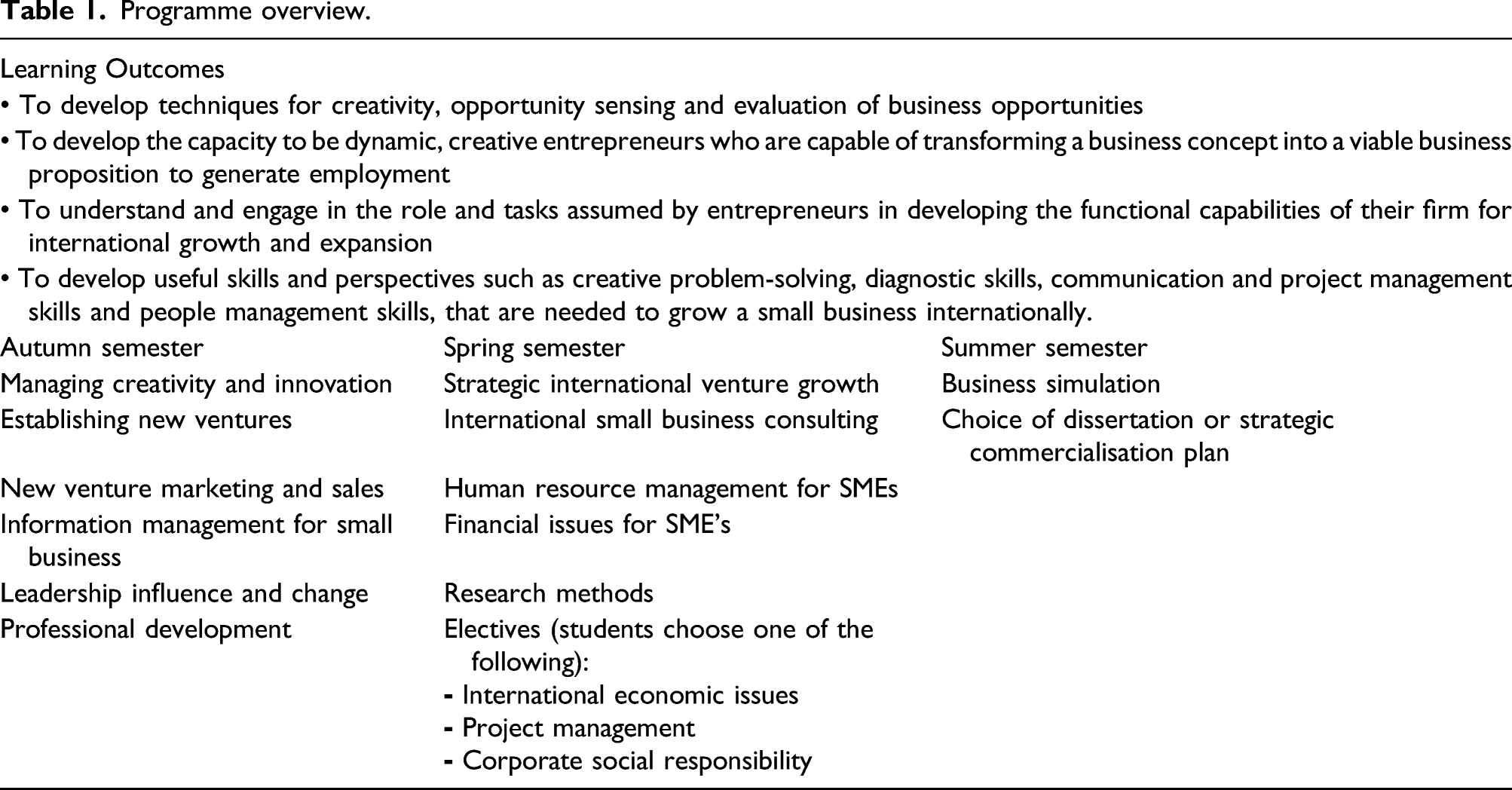
Programme overview.
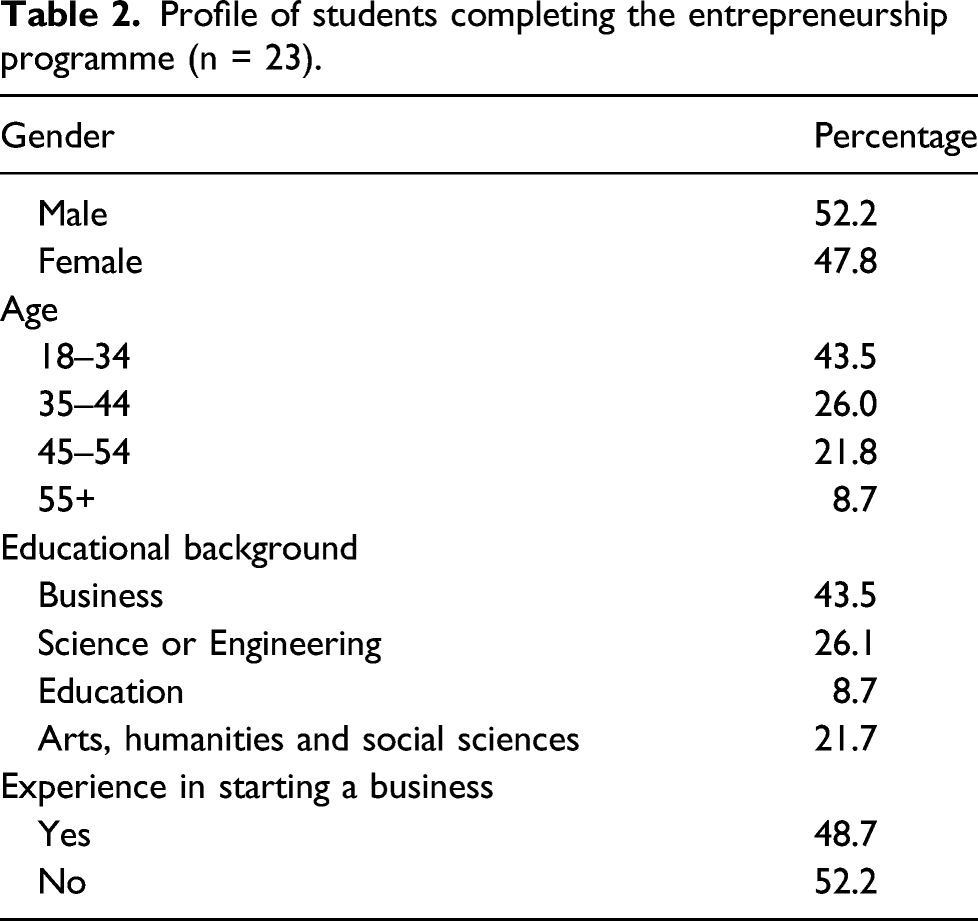
Profile of students completing the entrepreneurship programme (n = 23).
Entrepreneurial aptitude: pre- and post-findings (n = 23).
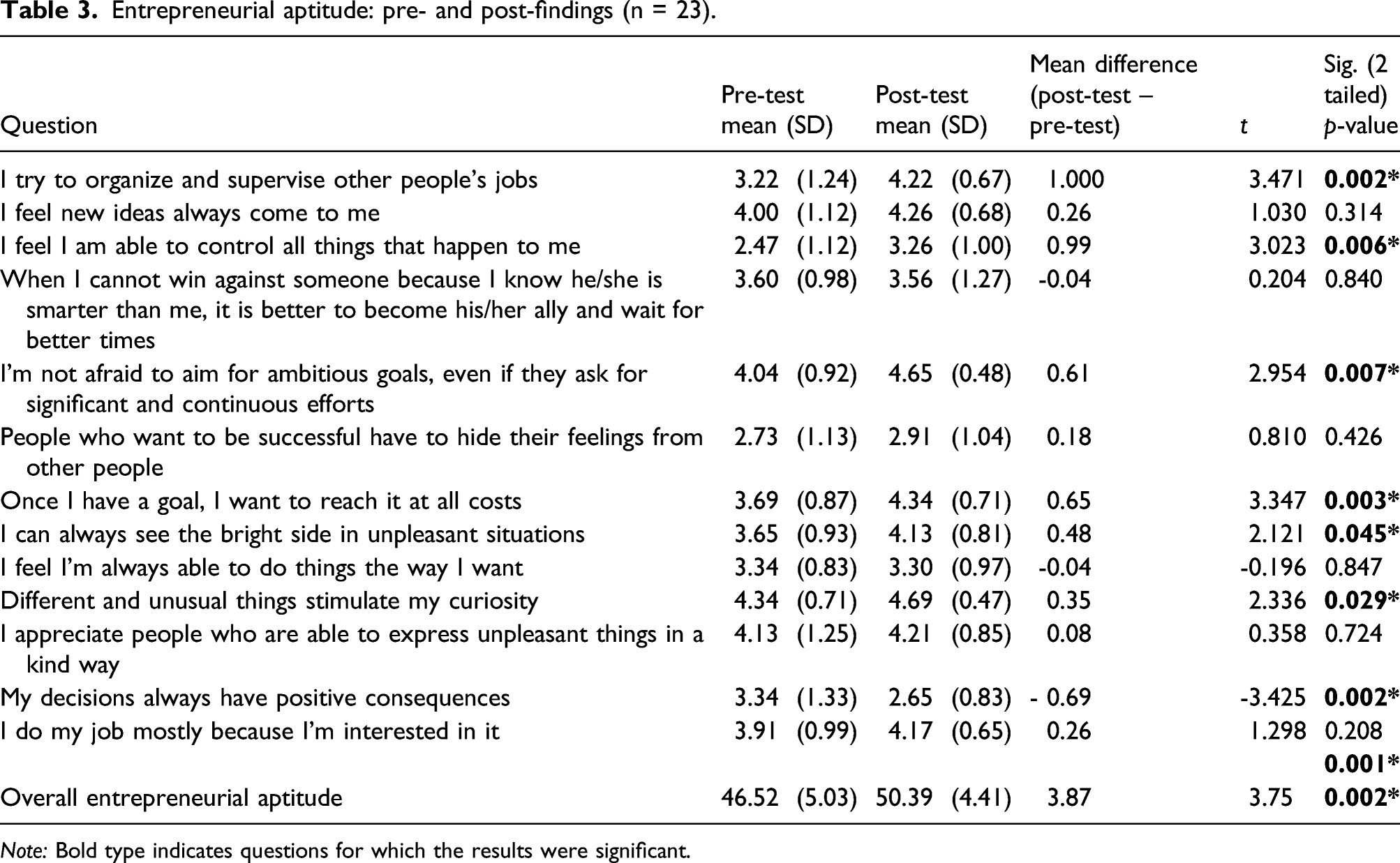
Note: Bold type indicates questions for which the results were significant.
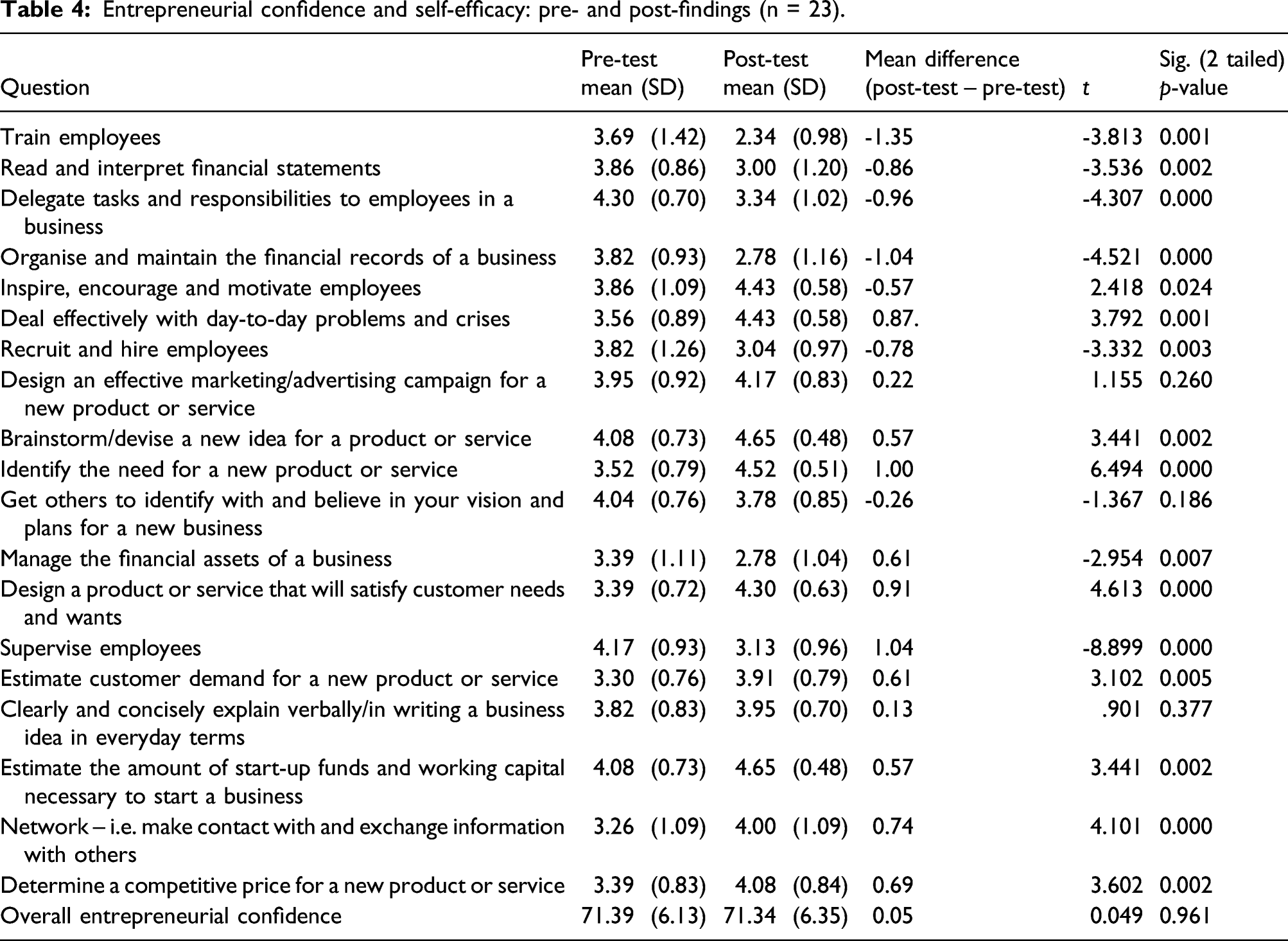
Entrepreneurial confidence and self-efficacy: pre- and post-findings (n = 23).
The Likert scales were weighted so that higher mean scores would indicate positive attitudes towards the behaviour. Repeated measures t-tests were conducted on each question item and on total scores in order to assess if there was a significant increase in entrepreneurial aptitude, confidence, and self-efficacy scores on completion of the programme. Anecdotal qualitative data were also collected to expand our understanding of student’s perceptions of how the course had affected their view of an entrepreneurial career.
Research findings
Entrepreneurial aptitude
The findings show, as expected, that the majority of the students exhibited strong, positive entrepreneurial attitudes and aptitude at the outset of the programme, perhaps attributable to the very fact that they were attracted by and motivated to choose this particular programme. As indicated in Table 3, nevertheless, there was an increase in the students’ entrepreneurial aptitude score when measured prior to and on completion of the programme. More specifically, a very significant (p = 0.000) increase in their overall entrepreneurial aptitude is apparent – providing evidence of the positive impact of the EE undertaken.
Table 3 also highlights the various questions (related to supervision of employees, new idea generation, ability to control one’s own destiny, goal setting, level of ambition, etc.) which explored students’ entrepreneurial aptitude before and on completion of the programme. The findings reveal that, for the majority of questions, entrepreneurial aptitude was enhanced, with mean scores increasing across 10 of the 13 statements posed. The following mean score increases were not statistically significant: ‘I feel new ideas always come to me’ (p = 0.314); ‘People who want to be successful have to hide their feelings from other people’ (p = 0.426); ‘I appreciate people who are able to express unpleasant things in a kind way’ (p = 0.724) and ‘I do my job mostly because I’m interested in it’ (p = 0.208). However, it is noteworthy that the programme had a positive impact on these factors, albeit not a statistically significant one.
The findings denote statistically significant differences across six categories. Very significant differences emerged for ‘I try to organise and supervise other people’s jobs’ (p = 0.002); ‘I feel I am able to control all things that happen to me’ (p = 0.006); and ‘Once I have a goal, I want to reach it at all costs’ (p = 0.003). These results may reflect the need for control so often cited as a common entrepreneurial characteristic. In addition, very statistically significant differences related to goal setting and ambition, specifically: ‘I’m not afraid to aim for ambitious goals, even if they ask for significant and continuous efforts’ (p = 0.007); ‘Once I have a goal, I want to reach it at all costs’ (p = 0.003). Statistically significant differences were also evident for ‘I can always see the bright side in unpleasant situations’ (p = 0.045) and ‘Different and unusual things stimulate my curiosity’ (p = 0.029), reflecting the entrepreneurial characteristics of creativity and opportunism, tolerance for ambiguity, tenacity and determination.
In contrast to these positive findings, there was a notable statistically significant difference with regard to ‘My decisions always have positive consequences’ (p = 0.002); the mean scores for this statement decreased amongst students having completed the programme, drawing attention to feelings of uncertainty. Additionally, decreases in mean scores were evident (although not statistically significant) for ‘When I cannot win against someone because I know he/she is smarter than me, it is better to become his/her ally and wait for better times’ (p = 0.840) and ‘I feel I’m always able to do things the way I want’ (p = 0.196).
Whilst acknowledging that some elements of students’ entrepreneurial aptitude experienced decreases in means, overall the mean scores in the post-stage for entrepreneurial aptitude are significantly higher. The findings thus indicate that students’ entrepreneurial aptitude was positive and affirmative, demonstrating an optimistic outlook towards entrepreneurship, and suggesting confidence in their capability to undertake the activities and tasks necessary to starting and run an entrepreneurial business.
Entrepreneurial confidence and self-efficacy
Similar to the findings for entrepreneurial aptitude, the majority of students displayed a high level of entrepreneurial confidence at the outset of the programme. Table 4 highlights the various statements explored relating to entrepreneurial confidence and self-efficacy (idea generation and new product development; knowledge and skills development; entrepreneurial team management and strategic vision etc.) before and on completion of the programme.
The students’ entrepreneurial confidence and self-efficacy mean score increased across 11 of the 19 questions posed, highlighting the overall positive influence of the programme. The mean increases for the following statements were not statistically significant: ‘Design an effective marketing/advertising campaign for a new product or service’ (p = 0.260) and ‘Clearly and concisely explain verbally/in writing a business idea in everyday terms’ (p = 0.377). Nevertheless, the evidence indicates that the programme did have a positive impact. Statistically significant differences emerged across 9 categories, with the most significant increases centring on the related issues of opportunity recognition, new product development and customer knowledge: ‘Identify the need for a new product or service’ (p = 0.000); ‘Design a product or service that will satisfy customer needs and wants’ (p = 0.000); ‘Brainstorm/devise a new idea for a product/service’ (p = 0.002); ‘Determine a competitive price for a new product or service’ (p = 0.002); and ‘Estimate customer demand for a new product or service’ (p = 0.005). These results demonstrate the impact of the programme on developing idea generation, opportunity recognition, customer knowledge and marketing skills. Students’ knowledge on start-up capital required also improved, with ‘Estimate the amount of start-up funds and working capital necessary to start a business’ (p = 0.002) experiencing a statistically significant increase. Similarly, the mean score for networking skill – “Network – make contact with and exchange information with others” (p = 0.002) – improved very significantly, reflecting the programme benefits of teamwork, invited guest speakers and collaboration with local entrepreneurial firms. ‘Deal effectively with day-to-day problems and crises’ (p = 0.001) also experienced a very statistically significant increase in mean score, evidencing an improvement in the students’ confidence with regard to addressing the types of challenges that arise on a daily basis.
Interestingly, students’ overall mean score for entrepreneurial confidence and self-efficacy decreased on completion of the programme, (although not a statistically significant result). It is therefore useful to investigate which aspects were most influential in this decrease. Two main factors emerged – the management of employees and financial management. The findings highlight that, while students’ entrepreneurial confidence and self-efficacy were high in relation to employee and financial management at the outset, the programme diminished their confidence with regard to these aspects. Concerning employees, the highest mean score decreases and statistically significant differences were for ‘Train employees’ (p = 0.001); ‘Supervise employees’ (p = 0.000); ‘Delegate tasks and responsibilities to employees in a business’ (p = 0.000); and ‘Recruit and hire employees’ (p = 0.003). ‘Inspire, encourage and motivate employees’ also experienced a decrease and statistically significant difference on programme completion (p = 0.024), but this was not as statistically significant as the aforementioned items. Although not statistically significant, there was also a mean score decrease for ‘Get others to identify with and believe in your vision and plans for a new business’ (p = 0.186).
Issues relating to finance also experienced mean score decreases which were very significantly significant. The most significant decrease related to ‘Organise and maintain the financial records of a business' (p = 0.000), followed by ‘Read and interpret financial statements (p = 0.002) and ‘Manage the financial assets of a business’ (p = 0.007), evidently suggesting a negative impact of the programme on students’ entrepreneurial confidence.
Self-efficacy and entrepreneurial intention: Pre- and post-findings (n = 23).

As a concluding question, students were asked to indicate briefly how the completion of the EE programme had influenced their interest in starting an entrepreneurial firm. While the majority displayed a positive disposition towards a future entrepreneurial career, an underlying level of caution, thoughtfulness and reflection was in evidence. The emergent central themes centred on risk-taking, increased awareness of the realities of business start-up, an augmented consciousness of the transition of the solo entrepreneur to the entrepreneurial team and financial management of the business. Specific responses with regard to these themes included: ‘The course has taught me that I need to be more calculated and prudent in relation to risk and uncertainty.’ (Respondent 1) ‘The programme showed me how naïve I was about starting a business ... it is so much more than just having an idea and passion.’ (Respondent 5) ‘The course showed me the harsher side of starting a business … it’s not just about pursuing a dream.’ (Respondent 18) ‘I have a greater understanding of complex business problems and how they can impact in unexpected ways … makes me wary.’ (Respondent 21) ‘I want to start a new business right now! The programme has really given me a holistic view of all the complex business issues I will face but I am ready!’ (Respondent 11) ‘I would love to have my own business but it’s hard … the programme really made me see barriers and challenges that entrepreneurs face every day.’ (Respondent 15) “ … not so confident in being able to see the impact of my decisions in a complex business world and being able to adapt to that world all the time.” (Respondent 22) ‘Working and managing a team of people is tough … had the perception that entrepreneurs were solo individuals but now see that entrepreneurial teams are necessary for success and that’s a challenge.’ (Respondent 16) ‘I like the idea of starting a business but nervous of all the roles I will have to play … really didn’t enjoy anything to do with finance and accounting … will hire an accountant as part of my entrepreneurial team!’ (Respondent 14)
Discussion
The overall aim of this study was to evaluate and measure the impact of EE on entrepreneurial aptitude, confidence and self-efficacy. Confirming previous studies on the importance and impact of EE (Gibb, 2002; Guedes Gondim and Mutti, 2011; Kyro, 2008; Lackeus, 2014; Oganisjana and Koke, 2012) in terms of developing entrepreneurial aptitude, this research highlights that EE is an effective means of doing so. More particularly, attention is drawn to how EE is clearly linked with entrepreneurial aptitude, with the findings demonstrating that students’ aptitude significantly increased on completion of the programme. The programme facilitated the acquisition of knowledge and the ‘know-how’ of how to undertake activities associated with starting and running a business. The students’ business acumen improved with increases in their knowledge of foundational business practices, including business planning, marketing, financial management, strategy development and management. In addition, it appears that the programme drew attention to challenges associated with new venture creation, equipping students with the knowledge and skills necessary to address, face and overcome them. Overall, the study indicates a significant contributing effect of EE on entrepreneurial aptitude.
Conversely, the research also points to a wavering in entrepreneurial confidence and self-efficacy amongst students on programme completion. This is a significant finding, and quite conflicting given the significant increase in entrepreneurial aptitude. One might assume a positive and direct relationship between entrepreneurial aptitude and confidence and self-efficacy; however, an inverse relationship emerges, reinforced by the students’ changing attitudes on completion. While their level of interest in starting a business did not change significantly, their belief in their ability to do so did – it actually significantly decreased, demonstrating that counter-effects emerge for students exposed to EE, as suggested in previous research (Fayolle et al., 2006b; Ndofirepi, 2020). In this study, the counter-effects appear to be in some way related to financial and employee management: mean scores regarding the statements related to these items significantly decreased on programme completion. Also, the student narratives point to individuals becoming disheartened or possibly discouraged as they obtained a realistic view of the requirements of effective entrepreneurship, not only in terms of what is needed to start a business but also what is required to actually manage, develop and grow an entrepreneurial firm.
The findings relating to increased entrepreneurial aptitude are very positive, positioning EE as an effective means of developing business knowledge and skills. However, the research points to a waning of entrepreneurial confidence and self-efficacy. There are various possible reasons for this change. It may be that students’ exposure to the realities of entrepreneurship leads them to reflect on their initial perceptions and preconceptions of what starting and running an entrepreneurial firm actually meant. Alternatively, it could be attributable to the numerous roles that students are expected to assume in EE (problem solvers, decision makers, negotiators, conflict managers and communicators, and leaders), which may leave them feeling overwhelmed and so impact their confidence. Educators need to recognise and acknowledge that some or indeed all of these roles may be unfamiliar or uncomfortable for students and may therefore have a negative impact on their entrepreneurial confidence and self-efficacy. The findings highlight that it is not enough just to develop entrepreneurial aptitude through the teaching of skills and knowledge, but that it is also important to develop and foster entrepreneurial drive through the enhancement of entrepreneurial confidence and self-efficacy. This need brings to the fore a variety of issues for consideration, which are outlined below.
Conclusions, limitations, implications and future research
This research is positioned at the juncture of the growing importance of EE and its role in developing entrepreneurial aptitude, confidence and self-efficacy. We consider that the study contributes to theoretical development on two levels. First, it indicates an encouraging and contributing effect of EE, aligning with previous studies on entrepreneurial aptitude, with the mean scores of the student sample for entrepreneurial aptitude significantly higher on completion of the programme than at the outset. This positions EE as an effective means of developing entrepreneurial knowledge and skills, thus endorsing the benefit of such programmes and highlighting the overall aim of the plethora of university EE programmes. The majority of these programmes focus on entrepreneurship and innovation, with curricula organised in knowledge disciplines (e.g. accounting, marketing and business planning) to equip students with the cognitive competencies of knowledge and skills.
Second, the study highlights that, while students are skilled and knowledgeable on completion of an EE programme, they appear to be lacking in entrepreneurial confidence and self-efficacy. This finding warrants attention, given the potential impact on the fostering of entrepreneurial mindsets and behaviour. The conclusion of this study is less optimistic regarding this objective and we therefore highlight some issues for consideration.
The curriculum content for EE must be considered. The EE programme in this study was effective in achieving its intended outcomes with regard to knowledge and skills development, but it was not so effective in fostering entrepreneurial confidence and self-efficacy, the catalytic agents for entrepreneurial behaviour. Educators who are designing, delivering and assessing curricula for EE need to be particularly cognisant of the importance of entrepreneurial confidence and self-efficacy. Students need to be afforded an opportunity to gain a better understanding of these factors and their role and influence in their individual entrepreneurial journeys. Emphasis should be placed on supporting individual motivation and personal traits consistent with entrepreneurship as a career choice. Reflecting the findings of Blass (2018), the study suggests that students’ intentions change during EE, and that this change may not relate so much to what they learn about entrepreneurship per se, but rather to what they learn about themselves and about what they would like to do (self-realisation). Hence, it is important that EE programmes develop students’ non-cognitive competencies that are key to undertaking entrepreneurship, and do not only develop the knowledge and skills required for business start-up, as traditionally and frequently prioritised. Developing entrepreneurial competencies implicitly entails an inspirational component, as this is what gives rise to attitude and intention and increases entrepreneurial confidence and self-efficacy and so students’ overall interest in pursuing an entrepreneurial career.
The study has some limitations, which at the same time offer avenues for further research. First, the sample size is small and may not reflect the perceptions of the larger student population. Second, it does not control for teaching methods and content employed over the course of the programme. Further, it does not investigate the impact of individual modules on entrepreneurial aptitude, confidence or self-efficacy, only taking a snapshot of students’ perceptions at two intervals – post and pre – for one particular programme: given the diverse and numerous forms of EE in existence, the results cannot be generalised to all EE programmes. Other drivers of entrepreneurial intention, such as exposure to inspiring role models, personality traits and public policy, are not taken into account.
The study presents opportunities for further research in assessing entrepreneurial aptitude, confidence and self-efficacy using qualitative measures. Further, more in-depth research is required to examine more specifically how and why EE changes students’ attitudes and behaviour, given that the majority choose to pursue EE with the intention of starting an entrepreneurial firm. Why does this intention change having completed the programme? Future research should examine the emotions, reactions and sentiment students experience during EE, and how these relate to entrepreneurial confidence and self-efficacy.
Footnotes
Declaration of conflicting interests
The author(s) declared no potential conflicts of interest with respect to the research, authorship, and/or publication of this article.
Funding
The author(s) received no financial support for the research, authorship, and/or publication of this article.
