




Abstract
Regional and institutional contexts have been acknowledged as important to the design of entrepreneurship education (EE), yet the importance of place for entrepreneurship has so far received less attention. There is still much work to do in connecting students to places and engaging them in understanding the relationship between entrepreneurship, local communities and local economies within the EE curriculum. Taking inspiration from the notions of place-based and place-conscious learning, the paper proposes a framework for place-based EE and considers challenges for integrating place-based approaches into the EE curriculum. A case study of place-based EE at a university business school is then used to illustrate how the framework can be used to review existing curricula, as well as to reveal how an institution’s context might both facilitate and constrain opportunities for place-based learning. The paper provides a contribution by making more visible the important yet often invisible role of place in EE, while being mindful of the needs, resources and educational aims of regions and institutions.
We are surrounded by places. We walk over and through them. We live in places, relate to others in them, die in them. Nothing we do is unplaced. How could it be otherwise? How could we fail to recognize this primal fact? (Casey, 1997: ix)
Introduction: Contexts, regions and places
There is increasing acknowledgement that both context and place are important to entrepreneurship (Jennings et al., 2013; Lang et al., 2014; Welter, 2011). When entrepreneurial endeavours are more closely aligned to the values, interests and visions of those who live and work in a place, region or community, they are more likely to contribute positively to the social and economic welfare of those places (Hudson, 2001; Korsgaard et al., 2015). As such, an increasing number of scholars have highlighted how entrepreneurs need be cognisant of the characteristics of local context and the importance of place to communities, in order to build and maintain a positive relationship between the two (Huggins et al., 2012; Korsgaard et al., 2015; McKeever et al., 2015). Increasing pressures for sustainable economic growth and regional competitiveness also highlight further the need for place-based thinking (Leick et al., 2020; Shrivastava and Kennelly, 2013; Vlasov et al., 2018). In addition, a growing body of work is starting to uncover a multifaceted relationship between places and the activities of entrepreneurs. For instance, studies have found that an understanding of the complex nature of places is important to understanding how entrepreneurship might thrive in those places (Muñoz and Kimmitt, 2019), and that an understanding of local places is important to building local resilience (Vlasov et al., 2018). Studies have also highlighted how places frame resources and opportunities (McKeever et al., 2015), and create opportunities for the marketing of ‘authentic’ and ‘local’ products (Arias and Cruz, 2019). At the same time, places shape entrepreneurial identities (Anderson et al., 2019; Gill and Larson, 2014) and in turn entrepreneurship ‘recreates, renews and reifies the identity of place’ (McKeever et al., 2015: 51). Given the increasingly recognised role of place in entrepreneurship, it is thus important to consider how, as educators, we might engage students in understanding the relationship between entrepreneurship and places as part of the entrepreneurship education curriculum.
There is acknowledgement that entrepreneurship education (EE) needs to be tailored to the needs of regions and their actors (Blenker et al., 2012; Thomassen et al., 2019; Toutain et al., 2017). Studies point to a variety of national and regional contextual variations that are important when designing entrepreneurship programmes (Chauhan and Das, 2016; Dodds and Hynes, 2012; Walter and Dohse, 2012), as well as how contexts are significant in understanding how EE contributes to regional economic growth (Walter and Block, 2016). Yet, although context is acknowledged as important to the design of EE, the importance of places for entrepreneurship has so far received less attention and there is still much work to do in connecting students to places and engaging them in understanding the relationship between entrepreneurship, local communities and local economies (Blenker et al., 2012; Garlick and Palmer, 2008; Sörensson and Bogren, 2020; Taylor and Plummer, 2003).
The purpose of this paper is to explore opportunities and challenges in connecting students to places within EE. The paper is structured as follows. It begins with further exploration of the importance of context and place for EE and the need to connect students to places as part of their entrepreneurship training. The paper turns to ideas from place-based and place-conscious learning to propose a framework for place-based EE, and further considers challenges for integrating place-based approaches into the EE curriculum. A case study of place-based EE at a university business school is then used to illustrate how the framework can be used to review existing curricula, as well as to reveal how the institution’s context both facilitates and constrains opportunities for place-based learning.
Context, regions, place and entrepreneurship education
There is growing acknowledgement that context and regions are important considerations for EE, but so far discussions of context, and place in particular, have received less attention than the wider entrepreneurship literature (Dodd and Hynes, 2012; Leitch et al., 2012; Thomassen et al., 2019). Current work in this area has sought to understand how context influences the content and type of EE (Blenker et al., 2012; Thomassen et al., 2019; Toutain et al., 2017) and in turn how the outcomes of EE might shape regional contexts (Walter and Block, 2016). Studies have focused on a number of aspects, including how country-level and regional contextual differences influence student learning (Chauhan and Das, 2016; Dodd and Hynes, 2012; Giacomin et al., 2011; Walter and Dohse, 2012); how University contexts influence approaches to teaching and learning (Blenker et al., 2008; Maritz and Brown, 2013; Walter and Dohse, 2012); and how the entrepreneurship curriculum needs to be cognisant of the variety of contexts in which students have lived, studied and worked (Blenker et al., 2012; Maritz and Brown, 2013). In addition, there has been discussion on how the outcomes of EE might contribute to regional economic growth and the development of enterprising human capital that is cognisant of the needs of the region (Garlick and Palmer, 2008; Taylor and Plummer, 2003; Walter and Block, 2016).
Despite acknowledgement of the importance of regional context on the design, content and outcomes of entrepreneurship programmes, and the increasing acknowledgement of the importance of place for entrepreneurship, less attention has been paid to how EE might engage students in understanding places and their role in shaping and being shaped by the types of entrepreneurship that are manifested (Blenker et al., 2012). Nearly two decades ago Taylor and Plummer (2003), exploring how educators might facilitate effective regional growth, suggested that enterprise education should engage students in ‘understand[ing] the workings of our local economies – the processes that shape, mould and drive place-based communities of business owners, manager, workers, bureaucrats and families’ (p. 558). Garlick and Palmer (2008), in a critique of the goal of university–business engagement practices, similarly pointed to the need for universities to develop students’ enterprising skills while engaging them in local communities to understand key local challenges and identify opportunities to develop solutions of local value. Similarly, Blenker et al. (2012), a few years later, made a case for educators to engage students in understanding localities as meaningful ‘places’ which ‘bring together material aspects such as the landscape, infrastructure or climate of the location, and social aspects such as community, local culture and heritage’ (p. 422). Despite acknowledgement of the importance of places for EE, there has been little progress in this area; an exception is the work of Sörensson and Bogren (2020) whose case study of an entrepreneurial learning programme highlighted the important role of place in the design of entrepreneurial learning.
In order to further work and understanding in this area, this paper develops a framework for place-based EE that builds on principles of experiential learning and teaching ‘through’ entrepreneurship. The framework brings together ideas from two approaches that aim to connect students to places as part of their learning. The first, place-based learning (Gruenewald and Smith, 2014; Smith, 2002; Smith and Sobel, 2014), focuses on places as arenas of learning, where understanding is formed through immersion in places. The second, place-conscious learning (Greenwood, 2013; Gruenewald, 2003b), complements place-based learning approaches by emphasising the importance of conceptual understandings of place to provide students with a deeper understanding of places as socially constructed and contested spaces. The paper brings these ideas together as a framework for place-based EE and discusses key challenges for educators considering integrating place-based approaches. The paper then turns to a case study to explore use of the framework and the challenges in integrating place-based approaches into the curriculum. In doing so, it addresses a broader call for pedagogical innovations that attend to context when teaching entrepreneurship (Thomassen et al., 2019) and the call for more place-based studies (Sörensson and Bogren, 2020).
Place-based pedagogies – Places as sites of learning
The important relationship between pedagogy and places of learning has been acknowledged for some time. Dewey noted how popular pedagogies failed to make connections between students’ classroom-based activities and their experience outside the classroom. Dewey (1916, 1930) promoted experiential forms of learning to enable students to create closer connections between learning and their own lives and interests. Over 60 years later, Orr (1992) highlighted similar failings, stating that ‘a great deal of what passes for knowledge is little more than abstraction piled on top of abstraction, disconnected from tangible experience, real problems and the places where we live and work’ (Orr, 1992: 126). Others too have highlighted the important role of education in creating ‘responsible citizens’ (Boyer, 1994) and engaging students in learning through serving the needs of their communities (Bringle and Hatcher, 1996).
The principles of experiential learning have been influential for proponents of place-based education, a movement that takes ideas from experiential learning and further highlights the importance of places for education. Place-based pedagogies are designed to connect students to places and to create awareness of their importance in students’ lives and in the lives of others. It is believed that place-based approaches lead to students becoming more excited by, and emotionally invested in, projects that relate to real places (Edelglass, 2009; Gruenewald, 2003a). In addition, proponents also believe that immersion in places contributes positively to student engagement and understanding (Smith and Sobel, 2014; Sobel, 2004). Approaches to place-based education are broad and include: service learning, community-based learning and real-world problem solving (Smith and Sobel, 2014; Woodhouse and Knapp, 2000). Indeed, these approaches are already familiar to entrepreneurship educators as they build on forms of experiential learning that have for some time been acknowledged as important for teaching entrepreneurship (Mason and Arshed, 2013; Pittaway and Cope, 2007; Rae, 2010). Service-learning activities, for instance, are frequently used to engage students in the activities of organisations and communities to understand challenges and provide solutions (e.g. Bringle et al., 2010; Litzky et al., 2010; McCrea, 2010; Mueller et al., 2015). Despite widespread recognition of the value of experiential learning for EE, however, there has been scarce acknowledgement of place-based learning, with only a small handful of examples (e.g. Elmes et al., 2012; Mehta et al., 2011; Sörensson and Bogren, 2020).
Patterns of place-based education for EE
In order to understand the opportunities for entrepreneurship educators to build on experiential forms of learning, the paper turns to Smith’s (2002) influential work which identified five patterns of place-based education. These patterns form the basis for place-based approaches today and have been adapted to different educational settings. For the EE context, this paper identifies three approaches for place-based teaching that build on existing approaches to EE: articulating and observing places, student-led place-making and business and community-led place-making. The first, labelled ‘articulating and observing places’, is adapted from Smith’s (2002) first two patterns (‘cultural studies’ and ‘nature studies’) and points to teaching activities that engage students in becoming more curious about places. Such activities are designed to engage students in learning about a particular subject area through observing and engaging with people in places. For EE, this can be translated to engaging students with local entrepreneurs or policy makers to understand the local entrepreneurial landscape. The second approach, labelled ‘student-led place-making’, echoes Smith’s ‘real-world problem solving’ and gives students control over identifying local community issues they would like to address (e.g. in their home towns, on university campuses or in university towns and cities) and then to work on developing solutions to those issues. The third approach, which this paper labels ‘business and community-led place-making’, combines Smith’s (2002) ‘internships and entrepreneurial opportunities’ and ‘induction into community processes’ which both involve students working with local businesses or local community groups to understand their challenges and identify solutions. Figure 1 illustrates how each of these patterns of place-based education immerses students more deeply in understanding and engaging with local communities and businesses, and its applicability to EE.
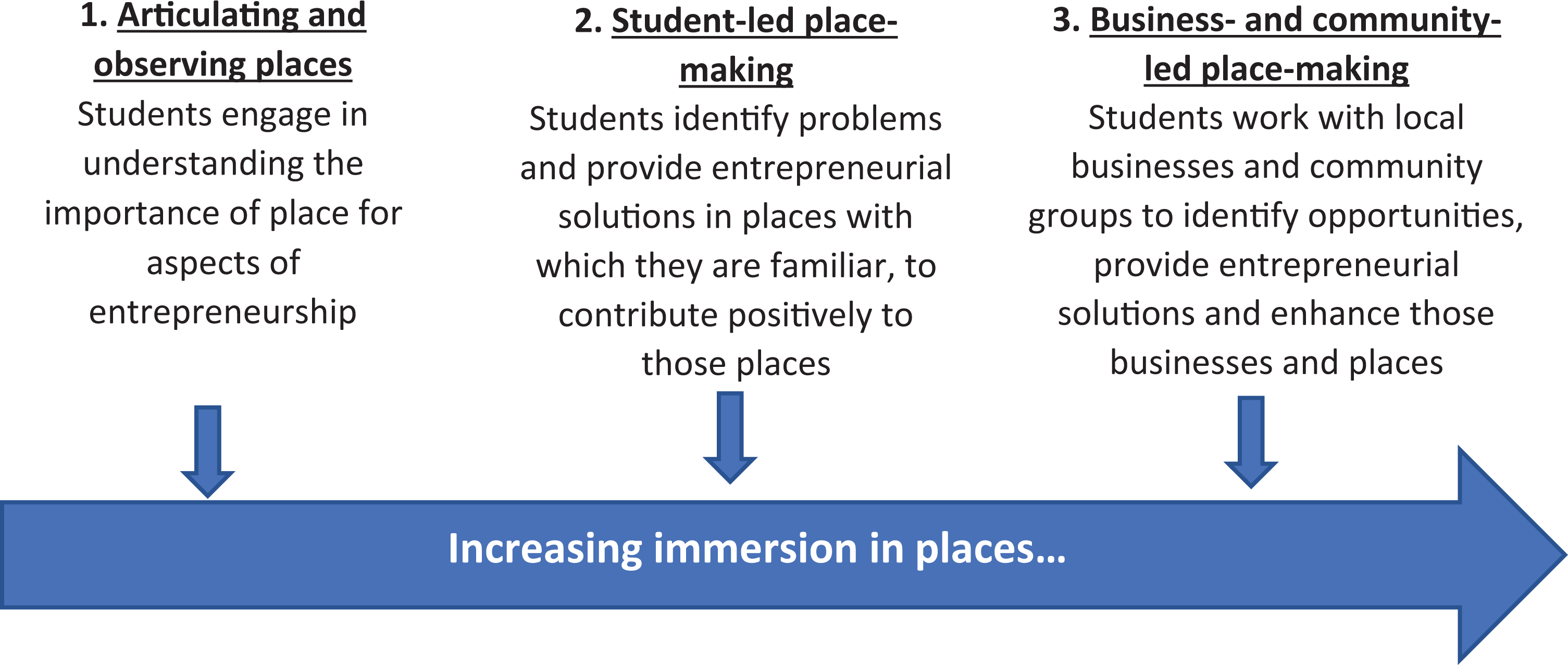
Adaptation of Smith’s (2002) thematic patterns for place-based EE.
Place-conscious learning – Understanding places as complex and multidimensional
Grounding our understanding of place and context
The notions of context and place are used pervasively, yet ambiguously, in the entrepreneurship and EE literatures (Thomassen et al., 2019; Zahra et al., 2014). This is perhaps not surprising, given that the word ‘place’ is ubiquitous; yet places are contested, multidimensional and constructed through complex relationships and histories (Cresswell, 2014). For geographers, contexts are identifiable spaces characterised through languages, customs, religions, ideologies, economies or policies, and places are the intersections of contexts and cultures (Anderson, 2015). Places are thus more than physical or geographical locations and are spaces imbued with meaning that give rise to affective bonds between people and place (Relph, 1976; Tuan, 1979, 1990). Others posit that the relationship between people and place is central to our existence as everyday meanings are always situated in places (Malpas, 2018; Sack, 1997). As Malpas (2018) states, ‘it is within the structure of place that the very possibility of the social arises’ (Malpas, 2018: 36). As locations of meaning, places are thus not static, but continually evolving as the actions of people, as individuals or groups, are shaped by and shape local meanings. The notion of place is becoming increasingly influential across disciplines as broad as sociology, anthropology and psychology (Greenwood, 2013; Gruenewald and Smith, 2014), as well as organisation studies (Sergot and Saives, 2016; Thomas and Cross, 2007) and more recently entrepreneurship (Anderson et al., 2019; Arias and Cruz, 2019; McKeever et al., 2015; Muñoz and Kimmitt, 2019).
Place-conscious learning for entrepreneurship education
Given the various ways in which places are important to entrepreneurship, and entrepreneurship is important to places, the question arises as to how entrepreneurship educators might engage students in a deeper understanding of places to complement and build on students’ experiences of entrepreneurship in places. The paper turns to Gruenewald’s (2003b), and later Greenwood’s (2013), work on place-conscious learning which has been influential in highlighting the need for conceptual understanding of the multidimensionality of places alongside learning in places. Indeed, Gruenewald’s (2003b) work has been recognised as important to place-based EE (Elmes et al., 2012; Sörensson and Bogren, 2020). Gruenewald’s (2003a, 2003b) five dimensions of place are discussed below and Table 1 presents key considerations for the EE context.
Dimensions of place for entrepreneurship educators.
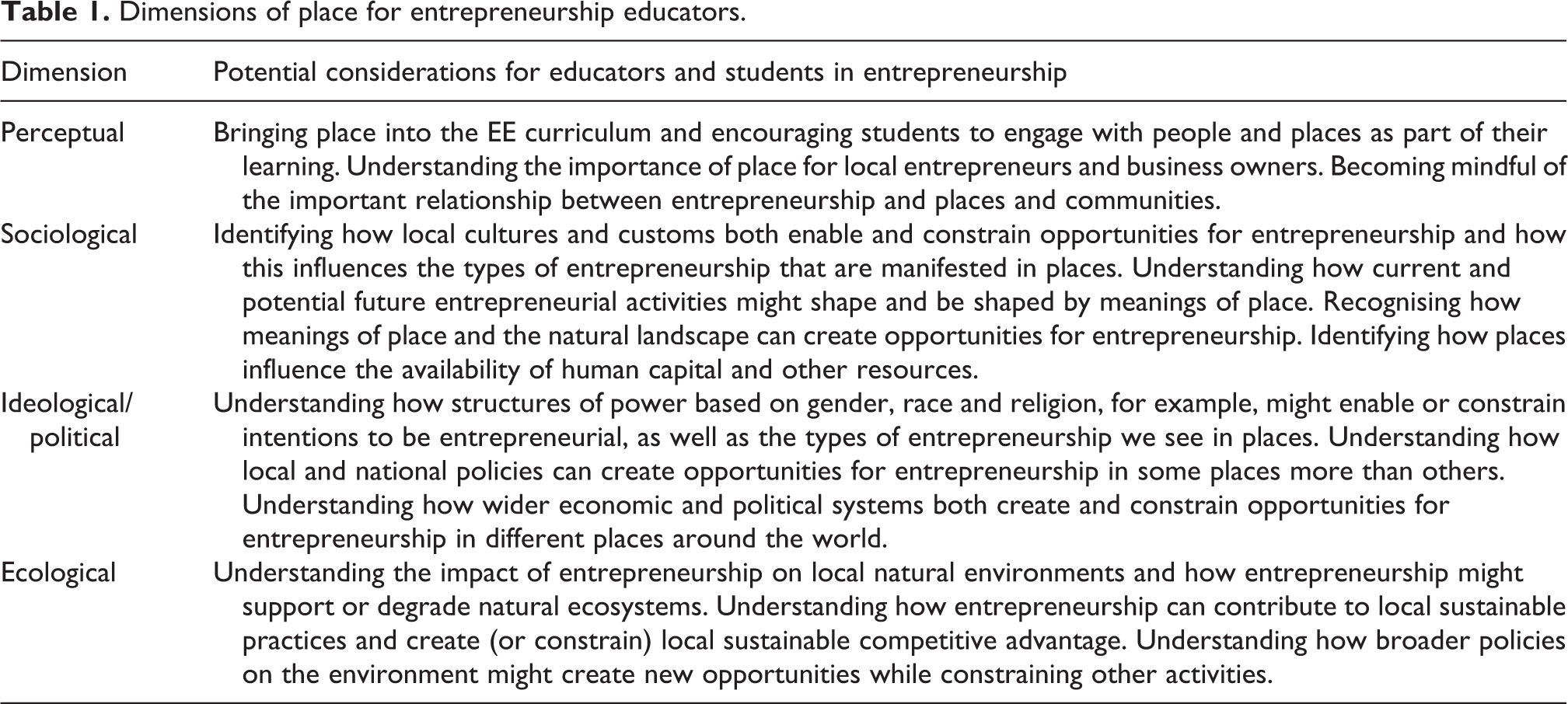
The perceptual dimension is based on a phenomenological perspective of place and focuses on engaging students in becoming aware of the importance of places for those living in them, working in them, studying in them and visiting them. The sociological dimension engages students in a deeper understanding of how people and cultures shape places. Gruenewald (2003b) argues that, if we do not see places as products of culture, it can lead to taking places for granted rather than seeing them as evolving through the actions and activities of the people who inhabit them. The sociological dimension directs educators towards engaging students in understanding how the activities of people shape and are shaped by the places in which they live and work. Both ideological and political dimensions have been referred to as the critical dimensions of place (Elmes et al., 2012), and engage students in understanding relationships of power, and how broader social, economic and political institutional landscapes shape places and the activities within them, as well as creating boundaries around possibilities for action. Given their combined focus, they are considered together in a similar way to the approach of Elmes et al. (2012). Finally, the ecological dimension engages students in understanding sustainability issues and how the actions of individuals and organisations impact on local and wider natural ecosystems, and thus how entrepreneurial activities might both care for as well as compromise those ecosystems.
The development of a framework for place-based EE
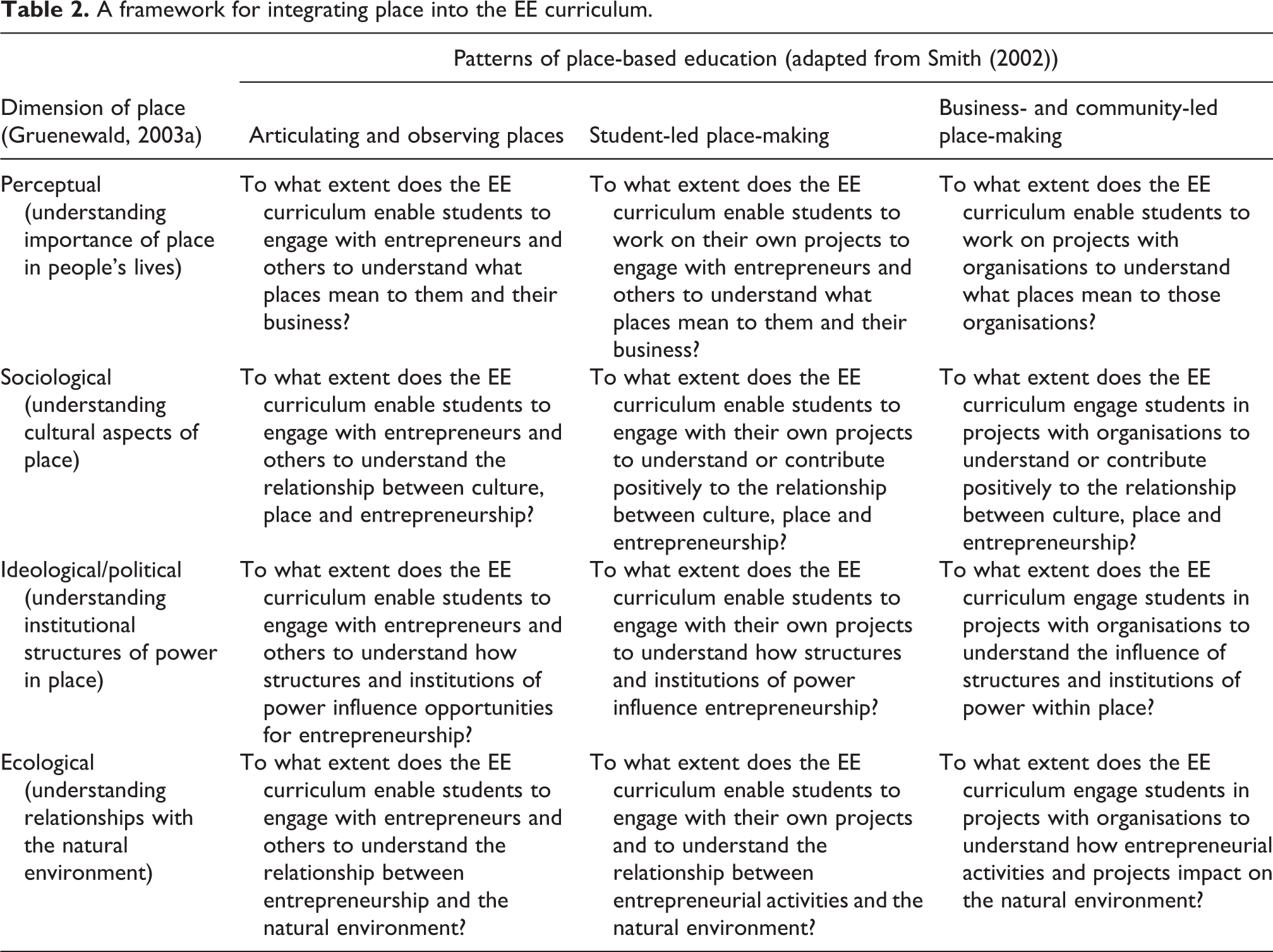
Table 2 combines patterns of place-based education and dimensions of place to provide a framework of approaches and opportunities for educators to build on existing teaching practices and to connect students further to understanding places as part of their EE experience. The framework captures the importance of immersing students in places (place-based education), as well as engaging them in conceptual understandings that enrich their learning of places (dimensions of place). The framework provides a series of questions entrepreneurship educators can ask about their existing EE curriculum.
A framework for integrating place into the EE curriculum.
Challenges when integrating place-based approaches for EE
It is important not to see place-based approaches as a panacea, but to consider potential challenges and the applicability of place-based learning in the wider context of the institution, educators and educational aims. Three particular challenges are considered here. The first is a consideration of trade-offs between place-based learning and other forms of learning to meet the institution’s educational aims for EE. The second is the choice of places of learning for students and the extent to which these places enable students to develop understandings that are meaningful to their own lives and contexts. The third is a consideration of conceptual understandings that might enrich students’ appreciation of the multidimensionality of places. These three challenges are discussed below.
The first challenge is understanding the value that place-based approaches might offer alongside other approaches to EE. Entrepreneurship educators already embrace a broad number of pedagogical approaches (Neck and Greene, 2011; Powell, 2013), and these depend on a number of factors that include the needs of regional and institutional contexts (Blenker et al., 2008; Maritz and Brown, 2013; Walter and Dohse, 2012). As with the introduction of any new pedagogical approach, there will always be trade-offs as educators design new teaching approaches and seek to understand how those approaches might impact on student learning (Hagvall Svensson et al., 2020). At the same time, experiential learning, on which place-based learning is based, is already popular among entrepreneurship educators (Neck and Greene, 2011) and the introduction of forms of place-based education might require only minor alterations.
Second, the choice of places of learning is also significant. In order to increase learning opportunities, it is believed that it is important to provide a diverse range of places for students to learn from (Sörensson and Bogren, 2020). Moreover, it is believed that educators should consider places that have greater economic, social or political challenges (McInerney et al., 2011). Indeed, engaging students in places that are less familiar culturally and socially might challenge them to be more creative and resourceful not only in identifying opportunities, but also in learning to connect to unfamiliar places and the people within them (Rae, 2017).
Third, it is also important for educators to consider the concepts and knowledge that students draw on as they engage in place-based learning. There are growing bodies of work on the importance of place and context for entrepreneurship, and there is much overlap across the five dimensions of place. A key consideration is thus which elements of this body of work to draw on for place-based teaching activities, and which concepts and ideas from entrepreneurship might offer greatest learning value for students as they connect to places. Again, there will be trade-offs, and educators need to be aware that highlighting particular ideas might lead to students focusing on those ideas in their activities, to the detriment of broader perspectives that might be best placed for the activity (Åkerblom and Lindahl, 2017).
Case study: Using the framework to explore place-based teaching activities
The paper now turns to a case study to look to how the framework can be used to make visible current place-based approaches, and also to further explore the challenges noted above. In particular, the case study explores how the context of the institution and its educators shape the choices of places of learning and the concepts students are introduced to prior to immersion in places, as well as how conceptual understandings influence students’ learning from places.
The case institution – An overview
The case institution is a university business school situated in the North West of England. The institution was chosen for two reasons. The first reason is that it has taught entrepreneurship for over 30 years, has an extensive portfolio of twenty-four entrepreneurship courses (or modules), and an undergraduate and postgraduate major programme specialising in entrepreneurship. The second reason is that the institution places emphasis on experiential and practice-based learning, provides numerous opportunities for students to engage with local businesses and the community, and highlights the importance of context and place for entrepreneurship across its curriculum. Although the institution does not refer explicitly to place-based learning, many of its activities connect students to places and help them to understand the relationship between places and entrepreneurship. The case study thus provides a valuable opportunity to use the framework to review place-based EE activities, to look at the challenges of integrating place-based learning, and to look to how teaching activities are shaped by the context of the institution. The data are based on course and programme handbooks, as well as extensive discussions with the institution’s educators who provided further insight into the range of place-based teaching activities, how the activities contribute to students’ learning and understanding of entrepreneurship, and the challenges educators face in designing and implementing place-based approaches.
A review of place-based learning at the case institution
The paper first uses the framework to identify and make visible the variety of place-based activities. It then explores further how the institution’s history and context, as well as its own relationships to place, have shaped those teaching activities, the places in which students learn and the focus on particular dimensions of place.
Identifying and making visible existing place-based learning activities
The framework is first used as a tool to make visible the variety of place-based approaches at the case institution. Eleven teaching activities were identified across two programmes that, in different ways, connect students to learning about places, with two activities, Good Dividends and Student Entrepreneurship, replicated across both undergraduate and postgraduate programmes. Table 3 provides an overview of the activities, mapped against the dimensions and patterns of place-based education. Tables 4 and 5 provide further detail on those activities, the courses and wider curriculum of which those activities are a part, as well as further insight into students’ learning expressed through dimensions of place.
Using the framework to identify and map place-based teaching activities.
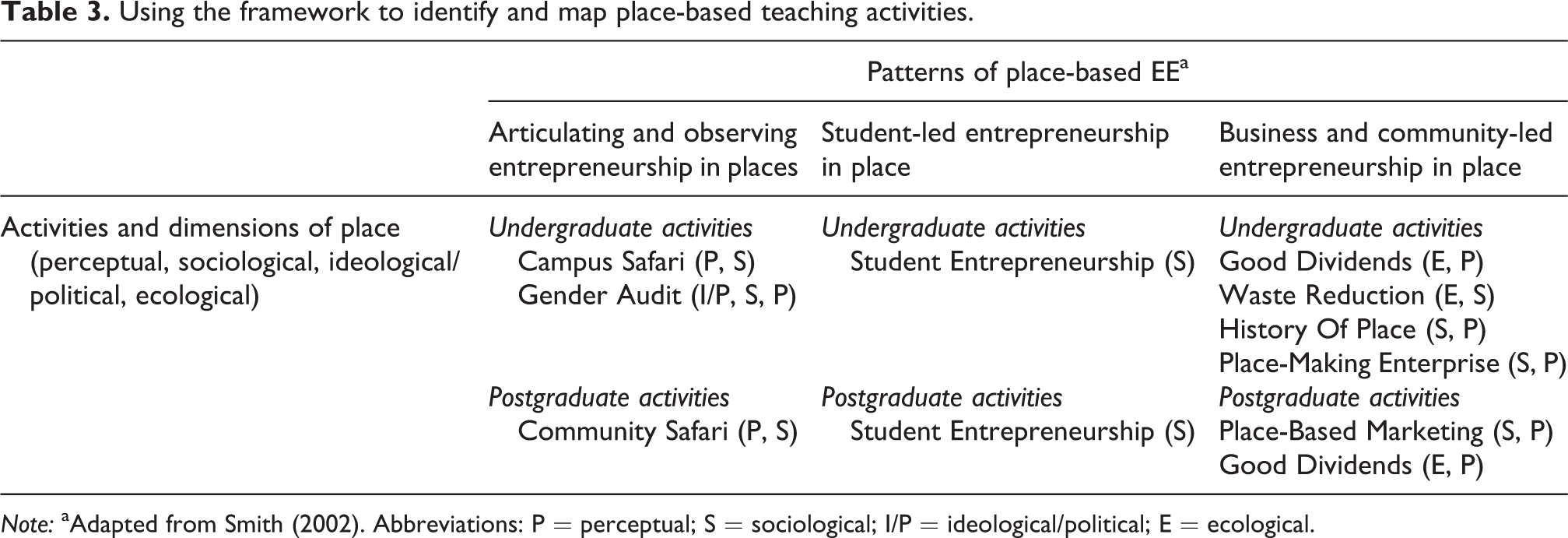
Note: aAdapted from Smith (2002). Abbreviations: P = perceptual; S = sociological; I/P = ideological/political; E = ecological.
Teaching activities and the different ways they connect students to place (undergraduate activities).
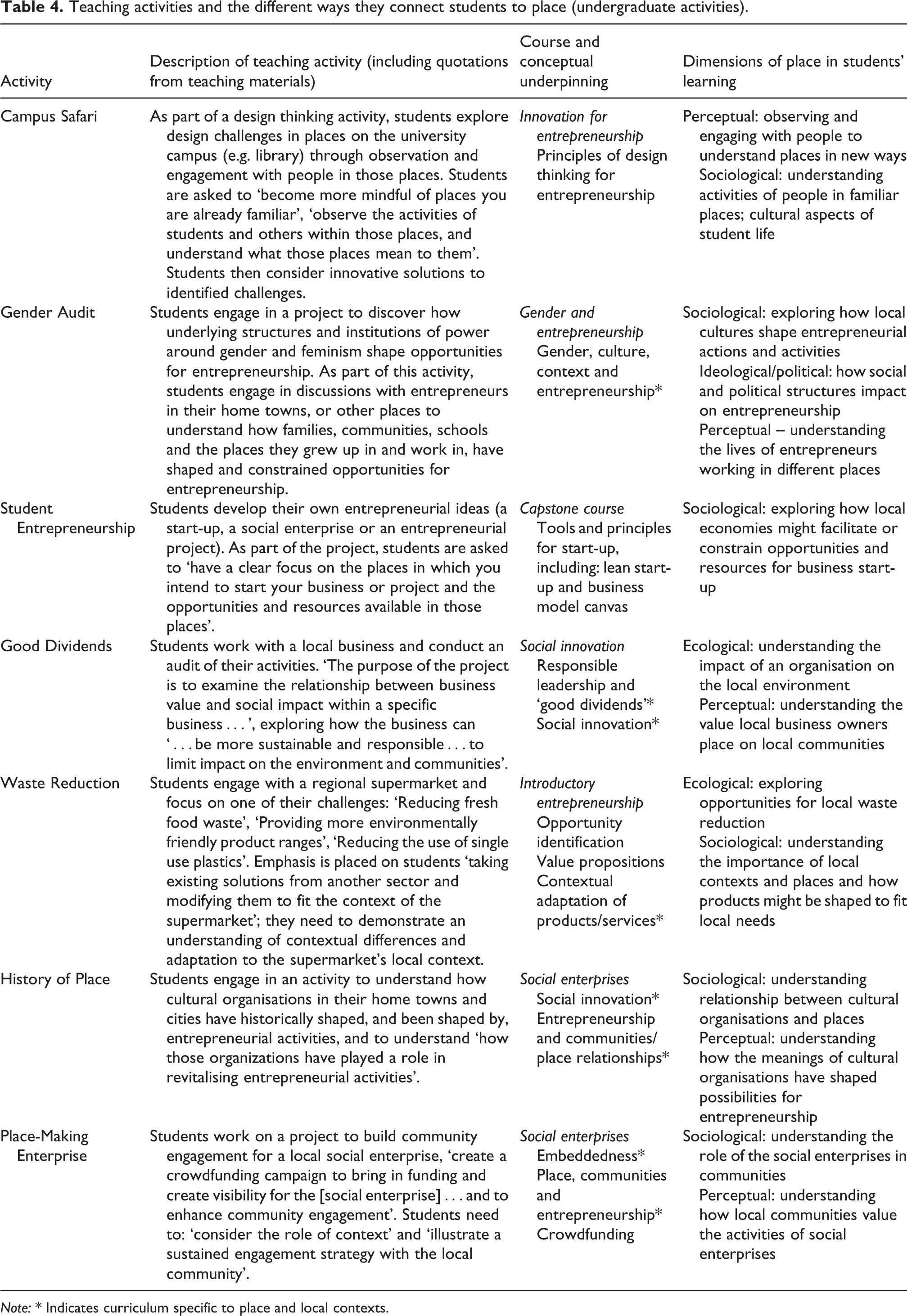
Note: * Indicates curriculum specific to place and local contexts.
Teaching activities and the different ways they connect students to place (postgraduate activities).
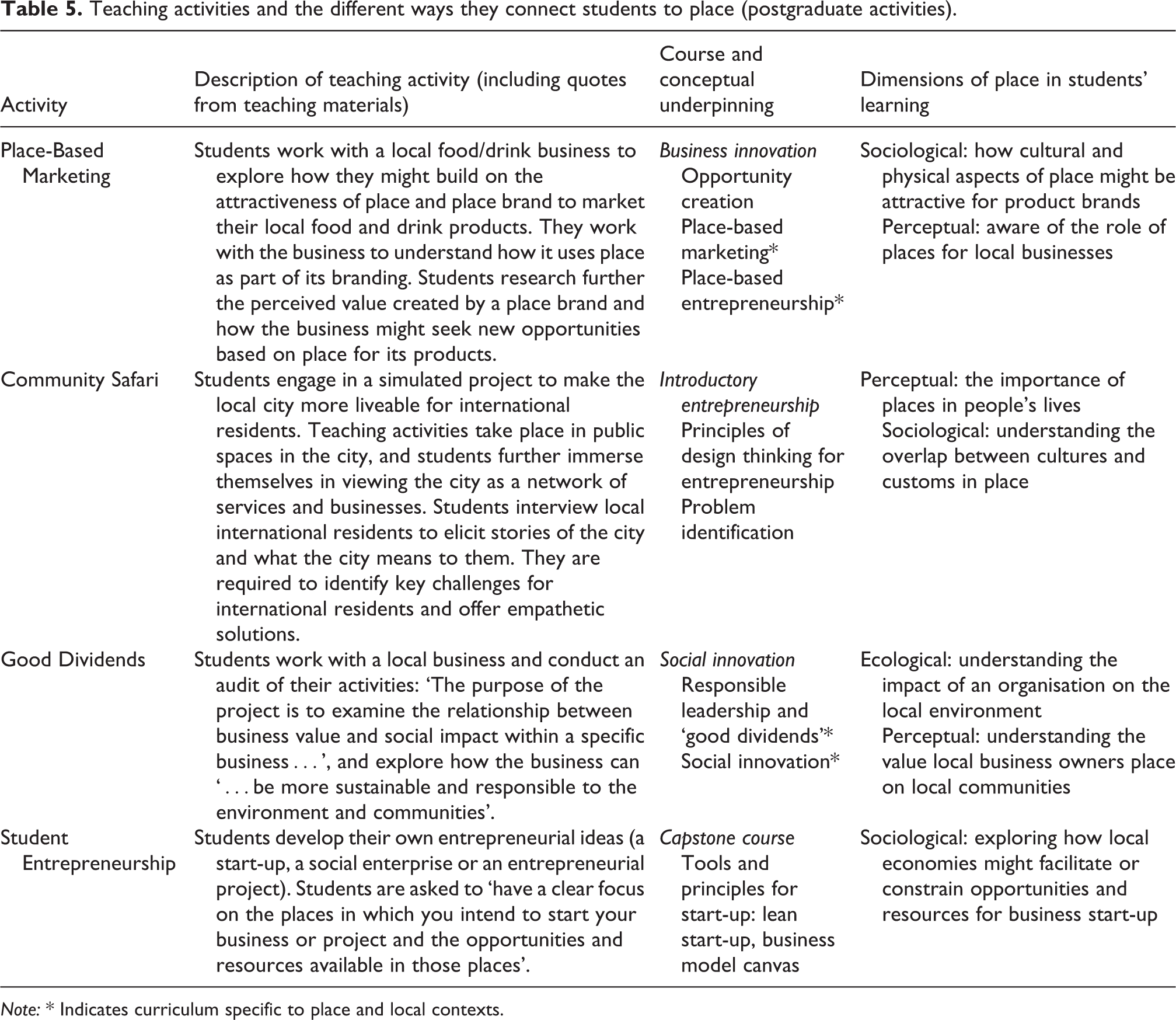
Note: * Indicates curriculum specific to place and local contexts.
The review of teaching activities against the framework highlights the extent to which aspects of place-based teaching and learning play an important role in the EE curriculum. The following sections explore further how the context of the institution has shaped these activities and in so doing reveal the challenges and opportunities it faces in integrating place-based approaches into the curriculum.
The university context: Opportunities and challenges of selecting places for learning
The institution has for over 20 years been involved in the design and delivery of a series of regional growth programmes (Gordon et al., 2012), which has led to the development of an extensive ‘Entrepreneurs in Residence’ programme whose members actively engage in teaching activities. Many educators at the institution who deliver entrepreneurship education have also been involved in regional growth programmes and through that involvement have developed personal networks of business owners who also contribute to teaching activities. These relationships have been central to providing opportunities for students to engage with local businesses, as is reflected in the number of business and community-led activities shown in Table 6, which maps sites of learning across place-based teaching activities.
Mapping places as sites of learning.
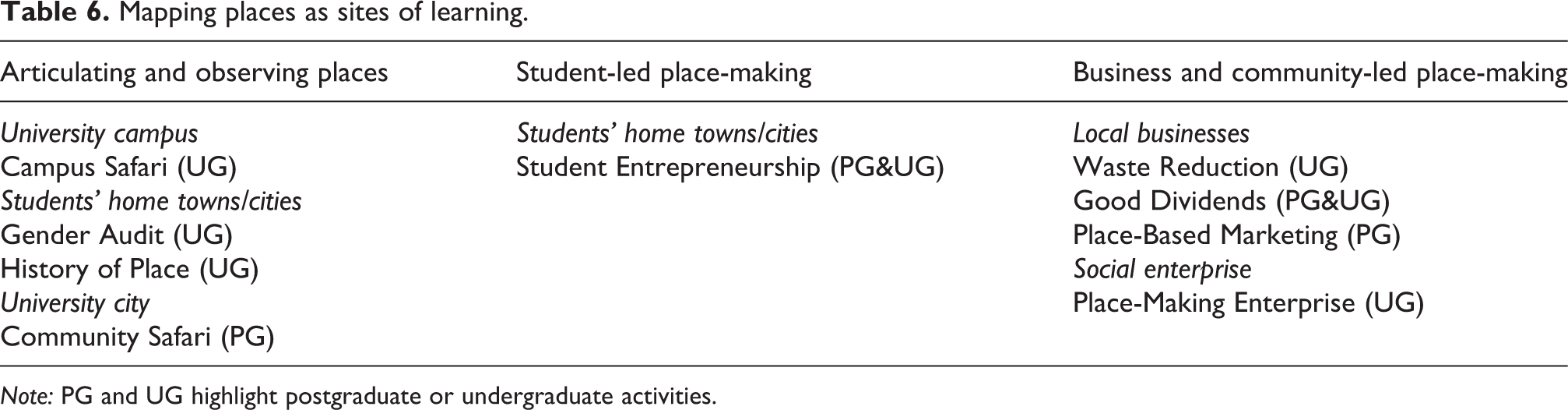
Note: PG and UG highlight postgraduate or undergraduate activities.
The strength of the institution’s and educators’ relationships with local businesses also limits the diversity of experiences for students as the businesses often fit the characteristics necessitated by regional growth programmes, and thus most are small and operate locally, albeit in a range of industries. Although the institution has a long history in regional growth programmes, and strong relationships with local or regional policy makers, teaching activities do not take advantage of those relationships to provide students with an opportunity to learn how local political, social and economic institutions work to shape entrepreneurial opportunities and resources in different places. Indeed, areas local to the university are in the top 10% most deprived areas of the UK (IoD, 2019) and there is perhaps an opportunity to engage students in projects in those areas which could demand greater levels of creativity (Rae, 2017).
Activities that fall into the ‘articulating and observing places’ pattern include a variety of places that provide students with an opportunity to draw on their own relationships with people and places (Gender Audit and History of Place), as well as engaging them in interviewing local residents or fellow students on the Community Safari and Campus Safari activities respectively. Again, these places are often familiar to students, geographically, socially and culturally.
Student-led projects are limited to Student Entrepreneurship activities, which engage them in conducting research around their business ideas with a view to starting a business either during or after their studies. For this activity students engage in the place in which they wish to start their business, usually their home town or the university city, to understand how that place creates opportunities and resources for their new ventures, as well as building relationships with potential customers, suppliers and partners. Such a project easily translates into a student-led one, as students have a clear motivation to engage in the place to form relationships with local organisations and create a meaningful project.
The university context: Opportunities and challenges for engaging students in dimensions of place
An advantage for the institution is that many of its entrepreneurship educators are actively involved in research on context and place for entrepreneurship, with educators’ interests including how rural, peripheral and minority entrepreneurship is shaped by and shapes places, as well as how the notions of heritage and authenticity attached to places create entrepreneurial opportunities. These research interests are prominent in the curriculum and also in the teaching activities, as can be seen in Tables 4 and 5. A combination of research interests and a curriculum designed around those research interests has thus shaped the scope of the dimensions of place covered in the curriculum. Furthermore, looking at Table 3, there is a clear lean in the curriculum towards perceptual and sociological dimensions of place, influenced by educator research interests.
The Gender Audit activity introduces students to theories and debates on gender, feminism and intersectionality, providing them with additional insights into ideological and political dimensions of place. Further insight into this activity, and a comparison with the Community Safari activity below, is also useful to explore how conceptual underpinnings influence and place a boundary around students’ learning about places. Within this activity, students take critical ideas introduced in the classroom and engage with entrepreneurs in their home towns and cities to understand the different ways in which political, cultural and social structures of power hinder or support opportunities for entrepreneurship for some groups of people more than for others. In subsequent discussions in class and in the work they produce, students reflect on their findings and relate them back to theories and concepts of cultural, ideological and institutional structures of power, thus obtaining a deeper understanding of these dimensions of place for entrepreneurship.
Not all place-based activities, however, introduce students to concepts relating to place. On the Community Safari activity, for example, they are introduced to key principles of design thinking prior to immersion in place, and the focus of learning is on the importance of design thinking for entrepreneurial solutions that respond to real problems. Students immerse themselves in the city and interview international residents to discover the importance of the city for them (perceptual dimension), as well as to understand how they engage in local cultural activities (aspects of the sociological dimension). Back in the classroom, students reflect on how design thinking can help the ideation and opportunity recognition processes, yet their learning about place is not foregrounded in discussions; place, for this activity, remains a site of learning about the design thinking process. A comparison of this activity and the Gender Audit example above highlights two different approaches to using places for teaching entrepreneurship and how these are influenced by educational aims and influence learning outcomes. Within the Gender Audit, concepts relating to place help build a language for students to articulate the important relationship between places and entrepreneurship.
Discussion – Integrating place-based approaches into the EE curriculum
Given the recognised importance of connecting students to places as part of their entrepreneurship educational experience (Blenker et al., 2012; Garlick and Palmer, 2008), this paper builds on previous work in the domain of EE that points to the importance of contexts and places of education (Sörensson and Bogren, 2020; Thomassen et al., 2019) to offer a framework for place-based EE. Understanding that EE needs to be designed in accordance with the needs of regional and institutional contexts (Blenker et al., 2008; Maritz and Brown, 2013; Walter and Dohse, 2012), the paper uses data from a case study to explore how the framework might be adopted by educators to reveal opportunities and challenges in their own university contexts. There are three important points that we can learn from the case study relating to the integration of place-based approaches in EE, and these are discussed below.
The first point is that the framework is not used as an ideal representation of the varieties of place-based education to aim for, but that institutions should consider their own contexts and the needs of the region to understand the value place-based approaches might add to existing EE programmes. As we see from the case study, existing relationships are important to the provision, and ongoing sustainability, of business and community-led place-making activities. Equally important are the educational aims of the case institution’s EE programmes and the research interests of faculty educators, which together shape the curriculum. As with the wider literature on the importance of context when considering EE (Chauhan and Das, 2016; Dodd and Hynes, 2012; Giacomin et al., 2011; Walter and Dohse, 2012), it is equally important to be cognisant of the needs, resources and opportunities of individual institutions and faculty members when looking to integrate place-based learning.
The second consideration is that, although the notion of place-based education has received little attention in the wider EE literature (Sörensson and Bogren, 2020), this is not to say that institutions do not already include elements of place-based learning in their curricula, as we see from the number of place-based teaching activities at the case institution. As experiential learning and practice-based approaches become increasingly popular for teaching and learning entrepreneurship (Mueller et al., 2015; Neck and Greene, 2011), and place-based approaches are based on the principles of experiential learning (Gruenewald and Smith, 2014; Smith, 2002; Smith and Sobel, 2014), many institutions might already include aspects of place-based teaching in their curricula. The framework is thus useful as a tool for educators to review current teaching activities and to look to how, with small adaptations, current teaching activities might integrate further place-based elements.
The final point is that place-based approaches are not a panacea, and that with all approaches to teaching there will always be trade-offs (Hagvall Svensson et al., 2020), whether those relate to the time and resources for educators to experiment with place-based ideas, or the extent to which place-based approaches might help to achieve an institution’s educational aims for its EE programmes. The case study institution also faces trade-offs in its prioritisation of practice-based learning and in the activities in which it immerses its students, which we see especially in how many of its activities engage students in learning about the perceptual and sociological dimensions. In addition, the businesses in which students engage are small and local, and students are often immersed in cultures and social environments that are familiar. Given the importance of the diversity of places for learning (McInerney et al., 2011), educators might consider how to create activities that sit on the periphery of familiarity to offer greater learning experiences (Rae, 2017), but these might also be more challenging and time-consuming for educators to organise and control.
Conclusion
The aim of this paper has been to emphasise the importance of place in entrepreneurship education and to highlight the opportunities for introducing place-based pedagogies into EE. The aim reflects the increasing prominence of place in the broader entrepreneurship literature and suggests that bringing place as well as place-based approaches more centrally into the entrepreneurship curriculum has the potential to create for students higher levels of engagement in learning, a greater sense of achievement and a greater understanding of the importance of the relationship between entrepreneurship and place. At the same time, a further recognition of the importance of place would enable students to connect to the places that are important to them, and to develop skills, knowledge and experience that will enable them to translate university learning to positively transform their own places and the places of others. The paper offers a comprehensive framework for educators to map current activities and to further understand new opportunities, as well as challenges, for place-based activities in the curriculum. The suggestion is not that the EE curriculum should become entirely place-based, as the contexts and educational aims of EE differ greatly, but that there is a need to consider further how place and place-based approaches, which build on existing experiential approaches, might become more prominent in EE and to encourage further debate about the potential for place-based approaches.
Footnotes
Declaration of conflicting interests
The author(s) declared no potential conflicts of interest with respect to the research, authorship, and/or publication of this article.
Funding
The author(s) received no financial support for the research, authorship, and/or publication of this article.
