




Abstract
Entrepreneurship-related modules have become increasingly popular over the years, not only among business school students but also among those from other disciplines, including engineering and the arts and humanities. In some circumstances, they are offered as optional modules for students across different faculties and disciplines. While it is beneficial to mix students with different backgrounds, bringing in a wide range of perspectives, there are also challenges relating to course design and student engagement. With these challenges in mind, the authors trialled a new approach in the hope of motivating students from diverse academic and socio-cultural backgrounds to engage more fully in the classroom by utilising student entrepreneurs as guest speakers. The student-centric approach has proved effective in enhancing student engagement, as evidenced by both informal and formal feedback.
Introduction
Entrepreneurship-related modules have become increasingly popular over the years, not only among business school students but also among those from other disciplines (Jones and English, 2004). In many higher education institutions (HEIs), these are offered as optional modules for students across different faculties and disciplines. While exposure to entrepreneurship is beneficial in relation to skills development, it brings its own challenges with regard to module design and content for a wide variety of learners. For instance, students may have varying levels of understanding of business-related topics or may be from different countries and cultures. Such challenges need to be successfully addressed in order to motivate students and ensure their active participation in the classroom.
Preparing students to engage and succeed has been a key consideration in the design and delivery of business courses, which aim to facilitate effective learning through interactive teaching. As lecturers in Enterprise and Entrepreneurship, we teach entrepreneurship-related modules for undergraduate students from different faculties and disciplines. In the delivery of the modules, we have experienced challenges in maintaining high levels of student engagement as well as in the achievement of good overall student satisfaction and experience. To address these challenges, we trialled a new approach in the hope of motivating students from diverse backgrounds to engage more fully in the classroom: this approach involves the use of student entrepreneurs as facilitators and guest speakers. The modules for which this approach was trialled were concerned with business networking, growth and optimisation and included students from over 15 countries and studying in the Faculties of Business and Law, Engineering, Environment and Computing, Arts and Humanities, and Health and Life Science. The overall aim is twofold: first, to enhance student engagement in the classroom leading to an improved student experience; and second, to make full use of the students’ differing backgrounds to facilitate knowledge exchange across disciplines and equip students with a better understanding of theories and practice related to the module topics.
In our experiment, we acted as facilitators. The student entrepreneurs selected as ‘guest speakers’ were actively working on their businesses and came to the classroom to share their real-life business experiences and the challenges they were facing. Students were ‘listeners and business advisors’ who participated in discussions to come up with solutions for the problems the student entrepreneurs were confronting.
Student entrepreneurs as guest speakers
Rationale
It is widely agreed that the role played by facilitators makes a difference to the student learning experience (Crisp et al., 2020). Previously, guest speakers from industry have been introduced into the classroom to complement the traditional lectures and have often been able to communicate to students their first-hand experience of the real-life application of theories. Indeed, well-prepared guest lectures delivered by experienced industrial veterans have proven to be an effective way to aid the educational process and contribute to students’ overall satisfaction with their learning experience. They often share memorable lessons and demonstrate professionalism, points of craft, personalised instruction with perfect timing and expert delivery, which result in very positive student feedback (Centre for Industry Education Collaboration, 2019; Finkelstein, 2018; Leor, 2015).
One of our fundamental assumptions, then, is that inviting industry guest speakers can be an effective way of improving the classroom experience, as they offer fresh and valuable perspectives, provide variety in the educational delivery and impart important specific subject knowledge that may be omitted in regular classes (Leor, 2015).
However, our second assumption derives from the observation that industry speakers are not always welcomed by cross-faculty students and sometimes such interventions receive negative feedback. For instance, students in previous cohorts have commented that some industry speakers came from traditional sectors and, although they were able to bring in valuable expertise from their specific field, the students were more interested in exposure to innovative and trending ideas, such as the sharing economy and AI-driven businesses. Moreover, for students from different faculties and with varying levels of understanding and mastery of business-related knowledge, the effectiveness of industry guest speakers can be limited. Thus, there remains an opportunity to introduce innovative ideas in order to create active participation and engagement in the classroom and so to enhance knowledge acquisition and exchange.
Meanwhile, there has been an increase in student entrepreneurs across the UK (Bearne, 2015; Evans, 2019; Santander Universities, 2019). Almost a quarter of students already run their own business or entrepreneurial venture, or plan to do so while at university, according to research by the financial services company Santander (Bearne, 2015). We became aware that the student entrepreneurs in our own classes were keen to act as guest speakers to their peers to offer their experiences. They were not only open to sharing their experience but also welcomed any suggestions within the class concerning the problems and challenges their businesses were facing. They had successfully established a business and were continually managing it in the UK or abroad. For instance, we identified a subscription-based e-business in London (online renting for high-value womenswear on monthly basis); a Ghanaian e-business making and marketing African featured socks with monthly sales of $25,000; an Airbnb homeowner in Shanghai who developed his business by targeting KOLs (Key Opinion Leaders)/influencers; and an Instagram-based business selling foldable bags (the winner of the UK Young Enterprise Company of the Year award in 2018).
There was a considerable cohort of student entrepreneurs across the programme and, given the evidence that peer power often works well in inspiring fellow students to achieve their best potential through sharing and learning from each other’s experiences and achievements, we felt that peer learning could be adapted in an entrepreneurial higher education context. Based on the above assumptions, therefore, we began the process of identifying and liaising with potential student entrepreneurs for guest speaker sessions.
The process
As educators in the entrepreneurship discipline, we see our role as facilitators of students’ learning journeys, inspiring and encouraging them to identify and explore venture creation opportunities in addition to learning entrepreneurship-related theories in traditional lectures. This section details how we identified, liaised with potential speakers, and utilised different teaching methods in the entire process.
Acknowledging the limitations of inviting traditional veteran guest speakers, we felt that student entrepreneurs could contribute to filling the gap identified above. From initial conversations with the student entrepreneurs we identified in each module, we found that they were not only highly motivated to share their passion for entrepreneurship and their experiences of business growth, but also keen to seize the opportunity to promote their businesses to fellow students and seek potential business partners. Before the delivery of the student-led sessions, the lecturer briefed the students about the guest lecturers, providing short introductions to the topics, and equipped them with the relevant theoretical knowledge. We asked the student entrepreneurs to prepare a 5-minute PowerPoint presentation, introducing themselves and their business. Additionally, to ensure relevance and adherence to the teaching schedule and learning outcomes of the business growth and optimisation module, we carefully scheduled the presentations taking into account the nature and specific characteristics of the businesses. For instance, we asked the student entrepreneurs to structure their presentations with a focus on the challenges and achievements of e-business, was in close alignment with the module coursework – a report on e-business’s impact on a selected small or medium-sized enterprise.
On the day, after the student entrepreneurs had delivered their 5-minute presentations, the rest of the class engaged in group discussions of the challenges the businesses were facing. These discussions lasted 20 minutes. Then, they were encouraged to provide tailored SMART (specific, measurable, achievable, relevant and time-bound) solutions for the businesses. Finally, there was a 10-minute Question & Answer session so that the rest of the class could put to the student entrepreneurs any questions they might have concerning the entrepreneurs’ businesses and management experiences.
Throughout the whole process (summarised in Figure 1), we analyse each student entrepreneur’s venture as a case study. The class discussion about challenges and solutions can be seen as a mini consultancy project.
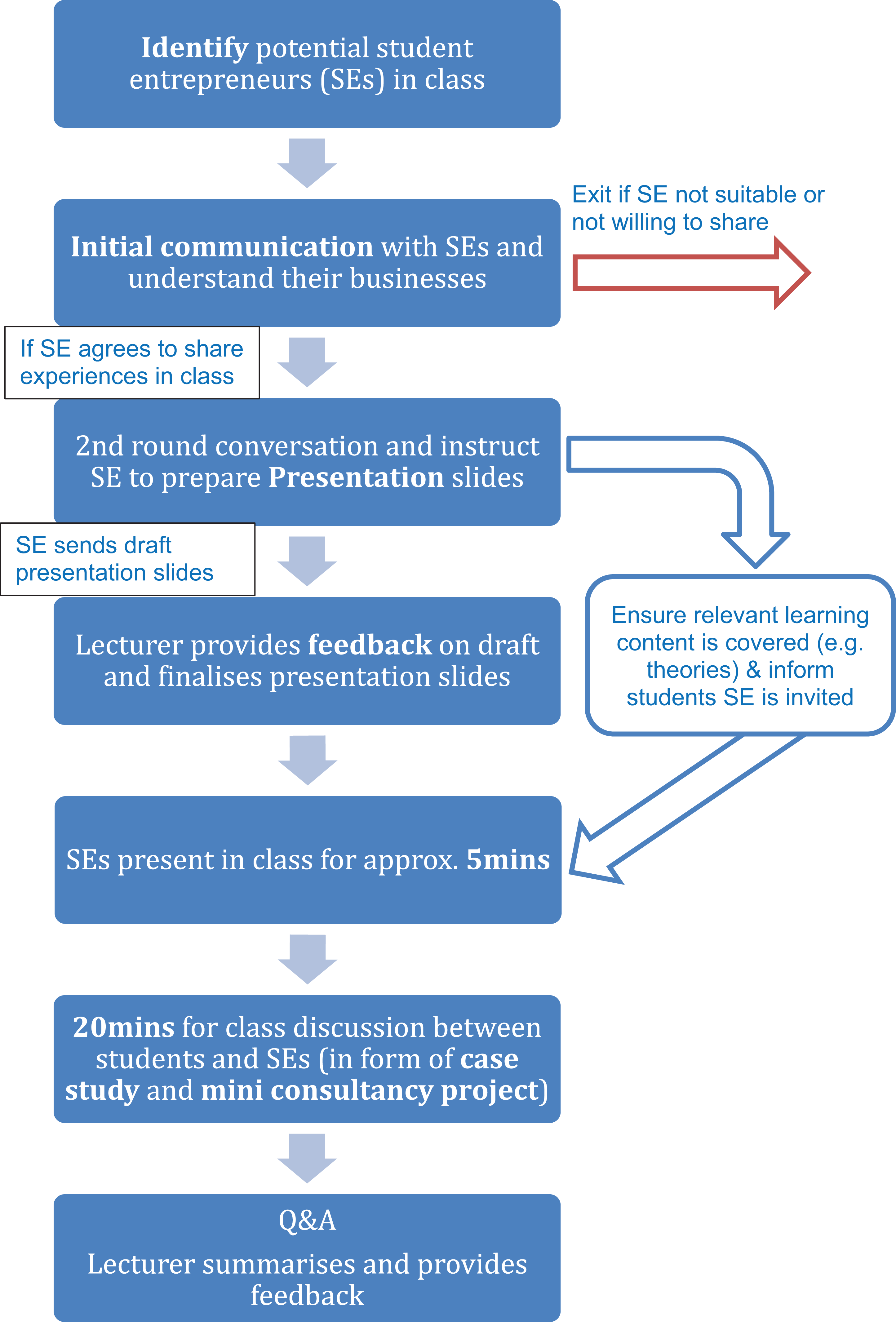
Process flowchart.
Outcomes of practice
This student-centric approach has effectively enhanced student engagement, as evidenced by both informal and formal feedback from students. Highly positive feedback has also been received from a senior colleague who was observing the session.
Enhanced engagement among students
As module leaders, we have observed that all attending students are fully engaged during the class. As for the student entrepreneurs, as noted above, they have demonstrated a high level of motivation to share their passion for entrepreneurship and their business growth experiences, and to seek business partners and talents who might like to join them in their venture. In particular, we observed conversations taking place among the student entrepreneurs and students from computer science and engineering disciplines regarding the development of mobile applications, business students regarding digital marketing solutions, and arts students in terms of improving the design of products or marketing materials.
Such conversations have contributed to addressing the challenges of enhancing student engagement in the classroom. Specifically, the advantages of mixing students from different faculties with diverse knowledge and skill sets have been realised and even amplified. We have also noticed that student entrepreneurs who have delivered guest lectures have returned to the classroom as more engaged learners throughout the rest of the module and the programme. The rest of the class was observed to be actively engaging with the student entrepreneurs’ presentations and business ideas – more so than with those of industry guest speakers. They were impressed and inspired by the achievements of their peers. When they were providing SMART solutions to the challenges experienced by the entrepreneurs, a high level of engagement was also apparent.
Module evaluation and teaching observation
After practising this peer-empowered learning technique, the formal student module evaluation results demonstrated considerable improvements compared to the previous academic year, with the overall satisfaction rate improved by 10%. Students’ comments included: Guest speakers are an interesting part of this module from whom I’ve learnt a great deal [of practical knowledge]. Somewhat interesting content and very attentive tutor. It is very engaging and lively; the module is very stimulating and helpful to myself. Like the way the module is delivered. Class is interactive, fun, informative, [and] well explained. It is practical and something I can use in my professional life. [It helps with my] understanding [of] the business around the world and [business] networking. It was a great session, and you handled the class really well. You were really well prepared and engaged the group in discussion from the outset.
Critical reflection
This experiment has allowed us to make several key observations in uncovering the power of peer entrepreneurial learning and showcasing entrepreneurship as a potential career path for students. However, the facilitating role of the lecturers in supporting student entrepreneurs in this journey should also be emphasised.
Peer empowerment
In our observations, we clearly noticed the sense of ‘peer empowerment’: students are intrigued to learn more about other students’ ventures not only because such ventures are often more interesting and relevant to them, but also because they see that the key driving forces behind the ventures are people just like themselves. This ‘peer empowerment’ both contributed to improved engagement in the classroom and motivated students to apply their learning to real-life practice, potentially in starting their own ventures. The student entrepreneurs demonstrated a different career path or possibility ‘at the doorstep’ for their fellow students. Consequently, we have observed increased motivation among students, with two of them already in the process of starting their own ventures.
Moreover, student entrepreneurs are very open to sharing their challenges and tend to adopt a humble approach to delivery rather than talking down to their audience. At the same time, the students in the audience are given an opportunity to work on real-life problems that are happening in the moment. There is a chance that the solutions they propose will be implemented and will make a difference to their entrepreneurial colleagues. This combination inherently provides greater motivation for students than the traditional teaching methods and hence results in a deeper sense of involvement.
We believe that entrepreneurship education is not just about teaching theories and studying case studies on paper; it is also about inspiring students to develop and apply entrepreneurial thinking in real-life contexts. Student entrepreneurs serve as an effective medium for stimulating such inspiration and providing real-life contexts for cases to be discussed in an open, safe and equal manner. Such an atmosphere is less likely to be achieved by a traditional experienced industrial speaker, as the ‘distance’ (e.g., due to age, life experience, personal resources) between students and speaker is much wider. It should be acknowledged that the proximity (in terms of both power relations and mentality) between the student entrepreneurs and their student audience plays a vital role in this experiment, and should be regarded as key to peer-empowered learning in similar scenarios. Student entrepreneurs should therefore be treated as valuable assets in entrepreneurship education.
Entrepreneurship as an alternative career path
There is a tendency for Generation Z to consider entrepreneurship rather than employment after graduation as a career path, as an increasing number of university students join their family businesses or set up their own businesses (Bearne, 2015; Fernandes, 2018). As already noted, research by Santander shows that this entrepreneurial spirit is present on campuses across the UK (Bearne, 2015). Inviting student entrepreneurs to deliver guest lectures can present a positive and proactive response to this trend. It encourages existing student entrepreneurs to be more engaged with the education process, and provides other students with examples of peers who are already practising entrepreneurship and who accordingly constitute sources of aspiration and inspiration.
Practical lessons
Various ice-breaking activities need to be undertaken in the first or second week of the module to generate discussions and encourage students to share their experiences. From these activities, student entrepreneurs are likely to be identified. One-to-one informal discussions between the lecturer and the student entrepreneur are needed to establish rapport and to enable the lecturer to understand more about the entrepreneur’s business, sector, achievements and challenges.
Advice and guidance are also key in ensuring a good presentation experience for both the student entrepreneurs and their student audience. In our experiment, all the experiences were positive. However, it is worth noting that inadequate support, unclear instructions or lack of alignment with the overall delivery of the module might result in negative experiences which could potentially do more harm than good. Thus, the lecturer has a critical role to play in ensuring that the process is executed at the right pace and in strong alignment with the overall learning outcome of the module.
Challenges
We encountered several challenges in the first semester when we implemented this practice. First, a couple of students said they would have liked to listen to ‘experts’ in addition to other students. Moreover, some pointed out that the invited student entrepreneurs’ businesses were in similar sectors and they would like to see a wider variety of guest speakers from different backgrounds. Also, although the student-led sessions were stimulating, there was the danger that the guest speakers would be overburdened as the module progressed: they were also fellow students and we, as facilitators, had to step in when we felt that, instead of a time-limited contribution, a student entrepreneur’s intervention was turning into a long 11-week advice session during the course of the module.
Amendments were implemented in the second semester. We selected three student entrepreneurs and at least one traditional veteran guest speaker, all from different industries on each module over the 11 teaching weeks’ duration. This mixture of guest speakers resulted in positive student feedback.
Conclusion
This account of practice is designed to inspire further discussion in the entrepreneurship education arena concerning how peer learning can be redefined and adapted to respond to the emerging needs and changing characteristics of a new generation of students in an innovative and effective manner. Engaging student entrepreneurs as guest speakers has had positive effects in cultivating interactive learning experiences. Drawing from this recently trialled experiment, this article has set out includes detailed practical procedures and offered recommendations on how to implement a peer-empowered entrepreneurial learning process. Lecturers or classroom facilitators need to adopt such an approach with careful planning to ensure the best results.
Footnotes
Declaration of conflicting interests
The author(s) declared no potential conflicts of interest with respect to the research, authorship, and/or publication of this article.
Funding
The author(s) received no financial support for the research, authorship, and/or publication of this article.
