




Abstract
This study provides new insights into the entrepreneurial role of universities in an entrepreneurial discovery process. Over the past decades, European policies have encouraged universities to identify opportunities and develop new partnerships and connections with society. This analysis focuses on the Vestfold region of Norway, which contains an institutionally rich and specialised electronic industry, supported by a university college. The development of entrepreneurial discovery as a process capability at the regional level is examined using qualitative analysis based on semi-structured interviews. Regional actors developed regional innovation capabilities based on a bottom-up entrepreneurial discovery approach, in which a local university college played an active role. Entrepreneurial discovery capabilities entail a rigorous assessment of the region’s knowledge base, experimentation and the institutionalisation of new collaborative work forms that mobilise industry–university interaction aimed at identifying and facilitating the emergence and growth of new domains. The article highlights the challenges and opportunities of a bottom-up entrepreneurial discovery approach and concludes with policy implications.
Keywords
The involvement of universities and research organisations (ROs) in regional development has gained increasing prominence in the academic literature (Goddard et al., 2013) and in national, regional and European Union (EU) policies since the 1990s (European Commission, 2014). This increased role has been highlighted in the agenda for the European Commission (EC) and has been promoted by the Organisation for Economic Cooperation and Development (OECD) (Kempton et al., 2013; Marinelli and Elena-Perez, 2017). The concept of smart specialisation strategies (S3) is a key element of the EC cohesive policy framework (2014–2020), in which the aim of S3 is to foster national and regional economic development through targeted support for research and innovation based on the identification of new domains of opportunity (McCann and Ortega-Argilés, 2015). The identification of a new domain of opportunity occurs through a bottom-up entrepreneurial discovery process (EDP), in which entrepreneurial knowledge spills over to more economic actors and, as a result, industrial and structural changes can stimulate new growth paths (Foray, 2014; Isaksen et al., 2018). According to Goddard et al. (2013) the EDP process involves complex challenges for all actors involved, and policy makers often underestimate these issues.
One of these challenges is the pressure that universities face from the national government to focus their resources on activities that are perceived as internationally prestigious, while also supporting the need for new knowledge. This study contributes to the debate about the role of universities in building entrepreneurial discovery capability by using a longitudinal case study of the region of Vestfold in Norway.
The university college and the region of Vestfold seemed appropriate for this type of analysis because of their long-term engagement in developing a regional innovation system (RIS) with strong participation from regional actors. The RIS of Vestfold is characterised as institutionally thick and specialised in advanced high-tech electronic and microelectronic companies, supported by a university college. It evolved in the 1960s as part of a national strategy to build research-based industry based on emerging technologies (Wicken, 2009). The industry of Vestfold experienced rapid growth and diversified its structure until the late1980s, when increased global competition slowed the pace of the planned regional development trajectory. As a response to that challenge, the industry, together with the university college and local authorities, began to develop a regional entrepreneurial discovery capability that promoted the transformation of the university college, the formation of new institutions and experimentation with new, interactive forms of work.
The university college is a result of a national political reform that combined numerous small higher education institutions in Norway into fewer, larger units. The intention was to build stronger, more robust educational institutions that could behave more entrepreneurially, in the sense of being more engaged with society and industry at regional, national, and global levels (Kwiek and Maassen, 2012). By considering the RIS of Vestfold, we can thus explore the path-dependent process of identifying new opportunities and regional innovation capability development by applying EDP as an analytical framework.
In order to gain insights into the EDP debate, the paper is organised as follows. The next section discusses changes in regional development approaches in the light of the policy frameworks of the past few decades, focusing on the debate concerning the role of universities. The third section describes industry path-dependent processes, paying particular attention to the contribution to changes in the university’s main functions and the EDP. The fourth section describes the context and method used in the study. The fifth section presents empirical analyses of university colleges and regional development, while the sixth discusses the findings from the empirical analysis. The final section concludes and provides policy recommendations.
Policy frameworks and regional development
One of the dominant conceptual points of reference for policies aiming to strengthen innovation-based regional development is the RIS framework. The RIS concept has been used to justify the development of specific targeted policies that emphasise the capabilities and performance of local firms, as well as improving local capabilities for knowledge spill-overs by promoting greater interaction between different actors, such as university–industry collaboration (Doloreux and Parto, 2005). Tödtling and Trippl (2005) argue that RIS policies lack specific understanding of the strengths and weaknesses of regions in terms of their industries, knowledge institutions, innovation potential and problems. The debate calls for better and more nuanced policy models that take into consideration different regional economic path challenges and institutional problems. According to the RIS literature, there are three types of RIS: organisationally ‘thick’ and diversified, organisationally ‘thick’ and specialised, and organisationally ‘thin’. Organisationally thin RISs have only a few knowledge and support organisations, and weak, poorly developed network-based co-operation. These RISs are often found in peripheral regions. The inflow of new knowledge through external links or the attraction of knowledge organisations is assumed to be important for innovation and regional development. Organisationally thick and diversified RISs are often found in large and advanced core technology regions. They are characterised by a relatively large number of different firms, a heterogeneous industrial structure and a number of knowledge and support organisations. Regions that host strong clusters in one or a few industries only, and in which knowledge and support organisations are mostly tailored to support their narrow industrial base, are organisationally thick and specialised RISs. This type of RIS supports entrepreneurship poorly and presents greater possibility of the lock-in of existing industrial strongholds (Isaksen et al., 2018). However, the regional innovation policies of the last decade have been marked by a narrow, technology-oriented policy interpretation, based on a narrow definition of an RIS, with most policies focused on individual firms in the form of R&D subsidies rather than selective policy instruments that relate to the actual problems identified in RISs (Trippl et al., 2015).
In addition to regional innovation policies, several nations have introduced policy reforms with the objective of reforming the educational system, such as the Bologna Process in the EU and the Norwegian Act on Universities and Colleges of 1995 (Kwiek and Maassen, 2012). In Norway, the reforms were designed to create more effective and robust units that could behave more entrepreneurially through greater involvement in regional development. Educational reforms were also supported by national industrial policies, which emphasised demand-driven innovation, and centre of excellence (CoE) policies, which challenged universities to redefine their roles and functions (Wicken, 2009).
Entrepreneurial discovery as a process and the system-level entrepreneurial role
The RIS perspective explicitly acknowledges that, for reasons of history and path dependency, regions vary not only in terms of their technological and industrial competence, but also in terms of institutional arrangements (culturally embedded beliefs and norms) (Garud et al., 2007) and their potential evolutionary trajectory (Brekke, 2015). Evidence from evolutionary economics shows that regions are more likely to branch into industries that are technologically related to pre-existing industries through path dependency and place-specific knowledge transfer mechanisms that connect the new industry to existing industries (Boschma and Frenken, 2011). In this context, path dependency is used to explain how the inherited local knowledge base of an industry is influenced by its past history or the regional economy along one development path rather than another through the effects of diversification processes, policy making and events (Martin and Sunley, 2010).
Entrepreneurial discovery as a process
The EDP is traditionally understood as the actions of individual entrepreneurs who are ‘routine-resisting’ and risk-taking, and who discover opportunities for profit that appear in a market (Kirzner, 1997). According to Coffano and Foray (2014) and Rodríguez-Pose and Wilkie (2016) the EDP is an interactive and experimental bottom-up process that involves a range of actors, such as entrepreneurial agents and policy makers, and the wider social and economic structures surrounding entrepreneurship and innovation in a region. The EDP is created by entrepreneurs who scan technologies and market opportunities to identify future potential, create new knowledge that can spill over to more economic actors and, as a result, create some form of industrial and structural change that can stimulate new growth paths, allowing the system to reorient and renew itself (Foray, 2014). The result of a successful EDP is assumed to create innovation and system changes that affect industrial development in a specific region and industry (Hausmann and Rodrik, 2003). These changes call for system-level entrepreneurs – individuals, organisations, or groups of actors who are receptive to the ideas of entrepreneurs – to identify priorities, mobilise resources, build entrepreneurial knowledge and facilitate the emergence and growth of new activities aimed at creating new system changes or transforming existing systems (Isaksen et al., 2018).
The system-level entrepreneurial role of the university
Isaksen et al. (2018) argue that there are two types of entrepreneurs: firm-level and system-level entrepreneurs. Firm-level entrepreneurs are individuals who start new firms or carry out entrepreneurial activities in existing firms. System-level entrepreneurs are actors who can change or diffuse new practices into the wider industry community by changing the framework conditions and mobilising the resources, competence and power to create new institutions or transform existing institutions and regional knowledge bases. A system-level entrepreneur might have the capacity to support or even initiate new industrial paths by taking part in an EDP.
Kempton et al. (2013) argue that, although universities have long been viewed as important actors in RISs, the EDP amplifies and even deepens their role. The university is regarded as one of the actors that build system-level entrepreneurial capabilities, precisely because of its evolving role in society and its engagement in third mission activities. The third mission stream concerns three main activities: (a) innovation, technology and knowledge transfer; (b) continuing education and lifelong learning; and (c) broader engagement in regional development. Despite the growing engagement of universities in society (Pinheiro and Stensaker, 2014), and their increasingly recognised regional development role, their entrepreneurial system-level role in the EDP is not a simple process. This is partly because such a role requires an explicit regional agenda that is not necessarily linked to the core functions of research and teaching, and often lacks basic funding schemes. Another issue is the pressure that universities face from their national government to focus their research activities on what is perceived to be internationally prestigious without necessarily linking to the regional knowledge base (European Commission, 2014). Another pressure follows from changing policy schemes, as there has been a degree of ambiguity concerning the goals of the university’s role in regional development (Foss and Gibson, 2015). Another challenge is the inherited structural capacity in the regional knowledge industry and the potential for new growth paths to emerge (Brekke, 2015). Recognising this multifaceted difficulty in implementing the system-level entrepreneurial role in light of the policy schemes of the last decade is critical to understanding the role and capabilities of universities in the EDP.
Context and method
The county of Vestfold is a medium-sized Norwegian region, with elected regional authorities that have a medium to low level of political autonomy. It has a population of approximately 250,000. The region has a long history as an important port for ferries, shipbuilding and other maritime activities. Today, its business activities consist of two main industrial branches: the first includes a variety of companies in the wholesale business, trade, logistics and transport, food and forestry; the second comprises advanced electronics and ICT companies that evolved in the 1960s as part of a national strategy to build a research-based industry in emerging technologies. In the 1990s, these branches became key targets for regional authorities, university colleges and regional companies in the mobilisation of resources to build an RIS. One significant outcome of the process was the development of a dialogue arena called ‘Value Creation Vestfold’ which aims to ensure closer collaboration between regional actors and to define and implement common development strategies. Advanced electronics and ICT companies serve the international market for defence, maritime, offshore, electronics products, health and medical equipment, and communication software (Brekke, 2015). The cluster of companies is mainly located within a 40-kilometre radius from Vestfold University College. This spatial proximity of firms represents an agglomeration of innovation power that is best understood as knowledge spill-overs between related companies and higher education institutions.
Vestfold University College is located 100 kilometres southwest of Norway’s capital city, Oslo. In 2013, it was organised into four faculties: Health Science, Humanities and Education, Technology and Maritime Sciences, and the Faculty of Social Science. Vestfold University College offers 20 Bachelor’s and 8 Master’s degrees and a PhD programme in Nano- and Microelectronics.
This analysis in this paper derives from a longitudinal intrinsic case study based on the principles of ethnography (Berger and Luckmann, 1967; Weick, 1995). The single intrinsic case study approach (Sayer, 2000) is widely accepted as a valid research design for this type of study, the purpose of which is to provide in-depth insights into underlying processes and mechanisms that have not been properly discussed in existing theory, thereby contributing to theory development (Eisenhardt, 1989). The case study is based on 23 interviews with the provost, dean, department managers and academic staff at Vestfold University College, and 43 people who were company managers between 2007 and 2014. All interviews were conducted in confidentiality; interviewees’ names are withheld by mutual agreement. The case study used qualitative semi-structured interviews, which were fundamental for manual coding and the use of the analytical software NVIVO (Bazeley, 2007). The informants were selected based on their experience of university–industry interaction and interviews were conducted at their workplaces. The interview guide focused on the kinds of experiences they had had with regard to regional development by addressing issues such as firm and department history, the development of core skills and competencies, access and search for knowledge (both internal and external to the region), new forms for organising innovation and learning processes, the use of external resources and entrepreneurial activities. All interviews were conducted in person. The interviewees received transcripts and analyses of their responses as a quality check. In addition to the interviews, the analysis employed various reports, documents, statistical sources, and observations of project meetings to complement and verify the information obtained from the interviews in order to increase the validity and reliability of the data (Yin, 1981). Purposeful sampling was an important part of the coding technique employed, in which data were repeatedly compared across informants over time. This process resulted in an evolving and increasingly focused sample that was repeated until the analysis reached theoretical saturation (Gioia et al., 2013).
Empirical analysis of Vestfold University College and regional development
Capability building of the higher educational system of Norway
Rapid industrial growth and tax income channelled to the higher education system in the 1970s resulted in the growth of 98 public university colleges in Norway. Most of these institutions provided their surrounding region with vocational and basic training. In the late 1980s, these university colleges were regarded as weak rural institutions that were unable to provide their host regions and companies with the requisite research and problem-solving capacity (Bleiklie and Kogan, 2007).
In 1994, a national higher education policy reform, followed by the new Act of 1995, reduced the number of public university colleges. The objective of the reform was to create more effective organisations through economies of scale, and a better division of functions and tasks among fewer, larger national universities (Kwiek and Maassen, 2012; Kyvik, 2002). The reform also emphasised the need to create stronger and more robust university colleges that would behave entrepreneurially, in the sense of being more regionally, nationally and globally relevant (Kyvik, 2002). Educational reform was also supported by a new national industry policy that emphasised more demand-driven innovation (Wicken, 2009). In this new demand-driven policy context, universities were challenged to redefine their teaching and research missions in accordance with the existing industry’s need for knowledge support and regional development needs. The national innovation and research policy was further strengthened in the 2000s by the introduction of a National Centre of Excellence (NCE) scheme. The NCE is based on project funding, and selection is done through open calls for research proposals and an international peer review process. The main objective is to promote high scientific quality, ground-breaking research and international competitiveness. The idea was that the NCE would enable universities to build strong research communities, secure additional funds, attract highly qualified scholars and partners, and increase their international visibility through citation scores in highly ranked journals (Langfeldt et al., 2015).
The Act of 1995 was revised in 2005, granting greater autonomy to universities and colleges with adequate research capacity. The degree and credit system was changed to meet new European Credit Transfer standards. A new financial model, comprising basic funding, a piece rate payment for education candidates and a strategic and result-based budget appropriate for research and the NCE, was introduced (Stensaker and Benner, 2013).
Industry path development and the need for entrepreneurial discovery as a process capability
The current industrial structure of the Vestfold region can be traced back to the aftermath of the Second World War. Due to the location in the region of a national defence research institute, a specialised workforce and the agglomeration of electronics manufacturing industries, an advanced semiconductor manufacturing industry emerged during the 1960s (Brekke, 2015). The rapid growth of the semiconductor industry, driven by the global demand for consumer electronics, was supported by a national technology push policy logic, similar to other Western countries’ technology-driven industrialisation (Gulbrandsen and Nedrum, 2009). In the 1970s and 1980s, the regional semiconductor and electronics industry became a specialised production system within micro- and macro-electronics production. Industrial growth was based on strong ties with national research universities that provided the regional industry with scientific knowledge (Brekke, 2015). The results of academic research are especially important for firms in so-called science-based industries, as these firms invest relatively heavily in R&D and collaborate intensively with academia (Ponds et al., 2010). The local university college played only a minor role in the production system by providing the industry with mostly vocational teaching programmes.
The first glimpse of regional entrepreneurial discovery occurred in 1994. In 1994, the Norwegian government decided to include smaller vocational colleges as part of the regional knowledge infrastructure through a new research and development programme aimed at strengthening the collaboration between state colleges and regional industry in Norway. The programme was called RUSH and its purpose was to build regional technology transfer capacities by empowering vocational university colleges to better organise and structure their regional relationships and enhance the commercialisation of knowledge (Arbo, 1999). The programme had two main objectives: (1) to increase regional knowledge flow by selling colleges’ competence at the market price, and (2) to offer research equipment for hire. Departments of engineering, maritime education and social sciences were selected as target departments because of their assumed scientific relevance for regional businesses. However, several challenges emerged. The college had weak teaching and research quality, and it lacked significant senior research capacity that could support regional industry with scientific knowledge in related but different markets. The college lacked entrepreneurial competence and organisational routines, which consequently made it difficult to convince companies to ‘buy knowledge’ from it.
Further possibilities for the development of a regional EDP capability occurred in 1997, when RUSH was replaced by a new programme which was designed to build R&D competence based on regional competitive advantages and the division of work between universities and vocational university colleges (the NODE programme). Such academic strengths were assumed to play a leading national role in co-operation with similar educational and professional environments and other institutions, thus improving the quality of higher education as a whole. In 1998, Vestfold University College was appointed by the government to host a maritime NODE function due to the rich industrial history of the region in this sector. According to the Dean, the NODE function was primarily used as a rhetorical argument to accomplish the university college’s vision of becoming the region’s knowledge centre and, secondly, to position it within the new order of the national higher education system. The global economic downturn and the entrance of cheap labour from Eastern Europe and Asia in the 1980s impacted regional knowledge collaboration in the sense that local shipyards and maritime companies were forced either to close their businesses or to search for low-cost manufacturers in other countries. Thus, despite the high ambitions of the programme, the internationally oriented maritime industry remained reluctant to collaborate with the university college because of its poor research and teaching quality, and the lack of capabilities to diffuse related knowledge to the wider regional industry.
During the late 1980s and the 1990s, the global market for microelectronics and electronics equipment changed significantly due to stiff global competition and increased R&D costs arising from the increased miniaturisation and complexity of components that were very difficult for single firms to manage alone (Balconi and Centuori, 2004). The global microelectronics and electronics industry responded to these challenges by establishing manufacturing or assembly facilities in multiple low-cost regions of the world. Developing industrial alliances, joint venture projects, and strong co-operation with leading global research universities became the preferred modes of innovation for global manufacturers (Ham et al., 1998). The new ways of producing knowledge affected local companies in various ways: they invested more abroad than within the region; several became foreign-owned or part of larger national corporations; the growth of new companies declined; and local manufacturing was challenged by low-cost production. In order to meet these challenges, local microelectronics and electronics manufacturers asked for greater regional responsiveness to the turbulent market environment and novel ways for companies to search for knowledge (Brekke, 2015).
Several steps were taken to change the situation for the local industry. In 1997, the university college participated in the Regional Innovation Programme (REGINN). Unlike the RUSH and NODE programmes, REGINN was designed to support promising, internationally competitive and advanced industrial clusters, based on specific industrial knowledge needs within an RIS approach (Asheim et al., 2011). The REGINN project identified several system failures of RIS components (Coenen et al., 2016). There was poor interaction between the exploration (university college) and the exploitation (companies) parts of the system, and the RIS lacked a system-level entrepreneur who could change the regional institutional set-up and framework for systematic interaction with and diversification of the industry base. According to the microelectronics and electronics companies, the college’s teaching programme was outdated, and the research was of poor quality and not in line with an innovation mode in which companies search for advanced knowledge in highly competitive global knowledge networks. There were also bottlenecks which affected systematic interaction and knowledge transfer between what appeared to be related technology industries. Overall, the long-term ongoing diversification process of the regional industry into different market areas seemed to create greater cognitive distance between companies, which hampered the diffusion processes of regional knowledge and the lack of regional EDP capabilities.
Vestfold University College responded to these challenges by inviting the Electronic Coast network to identify domains that offered potential for future regional development (Foray, 2014). Electronic Coast (EC) is a cluster association committed to arena and network building with the aim of promoting growth and innovation in the region’s electronics-based firms. The EC network played a significant role in the discovery process by developing a joint management programme to improve management practices and increase regional co-operation (Gausdal, 2008), and to orchestrate interaction between the regional industry and the university college. The EC network identified micro-electromechanical systems (MEMS) as a future technology platform. The MEMS technology platform was selected because of its general-purpose technology (GPT), which is applicable and increasingly relevant across most segments of advanced electronics. MEMS packaging research was organised as contract research within the boundaries of the newly established Institute of Micro Systems Technology (IMST). The regional industry provided IMST with a clean laboratory, production equipment, research co-operation and knowledge expertise. A professor was recruited from the industry, along with key personnel. Incentives were also given to academic staff at the college to finish their PhD degrees or to qualify as professors. Partly based on external funding through contract research and the recruitment of skilled staff, the university college managed to build the new IMST and finance Bachelor’s, Master’s, and PhD programmes over a short period (2003–2009). In 2013, the IMST had 30 employees and hosted 25 PhDs and 6 professors.
Selection of the MEMS scientific field was not without internal or external tension. Internally, it entailed channelling attention and financial resources towards one specific scientific area at the expense of other, well-established areas. In practice, this meant a substantial reorganisation of the engineering department and the downsizing of former academic strongholds. Second, the specific innovation mode of the industry emphasised contract research and face-to-face communication, with scientific analytical knowledge put into context before being transformed into commercial innovation. This indicated that the application of scientific knowledge required a fundamental understanding of the research principles and trust-based personal relationships as the main work forms, which differed from the college’s vocational teaching culture. Externally, several companies experienced financial crises in the 1990s due to the global recession, which forced them to reduce their project obligations. Other electronics manufacturing companies claimed that the MEMS technology research was too scientifically focused, and represented only a very small part of their core knowledge portfolio. Some company managers even claimed that the college had its own interest in building a research environment that could compete nationally and internationally and did not necessarily serve local needs for knowledge. A researcher expressed the disparity between the companies’ needs and the university college’s ambition as follows: Local companies are too small and do not have the necessary research competencies to utilise such advanced and expensive knowledge production in the long run. To become a world leader within MEMS packaging, we need to conduct advanced research and publish in international journals with the best companies and research institutions in the world.
Enhancing the entrepreneurial system-level role of a local university college
The region further improved its EDP capabilities by identifying new sectors of the regional economy suitable for research-based collaboration and strengthening the university college’s capability to interact with industry. This was achieved with the launch of two new research programmes in 2005 and 2007: the Regional Research and Development Programme (VRI) and the NCE programme. Four new industrial clusters of the regional economy were identified: water treatment, oil and gas, food manufacturing and the creative industry. Due to the lack of corresponding expertise at the college (Caniels and van den Bosch, 2011), food manufacturing and the creative industry were excluded as independent cluster initiatives. However, the role of the college became controversial, with some company managers claiming that the university college’s focus on research and publications was not necessarily in the interest of individual companies. Two quotations on record capture this sentiment: There is high attention from the college to focus on research and, through that, publication in international journals, but that is not in our interest as we seldom benefit directly from such collaboration. We need more attention to tailor-made courses or teaching programmes where we can recruit engineers.
In 2010, the university college, on behalf of national maritime interest groups, developed a new Master’s in Technology and Commercial Maritime Management. However, according to oil and gas and maritime companies, the competence profile of the Master’s did not correspond with the competence requirements and innovation mode of the regional industry. This mismatch was partly addressed by involving companies in the development of the educational profile of the Master’s programme and through student–industry projects. Internally, the college experienced a significant shortcoming in meeting the national standard of significant qualified academics to administer the Master’s programme. According to the Dean of the maritime department, contract research was used to attract additional funding to upgrade staff competence, invest in equipment and employ full-time professors.
Overall, collaboration and interaction with regional stakeholders resulted in specific network-based learning methods (Gausdal, 2008). As an example, construction of the water treatment cluster and new technology solutions for water treatment were achieved by developing network-based knowledge brokering, workshops and think-tank experimentation based on previous experiences from the MEMS and NCE processes, which involved the interaction of regional actors (Svare and Gausdal, 2015). These work forms became institutionalised as a development practice by prioritising and facilitating the regional EDP. The evolution of new collaborative and decision-making work forms can be interpreted as an EDP that strengthens the entrepreneurial system-level role of the university college.
Figure 1 shows the evolutionary path of the region by identifying key characteristics of the national policy schemes, industrial path development, the university college, the EC network and Value Creation Vestfold. The figure also shows how development paths became ingrained in each other’s evolution from the 1990s.
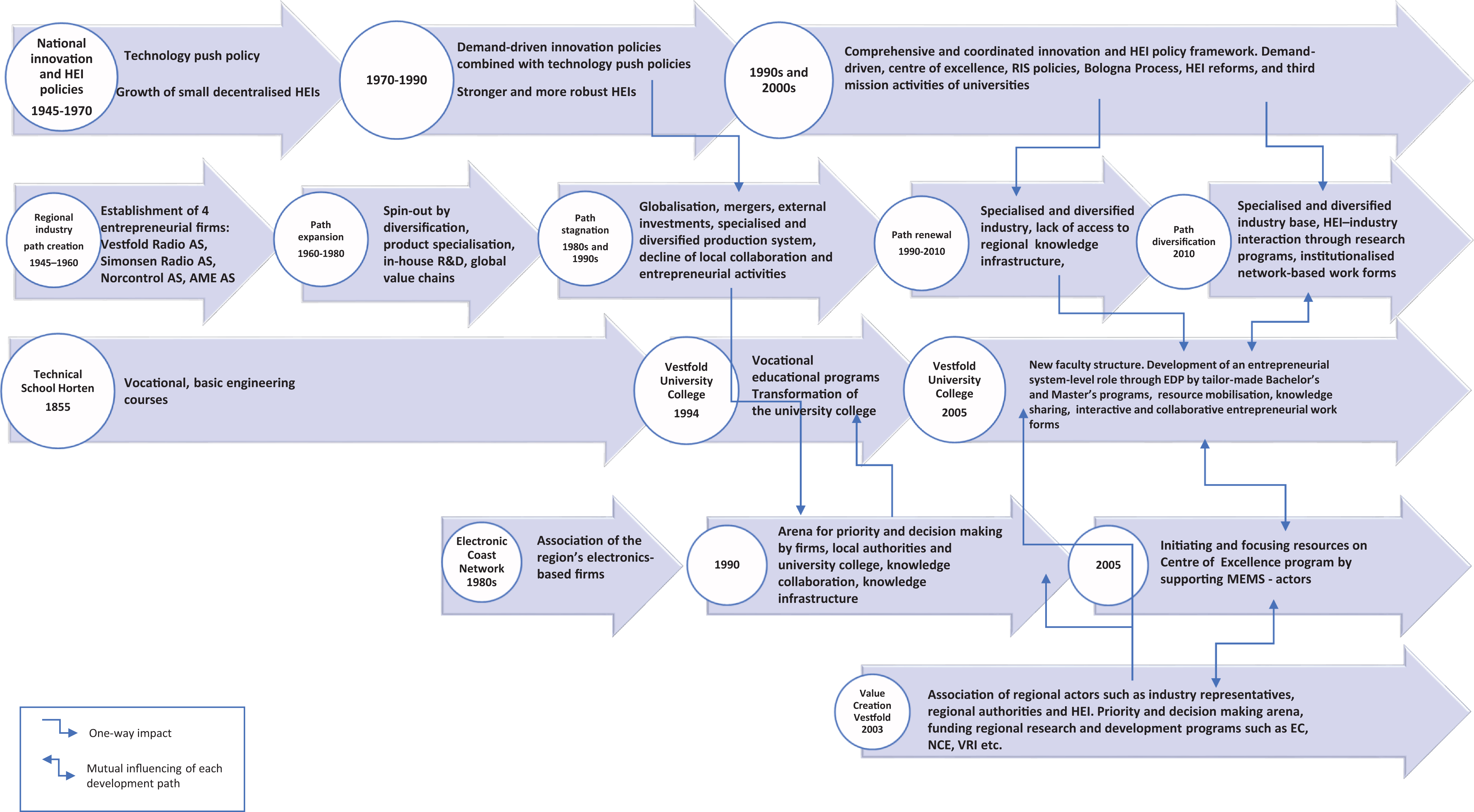
The evolution of the industrial region of Vestfold County.
Discussion, challenges and opportunities concerning EDP capability
Changes in RIS policies and higher education reforms represent decades of ongoing debate concerning the structure, objectives and capabilities of Norwegian universities. The national intention was, and still is, to build robust institutions that are able to mobilise regional resources for the identification of new opportunities. In particular, three types of interrelated challenges are identified in the case of Vestfold. These are: challenges concerning contradictory policy schemes; challenges concerning different cultures and operational objectives; and challenges concerning EDP capability.
With regard to contradictory policy schemes, Vestfold University College responded to contradictory policy reforms by redefining its roles and strategies in regional industry development processes and by upgrading its teaching and research quality, in addition to introducing third mission activities. However, as reported by the university college and industry, contradictory policies have revealed the existence of friction between companies and the university college’s capabilities to serve industry with adequate knowledge. It was not easy for a small vocational university college to receive recognition as local knowledge provider because it lacked industry co-operation experience, administrative routines and significant teaching and research quality. Among the difficulties encountered was the dilemma of how to build research capacities, commercialise knowledge and develop regional technology transfer capacities for a diversified regional industry. In this respect, a key problem encountered by the university college was to identify regional industry strongholds when companies were reluctant to collaborate with it. As reported by the university college, policies were mostly used as rhetorical arguments to reflect the vision of the university college. The friction resulting from a reluctance to follow contradictory policies is a very important finding of this study, revealing the inherited complexities of implementing new innovation policies that will foster system changes and reorient the regional industry structure such that all actors will adjust their role to accommodate new ways of producing knowledge. These challenges were addressed by introducing a bottom-up process through industry mobilisation and involvement. The aim was to modernise the university college by renewing educational programmes, increasing research quality and identifying regional strongholds by using an EDP that mobilised regional actors.
With regard to the second set of challenges, concerning different cultures and operational objectives, the cultural differences between the university and industry and a mutual reluctance to cooperate reflect a culturally embedded understanding of the role of the university college in society and new forms of knowledge production. As a response to the new policies, the university college upgraded its academic staff’s formal competence, which did not necessarily meet the needs of industry. The majority of companies reported that the upgrading of academic competence was not related to the innovation mode of their core business area. Other difficulties relate to the regional industries’ search for knowledge and their innovation modes. Larger technology-intensive firms that invest heavily in R&D capacity source knowledge from the global knowledge chain rather than relying on localised research collaboration. As an example, the high ambition of the MEMS technology research agenda pushed the university college to become more internationally visible through publications which, in turn, distanced it from the companies’ short-term commercial goals and knowledge needs. On the other hand, becoming part of a global knowledge chain in MEMS technology research gave the university college staff an opportunity to collaborate with highly ranked academics which, in turn, made them more attractive as research partners for microelectronics companies but not necessarily for the wider industrial community. The MEMS/IMST experience illustrates how universities are exposed to strong conflicts of interest between regionally oriented ambitions and global research ambitions which may not align with the regional EDP due to companies’ modes of innovation and different institutional arrangements.
The third set of challenges, concerning EDP capability, relater to weak EDP practice. As has been discussed, the vocational university colleges were not designed to provide regions with entrepreneurial activity. Most lacked experience in collaborating with a demanding industry, and they also lacked the administrative practice and competence to serve EDP development processes. However, a key finding from this study is that long-term engagement in EDP practice ultimately strengthened the university college’s capability to support advanced regional companies and the wider industrial community with innovation competence. The case illustrates the challenges of developing a regional EDP, given the difference between the mindset of the institution and the companies’ innovation mode – their novel ways of searching for knowledge and their short-term commercial focus – which drives regional economic growth. On the other hand, universities operate on a longer time scale and hold a significant surplus of resources that can be used to support multiple evolutionary trajectories and enhance the overall responsiveness and capability of the RIS to react to market pressures. This case shows that the mobilisation of industry co-operation resources (human, physical infrastructure, knowledge, and funding) helped the university college to renew and modernise its educational programmes and research quality, and, in addition, to experiment with new interactive work forms. These work forms became internalised and embedded in the university college’s entrepreneurial discovery capacity as well as becoming part of regional development practice. The EDP, which seems to be at the heart of the university college, has strengthened the regional system’s ability to identify new areas of opportunity based on existing knowledge bases and to diffuse knowledge into new economic activities (as in the water treatment example).
Conclusion and policy recommendations
The purpose of this paper is to identify the challenges and opportunities experienced by Vestfold University College in building EDP capabilities by responding to new policy schemes and companies’ novel ways of searching for knowledge.
Vestfold University College appears, in terms of its experimental work form, to be a valuable entrepreneurial system-level actor, engaging with relevant industries in a continuous long-term EDP. While this article cannot constitute a complete evaluation of the EDP process or the entrepreneurial system-level role of universities, it does indicate that small university colleges offer an appropriate development platform for mobilising industry engagement and collaboration between regional actors. By continuously responding to new and conflicting policy schemes and adapting to companies’ novel ways of searching for knowledge in the global–local context, university colleges have developed capabilities to diffuse related knowledge into the wider industry community and gradually change the institutional arrangement of the regional industrial community. They have developed a strategic vision, reformed, and reinvented their educational and research programmes, introducing new collaborative work forms and embedding third mission activities in their organisational structures and cultures. By building EDP competence and mobilising industry resources (human, funding, infrastructure), the university college collaborates with partners who were previously outside its regional radius for research and innovation activities. Notably, the EDP process and the entrepreneurial system-level role are intended to be sustainable over time, allowing the actors in the RIS to continuously build new interactive learning and knowledge sharing capabilities which will attract new and related knowledge for diffusion into the regional industry community.
Many of these results can be generalised for the benefit of other peripheral regions in Europe which may be characterised as institutionally ‘thin’ or diversified and which are supported by a smaller university or a university college with few resources. First, the paper confirms that building regional EDP capability is a long-term engagement process involving many regional actors to address the importance of mobilising industry resources and collaboration with the science and education system. Second, it confirms the importance of building responsiveness to shifting policy reforms and companies’ novel ways of searching for knowledge. Third, it confirms the importance of building internal capacities to handle the entrepreneurial system-level role by reforming teaching and research activities, developing new entrepreneurial practices and routines, and continuous experimentation with new collaborative interactive learning and knowledge sharing activities.
Despite the overall positive experiences and opportunities of EDP capability building, university colleges face several challenges in their efforts to take on the role of an entrepreneurial system-level actor. These challenges partly stem from the shifting circumstances that follow the introduction of new contradictory policy schemes, different understanding and expectations of the role of the university in regional development, and a lack of experience and routines with regard to the entrepreneurial discovery process. These challenges mirror the dynamic, heterogeneous and path-dependent processes of regional development, which reflect the strategic nature of the EDP. While these difficulties point to the need for universities to build relevant administrative capacities, they also call for greater reflection on the formative processes and an understanding of how regions diversify and grow (e.g., path-dependent regional development) – which, in turn, call for more experimentation in new collaborative work forms. The policy implications of this study suggest that it is critical to further improve and tailor regional innovation and higher education policies so that EDP processes can strengthen the entrepreneurial system-level role of universities in core and peripheral areas. Last but not least, the findings show that universities continue to face challenges in the fulfilment of the broader objectives of third mission activities, despite greater awareness of the possibilities inherent in an EDP.
To conclude, while the future is challenging for universities facing a policy environment that is more dynamic than their organisational culture and administrative capacities, they are showing both resilience and leadership abilities in taking on the role of the regional entrepreneurial system-level actor by building their EDP capabilities.
Footnotes
Declaration of conflicting interests
The author(s) declared no potential conflicts of interest with respect to the research, authorship, and/or publication of this article.
Funding
The author(s) disclosed receipt of the following financial support for the research, authorship, and/or publication of this article: This work was supported by the Research Council of Norway.
