




Abstract
This paper returns to the question of whether business schools alone can meet the challenges of enhancing creativity and innovation in entrepreneurial education. Policy makers have side-stepped definitional argumentation in order to embrace a more nuanced potential for entrepreneurial competency development, using multidisciplinary practice in learning and assessment that can be found beyond business and management discourse. Insights from other disciplines can be missed as different terminologies and definitions apply. Design education is inherently multidisciplinary and has been instrumental in facilitating significant policy-level changes. To delve more deeply into this phenomenon, the authors illustrate what actually happens in a classroom in which business and design intersect. Neuroscience research into the learning brain informs learning, teaching and assessment related to creativity, visioning and dealing with ambiguity – through the progressive development of flexibility and adaptability. The authors introduce the Crit, a common feature of Art and Design courses, as a tool of assessment, concluding that, before we dig deeper into business and management discourses, sideways glances into design education will continue to offer benefits.
Keywords
The context – Setting the scene
Provocations from business school scholars calling for ‘entrepreneurship research that is more interactive, activity based, cognitively hot, compassionate and prosocial’ (Shepherd, 2015: 1) are prevalent, especially when exploring how to create the entrepreneurs of the future (Burns, 2018; Fayolle and Gailly, 2015; Neck and Corbett, 2018). Business education is accused of being conservative and insufficiently forward-looking (Kariv et al., 2019), and of relying on theory and business functionality, rather than attending to the enhancement of creativity, visionary skills and flexibility (Azanza et al., 2017; Carey and Matlay, 2010; European Commission, 2008; Rae et al., 2014; Scott et al., 2016). Definitional variations challenge researchers who seek evidence of how and what should be taught (Fayolle, 2013).
These challenges are long-standing (Gibb, 2002, 2005; Higgins and Galloway, 2014), with Kirby (2004) calling for a paradigm change that better considers competency and mindset development, and Pittaway and Edwards (2012) for assessment that is more innovative, reflective and inclusive of stakeholders: ‘There is a need for further research that explores assessment practice in entrepreneurship education in disciplines outside of business schools’ (Pittaway and Edwards, 2012: 794).
Krueger and Welpe (2014) engaged with an evolving series of neuroscience discussions, concluding that, while research into the learning brain was hard to follow, it could offer valuable insights related to entrepreneurial competency development. These findings not only look beneath, but also encourage us to use our peripheral vision. What lies beyond the dominant business school perspectives (Landström and Persson, 2010)? Can entrepreneurship scholars break out of Einstellung and harvest other relevant knowledge and expertise (Handscombe et al., 2005; Penaluna and Penaluna, 2008)?
However, there may be a problem for us, as entrepreneurship terminology is rarely used in our context of design education because the terms are akin to ‘dirty words’ (AHEH, 2019; Ball et al., 2010; Brown, 2013), and ‘antithetical to their [design educators’] own creative practices’ (Clews and Boddington, 2007: 57). In consequence, there is a dearth of literature that readily aligns design education to entrepreneurship education (Bridgstock, 2012), and it might be assumed that Design Thinking models fully represent practices found in design education. However, design scholars are increasingly critical of interpretations prevalent in business education (Neck and Green, 2011) as they redefine established principles of design and misrepresent its core assumptions (Badke-Schaub et al., 2010; Dorst, 2011; Johansson-Sköldberg et al., 2013). Design Thinking models from the design company IDEO (Brown, 2009) and the University of Toronto’s business school (Martin, 2009) are considered to be so diluted that they have become meaningless (Badke-Schaub et al., 2010). Human empathy and user-centric approaches have been readily recognized as advantageous; however, more engaged research that considers what design educators actually do to develop and evaluate such competencies has not followed (Tynan, 2017). Johansson-Sköldberg et al. (2013) suggests that business and entrepreneurship educators have been discussing music with no musician present. As a result, design educators are increasingly vocal about what they perceive to be a watering down of their discipline, within an environment in which their scholarly work is rarely consulted, if at all.
To ensure clarity here on in, we will use ‘Design Thinking’ when referring to the business and management discourse (external perspective), and the original term ‘Designerly Thinking’ (Cross, 1982) when referring to established practices that have developed within design education itself (internal perspective).
As the paucity of interpretative literature (Bridgstock, 2012; Pittaway and Edwards, 2012) means that what actually happens in a designerly-led classroom is overlooked, and its impact on policy development is difficult to ascertain. We will therefore introduce a BA (Hons) Design for Advertising programme that had significant influence. This 3-year course develops enhanced business-to-business communication skills, an understanding of a client’s markets, an ability to see into the minds of consumers, and persuasion skills related to selling. Graduates are reliant on the ability to develop creative ideas on a daily if not hourly basis. Contextually, 89 per cent of the market they move into employs fewer than five people (Kelly, 2019) – freelance, self-employment and start-up have always been the norm and portfolio careers are common (Kellet, 2006; EU Arts and Humanities Entrepreneurship Hub (AHEH), 2019). If these graduates are not entrepreneurial, they may flounder.
Method and assumptions
There appeared to be an underlying assumption in the call for papers for this special issue of Industry and Higher Education that research from the entrepreneurship literature provided sufficient ‘disciplinary’ foundations. However, we present a case that there are other relevant informants who have gone unnoticed, even though the students targeted in these subjects will have limited employment options and are historically driven towards enterprising endeavour (Valero et al., 2014).
The Enterprise and Entrepreneurship Education Guidance of the UK Quality Assurance Agency for Higher Education (QAA, 2018) uses ‘entrepreneurial’ when discussing enterprise and entrepreneurship jointly (Figure 1). However, ‘entrepreneurial learning often takes place within institutions without bearing the label of enterprise or entrepreneurship’ (QAA, 2018: 7) at all, because those ‘labels’ put people off, particularly outside the business domain (Bridge, 2017). Alternatively, subject and discipline can lead the navigational pathway into entrepreneurial learning, as can be found in examples within the QAA-based ETC Toolkit. This was originally funded by the Higher Education Funding Council for Wales, and is now curated and regularly updated by Enterprise Educators UK (EEUK, 2020).
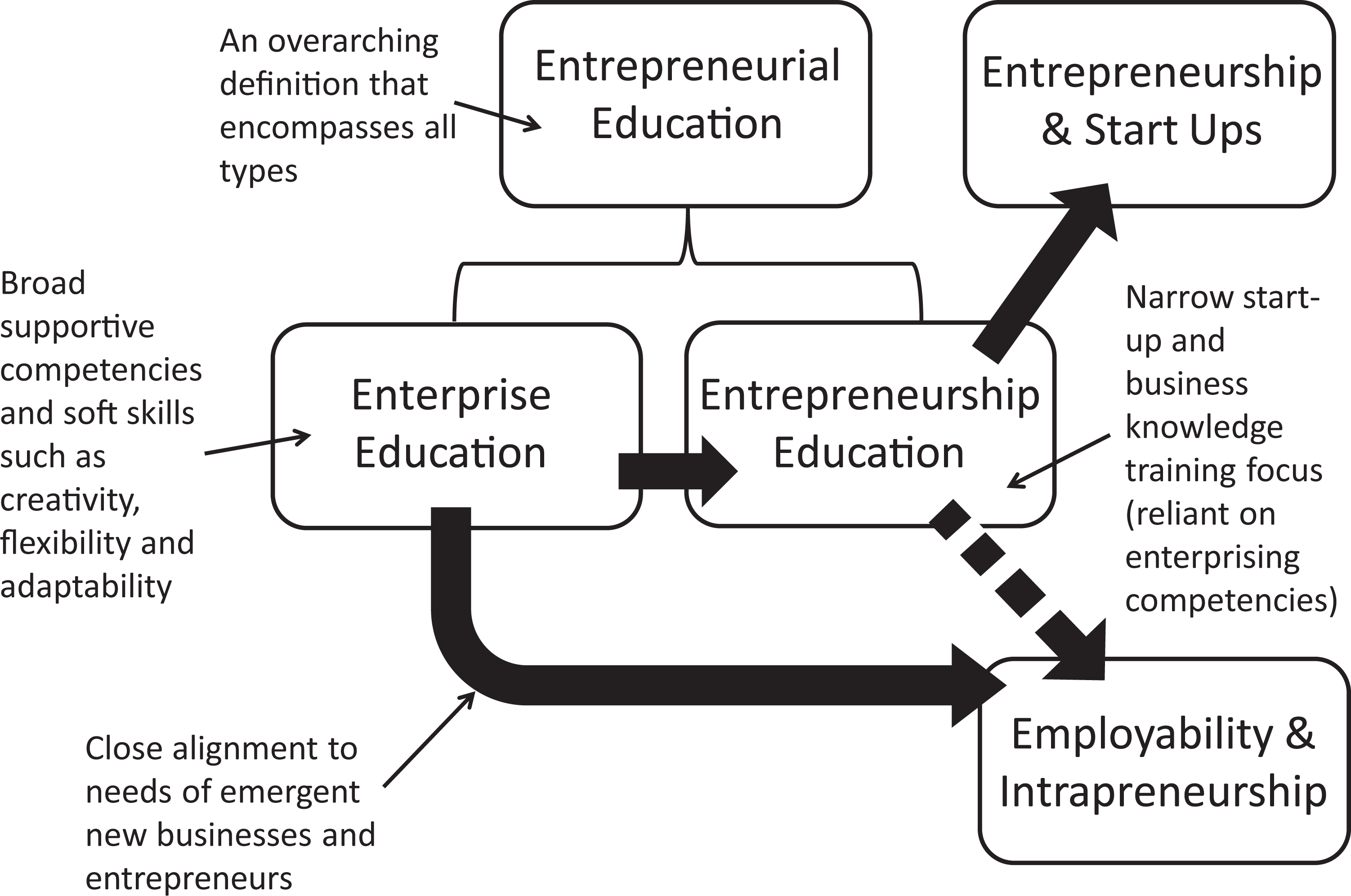
Definitional stances based on UK Quality Assurance Agency’s Enterprise and Entrepreneurship Education Guidance. Source: QAA (2018).
However, US business school literature, anchored in business and management schools with a venture creation focus, still dominates research (Jones and Matlay, 2011; Landström and Persson, 2010). Therefore, discipline-based insights are potentially excluded, even those created by entrepreneurial educators within their own disciplines (EEUK, 2020; Penaluna and Penaluna, 2019; Rae et al., 2014). Our assumption is that, when specialist knowledge from subjects and specialisms within a student’s discipline of choice are integrated, enterprise and entrepreneurship are more relevant to the learner, and disciplinary strengths and weaknesses are made visible. We are not advocating best practice but arguing for more overt inclusion of disciplinary insights that develop entrepreneurial competencies and mindsets (Burns, 2018; Neck and Corbett, 2018). Our aim is to illustrate research-based practice that is driven by its potential for use within a quest for fundamental understanding, positioning ourselves as interdisciplinary investigators who are advocates of Pasteur’s quadrant (Furlong and Oancea, 2005; Stokes, 1997). Recognizing the development of entrepreneurial competencies within a context that rarely references the dominant terminologies requires us to position ourselves as interpretative boundary spanners (Williams, 2002).
This type of inquiry requires a narrative review in conjunction with insights from within (Lave and Wenger, 1991), and relies on insiders’ emic views as opposed to the etic perspective of an external observer (Brooks, 1994, Young, 2005). This presents a significant challenge when translating works, practices, assumptions and terminologies from one discipline to another, so an evolving narrative is required.
We shall therefore move progressively from overarching policy observations to a specific programme in design education that engages neuroscience to inform its delivery, assesses performance through a managed process of reflection and has many identifiable parallels with the goals of entrepreneurial education. Designers’ educational practice encourages students to look outwards towards the needs of others within their lived experiences; they are inherently multidisciplinary. Design is defined as ‘working out a solution for any specific problem in diverse contexts’ (Simon, 1981, in Lau, 2009: 154) and, intends to ‘to establish [in their students] reservoirs of experience […] fostering creative thinking processes for originality and novelty’ (Simon, 1981, in Lau, 2009: 155).
In this paper: We discuss how both the QAA and the EU Joint Research Centre (EU-JRC) looked beyond business education when researching the needs of entrepreneurial education. AdvanceHE (2019), the leading body for UK learning and teaching excellence, advocates this approach, which adds resonance to the discussion in the context of this special issue. We explain how a BA (Hons) Design for Advertising programme informed the above national and international educator guidance documents. We then introduce Art and Design’s Crit approach to assessment in these contexts. Finally, we offer insights into what actually goes on in our example of a design undergraduate classroom – where key goals are developing creativity, flexibility and adaptability.
There are two distinct limitations of this method. The first is that a full description of the methodological approach cannot be articulated, and the article cannot respond to specific quantitative research questions (McAlpine, 2016). Second, there is potential for research bias (Baumeister and Leary, 1997) and a potential lack of objectivity as an ontological stance (Eikeland, 2006). However, it is asserted that, in drawing on the combined perspectives of practitioners, researchers and policy makers, the investigation offers the type of rich contextualization called for in this special issue. Evidence is gathered and interpreted from a breadth of resources to produce provisional and perspective truths (Briggs et al., 2014).
Developing guidance through multidisciplinary insights
The UK’s national guidance for entrepreneurial educators was designed to support and enhance the quality of entrepreneurial education (QAA, 2018; Rae et al., 2014), and underpins learning and teaching that inform Higher Education Academy Fellowship evaluations (AdvanceHE, 2019). Both have their roots in the work of the Higher Education Academy’s Special Interest Group in Entrepreneurial Learning which, using a designerly methodology, drew on insights from 32 Subject Benchmark Statements from different disciplinary areas in which aligned competency development and assessment strategies were well developed (Penaluna et al., 2010; Rae et al., 2014). Examples include: decision making in situations of stress (Medicine), decision making with incomplete evidence (Greek and the Classics), persuading an audience (Performing Arts), risk management (Agriculture), developing innovative capacity (Art and Design), and learning distinctions about, through and for (Sports). To offer a specific insight, the topic of dividing learning into about, through and for is typically attributed to Jamieson (1984), but it effectively fell dormant until it was reintroduced by Henry et al. (2005). These distinctions were already prevalent and critiqued in Sports education (Arnold, 1979), but the literature concerning them had been overlooked.
As noted by the joint OECD–EU team tasked to develop the Evaluation of Entrepreneurship Education Programmes in Higher Education Institutions and Centres, QAA’s work has become an influential taxonomy, especially in terms of how to assess student development. ‘One key guidance tool in the QAA is the gateway triangle which identifies different assessment approaches for enterprise/entrepreneurship education. This ranges from the self (inner world), via the environment/context and self-led negotiated action to entrepreneurial action’ (Moberg, 2019: 14). The concept came from the QAA’s Benchmark Statement for Art and Design, in which ‘students normally pursue a programme of staged development progressing to increasingly independent learning’ (QAA, 2017: 6).
Highlighted in the QAA’s 2018 updated guidance, following 18 months of consultation with HEI representatives from a wide range of disciplines and departments, is the EU Joint Research Centre’s EntreComp Framework (Bacigalupo et al., 2016). This was developed following extensive research that addressed calls in the Oslo Agenda (European Commission, 2006) and an acknowledgement that no similar European guidance existed (European Commission Thematic Working Group on Entrepreneurship Education, 2014; Komarkova et al., 2015a, 2015b). EntreComp’s competence area of ‘Ideas and Opportunities’ aligns with the QAA’s enterprise definition, its ‘Into Action’ section aligns with the QAA’s ‘Entrepreneurship’ and the area of ‘Resources’ was added because the Entrecomp Framework is intended for all levels of education, both formal and informal (Bacigalupo et al., 2016).
Historically relevant, and to further illustrate the thinking that informed EntreComp, is the suggestion by the European Commission’s Directorate General for Education and Culture (2009) that business education could benefit from Art and Design experience to ‘…foster students’ creativity, which is essential in the experience economy, in which product differentiation, experience staging and entrepreneurship are central’ (European Commission Directorate General for Education and Culture, 2009: 114). More specifically, the type and nature of the experiential learning enables students to challenge existing ideas and concepts, imparting ‘visioning and scenario-planning skills which are essential in problem-solving situations and therefore relevant for business managers’ (European Commission Directorate General for Education and Culture, 2009: 115). Two of EntreComp’s 15 competency goals resulted: the dimensions of creativity and visioning. Moreover, the influence does not end there, as two other dimensions use scenario-based approaches that are dominant in Art and Design: learning through experience and coping with ambiguity, uncertainty and risk (Bacigalupo et al., 2016).
Two influential reviews by the Skills and Qualification Unit of the Directorate General for Employment, Social Affairs and Inclusion led the way for the development of EntreComp. Their scope was deliberately wide, both geographically and in terms of stakeholder insights. They first considered overarching competency requirements (Komarkova et al., 2015a). Second, they provided in-depth case studies that met all of the resulting criteria (Komarkova et al., 2015b). Rather than looking at initiatives in formal and informal settings that claimed to be educating and developing entrepreneurs, their main objective was to look at learning examples that mapped well against the competency requirements of the various stakeholder groups they had consulted. The research culminated in 292 competence statements, which were subsequently refined to include, ‘creativity, opportunity identification, self-efficacy, self-confidence, communication, leadership, decision making, innovation, responsibility, collaboration, ideas generation, problem-solving, autonomy, negotiation and networking’ (Komarkova et al., 2015a: 8). One finding was that there was ‘little doubt that the concepts of entrepreneurship and entrepreneurial activities have spilled over from the original economic domain’ (Komarkova et al., 2015a: 18).
Thus, the EU research did not focus on entrepreneurship courses, but on the means by which learners acquired competencies, ‘to gain a profound understanding of the entrepreneurship competence concept as it currently translates into learning objectives, curricula, teaching guidelines, and practical courses’ (Komarkova et al., 2015b: 17). EntreComp’s learning progression model of dependency to autonomy subsequently drew on the Art and Design model found in the QAA’s Art and Design Benchmark Statement (QAA, 2017), and is closely aligned with emerging debates on the Academagogy of learning (Jones et al., 2019).
Subsequently, 10 in-depth cases studies were selected by the EU research team (Komarkova et al., 2015b), because they provided illustrations of the full gamut of competencies that they had identified. Only two universities were selected in the 10: Case Study 1 draws on the experience of Lapeenranta University of Technology’s Centre for Training and Development team and their measurement tool for entrepreneurial educators, and Case Study 8 focuses on the University of Wales Trinity Saint David and its International Institute for Creative Entrepreneurial Development (UWTSD-IICED). A significant part of the latter case focused on its BA (Hons) Design for Advertising programme. However, it should also be noted that Case Study 6 detailed an eight-country Balkan initiative, the South East Europe Centre for Entrepreneurial Learning. Here the teacher training methodologies for schools was led by UWTSD-IICED, so 2 of the 10 selected European cases drew extensively from the same source, the one that we shall now discuss.
Beneath the name: Design for Advertising’s approaches and insights
The BA (Hons) Design for Advertising course is highly reliant on a learning community that has listened to the views of past students for over 35 years and incorporated their perspectives into new course development, teaching and learning, and assessment. Progress is driven not only by theory or economic intent, but by longitudinal student/alumni satisfaction surveys and interactions that extend way beyond their studies. By 1996 technological advances had enabled alumni around the globe to respond directly to both students’ and educators’ requests for information, and the approach became known as the ‘Continuous Conceptual Review Model’ (Penaluna and Penaluna, 2008 – see Figure 2). The EU–JRC research team highlights the case’s ‘motivating effect when teachers keep in contact with (past) students’ (Komarkova et al., 2015b: 35). When the course was developed in 2003–04, 272 design alumni joined the validation process to offer insights into evolving work opportunities. In their critique, EU–JRC commended this, noting that ‘traditional, less well-aligned teaching, learning and assessment methods may not work when developing future-proof skills sets’ (Komarkova et al., 2015b: 38).
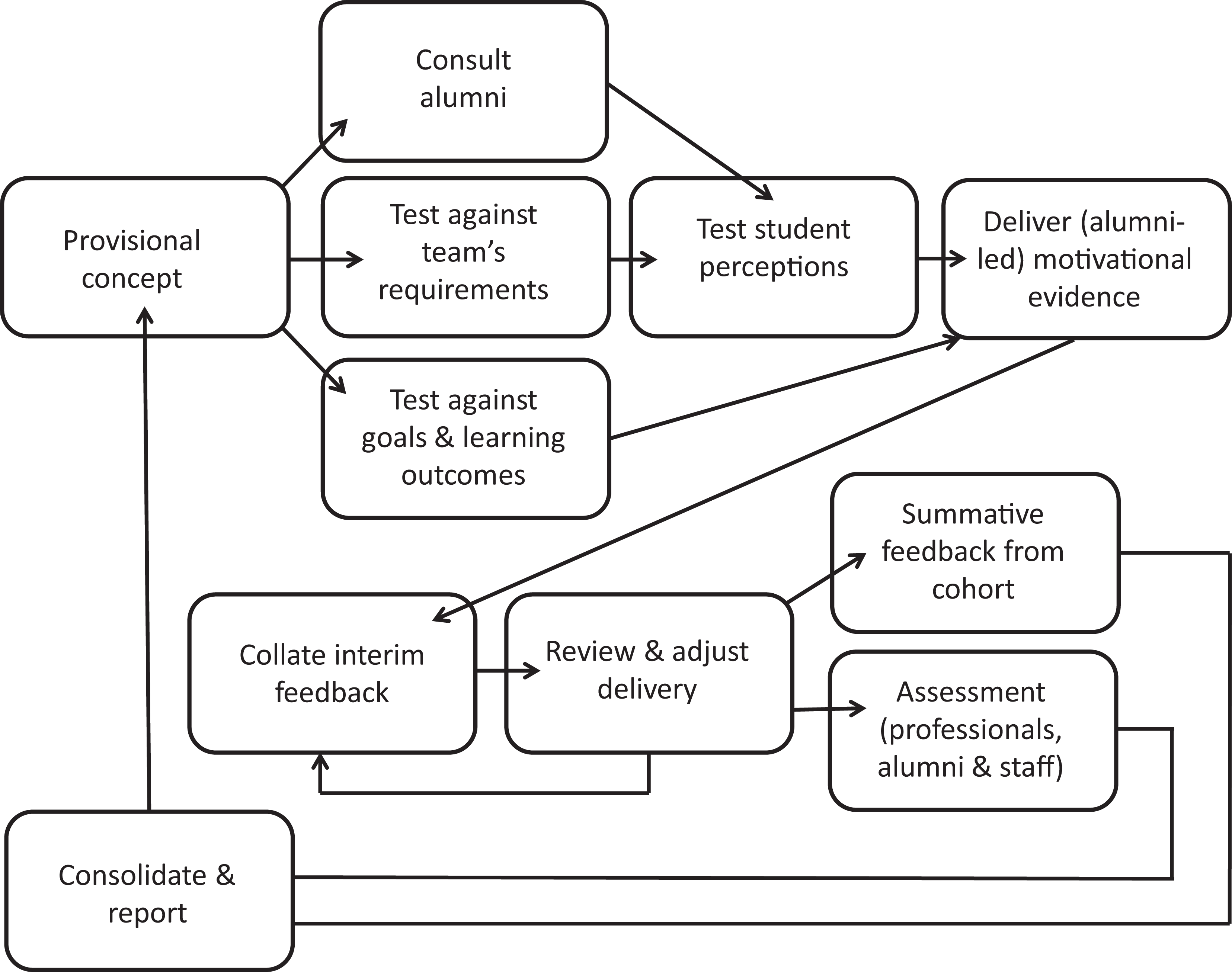
Continuous Conceptual Review Model – demonstrates alumni engagement in programme design, motivational constructs, feedback and assessment. Source: Penaluna and Penaluna (2008).
Alumni feedback included criticism of those who consider that there are already lots of ideas to evaluate, as if the sheer number were the only determinant. In direct consequence, learning and teaching processes that develop a capacity for richer, more diverse and unique idea generation and enhance the ability to develop argumentation for alternative solutions are provided. This drew the attention of EU–JRC as providing a better foundations for learning in creative entrepreneurial development (Komarkova et al., 2015b). Pedagogies such as curiosity-based learning, in which the distinction between divergent (opening minds and synthesis) and convergent (analytical and solution-focused) makes ‘it possible to generate creative ideas and explore many possible solutions’ (Komarkova et al., 2015b: 32). This in turn relies on assessment that embodies cognitive neurology research which criticizes premature articulation, when a rushed idea with limited insight is presented and rewards glorious failures ‘so long as [the learners] reflect upon why and articulate their reasoning’ (Komarkova et al., 2015b: 34). Formative assessment is seen as an extremely valuable tool that enhances for learning. This takes place in a series of Crits, which we shall discuss presently.
Value creation for others is a long-standing tenet of design. Value creation pedagogy was first discussed in Japan in the 1920s by Makiguchi, who considered human creativity that is employed for the development of society (Bethel, 1989). More recently, discussions of value creation pedagogy in the entrepreneurship literature have suggested that value creation needs to be developed for others from outset (Lackéus, 2018, 2020). This does not, however, not take into consideration prior learning that can support that goal, nor does it acknowledge prior scholarly work. The Design for Advertising course follows the Makiguchi approach and does not assume that the students are automatically prepared for value creation, but helps them to develop competencies prior to engagement. This is for four reasons: External bodies and potential co-creators are rarely well-versed in education; they can inadvertently set unrealistic goals or ones that do not necessarily progress learning. Clear goals and definitions may hinder opportunities to develop divergent thinking that takes account of multiple perspectives and alternative views. The ‘rush’ to answers may lead to premature articulation, with a basic iterative solution or first idea taking priority over the potential range of alternatives. Real life, much like the current trends in reality TV, is a slow process. Editing can be done to accelerate the learning experience, progressively engaging students’ emotions so that they move from it ‘feeling real’ to being able actually to cope. A constant call from alumni (Penaluna and Penaluna, 2008) is to ensure that flexibility and adaptability are central constructs of learning. Most school leavers are familiar with talking about, as opposed to being able to do and to reflect upon action. Assessment has primarily tested memory recall in time-constrained environments, as opposed to asking students to respond to shifting scenarios that constantly challenge their thinking.
Students in design education do not typically theorize at outset; they theorize after experiencing studio-based hands-on project work. This is achieved by creating believable scenarios that situate the work that they are given to undertake. A design brief simulates what will be expected in the profession, outlining a problem to be resolved and setting parameters within which to work. Students are encouraged to test perceived boundaries and to challenge them if deemed appropriate. This responds to national benchmark guidance that ‘demands high levels of self-motivation, intellectual curiosity, speculative enquiry, imagination and divergent thinking skills […where] there are no limitations in terms of interdisciplinary relationships’. (QAA, 2017: 11)
In contrast to the iterative approaches described in Design Thinking models, advertising requires radical innovation based on visioning a future scenario. ‘Incremental innovation tries to reach the highest point on the current (and most visible) hill. Radical innovation seeks the highest hill’ (Norman and Verganti, 2014: 79). The practice of visioning multiple alternative futures therefore precedes solution finding, which in turn requires an ability to imagine perspectives that may not yet exist and have, perhaps, not reached the conscious thoughts of others. The search for the highest hill can be facilitated by investigating compound remote associations that require the re-formation of associative elements into new combinations by providing mediating connective links (Mednick, 1962). In practice, this means linking and connecting prior knowledge in distinctly new ways and seeing differing human perspectives, including those that a target audience may not have brought into conscious thought. Students continuously map the development of their new neurological connections, using notebooks and sketch books to ensure that a record of these is kept.
When visioning a future, the ability to develop multiple solutions ensures that, when contexts change, pre-formed ideas can be adapted and merged so that the designer is never left in a situation in which they have to fully start over again. Divergent (insightful synthesis) and convergent (reductionist analytical) thought processes are demonstrated in practice, and reflected upon during assessment. Theoretical support for learning and reflection includes investigations into memory types and their impact on behaviour, plus detailed discussions related to the theory of abduction (McKaughan, 2008) or, as described by Lipton (1991), the role of ‘explanationists’. The learning interventions focus on the development of thinking and cognitive skills, learning that favours understanding over memorization (Ferrari et al., 2009; Penaluna and Penaluna, 2015). Accordingly, examinations do not feature in any assessments, and testing is based on evidence gathering during research, alongside students’ reflections that demonstrate newness, appropriateness and future orientation.
Beneath the name: Design for Advertising’s approaches to assessment
In 2004 the UK advertising industry’s professional body, the Institute of Practitioners in Advertising (IPA), gave up on university grading systems and created its own Diagonal Thinking evaluation metrics to assist effective recruitment (IPA, 2004). This in turn impacted assessment strategies developed for the programme.
In his Review of Business–University Collaboration for the UK government, Wilson (2012) supported the IPA’s premise that ‘enterprise skills require responsiveness to unexpected pressures and tasks; they require reaction to changing circumstances and disruptive interventions. These attributes are contrary to the established framework of assessment processes’ (Wilson, 2012: 50). Baartman et al. (2007) also explain that competency assessment requires authenticity and meaningfulness for the learner and transparent assessment of cognitive complexity, which is also now seen as a goal of entrepreneurial education (Morselli, 2019).
In contrast, the systematic review by Pittaway and Edwards (2012) discovered ‘unattractive’ and ‘disheartening’ results in entrepreneurship education’s assessment strategies. Static and pre-predicted solution-oriented examination, essay and test-type activities were prevalent, none of which provided insights into innovative thought related to newness. Rarely did the educators capture perspectives beyond those of the education team, and they concluded that those who advocated more innovative types of assessment, such as seen in design, should continue their efforts.
Tynan (2017) observed design educators and compared them to specialist entrepreneurship educators from business and management departments. Very similar pathways of intent became apparent, especially in areas related to opportunity recognition. However, she observed that design education was more effective at nurturing creativity and critical thinking through enhanced reflection strategies that had an impact on the development of innovation capacity: ‘Participants explained that these types of reasoning were not explicitly taught in DE [Design Education], they develop through a series of carefully structured learning within scenarios […] it is a ‘journey’ which is undertaken over a number of years, which leads you to a way of thinking that you cannot move back from’ (Tynan, 2017: 166).
The assessment vehicle for this approach to learning is the Crit, which has its roots in the 19th-century Beaux-Arts tradition of critiquing each other’s work when developing architectural designs, and closely aligns with Vygotsky’s Zones of Proximal Development (Simpson, 2012; Vygotsky, 1978). The Crit offers flexibility within assessment, so that surprise and newness can be accommodated (Horten, 2007). Students are expected to communicate and debate their thinking processes and enter into a discussion of their work with tutors and peers and in later studies when appropriate with external stakeholders such as industry practitioners, clients and community members (Cennamo et al., 2011).
The Crit is designed to be a future-oriented discussion which considers proposed connections that verify the newness of concepts and ideas, often referring to past ‘evidence’ as incomplete (Souleles, 2013). Based on the disruption–empowerment model of value creation (Malinin et al., 2014) and drawing on the seminal works of Wallas (1926) and Evans and Russell’s (1989) models of managing the creative process, the Crit can also be aligned to Koestler’s (1964) bisociation theory. Furthermore, the Crit is designed to surface perceived performances, solutions that may well be valid in the future or in a different context but are as yet unactionable, so new goals may emerge for future consideration. Simply put, students are expected to justify their decision making when envisioning new futures, as has also been proposed for entrepreneurial education (Morselli, 2019; Pittaway and Edwards, 2012).
Progress is mapped visually through charts that evidence new connections in the mind of the learner. Fewer connections and poor argumentation equal a poor grade, whereas complex connectivity and numerous justifiable solutions reap high reward. The highest grades are given to those who can argue for a range of distinctly different yet justifiable solutions. The number of alternative solutions required will be determined by the educator, who will consider the developmental stage of the learners. New students may be asked to present only two alternatives, whereas more accomplished students will be more challenged, with 6 to 12 alternatives. This is based on Mumford et al.’s (1997) category combination form of evaluating the development of creative problem-solving skills.
The portfolio of work produced, from initial concepts to the range of alternatives argued, forms the vehicle on which summative assessment is based (see Figure 3). Students are not assessed on what they remember, but on how well their portfolio presentation articulates their learning journey through a project. End of year assessments typically include a viva voce in which all module evaluations are holistically considered.
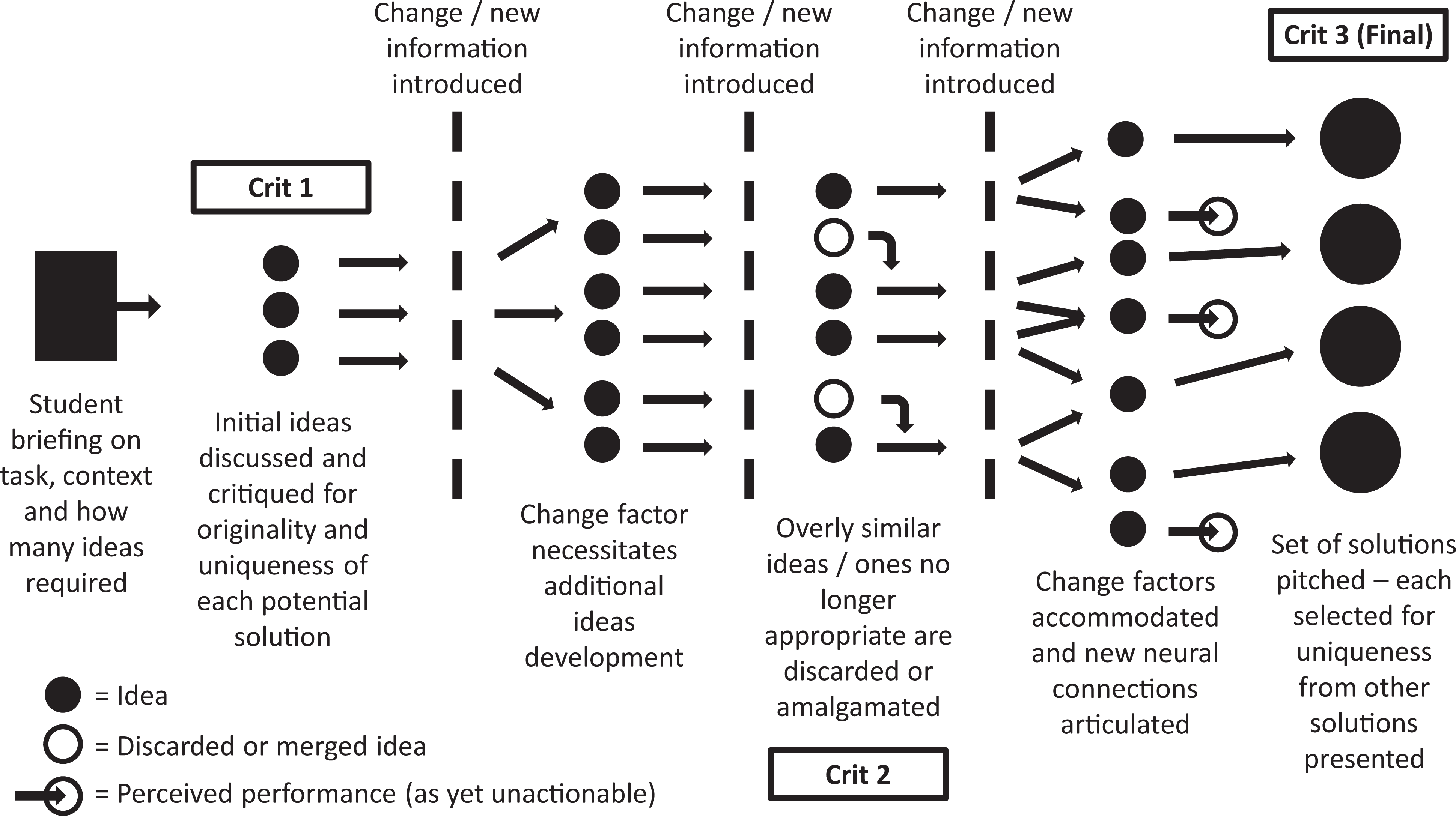
Positioning the Crit within a learning journey that accommodates change. Note: Simplified for clarity.
Informal Crits can be introduced by the educator at any stage when either creativity or criticality is required – for example, when a critical incident occurs in a studio project that may impact all of a student’s learning – during regular pre-planned sessions and during summative assessment. The number of Crits a student will be engaged in during the second year of the three-year course under discussion will be in the region of 30–40. It is the role of the design educator to progressively develop students’ confidence and reflective abilities (Dannels and Martin, 2008; Schoün, 1982; Wong, 2011). The educator is a skilled meddler in the middle, as opposed to a ‘sage on the stage’ or a ‘guide on the side’ (McWilliam, 2008). The design educator ensures that learning that has been demonstrated is rewarded, not merely the end product or outcome (see Dweck, 1999). Demonstrating new skills, mastering new tasks or understanding new things (McWilliam, 2008) is evidenced during the Crit assessment, which can be formative ‘for learning’, or summative if used on completion of the module or section.
The Crit is also intended to develop students’ ability to relax during situations akin to public speaking in uncertain situations (Dannels et al., 2011), so that they can adapt and shift should the need arise, bringing previously unconscious thought to mind when the situation demands (Dijksterhuis and Meurs, 2006).
Because a singular solution does not mean that the student can continuously be creative (Healy, 2016; Miniti and Bygrave, 2001), multiple solution generation facilitates adaptability when change is present or likely (Guilford, 1984), because alternative ideas and connections have already been articulated. This facilitates the development of emotional intelligence and persuasion skills, so that the student can consider the realities of others and, in some cases, employ tactics that work below the conscious thought of the target audience, based on research into neuroscience and the natural mechanics of decision-making (Lempart and Phelps 2014; Sanfey et al., 2006). It also considers the effects of Cognitive Load Theory (Sweller, 1994), so memorization (knowledge retainer) is contextualized within new knowledge creation (knowledge harvester).
This regular developmental learning through assessment supports learner development related to a professional pitch, a term familiar to all entrepreneurial educators. According to Yorke (2003), formative assessment found in the Crit could enhance pedagogic practice when learning relates to being capable of sophisticated thinking for oneself, yet is rarely found beyond Art and Design.
All of the above assessment of learning progression strategies is dependent on the educator’s ability to mitigate against the negative aspects of groupthink as found in a brainstorming approach (De Dreu et al., 2008; Diehl and Stroebe, 1987), especially when emotions, moods and other affect variables may be present (Rank and Frese, 2008). Negative commentaries on the Crit typically relate to the educator’s inability to manage the deep emotional engagement required to surface subconscious thinking during reflection. Other criticism includes the levels of complexity of educator training (Percy, 2004).
Beneath the name: Examples of Design for Advertising’s projects and practice
The projects we describe here are set in the second-year, first semester’s Visual Studies module, which is effectively the halfway point in the three-year study programme. The learning strategies align with emerging theories on the classification of andragogy and heutagogy within an Academagogy of learning (Jones et al., 2019), as they progressively move the learner away from dependency on the educator towards self-dependent thought. They are designed as sequentially managed challenges that require the students to think creatively and to adapt to working in ever-changing scenarios, as is required in the advertising industry (IPA, 2004).
Project 1: The soft bomb
The ‘Soft Bomb’ is a scenario-based learning environment in which students are required to produce practical responses to the threat of terrorism by explaining to others how persuasion works. Over a five-week period they are consistently introduced to new information and current debates in order to simulate the shifts and changes found in everyday life. In the latter part of the project they are informed that the City of Leipzig has agreed to host their work, and are briefed by colleagues from the University of Leipzig to enhance credibility. This briefing includes Leipzig’s peaceful contribution to the fall of the Berlin Wall and data on the number of citizens who speak English, so a written response will not suffice. The psychology of creativity (Amabile et al., 2002) and the art of persuasion (Braun-LaTour and Zaltman, 2006) are introduced, so that the students can consider and review their responses in the light of newly understood theoretical constructs.
Project 2: Subversion
Students promote or advertise a product or service in a simulated design agency task. They start to delve into perceived values and consider benefits to target audiences. Once underway, they are asked to stop work, as a competitor has hired the agency to subvert the perceived brand values and wishes the designer to undermine the product or service they had been researching. An alumnus explains that this is the norm in the industry, as it ensures that research is extensive and that any assumed biases are surfaced.
Theoretical and scientific evidence from research related to brain cell connectivity and dendritic growth, including inhibitory and excitatory synapse connection, is then explained (Kounios et al., 2006) so that the students can incorporate these new understandings into their work and associated reflections. This project ensures that the students can demonstrate that they have the ability to change direction and are resilient in the face of uncertainty and change. While this directly relates to ‘pivoting’ (Ries, 2011), the term would be unfamiliar to these students.
Project 3: Free time is thinking time
Throughout the previous two projects and in earlier studies, students have been asked to keep diaries of their most lucid moments of discovery in terms of connecting unusual thoughts and ideas, noting that the most disparate neural connections are the ones that lead to radical innovation. Typically, for example, students report times when they are in the shower, walking the dog, driving the car, socializing, and often when they are in bed. Noting the consistency of responses with previous year groups (14 years in total), students are tasked to present their new-found understandings to leaders and managers in business. The topic of ‘Free Time Is Thinking Time’ seeks to explain to managers that employees will rarely be at their most creative in the workplace.
Students are then unexpectedly required to discuss two random things that caught their attention on their way into the university, so that a situational aspect comes into play (Gibbs and Simpson, 2004). They are asked to integrate these two random observations into their solution. This forces divergent thinking through which external factors have to be accommodated, and divergent, more radical innovation automatically results.
Theory includes a discussion on the neuroscience that explains and reinforces students’ experiences, including the fact that excitatory synapse (brain cell connectivity that is new, usually through enhanced levels of dopamine) occurs when the individual is in a state of defocused attention (Martindale, 1999), typically meaning that focused and attentive reasoning has stopped, yet the subconscious mind is still processing. This new thought has to be reprocessed and checked in order to be rationalized as valid in the brain before it enters awareness, especially if other neural processing related to criticality and analysis is demanded prematurely (Fletcher et al., 2001). The practice and awareness of neural processing encourages deep reflection in which unconscious thought can be brought into mind (Shen et al., 2017), but relies on understanding the emotional state of the learner and their ability to reflect (Damasio, 1994; Dietrich, 2004). Theories on the creative flow of thought (Csikszentmihalyi, 2006) and the psychology (Amabile et al., 2002) also inform this learning methodology.
In the Crits, students are not told, but immediately see for themselves that the most radically innovative solutions came from those who saw many alternative perspectives, made many new connections, and were persuasive in explaining unusual and complex combinations. Through complex argumentation they also reinforce new types of neural connection, an essential aspect of neuro plasticity.
These studies develop explorative capacity before engaging in learning typified as refinement, efficiency and execution (March, 1991; Hughes et al., 2007). The educational approaches avoid repetition and routine (Ucbasaran et al., 2003) and offer high-end learning that comes from reflecting upon, and overcoming, problems (Cope, 2003, 2005). Thus, the project work in these carefully designed experiential learning environments aligns well with both Kolb and Kolb’s (2005) explorative and exploitative cycles and Blank and Dorf’s (2012) experimental failure theories.
Although beyond the scope of this paper, the entrepreneurship aspects of the course come later, but are framed in terms of marketing personal competencies within the industry of choice. Students also log their hours to help them to estimate how long things take, and this information will later inform a personal costing and estimating exercise.
Summary and conclusion
We have highlighted that approaches which start with multidisciplinary perspectives are rarely discussed in the business and management literature. We clarify that national and international guidance for entrepreneurial education had been driven by insights from design, and is based on research that considers desired competencies, not definitions. As definitional stances have hindered the evaluation of impact, we demonstrate that competency models offer more nuanced opportunities to evaluate learner performance.
To respond to calls for better informed learner progression and assessment related to the enhancement of creativity and innovation, visioning and adaptability, we discussed the incorporation of neuroscience theory and the science of education in a design-based programme of study that does not use examinations but evaluates performance through requiring learners to evidence how they can think creatively and can act flexibly through an Art and Design approach known as the Crit. The approach is based on providing contextually relevant lived experiences that have been designed by their educators.
With specific reference to the call for papers for this special issue of Industry and Higher Education, we have challenged dominant assumptions, discussed pedagogical implications and explained deep stakeholder engagement that includes alumni. We have provided insights into established learning and assessment practices that utilize cutting-edge neurological research to develop and assess creative and critical thinking. Often perceived as new approaches, our multidisciplinary insights have illustrated that little is in fact new. We provide alternative philosophical stances that have influenced high-level policy making – and we do not forget that we teach enterprise and entrepreneurship, despite not normally using the words in our practice.
Our aim has been to stimulate a multidisciplinary research discussion that assists those who wish to look beyond perceived boundaries and to take a step outside their own silo or box by building on pre-existing subject expertise that has the potential to facilitate entrepreneurial advancement across all disciplines.
We ask our readers not simply to go deeper and look below, because solutions may have already been found in the building or faculty down the road. Peripheral vision beyond management and business education is essential if we are to progress in a manner that engages all disciplines.
Footnotes
Declaration of conflicting interests
The author(s) declared no potential conflicts of interest with respect to the research, authorship, and/or publication of this article.
Funding
The author(s) received no financial support for the research, authorship, and/or publication of this article.
