




Abstract
While there is abundant research looking at the impact of mentoring in academic environments, inquiry into and the construction of knowledge from the experience of mentors has remained limited. This is mainly because of the methodological difficulty that is inherent in the study of mentoring experiences. The authors address this difficulty by using hermeneutics as a research method, and developing a learning framework based on the Laurillard conversational framework to reflect on a mentor’s journey throughout her experience of mentoring a group of PhD students working in industry. From this we learn that mentoring working PhDs is a common goal focused learning partnership between all actors involved. This partnership is defined by the actors and the forms of interaction within the partnership, and is enabled by the mentor’s availability and capabilities. The paper also demonstrates how hermeneutics can be used as a robust research method to study the many subjective meanings of professional mentoring – meanings that are challenging to translate into transferable knowledge for ourselves and others to learn from. In particular, the authors wish to encourage colleagues and readers to use hermeneutics as a critical approach to explore complex, human-made academic–industrial collaborative mentoring practices from different perspectives and to produce a new understanding of the potential of alternative academic–industrial collaboration links.
Keywords
Universities play an increasingly crucial role in a rapidly evolving knowledge society whose job market needs greater numbers of highly-skilled and flexible knowledge professionals. To keep up with this change, knowledge production and the education and training of scientists has moved beyond merely the academic sphere. The boundaries between society’s knowledge-producing institutions (universities and research centers) and other sectors (industry, government, services, etc.) become increasingly blurred.
The doctoral enterprise has been and is still at the core of academic performance and achievement. However, there is plenty of literature demonstrating how the needs, environment and value of doctoral education are changing. Doctoral research is no longer simply a university enterprise, and the development of doctoral education is no longer solely the domain of universities (Manathunga, 2014; Strengers, 2014). These trends have emerged particularly in highly-developed knowledge societies, and mean that universities need now to address the way they approach doctoral education and training.
In the higher education arena, increased academic emphasis is being placed on the value and impact of mentoring in doctoral education and training. The greatest emphasis is on the beneficiary partners involved in the doctoral program – their role and influence on program development and management. The beneficiary partners are the doctoral supervisors and the degree-providing institution, the industrial collaborative environment, and the doctoral students themselves and their social networks and ecosystems (Costley and Lester, 2012; Edwards, 2010; Halse, 2011; Halse and Malfroy, 2010; Manathunga et al., 2012; Pilbeam et al., 2013; Pyhältö et al., 2012; Stubb et al., 2014; Strengers, 2014). For example, studies have explored the relationship between mentorship and graduate school success (Barnes, 2005; Gardner, 2009) and research output (Nundulall and Dorasamy, 2012), student career development and employability (Curtin et al., 2016). Other studies have also explored the links between mentorship and the wellbeing of doctoral students and their educators (Al Makhamreh and Stockley, 2019; Kutsyuruba and Godden, 2019).
Not much has been published on the academic mentoring experience where: multidisciplinary and multidirectional group practice is an additional element of the mentoring system; the group is a remotely established, heterogeneous network of PhD students who are working in industry, including their work supervisors at the industrial workplace; the dynamics in PhD group mentoring are experienced and reflected upon by the mentor. For example, only a few studies have looked at the role of mentoring in relation to the mentor’s role in managing doctoral group differences (Rose, 2005) and from a mentor’s self-reflective perspective (Barnes and Austin, 2009; McConnell et al., 2019). This presents a research gap, which may be attributed to the methodological difficulty for us, as researchers and practitioners, to create knowledge from subjective experience. This methodological difficulty is specifically inherent in educational practices in which the conditions of grasping content (such as discussions and questions, concerns and feelings) are subjective and multifaceted. The aim of this study is to address this gap in the doctoral education literature.
We use hermeneutics as a qualitative research approach (Paterson and Higgs, 2005) to construct knowledge of what an academic mentor has observed from her own experience of mentoring a group of PhD students working in industry. Ultimately, we seek to develop a framework that enables us to collect and interpret data from complex mentoring interactions, so that we and others can learn from the experience and pass on what the mentoring experience was like.
In the following sections, we briefly describe the context of doctoral program development in a university doctoral education and training environment. We then describe the main research question, the objectives and the methodology of the study. We develop a learning framework, based on the Laurillard conversational framework, and an inquiry methodology to reflect on the PhD mentoring experience. We then synthesize the findings and describe the mentoring practice as a partnership system in which the partners share their knowledge, skills and experience to progress toward their goals. The framework identifies key dimensions and attributes for an assessment of the PhD mentoring practice.
We conclude by showing what we have learned from the mentoring experience, and how hermeneutic learning can be used as a robust research method to create knowledge from mentoring interactions between PhD students, their academic mentor and the industrial environment at the student’s workplace.
The context of doctoral program development
In 2009 a team of 7 Finnish research organizations, of which 5 were universities, launched a new doctoral program in the field of technology and engineering. The program was designed for the education and training of doctoral students (often internationally also referred to as PhD students, and hereinafter “PhDs” for brevity) looking to undertake their doctoral studies alongside their work. For the first time, the professional and systematic support of working PhDs was a key concern for the program developers. In addition, the program was to bring together PhDs from the different fields of forestry and forest resources related academic and industrial R&D. Its main purpose and objectives were formulated in a multidisciplinary context at the interface of energy, materials, chemical and mechanical engineering and related aspects of innovation and economic growth. This bringing together of PhDs from a variety of disciplines into one group was considered an additional element but also an important, value-adding dimension of the mentoring system.
A key objective of the program was to both allow and support experts and managers employed in companies to work on their doctoral theses and attend graduate school while at the same remaining in the employ of their company. The multidisciplinary nature of the doctoral program and its close links to the corporate world would enable the creation of continuous cross-disciplinary discourse between students with different professional backgrounds.
The program was administered over a period of 6 years. A group of 14 experts and managers working in industry, and with different educational backgrounds, were selected (based on their application) to participate in the program. This group was appointed a group mentor, who was to act as both mentor and facilitator. The mentor was also expected to help establish and maintain a working link between the group and the respective scientific supervisors. This would require from the mentor the specific know-how needed to actively integrate the scientific issues of the doctoral work into the mentoring work.
This study may also be considered as a continuation of the feedback process that has been implemented across and after the program. Feedback should help managers and professionals reflect on what capabilities and skills are looked for when group mentoring working PhDs.
To preserve the anonymity of the practice and practitioners, they are given fictitious names in this study: we call the doctoral program Forestry, and the mentor of the program Juniper – inspired by the Finnish forests.
The main research question
Our contribution to the research on mentoring is twofold. We develop a hermeneutics-based methodological approach to assess a mentor’s experience of working with a multidisciplinary group of PhDs working in industry, and part-time and remotely working on their research. By using the method we have developed for the hermeneutic study, we define the mentoring practice and its elements from a practice perspective. We illuminate the capabilities a mentor should have to support working PhDs to learn from peer experiences, become more engaged in their doctoral research and better progress toward their doctoral aspirations.
The specific focus of the study is on the experience of the group mentor, Juniper, in our case study. As the vehicle for the analysis, we will consider what she has learned about the meaning of academic mentoring through conversational processes with the PhDs – on an individual basis, and within mentor-group–workplace interaction on a peer basis. The primary research question for the hermeneutic interpretation is thus: what can we learn from the experience of group mentoring working PhDs? The argument is that, if we have a better understanding of the problems related to the successful mentoring of working PhDs, we can use this knowledge to target the solutions needed to develop similar mentoring practices and to educate those working with such practices. The study is targeted primarily at researchers, scientists and practitioners who wish to understand and improve the environment that affects mentoring in general, in higher education and, specifically, in doctoral education and production systems that are strongly linked with industry.
We next describe the learning concepts and the research methods we have used in the analysis. After this, the experience-based evidence is sorted into themes to answer, first, the research questions that arise from the learning cycle between interpreter and text (Robinson and Kerr, 2015), and, second, the main research question.
The research methods
Learning frameworks are everywhere in educational contexts. Many theoretical constructs have been proposed in the literature. The learning cycle developed by David Kolb (1984) views learning as an integrated process in which personal experience is the starting point of the cycle. This personal experience is used as a lens through which to interrogate the cycles of reflection and generalization, and the conceptualization of new ideas. The Kolb learning cycle focuses on the cognitive flows of the individual learner. The social dimensions associated with the learning processes are not integrated into the concept. Later learning concepts recognize that any learning event also has a social dimension. Perhaps the best known of these later concepts is Diana Laurillard’s typology of learning activities. Laurillard (1992, 1993, 2002) extended the experiential learning cycle to comprehend the conversational flows that together constitute an interactive framework of teacher-focused, learner-focused, practice-focused and collaboration-focused learning processes. Laurillard’s conversational framework makes explicit the importance of dialogue in the learning process. It provides a powerful approach and tool for theorizing the complexity and dynamics of learning between the mentor, the PhD, the PhD group and the PhDs’ respective learning environments.
We use hermeneutics as a research approach and the hermeneutic cycle of learning as a method to learn from the mentoring experience, and to achieve empirical understanding. In accordance with hermeneutic phenomenology, all our understanding is connected to a given set of pre-understanding, which is a structure for being in the world, inherently part of who a person is, and the way she or he lives (Heidegger, 1962 [1927]; Laverty 2003). This structure includes an individual’s current beliefs and prejudices, her or his historicality, and the beliefs, prejudices and history of any group or community to which we belong (Laverty, 2003). When entering the hermeneutic process of understanding, the first task for us, the researchers, is therefore “to become aware of and reflexively to explicate this pre-understanding in a way that creatively feeds into the process of understanding itself” (McLeod, 2003: 23). This interpretive process is achieved through a hermeneutic circle which moves from the parts of experience to the whole of experience, and iteratively back and forth between the whole and the parts to increase the depth of understanding (Annells, 1996; Laverty, 2003; Polkinghorne, 1983; VanLeeuwen et al., 2017). In our study, the dialectic between the experience of the mentor, PhD, peer group, and other learners of the practice forms the conversational framework. The use of the hermeneutic approach is described in more detail in the following section.
The case study is used here to support us in our attempt to understand in depth and to present thoroughly the richness of the mentoring experience introduced in this paper. We acknowledge that a single case does not provide sufficient evidence to make strong theoretical claims about the characteristics and processes underlying mentoring. However, we consider the single case approach to be appropriate for our inquiry because the objective of the study is to explore a previously under-researched topic (Yin, 1984) of mentoring, and it helps to describe the existence, nature and complexity of the phenomenon (Kelliher, 2005). We selected this case because we identified it as one particularly rich in specific information (Patton, 1987: 19, 23; Patton, 2002) about mentoring, learning and piloting in doctoral programs.
Throughout the mentoring period, reflective diary notes were maintained by Juniper, the group mentor. This way, responses to reflective conversations within the group and on an individual basis with group members were recorded. This material forms the textual data of the hermeneutic study, and is used to reflect on the experience in a back-and-forth movement between the text as a whole and its constituent parts.
Using the hermeneutical cycle to explore the mentoring practice
In this section, we reflect on the mentoring experience by going through a five-horizons hermeneutic circle of analysis (Robinson and Kerr, 2015). These horizons are designed to develop understanding of (1) the context; to develop (2) the researcher’s pre-understanding of and relationship with the research context and process; to construct (3) emerging ideas and themes into an analytical framework; to enable (4) reflexivity on the mentor–researcher relationship; and to answer (5) the primary question of the hermeneutic inquiry. As a starting point for interpretation, we use the Laurillard conversational framework for individual learning to explore the relationships between the conceptions of the mentor and PhDs, as a group and as individuals, each with distinct work and social environments that influence their learning environments. We reflect on the mentoring experience by using the hermeneutic cycle of learning to understand the learning horizons involved in the process and to create a fusion of horizons.
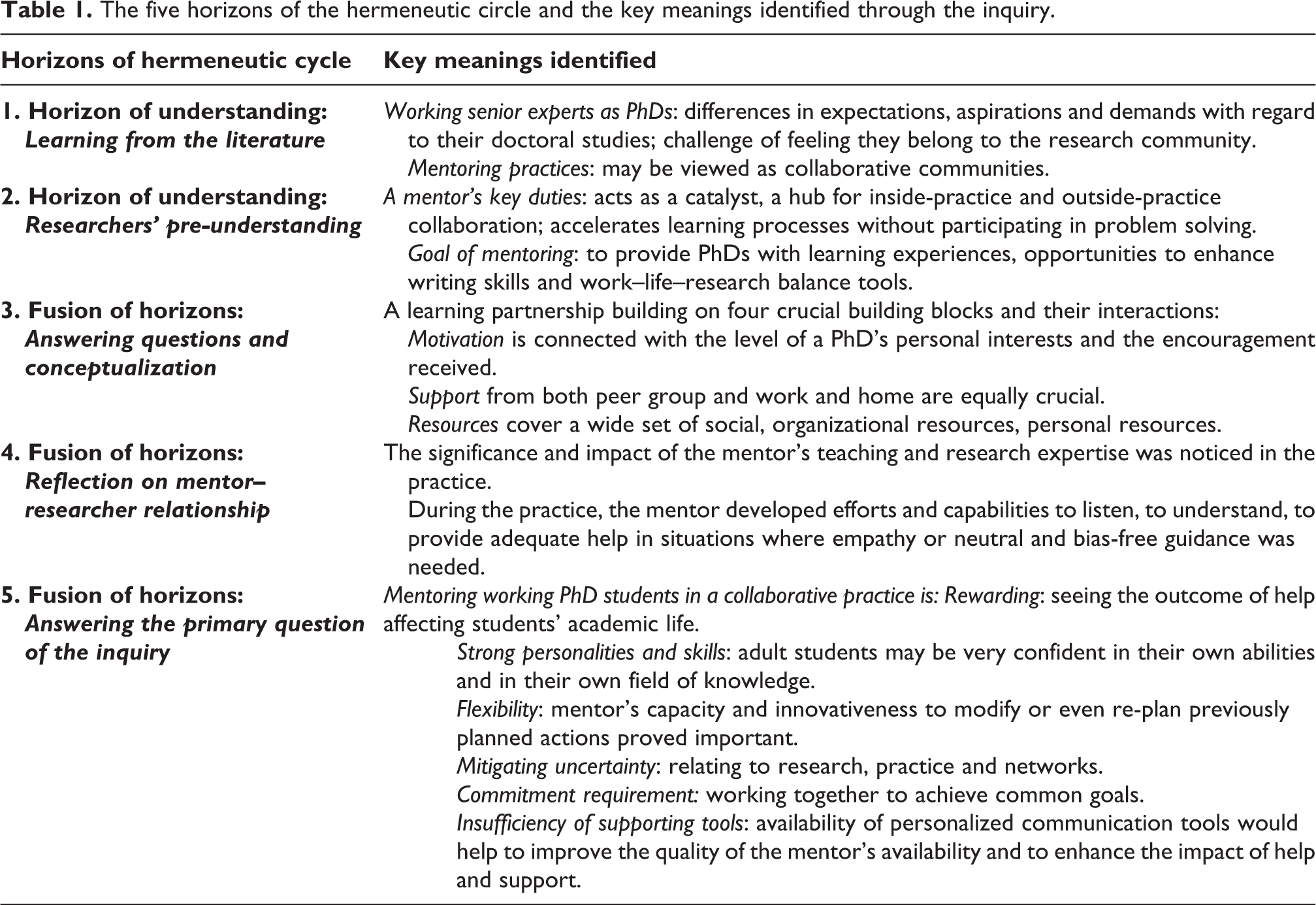
Knowledge is constructed through a dialogue or hermeneutic conversation between text and inquirer (Koch, 1999; Paterson et al, 2005). By reading the literature, and based on our own academic work and experience of working with PhDs, we construct both understanding of the meaning of the mentoring practice and knowledge about key concepts related to PhD student education, training and mentoring. Following the learning cycle, we start with building understanding of the horizons of others, through learning from published, professional knowledge (horizon 1), and of our own horizons by reflecting on personal experience (horizon 2). We continue interpreting this understanding to resolve it into a fusion of horizons. We construct questions, find answers to those questions and develop ideas and concepts about the mentoring practice (horizon 3). We then reflect on the role of the inquirers as researchers and participants in the cycle of learning (horizon 4). By iteratively moving between the parts of the cycle of learning, we will be able to answer the primary research question (horizon 5). The five horizons of the hermeneutic circle and the key meanings identified through the inquiry are summarized in Table 1 toward the end of the next section, in which we describe the horizons.
The five horizons of the hermeneutic circle and the key meanings identified through the inquiry.
Horizon 1: Understanding the meaning of training in PhD student education and the role of mentoring in a professional context
In this first horizon, the goal is to understand the phenomenon of mentoring working PhDs from the horizons of other authors, and to answer the principal research question of horizon 1.
We identified three sub-questions, which would help us achieve a fusion of horizons between text and experience (Paterson, 2005):
What is PhD training?
How is PhD mentoring valuable in the setting of PhD education and training?
What is the nature of group mentoring in the mentoring practice?
PhD training can been characterized as a deeply uncertain practice, a secret business, a somewhat intimate phenomenon (Strengers, 2014). In doctoral research programs, the PhDs and their supervisors are jointly responsible for working together to both produce quality research and to adhere to the scheduled timeframe for submission of the PhD thesis. For working PhDs, the timeframe is flexible and negotiated.
Traditionally, the main target of doctoral education has been an academic career. However, in the 21st century, experts with a PhD degree are increasingly working outside academia in technology and business companies, or in the third sector (Costley and Lester, 2012). An extra challenge is posed when PhDs are doing their doctoral studies alongside their job. Often, these students are mid-career senior practitioners who want to engage in professional knowledge creation through academic research while at the same time aspiring to obtain a doctorate-level degree (Wikeley and Muschamp, 2004). They may also be heading toward a higher professional position for which a doctoral degree is a requirement, or they may have a strong motivation to investigate a phenomenon or challenging issue which is, typically, related to their professional work.
Senior PhDs of this type have their own high, very specific expectations of their doctoral studies and therefore constitute a demanding group. As determined in the Bologna Agreement (Pyhältö et al., 2012), because doctoral studies are so demanding, and despite the support available for PhDs in different disciplines through national and international doctoral programs, many students drop out (Pyhältö et al., 2012), especially from the group of working PhDs (Martinsuo and Teikari, 2008). The problem seems to be that working students often do not really feel they belong to the research community. Their relationship with supervisors may be loose and distant, and students working in industry have different routine activities than those working in an academic environment.
On the other hand, PhDs working in and for industry contribute in a natural way, through a combination of work and research, to the impact of academia on society (which is defined as the third mission for Finnish universities). Further, they may continue in their job outside academia after having graduated, and their knowledge of this reduces uncertainty and enables effective focus on the research.
According to Vekkaila et al. (2009), collaborative communities, offering participation in courses and meetings, can increase the PhD graduation percentage. Someone, however, needs to coordinate such communities of students living remote from each other. The mentor is an important link to the academic world – especially if the supervisory relationship is loose, or if there are non-research issues relating to the doctoral studies that require answers or help.
On the Forestry program, a heterogeneous group of motivated PhDs were trained. Students were provided with up-to-date information through relevant postgraduate courses and different cooperation seminars were arranged regularly on key subjects related to their research work. Regular meetings, the support of the mentor and peer group and the practical coordination of studies helped the students to pace their studies and make headway with their dissertations. It was the program mentor’s responsibility to manage the Forestry program. There was also a steering group with representatives from the 7 program partners: this group was responsible for the selection of applicants, met 4 or 5 times in a year, advised on program design and continuously followed its execution and progress in the studies of the PhDs.
Horizon 2: Researchers’ pre-understanding and relationship with the research context and process
Here, the goal is to look at the researchers’ existing understanding of the mentoring practice and to answer the research question of horizon 2:
To answer question 2, we look to answer the following 3 sub-questions:
What does it mean to be a professional mentor working in a professional, multidisciplinary practice context?
What does it mean to mentor PhDs and how are university-based PhDs and working PhDs similar and different?
What do PhDs understand by doctoral training and mentoring?
The mentor is a professional academic who supports working PhDs during their doctoral research process in all studies-related issues except for issues of scientific supervision. The mentor is also a professional researcher and experienced in academic research and doctoral studies. Mentoring work is not designed to replace the work of the supervisor, whose task is to train the student in the scientific aspects of research.
The mentor helps the PhD to find ways to resolve research issues. This means many things, but most importantly it means that she understands the importance of exploiting the benefits of doctoral bootcamp intensive working and training (Rowtho et al., 2020). She has the skills to facilitate, design and operate bootcamp sessions, including workshops, meetings, seminars and courses to strengthen transferable and researcher skills, such as using scientific library services, research techniques, research ethics, data management and scientific writing. The mentor may also provide easy access to other university support services.
The dissertation requirements are the same for working PhDs as for other PhDs; they have to take the same courses and learn things that are crucial for their research. What is often different is that working PhDs are, on average, older than PhDs who start their PhD education immediately after graduating from a Master’s program. Working PhDs are therefore more likely to have wider work and life experience. Whereas young PhDs may have concerns about their after-PhD career, working PhDs may already have established a wide network of valuable connections that will allow them to access data or places that are not accessible to young PhDs or other academic staff. For example, one of the Forestry PhDs had the opportunity to do plant size tests in different factories in three continents.
The students had different background knowledge, with educational backgrounds and professions in industrial management, chemistry, wood processing, mathematics and physics, environmental engineering and energy technology. Also, their working environments and positions were different; there were managers, researchers and entrepreneurs. This caused situations in which people were using different professional vocabulary and taking different perspectives. Students were also working for different or even competitive companies, which sometimes meant that they were not allowed to discuss their research topics with the others. However, the group was heterogonous and supportive enough to be able to address common research problems and to find collaborative and creative solutions. The presence of the mentor was crucial in these cases; she was acting as a catalyst, an inert medium that accelerated the process without otherwise participating in problem solving. The solutions were created during the process, based on a common understanding of the problems.
The PhDs also came from different universities. Universities have their own, slightly different rules and practices – for example in study coordination and processes. The mentor also had to learn this and take it into consideration in her work. Practices may also differ across disciplines within the same university: there are different well-defined and ill-defined research domains (Pyhältö et al., 2012). The universities involved in the Forestry program arranged discipline-specific lectures, seminars and other events, in collaboration with industry. Multidisciplinary collaboration made it possible to attract top experts to seminars, and to obtain appropriate facilities for courses and seminars. The mentor was the hub in this collaboration, contacting people in different academic and industrial organizations, and taking care of arrangements and announcements.
Juniper, the mentor of our case PhD group, understood the crucial role of mentoring working PhDs as a responsibility to deliver professional and peer support. In practice, this would involve the whole range, from systematically following-up and simply asking students how they were doing, to delivering guidance and access to information about PhD courses, seminars and conferences, writing and publishing, dissertation requirements, and many other issues. Support was organized in a number of ways. For example, there were regular student group meetings and collaboration seminars, in both physical and virtual forms. Experts from industry were invited to give lectures in Forestry research areas. Students were trained to achieve crucial writing skills, and other important work–life–research balance tools (Vekkaila et al., 2012). There were hands-on generic courses to provide students with an important understanding of different research approaches and methodologies, and associated publishing strategies. So that as many students as possible would be able to attend, courses were realized by applying blended learning strategies (Wikeley and Muschamp 2004).
Juniper was also aware of her presumptions about the problems that could arise with PhDs who were trying to combine their professional work with their doctoral studies. Martinsuo and Teikari (2008) had noticed that doctoral researchers who were working mostly outside academia would easily feel that they were not part of the academic community, and therefore might be more inclined to drop out. Also, they were less familiar with academic practices (e.g. research methodology or scientific writing). However, these aspects had already been taken very much into consideration during the planning of the Forestry program.
During and after 2 years of implementation of the Forestry program, this is how Juniper registered the crucial practice processes and change involved: Peer support. Students enjoyed participating in the program events and found the group meetings definitely supportive. Peer support and opportunities for networking with peers were clearly the main expected benefits mentioned by the PhDs in their applications to the program. Targets and motivation. The majority of students were highly motivated and the motivation of each student seemed to inspire and motivate their peers and all group work. Students had set for themselves very high targets, which in some cases revealed a slight mismatch between the academic requirements and the students’ own expectations with regard to the program. Priorities. In most cases the work community was the primary priority, and the research community the second (which also confirms the findings of Pyhältö et al., 2012). Work-related business secrets. These prohibited some of the students from informing the mentor and their peers about their actual research. Publishing was challenging. Not all employers were supportive in publishing research findings, and there were major issues of how to write an article and with whom. Notable impact of change in work and personal life. Students’ commitment to doctoral studies varied at different stages of their studies due, for example, to a change of work duties, increased work-related traveling, unforeseen unemployment, sudden illness, etc. Data. Students have access to industrial and company data and even factory tests in several countries, which is not at all the case for the majority of university academics and employees. Research multidisciplinarity. The research problems were industrial research problems that needed to be resolved in multidisciplinary collaboration. This provided students, mentor and peers with great opportunities to apply their background scientific knowledge to a range of real research problems. Remote and dispersed team. Students were physically located in very different – national and international – places. From time to time this became a challenge to the smooth implementation of the practice.
Conceptually, these issues can be classified as issues of motivation, resources, peer group support, and work and home support, which helps us to situate these as the 4 key variables of the mentoring practice within the Laurillard conversational framework. This we explain in the next section.
Horizon 3: Identification of emerging ideas and themes in an analytical framework
A major goal of our study is to identify the key variables impacting the practice of mentoring a group of working PhDs and to provide an analytical framework for theorizing on the causal relationships between the variables. This framework may help us – and other mentoring practitioners – characterize the practice, describe the settings, understand, and ultimately answer the primary question of the inquiry.
In this horizon, the goal is to look at the core elements of learning in the mentoring practice, which – when well understood and effectively integrated – make up mentoring professionalism, and enhance the positive impact of mentoring and the effectiveness of the practice.
The main research question of horizon 3 is:
To answer the question, we seek to answer the following:
What are the key variables of the mentoring relationships?
What are the core learning elements of the mentoring relationships?
What is the impact of group mentoring on the mentoring relationships?
Figure 1 shows the learning framework, modified from the Laurillard framework, which we have designed to help mentors understand the crucial factors affecting the success of mentoring practice, and so help them to become more effective mentors. The framework identifies the key dimensions and main attributes for assessing the mentoring experience. The key dimensions are motivation, support from work and eventually home, group and peer support, and resources.
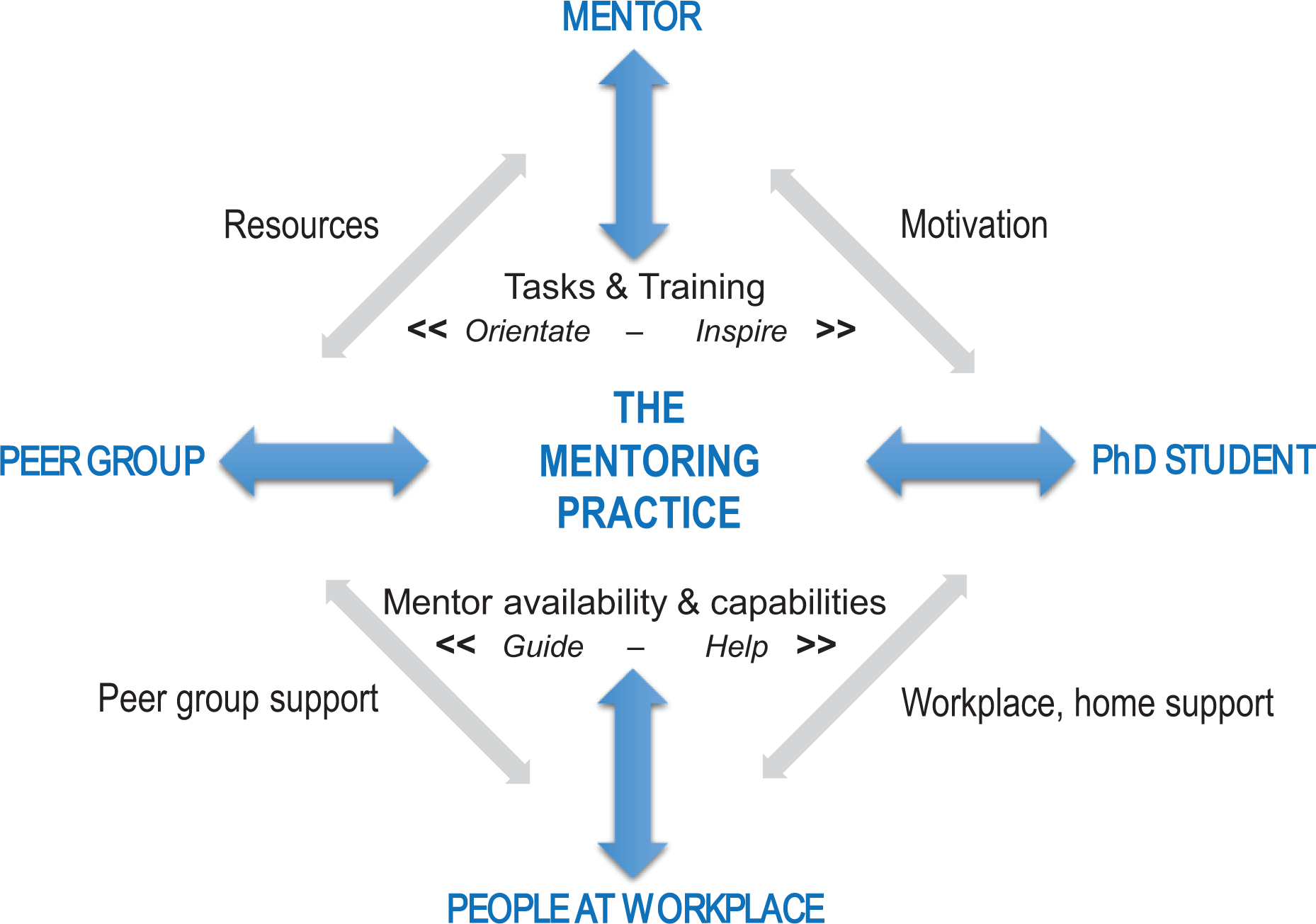
A multidirectional framework for describing the learning relationships in the PhD mentoring practice.
Motivation is perhaps the most important factor driven and shaped by internal and external motives. Internal or intrinsic motivation is related to personal interests and goals with regard to doctoral studies and research, the impact of previous research experience, and the prospects for career development. External motivation comes from encouragement by friends and family, including peers, lecturers and supervisors (Guerin et al., 2015; Wiegerová, 2017)
Work and home support describes the encouragement – or discouragement – and professional advice received by the PhD at the workplace or in the family. Supportive relationships with supervisors and colleagues in the workplace and with the family at home, feeling part of the academic community and receiving peer support beyond the academic community at work are important.
Group and peer support describes the benefits of a sharing culture and positive peer pressure and group support. Group mentoring can be considered an additional dimension of the mentoring practice, which makes the practice at the same more multidimensional and multidisciplinary.
Resources includes job, social and organizational resources, and personal resources such as research skills, expertise, time, energy, effort and commitment to the doctoral work.
The mentoring practice can be understood as a learning partnership, requiring the partners involved – mentor, PhD, peer group, work environment – to work together to achieve their goals. As noted above, performance and monitoring within the practice is impacted by 4 key variables – motivation, work and family support, peer group support, and resources. From this viewpoint, it is possible to assess the mentoring practice as a relationship system in which those four key variables fuse together into a joint search to ascertain whether or not the practice works well. Problem solving within the practice is a collaborative process, which is supported and expanded by the circular learning processes. The learning processes are implied in the mentoring interactions between mentor, PhD, peer group and the work environment (the interaction arrows in Figure 1, further explained below). Learning involves multidirectional actions and reactions to inspire, orientate, help and guide PhDs toward their goal of progressing in and finalizing their doctoral research.
The main attributes of the learning interactions within the practice are 1) the mentor’s capabilities (which include personality traits such as skills to support others to progress and succeed in their work); 2) the mentor’s availability (for example for guidance and support, for enabling links with supervisors and peers at the workplace, for individual and group discussions, for feedback and for providing new viewpoints from other disciplines); and 3) the tasks and training sessions, aiming to enhance students’ transferable skills and researcher skills.
The framework we have developed may be helpful in promoting a proactive, proficient, responsive and reactive development of mentoring practices. It may help to assess the suitability of academic mentoring practices for meeting the needs of PhDs who are working in an industrial environment.
In our case, we use our framework to interrogate both reactively and proactively (for future practice development) the mentoring measures Juniper had implemented in the course of the practice. We do this in the following section.
Horizon 4: Reflecting on the mentor–researcher relationship in mentoring assessment
Here, the goal is to answer the primary research question of horizon 4:
The main research questions we are considering are:
What threshold capabilities should a person have to be a professional mentor?
What intentional capabilities should a person develop to become an effective mentor?
What is the mentor’s key challenge in supporting individual and group learning and in building a collective identity?
What is the impact of the mentor’s identity on the practice of mentoring and on the learning processes within the practice?
Combining doctoral studies with the demands of working full-time and also, in our case for almost all of the PhDs, of family responsibilities, is a challenging task which from time to time generated stressful conditions and conflict with motivation and performance. For example, there were some unexpected issues – such as unemployment or other significant changes in working life, or serious health problems – which prevented some of the Forestry students from graduating. Juniper needed special capabilities to face challenges and uncertainties in students’ lives, and related evolving expectations with regard to the mentor and the practice. She needed to deliver on the mentoring program while also delivering flexibility and support in difficult situations.
What specific capabilities influenced Juniper in shaping the mentoring practice? Juniper has strong teaching and research experience from her own specialist field (chemical engineering). She has a strong capability of listening and understanding, a capability that is needed to appreciate the different interests of people, students as well their supervisors, coming from different areas of education and employment. This capability would also help her when confronted with situations in which empathy was needed, or when keeping a neutral and bias-free position was of primary importance.
Lessons were learned from the first Forestry years, and Juniper learned to better understand her personal capabilities as researcher, teacher and program manager. Some modifications were made to enhance the effectiveness of the mentoring practice, such as:
– the implementation of a memorandum of understanding among all members of the practice in order to achieve academic balance between the responsibilities to publish research work and the commitment to protect industrial secrets from disclosure (cf. Costley and Lester 2012, s. 5);
– the reduction of planned hands-on, generic courses – there was less need for these types of activity than had been anticipated;
– the reduction of planned theme seminars, which were replaced by peer group meetings (there was one annual Forestry seminar);
– more virtual meetings were organized (these were held at least 6 times a year), and distance communication was encouraged through virtual home classes (Wikeley and Muschamp 2004) and net forums (e.g. on Facebook);
– writing retreats were facilitated, helping students to get into the zone of self-led, peer-supported writing; and
– annual thorough checks and written feedback were implemented once a year to follow up students’ progress in doctoral studies.
Horizon 5: Answering the primary research question
In the above sections, we have reflected on the learning dynamics in the practice of mentoring a group of working PhDs. We have done this from the viewpoint of the mentor, Juniper, and her personal learning experiences. The nature of the hermeneutic inquiry is dialectical: it is an interpretive and critical conversation between Juniper’s past and present understandings of the mentoring practice. New understanding has emerged through a fusion of these past and present understandings and this new understanding helps us now to answer the primary question of the hermeneutic inquiry. The horizons of the hermeneutic cycle, the horizons of understanding and the fusion of horizons, and the key meanings we identified for each horizon are summarized in Table 1.
We present our consideration of question 5 in two ways: concretely, in terms of how Juniper has lived the experience, and conceptually in terms of how what has been learned can be explained by using the learning framework as outlined in Figure 1.
The lived experience
Mentoring the working PhDs was a rewarding job, especially when Juniper was able to really help the practice lead to successful outcomes, and when she could see the outcome of that help affecting the students’ academic life. At times, Juniper appeared to be the only person in the university to whom the PhDs could talk. When PhDs had a problem with their supervising professor, Juniper intervened by discussing the issue with both the student and the professor.
In practice, there were additional challenges that were specific to combining academic research with work in industry. In some cases, a PhD’s employer was very interested in the progress of their employee’s research, while in other cases, the employer simply allowed the employee to do the doctoral research as long as it did not hamper their normal working duties. In some cases, the topic of the research was directly company-related and employers did not always support open science or allow open access publishing of the results. This increased uncertainty among the students as to what outcomes or results they would be allowed to share with the practice members in seminars or through article writing exercises. On the other hand, and on a more positive note, Juniper learned that PhDs working for a company have a great opportunity to focus their research on a real and specific problem and so the research can be tailored to benefit the company. From the university’s point of view, PhDs who are already active in working life are best placed to engage in academic–industrial collaboration.
In some cases, the distant relationship between the supervising professor and the PhD caused disagreement. Working PhDs are adult students with a range of experiences and priorities additional to undertaking research, and require different guidance from that needed by young and less experienced PhDs. Juniper learned that adult students may be very confident in their own abilities and in their own field of knowledge, that they may have acquired knowledge that differs from the scientific knowledge of their supervising professor, and that they are usually more mature also socially, which may pose a challenge to their supervisor. However, they also understand that the practical knowledge they have gained through experience is not enough to gain promotion at work, and so evidence in the form of an accredited qualification is required (cf. Wikeley and Muschamp, 2004). According to Costley and Lester (2012: 5), supervising PhDs is mentoring work. Juniper noticed that students all had their own, different challenges, and it was important for her to be able to identify these challenges and offer help and guidance in an appropriate manner, without being too intrusive.
The learning interactions within the group were very dynamic and not always predictable. This required from Juniper the capacity and readiness to modify or even re-plan previously formulated actions. The tasks, training events and actions of the practice needed to be modified at some stages of the Forestry program to better serve the needs and expectations of the group and of each individual participant. An example of such modification was the enabling of regular writing retreats, and regular virtual meetings which served as check-points for assessing the progress of each individual student and of the practice as a whole.
To run the practice, Juniper used a set of appropriate tools and approaches. However, to guide it through moments of distance and demotivation, unexpected change in personal lives or crises, she felt she needed more innovative and personalized tools, which might improve the quality of the mentor’s availability and so reinforce the impact of help and support.
The learned explained
Mentoring is a learning partnership involving four actors: the mentor, the PhD, the peer group, and people at the workplace and even at the student’s home. All partners work together for a common outcome – to meet the expectations of the partnership and to deliver meaningful outputs. Interactions within the practice are dynamic cycles of learning and reflection, supported by the various tasks and training sessions and enabled by the availability and capabilities of the mentor (Figure 1).
The tasks and training sessions are modal components (physical or virtual) that structure and carry the practice. For the actors of the partnership it is easy to schedule these actions and also to commit to them, because they are concrete and practical and have specific take-aways, and because they are topical, relevant and do-able. They are designed to deliver inspiration that will motivate not only the PhDs but all the partners in their work on and for the practice. The tasks and training sessions also deliver orientation by indicating the resources available within the partnership – the skills and capabilities, the multidisciplinarity, the strengths (and limitations), the group and peer support – and by explaining how to best exploit these.
The role of the mentor is crucial. Physical or virtual is not an issue in mentoring. Continuous availability, mentoring skills and personal capabilities are what make the mentor the enabler and moderator of all learning processes within the partnership. “Availability” includes the inherent flexibility to design, plan and where needed re-plan the practice so that the benefits from the partnership are maximized. The mentor needs to accept the responsibilities of understanding, looking for the best solutions and resolving partnership difficulties. In these ways, the mentor facilitates the achievement of learning and the related professional growth of each student.
Conclusion
The aim of this study is to bridge a gap in the research on mentoring in doctoral education. It addresses that gap by making explicit the experience of mentoring work in a multidirectional and multidisciplinary practice. It tells the story of an academic mentor who, over an administrative period of 6 years, mentored a group of PhDs working to achieve their doctoral degrees while at the same working in industry. The mentoring program was part of piloting a new doctoral program.
This story is used to illustrate how hermeneutics methodology provides a research approach that helps to overcome the methodological challenge of turning the mentoring experience into narrative and knowledge. To make explicit the experience of mentoring, we developed a learning framework and a methodological approach. We used the approach to help (re-)interpret and understand the mentoring work, the multidirectional and multidisciplinary nature of the mentoring practice and the dynamics involved from the mentor’s perspective and throughout the mentor’s experience. In general, we show the potential of hermeneutics for studying the many subjective meanings of mentoring which are challenging to translate into transferable knowledge from which we and others can learn.
Similarly, consistent with the conclusions of Paterson and Higgs in their study (2005) and with those of many other researchers using hermeneutic-based approaches in similar case studies (cf. an illuminating study by Verganti and Öberg, 2013), we were encouraged by the flexibility and intensity of hermeneutic interpretation as a research approach for exploring in depth the importance, meanings and effectiveness of support actions.
The study is conceptual in nature, since it aims to provide a methodological approach and learning framework on which other scholars may build to envisage and implement new learning processes in mentoring practices. Rather than providing a conclusion on the practice of mentoring working PhDs, we would like to note, on the basis of our findings, that we were able to deliver a learning method to assess the multidirectional experiences of mentoring and the knowledge development involved. Especially, we would like to encourage our colleagues and readers to use hermeneutics as a critical approach to explore complex, academic–industrial collaborative mentoring practices from different perspectives and to produce new understandings and foster the potential of alternative academic–industrial collaboration links.
Footnotes
Declaration of conflicting interests
The author(s) declared no potential conflicts of interest with respect to the research, authorship, and/or publication of this article.
Funding
The author(s) received no financial support for the research, authorship, and/or publication of this article.
