




Abstract
This paper considers business and enterprise education through the lens of theatre and the creative arts, and identifies new pathways towards an interdisciplinary way of supporting the young innovators of the future, placing higher education as a central catalyst. Following a review of key criticism directed at traditional business and management approaches in the academy, the article problematizes the notion of experiential enterprise education in the curriculum and poses the question as to where and when students are afforded the opportunity to fail. Through an autoethnographic account, the key themes of authenticity, risk and failure, experiential approaches and embeddedness are presented. There is an urgent need for further and higher education institutions to develop a much more holistic and interdisciplinary approach to developing entrepreneurship in their students. These institutions are currently perpetuating pedagogical hypocrisy in that they preach productive failure while practising assessment success. An effective 21st-century approach would champion risk-taking and productive failure, place processes over outputs and acknowledge the important role of the post-course curriculum.
A ubiquitous question in enterprise education is that of whether entrepreneurship can in fact be taught at all (Gottleib and Ross, 1997; Haase and Lautenschläger, 2011; Henry et al., 2005; Jones and English, 2004). Perhaps more honed and critical questions are whether entrepreneurship can be taught within the academy, and whether business schools are up to and are best placed for the task (Kirby, 2004). Raposo and Do Paço (2011) identify a crisis in confidence in the academy which is underlined by a lack of consensus about how enterprise programmes should be delivered (Jones et al., 2013; Pittaway and Cope, 2007). This is mirrored in many ways by the debate concerning the applicability of skills taught on business school MBA programmes and their suitability for preparing students for the workplace (the ‘real world’) (McDonald, 2017). Enterprise educators have outlined the significant differences between education ‘about’, ‘for’ and ‘through’ enterprise (Kyrö, 2005; Mwasalwiba, 2010); the last being seen as the preferred model whereby experiential and real-life learning opportunities help foster permeable academy walls and give students the opportunity to learn alongside messy reality. But do today’s universities really provide the right space for experimentation and failure, for uncertain outcomes and the development of innovation born out of a certain amount of chaos? This question is asked by Matthew Reisz in a recent Times Higher Education article summarizing the thoughts of Dominic Johnson, which were expressed at a panel discussion: Programmes are very assessment-driven and often modular, so students cannot afford to experiment and get things wrong […] a model of experimentation where people would go out into the wilderness and fend for themselves and then come back and make something is not really tenable any more, [we need] to create an environment where experiment and managed risk are part and parcel of making work. (Reisz, 2019)
In this paper we consider approaches to risk-taking, play, improvisation, resource bricolage, autonomy, rehearsal, interdisciplinarity (boundary spanning), challenging authority, pushing the limits and testing institutional boundaries. All of these activities are identified in the literature as intrinsic to the creative disciplines (enterprise included), but are also perhaps increasingly less easy to accommodate within the traditional structures and processes of the academy. We aim to explore how universities and colleges may foster the kind of physical and conceptual spaces to encourage ‘counterintuitive thinking’ and risk-taking. Through a critical exploration of business and enterprise approached through the lens of theatre and the creative arts, we hope to identify some new pathways towards an interdisciplinary way of supporting the young innovators of the future, placing higher education as a central catalyst.
Enterprise education
In his recent Forbes article, ‘Why today’s business schools teach yesterday’s expertise’, Denning (2018) offers the following critique of the traditional management education: As the world undergoes a Fourth Industrial Revolution […] one might imagine that business schools would be hotbeds of innovation and rethinking, with every professor keen to help understand and master this emerging new world. Paradoxically, it’s the opposite. For the most part, today’s business schools are busy teaching and researching 20th-century management principles and, in effect, leading the parade towards yesterday […] the new management isn’t simply a new training course, or a process, or a methodology or an organizational structure that can be written down in an organizational manual […]. It’s a different mindset with counterintuitive ideas that fly in the face of the assumptions of a ‘good’ 20th-century manager or the typical business school case.
Enterprise and entrepreneurship are increasingly important aspects of the business school (and indeed the wider university) curriculum, not just in terms of supporting student start-ups, but in the development of the kind of skills that Denning believes are necessary for applying creative solutions to emerging global problems. Enterprise education has seen a significant rise in prominence in the academy over the last few decades (Hytti and O’Gorman, 2004; Jones and Matlay, 2010; Matlay, 2019). Its emergence may be attributed to the acknowledgement of the need to differentiate between business education and entrepreneurship/enterprise; the latter being more concerned with motivating students towards a propensity for creativity and innovation (Turner and Mulholland, 2017). Hytti and O’Gorman (2004) outline the distinction between entrepreneurship education and what they describe as ‘traditional’ management studies, although it is observed that there remains somewhat of a business school bias towards the promotion of business venturing (Fayolle et al., 2006; Herrmann, 2008; Murray, 2019) and this has resulted in some scholars questioning key tenets associated with traditional approaches to enterprise and entrepreneurship: ‘[…]the business plan is not necessarily appropriate for enterprise education; but is, possibly, appropriate for entrepreneurship education’ (Jones et al., 2013: 493). In this sense, enterprise education is not just about start-up competency – it is about inculcating a critical and creative ‘perception of the world’ (Cope and Watts, 2000; Hofer and Kaffka, 2018).
Rae (2017) defines entrepreneurial learning as an ‘experiential process of learning to recognise and act on opportunities’ (p. 487). Entrepreneurship education and training are seen as important means to foster economic development through improving the nature of the entrepreneurial contribution to regions and the societal impacts generated as a result (Garavan and O’Cinneide, 1994; Hynes, 1996): ‘the importance of entrepreneurial education is derived from the importance of the entrepreneur throughout the economic system’ (Ulrich, 1997: 1). The subject of entrepreneurship education and training has received much attention over the years, with many authors (e.g. Gibb 2002; Jamieson, 1984; Kyrö, 2005; Mwasalwiba, 2010; Pittaway and Edwards, 2012) categorizing entrepreneurship education in three ways. The first category is education ‘about’ enterprise, which focuses on creating awareness and developing students’ entrepreneurial intention. This approach has a tendency to valorize the entrepreneur and is also more theoretical in nature. The second category is education ‘for’ enterprise, which focuses on the value proposition and seeks to develop knowledge and skills that may find value in future start-up activity. Finally, there is education ‘through’ enterprise, where the focus is on prototyping, evaluation and supplementing explicit knowledge with tacit ‘know-how’ via experiential practice. The last approach is identified by Leon (2017) as focusing on ‘non-cognitive’ entrepreneurial skills (Moberg, 2014).
Scott et al. (1998) and Matlay and Mitra (2002) offer a similar categorization, suggesting that education and training are predominantly about raising awareness of entrepreneurship as a key agent of social and economic change (‘about’ enterprise); offering opportunities to learn experientially (‘through’ enterprise); and providing training to develop the skills of potential and existing entrepreneurs (‘for’ enterprise). While entrepreneurship support programmes vary greatly in duration, structure and content (Garavan and O’Cinneide 1994), there are three main areas of focus: technical skills, business management skills and personal entrepreneurial skills (Hisrich and Peters, 1998).
Leon (2017) provides an extensive review of literature relating to the nature of skills identified by researchers as being focused on in enterprise education programmes. These core skills are summarized in Table 1 and mapped onto those described by Hisrich and Peters.
Areas of entrepreneurial education skills focus.
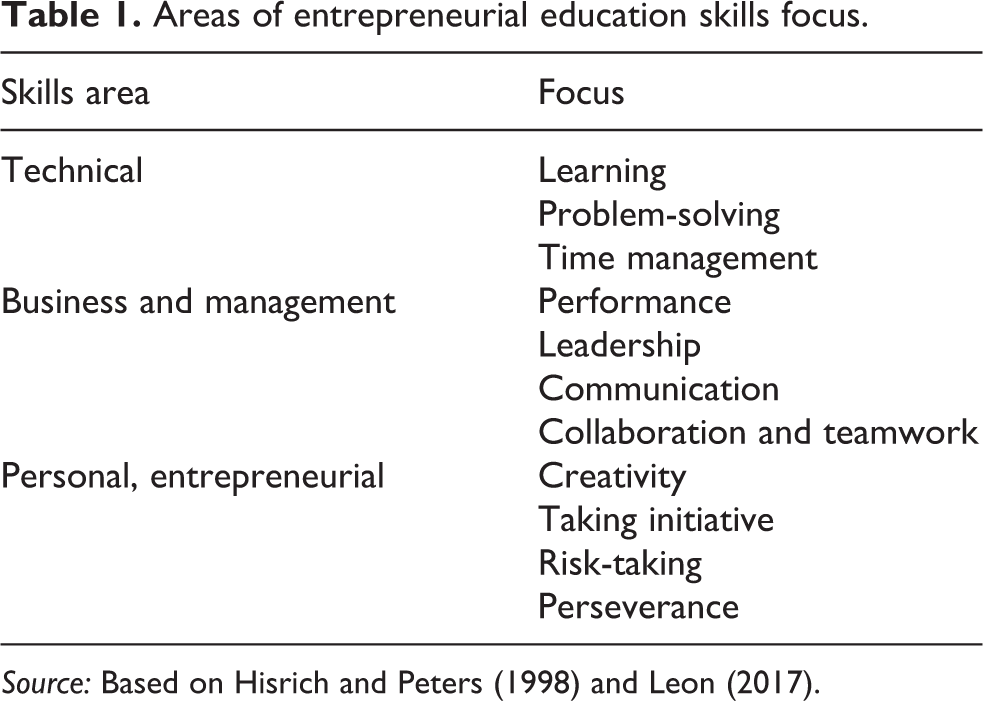
Source: Based on Hisrich and Peters (1998) and Leon (2017).
Many research and policy initiatives focus on the role of higher education in fostering entrepreneurship and developing entrepreneurial competence (Arthur et al., 2012; Rae and Wang, 2015), and pressures on higher education to become more entrepreneurial have meant that business and management disciplines have seen a large growth in research exploring the teaching of entrepreneurship as a subject (Carey and Matlay 2010).
However, despite the importance of experiential connection to business and enterprise for the entrepreneurial development of students (Fayolle, 2013), some authors conclude that current education programmes are simply too mechanistic to support the necessary creative and enterprising behaviours (Ahmad, 2015; Leon, 2017). In this context, both Murray (2019) and Muff (2017) question whether the aspirations of entrepreneurship and/or enterprise education are in line with the requirements of industry. Together with the ‘creative tensions’ outlined by Jelly and Mandell (2017), resulting from an increasingly rigid and risk-averse university environment, it would seem that there is potential for today’s students to find themselves stranded between invitations to fail productively and the demonstration of uncontroversial success.
Fail fast, fail often…but don’t fail this course!
One is hard-pressed to experience an enterprise lecture without hearing the mantra ‘Fail fast, fail often’. However, given the pressures for high student attainment and satisfaction levels we should reflect on the extent to which students are really supported in practising what is preached within the narrow confines of the curriculum. Middleton et al. (2019) explore the ‘boundary’ of the classroom and consider how we might expand the learning space to the university as a whole. They suggest that entrepreneurial education needs to include experiential learning perspectives – especially ‘learning influenced by environmental factors’ (forthcoming). Expanding the ‘boundary’ of the classroom enables a shift from the traditional emphasis on cognition acquisition to include participatory learning (Middleton et al., 2019). Learning is primarily situational and contextual. It often takes place outside the educational institution, and is described by Rae (2017) as experiential and socially mediated. Since this kind of approach is difficult to facilitate in a traditional classroom setting, perhaps learning beyond the boundary of the classroom (or, as Rae describes it, learning at the ‘periphery’) has become a facilities management necessity rather than a pedagogic choice. Indeed, Rae suggests that creative ideation may best be facilitated in ‘open thinking spaces’ at the periphery of the academy. However, such creative and flexible thinking spaces are quite different from the traditional classrooms that dominate most campuses. As such, entrepreneurial learning is often considered extra-curricular, which not only places a strong focus on mentorship but also raises the question of where students might ‘perform’ entrepreneurship beyond the classroom.
Inevitably, both academics and university support workers have recommended immersion in practice/industry to gain this ‘beyond the classroom’ experience. However, what is lost in this scenario is arguably the most valuable aspect of the academy – namely, the ability to create safe spaces for students to have the confidence to embrace a level of risk they might otherwise be reluctant to take in an industrial setting. O’Dwyer et al. (2019) underline learning-by-doing as an important theme in entrepreneurial education delivery. This focus was supported in their study, with students reporting that enterprise education was less traditionally taught and more practical than other subjects. The authors felt that, in order to accommodate such methods in the academy, learning should necessarily involve opportunities for ‘play, creation, empathy, experimentation and reflection’ (p. 100).
This all builds an important case for entrepreneurial learning to take place in a liminal space between the academy and industry – in spaces where risk, creative development, experimentation, rehearsal and productive failure may be practised in relative safety. In artistic and creative domains, the use of the studio or rehearsal space is commonplace to support the development and refinement of practice. The creative studio becomes an active, configurable and transitional space between the formal classroom and the professional world. These are ‘peripheries’ (Rae, 2017) within the safe boundaries of the academy and as such present ideal spaces for experiential entrepreneurial learning. Artistic and creative development thus provides a valuable lens through which to consider enterprise space.
Enterprise in creative disciplines
In their examination of creative education, Carey and Matlay (2010) argue that education in the creative disciplines is characterized by ‘experiential, project-based learning environments’ and is frequently led by ‘educators, who are also practitioners, in their respective fields’. They note that the teaching of entrepreneurship in business schools has been criticised for its traditional ‘lecture and textbook delivery’ (p. 694). While this may be less the case today, it is probably safe to conclude that business schools remain places more associated with the promotion of business venturing than the development of creative practice. Zazzali and Klein (2015) underline the need for educators in creative disciplines to ‘cultivate the curious minds and personal epistemologies of students within each dynamic learning space’ (p. 264). Importantly they describe students in the context of theatre studies as ‘co-decision-makers’ in a curriculum that embraces ‘entrepreneurial and community-based learning strategies in order to disrupt individualistic silos, initiate alternative careers, and create innovative forms of theatre’ (p. 263).
While many enterprise educators currently aim to create these student-centred teaching and learning environments, where students are actively involved in problem-solving and inquiry-based experiences, the limitations of timetabling structures and the generic nature of most campus learning spaces means that especially those seeking to pursue creative enterprise are typically required to ‘practise’ enterprise elsewhere; in ‘creative spaces’ outside of the typical classroom environment. A traditional model of business school collaboration with a creative discipline to support enterprise teaching and learning is represented in Figure 1.
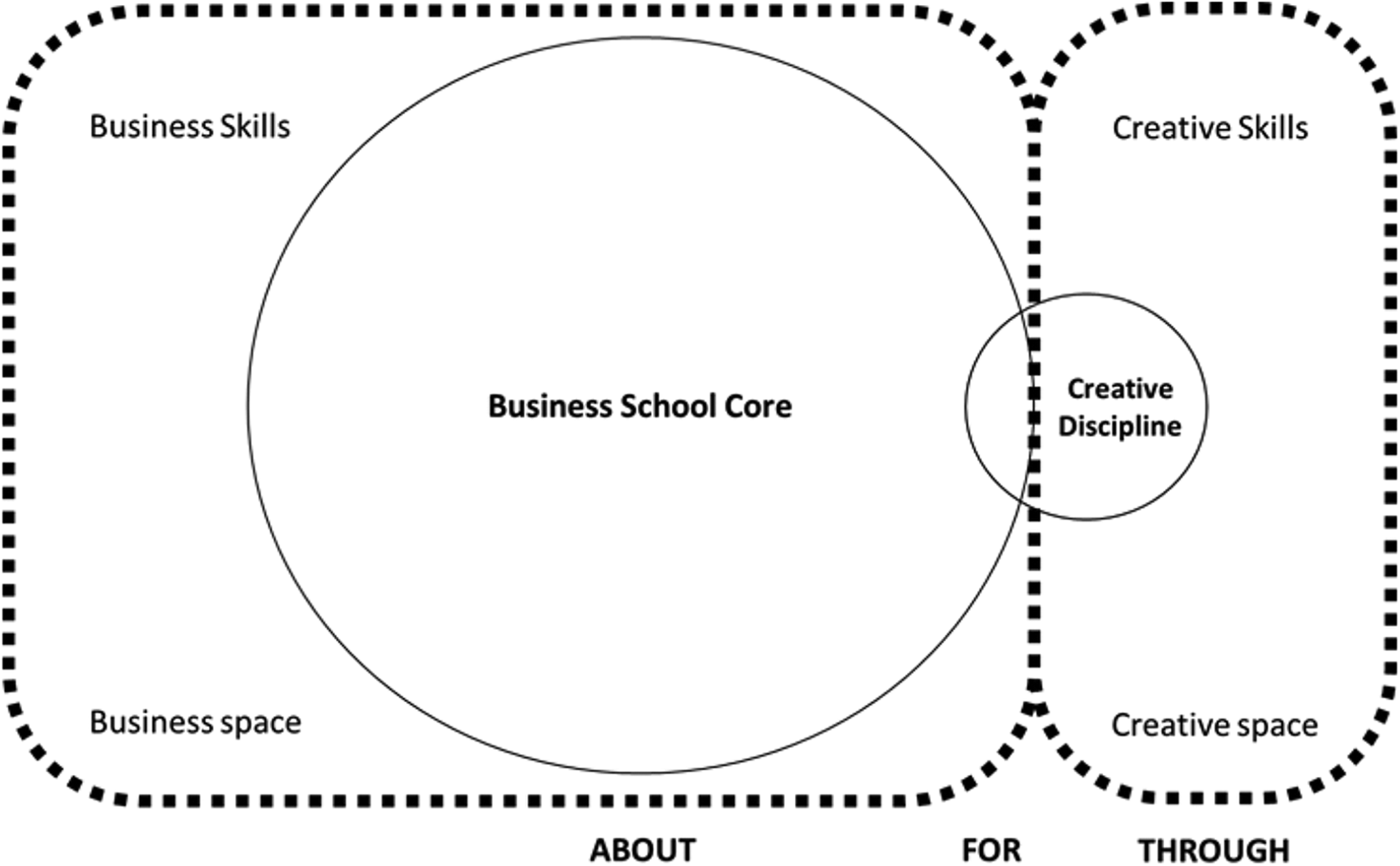
Traditional model of business school collaboration with a creative discipline to support enterprise teaching and learning.
Therefore, where business and management skills relating to enterprise and entrepreneurship are predominantly delivered through traditional business school teaching spaces, these will inevitably be ‘about’ or ‘for’ entrepreneurial action. Practical action must then be conducted beyond the classroom and so is often part of self-directed project work. Carey and Matlay refer to this interplay between ‘explicit’ and ‘implicit’ education; Middleton et al. (2019) also use this distinction in referring to ‘formal’ and ‘informal’ learning. However for some this situation raises the question of whether the current higher education environment is potentially encouraging ‘pedagogical hypocrisy’: Higher education lies in the midst of a changing paradigm. Politically conservative and market-driven pressures are now holding universities accountable for delivering a more cost-efficient education that provides students an adequate return on their investment. (Zazzali and Klein 2015: 261)
Current scholarship highlights the increasingly anachronistic pedagogical approaches taken by traditional business and management schools in teaching enterprise. While some scholars have identified important steps to counter this and build greater permeability of the academy walls through stronger experiential components, there remains a somewhat dichotomous relationship between the academy and industry. Some scholars have identified the importance of safe spaces for experimentation and failure, and it is this notion of ‘playfulness’, so central to ideation and creative development (Dobson and McKendrick, 2018), which is challenging to support in the classroom but arguably even more so within an industrial partnership (Muff 2017; Murray, 2019). This has led to the call for more use of peripheral, liminal, boundary spaces which are not just student-centred, but student-driven. Meanwhile arts and humanities focused research suggests (Belluigi, 2013; Carey and Matlay, 2010; Danvers, 2003; Moshavi, 2001) that creative arts education might offer some solutions for developing a more holistic approach based on its longer traditions of experiential and practice-based learning and on its playful and experimental attitude towards risk(-taking).
The aim of this research is to consider these points through reflective practice. The paper offers an autoethnographic account of enterprise education in the context of a theatre and performance undergraduate programme in the UK.
Method
Autoethnography as an approach to research involves the systematic analysis of and reflection on personal experience in order to understand a cultural phenomenon (Adams and Holman Jones, 2011; Ellis et al., 2011; Holman Jones, 2007). As such, it is described as both process and product. In a pedagogic setting it may be seen as a valuable means for educators to understand their own professional development alongside the development of curricula and the learning context within which they practise. Starr (2010) describes autoethnography as a research method in which self-analysis ‘can have purposeful implications for the preparation of teachers and schools leaders’ (p. 1). While self-exploration is central to this, Starr clarifies that autoethnography is ‘not the literal study of self but the space between the self and practice’ (p. 2).
For the purposes of this study, the method involved retroactively describing and noting past experiences assembled using hindsight (Freeman, 2004). Ellis et al. (2011) suggest that the process is a very individual one, involving journal writing, discussions with others or interviews as well as the production and/or consultation of sketches, photographs or other visual prompts to aid recollection. For educators there are numerous administrative reviews and reports produced throughout the course of an academic cycle, as well as records of course progress, which are invaluable to the process. Throughout the compilation of autoethnographic accounts there will be pivotal moments, the importance of which can be truly appreciated only through reflection: ‘Most often, autobiographers write about ‘epiphanies’ – remembered moments perceived to have significantly impacted the trajectory of a person’s life’ (Ellis et al., 2011: 275). The experience of the lead author is summarized in the following autoethnographic summary and discussion.
An account of entrepreneurial learning in theatre and performance
As an experienced enterprise educator my role is rarely to ‘teach’: I facilitate learning and hope that through this participants may gain motivation, confidence and perhaps a little more clarity about the road ahead. I personally have an arts background and so, while I have taught business, management and entrepreneurship for many years and in many contexts, I have a wide view of what ‘being entrepreneurial’ might mean. This was important when making the shift from teaching enterprise in a management school to teaching theatre and performance students in a faculty of arts. Being entrepreneurial is an important part of developing one’s own creative identity and practice since this is so closely aligned to autonomy, efficacy and creative innovation. Equally important is a definition of entrepreneurship (being ‘an entrepreneur’) which is flexible enough to be personalized and to feel authentic within the creative discipline: A key criterion for developing the theatre curriculum, entrepreneurship implies a sense of risk-taking and initiative in conjunction with creativity, imagination, personal responsibility, and organizational skills. Although commonly applied to the business sector of our capitalist society, we are using this term in an artistic context, consisting of innovation and initiative – two necessary skills for developing and deploying one’s craft. (Zazzali and Klein 2015: 267). enable students to develop knowledge of entrepreneurship as it applies within the cultural and creative domains, including, for example notions of intrapreneurship, and its application to possible contexts beyond. The relevant context for this module is normally outside the School and may be outside the University. Working with the tutor, students will identify a context within which they will have the opportunity to practice their entrepreneurial skills and apply their entrepreneurial knowledge. Examples might include managing and marketing creative events, developing creative projects in community and educational contexts and using creative/performance skills and understanding to meet needs of external partners. (http://webprod3.leeds.ac.uk/catalogue/dynmodules.asp?Y=202021&F=P&M=PECI-3702)
In the early stages it is clear that some of the students are resistant and cautious: they are artists not entrepreneurs. While they generally see the value of self-employability or engagement with ‘industry’, I am aware that a lot of entrepreneurship literature emphasizes ‘characteristics’ approaches and that as a society we valorize a certain image of the entrepreneur as a heroic and charismatic figure. Try stepping into a business-facing incubation space. These are clean, cool, well-designed spaces that seek to conjure aspirational images of the ‘tech-bro’. I begin to wonder how much of this is evident in the Silicon Valley type case studies that are ubiquitous in the media as illustrations of the way of the entrepreneur. This image feels a million miles away from the world of the creative producer, the independent artist. The very use of term ‘capitalist society’ in the Zazzali and Klein quotation above is employed with disdain. And I can see this in the faces of some of my students on the first day of class.
Authenticity
The primacy in these early days is authenticity: ‘we honor our mutual intransitive processes and continual self-interrogations of our respective work’ (Zazzali and Klein 2015: 264). To build trust and engagement it is important that the students’ own creative identities are foremost. This is not about shaping or modelling behaviours and characteristics; this is about diversity in what it might mean to act in an entrepreneurial manner and it is grounded in the notion of ‘self’. Seth et al (2018) find, through their research into entrepreneurship education and its influence on entrepreneurial intention, that two of the key criteria are ‘embeddedness in an entrepreneurial network’ and the ‘visibility of role models’. However, it is clear that, in order to preserve an authentic creative entrepreneurial identity, the nature of this network and the types of role model are critical. It is impossible for me to predetermine these; the types of role model are personal, individualized, and so must come from the student as emergent identities. The importance of authentic and emergent identity is reinforced by Kruse and Pongsajapan (2012).
Risk and failure
For students of creative disciplines it is their own creative output, their art, that forms a central component of their value proposition. In the case of theatre and performance students, they have honed and crafted this creative output in rehearsal and stage spaces. In these iterative processes of creativity, most will consider on reflection that they have ‘failed’ more than they have succeeded. Failure is commonplace; it is how you develop your craft. In any creative discipline, criticism and critique are a constant part of the journey. However, as Jelly and Mandell (2017) explain, there are creative tensions here between the amount of failure and experimentation that students may be afforded in the academy and the need to ‘pass’ with demonstrable success.
Carey and Matlay (2010) also reflect on pedagogy and assessment in art and design curricula, outlining that often there are no generic (potentially subjective) criteria for assessing whether an idea is ‘good’. Emphasis is on the learning journey and quality and richness of experience rather than tangible successful outcomes. The purpose of this is to encourage risk-taking. Therefore, a project may be deemed an artistic failure but could still score highly if it has provided, and the student has engaged with, a rich learning experience. So, in this sense, academic credit is awarded for process over and above product. The PowerPoint slide in my class stating ‘This project is NOT marked’ generates smiles and relief in equal measure, but also encourages students to try something that may not work out. This acceptance of risk is possible because of the removal of institutional pressures and the negative impacts of failure.
Experiential approaches
While the module contains around 16 hours of contact time, much of this takes place through a ‘virtual incubator’ approach with mentoring support more than ‘chalk and talk’. Self-motivation is an important factor and, while there are strong collaborations with the business school in a model similar to that in Figure 1, it is Figure 2 that perhaps best captures the kind of experience that the students on this particular module are engaged with. By focusing on ‘doing’ and ‘enacting’, the emphasis is shifted to the process of building through ‘rehearsal’ and ‘performance’.
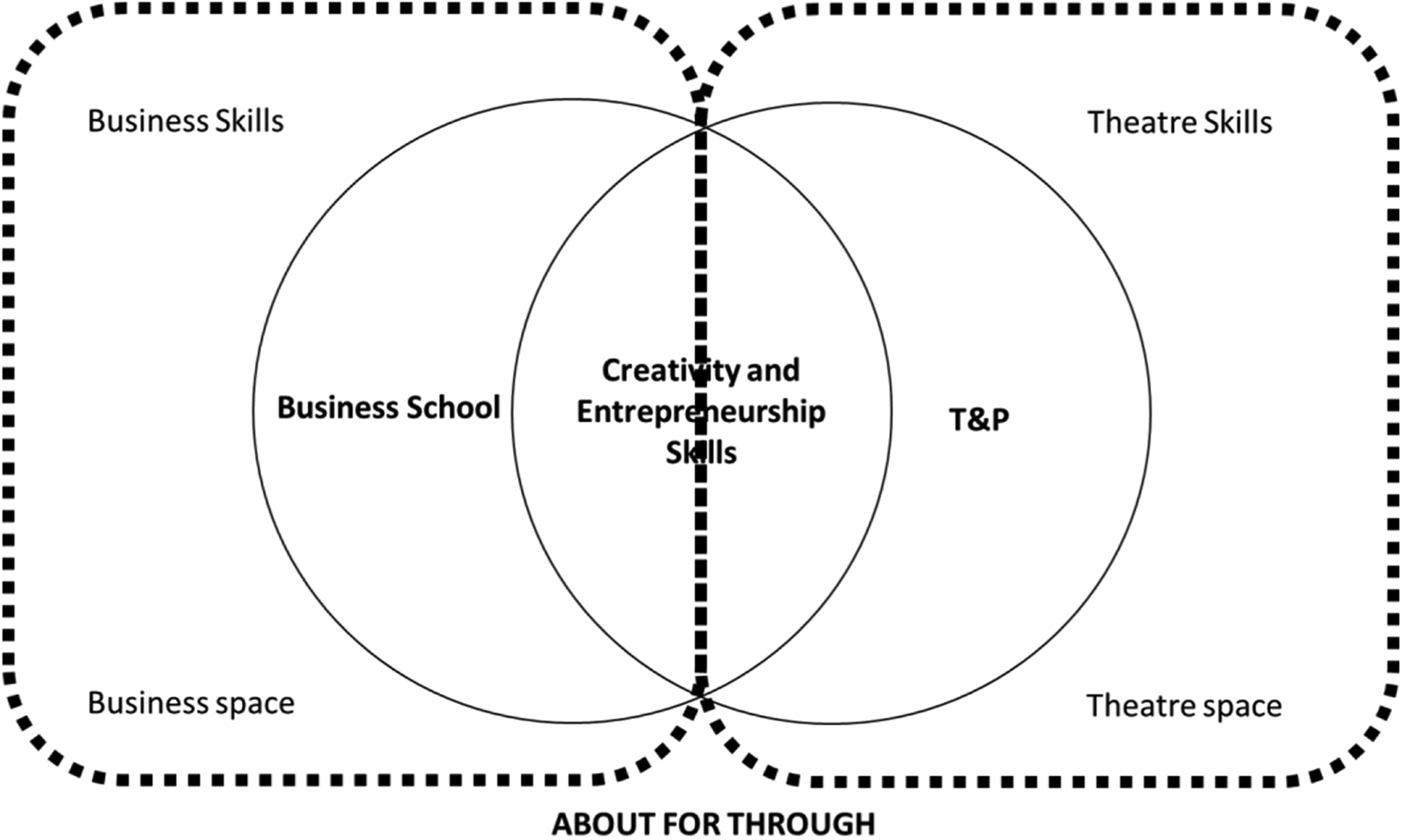
Model of business school collaboration with theatre and performance (T&P) which emphasizes ‘in-house’ creative studio/rehearsal space.
I feel that the students who were ‘going through the motions’ of a start-up idea often might experience the feeling of being lost and directionless. Motivation is inevitably hard to find when your project is just a piece of assessment on the road to graduation. As an educator, I am aware of those special moments when students suddenly gain a sense of real efficacy: ‘Many of us were talking and saying that these projects could actually become businesses!’
The interweaving of learning and lived experience becomes difficult to unpick and, in line with creative practice, a key component of the module’s assessment are the students’ own autobiographical accounts of their processes or entrepreneurial journeys. Whether ultimately they feel that such journeys have led to a moment of success or whether their expectations are still to be realized is therefore a relatively moot point. The journey and the depth of their reflection provide the evidence that they have engaged with the experience as a learning one.
Embeddedness
While the academy can provide a safe place for successive and constructive failures in the honing of craft, it is equally important to engage with relevant networks. As a ‘co-learner’ I embed myself in the local cultural and creative scene, and spend a lot of time meeting individuals and networking, drinking coffee, and exploring spaces. This is a time investment that is not in my work plan but is a critical part of offering practical guidance and mentorship. In fact, some of the artists and creative producers I have met over the years are indeed my own ‘entrepreneurial role-models’ (Seth et al. 2018) – although, as far as I know, none of them are aware of this fact. It is through the development of and ‘embeddedness’ in a local network or scene that I am able to help students find spaces for enterprise, to link them with contacts or open access to resources that would otherwise be unavailable to them. It is through embeddedness that the creative practitioner may circumvent what Burt (2009) refers to as ‘structural holes’ in social capital. Research indicates that the level of entrepreneurial embeddedness is of fundamental importance to the entrepreneur (Thornton, 1999; Zahra, 2007) and that all enterprising action is socially situated and within a broader local context. Through their networks, entrepreneurs gain access to idiosyncratic information, and may build collaborative alliances and find value through social capital: ‘both recognition and realisation of opportunity are conditioned by the entrepreneurs’ role in the social structure’ (Jack and Anderson, 2002: 467). It is the lack of access to local social capital that underpins Stinchcombe’s ‘Liability of Newness’ (Abatecola et al., 2012; Stinchcombe, 1965). This refers to the likelihood of enterprise failure – due, in part, to the lack of local connectedness – or, as one of my entrepreneurial role models said recently, ‘If you want people to come to your event, you go to their event’.
Working with an increasing diversity of people, my notion of the ‘typical entrepreneur’ feels like it has become so stretched as to be meaningless and I can see that I am losing the classroom with every slide that suggests particular competences and characteristics of the ‘successful’ entrepreneur. Every inspirational Instagram post claiming to reveal the 10 things successful people do before breakfast just serves to valorize the exceptional. Entrepreneurship should not be exclusive. Of course this is not just a problem with the popular image of the entrepreneur, since the Romantic notion of the creative in Western culture has also valorised the artist as individual and even divinely gifted – the tortured genius who is both misunderstood and brilliant and walks an alternative and lonely path. Most creative professionals, and indeed entrepreneurs, share one important trait: the knowledge that they can achieve very little alone and that sharing a supportive and strong network is the best way of achieving success. I am fond of telling my students that gamblers in a casino are risk-takers, whereas entrepreneurs actually try to reduce risk as much as possible. Embeddedness is an important way of doing this.
Conclusions
Throughout this paper, we identify that enterprise education is increasingly being seen as a highly creative pursuit of innovation and wider value creation, and is presented by many scholars as a departure from more traditional business venturing. This development gives rise to an important need for debate about the contribution that arts and humanities may offer the wider delivery of enterprise education in higher education.
The typical entrepreneur no longer exists, if indeed she ever did. Entrepreneurs and intrapreneurs are increasingly found in all walks of life, from universities to theatre collectives. There is thus an urgent need for further and higher education institutions to develop a much more holistic and interdisciplinary approach to the encouragement of enterprising students. At the same time, some scholars accuse institutions of perpetuating pedagogical hypocrisy in that they preach productive failure while practising assessment success. An effective 21st-century approach would champion risk-taking and productive failure, place processes over outputs and acknowledge the important role of the post-course curriculum. Jones et al. (2013), for example, champion such pedagogy through the identification of the need to reward students’ entrepreneurial learning over the immediate viability of the business plan, but also conclude that this is by no means an uncontroversial or universally adopted approach.
We have also highlighted the need to distinguish between education about, for and through enterprise. In order to offer a meaningful and remotely authentic education through enterprise, universities and colleges will need to design and develop the kind of safe, liminal physical and conceptual spaces that encourage counterintuitive thinking and risk-taking – places where students can practise and perform entrepreneurship through processes of play, creation, empathy, experimentation and reflection. This will require a radical rethinking of estates and timetabling, and is therefore unlikely to happen overnight.
Research into the potentially embedded interrelationship between business/management and the creative arts reflects a wider debate taking place beyond the academy, not least about the increasing demand for creative thinkers to respond to the workforce challenges posed by artificial intelligence (AI). There are indications that arts-based management initiatives are starting to gain traction, especially in Europe (Schiuma, 2011), but future studies would benefit from investigating how artistic processes such as rehearsal and improvisation management might benefit the business world (Beirne, 2013; Bilton, 2007). Meanwhile, many artists continue to fear that intrusive, unresponsive applications of management theories and practices are stifling creativity (Palmer, 1998), while others warn of the collapse of culture into a crude commercial discourse on workplace innovation (Oakley, 2009). The interrelationship between business and the arts is certainly a tense one. But, in the field of entrepreneurship and enterprise, it can be both productive and symbiotic.
Footnotes
Declaration of conflicting interests
The author(s) declared no potential conflicts of interest with respect to the research, authorship, and/or publication of this article.
Funding
The author(s) received no financial support for the research, authorship, and/or publication of this article.
