




Abstract
Spin-off companies are generally considered a promising vehicle for developing academic knowledge into products that are ready for the market. In this paper the authors explore under what circumstances spin-off companies can serve as a source of knowledge for the research organization from which they originate. The paper brings together literature from different academic fields to construct an analytical framework for investigating knowledge feedback mechanisms between spin-off companies and their parent research organizations. The authors illustrate the application of this framework in six case studies of parent–spin-off couples in the water technology sector. These case studies show that the interaction with spin-off companies can yield important cognitive benefits for the academic research process, such as an improvement of the research agenda and new insights about the practical operation of theoretical models and technologies. These benefits were facilitated mainly by staff exchange, collaborative research and personal contacts.
Over the past few decades collaborations between universities and industry have been stimulated by public policies in order to improve the economic impact of public research (Etzkowitz and Leydesdorff, 2000; OECD, 2016). Innovation literature suggests that these science–industry interactions generate knowledge that is not only of high practical relevance but also of academic excellence (Leydesdorff and Zawdie, 2010; Wissema, 2009). This suggests that, under certain conditions, the practical application of knowledge in a commercial context creates new cognitive benefits in the form of knowledge that can feed back into the research process. For example, the confrontation of scientific claims with the practical constraints of a pilot plant can generate new insights about the underpinning scientific model. Experience in a real-world setting may provide reasons for academic researchers to adapt their theoretical concepts and formulate new research questions.
Spin-off companies of academic research organizations develop academic knowledge into products that are ready for the market. Through these activities, they can also generate knowledge for the research organization from which they originate. The growing literature on spin-off performance indeed suggests that the interaction between spin-off companies and their parent research organizations generates benefits for both partners (van Stijn et al., 2018; Zomer et al., 2010). This literature, however, focuses mainly on the economic and social benefits of these interactions. Also, there is a bias toward the benefits for spin-off companies. The papers by Zomer et al. (2010) and van Stijn et al. (2018) provide some evidence of cognitive benefits for the parent organizations, but a systematic understanding of these benefits is still lacking.
To address this gap in the literature, this paper explores in what way and under what circumstances the interaction between spin-off companies and their parent academic research organizations facilitates the scientific research process. In particular, we will investigate the following questions: What types of cognitive benefits are produced in practical applications of scientific research by spin-off companies? Through what mechanisms do these benefits flow back into the academic research process? What conditions support these cognitive feedback mechanisms?
Based on the available literature on the interactions in general between industry and research organizations in different fields, we develop an analytical framework that distinguishes between mechanisms of and conditions for cognitive feedback loops between spin-off companies and their parent research organizations. We illustrate this framework in a set of six case studies of collaborations between spin-off firms and their parent research organizations in the water technology sector.
Theoretical and analytical framework
In the academic literature, there is renewed interest in university–industry collaborations (Mascarenhas et al., 2018; Perkmann et al., 2013; Sjöö and Hellström, 2019). Depending on the disciplinary perspective, analysts highlight different aspects of this relationship, such as the types of knowledge that are produced through university–industry interactions, the conditions under which these types of knowledge develop, and the mechanisms through which the knowledge flows back into the research process. Building on this literature in different disciplinary fields (science and technology studies, innovation studies, economic geography), we have developed an analytical framework that distinguishes between four cognitive benefits, five mechanisms and five conditions that facilitate those mechanisms (see Figure 1). When available, we have included studies on spin-off companies in particular. The model includes bidirectional arrows to indicate the feedback from benefits to mechanisms and conditions. Given its exploratory nature, however, our analysis will focus on the causal relationships from left to right.

Analytical framework.
Cognitive benefits
University–industry collaborations can generate benefits for both partners. Companies can acquire support for product development, access to public research funding and solutions to technological problems, while universities can acquire insights into the industrial applicability of previous research, additional funding and increased opportunities for future research (Bodas Freitas and Verspagen, 2017; Perkmann et al., 2013). This paper focuses on cognitive benefits for universities and other research academic organizations. Innovation studies suggest that the acquisition of knowledge is one of the primary motivations for universities to engage with industry (Bozeman et al., 2013; Mascarenhas et al., 2018; Perkmann et al., 2013). We refer to this as “cognitive benefits” in order to distinguish this goal from financial benefits (attracting research funding) and social benefits (improving the reputation of the university). Cognitive benefits can in principle include both tacit and codified knowledge. Based on surveys and interviews among researchers, different types of cognitive benefit have been identified as driving science–industry collaborations. For example, in surveys of German, UK, Swiss and US research institutes, it was found that researchers expect to gain new and relevant insights relating to their research by collaborating with commercial partners (Ankrah et al., 2013; Arvanitis et al., 2008; d’Este and Perkmann, 2011; Fritsch and Schwirten, 1999; Lee, 2000; Meyer-Krahmer and Schmoch, 1998). In particular, researchers mention the benefits of testing the applicability of their research which helps to fine-tune their theories and technologies. In line with this finding, studies have also found that researchers engage with industrial partners to access new or specific forms of (practical) knowledge and expertise (Hessels et al., 2011; Meyer-Krahmer and Schmoch, 1998).
Besides accessing new insights for existing research projects, studies have shown that researchers engage in science–industry collaborations because it improves their scientific research agenda (d’Este and Perkmann, 2011; Fritsch and Schwirten, 1999). Contact with commercial partners can help to focus the research agenda on actual and contemporary problems that need solving. This is also linked to the aim of creating an inspiring and fruitful learning environment (d’Este and Perkmann, 2011). Exposing student and faculty members to practical problems is thought to ensure an up-to-date level of academic research. On a higher level, science–industry collaborations are thought to contribute to the reflexivity of researchers because, through these collaborations, researchers are encouraged to think about and explain their theories and technologies in practical settings (Arvanitis et al., 2008).
However, the finding that cognitive benefits can serve as a motivation for science–industry interactions does not imply that research organizations actually realize these benefits. The studies reviewed above report motivations rather than actual benefits. Further insights into the cognitive benefits of science–industry interactions can be gained from studies into the relationship between university–industry interactions and research performance. A Norwegian questionnaire, for example, has shown that researchers who collaborate with or receive funding from industry publish more papers than other academic researchers (Gulbrandsen and Smeby, 2005). In engineering, collaborative projects with industry typically yield less publishable results because they tend to be more applied, but they still enable exploratory learning by academics, leading to new ideas and projects (Perkmann and Walsh, 2009). Publications from university–industry collaboration on average receive slightly more citations, although they tend to be published in journals with a lower reputation (Lebeau et al., 2008).
A couple of papers deal specifically with the interactions between spin-off companies and their parent research organizations. Many spin-offs collaborate with their parent organization thanks to a shared cultural and educational background, a shared stock of tacit knowledge and similar research interests (Treibich et al., 2013). With regard to the cognitive benefits for the parent organization, Zomer et al. (2010) conclude, based on a number of case studies, that collaborations between universities and spin-off companies serve as a “reality check” and inform researchers about the relevance of their research questions and the feasibility of potential solutions. In all the case studies, the creation of a spin-off company led to an informal relationship in which test data, instruments or prototypes were exchanged between a research department and its spin-off company. Perhaps surprisingly, the direct benefits in terms of joint scientific output were limited: most spin-off firms and parent organizations produced few collaborative publications and collaborative patents. Only in cases where spin-offs directly contributed large funds to research projects did mutual interaction significantly influence the research agenda and result in high-quality publications. In another study, Stijn et al. (2018) found that interactions between universities and start-ups contributed little to fundamental university research, but often helped universities to gain credibility and social capital – that is, goodwill, giving access to the resources of third parties.
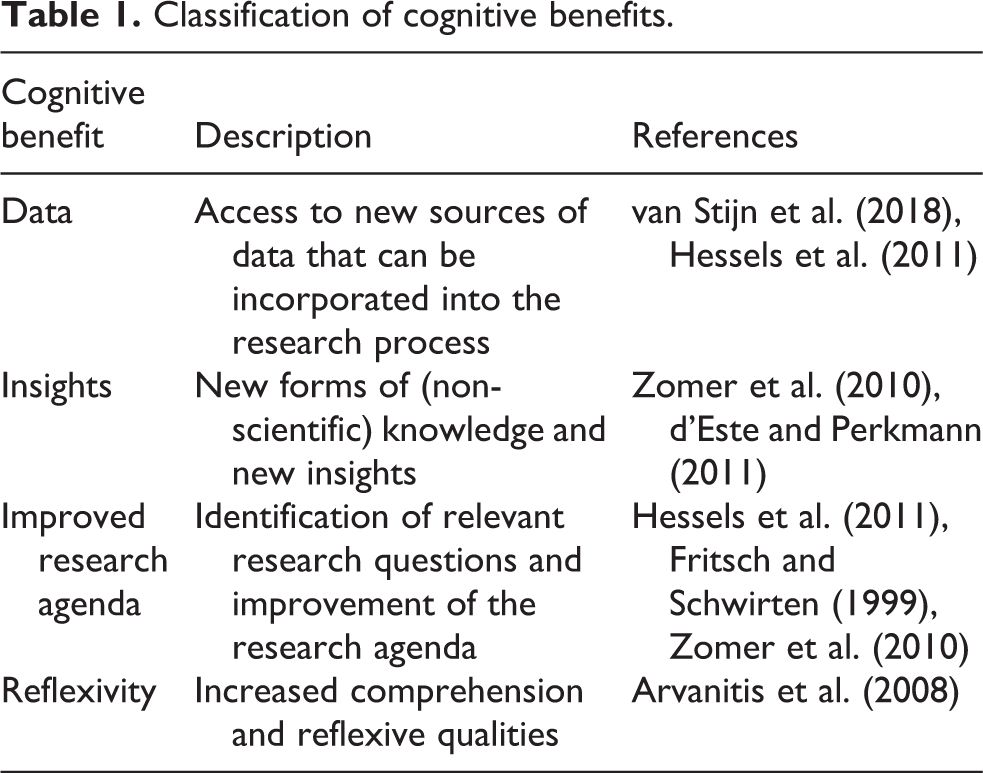
Integrating this literature, we distinguish between four cognitive benefits that researchers can gain by interacting or collaborating with industry, and spin-offs in particular (Table 1).
Classification of cognitive benefits.
Mechanisms
Our assumption is that the main mechanisms behind the generation of the cognitive benefits introduced above are different forms of interactions between spin-offs and their parent organizations. According to Perkmann and Walsh (2009), interaction modes such as meetings, sharing of equipment and materials and joint activity facilitate the learning process between university and industry. This suggests that these interactions are the mechanisms through which cognitive benefits flow back to the research process.
D’Este and Patel have distinguished a number of forms of interactions between research and industry (2007). First, researchers and commercial parties may collaborate in joint research or consultancy projects. Depending on the focus of the project, research or commercial parties can take a leading role and contract out parts of the consultancy work to commercial parties, or parts of the research work to universities. Researchers and commercial parties or spin-offs may also interact through meetings and conferences. Interactions between universities and commercial actors may also be boosted by the creation of (shared) physical facilities, such as offices for spin-off companies, campus laboratories, incubators and cooperative research centers. Universities may lend or rent out laboratory space, piloting sites and specialized equipment. Another important interaction mode is linked to training: academic researchers and commercial parties may jointly supervise PhD students and train company employees through course enrolment or personnel exchange (D’Este and Patel, 2007).
Comparing different types of interaction between universities and spin-offs, Treibich et al. (2013) found that informal relations were a prerequisite for formal collaboration. Informal relationships play an important role in trust building and form the basis for future formal relations or maintaining the link when partners are not directly working together (Asheim et al., 2007). The analysis showed that the ability to manage conflicts and competition issues mattered strongly for the success or failure of a collaborative relationship between research institutes and their spin-off companies.
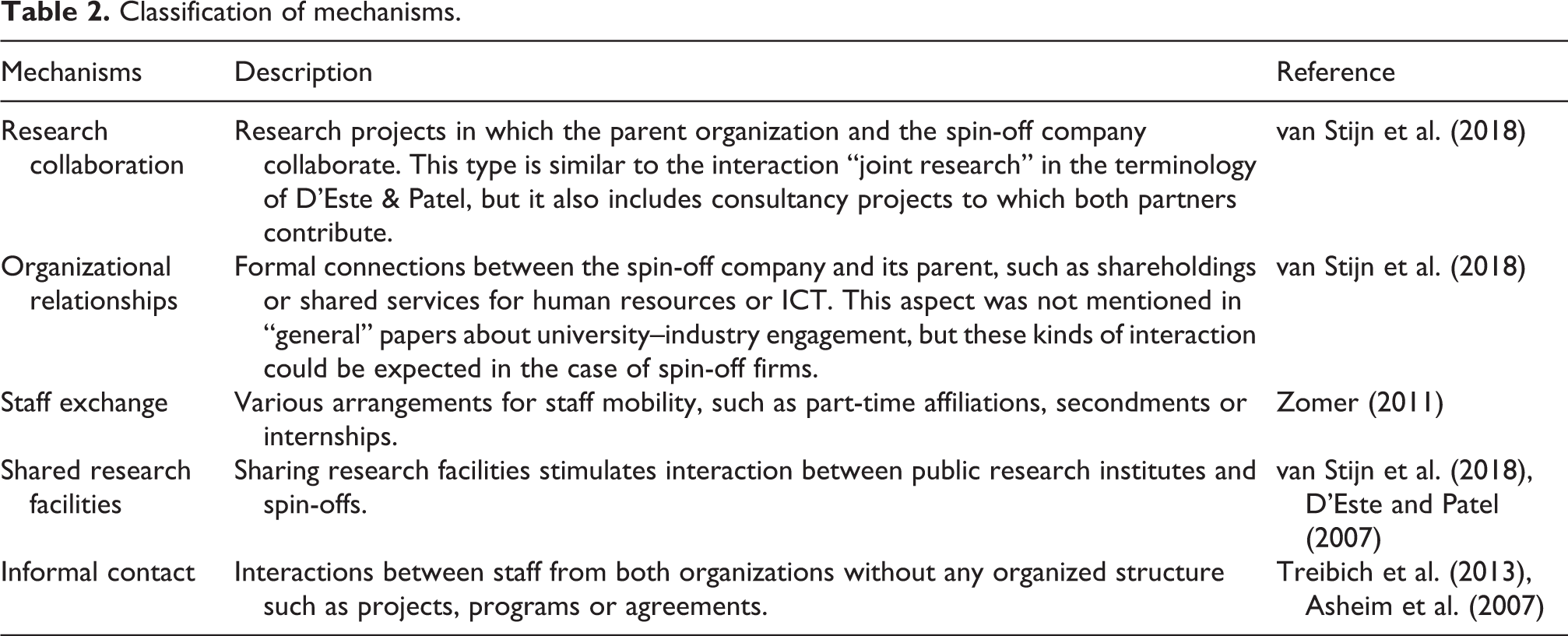
Integrating the different types of interaction found in the literature discussed above, we make an analytical distinction between five types of mechanism that can generate cognitive benefits (Table 2)
Classification of mechanisms.
Conditions
The previous section identified different types of interaction between researchers and commercial parties or spin-off companies that function as a mechanism though which cognitive benefits are integrated into the academic research process. But what conditions support these interactions? In answering this question, the economic geography literature is helpful. From a geographical perspective on innovation, the probability of collaboration is explained by different dimensions of proximity. Proximate partners in the geographical, social and organizational sense make it easier to collaborate: their closeness eases coordination and reduces uncertainty and transaction costs. However, too much proximity might lead to lock-in effects (Boschma, 2005; Heringa et al., 2016). In the geographical literature, four dimensions of proximity are distinguished: – geographical proximity: the shortest possible physical distance between the locations of two organizations; – organizational proximity: a similarity in incentives and routines of two collaborating organizations; – social proximity: the social embedment of the collaboration between actors, following from prior collaboration experience or other social connections; and – cognitive proximity: the similarity in knowledge backgrounds of different partners.
The influence of cognitive proximity was confirmed in a study on spin-off companies. Treibich et al. (2013) found that similarity of research interest was a crucial condition for collaboration. In their dataset of parent–spin-off couples, a major change in the research agenda of one of the partners was accompanied by a major change in interaction intensity.
Collaboration between universities and industry tends to be more complex than collaboration between two research organizations, due to the institutional distance and organizational routines (Boschma, 2005). Academic researchers tend to use a longer-term perspective (developing knowledge that may eventually lead to new products), while industry is typically interested in short-term benefits (profit) (Kloet et al., 2013). Many academic researchers are concerned about academic freedom (Tartari and Breschi, 2012). Intellectual property issues form a second barrier that has been frequently reported (Sjöö and Hellström, 2019). Factors that can help to diminish or overcome these barriers include trust, mutual understanding and face-to-face contact (Bruneel et al., 2010). These factors can be produced by a combination of individual and socio-cultural factors.
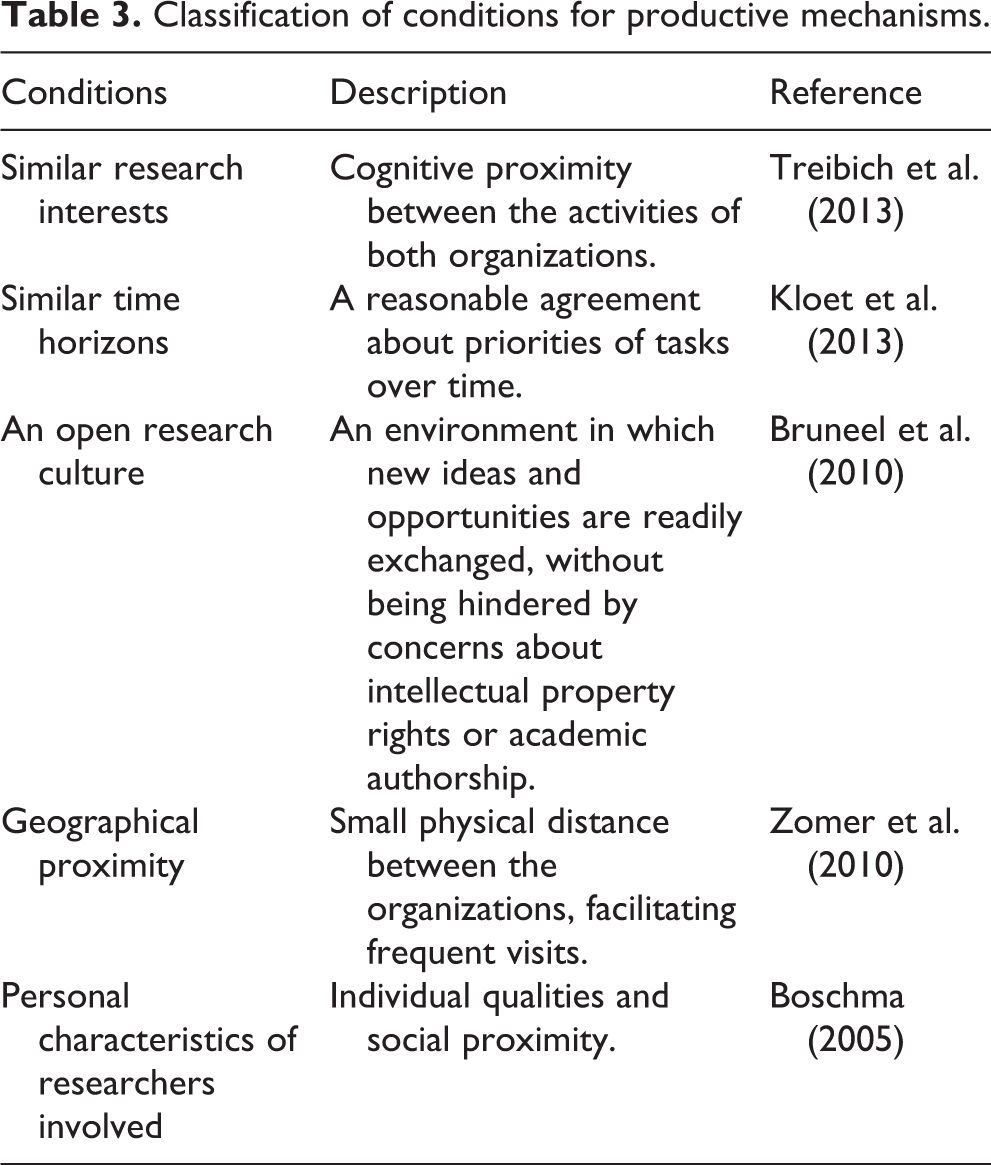
Integrating this literature, we distinguish between five conditions that may influence the interaction between public research organizations and spin-offs. Note that we do not include organizational proximity in our analytical framework because this variable is rather constant in our object of study: each case is a combination of a spin-off company and a public research organization. Another variable we exclude is the availability of sufficient resources (time and funding) for interactions. This is a generic requirement that will influence any type of interaction or collaboration (see Table 3).
Classification of conditions for productive mechanisms.
Exploratory case studies
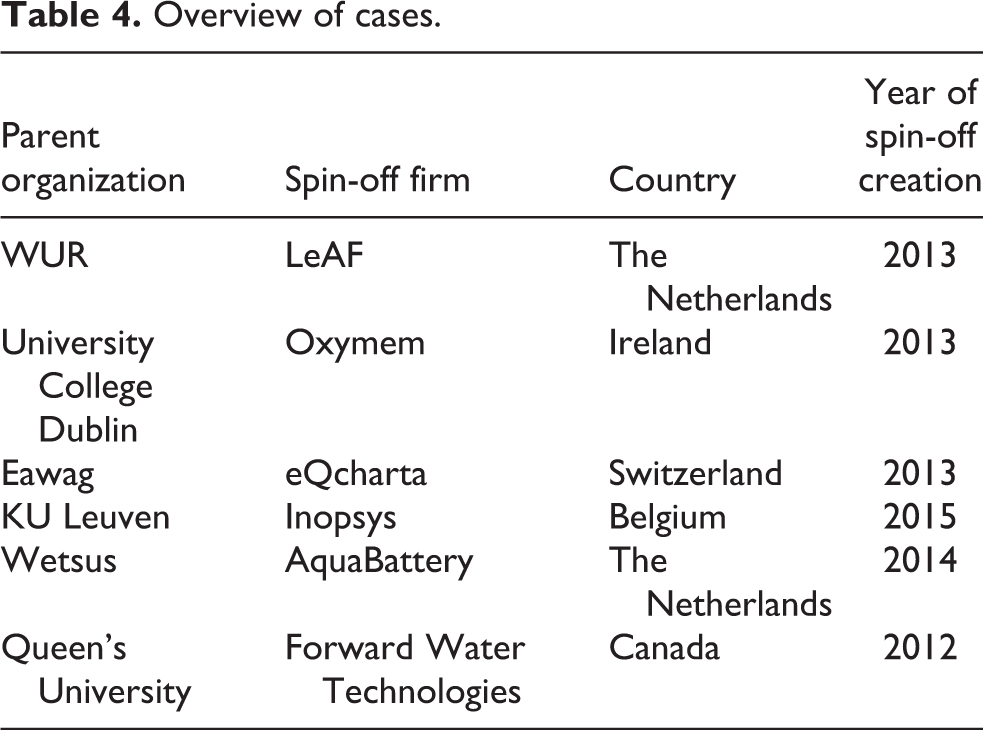
To explore the usability of our framework for analyzing cognitive feedback loops between spin-off companies and parent research organizations, we have analyzed the mechanisms and conditions identified in our framework in an empirical setting. Given the exploratory nature of our study, we have chosen a case study design. Case studies enable in-depth analyses of phenomena in direct relation to their context (Yin, 2017). Case study research can therefore be used to explore the (causal) relationships between the object of study and contextual factors and to develop hypotheses that can be tested in subsequent research. Because of the diversity of interactions between parent and spin-off that could be expected (Treibich et al., 2013), we chose a multiple-case design for our empirical analysis. With a multiple-case design, a more comprehensive exploration can be conducted and findings can be compared across cases (Yin, 2017). We studied six cases of interaction between spin-off firms and their parent research organizations. To facilitate a comparative analysis, we limited our sample to the water technology sector. On the one hand, the water technology sector was chosen for pragmatic reasons (the research program that funded the study and the affiliations of the authors). On the other hand, it is an appropriate choice because there is a strong tradition of collaboration between industry and academic research organizations in that sector, and because the technologies applied are sufficiently knowledge-intensive to facilitate a knowledge feedback loop between spin-off companies and their parent research organizations. All cases concern academic spin-off companies – that is, firms that have spun-off from a university or an academic research institute. We sampled firms that were (at the time of the research) between 3 and 10 years old (see Table 4), because we expected that, at this age, interactions with their parent organization would probably be ongoing, while they would also have had sufficient experience with such interactions to enable reflection. We strived for variation in terms of current size and geographical context.
Overview of cases.
For each case we describe the interactions between the spin-off and its parent research organization based on in-depth semi-structured interviews with representatives of both organizations. The interviewees were selected as key people in the interaction between the two organizations. They often had the role of Chief Technology Officer (CTO) or Scientific Director at the spin-off company and that of Group Leader or Professor at the parent organization. In several cases our interviewees had a dual affiliation, which facilitated reflection on the mutual relationship between the two organizations. Our interview guide included questions about the nature and intensity of mutual interactions (“mechanisms” in our analytical framework), the cognitive benefits generated by these mechanisms, and the conditions that facilitate or constrain these mechanisms. After approval by our interviewees, interview reports were analyzed with NVivo (software for qualitative analysis, which helped us to classify text fragments corresponding with the different elements in our analytical framework (see Table 5).
Codes used in qualitative analysis of the interviews.
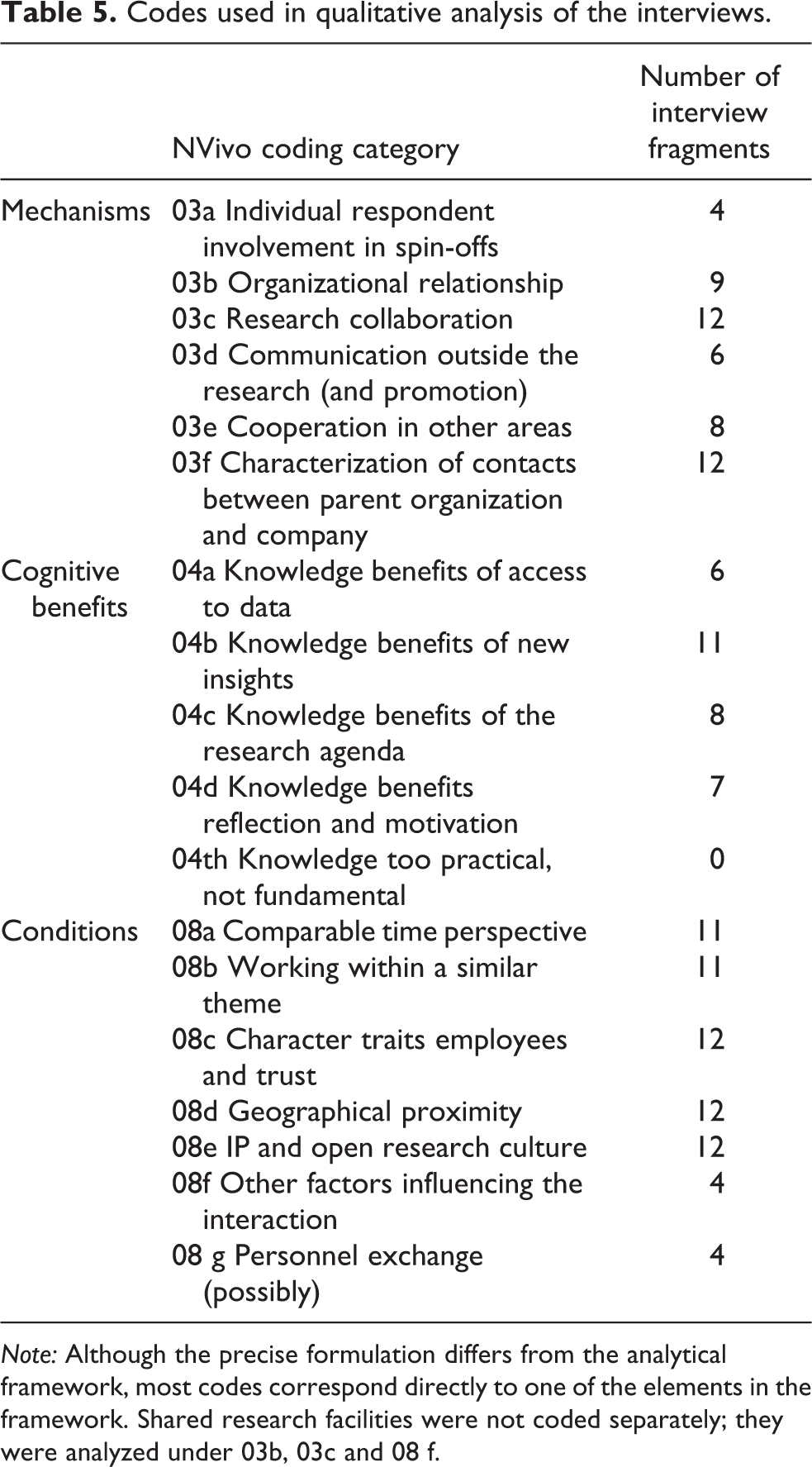
Note: Although the precise formulation differs from the analytical framework, most codes correspond directly to one of the elements in the framework. Shared research facilities were not coded separately; they were analyzed under 03b, 03c and 08 f.
The limited data available about each individual case did not allow us to apply the principles of a qualitative comparative analysis. Rather, we identified a number of similarities and differences across the cases that help toward a better understanding of the causal mechanisms between conditions, mechanisms and benefits.
Case studies: Results
LeAF–WUR
LeAF is an independent research and consultancy organization that specializes in, among other things, wastewater treatment, and energy and nutrient recovery and re-use. The organization was founded in 1997 by researchers affiliated to the Environmental Technology Department of Wageningen University & Research (WUR) to develop and disseminate knowledge about the application of water technologies analyzed by researchers in the department. Thus, the university and the spin-off deal with the same technologies. While the university focuses on the development of the technologies, the spin-off is concerned with their practical application, connecting scientific and practical knowledge.
Despite being independent organizations, LeAF and the university are closely connected. Many of LeAf’s employees also (still) have a formal appointment at the WUR Environmental Technology Department and there is a substantial amount of formal and informal contact between the organizations. For example, the WUR professor we interviewed is employed by the spin-off for 1 day per week. Through their contacts, information is exchanged about research developments, project ideas and funding opportunities. Both organizations collaborate intensively when setting up new projects. However, because of the difference in focus, LeAF and WUR do not always collaborate in actual projects and, when they do, they are often involved in separate work packages.
WUR researchers benefit from the interactions with LeAF in two ways – with new insights and a more relevant research agenda. The research collaboration with the spin-off generates new insights from practice and application. Through application, new research questions arise when, for example, the technology behaves differently than predicted. These questions can be answered through scientific research in ongoing projects when there is still a budget. The interaction also leads to a more relevant research agenda. By interacting with LeAF, university researchers learn what questions the market needs answering. This allows the university to focus on research that is actually needed in practice.
The interaction between LeAF and WUR is facilitated by three conditions: – Close geographical proximity. LeAf is located in the same building as the research group of the university and makes use of the facilities at the university by paying a fee. This boosts formal and, especially, informal contacts. “Many contacts are informal, in the corridors and at the coffee machines. We probably would not schedule in a meeting for these kinds of contacts but they are very valuable.” – Similar personal characteristics. Employees at LeAF and the WUR Environmental Technology Department share personal characteristics and intrinsic drives. They share the drive for research application and both actively initiate collaboration. This facilitates collaboration between the institutes. – Similar research interests. Both organizations focus on water technologies, which enables collaboration in setting up and performing research projects.
The differences in time perspective make the collaboration more difficult. LeAF is typically involved in short-term consultancy projects, whereas WUR participates in year-long academic research projects. This difference in rhythm makes it less logical to collaborate.
Oxymem–UCD
Oxymen is a spin-off company from University College Dublin (UCD). The company uses a Membrane Aerated Biofilm Reactor to increase the biological treatment capacity of waste water treatment plants and the quality of their effluent. The company has been independent for 3 years.
Oxymen and UCD have a close and well-coordinated relationship. Their main interaction is research collaboration. The two organizations prioritize research topics and write proposals together, and collaborate on research projects. They share personnel. For example, one PhD student at UCD is co-funded by Oxymem. There are also exchanges of staff: some of the UCD researchers split their time over the two organizations. There is much informal contact: “I talk to people from Oxymem every day, we often have short phone calls, especially in the evening to get an update on how things are going” (UCD interviewee). The two also publish together. “A lot of the journal publications and conference proceedings include co-authors from both the firm and UCD.”
Oxymem occasionally asks for assistance with operational problems, and sometimes uses the lab facilities of UCD. The university and the spin-off also do some PR and communication together. The university actively promotes any awards the company receives. The company in its turn distributes newsletters from UCD through its networks. There is also an organizational link, as UCD owns about 10% of the shares in Oxymem. Aside from this link, there are no shared administrative resources.
In this case study, collaborative research, staff exchange and informal contact generate four types of cognitive benefits for UCD. First, the frequent communication between the two helps the university to acquire insights into problems that would be of interest in the industry in general (agenda). “We are discussing issues and challenges. UCD will then apply for grants or start new research projects or programs” (UCD interviewee). Second, UCD also receives data from the real-life plants of Oxymem that can be used for scientific analysis. Third, UCD acquires insights into the problems and challenges of scaling up technologies. “At UCD we always work under idealized conditions. Oxymem does things under real-world conditions – such as environmental conditions, which are changing conditions.” Finally, with regard to reflexivity, one interviewee pointed out the importance of the collaboration for reflecting on problems and solutions: “The collaboration presents me with many more problems that we can solve. It can also be an ego-boost, it gives the feeling that our work is of importance.”
There are three main conditions that facilitate the collaboration, staff exchange and informal contact: – Similar research interests. “The strong thematic connection makes it easy to collaborate.” – Personal characteristics. “In our case there are similar personalities, there is acceptance and understanding. People are prepared to work together and understand each other.” – A good intellectual property (IP) arrangement. This creates an open research culture: “When you have an all-encompassing agreement, everything falls under the same agreement. That’s really helpful, because it implies that for most projects we do not need to discuss IP” (UCD interviewee).
Despite the significant geographical distance (a 1–1.5 hours drive) and the difference in time horizons, the collaboration is not negatively influenced by these factors. There would probably be more informal contact if the two were geographically more proximate, but the distance does not hinder collaborative research or staff exchange.
eQcharta–Eawag
The spin-off company eQcharta focuses mainly on freshwater-related issues. Born as a spin-off of the Swiss water research institute Eawag, it performs impact assessments of the usage of water resources for activities such as hydropower production, develops mitigation strategies, and performs general measurements of freshwater ecosystems.
Eawag and eQcharta collaborate continuously and intensively on several projects and publish scientific articles together. In these projects the company would typically conduct drone flights to collect data that can be used for research. Some of the projects are designed and prepared together; others are the initiative of the parent in which the spin-off assists. The two also frequently share research equipment, but there is no organizational relationship or common PR.
The parent benefits from the collaborative research and the shared equipment by acquiring valuable research data, new insights and input for the research agenda. There is also a lot of informal contact between the two organizations, but this does not seem to be a main mechanism for knowledge feedback.
The interviews confirmed that all five factors from our analytical framework influenced the interactions between the two: – A good personal relationship (friendship). “We have been friends for many years.” – Similar time perspectives. The fact that both organizations respect timelines and deadlines has facilitated the collaboration. – Geographical proximity (a 40-minute drive). This leads to face-to-face meetings at one of the companies or somewhere in between. – Similar research interests. They have similar ideas of how systems work, and that helps them find each other in different projects. – Open research culture. Although the research technology used (drones) is owned by the spin-off, there are no limitations to sharing the research results.
Inopsys–KU Leuven
Inopsys aims to solve issues regarding industrial wastewater, and focuses in particular on its on-site treatment. Inopsys developed from KU Leuven in The Netherlands and is 3 years old.
The company and the parent collaborate in different ways. The parent conducts consultancy projects, screenings and laboratory tests for Inopsys. The two also carry out research together to further develop the technologies of the spin-off: there are two research projects with government funding which were acquired through a collaborative effort. The organizations also share research equipment (for example, Inopsys employees are allowed to use the parent’s laboratory), which helps to generate frequent face-to-face contact. In terms of staff exchange, one PhD graduate from KU Leuven now works for the spin-off but there are no employees with double affiliations. There is a formal relationship between the two organizations: KU Leuven is a (minority) shareholder of Inopsys. Finally, there are occasional shared communications activities.
The collaboration and informal contact between the university and Inopsys contributes in general terms to the research agenda of the parent group. However, the firm is still too young (3 years old) to be able to generate relevant insights or to help formulate specific research questions. The same applies to the data that the spin-off has so far generated: more applied research is needed before the data could be useful for scientific purposes. The interaction with the spin-off contributes to the motivation of university researchers, many of whom are engineers who like to see their work applied in a commercial context.
The various mechanisms for cognitive benefits are facilitated by: – Similar research interests. To a large extent, the companies work in the same thematic field. Starting off from the same technologies creates common ground and facilitates communication. – Good personal relationships. The staff of both organizations have similar characteristics, because Inopsys hired staff from KU Leuven. This facilitates collaboration between the two. – Geographical proximity. The fact that the organizations are only 5 km apart helps to generate informal contact. It is easy to make face-to-face appointments. – A good intellectual property (IP) arrangement. The clear agreement about IP is helpful and creates an open research culture between the two. Jointly produced knowledge becomes shared IP and the spin-off has the first right of refusal of new research produced in the university’s research group.
There is a clear difference in time horizon, but that does not hinder the interactions according to the interviewees. The organizations have made agreements concerning how to work with the different time horizons.
AquaBattery–Wetsus
AquaBattery aims to develop a sustainable way of storing energy in the form of a battery based on water and table salt without the need for environmentally harmful components. AquaBattery developed out of blue energy research at Wetsus, a Dutch research institute on sustainable water technologies.
The organizations remain formally connected, but they have their own PR strategies, in which they do mention one another. They are in regular contact, at least weekly, and this contact is often informal. They conduct research and write research proposals together. The two organizations are linked through staff exchange: several PhD students from Wetsus are employed at AquaBattery and a program manager at Wetsus has an affiliation at AquaBattery.
Cognitive benefits for the parent of the staff exchange, collaborative research and informal contact are practical knowledge (how to use particular materials and technologies), new insights and input for the research agenda: “If it weren’t for the spin-off, there would be less demand to work on the design just as there would be less interaction with other companies.” The parent does not acquire useful research data. “This is something that I also notice when collaborating with other startups. Data sharing is nice in principle, but the data produced in a startup is often not suitable for science. The data is often not documented in a structured way, but more fragmented.” The engagement with the spin-off is also considered stimulating by most PhD students.
The collaborative research and staff exchange are facilitated by four conditions: – Similar research interests. These are grounded in the common background of the staff. – Personal characteristics. There is strong trust between the two organizations thanks to the shared background of many employees. – Clear agreements about IP. “As a principle Wetsus does not have the goal to accumulate IP, we mainly want to make it available for the companies. Everything that results from Wetsus research is a property of Wetsus. However, the companies have the right to buy it.” – Reasonably comparable time perspectives. “Actually things are not moving fast on our side [spin-off] either. The market in the Netherlands is not ready for it yet at the moment.”
There is a significant geographical distance (more than 2 hours driving). On this point, the organizations have different views. According to the parent, the distance does not hinder the collaboration because both organizations are used to working with digital media. The spin-off, however, indicates that distance does pose limitations to the collaboration, and that this is one of the reasons why it has intensified interactions with another academic partner.
FWT–Queen’s University
Forward Water Technologies (FWT) aims to establish the commercial viability of the forward osmosis system, a system which has been developed by Queen’s University in Canada to treat exceptionally high salt and mineral content wastewater streams. The linkage between FWT and Queen’s is partly mediated by GreenCentre Canada (GCC), a non-profit organization that aims to support entrepreneurship in environmental technologies. The three organizations collaborate, each with a different role. Promising results from the lab at Queen’s are taken up by GCC for testing at a larger scale and checked for costs and practical aspects. GCC manipulates the technology to make it ready for commercial application. After successful experimentation, new technologies move to FWT for large-scale pilot testing. Overall the relationship between the companies can be characterized as cooperative. At the beginning FWT was solely funded by GCC, but now it is also financed by private funds.
Queen’s university and FWT are connected in several ways. First, the university still owns the IP in the technology while FWT invests in research in Queen’s Lab, where the technologies for FWT are developed. This makes it difficult for the spin-off to attract funds. However, a shift is occurring, with the university becoming more comfortable with FWT owning the IP in the technologies which FWT sponsored. The university and FWT do not write scientific papers together, but FWT does provide feedback on the papers. There is frequent communication between the organizations: “We are frequently talking with Howie [spin-off employee] and the others, to make sure that our work is relevant. I always want to make sure that that the work of my students is useful for industry.” If possible there are face-to-face meetings, but otherwise they hold joint meetings every couple of months. The professor and the spin-off owner talk every week: “Frequent interaction is crucial to make sure that the research in my lab is on target,” said the university interviewee. In disseminating the results both parties mention one another.
The collaboration leads to three kinds of cognitive benefits for Queen’s university. It gains more knowledge on data, such as the qualities of membranes FWT are using. While these data are not suitable for scientific publications, they do help Queen’s university to choose an adequate research set-up. The collaboration also yields scientific insights into conditions that create particular problems. Additionally, the university acquires business, engineering and material insights. There are also reflexive benefits: the university learns more about the practical aspects of the technologies they develop and about the commercial context in which they are applied. This helps to focus the research agenda on specific applications.
The collaborative research and staff exchange are facilitated by two proximity conditions. First, similar research interests make communication easier between the organizations. Second, personal characteristics facilitate collaboration and communication. A similar background helps to overcome the difficulties that arise from a different time perspective: “I could work with others, but a personal match makes it easier. I don’t feel uncomfortable with sending Howie an email with stupid questions,” said the interviewee from the university.
The difference in time perspective is overcome by the shared background of the Professor and the spin-off owner.
Overview of findings
In this section we compare our observations across the six cases studied. We start with the cognitive benefits, and work from the bottom to the top of Table 6.
Overview of the findings across the six case studies.
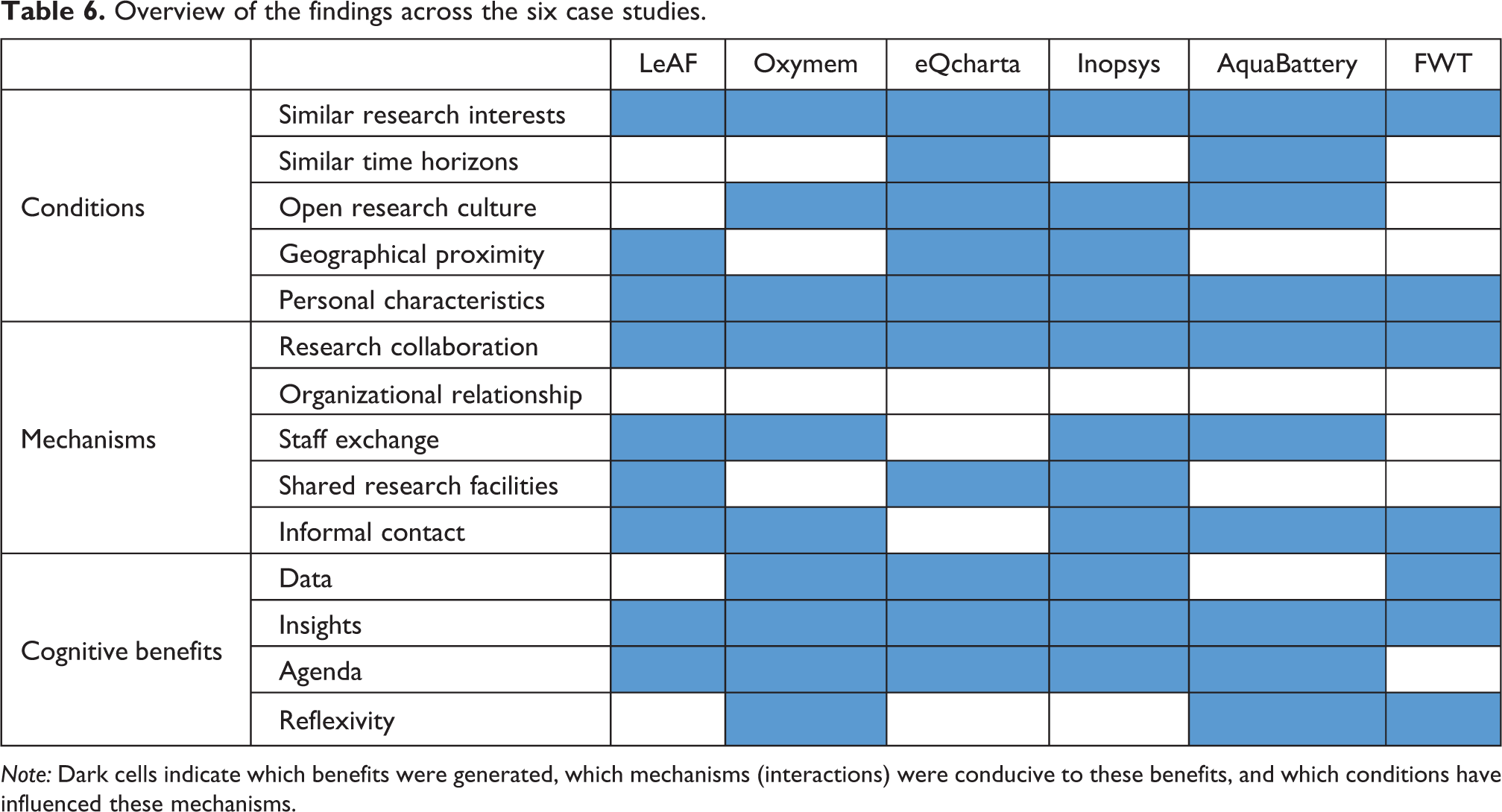
Note: Dark cells indicate which benefits were generated, which mechanisms (interactions) were conducive to these benefits, and which conditions have influenced these mechanisms.
The cognitive benefits we expected, based on the literature, were found in at least half of the cases. First, all academic research organizations benefit in terms of new insights about the technologies they investigate. Through frequent interactions with their spin-offs they acquire insights into the influence of real-world conditions on the developed technologies or solutions. The practical application of these technologies can show, for example, under what conditions they fail, and this provides important insights into the scientific models behind the technologies. Similarly, researchers also learn about the importance of actors, interests and institutions in relation to a particular concept or technology. Second, in most of the cases we found that the parent organization benefited from the interactions with the spin-off firms in terms of improving its research agenda. Regular exchanges and collaboration with spin-offs help articulate relevant research questions, both basic and applied in nature. Only one of the parent organizations indicated that its research agenda was not significantly influenced by the interactions with the spin-off unless the interactions led to the funding of new projects.
For some of the research organizations, interactions with spin-offs also improve the reflexivity of their researchers. They provide an occasion to reflect on their own goals and activities, the usability for end-users, and in this sense also contribute to the general motivation of researchers.
In most cases, the interactions provide access to useful data, but remarkably these are only seldom used in scientific research. In contrast to indications in the literature (van Stijn et al., 2018), the data are in most cases not suitable for scientific research. In a spin-off firm, data are typically not collected systematically, so the available data are too fragmented for scientific analysis. In one case, a researcher often uses testing data from the spin-off – for example, about the qualities of certain research materials. These data are not analyzed for scientific publications, but typically help in the design of a viable research set-up. One interviewee at a parent organization commented, “It allows us not to worry about that aspect [scientific publication], and focus on the part of the process that we are most interested in.”
We also found some cognitive benefits that were not covered in our analytical framework, because we had not expected these benefits based on the existing literature: Education of PhD students and postdocs. “The interactions are really important for my postdocs and students. Because most of them will end up with industrial groups when they leave. To be more successful in getting such a job and also in doing such a job, it is very good to know about what is going on in such an environment. To get feedback on aspects such as price or other practical considerations.” Practical expertise. Researchers ask spin-off for advice on what technologies to use for certain experiments or how to work with particular materials. Continuity of knowledge. One respondent argued that knowledge was captured more strongly in the spin-off than in the academic parent, because there was a lower turnover of staff. Given the limited job security in the current academic system (Van Arensbergen, 2014; Young, 2015), continuity of staff is sometimes higher in a spin-off than in its parent organization.
The most important mechanisms behind these cognitive benefits are collaborative research, informal contacts and staff exchange.
First, most of the parent organizations conduct collaborative projects with their spin-offs, ranging from multi-annual PhD projects to short consultancy assignments. Collaborations take the form of bilateral partnerships and consortia with several partners. The partners typically collaborate across the whole research cycle, from preparation (including the writing of research proposals) to research activities and publishing. These collaborations often depend on government funding for university–industry collaborations, because the spin-off company itself typically has few resources available to invest in research. In three cases, the partners also share research equipment. In one case, five out of the seven spin-off employees regularly spend time in the laboratory of the parent organization. Sharing equipment can be beneficial if the company needs advanced laboratory equipment that is too expensive to buy for itself, or if the parent organization can benefit from a particular practical tool that is available in the spin-off company.
Second, informal face-to-face contact seems crucial. In many cases there are frequent contacts, typically of an informal nature, which often relates to the shared background of the partners as former colleagues in the parent organization. “We’re in contact every week, mostly over the phone and e-mail. I’m happy about it. It’s relatively informal. Little goes through the higher management. The interactions between the researchers are relatively easy. It’s very good.”
Third, in many cases there is staff exchange in the form of dual affiliations for senior staff, frequent hiring of staff or PhD students who divide their time over two locations. Almost all spin-off firms in our sample employ researchers that have earned a Master’s or PhD degree at the parent organization. We found many examples of PhD students who spend part of their time in the parent organization and part in the spin-off company. These interactions are generally considered to be beneficial for the exchange of knowledge between the organizations: “Some of the researchers are employed both with [spin-off] and [parent organization], thanks to which they are informed about relevant knowledge developments.”
Contrary to our expectations, organizational relationships do not seem to significantly influence the exchange of knowledge between the organizations. In some cases there were formal organizational connections – for example in the form of IP arrangements or shareholdings – but these did not generate any cognitive benefits.
In terms of conditions, we found that two dimensions of proximity strongly promoted productive knowledge feedback mechanisms between the research organization and its spin-off: personal characteristics (and trust) and similar research interests. This is in line with economic geography research that has shown how social and cognitive proximity promote research collaboration (Boschma, 2005). In summary: Personal characteristics. Because of frequent staff exchange and shared employment, the staff of both partners are often relatively similar in terms of personal characteristics. This makes communication and collaboration easier: “They also share personal characteristics. They have similar opinions in what they consider good quality and professionalism.” At the same time, there are differences the staff of both organizations. Our respondents characterized researchers as typically less entrepreneurial, and spin-off staff more proactive and business-oriented. Thematic similarity. With shared interests and common ground, communication and working together are easier. For example, the close collaboration between Eawag and eQcharta is partly thanks to the shared research topics of the organizations. One of the reasons the spin-off interviewee gives for their intensive interaction is that they “have similar ideas of how systems work.” The importance of this condition is confirmed by the company in our sample which collaborates very little with its parent organization, because its product has developed in a different direction than the research activities of the parent organization. Somewhat surprisingly, some respondents stressed the importance of differences between the research agendas of public research organizations and spin-off companies: “In the best case scenario I try to keep the focus different. Use the university as a tool, use it for what it’s good for. The university is thoughtful and careful, and we can benefit from this in the demonstration of the potential of our technology.” (FWT)
In addition, many respondents considered a small geographical distance between the parent and spin-off as a positive factor that made communication and collaboration easier: “The geographical proximity helps to maintain contact. Many interactions are informal, in the hallway and at the coffee machine.” Most spin-off companies are located close to their parents, but some are at a distance of several hours traveling. This is not considered beneficial, but it can be overcome by making agreements beforehand regarding the frequency of contact. Technologies such as Skype and working “in the cloud” make long-distance collaboration easier. However, personal meetings are preferred.
What is more, adequate IP arrangements have also contributed to productive mechanisms in many cases. Some respondents stressed that the collaborative relationship between both partners would not have been possible without good agreements about IP. The importance of this factor seems to depend on the type of technology that the spin-off firm is exploiting.
In some cases, research quality and the management of expectations also helped to facilitate a good collaborative relationship. Remarkably, a shared time perspective did not seem to play a major role. The time perspectives of the two partners typically differ strongly (the spin-off oriented toward survival in the short term and the research organization oriented toward intellectual development in the longer term), but this does not hinder the collaboration. In one interview, it was suggested that these differences could be overcome by hiring PhDs in the spin-off companies.
Concluding discussion
While most literature about the interactions between spin-offs and their parent organizations deals with economic and social benefits, this paper specifically explores the cognitive benefits that arise from those interactions. What is more, while most papers have focused on the benefits for spin-off firms (Baroncelli and Landoni, 2019; Treibich et al., 2013; van Stijn et al., 2018), the present study deals in particular with the benefits for the parent organizations. Building on different bodies of literature, we have constructed an analytical framework for understanding the cognitive feedback mechanisms from spin-off companies to parent research organizations. Six exploratory case studies confirm that interactions with spin-off companies can yield important cognitive benefits for the academic research process – most importantly, improvement of the research agenda and new insights into the practical operation of theoretical models and technologies. These benefits were mainly facilitated by staff exchange, collaborative research and personal contacts.
Three conditions facilitated these mechanisms, which boil down to social, cognitive and geographical proximity. In addition to proximity, a certain degree of cognitive distance also seems beneficial. Some cases showed that differences in time perspectives and complementary research interests generated synergy between the partners.
This paper is a first exploration into the feedback loops that support knowledge to flow back from spin-off companies to parent research organizations, with an empirical focus on the water technology sector. The literature suggests that the relative value of different cognitive benefits will vary across sectors (Rappert and Webster, 1998). Future research should take into account the variation among spin-off companies in terms of their activities and the required knowledge base (Druilhe and Garnsey, 2004). Some of the mechanisms we found are strongly linked: in particular, collaborative research, shared facilities and informal contact. More in-depth research will be required to unravel which of these mechanisms are decisive for generating cognitive benefits, and qualitative comparative research will help to test and generate more robust findings. The same goes for the interplay and possible mediation effects between the different conditions in our framework. Further research could also look into more mature spin-offs, and into spin-off companies that do not collaborate with research organizations, or even have a conflict with their parent (Treibich et al., 2013).
In practical terms, some suggestions can be derived from our analysis for both research organizations and spin-off companies to maintain fruitful and productive interactions. First, it seems worthwhile for research organizations to maintain interactions with their spin-off companies as long as they have a shared research interest. Since spin-off firms typically have high social and cognitive proximity to their parent organization, they are a preferred partner compared to many other companies. In addition, we would suggest that both partners invest in frequent interactions and exchange of staff. Staff exchanges turned out to be a very central mechanism for knowledge transfer. In correspondence with the literature on face-to-face contacts (Asheim et al., 2007), this suggests that people are crucial carriers of information in this setting.
Footnotes
Acknowledgements
The authors wish to thank all interviewees for their cooperation. We also thank Stefania Munaretto, Frank van Rijnsoever, Robert Tijssen and Arend Zomer for their helpful feedback on an earlier draft.
Declaration of conflicting interests
The author(s) declared no potential conflicts of interest with respect to the research, authorship, and/or publication of this article.
Funding
The author(s) disclosed receipt of the following financial support for the research, authorship, and/or publication of this article: This study was made possible by funding from BTO, a collective research program of Dutch and Flemish drinking water utilities.
