




Abstract
Higher education institutions (HEIs) are experiencing a challenging era due to demand–response imbalances. An assumed means of responding to the challenge is through the entrepreneurial university model, which adds a third mission to HEIs: to contribute to economic, technological and social development. Therefore, governments across the globe promote this ideal through system reforms and funding schemes, while HEIs ignite institutional changes. Publications also explore the entrepreneurial university model, although some scholars have criticized the new mission and its implied commercial orientation. However, little is still known about how HEIs are applying the model to become more entrepreneurial. Therefore, this article presents a systematic literature review comprised of a meta-ethnography on the transformation journey of 36 HEIs across 18 countries. The outcome is a four-stage iterative action-framework proposition, suggesting that exogenous and endogenous forces constantly influence HEIs which, in response, ignite experiments, requiring sensitization to be consolidated and later institutionalized, in an endless, long and rather slow process. This article contributes to theory by explaining the metalevel of HEIs’ entrepreneurial pathway process and to practice by providing policymakers and decision makers in HEIs with an analytical framework.
Keywords
In recent decades, countries have carried out higher education reforms and developed policies that have changed the autonomy, public financing, mission and accountability of higher education institutions (HEIs). Now, HEIs are expected to be enterprising and to actively contribute to developing entrepreneurial ecosystems (Etzkowitz, 2019; Oh et al., 2016). The ideal, expressed by the entrepreneurial university model, incorporates and transcends existing dichotomies in a new synthesis: ivory tower–polytechnic, research–teaching (Etzkowitz, 2004). It gives HEIs a third mission to respond to knowledge societies’ economic, technological and social demands, producing human, knowledge and entrepreneurship capitals that generate innovations, increase competitiveness and positively affect economic growth (Etzkowitz, 2014; Guerrero et al., 2015). Nevertheless, the model has also been subject to criticism regarding its legitimacy and conflicts between the three missions of HEIs (Philpott et al., 2011; Powell et al., 2007; Stensaker and Benner, 2013; Tuunainen, 2005). Without consensus, many HEIs have embarked on a journey replete with challenging organizational changes (Clark, 2004; Mcgowan et al., 2008).
The concept of the entrepreneurial university was introduced in 1983, based on developments at the Massachusetts Institute of Technology (MIT) and Stanford University. An entrepreneurial university was defined as an institution that explored new sources of funds, like patents, research contracts and industry partnerships (Etzkowitz, 1983). MIT and Stanford were initially considered anomalies that would eventually conform to the research model (Etzkowitz, 2004), but they are now seen as epitomizing the entrepreneurial university. Their developments influenced policymaking and motivated HEIs worldwide to emulate them and Silicon Valley (Etzkowitz, 2003a, 2004, 2019), thus making the American academic model evolve to assume many roles in society and within innovation ecosystems (Sam and Sijde, 2014). The concept’s bottom-up emergence in the United States led it to be considered an extension of a university’s research mission, while its emergence in Europe’s welfare context required it to develop as a teaching mission extension (Etzkowitz et al., 2000; Etzkowitz, 2003b). Beyond the United States and Europe, this phenomenon has been documented in, among others, Brazil (Almeida, 2008; Amaral et al., 2011), Chile (Bernasconi, 2005), China (Zhou and Peng, 2008), Iran (Salamzadeh and Yadolahi Farsi, 2015), Japan (Yokoyama, 2006), Malaysia (Ahmad et al., 2018), Turkey (Beyhan and Findik, 2018), South Africa (De jager et al., 2017) and the United Arab Emirates (Bhayani, 2015). Its export has led to global convergence (Etzkowitz et al., 2000), though replication strategies are dramatically limited by environmental, resource and capability differences among HEIs (Etzkowitz and Zhou, 2008; Lazzeretti and Tavoletti, 2005; Philpott et al., 2011; Stensaker and Benner, 2013).
It is currently understood that the entrepreneurial university ideal is applicable to all HEI types in ‘an efflorescence of embryonic characteristics that exist ‘in potentio’ in any academic enterprise (…) with the ability to periodically reinvent itself and incorporate multiple missions’ (Etzkowitz, 2013a: 487). In this sense, a current definition proposes a systemic interpretation: an entrepreneurial university design integrates project-based learning in the curriculum with an outlook of seeking out the useful as well as the theoretical results of investigation. These results are moved into use through an innovation system that includes a penumbra of public and private actors posing problems, concomitantly with the provision of resources. (Etzkowitz et al., 2019: 169)
This article presents a systematic literature review with a meta-ethnographic approach, providing a compendium of 36 manifestations of the entrepreneurial university concept from 18 countries, shedding light on how this emerging global ideal translates into practice. Specifically, the research asks:
How do HEIs transform into more entrepreneurial institutions?
Which gaps and white spots remain in the understanding of this transformation process?
The resulting contributions are threefold:
An improved theoretical understanding of and research into HEIs’ transformation process.
A proposed research agenda.
Core entrepreneurial pathway propositions composed of three paths (ecosystem, education and governance) steered through an action-framework proposition.
The article begins by providing the topic’s theoretical foundation. Next, it uses meta-ethnography to synthesize the experience of 36 HEIs across 18 countries, proposing three paths and an action-framework to empirically explain the process and to serve as an analytical resource for HEI decision makers and policymakers. The findings are then discussed and the limitations of the study are considered with regard to expanding the conceptualization and development of the entrepreneurial university ideal – ultimately suggesting a research agenda before concluding.
Prologue: Theoretical foundation
Existing concepts and framework propositions explaining HEIs’ entrepreneurial pathways are generalizations, which fall short of clarifying how transformation happens in practice and defining the processual stages and required steps. Nevertheless, there is an overall understanding of the complexity and non-linearity of this process, characterized by experimental approaches in a steady state of institutional change (Clark, 2003; Etzkowitz, 2013a). Pathways for transformation are an incipient proposition developed by Burton Clark. He identified the following five elements, which become pathways through their interaction, as the elements alone would not be significant (Clark, 1998b): ‘Strengthened Steering Core’: a dynamic and flexible decision-making process enabled by formal and informal leadership, independent of the institutional governance structure being centralized or decentralized. ‘Enhanced Developmental Periphery’: a matrixed organizational structure with units, centres and parks beyond the traditional institutional structures, extending its boundaries to connect with the ecosystem. ‘Diversified Funding Base’: reduced government dependency, increased autonomy (i.e. self-determination) and active budgetary management to increase the total amount of resources through service commercialization and partnerships with the private sector. ‘Stimulated Academic Heartland’: academic departments and professors becoming entrepreneurial by connecting with the ecosystem and generating new income streams. ‘Entrepreneurial Culture’: an integrated organizational culture that embraces changes, diffused from the academic heartland, steered by core leaders at the university and in its peripheral units to respond to new demands and produce new income streams.
Attempting to understand how developed theory was being translated into practice, Kirby (2006) identified the following strategic actions for enterprising British HEIs: endorsement from senior staff, who act as role models; incorporation of entrepreneurial elements into university levels/departments; development of entrepreneurial targets that are monitored; effective communication, also via publications; support mechanisms via infrastructure, process, training and mentoring; aligned models for equity sharing and staff promotion; cross-disciplinary research and teaching; and promotion via role models and competition. Also in Britain, Newcastle University’s transformation towards entrepreneurialism serves as a pathway example, divided into four main stages (Benneworth, 2007): ‘Naïve’ – the development of services to local industries; ‘Growth’ – the attempt to promote its own spinoffs due to weak demand from local industries; ‘Consolidation’ – knowledge transfer deals made with large corporations to increase revenue; and ‘Reach-out’ – the attempt to open itself to outside users.
Another proposition, developed by Nelles and Vorley (2010), presents an ‘entrepreneurial architecture blueprint’ composed of Structures (entrepreneurial support infrastructure such as incubators and technology transfer offices (TTOs)); Systems (networks connecting different departments/actors); Strategies (institutional goals supported by incentive and measurement schemes); Leadership (orientation and support from university leaders with regard to the third mission); and culture (entrepreneurial attitude at institutional, departmental and individual levels).
In a simplified synthesis, Etzkowitz (2013a) suggests three complementary and non-sequential development stages to explain, in broad terms, HEIs’ paths to entrepreneurialism: University Entrepreneur One (HEI adopts new vision and begins to diversify funding and increase autonomy); University Entrepreneur Two (HEI develops transfer capabilities, actively enabling, sourcing and commercializing intellectual property); and University Entrepreneur Three (HEI uses Triple Helix collaborations to take a proactive role in regional development). This path is supported by four interrelated propositions, which characterize entrepreneurial universities (Etzkowitz, 2014): Interaction (HEI engages in Triple Helix collaborations); Independence (HEI is not dependent on another institutional sphere); Hybridization (HEI creates hybrid organizational formats such as centres and parks); and Reciprocity (HEI continually revises its structures and Triple Helix relationships). Furthermore, in an updated study on Stanford University, Etzkowitz et al. (2019) suggest a threefold strategy for entrepreneurial transformation: project-based experiential learning in teaching; applied research with support mechanisms for transfer; and various public and private partnerships.
Finally, Markuerkiaga et al. (2018) analysed characteristics and actions to propose three clusters based on the transformation status quo of 69 European HEIs. They conducted a quantitative study with institutions as the unit of analysis and technology office managers as key informants. The resulting statistical clusters are as follows: Advanced Entrepreneurial Universities (14 sampled HEIs consolidated the ideal); Emerging Entrepreneurial Universities (10 sampled HEIs were taking initial steps towards entrepreneurialism); and En-route Entrepreneurial Universities (45 HEIs were somewhere ‘in the middle’). This analysis illustrates the complexity of defining what it means to be an entrepreneurial university and how this ideal can be achieved. That most of the sampled HEIs were placed ‘in the middle’ demonstrates the challenge of distinguishing developmental stages.
Review method
This systematic literature review adopts a replicable and transparent search process among published studies on the phenomenon of entrepreneurial universities. The meta-ethnographic constructionism approach was best suited to form hypotheses on the transformation processes of HEIs, enabling the emergence of an action-framework combining empirical evidence with the author’s own expert practitioner insights (France et al., 2014; Lee et al., 2015; Mays et al., 2005; Noblit and Hare, 1988). Meta-ethnography was developed by Noblit and Hare (1988) to provide methodological rigour when deriving substantive interpretations from qualitative studies, facilitating a line of argument by interpreting findings across studies to produce new models (Atkins et al., 2008; Booth et al., 2016; Campbell et al., 2011; Noblit and Hare, 1988). The present author iteratively adopted the original seven steps (Noblit and Hare, 1988), while following enhanced strategies for case selection, analysis and synthesis (Doyle, 2003). After defining the topic and research questions (step 1), the author selected studies to read (steps 2 and 3) by purposively sampling case studies describing HEIs’ transformation, with the institutions as the analysis unit (Figure 1). Afterwards, she determined how studies were related (step 4), following the recommendation to apply selective case boundaries to increase rigour (Doyle, 2003). This resulted in 33 publications reporting on 36 cases (Table 1). Through coding via the ATLAS.ti software (Friese, 2014), the author identified and categorized common themes across studies, HEIs and countries. Towards the end of this step, initial assumptions about the relationship between studies were made (Noblit and Hare, 1988), meaning that the author could, based on the emerging categories, explore the topic’s many manifestations. This iterative process facilitated a conceptual leaping through bricolage (Klag and Langley, 2013) to develop an action-framework explaining how HEIs are transforming into more entrepreneurial institutions.
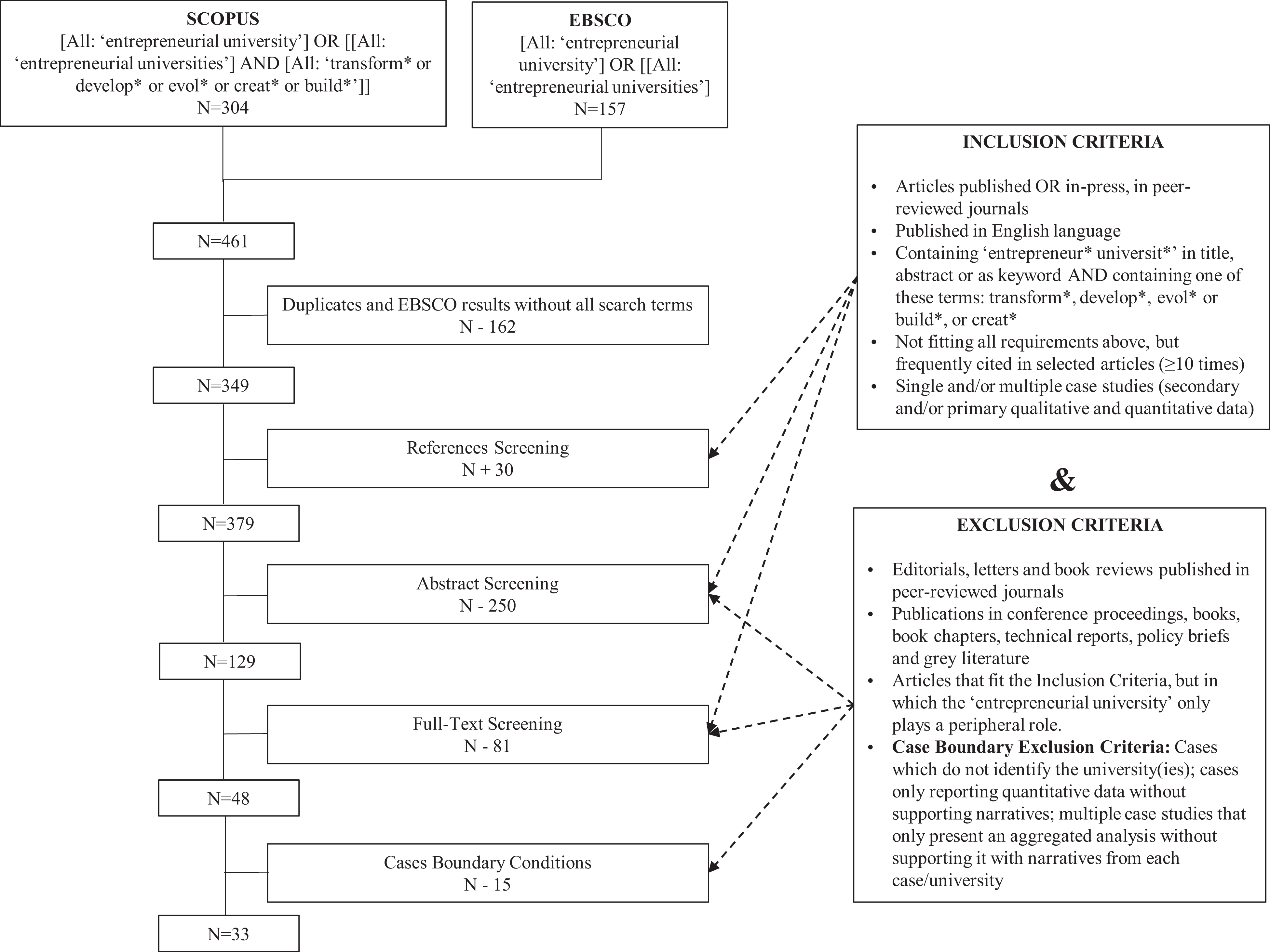
The sampling process.
The sampled cases.
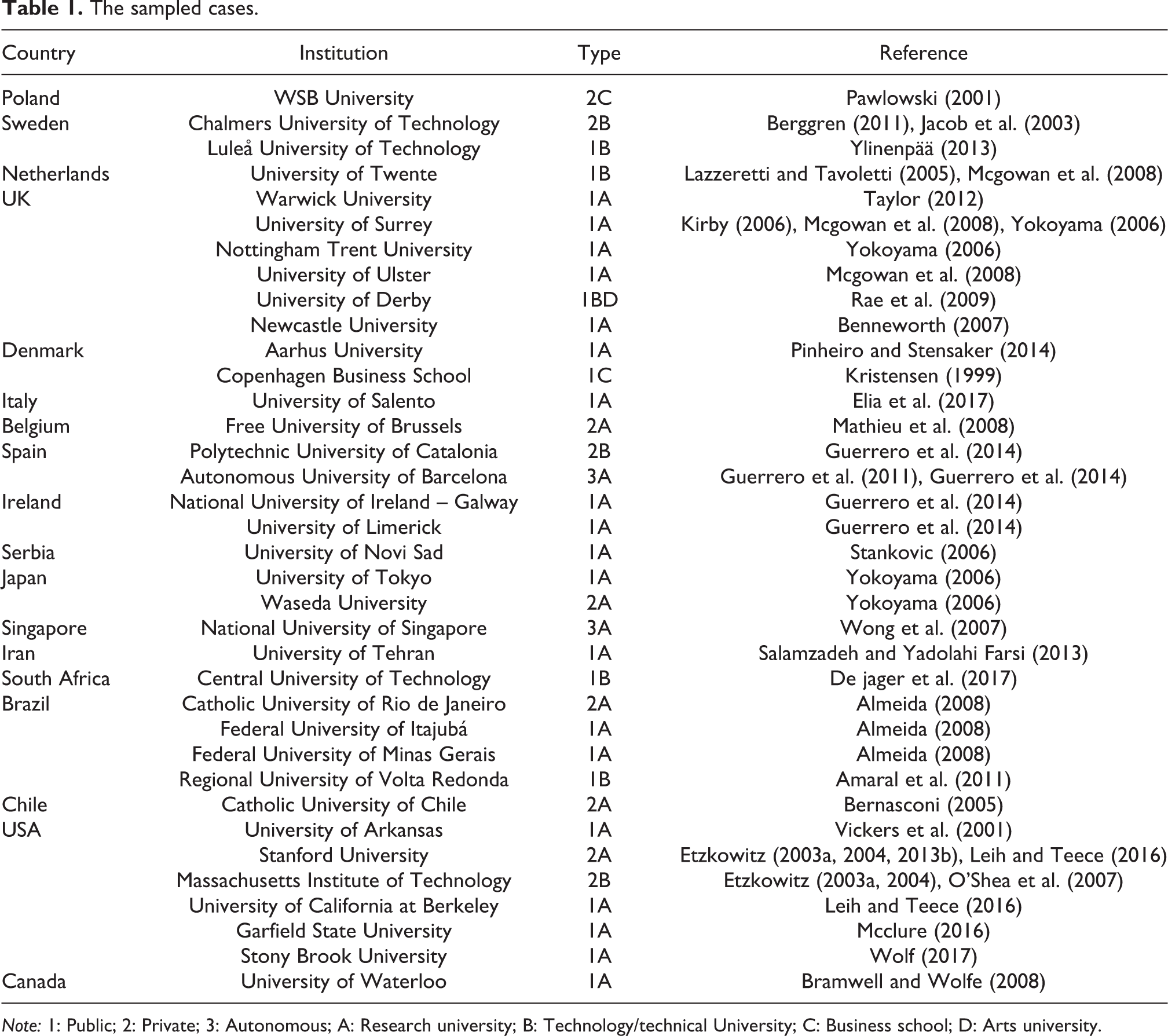
Note: 1: Public; 2: Private; 3: Autonomous; A: Research university; B: Technology/technical University; C: Business school; D: Arts university.
Next, the author translated all studies into one another (step 5) by comparing the cases’ narratives, treating accounts as analogies. To do so, she reviewed the cases, applying the developed action-framework to all 36 HEIs (see Online Appendix). She then synthesized the findings (step 6), considering that synthesis in meta-ethnography ‘does not mean transferability of similar findings on a case by case basis, but rather a reconceptualization across studies’ (Doyle, 2003: 323). Finally, she expressed the synthesis (step 7) in this article, following up-to-date recommendations (France et al., 2019; Noyes et al., 2018).
Entrepreneurial pathways for HEIs
The 36 reviewed cases are contextually different and present a wide range of elements characterizing the actions HEIs take to become more entrepreneurial. The author coded and grouped these into 13 categories (Table 2). Exploring relationships between these categories (Table 2) enabled the identification of the following three complementary, not mutually exclusive, core entrepreneurial pathways propositions:
Entrepreneurial pathways summary per case.
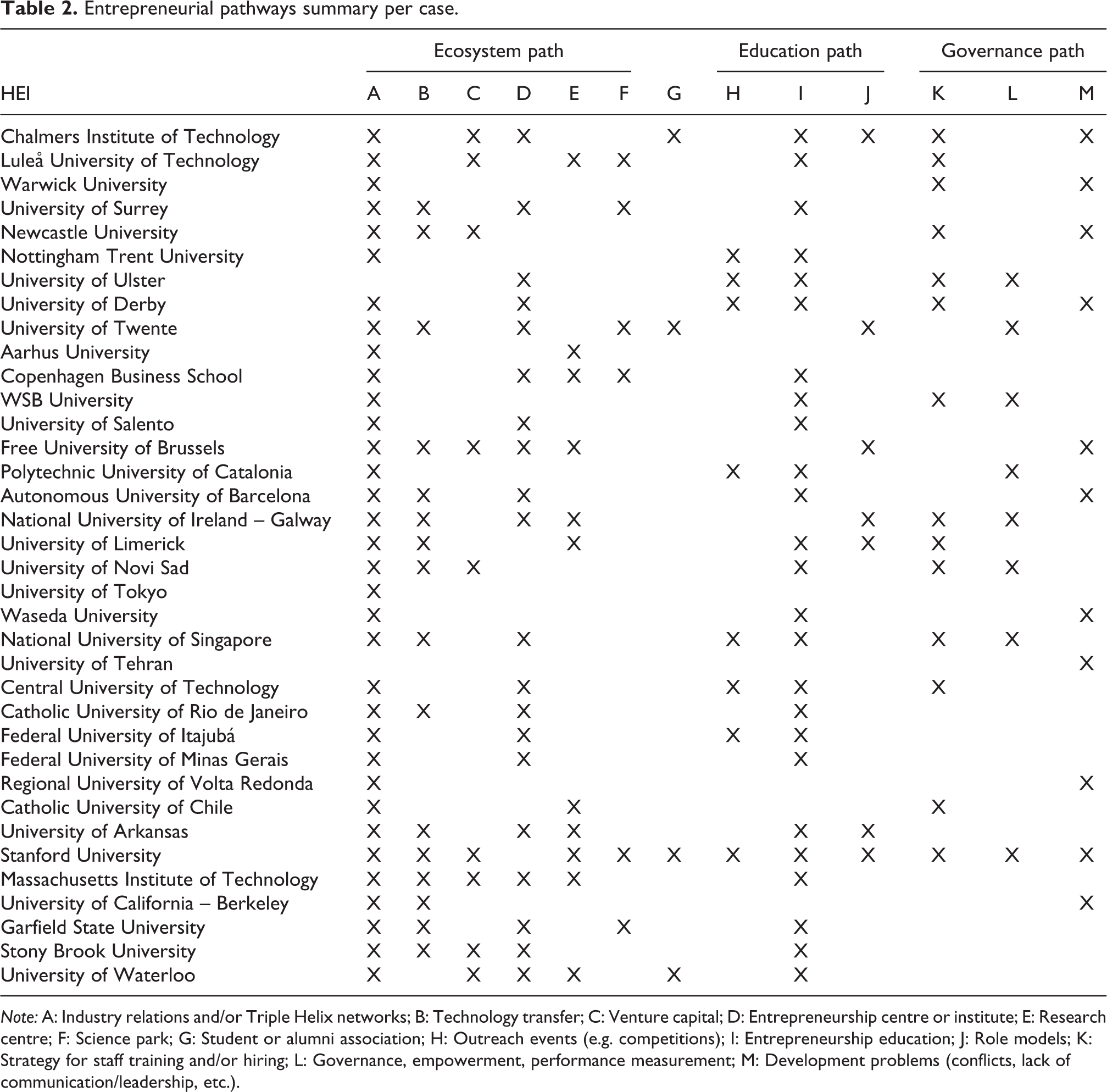
Note: A: Industry relations and/or Triple Helix networks; B: Technology transfer; C: Venture capital; D: Entrepreneurship centre or institute; E: Research centre; F: Science park; G: Student or alumni association; H: Outreach events (e.g. competitions); I: Entrepreneurship education; J: Role models; K: Strategy for staff training and/or hiring; L: Governance, empowerment, performance measurement; M: Development problems (conflicts, lack of communication/leadership, etc.).
Ecosystem path: establishing industry relations, in some cases benefiting from strong alumni relationships (G) leads to forming Triple Helix regional, national or international networks (A). These are combined with technology transfer services (B) and venture capital (C), connecting entrepreneurship centres’ services such as incubation (D), with research centres’ outputs (E), inside the university and/or at parks (F). The expected outcome is resources and capabilities synergy at the meso- and micro-levels
Education path: outreach events, such as business idea competitions (H), sensitizing students to student and alumni networks (G), dissemination support and role models (J). Entrepreneurship education offers (I) are developed in many formats – for example, online, boot camps, undergraduate/postgraduate degrees and interdisciplinary curricular courses (stand-alone or integrating entrepreneurship education learning outcomes with existing courses). The expected outcome is human capital constituted by resourceful individuals with entrepreneurial competences and skills.
Governance path: to minimize development problems related, for instance, to internal conflicts and communication (M), HEI leaders must establish effective governance structures that empower staff members, offer incentives and provide clear performance measurements (L) combined with an aligned staff hiring strategy and training opportunities (K). The expected outcome is a dynamic, proactive and promptly responsive institution.
Transformative action-framework
These identified paths move into action through a non-linear, long-term process constantly influenced by exogenous and endogenous forces (Figure 2). Despite the reviewed HEIs having widely different contexts, the meta-ethnographic method allowed a meta-level proposition to emerge, transcending individual organizational and contextual differences (e.g. developed versus developing countries and HEIs’ entrepreneurial maturity).
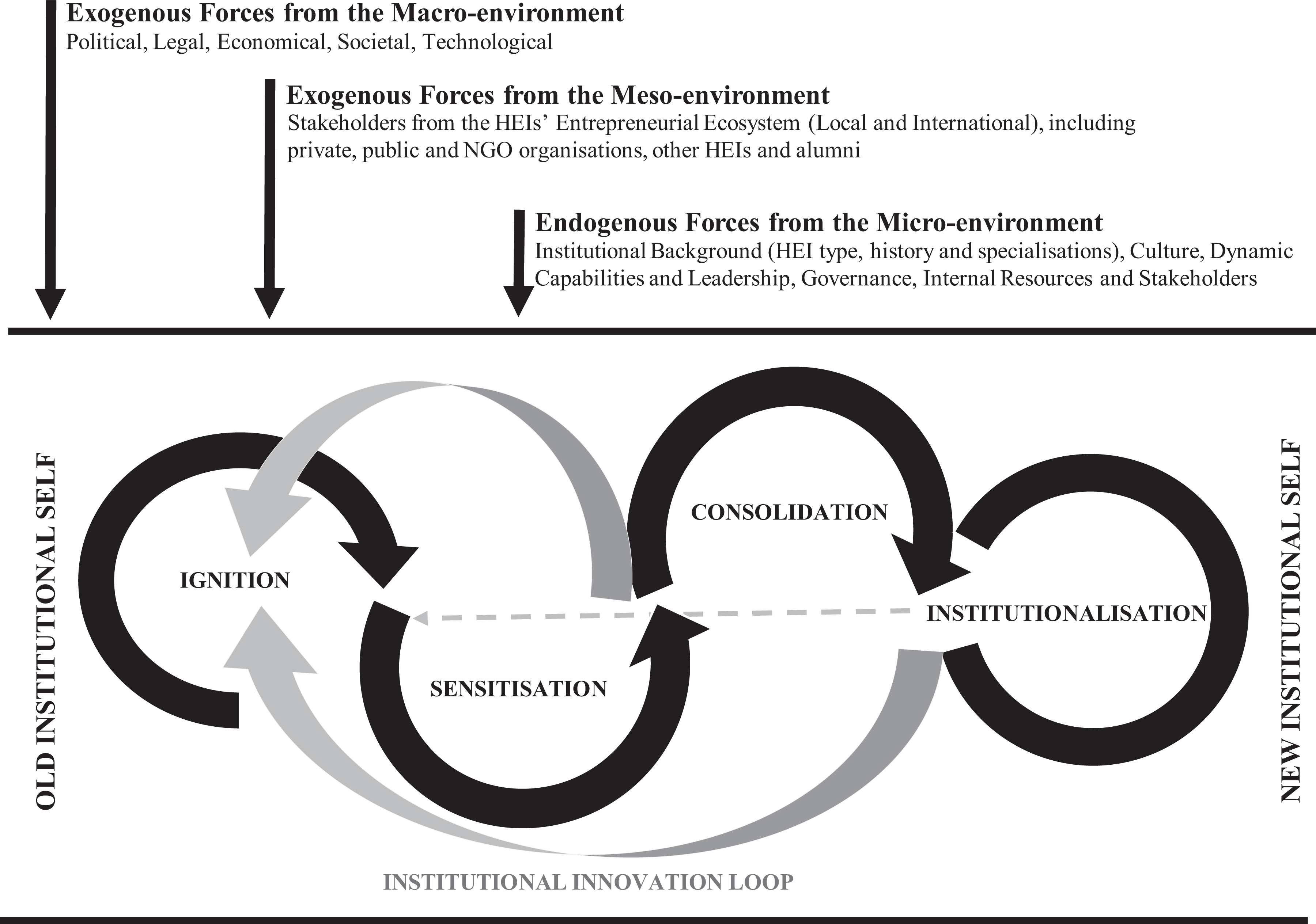
The action-framework.
The action-framework proposition takes an institutional perspective, thus accounting for the exogenous and endogenous forces influencing the transformation of HEIs. Higher education is highly regulated, and political changes influence that transformation. For example, consider Brazil and Chile where military regimes have pushed HEIs towards technology research. In Chile, this inspired a ‘neo-liberal agenda’, characterized by privatization and a new technological research fund, while in Brazil it meant creating technology parks. The return to democracy increased public funding in Chile while the new Brazilian Constitution (1988) defined teaching, research and ‘extension activities’ as the missions of HEIs (Almeida, 2008; Amaral et al., 2011; Bernasconi, 2005). Similarly, the return to democracy in Serbia (2000) led to a new Higher Education Law (2002), increasing the autonomy of HEIs and locally enabling the Bologna process (Stankovic, 2006).
For HEIs in developed economies, political reforms result mainly in increased autonomy, public funding changes and pushes towards the third mission, as in the United Kingdom (1988) (Yokoyama, 2006), Denmark (1993; 2003) (Kristensen, 1999; Pinheiro and Stensaker, 2014) and Sweden (1997) (Berggren, 2011). Many countries have also created specific policies to promote innovation directly affecting HEIs. In Spain, a 2007 reform regulated the use of research output, enabling academic entrepreneurship (Guerrero et al., 2011; Guerrero et al., 2014), while the US Bayh–Dole Act ignited the creation of TTOs in several HEIs in the early 1980s (Etzkowitz, 2003a). In many countries, public development agencies have also emerged, becoming major stakeholders for HEIs, such as Sweden’s VINNOVA (Ylinenpää, 2013), Denmark’s Globalization Council (Kristensen, 1999), Brazil’s FINEP (Amaral et al., 2011) and Chile’s FONDECYT (Bernasconi, 2005).
The lack of such policies and agencies is a major hindrance to the emergence of entrepreneurial universities (De jager et al., 2017; Salamzadeh and Yadolahi Farsi, 2013). A favourable business environment and the cultural proximity of business from HEIs are further influencers from the meso-environment, due to the importance of Triple Helix collaborations (Amaral et al., 2011; Salamzadeh and Yadolahi Farsi, 2013). In more neoliberal contexts, the absence of strong local economies creates opportunities for HEIs to support the emergence of entrepreneurial ecosystems, as with Stanford, Newcastle, Twente, Novi Sad and WSB, or the current attempt by the Central University of Technology.
Endogenous forces directly affect an institution’s ability to ignite the process and be promptly responsive. It is relevant to consider an HEI’s type, size, location and historical background. In this sense, a middle-sized technical university founded in the second half of the 20th century in a region with developed industries might be a natural fit for developing into an entrepreneurial university – for example, Luleå and Surrey. This does not mean that other HEI types may not transform, but they may face harder challenges, as have the University of Tokyo and the University of California–Berkeley. A more feasible entrepreneurial pathway, which the Free University of Brussels has followed, might involve specialized entrepreneurial efforts in specific fields.
Pursuing entrepreneurial pathways requires long-term commitment, clearly defined missions and visions, supportive leadership and enabling governance structures. In almost all the cases, this study has analysed, with the exception of Tokyo and Tehran, the universities added the ‘third mission’ and edited their visions accordingly. Furthermore, HEIs with matrixed organizational structures that empower individuals to be enterprising and professors to run their departments as ‘quasi-firms’ seem better prepared to navigate the process – for example, Stanford and Aarhus.
To establish these elements, it is essential for supportive leadership to provide the necessary guidance. Throughout the journeys of the sampled HEIs, a number of individuals have played crucial roles. The main example is Frederick Terman (Stanford), who is ‘hyperbolically’ considered the ‘father of Silicon Valley’ (Etzkowitz, 2003a). Others include the founders of MIT and Chalmers; the decision makers (e.g. chancellor/president) at Warwick, Itajuba and Garfield State; and informal leaders, such as the small entrepreneurial team at Derby University.
The process influenced by these forces is non-linear, encompassing four stages: ignition, sensitization, consolidation and institutionalization. One or more forces influence an HEI’s first actions, triggering the process. For some in this study, the triggering force was their founding principles, as at MIT and Chalmers (whose founders provided vision and leadership), Nottingham Trent and Derby (accession to university status) and Aarhus (after merger). In many countries, policy reforms, reducing public funding and/or requesting HEIs to pursue the third mission ignited the process, forced HEIs to react, as in Brazil (Catholic University of Rio de Janeiro), Chile (Catholic University), Japan (Waseda and Tokyo), Singapore (National University), Belgium (Brussels Free University) and the United Kingdom (Ulster and Surrey). More proactive ignitions, setting a new vision influenced by HEI leaders, occurred at Stanford, Novi Sad, Minas Gerais, Itajuba, the Autonomous University of Barcelona and Catalonia’s Polytechnic. Proactive leadership also ignited further waves of transformation at MIT, Chalmers, the National University of Singapore and the Catholic University of Chile.
Once the process has begun, sensitization is the most critical phase, when actions (i.e. projects) are conceptualized in response to influencing forces. These can be seen as pilot experiments, which require validation to consolidate. At this stage, the main aim is to sensitize stakeholders towards the third mission, developing an entrepreneurial culture, one experiment at a time. It requires leadership and the empowerment of key individuals. If these are weak or absent, emergence of the entrepreneurial culture is hindered, and the performance of pilot experiments is negatively affected, as at the University of Tehran and the University of Tokyo. A lack of effective and sustainable sensitization can have the same negative effect, an issue observed even in mature entrepreneurial universities such as Stanford and Chalmers.
The transformation process is non-linear and fuzzy and there is no clear-cut point between the sensitization and consolidation stages, as development speed can make them overlap in a process characterized by transformation waves. Thus, the availability of resources and capabilities dedicated to each project, especially supported by steady funding, can accelerate the process towards consolidation. This means that the consolidation and sensitization stages of the same project may occur concomitantly, rather than linearly. Consolidation is, therefore, a fuzzy continuum from sensitization, characterized by the expansion of successful ecosystem, education and governance actions, which have different meanings for each HEI. In general, this involves infrastructure building, the development of complementary offers, the identification and dissemination of role models and governance formalizations. For example, consider the following: Infrastructure: the Federal University of Minas Gerais merged two technical incubators and developed a business incubator. Stanford and MIT created TTOs, since their activities emerged informally. Complementary offers: Stanford, MIT, Stony Brook, Luleå and Novi Sad included venture capital initiatives to accelerate technology transfer and spin-off development. Governance actions: a new Vice-Principal position was created to consolidate Chalmers’s fragmented system. A New Business Development Directorate was formed at Surrey to concentrate non-academic entrepreneurial activities. A Corporate Service Unit was developed at Newcastle, whose Director is an Executive Board member. Role models: successful spin-offs have been devised – for example, HP and Google (Stanford). Key entrepreneurial individuals are recognized, such as Torkel Wallmark (Chalmers), or even entire departments, such as at the Free University of Brussels.
Once consolidated, these actions become an integral part of an institution, constituting an entrepreneurial (eco)system and resulting in a new culture and positioning with aligned values, mission and vision. The narratives of only 12 of the sampled cases characterize institutionalization – eight ‘fully-fledged’ (Chalmers, Warwick, Surrey, Newcastle, Autonomous University of Barcelona, Stanford, MIT and Waterloo) and four ‘smart specialized’, focusing on entrepreneurial efforts in selected fields (Twente, Free University of Brussels, Luleå and Stony Brook). A possible explanation for this is the incipience of the entrepreneurial university concept, as many HEIs and policymakers began the process in the late 1990s. Therefore, institutions are still igniting, sensitizing and consolidating the first projects in a complex and relatively slow process, influenced by volatile exogenous and endogenous forces. Examples of institutionalization include the following: Waterloo: the university institutionalized an entrepreneurial network, which is a catalyst in the regional high-tech economy and is perceived as a ‘good community player’. Free University of Brussels: this case suggests that HEIs can be entrepreneurial and contribute to economic regional development without transforming into a ‘fully-fledged’ entrepreneurial university. As a large, traditional, comprehensive university, this institution opted to concentrate its entrepreneurial efforts and outputs in the medicine and life science departments. Warwick: the ‘Warwick Way’ motto illustrates its institutionalization.
The present author further proposes that this process contains an institutional innovation loop, represented in the action-framework by iterations back to ignition, demonstrating endlessness. This iteration also occurs due to a need for sustainable communication to raise awareness. A dotted arrow from consolidation and institutionalization back to sensitization depicts this characteristic in Figure 2. Of the sampled cases, 21 presented narratives describing this characteristic, demonstrating how new demands and opportunities ignite new experiments in an iterative innovation process, which enables and fosters entrepreneurialism in HEIs. In this sense, dynamic capabilities for sensing, seizing and transforming are key to recognizing demand and (funding) opportunities. Thus monitoring and measuring progress is fundamental, as failed projects can teach lessons and ignite new attempts. Examples of the narratives are: ‘The Chalmers infrastructure for innovation and entrepreneurship has been an ad hoc experiment with little or no directions and guidelines from the main administration’ (Jacob et al., 2003: 1563). ‘[…] these faults meant that each particular attempt proved unsuccessful, and that failure in turn stimulated a further attempt […]’ (Benneworth, 2007: 494). ‘The formative and reflective learning experiences of the team as practitioners were a process of entrepreneurial action learning through sense-making, featuring “critical incidents” and “practical theories” developed from praxis’ (Rae et al., 2009: 188). ‘To respond to new opportunities, university leaders must also act entrepreneurially […] Plans must not be wooden […] continuous updating […] In the dynamic capabilities framework, transforming involves what is called asset orchestration and asset repurposing. These activities are associated with the breaking up of established ways of doing things to align capabilities with new needs and new opportunities in the broader environment. Universities, like all organizations, must undergo some level of continuous renewal […]’ (Leih and Teece, 2016: 200).
Discussion and research agenda
Scholars have raised concerns about the abilities of HEIs to follow entrepreneurial pathways, pointing out that this could be a path with no return, leaving HEIs ‘doomed to be entrepreneurial’ (Stensaker and Benner, 2013). In their cluster analysis, Markuerkiaga et al. (2018) allocated the majority (45) to a cluster they called the ‘En route entrepreneurial university’. However, the present researcher wonders if these are, in fact, ‘en route’ or merely ‘stuck in the middle’ – a transformation risk suggested by Ylinenpää (2013). Assuming that an HEI successfully becomes an entrepreneurial university, it still risks facing the ‘paradox of success’, as has Stanford (Etzkowitz, 2013b; Etzkowitz et al., 2019). Hence, HEIs are facing both new challenges and old ones with new levels of urgency. Survival and future development will depend on how well universities adapt to unpredictable environments that are becoming global, instead of isolationist; international, instead of domestic; and competitive, instead of regulated. (Klofsten et al., 2019: 150)
Moreover, the concept’s incipience means that elements that will ultimately constitute entrepreneurial HEIs are still emerging. The ‘networked university’ (Witt, 2010), the ‘engaged university’ (Breznitz and Feldman, 2012) and the ‘civic university’ (Goddard et al., 2016) are just some examples of surfacing propositions encompassing and extending the entrepreneurial university paradigm. These further account for the external environment and give HEIs a refreshed sense of purpose in knowledge societies.
The aggregation of case study narratives following a meta-ethnographic approach has enabled the author to identify and make sense of actions taken by the 36 HEIs across 18 countries in their attempts to become more entrepreneurial. This has resulted in two central propositions. First, the author asserts the existence of three complementary, not mutually exclusive, paths: ecosystem, education and governance. These are the fundamental cornerstones for HEIs aiming to become more entrepreneurial. Second, the research has presented a deeper understanding of how the transformation process occurs in practice. Combined, these contributions in practical terms might serve as insights and analytical tools for HEI decision makers, supporting the agile development of advancement strategies – thus minimizing HEIs’ risk of being ‘doomed to be entrepreneurial’, getting ‘stuck in the middle’ or facing a ‘paradox of success’ dilemma.
Therefore, this research contributes to practice by demonstrating how the transformation process of HEIs is composed of a series of pilot experiments following an iterative, non-linear path, constantly influenced by exogenous and endogenous forces. In this way, the author confirms the initial conceptualization proposed by Etzkowitz and Leydesdorff (2000) regarding ‘endless transition’ based on ‘non-linear innovation models’ of HEIs’ transformation processes. She also extends it, encompassing the Triple Helix model and combining it with the need for ‘dynamic capabilities’ (Siegel and Leih, 2018; Teece, 2018) to explain the meta-level process enabling organizational change. Therefore, the author’s proposition illustrates the innovation process, which recent evidence suggests ‘fully mediate[s] the transformation capability–organizational change relationship’ in HEIs (Zhang et al., 2019: 12). Nevertheless, the findings also suggest that the researcher’s proposition might be lacking a necessary negative iteration back to ignition to depict the risk of failed pilot experiments making an HEI backslide to its old institutional self.
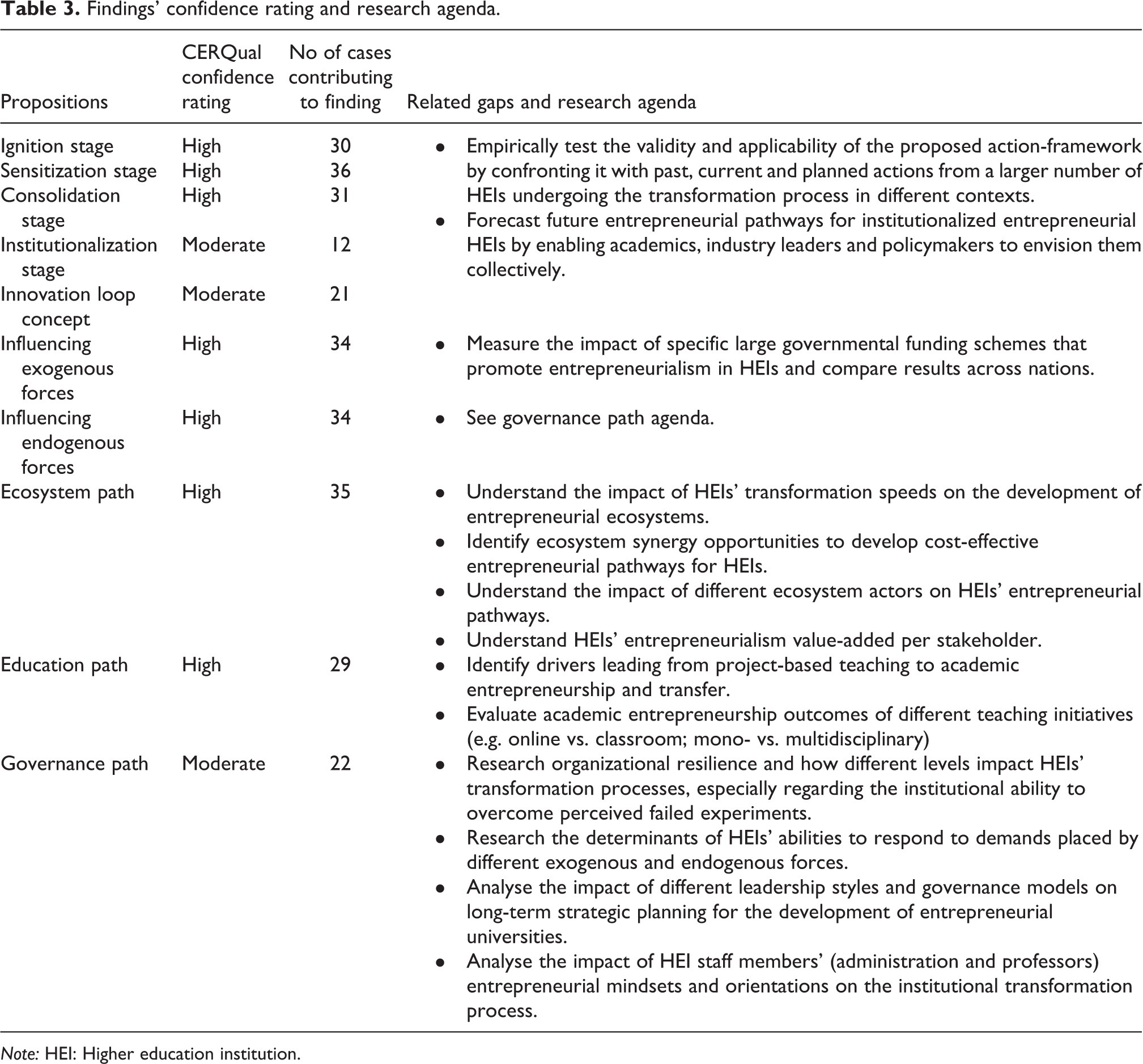
Some limitations of this study open interesting avenues for future research. This meta-ethnography relies on 33 peer-reviewed articles, excluding a vast body of literature on the phenomenon available in other sources. These other resources were excluded to improve confidence about the employed evidence body and to keep the body of selected literature manageable for a single researcher. These articles provide a picture from the viewpoints of their authors which might be incomplete, outdated and partial, as many authors were members of the studied institutions. Nevertheless, it is important to recall that in meta-ethnography synthesized interpretations are ‘metaphors’ or ‘characterizations of the juxtaposition of the author’s perspective with the perspectives of those studied’ (Thorne et al., 2004: 1347). Furthermore, not all requirements for an audit trail are present in this research, since the empirical evidence reviewed is combined with the author’s own expert practitioner insights (France et al., 2014). However, to mitigate this and the above-mentioned limitations, the author has followed up-to-date guidelines for methodological rigour and for reporting meta-ethnographic studies to improve confidence in the outcomes (Doyle, 2003; France et al., 2019; Lewin et al., 2018; Noyes et al., 2018). Thus, to assess the confidence in the key findings proposed, the author adopted the CERQual 1 framework to assess the methodological limitations, coherence, adequacy and relevance of the data supporting each finding. Taking into consideration the number of cases supporting each proposition, she rated the findings’ confidence levels as low (up to 11 cases), moderate (12–24 cases) and high (more than 25 cases). All propositions were rated as moderate or high. This analysis led to the identification of gaps, suggesting a research agenda to deepen the current understanding of HEIs’ changes in management due to entrepreneurialism (Table 3).
Findings’ confidence rating and research agenda.
Note: HEI: Higher education institution.
Conclusion
The forces influencing HEIs to become more entrepreneurial and contribute actively to economic, social and technological development cannot be ignored or downplayed. As significant public resources fund schemes towards an entrepreneurial agenda, decision makers in HEIs must acknowledge these influencing forces and proactively manage their institutions’ entrepreneurial pathways.
This article proposes that HEIs’ transformations are part of a long-term iterative process, characterized by non-linear, fuzzily divided stages, constantly influenced by exogenous and endogenous forces. Hence, context matters and there is no ready-made recipe. Rather than trying to emulate Stanford and create a Silicon Valley, each institution must develop its own advancement strategies towards entrepreneurialism. HEIs’ abilities to proactively lead this process, being promptly responsive to demands and opportunities, will determine future epitomes. Nevertheless, it is clear that not all HEIs should transform themselves into fully fledged entrepreneurial universities or will even have the potential to do so. A smart specialization strategy and/or focus on ecosystem resources and capabilities synergies at the meso-level might be a more feasible path for many HEIs starting the process of institutionalizing an entrepreneurial culture and intending to contribute actively to regional development.
According to Tranfield et al. (2003), the goal of a Systematic Literature Review is to serve both academics and practitioners. This article achieves this goal by contributing to the body of knowledge on entrepreneurial universities with an original methodological approach – systematically and pragmatically explaining HEIs’ entrepreneurial pathways and their underlying transformative process.
Supplemental material
Supplemental Material, SLR_Appendix - A meta-ethnography on HEIs’ transformation into more entrepreneurial institutions: Towards an action-framework proposition
Supplemental Material, SLR_Appendix for A meta-ethnography on HEIs’ transformation into more entrepreneurial institutions: Towards an action-framework proposition by Audrey Stolze in Industry and Higher Education
Footnotes
Acknowledgements
The author is grateful for the insightful and expert comments received on an earlier version of this article from Henry Etzkowitz (Triple Helix Institute), Andreas Kuckertz (University of Hohenheim), Klaus Sailer (Munich University of Applied Sciences and Strascheg Center for Entrepreneurship) and two anonymous reviewers. The earlier version was presented at the XVII Triple Helix Conference in Cape Town, South Africa (10 September 2019) and at the 23rd Annual Interdisciplinary Conference on Entrepreneurship, Innovation and SMEs in Vienna, Austria (27 September 2019).
Declaration of conflicting interests
The author(s) declared no potential conflicts of interest with respect to the research, authorship, and/or publication of this article.
Funding
The author(s) received no financial support for the research, authorship, and/or publication of this article.

Supplemental material
Supplemental material for this article is available online.
Note
References
Supplementary Material
Please find the following supplemental material available below.
For Open Access articles published under a Creative Commons License, all supplemental material carries the same license as the article it is associated with.
For non-Open Access articles published, all supplemental material carries a non-exclusive license, and permission requests for re-use of supplemental material or any part of supplemental material shall be sent directly to the copyright owner as specified in the copyright notice associated with the article.
