




Abstract
This case study analyzes the use by high-profile employers of the brainpower of nearly 1400 humanities undergraduates through “live” projects. At the Faculty of Humanities of Leiden University, a cohort of hundreds advises a set of public, private, and third sector organizations each year in a capstone course within the multidisciplinary Bachelor of Arts in International Studies program. In this course, aptly named PRactising International Studies (PRINS), students have, in teams, successfully consulted for employers including Google, the World Food Programme, and Organisation for Economic Co-operation and Development (OECD). Drawing on experience of designing, recruiting for, and running the PRINS course, the author offers evidence of the distinct value of humanities to practice, which is demonstrable even at the undergraduate level. The analysis entails the ex ante knowledge needs employers sought to have fulfilled by humanities students, and the ex post recommendations in their consultancies that employers have acknowledged as practically relevant. The findings indicate the potential of large-scale consultancy courses in the preparation of students for the labor market and the need for humanities graduates in future workplaces worldwide.
Keywords
The National Humanities Alliance, a US nonprofit advocacy coalition, compiled a list of articles that differentiate the practical value of an academic background in the humanities to employers and the wider society from that of a background in business or sciences (National Humanities Alliance, 2019). The compilation describes graduates from humanities disciplines as well-rounded citizens, critical thinkers with soft skills, broad knowledge, and moral awareness. Often these texts coincide with Steve Jobs’s remark that “It is in Apple’s DNA that technology alone is not enough—it’s technology married with liberal arts, married with the humanities, that yields us the results that make our hearts sing” (Peters, 2011). It is also interesting to note that the CEOs of several influential technology companies (e.g. YouTube, LinkedIn, and Bumble) have majored in humanities disciplines or programs such as history, philosophy, and international studies (Vega, 2017)—a fact that seems to support Vargish’s justification (1991) of the presence of the humanities courses in executive education.
More recently, several books have appeared that link the importance of thoroughly understanding the human context to business and economics. The authors of these works identify the benefits to industry leaders and economists of empathy, ethical concerns, and insights into the culture, history, and social structures that underlie human behavior (Hartley, 2018; Madsbjerg, 2017; Morson and Schapiro, 2018). Among the outcomes are increased innovation, a better alignment of services and products with customers, more realistic economic models and more effective and fairer policies.
While there has been acknowledgment of the practically relevant skills and content knowledge of humanities graduates, truly making the case for the tangible value for future careers of a humanities degree remains difficult, especially relative to the explicit career value of other degrees. Problems with articulating, appreciating, and demonstrating this value can be an obstacle or even a deterrent to parents, prospective students, graduates in the labor market, and employers.
For international studies (or global studies) programs taught at liberal arts colleges and universities, this difficulty in defining a practical value of the degree can be exacerbated by the very broadness of such programs—that is, their non-discipline-specific nature (Zartner et al., 2017)—and also by their newness in comparison to other programs. International studies programs tend to draw from multiple disciplines (such as history, political science, and economics) to obtain a broader perspective on global issues (Ishiyama and Breuning, 2004). Moreover, the growth of international studies as an undergraduate program is relatively recent (Blanton, 2009), and so, compared to degrees in international relations, law, or business, it might take time before the practical value of a graduate in international studies becomes matter-of-fact to the stakeholders mentioned above.
This article analyzes experiential learning practice that aims to alleviate these issues, in the form of academic student consultancy in “commissioned” or “live” projects. Such consultancy has the potential to build bridges between higher education and industry and can enhance employability so that graduates perceive and experience a smoother transition from university into the labor market and their early career.
Laughton and Ottewill (1999), Bak (2011), and O’Leary (2015) have already analyzed the pedagogies of their consultancy electives and courses and their students in the role of consultants. Their studies show how such experiential learning enables students to develop an understanding of the world of business and test the practical value of their academic background, while still in a “safe” environment with guidance. While student consultancy is a quite common practice in management disciplines (such as in those studies cited above), in the humanities this is not the case and studies on the topic in that context are thus far more rare.
This article aims to address this gap in the literature and to inspire learning practice. First, the methodology adopted is described, and this is followed by a description of the specific case under study—that of a large-scale academic student consultancy with consecutive sets of high-profile employers. Next, the findings will uncover the unique value that humanities students have brought to the real and complex challenges of these organizations. Finally, the article provides conclusions, sets out the limitations of the study, and highlights its implications for higher education and industry.
Methodology
The purpose of this exploratory case study is to examine the following research question: what pattern of valued skills, content knowledge, and characteristics emerges from analyzing data from consultancy collaborations between employers and Bachelor’s students of international studies taught from a humanities perspective?
The proposition underlying the study is that employers connect to university via student consultancy to receive knowledge contributed from a specific academic background and that this pattern (or student profile) will emerge by analyzing and comparing longitudinal data from different phases of these student consultancy projects.
This research adopts an embedded, single-case design, since the PRactising International Studies (PRINS) course can be considered a revelatory case (Yin, 2003: 42). The rationale for a single case is the rather unusual opportunity presented here, through the availability of data from 2014 to 2018, to analyze student consultancy in the context of the humanities and on the scale of hundreds of students at Bachelor’s level for a set of diverse and well-known employers (also known as clients).
The three sources of evidence are archival records (numbers of students, list of projects, and follow-up), documentation (recruitment slides and e-mails, videos for promotion, and newsletters/webpages of written client interviews), and physical artefacts (project briefs, student research reports, podcast by client with student, magazine article by winning team, and video by client with teams). The use of different data sources to indicate the value of the student profile in international studies increases confidence in the research findings and conclusions. This data source triangulation involves the combination and comparison of recruitment material, the list of elicited client projects, student research reports, and written interviews with clients and their follow-up to consultancies (as Table 1 shows).
Overview of consultancy projects, 2014–2018.
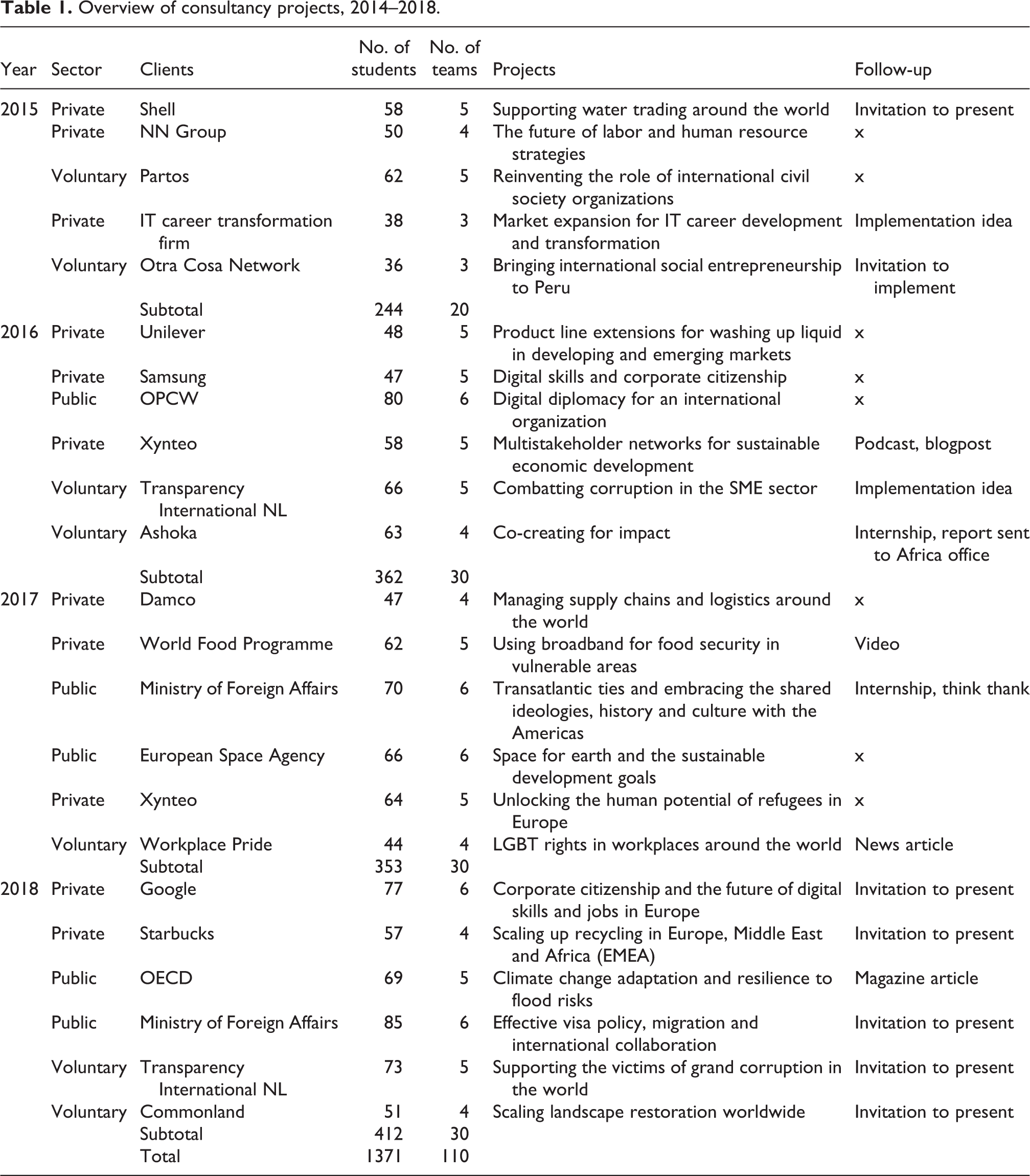
Within the single case, each year contains subunits of 5–6 projects and related clients and 4–6 student teams. This embedded design allows for analysis of phenomena at project and student team level, then returning to the larger unit of analysis (i.e. the course) to draw conclusions on the skills, content knowledge and characteristics displayed by the student teams and valued by the clients or employers (Yin, 2003: 45).
Informed consent was gathered from all clients to publish the content related to their organizations and completed consultancy projects in this article. The next section offers further detail on the PRINS course.
PRactising International Studies
The Bachelor of Arts in International Studies at Leiden University was founded in 2012 to combine the wide range of disciplinary and area expertise present in its Faculty of Humanities and also to meet societal demands for multidisciplinary fields and more broadly educated graduates in a globalizing world (Committee on the National Plan for the Future of the Humanities, 2009: 13; Leiden University, 2012: 5–7).
The 3-year program, taught in English, provides students with the “tools to investigate globalization and its regional effects from a humanities perspective” (Leiden University, 2020). Students become acquainted with four disciplinary approaches (culture, history, politics, and economics) and study a world region (e.g. Africa, Middle East, Russia and Eurasia) through the prism of these approaches. In addition, they acquire a related foreign language (e.g. Swahili, Arabic, and Russian). 1
Examination of data from the annual Dutch alumni survey (Nationale Alumni Enquête, previously known as WO Monitor) indicated that, for alumni of humanities programs (in language and culture), relative to those from other fields (e.g. the natural or social and behavioral sciences), the connection with the labor market could be improved (VSNU, 2009). With this in mind, the founders of the degree also decided to include a capstone consultancy course in the final semester, and this materialized in the form of PRINS. In 2014, they hired the author, from a business school background, to design and develop this core course using her experience 2 in academic student consultancy. Her main objective was to manage mutually beneficial learning partnerships between high-profile employers and the third-year students in their role as student consultants.
PRINS consultancy projects in the course have never been paid and have always been aimed at delivering value for practice (i.e. knowledge valorization for versus mere charity by organizations) and these factors are strongly emphasized in recruitment dialogues with prospective clients. The PRINS course is taught annually to all third-year students (cohorts have grown from 240 to 420 since the launch of the International Studies program in 2012). The course is distinct from other electives or modules since the PRINS consultancy is done en masse and at the undergraduate level for large partner organizations. While Master’s students might expect this type of practical opportunity in their degrees, it remains rare in Bachelor’s programs. Table 1 presents the network of projects and partners that has been the focus of PRINS from 2014 to 2018. Selecting a project partner is a matter of matching the background and interests of the students to the knowledge needs of the organization. As the PRINS course has matured with successful cases, it has become possible to achieve an increasingly better fit between the multidisciplinary and multiregional expertise of students and the type of organizations and projects.
Given her business school experience, companies were initially the author's main target partners for consultancies; as PRINS developed, however, she has adapted to the more diverse interests of the student profile in a humanities faculty and has therefore further included sectors of government and civil society (Centre for Innovation, 2017). This trend continues and is reflected in a decrease to two private-sector organizations since 2017. Concurrently, in line with global developments, projects and research questions have moved from a focus on areas of human, strategic, and marketing management (see 2015 in Table 1) toward business–society relations. Increasingly, PRINS consultancy projects have addressed complex and wicked problems (Rittel and Webber, 1973) and the involvement of the client organization in progress toward the Sustainable Development Goals in multi-stakeholder networks and cross-sector partnerships (Van Tulder, 2018).
The author prefers to recruit new partners each year 3 and to avoid sponsored projects, so allowing students to advise on current issues while maintaining the independent role of the university (Centre for Innovation, 2017). To a certain degree, this approach both corresponds with Leiden University’s motto of academic freedom and core values of academic integrity and responsibility to society (Leiden University, 2019) and resonates with the educational ideals associated with Wilhelm von Humboldt’s legacy and German idealism—freedom in teaching (lehrfreiheit) and freedom in learning (lernfreiheit) (Östling, 2018: 9; Scott and Pasqualoni, 2016: 212).
The last column of Table 1 indicates the follow-up by the client organization based on the consultancy received. At each project’s final presentations, a jury consisting of academic and client representatives selects a winning team that best meets the double objectives of: practically relevant recommendations based on solid scientific research. The winning teams have most often been invited to present at the organizations’ headquarters; other follow-up 4 has included a podcast, a video, and a magazine article.
While it is adjusted to the undergraduate level, the double impact that is central to the PRINS course resonates with scholarly debates (particularly in management research) on rigor versus relevance and the positive sum strategy proposed by Robey and Markus (1998: 9) of consumable academic research for practitioners.
For any study program in general, academic consultancy courses enable (further) developing students’ skills and abilities in teamwork, flexibility, problem-solving, verbal and written communication, critical thinking, negotiation, and persuasion, since the consultancy exercise entails group-based research to fulfill a knowledge need of an organization. In addition, academic consultancy courses can distinguish and put to the test the specific profile of graduates for employers as intended in the learning objectives of a particular degree program, as a litmus test of its vision. The PRINS course has now entered its fifth year, and this allows for an analysis of this profile through a longitudinal case study that reveals the specific skills, content knowledge, and characteristics that employers seek in these humanities students for addressing their organizational challenges.
The next section illustrates these assets—context-specificity through interdisciplinarity, cultural-historical understanding, and cultural competency—with rich descriptions from completed student consultancies. These collaborations are indicative of the need for and value of humanities graduates in the workplace.
Findings
Since founding the course, the author has been recruiting partnerships with organizations from the private, public, and third sectors. In the recruitment dialogues, she explains the student profile and degree structure of the Bachelor of Arts program and then lets the prospective client be triggered to decide which knowledge needs they want fulfilled by this type of student. The presentation slides sent to these potential partner organizations include these sentences: “Students could contribute to the ongoing work of [client] by developing approaches per world region” and “In each region, [the client] operates within a different economic, political, historical and cultural context. Impact will depend on knowing your playing field….” The slide on the student profile highlights (Koendjbiharie, 2014:2): Well-rounded knowledge on a specific region of the world (e.g. Latin America, Africa, East Asia). Training in at least one foreign language (many students are multilingual), including some less widely known (in the Netherlands) languages (e.g. Hindi, Swahili, and Korean) A good understanding of intercultural differences and divisions. Open-minded to other customs and ideas.
Recruitment using this presentation has led to the 23 completed projects listed in Table 1. These real-life cases completed for the course confirm the trend toward “multidisciplinary and team based approaches to help resolve global issues such as climate change, economic imbalances, conflicts and demands for natural resources and energy” (O’Leary, 2015: 463).
In 40% of these projects, clients required consultancy on specific countries or regions that utilized the regional expertise of students of international studies (Zartner et al., 2017: 153); or the skills to examine and thoroughly understand a context (or “playing field”) as the recruitment information indicates. To illustrate, in 2017 the client from the World Food Programme (WFP) was a senior analyst in WFP’s mobile Vulnerability Analysis and Mapping (mVAM) project, which uses remote monitoring tools to conduct surveys for high-frequency data on food security trends for humanitarian decision-making (VAM Tube, 2018; WFP, 2014). The project involves live calls, SMS surveys, and Interactive Voice Response calls to find out what people have eaten and what their coping strategies are. The WFP client selected three countries to consult on: Honduras, Nepal, and the Democratic Republic of the Congo. These countries contain hunger-prone and malnourished communities while simultaneously presenting WFP mVAM with challenging contexts for their remote data collection due to factors including conflict, civil unrest, natural disasters, displacement, literacy rates, lack of infrastructure (World Food Programme, 2018, 2019a, 2019b), and access to technology, with the last being related to gender inequality (Bauer, 2017).
Teams had to analyze how the WFP should use broadband (or high-speed Internet access) taking into account local contextual factors such as culture, literacy, bias and demographics (especially gender and how to reach women for nutrition-sensitive questions), Internet and cell phone coverage, access to electricity, and also data security and privacy (Bauer, 2017).
The teams’ tailored country recommendations included women-based free basic online services for support and empowerment, voice-operated chatbots using emoji language, geomapping apps, and multipurpose community centers (for education, measuring growth and weight of children) powered by community-owned renewable energy sources depending on the context (Connect2Provide, 2017; Creating Access to Food, 2017; Food Fighters, 2017; FoodNet, 2017; Seeds of Progress, 2017).
The winning team advised: There are several ethnicities in the DRC at the moment, as many are refugees from neighbouring countries. However, they are reached through data collecting systems set up in refugee camps and other densely populated areas. The phones provided must be easily adjustable for language use. The DRC has several different languages. Lingála is the lingua franca from trade and is increasingly understood. However, it is still not spoken by all people. We recommend making the content available in more languages to accommodate both refugees and the various local languages. The priorities are Kiswahili, Kikongo, Lingála, and Tshiluba as they are the languages with the most speakers or that cover the largest regions. (Food Fighters, 2017: 32; Zsiga et al., 2015: 26)
The following discussion presents evidence of solved real-life cases to further illustrate and substantiate the student profile described above, acknowledged by the receivers and intended users of the generated knowledge—the client organizations. It will emphasize the ability of students to adopt a holistic approach to an issue and, through interdisciplinary study, to develop rich context-specific recommendations. It will also demonstrate their ability to use their cultural–historical understanding and cultural competency.
Context-specificity through interdisciplinarity: The holistic approach
Zartner et al. (2017: 152) discuss how international studies programs educate students to analyze problems from more than one perspective, which is appealing to employers. The findings here are consistent with the view that organizations value and need this skill. In all of the 23 projects, encompassing 115 group research proposals and final reports, the theoretical frameworks contained concepts from multiple disciplines. Forty percent of the projects even contained a specific research question on how political, economic, and cultural–historical factors affected the central phenomenon under study: for example, “How can Starbucks scale recycling in EMEA [Europe, Middle East and North Africa] taking into account cultural-historical, political and economic perspectives?”
When asked about the attraction of collaborating through PRINS, that client said: I was especially interested in the fact that the study was focusing on some of the main drivers behind sustainability behaviors (history, culture, economics & politics). (Project Manager, Sustainability EMEA for Starbucks—Sawahata, 2018a)
To address the questions raised by their client, the students connected literature streams in business–society relations and marketing management, ecological economics, the circular economy, and national coffee cultures (Cupsidedown, 2018; Espresso Patronum, 2018; Recycle Stars, 2018; Starflakes, 2018). They built theoretical frameworks that combined concepts such as corporate social responsibility (Maloni and Brown 2006; Tolhurst and Visser, 2010), green image (Jeong et al., 2014; Ku et al., 2012) and persuasion in consumer behavior (Cialdini, 2001), social norms in recycling and warm-glow (Abbott et al., 2013) with the recycling technological readiness of the sector (Sultan et al., 2017), zero waste (Song et al., 2015; Zaman, 2014; Zaman and Lehmann, 2013), and also coffee or café cultures and drinking habits (Ferreira, 2018; Morris, 2017).
As a consequence, the students took a contextual, holistic approach in their case studies in selected EMEA countries, leading some teams to connect literature on “scavenger communities” or informal waste pickers in South Africa (Godfrey and Oelofse, 2017), Egypt (Nas and Jaffe, 2004), and Jordan (Aljaradin et al., 2015; Medina, 2007). So these students were also able to take into account the informal economy around waste recycling in developing countries and the socioeconomic conditions and societal contributions of poor and marginalized groups that pick and collect waste to earn a livelihood (Wilson et al., 2006). The winning team wrote in its case study: The existence of an informal waste collection system in Egypt has to be outlined. The Zabaleen,
5
an immigrant community within the country [an Egyptian Christian mainly Coptic minority], formerly active as pig farmers, generated their income by means of waste collection and resource restoration in Egypt for the last century. These “scavenger communities” make a living out of waste collection and thus specialize in the activity. […] During the reign of Mubarak, the Zabaleen were rather undermined and waste management was delegated to large multinational companies, so as to professionalize the entire system […]. (Starflakes, 2018: 65) Although various NGOs as well as the Egyptian government have already come up with a variety of initiatives to promote inclusion, Starbucks could join these efforts by setting up a cooperation with these informal waste collectors and in doing so take advantage of the higher efficiency when it comes to recovery of recyclable materials, while at the same time contribute to the social conditions of this marginalized community […] This would include the creation of opportunities through fair payment and investment into the working and living conditions of these workers. It is crucial to emphasize the importance of an equal footing within this cooperation, as otherwise given the discrepancy in relative power both parties hold, this cooperation would risk becoming inherently exploitative. (Starflakes, 2018: 73) As a result of the lack of waste separation in Jordan, we recommend that Starbucks should formally employ waste pickers or scavengers to separate their waste in landfill areas […] Historically, waste pickers have been an essential feature of the informal sector of waste management in many developing countries like Jordan […] Furthermore, employment of waste pickers ‘improves the efficiency in a society’s use of natural resources, a necessary step toward minimizing the waste in a country and toward a sustainable future’ (Medina 2007: 17). Additionally, it has been hypothesized by many academics, that the formal employment of scavengers will be cost beneficial for private companies like Starbucks (Aljaradin, 2010: 3). (Recycle Stars, 2018: 70) One way in which Starbucks can further contribute to raising awareness about sustainability is by aligning with the traditional “sit-down” coffee culture due to Jordan’s Bedouin history and influence. Focusing specifically on Amman (due to the location of Starbucks stores and high youth population) Starbucks can “glocalise” in its stores to promote the importance of conserving coffee and consumer behaviours. Whilst doing so, this hopes to diminish the use of disposable cups and connects the Jordanian youth to the significance of coffee […] Starbucks can do this by promoting the traditional meanings behind the three cups of coffee that are served in Bedouin custom. (Recycle Stars, 2018: 71–72)
This case illustrates that students of international studies can take into account the interconnections and context-specificities in addressing an international challenge of an organization. They are able to put global phenomena, such as waste management, into a local context and to understand an issue such as recycling from a top-down, political, and economic perspective while also taking into account bottom-up, cultural, and grassroots approaches (Zartner et al., 2017: 152). Such holistic approaches can lead to a broader understanding and a rich contextualization of a particular issue for an organization. This finding is further accentuated by the evidence from the next case, on flood risk and climate change adaptation.
The OECD launched its “New Approaches to Economic Challenges” (OECD-NAEC) initiative in 2012 to learn from the financial crisis, assess the shortcomings of analytical models, and promote new policy tools and data (OECD, 2019). OECD-NAEC and the BA International Studies have a similar approach to analyzing and understanding globalization—an approach that recognizes the interconnectedness of the economy with other systems, such as environmental and social systems. Student teams advising the OECD therefore considered the political economy and political ecology of flood risk resilience in their critical literature reviews, theoretical frameworks and resulting findings and recommendations.
When asked why they had not commissioned a business school to fulfill this knowledge need, the client answered: Business schools and management programmes teach a skill set that concentrates on needs and opportunities that are important of course, but that are too narrow for our needs. Our project was on building resilience to floods. One of the problems in this domain is that what makes sense from a business point of view may not be the best solution once you start considering other factors, in particular those playing out over a longer time horizon than most businesses plan for; and factors that can have an enormous impact on a project but are hard to quantify, such as cultural traditions or political sensitivities. (Advisor to the Office of the Secretary General for the OECD—Sawahata, 2018b)
The team that focused specifically on the interplay between technical measures (hard and soft measures such as dikes and early flood warning systems), social factors (inequalities and gendered vulnerability), and political structures (decentralization and stakeholder engagement) was selected as winner in terms of both scientific quality and practical relevance (Rising Solutions, 2018) and was invited to publish its findings in an article for the OECD Observer magazine.
The next case underlines this ability of adopting a holistic approach to scientific inquiry and its need by practice. Commonland is a foundation that develops business-driven landscape restoration projects, through which it combines the restoration of degraded landscapes with the economic and social revitalization of communities (Commonland, 2019). The organization had not worked with humanities students prior to the project and wanted to use this opportunity to test whether its holistic framework for large-scale landscape restoration was sound—in other words, was it context-specific or universal and could it scale? When asked about the added value that international studies students might bring to their case, the client reflected on experiences of working with students from other backgrounds: We predominantly work with business studies students or those in the environmental sciences. International studies and humanities students look at things from a different perspective, a more holistic perspective. Given that at Commonland we look beyond just financial returns from landscape restoration to include return of natural capital, social capital and return of inspiration, this is a unique and important view to take into account. (Science and Education Officer for Commonland—Sawahata, 2018c)
Figure 1 shows the theoretical framework the winning team applied to eight case studies consisting of the four pilot projects of Commonland in The Netherlands, Spain, South Africa, and Australia and comparative cases of land restoration initiatives in Brazil (Atlantic Forest Restoration Pact), Ecuador (Runa Foundation), China (Loess Plateau), and Indonesia (Restore+) (The Commoners, 2018).
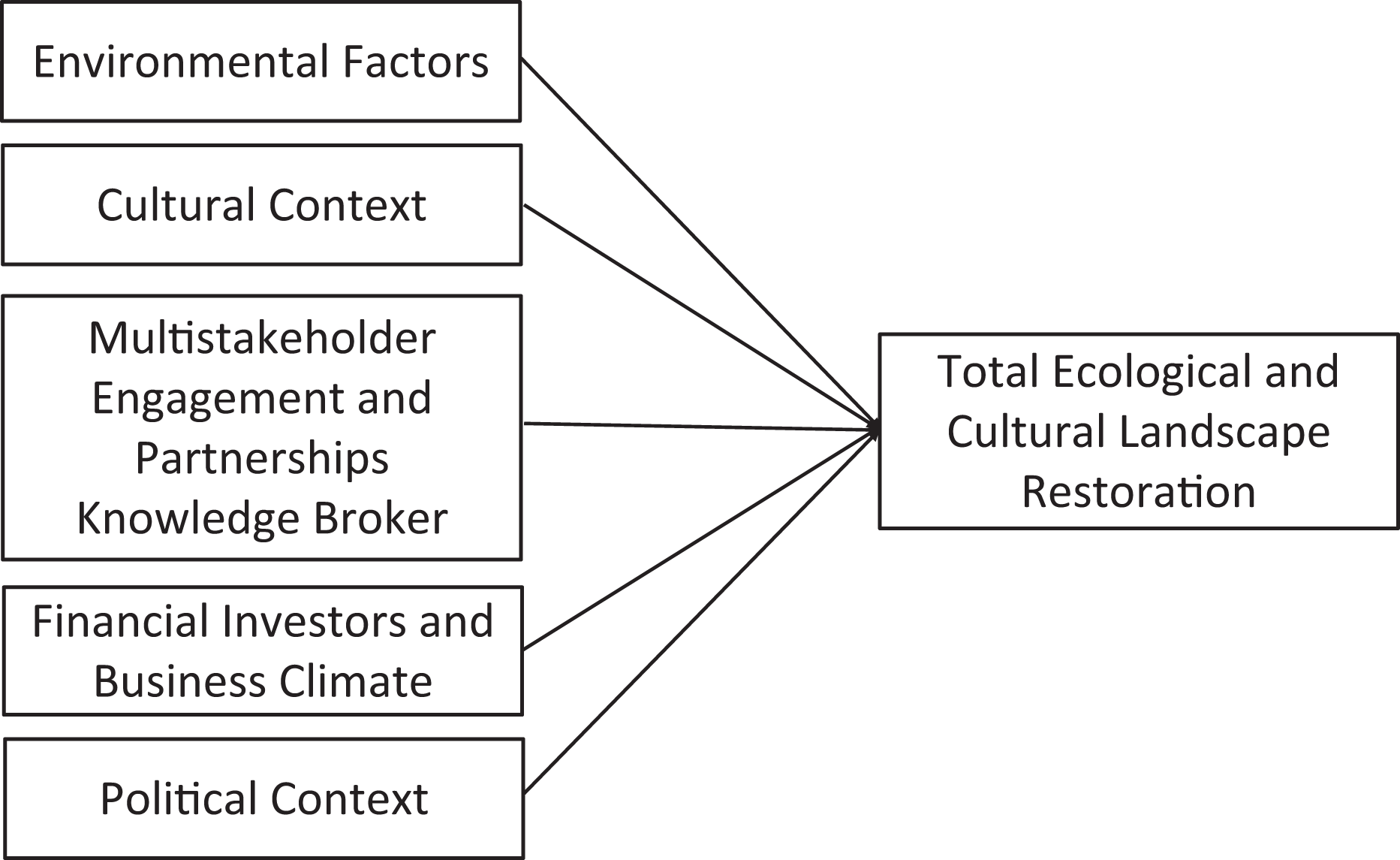
Theoretical framework adapted from The Commoners (2018: 32).
Based on the findings from these case studies, the team concluded that, for environmental factors, financial investors and business climate, multi-stakeholder engagement, partnerships and knowledge brokering, Commonland’s approach could be universally applicable whereas the cultural and political contexts would always require local adaptation due to dependences on traditional ecological knowledge and political stability and accountability (The Commoners, 2018).
The resulting action points for the client included: compiling a multilingual interactive open-access online map including traditional knowledge specific to landscapes and restorative methods for local community involvement 6 and using Hofstede (2011) to focus on societies with a long-term orientation as more receptive contexts for landscape restoration (The Commoners, 2018: 92–93); this relates to context-specificity. Furthermore, to scale and transition to a restoration economy, the team proposed creating a “four returns” 7 certificate (Ferwerda, 2015) related to the universal objectives of creating healthy soil, vegetation, biodiversity, multi-stakeholder partnerships, and a sustainable financial and social environment for business and local communities (The Commoners, 2018: 94–95).
The above discussion demonstrates that employers value an interdisciplinary 8 perspective such as that which these students have offered as it supports the pursuit of holistic understanding in scientific inquiry, with its potential to inform decision-making in response to complex problems (Klein, 2004: 2).
In the 23 projects, 110 teams of around 1400 international studies students engaged with concepts and literature from different disciplines, including those outside their own backgrounds (e.g. robotics and automation for Samsung and Google and earth observation for the European Space Agency) to supply knowledge to organizations that would help them act effectively in this complex world. The findings also offer some support to the idea that these students are trained to connect multiple disciplines—in other words, to pursue a more holistic view on an issue while not being restricted by disciplinary grounding (in this case culture, economics, politics and history).
In PRINS, moreover, while consulting on wicked and complex problems including corruption, sustainable development, and migration, students not only engage beyond academic disciplines but learn to create a dialogue between academics and practitioners (their client and other stakeholders) and to position these as (equal) participants in the process of addressing a problem of society at large (Ramchandani, 2017). Whether this lays a solid enough foundation for alumni to move into transdisciplinarity (emergence of new disciplines) or even further into anti-disciplinarity (areas of work without discipline—Ito, 2016) and whether this will occur, is a matter for a separate study on their early career formation. In any case, the distinct value of PRINS alumni in scientific inquiry and practice lies in their inclination and ability to synergize and synthesize knowledge, perspectives and actors from separate disciplines, fields and sectors into an arguably still selective yet nonetheless coherent whole (McGregor, 2004; Nicolescu, 2002; Ramchandani, 2017).
To conclude, the reflections in this section can be framed using Alexander von Humboldt’s holistic worldview and the complexity and interconnectedness in natural systems inherent in his work in the early 19th century and his scientific legacy (Fränzle, 2001). Often this Humboldtian vision (or gaze) represents the expansion of scientific inquiry by the humanities through the arts and aesthetics (Kwa, 2005); here the Humboldtian vision is invoked, only now by using evidence from student consultancy, to feature this purpose of the humanities in expanding understanding through international studies.
Cultural–historical understanding and cultural competency
The above discussions of projects for the WFP, Starbucks, and the OECD include examples of how international studies students can take into account cultural–historical perspectives and how they have used cultural competency in their consultancies. We will now sharpen the focus on these abilities. Schmitz (2007: 53), building on Trompenaars and Wooliams (2004) and Nilsson (2003: 36), defines cultural competency as “the propensity to reconcile dilemmas based on understanding, respect and empathy for people of different national, cultural, social, religious and ethnic origins and the acceptance of one’s own cultural involvement.”
In 2017, the Western Hemisphere department of the Dutch Ministry of Foreign Affairs asked students to analyze ideologies, history, and culture that the Netherlands shared with the Americas. With the then new Trump Administration in place, it was timely to gather reflections on the future of transatlantic relations. The client asked what key international norms, beliefs, and values were shared between the Netherlands and the United States and Canada and like-minded Latin American and Caribbean countries (Hinse and Van Wageningen, 2017). The aim was to preserve this community of values and foster and maintain transatlantic relations (political, economic, and cultural–historical) in support of Dutch foreign policy.
This requirement led to a variety of consultancies on shared values and interests informed by constructivism and soft power in international relations (Hopf, 1998; Nye, 2008). For the promotion of democratic values, justice, and human rights, teams focused on the rule of law in Chile, Brazil, and Argentina and cultural cooperation with the Netherlands (Transatlantic Ties in Progress (TTIP), 2017); trust between civil society and police in Guatemala (Values Beyond Borders, 2017); the reintegration of female victims and ex-combatants in post-conflict Latin American countries (The Americas First, 2017); and drug trafficking in the Netherlands Caribbean (Transatlantic Avengers, 2017).
For coalition and climate change, teams analyzed (inter)national and local environmental policy making and corporate social responsibility in the Netherlands, Aruba, the United States, Florida State, Brazil, and the city of São Paulo (Triumphant, 2017) and water-related threats and security in the Netherlands, the United States, Argentina, Brazil, and Uruguay (Globalista, 2017).
Based on this collaboration, the client commented: At the MFA we are really looking into the phenomenon of a value community and that is something humanities students can answer—it’s broader than quantitative research. It goes into the history of ideas, culture, and history in general. (Policy Officer for the Dutch Ministry of Foreign Affairs—Sawahata, 2017)
The client further reflected: These students know the history of specific regions, and there are also skills that include creativity and delving into research sources with an inquisitive nature. They are really encouraged to think about, and try to really understand, The Other—it’s cultural empathy. They not only look at a case or question in a narrow way, but try to understand the dialogue from the other side. (Senior Policy Officer for the Dutch Ministry of Foreign Affairs—Study International, 2017) The government mentions that the Netherlands is actively involved in the Brazilian social/civic structures, which the government seeks to fortify and further develop (“Relations between the Netherlands and Brazil”). Thus cultural cooperation (exchange of know-how, educational and research capabilities) and rule of law (the promotion of democratic values and freedoms) are on the agenda of both countries and consequently do lead to strengthened economic and political ties. (TTIP, 2017) The Netherlands and Brazil have a stable relationship, partially because of the values they share. These values are based on socio-economic and democratic elements. They include the support of democracy and international laws, using the rule of law in governing, inclusive social development and access to safe Internet for everyone. (Globalista, 2017: 74)
Cultural–historical understanding and cultural competencies, here regarding differences, are reflected in consultancies for the NGO Workplace Pride on how its globally active member organizations can further their lesbian, gay, bisexual, and transgender (LGBT) policies and practices (Workplace Pride, 2017). In a large variety of case studies (e.g. South Africa, Russia, China), teams analyzed religiosity, social norms, gender norms, acceptance of homosexuality, media representation and discourse and sexual orientation law (Bumblebees, 2017; None of the Above (NOTA), 2017; The Chameleons, 2017; UniQorn, 2017). All teams engaged with literature on resistance and threat perceptions of LGBT narratives and rights as Europeanization or as a Western phenomenon or product of colonialism (Ayoub, 2014; Currier, 2011; Hasso, 2005; Vincent and Howell, 2014).
The winning team built its solutions on dialogism and comprehensive sex education to advance LGBT rights worldwide. The team defined dialogism as “entering into a discussion in which the intention, and social and historical origin of what the other speaker is saying, is taken into account” (Bumblebees, 2017: 11). It discussed Curtis’s ethnography (2013), which used Bakhtin’s (1981) concept of dialogism (how voices engage with multiple others through the addressivity of speech) to study gay rights and religious moderation in Belfast. Curtis found that changes in religious rhetoric and responses relating to Belfast’s Pride Festival were connected to conscious moderate discursive practice. Based on Curtis’s (2013) findings, the team advised: […] moderate dialogue and action are fundamental. Moderate communications and actions from both sides are necessary to shape a more inclusive and supportive rhetoric. The discourse should be changed, not by (inherently) changing one party or the other, but by moving forward together to create a new legitimate discourse. (Bumblebees, 2017: 20)
Conclusions, limitations, and implications
Within the humanities, international studies programs are growing to meet a societal demand. At the same time, difficulties persist in making explicit the value of this degree to practice—and this challenge is exacerbated by the broadness of a multidisciplinary background. This article has presented findings from a revelatory case study on the learning practice of student consultancy to employers that aims to mitigate these difficulties. The article has shown how employers over the past 5 years have been using the characteristics, knowledge, and (research) skill set of an international studies program’s student profile, drawing on the profile’s context-specificity (through interdisciplinarity and a holistic approach) and cultural–historical understanding and cultural competency to address contemporary management challenges. The practical relevance of this pattern of skills, content knowledge, and characteristics is reflected in evidence such as comments and follow-up from consultancy clients.
The competencies demonstrated (illustrated by evidence from student research carried out for the WFP, Starbucks, OECD, Commonland, the Ministry of Foreign Affairs, and Workplace Pride) can be related to one of the foundational literacies for 21st-century skills according to the World Economic Forum: civic and cultural literacy. This is defined as: “the ability to understand, appreciate, analyse and apply knowledge of the humanities” (World Economic Forum, 2015: 23). Furthermore, it matches several global leadership competencies and desired mental characteristics, such as an acceptance of complexity and contradictions, leading to an appreciation of cultural differences (Jokinen, 2005) and social judgement skills (a drive for the broader picture, an awareness of different stakeholders and global interdependencies). Underlying the ability to be sensitive to different needs and to understand different (cultural) viewpoints is empathy (Jokinen, 2005).
The multidisciplinary background provides students with an ability to think through large problems from multiple perspectives (Zartner et al., 2018: 152) and renders them comfortable enough to adopt perspectives with which they are not yet familiar (again relating to their acceptance of complexity). Naturally, this more generalist approach will lead to less discipline-specific depth in analyses compared to the analyses of monodisciplinary students. To clarify, this article does not argue for the use of the skills and content knowledge of international studies and other humanities students as a substitute for business or behavioral and social or natural sciences; nor does it argue in favor of holistic versus reductionist science. Rather, the intention is to provide concrete evidence of the (not immediately apparent) value of international studies degrees relative to other academic backgrounds in the context of practice. These rich insights from applied research with a holistic approach by international studies students are intended to emphasize the potential contribution of the humanities to scientific inquiry in the service of practice.
This study has taken care to use data from multiple years, projects, sectors, and student team reports to avoid presenting outliers in order to reach sound conclusions. Moreover, in the discussion of six projects, all related student team reports were always connected to provide depth to the analysis. The study was, however, limited to these highlighted projects and by the lack of availability of related client interview data, which were not gathered for the full set of clients every year and became more specific as the course matured. Another limitation is that the type of projects and follow-up of the consultancies described have been used here as proxies for actual value to practice of the international studies student profile. Given the approach to these recruited projects (actual knowledge valorization for versus charity by organizations) and consecutive collaborations across the public, private, and voluntary sectors, this seems reasonable; however, future research in, for example, journals such as International Studies Perspectives might present stronger corroboration of the generalizability of the findings here through empirical data from internships or (entry-level) employment with respect to job profile, task requirements, and performance evaluation.
As for the implications, the findings of this study support the embedding of employability in the curriculum via consultancy modules and demonstrate that this can be done fruitfully and sustainably at a very large scale as early as the undergraduate level. The PRINS course may hopefully serve as a best practice example in the humanities with regard to articulating, appreciating and demonstrating the value of humanities studies for parents and prospective students, but most of all for graduates in the labor market and employers. As has been shown, student consultancy can be the means by which both employers and students can realize the distinct value of and need for humanities graduates in workplaces worldwide.
Footnotes
Acknowledgements
The author gratefully acknowledges the editors and anonymous reviewers for their helpful guidance and comments, Lesa Sawahata for proofreading, client interviews, and copywriting; all clients, student consultants, coordinators, and research coaches for our collaboration in PRINS; and Peter Vervest, Eric van Heck, Otto Koppius, and Marcel Oosterhout of Rotterdam School of Management, Erasmus University and Johannes Magliano-Tromp of the Faculty of Governance and Global Affairs, Joost Augusteijn and Jaap Kamphuis of the Faculty of Humanities, Leiden University, for enabling growth and specialization in course design, development, and pedagogy in academic consultancy across a wide variety of students and organizations.
Declaration of conflicting interests
The author(s) declared no potential conflicts of interest with respect to the research, authorship, and/or publication of this article.
Funding
The author(s) received no financial support for the research, authorship, and/or publication of this article.
