



Abstract
This article examines how self-expatriates (SEs) negotiate tensions between multiple social identities and how this affects their long-term social and professional adjustment to work and life in another country. We use identity work theory to broaden social identity theory (SIT) and offer a deeper understanding of the roles played by social communities in the lived experiences of SEs. Longitudinal qualitative data were collected through 60 in-depth semi-structured interviews with 18 participants. The thematic analysis of the data reveals how SEs balance their allegiance to their expatriate community and host-country nationals (HCNs) as they (re)construct their identities to fulfil their work and lifestyle goals. By highlighting how group membership is not fixed but negotiated and reframed, we contribute to the sociological literature on expatriation by identifying four waves to the identity and adjustment process experienced by SEs.
Keywords
Introduction
More people are migrating abroad than ever before. The UN reports a 65% increase in the number of international migrants over the last two decades, reaching 304 million in 2025 (International Organization for Migration (IOM), 2025). Global labour mobility impacts not only national economies but also the identities of individuals and communities as they navigate complex social, cultural and political landscapes (Vertovec, 2007). Migrants develop multiple identities across borders, shaped by political and economic structures such as the global North–South divide (Castles, 2010), transnational communities (Anderson, 2016; Basch et al., 1994) and intersecting forms of marginalisation based on their gender, race and class (Beck et al., 2016; Ham and Ceradoy, 2022). Among these migrants are expatriates, whom the UN defines as ‘nationals taking up residence in a foreign country, such as employees of multinationals or international civil servants’ (IOM, 2019: 67). While a large body of research focuses on the cultural identity changes of expatriates (Mao and Shen, 2015), less attention has been paid to the ways their social and professional identities evolve in response to new organisational cultures and role demands (Rowson et al., 2022).
Existing literature also overlooks the diversity of expatriate experiences. Self-expatriates (SEs) are skilled professionals who relocate abroad for work or lifestyle purposes, challenging traditional expatriate definitions (Caldwell et al., 2024). Their motivations and experiences differ from assigned expatriates (AEs), highlighting the need for deeper insight into the profiles and experiences of SEs (D’Angelo et al., 2020; Hutchings, 2022). Expatriates’ multifaceted identities – national, professional and familial – shape their self-perceptions and social roles (Peltokorpi and Zhang, 2020). We define this process of balancing multiple social identities within a coherent sense of oneself as identity work (Sveningsson and Alvesson, 2003) and use it to extend social identity theory (SIT) (Tajfel and Turner, 1979; Turner, 1982).
Globalisation underscores the importance of social communities in helping migrants integrate into their host country (IOM, 2024). The adjustment of expatriates to new cultural and professional environments depends on balancing their social involvement and emotional connections with fellow expatriates and locals (Sciortino et al., 2024). This study defines international adjustment as the process of adapting to a new culture and work environment, including psychological well-being, socio-cultural integration and workplace effectiveness. In line with international adjustment frameworks (Black et al., 1991), we suggest that frequent social interactions, such as daily conversations and workplace discussions, facilitate this process by reducing isolation and fostering cultural learning.
In this article, we investigate the following research questions. Firstly, how do the social identities of SEs change when working and living abroad? Secondly, how do their social interactions with expatriate and local host communities contribute to these changes? Thirdly, how do these changes to their social identities shape their social and professional adjustment over time?
The following section of the article explains SIT in greater depth before linking it to identity work theory in the context of international mobility and presenting our research methodology. SIT assumes an ‘in or out’ perspective on group identification, underplaying the role of individual differences and agency (Hornsey, 2008). Using a social-constructionist perspective, we reveal a more nuanced relationship between identity development and social integration where SEs actively negotiate rather than automatically accept their group identities. Our findings enable us to broaden SIT by illustrating how SEs leverage their group belonging to push themselves forward personally and professionally but then retreat from this group when experiencing pushback. This wave-like adjustment process highlights the role played by their ability to navigate multiple social identities during their long-term social and professional adjustment to explain differences in their migration paths (i.e. repatriation, citizenship or re-expatriation).
Exploring social identity dynamics among SEs: The roles of community support and identity work in social and professional adjustments
According to SIT (Tajfel and Turner, 1979; Turner, 1982), the social identity derived from group membership forms an important part of our self-conception. Identifying with a specific social group emphasises similarities with members of the group and highlights differences compared with members of other groups (Hogg and Williams, 2000). In the case of expatriation, this group membership is typically based on an individual’s most salient characteristics (i.e. their demographic attributes), reflecting the distinction between host country nationals (HCNs) and so-called foreigners (Olsen and Martins, 2009). Group membership allows access to the guidance and support needed to gain insight into nuanced norms, attitudes and behaviours that may be unknown to new arrivals (He et al., 2019). An example of a social group relevant to our study is expatriate communities, which transcend occupational and national boundaries and support newcomers regardless of their expatriate status (Anderson, 2016; Basch et al., 1994). In line with Cohen’s (1977) seminal work, we define expatriate social communities as social organisations comprised of both AEs and SEs and held together through specialised institutions (e.g. embassies, international schools), dedicated geographic spaces (e.g. housing estates, leisure spaces) and informal social norms (e.g. cosmopolitanism, globalised educational ideals) (Liu-Farrer and Yeoh, 2017).
According to the sociology of migration, social communities support the assimilation of migrants by progressively introducing them to the social norms of the host society (Alba and Nee, 2020). Segmented assimilation theory (Portes and Rumbaut, 2001; Portes and Zhou, 1993) supports this view with ethnic communities seen as decompression chambers helping newcomers to balance their adoption of a host country’s cultural values and language(s) while remaining connected to their ethnic community. Combining this perspective with SIT suggests that belonging to an expatriate community helps expatriates overcome cultural shocks by giving them the support needed to become more comfortable in their new country (Oberg, 1960).
In the case of China, the national setting examined in this manuscript, expatriates from the West have long been seen as bearers of Western knowledge, which has been instrumental in transforming China’s economy since the country’s Open Door Policy in 1978 (World Bank, 2024). This status enables them to access higher-quality housing and greater freedom of movement than local citizens and many primarily socialise with other expatriates based in China (Boncori, 2013; Farrer, 2019). As SEs expatriate without the support of a sending organisation, the balance between their social interaction with expatriates and local host communities is likely to be different in comparison with AEs. Nonetheless, while SEs form a significant part of the expatriate population in China, the differences between them and AEs are not immediately apparent to locals who consider both types of expatriates to be outsiders (Guo et al., 2021).
Applying one of the 20th century’s most influential social psychology theories (Hodson and Earle, 2020) to the experiences reveals opportunities for sociological contributions to its theoretical development. Firstly, SIT posits that positive ingroup evaluations compared with other outgroups contribute to positive self-evaluations, as SEs strive to see themselves as part of a desirable group with a positive social identity (Hogg and Terry, 2000). This entails a shift in their self-perception from unique individuals to interchangeable members of a social category, a process referred to as depersonalisation (Turner et al., 1987). Meanwhile, SEs typically choose to relocate to another country to experience a different culture or location for work and life (Meuer et al., 2019), suggesting a preference for diversity rather than conforming to home country norms. This makes SEs an interesting population for examining how individuals seeking unique skills and competencies embrace or resist depersonalisation (Despotovic et al., 2022).
Secondly, critics highlight the overly deterministic nature of SIT with individuals having little to no agency in shaping their identities (Brown, 2000; Hornsey, 2008). This conflicts with a focus on SEs exercising a greater level of agency than AEs in their choice of future destination and occupation, leading to higher levels of socio-cultural adaptation (Peltokorpi and Froese, 2013). Once in their host country, SEs interact with different communities and adopt multiple and possibly conflicting social identities (Hu and Cheung, 2024; Peltokorpi and Zhang, 2020). According to identity work theory (Sveningsson and Alvesson, 2003), SEs take on the challenge of shaping a coherent ‘story’ or narrative accommodating these various identities to adjust to their new environment. However, existing SIT fails to adequately explain the conditions under which one identity takes precedence over others (Hogg and Terry, 2000). For example, in their study of European SEs living in the UK, Jonczyk Sédès et al. (2023) illustrate how the adoption of a European or British social identity by SEs depends not only on the salience of that identity as predicted by SIT, but also on their identification with the host country and their perceived mobility.
This line of inquiry leads us to a third avenue of interest raised by the application of SIT to SEs, which is the nature and degree of power dynamics and social stratification within expatriate communities. Broader sociological themes such as globalisation, migration policies and the global labour market shape the experiences and strategies of SEs (IOM, 2024; Sciortino et al., 2024). For instance, recent research on SEs investigates the role of political shocks, such as Brexit or global pandemics, on the adjustment and repatriation intentions of SEs (Caligiuri et al., 2020; Jonczyk Sédès et al., 2023). Labour market structures and migration policies also heavily influence their opportunities for identity reconstruction in a host country. In contexts where migration is framed as a problem to be fixed, with migrants presented as a threat to prosperity and public order (Castles, 2010), migrants are more likely to experience hazardous working conditions, limited access to healthcare, discrimination, economic insecurity and social exclusion (Pickering and Ham, 2018; World Health Organization, 2024). This is due to the stigma and marginalisation they often face within the host society, with migrants being ascribed an undesirable social identity.
Transnational working arrangements typically normalise the dominance of Western knowledge over non-Western cultures, with AEs exercising control and bringing expert knowledge to subsidiary operations (Boussebaa, 2024; Boussebaa and Brown, 2017). This distinctive and prestigious social and economic status opens a range of inequalities between expatriates and the local population, with the salaries of AEs being as much as 10 times higher than those of local workers (Cooke et al., 2019). Even within expatriate communities, inequalities exist between individuals fitting the stereotypical profile of an AE (i.e. White Western, highly educated male) and those who do not (Berry and Bell, 2012). For instance, women expatriates remain under-represented when it comes to global mobility (Bader et al., 2024) and postcolonial studies highlight the impact of colonial legacies on expatriate adjustment, with non-Western expatriates experiencing markedly different challenges than Western counterparts (Aguzzoli et al., 2024; Fechter and Walsh, 2010). Therefore, between considerations of race, class, gender and historical context lies the opportunity to deepen our understanding of the experiences of SEs and the nuanced ways in which power dynamics shape their experiences.
SEs do not share the same status as AEs, but their demographic characteristics differentiate them from the local population (Jannesari et al., 2024). Consequently, they reside in an in-betweenness between the two groups (Turner, 1969), with SEs not quite belonging to the AE group and with little hope of one day being seen as one of them by HCNs (Guo et al., 2021). We define this transitional space as liminality (Beech, 2011), where expatriates reconstruct their social identities to successfully integrate into their host country. This process is shaped by socio-cultural expectations such as expatriation being associated with career progression and an expatriate’s long-term project to return home to (re)establish familial connections (Kirk et al., 2017; Tharenou and Caulfield, 2010). For SEs, lacking a strong claim to the social identity of expatriates invites further exploration into the strategies used to meet these expectations and their impact on their adjustment. For instance, Lehtonen et al. (2023) found that SEs’ appreciation of the career and lifestyle opportunities offered by their host country made them more tolerant of the workplace discrimination they and other foreigners experienced and less likely to repatriate. Additionally, SEs’ original motivation for expatriating (i.e. discovering a new location and culture) conflicts with the ingroup bias predicted by SIT, with SEs typically investing more time and energy in building relationships with HCNs than AEs (Peltokorpi and Froese, 2013).
Research on expatriates and their identity work often focuses on AEs and how organisational practices can improve their productivity and prevent early departure (Brewster et al., 2021). Contextual factors such as changes in the global market or the role played by social communities on their socio-cultural adjustment remain under-examined (Jiang and Korczynski, 2024). Although an important sub-segment of the expatriate population, insufficient attention has been paid to the work adjustment and career journeys of SEs and how they differ from AEs (Andresen et al., 2019). Our research contributes to our understanding of the fluidity of self-conception in a globalised context (Onorato and Turner, 2004) by illuminating how the multiple identities of SEs (i.e. as self-expatriates, adventurers, White Western and non-White Western individuals) cross, conflict and collide as they strive to maintain coherent life and career narratives.
Methodology
Our philosophical position is a social constructionist one viewing expatriates’ social and professional lives as being shaped by social interactions and the meanings associated with them (Burr and Dick, 2017). While SIT leans more heavily on the cognitive processes that drive intergroup relations (Hogg and Williams, 2000), combining SIT with identity work theory allows us to emphasise the role played by day-to-day interactions and unplanned events (i.e. identity threats) on social identification and behaviours (Watson, 2011).
We used a narrative approach to examine how SEs navigate identity changes. Narrative research seeks to understand social phenomena from the perspective of social actors to reveal how individuals construct and express their identities (Riessman, 1993). In the first interview with each participant, the participants were asked to share their experiences of living and working in Shanghai, from their initial motivations for self-expatriating to its impact on their work and life. While they were narrating their experiences, the interviewer probed their accounts to allow them to extend or clarify previous statements. Follow-up interviews started with the key points from the previous interview(s) and an invitation to share changes. Though participants were not directly asked about their identity, participants naturally discussed how they perceived themselves and how others perceived them as they relayed their personal and professional stories. This is in line with the use of a narrative approach where identities are viewed as ‘in-progress stories and story-fragments’ (Brown, 2006: 732), an ongoing and iterative enterprise that surfaces when moments of crisis threaten the coherence of the overall narrative. Our data collection was longitudinal with participants being interviewed a minimum of three times over 19 months. We kept eight and a half months on average between waves of data collection to maximise our chances of capturing marked changes in participants’ experiences and migration outcomes.
Sample
In line with recently published studies on SEs (Farivar et al., 2023; Jonczyk Sédès et al., 2023), we used the network of the first author, who had previously self-expatriated to Shanghai (i.e. purposeful sampling), to identify and recruit an initial group of participants. Combining it with a snowball sampling procedure, we then asked participants whether they could suggest others fitting our criteria and potentially interested in taking part. Relying on individual networks to initiate data collection could potentially limit the diversity of the sample, with interviewees sharing characteristics and perspectives similar to those of the first author. Conversely, we also benefited from the insider/outsider position of the first author and interviewer. Having shared experiences or ‘insider status’ (Greene, 2014) positively influenced their level of trust in the research process while prompting the researchers to become more aware of their individual views and interpretations (McKenzie and Bartunek, 2023).
In total, over 60 hours of interviews were recorded as part of our longitudinal study with 18 participants, producing over 750 pages of transcribed data. Participants had lived as professionals in Shanghai for at least 12 months and moved to China without the support of a sending company, thus excluding students, interns, tourists and AEs (Cerdin and Selmer, 2013). They were aged between 29 and 56 years old and had spent an average of seven years in China in line with the average host country stay for SEs (Bonache et al., 2021). The sample mirrors the diversity of occupational backgrounds occupied by SEs, with the most represented group being academics (eight) (Brewster et al., 2021). Most of the participants were from Europe (12), and all were from developed countries (Table 1). All participants were single without dependants when they first arrived in China, but eight got married during their expatriation. Only one participant had children while in China. Additional details such as their sex, age and previous experience abroad are available in Table 1. Participant consent was obtained before their first interview and pseudonyms are used in this article to ensure their anonymity.
Participant details.
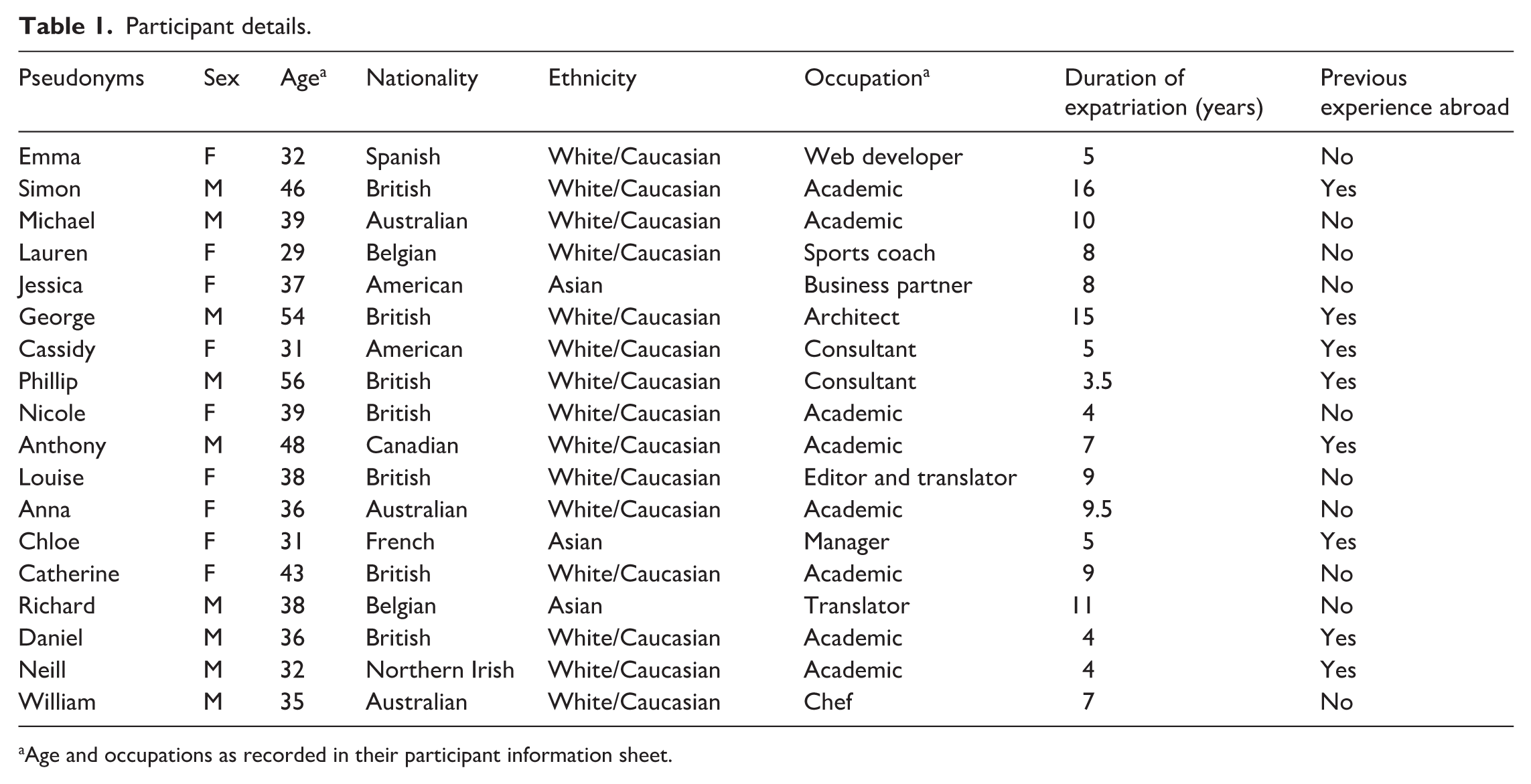
Age and occupations as recorded in their participant information sheet.
Data collection and analysis
Interviewees were contacted by email in July 2019 to be informed about the nature of the study and given a participant consent form and demographic information sheet to complete and sign. The first interview took place in July 2019 and the last in March 2021. The first wave of data collection started before the COVID-19 pandemic, allowing us to conduct six interviews face-to-face with participants in the UK in public places (e.g. coffee places) or in their offices. For the subsequent waves of data collection, we relied on online interviews in line with government guidance in the UK at the time.
There are many important ways in which the COVID-19 pandemic shaped the experiences of our participants even though the most serious lockdown in Shanghai took place between February and June 2022, after our data collection had ended. At the time of data collection, Shanghai had a relatively relaxed approach to the pandemic compared with the rest of the world. However, certain restrictions were already in place, such as quarantine for international arrivals and the use of individual QR codes to monitor movement within the city (BBC News, 2022). There is much to learn from setting these narratives in the context of China in 2019–21 due to the escalating political and economic tensions between China and Western economies occurring at the time. While China’s attitude towards migrant workers was one of great openness after joining the World Trade Organization (WTO) in 2001, its stance on foreign labour tightened significantly during the pandemic (Herrero, 2022). This trend is not unique to China, as the US also tightened its immigration policies after the 2020 elections, reflecting a global shift towards restricting migrant labour amid economic and political challenges (Smith, 2020). We acknowledge that these important changes do not get the attention they deserve in the current study, but they were not the focus of the interviews.
The interviews were conducted by the first author. English was the chosen language for the interviews as it is the main language used by expatriates in China. The interviews lasted 45 minutes on average and were audio-recorded and transcribed verbatim. The textual data from the transcripts were imported into NVivo12 as all three co-authors had access to and were familiar with the use of this qualitative coding software. Using this software facilitated our collaborative approach to data analysis as we could share and combine our files and codes. The chosen approach to analyse the narrative interviews was abductive, allowing the researchers to move between theory and data (Tavory and Timmermans, 2014). We used Braun and Clarke’s (2006) six-phase guide to reflective thematic analysis to apply initial codes to segments of text relevant to our research questions. To respect the integrity of the participant’s narrated account, transcripts from the different interviews were first regrouped within a single file before generating themes and broad dimensions (Figure 1).
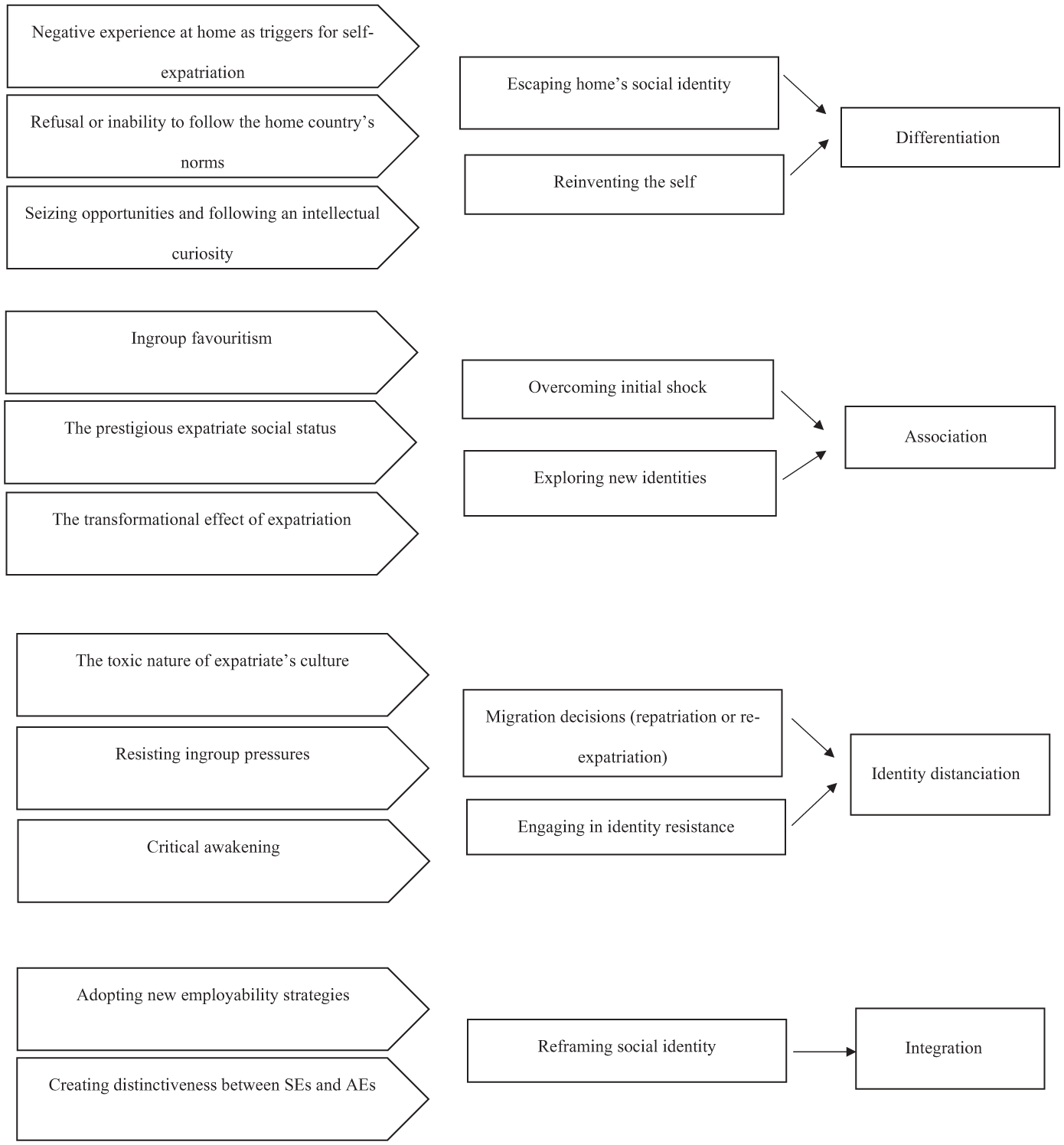
Coding and themes.
The analysis followed an interpretative approach paying particular attention to participants’ subjective perceptions (Braun and Clarke, 2022) and the role played by context in shaping their experiences of work and employment (Andresen et al., 2019). This search for meanings and their significance for participants was undertaken collaboratively by the research team through regular meetings to discuss emerging codes that later became themes and aggregate dimensions. The research team comprised individuals from diverse national settings and included a team member born in China, which contributed to greater reflexivity and cultural awareness in the team’s interpretation of the data.
Findings
The findings reveal how SEs make sense of their self or selves through their career narratives during their cross-cultural transitions. Their identity (re)construction in this process generates tensions since cross-cultural adjustment requires them to fit in while also seeking to stand out. Various factors contribute to changes in their identities. Specifically, social interactions with fellow expatriates and HCNs played a key role in their social and professional adjustment but changed over time. SEs primarily talked about their social interaction with their local expatriate community, which they relied on more heavily in the first two waves of their adjustment (differentiation and association). Their attachment to this community changes in subsequent waves of adjustment (identity distanciation) with SEs connecting more extensively with HCNs in the fourth wave (integration). Some of the SEs went through some rather than all four waves.
Differentiation: Self-expatriation as a chance to self-identify
Differentiation marked the participants’ first wave of identity reconstruction and took place before they arrived in Shanghai. Participants expressed their wish to ‘stand out from the crowd’ (Lauren) to differentiate themselves from home country nationals. While acquiring international experience was not unheard of, going to China was still considered at the time to be ‘not for everyone’ (Catherine). By extension, it said something special about them as they were daring to do what others would not. Anna, who had never lived abroad before, shared that: ‘I was looking for a job overseas, and I didn’t want to do what any other Australian teacher does and teach in London. It just wasn’t me (smiles).’
Moving abroad put the participants in a liminal space where they started to transition from one identity to another, or as Lauren said, from a ‘homebird’ to an ‘adventurer’. Their geographical mobility led them to cross significant social boundaries, such as expectations described by William as: ‘to have a three-bedroom house, a regular job with a dog and a cat’. Anna expressed how such social conventions were not necessarily perceived as achievable or desirable and that being ‘out of sight, out of mind’ helped her ‘find herself by breaking away from the stress of society’s rules, all these undisclosed rules of society’. This was shared by Cassidy, a single English teacher when she first arrived in China: ‘As soon as I moved to China, I was like: All right, I am allowed to not be normal’. These quotes help illustrate the identity work they undertook as they used their in-between status (i.e. newly arrived and not sure if they will stay) to make sense of the challenges ahead.
This liberating effect was particularly felt by those who decided to self-expatriate following a traumatic event at home, such as a relationship breakdown (six participants) or a termination of employment (three participants). Having lost this part of their identity, self-expatriation represented a new start by taking on the identity of challengers and ‘adventurers’ (Jessica). Being young, single and without dependants at the time played an important role in their decision-making process. This step was even easier for those who had already lived overseas (eight of our participants). With few job opportunities and responsibilities at home, the risks were minimal, as Neill described: I can either go down this path to medical translation and be on a pretty measly salary. Or I can go and experience something completely new, learn a new language, and then I can always come back and continue with translation.
Becoming an expatriate was associated with gaining access to a more prestigious social status of ‘international talent’ (Kirk, 2021), someone leading ‘an exciting life’ (Louise) with greater levels of financial and geographical mobility. When asked about her plans following graduation, Cassidy explained the type of person she thought she could become by moving to China: ‘Somewhere vaguely in my mind when I graduated, I wanted to learn Chinese so that I could work for a big company as a businessperson in China and fly first-class’. While the possibility of reinventing the self by joining a prestigious social category was key in their motivations to relocate, for all but four of our participants it was the expatriate community that made it possible. As summarised by Neill: ‘I think if my friend Warren hadn’t been there, I probably wouldn’t have considered it’. Expatriate networks played a key role in their decision-making by circulating information about their future host country (Sciortino et al., 2024), such as advice on visas, work applications and accommodation. British tea bags, Western books, cosmetics and other hard-to-get items were offered on arrival as thank you gestures, consolidating ties that played a crucial role in their initial adjustment.
Association: Becoming part of the expatriate community
In keeping with extant findings (Liu-Farrer and Yeoh, 2017; Sciortino et al., 2024), participants reflected on the isolating effects of international migration. Anna and Cassidy conveyed how they felt ‘lonely’ and ‘isolated’ upon arriving in China. Being away from family and friends amplified the emotional range of feelings experienced in the initial periods of general adjustment (Oberg, 1960; Ybema et al., 2009). As Cassidy explained when discussing her relationship with friends at home: ‘They cannot comprehend what it is to live in a different country, and how exciting it is as an adventure, but also how isolating. (pause) Because when you are sad, it’s the saddest.’
Joining the expatriate community allowed them to overcome this relational disruption and re-establish positive self-esteem (Tajfel and Turner, 1979). Our participants’ identity work and adjustment involved reflecting on the compatibility of their desire to be different and ‘find themselves’ (Anna) with the reality of living in a foreign country. Sharing a common expatriation experience created an expatriate identity transcending traditional identity markers such as gender, occupation, status (assigned vs self-expatriates), or nationality. Based on this social categorisation, participants were expats as opposed to locals, in an ingroup as opposed to an outgroup. This new-found social identity helped soften the initial culture shock, with participants describing the expatriate network as a ‘tight-knit community’ (Catherine) and a ‘second family’ (Richard). In line with SIT, their social identity took the forefront in their self-descriptions to precede references to their personal self (Onorato and Turner, 2004). Simon, who had been living in China for over a decade, revealed: ‘I live in China and it’s my life. It’s more than just my career or the job. It is my LIFE.’ Similarly, Anna described herself as ‘the girl that went to China’, illustrating the transformational impact of the experience on her sense of self.
Social identification with the expatriate community provided a way to network and gain access to emotional support along with the scope of securing paid employment. Ingroup bias played a critical role in their job search, with group members favouring each other. Eight participants secured their first position through a self-expatriated friend in Shanghai and four did so by reaching out to contacts from previous work experience in China (all were expatriates, none were HCNs). The participants’ social networks exclusively consisted of fellow Western expatriates, with little to no resistance to the segregation occurring between the ingroup of expatriates and the outgroup of HCNs. According to SIT, this can be explained by the salience of their self-categorisation as members of the group encouraging conformity to group norms and reinforcing differences with the outgroup (Abrams and Hogg, 1990). Only three participants had made continuous efforts to acquire some level of fluency in Chinese Mandarin and develop friendships with HCNs. Thanks to the well-established expatriate community, this absence of cultural interactions did not hinder their social integration. Like the other participants, Neill’s typical day-to-day life required little to no cultural adjustments: If you stayed within Xuhui (a popular district in Shanghai among foreigners), you literally could speak English the whole time. You could eat Western food the whole time. You could drink IPA the whole time (laughs). You can basically live a European lifestyle. But you’re in a city of 20, 25 million Chinese people, but you would have no contact with any of those people.
The participants also shared evidence of self-stereotyping; that is, the ascription of ingroup-defining traits to the self (Hogg and Turner, 1987) by displaying behaviours associated with AEs. While the expatriate community was made of both AEs and SEs, it was AEs that sat at the top of the pyramid in terms of social status and benefits, as Simon explained: There are two kinds of expatriates in Asia. You have those who turned out for a job and ended up on local contracts, and people sent by big companies which are on a different league . . . they have a house with a driver, and international schools, and all of that. I wish I was in this category.
What they could do, however, was to create the illusion that they shared the same economic and social benefits as these stereotypical expatriates. Cassidy explained how in Shanghai: ‘you could go to the Bund 1 and pretend to be rich for a day’. She relayed how being a young, White, American woman allowed her to try different occupations such as modelling or acting to try on a new, more glamourous identity.
For most participants, demographic attributes such as their native language, country of citizenship and/or ethnicity became a form of social privilege and facilitated their identity and geographical transitions. For instance, Anthony, a Canadian citizen who befriended Chinese classmates during his studies, described his first position in China as: ‘being the White guy in the office, who would go to international meetings’. Similarly, George, a British architect, relayed how his presence was required during presentations to clients regardless of his involvement in the work presented: ‘I would have to make a lot of presentations just because I was a foreigner’. Their privileged status as White Western expatriates granted them higher hierarchical positions, such as supervisory roles despite lacking managerial experience. This led to preferential treatments in the workplace such as sitting at the honour table during annual celebrations and being treated by local colleagues ‘with the utmost respect’ (Louise). Their whiteness conferred an inherent legitimacy or Western superiority (Samaluk, 2016). They became the default authority, with their knowledge and opinions often considered as more credible and valuable than those of their non-White colleagues, notwithstanding their expertise.
During this wave, participants did not resist this ingroup favouritism and perceived such practices as signalling their intrinsic value. Their social identity served their self-esteem needs by creating a sense of self-worth and accomplishment. Chloe suggested that this preferred treatment was a fair reward for her efforts to self-expatriate: Being abroad, it involves a lot of compromises. You are far from your loved one and you are in an environment where you are not in danger, but you are not in your comfort zone. The reward for this is that if you perform, your value is also seen because you are of a foreign breed.
Still, Anthony and George shared that they were also very aware of the unsustainability of their privileged positions. In other words, ‘being of a foreign breed’ (Chloe) was not going to serve their social identity needs in the long term as the social status of expatriates in China started to shift (Lan et al., 2022). Those who were able to acknowledge and reflect on this shift were able to prompt a new wave in their identity development, which is presented in the following section.
Identity distanciation: Resisting the expatriate social identity to remain different
For our participants, increasing their distinctiveness as individuals within a social category allowed them to develop positive intergroup relationships (Ellemers and Haslam, 2012). Internal and external push factors incentivised them to resist depersonalisation. Firstly, participants sought to resist ingroup conformity pressures when they conflicted with their values and beliefs. Expatriates’ self-enhancement – that is, feelings of pride for belonging to an economically and socially prestigious group – sometimes led to derogatory attitudes and behaviours towards outgroups. Participants shared how they witnessed racist comments being made towards local colleagues (HCNs) and their exclusion from leadership opportunities for not belonging to the expatriates ingroup. Neill, the Irish translator now teacher, described his ethical struggle to protect his self-identity as a ‘foreign expert’ while seeing how unfairly local staff were being treated: ‘They resented us, obviously. And if I had their shoes on, I would completely resent them.’
For Louise, being offered opportunities based on ethnicity rather than merit challenged her self-identity as someone with a deep appreciation for foreign cultures. While still playing the colonial madam in Chinese movies, she was also one of the few who learnt Chinese Mandarin to build good relationships with her local colleagues. She explained her intent to not be seen as ‘one of these expatriates’ by saying: I knew a lot of people there who took advantage of their status as foreigners, and White foreigners especially, and I really didn’t want to be one of those people who would just go there and take advantage.
Some expatriates’ behaviours were perceived as ‘just not right’ (Anna) or ‘unethical’ (Louise), leading to emotional discomfort that triggered identity changes. All but one of the participants experienced these critical awakenings that we define as moments when participants acknowledged tensions between their self and social identity. As illustrated in Louise and Neill’s case, the trigger could be a conflict between their preferred self and their ascribed identities as White Western expatriates. Participants became low identifiers within the expatriate social category (Turner, 1999) and tried to distance themselves from stereotypical expatriates by emphasising ingroup variability (i.e. ‘we are not all the same’).
Additionally, new globalisation trends also provoked these critical awakenings. George spoke of the rarefication of positions reserved for expatriates due to the push for localisation in China: ‘I think they’re now getting to that point where more of those positions that once were taken on by probably overpaid expats are now going into the local workforce’. Likewise, Michael compared the situation to ‘being a very small fish in a big pond’. The trend for localisation building on the bettering of the level of education and skills available in the local market threatened the ingroup’s unique identity (Ellemers and Haslam, 2012). To maintain their positive distinctiveness, 11 of the 18 participants decided to pursue further education and training to consolidate their cultural capital. This change was illustrated by George, a British architect who delivered all the important presentations in his company: I think (Chinese) people certainly treat foreigners differently, but I see that less and less over time. And I think you can only survive here if you have an intrinsic value for a firm or team or a project, you’ve got to get out of your bubble.
Not all the participants were successful in their attempts to ‘get out of the bubble’, with Neill sharing how his attempts to learn Chinese were blocked by outgroup members: There was a weird sort of apartheid in the school because I remember trying to set up some language exchanges with some of the Chinese staff and they were like: Okay we can do that, but we can’t tell anyone about it, and we’ll have to meet off-site.
This illustrates how group boundaries are reciprocally maintained with prejudices working both ways. Participants were aware that their social status as foreigners was not as highly respected as suggested by the narrative of the glamorous lifestyle of expatriates. Derogatory comments towards foreigners, such as ‘being losers in their home country’ (Anthony) or the stereotype of the ‘sleazy English teacher’ (Neill), deterred intergroup relations. Another example of guarding behaviours is illustrated by Chloe’s experience. Like three other participants, Chloe is of Asian descent and does not fit the stereotypical profile of expatriates in Shanghai as White Caucasian, leading to strained relationships with HCNs: Looking Asian in Shanghai by default they would assume that you are Chinese, or at least you speak Mandarin . . . They would be quite shocked, and kind of outraged that I wasn’t mastering this language, it was a little bit racist.
Her failed communication attempts led to the development of intergroup anxiety (Greenland and Brown, 1999) where unsuccessful attempts discouraged future efforts towards intergroup contact for fear of ridicule or feelings of shame. Intergroup anxiety reinforces negative expectations about outgroup members and ingroup favouritism, with SEs retreating to the comfort of their community before repatriating or re-expatriating. These behaviours can be interpreted as identity maintenance or identity-protecting strategies (Brown, 2000) and align with the tendency for ingroup members to exert ingroup bias when their self-esteem is weakened (Tajfel and Turner, 1979).
Integration: Balancing individual and social identities
Like the previous wave, getting out of the expatriate bubble required the ability to connect and integrate across group boundaries. Not all the participants were able to do so and therefore not all of them experienced this fourth wave. Those who did build multiple identities, described by Neill as ‘double lives’, altered their attitudes and behaviours based on who they were interacting with: I had a sort of a double life living in Shanghai, on one side I was trying to immerse myself in the Chinese side of things, and on the other side, I was just living this really exciting expat life.
Switching identities was easier for those loosely connected to their home countries (e.g. with limited contacts at home and no family commitments). With little to no one to hold them accountable for who they were (or were pretending to be), Shanghai became a form of identity playground. This way, Cassidy altered her marital status depending on whom she was meeting and introduced herself as single when interacting with other expatriates because: ‘If you talk to other expats our age, they’re all like: we’re young, we’re fun, we are expats, never get married and never have kids’. Another strategy used by participants to resist depersonalisation and foster social mobility was to increase personalisation; that is, treating individuals in the outgroup as unique individuals and not group members (Brewer and Miller, 1984). Anna, Richard and Michael used their hobbies to meet other like-minded individuals and cultivate friendships across group boundaries. For Lauren and Louise, venturing outside expatriate circles was driven by their growing attachment to their work, which they used as an outlet for self-development. Being an expatriate did not take the forefront in the way they were presenting themselves, nor was it their main source of personal fulfilment. Among the academics in our sample, teaching originally served as an entry ticket to China but became a professional calling, changing their narrative from ‘I teach, so I can be in China’ to ‘I am a teacher, and I live in China’ (Simon).
Not all attempts to redefine themselves were welcomed by HCNs, whose resistance threatened the SEs’ sense of belonging. For example, Anna and Richard called themselves ‘a girl/guy from China’ but knew they would never be considered as ‘one of them’ (i.e. an HCN). Since few participants had learnt Mandarin and none planned to stay in China indefinitely, this reaction was unsurprising. Yet, reported cultural interactions with HCNs, such as challenges interacting with local neighbours, shopkeepers and landlords, highlight the role of community support in shaping expatriates’ identity transformations. Specifically, participants cited the ‘lǎowài tax’ (老外税 foreigners being overcharged compared with locals) and being called derogatory terms such as ‘White ghost’ (白鬼子 báiguǐzi) or ‘long nose’ (长鼻子 cháng bí zi) as examples of how these interactions can either facilitate or hinder their adaptation.
These identity transitions continued following their re-expatriation and repatriation. Moving away represented a new threat to their identity, to which they responded by selectively presenting the exact nature of their experiences in China. As Emma expressed: I learned it the hard way. I went to this event, and I was like, ‘Yeah, China, China, China!’, and they did not get it because they don’t share the same passion. After a while, I changed to: ‘I am from here, but I lived abroad’. But I don’t mention China because they don’t care.
Anthony shared how recruiters had questioned his motivations for leaving his home country for so long, insinuating that he could not be trusted: ‘They told me: You’re just going to leave us in a few months’. Additionally, Simon stressed that China was viewed by a minority as ‘downtown Bangkok’ and not a business destination to question the credibility of his work experience. Finally, most repatriated participants used a strategy of removing any mention of China in their resumes but emphasised the names of multinationals they had worked for.
Conversely, participants found strength and hope in their China experiences when struggling to readjust at home. As Phillip explained: ‘To me, anybody who has been to China has really stepped out of their comfort zone. It makes them stand out to me from other people.’ Like Phillip, repatriated participants used the narrative of the self-made expatriate to differentiate themselves from AEs, claiming that their experience was deeper and more challenging. The creation of this alternative group for comparison served their need for positive distinctiveness (Abrams and Hogg, 1990). To conclude, participants managed and alternated between multiple social identities by positioning themselves between different social groups.
Discussion
This study examined how the expatriate and local host communities influence the social and professional adjustment of SEs and impact their identity work before, during and after expatriation. The findings exemplify our participants’ attempts to (re)construct their narratives by initially drawing from the support of their expatriate communities before progressively distancing themselves from them. All but one participant reflected on the value and meaning of their privileged social positions in determining their self-image. Once they experienced a critical awakening, they sought to change their social and professional identities. Their ability to balance their social identity as expatriates but also as ‘adventurers’ or ‘self-made expatriates’ significantly impacted their long-term adjustment, highlighting the benefit of a longitudinal methodology. A visual representation of the ups and downs experienced by SEs throughout this process is depicted in Figure 2. We liken these to sea waves and their continuous pushing and pulling motion: SEs may push themselves out of their comfort zone but end up being pulled back towards their community – a force of gravity they may not be able to resist. Consequently, not all SEs will go through all four waves, explaining the differences in social and professional adjustment migration outcomes (e.g. staying, repatriating or re-expatriating).
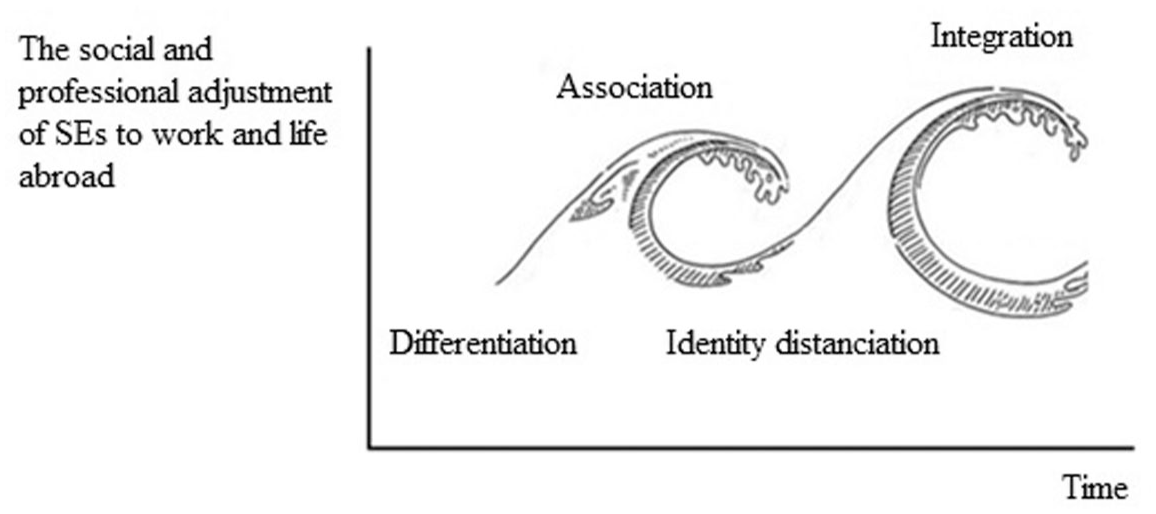
The four waves of self-expatriates’ identity (re)construction.
Through the adoption of a social identity perspective, our model differs from existing adjustment models such as the U and W curves of adjustment (Gullahorn and Gullahorn, 1963; Lysgaard, 1955) or Black and Gregersen’s (1991) adjustment model in important ways. Firstly, our model illustrates that SEs may move fluidly in and out of adjustment waves, rather than progressing in a rigid and fixed manner. This better reflects the unpredictability of life abroad, shaped by sudden personal, professional, or political events. Secondly, we go beyond integration as the sole marker of expatriation success to suggest alternative possible migration outcomes (i.e. repatriation, citizenship or re-expatriation). Doing so challenges conventional assumptions of either upward or downward expatriation and suggests a more complex relationship between one’s assimilation in their host country and perceived success (Zhu et al., 2016). Finally, the model frames social communities as active contributors to international adjustment rather than passive background influences. This acknowledges the multiple layers at play in international adjustment (i.e. micro, meso and meta levels) and the structural and institutional forces that shape them (i.e. the country’s economic development, immigration policies and government regulation of social events such as pandemics).
Specifically, our findings shed light on how field-level changes such as workforce localisation reshape expatriate community dynamics by reducing ‘expatriates-only’ opportunities and driving the departure of foreign talent. We frame these developments as identity threats (Watson, 2011), prompting individuals to reconstruct their identities to preserve both the socio-economic advantages gained abroad and a coherent sense of self. As our model illustrates, this process may involve expanding networks beyond the expatriate bubble in the association wave by reaching out to HCNs in the identity distanciation wave.
Participants’ reflexive projects – that is, their ongoing and non-linear attempts to maintain a cohesive life story and sense of self (Giddens, 1991) – illustrate the complex role that intergroup behaviours play on individual journeys. In our case, participants found themselves between AEs and HCNs. This liminality gave them the space to explore and try different identities (e.g. the adventurer, the first-class flyer) and position themselves concerning aspects of different groups that they might see as positive or negative. Among themselves, newcomers initially developed ‘intense comradeship and egalitarianism’ (Turner, 1969: 95). Yet, with time, these social bonds became splintered as SEs became aware of the moral and ethical tensions generated by their ascribed identities.
Recognising the conditions under which minority influence takes place helps us emphasise the dynamic nature of intergroup perceptions with adjustment being relational and reciprocal (Alba and Nee, 2020). The participants’ personalities and positionalities shaped their identity as expatriates, with no straight answer to what a role model or stereotypical expatriate should be. This made expatriation a bumpy rather than a straight line of convergence, with the assimilation attempts of newcomers often remaining blocked by their social communities and the native population (Brown and Bean, 2006). More time in the host country did not necessarily translate into better work and non-work adjustment, with lingering discrimination and persisting conflicts blocking their paths to socio-economic mobility. For several participants, extended time abroad only led to the reinforcement of their prejudice towards HCNs and their retreat towards secluded expatriate communities (i.e. association wave). Therefore, these communities did not necessarily act as decompression chambers as theorised by Portes and Zhou (1993) but could also hinder cross-cultural acculturation. This can be explained by SIT where members of a superior ingroup show increased ingroup bias when group boundaries become destabilised or delegitimated as is the case when racial privileges are questioned (Lan et al., 2022). Accordingly, our study resonates with thriving critical migration research adopting a postcolonial lens to expose the power that multinational organisations and their employees have in maintaining or challenging global social inequalities (Banerjee and Prasad, 2008; Eden, 2003) such as Western expatriates’ privileged positions in non-Western workplaces. Therefore, SIT is also a useful lens for studying the relationship between power and status in multicultural settings (Zulfiqar and Prasad, 2022).
Our findings reveal how a preference for ingroup membership can be motivated by goals other than maintaining a positive self-esteem (Brown, 2000). Previously suggested alternative goals aligning with our data include the need for coherent self-conception and the quest for meaning (Onorato and Turner, 2004; Watson, 2009). By framing expatriation as a door to self-transformation, we can see how SEs can express their agency by adopting a particular self-image (i.e. the first-class flyers, the White guy in the office) to achieve economic independence or cultural integration. These alternative goals illuminate the benefits of using a sociological approach to extend SIT by arguing that not only cognitive processes – that is, identifying with a group to obtain validation – but also social and structural dynamics shape intergroup behaviours (Hu and Cheung, 2024; Stets and Serpe, 2016). Additionally, our findings reveal how ingroup members can resist depersonalisation and the necessary conditions for it, with moments of critical awakening triggering their reflexive identity work.
Given the current institutional push to promote international experience in educational and managerial settings, this study has important social and organisational implications. Firstly, it encourages a rethinking of the assumption in the management literature that there is such a thing as a self-made career. This has implications for research on global mobility, transnationalism and cultural adaptation by emphasising the role played by transnational communities and networks in expatriate transitions (Jiang and Korczynski, 2024; Rodrigues et al., 2016). Migration poses risks such as job insecurity, challenges in maintaining personal relationships, and social isolation – issues that also affected our participants despite belonging to a privileged class of mobile workers (WHO, 2024). Our study illustrates the crucial role played by communities in alleviating or exacerbating these challenges, and how this may change through time.
Secondly, our findings problematise the current glamorisation of expatriates’ lifestyles by bringing to the forefront the social and ethical implications of transnational working arrangements such as White Western expatriates being the default authority in non-Western work settings (Boussebaa, 2024; Boussebaa and Brown, 2017). The label of self-expatriate is loaded with assumptions of social and economic privilege such as possessing both the financial means to relocate and a form of citizenship that affords relatively easy international mobility. In fact, when skilled professionals from developing countries such as China or India move to developed countries, their migration is often referred to as ‘skilled migration’ rather than ‘self-initiated expatriation’. In this sense, the term ‘self-initiated expatriation’ may to some extent reflect underlying biases. The findings from this study thus illuminate the privileges and exclusions embedded in the social category of expatriates, with AEs benefiting from greater economic privileges and a higher social status than SEs.
Finally, we raise questions about the conditions under which expatriates are perceived as legitimate bearers of foreign expertise in a host country. Our findings show how factors such as race, ethnicity, age and gender shape the ability of individuals to move through the four waves. For instance, Anthony (described as ‘the White guy in the office’) was openly welcomed by HCNs and able to build a strong local professional network. By contrast, Chloe encountered occasional hostility in everyday interactions for what she described as ‘looking Asian but not speaking Chinese’, thus lessening her authority and desire to stay. Future studies may wish to deepen our understanding of how whiteness, gender and racialisation influence the identity (re)construction and international adjustment of expatriates, specifically for individuals who embody multiple marginalised or less socially valorised traits (e.g. being female, non-White, or older).
Conclusion
This article contributes to research on expatriation and international adjustment by presenting a novel process model of identity (re)construction that moves beyond conventional acculturation and adjustment frameworks, focusing on identity dynamics within stratified global occupational landscapes. Using Shanghai as an example, we illuminate how identity work unfolds as expatriates learn to navigate self and social identities and the implications this has for mobility outcomes such as repatriation, citizenship or re-expatriation. Theoretically, we extend SIT through its integration with identity work theory, thereby offering a richer account of how individuals navigate identity threats across borders. More broadly, our analysis contributes to the sociology of migration by foregrounding the constitutive role of race and power in shaping transnational experiences, dimensions that remain underexamined but are central to understanding contemporary forms of global mobility.
Footnotes
Funding
The authors received no financial support for the research, authorship, and/or publication of this article.
