




Abstract
This conceptual article contributes to the theoretical development of career studies by responding to calls for a robust social theory that would support the advancement of career research. While the theories of Bourdieu, Giddens and Luhmann (and some others) have had some resonance, alternative broad theoretical frameworks are still needed to tackle unresolved issues. Proposing Realist Social Theory (RST) as one such alternative, this article outlines four key contributions that this theoretical framework can offer to further advance career scholarship. The article explicitly invites a plurality of voices to further fuel conversations about the future theorisation of career studies and to take part in debates about suitable ways forward in this endeavour.
Keywords
Introduction
Careers as the ‘moving perspective in which persons orient themselves with reference to the social order’ (Hughes, 1958: 67) are situated at the intersection between the individual and society (Schein, 1980). Defined as ‘the evolving sequence of a person’s work experiences over time’ (Arthur et al., 1989: 8) or ‘the sequence of employment-related positions, roles, activities and experiences encountered by a person’ (Arnold, 1997: 16), careers are understood in different ways (for a comprehensive discussion see Gunz and Mayrhofer, 2018: 25 ff.). Elaborations range from retrospective sensemaking and self-construction (Cohen and Mallon, 1999) via being a product rather than a process (Bird, 1996) to linking different levels of social complexity (Grandjean, 1981) and constituting a path through space and time (Collin, 2006).
It is hardly surprising, then, that career research is extensive in scope, diverse in theoretical and empirical approaches, and considers a great variety of topics, such as structural changes shaping career mobility opportunities (Witteveen and Westerman, 2023), erosion of career calling (Cohen et al., 2019) or boundaries and their crossing (Rodrigues et al., 2016). It also is of interest to a broad number of academic disciplines, including sociology, psychology and management studies. Like these disciplines, career studies regularly review their progress and suggest avenues for future development (e.g. Baruch and Sullivan, 2022; Inkson et al., 2012). Such considerations typically point towards promising research topics, newly refined methods and methodologies, and more powerful empirical samples. Two particularly prominent features of career studies’ reviews are the recurrent calls to advance the field by a deepened understanding of major issues that it has been grappling with and the repeated plea for a robust social theory that would encourage and enable such progress (Dokko and Chudzikowski, 2020; Gunz and Mayrhofer, 2018; Khapova and Arthur, 2011).
Regarding the latter, some commentators have recommended concrete theoretical frameworks. Examples include Bourdieu’s (1977) Theory of Practice as a potential ‘unifying framework for generating new questions in career research and systematically integrating concepts from other disciplines’ (Chudzikowski and Mayrhofer, 2011: 19), Giddens’ (1984) Structuration Model to understand the structure–agency relationship in careers and Luhmann’s (1995) Social System Theory to appreciate the key role of communication, action and decision. Indeed, some career research has related to these theories by, for example, using various building blocks of Bourdieu’s legacy, such as field, habitus and capitals (e.g. Iellatchitch et al., 2003; McCann and Monteath, 2020), Barley’s Structuration Career Model (Duberley et al., 2006) and Luhmannian analyses of the effects of boundaryless careers on the functioning of organisations (Becker and Haunschild, 2003). However, it seems fair to say that none of these efforts has gained a commanding position in the career discourse, and the respective pleas for a substantial theoretical framework still emerge and are profoundly justified.
In terms of the major issues requiring special attention, four of them appear to be particularly salient and topical in the available reviews of career studies and the overall career scholarship: the role of context, the relationship between structure and agency, the importance of time and the question of taking impactful action. Context and its role is a long-standing issue that has captured generations of career researchers, from the seminal works of the Chicago School of Sociology (for an overview see Barley, 1989) and contributions in major career handbooks (Gunz and Peiperl, 2007; Gunz et al., 2020) to recent works that critique the neoliberal assumptions behind the idea(l) of finding one’s purpose through a career and being able to choose freely (Bal et al., 2020) and analyse careers and their perceptions across different contexts (Andresen et al., 2024). Nevertheless, we are far from having a thorough understanding or appreciation of the context and its role. Like ‘“Mr Environment” does not simply walk into an organisation and dictate to management what decisions need to be made for an optimal “organisation-environment fit”’ (Matiaske et al., 2008: 6), we need more solid and insightful theoretical explanations about the ways in which context affects – and is affected by – individual careers.
The relationship of structure and agency is at the centre of the enduring debate about individuals’ capacity to act and the influence of social organisations, culture and institutions on their behaviour. When analysing careers, mainstream research focuses on either agency or structure, congruent with the primary focus of two main ‘parenting’ disciplines, psychology and sociology, respectively. In line with the laudable efforts to overcome this divide by acknowledging the interdependence between agency and structure (Schneidhofer et al., 2020), the contextual turn in career research – such as the efforts to acknowledge the effect of career boundaries (Mayrhofer et al., 2007) and to appreciate the impact of different contextual layers (e.g. Tams et al., 2021) – requires a more differentiated view on structure and agency ‘favoring none over the other’ (Chudzikowski and Mayrhofer, 2011: 22). Yet, the current emphasis on the duality of structure and agency makes it difficult to specify how individuals navigate and negotiate within social systems as the two become ontologically and/or analytically inseparable. Moreover, literature has emphasised the importance of balancing individual agency and structure to overcome contextual determinism as context constrains and enables action, and Actors respond differently based on, inter alia, their resources and management style (Cohen and Duberley, 2015).
Emirbayer and Mische (1998) further conceptualise agency as shaped by the past, oriented towards the future and responsive to the present, and the importance of time has received renewed attention in career research (Mayrhofer and Gunz, 2020). Acknowledged by all prominent definitions of careers, it has been addressed in a number of ways. This includes research on stage models of careers (Levinson, 1978), the dynamics of career imagination as a way of making sense of one’s life (Cohen and Duberley, 2021) and longitudinal studies of careers over individuals’ lives (Abele and Spurk, 2009). Despite this importance, a number of issues loom large and remain underexplored, especially in terms of different conceptualisations of time, the co-evolution of various Actors over their respective careers and the role of temporal structures for individual career behaviour and organisational career management (Mayrhofer and Gunz, 2022). Particularly important is the differentiation between objective and subjective time. The former, often called clock-time, is rooted in the Newtonian paradigm and assumes that time is objectively measurable and its units (hours, minutes, etc.) can be put into mathematical calculations with clear results. Subjective time, however, acknowledges that clock-time can be experienced differently by individual and collective Actors. A week of hard work feels very different from the same objective period spent relaxing. Related to that, Chronos emphasises the objective quality of time and its measurable intervals, whereas Kairos indicates that various points in time differ in their potential for opportunity and that certain times can be more opportune for making decisions (Otto et al., 2024; Smith, 1969).
Taking research-informed actions to make an impact is rooted in the more fundamental – and contentious – debate about the purpose and limits of the scientific dimensions of the Enlightenment project (Pinker, 2018). Endorsing the idea of advancing scholarly knowledge for its own sake can be a tempting, low-risk, convenient and – sometimes – justifiable proposition. Yet, it misses mounting demands from, among others, publishers, funding bodies and promotion panels to produce practical, actionable and otherwise useful-outside-of-academia scholarship that would benefit the wider society. The understanding of whether and how this can be achieved is absent in career studies. Like other disciplines, career scholars appear to be deterred by the lack of guidance on how to address societal issues without resorting to judgemental and pontifical evaluations, such as labelling other people’s careers as ‘good’ or ‘bad’, ‘successful’ or ‘unsuccessful’ (Gunz and Mayrhofer, 2011).
Against this backdrop and career’s intersectional qualities including the individual and the social order, Archer’s (2003, 2007) Realist Social Theory (RST) can provide a useful theoretical framework for career studies. It explains how context provides specific conditions that hinder or enable individual Actors’ responses, explicitly puts the intricate relationship between agency and structure/culture to the fore, acknowledging that both are closely linked but analytically and ontologically distinct and irreducible, and has the in-built temporal element of ongoing cycles of preserving/reproducing or transforming/elaborating initial conditionings. In such a way, it allows for both an objective and a subjective time angle. All this provides fertile ground and solid reasoning for practical action. Importantly, we do not juxtapose RST with any other grand social theories. Instead, our ambition is to demonstrate its potential to offer a comprehensive framework for career studies and generate a fresh and in-depth view on the major issues that career studies are grappling with. The suggested contributions of RST draw upon established insights and more recent developments in career studies and cognate disciplines, in particular debates about temporality (Mayrhofer and Gunz, 2022), relational views (O’Mahoney, 2007; Schneidhofer et al., 2020) and research impact and actionability (Sayer, 2011). While committed to what we see as a potent theoretical instrument for career studies, this is no move towards dogmatism. On the contrary, our main goal is to further fuel conversations about the future developments of career studies and to encourage debates about suitable ways forward, thus amplifying voices that favour plurality (Van Maanen, 1995).
We proceed by introducing RST and its critical realist ontological foundation. We then discuss four distinct contributions that the theory offers to career studies.
Realist Social Theory (RST)
Critical realist ontology
Archer’s RST avails itself explicitly and extensively of critical realism (CR), originally developed by Bhaskar (1975, 1979, 1989) and later extended by other theorists, including Archer (1995) herself (also Collier, 1994; Elder-Vass, 2010; Sayer, 1992). Thus, an introduction to RST should commence with an overview of its ontological roots. In a nutshell, CR regards the social world as stratified, open and existing (at least partly) independently of our identification system of hierarchically organised entities that have emergent causal powers to impact upon the world (Bhaskar, 1989).
CR argues that the reality is deeper and more complex than our ideas of it and consists of three domains or strata (Bhaskar, 1989). The empirical refers to events that we observe, sense and experience. The actual includes all events that are happening, observed or otherwise, and can be very different from what we witness. Finally, the real comprises generative mechanisms that cause the events. This ontological hierarchy does not deny the importance of people’s subjective perceptions but emphasises that such perceptions do not account for the entire social reality as many incidents and occurrences stay under people’s radar and transcend their experiences (Bhaskar, 1975).
The reality is composed of various entities (e.g. people, organisations, planets) that have properties (e.g. being purple or having scales) and causal powers (Fleetwood, 2009). At times, powers and mechanisms are used interchangeably, whereas some understand mechanisms as specific combinations of powers or regard powers as agential and mechanisms as structural (Sayer, 1992). For this introduction, it suffices to note that both powers and mechanisms are technical terms used to denote abilities to impact upon the world or causality. In CR, causality is the necessary and sufficient criterion for validating things as real. Fleetwood (2005) distinguishes between four modes of realness. The existence of materially real things, such as flowers and rocks, is not premised on our sense-making. The ideally real comprises such intangible things as languages, theories and ideas. Artefactually real things, such as microwaves and socks, are tangible and physical but fabricated and interpreted by people. Lastly, socially real entities, such as the labour market, class structure and organisations, are intangible and enacted by human actions but can exist independently of people’s identification. This ontological distinction usefully differentiates between things and discourses about them, as well as their causal powers and outcomes. For example, although it may be possible to discuss whether discrimination is real or not, the concepts, ideas and discourses of discrimination certainly are real because they influence the lives of millions of people.
Causality is also emergent. CR posits that entities are composed of parts arranged in specific ways (e.g. human beings consist of organs that consist of tissues consisting of cells). Such parts are lower-level entities, with properties and powers of their own (Sayer, 1992). Causal powers of the whole are irreducible to the sum of powers of its parts and emerge from relations between them (Elder-Vass, 2010). Entities of all levels are real, attention-worthy and cannot be fully understood either through the lower-level units forming them or the higher-level entities that they form. For example, this article is, hopefully, more than an arbitrary miscellany of letters or graphic dots that represent them in print.
Importantly, (social) entities exist in an open system impregnated with countless powers that reinforce, mediate, enfeeble, neutralise and otherwise alter and distort each other (Bhaskar, 1979; Sayer, 1992). Therefore, causality is contingent and context-sensitive. Some powers are never exercised, and some events never occur – arguably, all literate people can become writers, but the majority will never attempt writing a book. Yet, exercised powers can remain unactualised and operate transfactually (Fleetwood, 2009) – one could start a novel but fail to finish it because of family pressures. Finally, powers that satisfy certain conditions become actualised – an aspiring author finalises their manuscript and signs a deal with a publisher.
The openness of the social world suggests that it is impossible to account and control for all relevant mechanisms. Hence, CR considers law-like deterministic regularities unworkable, even though some mechanisms are more causally efficacious than others. Thus, claims such as ‘university degrees make people more employable’ should be taken with a considerable pinch of salt. Yet, it may be possible to uncover contingent tendencies or demi-regularities (Lawson, 2003) and, consequently, to argue that some university degrees may make some people more employable in certain conditions, and to explore at least some of those conditions. However, an unabridged explanation of who benefits from higher education, under what circumstances and why would have to trace causes back to the Big Bang. Thus, our knowledge and theories are inevitably fallible, which suggests endless opportunities for advancing them as more mechanisms are uncovered. At the same time, CR refuses to submit to judgemental relativism that treats all beliefs, convictions and conclusions as equally trustful and trustworthy. Instead, judgemental rationality is advocated to discern between fallible ideas as more or less adequate. Similarly, although people’s subjective interpretations and perceptions are important, the properties of things, as well as the space-time context, pose objective limits to subjective meaning-making. For instance, boots can be construed as footwear, vessels or mediums of exchange. Yet, wearing boots on a stroll is easier and (typically) more worthwhile than keeping liquids in them or exchanging them for food in a supermarket. Therefore, it is not only possible but also desirable to prioritise some theories, perceptions and explanations as more workable, practical and, put simply, better than others because they more accurately reflect the objective reality.
Archer’s RST
Archer’s RST retains critical realism’s fundamental ontological principles, while also drawing on empirical evidence. However, whereas CR presents a generic picture of social reality with emergent causal powers, Archer develops a more domain-specific theory of structure–agency interactions. RST puts forward the idea of dualism that recognises that structure and agency ‘emerge, intertwine, and redefine one another’ (Archer, 2010: 275; italics in original) but remain ontologically and analytically separate and irreducible. Archer (1995) also differentiates between structure (relations between social roles and positions) and culture (ideas, beliefs and norms). RST conceives of ‘people’ (agency) and their ‘reality’ (structure/culture) as having essentially different emergent powers: structure and culture condition people’s agency by posing various objective obstacles and enablers, whereas people deploy their own powers to navigate such impact. Archer (1995) suggests that certain structural and cultural configurations can encourage specific agential responses: people tend to defend favourable conditions; negotiate compromising conditions; pioneer and develop under stimulating conditions; and reform and revolutionise under mismatched or disjointed conditions. Yet, social configurations do not predetermine responses and people can make their own way through the world, reproducing or transforming it (Archer, 2007). As such, all social events and phenomena are outcomes of interactions between structure/culture and agency or, rather, their respective causal powers (Archer, 2003, 2012).
The dualism at the heart of RST is based upon and enabled by assumptions about the fundamentally different temporalities of structure/culture and agency. These assumptions form Archer’s (1995) three-stage morphostatic–morphogenetic model (Figure 1).
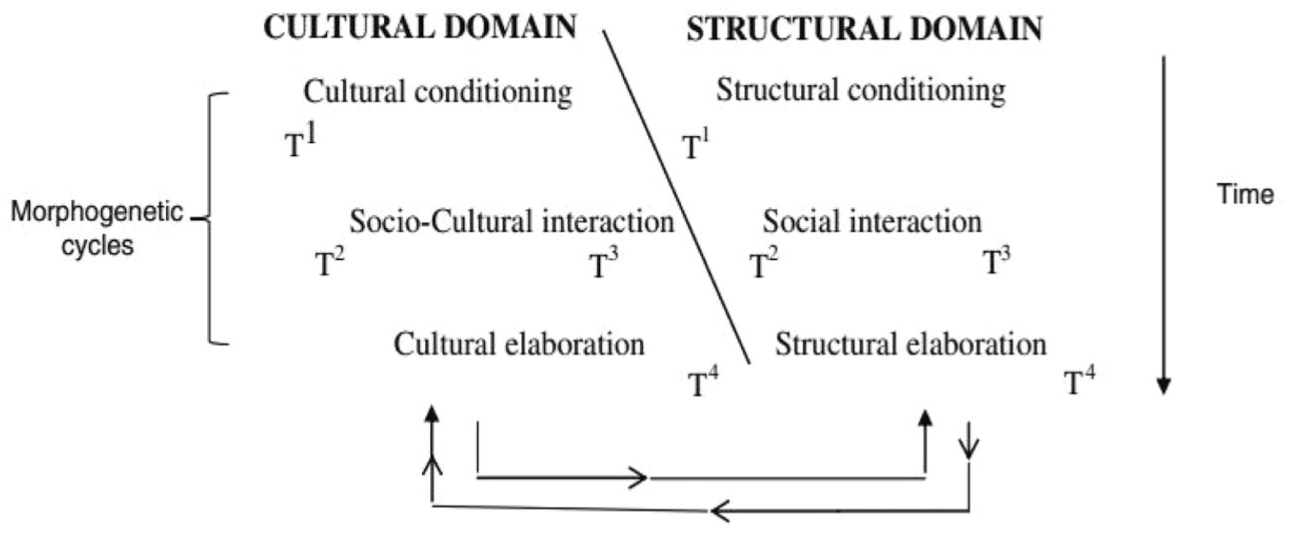
Morphogenetic cycle with structure and culture (Archer, 1995: 323).
The model presupposes that, as social agents, we enter the world (T1) featuring certain pre-existing social conditionings, which are results of previous interactions. At time T2–T3, agents draw upon these configurations in pursuit of their goals, activating both their own and structural/cultural powers. Then, at T4, the interactions between agency and structure/culture are complete and the initial conditionings are either preserved and reproduced (morphostatic) or transformed and elaborated (morphogenesis). Through these interactions, agency can transform itself too through double morphogenesis (Archer, 1995). The ensuing conditionings at T4 pre-exist future interactions and the end of one cycle is the beginning of another (Archer, 1995, 2010). The model untangles temporo-spatial interactions between agency and structure/culture and explains the social reality as a continuous reiteration of these cycles that accounts for either continuation or change.
The morphostatic–morphogenetic model necessitates that agents differ in their causal powers, since some agency reproduces the reality, whereas some (other) agency transforms it. Archer (1995) distinguishes between Corporate and Primary Agents. Both are understood as ‘collectivities’ with the same life-chances, but the former (1) have similar vested interests and articulated shared goals they are determined to achieve and (2) are organised for collective action aimed at achieving those goals.
One of the chief premises of RST is that interactions between structure/culture and agency are mediated by reflexivity or ‘the regular exercise of the mental ability, shared by all normal people, to consider themselves in relation to their (social) context and vice versa’ (Archer, 2007: 4). Through internal conversations, people have an emerging power to reflexively weight their subjective agential concerns (goals, ambitions and priorities) against the objective external circumstances (structural and cultural conditionings). Our (fallible) reflexive interpretations and decisions lead to modus vivendi or living life as a compromise most compatible with both concerns and conditionings (Archer, 2007, 2012). Therefore, reflexivity links structure/culture and agency. On the one hand, even though the reality may not be of our choosing, reflexive deliberations help us make our way through it. On the other hand, our own responses to constraints and enablers are conditioned by our reflexivity and different concerns we may have.
Another important contribution of RST is a contention that people exercise reflexivity differently. Archer (2007) identified and elaborated four distinct modes of reflexivity; all four can be present in our deliberations but usually one dominates them. People whose internal dialogues are dominated by communicative reflexivity are mainly concerned about inter-personal relations and prefer to build their lives around family and friends. Before leading to action, their deliberations need confirmation by trusted dialogical partners. They endorse contextual continuity (e.g. long-lasting employment or career for life) and seek to maintain the existing status quo, which often results in social immobility. Yet, these people do not reproduce the existing conditionings in a robot-like fashion but reflexively resist change that may unsettle their valued relationships. Autonomous reflexivity does not require confirmation and leads directly to action aimed at upward social mobility. These people tend to be independent and achievement-orientated. They set strategic goals, develop plans and monitor their progress, but are less inclined to be critical about those goals and objectives. They ably manage contextual discontinuity and are willing to induce it and transform the social reality to win competitive advantage. Meta-reflexivity encourages people to be reflexive about their own internal conversations, as well as the wider society. Meta-reflexivity is associated with contextual incongruity, wherein the society is incompatible with the values-centred ethical concerns of these people. In response, they often devise subversive programmes but rarely find enough confederates and often resort to lateral mobility. Lastly, internal conversations dominated by fractured reflexivity fail to produce adequate answers to people’s questions and lead to social confusion and disorientation, rather that purposeful action. Archer (2012) links this mode to contextual discontinuity, but these people do not celebrate change. Instead, they fall victim to social restrictions constraining their ability to act.
Crucially, Archer does not regard reflexivity as another personality trait, because reflexive orientations are developed and even switched between in response to social conditions. Archer (2003, 2007) suggests that traditional societies encourage communicative reflexivity, the more fluid modernity empowers autonomous reflexivity, and the uncertainties of post-modernity give rise to meta-reflexivity, while also increasing fractured reflexivity. Also, people facing more social obstacles (e.g. women and younger people) have been found to be more reflexive than those progressing through life with relative ease (see Golob and Makarovič, 2019). Such findings, however, uncover conditional tendencies rather than universal laws, and meta-reflexivity can occur in traditional societies, whereas many people maintain communicative reflexivity even when dealing with substantial changes.
Despite inevitable drawbacks and imperfections, RST is a strong, trailblazing, elaborate and promising theoretical option for advancing career studies further. Not only does it provide a coherent and well-funded overall framework, but it also allows the field to develop new insights into the major issues outlined in the introduction: the role of context, the relationship between structure and agency, the importance of time, and the question of taking action towards impact. To this our discussion turns next.
RST’s contributions to career scholarship
In this section, we explain how RST can enhance our understanding of careers by establishing it as a contextual construct, overcoming the structure–agency divide, theoretically accepting temporality as career-inherent and bridging career theory and practice through ‘actionability’. We start, however, by emphasising the integrative capacity of CR and RST. Indeed, both are remarkably reluctant to discard valuable ideas produced by even radically opposed schools of thought, and future RST-informed career research will – to a considerable degree – be able to engage with the existing career scholarship generated within other theoretical frameworks. Archer’s RST is developed in a dialogical manner (Caetano, 2014) and explicitly adopts elements from some theories and paradigms, while scrutinising and rejecting others. RST has been discussed against, for example, Foucault’s (Hardy, 2019) and Luhmann’s (Elder-Vass, 2007) ideas and, more frequently, Bourdieu’s Theory of Practice (Elder-Vass, 2010). Particularly close attention has been paid to the (in)congruity between reflexivity and habitus, and their relative importance when (co)determining our actions and decisions. For a conciliatory view, see Archer (2010, 2007), who argues for co-determination, and for fruitful combinations, see Vincent and Pagan (2019).
One example of the potential of RST to embrace other theoretical approaches is a study by Vincent and Pagan (2019) of self-employed and entrepreneurial Human Resource consultants and how they develop their businesses. The authors integrate Bourdieusian concepts of field and habitus with Archer’s notion of reflexivity to add more depth to the analysis and conclude that ‘combining Bourdieusian analysis and critical realism enriches our understanding of the constituent parts of economic fields, the resources entrepreneurial workers access through them, and agents’ relations, experiences and reflexive struggles’ (Vincent and Pagan, 2019: 188).
In the following, we illustrate how CR and RST contribute to the major issues within the field.
Contribution 1: Multi-layered contextuality
Context is crucial for RST, and the theory appreciates its causal efficacy as well as complexity, which reflects career scholars’ renewed interest in a wide range of organisational, occupational and cultural settings (Mayrhofer et al., 2020). All studies informed by CR ontology must take context into account because generative mechanisms and their causal effects are contingent upon relationships within the larger social system. For example, it is now widely accepted that non-White people in the Western world underperform in their careers not because of the innate dearth of talent, but because of inadequate support with schooling and persistent racial stereotypes. Recently, an RST-informed study (Fletcher, 2017) identified gender ideology and corporatisation as two primary mechanisms explaining farm women’s decision to take extra work off-farm as a response to their subordinate gendered positions as farm ‘helpers’ and the deterioration of farmers’ control over the production conditions.
In RST, the context pre-dates our actions and influences dominant modes of reflexivity through, for example, availability of resources (structural conditionings) and prepotent ideas (cultural conditionings). Archer (2012) draws a vivid picture of the modern world’s unstable conditions to argue that reflexive actions are becoming predominant. Archer (2003, 2007) also suggests that people are exposed to the natural, practical and social orders of reality, which engender concerns about physical well-being; performance and achievement; and self-actualisation, respectively. This challenges the notion of economic rationality or (career) decision-making guided solely by financial profits and casts light on people’s different priorities in relation to their contexts (Sayer, 2011).
With explicit references to RST, Fleetwood (2017) discriminates between four elements of labour markets. (1) Institutions are systems of entrenched rules that are internalised and enacted habitually. (2) Organisations are purposefully devised and comprise (a) consciously reproduced or transformed regulations and agreements; (b) unconsciously reproduced or transformed values and obligations; (c) artefacts like buildings and inventory; and (d) people who reproduce or transform those things and, simultaneously, themselves. (3) Social structures refer to ‘latticework’s of internal relations between entities that may enable and constrain (but not determine) the plans and actions of agents who reproduce and/or transform these relations’ (Fleetwood, 2017: 96). Unlike institutions, they are enacted reflexively. (4) Mechanisms are systematic configurations of (a) consciously reproduced or transformed regulations and agreements; and (b) unconsciously reproduced or transformed values and obligations. They do not contain agents but are enacted, reproduced or transformed by them. This framework has been recently used by Vincent and Pagan (2019) to disaggregate the broad field of Human Resource consultancy into specific elements, such as contractual and relational mechanisms and formal and informal organisations, influencing networking practices of entrepreneurial consultants and to explore the powers and potentials of the identified elements.
The appreciation of emergent contextual layers can enable a more fine-graded understanding of contextual forces. For example, there have been recent calls (Tams et al., 2021) to recognise cities as unique and significant career contexts. From the RST perspective, cities are parts of the national environments and, in turn, comprise other entities, such as organisations. Yet, urban contexts have unique causal powers to shape careers. For example, employment opportunities are not limited to organisations located within the urban area, as some people may work remotely, commute elsewhere or create jobs for themselves. Kozhevnikov (2021) further demonstrates that global and secondary cities are endowed with distinct causal powers to affect career capital in dissimilar ways. RST can be useful for understanding causal powers of different contextual layers, but also for correct attributing of such powers to contextual levels of analysis. This can be especially beneficial for uncovering the roots of career (dis)advantages.
Contribution 2: Relational view on agency and structure
One of the most long-lasting and puzzling conundrums that enthral career studies is whether careers are the properties of individuals or their contexts (see Schneidhofer et al., 2020). Whereas the boundaryless career scholarship prioritised the former view, more recent studies have brought boundaries back (Inkson et al., 2012; Rodrigues et al., 2016) and reignited the debates about structure, agency and their effects on careers. The dualism of structure/culture and agency as ontologically and analytically distinct is the very kernel of RST. Avoiding their conflation(s) has been one of the most ambitious and hallowed missions assumed by Archer (2007). RST argues that the very existence of reflexivity and its mediating role are contingent upon clear separability of structure/culture and agency (as subject and object) and their causal powers (Archer, 2007). Indeed, if we fail to separate contextual circumstances and people’s agency, then reflexivity is reduced to an oxymoron.
To explicate structure/culture and agency as interdependent but distinct, Archer (2007: 17) puts forward a three-stage model. (1) Structure and culture objectively define the context in which people find themselves and present obstacles and enablers to (2) subjective agential concerns. Then, (3) decisions are made and enacted through reflexive deliberations of subjective projects within objective conditions. The model emphasises that social mechanisms are inescapable. People’s concerns are, at least partly, shaped by contextual circumstances and it seems only ‘natural’ that experiences of indigence encourage prioritising financial goals. Further, social conditionings affect our modes and levels of reflexivity (Archer, 2003; Golob and Makarovič, 2019) and the scope of reflexivity is arguably growing in the ever-changing post-modernity (Archer, 2007). The contexts also feature the presence (or absence) and relative value of resources, and present obstacles and enablers rendering (career) projects more or less attainable and successful (Archer, 2007). In other words, structure and culture shape opportunities for agential actions.
An in-depth understanding of agential actions also builds on the elaborate distinctions between Primary Agency, Corporate Agency and Actors. Actors are individual occupants of various social roles. Actorship is understood in relation to agency, with agents defined as ‘collectivities sharing the same life-chances’, such as access to career resources (Archer, 2000: 261; italics in original). Agents, therefore, constitute a group, members of which are equally (under)privileged. People become Primary Agents from birth, belonging to groups (and sharing their privileges or lack of them), such as Whites and non-Whites or working- and middle-class. It may be possible to acquire new positions at later stages of life but, crucially, Primary Agents cannot partake in strategic (re)modelling of structural and cultural conditions. This is a prerogative of Corporate Agency, which is developed as people identify their chief concerns and organise themselves for collective action. Corporate Agency is particularly useful for understanding social movements, such as unionism or feminism, and their impact on people’s careers. Karlsson (2020) further distinguishes between Formal Corporate Agency (stated aims and coordinated action), Informal Corporate Agency (coordinated action but no stated aims), Withdrawn Agency (stated aims but no coordinated action) and Primary Agency (no stated aims or coordinated action).
While RST points at structure and culture shaping agential actions, it explicitly rejects determinism as the impact of social mechanisms is never fixed. Although social circumstances hinder or enable, they do so only insofar as people pursue their concerns-orientated projects (Archer, 2007). For example, immigration policies can discourage some international careers, but their causal effects must be activated by people’s plans to relocate. Furthermore, people analyse and respond to the social reality in dissimilar ways. Not every person for whom immigration appears to be easily attainable will entertain, attempt or succeed in it, whereas some less privileged people will. People have their own powers to identify and rank their priorities, evaluate their situations, engineer and monitor projects as compromises between the desirable and the achievable and, ultimately, satisfy their chief concerns (Archer, 2010; also Elder-Vass, 2007). Crucially, this becomes possible through reflexive deliberations that mediate conditionings and practice.
Archer’s discrimination between structure/agency and their causal powers means that all instances of reproduction or transformation can be understood only as products of both structural/cultural conditionings and reflexive agency. From this perspective, why people do what they do cannot be explained solely by their personal desires or contextual circumstances but requires attention to both. Kornblum et al. (2018) examine individual characteristics and the labour market as determinates of career mobility. Yet, RST offers an opportunity to go beyond identifying agential and structural factors shaping career choices and invites a differentiated view on agential action. Regarding the former, RST has been used to explore entrepreneurship in Sri Lanka ‘as emergent from individuals’ reflexive responses to socio-cultural influence upon their lives’ (Wimalasena et al., 2021: 272). That study demonstrates how the modes of reflexivity differently shape entrepreneurial attitudes, motivations and decisions in a specific national context, prioritising neither structure nor agency but appreciating both. In terms of agential action, RST is useful for in-depth understanding of entities that ‘have’ a career and their transformation. For instance, Nelson Mandela’s career (for an account of Mandela’s career along his career transitions see Gunz and Mayrhofer, 2018: 213 ff.) took him from a member of the Executive Committee of the Transvaal African National Congress (ANC) in 1947 to his retirement from politics in 1999 as President of the Republic of South Africa. Initially, he was an isolated individual, a Primary Agent with little influence over state-wide structures and culture despite his somewhat prominent descent in the Thembu Kingdom. Only after the brief period of Withdrawn Agency (when Mandela developed his anti-apartheid agenda) and the emergence of Formal Corporate Agency – the ANC – such an influence occurred, paving the way for Mandela’s career development from an unknown young student at the University of Fort Hare to a worldwide celebrated figurehead receiving the Nobel Peace Prize in 1993.
Contribution 3: Temporality
Careers are a congenitally temporal phenomenon (Gunz and Mayrhofer, 2018) that unfold over time. Archer’s RST is quintessentially temporal as it rests upon the proposition that structure/culture and agency operate diachronically over different time-courses – structural and cultural conditionings necessarily predate interactions, whereas structural and cultural elaboration (or reproduction) necessarily post-date them (Archer, 1995, 2012). Crucially, interactions between structure/culture and agency are continuous and cyclical, without stoppages (see Fleetwood, 2005). This underscores the continuing causal importance of both structure/culture and agency. The historicity of RST enables the analysis of dynamic relations between structure/culture and agency and, specifically, the analysis of social change (or its absence). Such appreciation of the prior conditionings enables transitions from the descriptive analysis of ‘what happened’ to the in-depth investigation of historical reasons and motives, including ideologies, prejudices and distribution of resources. Importantly, Archer does not suggest that change is always dramatic and momentous. Many structural and cultural configurations (e.g. class hierarchies or gendered stereotypes) are remarkably resistant to change, and transformation, when it occurs, is often only gradual, sometimes imperceptible, but nonetheless real. The possibility of transformation is always understood through the structural/cultural malleability and agential leverage. Clegg (2006) specifically recommends the use of RST in feminist studies to theorise present conditions of oppression as emerging from earlier interactions rather than as simply created by present actions, which enables more practicable subversive interventions. Such an approach could greatly benefit career studies as the evidence of lingering disadvantage is ample and the uprooting of historically entrenched causes is essential.
Archer (1995) distinguishes between ‘morphogenesis’ and ‘double morphogenesis’ and also elaborates ‘triple morphogenesis’ (Archer, 2000), through which agency conditions (but does not determine) which Actors occupy various social roles. Temporality helps to separate between Actors as incumbents of social roles and the roles themselves, since the roles are usually more durable than the Actors who hold them (e.g. the post of the Dean of Christ Church, Oxford is over 450 years old, whereas the current incumbent, Sarah Foot, is considerably younger).
Temporality and change are also at the core of the argument of the reflexive imperative in late modernity. Archer (2010, 2012) states that presently children are less likely to follow their parents’ career steps. In conjunction with other factors, such as rapid technological developments, shifting training standards and increased geographical mobility, it means that parents are less able to provide reliable guidance towards the most lucrative, fulfilling or otherwise preferred careers. As contextual continuity is disrupted more frequently and fewer individuals remain in their natal contexts, Archer suggests that communicative reflexivity gives place to autonomous, meta- and even fractured reflexivity. Delbridge and Edwards (2013) associate different types of internal conversations with dissimilar temporal orientations and morphostatic–morphogenetic outcomes: (1) past orientation is typical for communicative and fractured reflexivity and tends to result in taken-for-granted institutional continuity; (2) present orientation is more typical for meta- and autonomous reflexivity and produces negotiated continuity and/or change; and (3) future orientation is associated with autonomous reflexivity and is more likely to initiate social change. Thus, reflexivity and the morphogenetic approach are useful tools to investigate career change or lack of it.
This view of temporality invites (career) scholars to go beyond descriptive statements about ‘what is’ towards ‘why is this different from before’. For example, the morphogenetic approach can be used to explain – rather than simply record – the growing numbers of female football and ice hockey commentators in the German-speaking world. At T1 (pre-2010s), a clear gendered pattern could be observed, and the profession of sport commentator was evidently male-dominant, reflecting assumptions about gender-appropriate interests and occupations. During the social interaction at T2–T3 (2010s), significant, although uncoordinated, efforts by Collective Agents (policymakers, progressive media and pressure groups) called for gender equality. One key factor was the financial and social costs for organisations deviating from legal and societal expectations of employing women in visible positions and adequate numbers. Consequently, at T4 (late 2010s/early 2020s), broadcasters hired an increasing number of female sports reporters who also cover male-dominated sports, such as football and ice hockey.
Contribution 4: Actionability
The final contribution of RST discussed here is underpinned by the axiological commitment to emancipation (Bhaskar, 2009), which makes it both diagnostic and actionable. Sayer (2011: 234) discusses emancipation as people’s ability to achieve states of doing and being (‘functioning’) of their choice. Eventually, emancipation should enable people’s flourishing or well-being instead of suffering or ill-being. Through its CR roots, RST is ontologically and ideologically emancipatory. Ontologically, the idea of the world as a stratified and open system repudiates normalisation of the existing issues. People’s potential properties (O’Mahoney et al., 2018) are of particular importance; for example, how and in what contexts can women acquire the properties of being successful entrepreneurs? Importantly, CR explicitly declares unveiling and, ideally, subverting sources of oppression as the ultimate goal. The diagnosis of social ‘problems’ itself is commendable as cognitive enlightenment raises people’s awareness of their situations, urges resistance and attracts attention from other stakeholders. However, CR emancipatory interventions go further to identify: (1) mechanisms underpinning oppressive ideas and practices; and (2) mechanisms that should be in place for the reality to be otherwise (Bhaskar, 2009). Through scrutinising, challenging and elaborating academic ideas, meanings and explanations of career and kindred phenomena, researchers should use their judgemental rationality, even though their own interpretations are fallible. The ultimate goal of CR epistemological pluralism is to differentiate between ideologies as more or less oppressive and between forms of knowledge as offering a more or less accurate diagnosis of and solution for the social ‘problem’ (O’Mahoney et al., 2018).
Admittedly, emancipatory interventions and judgemental rationality are, at least partly, normative. Otherwise, it would be impossible to point the change in the right direction and emancipatory research could endorse dictatorship as eagerly as democracy. Therefore, emancipation (and social theory) needs feasible and righteous directions for the change. The fear of producing illiberal, condescending, culturally insensitive or otherwise ill-informed injunctions may deter some researchers. Nonetheless, as Sayer (2011: 221) argues, avoiding normativity altogether is counter-productive, disempowering and coy, as social science rests upon a normative conviction that ‘it is better to believe what is true or more true than what is false or less true’. Indeed, (career) scholars are facing mounting pressure to demonstrate how their research contributes to society by facilitating progressive social change that is in line with debates of (management) scholars to stay relevant in conversations on grand challenges for organisations and their members in current times (e.g. Brammer et al., 2019; Buckley et al., 2017; Danner-Schröder et al., 2025). At the same time, many academic journals explicitly invite authors to provide practical, as well as scholarly, recommendations. Arguably, meeting the expectations of journal editors and the lay public requires (career) researchers to express their normative judgements. Furthermore, accurate accounts of many events and phenomena cannot avoid being evaluative: ‘racist’, ‘sexist’ and ‘discriminatory’ are adequate descriptions of the experiences of a Black woman denied a promotion in favour of a less-qualified White man.
However, judgements about oppression and injustices, mechanisms underpinning them, and alternative ways of organising the social reality need not be dogmatic (O’Mahoney et al., 2018). Sayer (2011: 23) usefully distinguishes between agential and epistemic authorities. The former is encouraged as people make their own choices, as long as they do not cause suffering to others. The latter, however, is not given for granted as people’s knowledge is fallible, including ideas of what is good, even for themselves. RST-informed studies are not expected to provide tyrannical commands. Yet, they should supply explanations of the causes and consequences of suffering, as well as how it can be avoided, taking into account people’s different and conflicting concerns, such as those attributed to their dominant modes of reflexivity (Archer, 2007). For example, some workers see attempts to involve them in organisational decision-making as an additional burden rather than empowerment (Martin and Harrison, 2022). While encouraging employers to provide such opportunities and employees to partake in them, RST scholars would acknowledge that people should be free to make their own choices, even against the researchers’ advice.
Whereas career scholars have been proactive (and prolific) at diagnosing ‘problems’, issues and barriers faced by various career agents, examples of concrete practical recommendations on how to address the identified problems are sporadic and focus either on individuals themselves (e.g. encouraging them to accrue more or better career capital) or on the organisations employing them (e.g. calling for more equitable recognition of people’s career capital). CR and RST can help explore and tackle broader societal sources of career ‘problems’. Further, RST can add depth to the solutions targeting individuals and organisations. For example, one current ambition of career counselling (arguably, the most actionability-conscious body of career literature) is to combine traditional career guidance with more subjectively meaningful career construction (Hirschi and Froidevaux, 2020). This ambition can be aided by analysing people’s reflexive concerns and how these can be navigated in their environments (see Wimalasena et al., 2021).
Concluding remarks and future research directions
‘Good’ social research uncovering the deeper layers of social phenomena requires ‘good’ theories that it can draw upon and, possibly, refine. Career studies are no exception. The long-standing calls for better theorisation of career studies testify to that. Our conceptual article responds to the long-standing calls for a sound theoretical framework advancing research of the multi-faceted phenomenon called career (Dokko and Chudzikowski, 2020; Gunz and Mayrhofer, 2018; Khapova and Arthur, 2011).
Archer’s RST provides a frame that can be immensely useful for future career studies. The emphasis on multi-layered contextuality is important for career studies. While contextualisation of careers has again come to the forefront in the past 15 years, we still do not have a clear understanding of what is meant by context, how it is structured and through what mechanisms various contextual layers affect careers. For example, while the role of the economic cycle and internal labour markets is acknowledged in some career research, the interplay between these elements remains to be examined. Thus, questions around a buffering effect of strong internal labour markets during economic downturns or weak internal labour markets in times of economic growth constitute important issues for individual and organisational career management.
Pointing towards a relational view on agency and structure and the specific view of RST on agency leads to stimulating new research avenues. The emphasis on Corporate Agency enables further elaboration on the development and outcomes of individual careers. How organisations are intertwined with individual careers, how they co-evolve and depend on each other, as illustrated by start-ups that within a few years become global players and boost individuals’ careers beyond what was imaginable (i.e. stories of Microsoft, Apple, etc.), and what effects such co-evolution has on individual career Actors has hardly been addressed by current research but can be explored within the RST framework.
The temporal angle taken by RST provides rich and fertile grounds for career studies to integrate time into its efforts. This not only comprises the familiar calls for more longitudinal analyses but also expands to even more substantial issues. Examples include making transparent which types of time (objective/subjective, Chronos/Kairos, etc.) we are talking about; what theories of time we use; how we appreciate idiosyncratic time experiences; and to what extent we refer to temporal structures as guiding and coordinating Actors’ activities when describing and explaining careers. Besides, temporality points career studies towards two directions: increased process-orientation and appreciating the context–time link. The former emphasises the dynamic, non-linear and multi-causal qualities of careers that often get lost when overly fascinated by quantitative studies and their ‘variance orientation’ that usually reduces the phenomenon’s complexity. At the heart of such a process, orientation is the interest in ‘how and why things emerge, develop, grow, or terminate over time’ (Langley et al., 2013: 1). Taking the context–time link more seriously also points towards fascinating future research avenues. For example, much of career studies is nearly blind to the broader historical context within which careers unfold. Yet, without recognising, for example, that choosing an entrepreneurial career in Vietnam, the USA and Hungary has very different connotations in the historical light of what it means to own a company in these countries, career studies fall short of a comprehensive understanding of their object.
Finally, RST’s emphasis on actionability addresses an aspect that has been at the initial core of career studies but tends to be somewhat underplayed in the research of management and organisational careers: its applicability for those involved. Of course, the mere better understanding of the phenomenon at hand – careers – is the key objective of career studies. Yet, RST reminds us that practical applicability also is of high importance. Such an orientation involves tricky issues, such as violating the distinction between scientific and ideological interests. Still, reminding ourselves of the actionability of our work helps career studies choose which areas to focus on, in which ways and how to apply the results.
The four areas of contribution identified and discussed in this article extend the discussion initiated by Chudzikowski and Mayrhofer (2011), while attending to the new developments within the field of career studies and in wider society (Baruch and Sullivan, 2022; Tams et al., 2021). We are, however, under no illusion that these contributions exhaustively cover either the challenges faced by career scholarship or the benefits offered by RST (for career studies or other fields and disciplines). While our focus has been on what we see as the most fundamental and pressing matters, it may be possible to add more, and we welcome such future contributions. We are also aware that our own arguments are not beyond scrutiny. The discussed contributions reflect the most salient dilemmas, predicaments and stumbling blocks within career studies. Therefore, they should be familiar – in one form or another – to most scholars working within the field. Yet, it may be possible to dispute their relevance or appropriateness, as different schools of thinking have different opinions about the most desirable, congruous or even feasible avenues for the development of career scholarship. For example, actionability of (career) research is, although a traditional theme in social science (e.g. Whyte, 1991), a particularly contested issue (Sayer, 2011). Despite our efforts to verify its importance, we recognise that it is unlikely to be embraced by all career scholars. Yet, we hope that the arguments presented in this article are sufficiently convincing and thought-provoking to at least (re)ignite the discussion about the impact career studies could/should make and the accountability of science in the broader sense. The same applies to the remaining three areas of contribution.
Next, despite its merits, RST is not beyond criticism either and it is not our intention to be blindly dogmatic when advocating it. Whereas we regard the critical realist ontological foundations as a helpful complement to RST, some others would, undoubtedly, see it as a philosophical nuisance incompatible with their own convictions. Other shortcomings of RST have been said to include exaggerating contextual discontinuity and incongruence, limited theorisation of structure and culture, and aggrandising the role of reflexivity at the expense of routinised action (Caetano, 2014; Golob and Makarovič, 2019). Whether these points are applicable to RST and whether they should be seen as shortcomings at all is a matter for another debate. While agreeing that RST – as any other theory – does not (and cannot) have an ambition to be regarded as the final destination of theory-making, we maintain that RST’s benefits outweigh its shortcomings, at least as far as the four outlined areas of contribution are concerned. It is also reassuring that even critical reviews of RST acknowledge its value and potential (Caetano, 2014; Karlsson, 2020). We hope that the integrative capacity of RST can encourage even career scholars working in different ontological, philosophical and theoretical traditions to consider how RST could benefit their research. To what extent the career study discourse will endorse or renounce these suggestions is an empirical question and remains to be seen. Meanwhile, we hope for the best without expecting the worst.
Footnotes
Acknowledgements
We wish to thank the editor and three anonymous reviewers for their thorough and insightful suggestions. We also thank Felix Diefenhardt, Stefanie Gustafsson, Nancy Harding, Anna Roberts and Jennifer Tomlinson for valuable feedback on an earlier draft of this article.
Funding
The authors received no financial support for the research, authorship, and/or publication of this article.
