




Abstract
This article examines how understandings of passion shape people’s agency at work, through interviews with UK publicans. It addresses calls to rethink how ‘passion’ is conceptualised in the sociology of work. While discourses around passion are often thought to legitimise individualised working practices, the article explores more collective interpretations. It analyses how publicans exercised agency in negotiating externally imposed problems including the pandemic and exploitative relationships with leading industry actors. It identifies a collective understanding of passion centralising notions of community, which shaped participants’ agency in responding to these problems in three ways: providing motivation to persist in the industry; a frame for critiquing perceived injustice and (occasionally) mobilising against it; and a resource for reinvention in pursuing business sustainability. The main contribution is thus new concepts for analysing how ‘collectively oriented passion’ shapes individuals’ agency at work.
Introduction
The idea of being passionate about one’s work is an important sociological question. Despite evidence that individuals’ wellbeing benefits from doing activities about which they feel passionate (Chen et al., 2020; Philippe et al., 2009), scholarship in the sociology of work has often interrogated the concept critically, showing how understandings of work as the pursuit of a ‘passion’ can legitimise or obscure individualised, precarious and exclusionary working conditions (Busso and Rivetti, 2014; Cech, 2021; DePalma, 2021; Farrugia, 2019; Rao and Tobias Neely, 2019; Umney and Kretsos, 2015; Wilson, 2022). However, some scholars have recently advocated for alternative ways of thinking about passion at work. While passion might be an individualising influence, it could be conceptualised in more collective, even emancipatory, ways: if it leads people to defend a collectively shared vision of what work should be like (Alacovska, 2020; McFarlane, 2022; Sandoval, 2018), or catalyses mutual support (Banks, 2006; Umney and Kretsos, 2014). These arguments urge scholars to question how understandings of passion inform people’s responses to challenges in working life.
The tension between individual and collective ways of conceptualising passion at work forms the context for this investigation. The article examines the implications of collective understandings of passion at work, in an insecure and even exploitative industrial context, taking small hospitality businesses – specifically pubs – as a lens. Small businesses often face constraining structural contexts, responding to them in heterogeneous ways, calling attention to the resources they utilise when exercising agency (Barrett and Rainnie, 2002; Hagqvist et al., 2020; Ram and Edwards, 2003; Valsecchi et al., 2023). Furthermore, these resources and frames, among small businesses, reflect tensions between individual and collective visions of working life. Small businesses are sometimes associated with individualising discourses about ‘entrepreneurialism’ and ‘being your own boss’ (Morgan and Pulignano, 2020; Munro and O’Kane, 2022; Musílek et al., 2023), where ‘passion’ is conceived primarily as a source of personal motivation and self-efficacy (Montiel-Campos, 2017; Pagano et al., 2021). Yet, they are also frequently embedded in community networks and family ties (Ram et al., 2020). Hence, studying small businesses provides an opportunity to investigate connections between passion, collectivity and agency.
The article draws these threads into the research question: how do notions of passion and community shape how publicans respond to structural constraints? It contributes a new analysis of three ways in which collectively oriented passion shaped participants’ responses to externally imposed problems, notably the Covid pandemic and proliferation of exploitative business models. Collectively oriented passion is here defined simply as any sense of ‘passion’ for one’s work, which is conceived primarily in relation to service to, and relationships with, a wider community rather than individual self-fulfilment (recognising that, as discussed below, the boundaries between these poles are fluid and potentially subject to reframing). First, collectively oriented passion provided motivation to persist in an increasingly difficult industry; second, it provided a frame for critiquing perceived injustice and – occasionally – contesting it; and third, it provided a resource in the pursuit of sustainable business models. This argument expands the significance of collective understandings of passion at work, prompting new insights and questions of relevance beyond the pub industry. Indeed, complex conceptualisations of passion, and their influence on workers’ engagement with their jobs, are important to a sociological understanding of occupations ranging from creative to caring occupations.
The next two sections contextualise the study, examining how debates around passion at work intersect with the sociology of small businesses. After discussing methods, the findings explore the three ways in which collectively oriented passion shaped participants’ agency. A discussion section then reflects on the findings’ implications, considering how they can advance sociologists’ understanding of the multifaceted meanings of passion at work.
Competing conceptions of passion at work
There is by now a significant literature on passion in working life, revealing ambivalence about its implications. Certainly, some research identifies significant benefits. Individuals who engage in activities about which they feel passionate tend to experience improved wellbeing (Philippe et al., 2009). Passion specifically about one’s job can be associated with numerous positive indicators including reduced burnout, reduced conflict at home and even improved physical health (Chen et al., 2020; Yukhymenko-Lescroart and Sharma, 2022). Yet, sociologists of work have often been more sceptical. Notions of ‘passion for the job’ might legitimise precariousness and individualised models of work. For example, they could load responsibility for achieving self-fulfilment onto individuals, obscuring problems of poor working conditions (Cech, 2021; Umney and Kretsos, 2015). They might help to normalise self-exploitation, as Busso and Rivetti (2014) show in relation to academic careers. For DePalma (2021), the ‘passion paradigm’ provides discursive cover for ‘hyper-individualism’, and potentially a legitimising frame for precarious work (Trappmann et al., 2024).
Moreover, by legitimising insecure working conditions, conceiving work as the pursuit of one’s passion can obscure and perpetuate existing inequalities. Umney and Kretsos (2015) argue that reliance on passion biases labour markets towards individuals whose class background means they can afford periods of low or unpaid work. Wilson’s (2022) study of the craft beer industry identifies similar problems. For Farrugia (2019), an emphasis on passion in work is used as an important marker of class difference. Rao and Tobias Neely (2019) show how perceptions of passion can filter into hiring, promotion and other processes in white collar jobs, in ways which reinforce gendered, racialised and classed inequalities. Moreover, assumptions about passion can also normalise work extensification, generating work–life conflict disproportionately affecting women (Conor et al., 2015).
Yet this critical reading of passion at work warrants challenge. Authors including Alacovska (2020) and Sandoval (2018) call attention to the possibility of a more collective reading of passion at work, emphasising how being passionate about a particular vocation might engender caring and communitarian orientations. Some evidence already supports this point. Umney and Kretsos (2014) explicitly distinguish between individual and collective pathways for musicians, showing how tendencies towards community-building and individualism exist in tension and find balance even within individuals’ careers. Banks (2006) describes the development of communities rooted in collective moral economies even in ostensibly highly individualised labour markets (see also Umney, 2017). McFarlane et al. (2022) show how passion for one’s occupation can also catalyse communities that incubate collective challenges to exploitative treatment. In healthcare, for example, collective protest may stem from a sense that frontline workers care about the meaning of their work in ways that their employers simply do not (Umney and Coderre-LaPalme, 2017). Yet there remains a need to systematically interrogate how more collectively oriented understandings of passion influence individuals’ agency at work. Small businesses provide a generative lens through which to investigate the complex meanings of passion at work.
Structure, agency and passion in the sociology of small business
Small businesses are often treated ambivalently by sociologists of work, often being associated with intensifying discourses celebrating (sometimes uncritically) individualism and entrepreneurialism (see McDonald and Giazitzoglu, 2019; Mallett and Wapshott, 2017; Musílek et al., 2023 for critical perspectives). Indeed, the association of small business with entrepreneurial discourses, especially amid international neoliberal drift, generated some polarisation in the literature: romanticised analyses of small business independence were juxtaposed with critical depictions of them as sites of sweated labour with minimal worker voice. Wilkinson (1999) characterised this dichotomy as ‘“small is beautiful” versus “bleak house”’, a binary which he argued needed replacing by a deeper understanding of heterogeneity and agency among small businesses.
The sociological literature has since developed to engage more heterogenous themes, including the role of family structures in small businesses, government policy and connections between small businesses’ internal lives and the structures in which they are embedded (see Mallett and Wapshott, 2017 for a review). Barrett and Rainnie (2002) situated small businesses in relation to the wider industrial environment: they might be dependent (i.e. on lead firms who impose operational conditions on subcontractors), dominated (independent but pushed towards a sweated labour model by competition from larger peers), isolated (occupying discrete markets) and innovative (pioneering new markets). Ram and Edwards (2003) responded to this framework by emphasising the heterogeneity in small businesses’ responses to similar structural situations.
These debates have set the stage for intensified focus on small businesses’ agency within structurally constrained contexts. Increasingly, small businesses have been associated with debates around informality and, to an extent, precarity (Moisander et al., 2018). They often occupy a marginalised position in the economy (Mallett and Wapshott, 2017) and consequently are more likely to feature intense working conditions, insecurity and informality. Yet this acknowledgement must be combined with interest in how they respond to these problems. Valsecchi et al. (2023) typologise the strategies through which small business managers address concerns about worker wellbeing. Hagqvist et al. (2020) emphasise how the process of ‘doing management’ in small businesses enables individuals to cope with long and irregular working hours. There is thus growing evidence concerning how small business actors exercise agency in coping with difficult conditions. Importantly, this requires considering them not only as individual entities but in a more collective context; for instance, by paying attention to how small businesses construct networks and communities (Ram et al., 2020).
These debates on small businesses thus feature tensions between individualising and collectivising dimensions, similar to the debates surveyed above concerning passion at work. Indeed, passion has become more prominent in the small business literature, in ways reflective of this tension. The overlap is made explicit in recent contributions on ‘entrepreneurial passion’, which treats passion as a resource which can boost entrepreneurial confidence and self-efficacy (Montiel-Campos, 2017; Newman et al., 2021; Pagano et al., 2021). Thus, in the more mainstream management literature, passion is sometimes invoked to explain motivation and aptitude for small business work (Montiel-Campos, 2017; Newman et al., 2021; Pagano et al., 2021), entrenching an individualising view of passion of which sociologists of work are often critical (Munro and O’Kane, 2022; Musílek et al., 2023).
Yet, in the light of sociological calls for more collective understandings (Alacovska, 2020; McDonald and Giazitzoglu, 2019), what other meanings might ‘passion’ have in shaping the agency of small businesses? Could it also be connected with a more collective model of commitment and service? This question is especially salient given the established importance of themes like family and community in some important accounts of small business (e.g. Edwards and Ram, 2006; Ram et al., 2020). Consequently, small businesses provide an important context in which to study the multifaceted meaning of passion at work.
This article addresses this research agenda through a study of publicans. ‘Pubs’ are public houses, businesses licensed to serve alcoholic drinks and, increasingly, food, comparable to the more international concept of the bar and which are often important sites for social interaction. They have historically been male-dominated spaces, though this has changed over time (Thurnell-Read, 2024). Publicans manage these businesses, typically combining frontline service work with administrative and managerial tasks like ordering stock, directing staff, maintenance, handling relationships with suppliers and real estate owners, and similar. They are particularly relevant to notions of passion and community at work as, in the public imagination (and, importantly, in participants’ own self-perception), pubs and publicans are often widely understood as community lynchpins (Thurnell-Read, 2024). Moreover, the pub industry is increasingly precarious due to a combination of events like Covid and longer-running changes in consumer behaviour. Indeed, The Guardian newspaper reports that 50 pubs per month closed in England and Wales during the first half of 2024 (Simpson, 2024). Keenan (2020) examines how pubs, as businesses, have been fundamentally fragilised, forcing smaller-scale publicans into new dependencies on extractive ‘PubCos’ – whose role is discussed in detail below (see also Meers, 2023). They are thus fertile terrain for exploring how small business actors may mobilise ideas of passion and community in response to structural challenges.
Pubs are identified here as an exemplar of small business work, which requires qualification. There are large enterprises in the pub industry which own hundreds of sites and directly employ managers. The implications of this variation are considered in the Methods section. Pubs are also part of the service, and more specifically hospitality, industry, which pose their own well-documented challenges. Service work is notable for the role of the customer in ‘“managing” the labour process’ (Grugulis, 2014: 48; see also Leidner, 1993). In other words, the customer’s evaluation of how the work should be done influences how workers must perform tasks, as it is not only employers who can censure the worker for perceived deficiencies, but customers through complaints and other feedback. This is certainly a critical aspect of pub work and existing research has explored the blurring of worker and customer roles in pubs (Sandiford and Seymour, 2013). However, this study will underline how publicans reflected not only on the role of the customer within the pub, but the wider geographically bounded community in which the pub was embedded. Publicans’ ‘passion’ for serving these communities had multifaceted implications, which are explored below.
Methods
The article presents data from interviews with 50 publicans and 12 sector stakeholders in Yorkshire, Northern England. The publican’s multifaceted role, described above, means they experience the economic imperatives imposed by industry conditions alongside the day-to-day human interactions of frontline hospitality work. Yet, publicans find themselves in contrasting situations depending on the business models in which they are embedded. The project’s initial aim was to examine whether different pub models generated different experiences of publican work. Hence, the research team identified four business models based on desk research and key informant scoping interviews, ensuring the sample included representatives from each:
Managed houses. A large enterprise directly owns and manages chains of pubs, employing the publican (as a manager) to oversee each venue. This model includes well-known enterprises like JD Wetherspoons. As these are not small businesses, they are less relevant to this research but will be referenced below where a comparison provides instructive context.
‘Tied’ pubs. Pubs where the landlord rents the site from pub companies (PubCos), who typically own extensive pub real estate. In such cases, publicans, usually acting as independent traders, rent and run pubs through leasehold agreements. These agreements might incorporate a ‘beer tie’, where PubCos require the venue to stock particular products (specified to the PubCo’s commercial advantage). Where interviewees are labelled ‘tied’, this means they are publicans working within this model, rather than PubCo representatives themselves.
Independent pubs. The publican owns the real estate, running the pub as a limited company or sole trader.
Community pubs. A relatively recent institutional innovation, where pubs are given a ‘community’ mandate. In practice, this can mean different things but usually implies some form of community ownership model. The pub may be run by volunteers from among community shareholders and stakeholders, or a community trust may employ a professional publican to run the pub.
Table 1 presents the breakdown of interviews across these types. The focus of the data here is the 33 interviewees across the second, third and fourth categories, as the first category are not small businesses. However, often, managed house respondents were career publicans with prior experience of independent pub work, meaning they still contributed to developing a holistic understanding of the industry.
Pub respondents.
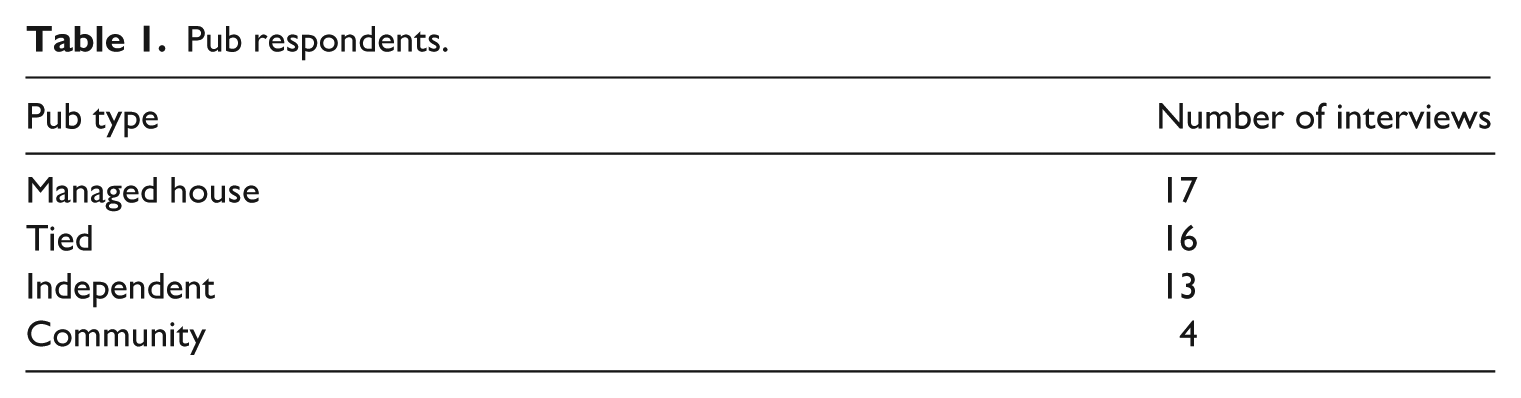
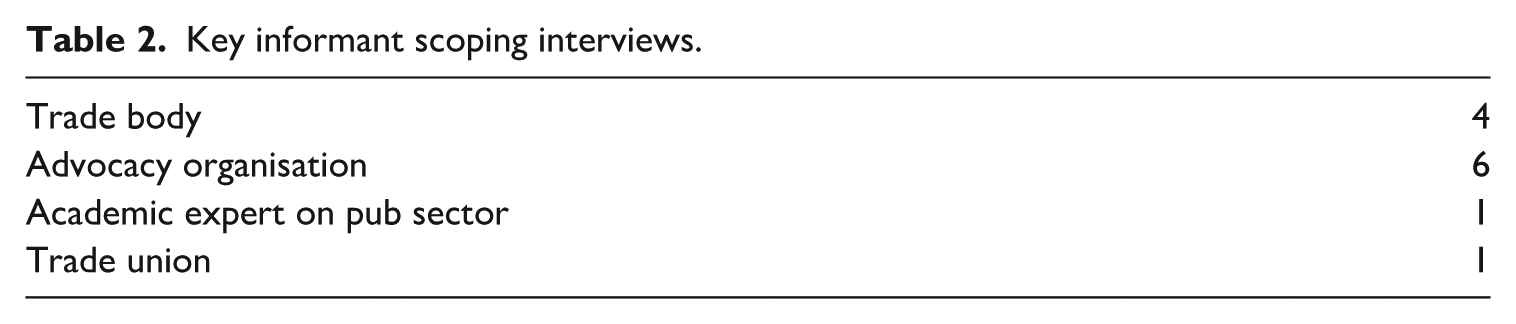
Recruitment sought voices from each pub type. The recruitment process was driven initially through desk research, reading through guides and directories of pubs (like the British Institute of Innkeeping) and trade literature, to identify key types. This was supported by 12 scoping interviews with sector stakeholders (Table 2), typically either representative trade federations or campaigning organisations advocating for pubs, who helped strengthen the team’s understanding of different pub types.
Key informant scoping interviews.
Publicans were contacted through site visits and phone calls. Following university ethics approval, the research team briefed them on informed consent protocols, securing permission to record interviews. Data gathering took many months (June 2022 – February 2023) as participants were often busy and difficult to access (especially during the fieldwork period, given that Covid had plunged many pubs into financial distress). Many were fulfilling multiple job roles (manager, chef, cleaner, etc.), undertaking up to 80-hour weeks (Participant 16, independent). Interviews lasted one hour on average. Interviews with publicans were all conducted face-to-face, though key informant interviews were interviewed online owing to their wider geographic dispersal. There are limited statistics on publicans’ demographic makeup, but the fieldwork experience suggests a predominantly White, male sample. However, the team diversified the sample where possible, particularly regarding gender, with 18 female participants. Participants were a range of ages including participants in their early 30s up to late middle age.
Data analysis took a grounded approach, beginning with a set of broadly defined questions (understanding different pub types, how they work and publicans’ experiences within them) which evolved through discussion of emergent themes. The team met regularly during data gathering to identify these themes and develop interview themes accordingly. Key emergent themes that shaped ongoing data gathering and research questions were: (1) PubCos’ extractive role in the sector and (2) landlords’ efforts to cope and to reinvent their pubs in an increasingly precarious context. Finally, the team also observed that themes of passion and community appeared frequently throughout these discussions, in heterogeneous guises and contexts. This observation generated the structure for the findings as presented below, organised around the three major ways in which these concepts recurred. The team used NVivo for electronic coding and held coding meetings to ensure coding consistency across team members.
Findings
The empirical findings are not structured around the different types of pub, as different facets of collectively oriented passion were generally not aligned to specific business models. Instead, findings will focus on how collectively oriented passion presented among respondents (where these manifested in particular ways for particular pub types, this will of course be noted). Thus, the empirical material is presented in three parts, each focusing on a different way in which notions of passion and community shaped publicans’ work and their exercise of agency in response to challenging industry conditions. First, how collectively oriented passion motivated publicans to persist in the sector despite challenging circumstances. Second, how it formed a frame for critiquing perceived injustices within the industry. Third, how it became a resource in participants’ search for more sustainable business models.
Collectively oriented passion as a reason to persist
Collectively oriented passion shaped publicans’ agency by motivating them to persist in a job which, as noted above (see also Keenan, 2020 and Meers, 2023), was becoming increasingly precarious. A common theme across the dataset was the extent to which publicans were committed either to the pub industry or to the geographical communities they served, and often both (though, importantly, often less so to publicans as an occupational group, as discussed below). Thus, passion for pub work was manifested through a relatively community-oriented focus. Most publicans derived a strong sense of meaning from their work, based on the idea of pubs (and by extension themselves) as a core part of close-knit local communities. There were numerous examples: I’m a local resident. I moved to this part of [anonymised] because of this pub, because we’ve always been pub people. So [my partner] and I moved up here. We were scoping around for somewhere to live . . . We walked in here one night and said, ‘That is a fantastic pub, let’s move near there because we can base our new social life around that pub’. Which is exactly what happened . . . I deeply love this pub, and I care deeply about the local community, so I run this pub in that way. (Participant 18, tied) Long may it continue until I can’t do it anymore. I’d actually quite like to, you know, drop dead at the bar or something, in that sense. But my passion [is] for the idea of a pub as being part of a community. (Participant 41, tied)
Participant 4 (independent) felt pride in being perceived as a local institution: There’s nothing more British than [a pub], and . . . when you see people come in . . . they have an element of pride. So, there was one lady came in and she had a party here, and it was her 70th party, and when she was showing everyone round here it was like, ‘come on, let me show you my pub’. People take it as their own.
Participant 12 (tied) stressed the prominence of community in their motivations, once again evoking the idea of the pub as a quintessential part of rural British life, which they felt a responsibility to maintain: We do a lot for the community . . . we’re in the centre of the village, we have lots of meetings in here, the Boy Scouts’ meeting, the Brownies’ meeting, book clubs come in, WI, the parish council . . . come here and have a chatter . . . So yeah, sustaining that . . . it’s an important thing for me . . . I need money to keep the place running but I’d much rather be awarded with a community accolade than anything else, definitely. And I think they are important, pubs are important in a village. There’s always a church and a pub in any healthy village.
Comparable comments were also made by Participant 15 (independent): I personally think that pubs are always an important, vital part of a community. If you lose that . . . hub in your community for an older lady or gentleman who maybe live on their own or whatever, it becomes a point where it might be their only contact that day or that week where they get to speak to somebody. So, it’s vital in my opinion, that these sort of places, we try and keep them going.
Certainly, community embedding was also a necessary condition for business success because it enabled a reliable base of repeat local customers. One landlord (Participant 47, tied) described the sense of being ‘vetted’ by the local community to see if they were suitable to become part of it. Being visibly committed to, and active within, local communities, conferred the legitimacy necessary to build trade. Thus, a sense of passion and community service, while also a business resource (discussed further below), also appeared a strongly felt normative commitment.
Most participants, however, encountered significant challenges and many were struggling against imbalanced industry dynamics (discussed in the next section) but also general trends which were making pubs less sustainable. Customers drifting away from pubs has been a long-term trend but was accelerated by Covid-19 lockdowns, threatening pubs with closure and the urgent need to reduce expenditure. By the time of interview, this distress had generally not abated. Later sections will examine how notions of collectively oriented passion could be a resource for responding to these problems. For now, the point is that they provided reasons to persist despite these circumstances. Participant 44 (independent), for example, described the challenges of managing costs in a post-Covid climate, while ‘always try[ing to] . . . give to people that are trying to do something for charity’, such as local schools and groups.
However, while community commitment was widespread among participants, views on whether it was realistic and practicable were more heterogeneous. Some participants felt industry conditions had prevented them from pursuing environmental and social commitments like paying above minimum wage (Participant 3, Community Pub) or prioritising local sourcing (Participant 5, Community Pub). Sometimes, participants felt the idea of running a pub as a collectively oriented passion appeared naïve or unsustainable: We have things like book clubs and like some singalong music nights and stuff, but they’re not as well supported as they used to be. I think people kind of lose interest . . . When you hear some of the pubs that have come to us to get our advice and they’ve been like, ‘Yeah, we’re going to do all these community events, we’re going to do this and this’, and I’m just like thinking, ‘Oh, my God, are you going to try and make some money at some point (laughs) or are you just going to do community events?’. You’re not a charity. You’re trying to run a business. (Participant 3, Community Pub)
Also note that difficulties in attracting new trade post-Covid might leave publicans feeling their commitment to the community had not been reciprocated. For example: [There was previously a] little tiny corner shop, essentially selling essentials. During . . . the first lockdown . . . we kind of took that over. We were doing veg and meat, selling beer, selling takeaway beer through there . . . I was working all the way through lockdown. And that was good . . .. But now, after, now it’s dead in that shop. Like this morning, they will have had maybe two customers, you know? So, the people who were relying on it and using it during lockdown don’t support it when they don’t need to. (Participant 3, Community Pub)
Thus, collectively oriented passion was a source of enthusiasm but might also deepen feelings of resentment where customers appeared to disengage.
Collectively oriented passion gave publicans motivation to persist in the industry, but some participants had become sceptical or disillusioned with these commitments. Sometimes, collectively oriented passion was mobilised by participants as a means of criticising, and occasionally even mobilising against, exploitative conditions in the industry – the subject of the next section.
Passion and community as a basis for critique
Collectively oriented passion also shaped publicans’ agency by providing a frame for critiquing exploitative conditions. This was a particular priority for tied landlords, as it related to the role of PubCos. Tied participants generally leased their pubs from a PubCo who was able to determine leasehold agreements and impose other conditions, such as the kind of products sold and associated purchase costs.
Interviews with tied participants suggested that landlords generally perceived the PubCos as extractive organisations, imposing additional financial burdens on the pub and restricting their autonomy in other ways (notably through the beer tie, explained below). The main sources of discontent were leasehold agreements, which many perceived as exploitative. For example, some respondents described manipulation of the concept of ‘Fair Maintainable Trade’ (FMT), whereby a PubCo estimates a ‘fair’ average level of business for a given pub as a means of deciding rent (as a high level of FMT implies that higher rent can be sustained): I think the penny dropped at my first rent review . . . I’d been here five years by that point. We’d increased the trade by 50%, and it was already a thriving business under the previous owners . . . And they set the FMT at a figure higher than the pub had ever done, and this is a pub that had already won [two local prizes] . . .. They came in with this headline figure that was absolutely ridiculous . . . I was shaking with rage, and I realised then that it’s a complete scam. Every rent review that everyone goes into, they always set the FMT at a ridiculous level. (Participant 18, tied)
Participant 5, who currently ran a community pub but who had extensive experience of tied models, referenced the same FMT problem, concluding: ‘they just penalise you for being successful’.
Another aspect of this relationship that landlords perceived as exploitative was PubCos’ pushing of maintenance costs onto leaseholders. One landlord described becoming a self-trained DIY expert because their leasehold agreement removed any responsibility for repairs from the PubCo (Participant 6, tied). This should be considered in the context that many pub buildings are very old, imposing potentially huge costs for maintenance and regulatory compliance. It also contrasts with more common arrangements in other industries where landlords retain responsibility for core repairs.
In addition to these destabilising financial relationships, rental agreements could impose additional restrictions on pub operations. The most prominent was the beer tie, a contractual stipulation whereby PubCos require landlords to source drinks from certain providers (facilitated by the 1989 Beer Orders legislation). The beer tie, in publicans’ perceptions, fragilised pub finances by requiring them to source beer from a restricted set of providers, often at higher prices than for non-tied pubs (Participant 18, tied). It thus intensified publicans’ dependency on larger firms: I think [with] the bigger players . . . we don’t have any control, so at the minute we’re tied . . . to [anonymised]. So, if they up the prices that we’re buying in, we have to up the prices that we’re selling at, unless you want to have less money . . . So we’re very much at their mercy really. (Participant 47, tied)
In this context, collectively oriented passion resurfaced as a frame through which PubCos could be critiqued. Respondents could rhetorically question who was, and was not, part of the pub community. PubCos could be clearly delineated as outsiders, exploitative monopolists, with no interest in pub work beyond the revenue that could be generated from owning properties and ‘ripping off’ (Participant 11, tied) landlords. Some participants denied that they could even be considered truly part of the industry, depicting them as bankers or estate agents: They’re just an estate agent and the middleman essentially. (Participant 9, tied) The [PubCos] hold so much power . . . they’re literally offshore bank property companies now. (Participant 14, tied)
These remarks identify PubCos as interlopers who were not part of, and could only undermine, norms of passion and community in the industry. Numerous participant comments played on a perceived divide between publicans who are embedded in and committed to their communities via the pub, and major PubCos and chains who were not: [Independents and tied leaseholders are] very conscious of their role in . . . the social environment . . . Both from a responsibility perspective, as in responsible operating. But also local supply and local employment as well. So that’s where they feel very [in]vested . . . They do tend to source from the local butcher, local baker, the guys that are working there live within the locality . . . It’s far more intimate . . . The publican is that traditional . . . well-respected person in the community. (Advocacy organisation)
Participant 2 (Community Pub) puts it forcefully: They [PubCos] don’t care at all about community support . . .. They’re not bothered. They could kick us out tomorrow and send in a manager and they wouldn’t really be bothered. Well, they would after nobody came in the pub because everyone would boycott the pub, but until they found that out, they wouldn’t be bothered about it happening.
Put bluntly, such comments propose: publicans care about the community, and PubCos don’t. Participant 15 (independent) drew this theme to its ultimate conclusion: that PubCos, through their extractive model, were likely to leave irreplaceable holes in communities that publicans had previously filled: They’ve got too greedy, and it just strangles that premises. Unfortunately, nobody then – it sits boarded up for a while to the point where it becomes more profitable for them to sell it for demolition or repurposing as housing and then you lose something from the community.
The last remark links to a phenomenon participants called ‘the churn’. The churn is where individuals with a passion for the industry invest their savings in a pub leasehold, before losing that investment due to unfavourable trading arrangements, only for someone else to take over and encounter the same problems. While in general business terminology ‘churn’ is used to signify customer exit (e.g. Mehta et al., 2016), in this context it described a quite specific dynamic associated with the imposition of exploitative and unsustainable tenancy agreements, posing a fundamental threat to the livelihoods of many publicans (see also Keenan, 2020; Meers, 2023). Through ‘the churn’, PubCos were perceived to be extracting value from the passion-driven investment of others: They’ll get someone else to come in and invest their own life savings into the pub again, drive them out of business. It’s called the churn. It’s a well-known thing that goes on . . . There’s very few tenants . . . that last more than a few years. Because it’s hugely profitable to overcharge them for the beer for as long as they can possibly hold out, and then kick them out. And then get someone else in to do the same. (Participant 18, tied) [The PubCo] got another tenant in [after the previous one left]. That tenant lasted six weeks and then ran off, and the pub shut again. The fences went back up, the windows were boarded over and that was it. (Participant 19, independent)
Consequently, PubCos appeared to many participants as remote elites wielding unjust power, destabilising their financial security and restricting their autonomy. Various interview remarks highlighted this disconnect between PubCos and the wider sector, underlining the void where communitarian relationships should have been: The formation of Pubcos . . . has definitely been a very, very sad thing for the industry . . . [Previous models pre-dating PubCo monopolies] looked after their buildings . . . They looked after their staff better . . . They took care of their tenants better. They took care of their managers better . . . [PubCos] don’t care, because they’ll sell it tomorrow and make a huge profit and put a block of student flats on it. They don’t care about pubs. (Participant 7, PubCo leaseholder, free of beer tie)
Others (e.g. Participant 11, tied) believed that PubCos disregarded the local roots and commitments of their leaseholders. Thus, there was a widespread feeling that community-oriented aspects of publican work were fundamentally at odds with the PubCo model, and themes of collectively oriented passion were used to voice this discontent.
Generally, the dataset did not reveal this form of critique developing into active contestation. In some cases, it pointed towards an unfulfilled desire to wield collective agency to rebalance the industry. The perceived lack of channels through which to do this concerned some participants. A PubCo leaseholder (Participant 7, PubCo leaseholder, free of beer tie) commented that ‘I don’t feel we have anybody representing us in a true and proper way’, and reflected on a sense of collective weakness: ‘as an industry, I do think that there’s a lot more that we can do to help ourselves’. Key informants advocating for the community pub model commented: I know there is collaboration between community pubs, but nothing that would, in my knowledge . . . constitute change. We can help there because we have a community pub representative who does liaise with the community public group, but there is no linkage, there’s no . . . sort of Co-operative movement.
Only one participant was actively seeking to change this situation and their case merits detailed consideration, insofar as it underlines the (generally unrealised) possibilities of collectively oriented passion as a frame for contestation. The participant (18, tied) was closely involved in a campaign organisation that lobbied the UK government to regulate for a better deal for leaseholder pubs – for instance, through reform of beer tie and FMT rules. Some other participants joined the group, but without an activist role. Importantly, the notion of collectively oriented passion was reflected in this participant’s framing of his activism. First, he repeatedly emphasised pubs’ vital role in communities as the key moral claim behind his advocacy: We stand for all pubs, because we think that all pubs are valuable to their communities . . . They’re important to their communities, and if they disappear that’s a huge problem for the community that they serve . . . These are purpose-built facilities that were built to . . . serve the community and serve a multitude of functions. Funerals, weddings, everything that we do in pubs.
This he explicitly juxtaposed with PubCos as remote actors with little connection to this community role: I’m afraid a remote corporation putting a manager in is going to be in an entirely different situation. They’ll be pursuing profit, they won’t have that personal service, they won’t be embedded in the community in the same way, and it will become a chain pub full of Heineken brands.
Significantly, however, he perceived that a critical challenge for his organisation’s advocacy was key interlocutors’ (like government) misidentification of who was, and was not, a part of the pub community: [PubCo trade groups] claim to speak for the industry, but their membership is comprised of all the big players. They always try and make out that [the leasehold model is] totally positive . . . It’s all bullshit I’m afraid, it really is, and it’s demonstrably so . . . But they have the ear of government, and government think they speak for the entire industry, because they claim to speak for their tenants as well . . . What government don’t understand is that actually there’s a split right down the middle of the sector between landlords and tenants, and their interests are actually diametrically opposed.
Thus, defining the pub community’s boundaries can be both contested and consequential. In an ironic reflection of this point, the participant also reflected on the difficulties of mobilising publicans, recalling the comments above about the seeming failure of collective agency in the perception of some participants. On one hand, their passion for their communities provides a discursive frame for advocating on their behalf. Yet, because pubs are usually isolated small businesses, it was difficult to build collective identity between publicans themselves. He described the reticence of publicans to speak out due to the ‘whole “walls have ears” thing’ and the potential implications for tied publicans’ rent or beer contracts. Furthermore: Everyone who’s running their pub is to an extent an individual entrepreneur, and that in itself raises problems because they don’t tend to be collaborators. They tend to be people who’ve gone off and started something up, and they don’t really see themselves as being part of a bigger thing . . . They’re geographically disparate, they’re all over the country . . . and if they’re struggling with a tied lease they’re kind of in a bunker.
This participant’s story shows how collectively oriented passion could provide a frame for critique of exploitative industry structures, but in this dataset rarely translated into collective mobilisation among publicans: it reflects a desire for agency at this stage, rather than effective collective agency itself. The problems facing pubs are unlikely to disappear and publicans’ collective voice may, potentially, develop further, though this is beyond the scope of the present article. The methods used by Participant 18 were generally lobbying and campaigning: speaking to policymakers and the media, seeking to build a narrative of the urgency of reforms to the PubCo leaseholder system and the beer tie. Collectively oriented passion may prove a critical frame in efforts to further develop this narrative, especially given that other forms of collective action like collective bargaining are improbable among publicans for various reasons (as most are self-employed). There is thus a possibility that these frames could facilitate a form of ‘discursive power’ (Però and Downey, 2024), though at this early stage such an argument remains speculative. The final empirical section shows how collectively oriented passion could also be a resource for business reinvention in challenging circumstances.
Collectively oriented passion as a resource in sustainable business models
The final way collectively oriented passion shaped publicans’ agency was providing a resource for reinvention in response to precarious industry conditions. This theme was relevant across all pub types, as no pub was unscathed by upheavals like the pandemic. However, the community pub model will be particularly interrogated in this section because it is specifically intended to capitalise on ‘community’ as a resource.
The strongest evidence of collectively oriented passion as a survival resource lay in publicans’ efforts to reinvent their pubs’ functions during lockdown. A common initiative to maintain trade involved bolstering their role as community hubs. Examples included providing venues for book clubs and bicycle swaps (Participant 5, Community Pub), food distribution during Covid lockdowns (Participant 3, Community Pub), or craft activities (Participant 41, tied). Through such measures, publicans hoped to further extend their social role within communities.
These attempts took various forms. Some publicans reflected measures to prioritise local sourcing for environmental reasons and to support local trade: [We] try to use local suppliers and less mileage in your food and your products. Surely it’s got to help? . . . Like the wine supplier . . . now we use someone in [anonymised local town] . . . You’ve got to just try and do a little bit, haven’t you? If everyone tried to do a little bit instead of giant companies getting all frozen stuff from another country – that can’t be good. What if they got all their chicken from a local producer or all their pork or whatever? (Participant 5, Community Pub)
Other measures cited included attempts to improve recycling and reduce waste by housing clothes banks in the pub (Participant 47, tied). One pub had brought brewing back on site to minimise transportation and waste, perceiving this as a way of reconnecting with pre-industrial pub traditions (Participant 19, independent).
The idea of community as a resource for sustainable business models was most explicit in the community pub model itself, in which local community shareholders or a community-directed company take ownership of the pub. The idea of the community pub has become increasingly prominent in UK discourse, often framed as an alternative to the PubCo model (Ainsworth, 2021; Plunkett Foundation, 2019). Key aspects of the community model appeared to promise more stability for publicans as they avoided the kinds of extractive rental agreements described above. Thus, they offered a contrast with the ‘churn’ associated with PubCo leaseholds, and publicans felt they could set down deeper local roots: Publican: I think, especially, like longevity, it’s that stability, longevity, I think they’re the main benefits. Interviewer: So it’s really helped? Publican: I think there’s positives and negatives of being a community [pub] . . . but I think generally it’s a positive thing because it does add that stability to things. (Participant 3, Community Pub)
The community pub model provided autonomy for publicans to find their own ways of benefiting from community embedding. Participant 5 (Community Pub), who had previously encountered restrictions on his ability to source locally under the PubCo model, reflected on his subsequent community pub experience: I can buy from anywhere, so I can buy all my local products and beer miles and things like that. So, I buy all my beer from local places and it’s just proper, it’s proper, you know what I mean? It’s not like, ‘Oh, we’re getting this chicken from Thailand’, or whatever, and it’s frozen and it’s rubbish. Use our local suppliers. It’s proper stuff.
The community pub owners are, in participants’ views, likely to be more invested in making the pub a success than the PubCo. For landlords employed to run the pub on the PubCo’s behalf, this could be challenging but spoke to a level of commitment which contrasts with the PubCo model. Recall Participant 47, who, as described above, had felt ‘vetted’ by local community stakeholders before being able to run the community pub. Indeed, the community model appeared to amplify the importance of passion as a fundamental necessity of the job, requiring a greater investment of the self, in exchange for the community’s buy-in as a vital business resource. This could be demanding. Participant 18 had encountered community models as a campaigner and related his impression: It’s very difficult and you’ve got to throw yourself in for a community pub, otherwise it’s just any old pub. And with these guys [the community shareholders], they’re literally invested in it. It’s just a building but it’s more than that to them, do you know what I mean?
Other publicans interpreted this sense of greater self-investment in a more sceptical way, as in this comment from a PubCo leaseholder who was wary of the community model: It’s like you could get into a conflict situation [where community owners may say]: ‘Well, actually, we own it. I own it, so you can’t bar my son because he’s been sick on the pool table. You can’t bar him. He’s my son and I own it, or I’m one of the owners.’ So, I think they’re more trouble than they’re worth. (Participant 41, tied)
This example is, evidently, a flippant one. Participant 18 (tied) reflected on the point in greater depth: It’s a slightly different dynamic in a community-owned pub in that if you’re the manager you might not get the support or the backing from the shareholders above you, because they might have a different vision. And it might not be a realistic vision. You might be an experienced manager who knows what’s going to work, and the best way to achieve what the community is trying to achieve, but the community might say, ‘Well, why is that £4 now?’, ‘Well, it needs to be £4 to give us the resources to do all the things that we’re doing’. ‘No, it shouldn’t be more than £3’. ‘It’s a community-owned pub’ . . . I would not get myself in that position, I simply wouldn’t.
Thus, collectively oriented passion, where it manifested as a strong bond with local communities, could prove a vital resource for publicans in pursuing sustainable business models, but it required significant time and energy investment in building relationships, which was a deterrent for some publicans. Indeed, as noted previously, some participants felt deep frustration when they perceived their efforts in connecting with the community had not resulted in sustainable customer growth (e.g. Participant 3) and reciprocal support. In addition, the potential of the community model is limited by the fact community pubs appeared confined to more affluent towns and villages, where locals could support the pub financially (potentially even investing). These community models were therefore not equally available to all.
Discussion
This article has interrogated the multifaceted ways collectively oriented understandings of passion shaped publicans’ agency, in a context shaped by profound economic challenges and exploitative industry conditions. Publicans were undoubtedly ‘passionate’ about their work but, more importantly, this was manifested in a relatively collectively oriented way: they wanted to be embedded in the communities they serve. There were instrumental reasons for this, but it also appeared a normative commitment, rooted in a belief in the long-standing centrality of pubs to community life. The article described this as a ‘collectively oriented passion’. Its main contribution is an understanding of three distinct meanings of collectively oriented passion. Among publicans in the dataset, it drove people to persist in an industry despite profound challenges, it provided a frame for critiquing perceived unfairness (though rarely acting collectively to contest it) and it provided a resource in the search for sustainable business models (though it was a resource publicans themselves had to invest in).
The article’s central contribution is to debates on the meaning of passion at work. While some fields have highlighted the benefits of feeling passion for one’s work (Chen et al., 2020; Philippe et al., 2009), sociologists of work have been justifiably more sceptical, associating it with individualisation and the obscuring of exploitation (DePalma, 2021; Umney and Kretsos, 2015; Wilson, 2022). Recent contributions have challenged scholars to think about passion at work in more collective ways (Alacovska, 2020; Sandoval, 2018), and this article has taken up that challenge. There is, certainly, previous literature emphasising the possible collective dimensions of passion (Banks, 2006; McFarlane et al., 2022; Umney and Kretsos, 2014). Yet the new contribution of this article provides a more systematic analysis of three specific ways in which collectively oriented passion may manifest. In doing so, it can support the development of a vocabulary for thinking through a more collective and even emancipatory vision of how ‘passion for one’s work’ might look.
Before reflecting further on the implications of this contribution, note that the article also contributes to other literature, notably the sociology of small businesses. It provides new tools for analysing small businesses’ agency and their relationship to their external environment, a long-running subject of debate in the sociology of work (Barrett and Rainnie, 2002; Mallett and Wapshott, 2017; Ram and Edwards, 2003). It is already understood that passion matters for understanding the agency of small business actors (Newman et al., 2021), but this article expands this insight by identifying three specific ways in which it shapes that agency, thus also moving beyond accounts which celebrate it as a source of motivation and self-efficacy (Montiel-Campos, 2017; Newman et al., 2021; Pagano et al., 2021). This analysis of the different types of work done by collectively oriented passion provides not only concepts and a vocabulary for analysing small businesses’ agency, but also insight into how they may be able to contest power inequalities within their industrial context. It is also worth noting the relevance of this contribution to the literature on service sector work, which has stressed the role of customers in shaping the labour process (Grugulis, 2014; Leidner, 1993). The findings presented here are certainly consistent with these arguments but draw in another angle: publicans’ work is not only shaped by customers within the pub, but by wider communities in which the pub is embedded, which are not only customers-in-waiting, but sources of legitimacy and resilience.
General implications of this research can be drawn out, albeit with caution, because the evidence presented here is drawn from a qualitative sample of a specific occupational group. First, while the specific image of the ‘pub’ discussed here is rather geographically bounded (being most prominent in the UK and Ireland), publicans have significant similarities with other more international types of small business-oriented hospitality work, like bars and potentially cafes and restaurants. All of these contexts require scholars to engage with small hospitality businesses which may envision themselves as closely embedded in the local community, and where people often combine front-of-house service roles with a range of management functions (e.g. on cafes and community, see Warner et al., 2013). As such, while ‘publicans’ as a sample may seem specific, they exhibit characteristics which are more general and require sociologistic reflection. This is all the more relevant where these small businesses find themselves at the ‘customer-facing’ end of supply chains which are constructed in the interests of much larger corporate forces (e.g. Barrett and Rainnie, 2002).
More importantly, however, these findings are relevant even in industries quite dissimilar to pubs, because the notion of ‘collectively oriented passion’, and its multifaceted meanings as set out here, is likely to have wide applicability. Arguably ‘passion’ has been most prominently studied in relation to creative work (e.g. Alacovska, 2020; Umney and Kretsos, 2015), yet it is clear that notions of collectively oriented passion are important in, for example, caring occupations. Studies of collective protest by healthcare workers in recent years have underscored the importance of a sense that frontline workers care deeply about service to their patients, in a way which policy and managerial elites simply do not (Umney and Coderre-LaPalme, 2017). Thus, the most widely relevant contribution of this work is to offer concepts understanding how passion (potentially) can shape collective agency at work. It raises important questions of how passion can be framed, as a motivation, as a resource, or even a source of discursive power in critique (Però and Downey, 2024). This framing is likely to be fluid: a worker may view their passion for their job as primarily about pursuing an individual interest, but if they find themselves drawn into extractive industry structures, a message of ‘we care, they don’t’ may emerge as a potent alternative frame, and in this sense the work has relevance for the rhetorical strategies and framing processes of actors like unions and campaigning organisations.
It is also important to note that pubs have historically been sites of the reproduction of social inequalities and this is particularly important when reflecting on themes of collectivity and community: potentially, they might exclude minority communities, particularly those for whom alcohol is less central to sociality, and they have traditionally been male-dominated spaces (Sandiford and Seymour, 2013). Most of our interviewees were White men. This means that there are likely to be gendered and racialised inequalities embedded in the notions of community and collective orientation discussed in this article. Future research might therefore explore in a more critical way the possibly exclusionary or hierarchical dynamics of ‘collectively oriented passion’.
Undoubtedly, the future of pubs is uncertain and likely to be difficult. To an extent, this is driven by unexpected transformative phenomena like Covid. Yet there are also extractive dynamics in the industry which exacerbate these problems for publicans, notably the PubCo model. To address this combination of problems requires collective action. The article has identified campaigns underway to lobby for a fairer deal for PubCo leaseholders and some of the participants in this were closely involved in them. Generally, however, this was not widespread. Indeed, the research presented here uncovered very few examples of them working collectively to challenge PubCos. There is much to gain for publicans in expanding this activity and this article has shown how frames associated with notions of passion and community might help galvanise further action.
Footnotes
Acknowledgements
The authors are greatly appreciative of valuable comments provided by the Editor, Dr Elizabeth Cotton, and the three reviewers. These were all instrumental in helping develop the work and strengthen its contribution. In addition, the authors are extremely grateful to Professor Irena Gregulis who provided insights and comments on earlier iterations of this manuscript.
Funding
The authors disclosed receipt of the following financial support for the research, authorship, and/or publication of this article: funding was provided through the Leeds University Business School ‘Challenge Fund’ to support this research.
Ethics statement
A ‘Proportionate Ethical Review’ was submitted and granted by the University of Leeds prior to conducting this research.
