




Abstract
Existing research predominantly examines precarisation processes within the framework of the welfare state crisis. This study diverges from this conventional practice as it explores precarisation in terms of a product of welfare state intervention. Specifically, the main argument is that welfare state interventions towards individual responsibility and activation centre on precarisation as a governance principle. Through a temporal examination of the perceived risk of unemployment – a key aspect of precarisation in the labour market – utilising data from the Swiss Household Panel spanning 1999 to 2019, the study reveals a growing prevalence of the perceived risk of unemployment within the group of individuals in more privileged employment arrangements, notably stable and full-time contracts. Results suggest that precarisation is diffusing into segments of society considered secure and protected by the welfare state. This seems to be closely linked to the new activation mode of welfare state intervention.
Keywords
Introduction
Over the last decades, the debate on precarity in the labour market, defined as a state of work insecurity, and precarisation, defined as the process of increasing employment insecurity in societal and individual conditions, in Global North societies has taken centre stage in both academic (Alberti et al., 2018; Bourdieu, 1998; Brinkmann et al., 2006; Castel, 2003; Kalleberg, 2009; Standing, 2014) and political debates (Council of the European Union, 2023; European Parliament, 2016). These strands of literature situate the return of precarity within a wider framework addressing the crisis of the welfare state, including its erosion, austerity measures, reconfiguration, retrenchment and adaptive measures. Within this framework, the welfare state is increasingly perceived as being subject to the pervasive influence of uncontrollable market forces, identified as globalisation or neoliberalism, which constrain human intervention and guide the actions of both the welfare state and society at large (Esping-Andersen, 2002; Giddens, 1999; Holst, 2010; Jessop, 2004; Pierson, 1994; Streeck and Heinze, 1999).
The starting point of this study is that the above-mentioned focus on the welfare state as a subject of market forces inadequately addresses the current development of welfare state interventions. In line with other scholars (Aulenbacher, 2009; Bröckling, 2007; Butler, 2006; Dean, 2010; Kaufmann, 2002; Lemke et al., 2000; Lessenich, 2008; Lorey, 2015; Rose, 1999), this article argues that, rather than undergoing a crisis, the welfare state is changing its logic of action with activation as a new paradigm in the regulation of precarity. More specifically, the argument of this article is that the welfare state no longer seeks to regulate precarity through centralising and collectivising risk structures; rather, it increasingly reorganises such structures with the intention of dispersing and individualising the regulation of risk across society.
Considering different types of welfare state regime such as the Esping-Andersen (1990, 1999) typology, welfare state regimes in the Global North have been realigning their social governance by increasing active labour market policies vis-a-vis insurance policies. Even the Nordic welfare states, typically characterised by an extensive centralised structure and a strong social insurance focus, introduced active labour market policies rather early (e.g. Larsen, 2005). This shift towards activation has been occurring in both social democratic and corporatist-conservative welfare regimes, as well as in liberal, family-oriented and post-socialist regimes; the social democratic and corporatist-conservative regimes have historically adopted a more centralised mode of intervention to address labour market risks, whereas other regime types traditionally adopt a more decentralised mode of intervention and spend less on de-commodification and redistribution.
Building on recent discussions in this journal (Alberti et al., 2018; Greer, 2016; Rubery et al., 2018), this article goes beyond a static, employment-focused understanding of precarity in terms of a deviation from standard employment: it considers precarity a process and a function of the welfare state to regulate subjective conditions, experiences and perceptions. More specifically, precarity is considered a product of welfare state intervention that aims at mobilising society towards shouldering more individual responsibility than was previously expected with the centralised and collectivised risk structures.
To address this argument, the present study focuses on perceived risk of unemployment as one key aspect of the historical framework of precarity regulation by the welfare state. Adopting a temporal perspective, the study examines how perceived risk of unemployment is changing over time, and how this process is linked to the changing mode of welfare state intervention towards more activation.
Considering that the process of regulation of precarity has been dealt with mainly from the demands of labour market flexibility and labour’s need for a minimal security (e.g. Crouch, 2015), this study uses Swiss Household Panel (SHP) data and focuses on risk of unemployment – one aspect of precarity – as a function of welfare state intervention. While the time frame (annual waves between 1999 and 2019) is still rather short, it is the maximum available time span not interrupted by the COVID-19 pandemic, which had an impact on the labour market and all areas of life. The study examines Switzerland, a case that has received limited scholarly attention in the precarity literature. Besides its economic stability and prosperity and its liberal welfare state tradition that has been shifting towards a post-liberal welfare state (Trampusch, 2008), the Swiss context shows some similarities with other national economies in the Global North: Switzerland and its cantonal systems are experiencing a transition in welfare state regulations, with an increasing focus on activation principles (e.g. Magnin, 2005). Such policies – as in other countries – manage precarity in the labour market by transferring more responsibility to individuals and expecting them to continue working on themselves through practices such as lifelong learning in order to become or remain employable.
The main innovative potential of this study lies in its theoretical and empirical examination of risk of unemployment as one aspect of subjective experiences and perceptions of precarisation processes from a temporal perspective, conceptualising these processes as a function of welfare state intervention in a stable, prosperous, economic context (Switzerland) among people with more privileged employment conditions (full-time, permanent contracts). In particular, the empirical study analyses perceived unemployment risk (as outcome) in relation to measures of transformation processes in welfare state intervention (active labour market policies, adjusted unemployment rate, gross domestic product [GDP]). With these features, the study contributes to the recent sociological literature on precarity, thus far being centred predominantly on objective employment conditions of precarity such as a decline in employment stability and non-standard or atypical employment arrangements (Doogan, 2005; Dörre, 2008; Fevre, 2007). Investigations into workers’ assessment of job insecurity typically employ a psychological lens (e.g. De Witte, 1999; Sverke and Hellgren, 2002), with some exceptions that adopt a sociology of work perspective (e.g. Choonara, 2020; Gallie et al., 2017) or focus on the link between institutions and perceived insecurity (e.g. Chung and Mau, 2014; Lübke and Erlinghagen, 2014). In line with the request by Meardi et al. (2016), this study contributes to both scientific welfare state debates (activation) and debates on the sociology of work (precarisation in the labour market).
The article begins with theoretical considerations, contextualises the case of Switzerland and formulates hypotheses about perceived risk of unemployment as a key aspect of subjective precarity. This is followed by a description of the underlying data and the method. After presenting the empirical results, the article concludes with a summary, a discussion of the most important results and future research.
Conceptual framework
The key conceptual argument – in line with the worlds of welfare capitalism literature and empirical findings – is that welfare states regulate not only the various institutions but also their population’s perceptions of insecurity. The state both constructs institutions over time, impacting on individuals, and shapes the ‘optimal’ individuals to function within its regime. Each period and economic system requires its particular employees (Pongratz and Voß, 2003). Moreover, specific empirical evidence suggests that social protection institutions reduce employment insecurity (e.g. Anderson and Pontusson, 2007).
In line with this argument, the emergence and change of the welfare state from the traditional to the activation welfare state is described (Table 1). This shift is outlined through the lens of precarity as a function of the state to shape society in alignment with liberal idealism. Before the emergence of the welfare state, (pre-welfare) states focused on governing precarity through individual regulation. This approach was rooted in what has been termed the constitution of poverty (e.g. Dean, 1991; Procacci, 2007), where governments sought to address the material needs of impoverished populations as well as to control and regulate individuals through liberal individual responsibility. With the rise of the welfare state, the focus shifted towards governing precarity through social regulation, poverty being reframed as the social question (Castel, 2003). The social question focused on the poor living and urban conditions of the working classes. Over time, this issue began to be understood as a systemic and structural problem, with poverty recognised as an inherent and normal feature of the market system. Poverty was redefined through the constitution of unemployment (e.g. Garraty, 1979; Walters, 2000). This shift is characterised by the invention of new political institutions that target the population as a collective social body and treat precarity as a socially insurable risk (Ewald, 1991), thus moving away from the previous understanding of precarity as the result of self-blame. Within this new imaginary, precarity comes to be addressed as a phenomenon that threatens the liberal social order (e.g. Offe, 1984). In response, a protective mode of intervention was introduced that supports the liberal ideal of a self-responsible citizen, placing the male wage-earner breadwinner model (Aulenbacher, 2009) in a privileged position in society. At the same time, those deviating from this social norm – women, migrants, critics of liberal work ethics, etc. – are subjected to processes of othering and precarisation within the regulatory framework of the welfare state (Butler, 2006).
The historical development of regulating precarity: Intertwining of the welfare state, capitalism and subject.
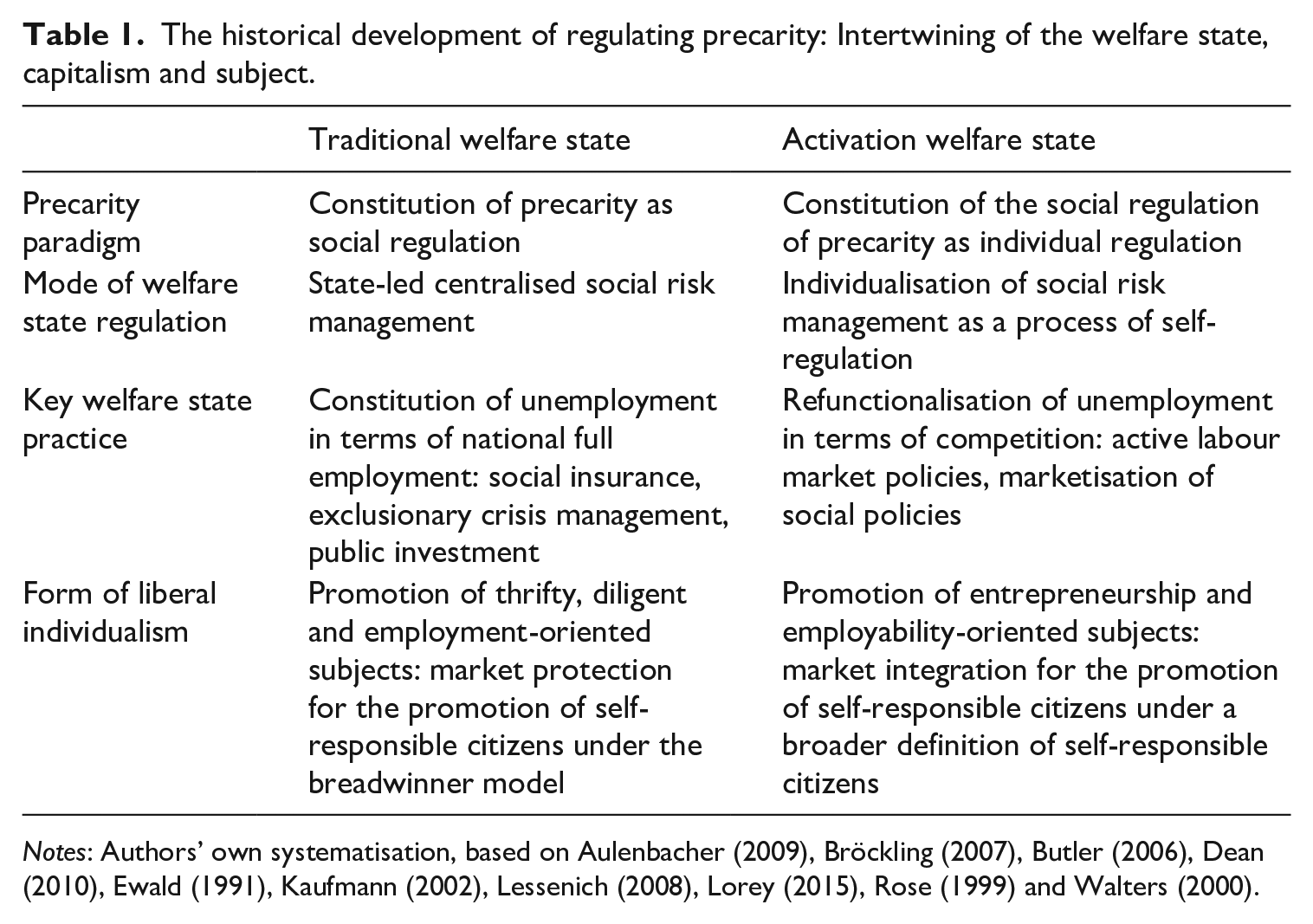
Notes: Authors’ own systematisation, based on Aulenbacher (2009), Bröckling (2007), Butler (2006), Dean (2010), Ewald (1991), Kaufmann (2002), Lessenich (2008), Lorey (2015), Rose (1999) and Walters (2000).
The transformation of the welfare state that this study focuses on is the occurrence of the activating welfare state. Since the 1970s, the welfare state has reached a pivotal turning point in its mode of regulating precarity and it now centres on activation. At the core of activation policies lie various shifts: the shift from collective to individual risk management; from social responsibility to individual responsibility for precarity; from welfare state to self-welfare.
The first key feature of the activating welfare state is that social regulation of precarity now follows the logics of the market. This represents a significant departure from the traditional welfare state’s understanding of poverty (Kronauer, 2010; Levitas, 1996; Rubery, 2011): poverty is no longer viewed as a result of market deprivation, but rather as the consequence of social regulations that create barriers preventing individuals from accessing market opportunities. In this new understanding, the activating welfare state can be seen as a collective commodifying agent (Cerny, 1997). Its goal is to increase access to market opportunities for a wider range of individuals, including groups that were previously viewed as non-workers, such as women and the elderly. Integral to this framework are welfare policies, specifically workfare policies, which rely primarily on coercive and punitive regulatory measures to push individuals into the labour market (e.g. Fletcher, 2015; Johnson et al., 2023; Rubery et al., 2018; Umney et al., 2018). Another crucial aspect is the marketisation of the welfare state (e.g. Greer, 2016; Nullmeier, 2004), which focuses on reconfiguring social welfare to emphasise cost-effectiveness and economic productivity. This shift signifies a deeper transformation in the traditional constitution of unemployment, which was once grounded in the social responsibility of achieving full national employment, predominantly centred on the male breadwinner model. The focus of the policy intervention is now being reorganised towards prioritisation of the economisation of the social (Bröckling, 2007), reflecting a broader integration of economic imperatives into social policy (e.g. Jessop, 2004).
The second key feature of the activating welfare state is that responsibility for social welfare, its social regulation of precarity, is shifted from centralised state risk management practices towards individual risk management practices (e.g. Dean, 2010; Lorey, 2015; Rose, 1999). For instance, in the case of unemployment, the activating welfare state emphasises individuals’ proactive efforts to engage in continuous self-improvement, thereby enhancing their employability and effectively competing for job opportunities through the development of personal skills and entrepreneurial abilities (e.g. Pongratz and Voß, 2003; Walters, 1997). This shift consequently transforms the social regulation of precarity into a process of self-regulation. This transformation reflects a new social formation of liberal individualism: the individuals’ failure to render assistance for themselves is considered not only a personal failure or a reluctance to care for oneself, but also a lack of responsibility towards society, primarily towards the state (Lessenich, 2015).
Within the framework of unemployment, the activating welfare state creates precarity and does so by means of labour market policies that shape perceptions and attitudes – for example, in terms of job insecurity as well as behaviour and subjective wellbeing. Studies focusing on labour market policies have shown that there are differences in how people perceive their own unemployment and how strongly their wellbeing is negatively affected by this condition (Wulfgramm, 2014). The societal interpretation of the causes of unemployment, and in particular, activation programmes, ‘put forward the interpretation that unemployment is at least partly voluntarily caused by a lack of effort and/or exaggerated demands of unemployed workers’ (Fervers, 2021: 5). People who directly experience activation policies more often perceive their own unemployment as an individual failure than a result of external factors such as economic crisis or the failure of labour market policies (Fervers, 2021; Ingold and Etherington, 2013). In light of the activating welfare state, can it be assumed that labour market policies reach segments of the society beyond the group of the unemployed via mass media or political debates, as well as the narratives of the workers perceiving their unemployment as their individual failure?
Overall, the activating welfare state suggests that the traditional welfare state is not simply in crisis; rather, it remains a key agent for the mobilisation of society towards liberal individualism – reorganising the governance of precarity through social regulation into individual regulation. This represents a profound shift in the relationship between the individual and society or, more precisely, between the individual and state agencies. This shift in itself constitutes a source inducing a process of precarisation across society. In this study, we consider the development of risk of unemployment over time, conceptualised as one expression of processes of precarisation.
The Swiss case and hypotheses
Switzerland offers an interesting case for studying precarity in the Global North. From a comparative perspective, Switzerland is often considered a liberal welfare state regime, characterised by less developed welfare, strong Calvinism, and comparably weaker workers’ and social-democratic political representation (Schröder, 2013), as well as the dominance of the market, the central role of the private sector and a low level of state intervention with social policies aiming at the prevention of poverty rather than the reduction of inequality (Esping-Andersen, 1990, 1999). However, more recent classifications note that Switzerland has shifted towards a post-liberal welfare state regime (Trampusch, 2008), a mix of liberalism and conservatism (Schröder, 2013), with central, federal and local health service, pension and unemployment schemes of a conservatist or even social-democratic nature (Armingeon et al., 2004). The liberal welfare tradition particularly applies to Swiss labour market policies. Legal protection for workers in Switzerland is among the lowest in Organisation for Economic Cooperation and Development (OECD) countries, clustering together with typical liberal welfare state regime countries like Australia, the UK and the USA, allowing possible dismissals at any time (for Swiss labour law, see Code of Obligations [CO] Art. 336; for the OECD employment protection indicator, see OECD, 2022: 178–194). Empirical studies on the development of precarious employment conditions in the UK, the USA and Switzerland provide evidence that both temporary contracts and tenure contracts remain relatively stable over time (Choonara, 2019; Doogan, 2001; Fevre, 2007; Goulart and Oesch, 2024; Hollister, 2011; Ecoplan, 2017).
Addressing the conceptual framework and the core argument of a link between the activating welfare state and increasing perceived unemployment risk over time, the analysis focuses on individuals with more privileged employment conditions (permanent contract working full-time) to provide the most conservative test. Why should policies of the activating welfare state in Switzerland affect individual perceptions, and do so even in the case of rather privileged employees? In Switzerland, like other national economies in the Global North, extensive activation programmes in the context of unemployment have been implemented (e.g. Duell et al., 2010; Lucas et al., 2021; Maeder and Nadai, 2009; Magnin, 2005). Prior to this transition, the country operated under a decentralised and voluntary insurance system in which workers with short-term residence status and women were primarily managed to mitigate the social consequences of unemployment and achieve full national employment (Afonso, 2019; Degen, 1993; Schmidt, 1995). A significant change in government strategy occurred in the 1980s, leading to the establishment of a centralised and compulsory insurance system. This transformation was marked in the 1990s and 2000s by activation, which included the establishment of regional employment assistance centres (Arbeitslosenversicherungsgesetz [AVIG] Art. 85b), the tightening of conditions for suitable employment (AVIG Art. 17), the strengthening of administrative sanctions (AVIG Art. 30, 1997) during the second partial revision of the Unemployment Insurance Act between 1992 and 1997, and the expansion of labour market reintegration programmes (AVIG Art. 59) that came with the third partial revision in 2003, followed by the reduction of benefits based on the length of unemployment (AVIG Art. 27) during the fourth partial revision in 2010. These changes in the regulation of unemployment have occurred within a new political discourse in which the government, intergovernmental organisations such as the OECD, mass media and public discourses (e.g. political parties) have played a fundamental role, disseminating narratives and knowledge that shape public perceptions and framing unemployment as an individual responsibility in terms of individual failure and lack of capacity (e.g. Kaufmann, 2013; Magnin, 2005; Zahn, 2021). This discourse was particularly effective in the context of mass unemployment and large-scale layoffs after the 1970s, as exemplified by the implementation of the Federal Resolution on a New Concept for Unemployment Insurance in 1976 and the 1993 Resolution on Measures in Unemployment Insurance. Within this framework, unemployment could no longer be managed exclusively through traditional exclusionary practices of particular social groups, such as women and migrants; it began to affect and concern people in more privileged positions (Pelizzari, 2009; Streckeisen, 2019). This is also reflected in surveys indicating that unemployment was perceived as one of the most pressing social issues, the Swiss Worry Barometer revealing that nearly 90% of respondents considered unemployment a serious social problem in the 1990s (Golder et al., 2021). Furthermore, Switzerland’s system of direct democracy enables citizens to express their opinions on decisions at all political levels, thereby facilitating the diffusion of knowledge and narratives regarding activation and unemployment throughout society.
The first hypothesis, a trend hypothesis, relates to an increasing risk of unemployment:
Hypothesis I: The importance of the perceived risk of unemployment increased significantly at the individual level between 1999 and 2019, even among workers with more privileged employment conditions (full-time and permanent contracts).
The second hypothesis relates to the explanation of this increase:
Hypothesis II: The expected increase in the perceived risk of unemployment between 1999 and 2019 among individuals with more privileged employment conditions (full-time and permanent contracts) is associated with the change in activation of the welfare state.
The empirical analysis includes certain controls. While the general starting assumption highlights the change in activation of the welfare state as a cross-cutting phenomenon that affects different social positions, the growing importance of subjective precarity may increase to varying degrees among different social groups structured by socio-economic status/education, gender and immigrant status. Among the group of individuals with more privileged (standard) employment conditions, deprived groups may perceive a higher risk of becoming unemployed than more privileged groups. Thus, we include individual-level controls (education, professional class, gender, immigrant background, age).
Furthermore, a possible rise in perceived unemployment risk is not expected to be primarily influenced by economic performance (measured in terms of GDP), which indeed remains relatively stable in the prosperous Swiss context during the period under study. Rather, the change in activation of the welfare state is expected to be associated with the perceived unemployment risk across society over time. Thus, to capture the genuine effect of activation policies, GDP is introduced as a control.
Additionally, the increase in perceived unemployment risk is expected to be influenced by rising unemployment rates – partly stemming from the new approach to activating welfare state interventions described above – shifting towards a greater emphasis on marketisation and competitiveness. While the prevalence of unemployment across society is a key aspect of the activating welfare state, the unemployment rate is used as a control variable to capture the genuine effects of activation policies accurately, thereby strengthening the theoretical argument.
Data and method
General analytical approach
To back the conceptual arguments empirically and to provide a conservative test, the present study focuses on temporal developments regarding the perceived risk of unemployment (dependent variable) among individuals in more privileged employment conditions induced by the activating Swiss welfare state. Accordingly, the sample consists of individuals who, at the time of the interview, have a permanent, full-time employment contract and are between the ages of 25 and 60, the working age phase of life. The temporal change (period 1999–2019) of the dependent variable is explained (stepwise) by policy-related variables. While government spending on active labour market policies – assistance, employment programmes – compared with insurance policies (income maintenance) is the key variable, period-related indicators, namely annual GDP growth rate, GDP per capita and adjusted unemployment rate, function as controls at this level. While the GDP variables are macro-economic performance indicators, the adjusted unemployment rate reflects changing policies along with demographic and economic developments. Individual-level controls include socio-demographic variables such as gender, Swiss citizenship, age, education and occupational class to identify general patterns considering inequalities within the target population.
Data
The analysis is based on SHP data using the waves corresponding to the years 1999–2019 at yearly intervals (to avoid outliers due to the COVID-19 pandemic). The SHP is suitable for the purposes of this study because, compared with other surveys (e.g. the Swiss Labour Force Survey), it provides more detailed information on employment conditions at the individual level and includes information on employees’ subjective perceptions, such as risk of unemployment. The net sample is an unbalanced panel and consists of 31,061 observations from 6960 respondents over the period of the analysis.
Operationalisations
Perceived risk of unemployment is measured based on the individual’s assessment of the risk of experiencing unemployment in the near future, measured via the question: ‘How do you evaluate the risk of becoming personally unemployed in the next 12 months?’. Response categories ranged from 0 (‘no risk at all’) to 10 (‘a real risk’; Budowski et al., 2001). The distribution of responses in the sample is characterised by a standard deviation across the whole period of 2.33, above the period mean of 2.05, indicating a right-skewed distribution (positive skewness) given the non-negative quality of the measurement scale. This indicator is well-aligned with the article’s theoretical framework: it measures the gradual precarisation process related to the shift in the regulation of unemployment (as risk management) from the responsibility of the welfare state towards individual responsibility. While precarity in society relates to many different life spheres (e.g. housing, income), risk of unemployment is a central aspect, as it relates to the labour market that provides the main source of income during working age as well as wellbeing in society. Unlike typical indicators of subjective job insecurity that focus on current anxiety or the perceived likelihood of losing one’s current job (job loss), the SHP indicator that we use measures a more severe form of insecurity according to the precarity literature: it assesses the perceived likelihood of losing a job in the near future and not finding a follow-up position (e.g. Chung and Van Oorschot, 2011; Kiersztyn, 2017).
While the period 1999–2019 is included as the first (technical) independent variable to reconstruct the temporal process, activating welfare state intervention is the key explanatory mechanism following the conceptual arguments. This is operationalised via the ratio of government expenditure between active labour market policies and insurance policies, calculated with data provided by the OECD. This variable indicates government spending on labour market policies and focuses primarily on the importance of changes in the activation of welfare state regulations.
Other period-related indicators are included as control variables to assess the genuine effect of the activating welfare state. The measurement of economic performance includes the current GDP growth rate and current GDP growth per capita (data provided by the Federal Statistical Office). An important control variable, that in a way transcends the function of a control, is the adjusted unemployment rate, measured with data provided by the International Labour Organization (ILO). It accounts for a broader definition of unemployment, including unemployed persons not registered in administrative records due to their participation in active labour market programmes or to sanctions, exceeding the maximum duration of unemployment benefits, ineligibility for benefits, or being discouraged to claim such benefits. The adjusted unemployment rate reflects not only the economic condition – namely, the ratio between supply and demand – but also the activating welfare state intervention described above. Nevertheless, the adjusted unemployment rate is less susceptible to the influence of activation programmes and is therefore more reliable over time than the official unemployment rate.
Individual-level controls include the socio-demographic variables of the wage earner: occupational class (Swiss socio-professional categories, binary: 1 ‘non-manual and manual skilled and unskilled wage-earner’; 0 ‘professional wage-earner’); education (International Standard Classification of Education [ISCED], three categories: 2 ‘no compulsory education’; 1 ‘upper secondary general or vocational education’; 0 ‘tertiary education’); gender (measured binary: 0 ‘male’; 1 ‘female’); Swiss citizenship; and age group (25–30, 31–40, 41–50, 51–60 years).
Data analysis
The first descriptive part of the analysis that focuses on visual inspection of the changes in the perceived risk of unemployment as one aspect of precarity presents the period-specific means and percentages for employees in different employment conditions (precarious and secure employment conditions). For the multivariate analysis, a linear mixed-effects model approach is used to account for the panel structure of the dataset (cluster: individuals). Graphical representation of the predicted probabilities is also done using a binomial mixed-effects model approach. The calculations were performed using R-libraries lme4 (Bates et al., 2015).
Results
Descriptive analysis
Figure 1 illustrates the increasing importance of the perceived risk of unemployment in Switzerland over the period of analysis, from 1999 to 2019. Furthermore, the figure examines changes over time in the adjusted unemployment rate (represented by the long-dashed line), government spending on active labour market policies (represented by the dot-dash line) and government spending on unemployment insurance policies (represented by the dotted line) to provide the reader with a contextual background. The bar chart and the bold grey line indicate that individuals in privileged employment conditions (full-time and permanent contracts) report an increase in their perceived unemployment risk. Specifically, the bar chart shows a notable rise in the percentage of individuals who perceive an unemployment risk, meaning they report a value greater than 0 on the measurement scale. In the 2000s, the percentage of individuals in privileged employment conditions reporting a perceived unemployment risk was around 45–50%, rising during the 2000s to just under 70% after the financial crisis of 2007–2008 and stabilising at around 65% in subsequent years before the onset of the coronavirus pandemic crisis. This increase is also reflected in the annual mean of reported perceived unemployment risk (bold grey line): initially, the annual mean tends to be below level 2 on the scale. Towards the end of the period, the annual average rises and exceeds level 2. These first results based on the descriptive analysis indicate a widespread increase in perceived unemployment risk over the period of analysis, from 1999 to 2019, even among individuals with more privileged employment conditions.
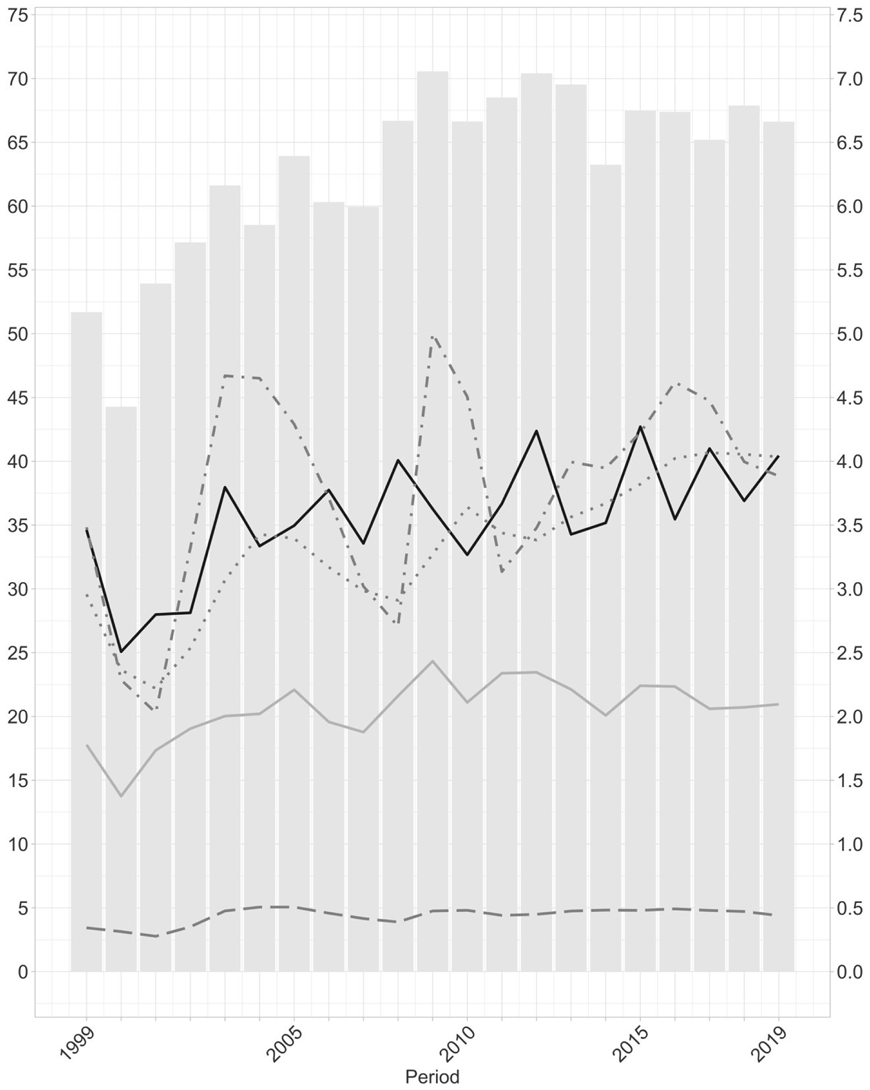
Development of perceived unemployment risk.
To provide a more nuanced view, the bold black line represents the annual mean of the unemployment risk assessed by individuals with temporary contracts, which serves as an indicator of precarious employment conditions. Even within this group, there is a noticeable increase in perceived unemployment risk; their reported level of perceived unemployment risk increases more over time and is higher when compared with those individuals in more privileged employment conditions. This suggests that the increased importance of perceived unemployment risk across Swiss society appears to have different consequences for individuals, being more pronounced for those in more precarious employment conditions. However, this also suggests that perceived unemployment risk goes beyond the conventional binary assumption related to employment conditions, affecting even segments of society considered to be protected by the welfare state.
Furthermore, Figure 1 illustrates that the evolution of perceived unemployment risk closely mirrors the adjusted unemployment rate, rising during economic downturns and falling during recovery periods. This pattern is also evident in government spending across the two kinds of policy. It can be observed, too, that the trajectory of the adjusted unemployment rate, similar to the trajectory of perceived unemployment risk, increases over the period of analysis, rising from around 3% in 1999 to approximately 5% by 2019. An increase over time is also noticeable in government spending on active labour market policies. In contrast, spending on insurance policies is highly sensitive to economic cycles, spiking during downturns and gradually decreasing or levelling off during recovery periods, without following the same continuous upward trend. Thus, public spending on active labour market policies seems to be on a slow, consistent rise, reflecting a long-term government strategy that is less influenced by economic cycles, while government spending on insurance policies is more reactive to changing economic conditions. In light of this, Figure 1 indicates that the increasing perceived unemployment risk over time appears to be associated with the growing importance of unemployment and active labour market policies relative to insurance policies in Swiss society.
Furthermore, the visualisation reveals a moderate increase in the trend of perceived unemployment risk, indicating that individuals are becoming more aware of the potential of experiencing unemployment. However, for most, this heightened awareness does not translate into a perception of actual unemployment risk. When viewed through the lens of our article’s argument, it suggests that while the activating welfare state leads people increasingly to experience unemployment and acknowledge the possibility of unemployment, it also individualises and privatises this experience by encouraging people to adopt proactive attitudes and behaviours to manage their unemployment risk.
Multivariate results
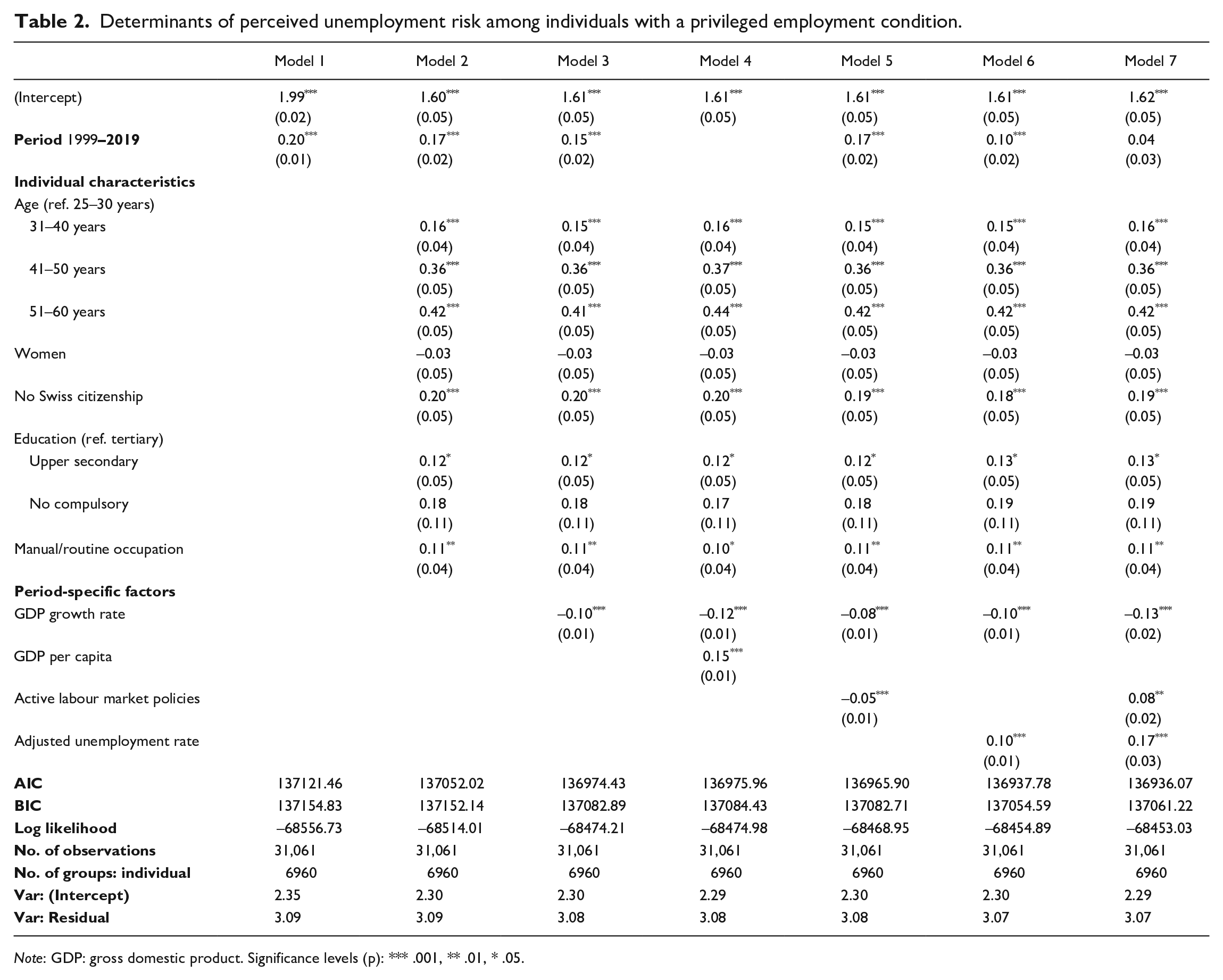
Table 2 presents linear mixed-effects model estimates for the determinants of perceived risk of unemployment among individuals with more privileged employment conditions (full-time and permanent contract). Owing to the high collinearity observed between the time period and GDP per capita (r > 0.9), they are analysed separately in different models. Across all models, variance components indicate that about 43% of the explained variance of risk of unemployment are explained on the time level and thus are subject to temporal changes, while 57% are explained on the person level. The goodness-of-fit indicators such as the log-likelihood value show that the fit between data and model increases over the Models 1–5, and thus with each analysis step.
Determinants of perceived unemployment risk among individuals with a privileged employment condition.
Note: GDP: gross domestic product. Significance levels (p): *** .001, ** .01, * .05.
Considering changes over time (period), Model 1 shows a positive and statistically significant association between the period and the perceived unemployment risk, indicating an increase in perceived unemployment risk over time for individuals with the most privileged employment conditions; this confirms the trend of perceived unemployment risk already observed in the visualisation in Figure 1 and supports Hypothesis I. Including different socio-demographic characteristics as control variables in Model 2 slightly reduces the correlation between period and perceived unemployment risk, though it remains statistically significant. This indicates that the increase in perceived unemployment risk over the period of analysis is only weakly affected by shifts in the composition of social positions among the group of individuals with more privileged employment conditions. Including the GDP growth rate as a period-related control in Model 3 slightly weakens the period coefficient, but the period retains a statistically significant and positive association with perceived unemployment risk. Model 4 substitutes the period estimator with GDP per capita due to high collinearity between these variables. Indeed, this adjustment effectively absorbs the period coefficient and reveals a positive correlation between GDP per capita and perceived unemployment risk.
While the first models focused mainly on the temporal increase and the function of control variables, Model 5 specifically explores the link between active labour market policies (vis-a-vis insurance policies) and the increased perception of unemployment risk. After controlling for period, socio-demographics and economic performance, the model shows government spending on active labour market policies to be significantly negatively associated with perceived unemployment risk. Model 6 demonstrates the functioning of the adjusted unemployment rate as a control variable that is not only introduced for this purpose but is also inherently linked to change in activating welfare state intervention, thus transcending its role as a mere control. The adjusted unemployment rate exhibits a positive association with perceived unemployment risk and effectively mitigates the period effect on perceived unemployment risk to a greater extent than the other factors considered in previous models.
The key Model 7 shows the genuine role of active labour market policies (vis-a-vis insurance policies) in the development of perceived unemployment risk net of the other period-related and individual-level factors. Adding government spending on active labour market policies vis-a-vis insurance policies, the initial negative effect of this variable (Model 5) turns into a significant positive effect with perceived unemployment risk. This indicates that the omission of the adjusted unemployment rate in Model 5 has suppressed the positive relationship between government spending on active labour market policies and perceived unemployment risk. Such suppression effects occur if, after control of a third variable, a direct effect becomes stronger or even changes its direction (MacKinnon et al., 2000). This positive effect can be interpreted as follows. Taking into account that the (rising) adjusted unemployment rate is already positively associated with perceived risk of unemployment, active labour market policies contribute even more to perceived risk of unemployment. Government spending on active labour market policies and rising unemployment simultaneously lead to increased perceived unemployment risk. This finding is not surprising, as the allocation of public expenditure to active policies (vis-a-vis insurance policies) is closely dependent on actual economic conditions, as already observed in descriptive analysis. When modelling the two factors simultaneously, the significant association between period and perceived unemployment risk disappears. This underscores that the increasing government spending on active labour market policies, together with the adjusted unemployment rate, contribute to a large extent to the changes in perceived unemployment risk over time. Model 7 supports Hypothesis II, as active labour market policies showed the expected genuine effect (even when controlling for other economic developments): the increasing perceived unemployment risk over time among individuals with privileged employment conditions is linked to changes in the activating welfare state’s interventions. Although the effects are substantial, especially concerning period-level variables, their magnitude – and consequently the explanatory power – remains relatively low.
Finally, Figure 2 substantiates the multivariate results. It provides a comprehensive illustration of the development of perceived unemployment risk over time in terms of predicted probabilities derived from a logit mixed model where the dependent variable is dichotomised into two categories: Y = 0 indicates the absence of any perception of unemployment risk, while Y = 1 indicates any degree of unemployment risk on the measurement scale. The predicted probabilities shown in Figure 2 are calculated for a typical individual belonging to groups with privileged employment conditions (full-time and permanent contracts) and with the following socio-demographics and privileges: aged between 41 and 50, Swiss citizenship, male, tertiary degree and professional occupation class. The GDP growth rate is held at its time period mean. Figure 2 shows that the predicted probability of perceived unemployment risk compared with no perception of unemployment risk is notably high at the beginning of the analysis period and increases significantly over the period of the analysis. Specifically, in 1999, the probability of reporting perceived risk of unemployment was already 0.65, and this probability increases significantly until the end of the analysis period in 2019, reaching just below 0.90.
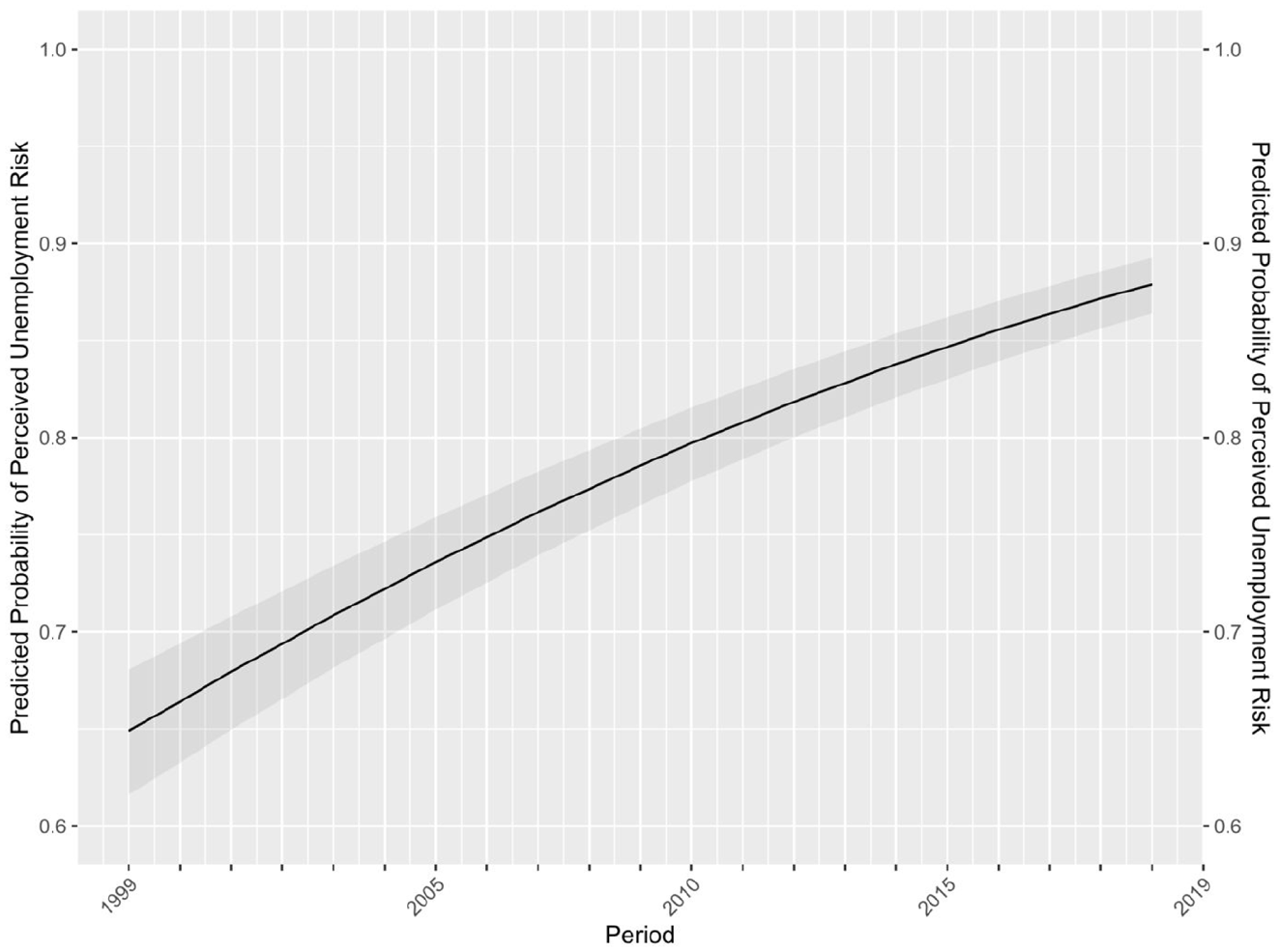
Predicted probability of perceived unemployment risk over time.
Discussion and conclusion
The debate on precarity is attracting increasing attention from policymakers and academic scholars alike. Precarity is commonly conceptualised and studied as a condition that is primarily situated among marginalised populations and confined to particular forms of contingent employment (Diekmann and Jann, 2005; Doogan, 2001; Fevre, 2007; Goulart and Oesch, 2024; Prosser, 2016; Ecoplan, 2017; St-Denis and Hollister, 2024). This article applies a broader understanding to capture the underlying structural dimensions of precarity, focusing on risk of unemployment as one key aspect. The results of the article highlight that among processes of precarisation in the labour market, an increasing perceived unemployment risk over time is present even in an economically rather prosperous setting (Switzerland) and in social positions in society that have long been considered to be protected by the traditional welfare state. In the Swiss case, the study indicates that perceived unemployment risk is a widespread phenomenon that has become increasingly important over time. More specifically, the findings provide compelling evidence that among individuals in privileged social and occupational positions, most had already perceived some unemployment risk at the beginning of the study, in 1999, and this even in a relatively favourable and stable national economic context. By the end of the study period in 2019, this probability had significantly increased, with only a small minority of respondents claiming to perceive no risk at all. This finding indicates that it is essential to recognise that ‘the diversity of precarisation processes today goes beyond the “non-standard”’(Alberti et al., 2018: 452). This is particularly evident in liberal market economies, such as Switzerland, where there has historically been no clear legal distinction between standard and non-standard employment. Therefore, to understand precarisation processes in the labour market, it is necessary to adopt a nuanced approach that acknowledges these complexities and their implications for individuals with various types of employment contract. This article thus contributes to the literature on precarisation in society that conceptualises precarity as a profound reconfiguration of the social order of the traditional welfare state (Bourdieu, 1998; Brinkmann et al., 2006; Castel, 2003; Dörre, 2008).
While this article departs from the conventional literature on precarity that typically assumes crisis in the welfare state, it is original in that it sheds light on how social regulation of the activating welfare state produces precarisation (Alberti et al., 2018; Butler, 2006; Greer, 2016). The article presents empirical evidence that the activating welfare state’s new mode of intervention is related to increased perceived unemployment risk over time in Switzerland. More specifically, the findings provide compelling evidence that the increasing importance of activation, in terms of labour market policies and unemployment, is associated with perceived unemployment risk even among individuals with privileged employment conditions. These associations persist regardless of economic performance, which remained relatively stable and prosperous during the period of analysis in Switzerland. These results support the argument that a new function of precarity in social regulation and control is emerging within the continuity of the state regulatory framework of liberal individualism, and that this is not due to the thesis of crisis in the welfare state. In contrast, society has entered a new sociopolitical stage in which the social governance of precarity is changing into self-governance. This indicates a profound adjustment in the relationship between individuals and society, intertwined with the welfare state’s regulations of precarity, and this in itself is a source of precarisation (e.g. Lorey, 2015).
There are several limitations to this study that need to be acknowledged. First, the dependent variable ‘perceived unemployment risk’ does not adequately address the multifaceted nature of precarisation processes in the labour market. Including further indicators commonly used in empirical studies of precarity such as job insecurity (fear of losing one’s job) and income insecurity (fear of losing one’s main source of income) would improve the validity of the argument, as policies increasing flexibility in the labour market and inducing activation may more often lead to job and income loss rather than to (long-term) unemployment. However, since more significant changes in the perceived risk of job and income loss could be expected over time compared with changes in the risk of unemployment, our study, which uses a single item related to unemployment, may present a more conservative test. In addition, the inclusion of additional indicators addressing individuals’ perception of changes in expectations and responsibilities in the labour market over time could show another aspect of the precarisation processes induced by the activating welfare state. Indicators that address precarity beyond the labour market yet are closely associated with it, such as housing, health or the family, would provide insight into aspects of precarisation in other life domains and take into account the heterogeneity of different experiences and perceptions of precarisation that individuals face today.
The second limitation relates to the time frame of the empirical analysis. Although the article theoretically addresses paradigmatic changes in the mode of intervention of the welfare state since the 1970s, its empirical focus on shifts in perceived unemployment risk starts only in 1999 due to the availability of data. However, this limitation can also be seen as a more rigorous empirical test, as the findings are empirically significant for the 20-year period (1999–2019).
A third limitation concerns the question of causality between the activating welfare state intervention and the subjective perceptions of people in the period under question in the empirical analyses. On the one hand, the theoretical framework employed in this article indicates how the regulation of precarity is interpreted as a function of the state to shape individuals’ behaviour and perceptions within the context of liberal individualism. On the other hand, the complexity of processes of welfare intervention and precarisation processes regarding causes and consequences is not covered in its full complexity. Welfare state policy also adapts to the collective experiences and perceptions of individuals. Thus, these empirical analyses give sophisticated insights, but future research may address these interdependencies based on larger data sets covering more aspects and time periods.
A fourth limitation of this study is its focus on general processes of increasing risk of unemployment, without a detailed analysis of how these processes vary across different social groups. Our preliminary findings indicate that the perceived unemployment risk differs based on class, gender and race. Future research should therefore investigate how processes of precarisation – such as an increasing unemployment risk – have disparate consequences, reflecting the differing labour market positions that individuals have historically occupied. This area has not received the attention it deserves. By analysing such processes through the lenses of gender, race and class, researchers can gain critical insights into how these processes function today. Such analyses will deepen our understanding of the new dynamics and continuities of precarisation processes within the regulatory framework of the welfare state, highlighting how it reproduces social inequalities and affects the distribution of power, resources, and vulnerability, ultimately reflecting and perpetuating social divisions. The analysis presented here represents one of the first attempts to study the perception and experience of precarisation processes quantitatively from the individual’s subjective perspective in the long term. There is much to be said for qualitative studies on the issue of increased risk of unemployment and its consequences or implications. Overall, the findings indicate that the activating welfare state has a major influence on shaping society, namely through the promotion of liberal individualism and the individualisation of social risks (in this article, active labour market policies and unemployment) and the production of precarity (understood as perceived employment risk, i.e. insecurity). According to the empirical results of the present study, and in line with the theoretical considerations, welfare state interventions consisting of encouraging self-governance and individual responsibility have widespread effects on perceptions and contribute to the rise of precarious experiences across the whole of society.
Footnotes
Funding
The authors received no financial support for the research, authorship, and/or publication of this article.
