




Abstract
This article examines how Brexit affected EU migrants’ sense of belonging at work by drawing on empirical data from a study of workers in the UK restaurant sector. Brexit was a political project of belonging that led to the formation of new communities at work based on citizenship and national identity. These ‘bubbles’ provided a sense of belonging for EU migrant workers during a period of heightened socio-political tension about migration. However, these bubbles were ruptured by conflict between EU migrants and other workers and managers, and by interactions with customers who become a conduit for socio-political issues to enter the workplace. The article highlights the problems with workplace community building as a strategy of solidarity in political contexts where societal belonging is disrupted. While bubbles of belonging create temporary safe spaces at work, by raising awareness of difference between groups they become a divisive approach to managing employee relations.
Introduction
EU migrant workers’ mobility patterns and migration trajectories are increasingly contingent on conditions of entry into a host nation, particularly following contentious debates over citizenship rights, notably in the UK during and post-Brexit (Basok and George, 2020; Guma and Jones, 2019). Brexit intensified and polarized Euroscepticism and xenophobia, prompting debates about nationalism, citizenship and the construction of a European identity (Yuval-Davis et al., 2018). It thereby functioned as a type of immigration control which transformed employee relations and the UK labour market (Anderson, 2010) by reinforcing precarity among EU migrant workers and calling into question their legal rights to live and work in the UK (D’Angelo et al., 2020). These changes created contention and division around who was seen as belonging to a nation’s ‘imagined community’ (Anderson, 2013: 4) and who was excluded from it, including EU migrants who had previously experienced a privileged status over other migrant workers through the EU right to freedom of movement.
Belonging at work is characterized by the formation, development and maintenance of relationships with others based on categorical in-group and out-group distinctions (Ashforth and Mael, 1989; Baumeister and Leary, 1995). Fostering a sense of belonging at work is an important aspect of employee relations that has the potential to make organizations and societies more inclusive (Bryer, 2020). Previous research has shown that tensions surrounding belonging at work can arise from the ‘need to feel both a sense of similarity to, and distinctiveness from, others’ (Cuganesan, 2017: 490). In addition, the formation of groups based on sameness and difference is especially likely during periods of organizational change, when collective values and identities are more likely to be challenged and pitted against one another, provoking a range of defensive and active responses (Jarzabkowski et al., 2013). The purpose of this article is to explore how socio-political tensions surrounding the issue of belonging, which emerged during Brexit, affect workplace community formation. The research questions are (i) how are workplace communities shaped by socio-political issues of belonging, and (ii) what are the implications of communities of belonging for employee relations?
Belonging, as a feeling of togetherness arising from empathetic connections with others (May, 2011; Probyn, 1996), is a crucial aspect of human existence that has social, political, organizational and cultural consequences (Baumeister and Leary, 1995; May, 2011). Previous research highlights the benefits that can arise from inter-group contact between majority and minority ethnic groups at work in reducing levels of societal prejudice (Klein et al., 2018). For example, Kokkonen et al. (2015) suggest diverse workplaces can foster inter-ethnic (migrant/non-migrant) relations more effectively than neighbourhoods or other types of social communities. This is because employees cannot control who they interact with at work, leading to a higher likelihood of the formation of individual and collective relationships that span ethnic, racial, age and gender differences.
Studies have also revealed the negative impacts of socio-political tensions on workplace belonging caused by political parties that emphasize us/them divisions and heighten awareness of difference between different citizenship groups. Research has shown that a negative political focus on immigration issues at a societal level can weaken the effectiveness of workplace contact in minimizing ‘antiforeigner sentiment’ (Sønderskov and Thomsen, 2015: 50). However, we still know relatively little about how socio-political tensions about migration at the societal level affect employees’ experience of belonging and community at work.
To explore how EU migrant workers in the UK construct communities and experience belonging at work, empirical data are drawn from a study undertaken in the UK restaurant sector in the period following the 2016 Brexit referendum, when the UK electorate voted to leave the EU, but before Britain’s formal withdrawal in 2020. This article analyses how changes in belonging at a societal level led to new processes of boundary-making at work. Specifically, it shows how ‘bubbles of belonging’ were constructed by EU migrant workers as a strategy of workplace solidarity in response to socio-political tensions about migration. These bubbles helped EU migrant workers to create safe spaces of belonging at work despite feeling a lack of belonging outside work. However, the article also shows how these workplace boundaries reinforced awareness of difference between citizenship groups by making us/them distinctions.
The article contributes to the literature on belonging at work by highlighting the importance of communities of coping that go beyond collective activism (Korczynski, 2003) and enable migrant workers to survive in hostile socio-political contexts. It draws attention to the challenges of cultivating inter-ethnic relations in diverse workplaces in times of heightened socio-political tension about migration (Kokkonen et al., 2015). The article also contributes empirically to the understanding of EU migrant workers’ experience of UK hospitality work during and post-Brexit. It highlights how hostile socio-political contexts affect front-line service workers’ experience of employee relations (Bélanger and Edwards, 2013). Specifically, it draws attention to the role of customers in rupturing bubbles of belonging in front-line service work, undermining their efficacy as a strategy of solidarity by building communities of coping. Through this, the analysis emphasizes the interconnectedness of socio-political and workplace belonging.
The article begins by reviewing existing literature on communities of coping at work before introducing Yuval-Davis’ (2011) politics of belonging framework which is used to theorize Brexit as a political project of belonging. It then outlines the UK hospitality sector context and data collection methods. The findings focus on three main themes related to the construction of bubbles of belonging at work and how they are ruptured. The discussion considers how ‘bubbles’ as communities of coping are a strategy of solidarity in response to disrupted belonging while also being inherently fragile and divisive, causing tension and conflict, especially in front-line service work.
Communities of coping at work
Communities of coping are ‘emergent, informal, oral-based [and] social’ (Korczynski, 2003: 74) modes of organization that rely on the formation of groups at work. This term is used to explain the collective organization of emotional labour in response to customers as a source of pleasure and pain in service work (Korczynski, 2003). When faced with the pain of emotional labour, service workers seek support from each other, creating a community of coping. Korczynski (2003: 58) argues that such communities are ‘a crucial part of the social relations of the service workplace’ because they emerge from strong workplace cultures, rather than as part of the labour process.
The concept of communities of coping emphasizes the role of solidarity in work-related communities (Korczynski, 2003), mainly in response to internal employment-related issues like managerial control. Communities of coping are a form of collective activism (Jiang, 2018) or collective resistance through micro-mobilization (Jiang and Korczynski, 2016). This literature draws attention to the importance of solidarity in constructing communities of coping which constitute a ‘peculiar combination of consent and resistance to work’ (Lewis, 2005: 567) that ‘preserve[s] the fragile social order’ of workplaces (Korczynski, 2003: 58).
However, solidarity can ‘mean different things to different people’ (Beck and Brook, 2020: 5). On the one hand, it can be defined as ‘the manifestation of a shared sense of injustice and common purpose across different groups and/or societies’, which is often associated with collective action, resistance and opposing unjust workplace regimes (Beck and Brook, 2020: 6). On the other hand, solidarity can be understood as not solely oppositional but rather involving human connections that exceed management control (Bolton and Laaser, 2020). These human connections can arise from mutual support between employees which fosters workplace camaraderie and the development of communities (Prouska et al., 2023). This research draws attention to the potential connections between communities of coping and constructing safe spaces at work (Jiang, 2018). For example, in a study of collective activism among immigrant domestic workers, Jiang (2018: 39) shows that communities of coping emerge as ‘ideological spaces’ that offer workers a feeling of safety. These spaces can form outside of work, where ‘workers can discuss work grievances and understand the structural causes of work exploitations’. In some instances, they challenge common assumptions about working conditions in an industry. For example, Barnard et al. (2023) question the perceived heteronormativity of the construction industry by showing how LGBT workers experienced safe spaces at work which enabled them to negotiate more authentic identities.
The communities of coping literature demonstrates the importance of informal communities in helping employees to cope with the pain of emotional labour (Korczynski, 2003; Lewis, 2005) and managerial control (Jiang, 2018; Jiang and Korczynski, 2016). This work also suggests workplace communities offer a source of informal resistance to unjust workplace regimes by creating solidarity within groups. However, there is limited exploration of how communities of coping at work are affected by socio-political contexts. This article contributes to this literature by exploring how communities of coping are constructed as a strategy of solidarity in response to the disruption of belonging at a societal level. It shows how solidarity emerges from human connection (Bolton and Laaser, 2020) and mutual support (Prouska et al., 2023), which contribute to feelings of safety at work (Barnard et al., 2023; Jiang, 2018). However, it also demonstrates the fragility and divisiveness of bubbles of belonging at work, particularly in times of socio-political tension about migration.
Belonging and the politics of Brexit
Belonging involves labelling and making comparisons between those who are seen as the same and those who are viewed as different, in terms of factors such as gender, ethnicity, race, class and nationality (May, 2011; Yuval-Davis, 2011). By making connections between those who are seen as similar, constructions of belonging can become associated with a ‘rhetoric of sameness’ based on the ‘language, culture, values, behavior and religion of [a] dominant group’ (Antonsich, 2010: 650). This can lead to systematic marginalization and exclusion by positioning certain people on the inside and others on the outside (Probyn, 1996; Yuval-Davis, 2011).
Probyn (1996) uses the term ‘outside belonging’ to interrogate these insider/outsider distinctions, drawing attention to tensions that arise from an individual’s desire to belong, while also acknowledging that ‘belonging is not an individual action’ because it depends on being included (or excluded) by a collective group (p.24). Such distinctions are often political, shaped by societal power relations which determine the boundaries that define identity and selfhood (Yuval-Davis, 2006). In some historical moments, constructions of belonging may be imposed on people and, through this, the relationship between location and identification becomes ‘more closely intertwined’ (Yuval-Davis, 2006: 203).
Yuval-Davis describes this as the ‘dirty business of boundary maintenance’, which is all about potentially meeting other people and deciding whether they stand inside or outside the imaginary boundary line of the nation and/or other communities of belonging – whether they are ‘us’ or ‘them’ (Yuval-Davis, 2006: 204). The drawing of boundaries becomes particularly prominent when belonging is contested in response to hegemonic political power (Yuval-Davis, 2010). This is because belonging is most clearly articulated and politicized when it is threatened (Probyn, 1996; Yuval-Davis, 2006), often in the context of political projects related to identity. These projects challenge location-based power structures and identities, prompting a renegotiation of who is considered inside or outside the boundaries (Yuval-Davis, 2011).
A key purpose of political projects is thus to maintain and reproduce ‘the boundaries of the community of belonging’ and to resist challenges from other political agents (Yuval-Davis, 2011: 20). The nation state plays an important role in maintaining societal boundaries of belonging by providing an imagined community that allows individuals to see themselves, or specify others, ‘as belonging or not belonging’ (Yuval-Davis, 2011: 84). Such ‘quasi-nationalist invocation[s] of community’ (Cassidy et al., 2018: 191) are not necessarily based on ‘citizenship to states and the right to carry a passport’ (Yuval-Davis et al., 2018: 229). Instead, citizenship and national identity are subjective affiliations rather than objective states (Miller, 1995).
Brexit was a political project of belonging (Yuval-Davis, 2006, 2011) that raised questions about citizenship and national identity and signalled a ‘new phase of community boundary drawing’ based on the premise that ‘I was here before you’ (Vieten and Yuval-Davis, 2018: 79). This was used by political parties to create divisions between groups based on citizenship in ways which appealed to particular collectives (Sønderskov and Thomsen, 2015). For example, the Brexit Leave Campaign relied on rhetoric which categorized British nationals (as ‘us’) and EU migrants (as ‘them’) (Charteris-Black, 2019). It disrupted the conditions created when migrant workers entered the UK labour market following the expansion of EU borders in 2004 (McDowell et al., 2009). By ending the freedom of movement which allowed EU citizens to work in the UK, Brexit led to a redrawing of their right to belong in Britain (Kerr and Śliwa, 2020) and created uncertainty about their future employment rights (Edwards et al., 2022). Brexit was also experienced as an extended period of Othering and unsettling, characterized by increased physical and verbal abuse (Guma and Jones, 2019) which transformed EU citizens’ everyday experience of living and working in the UK (Cassidy et al., 2018).
Context and research methods
The UK hospitality industry
The study focused on the UK hospitality industry as a context that could generate rich, in-depth insight into these issues (Lincoln and Guba, 1985; Patton, 2014). The hospitality industry relies heavily on migrant workers, including a high proportion of EU migrant workers, approximately 26% from EU countries (Cole et al., 2022; McDowell et al., 2009). This industry is typically characterized as a site of migrant worker precarity and exploitation and high employee turnover (approximately 30%, double the UK average), low-pay, long working hours and unpaid overtime (Alberti, 2014; Cole et al., 2022). Yet hospitality work remains under-researched relative to its size and economic importance (Butler and Hammer, 2019).
The hospitality industry is also characterized by poor working conditions that scholars have argued can only effectively be opposed or resisted through collective mobilization. Yet hospitality workers typically have limited rights and bargaining power due to low trade union membership (D’Angelo et al., 2020). Many migrant workers exit the industry or eventually plan to leave hospitality work (Janta et al., 2011). They are particularly unlikely to engage in collective action, trade unionism or outright resistance (D’Angelo et al., 2020). Asymmetrical employment relationships are more likely to emerge among service employees who ‘have more objective reasons for resistance’ due to poor working conditions but ‘less capacity to resist or oppose’ (Bélanger and Edwards, 2013: 447).
A key role is played by customers in these relationships, who act as antagonists, allies, resources or scapegoats for worker frustrations (Bélanger and Edwards, 2013; Laemmli, 2023; Leidner, 1993), especially for employees in service roles (Korczynski, 2005). Bélanger and Edwards (2013) argue that more research is needed to understand the impact of customers on front-line service workers in hospitality, including ‘small acts of resilience and resistance’ used by migrant workers (D’Angelo et al., 2020: 747). Understanding the experiences of these workers is particularly important in times of increased socio-political uncertainty and hostility when they are likely to experience heightened precarity in an already exploitative, insecure labour market (Anderson, 2010).
Methods
Qualitative data were collected by the first author between June 2019 and January 2020, during the intense political debate prior to the UK’s withdrawal from the EU (January 2020). Fieldwork was carried out in three restaurant chains (‘Coral’, ‘Luke’ and ‘Eddies’), which are owned by a single parent company that has over 400 UK restaurants, £800 million in revenue and more than 16,000 UK employees. The company’s rapid expansion in recent years, driven by hedge fund investment, had led to pressures from investors to close underperforming restaurant sites across the portfolio. This mirrors broader trends in the hospitality industry which contribute to poor terms of employment and working conditions (Garvey and Stewart, 2015; Wood, 2020). Access to the company was granted when a senior manager at Coral responded to a post made by the researcher on LinkedIn explaining the purpose of the study and inviting research participation. Concerned by Brexit’s possible negative impact on staffing, the manager enabled access to Coral and facilitated access to senior management at Luke and Eddies. In exchange, the researcher provided managers with a verbal report of the main findings in anonymized form.
During the fieldwork, opportunity sampling was used to identify and approach interviewees (Patton, 2014). To understand the relationships between, and experiences of, EU migrant workers, their co-workers and managers, non-EU workers and British employees were also interviewed. This sampling approach allowed exploration of the boundaries of belonging and the power relations between those who are considered inside a community and those positioned on the outside (Yuval-Davis, 2011).
The researcher adopted an observer-as-participant role (Gold, 1958), shadowing employees (Czarniawska, 2014) and engaging in informal conversations. Guided by access conditions, research visits took place when the restaurants were relatively quiet (between 6 a.m. and 11 a.m.), when three to six employees were on shift. The researcher remained ‘front of house’ – that is, outside the kitchen areas unless otherwise agreed with management – but the open plan style of the restaurants meant that kitchen workers could also be observed from this location. Observations were complemented by semi-structured interviews to enable methodological triangulation (Denzin, 1978; Lincoln and Guba, 1985). This multi-method approach minimizes the possible limitation of using interviews in isolation, which can be related to discrepancies between reported and actual behaviours (McDonald and Simpson, 2014). The researcher visited a total of nine restaurant branches and interacted with 87 employees, resulting in a dataset of 104.5 hours of observational fieldnotes and 47 semi-structured interviews averaging 51 minutes in length.
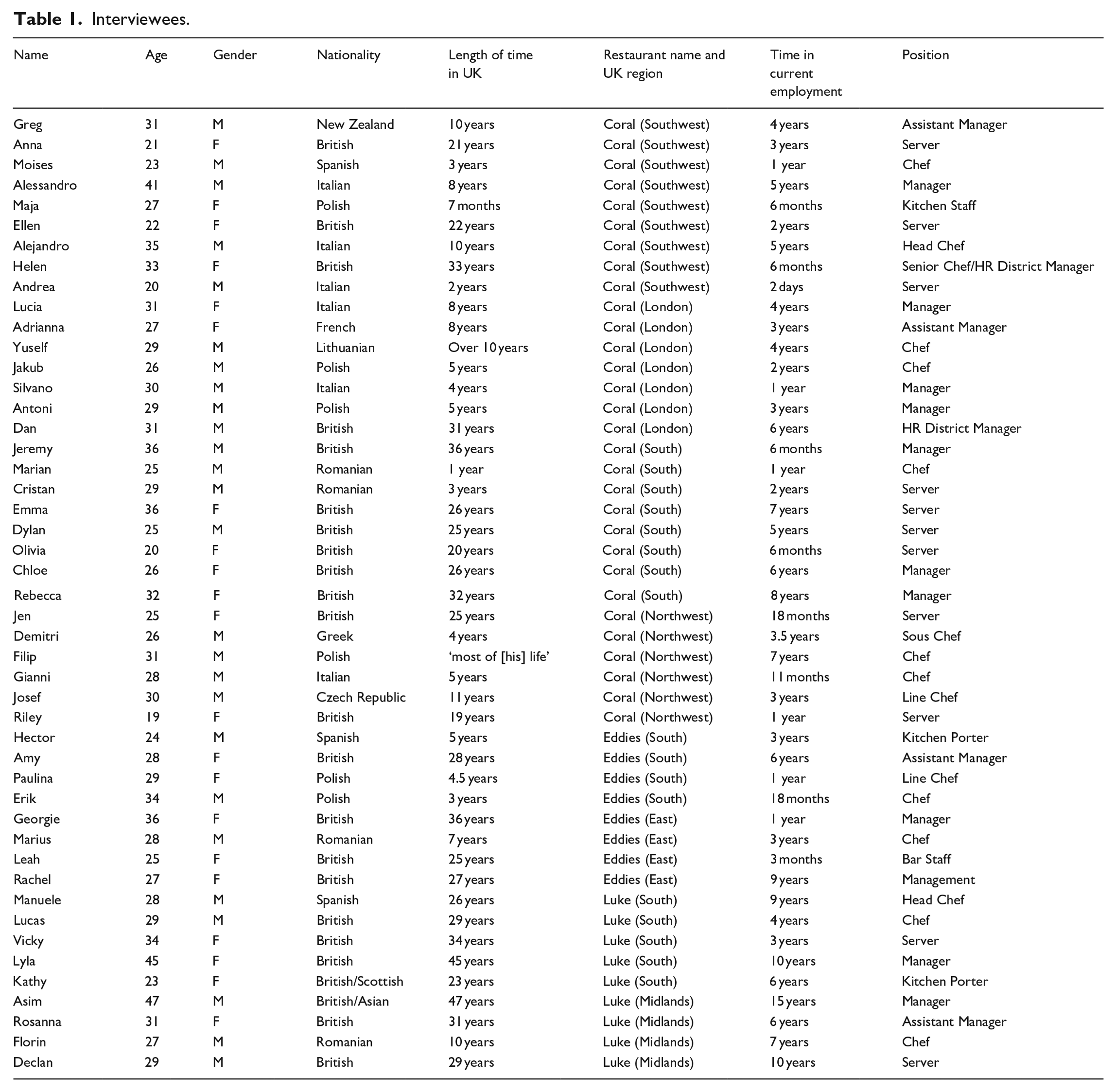
Of the 47 participants interviewed, 23 self-identified as EU migrants, one as a non-EU migrant, and 23 as UK citizens. Their ages ranged from 19 to 47 years old, with 21 women and 26 men taking part in the study. They included Spanish, Romanian, Polish, Greek, Italian, Lithuanian, French and British nationals. Interviewees ranged from having lived in the UK from birth, to having lived in the UK for as little as three months. The length of time worked in the restaurant varied from six weeks to 15 years (Table 1). The sample comprised 23 ‘back of house’ positions (chef, sous chef, kitchen porter), 18 of whom were EU migrants, and 24 ‘front of house’ positions (waiter, waitress, bar staff), five of whom were EU migrants. Of these, 18 held management positions (seven of whom were EU migrants).
Interviewees.
Interview questions focused on how employees’ sense of belonging was shaped by experiences at and outside of work. They explored whether Brexit had led to any changes in their sense of belonging, including any ‘pragmatic strategies’ used by workers to mitigate their ‘insecure status’ (Botterill and Hancock, 2019: 4). Interviewees were also asked questions about employer support during Brexit and whether there had been any changes in relationships with co-workers. Interviewing continued until data saturation was observed (Alam, 2020), by reviewing audio transcripts and noting emerging themes until no significant new themes were found (Patton, 2014).
Thematic analysis involved repeatedly reading the data, notetaking and grouping ideas together (Braun and Clarke, 2006). First-order themes of sameness and difference were used to explore theoretical connections. Analysis also explored narratives of belonging as the ‘stories people tell themselves and others about who they are (and who they are not)’ (Yuval-Davis, 2006: 202), by looking back and projecting forward on their emotional investments and desire for attachments (Yuval-Davis, 2006). Aligned with interpretivist views around the limits of generalizability (Williams, 2000), analysis also involved identification of instances in the data which did not fit with emerging patterns (Patton, 2014). Though few, these non-confirmatory accounts are included in the analysis which also compares different data sources, such as fieldnotes and interview transcripts, to confirm participant experiences and confirm contradictions and tensions between interview statements and observed behaviour (McDonald and Simpson, 2014). This process was used to develop three overarching themes: (i) constructing communities of belonging at work; (ii) boundaries and bubbles of belonging; and (iii) being out of place and ruptured boundaries of belonging.
Findings
Constructing communities of belonging at work
Several British and EU migrant workers spoke about belonging at work as a feeling of ‘being at home’. Typical of these accounts, Anna (British, server, Coral) described the workplace as a ‘home away from home’, while Moises (EU migrant, chef, Coral) said, ‘I belong here [at the restaurant], it is my second home’. More ambivalently, British worker Dylan (server, Coral) related his views about belonging to the long hours worked in hospitality jobs (Cole et al., 2022), saying, ‘we spend a lot of time here, who wouldn’t want to feel at home?’.
Expressions of belonging as feeling at home were also related to the notion of family. For example, Ali (British-Asian, kitchen manager, Coral) said, ‘we are family here, have each other’s back, so I guess it’s a home away from home. That’s what it is all about isn’t it, belonging [is] being at home’ (fieldnotes). While metaphors of home and family were used by both migrant and non-migrant workers to express belonging at work, for EU migrant workers these concepts provided a temporary means of escape from feelings of exclusion, foreignness and difference caused by the politics of Brexit outside of work. The restaurant offered the promise of belonging and safety, which contrasted with EU migrant workers’ experiences of not belonging outside work.
For example, Moises explained that ‘Brexit is creating uncertainty . . . and that makes him upset, but he feels that “disappears” and he “can forget” when he gets to work because Brexit isn’t a problem here’ (fieldnotes). In making distinctions between his experience inside and outside of work, this example shows how the politics of Brexit caused EU migrant workers to experience belonging and not belonging simultaneously in different contexts. Some participants challenged the portrayal of hospitality work as a site of precarity by suggesting the workplace was a safe space for them because it was based on a shared European identity which provided a sense of solidarity, comfort and respite from disruptions to belonging experienced outside work: At work it is different [to outside work], it is lovely here. My accent is not laughed at. My Polish look doesn’t matter . . . At work I feel safe, welcomed. We are together here. We are European and I forget Brexit. [Maja, EU migrant, kitchen staff, Coral]
These contrasts between belonging/not belonging, inclusion/exclusion and safe/less safe highlight the boundary-making that defines who belongs to or is excluded from imagined communities.
However, experiences of not belonging also occurred at work through debates about who had the right to claim the UK as their home or place of residency. While most EU migrant workers described being made to feel welcome by British co-workers, a significant minority had experienced hostility from individuals who held xenophobic views. Josef (EU migrant, chef, Coral) explained that when the referendum result was announced, some British co-workers who no longer worked at the restaurant asked him if he had booked his plane ticket yet (fieldnotes). He explained that while these co-workers, whom he also considered friends, had described this as a joke, it had disrupted his sense of belonging at work.
A few EU migrant workers said they had received support from their employer in applying for permanent residency status. For example, Moises had been ‘contacted by a colleague from head office who helped him with the application’. While this could be interpreted as a strategy to prevent potential loss of staff and labour shortages, it also provided a sense of solidarity between workers and their employer. Moises felt it ‘was very supportive’ and made him feel ‘important’, ‘worth something’ and ‘valuable to the team’ (fieldnotes). Lucia (EU migrant, manager, Coral) had helped several workers in her team to complete residency applications. Her approach reflected her solidarity with other EU migrant co-workers, as she explained: ‘I am Italian you know, I am different [laughing]; how can I not make someone else feel welcome here . . . when the whole Brexit thing came out?’. This manager’s comment illustrates how socio-political events can affect employee relations by sensitizing people to the importance of communities at work.
While for many the workplace was understood as a site of belonging, a small number (three participants, two of them British) rejected the idea that belonging was associated with work. Mandy, a British waitress at Eddies, said: ‘I am here to work and make money and that’s it . . . I don’t belong here’. As she went on to explain: We are seen as employees. We are here to work that’s it . . . For starters, there aren’t enough of us . . . We work long hours, take lots of crap from customers and it’s rare that you get appreciation from management. What is there to belong to? (fieldnotes)
Mandy’s comment draws attention to the negative effects of poor working conditions on belonging at work. However, she went on to clarify that this was not related to her citizenship because Brexit had not disrupted her belonging, noting: ‘I don’t have to go anywhere’. As this suggests, Mandy saw herself as included within the boundaries of the imagined community of the British nation state because of her nationality. It shows how feelings of safety through belonging at work were experienced differently by restaurant workers depending on their national identity and experiences of belonging outside work.
In contrast, Marian (EU migrant, chef, Coral) felt neither belonging at work nor in the UK, saying ‘I need this country, I am here to work. Belonging [is] back home, [I am] here to work . . . My belonging is back home.’ Despite associating belonging with being ‘back home’, Marian’s emphasis on ‘need[ing] this country’ suggests a sense of vulnerability caused by Brexit.
These accounts draw attention to the importance of citizenship and national identity as subjective affiliations that EU migrant and British workers use to navigate the workplace as a site of belonging. However, as the following section explores, the political project of Brexit prompted the construction of communities of coping and contributed to the construction of boundaries which led to conflict.
Boundaries and bubbles of belonging
Managers referred to the restaurant using the metaphor of ‘a bubble’ (Lucia) and a ‘shield’ (Greg, non-EU migrant, assistant manager, Coral), suggesting that work was a place where employees could experience belonging and be protected from the hostile socio-political context created by Brexit. These views were shared by some EU migrant workers who contrasted their positive experiences of belonging at work with the hostile socio-political context experienced outside the workplace: There is a difference – in here, behind that door [in the kitchen] we can protect from the looks, the mind thoughts from people. But out here [in the restaurant and], out there [beyond the restaurant], people want to tell us to ‘fuck off’ to ‘go home’. I don’t know why this is happening but coming to work saves me from this. [Hector, EU migrant, kitchen porter, Eddies]
Describing the restaurant as a ‘shield’ from Brexit, Greg explained that: We don’t want to talk about the issues [of Brexit] because we know how much it can impact people. We know it’s an uncertain time, but what we do not want is for it to creep into the restaurant and ultimately cause friction, upset and impact our staff.
However, the construction of a safe space for EU migrant workers relied upon silencing talk about Brexit at work. One manager said they did not want to ‘encourage the talk of Brexit’, although she admitted that ‘what is going on out there can affect your work life’ (Rachel, British, manager, Eddies). Her comments highlight the difficulty in trying to prevent the issue of socio-political belonging from intruding into the workplace. Similar views were expressed by Lucas (British, chef, Luke), who described Brexit as ‘an elephant in the room’, observing that ‘a lot of Europeans work here and it’s just not appropriate to have debates about it at work’.
The use of the metaphors ‘bubble’ and ‘shield’ drew mixed responses from EU migrant workers. Some identified tensions in the views presented above. For Cristian (EU migrant, server, Coral), attempts to construct boundaries at work to insulate employees from the political project of Brexit were inherently problematic and inward looking: Company-wise, I think we are being kept in the dark about Brexit. Maybe this creates a bit of an ignorant bubble here. Close your eyes, it isn’t happening kind of thing. The last time I heard about Brexit from the company was one and half years ago from previous manager who works here.
This comment illustrates the employee cynicism which surrounds managerial attempts to regulate socio-political conversations about belonging at work. Attempts to shield EU migrant workers from the socio-political project of Brexit were seen by some employees as flawed, as Alessia (EU migrant, manager, Luke) explained: We live in uncertainty now. I am scared they will bang my door and ask me to leave. Some friends have already left. They did not like living like this, like we are just waiting to be deported like animals. It’s like I am just waiting . . . my life is waiting (fieldnotes).
This situation placed considerable strain on EU migrant workers such as Paulina (EU migrant, chef, Eddies), who said Brexit made her ‘an immigrant’ in the UK and placed her in ‘no man[s] land’.
Being out of place and ruptured boundaries of belonging
Specific moments were identified in the fieldwork when the boundaries constructed around workplace belonging were ruptured. One source of rupture arose from interactions between employees and the researcher, which prompted some workers to suggest that, as a British citizen, she had contributed to their lack of belonging: Brexit torn me inside! I am Romanian but I live in England. Brexit changed this. I am torn. Do I go to Romania where I belong? Do I stay in England where I want to belong? I am being under torture, and I am conflicting in my feelings. I want to stay here my life is here, but you don’t want me. [Florin, EU migrant, chef, Luke; emphasis added]
Another source of rupture arose when restaurant workers encountered customers. These encounters were common in customer-facing roles, including ‘front of house’ workers and managers. For example, Lucia recalled an experience when customers made a ‘sarcastic’ remark about her pronunciation, related to a wider point about customers making ‘comments about Brexit, getting rid of foreign people’. As these instances illustrate, customers can disrupt workplace belonging, leaving front-line service workers feeling Othered and excluded: ‘Oh my god!’ [laughing]. I was so out of place . . . It made me feel really bad. Still when I think about, it makes me shiver [laughing]. There was absolutely no reason for him to think . . . [or] be like that . . . He understood me. [He was] just being horrible because of Brexit. It makes me laugh because it is his problem not mine, but it is just not a very good vibe between me and the customer. [Lucia, EU migrant, manager, Coral]
The extent to which communities of coping were able to deal with customers’ attempts to construct difference was limited, and managerial responses were inconsistent and partial. Amy (British, assistant manager, Eddies) observed that ‘customers can be a bit stupid about it . . . One customer actually told us that she wouldn’t want to be served by someone who is foreign.’ Amy responded to the customer’s request by seating them in an area of the restaurant where they were served by an English employee. However, she only did this when her manager instructed her to, saying, ‘I actually wanted to not even seat the woman. I didn’t want anyone in here thinking they were not good enough for her just because of where they were born.’
In other instances, a more supportive response from managers was observed. One incident involved a customer who complained about being served by Andrea (EU migrant, server, Coral), calling him ‘foreign’. The manager (Greg) dealt with this by asking the customer to be served by Andrea or leave the restaurant. After Andrea had taken the order, the researcher asked if he was ok. He replied, ‘Stupid people, they don’t understand anything’. The researcher then asked Andrea if he feels that at Coral ‘the customer is always, right?’. He threw his hands in the air and said, ‘Well, customer say I am foreign, and they did not leave, so I am foreign to Coral in the end as well . . .’ (fieldnotes). As this example highlights, managerial attempts to resolve these conflicts in ways which protect employee belonging were limitedly successful due to the pain caused by abuse from customers (Korczynski, 2003) and the ambivalent response of management: My hands are tied in these situations because I am stuck in a weird place – I am running the restaurant, we rely on customers here and we shouldn’t argue with the customer, but they aren’t right. Andrea is a good guy. There is nothing wrong with his language and I don’t think the customer is representative. What can I do? They leave or let him serve them. That is a good compromise, I think. Insisting they leave would have caused a commotion. It wouldn’t have looked good. Andrea understands we don’t think that here. [Greg, fieldnotes]
However, these disruptions to belonging at work were mitigated by the mutual support within the communities of caring that EU migrant workers had constructed. In response to the situation described above, a strategy of solidarity emerged when Alberto (EU migrant, chef, Coral) tapped Andrea on the shoulder saying: ‘Don’t worry man, they are [a] wanker’ (fieldnotes). Instead of opposing Greg’s attempts to engineer a ‘good compromise’ between customer and worker, Alberto sought to develop a human connection (Bolton and Laaser, 2020) which allowed Andrea to benefit from the mutual support from other EU migrant workers (Prouska et al., 2023). An informal community thus stepped into the gap created by the ambivalence of management to take a more supportive position:
As these examples illustrate, interactions with customers where EU migrant workers were made to feel they did not belong in the UK regularly intruded into the workplace. The reluctance of some managers to acknowledge how Brexit had disrupted EU migrant workers’ sense of belonging led Marius (EU migrant, chef, Eddies) to organize an informal support group where employees could share feelings and experiences and seek practical support: ‘I created . . . [the support group] so people can share their Brexit feelings . . . I wanted to share experience[s] with people. Some others have questions about living in England, if they stay . . . It is nice to speak with people.’ [fieldnotes]
The ‘Brexit support group’, as it was referred to by EU migrant workers, was intended as a space for the provision of mutual support and solidarity. However, its existence drew attention to the lack of employer support (Sédès et al., 2022). Although the support group was open to everyone, it sometimes created tension and conflict. Managers were seen as reluctant to engage with it, as Steve (British, server, Eddies) noted: ‘no managers go to that group’ (fieldnotes). Management was thereby positioned outside the community of coping that workers had built to cope with their disrupted belonging.
The Brexit support group also prompted negative reactions from some British workers. For example, Leah (British, bar staff, Eddies) said, ‘Dean, who used to work here, didn’t really like [the group]. He thought it was racist.’ Similarly, Steve said the group ‘divid[ed] people in the workplace’ and made him ‘uncomfortable’. He felt he did not ‘belong in the group because he voted to leave’ and was ‘embarrassed to even talk about Brexit’ because of this (fieldnotes).
The emergence of these tensions led Georgie (British, manager, Eddies) to suggest the group met outside the workplace. She said she ‘didn’t want to encourage the group to become part of [Eddies] workplace’ and was concerned it might become ‘disruptive’, creating ‘a divide in the restaurant’ and causing ‘friction with staff’ (fieldnotes). However, Leah explained that the group ‘still met at work [and . . .] didn’t get in trouble’. The support group provided EU migrant workers with a feeling of safety and a sense of belonging at work. At the same time, it was seen by some British workers and managers as isolationist because it surfaced issues of difference which they sought to overlook. This prompted some employees with more positive experiences and views about Brexit to construct boundaries at work that reflected their different identities.
This example illustrates the potential for groups based on citizenship and identity to create division and conflict at work by amplifying differences between workers, sometimes leading to workplace conflict. For example, Rachel recalled an occasion when ‘there was a bit of a disagreement in the staff room . . . a bit of debate over Brexit and two of my employees had to be separated. It did get heated.’ Thus, while the support group sought to protectively contain issues of difference, it quickly became associated with a politics of isolationism (Charteris-Black, 2019).
Discussion
This analysis of EU migrant workers’ experiences in UK restaurants during the negotiation of Brexit shows how communities of coping at work based on citizenship and national identity were constructed in response to disrupted belonging. While the existing literature illustrates how communities of coping can emerge in response to internal organizational and labour-related issues (Jiang, 2018; Jiang and Korczynski, 2016), this article has explored how workplace communities are shaped by external, socio-political tensions surrounding the issue of belonging. The analysis has shown how bubbles of belonging became a strategy of solidarity that was used to construct safe spaces at work for EU migrant workers. In comparison, British workers felt less need to build workplace communities because their societal belonging was not threatened by Brexit. These findings draw attention to the importance of national identity, citizenship rights and who is considered inside or outside a nation state in community building at work (Yuval-Davis, 2011).
While existing research has explored how informal communities are constructed at work, less attention has been devoted to understanding how these communities affect employee relations (Korczynski, 2003). The findings reported here highlight how communities that are based on strategies of solidarity can be both a means of coping and a source of division. This results in a more nuanced understanding of community solidarity as more than just a form of resistance and opposition to unjust work (Beck and Brook, 2020). In addition, the article emphasizes the divisiveness and fragility of bubbles of belonging at work in hostile socio-political contexts, which can rupture when workers encounter customers and make the workplace feel unsafe.
Bubbles of belonging were formed as a strategy of solidarity to deal with experiences of not belonging at a societal level, helping EU migrant workers to feel temporarily safe at work, in spite of the precarious and poor working conditions that characterize hospitality work (Cole et al., 2022; Jiang, 2018) and their sense of not belonging outside work. These communities of coping helped them to counteract the precarious conditions of the hospitality industry (Alberti, 2014; Cole et al., 2022), and the precarity of living in the UK during Brexit (Vieten and Yuval-Davis, 2018). However, unlike the ideological spaces described by Jiang (2018), the support group was not concealed from management. Instead of coming together to discuss grievances or understand structural work exploitation, it was used by EU migrant workers as a safe space to discuss the socio-political issue of Brexit and provide mutual support (Prouska et al., 2023).
Boundary setting and containment metaphors were widely used in political speeches by the media and on social media during Brexit to create contrasts between those who were collectively considered to be on the inside, and those on the outside (Charteris-Black, 2019; Sønderskov and Thomsen, 2015). A similar language was observed in restaurant managers’ use of metaphors regarding the ‘bubble’ and ‘shield’ to try to protect EU migrant workers, driven by managerial interest in minimizing the impact of Brexit on the workforce. However, these efforts to minimize the impact of Brexit ultimately encouraged EU migrant workers to reflect on what was required of them to be considered as belonging to the collective (Yuval-Davis, 2011). The bubbles of belonging constructed by EU migrant workers were informal workplace communities that engaged in an act of resilience that went beyond direct collective resistance (D’Angelo et al., 2020). They allowed EU migrant workers to form a community at work as a strategy of solidarity that helped them to cope with the threat to their belonging caused by Brexit. This provides understanding of how communities of coping at work emerge without direct collective action, in response to external factors like socio-political tensions about migration.
While bubbles of belonging offered a strategy of collective workplace solidarity for EU migrant workers, they also created divisions between those who were considered inside and those who were positioned on the outside of the community. British restaurant workers did not form bubbles of belonging because they felt safe in their citizenship and national identity. However, the formation of the Brexit support group created a boundary that positioned managers and British workers on the outside and EU migrant workers on the inside. The boundary-making processes of Brexit mobilized and marginalized EU migrant workers (Basok and George, 2020) in ways which highlighted their solidarity as well as their separation from other employee groups, ultimately reinforcing us/them distinctions (Yuval-Davis, 2011).
The metaphor of bubbles of belonging highlights the difficulties and implications associated with building informal communities of belonging at work as a strategy of solidarity in employee relations. It also draws attention to the impossibility of keeping socio-political events in the wider environment separate from employee relations, especially when boundaries of belonging are being redrawn at a societal level. Dichotomous categorizations of us/them around which political projects of belonging are formed (Yuval-Davis, 2011) do not reflect the complexity of the social world and invite practices of Othering. These findings show that the boundaries that constitute communities of belonging at work are ‘permeable, open, complex and multifaceted’ (Anderson, 2013: 181; Probyn, 1996). Their formation depends not only on formal legal status, but also on processes of struggle and mutual support between community members (Garvey and Stewart, 2015).
Bubbles of belonging are particularly fragile and difficult to maintain in front-line service work because of the influence of customers on the employment relationship (Korczynski, 2005). In times of socio-political hostility, customers can become a conduit for socio-political issues to enter the workplace and cause pain (Korczynski, 2003) through ‘anti-foreigner sentiments’ (Sønderskov and Thomsen, 2015: 50). Customers, thereby challenge and undermine communities of coping (Sandiford and Seymour, 2007), rupturing the safe spaces that workers have attempted to build. This finding suggests that bubbles of belonging in front-line service work are more likely to be disrupted in hostile socio-political contexts due to the nature of the employment relationship, which involves customers (Bélanger and Edwards, 2013).
The findings further show how managers and other EU migrant workers responded to these ruptures in a way which created tension and conflict. Front-line service workers often face ‘unrecognized degree[s] of complexity’ when deciding how to respond and adapt to the initial body language and tone of the customer they are serving (Korczynski, 2005: 6). This complexity is increased for EU migrant workers who are unable to adapt physical characteristics such as dialect and ethnicity to respond to ‘anti-foreigner sentiments’ (Sønderskov and Thomsen, 2015: 50). This shows how EU migrant service workers respond to disruptions to their sense of safety and belonging at work, especially from customers, where they may have less capacity to resist or oppose managerial control or unequal relations (Bélanger and Edwards, 2013).
Overall, bubbles of belonging as a means of constructing communities of coping at work during times of socio-political tension are complex and contradictory. They offer a promise of safety and a strategy of solidarity at work in response to the disruption of belonging at a societal level. Front-line service workers have limited capacity to resist threats to their safety and belonging that arise from relations with customers. EU migrant workers in this study sought support from other EU migrant workers. However, the formation of bubbles entails a redrawing of the boundaries that determine who belongs inside or outside a community. Consequently, bubbles of belonging are likely to become divisive in a way which undermines their potential as a form of resilience and coping.
Conclusion
This article has provided insight into how Brexit affected EU migrant workers working in the UK hospitality sector. It has shown how strategies of solidarity were used to construct bubbles of belonging at work as a space of safety in response to a hostile socio-political context where belonging was disrupted. However, these communities also promote divisions based on us/them distinctions between those who belong inside and those who are positioned on the outside. Based on this, the article makes two contributions.
First, a theoretical contribution is made by showing how bubbles of belonging as a community of coping emerge in response to hostile socio-political contexts. Previous research suggests communities of coping can emerge as a form of resistance to managerial control and a means of collective action (Jiang, 2018; Jiang and Korczynski, 2016). This article has shown how informal communities of coping also emerge in the workplace in response to disrupted belonging at a socio-political level. By demonstrating how bubbles of belonging at work are built, it offers insight into the implications of communities of coping for employee relations (Korczynski, 2003). Specifically, it shows how redrawing boundaries based on citizenship and national identity can cause division and conflict between migrant and non-migrant workers and managers. Consequently, these communities of coping can amplify and reinforce us/them distinctions at work by challenging and undermining principles of diversity and inclusion through which positive inter-ethnic relations are formed (Kokkonen et al., 2015). These findings highlight the difficulty in preventing hostile socio-political events that disrupt belonging from affecting employment relations.
Second, an empirical contribution is made to understanding employee relations in UK hospitality work during and post-Brexit. Not only is hospitality work precarious and characterized by poor working conditions (Cole et al., 2022), but it is also significantly affected by socio-political events which redraw the boundaries of belonging, like Brexit. These findings have shown that the construction of communities of coping is challenged (Sandiford and Seymour, 2007) and risks being ruptured by customers who act as a conduit in transferring socio-political tensions into employee relations. These findings demonstrate the impossibility of keeping socio-political events separate from the workplace, particularly in front-line service work. While bubbles of belonging provide a strategy of solidarity for EU migrant front-line workers that enables them to cope with a disrupted sense of belonging, these workers have less capacity to resist or oppose managerial control and/or threats to their feeling of safety (Bélanger and Edwards, 2013). Bubbles of belonging are thus limitedly effective as a workplace community of coping in dealing with disruptions to belonging outside of work.
These findings show that employees tend to have a ‘longing to belong’ and think about belonging when it is threatened (Probyn, 1996: 8). Conflict about belonging at work is likely to become more common due to a rise in divisive politics and a growing hostility towards immigration (Beck and Brook, 2020). This is particularly relevant given the current wider socio-political context where societal divisions and divisive politics are not abating. This includes socio-political issues like Brexit, where migration is used to create contention and division (Anderson, 2013), as well as broader socio-political contexts where political uncertainty is a catalyst for the rise of populism, which directly affects businesses (Śliwa et al., 2021). As the political focus on labour migration becomes more widespread across Europe, it is likely that issues of belonging will continue to affect employment relations, particularly for employees in low-skilled jobs (D’Angelo et al., 2020).
Consequently, there is a need for further research to explore the impact of socio-political tensions on employee relations to mitigate potential inequalities between employees caused by these divisions. Research is also needed to continue to examine how political projects in the UK and other European countries shape experiences of belonging at work. Future research could also explore the construction of bubbles of belonging in different industries, including those that do not involve front-line service work.
Footnotes
Author’s note
Current affiliation: Emma Bell is now affiliated with Hanken School of Economics, Helsinki, Finland.
Funding
The authors received no financial support for the research, authorship, and/or publication of this article.
Ethics statement
Ethical approval was obtained from The Open University Ethics Committee on 8 May 2019 (REF: HREC/3211/Reeves).
