




Abstract
This article investigates the implications of atypical employment in couples for labour income. It develops differentiated hypotheses on consequences of atypical employment for couple income by integrating theories on labour market segmentation and partner effects on labour market outcomes. Longitudinal data from Germany (1995–2018) is used to run fixed-effects models. Couples with one partner in temporary employment do not experience income disadvantages relative to dual-permanent couples, but some disadvantage is observed for dual-temporary couples. When one or both partners work part-time, absolute joint labour income is significantly lower, but net of working hours no significant differences remain in most cases. The exception is dual part-time couples with at least one partner in marginal part-time work, who face large absolute and full-time equivalized income disadvantages. Analyses also indicate that the male partner being atypically employed affects labour income more negatively than the female partner being atypically employed.
Introduction
The characteristics and socio-economic consequences of ‘atypical employment’ have long been the subject of sociological enquiry. Atypical forms of employment – defined as employment diverging from the standard employment relationship, that is, permanent, full-time employment where the worker is employed on a contractual basis by an employer (Giesecke, 2009) – have important implications for social inequality. Commonly building on labour market segmentation theory (Doeringer and Piore, 1971), empirical research has demonstrated that atypical employment is associated with disadvantages such as lower wages, with different extents of disadvantage across types of atypical employment (Giesecke, 2009; Kahn, 2016; Nightingale, 2019; Westhoff, 2022).
At the same time, a significant body of sociological research has investigated the effect of partners on individual labour market participation and outcomes (Dieckhoff et al., 2020; Róbert and Bukodi, 2002; Verbakel and de Graaf, 2009). This literature has highlighted different theoretical mechanisms that influence labour market participation patterns within couples, including household specialization theory and accumulation of (dis)advantage within couples.
To date, the literature on the economic consequences of atypical employment has largely neglected the dimension of couples and households. However, as many individuals share income and resources with a partner, examining higher-order dimensions than the individual level is of substantive importance (Fauser and Scheuring, 2022; Laß and Wooden, 2020). In times of increasing dual earnership, partnership dynamics need to be incorporated in our understanding of the relationship between labour market developments – such as atypical employment – and social inequality (Horemans, 2016). This article contributes to furthering such a perspective, by integrating the two bodies of sociological theory described above and investigating the extent of income disadvantage associated with different constellations of atypical employment in couples.
A few previous contributions examine the presence of atypical employment in couples. Horemans (2016) investigates the polarization of employment that is not full-year, full-time across households, the extent of which differs across European countries. Grotti and Scherer (2014) find a significant association between partner and own temporary employment in Europe. Most recently, Westhoff (2024) finds associations between partner and own part-time and temporary employment in a large number of European countries, with some country variation. These findings raise a new question, however: to what extent is the observed presence or accumulation of atypical employment in couples associated with material disadvantages?
To date, the economic implications of atypical employment in couples are understudied. For Australia, Laß and Wooden (2020) show that individual fixed-term work is associated with higher household income, whereas the reverse is the case for casual and agency work. In Europe, households with atypical working patterns – including own-account self-employment, temporary work and part-time work – are disproportionately located at the lower end of the household income distribution (OECD, 2015). Moreover, some recent research finds evidence of disadvantage in non-monetary dimensions. In Germany, couples where both partners have a career trajectory characterized by temporary employment and unemployment are substantially less likely to be homeowners and spend higher shares of income on rent (Fauser and Scheuring, 2022).
This article builds on this existing scholarship in several ways, providing a novel account of how constellations of temporary and part-time work 1 within dual-earner couples influence their labour income, and highlighting heterogeneity across and within types of atypical employment. Theoretically, the article integrates two bodies of sociological scholarship that have remained largely isolated in previous research: literature on the economic consequences of atypical employment building on labour market segmentation theory, and accounts of partner effects on labour market outcomes. It argues that the extent of income disadvantage associated with atypical employment in couples will depend on individual-level factors, notably the disadvantage associated with different forms of atypical work, as derived from labour market segmentation theory, and the extent to which this disadvantage accumulates within couples. The latter may depend on whether atypical employment forms part of household specialization strategies. By connecting the two bodies of sociological literature, the article thus constructs an integrated theoretical framework that examines the socio-economic consequences of atypical employment at couple level.
Furthermore, the article discusses gender differences in the implications of atypical employment in couples. The division of labour in couples continues to be structured along the lines of gender (Dieckhoff et al., 2020). Reflecting this pattern, atypical employment is gendered with regard to both the characteristics of atypical workers and its income consequences (Giesecke, 2009; Westhoff, 2022). This article links these lines of enquiry. It argues that in (heterosexual) couples, atypical employment is associated with labour market disadvantage, and part of household specialization strategies, to different extents depending on whether the male or female partner is atypically employed. In doing so, it furthers the theoretical and empirical understanding of the heterogeneity of the socio-economic consequences of atypical employment.
To analyse the link between constellations of atypical employment in couples and labour income, the article focuses on Germany, using longitudinal data from the German Socio-Economic Panel (SOEP). In Germany, the successive deregulation of employment protection legislation for temporary contracts has led to the development of a dualized labour market with strong differences in protections between permanent and temporary workers (Gebel, 2010). Temporary contracts in Germany are associated with substantial wage penalties (Giesecke, 2009; Mertens et al., 2007). Part-time work, which is particularly common among women, is also associated with wage penalties, though these become much smaller once job characteristics are accounted for (Gallego-Granados, 2019). Some articles identify an adjusted wage gap only for part-time workers working a low number of hours (Giesecke, 2009; Paul, 2016).
Moreover, the German labour market has traditionally been considered part of a conservative welfare state, with strong emphasis on the male breadwinner model and a gendered division of labour (Ahrens and Scheele, 2022). Though female labour force participation has increased, substantial inequalities remain in hours worked, income, and vertical and horizontal segregation (Ahrens and Scheele, 2022). Women largely continue to be the secondary earner within couples (Dieckhoff et al., 2020). This makes Germany a very suitable case to study the gendered impacts of atypical employment.
The rest of the article proceeds as follows. The following section develops theoretical expectations regarding the impact of different constellations of atypical employment in couples on labour income. Next, the data and methods used are presented. The empirical results are described and analysed. Finally, the conclusion summarizes and discusses the findings.
What are the implications of atypical employment in couples for labour income?
This section develops theoretical expectations on the relationship between different constellations of atypical employment in couples and labour income. To do so, it links two sets of sociological theories that have largely remained separate in previous literature: labour market segmentation theory and scholarship on the effects of partners on labour market outcomes.
The individual level: Labour market segmentation theory and implications for atypical employment
According to labour market segmentation theory, labour markets are divided into a primary (internal) and secondary (external) segment. The former consists of stable, well-paid jobs with advantageous working conditions and high stability, while the latter is characterized by lower-quality jobs and higher turnover (Doeringer and Piore, 1971; Reich et al., 1973). Workers who are located in the primary segment have relatively higher bargaining power than those in the secondary segment, allowing them to negotiate for higher wages (Bentolila et al., 1994).
Both temporary and part-time employment tend to be located in the secondary labour market, and therefore to be associated with labour market disadvantage, though to varying extents. The primary labour market segment predominantly contains ‘closed’ permanent positions that cannot easily be accessed by external workers, while ‘open’ positions are defined by short matches assigned through competitive allocation mechanisms (Sørensen, 2000). By definition, temporary employment contracts are more open than permanent ones. As a result, permanent workers in more strongly protected, closed positions, whose bargaining power is relatively high given employer incentives to avoid the cost of replacing them, can extract wage premiums (Giesecke, 2009; Westhoff, 2022).
The extent to which part-time work is located in the secondary labour market is, by contrast, more differentiated. Theoretically, Tilly (1996) establishes a distinction between retention and secondary part-time jobs. Retention part-time jobs, used by employers to attract highly qualified workers who may prefer part-time work, are located in the primary labour market segment and characterized by high wages, skill levels and employment stability. In contrast, secondary part-time jobs are part of the external labour market segment and associated with substantial disadvantage.
In European labour markets, part-time work has become increasingly established and highly protected, characteristics more reflective of retention part-time work – in contrast to temporary employment, which is often subject, for instance, to looser dismissal regulation than permanent employment (Barbieri, 2009; Nicolaisen et al., 2019). As such, part-time work should, on average, be associated with lower labour market disadvantage than temporary work. Nevertheless, where part-time work takes the form of a secondary part-time job, labour market disadvantage may be substantial. One dividing line between retention and secondary part-time jobs is the number of working hours. In Germany, marginal part-time work (i.e. part-time work with a very low number of hours) has grown notably since the Hartz II reforms in 2003 and is associated with significantly lower job quality than substantial part-time work (Dieckhoff et al., 2016).
Empirical research tends to bear out the expectations of labour market segmentation theory. Many studies have found an hourly wage penalty on temporary employment relative to permanent employment (e.g. Kahn, 2016; Mertens et al., 2007), and temporary workers tend to, on average, be negatively selected with regard to characteristics such as education and labour market experience (Barbieri, 2009). In comparison, hourly wage penalties on part-time work are smaller and may become insignificant once job characteristics, such as occupation, are controlled for (Giesecke, 2009; Matteazzi et al., 2014). At the same time, research has also established that hourly wage penalties associated with part-time work depend on whether it is marginal or substantial (Giesecke, 2009; Paul, 2016), underlining the importance of the distinction between retention and secondary part-time work.
Atypical employment and labour market disadvantage: Integrating the couple dimension
Labour market segmentation theory and associated empirical research have provided ample evidence of the labour market disadvantages associated with different types of atypical employment for individuals, as described in the previous section. However, this literature largely does not address how these disadvantages translate to the couple level. The primary contribution of this article to existing literature is that it investigates linkages between the individual-level disadvantages associated with atypical employment and the labour income of couples. To this end, this section integrates the labour market segmentation perspective with theories of partner effects on labour market outcomes. Theoretically, partnership could either insulate against or enhance the disadvantage associated with atypical employment. This will depend on whether a partner’s atypical employment is an expression of labour market disadvantage and leads to an accumulation of disadvantage in couples or is part of couples’ household specialization strategies.
From one theoretical perspective, atypical employment in couples may be associated with an accumulation of labour market disadvantage, and associated income penalties. As described above, following labour market segmentation theory, different types of atypical employment are located – to varying extents – in the external labour market and associated with income disadvantages. Where one or – particularly – both partners are atypically employed, a negative effect on the couple’s overall labour income is expected. This disadvantage may be further exacerbated through homogamy in couples. Partners match on many characteristics, including education, age, occupation and family background (Blossfeld, 2009). To the extent that atypically employed individuals have characteristics associated with labour market disadvantage – such as lower education and less labour market experience – an accumulation of disadvantage in the couple occurs, which may exacerbate the potentially negative income effect of partners being atypically employed.
Accumulation of disadvantage may be further enhanced because partners’ labour market situation and resources mutually reinforce each other (Westhoff, 2024). Atypically employed individuals tend to have lower social and cultural capital, which can negatively affect their partners’ career through reduced access to networks and career resources (De Lange et al., 2013; Verbakel and de Graaf, 2009). Partners may also affect each other’s labour market behaviour and adapt their career expectations to match their partner’s (Brynin and Francesconi, 2004; Róbert and Bukodi, 2002). Taken together, these mechanisms imply a negative effect of atypical employment within the couple on joint labour income. Where both partners are atypically employed, this mutual reinforcement process is expected to lead to a particular accumulation of disadvantage (Fauser and Scheuring, 2022) – beyond a mere additive effect – leading to especially strong implications for the couple’s labour market and financial situation.
A contrary theoretical pathway can be formulated drawing on household specialization theory, originally described by Becker (1993), where partners specialize in paid and unpaid work because they pool their resources to maximize utility. Household members allocate their time where they are comparatively most efficient, disincentivizing labour market participation for the partner with inferior labour market resources. In dual-earner couples, this disincentive effect may impact the level of labour market connection, in the form of hours worked, job permanency, occupational status or earnings (Becker, 1993; Róbert and Bukodi, 2002; Westhoff, 2024). As a result, couples opt for one partner to work atypically, with any income disadvantages associated with this balanced out by the partner in standard employment (Laß and Wooden, 2020). In this scenario, one partner working atypically is not associated with income disadvantages for couples.
Theoretical expectations on the impact of different types of atypical employment on couples’ labour income can be derived by combining the insights on disadvantage associated with atypical employment with the theories on partner effects on labour market outcomes. Temporary employment tends to be located in the secondary labour market and may thus lead to income disadvantages for couples’ joint labour income through the pathways to accumulation of disadvantage described above. Accordingly, one partner working in temporary employment should be associated with income disadvantages relative to couples where both partners are permanently employed (H1a), and this disadvantage is exacerbated when both partners are in temporary employment, beyond a mere additive effect (H1b).
In contrast, part-time work is not part of the secondary labour market to the same extent as temporary employment, and one partner reducing their working hours is a core element of couples’ household specialization strategies. Net of working hours, one partner working part-time is not expected to be associated with income disadvantages relative to dual full-time couples (H2a). However, cases where both partners work part-time do not constitute examples of household specialization and are more likely to represent part-time work in the external labour market, therefore associated with an accumulation of labour market disadvantage and income disadvantages relative to other couples (H2b).
Moreover, the previous discussion highlighted the key theoretical distinction between retention and secondary part-time work, with a very low number of hours being one indication of secondary part-time work. In a similar vein to temporary employment, marginal part-time work is therefore part of the external labour market. Its presence in couples is more likely to lead to an accumulation of disadvantage and labour income disadvantages compared with substantial part-time employment (H3).
Finally, in theorizing whether atypical employment leads to an accumulation of disadvantages in couples or reflective household specialization strategies, it is important to consider the role of gender. In the context of persistent gender inequalities in the division of labour, it is likely that male and female atypical work are driven by different underlying mechanisms. Workers who allocate more time to non-market work – who tend to be women – may prefer less substantive labour market commitment, through a reduced number of working hours or lower contractual commitment (McGinnity and McManus, 2007). If women select into atypical employment due to such preferences – within the context of gendered norms and institutional constraints encouraging female care work (Kangas and Rostgaard, 2007) – they are less likely to be negatively selected. For men, atypical employment is less likely to be driven by such household factors and should rather reflect inherent labour market disadvantage. Indeed, empirically, the hourly wage penalties associated with temporary and, particularly, part-time work are weaker for women than for men (Giesecke, 2009; Manning and Petrongolo, 2008; Matteazzi et al., 2014; Westhoff, 2022).
As such, atypical employment is more likely to be part of household specialization strategies when the female partner is atypically employed, while for male partners, atypical work is more likely to be associated with labour market disadvantage. In Germany, women are more likely to work part-time when they are in a weaker labour market position relative to their partner, and such household specialization appears to be increasing over time (Dieckhoff et al., 2016). In contrast, where the male partner is working atypically, women contribute more to overall household income (Dieckhoff et al., 2020), suggesting that the male partner being atypically employed is associated with labour market disadvantage. Given these considerations, the income disadvantage associated with atypical employment in couples may be more pronounced when the male partner is atypically employed (H4a). Moreover, these effects should be more pronounced for part-time employment compared with temporary employment, given the prominence of part-time work in household specialization strategies (H4b).
Data and variables
The analysis relies on data from the SOEP (DIW, 2021), a panel dataset covering private households in Germany from 1984 (including East Germany from 1990). It covers around 15,000 households and 30,000 individuals yearly. The longitudinal data contains information on individuals’ income, employment status and socio-demographic characteristics. In this article, data from 1995 to 2018 is used, due to extensive missingness on the temporary employment variable prior to 1995. Weighting and sample design information is considered in all analyses. 2
The analysis focuses on heterosexual 3 dual-earner couples (i.e. couples where both partners are employed) aged 25–64 years. 4 The SOEP provides a partner ID for each individual living with a partner in the same household, so that partners can be linked. A couple-level dataset is constructed, where variables are measured at couple level. The final analytical sample size is 39,706 couple-year observations, based on 8914 couples. The Appendix (Table S1) shows the analytical sample size by year of observation.
The dependent variable is the couple’s joint labour income. The SOEP provides data on both partner’s gross monthly labour income. 5 Based on this, two measures of couple joint labour income are constructed. First, couples’ absolute joint gross monthly labour income is calculated as the sum of both partners’ monthly labour income. Second, full-time equivalized joint couple labour income is constructed. The measure of full-time equivalized joint labour income adjusts for the possibility that differences in labour income are driven by differences in working hours by calculating couple income if both partners were working full-time (40 hours per week). In this way, the extent to which observed income variation persists once accounting for working hours can be examined. Logged measures of income are used in all analyses.
The previous section developed differentiated theoretical expectations on the relationship between types of atypical employment in a couple and labour income. The key independent variable is the constellation of atypical employment in the couple, distinguishing between part-time and temporary employment. For each partner, temporary and part-time employment status are observed. Temporary employment is defined as holding a non-permanent contract at the time of interview. Part-time employment is defined as working less than 32 hours per week. While there is no fixed definition of part-time work in research on Germany, an hours-based definition is commonly used (Gallego-Granados, 2019; Giesecke, 2009). Robustness checks show results based on alternative thresholds of working less than 30 and 35 hours (Table S8), as well as self-defined part-time work (Table S9), with similar results.
Based on partners’ atypical employment status, categorical variables on atypical employment in the couple are constructed. The indicator for temporary employment includes the following categories: both partners in permanent employment; one partner in temporary employment and one in permanent employment; both partners in temporary employment; at least one partner self-employed. 6 Correspondingly, the indicator for part-time employment includes the following categories: both partners in full-time employment; one partner in part-time employment and one in full-time employment; both partners in part-time employment; at least one partner self-employed. To ensure that the model captures the influence of atypical employment in the couple on income and avoids issues of reverse causality, the indicator is lagged by one year. 7 However, one limitation of this approach is that some couples may have changed their labour market position within this one-year period, a factor that cannot be captured in the analysis.
Table 1 shows the distribution of temporary and part-time employment in dual-earner couples in the sample. In the majority of dual-earner couples (70.7%), both partners are permanently employed, with one partner in temporary employment in 9% of couples and only a small share of couples (0.8%) where both are in temporary employment. Nevertheless, the relatively small share of dual-temporary couples constitutes a significant number of individuals at population level. For instance, a calculation based on German micro census data (Statistisches Bundesamt, 2022) suggests that, averaging over the observation period, 8 ca. 57,000 couples in Germany are in a dual-temporary situation. In contrast, dual full-time couples are in the minority (33.5%) of dual-earner couples, with the largest share (42.6%) having one partner in part-time employment, and a relatively small proportion of dual part-time couples (1.8%).
Distribution of temporary and part-time employment in dual-earner couples aged 25–64, SOEP 1995–2018.

Additional analyses further disaggregate the independent variables. First, the theoretical discussion highlighted the key distinction between retention and secondary part-time work. To investigate this heterogeneity, an extended categorical variable distinguishes between marginal and substantial part-time work in the couple, marginal part-time being defined as working less than 15 hours per week (Messenger and Wallot, 2013), and substantial part-time between 15 and 31 hours. The variable includes the following categories: both partners in full-time employment; one partner in full-time employment, one in substantial part-time employment; both partners in substantial part-time employment; one partner full-time, one marginal part-time; both partners part-time, at least one partner marginal part-time; 9 at least one partner self-employed.
Second, the previous discussion highlighted that the effects of atypical employment in a couple may be gendered. To investigate potential gender differences in effects, an additional set of analyses disaggregates the key independent variable, distinguishing between whether the female or male partner is in temporary or part-time employment.
In addition, the analyses control for several variables considered to influence both the outcome (couple’s joint labour income) and the key independent variable (the couple’s employment constellation). Socio-demographic characteristics include the average age of the two partners and whether the couple lives in East Germany. 10 The analysis also controls for the couple’s level of education (both elementary education; one elementary education, one secondary education; both secondary education; one lower tertiary education, one less than lower tertiary education; both lower tertiary education; one lower tertiary education, one less than lower tertiary education; both upper tertiary education) and the average ratio of years spent in unemployment. Furthermore, separate variables for the two partners are included considering whether they work in a small firm, their industry (categories extractive services, manufacturing and construction; trade, accommodation and food services; professional services; public and other services) 11 and the respective other type of atypical employment not included as the key variable (temporary or part-time employment). Further control variables, including family characteristics of the couple and other job-level characteristics, such as occupational status, are not included to avoid overcontrolling for variables that may be influenced by the couple’s employment constellation (Elwert and Winship, 2014). 12 The Appendix shows descriptive statistics on the overall composition of the sample (Table S2), as well as the distribution of control variables (Table S3) and income (Table S4) by couple employment constellation.
Couples in atypical employment may systematically differ from those who are not in atypical employment, which could account for income differences between them. To account for such selection effects as much as possible, the longitudinal data structure is exploited by running fixed-effects regression models, which absorb observable and unobservable variation across couples that does not vary over time (Allison, 2009). Models also include a fixed effect for year to account for change over time. An alternative specification is a mixed model including a fixed effect for observable characteristics, as well as a random intercept for each couple. A random effects component captures the variance of individual trajectories around the average effects of variables in the model (Curran et al., 2010). However, the random effect cannot account for unobservable (time-constant) variation. Random effects estimates are presented in the Appendix (Tables S10–S12) as a robustness check. 13 The results are generally similar, with the random effects specification, if anything, showing larger or more significant effects relative to the fixed-effects specification, as would be expected given that the unobservable time-constant variation is not differenced out of the model.
Results
Table 2 14 shows the results from the fixed-effects regression on log joint couple labour income and equivalized income, where couple temporary employment is the key explanatory variable. The table shows the unadjusted coefficients (M1), and adjusted coefficients where controls are accounted for (M2). To illustrate, Figure 1 shows estimated log income and equivalized income by couple temporary employment status, based on the adjusted model.
Results of the fixed-effects regression on couple income and equivalized income, with couple temporary employment as the key explanatory variable.

Notes: 95% confidence intervals in parentheses. Standard errors clustered at primary sampling unit level. **p < 0.01, *p < 0.05, ^p < 0.1. All models include fixed effects for the survey year. Models with controls include the average age of the couple, education, couple’s unemployment experience, work in a small firm, both partners’ industry, living in East Germany and part-time employment as controls.
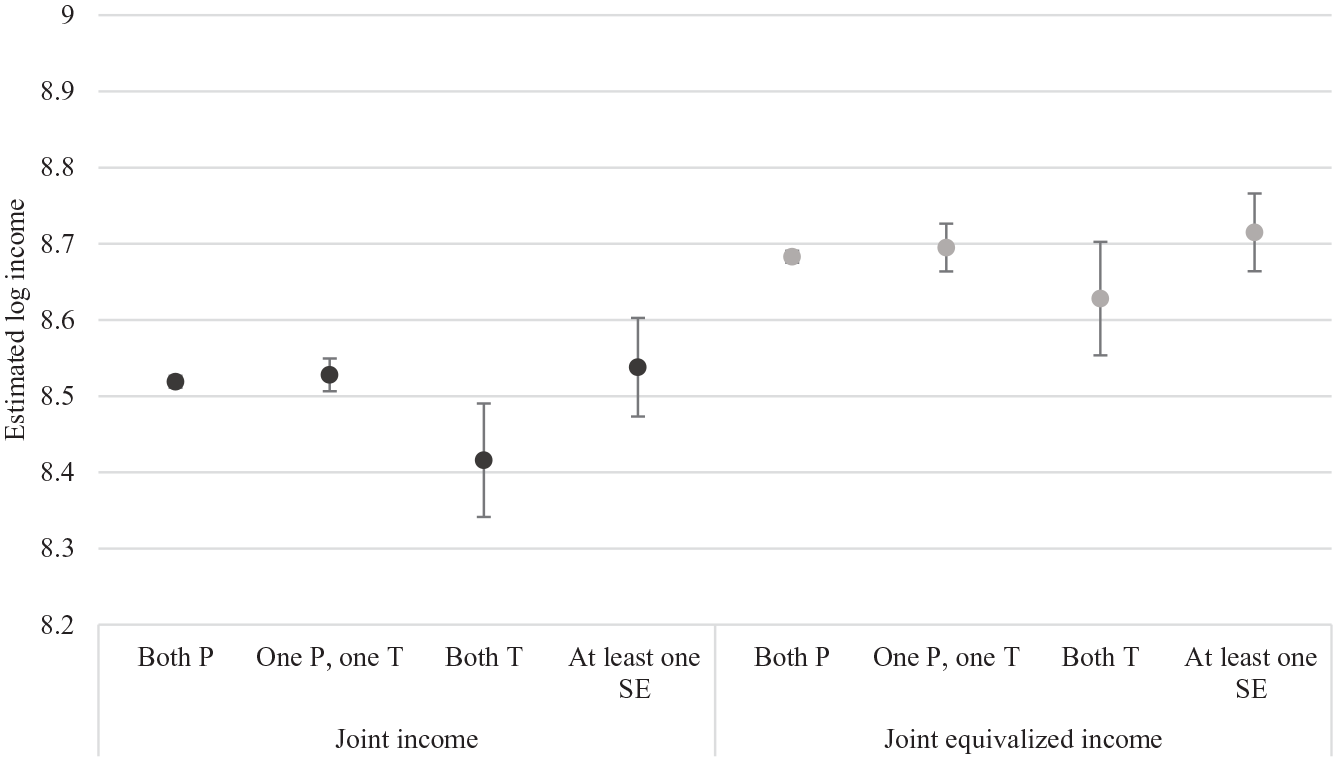
Estimated log income by couple temporary employment composition, regression on joint labour income and equivalized labour income.
In the unadjusted model, there is no significant difference in joint labour income between couples where one partner is in temporary employment and those where both are in permanent employment. In contrast, the coefficient on both partners being in temporary employment is −0.126, corresponding to an 11.8% difference in labour income relative to couples where both partners are permanently employed. 15 When including controls, the coefficient size decreases, but the coefficient remains significant and substantially large. Turning to the results on equivalized income (i.e. adjusted for working hours), the coefficient on dual-temporary employment becomes smaller and is only statistically significant at a significance level of 10%. When including controls, the coefficient further decreases in size and becomes statistically insignificant.
Overall, results are partially in line with the theoretical expectations. Contrary to H1a, relative to dual-permanent couples, no income disadvantage is identified for couples where one partner works in temporary employment. However, for dual-temporary couples, there is evidence of income disadvantages relative to other couples, in accordance with H1b. One potential explanation for the results for couples with one temporarily employed partner is that the labour market disadvantage associated with temporary employment may not apply universally. Going back to the labour market segmentation framework, mobile temporary workers exist in both the primary and the secondary labour market segments, and for some temporary workers job mobility and turnover could be associated with higher status, pay and career advancement (Piore, 1975). These workers, employed in professional and managerial occupations, can be characterized as located in an ‘upper tier’ of the primary segment, where highly mobile workers have higher bargaining power and do not face income disadvantages (Piore, 1975).
It is possible that temporary workers experiencing different degrees of labour market disadvantage select into different types of couples. For instance, descriptive statistics on the distribution of occupational status (measured by the International Socio-Economic Index of Occupational Status (ISEI)) in the population show that temporary workers with a partner in permanent employment are most commonly located in the middle third of the distribution of occupational status (36.6%). In comparison, temporary workers with a partner who is also in temporary employment are more likely to be located in the bottom third of the occupational status distribution (37.3% versus 33%), but also at the top (37.6% versus 30.3%). In this sense, temporary work is polarized, and dual-temporary work is located in both advantageous and disadvantageous labour market positions. This could indicate that the income disadvantages associated with dual-temporary work are driven by the portion of dual-temporary couples located in the external labour market with low occupational status. In contrast, temporary workers with a permanently employed partner do not appear to be disproportionately located in particularly disadvantageous labour market positions, which could explain the lack of significant income disadvantages.
Moreover, the results on equivalized income suggest that the income disadvantages associated with dual-temporary work are, to a large extent, driven by differences in working hours. Put differently, not all dual-temporary couples are necessarily in jobs that are inherently lower paid on an hourly basis, consistent with the evidence on the polarized occupational status of temporary workers with partners in temporary employment. Nevertheless, the fact that, on average, dual-temporary couples face a substantial income penalty on an absolute level points to significant labour market disadvantage for these couples. This is in line with the theoretical framework, where the presence of dual-temporary work is associated with an accumulation of disadvantage in couples and corresponding income penalties relative to other couples.
Analogous to Table 2, Table 3 shows the regression coefficients on part-time employment in couples, and Figure 2 shows the estimated income based on the adjusted model. Looking at absolute labour income, there are significant negative income effects when one partner (coefficient −0.059, corresponding to a 5.7% difference in joint labour income) or, particularly, both partners (coefficient −0.162, corresponding to a 15% difference in joint labour income) work part-time in the unadjusted model, and these do not change substantially when including controls.
Results of the fixed-effects regression on couple income and equivalized income, with couple part-time employment as the key explanatory variable.

Notes: 95% confidence intervals in parentheses. Standard errors clustered at primary sampling unit level. **p < 0.01, *p < 0.05, ^p < 0.1. All models include fixed effects for the survey year. Models with controls include the average age of the couple, education, couple’s unemployment experience, work in a small firm, both partners’ industry, living in East Germany and temporary employment as controls.
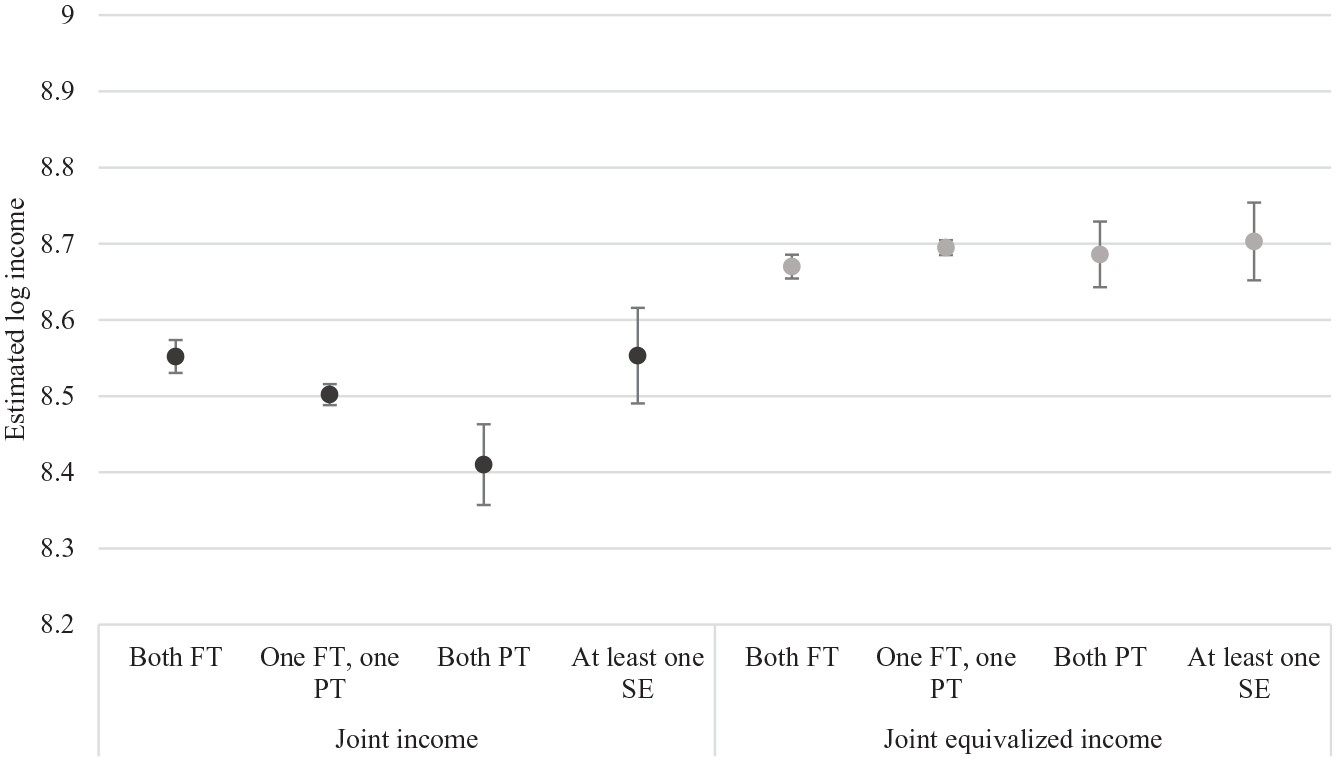
Estimated log income by couple part-time employment composition, regression on joint labour income and equivalized labour income.
However, no significant difference remains when looking at equivalized income. In fact, for couples with one partner working part-time, a small income premium is observed in the adjusted model. As such, the income disadvantage associated with part-time work in couples is driven by lower working hours, not by the fact that part-time workers are inherently lower paid. The patterns observed for couples with one partner in part-time work align with H2a and the theory set out, where one partner working part-time within a couple tends to be part of household specialization strategies, rather than being indicative of work in the external labour market. However, contrary to H2b, dual part-time work is not associated with income disadvantages.
To investigate these results in more detail, an additional analysis distinguishes between constellations of substantial and marginal part-time employment in couples (Table 4 and Figure 3). 16 The results showcase a nuanced picture. All forms of part-time work in couples are associated with absolute income disadvantages, but to substantially different extents. The absolute income penalty is relatively smaller when one partner works full-time, both where the other partner is in substantial part-time work (4.6% difference in labour income) or in marginal part-time work (6.8% difference in labour income, significant at 10%). In contrast, the penalty relative to dual full-time couples is much larger where both partners are in substantial part-time employment (14.2% difference in labour income) or, particularly, where both partners work part-time, with at least one in marginal part-time work (35.8% difference in labour income). In most cases, when adjusting for working hours, these penalties disappear or even become slightly positive, as in the case of one partner in substantial part-time employment. The exception is the case of both partners working part-time, with at least one in marginal part-time employment. Here, a statistically significant and substantial penalty (16.7%) on equivalized labour income remains.
Results of the fixed-effects regression on couple income and equivalized income, with couple part-time employment as the key explanatory variable, and distinction between substantial and marginal part-time employment.

Notes: 95% confidence intervals in parentheses. Standard errors clustered at primary sampling unit level. **p < 0.01, *p < 0.05, ^p < 0.1. All models include fixed effects for the survey year. Models with controls include the average age of the couple, education, couple’s unemployment experience, work in a small firm, both partners’ industry, living in East Germany and temporary employment as controls.
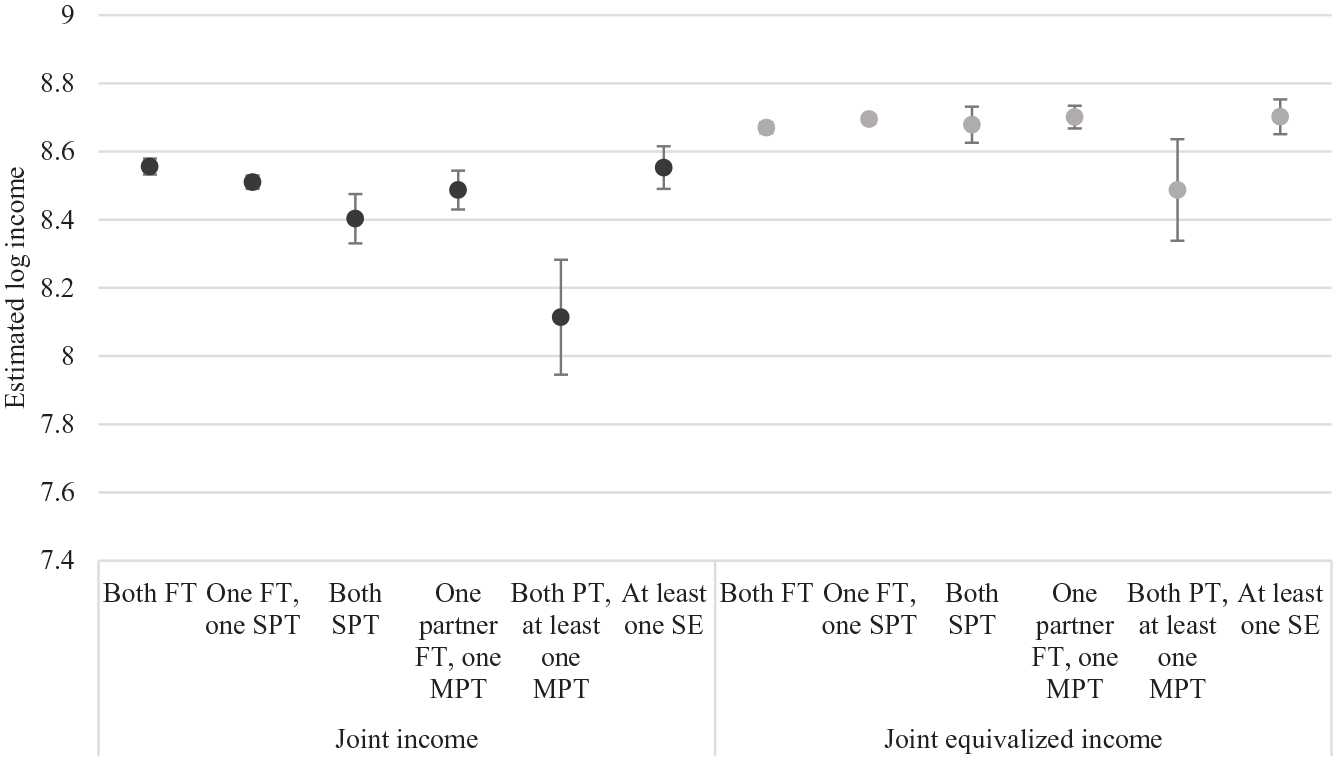
Estimated log income by couple part-time employment composition and type of part-time work, regression on joint labour income and equivalized labour income.
As such, the results are partially consistent with H3. Where one partner works part-time, no substantial labour income disadvantages for couples, net of working hours, emerge. The expectation that one partner working part-time is part of household specialization patterns, and not inherently associated with an inferior labour market position, appears to apply even where that partner is in marginal part-time work. Furthermore, the disadvantage associated with dual part-time work varies, which lends nuance to the results observed above. A substantial disadvantage applies only for dual part-time couples with at least one partner in marginal part-time work. The pattern observed for this group is in line with the theoretical expectation developed, where dual part-time work in couples is located in the secondary labour market and associated with an accumulation of disadvantages within these couples. However, couples where both partners are in substantial part-time work do not face the same income disadvantages; rather, these couples appear to be in retention part-time jobs in the primary labour market, with no income penalties relative to full-time couples, net of working hours.
However, while the results on equivalized income suggest that the disadvantage associated with part-time work disappears in most cases when adjusting for working hours, this does not imply that part-time work is not disadvantageous for couples. Clearly, in absolute terms, working part-time is associated with material disadvantages. This may be a particular concern if individuals would in fact like to work longer hours. Data on working hours in the SOEP can be compared with data on preferred working hours. Of all female part-time workers in dual-earner couples, 42.4% would like to increase their working hours, while this is the case for 58.9% of male part-time workers. Moreover, 10.6% of female part-time workers and 31% of male part-time workers would like to increase their hours by 10 hours or more. Hence, low working hours are in fact not voluntary for a substantial proportion of part-time workers, particularly for men.
Finally, the theoretical discussion highlighted that the effect of atypical employment on couples’ labour income could be gendered. Table 5 shows the estimated regression coefficients on couples’ temporary employment, distinguishing between whether the male or female partner is in temporary employment, while Figure 4 shows estimated log income based on the model. 17 The male partner being in temporary employment is associated with a negative, though statistically insignificant effect on couple joint labour income, whereas when the female partner is in temporary employment, there is a small positive effect. Adjusting for working hours, the male partner being in temporary employment is associated with a lower couple labour income (4.4% difference) relative to both partners being permanently employed, while there is a positive coefficient (3.3% difference, significant at 10% level) on female temporary employment. The difference between the coefficients on the male and female partner is statistically significant in both models.
Results of the fixed-effects regression on couple income and equivalized income, with gendered couple temporary employment as the key explanatory variable.

Notes: 95% confidence intervals in parentheses. Standard errors clustered at primary sampling unit level. **p < 0.01, *p < 0.05, ^p < 0.1. All models include a fixed effects for the survey year. Models with controls include the average age of the couple, education, couple’s unemployment experience, work in a small firm, both partners’ industry, living in East Germany and part-time employment as controls.
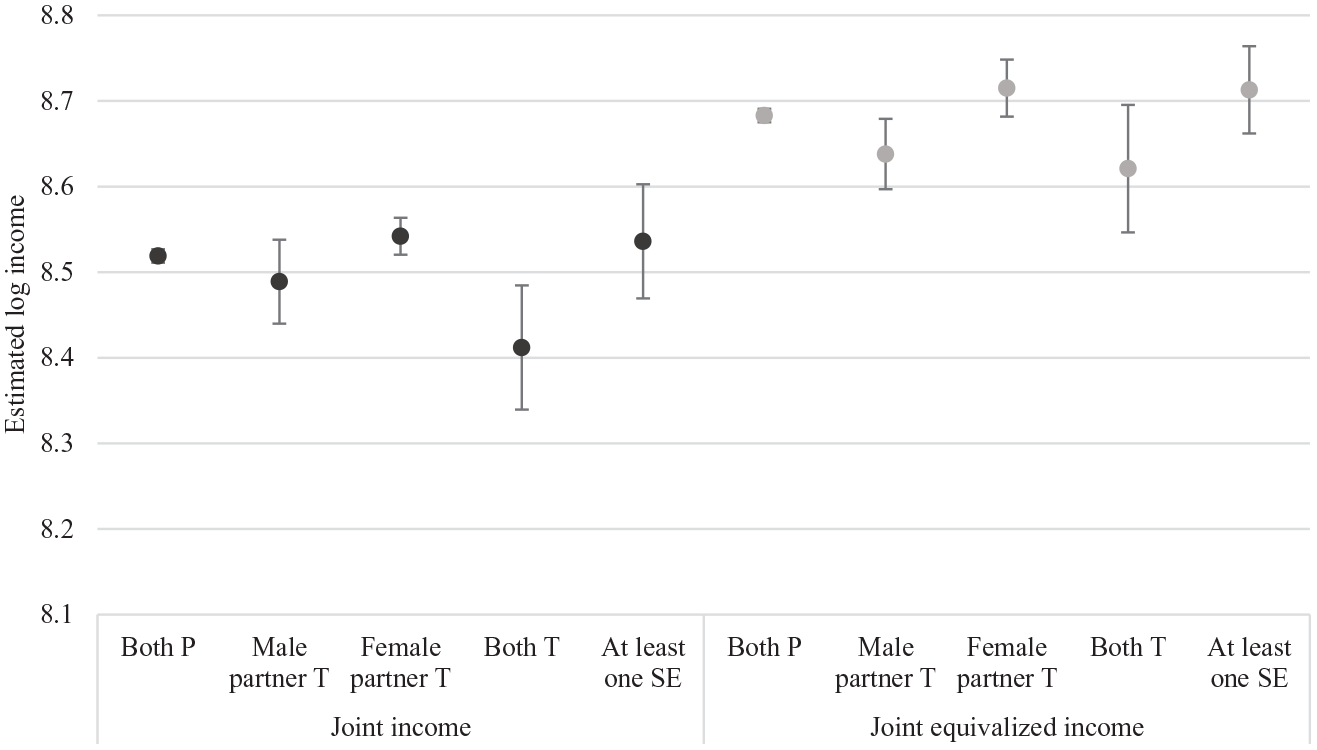
Estimated log income by couple temporary employment composition and gender, regression on joint labour income and equivalized labour income.
Similarly, Table 6 and Figure 5 show the results from regressions on part-time employment within couples by gender. As for temporary employment, there are indications that the male partner being atypically employed is more disadvantageous. The absolute income penalty on couples’ labour income associated with male part-time work (7.2%, significant at 10% level) is more than 1.5 times that associated with female part-time work (4.7%). For both genders, looking at equivalized income, no statistically significant income penalty is observed. In fact, when the female partner is in part-time employment, a small income benefit for the couple’s equivalized income is observed (3.1%). The difference between the coefficients for male and female part-time employment is statistically significant only in the model on equivalized income (at 10%) due to large variation in the coefficient on male part-time employment. Nevertheless, the result is still substantively meaningful.
Results of the fixed-effects regression on couple income and equivalized income, with gendered couple part-time employment as the key explanatory variable.

Notes: 95% confidence intervals in parentheses. Standard errors clustered at primary sampling unit level. **p < 0.01, *p < 0.05, ^p < 0.1. All models include fixed effects for the survey year. Models with controls include the average age of the couple, education, couple’s unemployment experience, work in a small firm, both partners’ industry, living in East Germany and temporary employment as controls.
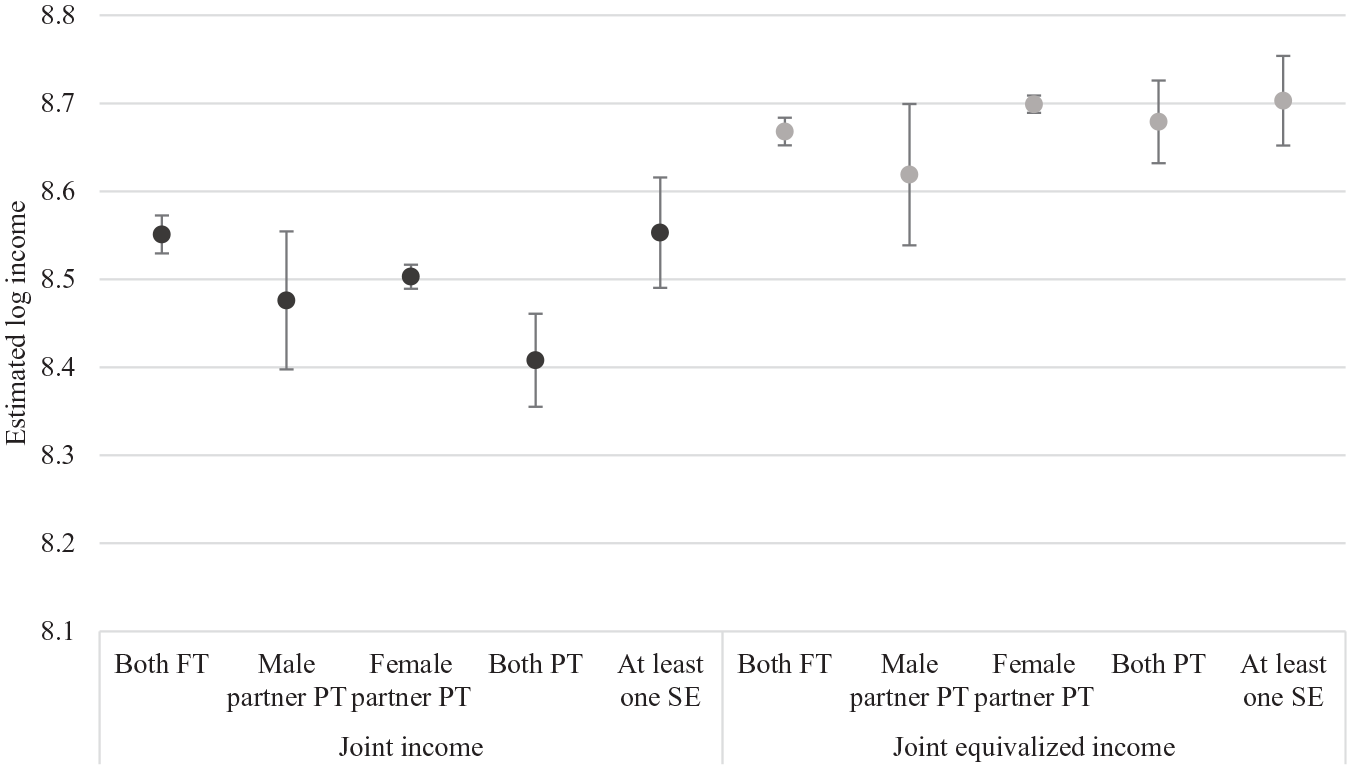
Estimated log income by couple temporary part-time composition and gender, regression on joint labour income and equivalized labour income.
Overall, the results confirm the expectation that male atypical work has more negative consequences for the couple’s income than female atypical work (H4a). Contrary to H4b, however, this effect is not more pronounced for part-time work than for temporary employment. The finding that male part-time work is associated with greater disadvantage than female part-time work reflects the fact that, as argued in the theoretical framework, part-time work is strongly gendered and the female partner may work part-time as part of household specialization strategies when couples can afford this. For men, part-time work is more likely to be reflective of disadvantaged employment in the secondary labour market. The result is also consistent with the earlier observation that a large proportion of male part-time workers would like to increase their hours. The analysis further suggests that there is a gendered dimension to the income consequences of temporary work in couples. This may be reflective of the fact that temporary work, as argued earlier, is somewhat more likely to be associated with labour market disadvantage for men than for women. However, it is also possible that temporary work plays a role in household specialization strategies of couples.
Discussion and conclusion
The previous literature on labour market effects of atypical employment has largely focused on its socio-economic impact on individuals (e.g. Fauser and Gebel, 2023; Kahn, 2016; Matteazzi et al., 2014). Yet to fully understand the implications of atypical employment, the household context needs to be taken into account (Horemans, 2016). This article contributes to existing scholarship by providing such a household perspective, through a novel account of the income implications of part-time and temporary employment for couples.
The article builds a theoretical framework that can be used to understand the labour market disadvantage associated with atypical employment at couple level. To this end, it integrates expectations on individual disadvantage associated with atypical employment based on labour market segmentation theory with perspectives on partner effects on labour market outcomes. This allows for the derivation of differentiated hypotheses on the impact of atypical employment on couple income depending on the type of atypical employment and its role within the household context, notably whether it is part of household specialization strategies. Using longitudinal data from the SOEP, the article then examines how different constellations of temporary and part-time employment in couples influence couples’ labour income, in absolute terms and net of working hours.
The analysis finds no evidence that couples with one partner in temporary employment face income disadvantages relative to those where both are permanently employed. Some empirical contributions have emphasized that the disadvantage associated with temporary employment varies among workers (Mertens et al., 2007; Westhoff, 2022), reflecting the heterogeneity between mobile and non-mobile workers within the primary labour market segment as highlighted by Piore (1975). Where temporary employees partner up with someone in permanent employment, at the level of the couple, labour market disadvantage appears to be limited. In contrast, for dual-temporary couples, a substantial income disadvantage is observed, which is largely accounted for by adjusting for working hours. These results support the theory set out, that where both partners are in temporary employment, an accumulation of disadvantage within the couple occurs. They also complement insights from recent research by Fauser and Scheuring (2022), showing that German couples where both partners have experienced insecure employment trajectories are substantially less likely to own a home.
One partner, and particularly both partners, working in part-time employment is associated with significantly lower absolute joint labour income relative to dual full-time couples. However, adjusting for working hours, this disadvantage disappears. That is, the income disadvantage associated with part-time employment in couples is attributable to the reduced working hours associated with it, rather than those part-time jobs being inherently lower paid. These results reflect the fact that in European labour markets, part-time work is a largely well-protected form of employment that is often of relatively high quality and not necessarily associated with work in the external labour market or hourly wage penalties (Barbieri, 2009).
However, the analysis reveals nuances in these patterns by examining distinctions between marginal and substantial part-time employment, previously found to be significant in the German context at individual level (Paul, 2016) and argued to reflect differences between retention and secondary part-time work (Tilly, 1996). Couples where one partner works full-time – no matter if the other partner is in substantial or marginal part-time work – do not face income disadvantages net of working hours. These patterns align with household specialization theory, where the partner working full-time compensates for any disadvantages associated with part-time work – even if such part-time work is marginal. Within dual part-time couples, substantial income disadvantages, adjusted for working hours, only occur where at least one partner is in marginal part-time work. Previous work on patterns of dual part-time work has shown that it occurs at the extremes of the income distribution, within both low-earning and high-earning couples (Westhoff, 2024). The results add to these findings by showing which types of dual part-time work incur labour market disadvantage. Dual substantial part-time work is not associated with labour market disadvantage and may be taken up by couples who can afford it. In contrast, couples in marginal-substantial part-time work are arguably part of the external labour market in secondary forms of part-time work, with substantial labour market and income disadvantages.
Furthermore, the analysis examines gender differences in these patterns. For both temporary and part-time work, there are indications that atypical employment is associated with more significant income disadvantages when the male partner is atypically employed. This supports the theory developed that male part-time work in couples is more reflective of labour market disadvantage, whereas female part-time work may more often be associated with household specialization strategies. Temporary employment similarly appears to have a gendered dimension. Previous research has found links between household context, including children and partner characteristics, and temporary employment of German women (Dieckhoff et al., 2020). This article extends these findings by showing that the income disadvantages associated with temporary employment within couples are gendered, pointing to a potential role of not only part-time, but also temporary employment, in household specialization.
Overall, this article furthers the theoretical and empirical understanding of atypical employment. It builds an integrated theoretical framework examining the income consequences of atypical employment, which considers both the individual-level disadvantage associated with atypical employment and the effects of partners on labour market outcomes. Thereby, it shows that labour market disadvantage associated with atypical employment is not equally distributed across couples. Rather, disadvantage is observed for specific constellations of atypical employment – such as dual-temporary work and dual part-time work with low hours – within couples, which likely reflects the position of these couples in the secondary labour market. At the same time, other constellations of atypical employment – such as one partner working part-time – reflect the gendered division of labour within couples and the part of household specialization strategies. These findings therefore add to previous individual-level results demonstrating that the effects of atypical employment are heterogeneous not only across, but also within these forms of employment (Nightingale, 2019; Tõnurist and Pavlopoulos, 2013; Westhoff, 2022). More broadly, the article shows that to fully capture the socio-economic consequences of atypical employment in sociological theory and research, the household context needs to be taken into account.
However, this analysis could be extended in several ways. First, previous research suggests that at individual level, occupation is a key factor influencing the disadvantage associated with atypical work (Westhoff, 2022). The role of occupation should also be investigated at couple level; for instance, in driving disadvantages associated with dual atypical work. Second, this article does not consider measures of cumulative couple income, which would allow for a dynamic perspective on accumulation of disadvantages in couples (Fauser, 2020). Third, a broader household-level analysis could include single individuals and single-earner households in atypical employment, who may be in a particularly precarious economic situation. Finally, sources of household income beyond gross labour income should be considered. In particular, welfare state policies could play a significant role in mitigating against disadvantages associated with specific types of atypical employment. This task is left to future research.
Supplemental Material
sj-docx-1-wes-10.1177_09500170251317435 – Supplemental material for Constellations of Atypical Employment in Couples and Labour Income: Where is Disadvantage Located?
Supplemental material, sj-docx-1-wes-10.1177_09500170251317435 for Constellations of Atypical Employment in Couples and Labour Income: Where is Disadvantage Located? by Leonie Westhoff in Work, Employment and Society
Footnotes
Acknowledgements
I would like to thank Erzsébet Bukodi, Inga Steinberg, Brian Nolan and Martina Dieckhoff, as well as the editor and the anonymous reviewers, for helpful comments on this article.
Funding
The author disclosed receipt of the following financial support for the research, authorship, and/or publication of this article: This research was supported by the UK Economic and Social Research Council, the University of Oxford Clarendon Fund and Nuffield College, Oxford.

Supplemental material
Supplemental material for this article is available online.
Notes
References
Supplementary Material
Please find the following supplemental material available below.
For Open Access articles published under a Creative Commons License, all supplemental material carries the same license as the article it is associated with.
For non-Open Access articles published, all supplemental material carries a non-exclusive license, and permission requests for re-use of supplemental material or any part of supplemental material shall be sent directly to the copyright owner as specified in the copyright notice associated with the article.
