




Abstract
The ideal worker concept, typified by an unencumbered male, continues to influence workplace norms, despite a more gender-mixed workforce. This article examines whether this concept is being disrupted or reproduced as digitalisation becomes increasingly embedded in the workplace. Based on qualitative research in two professional services firms, the analysis shows how the ideal worker themes of work prioritisation and presenteeism have been maintained but adapted. Significantly, the study reveals how the novel dimension of connectedness is reshaping the ideal worker norm as enhanced digitalisation becomes interwoven in social relations. This has modified informal expectations about how, when and where work is performed, altering work organisation. This reconfiguration may in principle broaden scope for conformity with the ideal worker model, but in practice the heightened intrusion of work demands on personal time and into domestic space potentially works against gender equality.
Keywords
Introduction
Acker’s (1990) concept of the ideal worker has been influential in revealing how the white-collar workplace has been constructed around a full-time dedicated employee who is exempt from social reproduction responsibilities. In the context of changing labour markets, this conceptualisation is misaligned with everyday realities, yet it continues to reflect a gendered, racialised and classed division of labour (Acker, 1990; Davies and Frink, 2014). The ideal worker is embedded within organisations that are described as ‘inequality regimes’ whereby ‘loosely interrelated practices, processes, actions, and meanings’ reproduce complex inequalities (Acker, 2006: 443). Success at work is defined by ideal worker characteristics, as those who conform are rewarded with progression and remuneration, while others are excluded (Davies and Frink, 2014; Lott and Abendroth, 2020; Neely, 2020; Reid, 2015; Williams, 2001). Certain attributes become valorised over time and an unofficial ideal worker norm emerges, creating expectations that become implicit in organisational practices, operating as a type of ‘unobtrusive control’ (Putnam et al., 2014). Both women and men are expected to comply, and men are more likely to do so successfully because work is organised around presumptions that workers are unencumbered with caring responsibilities (Acker, 1990, 2006). Employees who struggle to conform become marginalised and face additional pressure to prove themselves (Poorhosseinzadeh and Strachan, 2021). However, the rise of dual-earner families, alongside pressures on fathers to take on more parenting responsibilities (Gatrell et al., 2022), may challenge gender stereotypes.
Now that women’s employment in white collar and professional jobs has increased, researchers interested in why the masculinised ideal worker norm persists (Brumley, 2014; Davies and Frink, 2014; Kelly et al., 2010; Reid, 2015) have examined how changes in organisational practice have failed to modify these norms (Al-Asfahani et al., 2024). Of particular interest is whether the adoption of family-friendly policies by employers challenge traditional conceptions of the ideal worker as exempt from domestic responsibilities. The extent to which such changes have delivered greater equality remains questionable as adjustments by employers often serve performance-enhancing goals (Chung, 2022) and are primarily confined to placing women workers with care commitments in a different category. It is argued that employers adopt either a segmentation approach (separating personal and work domains) or an integration approach (allowing home and work to overlap), depending on how they perceive employees will be best placed to devote themselves to work (Dumas and Sanchez-Burks, 2015; Kelly et al., 2010). Workplace change that ostensibly reduces inequalities may, in practice, augment ideal worker norms. Although alternative ideal worker norms have developed in relation to specific social and work contexts, these are often based on different types of worker stereotypes (e.g. Neely, 2020; Poorhosseinzadeh and Strachan, 2021; Sang et al., 2015). As Acker (2006) observes, these other ideal types include female or migrant labour who employers believe are willing to accept low pay (for the skills required), limited progression and, in some cases, irregular hours. Moreover, even within predominately feminised white-collar work, the masculinised ideal worker norm re-emerges to influence who can move up the ‘glass escalator’ to management, providing accelerated opportunities for the few men or for women who ‘manage like a man’ (Wajcman, 2013).
Tienari et al. (2002) suggest that the ways in which the ideal worker adapts requires research, since this may have significance for inclusivity. Therefore, this article aims to examine whether the concept of the white-collar ideal worker is being disrupted or reproduced in the context of digitalisation. New technologies are deeply embedded in organisational activities, creating qualitatively different work practices and reconfiguring old ones (Aroles et al., 2021; Bailey et al., 2022; Chesley, 2014; Wajcman and Rose, 2011), yet how this influences the ideal worker is under-explored. Concurrently, the experience of work–home segmentation, previously seen as a privilege of the unencumbered male, is being eroded as digital connectivity brings work into the home (Derks et al., 2016; Gregg, 2013). These processes of cumulative change among white-collar workers have been accelerated by the Covid-19 pandemic, resulting in a range of new technologies being rapidly implemented. When evacuating the workplace became a policy instrument, digitalised working practices supported the significant expansion of white-collar hybrid workers (Felstead, 2022). Therefore, it seems apposite to ask if the ideal worker concept as applied to white-collar professional work is being reshaped by digitalisation. To address this question, the next section analyses literature from distinct research areas, making connections between the embeddedness of digitalisation in contemporary workplaces and the enactment of ideal worker characteristics. Then, the article details the qualitative research conducted among two professional service firms (PSFs), which epitomise ideal worker norms (Al-Asfahani et al., 2024). These were selected because the rising use of digital technology is especially prominent among higher-skilled professional occupations (Chung, 2022; Green, 2004; Mullan and Wajcman, 2019). The analysis follows, which is based on the themes of work prioritisation, presenteeism and connectedness. Finally, the contribution is presented; this shows how intensified digitalisation (triggered by mandated homeworking) challenges ideal worker norms. The characteristics of work prioritisation and presenteeism became outmoded and were reformulated accordingly. Concurrently, the increasingly embedded nature of connectedness in work practices, identified in this study as a novel dimension of the ideal worker model, plays a crucial role in reshaping work relations and organisation. This has implications for the gendered nature of the ideal worker as informal expectations about how, when and where work is performed are modified. This broadens access to conformity to the ideal worker norm, but the effects may be detrimental for gender equality as the intrusion of work into private space is heightened.
The ideal worker and digitalisation
This section examines extant literature on the ideal worker and forges connections with research on digitalisation. The intention is to highlight how the traditional characteristics associated with the white-collar ideal worker feature, albeit in modified form, in the context of post-lockdown digitalised workplaces. Aside from the literature on platforms, research on digitalisation at work tends to cluster around a particular technology and analyses its impact on specific dimensions, such as email use and stress (Barley et al., 2011), smartphones and control/autonomy (Mazmanian et al., 2013), warehousing systems and ‘computer control’ (Elliott and Long, 2016) and mobile phones and work–family boundaries (Derks et al., 2016). Yet, digitalisation is broader in scope and encompasses the ways in which working life is organised through and around digital technologies (Leonardi and Treem, 2020), including developments such as distributed and flexible work, automation, data analytics and advanced communication channels.
It is well-established by sociologists of technology that technology is not an independent force that has impact but a product of human action (Wajcman, 2006; Winner, 1985). Rather than view technologies as stand-alone objects around which work occurs, we conceptualise technology as shaping the social and, reciprocally, the social shaping technology (MacKenzie and Wajcman, 1985), as each evolves in relation to the other. As Barley (2020: 26) explains, rejecting determinism does not mean rejecting materialism, which holds that our actions are shaped by physical contexts. The ways in which digital technologies enable or constrain production are contingent upon the material properties of the technology itself, the data sets employed, the rules and norms that govern usage, and the nature of workforce interaction in a dynamic network of relations (Bailey et al., 2022).
Turning to the ideal worker, fundamental to its conceptualisation is work prioritisation, based on the premise that work should ultimately be privileged over other roles (Acker, 1990; Cha and Weeden, 2014). In their history of the gendered division of work and home in the US, Davies and Frink (2014) analysed how male workers prioritise work through uninterrupted periods in the office, separated from home. Men experience a demarcation of the working day, made possible by the unpaid labour of others in the domestic sphere. Having the capacity to prioritise work demands commitment (Reid, 2015), often epitomised as ‘love of the job’ or dedication to the organisation (Neely, 2020). Ideal workers are expected to demonstrate their commitment to work by relocating or travelling at short notice (Kelly et al., 2010), which includes commuting between sites and to client organisations. This marker of work prioritisation was challenged during the pandemic when travel activities were substituted by videoconferencing tools such as Teams, Webex and Zoom. As workers return to the office, the balance between in-person and online interactions continues to evolve.
Research shows how ‘continuous and compulsive connectivity’ (Mazmanian et al., 2013: 1338), which facilitates informational and/or social exchange (Kolb et al., 2020; Leonardi and Treem, 2020), intensifies displays of commitment while merging work and non-work time. Out-of-hours contact reinforces the ideal worker as someone who does not have to attend to domestic responsibilities and has the capacity to prioritise work (Kelly et al., 2010; Reid, 2015). The portability and interconnectivity of technology have reduced requirements for fixed place-based work activities, but with this greater fluidity comes the risk of them becoming more intrusive (Felstead, 2022). Work intrusion into private space becomes a ‘double edged sword’ (Gregg, 2013), enabling workers to be present in the office and then continue working from home, raising productivity potential (Green, 2004). Women have been less able to commit to out-of-hours activities in workplaces due to limited scope to expand their hours because of domestic commitments. Research shows that during the pandemic, workers, on average, worked for longer given the blurred boundaries between home and work (Felstead, 2022). This especially affected women when full-time childcare was suspended, resulting in an extended working day (Chung, 2022).
The potentially negative fallout from enhanced connectivity informs various initiatives around the ‘right to disconnect’. Such policies intend to provide ‘temporal distancing’ (Mazmanian et al., 2013), yet connectivity pressures persist for those who wish to be perceived as career-oriented. Despite the purported benefits of disconnection outside working hours (Newport, 2019), the imposition of temporal parameters that segment work and home may not suit carers who prefer to self-determine their working hours around fluctuating domestic demands. In some cases, flexibility – as opposed to fixed boundaries – facilitates women’s labour market participation and reduces barriers to access (Chung, 2022). Many employees experience both segmentation and integration of their work and non-work roles on a recurring basis (Kossek, 2016). For example, research shows how part-time women workers with childcare commitments favour blurred work–home boundaries, as regular ‘checking in’ ameliorates the effects of feeling overwhelmed by work (Young, 2018).
The ideal worker is epitomised as an employee that is constantly present at the work site and willing to commit to long hours (Lott and Abendroth, 2020). Presenteeism in the form of putting in ‘face time’ (Wynn, 2018) symbolises work prioritisation (Knani et al., 2018) and means that workers are on display to the scrutiny of others (Felstead, 2022). However, presenteeism has been upended during the pandemic as white-collar workers are no longer tethered to the office. The features of new technologies have the potential to redefine the ways in which work commitment is physically presented, as connectivity intensifies (Kolb et al., 2020). Long hours office presenteeism can also be evidenced using online visibility (Leonardi and Treem, 2020), which enables both one’s own presence – and that of others – to become digitally visible and recorded (Leonardi, 2021).
As Chesley (2014) states, new technologies make some tasks easier but may also increase demands. Connectivity that involves regularly checking messages outside contracted hours can create invisible work that manifests as ‘never truly off’ (Beckman and Mazmanian, 2020: 100). Research by Barley et al. (2011) showed how continuously attending to e-mail creates a sense of coping with workload, even though it simultaneously generates overload. A study of knowledge workers demonstrated that they did not perceive connectivity as a distraction, but as an essential part of work, which reflects organisational culture and employee perceptions of their work function (Wajcman and Rose, 2011). Nevertheless, there are hidden costs associated with maintaining a ‘partial presence’ (Gregg, 2013), as checking messages can be tied to work-related stress (Mullan and Wajcman, 2019). Also, while new technologies may increase family connections and interactions during the working day, on the flip side the ease of switching between work and one’s personal life can lead to fragmentation (Beckman and Mazmanian, 2020; Kossek, 2016).
Research by Østerud (2023) on disabled workers extends the ideal worker concept to include social integration. From an employer’s perspective, a collegial environment can increase time being devoted to work, as workers make personal sacrifices when necessary (Gregg, 2013). Yet for those in the demographic minority, social integration can be more difficult, especially as within most organisations there are implicit beliefs about a prototypical member’s desired characteristics based on identities such as gender, race or family status (Dumas and Sanchez-Burks, 2015). For example, research shows that integration is less likely among those who are demographically dissimilar to their co-workers, particularly when relationships span racial boundaries (Dumas et al., 2013). Social integration is also visibly evidenced with networking activities, which signify engagement and ambition (Brumley, 2014), yet tend to occur out of hours. Advancement is predicated on networking (Poorhosseinzadeh and Strachan, 2021). These opportunities are assumed to be equally available to men and women, yet those with caring responsibilities may be disadvantaged. During the pandemic, face-to-face networking was replaced with online activities during working hours. This digital alternative is ostensibly more inclusive but has been viewed as a poor substitute and is unlikely to be retained as workers return to the office.
To summarise, the characteristics of the ideal worker outlined above meld together, generating expectations, which are normalised and embedded in contemporary workplaces. Research on new technologies shows how digitalised practices challenge traditional forms of work relations and organisation. However, the ways in which digitalisation has the potential to reshape the ideal worker norm is under-researched.
Research design
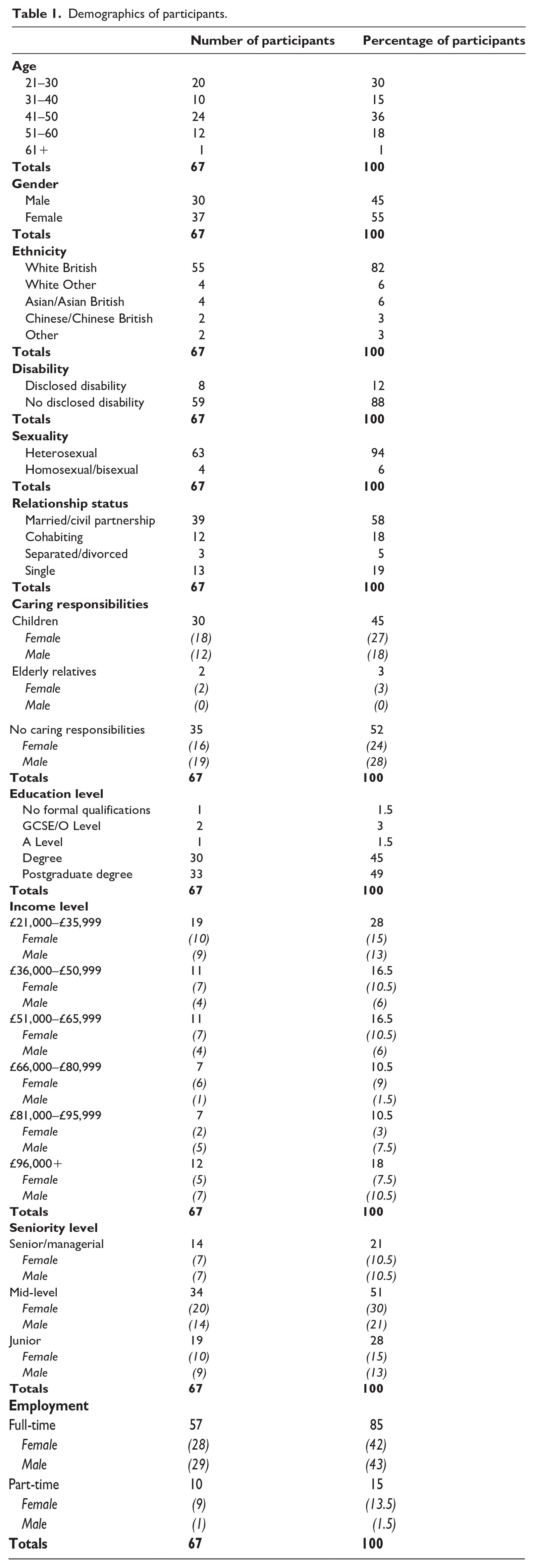
The study adopted a qualitative approach and focused on two PSFs in distinct sectors. A total of 67 respondents were interviewed, 35 from a national law firm (LawCo) and 32 from a multinational technology provider (TechCo). These digitalised organisations share similarities that are typified by ideal worker norms such as overwork, constant availability, presenteeism, extensive travel requirements and unpredictability (Barrett, 2005; Bolton and Muzio, 2008). There are gender differences between sectors, with law becoming increasingly feminised, while women remain under-represented in the technology sector. These differentials were reflected in the profile of the research participants: 66% female and 34% male at LawCo; 44% female and 56% male at TechCo. Ethnic minority groups are under-represented in both sectors, and this was also reflected in the sample composition. The study aimed for a range of participants across functional areas and job categories, from senior management through to interns/trainees/paralegals. This captured a variety of work practices and experiences of digitalisation. It is important to consider self-selection in any research study and this is especially relevant during the pandemic when some employees faced additional pressures, particularly regarding caring responsibilities (Chung, 2022). However, no specific issues were identified and the research participants roughly aligned with demographic representation in the organisations studied (Table 1).
Demographics of participants.
To progress beyond the tendency to research single technologies, the study investigated how research participants described their use of a diversity of technological devices and applications within both work and home, as usage of digital technologies for personal use has the capacity to influence work experiences (Chesley, 2014) and vice versa. The timing of the research coincided with the pandemic, which led both organisations to shift almost entirely to working at home, and necessitated an increasing reliance on digital technologies for everyday work processes as well as connections to work, colleagues and clients. Pre-pandemic, both companies primarily used email systems and Skype, but they responded to lockdown with the rapid implementation of new systems (e.g. digitalisation of paper documents, removal of ‘wet signatures’, remote court hearings, etc.) along with the adoption of new communication channels (e.g. MS Teams, Yammer, WhatsApp, MS365, Zoom).
The research phases
The context of lockdown provided the unique backdrop for the study and influenced the research design, given that face-to-face data collection was not possible. Research on the two companies was conducted in tandem; data collection occurred between March 2021 and September 2022 when employees were predominantly homeworking, with infrequent visits to the office. Each company used their communication channels to circulate a project information sheet, provided by the research team, inviting employees to participate. Those who granted consent were invited to complete an online questionnaire, providing details of demographics, personal circumstances, digital devices and applications, and their views on how technology was influencing their work and home lives. Data were captured using a combination of open-ended, multiple choice and ordinal scale questions. The questionnaire was used to gather sensitive data (e.g. pay, family circumstances), which was probed and elaborated in the subsequent stage. A semi-structured interview followed, which provided flexibility so that participants could introduce topics that they identified as important. Most interviews involved two researchers, lasted for around 90 minutes and were conducted online (MS Teams or Zoom). With participants’ ethical consent, interviews were recorded and transcribed. The semi-structured interview began by asking participants to detail their career history and plans. Next, experiences of digitalisation, remote working, working time, the organisation and practice of work, connectivity and work relationships were explored. This included accounts of experiences during lockdowns and in what ways these experiences were changing as people returned to the office. Additional interviews were conducted with HR representatives to identify company policies and culture – pre- and post-lockdown. Various company publications were analysed for further background information.
Data analysis
Two key data items were generated for each participant: a questionnaire and interview transcript. To ensure anonymity, each participant was assigned a unique identifier representing the organisation (Law/Tech), occupational level (A–G, with A denoting seniority), participant number and gender (F/M). The anonymised data were inputted to qualitative analysis software (NVivo) and the analysis began with an overall reading of the full data set by the research team. Analysis first focused on individual participant accounts, building up a picture of their experiences. The combined data informed a more holistic understanding of the organisations, including the implicit norms and narratives within which individuals operate, also extending the contextual understanding to significant events, notably enforced lockdown and the return to the office. 1
The coding process involved the researchers working through the data set incrementally, sharing critical reflections. This collaborative process began with coding individual descriptive accounts of activities and experiences (e.g. work location, travel, performance management). Next, interpretive categories (Mason, 2002) were developed, which reflected more abstracted interpretations of what could be inferred from the data based on interviewees’ understandings of how they made sense of social phenomena (e.g. visibility, accessibility, interruptions, digital overload). The categories were applied systematically across the whole data set and informed an iterative process of reflexive thematic analysis (Braun and Clarke, 2022) whereby the researchers engaged with the data (questionnaires, transcripts and company websites/publications), relating the analysis and interpretation to existing academic literature/theory; an approach that could best be described as abductive (Coffey and Atkinson, 1996). The intention was to forge understanding of individual participant narratives while moving towards an overall explanation. This process informed the focus on three overarching themes considered to underpin ideal worker norms within the context of digitalisation. The two themes of work prioritisation and presenteeism typify extant understanding of ideal worker norms. The third theme, which emerged during the analysis process, is connectedness, a concept that is well-established in organisational studies, but is absent from the ideal worker literature. Within these themes the team specifically looked for commonalities and differences, both between study participants, but also in terms of how the data built on, differed from or added complexity to established theoretical understandings.
Company 1: LawCo
LawCo is a UK company that can be categorised as a ‘large corporate’, in that they have significantly more fee earners than the average law firm, focus predominantly on commercial law and operate across multiple offices (Tomlinson et al., 2019). The legal profession is notorious for the persistence of inequalities (Pringle et al., 2017; Sommerlad et al., 2017), particularly in relation to gender, race and class. Within LawCo around two-thirds of staff are female, but inequalities are especially prominent at the senior level, with men comprising the majority of equity partners. Work is team-based and most employees are engaged in client-facing work, which traditionally requires client visits and working on client technology systems. Depending on the role, working time is dominated by billable hours, which are divided into 6-minute units. Employees are provided with a laptop, with additional devices (e.g. smartphones and tablets) allocated according to seniority. The company operates an informal ‘right to disconnect’ policy, which applies to sending email outside contracted hours. Just before lockdown, hybrid working was introduced, based on the expectation that legal professionals would work from home two days a week. This had limited adoption, largely because of the culture of presenteeism, but when lockdown was implemented, employees seamlessly transitioned to WAH. In 2022, senior partners strongly encouraged returning to the office for a minimum of two days per week.
Company 2: TechCo
TechCo is a multinational multi-service IT company, whose staff range from technical experts to business-focused consultants. High levels of mobility across departments and jobs mean that few employees live close to their team base, and long-distance commuting, to both company offices and client sites, is common and often combined with hybrid working. Sales is the most lucrative area, and this often requires working extreme hours in the run-up to deadlines. Other business areas are less pressured and do not necessarily require out-of-hours working, although some choose to connect. TechCo regards itself as offering an inclusive working environment and provides active support for gender, race, disability and LGBT equality but staff working part-time face challenges in progressing their careers. Women are under-represented in TechCo, tending to work in management or business-focused roles rather than as technical specialists. Despite hybrid working being common pre-pandemic, lockdown led to enhanced support for universal WAH with the removal of domestic and international travel requirements. Post-lockdown, most staff are encouraged to determine their preferences for office-based and home-based working, with the office used mainly for meetings, except for those with client responsibilities who have returned to on-site working when required.
Analysing digitalisation and the ideal worker
In this section, three themes are presented. The first two, work prioritisation and presenteeism, typically associated with ideal worker norms, are examined for potential adjustments in the context of digitalisation and hybrid working. Connectedness also emerged as a novel and important theme given the scale of workplace change. This theme has distinct characteristics but plays a key role in facilitating mutated forms of work prioritisation and presenteeism. Inevitably, the content of the themes overlap given the embeddedness of digitalisation in working practices.
Work prioritisation
Fundamental to the ideal worker norm is work prioritisation (Acker, 1990; Cha and Weeden, 2014), creating a clear dividing line between work and home commitments. Across both companies, the notion of an ideal worker being unencumbered by family obligations was confronted head-on during the WAH period, transforming work–home boundaries. Online meetings conducted within the home heightened awareness of domestic circumstances, contrasting with the perception of a disembodied ideal worker. During lockdown, although women bore the brunt of childcare, home-schooling and housework (Chung, 2022), several senior male participants described the benefits of spending more time at home, as described by this senior manager at TechCo:
IT-001-A-M: Previously it would be quite unusual for me to be at home for things like bath time and bedtime, quite practical things, but important moments. Now it’s extremely rare that I’m not here. [. . .] So, for both my children, I think I’ve become a fixture, which is great.
Work prioritisation is often associated with limited flexibility and clear boundaries between work and home activities (Chung, 2022), but when WAH, there was an overall sense that spatio-temporal autonomy had increased, enabling greater scope over when and where to engage in domestic and work activities. As work organisation became entirely digitalised, many valued the opportunity to operate in a way that was compatible with their individual preferences, although this differed for men and women given their domestic responsibilities. Some participants, in particular men, took advantage of the added flexibility to devote time to activities such as sports, while primary carers, generally women with divided commitments, were more likely to use the time to better juggle childcare. One female lawyer observed how she allocated part of the working day to care responsibilities:
LAW-023-E-F: If I want to finish at four and do something I can do an extra hour at night instead. So, I can split the working day across the whole day, rather than just the nine to five core hours. Which is better, certainly, as a parent.
While work prioritisation is often associated with loyalty to the employing organisation, our data showed that devotion to the client is paramount. The pandemic required both companies reconsider the operationalisation of face-to-face client contact, while maintaining the primacy of these relationships. This created additional demands for online accessibility as client interactions became entirely screen-based. Emphasising client prioritisation, rather than company demands, enabled the employer to maintain an image of being ‘good’ and ‘fair’, while external clients were sometimes depicted as ‘demanding’, shifting the origin of ideal worker expectations from the employer to the client. Regardless of family-friendly policies, many participants felt obligated to prioritise client needs and were therefore more likely to communicate with them out of hours. A TechCo service manager reported that workplace policies were largely adhered to ‘other than to meet the ask of the customer’ (IT-004-A-F). Flexibility was acceded on condition that work priorities were satisfactorily addressed.
Work prioritisation is often evidenced as willingness to relocate or travel when necessary (Kelly et al., 2010), yet during lockdown this physical marker of work primacy was largely eliminated. A common sentiment reported across both organisations concerned the benefits of the removal and subsequent reduction of travel requirements. The view that online meetings often sufficed remained as people returned to the office. Subsequently, some participants prioritised digital work demands as a trade-off for travel reduction, as a manager at TechCo reported:
IT-003-A-F: I’d rather be pinged on Teams at eight o’clock in the morning than be expected to be at the airport for six o’clock in the morning.
However, exchanging the downside of travel for increased digital connectivity contributed towards a shifting of norms regarding how and when work should be performed. An escalation in work prioritisation arose from the gradual shift in behaviour that emerged as workplace interactions became entirely screen-based. Several participants commented that work intruded into spaces previously deemed sacrosanct, providing evidence of work prioritisation during times when non-work roles were more salient, such as annual leave and sickness absence:
IT-013-E-F: Even when I’m on leave, in my out-of-office, I’ll say, if I’m not going anywhere, and I know that if somebody needs me, I can be available. LAW-035-G-M: Maybe you feel a bit sick or you’re unwell, you think, oh, you know what, I’ll just work from home today . . . because you’ve got your laptop, you just think, I’ll just log on in bed and I’ll do a few hours.
While expectations of work prioritisation differed according to seniority, as these quotes illustrate, junior colleagues experienced comparable pressures.
Presenteeism
The ideal worker is epitomised as being constantly present at the work site (Lott and Abendroth, 2020) with presenteeism demonstrating physical commitment to work. Although TechCo and LawCo had distinct approaches to hybrid working, lockdown served as a turning point that removed imaginary obstacles to WAH and the absence of a physical presence, as expressed by a technical consultant: ‘I think we’ve all realised that everything we thought we had to do before, we don’t need to’ (IT-035-G-F). Historically, wider occupational norms of presenteeism in the legal sector (Bolton and Muzio, 2008) were valued at LawCo, which one lawyer referred to as a ‘law firm mentality’ (LAW-021-E-F), but these expectations shifted during lockdown. In contrast, hybrid working was well established at TechCo, although an extended physical presence was presumed when project deadlines surfaced. Experiences of WAH and the concomitant increase in digitalisation, saw presenteeism take on new meaning. At LawCo, 60% of our participants reported that pressure for a digital presence had increased when WAH. This occurred despite the transparent quantification of productivity in the form of billable hours. At TechCo, the technological know-how of employees meant that they were sensitised to digital monitoring capabilities, and some adjusted their behaviour accordingly. Aware that the technology monitored and visibly flagged online activity, several participants engineered digital visibility mechanisms to signal presence and avoid being perceived as shirking:
IT-025-G-M: It’s almost like a thing, I’ve got to make sure I’m always green, and if I go orange, I’m worried. It’s like a bit of a stressor. But when I’m in the office, I don’t care about it at all. Because people know I’m in the office and no one can be slacking off. IT-017-E-F: When you’re at home, it’s like if my thing goes yellow, I get major anxiety, and I know I’m not the only one . . . subconsciously you feel like people are judging you or thinking you’re not working hard enough. It’s almost like sometimes when I’m working until midnight I will send emails with my manager cc-ed in just so he knows I’m working until midnight.
These comments from junior staff at TechCo point to the perception that an office presence intrinsically equates with being busy, regardless of the normalisation of hybrid working and the work/balance policy. When employees experience less face time, they may feel pressure to compensate in other ways (Kelliher and Anderson, 2010). WAH necessitated employees fashion their own sense of what it meant to be present when working virtually, as expressed by a graduate trainee: ‘I have to kind of show that I’m actually working here’ (IT-029-G-M).
Although researchers have suggested that digital technology eradicates spatio-temporal restrictions (e.g. Castells, 2000), this is highly contested (see Huws, 2014). At both companies, enhanced digitalisation increased spatio-temporal flexibility, but this generated a dynamic of always being available online, which gradually shifted the norms of how work should be accomplished. In the absence/reduction of face-to-face meetings and conversations, digital alerts proved difficult to ignore, as numerous participants reported their continuous online presence in order to monitor new requests and information. This represented a new form of presenteeism, which was difficult to reverse and undo, even when people returned to the office.
One of the consequences of lockdown and the absence of social alternatives was the creation of a perpetual presence. Our data revealed competing demands across virtual and physical spaces and during multiple times, which can be interpreted as an expectation of omnipresence. For some, this entailed regularly monitoring devices out of hours, whereas others put effort into establishing more compartmentalisation. Research by Chesley (2014) demonstrated how ICT-enabled multitasking leads to higher job strain. Common to both organisations was the provision of dual screens, which enabled employees to simultaneously attend to various types of work using multi-modal connectivity. Several participants described the frequency of concurrent work practices, such as responding to emails during face-to-face meetings or replying to messages when undertaking online training, while at TechCo meetings would be purposefully scheduled over existing calendar appointments. An IT manager illustrated how multiple demands were intensified when workers simultaneously monitored their workplace technology as well as client technology:
IT-027-G-M: So, I’ve got my TechCo Teams account and my TechCo email, but I’ve got an email and a Teams account on their customer system. So, I’m very easy to contact from their side, they don’t have to ring me, they can just message me on Teams and then you’ve got that instant connection with them.
Some participants were more attentive than others when it came to sustaining a digital presence and being receptive to interruptions. This led them to report negative consequences from interruptions arising from digital presenteeism and left them little option other than to complete high-concentration work in the evenings, which created work extension. One female lawyer recounted: ‘The main work you need to do for clients I tend to do in the evenings and the mornings just because I can’t get it done in the day because of all the emails and calls’ (Law-012-D-F).
These professional workers were ceded a degree of control over work organisation, yet in practice this was deemed largely insignificant when faced with the demands of delivering results-based work, where task assignment and completion were independent of specified work time. Relations of interdependency within the team and with clients required coordination and frequent monitoring of communication. Lockdown experiences compelled an enhanced online presence, which became incrementally embedded in everyday interactions over time. This created heightened expectations of accessibility and had a bearing on the behaviour of colleagues and co-workers.
Connectedness
The increasing scale of connectedness enabled greater spatio-temporal autonomy, allowing social exchange to occur during various times and in multiple places. Pre-pandemic, in recognition of the potentially adverse effects of digital connectivity, both employers provided guidelines advising against sending email messages outside working hours. In TechCo, for those in international teams with different time zones, these recommendations were effectively redundant. Yet, even for employees working within synchronous time zones, the guidelines were often disregarded:
IT-024-G-F: I tend to answer everybody when they need me, even though I’m maybe not meant to do it. But if something comes up in the email, I normally promptly answer . . . I feel like it’s an expectation for you to be available and online. LAW-035-G-M: Everyone I speak to does it just like, oh yeah, I’ll just do a couple of hours, catch up on the weekend. And then you go on and you email someone and they’re emailing back on a Sunday afternoon . . . it just seems to be part and parcel.
Research by Barley et al. (2011) observed that employees may prefer to attend to email outside contracted hours in order to cope with the workload. Practices varied within both companies, as some participants abided by the right to disconnect out of courtesy to colleagues. Nevertheless, time-shifting functionality (Wajcman and Rose, 2011) was employed as a technique for dealing with work pressures, ensuring issues were addressed in the evening while utilising the delayed send function: ‘I feel pressured to do the work so that I can respond straightaway once we’re back in working hours’ (Law-012-D-F). Subtle differences in practices highlighted the potential for misunderstandings, with some interpreting the guidelines at face value while others remained digitally connected. However, approaches to instant messaging systems (such as WhatsApp, Yammer), which afforded an informal and rapid response, were generally viewed as a legitimate channel for contacting colleagues during anti-social hours. One of the consequences is that this inadvertently reconfigured accessibility norms, regardless of whether some might prefer a more compartmentalised work–home life, as explained by a female lawyer:
Law-021-E-F: If somebody sends you an email, you don’t feel obliged to instantly respond to that email, whereas if a member of the team sends me a WhatsApp chat . . . it is more of ‘I need an answer now’ isn’t it?
During lockdown, the compulsion to engage with digital technology intensified as connectivity enabled employees to maintain work commitments when faced with significant care responsibilities during a period of crisis. Many female participants described how they spent early mornings and evenings keeping on top of work demands, creating ‘regimes of preparation and recovery’ (Gregg, 2013: 47). One female lawyer with two young children described her routine, explaining how WAH left her feeling like she was living in work: ‘I mean the first thing I do in the morning is I’ll get up in my pyjamas and I’ll come in and turn my laptop on and just see what emails are there’ (Law-010-D-F). A common pattern was that participants regularly checked their phone for messages in the evening, even though they were unlikely to send a response, which indicated a subtle distinction between checking and replying. Maintaining a partial presence may create a sense of greater control, but it can be problematic when it ‘plants a seed in your head . . . and then it’s playing on your mind’ (Law-005-B-F), inevitably eating into personal time.
While ubiquitous connectivity presented different challenges in the two companies, this was especially problematic for the all-female part-time workers. There was widespread acknowledgement that full-time work was expected for career advancement. The data showed that female part-time workers with ambitions to progress regularly monitored messages during their non-working days, in the hope of counteracting assumptions. As one solicitor explained:
Law-024-E-F: My work laptop and the work phone get turned off on Thursday evening and I won’t turn them back on until Monday. I have a paralegal that works alongside me, so on a Friday, I find myself very often sending her messages. From my personal phone, I’ll send her a message saying, ‘Oh, can you . . . I’ve just remembered about this and if this comes in, will you let me know?’, . . . then if anything did come in and I had to open my work laptop, I would.
While participants pointed to the additional temporal demands associated with connectivity, working outside formalised hours primarily occurred because of ‘time famine’ (Perlow, 1999): not enough hours to complete the work. Overtime was normalised at LawCo, while it was more sporadic at TechCo where it depended upon project deadlines and the nature of the role. Those who used mobiles and engaged in work-related social media tended to work significantly more hours, as digitalisation facilitated the lengthening of the working day. Questionnaire data captured average weekly working hours and when participants were asked to elaborate on this, it was notable that certain work-related activities were not accounted for. Varying perceptions of what constituted ‘proper work’ were captured in the following remark:
LAW-010-D-F: 45 hours [weekly] is probably the time that I’m at my desk, whether it’s chargeable or non-chargeable and then, separate to that, in the evenings is when I get to look at LinkedIn. So, I can scroll and like and forward and share and all that sort of stuff and I’m on Twitter as well . . . but I didn’t count that as part of the 45, just because it’s something I’ll do watching the TV, so I guess it’s extra.
Østerud’s (2023) extension of the ideal worker concept to include social integration was evident in both organisations, although the dynamics changed with connectedness. The predominance of projects and teamwork generated commitment that extended beyond the client to colleagues, which materialised as intensified connectedness and accessibility when WAH. At TechCo, especially during pressurised periods, immediacy of response was essential to progressing team-based work. Compliance with shared expectations of being continually connected was critical; this increased the pace of work. In terms of informal ‘right to disconnect’ policies, there was consensus at both companies that senior management did not email lower-level employees outside working hours, although practices differed within the senior management team. However, at lower levels, collegiality and commitment to colleagues led to wider accessibility:
IT-019-F-F: People have my personal mobile if they need to get hold of me, and I’m quite happy to respond and deal with queries. [. . .] I always say, this is my personal mobile, call me on my day off, because I’d rather you call me, I can answer you straightaway.
There was further evidence that social integration was strengthened through informal messaging platforms, which added another layer of connectedness. This applied across the hierarchy, as one lawyer described how her relationship with her boss was ‘more friends than just colleagues, so if she needs something, she will text me’ (Law-010-D-F). In LawCo, workers reported how a team WhatsApp group that exchanged messages unrelated to work activities (e.g. football competitions) was intended to strengthen social relationships, but inadvertently generated informal connectivity outside contracted hours, reconfiguring assumptions of accessibility.
Company communications concerning staff wellbeing and work–life balance were regularly circulated during the pandemic. While such gestures were generally well-received, nevertheless, it was left to the discretion of individual workers to manage their own work demands in the context of organisational and occupational constraints. A senior project manager described how increased connectedness negatively impacted his ability to manage and progress his regular workload, leading to extensification:
IT-013-E-F: When I was on that bid, when I didn’t see my kids, every waking hour . . . it was just like fire-fighting . . . and responding to queries and responding to the team, because that allows them to do their job . . .. And then I do my bits after that, which is like evening and weekends.
Managing one’s wellbeing was further problematised by the ease of setting up virtual meetings, based on assumptions of temporal availability. These altered practices, which continued when workers returned to the office, materialised as follows:
Law-012-D-F: Whereas you might regularly, but not always, have meetings starting at eight or half seven, that’s sort of become the new nine. IT-001-A-M: It would be quite common to be in back-to-back meetings from half seven in the morning till six at night, and of course you do that over a few days consecutively, you then haven’t had any chance to do the actual work, so you’re then trying to catch up with that as well.
Many participants described the stress of attending back-to-back online meetings in terms of physical tiredness, but also temporal encroachment. Ensuring that they were ‘always connected’ (IT-024-G-F) generated unintended negative consequences, as digital connectivity affected concentration and hindered participants’ workload progression. It also had potentially detrimental effects on stress levels and overall health, as reflected below by a senior business manager:
IT-002-A-M: I was burnt out . . . the role I was doing . . . was just horrifically like a treadmill, and you get called into lots and lots and lots and lots of calls and meetings, to the point where I would be on Teams calls pretty much all day . . . most days, and found myself being absolutely wiped out at the end of the day to the point where, you know, exhausted rolling into the next day.
Discussion and conclusion
As new technology becomes increasingly embedded in organisational activities, constructing qualitatively different work practices, this article has examined whether the white-collar ideal worker is being remade in the context of digitalisation. The timing of the study was pertinent given that the process of change associated with the pandemic accelerated digitalisation. While PSF’s have long been digitalised, mandated homeworking necessitated employers immediately adapted their practices. This intensified reliance on digital technology and required amendments to work processes. Lockdown became the catalyst through which characteristics typically associated with ideal worker norms appeared redundant: long days in the office, performing physical presenteeism, travelling to client sites and multi-location offices, after-hours networking, limited autonomy over spatio-temporal demands and segmentation of work and family life. Incrementally, this process of change gave rise to a reformulation of the ideal worker, with some of the traditional characteristics seemingly outmoded, while others were adjusted or reworked as people returned to the office. Ultimately, this resulted in employees being better able to devote themselves to work, enhancing ideal worker behaviour. This finding broadens Green’s (2004) contention that new technology has made it possible to work for longer, allowing employees to access work more easily.
Analysing evidence from the companies using the core parameters of work prioritisation and presenteeism has shown how conventional expectations associated with ideal worker behaviour adjust to novel circumstances, exemplified by digitalisation and hybrid working. The addition of connectedness, an activity critical to the functioning of white-collar work organisation, contributes a new dimension to extant understanding of the ideal worker norm. Connectedness has its own distinctive characteristics that transcend the technical act of digital communication, redefining what it means to perform as an ideal worker in a particular organisational and occupational space. The essence of connectedness is information exchange and so incremental changes in individual patterns of behaviour necessarily impact co-workers as it becomes entangled with social practices. The interdependent nature of work in both companies means that subtle shifts in connectedness shape informal expectations about how work is performed and how colleagues engage with each other and with clients, as they adjust to challenging circumstances. This can be problematic for those who prefer, or are compelled, to take a more segmented approach as the incursion of work into the home becomes normalised. While workers acknowledge the negative consequences of connectedness, they are willing to trade this for increased spatio-temporal flexibility that facilitates improved management of the work–home divide. As professionals with a degree of workplace autonomy, employees experience some scope to tailor their approach to digitalisation, which reflects personal preferences, domestic circumstances and workload pressures. This shift is welcomed by those who seek to reset traditional ways of working.
This article also shows how connectedness makes it possible to demonstrate traditional ideal worker characteristics in new ways, thus extending the literature on ideal worker behaviour. Connectedness enables work prioritisation to be presented differently. Plans to reinstate office attendance and work-related travel were resisted by employees, given that online connections are seen as adequate. Instead, work prioritisation is now demonstrated through enhanced accessibility, afforded by the flexibility of connectedness. While extending accessibility demonstrates one’s own commitment to work, having an increased online presence – and the associated interaction this entails – expands the volume of social interaction within a network of co-workers and clients. This subtly influences collective behaviour while solidifying new ways of working. Digital demands take precedence, endorsing work centrality, despite its intrusion into domestic space. The value of connectedness is reinforced by the need to deliver results-based work in a time-pressured environment, which escalates work prioritisation.
The features of connectedness facilitate the initial replacement of office presenteeism with digitalised omnipresence, as long hours are evidenced by online activity. Although presenteeism denotes an individualised compliance with ideal worker norms, the network effects of connectedness have wider consequences. As workers return to the office, there is an expectation that both digital and physical presenteeism will be managed simultaneously as the tacit shift in boundaries and obligations among co-workers and clients reshapes work relations, which has implications for both home life and work.
For employees excluded by the gendered nature of the ideal worker, enhanced digitalisation combined with hybrid working widens opportunities to enact ideal worker characteristics, enabling more women (and men) to conform to that ideal. Arguably, digitalisation expands the scope of ideal worker behaviour previously deemed inaccessible to those with domestic responsibilities. By easing the integration of work and home, it bolsters the signalling of commitment, potentially improving career prospects and gender equality at work. However, round-the-clock access to work using digitalisation may disadvantage those who struggle to expand their working time due to care demands (Barley et al., 2011; Chung, 2022), exposing them to ‘everwork’ (Wynn, 2018). As Williams (2020) astutely observes, rather than embrace broader access to ideal worker conformity, this should be resisted, since ‘very often neither men nor women are the ideal workers of times past’. Women workers are more vulnerable to the stress and conflict associated with overlapping double shifts at work and home, and men seeking greater involvement in care are likely to experience similar challenges. Although spatio-temporal flexibility, afforded by connectedness, facilitates the juggling of competing demands, this strengthens the intrusion of work into private life.
Many participants reflected positively on their experience of changing work practices, using the features of digitalisation to seize a modicum of autonomy, while simultaneously keeping abreast of heavy workloads. Environmental circumstances compelled both organisations to move towards a more integrated approach as the domains of home and work inevitably intersected. This advantages a ‘performance-oriented logic’ (Chung, 2022), allowing the maintenance of work commitments when faced with disruption to the organisation of care. The invisibility of domestic labour is amplified in these circumstances as women workers become over-committed in both domains, a position that is unsustainable long-term.
This study shows how WAH leads to an augmentation of the ‘colonisation of the private by employers’ (Towers et al., 2006), facilitating the encroachment of work demands on private time and in private spaces. Digitalisation aids increased integration, enabling work to become rooted in the home during conventionally non-work hours, thus widening access to work. While we concur with Dumas and Sanchez-Burks (2015) that employers favour integration or segmentation depending on which approach better enables employees to prioritise work, in our study, the more integrated approach arose serendipitously during a time of crisis. Processes of change, rather than challenging or undermining ideal worker expectations, expanded the range of employees that are better able to embody an ideal worker, as productivity and efficiency demands percolate the home. This research shows that rather than jettisoning the hegemony of the ideal worker model, it is reconfigured and continues to serve the interests of employers. Consequently, it is important to note that changing practices do not simply represent a temporary aberration during extraordinary circumstances but constitute an inflection point. The findings show that some pre-Covid practices were later reinstated, albeit in a modified form. Critically, however, the combination of digitalisation and adapted work practices generated new features associated with work prioritisation and presenteeism, which, combined with connectedness, sedimented to create a reformulated, enduring ideal worker. Given the ideal worker model benefits employers, its remaking in response to changing circumstances aids its prolongation, maintaining its embeddedness in the structure of work organisations, while ensuring its persistence.
The Covid-19 crisis saw the relocation of white-collar work to the home and provided an opportunity to analyse how accelerated digitalisation is reshaping the characteristics of the ideal worker. While this study has focused on professional workers, research on different categories of employees, such as those with limited autonomy, would be instructive, especially in the context of increased homeworking. This could benefit from the application of an intersectional approach that examines how those with multiple intersectional identities experience expectations of ideal worker behaviour. Further research examining how the ideal worker model continues to evolve is also welcome, particularly as workers adapt and generate resistance to ‘new ways of working’ (Aroles et al., 2021).
Footnotes
Funding
The authors disclosed receipt of the following financial support for the research, authorship, and/or publication of this article: As part of the Digital Futures at Work Research Centre (Digit), this work was supported by the UK Economic and Social Research Council (grant number ES/S012532/1), which is gratefully acknowledged.
